“There is no position in sport as noble as goaltending.” –Vladislav Tretiak
Henrik Lundqvist. Jonathan Quick. Two world-class goalies vying for victory in this year’s Stanley Cup Final. Two netminders who will undoubtedly go down in NHL history. Two brick walls.
Lundqvist says Quick is “extremely aggressive, he’s like a gymnast.” Quick says Lundqvist “is one of the best in the world.”
Between them, they have a Stanley Cup ring, a Vezina trophy, a Conn Smythe trophy, a William M. Jennings trophy, an Olympic gold medal, two Olympic silver medals, an ESPY award, a handful of NHL All-Star appearances, and 570 NHL wins. They are highly decorated hockey nobility. And in two weeks, they’ll have at least another four wins to add to their combined list of accomplishments.
“Quick, who also won the Conn Smythe Trophy as playoff MVP in 2012, is arguably the most aggressive positioned goalie in the NHL. He plays an outside-in style, challenging way, way beyond the top edge of his crease and retreating backwards against the rush. Quick even manages to get back beyond the blue ice on chances generated from end-zone play, relying on incredible lateral mobility, especially from the knees, to quickly recover all that extra depth he takes on the initial shooter. Quick plays low, hunched over and tracking down.
At the other end, Lundqvist, who took home the Vezina Trophy the year Quick won the Cup, is the exact opposite. He plays the inside-out style taught to him be New York Rangers goalie guru Benoit Allaire, starting from the goal line and staying deeper in the blue ice. Where Quick plays low and a lot from his knees, Lundqvist relies on patience to stay on his skates longer than any other goaltender in the NHL.”
Goal locations vs. Jonathan Quick in the 2014 playoffs (via NHL.com)
Goal locations vs. Henrik Lundqvist in the 2014 playoffs (via NHL.com)
The charts show that most of the goals scored on Quick have been higher up, while the majority of the goals against Lundqvist have come low on his right-hand side. So it’s going to be up to the Rangers and Kings to take advantage of these weak(er) areas against these two goaltenders; the Rangers will need to lift the puck and try to go top-shelf on Quick, while the Kings should shoot for Lundqvist’s blocker side.
Theoretically, at least.
Lundqvist’s backhand twist save, Game 6 vs. MTL 5/29/14 (via bleacherreport.com)
Quick’s “Save of the Year” scorpion save vs. WPG 3/29/14 (via TheRoyalHalf)
So…who has the advantage here?
Defense will be key to either team’s success, because as good as Lundqvist and Quick are, they’re going to need help when the puck is in their respective defensive zones. And offensively, both teams just need to keep shooting: in the playoffs, especially in the final round, any shot on goal is a good shot–the puck can’t go in the net if it doesn’t have the opportunity to do so.
But as far as goaltending goes, well. It’s nearly impossible to pick one over the other.
As overused as the phrase is, this one is truly a toss-up. This series features arguably the two best goalies in the entire NHL, and there are going to be some amazing saves on both sides of the ice, no matter what. However these next four to seven games play out, it’s going to take a total team effort to win the Cup.
—
One is known as the King. The other plays for the Kings.
The Reading Royals of the ECHL and Philadelphia Flyersof the National Hockey League today jointly announced that they have entered into an affiliation arrangement under which the Royals will receive players designated for assignment within the professional hockey operations development system of the Flyers. This marks the first time that the Royals and Flyers have entered a formal affiliation relationship.
“We’re very excited to announce our new affiliation with the Philadelphia Flyers,” said Royals President Drew Bell. “The Royals are committed to achieving excellence in in all facets our operations, and we’re confident that by joining forces with the Flyers and the Phantoms of the AHL we’re taking a significant positive step in that direction. We see this as a perfect fit for our team, as both organizations have a proven track record of winning and are supported by legendarily passionate fans. We look forward to teaming up with what is unquestionably the region’s premier hockey organization as we all work towards strengthening and growing interest in and support for professional hockey in Southeast Pennsylvania.”
“We are pleased to announce an ECHL affiliation agreement with the Reading Royals,” said Flyers’ general manager Ron Hextall. “We’re excited to be entering a new era for the Flyers with respect to player development and look forward to working closely with them in a winning environment. The geographic proximity of our minor league affiliations in the Lehigh Valley and Reading will give our coaches and scouting department the best possible platform to monitor, and promote the growth and advancement of our young prospects.”
“I’m looking forward to working with the Flyers coaching and scouting staffs,” said Royals’ Head Coach and Director of Hockey Operations Larry Courville. “Our goal in Reading has not changed—to put a championship team on the ice. A big part of our success is linked to having an affiliate who is committed to stocking their minor professional system with young, talented players and getting these players as much game time as possible in the early phases of their career. Of course, I’m sure our fans will enjoy watching the Flyers’ prospects assigned to Reading as they pursue their goal of advancing to the highest level of the game, while helping us achieve our team goal of winning another ECHL championship.”
The Flyers American Hockey League affiliate, the Lehigh Valley Phantoms, is slated to kick off the team’s first season in Allentown, Pennsylvania, this fall. It is expected that the Royals will work closely with the Phantoms with respect to player movement within the Flyers’ minor professional development system. A number of players currently on the Flyers’ roster are products of that system, including goaltender Cal Heeter and forward Jason Akeson, both of whom played for the Trenton Titans of the ECHL in 2012-13.
The Royals, who are entering the team’s fourteenth season in Reading, have qualified for the post-season nine times, including the last five consecutively. The Royals, who won the ECHL’s Kelly Cup Championship in 2013, tied a team record with forty-six regular season wins this past season to claim the team’s second consecutive Eastern Conference regular season title. Although the Royals have never been formally affiliated with the Flyers, the team did receive two contracted players from Philadelphia on assignment in 2013-14, goaltender Carsen Chubak and forward Doug Clarkson.
From the Royals’ inception in 2001 through 2008, the team was primarily affiliated with the Los Angeles Kings of the NHL and the Manchester Monarchs of the AHL. From 2008-09 through 2011-12, the Royals were affiliated with the Toronto Maple Leafs of the NHL and the Toronto Marlies of the AHL and, beginning in 2009-10, the Royals added a secondary affiliation with the Boston Bruins of the NHL. The past two seasons the Royals have been affiliated with the Washington Capitals of the NHL and the Hershey Bears of the AHL.
With Game 1 of the Stanley Cup Final nearly upon us, C Dominic Moore and C Brian Boyle talk briefly about what the New York Rangers expect for tonight and what the team is doing to prepare for the LA Kings:
“Yeah, we had a meeting, just went through our normal routine. Obviously it’s an afternoon game, but it’s good to get up and get moving a little bit, go for a walk, just try and stick to the regular routine as if it were a normal time,” says Moore. Tonight’s game is relatively early, starting at 5pm (8pm ET) due to its West Coast location.
Boyle adds that the Rangers, who have not played in six days (their series against Montreal ended on May 29) have taken advantage of their off-days to “rest, and we got our work in on the days that we needed to. Had some good practices…Shortened practices up, games every other day.” The Kings last played on June 1 in the series clincher against the Chicago Blackhawks.
And what is the team’s strategy for tonight?
“We need to limit [Drew Doughty’s] time and space as best we can,” says Moore. “When you’re down a man, we have a system that we have had success with. We need to stick to that.” Doughty is one of five players in contention for the Conn Smythe trophy for these playoffs.
Boyle is confident that his team is ready: “We had some time off. We came back to practice, I think the mindset was there.” And as the puck drop draws closer and closer, the Rangers just need to stay in that can-win mindset and keep their eyes on the prize.
It’s never easy for any team to make it to the Stanley Cup Final. The New York Rangers and the LA Kings are the first two teams in history to play 20 or more games and make it to the Final. It’ll be an interesting series as head coaches Alain Vigneault and Darryl Sutter know each other quite well, though the players share less familiarity on the ice.
The Rangers had a less difficult road to the Final, facing less than dominant teams in the Philadelphia Flyers, Pittsburgh Penguins and Montreal Canadiens. The highest ranked possession team in the aforementioned list was Pittsburgh at 16 while Montreal and Philadelphia ranked 22nd and 23rd respectively. At the other end of the spectrum, the Kings faced the San Jose Sharks (third), Anaheim Ducks (fifteenth) and the Chicago Blackhawks (second). It’s also worth noting that the three western conference teams LA beat were three of the highest scoring teams during the regular season and had a combined 334 points. Pittsburgh, Philadelphia and Montreal had combined 303 points. This doesn’t diminish everything New York did because they obviously worked hard to get to the Final; however, the caliber of their competition was far less difficult than what LA faced.
Blueshirt Banter and Jewels from the Crown both have series previews that you can find at their respective sites (JFTC has everything grouped together here) for different perspectives.
With their second Final appearance in three years, the Kings are considered a favorite to win the Cup this year. They even have home ice advantage over the Rangers and if the series goes seven games, they won’t have to win their last game on the road for once. However, the Rangers had five days of rest before flying out to LA Monday afternoon while the Kings barely got in at 2am Sunday after defeating the Blackhawks. It may take a while before the Kings find their legs and will likely rely on Jonathan Quick to hold off any Rangers surges until LA finds its game. Quick will need to be sharp early to give his team a chance.
That said, let’s take a look at what some of the key matchups will be, starting in goal.
Netminders
Henrik Lundqvist: Widely regarded as one of the best goalies in the world, Lundqvist more than lives up to his reputation as an elite goalie, posting a sterling .920 career save percentage (.915 is average for an NHL goalie). He has been consistently great throughout the playoffs this year and backstopped the Rangers to a victory over Pittsburgh when they probably had no business winning that series. He will need to be spectacular in order to stop LA’s high powered offense and give his team a shot at winning the Cup for the first time in 20 years.
Jonathan Quick: A league average goalie with a career .915 save percentage, he is often (incorrectly) hailed as elite. His strong, athletic play can certainly steal games but it can also lose them. He has been streaky this postseason (though when you’re facing three of the best, highest scoring teams in the league, it’d be difficult to maintain any kind of save percentage at or above average), allowing some soft goals before turning around and robbing guys (This empty net may haunt Brent Seabrook‘s dreams). If he can be consistent and maintain at least average play, there’s a good chance he can backstop the Kings to another Cup.
Defense
Ryan McDonagh: Flourishing in Alain Vigneault’s offense-friendly system, McDonagh is having a breakout year and is quickly becoming one of the best young defensemen in the league. With speed and a good hockey sense, he is the driver for New York’s defense and is able to shut down top competition. He will likely see a lot of time matched up against LA’s top line.
Drew Doughty: At just 24 years old, Doughty has made a name for himself as an elite defensemen. Outside of probably Anze Kopitar, he is Sutter’s most trusted and valuable asset. No other player on the team receives more minutes or is relied on as much to play in more key situations than him. Like McDonagh, Doughty has been having a stellar postseason and is a heavy favorite for the Conn Smythe if LA wins.
Offense
Derek Stepan: He’s not very strong on the draw (only a 41.5% success rate in the playoffs), but he is incredibly fast and has a good awareness of what’s happening around him. He can score goals and is a dangerous player around the net. He will likely see a lot of LA’s top line and his best asset will be his foot speed.
Anze Kopitar: After going head-to-head with three elite centers, Kopitar may find his life in the faceoff circle a little easier. But that won’t make the rest of his job any easier as he’ll likely be tasked with trying to shut down Stepan’s line. If Kopitar can play with the same dominant force that he played at in the first two rounds, his line should win any matchup they face. He can probably match speed, but it’d be unwise to turn the game into a track meet since that would greatly favor New York.
Keys for Success
If the top lines play each other to a draw and it comes down to depth, New York probably has the edge. They have good possession numbers and though they haven’t gotten scored on alot throughout the playoffs, they’ve gotten them when it matters most (i.e.: Dominic Moore, who plays on their fourth line, getting the game winning goal against Montreal in Game 6 of the Eastern Conference Final).
If games end up requiring pure speed, that greatly benefits New York, whose top six are very fast.
If it comes down to defense, LA may have the edge. It might seem otherwise, but again, three of the highest scoring teams in the league probably won’t suddenly have much trouble finding the back of the net in the postseason. Their top defensive unit has been incredible so far and has constantly flustered top opponents while regression to the mean favors their struggling second unit.
If it comes down to a slow, grind it out style of play, that greatly benefits LA who is more than comfortable with a hard hitting physical series. Strong forechecking is LA’s bread and butter and a major staple of their game. They’ll need it to inhibit the Rangers as much as possible.
Prediction: This goes to 7 games and will be extraordinary for neutral fans, but painful (in a “OH MY GOD WHY IS THIS SO CLOSE” way) for dedicated team fans.
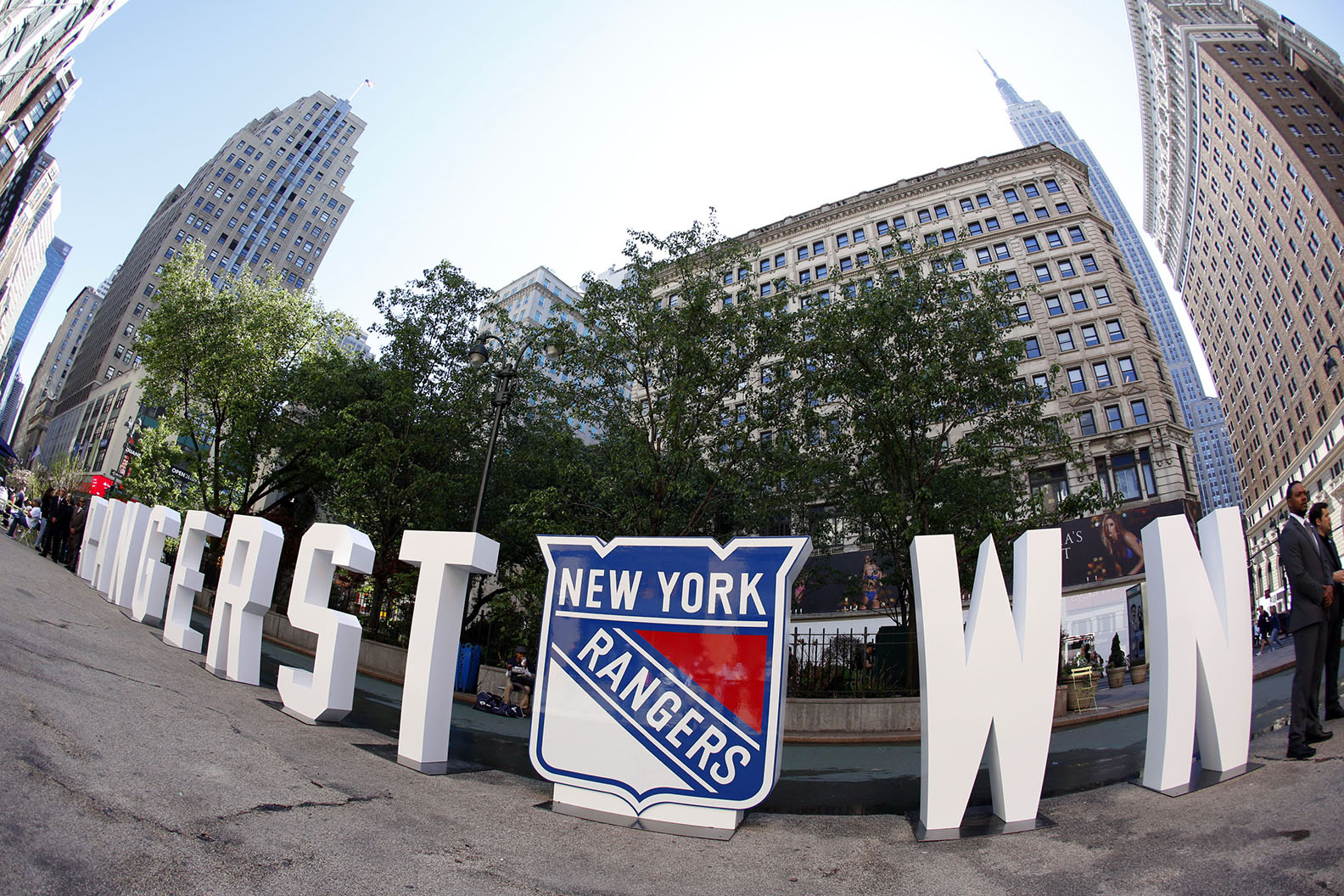
Now, for the first time since 1994, the Rangers are four wins away from bringing the Cup back to Rangerstown, USA. They’ll face 2012’s Stanley Cup champions, the Los Angeles Kings, in a best-of-7, East Coast vs. West Coast showdown, beginning tomorrow in LA. Today, however, was a day for fielding questions and comments from the media.
The 2014 Stanley Cup Final Media Day, held in sunny California, highlighted this year’s ups-and-downs for the Rangers as well as their current team chemistry going into Game 1. This season, the Rangers got a new head coach in Alain Vigneault (previous coach of the Vancouver Canucks) and lost their captain, RW Ryan Callahan, in a deadline trade with the Tampa Bay Lightning for RW Martin St. Louis. And though no one player currently wears the “C” for the Rangers, this team has rallied under leadership from several different players on and off the ice:
“[The veteran group’s] presence, their leadership abilities, their approachability…it’s very easy as a young guy to show up to the rink every day and to be excited, not only to play hockey but to learn from those guys,” says LW Chris Krieder. “You learn so much from the entire group, even the other younger guys, you can take so much from them. It’s hard to really pinpoint one guy…It’s been a group effort all season.”
Vigneault, who brought the Vancouver Canucks to the Stanley Cup Final in 2011, knows what his team needs to do in preparation for the Kings: “We know we have to play a certain way. There’s a couple of areas that we think we can do real well on the ice. That’s what we’re going to try and start doing tomorrow.”
“Great thing about the playoffs is you watch the other games, and all our players had an opportunity to watch the Kings throughout these playoffs–their comeback against San Jose, their tough series against Anaheim, and obviously the last one against the Stanley Cup champions [Chicago Blackhawks],” he says. “Our players got a real good idea of what’s coming up here as far as the challenge. We know they have balance on their four lines. Doughty is probably one if not the best defenseman in the NHL, and they’ve got one of the best goaltenders. We got our hands full and we’re ready for it.”
And amidst all the strategy and game tape reviewing, there’s also the excitement and experience of competing in the Stanley Cup Final itself.
“We’re fortunate to be here,” says Rangers GM Glen Sather. “Anyone’s fortunate to be in this position. It’s not every team that gets a chance to play for the Stanley Cup.”
Kreider, who has been to two national championships with Boston College, says that while winning is certainly the main focus, “[The championship experience] goes by quickly…it’s a lot more special when you’re winning so that’s definitely something we’re focusing on, but at the same time…just have fun with it and cherish the moments.”
What’s the best part of playing in the playoffs?
“The energy in the games,” says C J.T. Miller. “At the end of the day, [both remaining teams] know why we’re getting up in the morning.”
And though there are still countless decisions to be made and questions to be answered about the team’s future (Will Brad Richards be resigned over the summer? What about the other RFA/FAs? Who will be captain for the 2014-15 season?), for the next two weeks, the focus will be entirely on becoming the next team to have their names carved into 35 pounds of sterling silver.
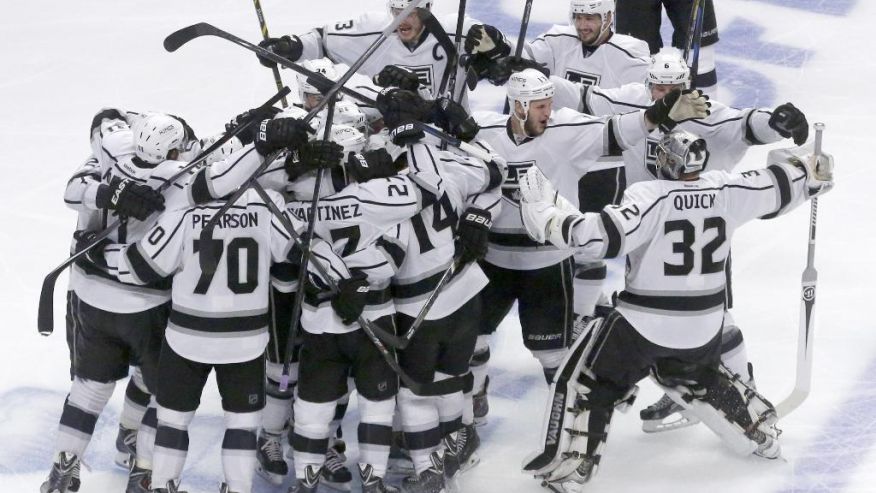
In case you missed it over the last few days, the LA Kings rallied four times in Game 7 against the Chicago Blackhawks to win the series and the West in overtime.
It was a close game and despite LA having taken a 3-1 series lead, it was a closer series than it appeared. The Hawks jumped out to an early 2-0 lead in the first ten minutes but the Kings battled back and tied the game a few minutes later. That only lasted 12 seconds as Patrick Sharp‘s shot took a funny hop and fooled Jonathan Quick.
Blackhawks had the lead 3-2 going into the first intermission.
In the second period, the Kings were playing with fire, getting dinged for five minor penalties, including a five-on-three. They managed to kill off four and even tied the game. It stayed that way for a while until Sharp’s shot on the power play deflected off of Jake Muzzin, who was attempting to block it; there was basically no chance for Quick on that shot. Once again, Hawks had the lead going into the second intermission.
The third period was played very tightly. Virtually no lead has been safe in these playoffs and Chicago tried hard to keep LA at bay, but the Kings finally broke through with just over seven minutes to go when Marian Gaborik‘s backhander beat Corey Crawford up high. With less than 10 seconds remaining in the game, Patrick Kane and Andrew Shaw had an odd man rush, but Quick kept it tied to send the game into overtime.
The break between the third period and OT was a good chance for fans to catch their breath. The series was incredibly close and was a wild ride so naturally the Kings twitter account made a nervous joke.
Find your loved ones and hold them tight. We’re going to Game 7 overtime.
While Game 5 took 82 minutes to play with Michal Handzus getting the eventual game winning goal, Alec Martinez decided not to wait as long to send his team to the Stanley Cup Final. Justin Williams cycled the puck down low and threw it out to his teammate waiting at the bottom of the circle. Martinez’s wrist shot deflected off of Nick Leddy and beat a helpless Crawford.
It was a strange game full of luck and flukey bounces. But it was very much an embodiment of the series as a whole: Weird bounces, subpar goaltending and seemingly little defense (though that last part isn’t true at all). The last two Stanley Cup Champions, two heavy weights, were dueling for hockey’s ultimate prize so it should come as no surprise that it came down to who got the luckier bounce. The last four games were extremely close, decided by a bounce here or there. These two teams are extremely similar and may be duking it out for title of Best In the West for the next few years.
Royal Pains
A month ago, the Kings were facing elimination down 0-3 to the San Jose Sharks. They made an historic comeback with a reverse sweep, joining only three other teams. Then they lost three games in a row to the Anaheim Ducks before winning Game 7.
As a team, they have been constantly frustrating their opponents and showing a resiliency in every game. Even when they’re down, they display an incredible belief that they can still win. Part of this is due to the “winning culture” that GM Dean Lombardi created when he built this team. Getting guys like Mike Richards, a winner at every level (the only NHL player to have a Memorial Cup, a Calder Cup and a Stanley Cup), and Justin Williams, who has a well-deserved reputation for being a clutch player (now a perfect 7-0 in Game 7) have helped that culture shift.
But for the Kings, probably the biggest factor has been balance and depth. While Gaborik’s presence has been beneficial on the top line, it was the development of young rookies Tyler Toffoli and Tanner Pearson that has brought the biggest balance of forward depth to the Kings. With Jeff Carter‘s ability to play either wing or center, head coach Darryl Sutter has been able to shift Richards down to the fourth line where he can flourish in soft minutes against weak competition. (It should be noted that Sutter doesn’t number his lines and that Richards averages more minutes than a typical fourth liner due to his play in all situations–5v5, penalty kill or power play). This has allowed Sutter to consistently roll four lines throughout all three series.
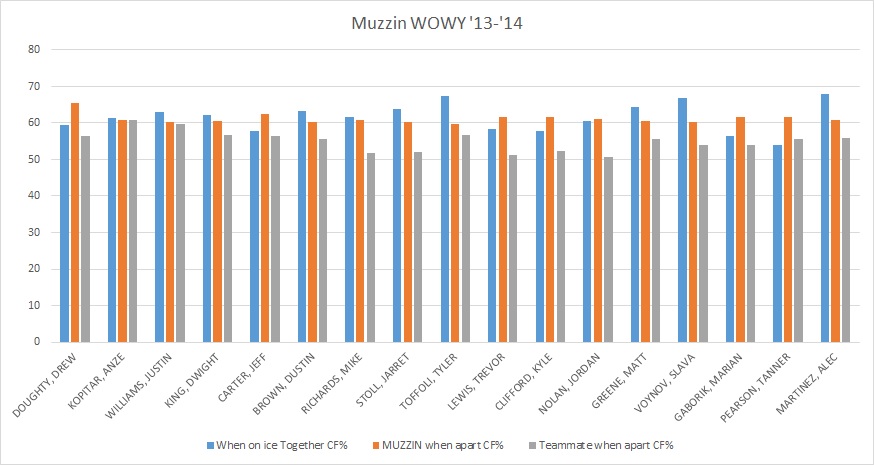
The emergence of Jake Muzzin is also helping the team on the back end. As a rookie, he appeared to lack confidence and seemed to be afraid to make a mistake. Playing against top competition with Drew Doughty didn’t seem to really help things, either. However, his growth this past year has been remarkable. Playing most of the year alongside Doughty, Muzzin has learned how to handle top competition and is currently third on the team in ice time, averaging 21.2 minutes a night. Being somewhat of a possession demi-god (with admittedly favorable zone starts), his ability to hang on to the puck to make plays has been one of the biggest reasons why the Kings are going back to the Final.
Numbers courtesy of stats.hockeyanalysis.com
When he’s playing with Doughty, the two put up ungodly numbers (the team controlled nearly 60% of 5v5 shot attempts when they were on the ice), which has frustrated opponents. While these may be regular season numbers, the team is still averaging control of ~50% of shots at 5v5 when Muzzin and Doughty are on the ice together. They have undoubtedly been LA’s best defense pairing. Their combined puck possession prowess, along with LA’s newly found offensive abilities (thanks in part to Gaborik’s ability to drive shooting percentages) have made the Kings a royal pain to play against.
Starting Wednesday, June 4th, 2014, the Kings will take on the New York Rangers for title of Best in the NHL.
The Commissioner of the National Hockey League, Gary Bettman, has reduced Dan Carcillo’s suspension from an automatic 10 games to six games.
Carcillo pushed Linesman Scott Driscoll while being escorted to the penalty box during Game 3 of the Eastern Conference Final against the Montreal Canadiens. A scrum had broken out in the corner and there was some pushing and shoving. Driscoll grabbed Carcillo and he tried to push the linesman away. Carcillo decided to appeal the suspension and won.
Bettman decided that Carcillo used physical force to get away from an official after an altercation and that is why the suspension was reduced from 10 games to six. The suspension was originally 10 games because Rule 40.4 states that “if a player deliberately uses physical force on an official without an intent to injure, then that player will be automatically suspended a minimum of 10 games.”
Carcillo has already served three games of the suspension and is eligible to come back for Game 4 of the Stanley Cup Final against the Los Angeles Kings. How the series is going for the Rangers will probably determine on how Alain Vingeault decides to use Carcillo, if at all.
The Boston Bruins announced on Tuesday, June 3, that their Pucks & Pups 2014 Bruins Calendar raised $30,000 to benefit the MSCPA-Angell.
There is just something about hockey players with animals that can melt even the coldest of hearts. This past December the Boston Bruins released the Pucks & Pups 2014 Bruins calendar in which many of the Bruins players and some of the management were pictured with their own pets or some of MSPCA-Angell’s animals who were awaiting adoption.
While some of the Bruins’ pets are well known, it is likely that few fans of the Bruins knew, before the release of the calendar, that Dennis Seidenberg had two dogs, one of which is a French Bulldog named Bubbles Lollipop – no doubt a name picked by his children. Of course, this just made a lot of fans like him and the other Bruins featured in the calendar all the more.
And while it’s great to get to know the players a little better, even if it is in the form of their favorite furry and four-legged friends, the calendar had a very serious side to it. Some of the players, including Milan Lucic, were photographed with one of the homeless animals hoping for adoption through the MSCPA’s adoption services program. Fortunately, all those homeless animals highlighted in the calendar did find their “forever” homes.
In addition to calling attention to the plight of homeless pets who wait in one of the many adoption centers around the country, the sale of the calendar raised $30,000 dollars.
Seidenberg and Director of the Boston Bruins Foundation, Bob Sweeney, will present the check, one of the largest single donations to the MSCPA’s adoption centers this year, to the MSPCA-Angell at their Boston Adoption Center (350 South Huntington Ave., Boston, MA) on Thursday, June 5, at 9:00 a.m.
The MSPCA-Angell is a national and international leader in animal protection and veterinary medicine, providing hands-on care for thousands of animals each year. Founded in 1868, it is the second-oldest humane society in the United States. The MSCPA-Angell is a private, non-profit organization that does not receive any government funding nor is it funded or operated by any national humane organization. And yet, each year it manages to offer a variety of services, including animal protection and adoption, advocacy, humane education, law enforcement, and world-class veterinary care.
The Boston Bruins Foundation is a non-profit foundation whose mission is to assist charitable organizations that demonstrate a strong commitment to enhancing the quality of life for children throughout New England. Since its inception in 2003 by the Jacobs family, it has raised more than $17 million through a series of fundraising events.
While much fun was had in photographing the players with their pets—and some tongue-in-cheek comments about who was Mr. June or Mr. September were made by those who purchased the calendars—many of the players feel strongly about the welfare of animals. This was a great way to help do something that would give the fans a little fun as well as perhaps some understanding about the plight of homeless animals.
The ECHL Toledo Walleye struggled during the 2014-2015 season, putting together only 21 wins over the 72 game regular season. Former Head Coach Nick Vitucci became infamous for putting his team through an epic bag skate after a humiliating 7-0 loss back in November so the writing was on the wall for a coaching change once the season was through.
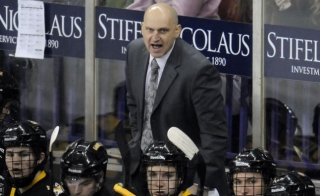
The Walleye are excited to welcome Derek Lalonde as the team’s new head coach. Lalonde was introduced during a press conference on Monday morning at the Huntington Center in downtown Toledo.
“We want to build great things here in Toledo, build a culture of success.” Lalonde has been head coach and general manager of the Green Bay Gamblers of the United States Hockey League (USHL) since 2011, compiling a record of 111-54-14, guiding the team to both regular season and playoff championships in 2011-12, and was USHL Coach of the Year in 2012. He was also Head Coach of Team USA’s U19 National Team which captured gold at the World Junior A Challenge in November of 2013.
Joe Napoli, Toledo Walleye president and general manager, says Lalonde was the one who stood out during a very rigorous interviewing process. “We were thrilled with the quality of candidates we interviewed, both nationally and internationally.”
Lalonde’s coaching experience includes being assistant coach at the University of Denver (2006-2011), Ferris State University (2002-2006), Hamilton College (2000-2002), Lebanon Valley College (1998-2000), and Massachusetts College of Liberal Arts (1995-1998). He played collegiate hockey at Cortland State University in Cortland, New York from 1991-1995 as a goaltender. He’s married to his wife Melissa, and has two sons, Alex (8), Luke (5) and a daughter Abby (3).
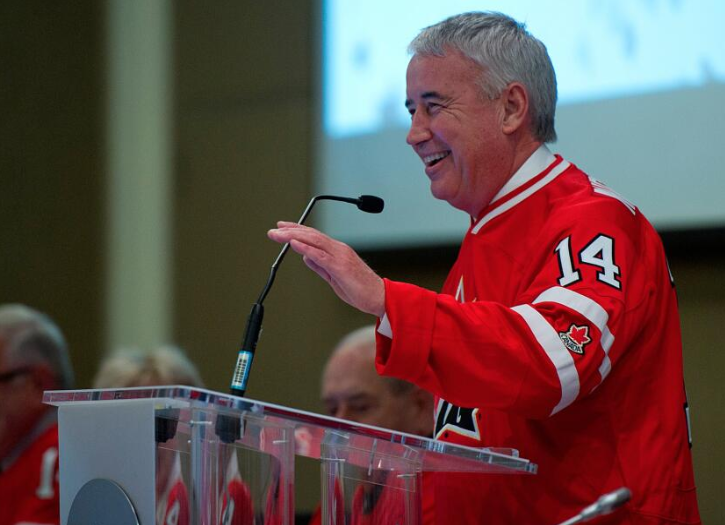
Wrapping up Hockey Canada’s 95th AGM must have been bittersweet – it was the opportunity for more than 250 hockey thought-leaders to say farewell to Bob Nicholson when the meetings wrapped Sunday in Calgary, AB. Nicholson officially ended his tenure June 1 after 16 years at the helm of Canada’s hockey governing body. In a fitting tribute, the room was filled with red and white as attendees donned personalized Team Canada jerseys for Nicholson’s final address as CEO of the organization.
“I cannot say thank you enough to the Hockey Canada staff, volunteers, players, coaches, officials and parents who have made these last 16 years so memorable,” said Nicholson in a statement released May 31. “It has been quite a ride, and I am so excited about where our game is on and off the ice. Canadian hockey is in great hands, and the future is bright.”
“On behalf of the Hockey Canada Board of Directors and every single Canadian involved in hockey from coast to coast, we thank Bob for his tireless efforts to improve the game,” added Jim Hornell, chair of the Hockey Canada Board of Directors. “There will be another president and CEO, but there will not be another Bob Nicholson.”
This year’s AGM also marked the official launch of Hockey Canada’s 100th anniversary celebration after the organization’s inception on December 4, 1914 when it was then known as the Canadian Amateur Hockey Association. The organization has grown exponentially over the years to become the national governing body for grassroots hockey in the country. Hockey Canada works with 13 provincial branches, the Canadian Hockey League and Canadian Interuniversity Sport in growing the game at all levels.
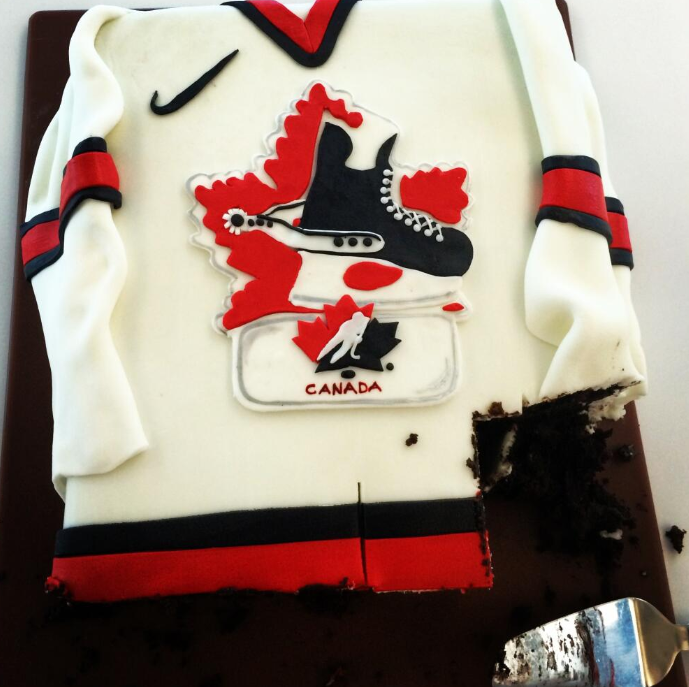
Celebrating early? Delegates at Hockey Canada’s 95th AGM enjoy a red and white cake as the organization launches its centennial anniversary celebrations.
Further information on the centennial celebrations will be released in the coming weeks, culminating with a news conference in Toronto on June 26, 2014. As a teaser, it has been revealed that the organization will visit more than 100 communities and engage more than one million Canadians. Additionally, Hockey Canada will partner with USA Hockey to curb violence in the game, arguably in an bid to align with Hockey Canada’s beliefs in “a positive hockey experience for all participants in a safe, sportsmanlike environment,” as outlined in its Annual Report released June 2, 2014.
Another item to arise from the AGM is a new governance structure, which will see the current Board of Directors reduced from 26 members to nine. This is to comply with the federal government`s Not-For-Profit Corporations Act, and no doubt to streamline leadership. Also, communication between the Board and its branches will be improved by a branch forum. Under this new structure, Hockey Canada councils will continue meeting twice a year, while standing committees will be reduced from 26 to eight.
Nancy Wilson accepted the Outstanding Volunteer Award at Hockey Canada’s awards banquet, held on the first evening of its 95th AGM on May 31, 2014 in Calgary, AB
Finally, the AGM gave delegates the opportunity to honour community leaders from across the country in an awards banquet held in the evening on Thursday May 31, the first day of the meetings. The awards gala recognizes those who have contributed to the growth of hockey throughout Canada, and one nod went to Nancy Wilson of London, ON. Wilson, the first woman inducted into the B.C. Hockey Hall of Fame, has spent the past 15 years growing hockey locally in British Columbia, throughout Canada, and also on the international stage. Specifically, Wilson helped grow women’s hockey by serving in roles with B.C. Hockey, University of British Columbia, Team B.C. and Canada’s National Women’s Under-22 team. Wilson was also assistant coach with Canada’s National Women’s Team.
The awards carry particular weight for recipients as they are peer-nominated. Nominations are accepted from all 13 member branches, and the winners are whittled down and ultimately selected by Hockey Canada’s selection committee.









 Prev
Prev