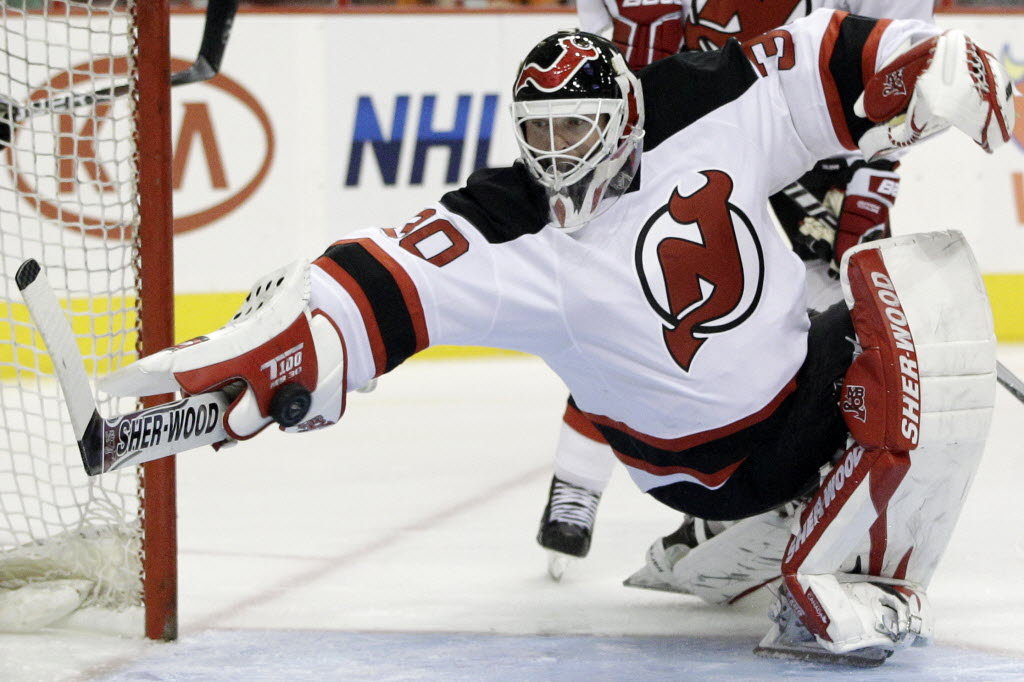
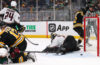
On July 1, the long-time New Jersey Devil Martin Brodeur will be a free agent. The 42-year-old goalie said that he wants to test the waters of free agency instead of returning to the Devils.
Brodeur is the NHL’s all-time winningest goalie, and has never spent a season away from New Jersey since entering the league in 1991. A few years ago, Brodeur tested free agency before returning to the Devils. While he has not completely ruled out a return to NJ, he made it clear he’s ready to go elsewhere this time, according to ESPN’s Pierre LeBrun.
With his contract up on June 30 and Cory Schneider also fighting for a spot in net, Brodeur feels that it is time to move on from NJ.
“At the end of the day, it doesn’t matter where I go next, I’m always going to be a Devil. I’m always going to come back to the organization. But I want to play one more year. So I’ll see what’s out there,” Brodeur said to LeBrun.
In his career, Brodeur has a 688-394-105-49 record. He has also won three Stanley Cups and four Vezina Trophies.
Photo courtesy of www.lehighvalleylive.com
(source: CBS Sports)
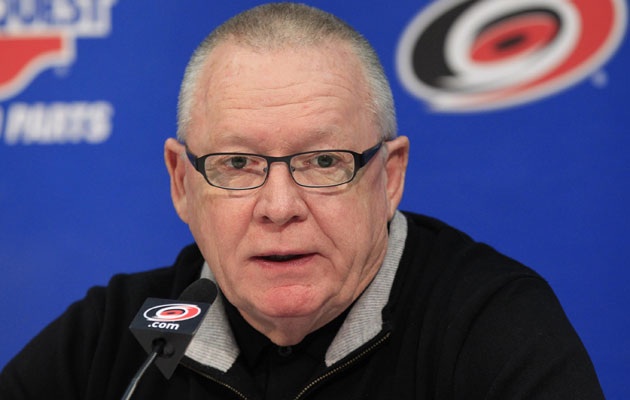
At their Friday press conference the Pittsburgh Penguins announced that former Carolina Hurricanes GM, Jim Rutherford, would be filling the void left by the firing of Ray Shero.
The sixty-five year old Rutherford, is one of the most respected executives in the league, and held the general manager position with the Carolina Hurricanes/Hartford Whalers franchise for 20 years.
“Jim has proven himself to be one of the finest executives in our sport, a man who always conducts himself with class and dignity, and we’re excited to bring him to Pittsburgh as our general manager,” Lemieux and Burkle said in a joint statement. “He has a wealth of knowledge and experience that few can match, and he will offer fresh ideas and a new perspective to our organization.”
The two years that his Carolina Hurricanes made it to the Stanley Cup finals (2002, 2006) he was named NHL’s Executive of the Year by the The Hockey News, and in 2006 by the Sporting News.
In Rutherford’s playing career, he spent thirteen seasons as a goaltender, some of that time being with the Penguins between 1971-1974.
“I’m excited by this opportunity to return to Pittsburgh and become general manager of a franchise that I’ve always admired,” Rutherford said. “To have the chance to work with Crosby and Malkin and the talented group of players assembled here is something that any GM would dream of. I’m looking forward to getting to work right away – it’s going to be an important summer.”
After his playing career, he joined the Compuware Sports Corporation as director of hockey operations in 1983. In that position he was the overseer of youth and junior hockey as well as being the general manager of the Windsor Spitfires. There he was named the Ontario Hockey League’s Executive of the Year in 1987 and 1988.
From there he went on to be the general manager of the NHL’s former Hartford Whalers on June 28, 1994, and he was a key component in the club’s transition to Raleigh, North Carolina in 1997.
It was a position he stepped down from after several less that stellar seasons for the Hurricanes. He was going to continue on assisting Ron Francis as an advisory general manager role, until this position arose. In Pittsburgh, he will also hold the title of executive vice president.
Jason Botteril, the interim general manager of the Penguins, will now have the title of associate general manager. Former Penguin Bill Guerin and Tom Fitzgerald have now been named assistant general managers. This change was one of the first tasks on Jim Rutherford’s to-do list as new team GM.
“Jason is one of the top young executives in the NHL, and I’m pleased to promote him to the role of Associate General Manager,” Rutherford said. “Jason knows our organization top to bottom, including all players, prospects and staff, and his detailed understanding of the CBA and salary cap make him a major asset to the Penguins. I look forward to working with him closely.”
Photo credit: Richard Mackson-USA TODAY Sports
LA Kings television color commentator Jim Fox likes to say that goals are scored in hockey due to mistakes.
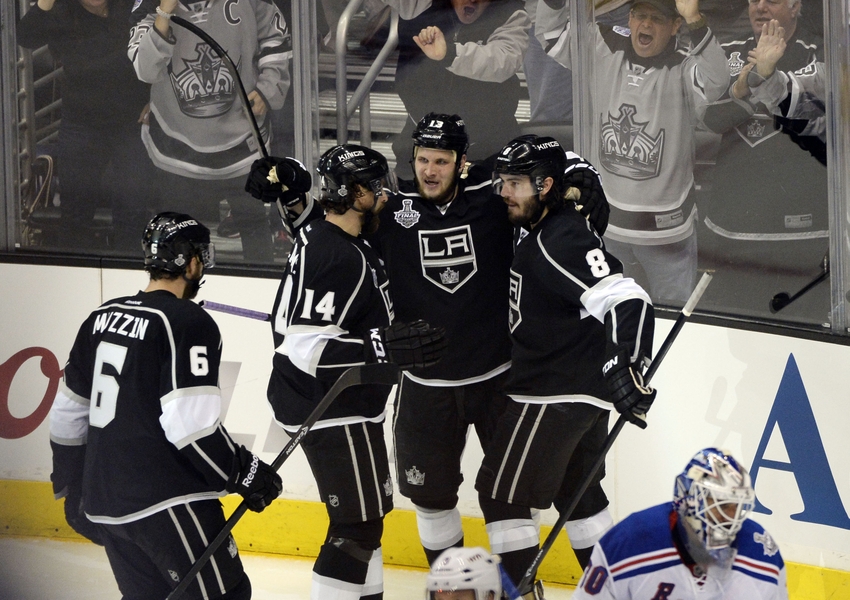
Defensemen Drew Doughty and Dan Girardi know something about the truthfulness of the statement. The difference is, Girardi’s mistake ended up as the game winning goal while Doughty’s didn’t end up coming back to haunt the team (though it’s probably something that’ll stay with Doughty for a long time). All five of the goals scored in Wednesday night’s Stanley Cup Final opener were due to errors and a pinch of good fortune, which, if you believe what Fox says, is how it happens.
In the first period, Doughty got caught trying to be too cute with the puck and New York Rangers forward Benoit Pouliot was more than happy to take advantage. He streaked out of his own zone and beat Jonathan Quick around the blocker with a good shot. Doughty’s partner, Jake Muzzin got his feet tangled underneath him and couldn’t even attempt to try and stop Pouliot, though it’s dubious he would’ve been able to.
Later on the power play, the Kings turned the puck over and this time it was Slava Voynov and Carl Hagelin who teamed up to beat Quick. Hagelin got a shorthanded breakaway and Voynov was attempting to backcheck him, to no avail. Quick stopped Hagelin’s initial shot but the puck bounced in off Voynov’s skate into the back of the net. A literal fortuitous bounce for the Rangers, thought not an undeserved one.
If there’s anything that we’ve learned about the Kings over the last several weeks is that they’re never out. It doesn’t matter how early or by how many you go up, they always feel like they can rally and more importantly, they can win.
It didn’t take long before LA halved New York’s deficit and it came from an unlikely person. Kyle Clifford shot from about parallel to the goal line and it beat Henrik Lundqvist over the shoulder. The Kings were right back in the game with more than enough time to come back and win. He and the Kings kept pressing but couldn’t find the equalizer before the end of the first.
Midway through the second period, Doughty decided he wanted to make up for his earlier indiscretion. Justin Williams gained the zone and stopped up short to escape pressure. He passed it to Doughty who put it between his legs and then scored. The description doesn’t do it justice, though.
Sometimes it’s like Doughty has a cheat code that he just plugs it in at will. His team is down and needs a game tying goal? No problem, he’ll just jump into the rush and score like it’s easy.
The rest of the period was played to a draw. In the third, Kings came out with a vengeance and peppered Lundqvist with 20 shots. At the other end, Quick was relaxing, reading the newspaper and knitting a sweater while only facing three shots. Though credit should be given to the Rangers because they were good shots. Martin St. Louis‘s shot went off Quick’s shoulder and the netminder had to be sharp again when Hagelin had another breakaway with 30 seconds left in the game.
Overtime wasn’t even five minutes old when Mr. Game 7 earned a new nickname: Mr. Game 1. On a 3-on-2 that Williams later described as one they “screwed up royally,” Tanner Pearson fanned on the pass and lost in the corner. As Girardi was going to play it, the puck hopped over his stick and he lost his balance. While attempting to play it from his knees, Girardi ended up turning the puck over to Mike Richards who found Williams waiting at the hash marks.
The first 40 minutes were pretty evenly played. Rangers held the edge in overall chances but the Kings had the edge at even strength. Then LA took over and flat out dominated the third period but were stoned by a hot Lundqvist.
Both goalies were great in Game 1 and if Quick maintains his current play, there’s a good chance that the Kings will win more often than the Rangers (even if it takes seven games).
MOAR SPEED
The mainstream media made a huge deal about New York’s speed. They made it seem like LA was surprised by it and how will they ever handle it in the future? Yet, the Rangers’ speed isn’t really a major issue. None of the previous three teams that the Kings beat were exactly slow, certainly not the Chicago Blackhawks. While the Rangers do have a lot of players that can win a foot race (as Hagelin proved), their overall team speed is not really concerning to the Kings, who have a bunch of fast guys like Pearson, Doughty and Jeff Carter.
If the Kings are conscious about clogging up the neutral zone, as they were in the third period, they will be able to frustrate the Rangers who won’t be able to skate laps around the rink with the puck. There’s a good reason LA has been at or near the top of the possession charts in the last three years. They’re very, very good at puck management and whether they play a swift transition team that likes to score off the rush or a grind it out, cycle down low, smackfest type of team, they know how to handle the puck. That’s not to say they’re perfect because they’re certainly not that. They usually end up losing when they get away from playing their game. So if the Kings stick with the game plan and just play the way Darryl Sutter wants them to, more often than not they win. And that is primarily due to excellent puck management.
Mistakes are made in every game but it’s always the most prolific ones that end up in the back of the net. It’s how you move on that matters most. Game 2 is set for Saturday, June 7, 2014 at 7PM ET/4PM PT. It’ll be interesting to see the way both teams respond to their mistakes in the previous game.
(Source: Facebook/Penguins)
The news Penguins fans have been waiting for since the firing of Ray Shero is finally in…..Dan Bylsma has been let go as Penguins coach.
The team had been waiting for the new general manager to make the decision, and at the team’s Friday press conference, their new GM Jim Rutherford, broke the news.
Bylsma had coached the Penguins for five-plus seasons, compiling a record of 252-117-32 and leading the team to the Stanley Cup in 2009.
“Dan is a good man and a good coach, but I thought we needed a change in direction moving forward,” Rutherford said. “I have no doubt that he will go on to be a head coach in the National Hockey League and have success. The search for our new head coach will begin immediately.”
“We want to thank Dan for everything he has done for the Penguins organization,” co-owners Mario Lemieux and Ron Burkle said in a joint statement. “He’ll always be remembered as a big part of Pittsburgh sports history for his role in our Stanley Cup championship in 2009. We wish all the best to him and his family.”
The rest of the coaching staff, including Tony Granato, Todd Reirden, Jacques Martin, Mike Bales, and video coordinator Andy Saucier will be evaluated by Rutherford and the future head coach.
(photo: Todd Meixner)
The first three games of the Kelly Cup Final have been played between the Alaska Aces and the Cincinnati Cyclones in Anchorage, Alaska. The Aces captured two games out of three as the series turns to Ohio for the next set of three. Alaska is two wins away from another Kelly Cup Championship, but Cincinnati is far from done in this series.
The two teams play a fundamentally different breed of hockey in this West meets East matchup. Alaska is all about puck possession and getting deep to set up their passing game in the offensive zone. The Cyclones favor a run-and-gun style allowing their swift skating forwards to carry the puck through the neutral zone and get all they can at the net.
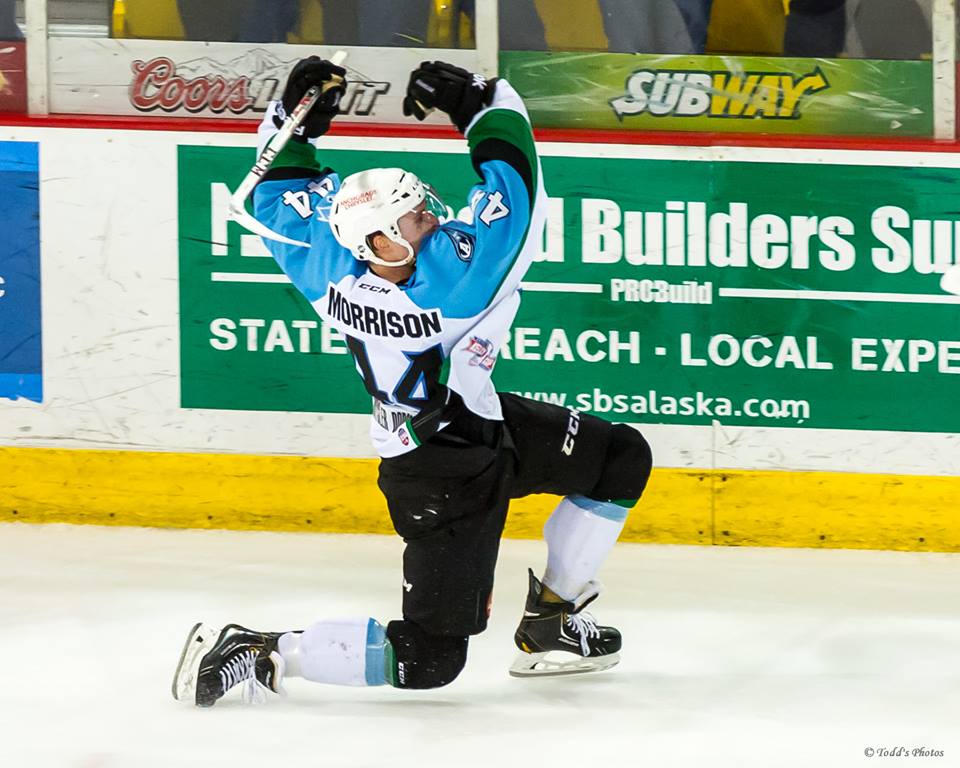
The first game of the series, Alaska got on the board first, with Aces Captain Nick Mazzolini notching his 10th goal of the post-season. The Cyclones then exploded offensively in the second period with goals coming from Wade Megan, Barry Almeida, and Logan Shaw. Alaska netminder Olivier Roy left the game with an apparent lower body injury and Gerald Coleman would take over between the pipes, closing the door on Cincinnati’s scoring. The Aces’ Jordan Morrison and Brett Findlay tied the game at three before heading into the final frame. Morrison would light the lamp a second time on Cyclones goaltender Rob Madore for the go-ahead goal and Aces forward Turner Elson sealed the Cyclones fate as he fired a shot on an empty net in the final 18 seconds, the final score 5-3.
The Cyclones took the second game by a score of 2-1 with all goals tallied in the first period, the first coming from Aces forward Ross Ring-Jarvi, his first goal of the post season. Cincinnati rallied and quickly took the upper hand with goals from Byron Froese and Jonathan Hazan coming just 21 seconds apart in the first period. The rest of the game became the battle of the goaltenders, as each team poured on the heat. The Cyclones appeared to push the lead forward another goal in the third period as Joe Basaraba seemed to have scored his first pro playoff goal; however, the referees determined that it was kicked into the net so it got waved off and the 2-1 contest remained. Madore made 35 saves despite heavy pressure from the Aces in the waning minutes of the third period to give Cincinnati the victory and tie the series at one apiece.
Game three appeared to be a boil over of tension and aggression on both sides, as pushing and shoving resulted in penalties doled out to Aces and Cyclones alike. The game showcased the talents of the men between the pipes, Aces Coleman and Clones Madore, each making spectacular saves to keep the game scoreless through two periods of play. Riding a hot streak, Jordan Morrison found the weak spot in Madore’s netminding, giving the Aces a 1-0 lead with just over 4 minutes to play. Morrison’s goal came after the Cyclone’s Hazen had a breakaway attempt but was hauled down from behind without a penalty call. The puck, turned over, found its way back the other way, with the Aces capitalizing. Alaska workhorse forward Tyler Mosienko got a well-deserved first goal of the playoffs with just two minutes to go, finalizing the win over Cincinnati 2-0 and giving Aces goaltender Coleman the shutout victory.
The Aces will continue to be without goaltender Olivier Roy as the series shifts to Ohio. Alaska signed former UAA product Rob Gunderson to an ATO after Roy’s game 1 injury sidelined him. On the plus side Aces top forward Peter Sivak made a quiet debut in game 2 after injury kept him out of the Western Conference Finals with the Bakersfield Condors.
GAME 4 – Alaska at Cincinnati (U.S. Bank Arena) – Fri. 6/6, 4:35 pm pacific
GAME 5 – Alaska at Cincinnati (U.S. Bank Arena) – Sat. 6/7, 4:35 pm pacific
GAME 6 – Alaska at Cincinnati (U.S. Bank Arena) – Mon. 6/9, 4:35 pm * pacific
GAME 7 – Cincinnati at Alaska (Sullivan Arena) – Wed. 6/11, 7:15 pm * Alaskan time
What Edmonton has undoubtedly discovered, and what Boston knew and misses, is that Andrew Ference doesn’t just come to a city to play hockey. No, he becomes a part of the fabric of the community, getting involved in the community whenever and however he can. So, it probably shouldn’t be a surprise to anyone that Ference will be found on Saturday, June 7, marching in support of diversity in the Edmonton Pride Parade.
The Edmonton Oilers captain announced on Tuesday that he would be participating in the parade as a representative of the You Can Play team, along with the University of Alberta’s Camp fYrefly youth leadership program.
You Can Play recently partnered with the University of Alberta’s Institute for Sexual Minority Studies and Services (iSMSS). But it should not be a surprise that NHL players are not only aware of the issues of the LGBT community but You Can Play has had a partnership with the NHL.
In January, 2014, with Gabriel Landeskog of the Colorado Avalanche lending his voice to the fight for inclusion and equality, it marked the historic moment when every team in the NHL was represented by at least one player in support of LGBT athletes, team staff, coaches and fans. The message is simple.: If you can play, you can play. Videos from a variety of teams, universities and individual players can be found on the YouCanPlayProject channel on YouTube.
 “You Can Play has fundamentally changed the way the NHL players think and act. We understand the important role we can play in ending discrimination within sports and society and I feel honored to be able to participate in events with them and Camp fYrefly including Edmonton’s Pride Parade,” Ference said. “When we work, play and live together without discrimination it makes our entire community stronger and more productive.”
Ference doesn’t just lend his name to things. He educates himself on the issues and makes sure that if he is talking the talk that he is also walking the walk. Moving from Boston to Edmonton at the end of the 2012-13 season, he helped launch an Edmonton group of the November Project, designed to encourage people to get out early in the morning and exercise, something he had become involved in while in Boston. In fact, he even got Patrick Burke, president of You Can Play, to join him for one of the early morning events at the Harvard Stadium, to run the stadium sections.
“We are grateful for Andrew’s relentless support for You Can Play and the ideals we work to instill in sports. Bringing professional athletes together with LGBTQ youth benefits everyone: the athletes, the young people, the University of Alberta, and the city of Edmonton. We look forward to celebrating inclusion and acceptance with everyone during Pride,” said Burke.
Ference doesn’t want accolades for his decision. He participates in the parade because it is the right thing to do for him. As he was quoted in the Edmonton Journal, he is quite cognizant of why he does things.
“I have an extreme fear of ever being a hypocrite. If I want to do something, I want to do it because I believe in it, not just because I’m doing a favor for somebody or because they’re giving you money to show up for a little bit,” he said. “I don’t like that. It loses credibility; it loses authenticity. I think you have to believe in the things you do. People have really good bullshit meters.”
And that is classic Ference. A straight shooting guy who recognizes that people see through those who show up for a photo-op rather than because they believe in the cause. Ference not only believes but his passion and devotion to those things he believes in is contagious and his enthusiasm spreads among those in the community he calls home. Some may feel that his decision to march on Saturday is a surprise, but those who have seen him become involved in other issues are not surprised at all.
When your team gets eliminated from the playoffs (or just doesn’t make the playoffs), an emotional healing process is necessary to get over the pain. As we get down to the final two, here are some of the steps every NHL fan goes through when his or her team is done for the season. And yes, all the classic stages of grief are included.
Denial and isolation: The first stage of grief is also the first stage of a hockey loss. As soon as the clock ticks to 0:00, a certain sinking feeling sets in. Did that really just happen? Are we really done for the year? WE REALLY LOST TO THAT TEAM?! You may choose to go directly into bed to avoid contact with anyone else. Or you may chose to go directly to your liquor cabinet. Either way, any human contact is not appreciated.
Anger (towards your team): Right after the denial stage comes the anger. Anger is a two-part process. First, you might think something along the lines of “how could they do this to me?!” while running through all the times they could have changed the outcome. Missed opportunities, giveaways, penalties, etc. “I can’t believe Tuukka didn’t make that save. I COULD HAVE MADE THAT SAVE.”

www.dailymail.co.uk
Anger (towards other teams and fans of other teams): Now, maybe you’ve convinced yourself your team did everything they could to win (or maybe not). Either way, though, you have a lot of built up contempt for other teams who are still in the run for the Cup. Including their fans. While the grieving process may only last a few days or weeks, this anger towards the team that eliminated you will last at least a full season. AKA, until you have a new team to hate.
Bargaining: “Dear Hockey Gods, I promise to never complain about penalties and/or the refs again if you go back in time and make the Ducks beat the Kings.”
Depression: At this point you’re over being angry and you’ve realized that the Hockey Gods cannot actually go back in time and change the outcome of your loss. The sadness sets in. Depending on your devotion to your team, your sadness can vary anywhere from a “slightly bummed” to an actual feeling of depression. Tears may be shed, mass amounts of ice cream may be consumed, school or work may be missed. All are acceptable ways to deal with the sadness, and don’t let anyone tell you otherwise.

http://sports.yahoo.com/blogs/puck-daddy/vent-shakespearean-response-lockout-nhl-nhlpa-toddlers-cry-223104311–nhl.html
Acceptance: Now, you’ve finally begun to accept that your team is no longer in the race. You might even pick a new team to pretend to root for just to make watching the next rounds more fun. Watching hockey is finally starting to become fun again. Life is starting to finally go back to normal.
Hope for next year: So you’ve finally accepted that this season is over and now you’re looking forward to a bright future. While the rest of the Cup run is going on (and for months after) you’re refreshing websites to see if there have been any big moves for your team. Checking cap space, free agents, and trade rumors will undoubtedly take over a big chunk of your time until the season opener.
(Photo: Kirby Lee/USA TODAY Sports)
Following a 3-2 OT victory for the LA Kings Wednesday night, New York Rangers coach Alain Vigneault reflected on his team’s strengths and weaknesses in Game 1 of the Stanley Cup Final.
“I liked the way we played in the first two periods,” he said. “I thought it was a hard-fought first 40 minutes by both teams.” The Rangers took a 2-0 lead in the first period on a breakaway goal by LW Benoit Pouliot at 13:21 and a shorthanded goal by LW Carl Hagelin less than two minutes later.
“[Hagelin’s] speed shorthanded was definitely a positive factor for us,” Vigneault noted. “We just need to be able to generate the same thing five on five.” Hagelin would later earn the third star of the game for his efforts.

Hagelin’s goal to put the Rangers up 2-0 (via @MyRegularFace)
The Rangers went into the first intermission up 2-1 after LA Kings LW Kyle Clifford scored with 2:27 left in the period. Kings D Drew Doughty then put in the equalizer 6:36 into the second period for what would be the final goal in regulation.
The third period was all LA.
“Not quite sure what happened there in the third. Not sure if it was them being that good or us stopping moving the puck and going north/south. They definitely took it to us in the third, and they were able to get a bounce on the winning goal and put it in the back of the net.”
Despite the Kings’ momentum in the third period, the aforementioned winning goal didn’t come until overtime. Kings RW Justin Williams–“Mr. Game 7”–became “Mr. Game 1” and was able to put the puck past Rangers G Henrik Lundqvist at 4:36 into the extra period.
“[Lundqvist] was the reason why we went into overtime…he gave us a chance,” said Vigneault. “When you get to overtime, a lot of times it’s a bounce, it’s a shot. Tonight [the Kings] got it.”
Vigneault plans to use the next 48 to “make some adjustments” before Game 2 on Saturday as the Rangers and Kings return to the Staples Center for a 4pm (7pm ET) puck drop.
(Photo: San Jose Sharks)
Back in the middle of May, Executive Vice President and General Manager Doug Wilson announced that the San Jose Sharks would not be offering Dan Boyle a contract extension. It was a bit of a surprise for the veteran defenseman who had been hoping to stay in San Jose. It appeared that he had been looking for a two year contract extension where the Sharks had only wanted to offer a single year. The contract talks never made it to talking about a price.
Dan Boyle is an unrestricted free agent come July 1st but before that happens, San Jose dealt Boyle to the Islanders for a conditional pick in the 2015 draft. If Boyle signs in New York before the start of the 2014-2015, the draft pick will become a 4th round pick. Currently, the pick is in the 5th round.
The 2008-2009 season was Boyle’s first in San Jose after having spent a number of seasons with the Tampa Bay Lightning. During his six seasons with San Jose, he amassed 269 points in 431 regular season games. He also added 48 points in 62 post season games. He provided excellent veteran leadership during his time with San Jose. Boyle, an extremely offensively-minded defenseman, won the Stanley Cup in 2004 with Tampa Bay. He had been hoping to help bring a Cup to San Jose.
Now that his rights have been traded, the New York Islanders will have the chance to try and negotiate a contract with Boyle before he becomes a free agent. He could be a good addition to the Islanders defensive core, some of whom are still young and inexperienced. In the meantime, the San Jose Sharks will continue their mission to make the team younger.
(Photo: USHL)
On Monday, the USHL announced the appointment of Bob Fallen as their new President and Commissioner. In the past 20 years this is the third Commissioner for the USHL. Fallen succeeds Skip Prince who led the USHL for the past six years—years that saw impressive growth not only in business and hockey operations but also in player development, achieving record numbers.
The USHL is celebrating its 12th season as the only Tier I junior hockey league in the United States. During the 2013 NHL Draft, the league saw a record high 32 players chosen. One of the main focuses of the USHL is to serve as a bridge for players to ultimately go on to play in colleges, and this last season saw more than 300 players on the USHL team rosters that had committed to NCAA Division I schools. This speaks volumes to the growth and leadership of the USHL in being one of the foremost producers of junior hockey talent.
Fallen brings with him professional experience that spans almost 30 years in sports marketing, publishing, sales, media relations and management. Most recently, Fallen managed the U.S. trade marketing efforts for Reebok-CCM Hockey—the world’s largest hockey equipment supplier to many leagues including the NHL, AHL and USHL. In this position, Fallen was responsible for executing retail product launches, strategic account planning, media promotion, and maintaining various league alliances.
“I am thrilled with the opportunity to lead the finest junior hockey league in the world,” said Fallen, when he was introduced during a media teleconference on Monday. “The foundation built by my predecessors, league owners, and the stakeholders through the hockey industry have made the USHL an important step along the developmental path for players, coaches, and officials. I look forward to working with our staff, aligned partners, and the international hockey community at-large to build upon our success.”
In the publishing world, before joinining Reebok-CCM, Fallen served as associate publisher for USA Hockey Magazine and Minnesota Hockey Journal along with developing the partnership developent efforts for Minnesota Hockey and the Hobey Baker Memorial Award—college hockey’s top individual honor.
Walk the Walk
But Fallen doesn’t just talk the talk. He has been heavily involved in hockey at the amateur level. He served for several years on the USA Hockey Marketing Council helping with a variety of initiatives that included marketing, sponsorship, media and membership development. He’s been a board member for the Upper Midwest High School Elite League, a Minnesota-based league for top high school hockey talent—many players of which have moved on to play in the USHL. He is a Director of Skaters Keep Achieving Through Education (S.K.A.T.E.), a non-profit organization devoted to promoting academic achievement among youth hockey players.
This importance on education fits in well with many of the initiatives of the USHL given their purposes for preparing players for colleges. One of the USHL’s awards is the Scholar-Athlete Award, established in 2007 to recognize players for both their success in the classroom and on the ice. Candidates are nominated by their coaches, teachers and academic counselors based on their grade-point-average, coursework and overall school participation. This year’s co-recipients were Team USA forward Alex Tuch, who has committed to Boston College, and Omaha Lancers forward Anthony Angello, who has committed to Cornell. Both players are NHL Draft eligible this year and are expected to go high.
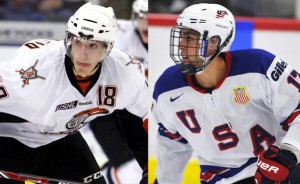
Anthony Angelo and Alex Tuch – USHL 2014 Scholar-Athlete Award Recipients (Photo: USHL)
In addition to promoting education with skaters, though, Fallen’s own two children have gone the college route in their hockey careers. Daughter Kelley, now 25, played NCAA hockey at the University of St. Thomas in St. Paul, Minnesota and was a four-year letter winner, serving as a captain during her senior season in 2011. Son Thomas, now 23, spent two seasons playing in the USHL for the Cedar Rapids RoughRiders (2009-11), helping the team achieve the regular season Anderson Cup title in 2010-11. He enters his fourth season college hockey at Yale University, where he was recently named captain of the Bulldogs for the 2014-15 season. He was part of the school’s first-ever NCAA Ice Hockey Championship in 2013 and is among the school’s all-time scoring leaders for defensemen.
For Fallen, coming to the USHL means a return home. The Glen Ellyn, Illinois native graducated from nearby Northern Illinois University and began his professional career in the area.
Development is Key
Fallen understands the importance of having players being noticed by the NHL.
“I cannot in any way, shape or form disparage any other alternatives for developing hockey players; if people have another path to follow to the NHL, more power to them,” Fallen said on Monday. “We just consider the USHL a really excellent opportunity for people and players developing not only for the NHL but college hockey before they reach the NHL.”
And while 94 USHL alumni competed in the NHL during the 2012-13 season, more than 200 are under NHL contract right now. And Fallen doesn’t limit the development to just the players.
“It’s important to note that our development model is not just for the players,” he said. “Look at [coach] Jon Cooper, who is heading up the [Tampa Bay] Lightning. Only four years ago he was at the helm of the Green Bay Gamblers. We’re proud of whatever we can do to develop players, officials and coaches and get them to the next level.”
While the USHL saw major growth under the helm of Prince, it looks like under the leadership of Fallen it will continue to grow in all the right ways—producing professional caliber players, many of whom will understand that education is as important as playing hockey.
 Prev1...238239240...412Next
  Page 239 of 412