For 56 minutes last night, it didn’t look good for the New Jersey Devils against the Winnipeg Jets. They had their chances and were out shooting the Jets for a while, their play looked as it has during the 1-3-2 stretch since opening the season 3-0. It was choppy, full of turnovers and poor breakout passes and though Cory Schneider finally looked solid in net, the players in front of him were not doing him any favors.
Michael Ryder saved the game for the Devils with an incredible individual effort, while being hooked, after Jon Merrill made a nice play at the blue line to hold the zone. Even following the shootout win (yes, you read that correctly), the Devils can’t feel overly confident in their game right now. There are many issues to point to, but one overlooked hole on this team is one they haven’t had to deal with in over 20 years.
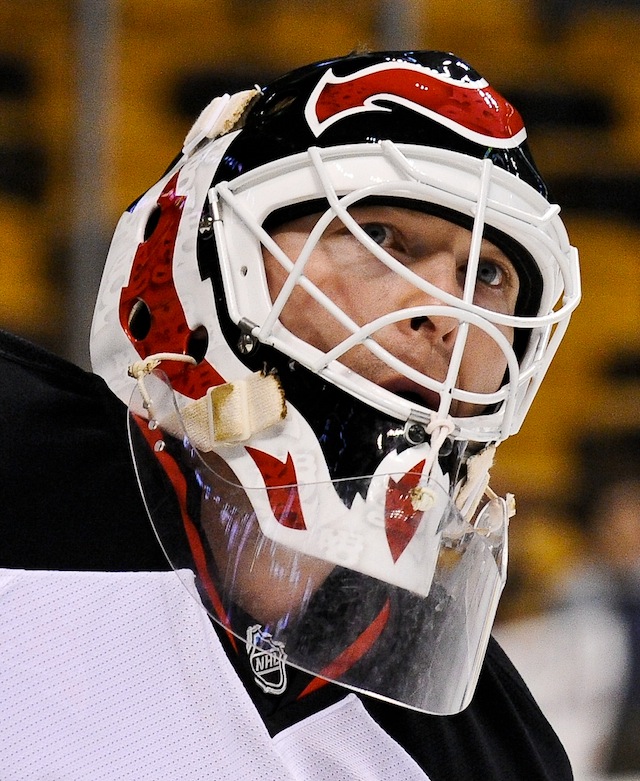
The term in soccer is “sweeper-keeper,” and for 21 seasons, the Devils had the best “sweeper-keeper” in the game. Martin Brodeur is regarded as one of the best puck handling goalies to ever play, and his ability to affect dump-ins, clear pucks out of the zone or begin breakout plays is a skill the Devils are really missing in 2014. The early warning signs were evident last year when the Devils struggled in front of Schneider while playing seemingly more organized in front of Brodeur. While Schneider made more saves and proved to be the more effective goalie – the quality and fluidity of play was higher with Brodeur in net.
Of the 28 goals Schneider has given up in the Devils’ first 10 games, 2 of them featured clear stick handling errors while a third showed his lack of awareness with a puck off the boards. Countless others were indirectly set-up by poor play out of the back, beginning either with a bad pass from Schneider or a defenseman put in a bad position due to him not being comfortable enough to leave the net. In Pittsburgh, with the Devils up 1-0 on an early goal and outplaying the home side, Schneider made a horrible gaffe behind the net leading to an open goal for Blake Comeau to put home – a precursor to seven straight goals scored by the Penguins. Against New York, with the Devils again up by 1, Schneider whiffed on a puck behind the net putting Marek Zidlicky in a vulnerable position with the puck, he inevitably turned it over leading directly to a Rick Nash score and another Devils loss. Yes, Zidlicky needs to do better with the puck in the corner, but if Schneider deals with the puck correctly, they are never put in a dangerous spot.
While Schneider is more than capable of being the #1 goalie – and showed vast improvement last night, not giving up any weak goals as he has in the previous 6 games – the Devils have to re-learn how to break out of their zone without the assistance of Brodeur. The Jets had numerous opportunities on turnovers and missed passes by Devils defenseman, but the chances were snuffed out by a very sound Schneider. It’s certainly nothing they cannot overcome – especially with good stick handling defensemen like Merrill, Zidlicky, Andy Greene and Damon Severson – but it’s time to accept that Schneider is better off staying in the crease, and the Devils blue line will have to make those clean breakout pass on their own.
It’s clear the Devils aren’t built on speed – relying on their skill and precise passing is going to be the most effective way for this team to possess the puck and control games. Until they correct the errors out of the back, it’s going to be a long season for Schneider and the Devils.
The shootout win mentioned earlier, was the Devils first in 18 tries – a dubious NHL record. Schneider made 2 saves and benefited from an off-target shot by Bryan Little to seal it – but the Devils goal scorer is the player to note. Jacob Josefson – who has constantly battled injuries and poor play since being selected by the Devils in the first round of the 2009 Entry Draft – made a great move with an even better finish to break the streak. In the post-game press conference, Devils coach Pete DeBoer was asked why he chose Josefson as a shooter. DeBoer answered by saying that Josefson has been one of the best shooters in practice, but it was Patrik Elias who threw Joe’s name into the ring when the Devils discussed their shooters going into the extra frame. Josefson proved Elias right by scoring a great goal – but it makes you wonder why it took PDB so long to give one of the self-described ‘best shooters in practice’ a go in the game. Josefson wasn’t chosen as a shooter in the shoot-out loss to Dallas and had only 4 attempts in his career before last night. Credit to Elias for speaking up, but in the midst of an 0-18 streak in shootouts with goals coming few and far between, I don’t see how a player with Josefson’s skill doesn’t get a shot until game 19. Yet another curious set of decisions made by Peter Deboer (don’t get me started on Bryce Salvador).
On November 8th, it’s Hockey Fights Cancer Night for Shane Doan and the Arizona Coyotes at Gila River Arena. For the Saturday night game against John Tavares and the New York Islanders, the Coyotes will be the next team to promote Hockey Fights Cancer.
On October 14, the NHL launched its annual Hockey Fights Cancer awareness month and it will run through November 15. This month-long campaign is to bring awareness to organizations, both national and local, that are known for their cancer research and care programs. Since the beginning of HFC in 1998, they have donated over $14 million to organizations that are centered upon helping in the effort to benefit organizations such as children’s hospitals, cancer institutes and player charities.
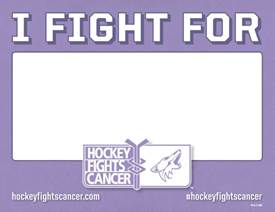
Fans attending the game are encouraged to wear lavender and the first 10,000 fans will receive the “I Fight For” card to show support for those we know and love that currently suffer or have overcome cancer. The Coyotes will host patients from all over the valley on this night.
USA Hockey will be in full swing in the coming week, as the U.S. Women’s National Team, and both the U-18 and U-17 teams from USA Hockey’s National Team Development Program will be competing in tournaments taking place November 2-9.
The U.S. Women’s National Team will travel to the Interior Savings Centre in Kamloops, British Columbia, for the 2014 Four Nations Cup, November 4-8. The Four Nations Cup is an annual women’s ice hockey tournament held between the United States, Canada, Sweden and Finland. Team USA has taken home 5 gold and 11 silver medals over the course of 17 tournament appearances, their only bronze coming after last year’s disappointing season. Team USA’s roster, which includes 12 members of the 2014 U.S. Women’s Olympic Team, can be found here.
Team USA Schedule for 2014 Four Nations Cup
Date
Opponent
Time (Local/EST)
Tue., Nov. 4
Finland
1 p.m./4 p.m.
Wed., Nov. 5
Canada
7 p.m./10 p.m.
Fri, Nov. 7
Sweden
1 p.m./4 p.m.
Sat., Nov. 8
Third-Place Game
2 p.m./5 p.m.
Championship Game
7 p.m./10 p.m.
Another Four Nations Tournament will take place for the U.S. National Under-18 Team, who will travel to Sundsvall, Sweden, November 5-9, to participate in the 2014 Under-18 Four Nations Tournament. Team USA will compete against teams from Finland, Sweden and Switzerland in the round-robin tournament. The United States has won six of the last seven Under-18 Four Nations Tournaments, including the 2012 event, which was played at the Ann Arbor (Mich.) Ice Cube, home of USA Hockey’s National Team Development Program. For the Team USA U-18 roster, click here.
Team USA Schedule for 2014 Under-18 Four Nations Tournament
Date
Opponent
Time (Local/EST)
Fri., Nov. 7
Finland
3:30 p.m./9:30 a.m.
Sat., Nov. 8
Switzerland
2 p.m./8 a.m.
Sun., Nov. 9
Sweden
2:30 p.m./8:30 a.m.
Finally, the U.S National Under-17 Team has already headed to Sarnia, Ontario, for the 2014 World Under-17 Hockey Challenge, taking place November 2-8. Team USA is also participating in a pre-tournament game taking place later today against one of their Canadian opponents. The U.S. has competed in the annual event since 1994, and has 12 top-three finishes, including a first-place finish at the last tournament held in Cape Breton, Nova Scotia, earlier this year. Luckily for Team USA fans, the World Under-17 Hockey Challenge preliminary and quarterfinal games will be streamed live and on-demand at FASTHockey.com. Even more exciting – the semifinals, third-place and championship games will be available on TSN. The online home of the tournament can be found by clicking here. For Team USA information, click here.
Team USA Schedule for 2014 World Under-17 Hockey Challenge
Date
Opponent
Time (EST)
Fri., Oct. 31
Pre-Tournament vs. Canada White
7 p.m.
Sun., Nov. 2
Sweden
3 p.m.
Mon., Nov. 3
Slovakia
3 p.m.
Tue., Nov. 4
Canada Red
7 p.m.
Thu., Nov. 6
Quarterfinals
TBD
Fri., Nov. 7
Placement/Semifinal Game
TBD
Sat., Nov. 8
Third-Place Game
3:30 p.m.
Championship Game
7:30 p.m.
To stay updated on scores, highlights, and any other USA Hockey news; please follow on twitter @USAHockey and @usahockeyscores
The Flyers were forced to sign the defenseman due to two major injuries on the blue line. The team learned last week that both Braydon Coburn and Andrew MacDonald would each miss four weeks due to lower body injuries.
Ron Hextall, the Flyers general manager, had called up prospect Shayne Gostisbehere from the Lehigh Valley Phantoms, the Flyers AHL affiliate. Gostisbehere played in just two games and was used very little in those games. The young defenseman needs more time in the AHL to develop, and the signing of Colaiacovo will give him the time in the minors that he needs.
The Flyers had also called up defenseman Brandon Manning from the Phantoms, and he played his first game of the season with the Flyers last night against the Tampa Bay Lightning. He looked okay and even added an assist, but it will be nice for the Flyers to have a veteran to fill in on the blue line.
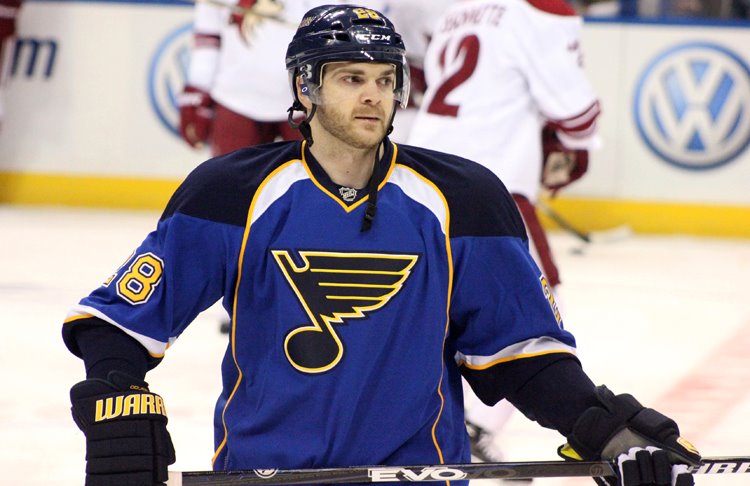
Colaiacovo, 31, spent last season with the St. Louis Blues. He had one goal, three assists, four points, and was a minus four in 25 games played. He has never played a full 82-game season in his 11-year career, but the Flyers won’t need him to do that. The defenseman has 31 goals, 113 assists, is a plus five, and has averaged 17:43 of ice time per game in 401 career games played.
He was drafted by the Toronto Maple Leafs in the first round of the 2001 NHL Entry Draft. In his six years with the Maple Leafs, he had 12 goals, 21 assists, 33 points, and averaged 17:05 of ice time per game. He was traded to the Blues, along with Alex Steen in 2008 in exchange for Lee Stempniak.
He spent the next four season with the Blues, and then signed with the Detroit Red Wings for the 2012-13 season, before returning to the Blues last season. In five total seasons with the Blues, Colaiacovo has 19 goals, 91 assists, 110 points, was a plus nine, while averaging 17:56 of ice time per game.
In his one season with the Red Wings, he played in only six games. In those six games, the defenseman only registered one point, an assist, was a minus four and had 18:54 of ice time per game.
Colaiacovo can play at even strength and on the power play, which should help the Flyers. The team is looking for another defeseman to pair with Michael Del Zotto on the second power play unit with the injury to MacDonald. He has some puck-moving skills, which could help him become an asset to the second power play unit.
He is sound positionally and doesn’t often get beat while one-on-one with the opposing player. Colaiacovo has decent skating ability but he is injury prone. He has limited offensive ability and can make mistakes in his own end.
He has three weeks to prove that he can still play at a high level in the NHL before he becomes the Flyers eighth defenseman on the roster.
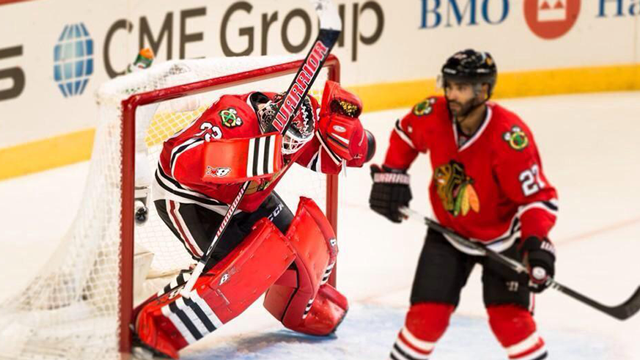
Scott Darling has shone in the net for his NHL debut–despite the Blackhawks‘ 1-1 record since his start.
The 25-year-old Lemont, Ill. native has seen quite a few arenas on his way to the United Center, but has certainly proven his capability between the pipes now that he’s returned to sweet home Chicago.
‘‘It was amazing,’’ Darling said of his first home start. ‘‘I was very emotional during the national anthem. Long road to get here, and I’m just very proud to be here.’’
That didn’t prevent jitters before a 22,000-person sea of red Sunday, though.
‘‘I tried to give off that illusion [of being calm],’’ Darling said. ‘‘I was pretty nervous to start. But once you get hit with a few pucks, it’s just another hockey game and you just try to do your job.’’
And, that he did, making 31 saves in the 2-1 victory and earning the coveted No. 1 Star of the Game. He stopped 25 of 26 shots in the Hawks’ loss against the Anaheim Ducks Tuesday, earning No. 3 Star of the Game. He has a .966 save percentage and a 1.03 goals against average. (Other Blackhawks backup goaltender Antti Raanta has recorded a shutout and a loss in his three starts this season–with a .933 save percentage and a 2.03 goals against average.)
Can’t Dodge the Ducks
On paper, Chicago should have won Tuesday. But, that’s the nature of hockey. The Hawks outshot the Ducks 38-25 (John Gibson made those 38 saves.) They had three Power Plays to the Ducks’ one. They won 34 faceoffs to the Ducks’ 22 and had 11 takeaways to the Ducks’ four.
Unfortunately for the Blackhawks, one Anaheim takeaway turned into the game-winning goal.
Brent Seabrook was not only unable to keep the puck in the zone on a Chicago Power Play, he couldn’t stay on his skates, either.
‘‘I’ve got to do a better job of that,’’ Seabrook said. ‘‘For whatever reason, I couldn’t get my footing after, and it was just one of those plays. . . . Just got away from me.’’
The Blackhawks had 45 shots on goal (stopped by another Chicago native, Craig Anderson) to the Senators’ 33. They led in Power Plays, six to three, faceoff wins 39-28, and ultimately, the game–a close 2-1.
Neither team was able to score in the first period, but the Hawks finally broke their second period scoring drought at the start of the second.
The now 5-3-1 Blackhawks cannot seem to get in sync and play for a full game. They’ve given up sloppy shorthanded goals the last two games.
Ever-changing line formations don’t yield an increase in production. Richards hasn’t proven to be the faceoff-winning, Power Play-revamping dynamo projected when he was picked up in the offseason. Instead he and Seabrook have been guilty of some pretty brutal turnovers.
What should have been a postgame celebrating the plucky Seth Griffith’s first multi-point game of his week-old NHL career (2 goals and 1 assist), coupled with Milan Lucic’s third multi-point game of the season, was instead yet another postmortem on what went wrong and when.
Coming off their impressive win on Saturday where they beat the Toronto Maple Leafs 4-1, it was hoped they had found the groove that had eluded them all too frequently up to that point. However, what started out as one of their stronger starts on home ice, would once again see the wheels fall off the wagon as the third got underway. In fact it wasn’t until 5:56 into the third period that the Boston Bruins would get their first shot on goal of the period. And before that happened, the Wild had scored an even-strength goal to cut the Bs lead in half. And just 38 seconds after the Bruins managed that first shot of the third, the Wild would tie up the score.
Postgame, Claude Julien was asked if there was anything he saw the Bruins do wrong in that third period.
“I think a lot of it started in the second period. We started playing on our heels, we stopped playing on our toes and being first to the puck, or at least create battle,” Julien responded. “I guess it’s disappointing to see the lack of tape-to-tape passes and how we’re just mismanaging that puck.”
In the end it was clear that the Minnesota Wild clearly were more determined to win—of course they had experienced their own lack of finish on Monday night when they let the New York Rangers score five unanswered goals in the third period of that game. The Wild no doubt had some motivation from the sting of that game. And they clearly wanted to pass along that hurting to the Bruins—and where it counts most, the score sheet.
And yet, with just 1:37 remaining in the first period Griffith, with assists by David Krejci and Zach Trotman (his first NHL career point), managed to tie the score, taking the Bruins into the first intermission even. Griffith would pot his second of the night while flying through the air just under five and a half minutes into the second allowing the Bruins to lead for the first time in the game. And when Lucic put the Bruins up by a pair, many assumed this would be the same Bruins who in the past held on to such leads.
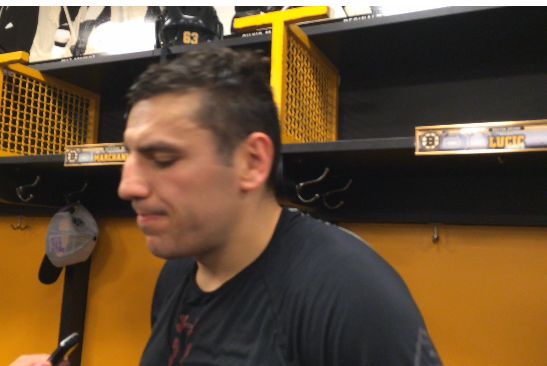
“We did what we had to do to establish a two-goal lead heading into the third. For our team that’s usually our bread and butter,” Lucic said after the game. “We’re real good at having that killer instinct and shutting it down and playing our best period in the third. Unfortunately it wasn’t there.”
It most definitely wasn’t. Julien shortened his bench as things continued to spiral out of control in the third. In fact, defenseman Matt Bartokowski saw the least minutes on the night, with just 11 shifts for a total ice time of 8:56 And while Julien refused to point fingers at the pairing of Bartkowski and Trotman as a reason for the lack of control from the Bruins, it was clear that he was not happy with Bartkowksi, who warmed the bench for approximately 13 minutes of that third period. Bartkowski and Trotman were on the ice for the first three of the Wild’s goals, but clearly Julien saw something in Bartkowski’s play that was more egregious.
Unfortunately the first line of Lucic, Krejci and Griffith was also on the ice for those three goals as well. But perhaps it was their hits, shot attempts and goals that helped keep them on the ice. Lucic had seven hits in the game and it was clear that the pre-injured Lucic was making his appearance in parts of the game on Tuesday night.
In the end it was again not enough. Too little, too late. Whatever cliché works, where the team didn’t. And Lucic was clear postgame about he and his line mates not calling out any of the Bruins.
“It just goes to show that you need all 20 guys to do their part in order to win a hockey game in this league,” he said. “Go back to that Toronto game and we have everyone doing their job at their best and we win the game.”
The season is young, fortunately. This was only the eleventh game of an 82-game schedule. And the Bruins have seen one of the busiest of game schedules of any team in the league. Perhaps this will work to their advantage later in the schedule when perhaps they may not be as pressed for healthy and healed bodies as those teams playing the heavier number of games. Unfortunately the Bruin have no games in hand on anyone and will have to climb out of a whole of their own making.
Right now the team reminds of the petulant child who is very sorry when he gets caught doing something wrong and promises not to do it again. They know all the right things to say, the problem seems to be between the saying of it and the doing of it.
We just [have to] communicate better, execute better in the d-zone so we can get going the other way. — Lucic
Now all the Bruins need to do is to put that into practice. They need consistency and they know it is lacking. Unfortunately knowing that something is lacking and knowing just how to fix it are two very different things.
The team has practice on Wednesday and then they will travel to western New York to take on the Buffalo Sabres on Thursday. This will be another important game for them and a chance to break the cycle and begin that climb to a consistency they must attain if they have any hopes of reaching the postseason.
After back-to-back wins against Holy Cross, the Penn State Nittany Lion improve to 3-1-2.
The two teams first met Friday, Oct. 24 at the Pegula Ice Arena in State College, Pa.
After a scoreless first period, Penn State’s Ricky DeRosa scored the first goal of the night at 13:49 of the second. The assists went to David Glen and Dylan Richard. DeRosa’s goal was the only one of the second period.
Holy Cross’s Scott Pooley scored the equalizer in the third period with assists from Castan Sommer and T.J. Moore.
Five minutes later, Penn State reclaimed the lead with Eric Scheid’s power play goal. Max Gardiner and Kenny Brooks had the assists on Scheid’s goal. Casey Bailey put the Nittany Lions up 3-1 with a goal at 16:14 of the third. Taylor Holstrom and Patrick Koudys each picked up and asissts.
The game ended with a 3-1 win for the Nittany Lions. Penn State outshot Holy Cross 50-30 in their first meeting of the weekend.
The next day, Penn State dominated Holy Cross by a score of 7-1.
After another scoreless first period, Penn State was faced with a 5-on-3 penalty kill. They survived the power play and a few minutes later, Casey Bailey opened up the scoring with assists from Taylor Holstrom and David Goodwin.
The Nittany Lion’s scored another goal with three minutes left in the second period. The power play goal came from Curtis Loik, assisted by Erik Autio who earned his first collegiate point.
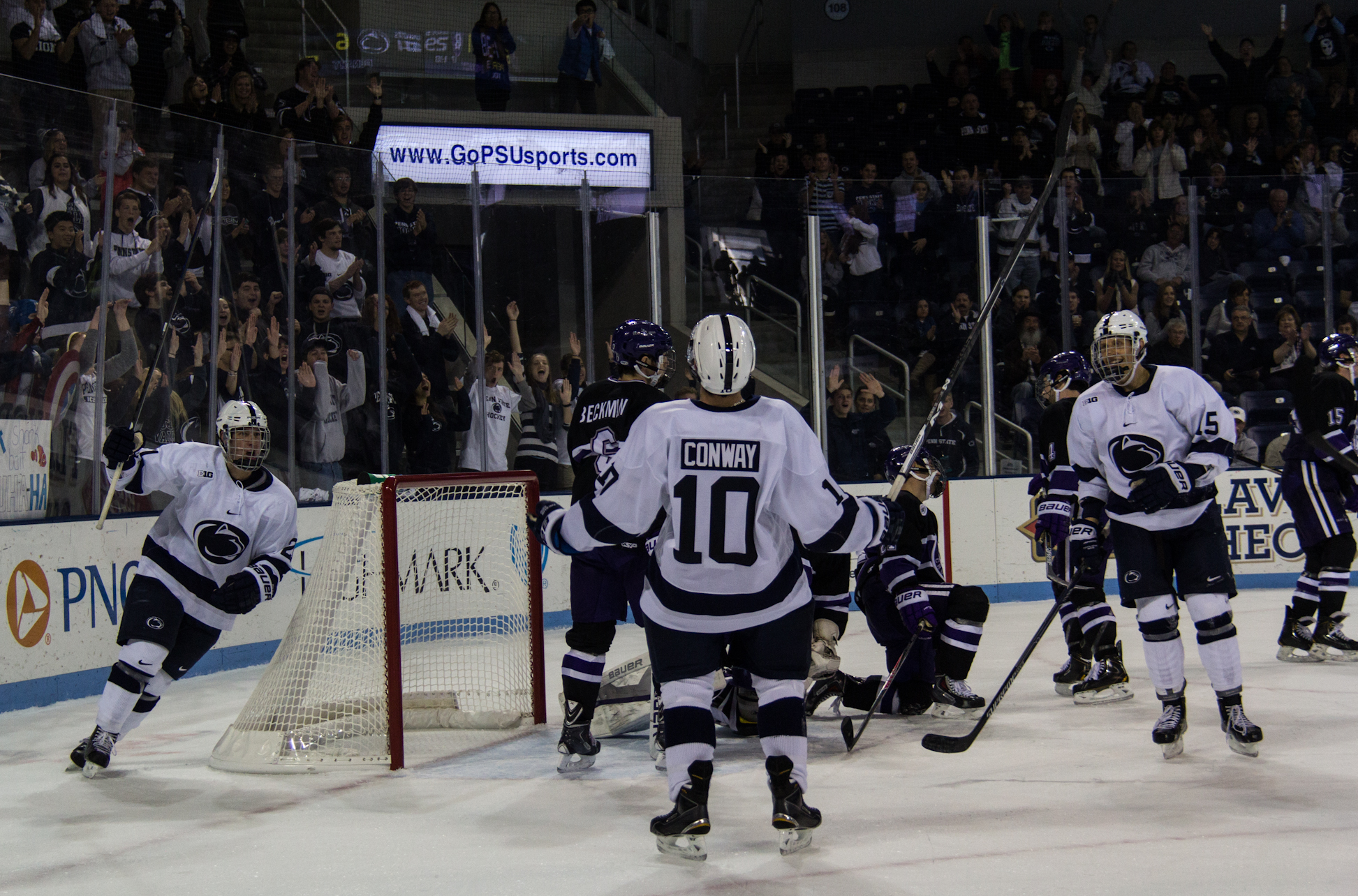
At the start of the third period, Eric Scheid gave Penn State a three point lead with help from Scott Conway and Dylan Richard.
David Glen extended Penn State’s lead to four when he scored with assists from Curtis Loik and Luke Juha.
Holy Cross scored their first and only goal of the game at 7:01 of the third. Jake Bolton got the puck past goaltender Matthew Skoff with the help of Smith and Lubanski to make it 4-1.
Penn State came back strong with three goals in the remainder of the third period. The Nittany Lions’ fifth goal was scored by Scott Conway who ended up with four points on the day, including his first collegiate goal.
Less than two minutes later, Jacob Friedman had the goal that pulled Holy Cross goaltender, Matt Ginn. With four minutes left in the game and Penn State up 6-1, Holy Cross put in goalie Paul Berrafato.
Scott Conway scored the final goal of the game with assists from Curtis Loik and Ricky DeRosa. Conway’s second goal of the game was a power play goal with 1:37 left in the third.
In their second game of the weekend, eleven different Penn State players recorded at least one point.
This win against Holy Cross was Penn State’s second 7-goal game this season.
Penn State will take the ice next on Thursday, Oct 30 against Bentley at Pegula. They will face Bentley again the following night. Both games will begin at 7 p.m.
Hockey at its best: A contest between two California division rivals. The San Jose Sharks delivered a stellar performance last night in Anaheim against the Ducks. Tanking to the Buffalo Sabres the day before on Saturday, the Sharks knew they had to win. The club went from losing to the second-worst team in the league, to defeating the best team in the Pacific Division, and 2nd place overall, the Anaheim Ducks. Coming into this game, and for comparison on this monumental early-season win, Anaheim had won 7 in a row, while the Sharks had lost 4 in a row.
Right from the start, the heat between these two teams was apparent with a scrum between San Jose’s big John Scott and Ducks Tim Jackman, resulting in a 5-minute major for each. Scott would eventually suffer three more penalties at the same time in the third period – instigating, fighting (major), and game misconduct. As of October 27, he has been suspended two games for leaving the bench on a legal line change to start an altercation.
There were a total of 37 penalties afforded – 18 for the Sharks and 19 for the Ducks. The majority of those penalties assessed were some kind of fighting offenses, whether it be for fighting (maj), unsportsmanlike conduct, roughing, instigating, or misconduct calls. If anything, that should demonstrate the kind of intense rivalry these two teams have for each other.
Early on in the period already with 5 shots on goal to Anaheim’s zero shots, showed just how badly the Sharks knew they had to win. But another big story of the night was all about Brent Burns, who scored his 100th career goal on the Sharks’ sixth shot of the game. Newly moved back to his original defense position, he is having an offensive impact, starting off both weekend games with a goal.
And, vastly improving on their power play performance (up 12% from only 10 days ago to 25%), Joe Pavelski nets one on the man advantage, helping the Sharks to continue their lead, making it 2-0 late in the first.
The shot clock evened out by the second, with a healthy 15 shots for the Sharks and 11 shots for the Ducks. At about the halfway mark of the game, Marc-Edouard Vlasic made a pretty five-hole goal through Frederik Andersen. Even though the Sharks were up 3 goals, high energy and scoring opportunities continued, which is what the Sharks needed to demonstrate in order to win. And then along came Tommy Wingels, with an impressive 10 shots on the night, giving the Sharks a 4-0 lead almost halfway into the third period, and on a power play to boot, further improving their ranking.
Besides the much-needed win after that dreadful 4-game losing streak, there were myriad positives for the Sharks in this matchup. Sure, division rival games are always entertaining to watch, but certain individuals really shined. Contributions from Burns and Wingels, plus the many scuffles during the game, showed grit, determination, and willingness to do whatever it takes to get the job done. If the Sharks can keep up that kind of work ethic, they will be unstoppable.
Monday morning began with the Boston Bruins hitting the ice for practice. They spent about an hour going through a variety of drills and working on passing, among other things. The mood was surprisingly reserved considering their win over the Toronto Maple Leafs and having had Sunday off.
With the injuries that the Bruins defensive line has seen—loss of Kevan Miller with the dislocated shoulder and then the loss of Zdeno Chara on Thursday night in the first period of their game against the New York Islanders—both Joe Morrow and Zach Trotman were called up before the Bruins took on the Maple Leafs in Toronto. Trotman played with the team having 12:23 total ice time and was there for practice on Monday. Morrow was released back to the Providence Bruins on Sunday.
For Seth Griffith, the past week has been somewhat of a roller coaster. On Tuesday during the Bs’ win against the San Jose Sharks, he scored his first career NHL goal. Then on Thursday, despite the Bruins one-goal loss to the Islanders, Griffith notched his first career NHL assist. These accomplishments came just after having been reassigned to Providence on Sunday, October 19, and then recalled on Monday the 20th. So not only were his games highs and lows, but his residence was changing too. However, despite his young age, he has a level head and calm demeanor to go with his hockey sense.
After practice, some of the players—Kevan Miller, Matt Fraser, Matt Bartkowski, Seth Griffith, Torey Krug and Dougie Hamilton donned Halloween costumes and went to visit some of the kids at Boston Children’s Hospital. In true form, their costumes elicited some surprise and some giggles, as they represented characters from the popular Disney film Frozen.
All in good fun, the players were definitely good sports to dress up like the princess Elsa, along with Kristoff, Anna, Sven, Hans, and Olaf. In the past the children have seen Chara as a big pink rabbit, but each year the players don’t seem to mind wearing dresses and animal suits if it brings smiles to the children. And it’s the children who get the treats–in the form of gift bags, a chance to chat with the players, pictures and autographs. And they will definitely remember a 6’7” Hamilton as Princess Elsa and 5’9” Krug as Olaf the snowman. Most of the players have younger cousins or nieces and nephews who know the story, so it just added to their understanding and willingness to visit the hospital and spread a little Halloween cheer.
Many of those children are suffering from some form of cancer and the Bruins are often visiting other hospitals where children battle daily with shots, needles, chemotherapy and other unpleasant things. In fact many of the players stand in awe of how strong those children are and how they still have smiles despite what they go through.
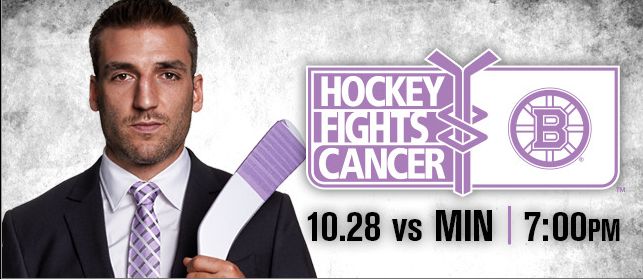
Tuesday’s game against the Minnesota Wild is the Bruins Hockey Fights Cancer night. The Pro Shop has special lavender items on sale and proceeds from these sales will go towards various cancer fighting organizations. In addition to the items that are for sale, the team will be wearing special warm-up jerseys that will be auctioned off. And those attending the game are encouraged to purchase an “I Fight For” cards and personalizing them for someone they know who has fought or is fighting cancer. A Moment of Recognition will take place during the second period. The Boston Bruins Foundation will distribute proceeds to patients who are currently undergoing treatments at Boston’s local hospitals.
Hockey players are some of the most approachable and community committed professional athletes. You are encouraged to help them help others during Hockey Fights Cancer Night at TD Garden.
(photo courtesy: Fred Zwicky/ Peoria Journal Star)
Hockey is a fast game and injuries happen, from high speed collisions mid ice to board rattling checks that leave a player crumpled on the ice. As difficult as these are to watch, there is probably nothing more frightening for the players and fans alike than when a player suffers an injury that involves a serious gash and blood loss. The contact is inadvertent and it usually happens when players get tangled together, a stray skate blade finds that one place where padding doesn’t protect and the results are traumatic and life threatening.
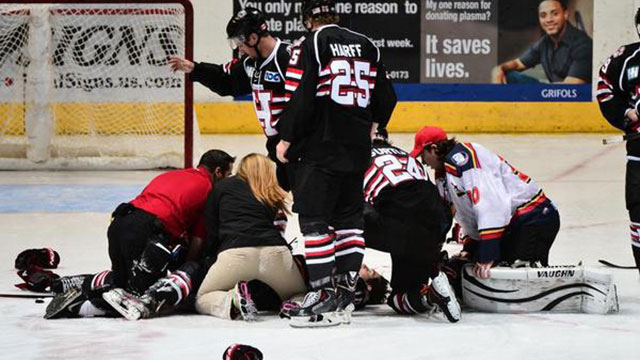
(Photo Fred Zwicky/ Peoria Journal Star) Havoc Justin Cseter takes a skate from Rivermen Dennis Sicard
This is exactly the situation SPHLHuntsville Havoc center Justin Cseter found himself in on Saturday night’s tilt against the Peoria Rivermen. As he went to the corner near the Havoc goal, Cseter collided with Rivermen Dennis Sicard, falling onto Sicard’s skate as he was down on all fours. The skate found the unprotected area of Cseter’s thigh between his pants and the top part of his kneepads and left a gash one and a half inches deep and six inches wide. With blood quickly flowing from the wound, he tried to skate back to the bench only to collapse onto the ice near the slot. Teammates rushed to his aid, to stem the flow of blood until paramedics could get to the ice surface. They had to work quickly, eventually using a broken hockey stick to help apply a tourniquet to the leg to slow the blood loss. A full recap of the event along with video and details of his on-ice treatment can be found detailed by Peoria Journal Star reporter Dave Eminian here. The game was officially suspended and players from both teams met at center ice to salute the fans, shake hands and embrace as a show of solidarity for their fallen hockey brother.
Thankfully, Cseter did not suffer any damage to the main artery. The cut, though deep, involved just the muscle tissue and he was able to get stitches and staples at a local Peoria Hospital to close the wound. In a show of true team spirit, the Havoc waited for Cseter to be released from the hospital and took him with them on the bus to make the 602 mile trek back to Alabama. Havoc Head Coach Glenn Detulleo told the PJ Star, “We waited for him. The doctors said he needed to be laying flat on the bus, so we had a bunk ready.”
The hockey community is one big family and the Peoria Rivermen Booster Club donated their 50/50 raffle proceeds for the night to help cover the cost of Cseter’s medical expenses and housing for his family, who were visiting from Wisconsin and watched the unfortunate accident unfold in front of them on the ice.
“Those Peoria folks are compassionate, classy people,” Coach Detulleo told the PJ Star. “The Peoria medical staff, the Rivermen organization and their booster club were wonderful in the way they handled the situation.”
Cseter agreed and said, “I thought it was thoughtful, very compassionate for the two teams to get together like they did, suspend the game and salute the fans.”
He was truly appreciative of the medical staff and to the fans who worked to save him. It will be a long road back to recover from such a deep injury, especially since it is one of the prime skating muscles that was damaged. Cseter is optimistic but knows it will be a slow process to heal the muscle and regain strength.
It is difficult to protect everything in hockey without sacrificing flexibility. Hockey pants have come a long way but they still have to be flexible enough to allow a player to open up their stride on the ice, which leaves an exposed gap. Kevlar socks were introduced after players like San Jose Sharks goaltender Alex Stalock suffered a season ending injury to his leg when he got stepped on, slicing his nerve. The cut resistant socks gained in popularity after Erik Karlsson from the Ottawa Senators had his Achilles heel cut from a stray skate. The socks, although effective for protection below the knee, have their limitations too. Winnipeg Jets player Zach Redmond was wearing Kevlar socks when he got cut behind the knee during a morning practice, leaving a wide gash that sent him off in an ambulance. Clearly in the case of Cseter’s injury, socks weren’t the issue as the gash came to the thigh, an area the socks just don’t reach.
Sports apparel companies like BodyArmour do make protective base layers that maximize Kevlar protection in key areas such as the calf, ankle and wrist but so far even their innovative Base360 line has yet to include Kevlar in the thigh area. It is no joke that skates are sharp, probably even more so now with blade technology reaching new levels as players seek every edge on the ice. Is it time for Kevlar fabric to come into play further up? No doubt, high performance base layers are pricey, but given the severity of injury, both with respect to career-ending and potentially life threatening, it may be money well spent.

 On October 14, the NHL launched its annual


 Prev
Prev