Last year, the Central Division was quite possibly the best in the National Hockey League. Three teams – the Colorado Avalanche, St. Louis Blues, and 2013 Stanley Cup Champion Chicago Blackhawks each cracked 100 points and were considered some of the best teams in the league.
Second-to-last in the Central Division, with 88 points (good for 19th in the league), were the Nashville Predators.
Fast forward to now, almost a full month into the season, and Nashville leads the Central Division with 16 points and 7 wins in 11 games. Four teams have played as many or more games, and the closest of those in the standings are the Winnipeg Jets, with 13 points and 6 wins.
The full standings see Nashville in first, followed by St. Louis with 15 points, Minnesota with 14, Winnipeg and Chicago with 13, Dallas with 12, and Colorado with 11. This was a division most people thought would be a fight between the same top three as last year, maybe with Dallas making a run for a top-three spot as well.
So, what’s going on in the Central Division?
First, in favor of the Predators taking the number one spot, a healthy Pekka Rinne makes all the difference. The 32-year-old goaltender, who played only 24 games last year, currently boasts a .931 save percentage. His 1.88 goals against average is good enough for sixth in the league, and the best among goalies who have played at least 10 games. A healthy Rinne between the pipes is dangerous for any of Nashville’s opponents.
Predators captain Shea Weber is still a solid blue-line presence, leading all team defensemen with four goals. Filip Forsberg is showing why he deserves a permanent role on the team, with 11 points in as many games. The additions of James Neal (7G, 2A), Mike Ribeiro (3G, 6A), and the penalty-killing presence of Anton Volchenkov have proven successful for Nashville so far this season. If all these guys continue playing at 100%, the Predators are going to be a very strong contender.
On the flip side, the Colorado Avalanche are suffering a major downfall after last year’s successes. Calder Trophy winner Nathan Mackinnon took the hockey world by storm and led his team to a great season, winning the division before being eliminated by Minnesota in the first round of the playoffs. Head coach Patrick Roy shocked analysts and fans with an unconventional coaching style, but it paid off in the regular season.
It’s hard to point out exactly what’s wrong with Colorado. They’re scoring goals, but they’re also being scored against a lot – 38 against to 31 for, through 13 games. It seems their biggest issue is they just can’t finish what they start – they’ve only won three games. One more than Carolina, and the same amount as Buffalo. They’ve held a lead at some point in regulation, though, in nine games this season. Their win percentage when they lead at some point in a game is a shockingly low 33%. This is a team that just can’t finish, and until they learn to do that, they’re in for 69 more long games.
Every team skates to center ice after a home ice win and salutes their fans. It shows that they love the fans’ support and they are grateful to be doing what they do in front of the home crowd. The Buffalo Sabres have not been able to salute their fans this year at home, until Sunday night. They have not won a game at home yet this season and they have been shutout in five of their previous eight games. They needed the help of their fans to get this win.
“It was fun,” right wing Chris Stewart said. “To hear our fans erupt, it was good to get the win for them.”
After an extremely disappointing showing Saturday evening in Pittsburgh, the Sabres were able to hang with their division rival Detroit Red Wings and take them to a shootout. First, however, they had to to endure 5 minutes of overtime with the majority spent in their own end. Fighting off shot after shot from Detroit, Buffalo’s Michael Neuvirth was able to make several spectacular saves to keep his team in the game.
“That one probably felt as good as anything just to be able to give them a little salute,” Sabres defenseman Tyson Strachan said.
The first period started out pretty mellow for both teams. With no real good opportunities for goals and only two penalties, the game looked like it could be a one goal game, and it could have gone to either team.
The second period saw two goals, one from each team, and the majority of the penalties for the game. Buffalo’s Brian Flynn opened the scoring on a nice backup play that started with Zemgus Girgensons. Girgensons made a nice wrap around attempt on Jimmy Howard and when that didn’t work, Flynn jumped up and got the puck past Howard to get his first of the season. Six minutes later Tomas Tatar tied the game at 1 after some nice play around the net. Tatar had a solid 10 seconds of skating around with the puck and nobody touching him before he just shot towards the goal and found the back of the net.
Detroit would take the lead four minutes into the third when a three on two saw Pavel Datsyuk alone in front of Neuvirth. A nice wrist shot would allow the assistant captain to get his 5th goal of the year. Buffalo was able to finally put together a decent third period and tie the game at 2. Chris Stewart got his first goal of the year, and first since last January, after some hard work down low. Stewart was falling towards the net and just pushed the puck towards Howard and with luck, the puck went past Howard and for extra insurance, Tyler Ennis was near the side of the net to make sure that puck went in and stayed in.
Just 46 seconds into overtime saw Detroit go on the powerplay after captain Brian Gionta got called for hooking. Buffalo would have to endure a lot of activity in their own zone if there were going to have a shot at a win. The same would be stuck on the ice for Buffalo for the majority of the penalty kill but goalie Neuvirth came up with some big stops, as did Tyler Myers who was able to get himself in front of a shot and stop the puck from going into a mainly wide open net.
This win was the first for Buffalo this season at home and the second shootout win of the season. “It’s a results-based business, and it’s been a tough stretch,” Strachan said. “It’s nice to see the guys smile a little bit.”
Buffalo gets a little break as they do not play again until Wednesday night, at home, against the Montreal Canadiens. Detroit plays their next game on the road against the Ottawa Senators on Tuesday.
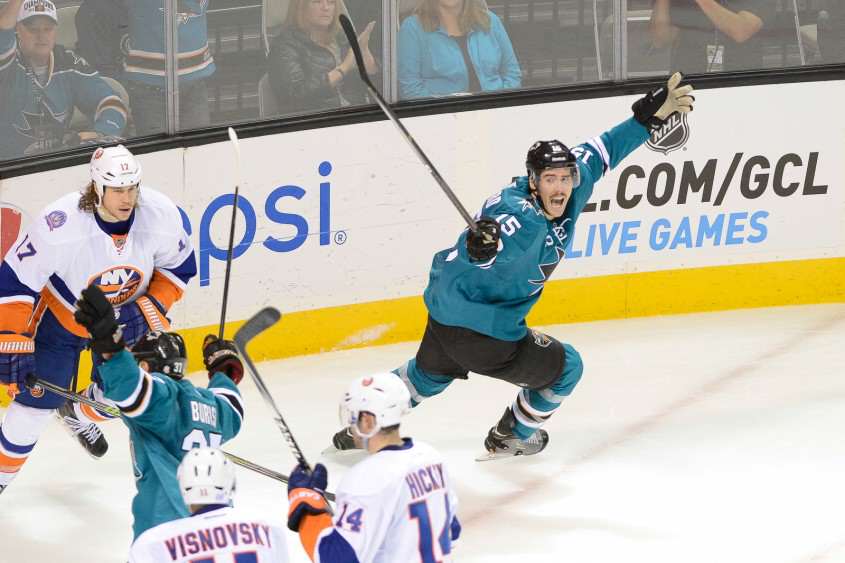
Saturday night on ice presented two very evenly matched teams. Both the San Jose Sharks and the New York Islanders were 6-4 in regulation coming into the game, with the Sharks two games in hand and with two overtime losses – one of which came back on Oct 16 when the clubs met back on the island. Now they were back here in San Jose for their last matchup of the regular season to get revenge.
The game began with some lineup changes for the Sharks – one planned and one on the fly. Matt Nieto entered the first line with Joe Thornton and Joe Pavelski, thus bumping Tomas Hertl to the fourth line. Plus, rookie Barclay Goodrow, in only his second game, is trying to show his stride as well, leaving Hertl, literally waiting in the wings to continue to prove he’s a talented sophomore sniper amid newcomers.
Along with Hertl’s personal struggle to prove himself came a team struggle when a clean hit into the boards on Scott Hannan from Cal Clutterbuck early in the first period sent Hannan to the locker room. He never returned to the ice, thus forcing the Sharks to adapt to playing only 5 defensemen.
Coach Todd McLellan thought the boys did just fine with a man down and said after the game:
“Yeah, I was (happy). We didn’t give up a lot. When we were in our end we weren’t running around. I thought the five defensemen managed their ice-time well, simplified their game a little bit more…They handled themselves very well.”
The Sharks were down 1-0 less than ten minutes into the first period. It was the first time this season that they gave up the first goal. Hertl tied the game just over the halfway mark of the first period on a power play. So now he’s off the schneid. Being on the fourth line either set a fire under him to try harder (and I’m not saying he hasn’t tried hard the past several games – he’s had numerous pucks on posts!) or the power play line with Nieto and Tommy Wingels was the winning combination.
“Oh yeah, I’m very happy I scored,” Hertl reflected in a post-game interview. “Tommy Wingels had a very nice pass to me, so it was a really easy goal. Hopefully, I start more (scoring) and just keep going.”
At the end of the first period, the shot clock was in favor of the Sharks with 17 shots; the Islanders had only 6. In the second period, San Jose was held to only one shot halfway through, but they powered through to gain four more shots for a total of 5 in the period, while the Isles were held to only 6 again. This showcased that the pace in the second period was sluggish at best with a lot of back and forth hockey.
Islanders’ Kyle Okposo commented: “I thought it was pretty back-and-forth, we had some good chances, we had some pretty good shifts and so did they. It was a back-and-forth hockey game.”
Finally some life returned in the third by a shot on goal by Pavelski about midway into the period. Jaroslav Halak made a great save, his 24th of the game, on the first real chance for the Sharks that period. The tally of shots on goal by period was still in favor of the Isles, but no scoring would come of it for them. The Sharks weren’t done though.
Logan Couture tipped a redirect from Justin Braun that was barely visible to the naked eye to make it 2-1 with 12 minutes remaining in the game. An insurance goal by James Sheppard (who has been in and out of the lineup since the start of the season for conditioning in the AHL) made it 3-1 with about 4 minutes left in regulation.
The Sharks really needed to win this game in order to show resoluteness in time of lineup changes and to get back the game they dropped on the island last month. Furthermore, this win was their first at home since the home opener. The fans appreciated this win. Lastly, Hertl and Sheppard both needed to score coming into this game to show their worth, and they did.
There are lot of things you can be pretty good at, for a girl. Science, for example. Math. Video games. Comedy.
Sports.
In hockey, to be pretty good (for a girl) means growing up most likely playing with boys, because there’s no girls league–or no girls league that receives even half the funding of the boys’. It likely means having a full or part-time job in addition to playing hockey professionally, for lack of paying options. It means losing out on training time, it means taking time off school, it means working your whole life for something that, until recently, the vast majority of people only cared about every four years.
Of course, what it really means is giving up the thing you love before you’re ready.
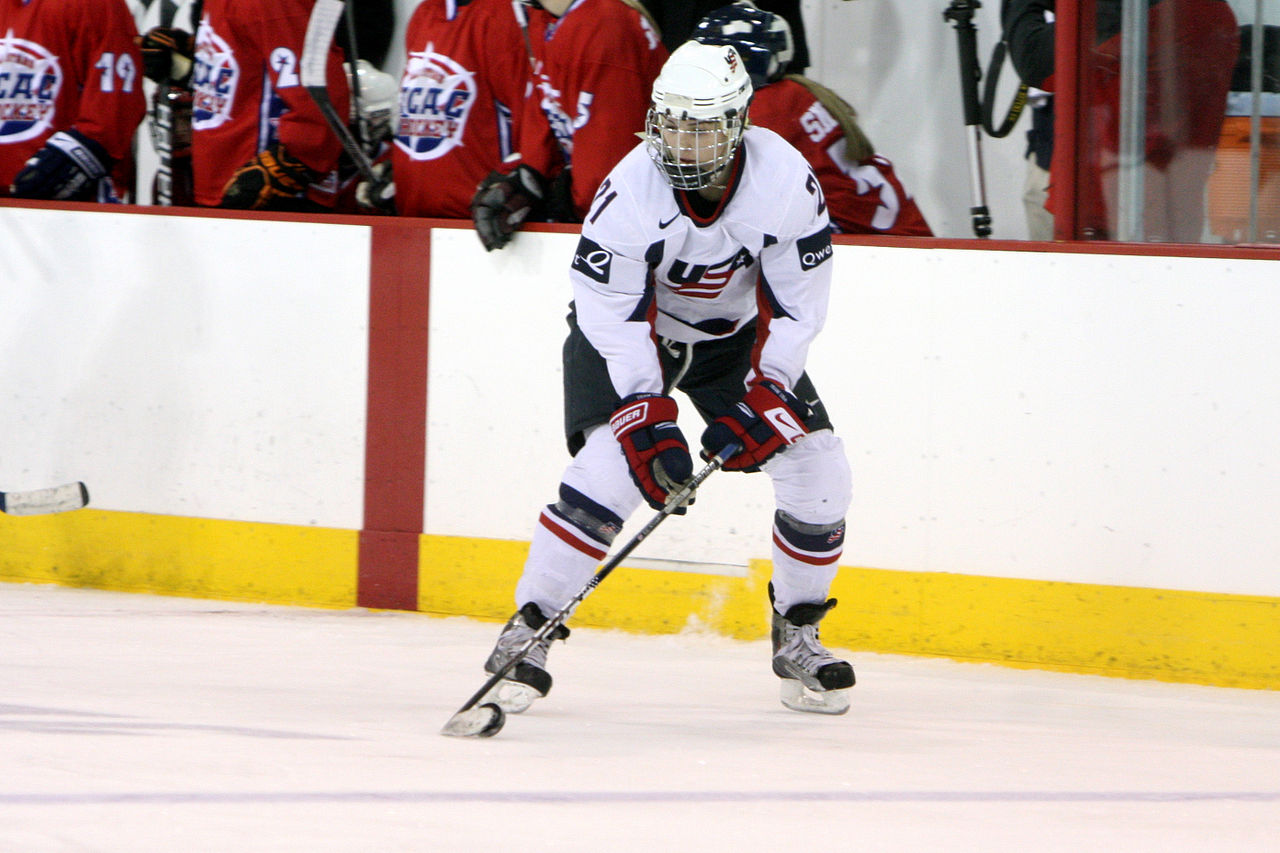
“I look at the boys and men who play [hockey],” said USA Olympic silver medalist Hilary Knight in a phone interview with The Pink Puck last week, “and I envy them. They have no idea. They don’t know what it feels like.”
“It’s a fun time to be in the sport because we can really shape the direction we want to go in, and I think there’s some exciting things to come,” Knight said. “The CWHL has been great thus far and it’s given post-college players an opportunity to compete, continue to train and pursue their passion. But I do see shortcomings in the way it’s formed. We’ve outgrown the mold that we’ve placed on ourselves.”
Some of those shortcomings include difficulties distributing the product, and by and large a lack of social media engagement. The players are all on Twitter, Instagram, and Facebook, but the CWHL seems to lack a targeted marketing and social media strategy. Where the NHL has found success by interacting with social media outlets on their own terms, CWHL accounts read much more like condensed press releases.
There has been some growth in that area. You can now purchase access to 23 CWHL games for a mere $10 via their website. Sites like Mike’s Mumbles is bringing advanced analytics to the women’s hockey blogosphere. But for the most part, it seems that we see players like Knight taking control of their own marketing, rather than a league-wide campaign.
“I’ve had countless people come up to me and ask, ‘How do I watch you guys?’ and I have to say, ‘Social media is kind of the only way you can follow us right now.'” Knight sighed. “But the league is young. Until each player and individual understands the value … I don’t think we’re going to make strides in terms of growth.”
As for the NHL’s more comprehensive strategy …
“Well, [the NHL] also has a budget for that,” said Knight dryly.
The NHL has budgets for all sorts of things that the CWHL doesn’t. Player salaries, for example. One of the concerns repeatedly mentioned during this year’s discussion of possible CWHL expansion included questions of expenses. Should the league prioritize paying its players, or growing its reach? Obviously these goals aren’t mutually exclusive, but adding a new team, new coaches, new uniforms, new rink expenses, new travel expenses … it has the potential to push “salaries” a little further down the road.
But Knight has a different perspective. “I hope it does expand,” she said. “There’s a huge U.S. market that wants to get involved. Dropping the Canadian part would be beneficial–and lucrative–not only to the organization, the league, and the companies, but also the players.” More teams mean broader potential viewership. And expanding into the U.S., where hockey is ever-growing, taps into a special kind of market all its own.
That being said, there’s a lot to be said for quantity versus quality. “At the end of the day, as a player, knowing the business side but also having been in the trenches a little bit, paying an athlete or supplementing their training is huge. It’ll only grow the sport.” Knight paused for a moment before adding, “And the more we don’t have to work on other things outside of training, the better caliber athlete you’re going to get.”
High caliber players mean high caliber competition … and more intense games. There’s no worse (or better) rivalry in women’s hockey than that between the U.S. and Canada. From bench-clearing brawls to OT heartbreakers, every game between those teams feels like the most important. There’s a level of competitiveness between the U.S. and Canadian women’s hockey teams that, frankly, I just don’t see between the men’s teams.
Is it there? Of course it is. Let’s be honest: everyone who isn’t Canadian wants to beat Canada at hockey. It would be like beating Michael Jordan at basketball. Or, maybe more accurately, it would be like Michael Jordan beating the Yankees at baseball. But there’s broader competition in men’s hockey. Russia has a good team; Finland has a good team; Sweden has a good team. The Czech team is hit-or-miss but sometimes wins Olympic gold on the back of their insane goalie (for example).
Not so in women’s hockey. In women’s hockey, the meeting between the U.S. and Canada is the best competition you’re going to get.
“The rivalry is there,” Knight said. “It’s live, it’s intense. If you’re a fan, that’s what you want. You don’t want to watch for the sake of watching, you want to go to talk to your friends, you’re grabbing your coffee, ‘Can you believe what happened?’ We love to play, we love to play in front of crowds, and it’s a win/win for everyone.”
“I had a couple teams reach out,” Knight acknowledged, turning thoughtful. “And to be honest, it would have been great. It would align with my training. I know Swedish. It was a good match.”
She hesitated, seeming to gather her thoughts. “My drawback was …. I was thinking about retiring. I wasn’t sure where I was. [I knew] traveling across the pond would be very difficult, [because] I could score however many goals, but it really wouldn’t matter because it wouldn’t impact or motivate or inspire anyone else if I wasn’t in North America. It was heartbreaking. It took months to kind of pick up the pieces … practicing with the [Anaheim] Ducks sparked my interest to stay here and try to make playing in the men’s professional league here work. I think it would do volumes for our sport.”
Knight’s practice with the Ducks sparked a social media storm. Seeing her in that Ducks jersey, skating with the team, meant something. Fans of Knight, of hockey, and of women’s hockey in particular, seemed to be strongly affected by Knight taking her place on the NHL stage, even if for only a practice.
Could Knight see a woman playing in the NHL in the next, say, ten years?
She doesn’t play coy about it: “I could see myself playing—tomorrow, if I got the call.”
The practice with Anaheim perhaps confirmed what Knight had begun to suspect, closing in on a year after winning an Olympic silver medal and struggling to figure out what she was meant to do next. “[I started] looking at it like, ‘I have a platform. How can I motivate and inspire youth, women, and men to achieve greatness in their own respect?’ I realized that it’s bigger than me.”
Growing the Game in the U.S.
But even the NHL doesn’t have all the answers. Though hockey has experienced incredible growth over the last decades, it’s still leagues behind U.S. juggernauts like football and basketball, in terms of TV time, exposure, and market saturation. The “non-traditional markets” approach that the NHL has been so fond of certainly pays off in some respects, but it also means a lot of struggle.
“The sport of hockey itself still struggles,” Knight acknowledged. Returning to her earlier assessment that the CWHL had outgrown its own mold, she added, “Expecting the NHL to take us on right away with no questions is a lofty goal, because we still need to create this market. You only have a certain number of teams that actually do well, that can sponsor a sister team.”
So while she envies her NHL compatriots in many ways, Knight is also careful to give credit where it’s due. “Yeah, it’s frustrating, but I kind of throw it out there with caution. When you’re comparing my life to an NHLer’s, they live the life, but if you take their sport and pit it against other male sports … they work a lot harder for their dollars than another professional might have to.”
In other words, it’s a sliding scale. Women’s hockey is smaller than men’s hockey, which is smaller than football. But more and more teams and leagues are realizing that growth is not gendered. Growing girls programs and courting female viewership not only makes a difference in women’s hockey, but men’s hockey as well.
“A lot of leagues are seeing the value of the female viewer,” Knight said. “If you look at boys’ versus girls’ hockey, technically girls’ hockey has the greatest amount of potential growth. It’s a huge untapped market.” Initiatives like Girls Play Hockey and the integrated practices are all ways that teams are reaching out to that demographic. Even the Blackhawks prompt and respectful response to the #BanTheStripper campaign is proof that hockey is slowly realizing just how much they stand to gain by reaching out to the other 32% of their fans (and how much they stand to lose if they don’t).
Seeing past gender isn’t the only hurdle hockey faces in the U.S. “You need to make the sport more affordable,” Knight said flatly. “And more accessible to all sorts of demographics. Hockey ends being a niche market for people who can afford expensive skates.”
She’s not wrong. According to the The Atlantic, hockey fans are largely white and largely middle-to-upperclass. In fact, white people make up an astounding 92% of hockey viewership. Black and Hispanic folks combined are a mere 5%. As for income, 33% of people watching hockey on television make $100k+ per year, more than any other single income group. Growing the sport means first and foremost reaching out past that rich, white demographic to generate interest and accessibility in other communities.
But growth is possible. In fact, it’s probable–and Hilary Knight plans to be a part of it.
“Whenever I step on the ice, I always have something to prove,” Knight said, thoughtful but determined. “For me, I aspire to play in the NHL for a game or so. My objective is to show people that hockey is hockey, no matter which way you slice it.”
Hockey to cure your Halloween hangover? Sounds like a plan to me!
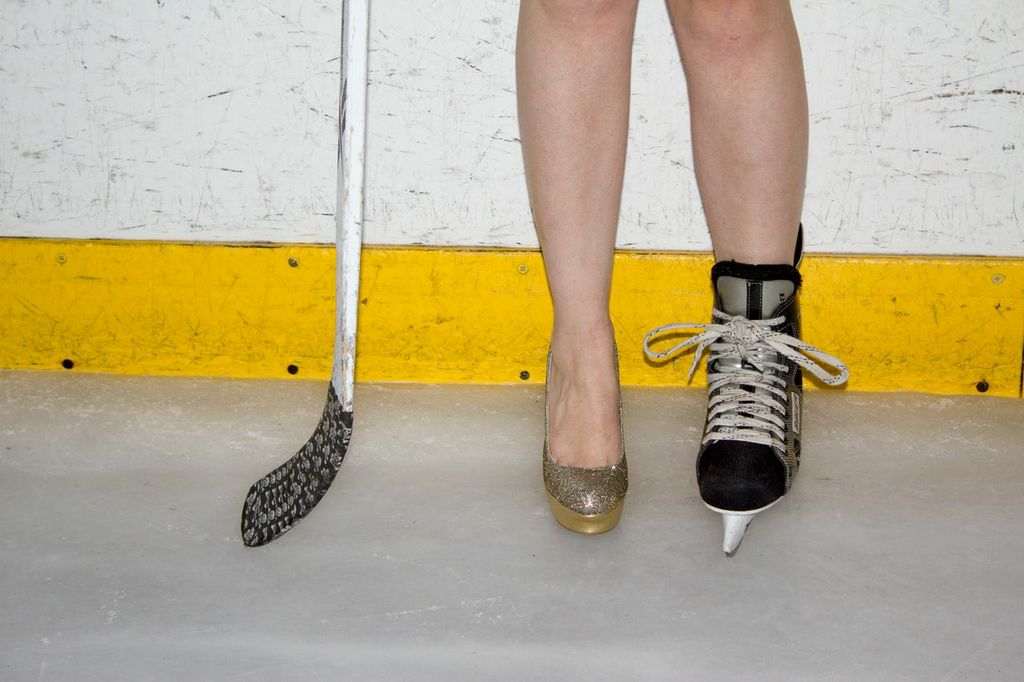
Going to work the day– or night, in this case–after a party holiday can leave you feeling a little less inclined to dress up. Heck, when it came time to take off my super-soft Brandy Melville sweatshirt and fleece-lined leggings I was like Oh my God, the struggle is real.
But a skirt and tights ensemble can be cozy too. And my outfit choice for the Sharks-Isles tilt Saturday night was exactly that.
Where’d I get this adorable Roxy Quicksilver school girl skirt, you ask? Um, well, I’ve had it since junior year of high school. Yes, high school. And believe me, I didn’t graduate yesterday. But I most certainly kept it all these years and it most certainly still fits. Plus, the way I see it, with current couture taking cues from the early 90s right now, by spring time stores will be stocking up with “Clueless”-era styles. So, I’m getting a leg up on the fashion-forwardness. Pairing this little number with a sublty-striped black stocking and dark brown hiking style boots fit the bill.
On top, I wore a green scoop-neck top from H&M. It’s super soft and lightweight; snuggle-worthy but easily layered over and dressed up. Which made it perfect to wear under this sport black ski jacket–a boutique from buy back in college that has truly stood the test of time.
Comfy-cozy and game ready? Achieved.
… Okay, so I wasn’t so tired that I didn’t put a little extra thought into Saturday night’s jewelry. I was grabbing for one of my sugar skull bracelets when I decided to grab a bunch of my skeleton accessories as sort of a Dia de los Muertos ode.
Until the next puck drops,
The Girl In The Black Tights
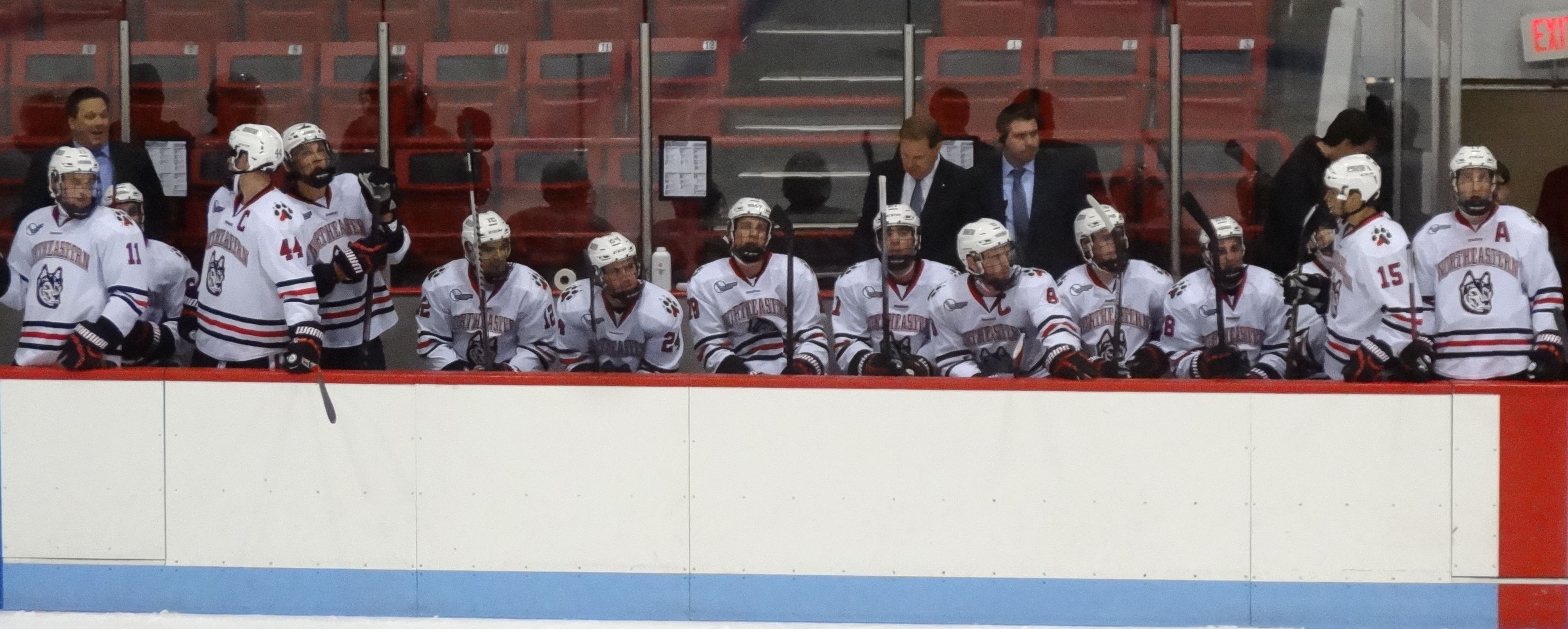
During the October 24 game against the University of Massachusetts Minutemen it looked like the Northeastern Huskies were being dominated on the face-off. Some may consider the word dominated to be a bit harsh, as they did win 42% of their face-offs, but it was clear that it was not their best night in this area. And while it certainly wasn’t the reason for their fourth straight loss of the regular season, it did get me wondering about their multi-game statistics in this area up to this point. Was the game against UMass an anomaly? Was this struggle on face-offs becoming a trend?
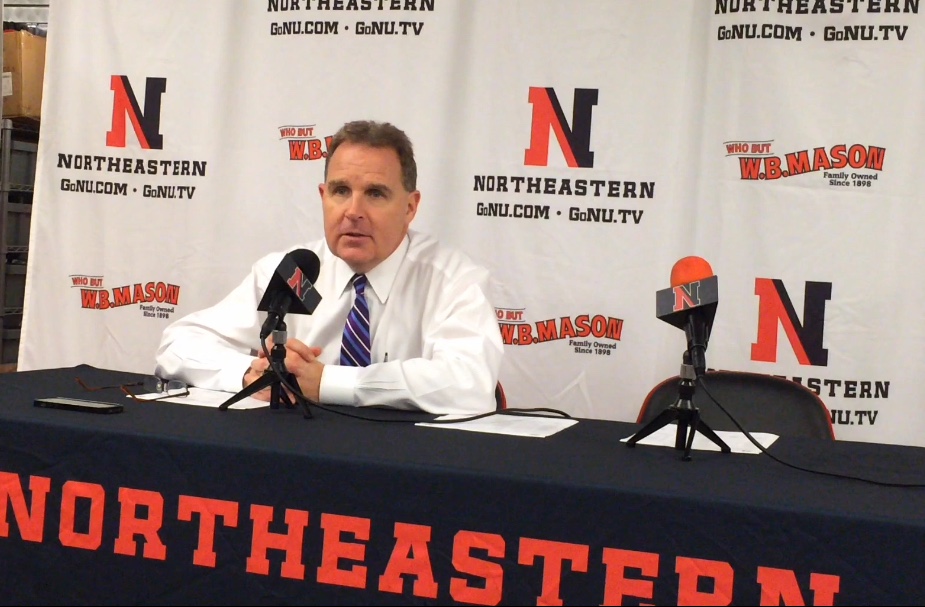
During the postgame media availability, I did ask head coach Jim Madigan about the issues in the dot for the team that night and if it was a concern.
“Yah, that’s always something that we need to work on. I thought we won a couple of key face-offs there, but we need to get better in the dot,” he responded. “It’s just not our center icemen, it’s all five guys. There’s times when our center icemen aren’t tying up, just not getting to the pucks quick enough.”
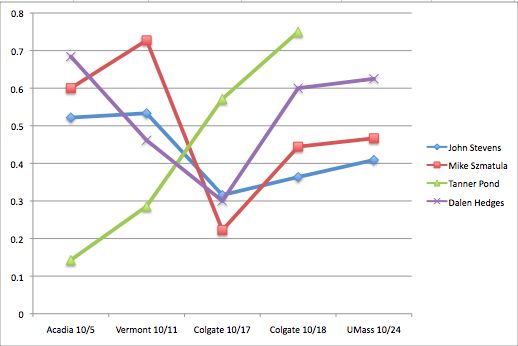
Looking back at the statistics since the pre-season, up through the game on October 24th, a total of five games, it was clear that their first two games were much better for most of their centermen—especially John Stevens and Michael Szmatula, each of whom see more than ten face-offs a game. Dalen Hedges, the Huskies other main centerman has rebounded better than the others.
Szmatula seemed to be almost magical during their first Hockey East tilt against the University of Vermont Catamounts when he won an impressive 72% of his face-offs. And then came the first of two games against the Colgate University Raiders in which it was clear he was off his game. Since then he has been steadily climbing back up, but is still well under his earliest games.
John Stevens, who played with Szmatula for the Dubuque Fighting Saints (USHL) before they both joined Northeastern as freshmen last season, likewise was either off his game or not expecting the skill that Colgate had in the dot, as his averages also dipped that first game. And like Szmatula he is working on getting back to above 50%.
Northeastern Face-Off Wins 2014-15 Season
Of the four centermen shown in the graph, Tanner Pond’s steady climb is perhaps a little misleading, as he has seen the least face-offs of these players. And the graph does not show all the Husky players who have taken a face-off, just the four who have seen the most over the course of the five games played, and in Pond’s case he was out in the game against the Minutemen—freshman Nolan Stevens, brother of John, taking his position for that game. Nolan won two of the six face-offs he saw, so was at 33% in that game.
The Huskies have lost all five of the games they have played as of October 31st, but Madigan was pleased with the jump and pressure that his team showed in the game against the Minutemen. In fact, they peppered the UMass freshman goalie, Henry Dill, with an astounding 42 shots, only two of which got past him.
The team is on the road and will take on Quinnipiac in two games this weekend. Next weekend they will have a home and home against the UMass Lowell River Hawks—the 2014 Hockey East Champions—followed by four more Hockey East tilts. And it’s these division games that they want to see in the win column.
Though the face-off struggles have not been the reason for their losses, it is certainly an area that they will want to improve, especially to protect the house when the face-off is in their end of the ice. The team as a whole is made up of hard-working, hockey-smart players and it will be interesting to continue to watch this statistic going forward in the season.
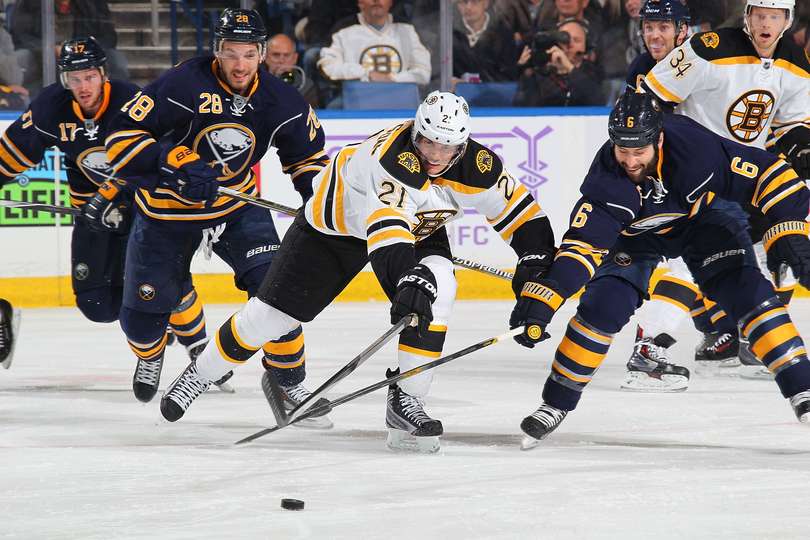
The Buffalo Sabres returned home last night after a disappointing 4 game road trip. They were looking to get back into the win column and forget what happened in the last week. Everything seemed to be going well for the team as they appeared to be skating better together, communicating better, and worker just a little bit harder than they had previously. That was, until the third period hit last night against the Boston Bruins. Since the beginning of the season, Buffalo has been outscored 18-5 in the 3rd period alone, making it the worst period for the team in almost every game. That did not seem to change last night against the Bruins either as they had a 2-1 lead going into the 3rd and let it slip away by allowing Boston to get that tieing goal and winning in overtime, 3-2. “Lately, we’ve been sitting back in the third and it’s catching up to us,” stated Buffalo’s Tyler Ennis.
Having already lost agains Boston once this season, Buffalo was looking to redeem themselves and even the series at 1 win apiece. Boston was also coming off a bad third period loss to Minnesota just two days before. The first period was rather uneventful between these two teams other than a minor fight between Buffalo’s Chris Stewart and Boston’s Milan Lucic.
The 2nd period found another painful stat for Buffalo as Drew Stafford not only scored his 1st goal of the season but also scored Buffalo’s first powerplay goal in 33 attempts. “It’s just embarrassing, unacceptable to go 0-for-this-long,” Stafford pointed out. Boston’s Adam McQuaid found the back of the net for the Bruins 1st goal of the game. This was also McQuaid’s first goal since October, 2013. Buffalo’s Mike Weber was in front of the net and attempted to block the shot and ende up redirecting it right past goalie Jhonas Enroth. Buffalo went back into the lead on a nice 2-on-1 play involving Torrey Mitchell and Tyler Ennis with Ennis getting the credit for his 4th goal of the season.
The dreaded 3rd period came and almost went with Buffalo still in the lead, until Brad Marchand scored with just over four minutes left in the period. Reilly Smith shot the puck towards Enroth and while it appeared to be going too high and was going to miss the net, Marchand got his hand in the way and was able, in a legal fashion, to get the puck behind Enroth and tie the game at 2.
Marchand would also score just over a minute into the overtime period to win the game for Boston, 3-2. “It doesn’t matter how you get a win on the road — you get the two points, and we’re going to be happy with that,” stated Marchand.
Buffalo is going to need to take more shots if the are going to have any shot at winning games. Last game against Toronto they had a mere 10 shots on goal and again last night against Boston, they were only able to get 15 shots on goal. “We still need to address the shots, though. We still had not enough shots,” Ennis said. “We’ve got to find a way to put those through.”
Buffalo’s next game will be Saturday night against the Pittsburgh Penguins, who will be looking for their 4th win in a row. Boston returns home to face the Ottawa Senators, who are coming off a loss to the Blackhawks.
The Tampa Bay Lightning and MicroLumen have partnered for a season-long ‘Make A Wish Experience Platform. The program kicked off after the team’s 11 a.m. practice on Friday. Eight dates have been set during in season in which the Lightning and MicroLumen will host a Make A Wish family for a game.
At the practice Steven Stamkos skated with one of his biggest fans, Noah Diflippo, 12, of Buffalo, New York. Noah currently plays center for the Cazenovia Chiefs in Upstate, New York. Noah will then attend the game on Saturday when the Lightning take on the Washington Capitals at 7 p.m.
Noah, and the children who see their wishes come true thanks to the Lightning Make a Wish experience, will attend a game at Amalie Arena and watch the morning skate with former Lightning captain and Stanley Cup Champion Dave Andreychuk. Their game experience will also including them meeting Lightning players, a personalized jersey, four tickets to that night’s game, a Zamboni ride during the first intermission, and an in-game video tribute about that child’s story. Fans attending that night’s game will get to see the child’s story highlighting his or her bravery all thanks to MicroLumen.
With the announcement that came from the Pittsburgh Penguins on Monday, about defenseman Olli Maatta having a thyroid tumor removed, Hockey Fights Cancer Night in Pittsburgh really took on a whole new meaning.
20-year-old Olli Maatta will undergo surgery at some point next week to remove a tumor that is estimated to have an 85% chance of being cancerous. Doctors are hopeful that after removal, he should be able to return back to hockey (in some form) in an estimated period of around 4 weeks, depending on how everything heals. They are remaining optimistic, and believe that even if they do find cancer, that they should be able to handle it in the offseason. Their main priority right now is to get rid of the tumor, and go from there.
This 20 year old defenseman has been through a lot so early in his hockey career. After just recovering from shoulder surgery, Maatta found out during testing before the season, that there was a tumor that had to be removed on his thyroid gland. He has played over 3 weeks of hockey, in fact some of the best hockey of his life, while knowing the possibility of having cancer. That is just a showcase of his maturity at such a young age.
Olli Maatta is not letting this affect him. He is not looking to be put on a pedestal so people can feel sorry for him. In press conference earlier this week when asked about how he felt he said, “I felt the same as I did before I found out. I feel healthy and fine. The only thing that’s different is that now I may have cancer. It’s tough news, but I don’t think it has affected me much.”
His perseverance has inspired teammates, and rivals from all around the league. The support that he has gotten is more of a respect, than anything considering the way that he has handled the whole situation.
Won’t meet a better person than Olli Maata, kid is a stud and will be back better than ever. #HockeyFightsCancer
Crosby on Olli Maatta: “He’s as strong as they come.” -MC — Pens Inside Scoop (@PensInsideScoop) October 28, 2014
So when Thursday came around for the Pens, the ordeal took on a whole new light. All around the league, players and staff have been personally affected by cancer. To have a teammate that has a high chance of having a cancerous tumor, means that they all have a personal reason (if not many) to fight cancer and support this cause.
Olli Maatta, himself, commented on how Hockey Fights Cancer is “a good thing to raise awareness. It’s a tough battle for those that have it and I think it’s a really good thing that the league is doing.” There is support from all around the league about the effectiveness of this month in the NHL.
Sidney Crosby addressed the night, and his teammate to the media by saying:
“The fact that we have someone that we can look across the room and support here, it’s the case, so it probably means a little more knowing you got a guy on your team that’s going through something like that. But I think in some ways, it’s affected everyone at some point so it’s real nice we’re able to do this [Hockey Fights Cancer Night].”
You can send Olli a message here.You can also purchase merchandise from the Penguins and other teams around the league here, or directly donate here.
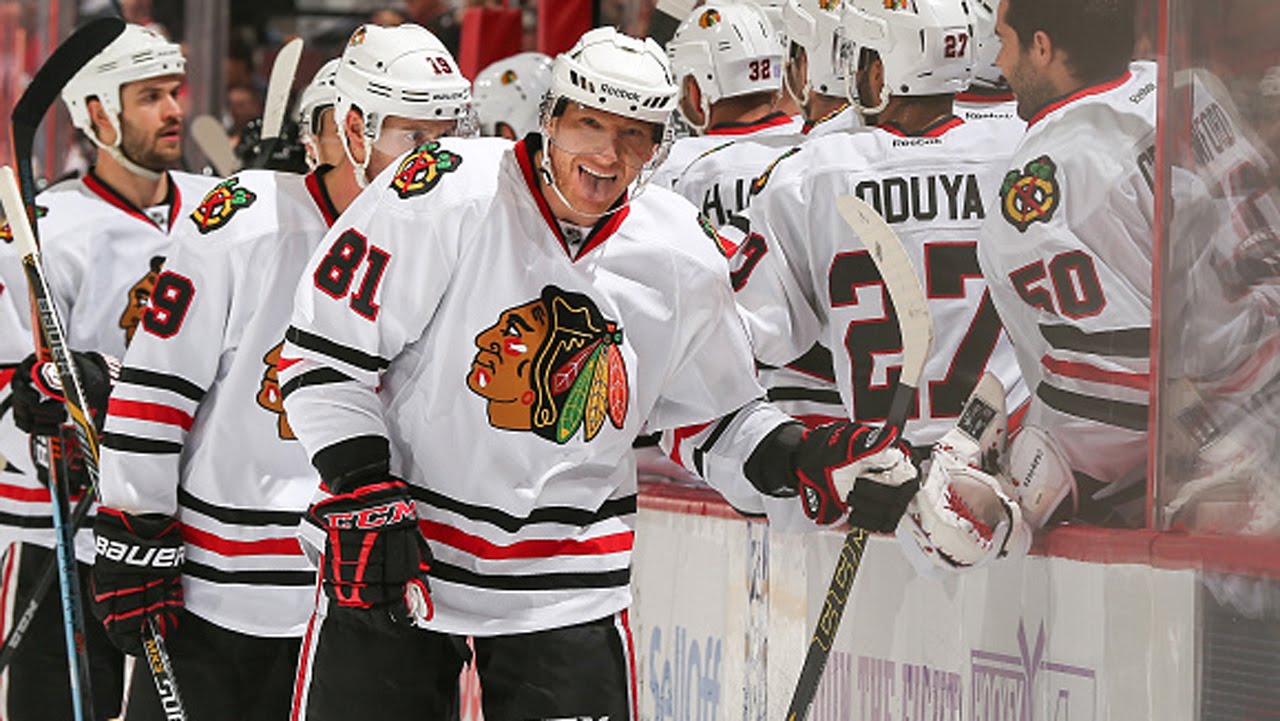
Marian Hossa played his first NHL game for the Ottawa Senators in 1997. In storybook fashion, he tallied his 1000th point back on their ice Thursday night.
Marian Hossa: scored 1,000th career point in his 1,100th career game. scored 1,000th career point vs team with which he scored point #1
It was a hard-fought game and if it could have been written as a screenplay, that 1,000th point, a beautiful wraparound goal that gave the Hawks a 4-3 lead with 6:10 left in the third, would have solidified victory for the Hawks.
But, this is hockey. And even with a standing ovation from Ottawa and Hawks fans alike to honor his accomplishment, and a surge of energy from Chicago, the Senators managed a comeback.
The game went to a shootout, and Hossa wouldn’t have the game-winning glory. Who needs it, though?
With Chicago, he’s twice lifted the Stanley Cup and he’s now the 80th in the 1000-point club, joining the ranks of Gordie Howe, Stan Mikita, Phil Esposito, Wayne Gretzky, Jaromir Jagr, and other esteemed players.
“It’s a great achievement, great milestone and I’m really thankful to all the players who helped me achieve this during my career. It doesn’t get better than that,” Hossa said. “It happened in Ottawa, where it started. I’m always going to remember that.” While the live show didn’t give Hossa a game-winner, the game definitely played out in dramatic fashion.
The Blackhawks did all they could to lose this game. While they led 39-32 in shots, they also led in penalties, 6-5, and giveaways, 10-7. They led themselves to a scoreless overtime and then a shootout.






 Prev
Prev