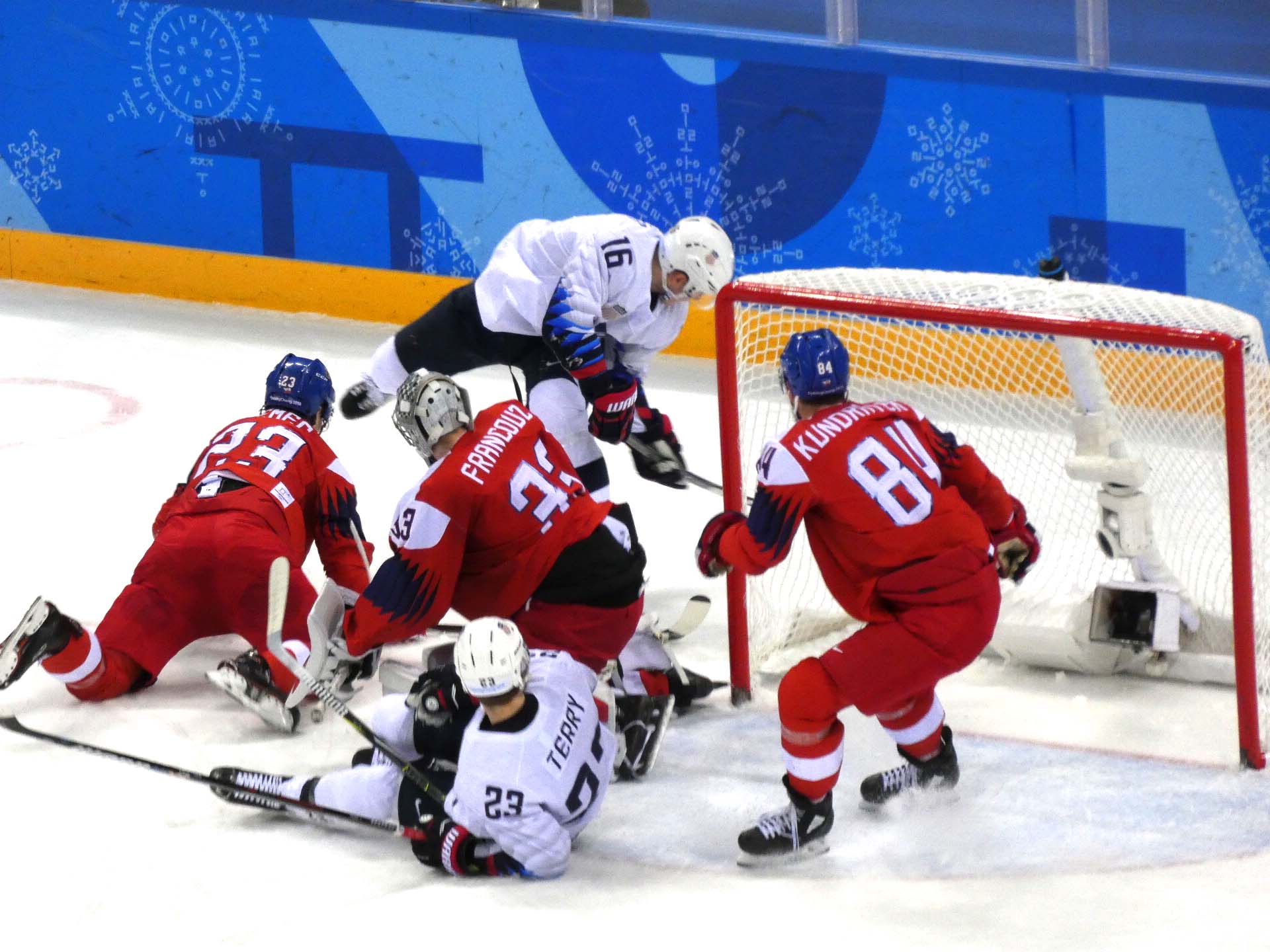
While the men’s hockey team for Team USA were eliminated in their quarterfinal tilt with the Czech team at the Winter Olympics in PyeongChang, the game was a one-goal game and had to be decided in a shootout in which only one goal was scored. That’s about as hard as you can push and still lose.
The players will have their “I should have…” moments, but in the end they most definitely left it all on the ice. And their goaltender, Ryan Zapolski will perhaps wish to have the one shootout goal he let through back. Their head coach, Tony Granato, wants them to hold their heads up though. He couldn’t say enough about what they accomplished in such a short amount of time.
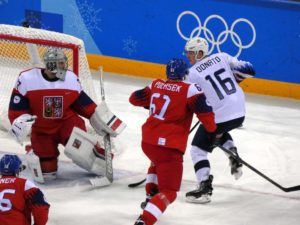
Ryan Donato
“Proud. We asked a lot of them. We asked a lot of this group. They came together from all different directions; all different points of their career with one goal,” Granato said after the loss. “And that goal was to make Jimmy Johansson proud, make USA Hockey proud, and represent the United States of America like we always do when we play hockey and play in tournaments and put our jersey on. And they did that. They left it on the ice. They played great teams.”
Many of the other teams were on a more even playing field in regard to their experience and familiarity with each other. Team USA was able to get to the Quarterfinals. When they took on the Russians, the only team they lost to in regulation, they gave up the fewest goals of any team that the Russians beat, which includes Team Norway whom the Russians eliminated in the second quarterfinal of the day.
“A lot of people weren’t happy with our Russian game because we lost four to nothing. We went stride for stride with that team. That might be the best team in the world right now,” Granato continued. “And we’ve got a bunch of college kids and guys that are playing professional in Europe and minor league players that did that because they’re American players that have pride in putting that sweater on. So, every one of them should be proud of everything they did here to represent us the way we wanted to be represented.”
With the exception of a period of time in the middle frame when the Czechs had the Americans on their heels, the game between the two was as evenly matched as you could get. Neither capitalized on the power plays, and even in the shootout, it was just a single goal in the shootout of the five they put on Zapolski.
And when the inevitable question came about did Coach Granato ever wonder how it would have gone if he had NHL players to coach, his answer was emphatic.
“No. We had 25 players here that was a team that was built to represent our country the way it was represented: Play hard, compete, leave it on the ice, represent us that way. We did that. So, we have a lot to be proud of,” he stated.
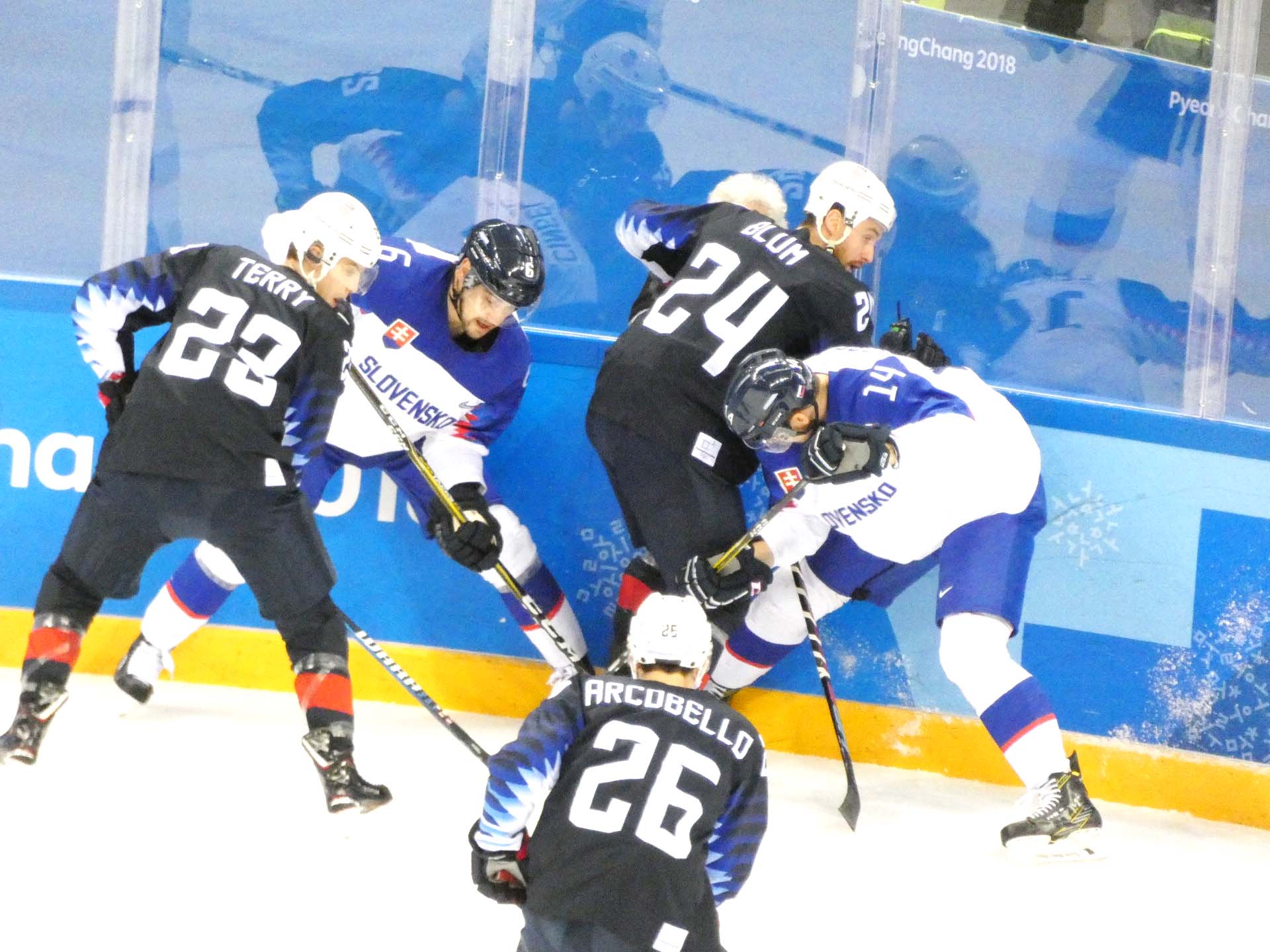
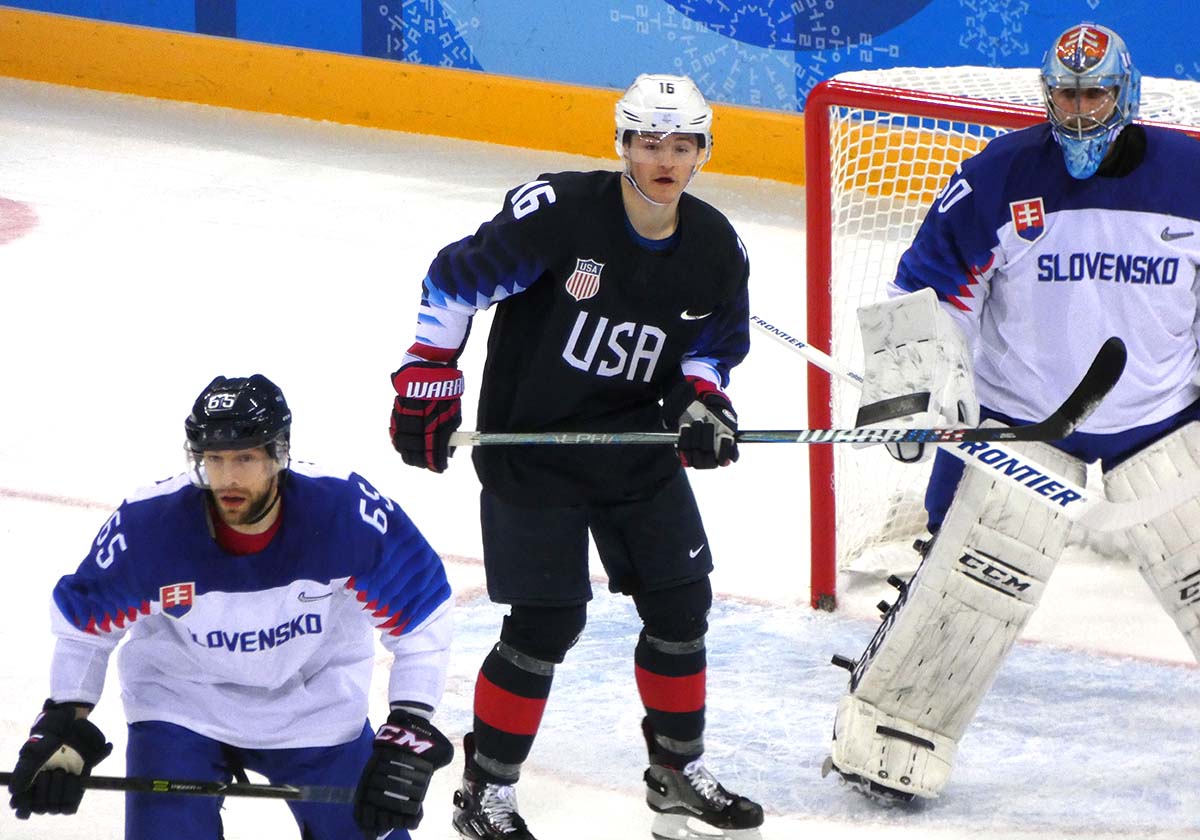
Team USA was in a do or die situation when the puck dropped against Team Slovakia on Tuesday afternoon. If they lost, that would be the end of their Olympic experience. However, the more games this team has played the better they have become. You can now see the cohesiveness that was missing at the beginning of this tournament.
Having played Slovakia once already in the round robin, they certainly knew what kind of a team they would be facing and what it would take to get the win. While they beat them in the first game, it was a one-goal differential. They needed to come out perhaps a bit harder and bury some of the chances they had missed in earlier games.
The first period was mostly a north and south affair with each team perhaps testing the goaltenders. Both teams took a penalty that neither opposition was able to capitalize on. Slovakia did have solid zone time in that first power play. The period would end scoreless, and a small margin of difference in the shots on goal.
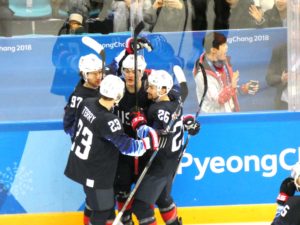
Celebration of Donato’s Goal
Ryan Donato would put the Americans on the board first 1:36 into the second period. This was his third goal of the games, and in seven periods, going back to the last time USA played Slovakia, he was the only goal scorer for Team USA. With a puck on his stick and a position to score, he will take the shot. Assists went to Matt Gilroy and Troy Terry.
“I think [the other goaltenders] probably say it’s deceiving how quickly he gets it off,” Team USA head coach Tony Granato said of Donato’s shot. “He snapped one off the cross bar the other night that he had the goalie beat from the top of the circle. He’s confident. He wants the puck to shoot it.”
Donato definitely sees himself as a shooter, but credits his line mates for the success he is having.
“Yeah, I think, I mean Troy [Terry] and Arco [Mark Arcobello] are unbelievable players. They see the ice great and I think if I can get myself open and in position, they’re going to find me,” Donato shared. “I mean, they’re great players. I think if they put me in positions to score, we’ll continue to create goals. I mean, both those guys can finish and create plays at the same time, so they’re great to play with.”
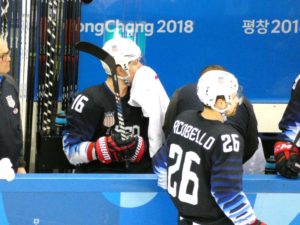
Ryan Donato
Twenty-six seconds later, there were some tense moments as USA’s goaltender Ryan Zapolski, who had been run into by Ladislav Nagy, was down on the ice and it wasn’t clear if he would be able to continue in net, though after a few minutes he was back up and able to play. Meanwhile at the other end of the ice, Donato was down on the ice, also being tended to by a trainer, after having eaten Michal Cajkovsky’s elbow. The outcome was a five-on-three for the Americans while Nagy sat for two, and Cajkovsky was given a game misconduct as a result of the five minute major penalty of checking to the head. Nagy was freed 18 seconds later, when James Wisniewski scored on the five-on-three, assisted by Terry, who now had two points in the game.
Though the USA didn’t capitalize on the remainder of the five-minute major, this turned out to really be the turning point of the game for the Americans. Ten minutes after Wisniewski’s goal, Arcobella would get the United States up 3-0, again assisted by Terry. Arcobella’s shot from the slot spoke to the building confidence of this team.
Slovakia would get on the board with 3:16 remaining in the second period while on the power play. USA’s Jordan Greenway was whistled for his first of two penalties in the game. This one was a slashing. And as the second period ended, USA would be leading 3-2, while the shots for the period would be equal at 11 a piece.
The third period saw a couple of penalties that in essence canceled each other out, as the teams would play about 1:09 of four-on-four hockey. Team USA was definitely pushing back. Greenway would sit for tripping in his second penalty, which fortunately Slovakia was unable to do anything on the man advantage. And when Marek Daloga was sent off for slashing, it would take Donato and the power play less than a minute to score their fifth of the game, this one assisted by Wisniewski.
Though just 21 years of age, Donato possesses a calm in big stage games that will certainly see him well. He is willing to get in front of the goaltender and be available. He understands what it takes to win hockey games.
“We put him on a pretty significant line and gave him a power play role right out of the gate, so we had the confidence that he had…. We saw what he’s done in college. We’ve seen him at different camps. We know what he is capable of doing,” Granato said of Donato. “So, when he gets to that stage for the first time, you never ever know, but, like I said, his dad’s an NHL player and coach. So he’s grown up in NHL locker rooms. He’s seen everything about it, so he gets it. He’s a pro.”
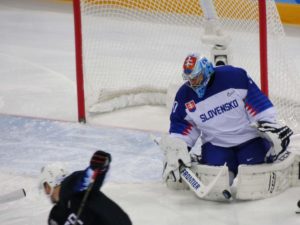
Jan Laco
Their shots on Jan Laco were greatly improved in this game, many of them coming from close to the crease, often in the slot, rather than from the boards. This undoubtedly contributed to the increase in scoring.
“We came in with the intentions of being confident and not just being worried about going home,” Donato expressed. “I think If we played on our heels and kind of played worried it kind of would have affected our game. I think we just played confident and the chemistry is just continuing to grow and it’s finally meshing.”
They will need that confidence and chemistry on Wednesday, when they take on the Czech Republic in the quarterfinals. A more offensive team than Slovakia, the USA will have to use every skill they have in each player if they want to continue to the next round.
“They’re a little deeper offensively. But I think we’ll learn from our team,” Granato said of the upcoming game. “It doesn’t matter what the other team does. We have to attack. We have to forecheck. We have to use our offensive players that we do have; the skill set we do have. They’re small, they’re quick, they’re fast. They’re hard to play against in the offensive zone and that’s what we’ll have to tackle tomorrow.”
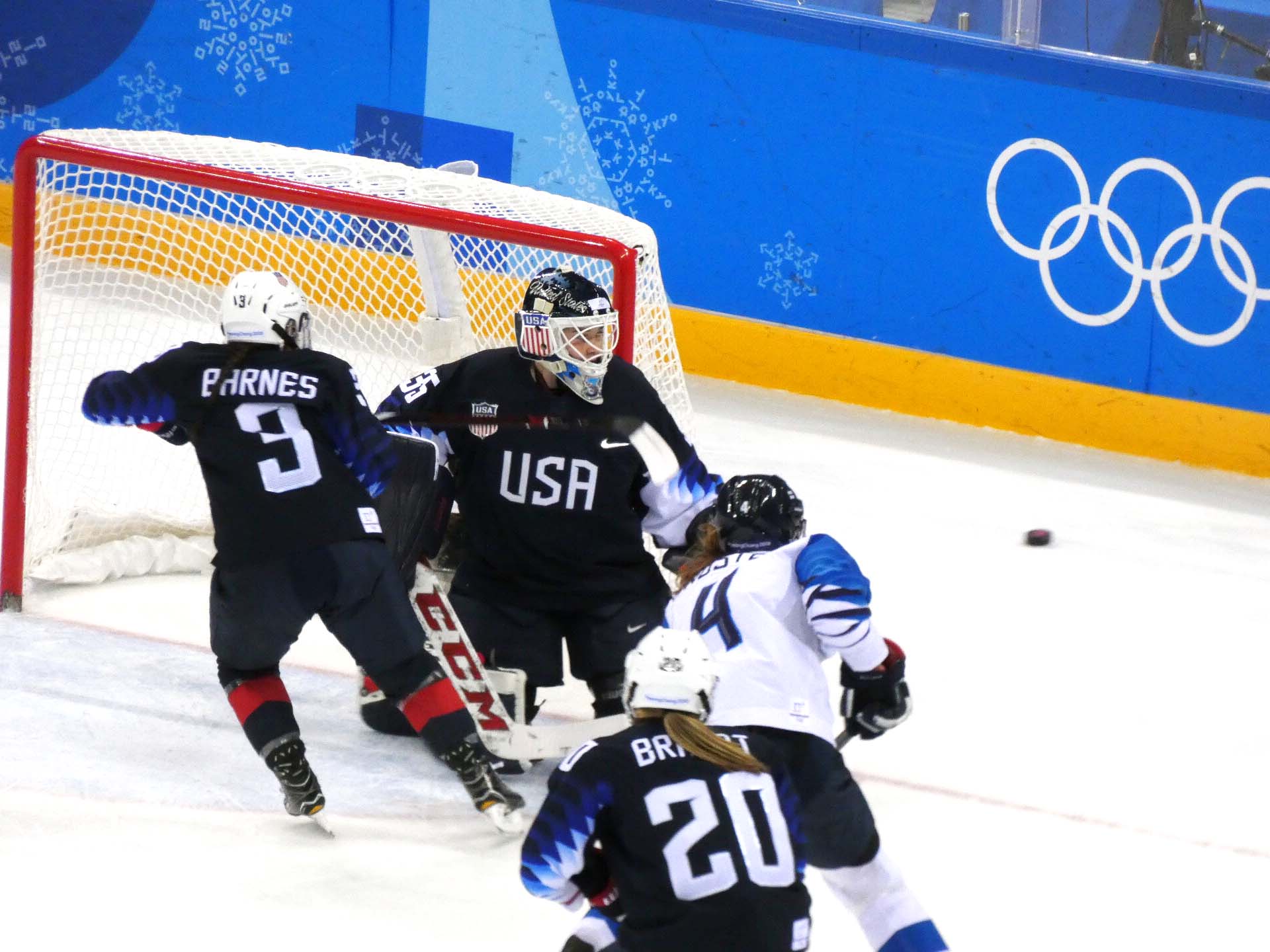
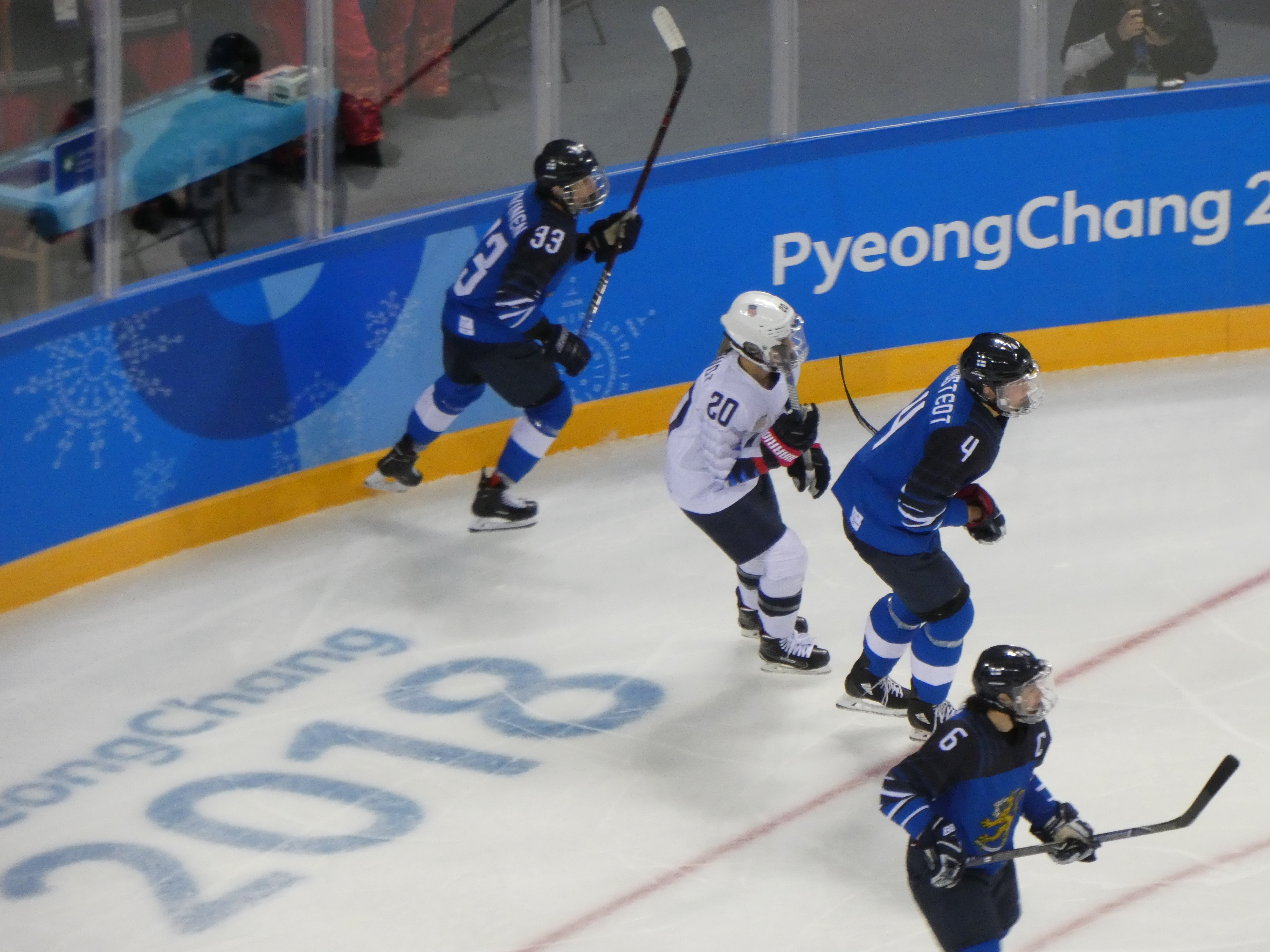
The semifinal game between Team USA and Finland that took place on Monday afternoon at the 2018 Winter Olympics in PyeongChang was a different game than their round robin tilt, with the exception of the shots on goal, which were still lopsided in the American’s favor. However, at the other end, USA’s goaltender Maddie Rooney didn’t let any of Finland’s shots get past her for the shutout.
The Americans came out hard and never really dialed it back throughout the game. Their first goal came 2:25 into the opening frame from Gigi Marvin. Meghan Duggan gave a nice feed from behind the net to Marvin who was out in front. Amanda Pelkey got the other assist.
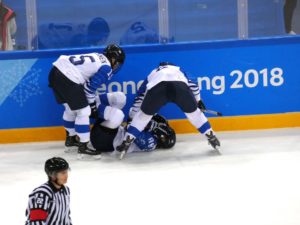
Ronja Savolainen
There was a stoppage of play about half way through the period, after Duggan and Ronja Savolainen got tangled up and Savolainen went crashing into the boards and was clearly in pain on the ice. During the replay it looked like a knee-on-knee collision, though there was no penalty called on Duggan, and head coach Robb Stauber was not worried about a suspension. Savolainen was helped off the ice, but fortunately would return to the game in the second period.
As the Americans started the period, so too would they finish it – this time Dani Cameranesi, unassisted off a nice takeaway would put the United States up 2-0 going into the first intermission. Like all of their games, the US women were outshooting their opponent. At the end of the first it was 11-2 in favor of USA.
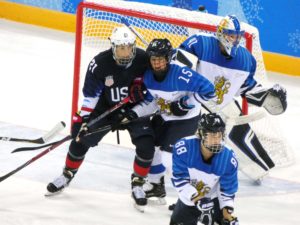
Hilary Knight and Noora Räty
In the first two minutes of the second period, the Finns saw two penalties called on their players 37 seconds apart: Sara Sakkinen for and elbowing and Rosa Lindstedt with a cross-check. Team USA would score with two seconds remaining in their five-on-three, this time it was Jocelyne Lamoureaux-Davidson, assisted by Kelly Pannek and Pelkey. The Americans still had 38 seconds remaining on the second penalty, and once again as the penalty was winding was winding down, the United States would take advantage, this time from Hilary Knight who was standing in front of Noora Räty’s crease, with the tip from Sidney Morin. Kendall Coyne got the other assist on this one. All of this took place before the second period was even five minutes in. Three more penalties, two on the Finns, and one on the U.S., on which neither side could capitalize finished out the period. Though Team USA would take 1:42 of man advantage time into the third from the second penalty on the Finns. The shots on goal, probably because of the number of penalties to Finland was an astounding 18-7 for a total of 29-9 in forty minutes in favor of the Americans.
Coming out in the final twenty, Team USA proved that giving them a power play can be dangerous. Once again they capitalized. This time it was Cameranesi, with her second of the game, just 45 seconds into the period, assisted by Hannah Brandt and Amanda Kessel. This period was perhaps the most even after the goal, in regard to shots and overall play, with Finland trying to increase their pressure which resulted in a lot of north and south play.
It is so clear how hungry this USA women’s team is. And it is that hunger coupled with their amazing skill that will once again take them to the medal round. Since women’s hockey has been added to the Winter Olympics in 1998, Team USA has medaled in each of the Winter Games. They currently have one gold (1998), three silver (2002, 2010, and 2014), and one bronze (2006). They have lost to the Canadians in the Gold Medal game in the previous two Winter Olympics, and they lost to Team Canada in the round robin. They undoubtedly are hungry for the gold. The question is, can they fix what went wrong in the earlier game, and contain the Canadians? That will be answered when the two teams take to the ice in the Gold Medal game on Thursday afternoon.
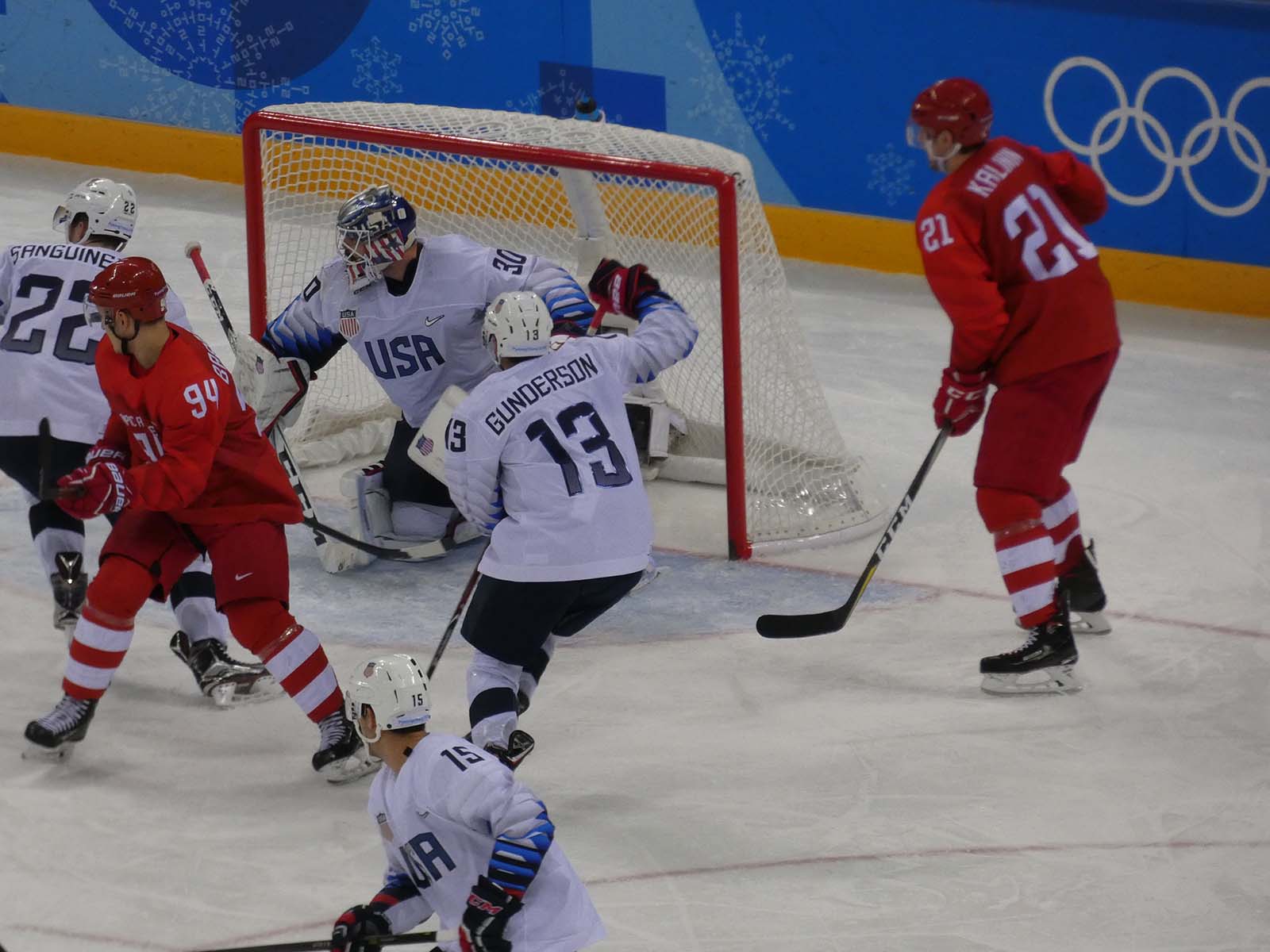
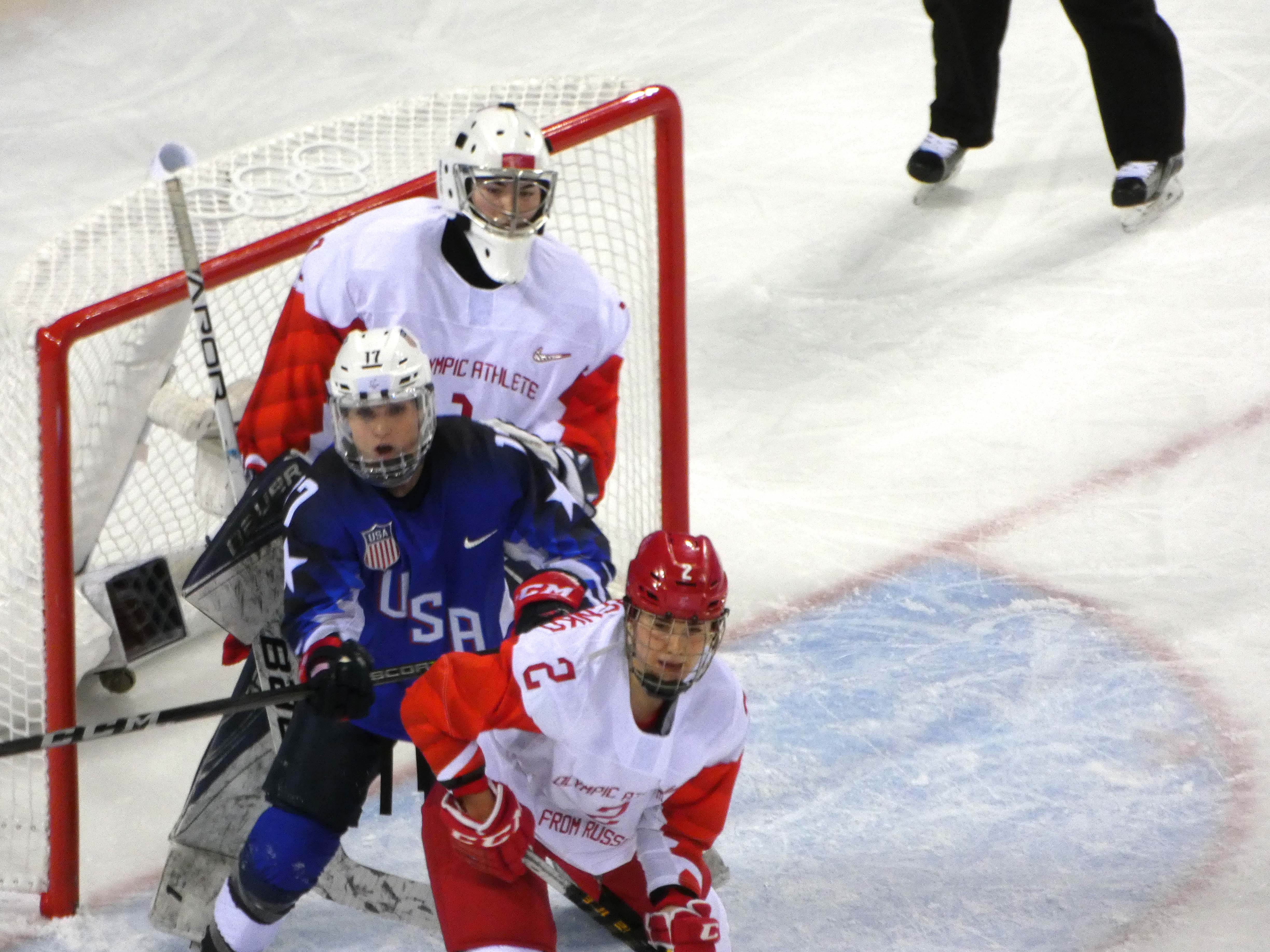
There was a feeling to this game of the 2018 Winter Olympics at PyeongChang that harkened back to the days of the Cold War where the feelings of the fans of each country against the other were intense, and the animosity of the players was real. The crowds at Saturday’s preliminary round game between the Olympic Athlete of Russia (Team OAR) and Team USA were already deafening as soon as the puck dropped. As for the players, one has to wonder how they could hear whistles and shouts from their coaches.
From the first puck drop, both teams came out strong, and it was good to see the Americans outshooting Team OAR at the beginning, but they soon let up. Russia began to rule the ice, getting some quality zone time which ultimately worked in their favor, as Sergei Mozyakin from the right circle saw an unguarded Nikolai Prokhorkin in front of the American net with a wide open back door. Tape to tape and it was 1-0 Russians 7:21 into the opening period.
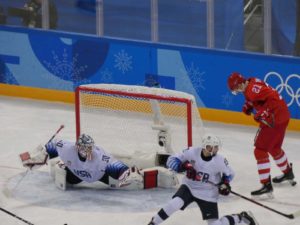
Ryan Zapolski and Troy Terry
Just after the Russians scored, they found themselves in the penalty box, as Sergei Kalnin was called for a tripping. Unfortunately, the American’s power play was anything but. Russia was able to hem them in for a good deal of the first part, and then USA just never got their special team together.
With just 26 seconds remaining in the period, USA’s Noah Welch was whistled for a hooking. And by that point the Russians were already getting the longer zone time and most certainly had more quality shots on goal. Going into the first intermission the score was still 1-0 Russia, and the shots were 13-11, but many of the American’s shots were easily stopped by Vasili Koshechkin.
The second period began with the Americans still killing Welch’s penalty, which they managed to do. However, just 2:14 in and the Russians were up 2-0 as Prokhorkin got his second of the game. And then 14 seconds later Welch was back in the box, this time for high sticking. The Russians had some quality time in the offensive zone as it took the Americans 1:14 of that penalty kill to clear the puck from their end.
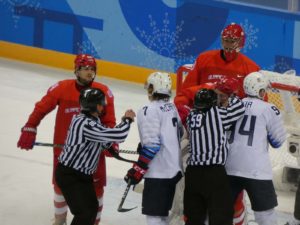
After whistle activities.
Not surprisingly the pushing and shoving–which had been going on much of the game–began to increase. With 5:49 gone in the milddle frame, Ryan Donato was whistled for a slashing penalty and Vladislav Gavrikov got a roughing, so the two teams played four on four. A delayed penalty was coming to the Russians and Ryan Zapolski had gone to the bench for the extra attacker. Brian Gionta had the puck on his stick and was on a breakaway, but he couldn’t get it in the net. This was a shot that the Americans needed.
There was a brief four-on-three for the Americans when play finally stopped and Nikita Nesterov was whistled for a holding penalty. Once again Team USA couldn’t make anything of the power play. And then while they were on a five-on-four finishing out Nesterov’s penalty, the Russians got an odd-man rush. Fortunately, Zapolski denied them.
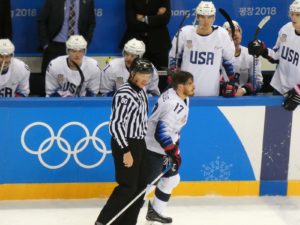
Chris Bourque
The pushing and shoving continued after many of the whistles. With 1:31 remaining in the period, USA’s Chris Bourque was sent to the box for a slash, while Prokhorkin got a roughing. And roughing it was. Bourque’s helmet came off and the two were still yapping at each other as they headed to their respective penalty boxes.
Another bit of four-on-four, but for the Americans this one would not result in them getting a power play as the earlier one had. This time they would hear Russia’s goal song, “Those Were the Days,” played as the Russians scored their third goal, off the stick of Ilya Kovalchuk, a name all too familiar to NHL fans, with .2 seconds remaining on the clock. Certainly not the way the United States wanted to end the period.
One would have expected the Americans to come out breathing fire in the third, but instead, it was the Russians. It was once again Kovalchuk with the goal, this time 28 seconds into the third period. From that point it was all but done for the Americans, though to their credit they continued to play hard.
So, what went wrong for the Americans? Their inability to finish was a big part of the problem. The Russians were just too much team for them. The shots Team USA did land on Koshechkin were often well to the outside, and seldom was he screened.
America’s loss to Slovenia in that first round robin game was a game they couldn’t afford to lose, even in overtime. Things aren’t over yet for the United States. They will play in one of qualification games to see if they can make it to the quarterfinal round. Those games will take place on Tuesday.
There is work to do for Team USA.
Friday afternoon, after having been handed an overtime loss by Slovenia on Wednesday night, Team USA certainly needed a win. Slovakia beat the Olympic Athlete from Russia in their opening tilt of the preliminary round, so they were looking to repeat.
While the tempo of the skating was good, the Americans weren’t able to get their first shot on net for the first 6:10 of the opening period. Such delays in testing the opposing goaltender are not an especially strong way to play and could hurt the Americans in future games.
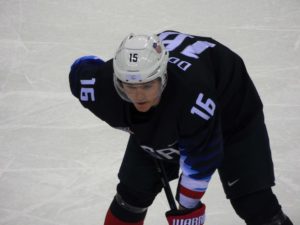
Ryan Donato
Marek Horvaka of the Slovenian team would be whistled for a hooking penalty 41 seconds after Team USA made their first shot on goal. Nineteen seconds later, Ryan Donato would get the Americans on the score board, assisted by Troy Terry and Chris Bourque. Unfortunately USA would not be able to enjoy the lead for very long. Just 25 seconds later Andrej Kudrna would get the equalizer for Slovakia, assisted by Tomas Surovy and Michal Cajkovsky.
Slovakia would find itself down a man once more in the first period, when Ivan Baranka was sent to the box for a boarding penalty. Team USA was unable to capitalize on this power play. As the period wound down, the score was tied at one each, but the shots on goal were 8-6 Slovakia.
Early in the second period, the United States had a couple of chances, one of which Jan Laco denied, and the other that was blocked. There was some north and south play, and Slovakia did its best to get ahead in the match. They would be hampered by two additional penalties; a high sticking call on Milos Bubela and a holding penalty to Juraj Valach, Neither time were the Americans able to capitalize. Jordan Greenway would be called for the first penalty on the Americans, for a goaltender interference, which seemed hard for him to avoid given how he was being forced over by a Slovakian player. Captain Brian Gionta tried to plead the case for his young teammate, but, as usually happens, the penalty call stood.
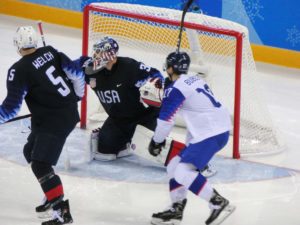
Ryan Zapolski
Perhaps the most disturbing moment of the game was about halfway through the period when the puck was in the USA’s end, and it was just sitting there dangerously in front of Ryan Zapolski and the American net. No one on the USA team was moving toward the puck to move it as Slovakia swooped in on the opportunity. Before the Americans realized the puck was just sitting there, Slovakia had made a shot. Fortunately for Team USA, the Slovakian shot went wide. But it could have put the US behind despite their outshooting their opponent at that point in the period 11-2.
The third period got underway with an up-tempo pace. Unfortunately for Slovakia, they found themselves back in the box—this time for a bench minor of too many men on the ice. Team USA wasn’t on the power play long—just seven seconds—before Donato again put the puck behind Laco, this time assisted by Bourque and Mark Arcobello. The Americans were up 2-1 and were two for five on the power play. The key would be denying Slovakia the opportunity to tie the game again.
Twenty-two seconds after Donato’s go-ahead goal, Terry would be sent to the box for high sticking and the Americans would need to have an aggressive penalty kill to keep their lead. The United States met the challenge, but there was still almost 15 minutes remaining in the final frame.
Donato wasn’t just sitting on his laurels having gotten the two goals in the game. No, he was aggressive on defense as well. One particularly timely move was a smart takeaway with about 11;30 remaining in the period.
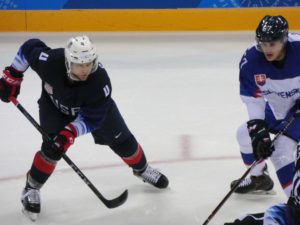
Chad Billins
As the clock continued to count down, the Americans continued to increase their pressure to prevent Slovakia from getting the equalizer. With seven minutes remaining they were doing a great job of holding the Slovakians in their own end. And though the chants of “USA! USA1” had been raucous throughout the game, they became even louder, even as the Slovakian chants were now all but nonexistent.
At one point when Slovakia did get into the offensive zone, America’s Chad Billins did an impressive job of hounding Matej Paulovic along the boards while he had the puck, thus preventing the Slovakian from getting any opportunity to make a play.
Team USA hung on to take the win 2-1. They will want to work on getting more shots on net when they take on the Olympic Athlete from Russia team on Saturday night. They will also want to make simple stick-to-stick passes and the definitely cannot lose sight of the puck and who has it at any point in the game. The Russians are advantageous and tenacious and will certainly make the Americans pay for any mistake. The Russians are coming off a slaughter of the Slovenians in their 8-2 win which will have certainly increased their confidence.
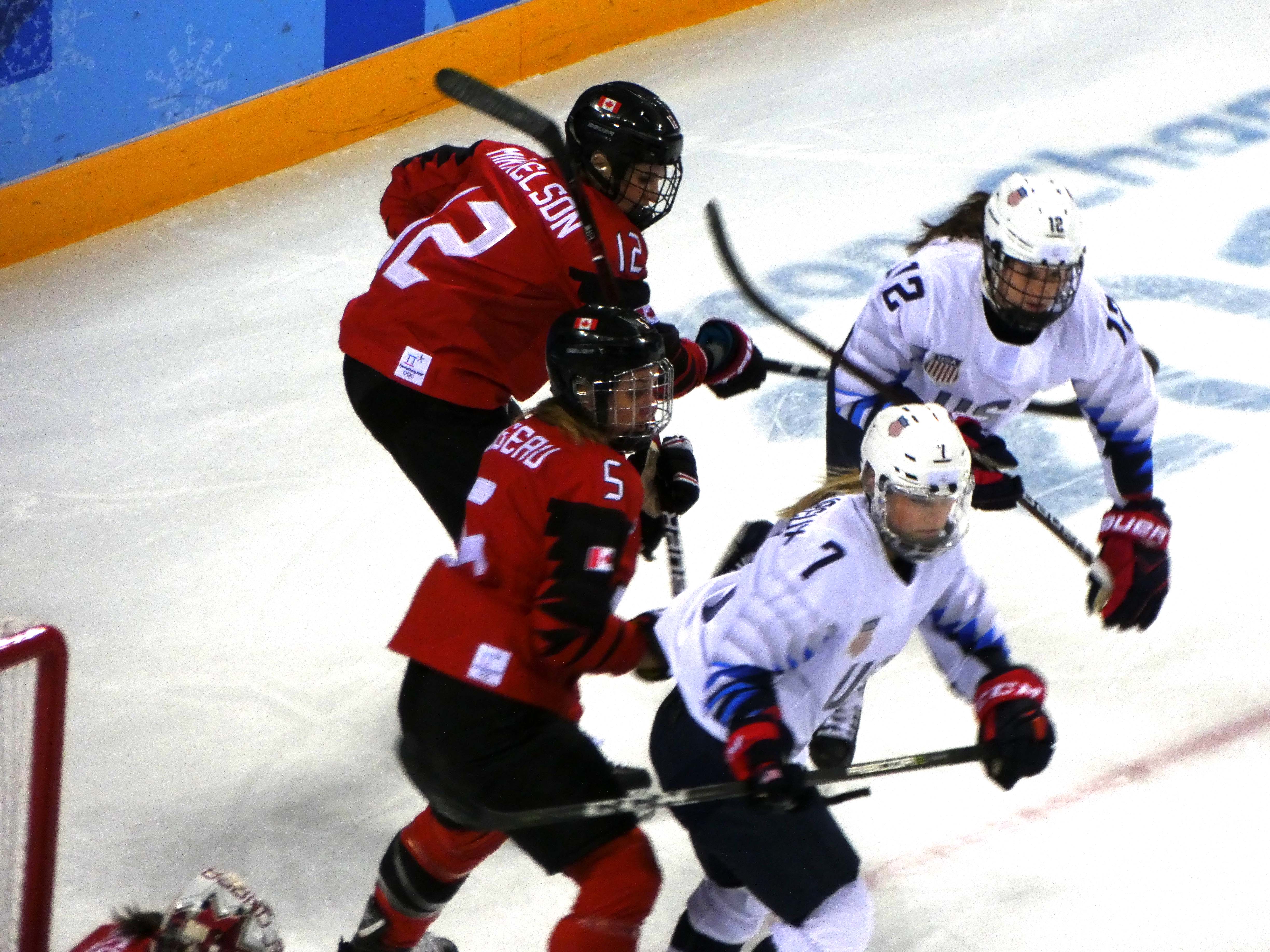
One of the biggest anticipated preliminary games in Women’s Hockey was Team USA and Team Canada which took place on Thursday evening at the 2018 Winter Olympics in PyeongChang. These two teams have met across a sheet of ice a number of times, especially in the Olympics. Since women’s hockey was added to the Olympics in 1998, Team Canada has won four gold medals (2002, 2006, 2010, 2014) and a silver medal (1998); while Team USA has won a gold medal(1998), three silver medals (2002, 2010, 2014) and a bronze medal (2006). Most consider the preliminary game for these two to be a preview of what the Gold Medal game will look like. And as the two teams were undefeated coming into Thursday night’s game, they are most likely correct.
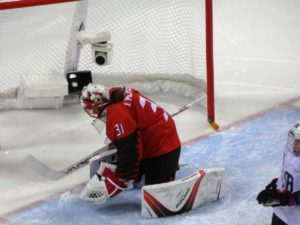
Geneviève Lacasse
One of the things that was noticed in this game was the number of higher quality chances that the Americans had throughout the game, unfortunately they struggled to find ways to solve Canada’s goaltender Geneviève Lacasse, in her Olympic debut. Whatever Canada is doing with their goaltender training, they are clearly wizards at it. Throughout the game, the Americans pummeled Lacasse with 45 shots and she let in only one.
At the other end of the ice, Maddie Rooney saw 23 shots throughout the game and allowed three goals, which included one while Canada was on the power play. There were two other pucks that got by Rooney that upon review were disallowed. The first, 3:15 into the first, was disallowed because the whistle had already blown. The second took place at 10:52 of the third period when it was determined that Haley Irwin kicked the puck into the net, rather than having it simply ricochet off her skate.
Team USA’s struggles on the power play and finishing were ultimately what resulted in their loss on Thursday. However, there was also a certain lack of puck luck for them as well. Hitting a couple of posts during the game, and then when Jocelyne Lamoureux-Davidson was awarded a penalty shot—the result of a Canadian player putting her hand over the puck in the crease—she was unable to get it past Lacasse.
And it is interesting that these two teams saw each other last April during the 2017 IIHF Women’s World Championships in Plymouth, Minnesota, and the Gold Medal game saw them equally matched in an exciting game that went to overtime, before the Americans won. So for Canada to outscore Team USA to such a degree was slightly unexpected.
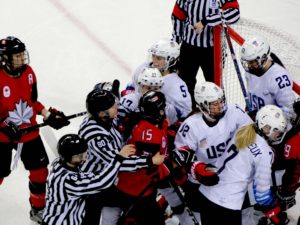 Given how often many of the players on these two teams have seen each other in the past four years, the last time Canada took the gold and left silver for the Americans, there has been a bit of animosity built up between them. Players who off the ice are friends become arch rivals when the jerseys are put on. And Thursday’s game was no different. During the second period there was a scrum of men’s hockey proportions in front of Canada’s net. And perhaps not so surprising was the almost line brawl that erupted right after the game ended.
Having played Canada, the Americans know what they must fix before they most likely see them in the Gold Medal Game on Thursday. In the meantime, both must wait as the quarterfinal games are played on Saturday, February 17, to see who their opponents will be in the semifinals which will take place on Monday afternoon and evening.
The Olympic Athletes of Russia will play Switzerland first and then Finland will take on Sweden in the quarterfinals. The winners of these two games will then reach the semifinals against Canada and the United States. The losers will be relegated to the classification games and one each will play Korea or Japan.
Team USA has already been labeled “Mystery Men,” and had to field questions about if they are hoping that a gold medal at the Olympics will perhaps open the door to the NHL for some of them. First, none of the hockey teams at the 2018 Winter Olympics at PyeongChang have headliners on their rosters, with the exception of the Russians. The NHL refused to allow any of its players to participate—including those with a two-way contract. Second, as every player would state, they aren’t thinking past their next game. They are just elated to be able to represent their country, an opportunity that many didn’t believe would be possible.
In the case of the Americans, their players have come from many different teams and leagues around the world. While they have used technology to get to know each other and the systems to be played, they had a mere four practices before the puck dropped on their first round robin game against Slovenia on Wednesday night.
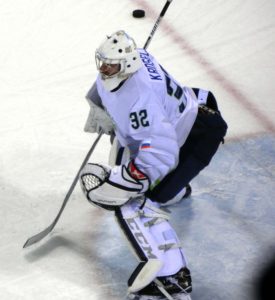
Gasper Kroselj
Team USA came out hard and fast, with contributing the first three shots on Slovenia’s goaltender, Gasper Kroselj. Ryan Donato, who had one of those shots, tried a wrap around, but Kroselj was able to get to the post and keep the puck out.
As the period continued, the play got a little choppy, as first Slovenia’s Luka Vidmar was whistled for playing with a broken stick, and then before the Americans could even set up their power play, James Wiesniewski found himself heading to the box for high sticking. Neither team was able to capitalize on their abbreviated power plays.
At one point while the teams were playing four-on-four, USA’s goaltender, Ryan Zapolski, was way out of position and out of his net, and Slovenia had a wide-open net to shoot on, which they did. Defenseman, and assistant captain, Noah Welch, slid into the crease and managed to block the shot denying them a scoring opportunity.
Marcel Rodman would be sent to the box on a tripping penalty and once again Team USA would go on the power play. Again, they would be unable to capitalize, though they did have a couple of good looks.
The Americans were spending some quality time in the offensive end, and eventually they were rewarded for their efforts as Brian O’Neill got Team USA on the scoreboard first with 2:16 left on the clock. As the horn signaled the end of the first period, Team USA was leading 1-0 and outshooting the Slovenians 11-3.
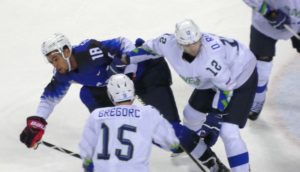
Jordan Greenway
The second period saw Jordan Greenway, who was already making history by being the first African-American to play for Team USA at the Olympics, put his team up 2-0. However, a tiny shift of momentum was taking place as the period continued. The Slovenians were getting more chances to shoot on Zapolski. While the score remained 2-0 in favor of USA and the two-period shot total still looked impressive for the Americans at 24-12, that was more the result of the lack of shots for Slovania in the first. The shots on goal during the second period were 13-9, showing a much closer game than it looked. And while they had dominated much of the puck control in the first, Team USA was not connecting on some of their passes, which could might be attributed to their lack of time together in game situations.
The tempo of the third period showed the resolve of the Slovenians. And they would figure out how to get a puck passed Zapolski, as forward Jan Urbas cut USA’s lead in half 5:49 into the third period. Slovenia not only gained confidence from this goal, but the moment shift in their favor became even more apparent.
With 14:11 remaining in regulation, Slovenia went to work to try to get the equalizer. In most any other undertaking, 14 minutes would not seem like a very significant amount of time, but in a game of hockey that is almost infinite. A lot can happen in such a span of time. Games can change in seconds.
In the case of this game, the clock ticked down to 1:37, perhaps lulling Team USA into believing they had the game in the bag. But hockey games are 60 minutes, and the team that doesn’t play for the full sixty is usually the team that loses. At the very least such a team may find itself going to overtime, if it is a one-goal differential. Such was the result between these two teams as Slovenia’s captain Jan Mursak got the equalizer.
The game would need extra minutes, and the two teams faced off in a three-on-three, five-minute, sudden death overtime. Mursak would need only 38 seconds of that extra inning to get the win for Slovenia along with his second goal of the game, and send many questioning the choices of the men’s roster of Team USA.
It was certainly not the outcome that the Americans wanted, but they suit up again Friday at noon to take on Team Slovakia—who will not have Zdeno Chara as a defenseman this time. Obviously there are some things that the USA will want to address, and no doubt they will watch video on where things went wrong. Their strength will be shown in how they come out against the Slovakians.
After a close game with Finland on Sunday, the women’s team took on the Olympic Athletes from Russia. It was clear that the confidence that grew as their game against Finland went on had carried over into Tuesday’s game.
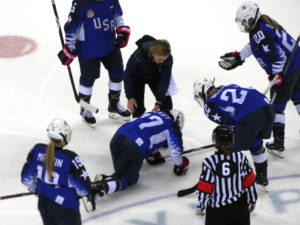
Amanda Pelkey
The game began with some north and south action and little else in the opening couple of minutes. A mid-ice collision between Amanda Pelkey and one of the Russians resulted in her on the ice moving slowly and struggling on all fours. The trainer went out to her, and eventually she did get up and went to the bench. She continued to play.
There was only one good chance for Team USA from Hilary Knight in the first 7:30 on ice, which had seen only three shots on either goal; two for the US and one for the OAR. However, once Kacey Bellamy scored from the right circle, off a pass from Jocelyne Lamoureaux-Davidson about 30 seconds later, the Americans got a burst of momentum, and in the next four minutes had put the puck on OAR’s Valeria Tarakanova three more times while denying the Russians any return opportunities.
With 6:19 remaining in the opening period, Northeastern University alum, Kendall Coyne, was whistled for a hold. However, it appeared that after being held, Lyudmila Belyakova had a problem with her right leg. She was seen being tended to by the trainer on the bench. She continued to play throughout the remainder of the game, though the trainer did appear to be discussing it with her at a later point in the game.
Team USA was strong on the penalty kill and soon Coyne was out of the box and the Americans were at full strength.
When the horn sounded the end of the period, the score was 1-0 in favor of the USA, and the shots on goal were 7-2 also in the Americans’ favor.
During the second period, USA’s Nicole Hensley denied an excellent opportunity from Russia’s Diana Kanayeva, who inexplicably was given a lot of time and space to get the shot off. Later Monique Lamoureaux-Morando tried a behind the back pass that connected with a Russian stick, and back the puck went toward Hensley. Fortunately, the USA had layers back who kept any shots being made on Hensley.
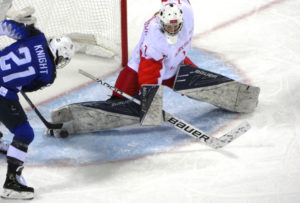
Hilary Knight and Valeria Tarakanova
The U.S. would get a power play, when Nina Pirogova was whistled for a cross-checking at 7:32 of the second, which the Russians would kill. Four and a quarter minutes later Lamoureau-Morando would redeem herself for her earlier giveaway when she put the United States up 2-0. And six seconds later, she would get her second goal of the game, making a nice fake that froze Tarakanova on her belly allowing Lamoureau-Morando to lift it up and over blocker side. At that point it seemed like the Americans knew they were in complete control of the game and were deteremined to keep going. Ninety seconds later it was 4-0 and the end of Tarakanova’s time between the pipes. Back up Nadezhda Morozova would step in for the Russians.
It may have been the frustration of the score, but the Russians were either getting caught taking penalties or were simply losing some of their discipline. Maria Batalova got a slashing penalty with just under five minutes remaining in the period. Team USA was unable to capitalize. A few minutes later Batalova found herself back in the sin bin, this time for a high stick, with 1:16 remaining in the period.
As the horn sounded the end of the period, the United States was still on the power play, not having been able to score. However, the score and the shots on goal for the period showed how they dominated the Russians. The shots in the second were 24-7 USA, for a two-period total of 31-7.
As the third period began, once again USA was not able to capitalize on the power play; something that could hurt them as the Olympic games continue. However, their domination of the game, in general, continued. It looked like they had a fifth goal, from Hannah Brandt, but upon review, it went in off her glove and was ruled a hand pass. That didn’t slow down the Americans, who continued their firing assault on Morozova, who saw an additional 19 shots in the period—the first 12 coming before the halfway mark of the final frame.
As the clock ticked under two minutes remaining in regulation, the United States put one last puck in. This goal would count. Megan Keller made a nice pass to Dani Cameranesi, who, despite going down on the ice at the time, shot it on the stick of Brandt. It seemed only fitting that Brandt got the goal, since it was her earlier one in the period that was taken away.
If you haven’t watched women’s hockey, then you really don’t know what you are missing. Not sure if people think it is too “light weight” or that they might be afraid to break a nail, but the reality is these women are committed to the game. And in some ways one might suggest that given the limited professional avenues available that they play for the pure love of the sport. This sometimes makes for a much more interesting game.
Team USA’s women started their round robin by taking on Team Finland in the 2018 PyeongChang Winter Olympics. The goaltenders were Noora Räty for Finland and Maddie Rooney for the USA. Räty is one of the best female goaltenders, and some might even say she is one of the best in general. Four years ago, Räty announced her retirement—not because she was too old or had lost love for the game, but for the simple fact that she needed to make a living. About a month later she signed with a men’s team, as have other female goaltenders–the only position that has this option. She played three seasons with men and then this current year she joined the Kunlan Red Star of the CWHL. With them, she has played in 16 games and has a 1.52 GAA and a .947 save percentage. Those who play in front of her are hardworking players from a number of different teams; some professional, while a few are playing at the collegiate level.
Of course, Team USA is a determined group as well. Many of them have represented the United States in a number of tournaments together and some of them now play on NWHL teams in North America. Names such as Hilary Knight, Kendall Coyne, and Amanda Kessel are just a few of those who continue to be able to live their dream as a result of the inception of that second women’s professional league. And like the Finns, they have their fair share of college players.
It was clear as the game began that Team USA didn’t yet have their legs. This was evident in their first power play when it took them most of the first minute just to gain the zone—the result of two offsides whistles. On the other side of the ice it took Team Finland some time to find their rhythm as well, they went more than four and a half minutes before getting their first shot on Rooney. By that time, Team USA already had four shots at Räty.
For much of the first period it appeared to be USA that was the better team, though they had not been able to get on the scoreboard. As the clock began to wind down to about 2:30 remaining, Team Finland mounted some pressure, and with just six seconds remaining in the opening frame, Venla Hovi, from the slot got it past Rooney.
When the second period began, Finland got a bit of a toe-hold in the USA end after Team USA iced the puck. However, when Finland’s Tanja Niskanen got whistled for interference, the Americans picked up their pace a bit, spending almost the first full minute in the offensive zone. It was during this point in the second period that it looked like Team USA was struggling to finish, they were 0-2 on the power play.
A breakaway by Finland’s Michelle Karvinen looked like it could put the Finns up two, but she was hauled down by Knight. It was interesting that no arms went up from either referee. That would have been whistled for sure in the NHL.
What was the same as the current season in the NHL was the faceoff violations. There were a few kicked out throughout the game, though no minor penalties resulted.
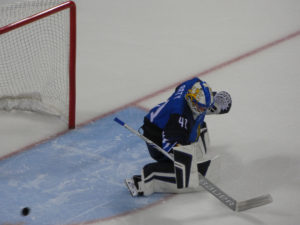
Noora Räty
At one end Räty gloved a shot from Hannah Brandt that was going wide. Down at the other end Rooney denied Susanna Tapani. It looked like it was going to come down to a battle of goalies. In addition to both goalies standing tall early, the physicality between the players was beginning to ratchet up. In fact during the second period one of the referees had to go talk to the Finnish coach and give a warning after Rosa Lindstedt used her stick on USA’s Monique Lamoureaux-Morando and followed it up with a facewash..
By the end of the second period, USA had begun to impose its will on Finland. They had outshot Finland 23-5 in the middle frame, bringing the shots on goal for the two periods to 34-14 and the score was 2-1 in favor of the Americans. Team USA had tied the game 8:58 into the second, as Lamoureaux-Morando, unassisted, from the short side, got the puck past Räty. Two and a half minutes later, Coyne got the first power play goal for Team USA, and the go-ahead goal, assisted by Knight and Brianna Decker.
The third period began with Knight putting a slap shot on Räty that she saved, and then it was Carla Barnes with a quality shot from the right circle that almost got past the Finnish goaltender. In the first four minutes of the period, Team USA had four shots on Räty, while Finland had failed to get any on Rooney.
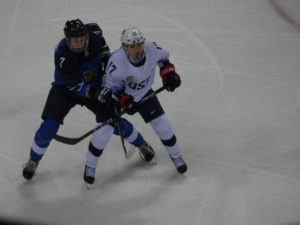
Mira Jalosuo & Jocelym Lamoureaux-Davidson
USA spent a good part of the first half of the third hemming in the Finns. Even when the Americans did make a mistake, they were quick to fix it. When Finland almost had a breakaway, a quick poke check solved the problem.
The Americans had been very disciplined in the first forty minutes of play, but with 12:05 remaining in regulation, and only up by a goal, Decker was called for interference. Coyne and Kessel would attempt a short-handed bid that richocheted off the lone Finn back and out of harm’s way.
The Americans did have a moment when it looked like the score might be tied. Rooney thought she had the puck between her pads, but instead it had actually squirted out behind her and was still in motion. Fortunately for Team USA, her angle to the net was such that it didn’t end up in the net.
With under six minutes to go, Coyne almost had her second of the game, but Räty squeezed her pads, and then gloved the rebound before anyone with USA on their jersey could make a move on it.
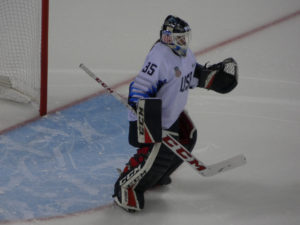
Maddie Rooney
With just 4:37 remaining on the clock Hannah Brandt sends the puck over the glass and sits for two for a delay of game. Finland elected to use their timeout. When play started Räty was still in net, but only briefly as she would rush to the bench for the extra attacker just 19 seconds into Finland’s man advantage, thus giving them a six-on-four opportunity. It was not to be and Räty would go back between the pipes 39 seconds later for a nearby faceoff. The Americans were determined to keep the puck in the Finnish end, and it was almost a minute before Räty could once again head to the bench for the extra attacker.
Team USA would respond 15 seconds later with an empty net goal by Dani Cameranesi, assisted by Megan Keller, and Räty would be back in net for the final 13 seconds of the game.
Despite having given up the first goal, it was clear that there was confidence on the Team USA beanch. They refused to get rattled and in the end they got the win by not giving the Finns many opportunities near Rooney.
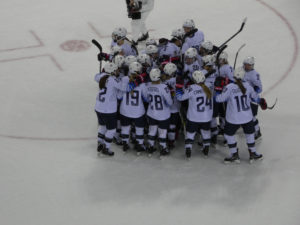
Team USA celebrating their win.
Like the first Monday of every February, the Beanpot semi-finals took place, as they have 65 previous years. The first semi pitted the Northeastern University Huskies against the Boston College Eagles. The Huskies are oft considered the underdogs against both Boston College and Boston University, however, their record in the 2017-18 season has been impressive.
Going into the Beanpot the Huskies were 15-5-3 overall and 11-5-3 in the HockeyEast division. They have had a strong season, and their upperclassmen have shown a determination that speaks to their commitment to the team. Dylan Sikura, who is usually on the line with fellow senior Nolan Stevens and junior Adam Gaudette, has experienced life with the pros—albeit briefly—most recently playing for Team Canada as they won the 2017 Spengler Cup. Here he experienced what it is like to be a professional athlete. Prior to the season, he’d had the opportunity to sign with the Chicago Blackhawks organization and chose to return for his final year with the Huskies.
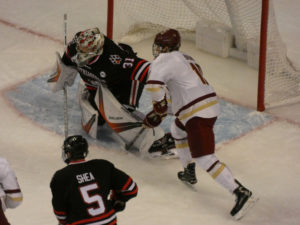
Cayden Primeau
Perhaps it is fortunate for the Huskies that Sikura was left off Canada’s roster for the Olympics, so he will still be in Boston to play in the championship game. He and his line mates were responsible for all three of the goals in the 3-0 win over the Eagles. Between the three of them they had three goals and four assists for seven points; Gaudette had the extra helper.
For his part, Cayden Primeau stood large and strong between the pipes, facing 37 shots in the game. Without his efforts the results could have been a different story. Not scheduled to be a starter at the beginning of the season, the injury to junior Ryan Ruck has given Primeau an opportunity to seize that spot. And seize it he has. The freshman has played 25 games and is currently boasting a 1.97 GAA and a .925 save percentage.
The last time that Northeastern shutout Boston College was in 1988, and that was the last time the Huskies won the Beanpot. They will play in the championship game on Monday, February 12th at 7:30 pm, taking on the Boston University Terriers who had to take it to double overtime to finish the Harvard Crimson.
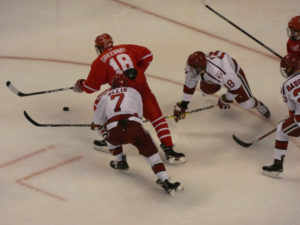
Jordan Greenway
The Terriers come into the championship game having tied Merrimack this past Friday and bringing a 15-11-3 overall record, with seven of those losses coming to HockeyEast division teams in league play. While their game against the Huskies won’t be a league game, they lost both of their prior league games to Northeastern in November—both games being strong wins for Northeastern. The game played at Agganis Arena, Terriers home rink, was a 4-1 loss, while their game played in Huskies’ Matthews Arena was a resounding 6-1 loss. Additionally, they will be missing Jordan Greenway, who two days after the semifinal game hopped a plane with Harvard’s Ryan Donato to represent the United States in the Olympics at PyeongChang, South Korea.
For certain the Huskies will be planning to bring their A game. Two years ago they downed UMass Lowell to take their first Hockey East tournament championship since 1988. Now it is two years later and 30 years since they last won a Beanpot. For the Huskies leading line, this would certainly cap off their time at Northeastern University wearing the red and black.
 Prev1...787980...412Next
  Page 79 of 412