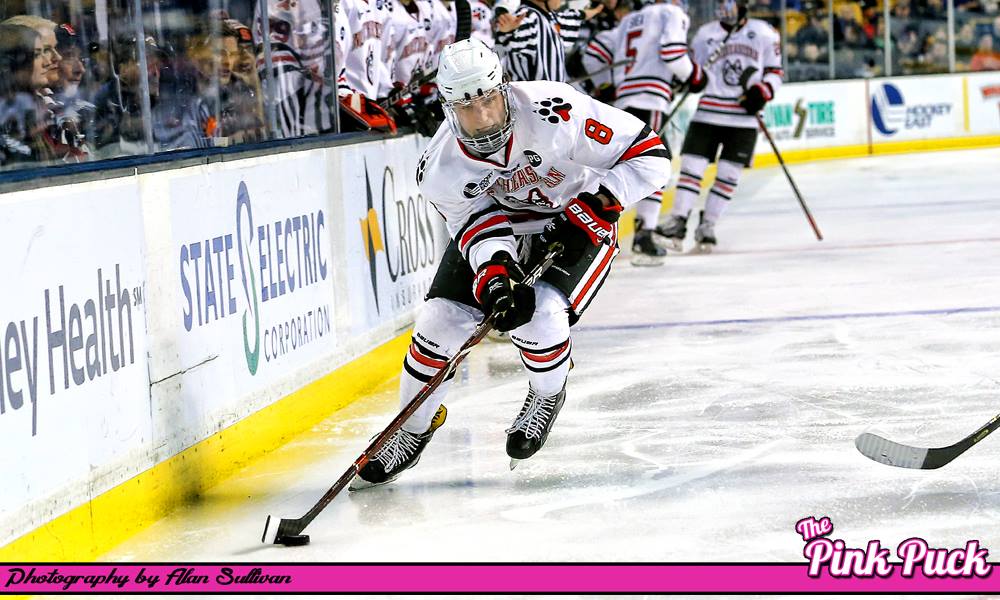
The Northeastern University Huskies have been a scoring machine this season, with their top line of Nolan Stevens, Adam Gaudette, and Dylan Sikura seemingly unstoppable in many games. Gaudette was named Hockey East’s Player of the Year on Thursday night and entered Friday night’s contest against the Providence College Friars leading the nation in points. The Braintree, Massachusetts native is only the third Husky to be so honored in the college’s history. And he follows in the footsteps of Zach Aston-Reese, who was chosen at the end of last season.
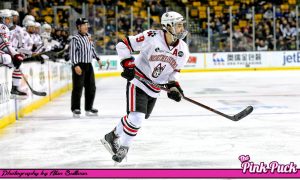
Dylan Sikura
The Huskies came into Friday night’s semifinal game against the Providence College Friars as the number two seed, with an overall record of 23-8-5 and the current Beanpot champion. They hoped to see their school hanging from both the Beanpot and the Hockey East banners in the rafters of TD Garden when the two-day tournament was finished. Such was not to be though for this impressive group, as the Friars would take the win in overtime.
“So, it’s overtime. One team’s gonna win, one team’s gonna lose, and unfortunately for our guys, we came out on the short end of the stick,” Huskies head coach Jim Madigan told the media after the game. “It will sting. We had some goals, and a good group of guys who have worked hard to accomplish goals, and one of them was Hockey East. Though we clinched a spot in the [NCAA] tournament last weekend, this tournament is special, the Hockey East tournament. This is a tough league, and it’s hard to get to this spot, and when you get here, you want to take the opportunities of it. Two years ago, we were known as Hockey East Champions, and you want to have that same feeling again this year. It’s not going to happen. But because of our good regular season, we’ll be able to move on, and in a few days, or not a few days, but later tomorrow or Sunday, focus in on the next goal in mind.”
Providence College Friars
After having played two strong periods against the Friars, in which they outshot Providence 29-16, the teams were tied at one, with Vimal Sukumaran having scored for the Friars at 8:57 of the first and Sikura tying it at 18:06 of the second, while the Huskies were shorthanded. At 3:03 of the third, freshman Austin Goldstein buried his first goal of the season giving the Huskies their first lead in the game. But just as Northeastern had scored with 1:53 remaining in the second to tie things up, Kasper Björkqvist would tie it up for the Friars, getting his 14th of the season with just 1:51 remaining in regulation, ultimately forcing the overtime.
The Friars did manage to accomplish something that few other teams had this season when playing against the Huskies—keeping Northeastern from scoring on the power play.
“You can’t be real aggressive against their power play. Everyone we watched, every tape we watched, and from playing them twice, you can’t be aggressive because if you get aggressive you get stretched out. They find that back door or the guy in the middle,” Friars head coach Nate Leaman shared. “It’s a power play you have to be real passive against. And when you’re real passive like that you spend a lot of time in your own end and we did. I give our assistant coaches Krys Mayotte and Scott Borek a lot of credit because we found a way to kill those three penalties. [Hayden Hawkey] made a lot of great saves and we were able to get through that stretch.”
Perhaps it shouldn’t be surprising that the Huskies and Friars went to overtime, given that their three regular season games required overtime. What hasn’t happened in a while though was that both Hockey East semifinal games on Friday had to go to overtime to determine a winner. The last time both Hockey East semifinals went to extra time was 1989.
The Friars will take on the Boston University Terriers on Saturday night in a rematch of their 2015 NCAA Frozen Four Championship game in which Providence beat BU 4-3 at TD Garden. If Providence can play as defensively strong on Saturday as they did against the Huskies, they will be a difficult team to solve.
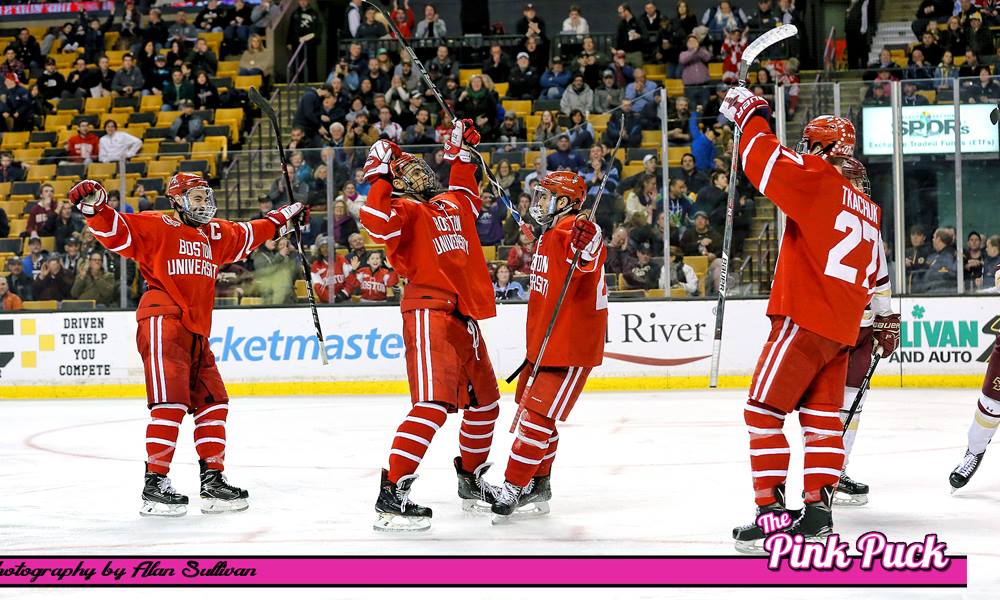
The Boston University Terriers beat the Boston College Eagles in overtime on Friday night in the first Hockey East semifinal game of the night. As the game got underway it didn’t look like that would be the outcome of this game. The Eagles were already on the scoreboard just 46 seconds into the game, with a goal from Connor Moore, assisted by Graham McPhee and Aapeli Räsänen. Definitely not the way the Terriers wanted to begin the game, especially with Joseph Woll in net for the Eagles.
Jordan Greenway
The teams would go into the first intermission with the Eagles up 1-0 and the Terriers hoping to find an equalizer in the second. Julius Mattila would give Boston College their second of the game 3:26 into the middle period—his 13th of the season—assisted by David Cotton. The Terriers would not give up though and Ty Amonte would cut the Eagle’s lead in half five and a half minutes later, assisted by Hank Crone and Patrick Curry. Two and a half minutes after Amonte’s goal, David Farrance would tie the game with only his second goal of the season, assisted by Chad Krys and Jordan Greenway.
The teams would come out in the third period tied at two each. It looked like Greenway had the go-ahead goal 5:15 into the third, with a snap shot from the slot, but upon review the goal was overturned for goaltender interference. Instead it would be Boston College’s Christopher Brown who would put the Eagles up 3-2 at 14:41, assisted by J.D. Dudek and McPhee. The Terriers remained undaunted though, responding 45 seconds later as Drew Melanson notched his fourth goal of the season, assisted by Greenway and Farrance.
Jake Oettinger
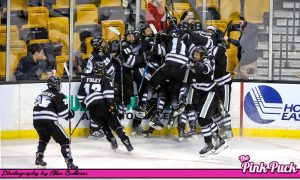
They would go to the end of regulation knotted at three and a sudden death overtime period would be needed to determine a winner. Despite outshooting the Terriers in the extra inning 14-7, the Eagles would be unable to solve sophomore netminder Jake Oettinger, who truly kept the Terriers chances alive until Curry could bury his wrap-around assisted by Shane Bower and Bobo Carpenter at 15:40 of overtime.
“The overtime wasn’t what we wanted it to be, but so proud of our team coming back,” Terriers head coach David Quinn said after the game. “Down 2-0, digging yourself a hole against that team and that goalie, you can get a little bit demoralized, but we never quit. You’ve got to show mental toughness. You have to have resiliency. This time of year, you don’t win games without those characteristics. Obviously, our goalie was great in overtime. These two guys to the left of me [Curry and Greenway] competed hard from the drop of the puck, as did everyone else.”
The Terriers will take on the Providence College Friars in the championship game on Saturday night. The Friars played a strong defensive game in their win Friday night. If the Terriers get down two goals like they did against the Eagles, it could mean a different outcome. But the Terriers are tenacious, so they should never be counted out until the end of the game.
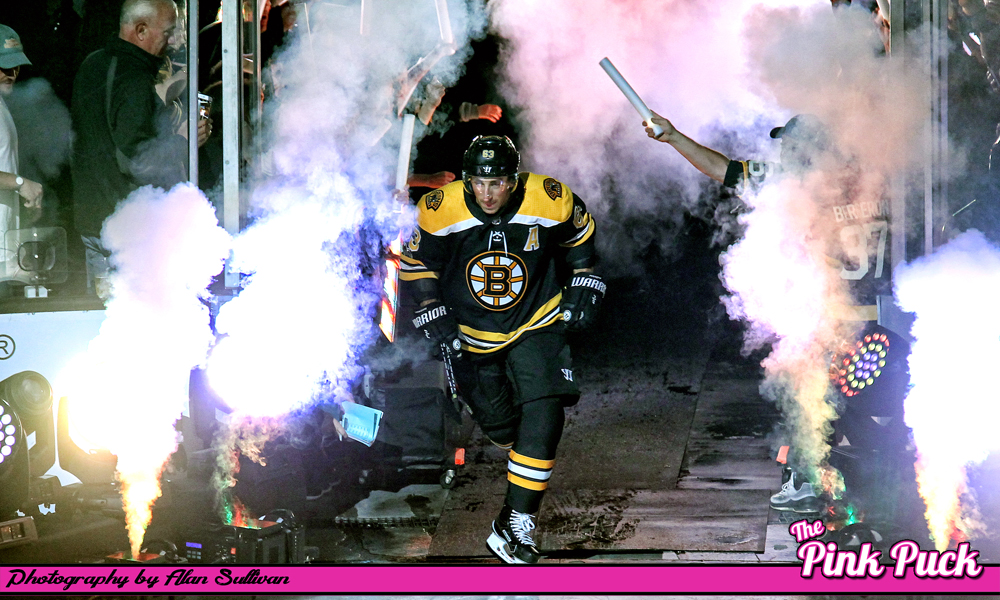
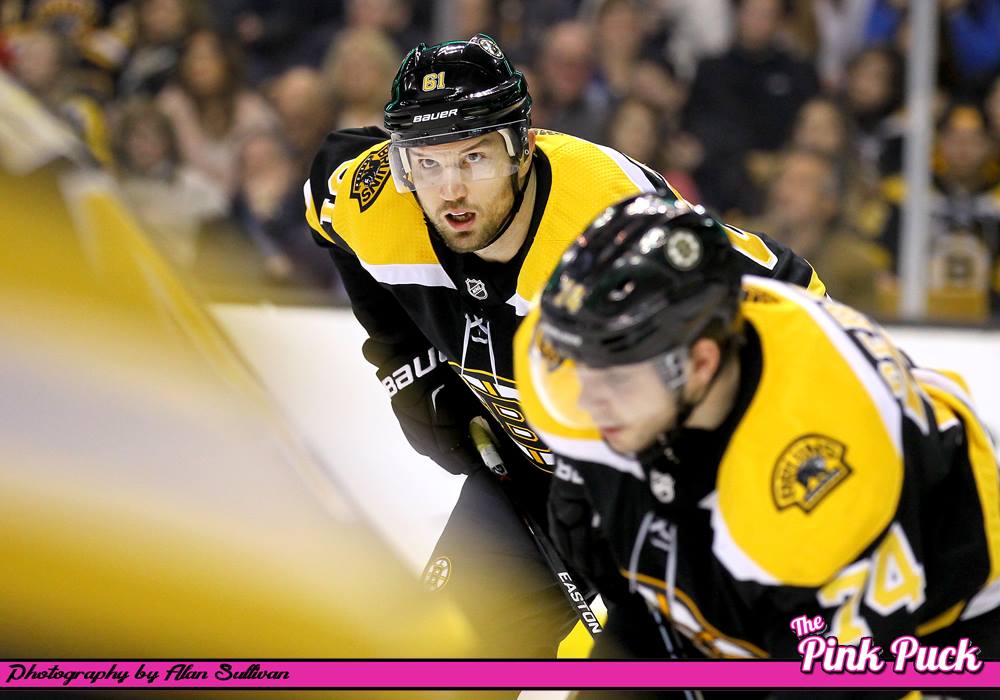
For the Boston Bruins, injuries have seen two of their best players taken out of the lineup. Patrice Bergeron last suited up in their road loss against the Buffalo Sabres on February 25th. It was then announced that he was likely to miss two weeks with fractures in his foot. Charlie McAvoy played just 37 seconds when Boston played host to the Montreal Canadiens on March 3rd. And then on Tuesday, March 6th, the team announced he had a sprained MCL and would miss four weeks. If that wasn’t enough, on Wednesday, March 7th the NHL Department of Player Safety handed down a three-game suspension to David Backes for his hit on Frans Nielsen during the Bruins game against the Detroit Red Wings on Tuesday.
Some critical players out when it comes to the Bruins scoring along with their defense. And yet, the Bruins have a five-game winning streak, having not lost since the Buffalo game. With one exception—their blow out of eight goals against the Pittsburgh Penguins, the other four games have been one goal differentials. And the last three wins have come off the stick of Brad Marchand. The wins against Montreal and Detroit came in overtime, while Thursday’s game-winner got past Flyer’s Alex Lyon with 22 seconds remaining in regulation.
The game against the Philadelphia Flyers was a bit of a struggle. Of course, when the Bruins found themselves killing a double minor just 1:29 into the game—the result of a high sticking penalty on Kevan Miller—it was a bit of a foreshadowing as to how the game would go. Nine seconds into the first two-minute penalty Jakub Voracek put the Flyers on the scoreboard. The Bruins were able to kill the second two minutes, but the Flyers put some shots on netminder Tuukka Rask. Six minutes into the game, the Flyers had seven shots on net, while the Bruins had managed only one.
Additional penalties would be called on both teams, though neither team would capitalize. For Boston, they would go 0-3 on the man advantage, their power play continuing to be less than impressive, perhaps in part due to the lack of Bergeron.
Riley Nash and Brian Gionta scored during the first period, to put the Bruins up 2-1 going into the intermission. Nash’s goal was the result of gritty determination hanging around the crease—something the Bruins could work to do more of. Gionta’s goal was on a breakaway in which he managed to freeze Lyon before deking to put it in the net off a backhand shot.
Jori Lehtera tied things up 7:21 into the second, a shorthanded goal that just emphasizes the Bruins’ current struggles on the power play. And that was where the score would stall. Most everyone watching was expecting to see the game go to overtime, but Marchand was single-minded. And when David Pastrnak managed to get the puck behind Lyon, but not over the goal line, Marchand, from the other side of the net, got his stick in sending the puck into the net and denying the Flyers even a point despite a hard-fought game on their part.
Marchand is only the seventh player in Bruins’ history to have three consecutive game-winning goals. The last player to do it was Tyler Seguin, between November 5-10, 2011.
“Yeah, he just keeps on ticking,” Bruins Head Coach Bruce Cassidy said about Marchand after the game. “He seems like he’s on a bit of a mission with [Bergeron] out that he wants to put the team up in the offensive part of it. He got frustrated tonight with a couple calls, that one went against him and one didn’t. He thought he was held on the shorty, but at the end of the day, just kept plugging away, refocused, and he does a good job for us.”
Marchand was also wearing the “A” showing the trust his coaches have in him while Backes and Bergeron are out.
“Yeah, you know, it was nice. It shows the confidence that they have, and you know, it’s a great honor. So, anytime you’re allowed to put that on it feels really good, but I wish I would have played better with it on and hopefully I’ll be better next game,” he shared.
And he takes his role seriously, while still humbly acknowledging the efforts of his fellow teammates. He doesn’t feel that he is on a mission, other than the one that he shares with all the other guys on the team.
“I think we all have to carry the load a bit. I think we’re all feeling that,” Marchand responded in regard to the team being without Bergeron. “You know, it’s very hard missing a guy like like him and McAvoy, and now [Backes] for a few games. It’s tough to replace them, so, you know, I think we all feel that a bit and have to step up.”
Marchand now has 29 goals on the season, with five of them having been notched in the past three games. But more importantly three of those were the deciding factor in whether or not the Bruins took the two points.
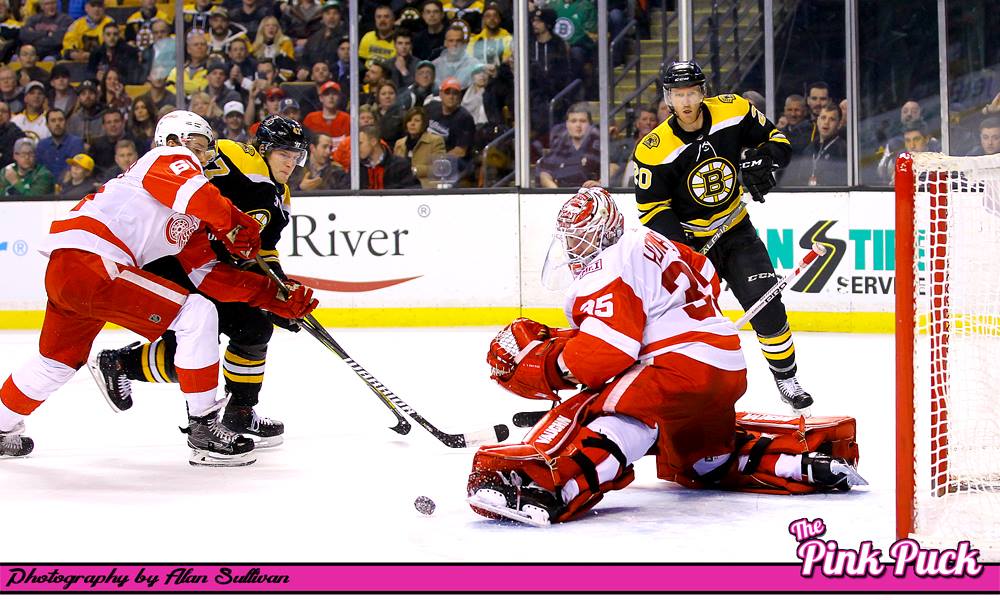
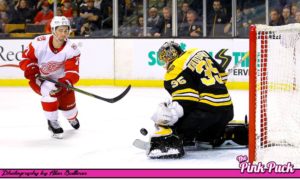
Make no mistake about it, this was not a pretty win. It started out looking like it might be, when Torey Krug got the Boston Bruins on the board just 37 seconds into the game, followed 15 seconds later by Jake DeBrusk giving Boston a two-goal lead. However, that is where the pretty ended. Before eight minutes had ticked off the clock, the Detroit Red Wings had tied the game. For Detroit, the first one came six seconds into the Bruins first penalty, as Tommy Wingels went off on a slash. Their second one was an even-strength goal from Mike Green.
Riley Nash and Jared Coreau
By the end of regulation both teams had notched five goals. For the Bruins, Krug had two goals and an assist for three points, David Pastrnak had three assists, and Brad Marchand had two goals and two assists. And the Bruins had managed to chase Jared Coreau from Detroit’s net 2:37 into the second period, requiring Jimmy Howard to close out the game and get the Red Wings a point out of everything.
For the Detroit, Anthony Mantha had two goals and two assists, Tyler Bertuzzi had two assists and Green added an assist to go along with that first period goal. That’s a lot of players having multi-point nights, perhaps indicating some defensive issues on both sides.
As the game went to overtime, it was Marchand who would get the Bruins the win, along with a hat trick and a five-point night for himself, while Krug would add another helper for a four-point night.
Patrice Bergeron is still healing from the fractures in his foot, sustained in blocking a shot about two weeks ago. Earlier on Tuesday, it was announced that Charlie McAvoy had sprained his left MCL just 37 seconds into Saturday’s game against the Montreal Canadiens and was currently expected be out a minimum of four weeks. Those are two important pieces in the Bruins tapestry and a bit of shifting of lines showed a few weaknesses.
Dylan Larkin and Anton Khudobin
In addition to the turnovers in the neutral zone, perhaps the biggest and most important area that Boston wants to address would be their lack of coverage in the slot. This is an area of their game that they have been strong, as was shown in the game against Montreal. However, Tuesday night’s game saw shots in the slot that got into the net as well as rebounds from Anton Khudobin right in the slot that the Red Wings capitalized on.
Of course, with an 82-game schedule in the regular season and still 18 games to go, it certainly isn’t time to push the panic button, and no one was in the locker room after the game. Marchand was honest in his assessment of the game pointing out that they hadn’t played their best on Tuesday night. The team did walk away with the two points though and as the season begins to wind down, that is the most important thing.
Perhaps the biggest positive that the team can take from the Detroit game, before turning their attention to Thursday’s match up against the Philadelphia Flyers, is the overall group effort when it comes to scoring. In looking at the Penguins game last Thursday, the Canadiens game on Saturday and the Red Wings game, the Bruins have 12 players with at least one point. David Krejci had a hat trick last Thursday. Newcomers Brian Gionta and Nick Holden each have three assists, while Rick Nash had a goal and an assist. DeBrusk had two goals and an assist for a three-game point streak. Pastrnak, Marchand and Krug were a combined 8 goals and 14 assists in those three games.
The Bruins currently sit in second place in their division, with three games in hand against the Tampa Bay Lightning, who sit in first place ahead by six points. The Toronto Maple Leafs are in third place five points behind the Bruins, but Boston has four games in hand on them. No other Atlantic Division team is even close to these three teams.
Boston will not practice on Wednesday, perhaps clearing their heads but learning from the mistakes they made on Tuesday. One would expect them to bring another push on Thursday against the Flyers, and given the last three games, who knows what the score will be.
There really is no other way to describe the shooting gallery that took place on Thursday night as the Boston Bruins played host to the Pittsburgh Penguins. The Bruins were coming off their overtime win against the Carolina Hurricanes on Tuesday. They were also adding the other two players they acquired before the trade deadline in Brian Gionta (free agent signing) and Nick Holden (trade that saw defenseman Rob O’Gara and a 2018 NHL Entry Draft third round pick go to the New York Rangers).
The scoring in the first period began with a Penguins goal 35 seconds into the opening frame and ended with a Penguins goal just two seconds shy of the buzzer on that period. And in between those two?It was 3-2 in favor of the home team before the clock had ticked off the first ten minutes. There were five Bruins goals: four at even strength and one on the power play; and one more for Pittsburgh.
David Krejci and Tristan Jarry
The Penguins starting goaltender, Casey DeSmith, let in three goals on five shots and was yanked 5:27 into the game, being replaced by Tristan Jarry, who would end up actually with the loss on the game. During the NHL Expansion Draft in the summer of 2017, Marc-Andre Fleury went to the Vegas Golden Nights. The Penguins felt solid with Matt Murray who had taken them to their second consecutive Stanley Cup in the 2017 playoffs. However, Murray is out indefinitely as he has returned home to be with his family after the passing of his father on January 16th. Both DeSmith and Jarry have been going up and down between Pittsburgh and the Wilkes-Barre Scranton Penguins, Pittsburgh’s AHL affiliate over the last few weeks.
Some of the goals of the first period were the result of some odd things. One of the Bruins goals sort of hopped over DeSmith, and landed behind him, and he pushed it in as he backed up. At the other end the Bruins starter, Tuukka Rask, was having his own issues with keeping the puck out of the back of his net.
“Yeah the first period I thought we were playing with white pucks there. The only time I saw the puck was when I dug it out of the net. Had some Red Bull in the intermission there and I actually made a couple saves after that,” Rask shared.
Brian Gionta and Brian Dumoulin
The second period saw David Krejci give the Bruins their sixth goal—on his second of the game—2:16 into the second period. Twelve minutes later the hats came raining down as he got a hat trick. David Pastrnak also got two goals, one in the first period and one in the second. Gionta, who had been named captain of Team USA’s men’s hockey team that played in the Olympics at PyeongChang, notched two assists, the first one in the opening period giving him a career 300th assist. Rick Nash who had a goal in the game against Carolina, added a goal and a helper to his columns as a Bruin, both in the first.
The second period also saw an increase in physicality which resulted in an increase in penalties. There was a couple of four-on-four shifts when Evgeni Malkin and Tim Schaller went off for matching roughing minors, and then again just a couple minutes later when Olli Maatta (tripping) and Brad Marchand (embellishment) reflected on their sins.
The Penguins would take the man advantage into the third period, after Torey Krug was whistled for an interference late in the second, but they would end up 0-4 on the power play by the end of the game.
A questionable hit by the Penguins Patric Hornqvist on Charlie McAvoy resulted in McAvoy needing repairs. And while there was nothing called on the play, McAvoy had definitely taken a number, and an opportunity to respond with a strong, hard, clean, check on Hornqvist came later in the game. The result was a line brawl that resulted in Zdeno Chara, who had already been on the ice for a full three minutes, and Jamie Oleksiak dropping the mitts.
The only thing this game didn’t have was a penalty shot.
The Bruins managed to close things down for much of the remainder of the game. Pittsburgh got their fourth, as Maatta teed one up that deflected off first Riley Nash and then Brandon Carlo before it got past Rask and into the net.
“I got myself in the game a little bit there and that last goal against us pretty much sums up my night,” Rask shared in regard to Maatta’s second of the game.
In the end the Boston continued to deny the Penguins many opportunities and took a win of 8-3.
The Bruins will take on the Montreal Canadiens on Saturday afternoon at 5:00pm. They will want to continue the scoring, while making sure to keep their defense and forecheck strong.
The Blackhawks, 27-28-8, are last in the Central Division and 3-7-0 in their previous 10 games. They’re 11 points behind the sixth-place Colorado Avalanche, 12 points behind the Minnesota Wild, who rear up the wild card spot, and a whopping 21 points behind the division-leading Nashville Predators.
How do the Blackhawks look right now?
Ryan Hartman scored the game-winning goal Tuesday—for the Nashville Predators—after being traded for a first-round and fourth round draft pick and prospect Victor Ejdsell.
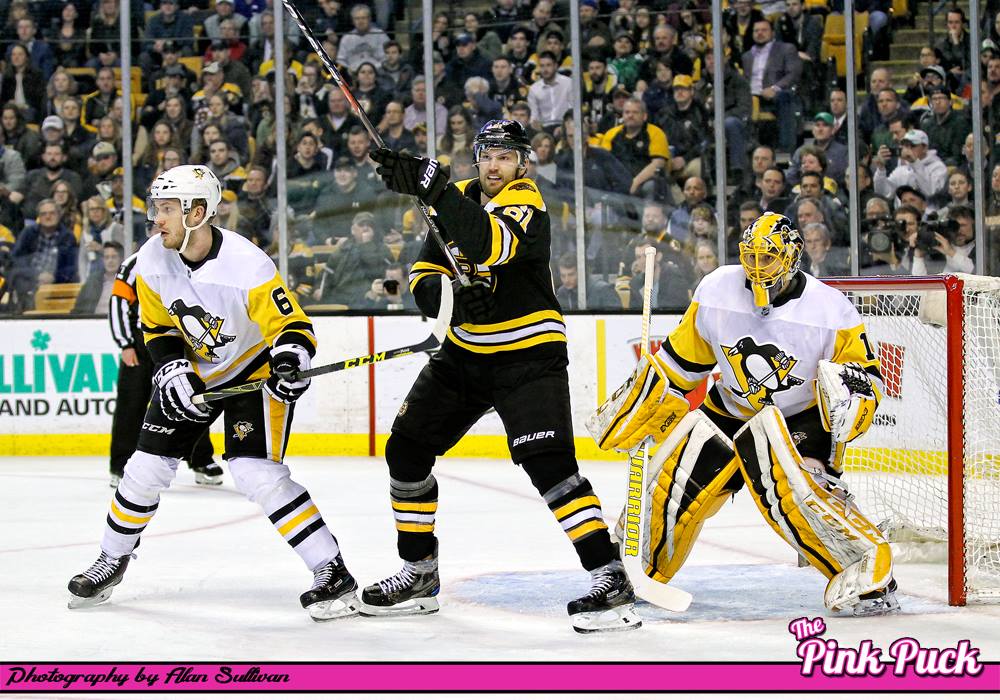
Tommy Wingels forced a turnover for an assist before the end of the first period and tallied a goal in the second, as a Boston Bruin, traded for a conditional 2019 fifth-round draft pick (made fourth-round if the Bruins re-sign Wingels or advance beyond the first round of the playoffs this year).
General Manager Stan Bowman said they were not easy deals to make.
“It’s disappointing, for sure, but you can’t feel sorry for yourself,” he said. “You have to sit here and try to plan for the future.”
Now, the Blackhawks look like a team that will not have a postseason for the first time in a decade, with cap-crushing contracts clouding slumping stars and the devastation of injury.
Crawford is believed to be dealing with post-concussion syndrome symptoms, and the Blackhawks are not taking any risks this season. Bowman told reporters:
“None of us can read into the future, predict anything. As far as Corey playing this year, I can’t say. What I can tell you is, Corey is not going to play until he is completely medically cleared and he says, ‘I’m ready and I want to play.’
“When those two things happen then he’s going to be back playing.”
So, what now?
With just 19 games remaining, the Hawks have recalled Matthew Highmore from Rockford following their seller’s market trade deadline.
Coach Quenneville told media Highmore would likely be used on the penalty kill and, “now and then” on the power play.
“At some point you knew he was going to get a chance to play up here. He deserved it. He was always in the discussions… Good reward for him and good opportunity down the stretch.
“He’s a hard player, has some skill, good work habits, plays the game the right way.”
“The players who are here right now who will be back, they have to find a way to grow their games. If they’re young players, they have to find a way to expand their arsenal. For the veteran players who were better in previous years, they have to find a way to get back to that level.”
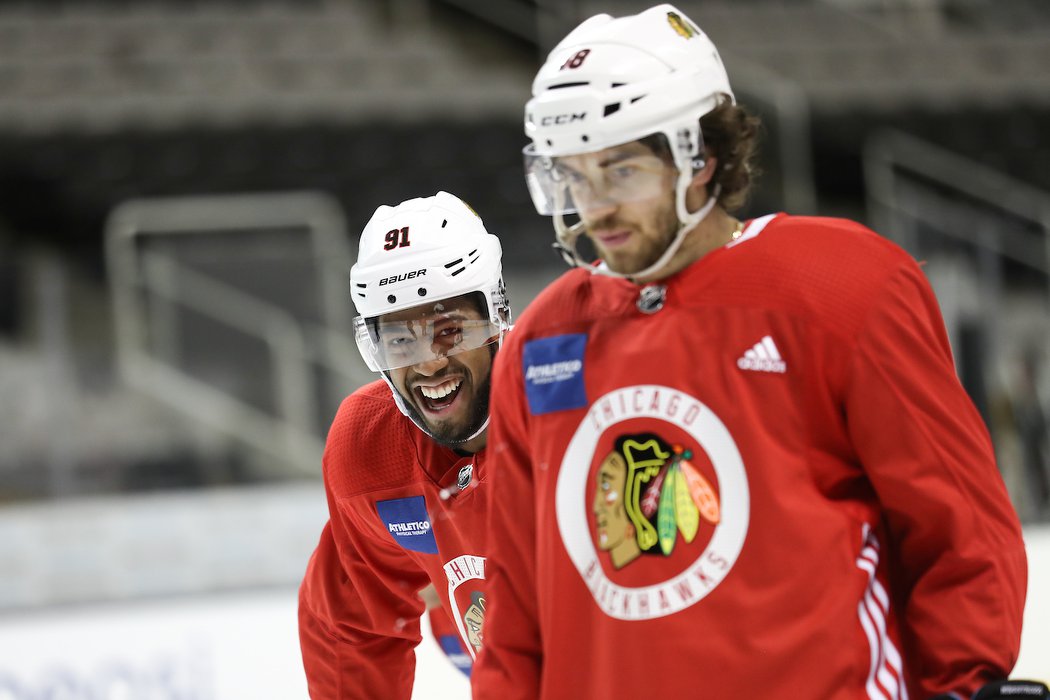
The Hawks have two first-round picks and seven others in this year’s draft. They also have 2014 draft pick center Dylan Sikura, currently playing for Northeastern University (17 goals, 31 assists, and 18 penalty minutes in 31 games), in their grasp if they choose.
DuClair, one of about 30 black players in a league of about 713 active players, spoke about the four people, allegedly there to cheer on his team:
“You would think there’d be some change after some years. How do I feel? I mean, like, we have some Blackhawks fans that think a certain way. If they’re Blackhawks fans, they would know there is a black hockey player on the team.
“It’s really tough [to internalize it]. It’s obviously a white sport, and you just want to go out there and compete. There’s obviously some ignorant people in this world, so you have to deal with that.”
Quenneville called the behavior “totally unacceptable in our game, in any sport and in society today.”
The four people were kicked out of the game immediately and have been banned from the United Center. The organization apologized to the Capitals and Smith-Pelly.
“Racist comments and other inappropriate behavior are not tolerated by the Chicago Blackhawks,” the Blackhawks said in a statement.
With that bad energy gone, and changes in the lineup, the team moves on to the end of its season, hoping to finish strong.
The schedule
The remaining regular season:
Blackhawks at Sharks, 9:00 p.m. C.T. March 1
Blackhawks at Kings, 3:00 p.m. C.T. March 3
Blackhawks at Ducks, 3:00 p.m. C.T. March 4
Avalanche at Blackhawks, 7:30 p.m. C.T. March 6
Hurricanes at Blackhawks, 7:30 p.m. C.T. March 8
Blackhawks at Bruins, 12:00 p.m. C.T. March 10
Bruins at Blackhawks, 11:30 a.m. C.T. March 11
Blackhawks at Jets, 7:00 p.m. C.T. March 15
Blackhawks at Sabres, 12:00 p.m. C.T. March 17
Blues at Blackhawks, 6:30 p.m. C.T. March 18
Avalanche at Blackhawks, 7:30 p.m. C.T. March 20
Canucks at Blackhawks, 7:30 p.m. C.T. March 22
Blackhawks at Islanders, 6:00 p.m. C.T. March 24
Sharks at Blackhawks, 7:30 p.m. C.T. March 26
Jets at Blackhawks, 7:30 p.m. C.T. March 29
Blackhawks at Avalanche, 8:00 p.m. C.T. March 30
Blackhawks at Blues, 8:00 p.m. C.T. April 4
Blues at Blackhawks, 7:30 p.m. C.T. April 6, last home game
I started The Pink Puck in 2011 as a forum to create opportunity for passionate writers and hockey fans to find their voice and it’s become so much more that that. The Pink Puck has become a family, connecting fans across the world through words, photos, and articles. In the last six years since it’s inception, the site has become more than I could have ever dreamed of, most recently our being credentialed for the 2018 Winter Olympics in PyeongChang. It has allowed not only myself, but our contributors endless and often unimaginable opportunity, something that I’m thankful for each day. On the other end of the gratitude spectrum, life happens… there’s growth, change, closed doors, open windows and eventually new paths.
Perhaps you’ve noticed, maybe you haven’t, but I’ve been a missing face in the writers column. It seems as though creatively speaking, I was benched. While hockey will always hold a piece of my heart, the overwhelming pull to cover games, attend events and contribute has gotten lost along the way and that isn’t fair to our readers and daily supporters. I believe in putting your all into each project and post, something I’ve been unable to do for some time now. While I’ve been active behind the scenes, the day-to-day operations have been handled by our managing Editor-in-Chief, Rhonda McClure.
It is with a heavy, but excited heart that I announce my departure from The Pink Puck. I will undoubtedly continue to love, support and sing the site’s praises to every devoted hockey fan that I meet and even those that may not love hockey yet. You may even see an article here and there when creativity lights the lamp once again.
In the meantime, I leave you and this beautiful site in the extremely capable, knowledgeable, and passionate mitts of it’s new owner, Rhonda McClure!
It’s safe to say that I can’t wait to see what amazing hockey adventures the future has to hold.
May you be happy, healthy and live your life with grace and ease (especially during playoffs!).
The day after the trade deadline saw the Boston Bruins back home after a number of away games. And it was the first chance for a couple of the newly acquired players to play in front of the home crowd. Rick Nash had already donned the Spoked B; playing with the team in Buffalo on Sunday. For Tommy Wingels, warm ups was the first time he even spent any time on the ice with the team—having arrived in Boston a bit after 11 in the morning.
With the recent news about Patrice Bergeron’s fractures in his foot, slotting in and getting a good start was essential for the team. Brad Marchand and David Pastrnak had Riley Nash join them on the first line. Rick Nash slotted in on the right wing with Jake DeBrusk and David Krejci. Wingels joined David Backes and Danton Heinen as their right wing.
The Bruins played host to the Carolina Hurricanes who are currently outside of a wildcard slot and fighting to get back in. However, their last few games have seen them unable to pull two points. In the previous ten games they had a 3-5-2 record, but their last five was 0-4-1. So it was obvious that they were going to come out hard and try to take the lead and keep it.
Rick Nash and David Krejci
The Hurricanes got their first goal while on the power play when Brock McGinn, while on the power play, cleaned up an uncharacteristic rebound right out to the front of the crease. Playing behind becoming something the Bruins know too well, it was good to see them respond just one minute and forty seconds later when Rick Nash, who had an impressive save right at the goal line as well in the game, got the Bruins tied.
The Canes second goal of the game again came on the power play, with 2:40 remaining in a double minor given to David Pastrnak for a high stick on Joakim Nordstrom, as Teuvo Teravainen once again gave Carolina the lead. It looked like they would go into the first intermission with a two-goal lead off the stick of Sebastian Aho, with 56 seconds remaining on the clock of playing time, but 53 seconds after Aho’s goal, Wingels made a nice pass to Riley Nash, who put it past Carolina’s Scott Darling and in the net.
It was certainly not the Bruins finest opening period, but they came back within one goal, which helped negate the psychological effects of Aho’s goal. And perhaps the Bruins staying out of the penalty box during the second and third may have contributed also.
“Riley Nash has a big goal for us, and Wingels started that play by, as advertised, good forechecker, puck-pursuit guy, and then he finished a nice play as well later,” Bruins head coach Bruce Cassidy said postgame.
Tommy Wingels
The Bruins needed to play better in the second and third, which they appeared to do. And it was a bit more necessary because Rask seemed to be having an off night with some of his positioning. At 5:34 of the second period, Wingels added a goal—the nice play Coach Cassidy mentioned—to tie things up for the Bruins and give himself a two-point night. Some good jump for a player who didn’t even get to practice with the team in the morning skate.
Of course, then it became necessary for the Bruins to either get a go-ahead goal or at the very least not give up another one. They began to play smarter and better as the second and third periods went on, forcing the game to overtime. The overtime period didn’t last long as Riley Nash, with some strong play managed to get it headed in the Canes direction and Charlie McAvoy put it in the twine.
While there were some familiar names doing what they do for the Bruins, had it not been for the two new players, the game could have gone the other way, something that the Bruins need to put an end to.
“There’s really no time for adjustment. You just go out and play. At this point in the season, you don’t have time to feel your way into it, you have to be ready to go from the get go,” Wingels said of adjusting to the Bruins system.
In the case of the game on Tuesday night, it’s a good thing Wingels didn’t waste any time holding back as he adjusted. The game could have been a win for the Hurricanes without his smart play and the contribution of Rick Nash as well.
There has been much written on how the Women’s Hockey Gold Medal game of the Winter Olympics in PyeongChang came down to a shootout to determine the winner. Many who have written believe that the International Ice Hockey Federation should change the rules and allow a tie game to continue in sudden death, much like the NHL Stanley Cup playoffs are handled.
Martin Rogers of USA Today referred to a shootout as a coin flip or a crapshoot. Such terms make it sound like it is simply a matter of luck, which discounts the skill of both the shooter and the goaltender. Granted it takes away from the team atmosphere of the game and in some situations, where days off between games is available, then playing overtime periods until someone scores may be an option.
In a tournament of limited days such IIHF’s World Juniors or their World Championships, that could put one team at a disadvantage if it must play the next day. The Olympics in PyeongChang will have a total of 52 hockey games (22 games played between 8 women’s teams and 30 games played between 12 men’s teams) and to get all those games played in the 16 days of the Olympics required two rinks and almost daily games.
On Friday, in the men’s hockey semifinals, the Czech team and the German team played at 9:10 in the evening (Korean time). The winner of that game would go on to play in the Gold Medal game on Sunday afternoon, but the loser had to play on Saturday in the Bronze game. That’s not a lot of time to recuperate.
Rooney’s block on Agosta
In watching Team Canada and Team USA in the women’s gold medal game, Canada had an opportunity on the man advantage with under two minutes remaining in the overtime period, and they just couldn’t make it happen. Credit certainly goes to Team USA’s penalty killing players, but it was four on three for Canada, and as the clock ticked down the game remained tied.
After Team USA’s men lost in the shootout to the Czech team in the qualification round, head coach Tony Granato was asked about the shootout.
“Like I said, if you win it, it’s great. If you lose it, it’s no good. Those are the rules. We knew them coming in. We knew how the format played out,” Granato shared. “Did we like that it went to a shootout and that was what would determine whether or not we moved on or didn’t move on? No. But those were the rules. We knew those rules coming in.”
Would the loss have been any less heartbreaking to the Canadian team had it come in overtime? They gave it all they had for 80 minutes and they put some amazing shooters in their lineup against USA’s Maddie Rooney. From start to finish there was nothing about that game that wasn’t exciting, even the shootout, which is often hard to say.
René Fasel at Olympic Press Conference
René Fasel, president of the IIHF, was asked about the format and comments about the shootout that had been mentioned after that epic game.
“Look at the women’s game also that was U.S. and Canada. Eighty minutes until they come to this point. Canada had 80 minutes, eight-zero minutes to score one more goal than the U.S. Period. And it’s a game and we cannot, simply not, in a tournament to play overtime and not to go into the shootout. I mean in a tournament it’s not possible,” Fasel stressed. “You would have a team play the whole night and then maybe one day… imagine yesterday Canada and Germany playing until three o’clock in the morning and the losing team is playing today again for the bronze. It is not possible. So, you have to put an end. But it’s a game, so, I can only say maybe the Canadians can practice more the shootout, you now? We in Europe, we are so different from your country in North America. We are growing up with football, and we are used to… In football, the biggest sport in the world, it is, and they finish a final of the World Cup in shootout. I will never convince North Americans to accept that, but it is like it is.”
The teams knew going in what the format would be and what would happen if they couldn’t get a win in either regulation or the overtime period. A loss at that level is not going to be diminished in how it happens. Both of the teams played hard and gave it all they had. A shootout does not take anything away from either of them.
Words probably can’t do justice to the absolute euphoria that Team USA’s Women’s Hockey Team experienced on Thursday afternoon in the gold medal game of the Winter Olympics in PyeongChang. A game that couldn’t be decided in 60 minutes or even 80 minutes went to a shootout and still could not be decided in the regulation five rounds, where it was tied at one each in goals off the penalty shots. In the 6th round Jocelyne Lamoureux-Davidson managed to get Canada’s Shannon Szabados down and gave USA their second penalty shot goal. At that point for the Americans it was all on their goaltender, Maddie Rooney.
Many of her teammates couldn’t speak highly enough of her. The word “poised” was used by some to describe her calm demeanor in the net.
“And it all came down to Maddie Rooney and she had a gold medal winning performance,” said Hilary Knight.
“We have such an amazing group and it didn’t matter if you were a veteran and three-time Olympian or if you’re a rookie,” shared Gigi Marvin who couldn’t stop smiling. “I mean holy cow, Maddie Rooney? Unbelievable in the net. It really doesn’t matter. We had so much faith and trust in her.”
Rooney, who admits that she’s afraid of snakes and doesn’t like the dark, is not afraid of the pressure of blocking such an important shot.
“I’ve been told that, that one of my strong suits is being calm,” Rooney offered quietly. “I think it’s just really important for my position to stay calm and have a short-term memory, if things don’t go well, and have trust in the teammates to bounce back.”
Rooney’s block on Agosta
She commented that all her teammates were supportive going into the shootout. So when it came down to Canada’s opportunity in the 6th round, she felt confident that she could block the shot from Meghan Agosta. And block it she did. For Team USA it was cheers and hugs and happiness. For Team Canada it was disappointment, heartache and tears.
In almost a switch of that final game in Sochi four years ago in which the United States was winning 2-0 for so long and then ultimately lost in overtime, this time it was Canada who went into the third period winning 2-1 in PyeongChang only to have it come down to the shootout and see things go against them. However, there was one thing that was eerily similar to the Sochi games.
“It was wild. It seems like so long ago, but when we got that penalty, I was thinking ‘Oh my gosh, this is the start of a living nightmare for us at the Olympics,’” Knight described. “Kendall [Coyne] went out there killed great, Dex [Brianna Decker] went out there. I mean everyone was rolling. And we all had our different responsibilities and jobs and big moments and people made those little plays that turned out to be big plays.”
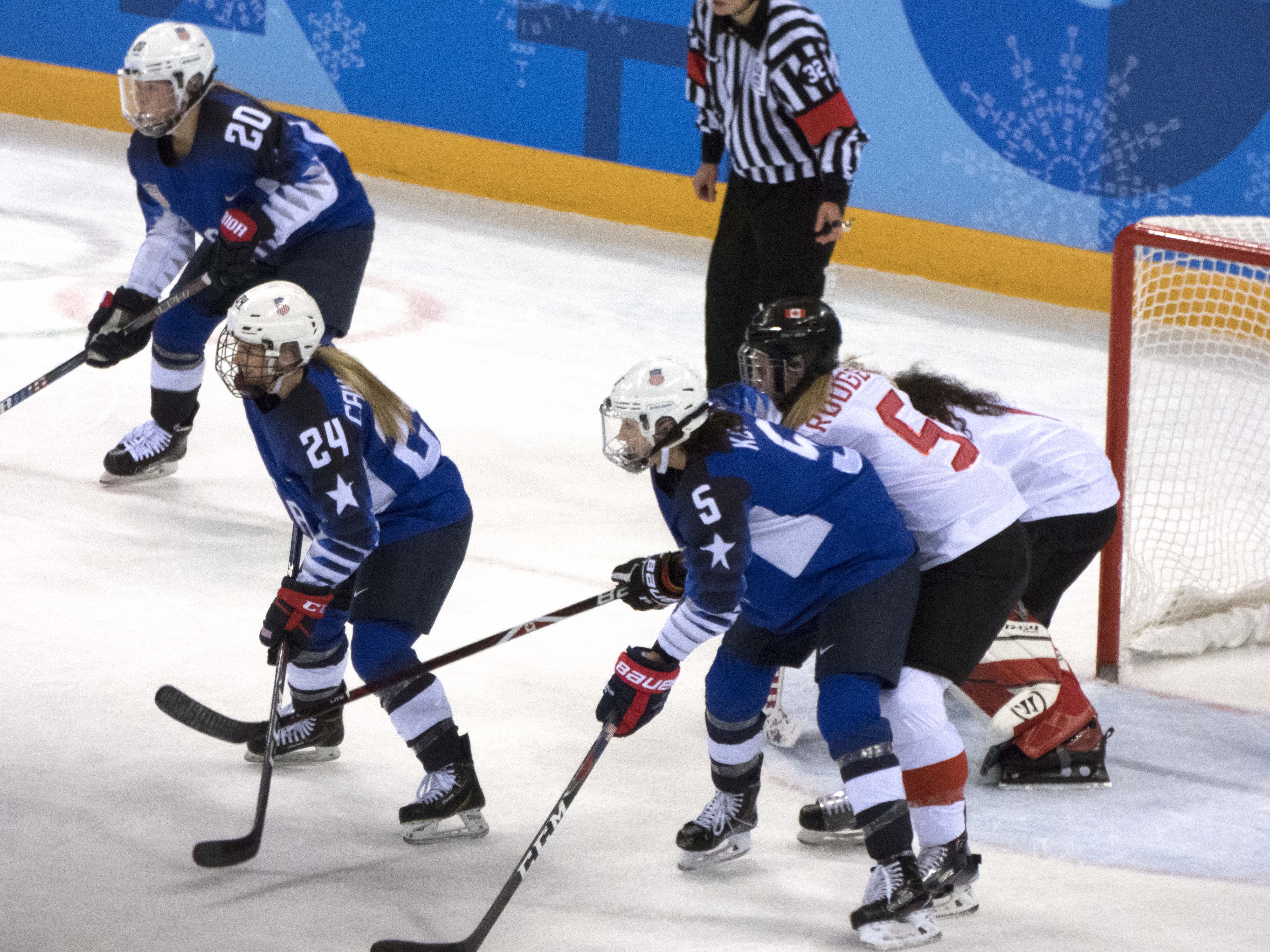
Throughout the game there was an intensity on both sides, but more restrained than perhaps their first meeting of the games. There were few instances of pushing and shoving after the whistles as opposed to the first game. And though Canada seemed to control things in the beginning it was the Americans who scored first while on the power play with just 1:25 left in the first.
“There was no doubt in anyone’s mind. It was just a matter of how and when and what an ending,” Marvin said.
The second period saw the Canadians score exactly two minutes in. They would get the lead at 6:55 of the period. It looked like they might get their third while on the power play. Sidney Morin was whistled for an illegal hit and Canada was strong on the power play. Fortunately for the United States, Canada was whistled for a crease violation, which simply stopped play and forced a face off down in Canada’s end.
With 6:21 remaining in the third period, Monique Lamoureux-Morando got the tying goal that would keep the Americans in it through the remainder of regulation and the entire 20-minute overtime. As Knight mentioned, while on the four on four overtime, Megan Keller was called for an illegal hit with 2:35 left on the clock. It was during this penalty kill time that it was clear that the confidence of Team USA was immense. They were not going to let history repeat itself.
All through the game the chants of “Go Canada Go” and “USA, USA” filled the arena in a deafening beat against each other. Each chant trying to infuse their team with more energy, feeling every bit a part of what was unfolding on the ice. Willing their energy reserves to imbue their team. There were oohs and ahs as pucks missed the goal or as goalies made incredible saves. From those cheering on the United States, a tremendous cheer erupted as that final puck was blocked.
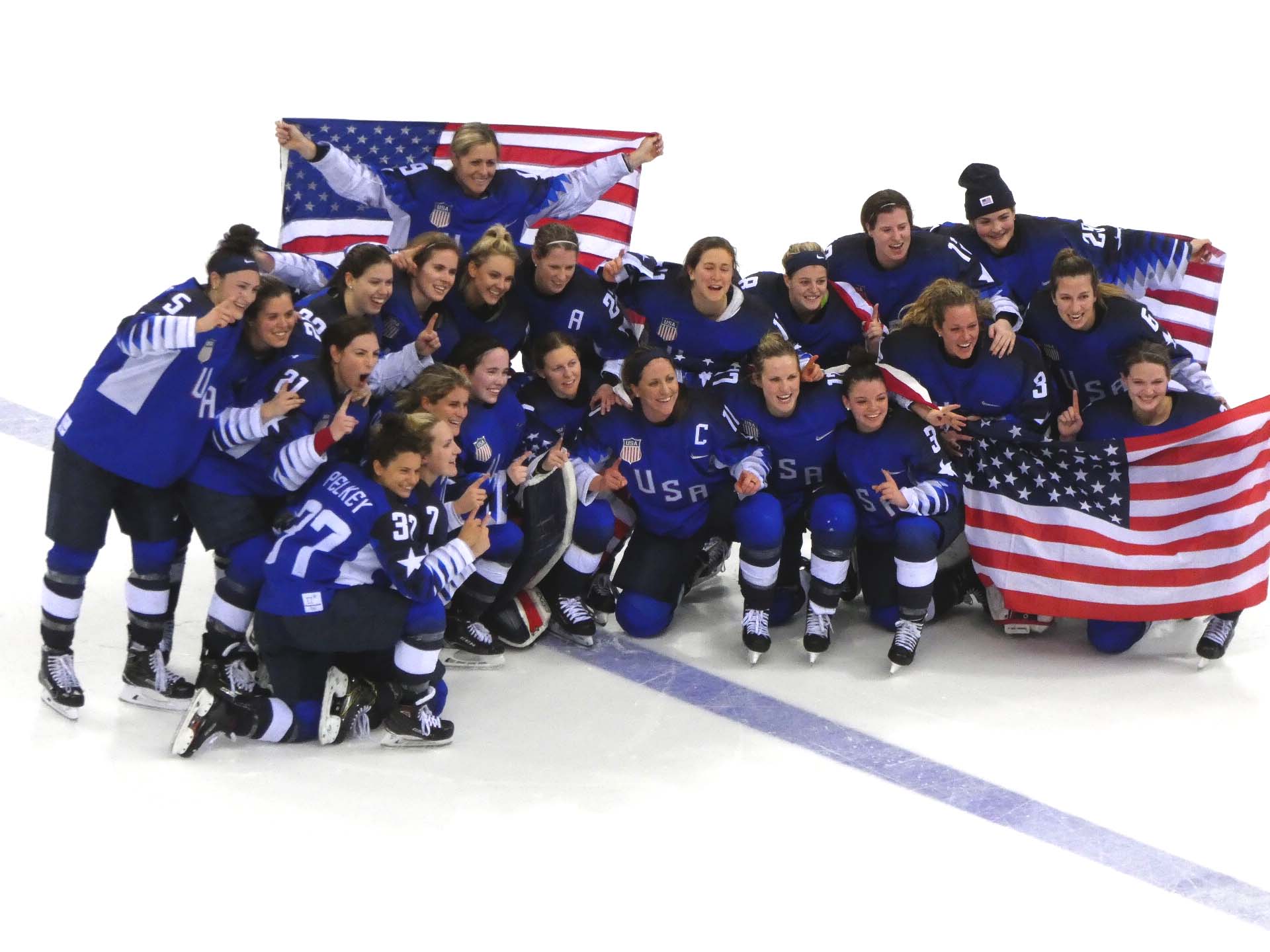
After twenty years, the gold medal is coming back to the United States with the women who worked hard to be recognized by USA Hockey and who have worked so hard on and off the ice to grow a sport about which they have so much passion. It was earned through hours and hours of work and training and practice. It was aided by family, friends, trainers, coaches, and countless others. And it will be remembered by millions.


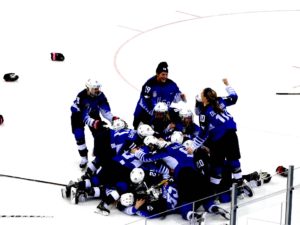 All through the game the chants of “Go Canada Go” and “USA, USA” filled the arena in a deafening beat against each other. Each chant trying to infuse their team with more energy, feeling every bit a part of what was unfolding on the ice. Willing their energy reserves to imbue their team. There were oohs and ahs as pucks missed the goal or as goalies made incredible saves. From those cheering on the United States, a tremendous cheer erupted as that final puck was blocked.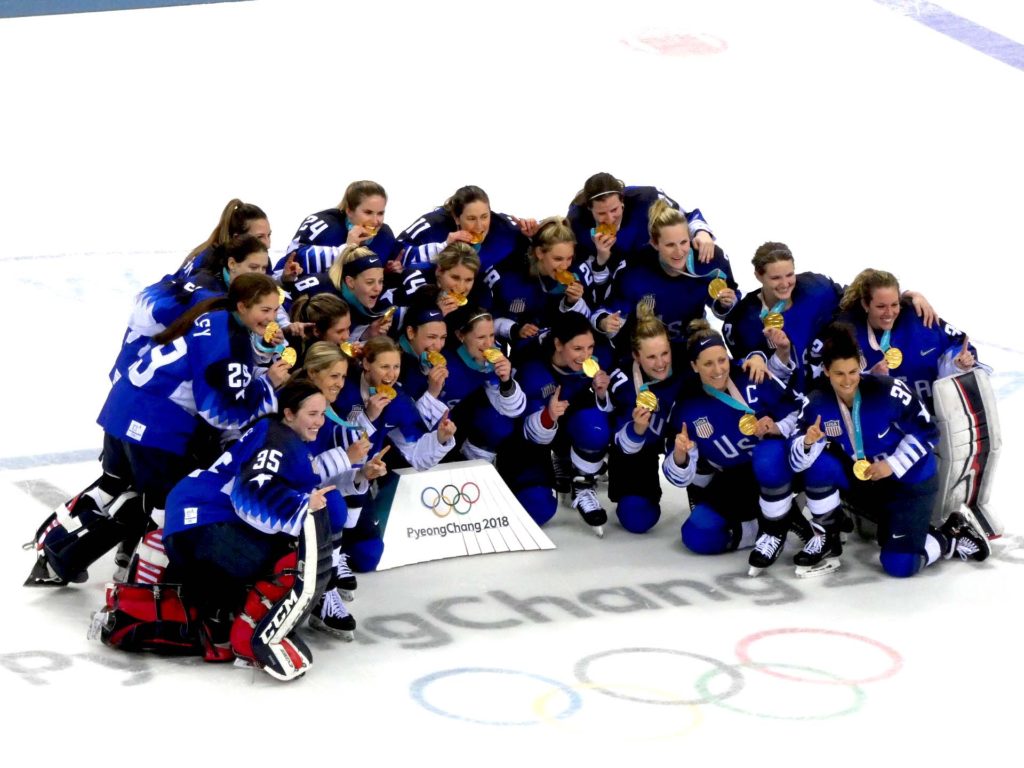
 Prev
Prev