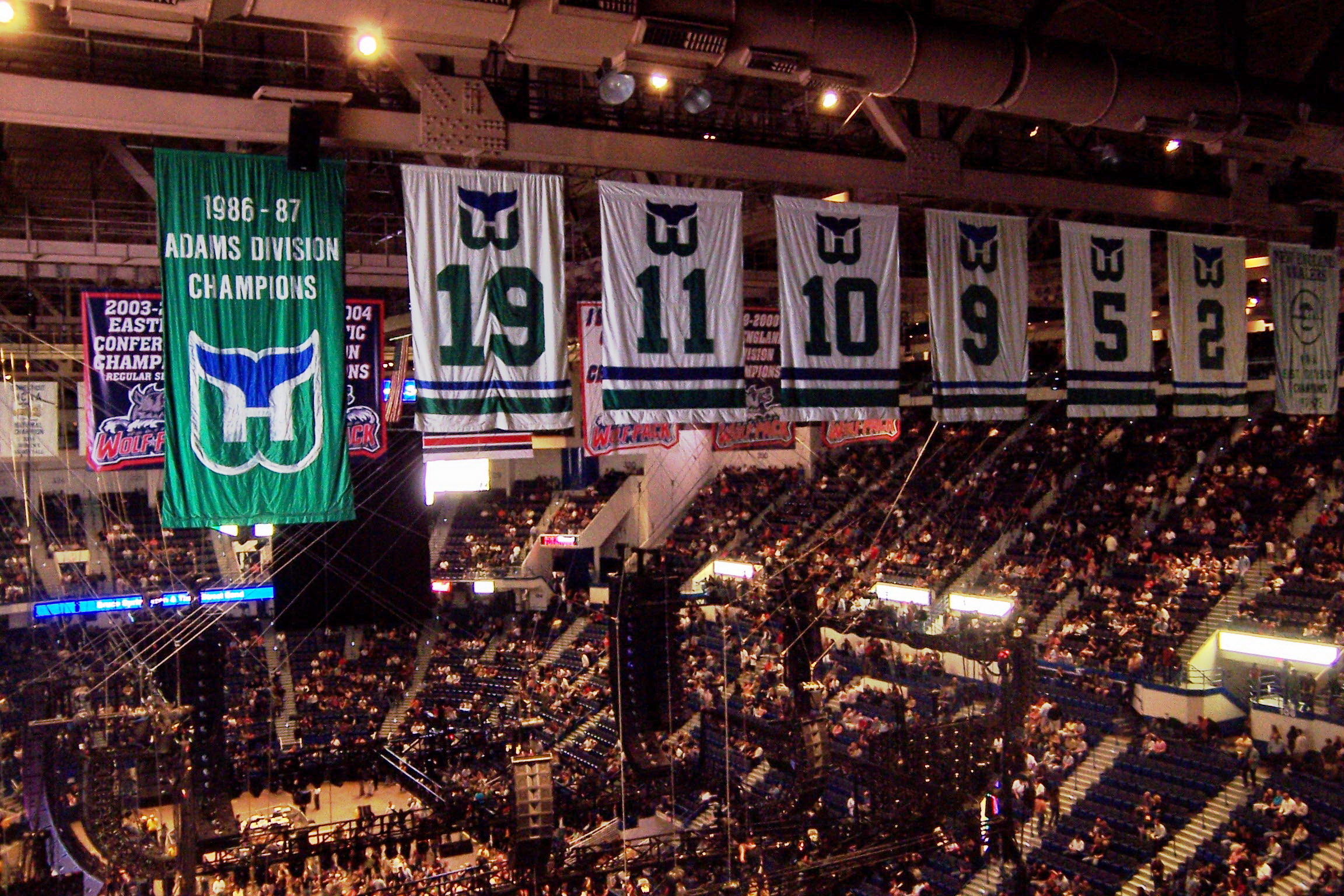
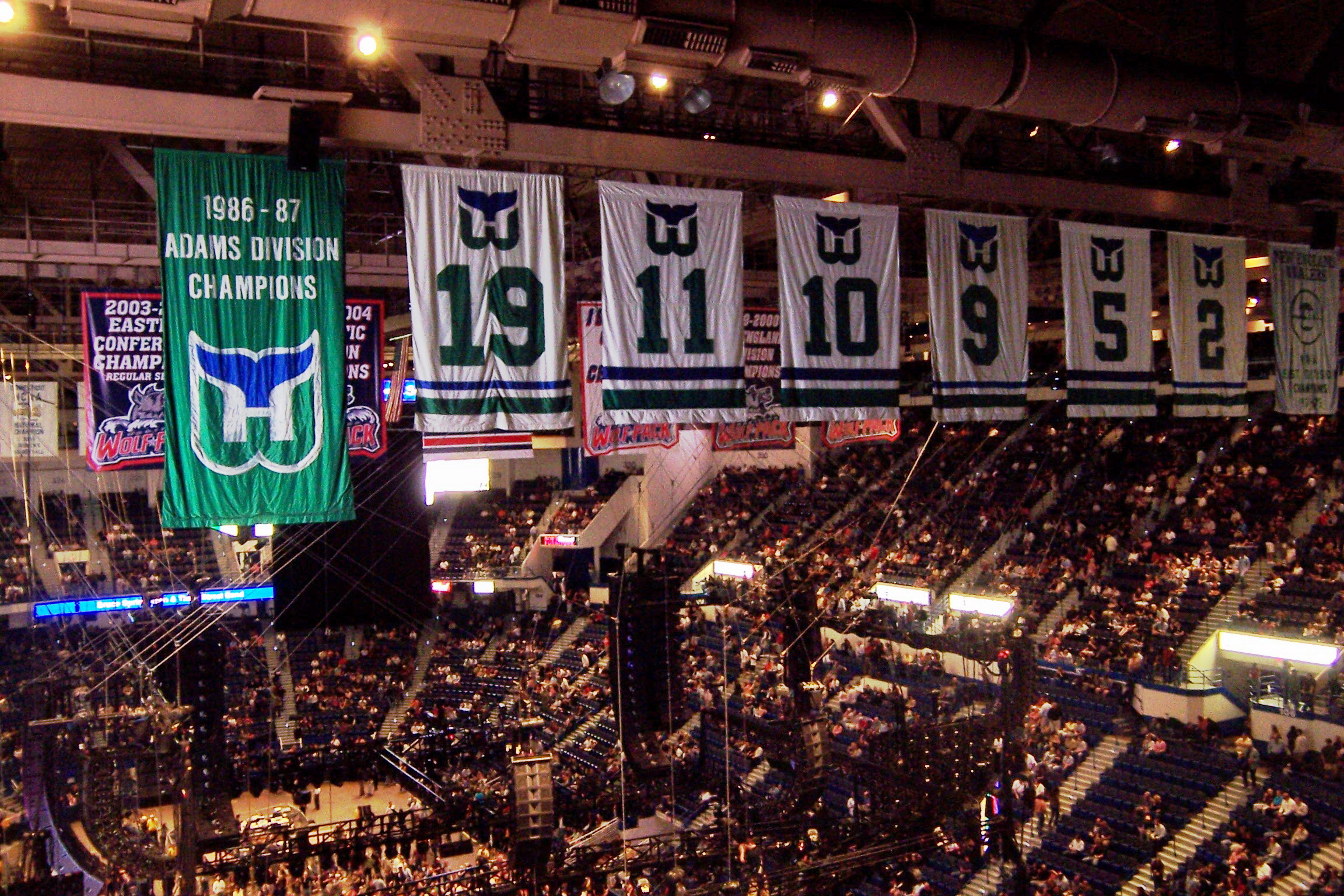
The Hartford Whalers, as a new NHL franchise, finally won their first victory on October 19, 1979. Having lost two games and tied two games, the Whalers clearly had a brief period of adjustment transitioning from the WHA (as the New England Whalers). In their fifth game, the Whalers defeated the visiting Los Angeles Kings 6-3. After two losses and a tie, the Edmonton Oilers also achieved their first victory as an NHL franchise that night. The score was exactly the same – the Oilers won 6-3 over the visiting Quebec Nordiques. Both of those teams had also just transitioned from the WHA to the NHL.
The Whalers owed their first victory to Mark Howe, who scored his first two NHL goals (along with an assist). The first was the first goal of the game and the second was the first game-winning goal for the NHL Whalers. His father, Gordie Howe, also had an assist that night. Meanwhile, Oilers’ rookie Wayne Gretzky had three assists.
Mark Howe (Photo: Centpacrr at en.wikipedia)
The Howe son and father had been playing with the Whalers since 1977. They had joined the WHA for the Houston Aeros’ 1973-74 season. Mark Howe began his professional career at the same age as his father, 18, and almost exactly 27 years after his father. That first season, the WHA selected Mark for the Second All-Star Team and Gordie for the First All-Star Team. Mark earned the Lou Kaplan Trophy (as the WHA’s top rookie) while his father (as the WHA’s MVP) was awarded the Gary L. Davidson Award (which was renamed the Gordie Howe Trophy two years later). They (and Mark’s brother Marty) won the Avco Cup that season and the next. By the end of the Whalers’ last season with the WHA, Mark Howe had played 426 regular season games (208G, 296A, 504P).
In the NHL, Mark remained with the Whalers until 1982. A gruesome back injury from 1980 and slow recovery eventually led to Mark skating with the Philadelphia Flyers for ten seasons. In 1992, Mark brought the Howe family full circle when his signed with his father’s first team, the Detroit Red Wings. Mark retired in 1995 having played in 929 regular season games (197G, 545A, 742P). None of Mark’s teams ever won a Stanley Cup championship during his skating years. However, he then worked as a Red Wings’ pro scout, which entitled his name to appear on the Stanley Cup for their victories in 1997, 1998, 2002, and 2008.
Only two seasons after Mark Howe’s retirement, in 1997, the Hartford Whalers became the Carolina Hurricanes. They won the franchise’s only Stanley Cup championship in 2006, having defeated the Edmonton Oilers in game seven. During the 2018-19 season the Hurricanes are bringing back the Hartford Whalers jerseys for a throwback night on December 23, 2018 when they play host to the Boston Bruins. They will also wear them when they visit Boston on March 5, 2019.
Additional Sources:
Stephen Laroche, Changing the Game: A History of NHL Expansion (Toronto: ECW Press, 2014), 286-288 and 291-295.
Kirk McKnight, The Voices of Hockey: Broadcasters Reflect on the Fastest Game on Earth (Lanham, Md.: Rowman & Littlefield, 2016), 32-36.
The Chicago Blackhawks head into their sixth game of the season making history. According to NHL Public Relations, the Hawks’ 3-0-2 record is the first time in league history that a team has started a season taking its first five games beyond regulation.
The Blackhawks won 4-3 with 38 seconds remaining in overtime. Hawks goalie Cam Ward saved 22 out of 25 shots while Sens goalie Craig Anderson stopped 39 of 43 shots.
Alex DeBrincat scored first for the Hawks with an unassisted wristshot just 4:40 into the first period.
Then, on a power play, Colin White (Lajoie, Chris Tierney) gave the Senators the lead to close out the first.
It was a scoreless second period, but Brent Seabrook tied it 3-3 at 12:18 of the third period with a one-timer fed by Patrick Kane in the right circle.
Kane said:
“If you can get [Seabrook] in that position, we’ve seen it before where he’s coming down the slot and he’s not going to miss too many of those. It was a great celebration, too. Good to see him excited.”
Then, 38 seconds into overtime, Kane (Toews) roofed a backhander past Anderson on a breakaway for the win.
After the game, Blackhawks coach Joel Quenneville told media:
“When you’ve got Kaner, you know he’s going to find a way to get something going.”
A hat trick from Toews gave the Blackhawks an overtime victory in St. Louis for a 5-4 win their second game of the season. This was Toews’ fifth regular season hat trick and his first time scoring in back-to-back regular season games.
Toews (Gustafsson, DeBrincat) cut the lead to 2-1 to head into first intermission.
At 1:33 into the second, Kane (Nick Schmaltz) tied the score for the Hawks. And, about halfway through regulation, Marcus Kruger (Kane, Schmaltz) launched Chicago back into the lead. Kane’s 518th assist, recorded here, moved him into fifth place in Blackhawks history.
But, the Blues came out hot for the third period. Just 3:45 in, Tarasenko (Maroon, O’Reilly) tied the game 3-3.
Then, Toews (Henri Jokiharju, DeBrincat) rebounded for a 4-4 game that held through regulation.
And, 2:20 into overtime, Toews (Brandon Saad, Jokiharju) delivered on a breakaway for the Hawks’ victory.
He told media after the game:
“It’s nice to get a chance there and overtime is always that style where you give up one, you’re going to get one right back. I had a chance to walk in and nice to see it go in.
“We knew it was going to be a tough game in this building tonight and all of the guys really bought into the rivalry we have with this team and everyone showed up and wanted to win tonight. It’s fun to win on the road here.”
DeBrincat (Kane) gave Chicago the lead again with a power play goal, but Suter (Parise, Staal) scored shorthanded to tie the game in regulation and allow for Zucker’s overtime game-winner.
Ward saved 42 of 46 shots while Devan Dubnyk stopped 27 of 30.
Blues at Blackhawks
Two goals from DeBrincat led Chicago past the Blues Sunday. His goal (assisted by Toews, Keith) with just under seven minutes in regulation tied the score and a second goal (assisted by Gustafsson, Artem Anisimov) less than five minutes into overtime allowed the Hawks to skate away with a victory.
Anisimov (Saad, Kahun) and an unassisted power play goal from Kane had Chicago in the lead early in the game.
But, Brayden Schenn (Schmaltz, Tarasenko) brought the Blues within one goal in the second period.
Then, in the third, David Perron scored an unassisted power play goal and Scheen (Steen, Parayko) gave St. Louis a 3-2 lead. And, with nine seconds left, DeBrincat (Toews, Keith) knotted the score at 3-3 to close out regulation.
At 4:51 in overtime, DeBrincat (Gustafsson, Anisimov) brought home the Hawks’ win.
Strong Start
According to The Daily Herald, Toews’ leadership—not to mention his hot start—has helped lead the team to a strong start.
He knew last season took a toll on the team:
“We let those little things—the little mistakes, the losses here and there—just build into bigger things.”
Hoping to turn that around, Toews offered his team some perspective on handling high-stakes situations. He invited a Navy SEAL to address his teammates two days before this season began in Ottawa.
“We wanted to start the right conversation with positive dialogue in the room (by) holding each other accountable and doing the little things right. With Special Ops and military guys, obviously the stakes are a lot higher if they make mistakes on the battlefield. They have to be over-prepared for every situation and make sure that they’re accountable to their teammates.
“It’s fun to hear from guys like that as far as the little things you can bring to mind and assess your own performance. I think he helped us create the right mindset in the locker room.”
Milestones
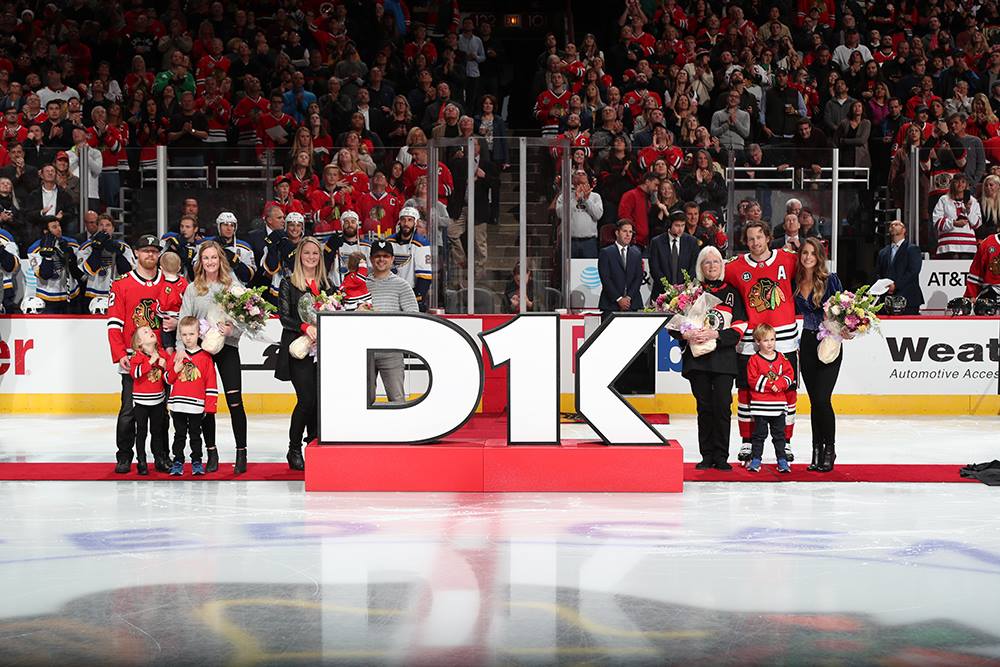
Keith celebrated his 1,000th game with the Blackhawks Sunday.
He’s the 12th active NHL player to hit that milestone and the sixth in Blackhawks history.
Keith told the press:
“It’s obviously a huge accomplishment. I’m proud of it. More than anything, I’m proud to be in the NHL this long and play with a lot of great players and a great organization for a great coach. Just all the good players and good guys that I’ve been able to be on this ride with.”
Keith was honored with a special presentation and commendations from his coach and teammates.
Kane said:
“What a great career he’s had. You look at two Norris Trophies, three Cups, a Conn Smythe Trophy, how well he’s played in the playoffs, how he’s able to come in in tip-top shape every year and be able to play so many minutes, be the backbone of our defense for a long time here. Even though he’s played 1,000 games, it doesn’t seem like he’s getting any older or slowing down. Pretty impressive.”
At the beginning of his second-to-last of 18 NHL seasons, Phil Esposito scored his final hat trick. On October 18, 1979 at Madison Square Garden, his 32nd hat trick established an NHL record. With those three goals and two assists, Esposito brought the New York Rangers to a 6-3 win over the Vancouver Canucks.
Esposito scored his first NHL hat trick on October 15, 1967, his second game and first win with the Boston Bruins. At Boston Garden, they trampled rival Montreal Canadiens 6-2. After four seasons with the Chicago Blackhawks, Esposito had been traded in a deal that most consider gave the Bruins the far better end of the bargain. He remained with the Bruins until 1975, during which time he topped the scoring leaderboard and made the First All-Star Team six times, won the Hart Trophy and the Stanley Cup twice, and set records for goals and points in the 1970-71 season. From 1975 until his retirement in 1981, Esposito skated with the Rangers.
Until Esposito, Bobby Hull held the record for NHL regular-season hat tricks at 28. He scored that final hat trick on December 22, 1971, when Esposito had less than half that. However, Hull left for the World Hockey Association (WHA), so his additional 13 hat tricks do not count towards the record. Esposito scored his 29th hat trick to top the list on November 30, 1977. Earlier that month, he had scored his 600th goal, placing him third behind Gordie Howe (786) and Bobby Hull (604). During the 1979-80 season, Esposito tied Hull for most consecutive 30-plus-goal seasons (13).
Esposito’s hat trick record could not survive Wayne Gretzky. Exactly five years after Esposito’s 32nd hat trick, Gretzky scored his 29th. Gretzky set the new record with his 33rd hat trick on January 26, 1985. He went on to score 50 regular-season hat tricks and still holds the record. Esposito remains in fifth behind Mario Lemieux (40), Mike Bossy (39), and Brett Hull (33). He also still ranks sixth in career goals (717) and 10th in career points (1,590).
As Bruins teammate Bobby Orr told Sports Illustrated in 1971, “We’re like a team of brothers. I know Phil has scored a lot of points, but to my mind he’s even more important off the ice.” After retiring in 1981, Esposito went on to manage and coach the New York Rangers before founding the Tampa Bay Lightning franchise (with his brother Tony Esposito) in 1992.
Over half way into the third period on October 17, 1989, the visiting Calgary Flames had only three goals while the Quebec Nordiques had just scored their eighth. The way the game was going may have surprised fans considering Calgary came into the game with four wins and one loss while the Nordiques had the exact opposite record. Instead of giving in, the Flames made a stunning comeback.
As the clock tipped into the 13-minute mark, the Flames scored three goals in less than 27 seconds (between 13:27 and 13:54). Left winger Gary Roberts, who had scored a goal in each of the first five games of the season, potted two goals back to back. Eleven seconds later, Jim Peplinski, right wing, scored his only goal for the entire season. The three goals in such quick succession were not enough to beat the Boston Bruins’ 1971 record of 20 seconds, but they brought the score up to 8-6.
At 19:41, the Flames’ loss seemed sealed. Gary Roberts was penalized two minutes for roughing, two minutes for unsportsmanlike conduct, and ten minutes for misconduct. The Flames would have to play the remainder of the game shorthanded. Four of the Nordiques’ goals occurred on power plays (due to 5 and 10 minute penalties incurred by the Flames for high sticking and game misconduct). With nothing to lose, the Flames pulled their goalie, Mike Vernon. At 19:45, with exactly 15 seconds remaining in the game, center Doug Gilmour scored from the left faceoff circle. At the next faceoff, he passed the puck to his left wing, rookie Paul Ranheim, who scored the final goal of the game at 19:49. The game ended tied at 8-8.
The Flames were the fourth team to score two goals within four seconds. The first team was the Montreal Maroons in 1931. The Buffalo Sabres had become the second team exactly 15 years earlier, on October 17, 1974. The third, the Toronto Maple Leafs, had accomplished their feat just the prior December. Although fourth, the Flames held a new record for the fastest two shorthanded goals. By that point, in 1987, both the St. Louis Blues and Boston Bruins managed to score two goals within two seconds.
Calgary’s huge comeback occurred exactly one year after another massive amount of scoring in the third period. On October 17, 1988, the Flames went into the third period edging over the visiting Los Angeles Kings 4-3. They added seven goals during the last period, which was a team record. In both seasons, 1988-89 and 1989-90, the Flames finished first in the Smythe Division. They won their only Stanley Cup in 1989.
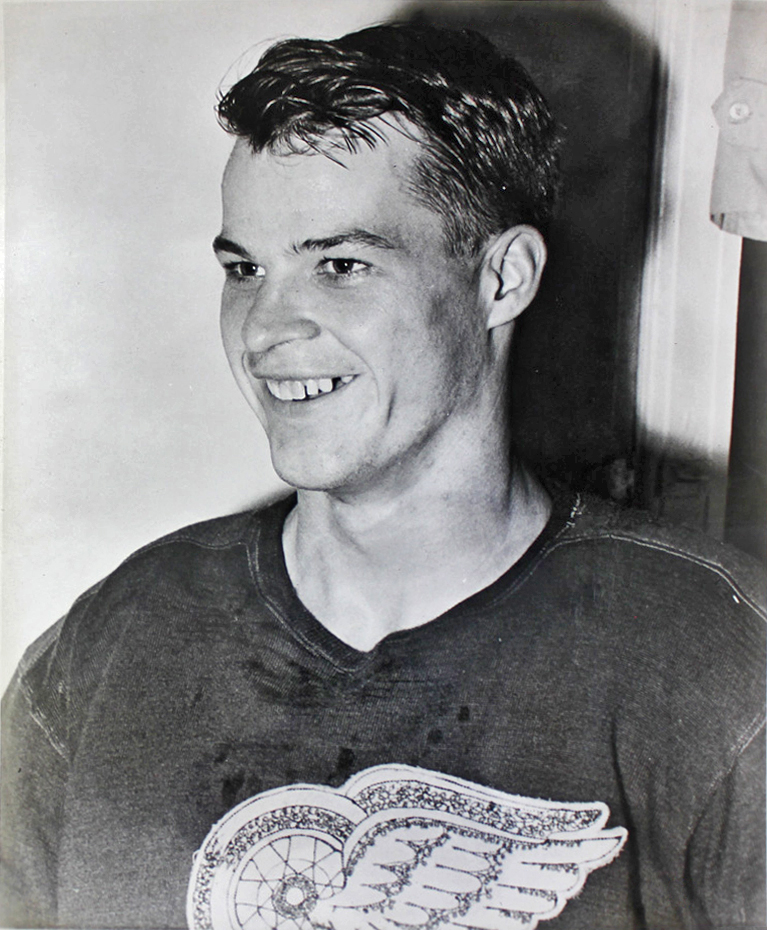
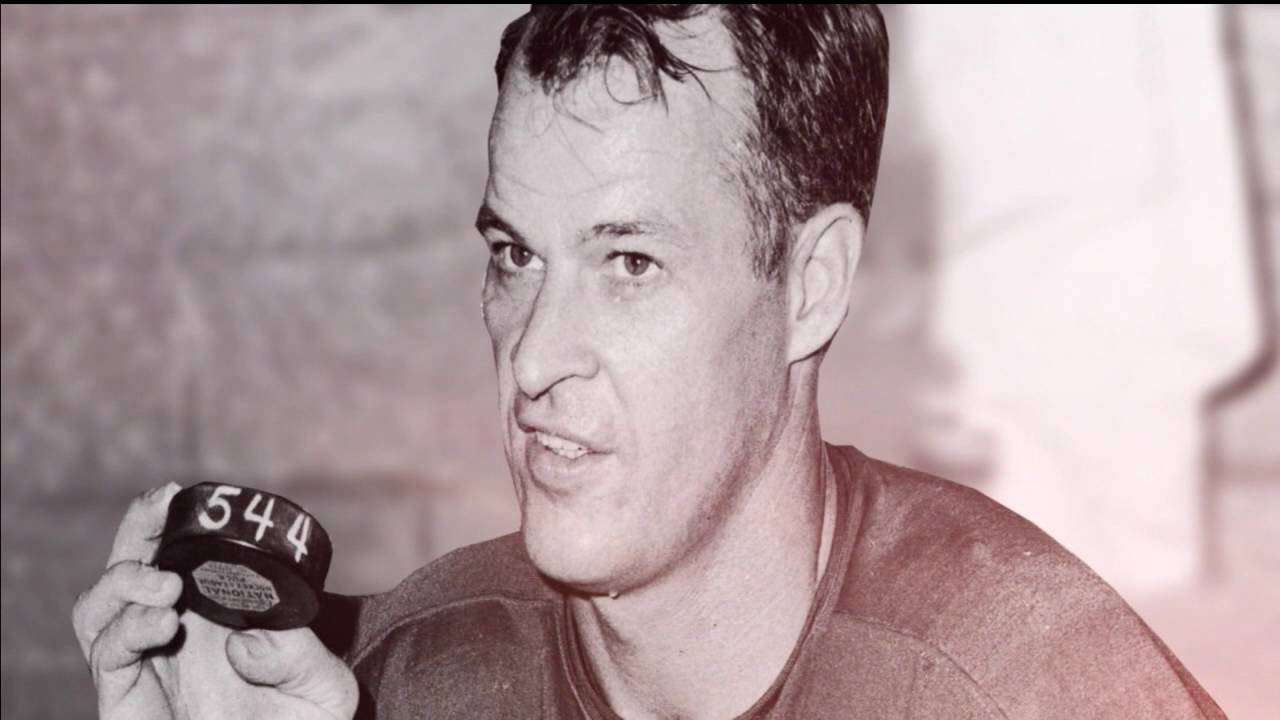
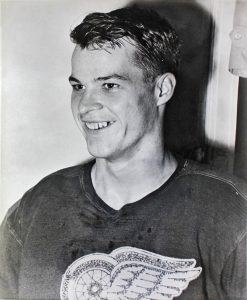
Gordie Howe, who was so iconic that he was known as “Mr. Hockey,” began his illustrious career in 1946. On October 16, eight days after signing with the Detroit Red Wings, the 18-year-old played in his first NHL game. That night in Detroit, he scored his first goal, helping tie the Toronto Maple Leafs 3-3.
He finished his first season with 22 points (seven goals, 15 assists). Not knowing the records he would go on to break, purportedly, “He kept a scrapbook of his first year, proof for future generations that he’d in fact played in the NHL.” The following season, he and his best friend, Ted Lindsay, became the wings around center Sid Abel and “The Production Line” became one of the most successful in hockey. Lindsay said of Howe, “I call him the greatest hockey player to ever play the game.” Six times each, Howe earned the Art Ross Trophy (as lead scorer) and the Hart Memorial Trophy (as MVP). The Red Wings won four Stanley Cup championships during his time with them. Howe played a record 1,687 games over 25 seasons with Detroit before retiring with wrist problems.
Then Howe came out of retirement to have a second playing career with the World Hockey Association (WHA). In 1973, Howe underwent wrist surgery so that he could play for the WHA’s Houston Aeros with his teenaged sons, Mark and Marty. Theirs was the first line featuring a father and two sons. The Aeros placed first in the West Division and won the Avco Cup championship that season and the next. The Howe family remained with the Aeros until 1977. They spent the last two years of the WHA with the New England Whalers.
Gordie Howe then returned to the NHL, on October 11, 1979, by playing his first game with the NHL-merged Hartford Whalers. Two days later, he scored his first NHL goal (since 1971) against the Pittsburgh Penguins. After the game, he announced that he would retire when the season ended. On the last game before playoffs, April 6, 1980, he scored his final regular-season goal.
That goal, number 801, set a record for career goals during the regular season that has only been topped by Wayne Gretzky (with 894). However, Gretzky’s total career goals (950) could not surpass Howe’s total from both the NHL and WHA (975). At retirement, Howe also led the NHL in assists (1,049) and points (1,850). He is still ranked ninth in assists and fourth in points, both lists now headed by Gretzky. In addition, Howe is seventh in WHA points (508), while his son Mark is eighth (504). Howe still leads the number of games played (1,767) over five decades in the NHL. Despite having beaten many of Howe’s records, Gretzky called Howe “the greatest player ever.”
Additional Sources:
Kirk McKnight, The Voices of Hockey: Broadcasters Reflect on the Fastest Game on Earth (Lanham, Md.: Rowman & Littlefield, 2016), 61-62, 194-195.
Stephen Laroche, Changing the Game: A History of NHL Expansion (Toronto: ECW Press, 2014), 294-295.
Three times players have reached 1,000 games on October 15. Two of them played for the Detroit Red Wings and the other for the Chicago Blackhawks.
On October 15, 1964, Ted Lindsay played his 1000th NHL game. Having begun his NHL career in 1944 with the Red Wings, Lindsay was traded to the Blackhawks in 1957. After playing 999 games in the NHL, he retired in 1960. Lindsay explained, “I still had a Red Wing on my forehead, on my backside and over my heart. I was existing, nothing more. Then, I retired for four years.” During those four years, Lindsay’s former Red Wings teammate, Gordie Howe, became the first NHL player to appear in 1,000 games. Howe still leads the NHL in total number of games played (with 1,767). Shortly thereafter, Bill Gadsby, in his first season as a Red Wing, became the second to play 1,000 games. The third player to reach 1,000 games, Red Kelly, did so a few years after leaving the Red Wings. Then, as Lindsay summarized, “Sid Abel talked me out of retirement when I was thirty-nine and I went back to play one more year in Detroit. It was the final year of the six team league.” Lindsay’s first game of that final season would be his 1000th, and he would play another 68 before retiring. He is tied for 225th in the rankings of most games played.
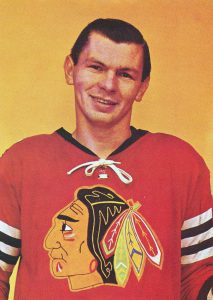
By Ralston-Purina Company, makers of Chex cereals [Public domain], via Wikimedia Commons
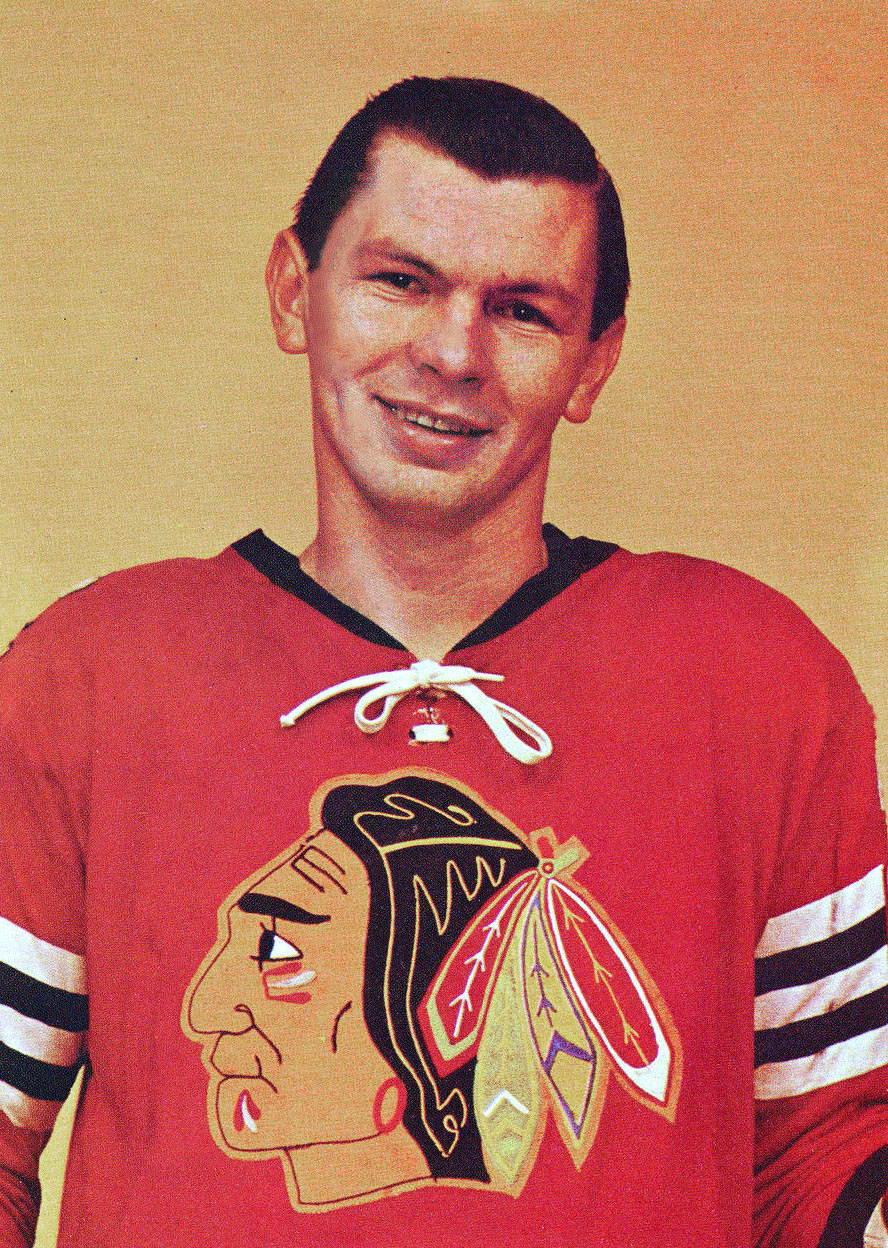
On October 15, 1972, Stan Mikita became the first European-born and sixth player overall to reach 1,000 NHL points. He had an assist on the Blackhawks’ only goal when they lost to the St. Louis Blues at Chicago Stadium. This was almost exactly a year from the date when Norm Ullman became the fifth to reach 1,000 points. The fourth, Bobby Hull (Mikita’s teammate at the time), reached 1,000 within the fewest number of games (909) up to 1974. Of course, the first to reach 1,000 points was Gordie Howe (in 1960). Mikita played 22 seasons with the Chicago Blackhawks (from 1958 to 1980), and his first two seasons were Lindsay’s last two seasons with the franchise. Mikita’s career total came to 1,467 points, which ranks him 14th among NHL point leaders.
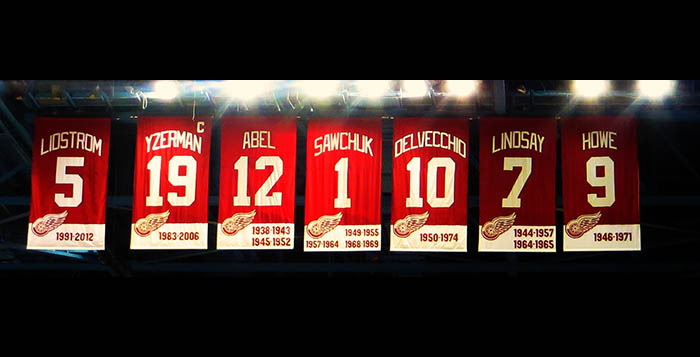
On October 15, 2009, Nicklas Lidstrom joined Mikita in the 1,000 points club. Whereas Mikita was the first forward, Lidstrom was the first European-born defenseman to reach this milestone. Lidstrom’s two assists at Joe Louis Arena led to the Red Wings’ win against the Los Angeles Kings. Nine years earlier, on October 21, 2000, Lidstrom had topped 500 points, as the third European-born defenseman to do so. His career total came to 1,142 points. By the time he retired in 2012, Lidstrom had played 1,564 games (in 20 seasons) with the Red Wings, a number second only to Gordie Howe with 1687 games. Lidstrom is 12th overall for number of NHL games played. According to the Hockey Hall of Fame, Lidstrom “holds several Red Wings’ franchise records, including games played by a defenceman, most regular season goals, assists and points by a defenceman (264, 878 and 1,142), most playoff games (263), goals (54), assists (129) and points (183) by a defenceman.”
All three players have been inducted into the Hockey Hall of Fame. Lindsay chose not to attend his induction ceremony in 1966 because women could not attend. In response, the Hockey Hall of Fame changed the rules the following year. Mikita (along with Bobby Hull) had his induction in 1983. After Lidstrom’s induction into the International Ice Hockey Federation (IIHF) Hall of Fame in 2014, he was inducted into the Hockey Hall of Fame in 2015.
The Philadelphia Flyers enjoyed many high points throughout the 1970s. One of them was an astonishing unbeaten streak, lasting 35 games, which began on October 14, 1979. Their streak outlasted not only other hockey teams but all North American professional sports.
The Flyers’ streak started at the Spectrum and ended on the road. The 1979-80 season started off promising on October 11 with a 5-2 win against the New York Islanders. The second game, two days later in Atlanta, gave the Flyers their only loss for the next three months. On October 14, the team returned to their own rink to defeat the Toronto Maple Leafs 4-3. Philadelphia then proceeded to win 25 games and tie 10 combining for a 35-game undefeated streak, two beyond the Los Angeles Lakers’ previous record of 33 basketball games. The streak finally ended on January 7, 1980, at the Metropolitan Sports Center, when the Minnesota North Stars crushed the Flyers 7-1.
Since the Flyers recently had collected two Stanley Cup wins (in 1974 and 1975) before narrowly missing a third (in 1976), their success during the 1979-80 season likely surprised few. After their unbeaten streak, they ended the regular season with a record of 48-12-20 (116 points). Unsurprisingly, the Flyers had the fewest losses in the league, led the Patrick Division, and placed first overall.
For the playoffs, the Flyers swept the Edmonton Oilers in the preliminary round and then proceeded to knock out the New York Rangers and Minnesota North Stars (in five games each) in the quarter and semi-finals. For a moment, it looked like the North Stars might again disrupt the Flyers’ plans, but they only managed to win the first game of their series. Then the Flyers took on the New York Islanders in the finals. The teams split the first two games held at the Spectrum, the Flyers lost the next two at Long Island, and then the Flyers took another win at home. However, the sixth game would mean returning to Nassau Coliseum, where the Flyers had won only a single game in the past five years. Unfortunately for the Flyers, they could not manage to add another game to the win tally and lost to the Islanders 4-2. The Islanders then continued with their own streak winning four Stanley Cup championships in a row. Meanwhile, the Flyers have yet to win another.
Additional Source:
Brian McFarlane, Brian McFarlane’s History of Hockey (Champaign, Ill.: Sports Publishing Inc., c1997), 170-175.
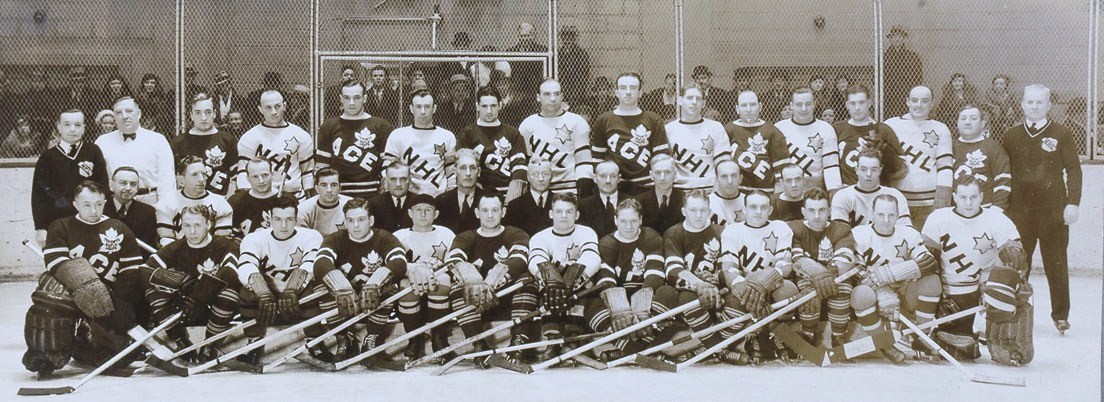
(Photo: 1934 benefit game by Alexandra Studio, Toronto [Public domain], via Wikimedia Commons)
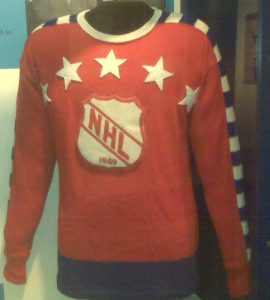
The NHL has a tradition of annually selecting All-Stars to play an exhibition game to raise money for the players’ pension fund, established October 1, 1947. While the NHL had chosen All-Star teams as early as 1931, only three similar benefit games predated the first official All-Star exhibition, held October 13, 1947.
At the game, the All-Stars (coached by Dick Irvin of the Montreal Canadiens) defeated the Stanley Cup champion Toronto Maple Leafs 4-3. The First All-Star Team included Maurice Richard of the Canadiens and Ted Lindsay, Bill Quackenbush, and Jack Stewart of the Detroit Red Wings. Turk Broda, although also named to the team, played for his Maple Leafs. In preparation for the game, the Maple Leaf Gardens had glass installed on the boards, which led to complaints about muffled sounds. With a crowd of 14,169 spectators, the game still drew the highest attendance until the 1961 All-Star game.
The All-Star game with the lowest attendance (9,166) happened to be the first one televised and the first one in which the All-Star team lost (and by the largest margin). On October 8, 1950, the All-Stars (coached by Lynn Patrick) played the Stanley Cup-winning Detroit Red Wings at the Olympia. Thanks in large part to Ted Lindsay’s hat trick (and an assist to Gordie Howe), the Red Wings won 8-1.
For the next two years, an American-based All-Star team played a Canadian-based All-Star team. After that, the All-Star team resumed playing the championship team until 1969, when two All-Star teams (typically divided geographically) began playing each other. The two head coaches for the previous Stanley Cup finalists coached the teams. As of 1996, the coaches are determined by the conference-leaders (in point percentage) of the current season. The games remained in October until 1967, when they switched to mid-season (January or February each year).
October 12th, with the NHL season still fresh, has proven a night of numbers for the league. In 1980, a forward scored the 100,000th goal. Eleven years later, in 1991, all of the league’s teams played each other on the same night.
When NHL teams first played, on December 19, 1917, the Montreal Canadiens defeated the Ottawa Senators 7-4 while the Montreal Wanderers beat the Toronto Arenas 10-9. With a start like this, surprisingly, it took 64 more seasons before the NHL reached its 100,000th goal. With 14 seconds left in a game between the Toronto Maple Leafs and the Philadelphia Flyers, Wilf Paiement shot the historic goal into the Flyers’ empty net bringing the score to 4-2. In this, his second season with the Leafs, Paiement would go on to score 40 goals, enough for a personal best and to tie for 17th place among the season’s score leaders.
The first game day of the NHL had all four teams playing each other. In its 75th season, the league had grown to 22 teams, and on October 12, 1991, they all played each other in eleven games. Seven of the home teams won, one tied, and four lost to the visiting teams.
Minnesota North Stars (home) vs Detroit Red Wings 3-2
New Jersey Devils (home) vs Pittsburgh Penguins 4-1
New York Islanders (home) vs Philadelphia Flyers 5-4
Buffalo Sabres vs Quebec Nordiques (home) 5-4
St. Louis Blues (home) vs. San Jose Sharks 6-3
Vancouver Canucks vs Toronto Maple Leafs (home) 2-1
Chicago Blackhawks (home) vs Washington Capitals 7-2
The very next October saw two additional teams added (Ottawa Senators and Tampa Bay Lightning), and the one after that another two (Florida Panthers and Mighty Ducks). By 2000, the NHL had grown to 30 teams, and on October 5, 2005, they would once again all play each other.
Some questioned the trade that sent Martin Jones to the San Jose Sharks and brought Sean Kuraly and a first round pick to the Boston Bruins on July 1, 2015. The 25-year-old came up through the USHL and the collegiate route—four years at Miami University in Oxford, Ohio—before ultimately signing a two-year entry-level contract with the Bruins on March 29, 2016.
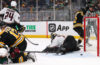
Spending much of the 2016-17 season with the Providence Bruins, Kuraly played just eight regular season games and four playoff games in the first season of his contract with the NHL club. During that time, when he did play in Boston, he made some clutch goals. His first two NHL career goals were scored during the 2017 Eastern Conference Quarterfinals against the Ottawa Senators, most notably his double-overtime goal that saw the Bruins beat the Senators 3-2 in the fifth game.
Kuraly scored his first regular season goal in November 2017, when the Vegas Golden Knights—the 2017 expansion team—came to visit Boston. He would go on to play 75 regular season games in the 2017-18 season amassing six goals and eight assists for 14 points. During their playoff run, in his 12 games he would score two goals and notch two assists for four points.
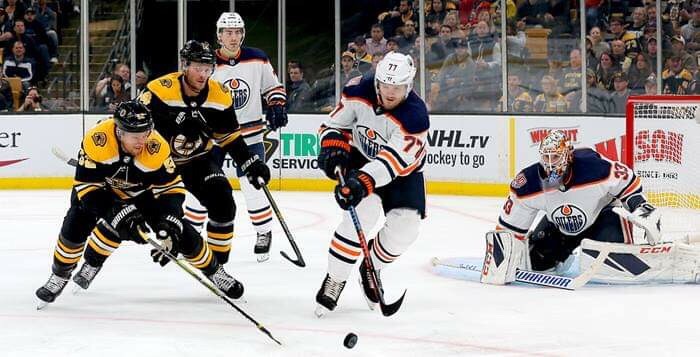
Coming into the 2018-19 season, he was re-signed July 3, 2018, on a one-way contract that carries him through the 2020-21 season at which point he will be an unrestricted free agent. During the preseason, he ended up sidelined with an injury that prevented management from seeing how well he would slot into the third-line center position. However, after his work during the Bruins game on Thursday, October 11, 2018, against the Edmonton Oilers, he may have shown that he is strongest in that fourth line center position.
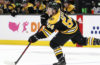
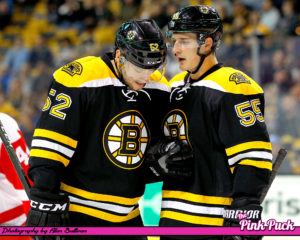
Sean Kuraly gets some info from Noel Acciari
The Bruins have always been a dangerous team when they can roll four solid lines. With the insertion of David Backes as third line center, on the line with youngsters Danton Heinen and Anders Bjork, that line has begun to look like it could gel. Meanwhile, Kuraly was on the fourth line flanked by Chris Wagner and Noel Acciari.
While perhaps nothing will ever replace the fabled “Merlot Line” of Gregory Campbell, Shawn Thornton, and Daniel Paille, who helped Boston to their 2011 Stanley Cup, the Wagner-Kuraly-Acciari line is certainly looking to make their mark. Wagner made sure that anyone wearing an Oilers jersey got hit in the course of the game, while also putting three shots on net. Kuraly had the most time on ice of the three of them—12:56, and he used it wisely. He had six shots on net, two takeaways and was an impressive 67% in the faceoff.
“There were parts that I liked and some parts that I think my line did well and I think there’s definitely things we want to build on. We want to possess the puck in the o-zone. I think we’re getting there. I think we did a lot of things well and definitely some things we still want to improve on,” Kuraly shared after the game.
Most players will point to the things that they need to improve on, and that shows the continued desire to grow as a player, but also that they are not falling into a sense of complacency. The line had nine shots on the Oilers goaltender, Cam Talbot, but Talbot was able to keep them all out of his net. However, it was clear that the three line mates looked like they could continue to build from Thursday night’s game.
Kuraly is fast, deceptively so. And having such a player on that fourth line offers an advantage that other teams may not have in their bottom six. If all three of them can begin to understand where the others are and how best to cycle the puck and get it into the offensive zone quickly, they could certainly cause some damage on the score sheet, supplementing the Bergeron line, which presently has amassed ten goals, 12 assists for 22 points of the total 14 goals, 22 assists and 36 points the team has for the season. During Thursday’s game, each member of the Bergeron line got a goal and Bergeron also got an assist.
One other thing that makes Kuraly a great asset on the ice is his willingness to hit his opponents and not back down. He will finish his checks, as he did on Edmonton’s Matt Benning who ended up through the glass, while the fans in the front row seats held up the pane.
“I don’t think I broke the glass. I didn’t even know that it happened to be honest, but I guess it was pretty cool,” Kuraly said. “I knew I wanted to give him a good lick but at the same time you want to be a little bit respectful and he knows I’m coming, but at the same time, you don’t want to put him in too vulnerable a position. And he was safe with how he protected himself and I kind of read it and knew that it’s my job to get in on the forecheck and finish defensemen, not just for that play but for the rest of the game.”
Kuraly is definitely a player to watch. He has speed. He has strength. And he is showing some great hockey IQ when he is out on the ice.




 Prev
Prev