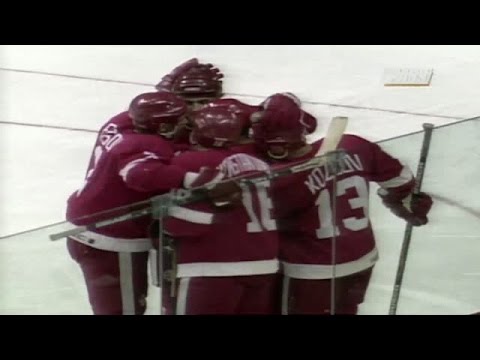
That night in the nearly sold out Saddledome, coach Scotty Bowman unleashed the Russian Five on the Calgary Flames. The NHL had never skated a complete unit of former-Soviets, and according to Kozlov, “the hockey that we started playing, the North Americans didn’t understand.” However, team captain Steve Yzerman noticed, “When Scotty put them all together, the five Russians, there was instant chemistry. It was unique. It had never been done in the NHL, and for us it was enjoyable, really enjoyable to watch, and obviously it helped us win hockey games.” Detroit general manager Jim Devellano commented, “It was beautiful to watch. Every pass was tape-to-tape. They all knew where everybody else was. They showed us the pride of the Russians. I mean, they were Russians and here they were in America, playing in the NHL together on a top-notch team in Detroit. Who would have ever thought that?” Assistant coach Dave Lewis had the answer. “I think it helped that it happened in Detroit. The fans know the game, and they really took a liking to all the Russian guys. But you’ve got to give it to Scotty for getting them all together.” The Russian Five dominated the game making 15 of the 25 shots on goal with Kozlov scoring in the first period and Larionov scoring in the third to end the game 3-0.
The five Russians played for the same Red Army club and hailed from western Russia. Fedorov was born in Pskov (near the border with Estonia) and grew up in Apatity (near the border with Finland). Konstantinov also hailed from the Arctic Circle, in Murmansk, the largest city up there. Kozlov and Larionov both hailed from Voskresensk near Moscow, where Fetisov was born.
When the Red Wings drafted Fedorov and Konstantinov in 1989, they sent Russian-speaking sportswriter Keith Gave to interview the two and secretly pass along invitations and information concerning the team during their training camp held at Helsinki, Finland. At first, Federov said, “I still didn’t understand what the draft is, who the Red Wings are, nothing really about the NHL. . . . My parents would be very upset with me if I change my mind now and try to get a release [from military service].” Thanks to some furtive planning, the Red Wings helped Fedorov defect in July 1990. As scout Nick Polano said, “We had him in Detroit before the Russians knew he was gone.” Unlike Fedorov, Konstantinov, captain of the Red Army team and a captain in the military, wanted to leave, but between his rank and his 25-year military contract, he would be considered a felon (and thus ineligible for a work visa) if he defected. The Red Wings ended up bribing doctors to tell the army that Konstantinov had a rare form of cancer they could not treat, and eventually, Konstantinov received a medical release. He escaped to Budapest with his wife and 3-year-old daughter before flying to the U.S.
In June 1990, Detroit drafted Kozlov in the third round – setting a new record for the highest draft pick of a Soviet-born skater. However, he was an immature 19-year-old who worried for his parents and liked the salary he was making with the Central Red Army club (CSKA). He only played 11 games with CSKA before a terrible car accident left him in coma for four hours and in the hospital for three months in the autumn of 1991. Kozlov remembered, “What kept me going and helped me to recover the most was the fear of never playing hockey again, because that is the meaning of my life. And the situation with my parents, putting all their hopes on me, that helped me to come out of the situation and recover form the accident and keep moving.” The Red Wings stepped in and again bribed the doctors to say that Kozlov had “permanent brain damage and a loss of peripheral vision,” so he was released from the military and then the hospital. He flew to Detroit that February 1992. His father, Anatoly, a career hockey coach, “spoke of how proud he was that Slava was playing in North America, in the best hockey league in the world. He was grateful that his son was so well-received, like the other Russian players, by the people of Detroit.”
The other two of the Russian Five had already left the Soviet Union for other NHL teams. Fetisov signed with the Devils after being drafted in 1983 and was promised that he could end his career there, but the Soviets kept postponing his release. In response, he wrote a public article and was forced to serve the Red Army as a soldier at the rank of major. Larionov went on TV to say he and teammates would not play internationally until Fetisov was reinstated. In 1989, Fetisov finally left to play for the Devils. “When I came to play in the [NHL], there was more politics in the game. In the first place, it was still the Cold War. When I walk in the dressing room, I can feel there was still some guys that don’t like you,” he said. “I took the challenge and it took a lot out of me, mentally and physically. . . . I had two choices in 1989. I could pack my stuff and go back, or I could fight through it.” When Fetisov re-signed with the Devils, he did not see much ice time, so the Red Wings traded a third-round draft pick for him on April 3, 1995. His new teammate Fedorov said, “It was certainly easy to play defense with him. He would not throw the puck around the glass. He would always find you. Slava brought to our team stability – and a lot of experience on the defensive end, where we had a little trouble.”
Just as Fedorov encouraged the Red Wings to acquire Fetisov, Fetisov was vital to the decision to trade for Larionov. The two were longtime friends and teammates. Larionov appeared too friendly with Americans, so the Soviets banned him from travelling abroad. In response, he published an open letter in October 1988 and “began to kick down what remained of the Iron Curtain.” Almost as soon as he became a civilian in May 1989, he signed with the Vancouver Canucks. As Larionov wrote in his book, “For nine years I was shackled in an Army I did not want to join, playing the game I loved for a man I despised. Now, at last, I am in the NHL. And most of all, I am free.” He quit for a season (but played for HC Lugano in Switzerland) before signing with the San Jose Sharks in 1993. Ironically, “in their first Stanley Cup playoff experience,” the Sharks “defeated the top-seeded and heavily favored Detroit Red Wings in the first round – one of the more memorable upsets in NHL history.” This caught Bowman’s attention, but when he asked about a trade, he learned it would cost the Red Wings one of their top goal-scorers, Ray Sheppard. Fetisov, as “a big supporter of the Russian system,” convinced Bowman to make the trade when he said, “You know, we would have five then, and if you ever want to, you could play them together.”
Going into the 1995-96 season, the Red Wings had just come out of the Stanley Cup finals having been swept by the New Jersey Devils. The Russian Five, “seemingly overnight,” according to Gave, “elevated their play to a level rarely witnessed in the league, breaking records and raising expectations sky-high.” They ended the season winning a record 62 regular-season games and the second-highest points of all time (131 points). Although the team lost the conference finals (to the Colorado Avalanche), they went on to sweep the Philadelphia Flyers and then the Washington Capitals to win back-to-back championships the next two seasons. After winning, Gave said to the Russian Five, “Molodyets (well done)!”
“He was a leader. He was a captain. He was the face of a franchise,” Detroit Red Wings GM Ken Holland said of Steve Yzerman. That was what Yzerman did for 19 years – lead as captain of the Red Wings. On October 26, 1997, he became the longest-serving captain, not only of Detroit, but in the entire NHL.
When, on October 7, 1986, Yzerman was named the 34th captain of the Red Wings at 21, he became the youngest NHL captain. He had gained a reputation for making many sweet goals, and fans began returning to the team. His teammates soon realized that he “led by quiet example,” and he became known simply as “The Captain.” Making captain in his fourth season, he captained the team for the next 19 seasons, through 1,300 games. During that time, the Red Wings finished first or second in their division for all but two seasons.
At the height of Yzerman’s career, he led the Red Wings to back-to-back Stanley Cup championships in 1997 and 1998. In between the two, Yzerman surpassed Alex Delvecchio’s record of 11 years, 12 games as the longest-serving captain. With the win (5-1 against the Vancouver Canucks) on October 26, 1997, the Red Wings started the season 6-0-0. At the end of the season, Yzerman won the Conn Smythe Trophy (as playoff MVP). He also earned the Lester B. Pearson/Ted Lindsay Award (in 1989), the Selke Trophy (in 2000), and the Bill Masterton Trophy (in 2003). Yzerman’s team won another Stanley Cup championship in 2002. For his final season, 2005-06, Yzerman led the Red Wings to another Presidents Trophy for finishing first in the league. That summer, he officially retired after having played 1,514 games and amassing enough career points (692G, 1063A, 1755P) to place him seventh all-time in the league. His successor as captain, Nicklas Lidstrom, said, “He was a true leader for us to follow. He showed a tremendous commitment in those playoffs, playing through injury, through pain.”
After retiring, Yzerman became vice president of his franchise, and three years later, the Red Wings won their fourth Stanley Cup championship in eleven years. Then, in 2010, he moved on to the Tampa Bay Lightning as vice president and general manager and “built the Lightning into a Stanley Cup contender.” For which, in 2015, he received the NHL’s General Manager of the Year Award. On the international stage, Yzerman had skated with team Canada in the Olympics held in 1998 and 2002 (when Canada won gold). He then served as executive director for Team Canada for the Olympics, earning two more gold medals (in 2010 and 2014).
Detroit honored Yzerman’s contributions by renaming the road leading to Joe Louis Arena Yzerman Drive. On January 2, 2007, the Red Wings retired his No. 19 – the same number as the number of seasons he served them as captain.
The Boston Bruins returned to TD Garden on Thursday, October 25, 2018 after a less than impressive road trip in which they garnered four out of a possible eight points. Going into Thursday night’s game against the Philadelphia Flyers they were undefeated on home ice. The Flyers were coming off a loss to the Colorado Avalanche and brought a 4-5-0 record with them.
The Bruins had recalled Jeremy Lauzon from Providence as their list of injured defensemen continues to mount. This would mark Lauzon’s first NHL game. He was understandably nervous, as he admitted to Alex Kramer and NESN during the first intermission. However, if he hadn’t said anything it would have been difficult to suspect such, as he looked strong and focused from his first to his last shift. He had a couple of mistakes with the puck, but he was not afraid to hit the opponent. At the end of the game he was credited with two hits, one takeaway and one blocked shot.
Jeremy Lauzon in preseason game.
“Yeah, we got the win and I just kept it simple. Played hard defensively and tried to put some shot on the net. I think, overall my game went well. I approached the game like any other game and just tried to play my game,” Lauzon shared.
Going into that first intermission the teams seemed evenly matched as each had seven shots on the other while neither team had scored. Even the penalties were even, with matching penalties at 7:11 for some four-on-four action and then both would put their team down a man just once in the first twenty.
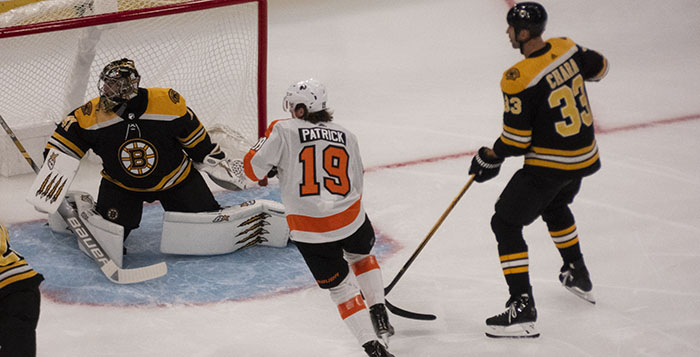
Bruins captain Zdeno Chara would open up the scoring 13 minutes into the middle frame, His bomb from the blue line looked like it might have deflected off a Philadelphia player past Flyers’ goaltender Brian Elliott.
Perhaps the most deflating goal of the game to the Flyers came at 17:28 of the second period as Jake DeBrusk tipped in a shot by David Krejci with just four seconds remaining on the man advantage after the Flyers were caught with too many men on the ice. Kampfer would get the secondary assist on that goal.
“Yeah, I think that [Krejci] was looking at me and as soon as I made eye contact I knew it was coming, so I was just trying to position myself and I was trying to go upstairs with it and that’s pretty much what happened. It was kind of a flubby puck and I think it kind of took Elliott off guard, so I’ll take it and it was nice to score,” described DeBrusk.
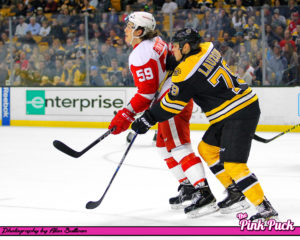
While the first period had been rather quiet it appeared that as the game went on the physicality of the play began to escalate, bubbling over at 6:38 of the third after Steven Kampfer made a hit on Scott Laughton. Laughton took exception.
Steven Kampfer
“Well, I hit him and he said ‘That’s enough; let’s do this’ and I backed off and he fake dropped and I real dropped, and I guess that’s how it happened,” Kampfer said. “If you’re going to play hard, play hard. I have no problem answering the bell to that. But if you’re going to ask me to go, go.”
In the end after Wayne Simmonds jumped in for the Flyers to help Laughton, which sort of invited everyone on the ice into the huddle. As the referees handed out the discipline, Kampfer ended up with four minutes for roughing while Simmonds received two. Many watching were confused by the penalties, since Simmonds was essentially the third man in on the fisticuffs. However, given the fact that Kampfer was the only one to drop his gloves—due to Laughton’s fake out—the penalties could have been a whole lot worse on the Bruins side. Usually the player who drops the gloves is assessed a five for fighting, two for instigating and that instigator penalty comes with an automatic ten-minute misconduct.
The Bruins were up two goals when David Pastrnak drew a penalty at 14:30 of the third as Travis Konecny was whistled for the trip. The Bruins were busy cycling in the the Flyers end with DeBrusk planted in front of the crease. Andrew MacDonald gave DeBrusk a slash, which resulted in DeBrusk retaliating. Both would go off to consider their crimes, but at that moment Laughton and Kampfer met up again and Laughton tried to get Kampfer to drop the gloves again. Kampfer didn’t, and this time Laughton was assessed a roughing and a ten-minute misconduct, putting his team down a man with 3:57 remaining in regulation. While the Flyers made the kill, just three seconds after getting back to full strength and having pulled Elliott, Oskar Lindblom would be sent to the box for an interference call. With 22 seconds remaining Chara got his second of the game, from the opposite end of the ice.
Jaroslav Halak (Photo: Alan Sullivan)
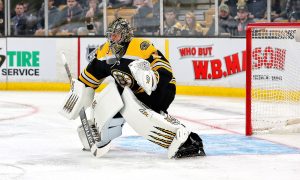
While the score may give the impression that the Bruins were in control, it could have been a completely different outcome if Jaroslav Halak had not done such an excellent job between the pipes for the Bruins. Earning his second shutout of the season, the Bruins back-up goaltender had some magnificent saves during those times the Flyers were in the Bruins end of the ice.
“Every time you start a game or play a game, you’re hoping to get a win. Obviously, if you can get a shutout that’s always more special. But, I always say, it’s a team effort. Everybody was on the same page and great work tonight,” Halak stated.
The secondary scoring was certainly something the Bruins needed. Coming into the game the bulk of the goals scored in their first eight games had come from Pastrnak, Patrice Bergeron or Brad Marchand. As has been seen in the past with this team, when they can get all their lines rolling, they are formidable.
The Bruins won’t have much time to rest on their laurels. They will be back in action Saturday night, October 27, 2018, when they play the Montreal Canadiens for the first time this season.
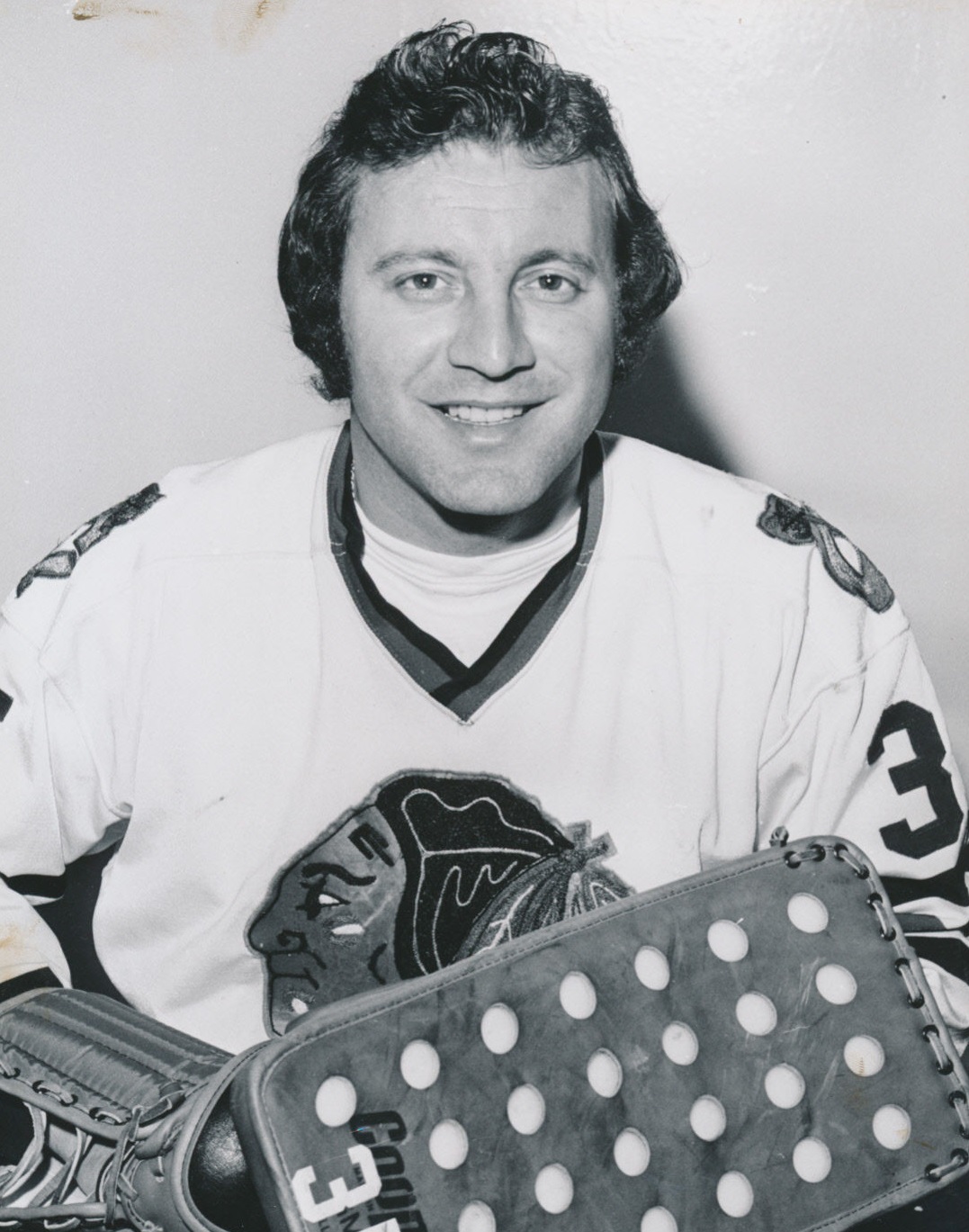
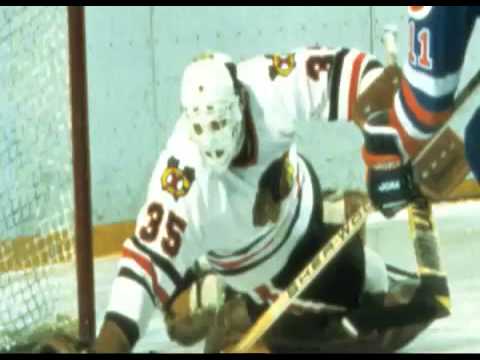
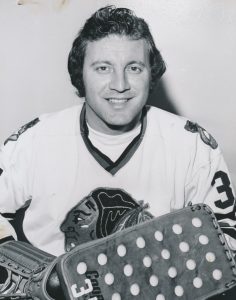
During his very first full season in the NHL, goaltender Tony Esposito gained a reputation for shutouts. Fifteen times he closed his net to all comers beginning with a 5-0 win on October 25, 1969.
The previous season, Esposito had played only 13 games for the Stanley Cup champion Montreal Canadiens before being drafted (on June 15, 1969) by the last place Chicago Blackhawks. Going into the game on October 25, Montreal had yet to lose a game while Chicago had yet to win one. Thanks to Esposito, the Blackhawks returned to Chicago much better off than they had been and rose through the ranks. They only lost three games in February and one in March before going on to finish the season in first place. Esposito’s 15 shutouts that rookie season put him ahead of all but a few goalies who played back in the 1920s. Although his brother Phil’s Boston Bruins swept the Blackhawks during playoffs that season (and went on to win the Cup), Tony “O” took home the Calder Trophy (as best rookie) and his first (of three) Vezina Trophy (as best goaltender).
Over the course of his 15 years with the Blackhawks, Esposito spent 12 of them ranked in the top ten for shutouts. He topped the league three times and came in second another five. When interviewed, Esposito said, “You’ve got to have a good team in front of you to get shutouts. . . . When you are setting records, you have to have a real good team.” He took the blame for every goal even though his high concentration levels and athletic butterfly style prevented most of them. When Esposito retired, his 76 shutouts and 423 victories set Blackhawks records and placed him in (a three-way tie for) ninth overall in shutouts.
At his induction into the Hockey Hall of Fame in 1988, Esposito said, “I’ve dedicated my life to playing goal. I gave everything I had.” Later that year, the Blackhawks retired his No. 35. He had been the first to regularly wear the number as a goaltender. The first time he wore the number, at an exhibition game before his first season with Chicago began, he shutout his opponents.
Additional Sources:
Brian McFarlane, Brian McFarlane’s History of Hockey (Champaign, Ill.: Sports Publishing Inc., c1997), 108-109.
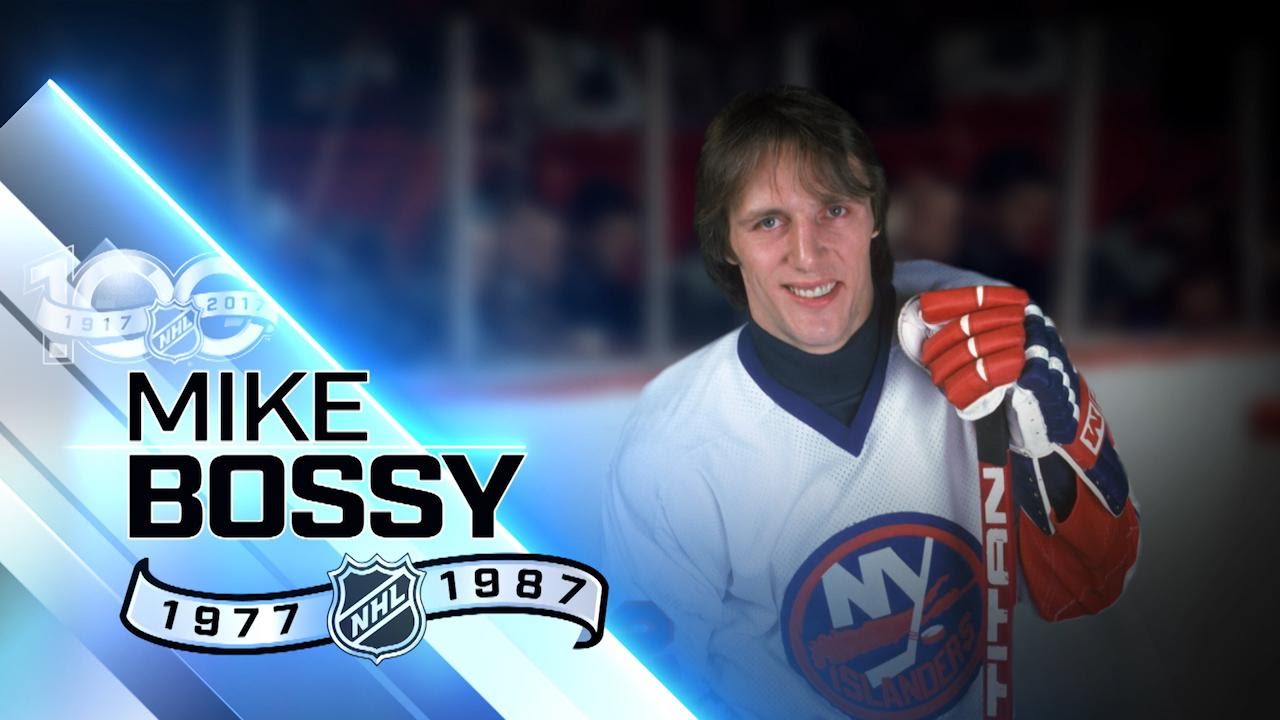
Mike Bossy led the New York Islanders with his scoring power throughout the ten years he skated in the NHL. On October 24, 1981, he scored his 250th goal in his 315th game. He set an Islanders record with that number of goals and an NHL record for the speed in which he scored them.
Bossy’s linemate and closest friend, Bryan Trottier, said, “Scoring goals was what mattered to him most. He’d get mad at himself if he didn’t produce in a game.” Whereas Bossy wrote in his autobiography, Boss: The Mike Bossy Story, “I probably developed what scouts called my quick hands and quick release more out of self-defense than anything else.” He wanted to get the shot off before he got hit. The January before, Bossy had succeeded in breaking Maurice Richard’s record for scoring 50 goals in 50 games. In fact, he scored over 50 goals in his first season and in each and every one of the next eight – a record that Wayne Gretzky could not top. For his final season, Bossy still managed to score 38 goals in 63 games, despite his terrible back pain.
The chronic back injury forced Bossy to retire early. He made the announcement on October 24, 1988. Bossy ended his career with 573 regular-season goals (and 553 assists for 1,126 points) and 85 playoff goals, then a record. Over his ten seasons, he had earned the Calder Memorial Trophy (as best rookie), the Conn Smythe Trophy (as the playoffs MVP), three times the Lady Byng Memorial Trophy (for sportsmanlike conduct), and four consecutive Stanley Cup championships. Bossy was inducted into the Hockey Hall of Fame in 1991.
Additional Sources:
Brian McFarlane, Brian McFarlane’s History of Hockey (Champaign, Ill.: Sports Publishing Inc., c1997), 188, 220, 225.
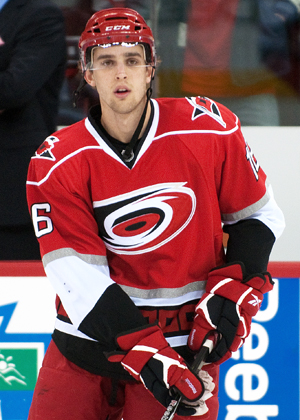
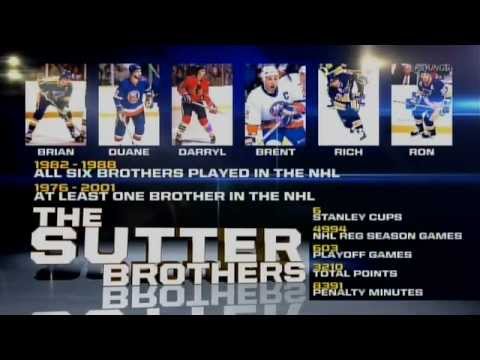
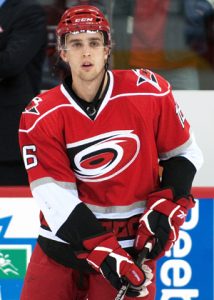
The seventh Sutter son, Rich Sutter, became the sixth Sutter scorer on October 23, 1983. In 2008, on the same date, Brandon Sutter, son of the fifth Sutter son (Brent), became the first second-generation and seventh Sutter to score. Rich’s Philadelphia Flyers won at home in 1983 (8-5), but 25 years later, Brandon scored the only Carolina Hurricanes’ goal when visiting the Pittsburgh Penguins (4-1).
Six of the seven Sutter brothers played for the NHL – a record number of siblings. Brian played for the St. Louis Blues from 1976 until 1992 and scored his first goal on February 26, 1977. Darryl played for the Chicago Blackhawks from 1979 until 1987. Meanwhile, Duane played for the New York Islanders from 1979 to 1987 and then for the Blackhawks from 1987 to 1990. They scored their first goals within a couple of weeks of each other in the autumn of 1979 (November 30th for Duane and December 16th for Darryl). Brent joined Duane in New York from 1980 to 1991 and then played for the Blackhawks from 1992 to 1998. He potted his first goal on February 26, 1980. Ron played for the Flyers from 1982 to 1991, the Blues from 1991 to 1993, then spent a few nomadic years before playing with the San Jose Sharks from 1996 to 2000 and the Calgary Flames for his final season. Ron’s first goal was made on December 9, 1982.
Although Rich began his NHL career with the Pittsburgh Penguins, they traded him to the Philadelphia Flyers on October 23, 1983, just hours before his first game and first goal. Skating on his line, Rich’s twin Ron received credit for the assist. After the game, linemate Darryl Sittler said, “They have good bloodlines and I’m sure they’re going to be a large part of our future.” Indeed, Rich made history as the sixth brother to make a goal in the NHL. A week later, October 30, 1983 would be the first time the twins together would face off against the Islanders, the team of their older brothers Duane and Brent. In 1986, Rich was traded to the Vancouver Canucks. Like his older brothers, he then (in the 1990s) spent time skating for the Blues and the Blackhawks.
As for the second generation, Brent’s son Brandon made his NHL debut with the Hurricanes in 2008. His first goal was against his uncle Rich’s first team, the Penguins. Unfortunately, a former Hurricane collided with him at the next game (two nights later) causing a concussion that resulted in Brandon missing eight games. In 2012, Brandon was traded to the Penguins, who traded him to the Canucks in 2015. That meant that Brandon played for two of the same teams as his uncle Rich.
Exactly two months after Brandon’s first goal, on December 23, 2008, his cousin Brett scored his first in his first game. As general manager of the Calgary Flames, Darryl Sutter brought his son into the fold for a 4-3 victory. Brett was the eighth member of the Sutter family to score in the NHL.
For the Sutter family, skating and scoring has become the family tradition.
Additional Sources:
Mike Commito, Hockey 365: Daily Stories from the Ice (Toronto: Dundurn, 2018), 23.
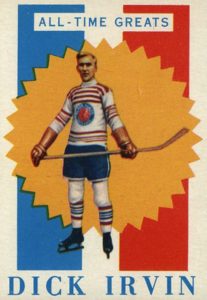
Chicago to Toronto to Montreal and back to Chicago – Dick Irvin came full circle and made his mark along the way. In Chicago on October 22, 1953, Irvin coached his 600th winning NHL game as the first to ever coach as many. The game occurred during Irvin’s fourteenth season with the Montreal Canadiens, who defeated Irvin’s first team, the Chicago Blackhawks, 3-2.
James Dickenson “Dick” Irvin was one of the Portland Rosebud stars brought over to play with the brand new Chicago Blackhawks in their first season, 1926-27, in which he was named their first captain. He became known as “one of the game’s top centers in the 1920s” and “one of the greatest playmakers of his era.” That first season he was the second-highest scorer in the NHL.
After fracturing his skull during his second season, Irvin spent the 1928-29 season playing and coaching the Blackhawks. Of the twelve games he coached, Irvin’s record was less than stellar (2-6-4), and the Blackhawks had their worst-ever season only scoring 33 goals and facing 21 shutouts. With the 1930-31 season, Irvin turned the team around, winning 24 of 44 games, and they made it to the Stanley Cup finals (where they lost to the Canadiens). Irvin coached his first 26 regular-season wins with the Blackhawks.
In 1931, when Conn Smythe saw the Toronto Maple Leafs slide into last place, he brought in Irvin, who brought the Leafs from last to first within a month. In his first season as their coach, Irvin led the team to the first ever sweep of the Stanley Cup finals. Irvin remained with Toronto throughout the 1930s and brought them to the finals six times more. With the Maple Leafs, Irvin tallied 216 more regular-season wins.
During this time, the Montreal Canadiens had been backsliding since they won the Stanley Cup in 1931. To revive them, in 1940 they brought in Irvin, who has been credited with saving the franchise from bankruptcy. Known as “demanding but fair as a bench boss,” in 1943-44, Irvin led the Canadiens to a 38-5-7 season and their next Stanley Cup (defeating the Blackhawks). They would earn two more, in 1946 and 1953, with Irvin as coach. In his final season with them, 1954-55, Montreal lost the finals to the Detroit Red Wings. However, the next season, the Canadiens defeated the Red Wings in the finals and then won the next four championships. Over the course of his fifteen seasons coaching the Canadiens, Irvin totaled 431 regular-season wins.
Finally, Irvin returned to his roots and coached one final season, 1955-56, in Chicago. Although the team “vastly improved . . . under Irvin’s hand,” the Blackhawks still had a rough season finishing sixth as they had the previous two seasons. His final 19 wins gave him a coaching record of 692 regular-season wins that held until the 1980s. Overall, he coached 1,449 games with a .557 points percentage. Irvin retired the year before he died, which was the year before his induction into the Hockey Hall of Fame.
Additional Sources:
Stephen Laroche, Changing the Game: A History of NHL Expansion (Toronto: ECW Press, 2014), 39.
Brian McFarlane, Brian McFarlane’s History of Hockey (Champaign, Ill.: Sports Publishing Inc., c1997), 29, 33-35, 47, 77-78.
This week started and ended with the Chicago Blackhawks and the Detroit Red Wings. These two teams have shared their timeline from the very beginning, and on October 21, 2000, they both played their 5,000th NHL games. As the fourth and fifth teams added to the NHL’s “Original Six,” they became the fourth and fifth teams to reach 5,000 games.
During the eighth game of the season, the Blackhawks lost and the Red Wings won, but they did not play each other. The Blackhawks were shutout (1-0) at the Savvis Center in St. Louis. The Red Wings stayed home at the Joe Louis Arena, where they scored on the Buffalo Sabres in overtime to win 5-4. To add to Detroit’s celebrations, Nicklas Lidstrom’s two assists brought him up to 500 points, making him the third European NHL defenseman to reach that milestone. The 2000-01 season continued in this fashion, with the Blackhawks finishing fourth in the Central Division and the Red Wings finishing first.
The Chicago and Detroit franchises began together. At a NHL meeting held on April 16, 1926, new franchises, including Chicago and Detroit, were proposed. Two weeks later, the NHL approved these two franchises. They both received players from teams made defunct by the collapse of the Western Canada Hockey League (WCHL). Many players of the Portland Rosebuds came to play for Chicago, while Detroit purchased the Victoria Cougars (and actually had to play in Canada until they constructed their own rink). The Blackhawks won their first game in the NHL by defeating the Toronto St. Patricks (4-1) on November 17, 1926. The following day, Detroit (still called the Cougars) lost to the Boston Bruins (2-0). Detroit would not win until their third game, against the Blackhawks. For that first season, Chicago fared better overall (19-22-3) than Detroit (12-28-4).
At this point, the Red Wings have pulled ahead of the Blackhawks. In the 735 games they have played against each other, Detroit has won 368, Chicago has won 283, and they left 84 games tied. That meant that the Red Wings earned 834 points to the Blackhawks’ 661 points. In addition, the Red Wings have appeared in the playoffs two more times than the Blackhawks but have won almost twice as many championships (11 for the Red Wings, 6 for the Blackhawks). Two of the six finals Chicago won by defeating the Red Wings. However, both teams look to have long futures in which they can keep the competition between them going.
Additional Source:
Stephen Laroche, Changing the Game: A History of NHL Expansion (Toronto: ECW Press, 2014), 7-10, 35-44.
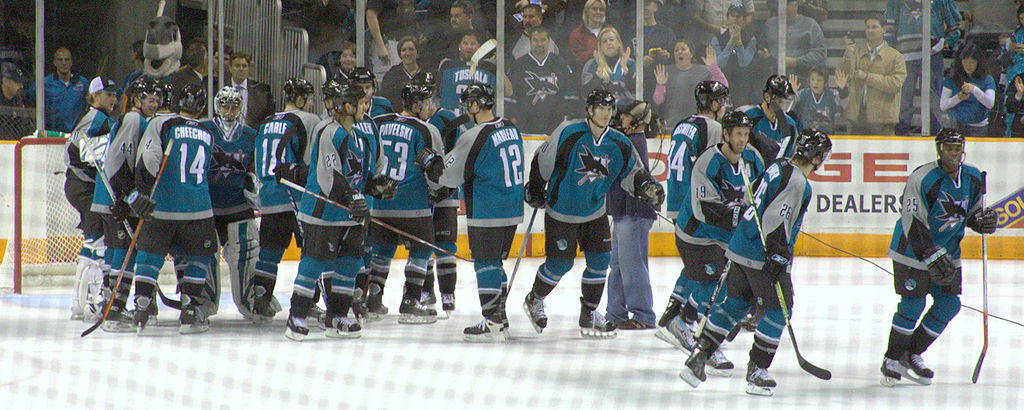
Although on opposite ends of the continent and from different conferences, the San Jose Sharks and Buffalo Sabres are evenly matched teams, both with three wins so far going into their matchup in San Jose Thursday night. But it was the Sharks who got the win in only their second home game of the young season after a 5-game road trip, in a 5-1 victory. Sometimes numbers tell a story, and this game did just that.
The first period was riddled with penalties, three for each team, which included a double minor infraction against the Sabres, the result of a high stick by Kyle Okposo. The Sharks were able to capitalize on that first one. Evander Kane shot the puck across the ice to Erik Karlsson who got the puck to the net, but it was Joonas Donskoi’s efforts that sealed the deal. This was Kane’s first of two assists against his former team.
A slashing call on Marco Scandella put the Sabres right back in the box and gave the Sharks another chance on the man-advantage. It was Logan Couture’s first goal of three of the night, and made it 2-0 early in the game. The Sharks drew another penalty, an interference call on Jake McCabe, but it stayed at 2-0 as the period closed. The Sharks’ hands weren’t clean either. Karlsson, Brenden Dillon, and Kevin Labanc all spent time off the ice for minors, but the Sabres came up empty-handed during each opportunity.
Only a minute and a half into the second, McCabe got revenge and scored the Sabres’ only goal of the game. After each team suffered another penalty each, the score remained in favor of the Sharks, 2-1.
Things fired up in the third period, beginning with a fight between Joakim Ryan and Zach Bogosian. While each got five minute majors for fighting, Bogosian was penalized an additional roughing call. This got things into high gear for the last 20 minutes of play. Couture netted his third of the game, and the fourth of the season, sandwiching a goal by captain Joe Pavelski, his fourth of the season as well. That made it 5-1, Sharks. To recap, Couture got two even strength goals, one also being an empty-netter when Sabres goalie Carter Hutton was pulled for a minute and a half late in the game, while Pavelski got a power play goal on Scandella’s second penalty of the game. Couture’s empty-netter marked his third career hat trick.
In the end, the numbers on paper tell it all. The Sabres were plagued with too many penalties, seven in all, while not able to capitalize on the Sharks’ five penalties. Also, the Sharks outshot the Sabres 39 to 25, in what would be Sharks goalie Martin Jones‘ near-perfect game.
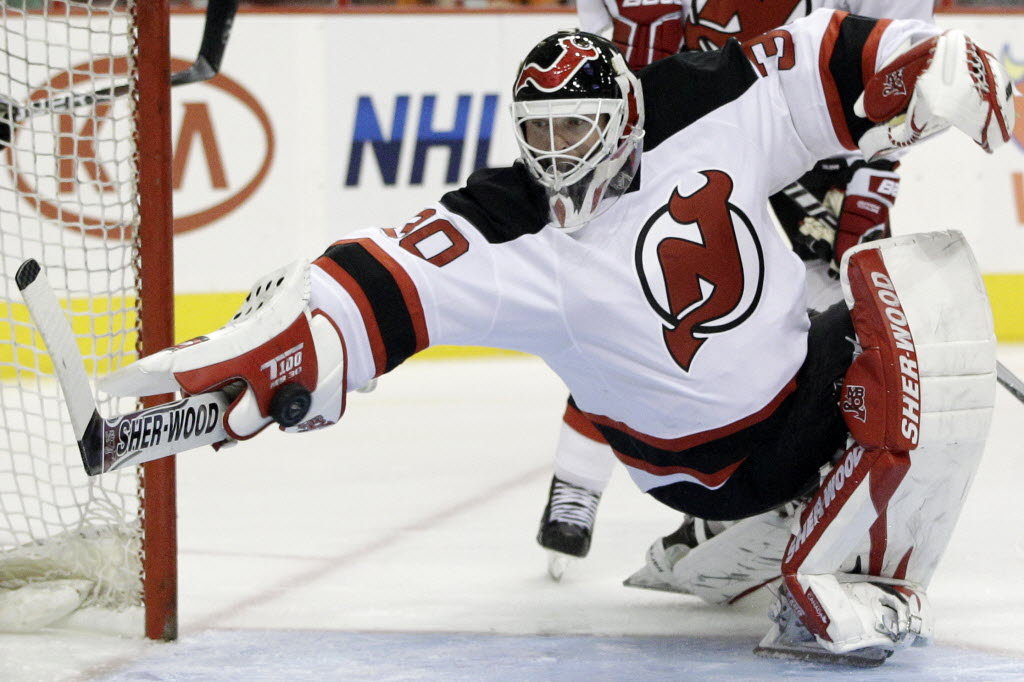
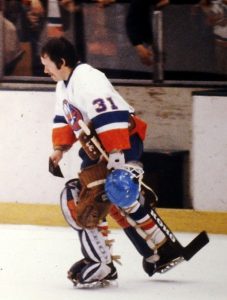
Neighbors New York and New Jersey kept their nets clear on October 20 nineteen years apart. Their goaltenders, Billy Smith and Martin Brodeur, each earned their first NHL shutout.
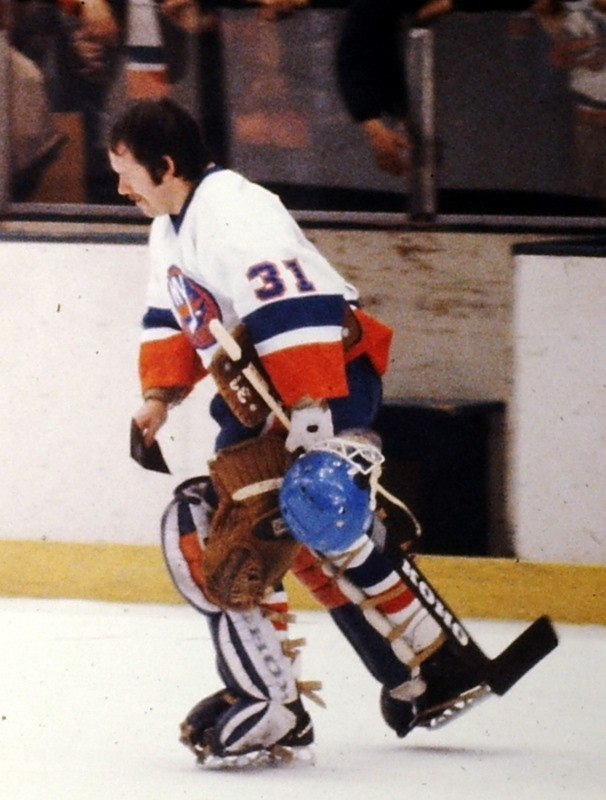
In 1974, the New York Islanders began their third season as an NHL franchise. When they first drafted players in 1972, they took goalie Billy Smith from the Los Angeles Kings. Although he was the second goalie chosen by the team, he seemed like the better investment from the start. His 28 saves during his first game, on October 12, 1972, led to a 3-2 victory over his former Kings. Two years and one week later, Smith and the Islanders shared their first ever NHL shutout. While visiting at the Capital Centre, they crushed the Washington Capitals 5-0 thanks to Smith’s 26 saves.
Smith tended goal for the Islanders until 1989. Along the way, he helped them win four (consecutive) Stanley Cup championships. He spent eight seasons ranked in the top ten for shutouts. In an interesting twist, on November 28, 1979, he received credit as the first goaltender to score an NHL goal. His record for playoff game wins (88) held until 1997, and he remains fourth on the list. He also led the NHL in penalty minutes for a goaltender (489 in regular season and 89 in playoffs).
In 1993, Martin Brodeur had his first of a record-breaking number of shutouts. Drafted by the New Jersey Devils (in the 1st round, 20th overall) in the 1990 NHL Draft, Brodeur had played four games for the Devils before the 1993-94 season. On October 20, 1993 his 17 saves led the Devils to shutout the visiting Mighty Ducks of Anaheim 4-0. That season he earned two more shutouts and the Calder Memorial Trophy as top rookie.
Brodeur remained with the Devils until 2014 and then played seven games with the St. Louis Blues to end his NHL career. Although the Devils were just one win from making the Stanley Cup finals his rookie season, they would win the championship the following season and again in 2000 and 2003. Brodeur was credited as “the backbone of the team’s” success. In addition to preventing goals, Brodeur made three, which was the most of any goaltender. He was the youngest goalie to win the benchmark 300, 400, and 500 games. In December 2009, Brodeur played his 1,030th game (surpassing Patrick Roy’s record) and earned his 105th shutout (breaking Terry Sawchuk’s record). For 15 seasons, Brodeur ranked in the top ten for shutouts. He still holds the regular-season career record (125) and the playoffs career record (24, one more than Roy). His postseason victories (113) and games (205) are second only to Patrick Roy’s. Brodeur tops the NHL lists in wins (691), saves (28,928), and games (1,266).
Of the two goalies with shutouts on October 20, one came to be known for his physical toughness and the other for his mental. Battling Billy Smith said, “The more aggressive it gets, the better I play.” Meanwhile Marty Brodeur commented, “I just don’t get nervous at a hockey rink.” The former was inducted into the Hockey Hall of Fame the same year as the latter had his first shutout, and the latter was born just as the former joined the Islanders.



 Prev
Prev