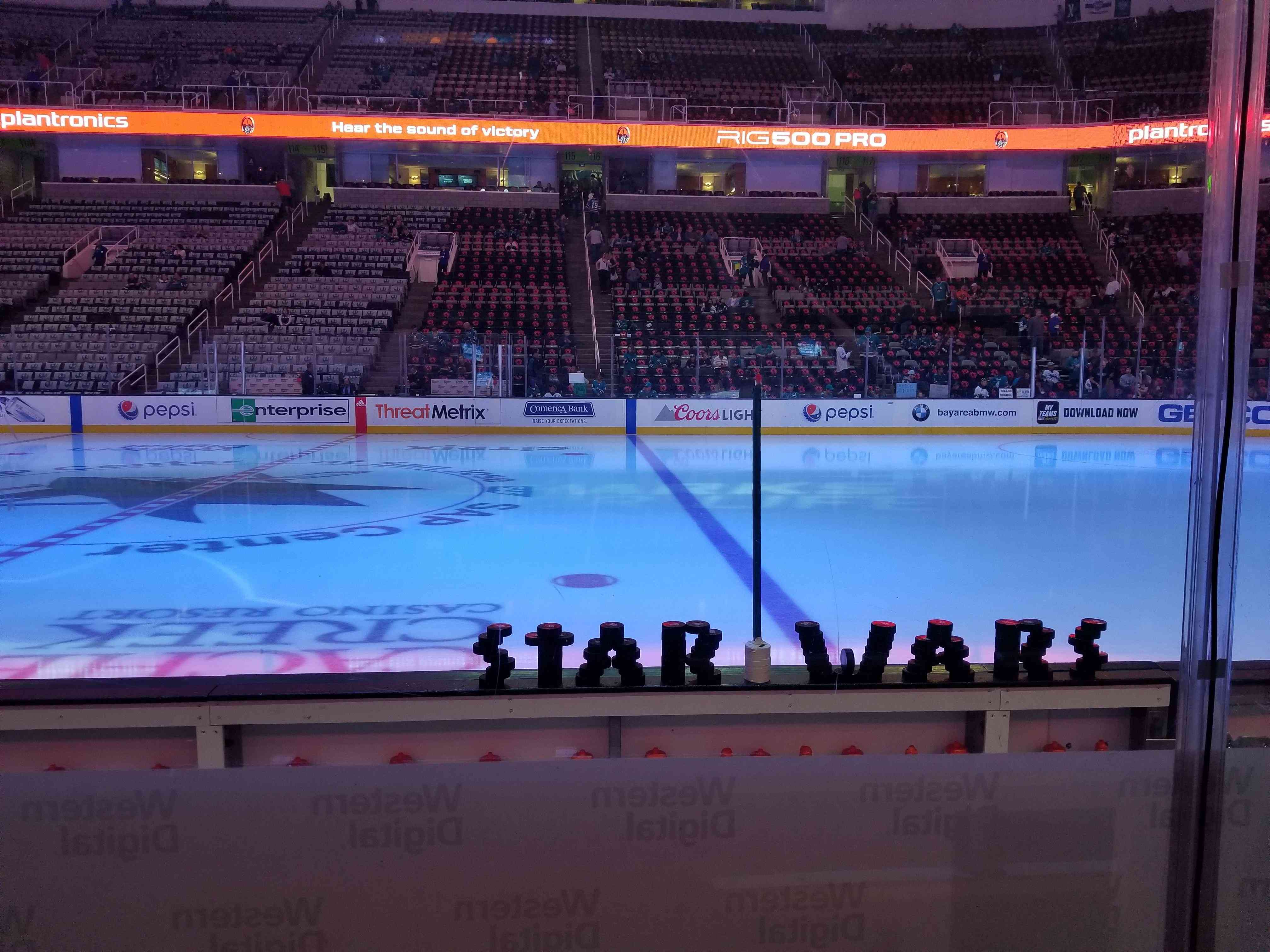
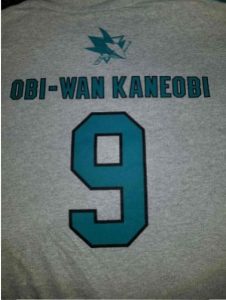
Fans donning teal and black (and also Star Wars gear) in support of the San Jose Sharks were delighted in an overtime win Saturday night. The traveling Philadelphia Flyers, who had the momentum of two wins against San Jose’s’ rivals Los Angeles Kings and Anaheim Ducks in their California road trip, did not make it easy for the Sharks. It truly was a battle in the hockey galaxy for two teams that are usually far, far away.
The Flyers and Nolan Patrick set the tone early by scoring only 37 seconds into the game. This would be a game of catch up for the Sharks from the start. Timo Meier got the Sharks started, less than three minutes after Patrick’s goal, his first of two on the night. The Sharks got a lot of offensive-zone time in the first period, notching 16 shots on goal to the Flyers’ 9 shots. Although having less shots, the Flyers scored just moments before intermission, this time Jordan Weal making it 2-1 for the Flyers at the end of the first. Not for the first time in the night the Sharks would go into the locker room in between periods behind in goals.
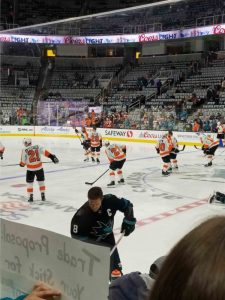
(photo: Sharks captain Joe Pavelski with Flyers warming up in the background.)
The second period had as much gusto, speed, and passing as the first, each team scoring a goal. Captain Claude Giroux’s hooking call put the Sharks on a power play and captain Joe Pavelski was able to even the score on a pass from Kevin Labanc, the first and only power play goal of the game. Already with 10 assists on the year, Jakub Voracek responded to Pavelski’s goal and getting the go-ahead goal for the Flyers, just a half a minute before the second period ended. The Sharks, once again, started the next period playing catch up.
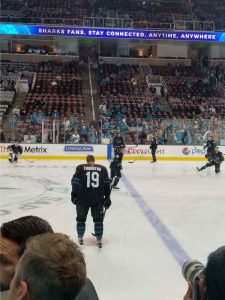
(photo: Joe Thornton during warm ups)
Back from his nine-game hiatus on the injured reserved list due to a knee infection, Veteran Joe Thornton made up for lost time and scored his first goal of the season, tying up the score late in the game. This was Labanc’s second assist of the game and his tenth point on the young year. This would push the game into overtime, something longtime Sharks fans have dreaded. This time, they didn’t have to wait long, for victory came at only 13 seconds into the extra frame off the stick of Meier, his second goal of the night. Meier is having a phenomenal year with 11 goals and five assists in 14 games played.
Fans left the building with either a “Dark Side” rebel alliance or “Light Side” Jedi alliance t-shirt to commemorate Star Wars night, but every fan left with a story of the battle in which the Sharks were victorious.
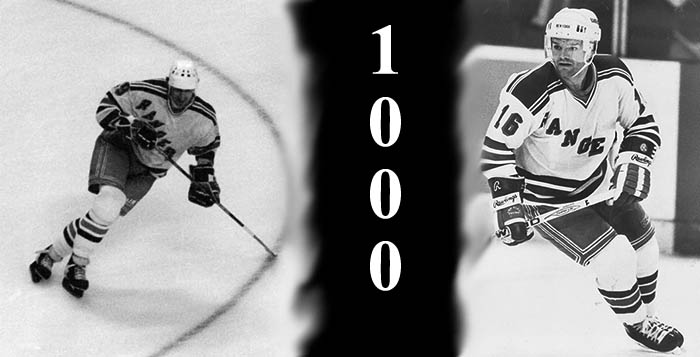
Going into the game on November 4, 1987, opponents Wayne Gretzky of the Edmonton Oilers and Marcel Dionne of the New York Rangers each had 998 assists. They seemed evenly matched in the race to be the second (after Gordie Howe) to reach 1,000 assists. However, Dionne already was at a disadvantage. The Rangers only had a record of 4-7-3 on the season while the Oilers came in at 7-5-0. In fact, the Oilers had just defeated the Rangers 7-6 on November 1st. The Rangers, having already lost at Madison Square Garden, now faced the Oilers in their own barn at Northlands Coliseum.
Dionne, born in 1951, also had a decade on Gretzky who was born in 1961. Gretzky would have only been 10 when Dionne was drafted 2nd overall by the Detroit Red Wings. In 1975, Dionne moved on to Los Angeles and played for the Kings over the next 12 seasons. Gretzky joined the NHL when the Oilers did in 1979. After the Kings traded Dionne to the Rangers in March 1987, they essentially replaced him with Gretzky for the start of the 1988-89 season. That 1988-89 season would be Dionne’s last before retiring. In an interesting twist of fate, Gretzky would then play for the Rangers for his final seasons, from 1996 to 1999.
Taking all of that into consideration, perhaps the extremely rough start the Rangers had on November 4, 1987 made more sense. With the smallest crowd in five years, the Oilers were in peak form with Gretzky earning his 999th assist less than five minutes into the game. He followed that up by scoring two goals in the first period and another in the second. Gretzky went into the third period with a hat trick, and the Oilers had a 6-0 lead on the Rangers. The Rangers managed to halt the shutout before Gretzky earned his 1,000th assist on the Oilers’ final goal of the night. Dionne did manage to produce his 999th assist on the last goal of the game, on a power play within two minutes of the game’s end. The Oilers had crushed the Rangers 7-2.
It did not take long for Dionne to reach 1,000 assists. In his next game, on November 7, the Rangers played in Dionne’s old barn in Los Angeles. When the Rangers scored their first goal during the first period, Dionne originally received credit, but he insisted his teammate Jari Gronstrand made the goal. Dionne thus became the third to reach 1,000 assists. He topped off the night with a goal in each of the following periods, which gave him his 700th goal and 1,700th point. Even so, the Rangers could not improve their record and lost 5-4.
By the end of the 1987-88 season, Dionne only had 34 assists while Gretzky had 109. In fact, on March 1, Gretzky had surpassed Howe’s 1,049 assists to hold the record. Dionne may not have kept up with the assists, but he scored his 718th goal on February 14 giving him second place (behind Howe) on the all-time goal-scoring list. He credited his success in scoring to “determination, confidence and consistency.” Meanwhile, the Oilers went on to sweep the Boston Bruins and win the Stanley Cup to end the season.
Dionne retired in 1989 with 1,040 assists, 731 goals, and 1,771 points. At the time, that ranked him third in assists and points and second in goals. Since then, Dionne still ranks tenth in assists, fifth in goals, and sixth in points. Gretzky topped all three lists by the time he retired in 1999.
Additional Sources:
Brian McFarlane, Brian McFarlane’s History of Hockey (Champaign, Ill.: Sports Publishing Inc., c1997), 224-226.
Mike Commito, Hockey 365: Daily Stories from the Ice (Toronto: Dundurn, 2018).
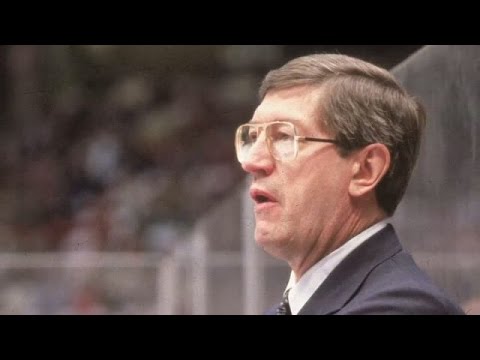
For some people retirement just does not stick. Al Arbour retired at least once as a player and twice as a coach before returning to coach just one more game on November 3, 2007. That final night behind the bench would mark his 1,500th game and 740th win coaching the New York Islanders.
Arbour began his NHL career as a player in 1953, and he played for the Detroit Red Wings, the Chicago Blackhawks, the Toronto Maple Leafs, and the St. Louis Blues. All of the moves took place at drafts. During that time, he won three Stanley Cup championships (in 1961, 1962, and 1964). In October 1970, Scotty Bowman coached the Blues. As Arbour explained, “He wanted to step aside and become the general manager and he wanted me to take over.” Arbour credited Bowman as “the one who got me interested in coaching.” After some back and forth with coaching and playing, Arbour retired as a player and coached the Blues for two more seasons. He then briefly scouted for the Atlanta Flames when, in 1973, the New York Islanders GM, Bill Torrey, asked Arbour to coach the Islanders’ second season as a franchise. At first, Arbour declined thinking he would not like the move, but he signed on after visiting the team. “You could see a good team in the making.” After his first season there, the Islanders came in last, but then they really took off. Their four consecutive Stanley Cup championships came between 1980 and 1983. In 1978, Arbour had earned the Jack Adams Award as Coach of the Year. He first retired in 1986 to work in management, but he returned after the Islanders struggled in his absence. He commented, “I had never given any thought to coaching again,” but in 1992, he earned the Lester Patrick Trophy for his contributions to ice hockey. Arbour retired again in 1994, after coaching the Islanders in 1,499 games and 739 victories. He had a 487-game lead to set the record for number of games coached with a single franchise.
Come 2007, Islanders coach Ted Nolan felt the need to round out Arbour’s career to 1,500 games. Upon receiving the call, Arbour told Nolan, “Lookit, I don’t care if the game’s in November or May, it’s a big game. I don’t want to cause any problems for you.” Arbour had his doubts, noting that he had not “coached a game in 15 years,” or even “seen a game in person in three years,” and did not know more than three Islanders players by name. However, the day after celebrating his 75th birthday, he signed a one-day contract to coach the next day. In preparing to coach, Arbour said, “I am flattered that Ted thought of me and I wouldn’t miss this night for the world. I told the team that I do not want any pre-game fanfare. I’m there to coach the game and help Ted and my Islanders try to earn two points against a very tough team.”
That tough team was the Pittsburgh Penguins, and after they pulled ahead scoring the first two goals, Arbour thought to himself, “Oh my god, it’s gonna be 10-0 my first game back.” Instead, the sold-out Nassau Veterans Memorial Coliseum chanting his name energized the players, and the Islanders won 3-2. Captain Bill Guerin commented, “We had a comeback victory, and honestly, it was like we won the championship.” Coach Nolan felt that “Just by him being here, we won the game,” and as he shook Arbour’s hand at the end he said, “Just like old times, Al.” Everyone stayed to watch as the banner extolling Arbour’s 739 wins was replaced by the 1,500 games banner. At the end of the night, Arbour’s career record (782-577 and 1,607 points) placed him second among NHL coaches ranked by wins.
Arbour’s legacy included being inducted as a Builder in the Hockey Hall of Fame in 1996 and having a banner honoring his 739 wins raised at Nassau Veterans Memorial Coliseum in 1997. He meant so much to his team that they extoll his virtues as a tough but fair and positive coach. Denis Potvin eulogized, “He left us feeling like champions and with great memories that we can carry on through life. Al used to say that negative energy that you’re feeling, turn it into a positive energy.” Bryan Trottier said, “Al was a softie and he cared about family and he cared about you as a person and he cared so much, and that would shine through.” According to Pat LaFontaine, “Al was able to take each player that played for him and, I believe, bring the best out of them, and the most out of them, and prepare them for what was in front of them.” Even though he may not have known all his players that fateful night in 2007, they knew him.
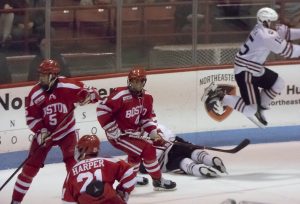
Going into the first of the home and home games between the Northeastern University Huskies and the Boston University Terriers, Northeastern really needed to come out strong and just keep going. After all, the Terriers had yet to win a game this season, going 0-4-0 having lost three on the road and their home opener last weekend.
As the game got underway at Matthews Arena, it looked like perhaps the Huskies were going to take it to the struggling Terriers who may have been feeling a bit fragile. As the clock ticked to 3:11 of the opening period, Northeastern already had two goals. Grant Jozefek put the Huskies on the scoreboard just 2:07 after the first puck drop. And Bobby Hampton notched his first goal of the season a mere 1:04 later.
Boston University’s head coach Albie O’Connell, who is in his first season as the Terriers head bench boss, had elected to start 21-year-old, red shirt junior Max Prawdzik in his first game of the season. However, just 20 seconds after Prawdzik had let in two goals on two shots, O’Connell made a quick goaltending change putting Jake Oettinger in. Oettinger has yet to get a win this season, currently 0-3-0 with a 4.66 goals against average and an uncharacteristic save percentage of .866 through those three games.
Cayden Primeau and Tyler Madden
Northeastern on the other hand was coming into the game on a hot streak with a 4-2-0 record in Hockey East division competition. Not surprisingly, Huskies head coach Jim Madigan was sticking with Cayden Primeau between the pipes. Primeau has been the starter in all of Northeastern’s games in the current season. He was bringing with him a 2.00 goals against average and a .923 save percentage.
Despite the score at the end of the first period, which stood at 2-1 in favor of the Huskies, the Terriers actually outshot the home team 10-8 and were 54% in the faceoffs. Neither team was able to capitalize on the man advantage, though both teams got two opportunities. In fact, during the Huskies first opportunity, Boston University’s Logan Cockerill got his first goal of the season on a short handed bid assisted by Shane Bowers to cut Northeastern’s lead in half. And it was that goal that gave the Terriers renewed energy.
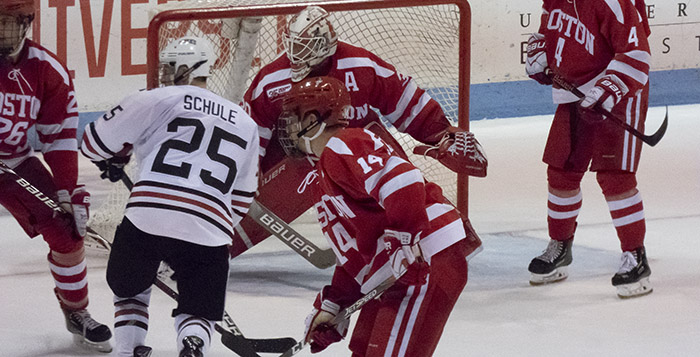
As the second period got underway it was apparent that the Terriers were determined. At 3:13 of the middle frame BU’s Patrick Curry put his second goal of the season behind Primeau and the Terriers showed their tenaciousness. While Northeastern would respond just a little more than a minute later to regain the lead off the stick of Patrick Schule, it was evident that the Terriers were keeping the Huskies on their heels. Once again Boston University’s players were outshooting the Huskies and as the period drew to a close, the score was again in Northeastern’s favor, at 3-2, but the shots on net were 31-23 for the two periods, with BU having outshot Northeastern 21-15 in the second. The Terriers continued to maintaining the advantage in the faceoff as well, having won 52% through the two periods. Northeastern also had added three more penalties during the second, giving the Terriers ample opportunity to try to capitalize on the man advantage, though Primeau continued to come up strong for the Huskies.
The Terriers tied the game 2:42 into the third off a shot by Joel Farabee and then for the first time in the game they found themselves leading when Bobo Carpenter scored at 4:05. Two minutes later Jozefek got his second of the game and tied things up again at four each while on the power play. Despite once again being outshot, the Huskies would take the lead at 10:57, as Schule got his second goal of the game. The lead would not last long. The Huskies once again found themselves in the penalty box, as Zach Solow was whistled for roughing. Twenty-five seconds into the man advantage, BU’s Chad Krys would knot the game up again at five each, where things would stay through the horn ending regulation.
Terriers and Huskies
The additional five minutes of overtime would not help declare a winner and the teams would have to be satisfied with each taking a point. Of course, satisfaction was not in abundance as things escalated after the game, when BU’s Carpenter shot the puck after the whistle and Matt Filipe let him know that wasn’t acceptable. Carpenter would receive two minutes for the initial infraction and an additional ten minute misconduct. Filipe was handed two minutes for roughing.
For the coaches, O’Connell was pleased to see his team skating hard and shooting at the net. He hopes to see that mentality continue as the season goes forward. When the Terriers are skating fast they are formidable. Madigan was not happy. He told his players that there are good ties and then there are bad ties. He qualified Thursday night’s game as a bad tie, pointing out that the Huskies had allowed the Terriers to get back into the game. He described the game as the Huskies “playing ping pong” with the Terriers.
Despite having let in five goals, Primeau actually saw a total of 50 shots, so his save percentage for the game was .900 and this was a season-high 45-save game for him. It was unfortunately also a season how 5 goals allowed game for him as well.
The teams will reconvene on Saturday night at Agganis Arena as the Boston University Huskies play host to the Northeastern Huskies. It should prove to be quite a game as both teams now have something to prove after the tie on Thursday.
The date was November 2nd. That night in 1975, two American hockey teams faced off, and in 2016, two Canadian teams did. For both games, the winning team wore red and the opposing blue, and both winning goalies, wearing No. 31, had 42 saves.
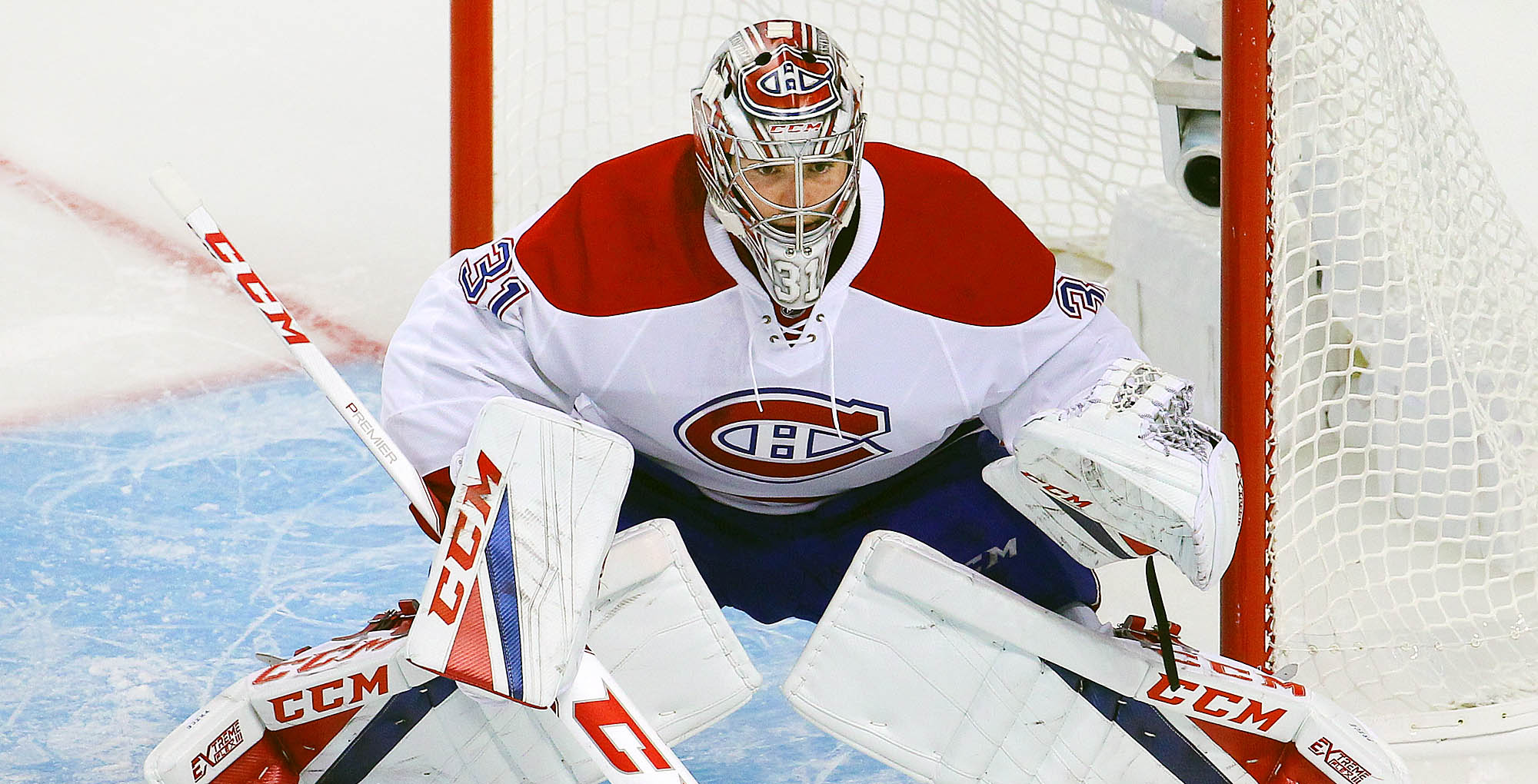
Ed Giacomin came into the 1975 game at Madison Square Gardens after ten seasons playing for the New York Rangers. He became popular with Rangers fans for his acrobatic and wandering (outside the crease) style. Giacomin imitated Jacques Plante’s style of stopping the puck behind the net, but he was one of the last to use a mask like Plante. When New York placed him on waivers Halloween night in 1975, he already had the franchise’s records for career wins (267) and shutouts (49). With that kind of record, the Detroit Red Wings immediately snapped him up, and instead of No. 1, he began wearing No. 31. Giacomin felt “such an empty feeling” because he “really loved being a Ranger and being in New York” and “never felt like I was a Red Wing.” His first game with the Red Wings, on November 2, happened to be back in New York. The fans welcomed him home cheering “Eddie” loud enough to drown out the national anthem, and his old teammates apologized whenever they scored on him, which amounted to four goals. Giacomin’s 42 saves in 46 shots on goal gave him a save percentage of .913 compared to his replacement, John Davidson, who only saved 24 in 30 shots for a percentage of .800. The Red Wings defeated the Rangers 6-4, and the Rangers missed the playoffs for the first time since Giacomin began starting in their net. Unfortunately, Giacomin only spent three seasons as the backup goalie for Detroit before they let him go on January 16, 1978.
Carey Price, in his tenth season with the Montreal Canadiens in 2016, minded the net at his home arena, the Bell Centre. Price’s teammate, Torrey Mitchell, told reporters, “I’ve been on other teams, and every time you come in to Montreal you’ve got that, I don’t want to call it a block, but you know you’re trying to score on Carey Price, best goalie in the world. It’s not easy. It’s definitely in the back of your mind before the game.” The visiting Vancouver Canucks must have been intimidated because despite outshooting the Canadiens by quite a lot, they could not score on Price. He earned his first shutout of the season, his 37th overall, with the final score of 3-0. The win meant that the Canadiens had the best 10-game start in their own history (9-0-1) and were the only NHL team without a regulation loss to that point in the season. They had bested their previous season record by one point, and the best 10-game start before that was back in 1943-44 (8-0-2). Price explained that their disappointment with the previous season’s finish led them to want to “get off to a hot start” to prove themselves. For having succeeded, he said, “For sure we’re proud of it.”
At the end of his career, Giacomin had a save percentage of .902, a 2.82 goals against average, and 54 shutouts. Still an active player, Price currently has a save percentage of .918, a GAA of 2.46, and 41 shutouts.
In the 1950s, television became the new frontier. After two decades of radio broadcasts covering hockey games, in 1952 audiences finally could watch their favorite teams and players without going to the arena. Canadian Broadcasting Corporation (CBC) aired the first French-language Montreal broadcast on October 11 and the first English-language Toronto broadcast on November 1. Hockey Night in Canada had come to the small screen.
Opinions divided over whether televising games seemed like a good idea. Back in 1949, NHL President Clarence Campbell thought that television would limit the view and reduce game attendance. On the other hand, Conn Smythe, then president of Maple Leaf Gardens, felt that television would help advertise and draw attention to the games. As a compromise, CBC decided to begin the Saturday broadcasts about halfway through the games.
In Montreal, Gerald Renaud and Rene Lecavalier led the way. Renaud, a print sports editor, had taught himself the production side and became the producer. His concept was to position the cameras as if the audience had the “ideal seat from which to watch the game.” The on-air commentator, Lecavalier, had experience as a radio war correspondent. For that first game on October 11, 1952, the Montreal Canadiens defeated the Detroit Red Wings 2-1, and part of the first telecast has been preserved. The Canadiens went on to win the Stanley Cup that year, and Elmer Lach’s televised overtime goal also survived.
For the English broadcast in Toronto, the producer, George Retzlaff, a technical director, also understood the importance of finding the “best seat in the house” camera views. He’d just finished cameraman’s training, and he had a “flair for cogent camera angles and sensitivity to the sound factors of a telecast.” He later invented the instant replay. Long-time radio host of Hockey Night in Canada, Foster Hewitt, made the switch to television to give the play-by-play. He probably had the most experience since he’d been studying how to telecast hockey from the earliest experiments. He became well-known for the opening line, “Hello Canada and hockey fans in the United States” and phrases such as “He shoots, he scores.” The first Toronto episode aired November 1, 1952, when the Toronto Maple Leafs won the game against the Boston Bruins 3-2. The Bruins went on to lose the finals to the Canadiens. Sadly, the only Toronto footage that survived from that first season was the last game at Maple Leaf Gardens, when the Leafs shut out the New York Rangers 5-0.
Hockey Night in Canada led many fans to purchase television sets. As the most consistently watched television program, Hockey Night in Canada often topped the ratings. The program has aired every season but for the 2004-05 lockout and has expanded its coverage to match the expanding number of Canadian NHL franchises. Having passed its 60th anniversary, Hockey Night in Canada continues on as the world’s longest-running sports show.
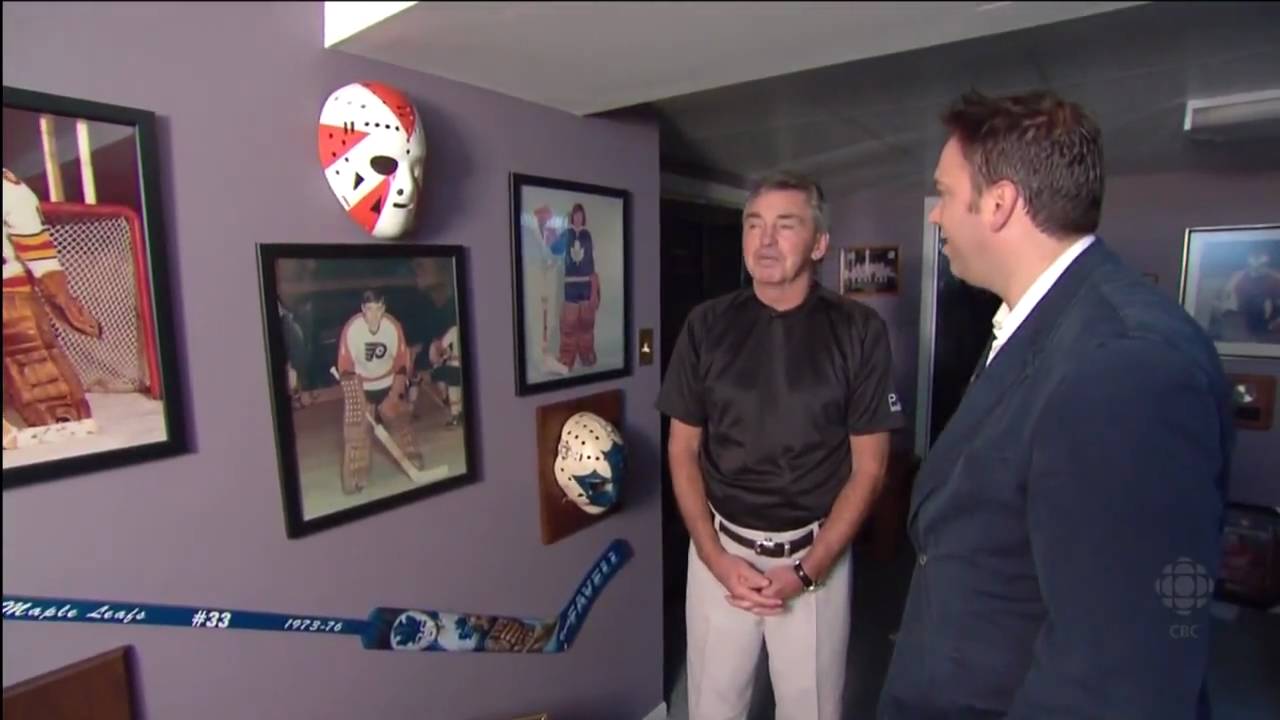
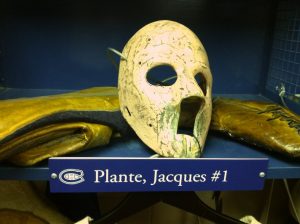
Goalie masks have rightfully taken their place among horror movie iconography. We may find the masks terrifying, but imagine how terrifying goaltenders used to find pucks flying at their unprotected faces. Two big moments in mask history came on back-to-back days perfectly timed for Halloween and All Souls Day. On November 1, 1959, Jacques Plante (of the Montreal Canadiens) became the first goalie to consistently wear a mask during games. Then a day shy of twelve years later, on October 31, 1971, Doug Favell (of the Philadelphia Flyers) first added color to his mask.
Plante paved the way towards mask usage in 1959. On the seventh anniversary of Plante’s first NHL game, the Canadiens came into their game against the New York Rangers on an eight-game winning streak after a Stanley Cup winning season. About three minutes into the game, Andy Bathgate, who had had a prior altercation with Plante, shot high so that the puck sliced into the goalie’s nose. Without a backup goalie, Plante left the ice to receive seven stiches and returned to the ice wearing the fiberglass face mask he had worn during practices. He had convinced Coach Toe Blake that he should wear the mask to protect his face.
Although the audience seemed quite disturbed by the new look, Plante only let in one goal for a final score of 3-1. This was eerily similar to his NHL debut exactly seven years before when he defeated the Rangers 4-1. When Plante insisted on keeping the mask, Blake agreed as long as the team kept winning. Plante only ever played without the mask once more, and by 1974, no goalies played maskless in the NHL.
The goalie masks evolved over time – especially in design and color. On November 8, 1967, Gerry Cheevers played (against the Rangers) with marker-drawn stiches decorating his mask. Then during the 1970-71 season, Gary “Suitcase” Smith of the California Golden Seals had to wear a yellow mask to match the team’s yellow and green uniforms. Seals owner Charles O. Finley had some interesting ideas of how to outfit hockey players.
However, Favell has been credited as the first goalie to have his mask painted. After joking around with his teammates about dressing up for Halloween, Favell said he asked their trainer Frank Lewis, “Frank, with tonight being Halloween, why don’t we put orange on the mask? . . . Why don’t we paint it like a pumpkin tonight for Halloween?” Lewis did as requested, and Favell wore the bright orange mask to defeat the Canadiens 5-3. Favell, as superstitious as most hockey players, decided to keep the color since they won the game, and he hoped that the color would draw the eyes of his opponents taking their focus off the net behind him. His mask stayed a solid orange through the rest of the season, and Favell became known as “The Great Pumpkin.” The following season, he and his backup goalie, Bobby Taylor, wore masks that featureed starburst patterns in orange and black, respectively.
Now the buckets are as unique as the individuals wearing them. We have Plante to thank for the wearing of the mask and Favell for the decorative colors.
Additional Sources:
Jim Hynes and Gary Smith, Saving Face: The Art and History of the Goalie Mask (Skyhorse Publishing, Inc., Oct 6, 2015).
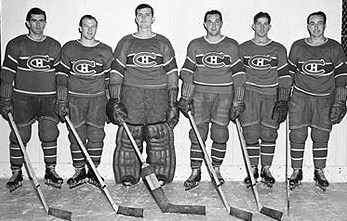
The Montreal Canadiens tied their rivals, the Boston Bruins, 2-2 at the Forum on October 30, 1943. But that was only the beginning of the story. How could they have known that playing center Elmer Lach with wings Toe Blake and Maurice Richard would make history leading to two Stanley Cup championships and a few records. With that tie, the “Punch Line” was born.
The three stars came to the Canadiens over the course of six years and played together for five. In February 1936, the Canadiens took Hector “Toe” Blake from their fellow Montreal team, the Maroons, for whom he’d played ten games and helped win a Stanley Cup. Four years later, Dick Irvin took over as coach and made Blake the team captain. Rookie Elmer Lach joined the Canadiens that year and remained with them his entire career. Almost exactly a year before appearing on the “Punch Line,” on October 31, 1942, Maurice Richard played his very first NHL game with the team. He considered Blake his hero, and he did not waste any time trying to prove himself when he scored an assist 36 seconds into the first period.
All three offered skills that meshed really effectively. Blake, as the senior skater (and called “The Old Man” by his linemates), served as the backbone of the line. He handled translations between French-speaking Richard and English-speaking Lach. According to Lach, Blake would say, “The way you practice is the way you played,” so he “never fooled around in practice.” “Elegant Elmer” Lach himself was “the 5-foot-10 bulldozer who cleared the lanes, traded elbows in the corners and passed the puck as though it had eyes for Richard’s stick.” The two would feed “Rocket” Richard the puck because he was the “short-fused stick of dynamite with a gift for finding the back of the net.” They understood their places and where to find each other. Even so, Lach humbly said, “We were just a line. I didn’t sense anything special when Irvin put us together in practice. As a group, we were good. Individually, we were just average hockey players.” However good he may have thought they were, the line earned the Canadiens four straight Prince of Wales trophies and two Stanley Cups.
Injuries plagued the line. Lach had a shattered elbow that kept him out during the 1941-42 season. During the 1942-43 season, Richard broke his ankle 16 games into the season. Richard’s replacement worked well with Blake and Lach, but Richard returned to the line in 1943 until another injury curtailed his play. That season, Blake ran practices during the Christmas holidays and put himself back on a line with Lach and Richard, and Coach Irvin kept them together after a spectacular game on December 30, 1943. The line remained together until Blake received a career ending compound fracture of his leg after a collision with Bill Juzda during a January 1948 game against the New York Rangers. Blake stayed with the Canadiens as off-ice captain.
Although Blake retired with 235 goals (527 points), a scoring record, Richard more than doubled that by retiring with 544 goals (965 points) in 1960. Richard’s retirement came right after the Canadiens’ string of five consecutive Stanley Cup championships, while Lach had retired two seasons beforehand but after having gotten another win in 1953.
(Photo: The Montreal Gazette as found on Newspapers.com)
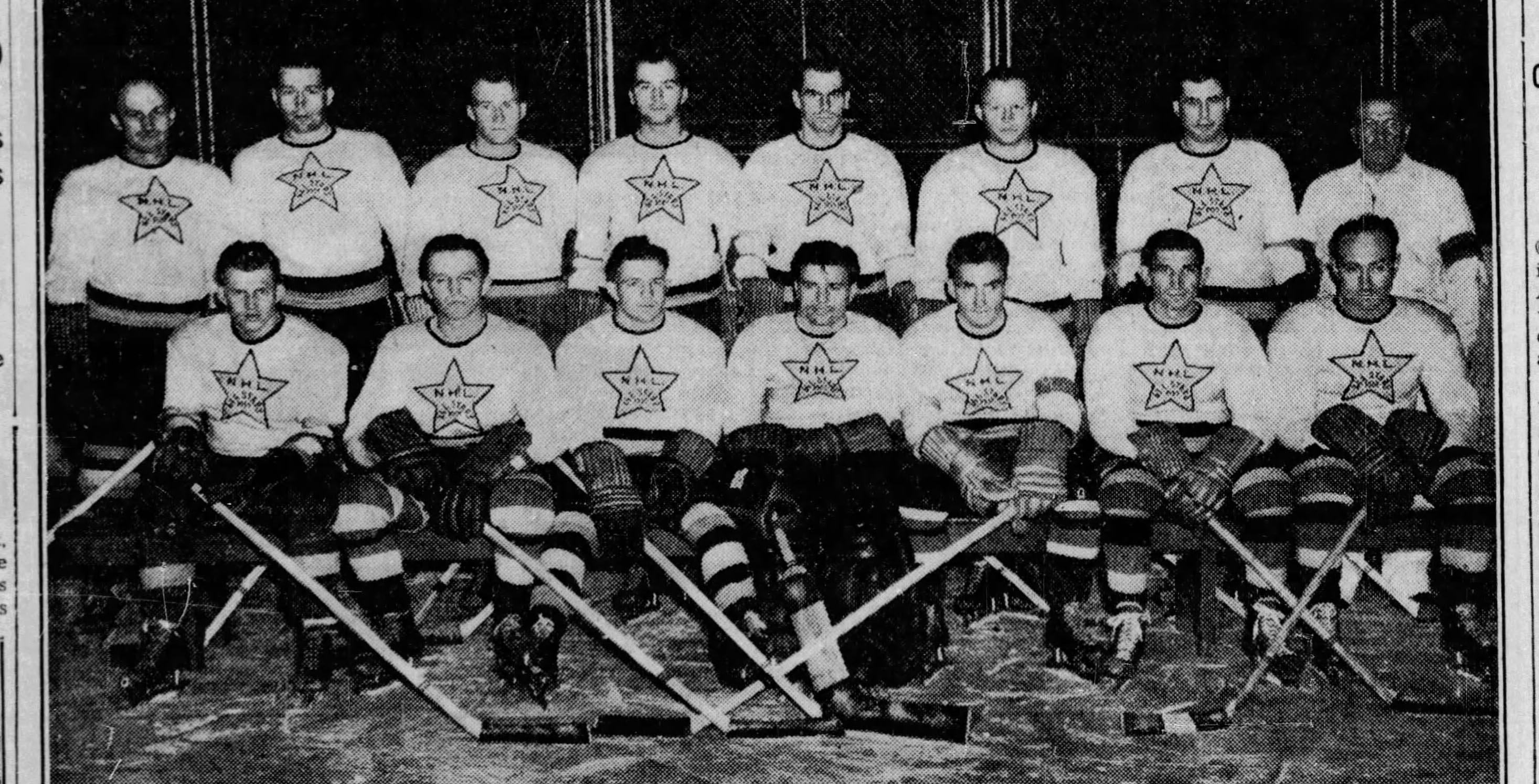
Before the first official All-Star game, NHL All-Star teams played in a few exhibition games to raise money for certain players. After the tragic death of Albert “Babe” Siebert, NHL stars banded together to play the Babe Siebert Memorial Game on October 29, 1939.
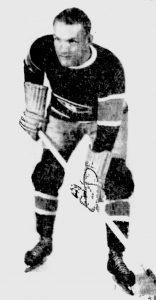
Babe Siebert began his NHL career with the Montreal Maroons and quickly became known as the “Flying Dutchman” playing on the feared S Line (with Hooley Smith and Nels Stewart). He finished his first season in 1926 with the Stanley Cup. The S Line lasted until 1932, when Siebert was traded to the New York Rangers. At the end of that first season with the Rangers, he again won the Stanley Cup. He then briefly played for the Boston Bruins before the Montreal Canadiens snapped him up in 1936. During his first year with the Canadiens, he earned the Hart Trophy. He retired in 1939 after 592 regular season NHL games (140G, 154A, 294P). A few weeks later, on June 9, 1939, the Canadiens named Siebert as their new coach.
Babe Siebert (Photo:Montreal Gazette (accessed via Google), via Wikimedia Commons)
Sadly, before he could start his new coaching job, Siebert drowned in Lake Huron near St. Joseph, Ontario. His family had gathered at their cottage to celebrate his father’s 80th birthday, and on August 25, Siebert took his daughters, Judy and Joan, out to swim. The girls’ inflatable inner tube drifted from shore, so Siebert swam out on a retrieval mission. He followed the tube too far, tired, called out for help, and finally disappeared in the waters about 150 feet out. His friend, Clayton Hoffman, tried to help, but his clothes hindered his swimming. He said later, “Before I could reach him, Babe had gone down for the last time.” Soon 15 men gathered to “watch the shoreline for the body and to dive in the spot where Siebert disappeared” and a “fishing boat set out from Grand Bend to start dragging.” The body was not recovered.
The tragic death of the 35-year-old prompted the NHL to organize a memorial game with the purpose of raising money to support Siebert’s family. Siebert’s wife “had been paralyzed from the waist down after complications during the birth of their second child,” so most of his paycheck and savings went into her care. She and their daughters would be left without his support. Although, at just 6,000, the game’s attendance was “short of expectations,” the needed funds came in. They met their goal of $15,000 (Canadian, worth about $254,026 in 2017).
Two months after the drowning, the Montreal Forum hosted the Babe Siebert Memorial Game. Siebert’s Canadiens played against the All-Star team, which had partly been selected by Art Ross (of Boston) as manager and partly chosen by the “annual Canadien Press poll.” The game featured exhibition-style hockey “with a minimum of body-checking and the lads taking care not to get hurt,” but the All-Stars kept the crowd excited until the game ended 5-2 in their favor. As Harold McNamara wrote for the Montreal Gazette, “To say Canadiens were outclassed might not be fair to the Frenchmen, who after all were asked to face the best in the game, but it is true nevertheless. The Frenchmen managed to get attacks organized now and then, but mostly they broke up on the almost impregnable defence flung up by Eddie Shore, Ebbie Goodfellow, Earl Seibert and Art Coulter.” He concluded, “To say that the All-Stars, whom Art Ross of Boston, had the pleasure of managing, were good would be putting it mildly: they were great. But they were a ‘Dream Team’ and they had to be good.” Beyond being good on the ice, their good deed in playing the game significantly helped Siebert’s family after his loss.
Additional Sources:
“Babe Siebert, of Canadiens, Drowned at 35,” The Gazette (Montreal), 26 Aug. 1939, p. 1.
“All-Stars Drub Canadiens, 5-2, In Siebert Memorial Game,” The Gazette (Montreal), 30 Oct. 1939, p. 10.
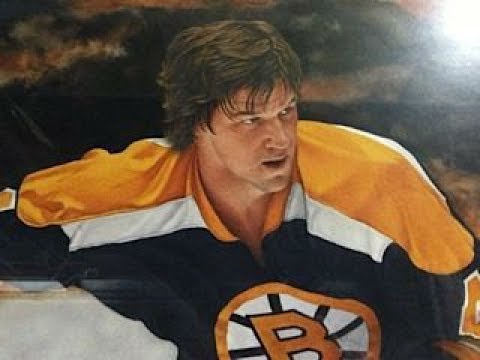
This week in Bobby Orr’s history began and ended with goals that bookended his career. In between, Orr went flying into his most famous goal, but that is a different story. Having scored his first NHL goal with the Boston Bruins on October 23, 1966, Bobby netted his last NHL goal with the Chicago Blackhawks on October 28, 1978 – twelve years and five days later.
Rookie defenseman Bobby Orr made his debut at Boston Garden on October 19, 1966, when the Boston Bruins defeated the Detroit Red Wings 6-2. Orr wrote in his autobiography that he was so excited he showed up far too early for the game and part of that excitement stemmed from playing Gordie Howe. “During that first game, I got into it a bit with my hero.” Despite the tussle, Orr went on to earn an assist, his first NHL point. “In reality it wasn’t much of a play. However it happened, I was happy to have my first NHL point and to get a win.”
Bobby Orr’s iconic flight, May 10, 1970 (Photo: Ray Lussier as found on Wikipedia)
At the very next home game, four nights later, Orr “got a point shot past the Montreal Canadiens’ Gump Worsley to tie the game.” He described his experience scoring his first goal. “The fans at the Garden were on their feet, not because the goal was a work of art – it was their way of welcoming me to Boston. Those fans went out of their way to make me feel at home. I always found the cheers deeply humbling. When you hear that, you just want to give back. So that goal was the start of a very special relationship.” Although the Bruins lost to the Montreal Canadiens for the second night in a row, the fans could see that Orr would bring something special to the team.
After ten seasons of very high highs and injury-driven lows, Orr relocated to the Chicago Blackhawks. They beat the visiting St. Louis Blues on October 24, 1976, when Orr scored twice (20 seconds into the game and midway into the third period) and topped 900 career points. He was the first NHL defenseman to reach that milestone. He played just twenty games that season and only scored once more before taking the next season off in the hopes of letting his knees heal.
Unfortunately, the rest did not lead to a full recovery, and Orr’s 1978-79 season would be short and his last. As Orr explained in his autobiography, “I couldn’t cut, I couldn’t accelerate, I couldn’t play at the level that I expected of myself anymore. I had always said I would play until I couldn’t skate anymore. Finally, I knew that day had come. I scored my last goal in the NHL on October 28, 1978, against Detroit. Barely a week later, I retired. I just couldn’t go anymore.” The Blackhawks lost that game 7-2, won the following night against Montreal, and finally lost Orr’s final game on November 1. Orr was only able to play six games that season before announcing his retirement on November 8. “Still, I am glad I played those last few games,” he wrote. “It was at least a relief not to have to go through life wondering if there might have been a chance I could have kept playing, could have raised the Stanley Cup one more time. I knew, without a doubt, I was no longer able to play.”
Added up from the first point and goal to the last, Orr retired as the all-time leading defenseman in goals and points. That was in addition to his 18 individual awards and two Stanley Cup championships. The Bruins retired his number in January, and so great were his accomplishments that the Hockey Hall of Fame waived its traditional three-year waiting period and inducted Orr in 1979. About his induction, Orr said, “I grew up with the same dream that most boys in Canada have — to play in the NHL. This is a tremendous way for it to end.”
Additional Sources:
Bobby Orr, Orr: My Story (N.Y.: G.P. Putnam, 2013).



 Prev
Prev




.JPG)


.jpg)