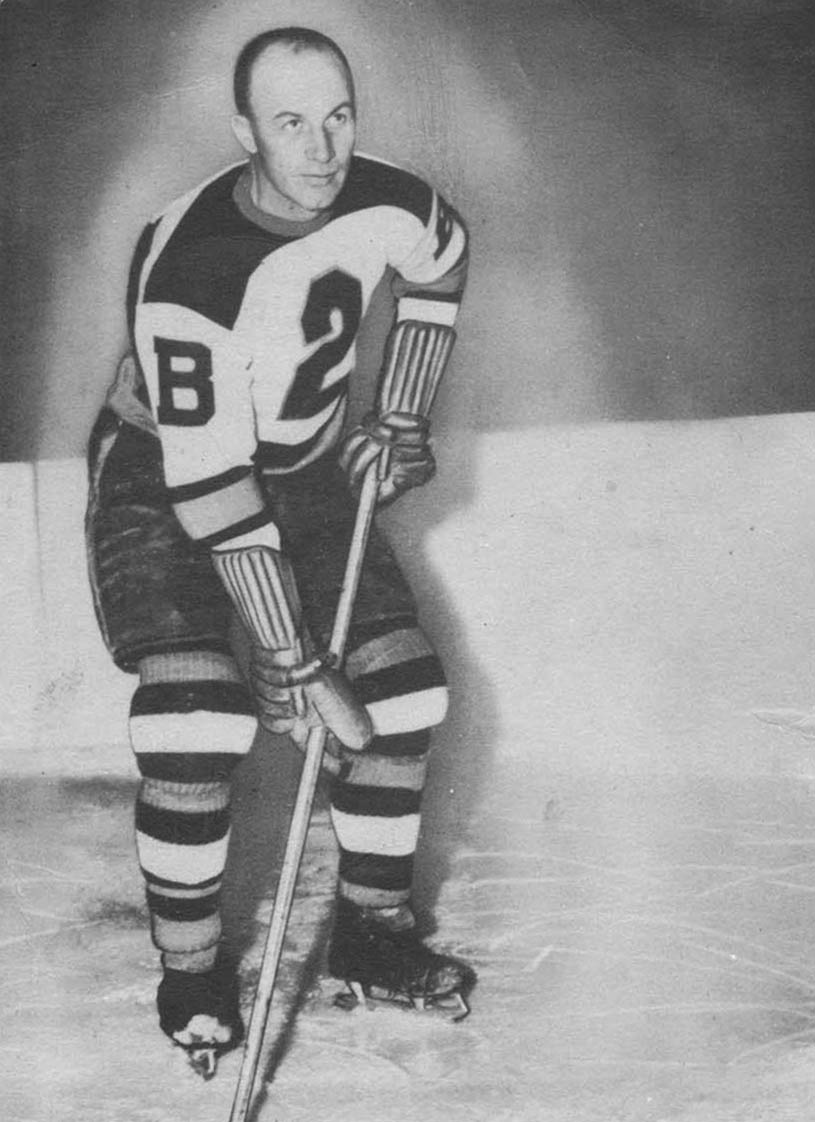
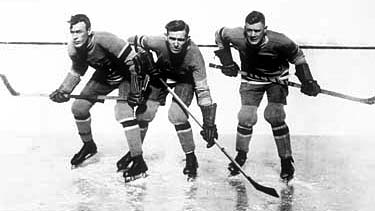
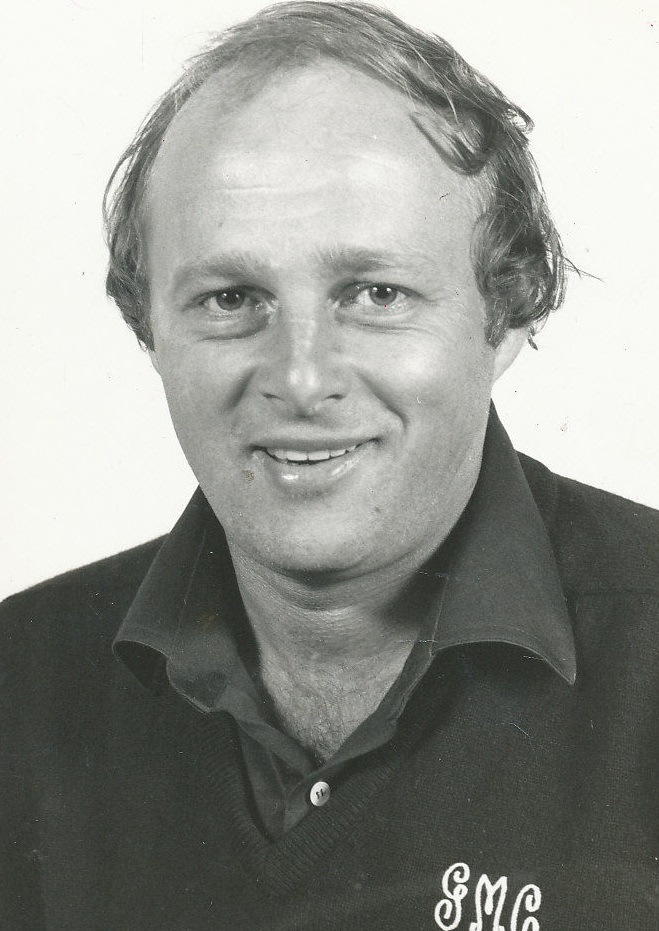
One would think that with the record for the most fights in one game that Eddie Shore was cruisin’ for a bruisin’ when his Boston Bruins played the Montreal Maroons on November 23, 1929. Turns out, even the Montreal Gazette did not blame him for picking all five fights.
Shore, just two days shy of turning 27, became an inspiration to his team during the “mayhem on ice.” His goal was to play all or most of the game since his teammate George Owen’s illness left the Bruins shorthanded. The current rule that would have had him evicted from the game after three fights had not yet been set.
His first fight was with George “Buck” Boucher (the “biggest and toughest” Boucher brother). Depending on the point of view, either Shore was then a victim or the instigator for the second fight. According to a Shore biography, he was sandwiched between Reginald “Hooligan” Smith and Dave Trottier, who gave him “the butt end of their sticks” until he “was sent reeling to the Forum’s near-perfect sheet of ice.” He came up with blood spurting from his forehead but refused to leave the game. By another account, it was Shore who randomly used his stick to butt Trottier after finishing with Boucher. Either way resulted in Trottier heading to the hospital with a collapsed lung. At that point, the Maroons really came after Shore, beginning with Smith instigating Shore’s third fight. Then came last season’s penalty leader, Mervyn “Red” Dutton, for the fourth fight. The biography claimed that in the midst of these fights, “Two well-placed jabs to his face tore open his cheek and sliced deeply into his chin” and “knocked out several teeth.”
For the fifth and final fight, Shore hit Albert “Babe” Siebert, who was trying to get up after being “knocked down behind the net.” In retaliation, “Siebert got up and rant at Shore with his stick up. Sticks, gloves and then the two players were dropped in short order.” Or was it that, as the biography claimed, “the final wallop was delivered by Babe Siebert, and it sent Shore reeling to the ice.” Even the Montreal Gazette noted, “The assault on Shore was deliberate and in plain view and called for a major banishment at least. No one, however, saw Shore smack Siebert over his Adam’s apple when the Maroon lay prone behind the Boston cage.” Regardless of the way the fight played out, both men ended up in the hospital. Per the Gazette, this marked the “first time in many games at the Forum the contest had to be stopped and the blood scraped from the ice so that hostilities could continue.” Somehow amidst all the fighting, Shore managed to assist on two of Boston’s four goals. The Bruins defeated the Maroons 4-3 for their fourth straight win.
At the final tally, Shore had a “broken nose, four teeth lost, two black eyes, gashed cheekbone, cuts over both eyes, and a mild concussion.” He was discharged from the hospital in time to catch the train back to Boston with the team. The Montreal Gazette claimed a parting shot. “The Bostonese left yesterday morning for home muttering that they would cut the Maroons’ ears off when the Montrealers appeared in the city of beans tomorrow night and, although Shore won’t be in any shape to perform these delicate operations, there will probably be a number of his mates who will be ready to do the job for him.” When the Bruins arrived back at North Station, the press wrote that Shore “had all the appearance of a man who had exploded a charge of dynamite with a hammer” and a nose “like a crushed egg.” Ross told the press, “The hockey displayed by the Maroons was a crime. It was brutal. Eddie Shore was knocked out four times.” His complaint to Bruins owner Charles Adams led to a complaint to NHL president Frank Calder. When Calder failed to do anything, Adams gave Shore a $500 check, “$100 for each facial scar.” The money was to be shared with Shore’s teammates.
Although the Boston Globe thought that Shore would be ready to face the Maroons in the rematch, he did not return for another week. The rematch, only a few nights later, only featured 12 minor penalties, but the Maroons won 6-1. For the season, Shore and three of his opponents, Smith, Dutton, and Siebert made the top ten in penalty minutes.
Additional Sources:
C. Michael Hiam, Eddie Shore and That Old-Time Hockey (McClelland & Stewart, 2011), 7-9, 171-172.
Liam Maguire, Next Goal Wins! (Toronto: Random House of Canada, 2012), 77-78.
“Boston Defeats Maroons, 4-3, in Rugged Struggle,” Montreal Gazette, 25 Nov. 1929, p. 20.
John J. Hallahan, “Bruins Playing Montreal Maroons at The Garden,” Boston Globe, 25 Nov. 1929, p. 23.
Today we give thanks for hockey and hope that our weather is a bit warmer than in Edmonton on November 22, 2003. From the time of its inception until that date, the NHL had never played a regular-season game outdoors. That chilly November night, the Edmonton Oilers hosted the Montreal Canadiens in the first Heritage Classic.
Edmonton had a dry, biting cold around -18.59 C (-1.46 F) at puck drop. Despite the cold, the record crowd of 57,167 spectators came early and bundled up enough to last through the two games at Commonwealth Stadium. Oilers alum Mark Messier exclaimed, “Not only did 57,000 fans come to the game, they came with enthusiasm. I guess that’s what makes Edmonton special. It’s the people that make this town so special.” Edmonton Oilers president Patrick LaForge found it “magical” how “it seemed everybody in Canada needed to be there that weekend.” For those who could not, CBC TV broadcast the games to 2.7 million viewers.
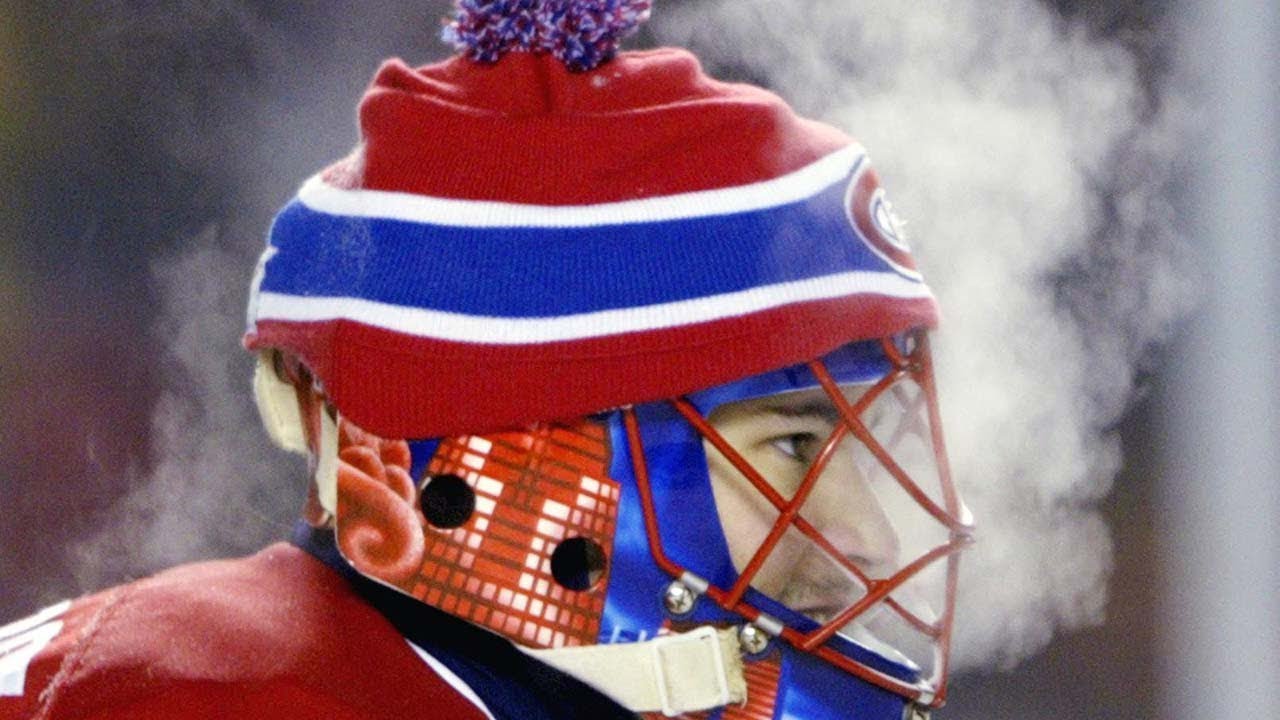
Those on the ice found creative ways of staying warm. The true star of the game was the toque (wool hat) worn over the mask of Canadiens goalie Jose Theodore. He explained, “I remember that my mom always said, ‘Put a toque on – you’re going to catch a cold.’ So I decided to make sure she’s not going to say anything when I go back home.” During period breaks, Theodore drank hot beverages trying to warm up. “My hands were really cold and my leg muscles really tightened up. With the cold, all my equipment and pads got so stiff it was just hard to keep your focus.” His teammate, Sheldon Souray, noted, “But we all had to wear extra underwear, we all had to prepare differently and we all had to play on ice that was less than ideal. But both teams came out of it and came out with a really good experience.” The Canadiens even had chicken soup served on their bench. As for the Oilers, Mike York apparently wore “long underwear and a neoprene balaclava” under his gear. He also went through five sticks because, as he explained, “You couldn’t overhandle the puck, you had to make simple plays. The sticks got frozen and it was hard to shoot at times. But it was the same for both teams.” Whereas his teammate, Georges Laraque, commented, “The weather wasn’t as bad as I thought it would be. Once you start playing you forget about that. It was the ice and the passing, and the longer the period went on, the harder it was.” The game had already been about 20 minutes late in starting because the ice needed some work. The officials also had to combat the cold by smearing Vaseline on their faces. Even though they wrapped their whistles in tape to prevent them from freezing to their lips, the whistles couldn’t really make sound in the cold.
Before the official game, the Oilers’ and Canadiens’ alumni faced off. Messier, as part of the Oilers’ 1980s dynasty, received special permission from the New York Rangers to play. According to an Edmonton Journal recap, “The oldtimers competed hard, put on a splendid, if somewhat slower show than in their prime. They scraped the ice between the two 15-minute periods of the game won by the ex-Oilers 2-0.” Wayne Gretzky, who started his NHL career with the Oilers, felt that all the events were “just tremendous for everybody” and that “it was a great day for hockey.” He went on, “Edmontonians should be proud of this. The fans were wonderful, the players were excited, it was really magical out there.” He doubted that it could ever really be duplicated. He and Guy Lafleur from the Canadiens then dropped the ceremonial puck for the active captains of their old teams.
The Heritage Classic game would count towards the NHL standings. The Canadiens were “at the end of a frustrating five-game road trip” while the Oilers had won four straight games. The Canadiens took the lead early on with goals by Richard Zednik and Yanic Perreault. Both Zednik and Perreault scored again in the third period. Meanwhile, the Oilers almost caught up with goals by Jarret Stoll, Eric Brewer, and Steve Staios. The game ended 4-3 in the Canadiens’ favor. “It’s the perfect way to end the road trip,” said Canadiens Joe Juneau. “If that’s the last game they play outside, we wanted to be a part of history. We wanted to be the team that won it.” On the other hand, the home team still had some work to do. Coach Craig MacTavish noted, “It was a great day with one exception, we didn’t take care of our part.” He explained that they knew the weather would be an issue, especially with the ice quality, but the Canadiens “got the better of the bounces.” Similarly, Oilers Scott Ferguson commented, “I don’t think either team knew what to expect. We weren’t even sure if the game was going to go ahead, or what the ice was going to be like. “But we came out and played hard and so did they.”
Writing for the Edmonton Journal, John MacKinnon waxed poetic. “This was as deeply Canadian a spectacle as anyone could conjure. . . . It was the all-Canadian neighbourhood rink writ large and beamed coast to coast, truly the game of our lives shared with the whole country. It was the two best hockey franchises in our history, their legacies of excellence interwoven, remembering that hockey is a game above all and that the rink is a community’s winter gathering place.” The Heritage Classic was considered such a success that other outdoor games followed, turning into the annual Winter Classic.
Additional Sources:
John MacKinnon, “Shinny Night in Canada,” Edmonton Journal, 23 Nov. 2003.
War impacted hockey the way it affected almost everything else during the 1940s. Being able-bodied, athletic men, many players served for their countries. Trains and other public transportation options were needed for moving servicemen, so they had to run on schedule. The NHL had to take these issues into consideration when setting rules. As solutions, the NHL decided, on November 21, 1942, to eliminate overtime and then, two days later, the NHL reduced the minimum number of players required for each team’s roster.
The Montreal Gazette shared NHL President Frank Calder’s announcement regarding overtime play, and the major newspapers for the four U.S. cities with Original Six teams published variations of Montreal’s Associated Press (AP) story. Calder stated, “Due to wartime travel conditions games in which the score is tied at the end of the regulation 60 minutes will be regarded as draws and no overtime will be played.” Apparently, the trouble really stemmed from teams trying to leave New York City after games. Jack Adams, manager of the Red Wings, commented, “The overtime period was only 10 minutes, it is true, but it usually resulted in a half hour’s delay. Railroads will not hold trains for athletic teams nowadays, and so something had to be done.” Adams went even further saying “that he felt the abolition of the overtime period would meet with the approval of the public and become permanent.”
Calder’s announcement also mentioned that “a proposal that rosters be cut will be reconsidered at a league gathering in Boston November 23.” On behalf of the Boston Bruins, Art Ross had proposed that instead of 15 players, rosters need only 13. Although the proposal had to do with the reduced number of players due to so many leaving for military service, Detroit blamed Boston for complaining because their team was short of players. Adams told the Detroit Free Press that he would vote against the measure like he had already earlier in the season.
The meeting, at Boston’s Copley-Plaza, was attended by Frank Calder, R.R. Duncan (Boston), Lester Patrick (NY), T.P. Gorman (Montreal), James Norris (Detroit), William J. Tobin (Chicago), and Frank J. Selke (Toronto). The end result was a compromise with team rosters being limited to 14 (instead of 15) players each game. In addition, the minimum number of players (12) was abolished, so a team could have as few as six players a game. Ross commented, “It’s certainly a step in the right direction.” Calder assured everyone, “Both of these changes have been made as wartime measures. They will remain in effect until further notice.” The new rule would go into effect that very night when the Bruins played the visiting Chicago Blackhawks. The Bruins would no longer be at a disadvantage, but other teams faced having to drop a player. For example, in Detroit “Johnny Holota, utility forward, will be cut from the roster and probably sent to Indianapolis.”
Three other rule changes were passed at the same meeting.
If a player catches and drops the puck anywhere but directly at own feet, there will be a faceoff.
If an official is hit with the puck, play continues from inside the penalty lines (rather than blue lines).
“Faceoffs after intentional offsides shall be in the faceoff spots instead of at the blue line.”
Rather than being a temporary wartime measure, overtime was not reinstated for over 40 years. With the 1983-84 season, sudden death overtime was set for up to five minutes. The number of players who skated during overtime was reduced to four-on-four in 1999 and then down to three-on-three in 2015. As for players, the roster numbers did go back up after the war. The season before overtime returned, the NHL went up to its present mandates of at least a 20-player game roster (which must include two goaltenders) and a maximum 23-player active roster.
Additional Sources:
“Calder Bans Overtime Play in N.H.L., to Consider Cut in Player Strength,” Montreal Gazette, 21 Nov. 1942, p. 16.
“Hockey Overtime Periods Ruled Out for Duration,” Detroit Free Press, 21 Nov. 1942, p. 14.
“Hockey Bans Overtime Play for Duration,” Chicago Tribune, 21 Nov. 1942, p. 20.
“Overtime Hockey Out For Duration:Calder,” New York Daily News, 21 Nov. 1942, p. 25.
“Overtime Play Out of Hockey for the Duration,” Boston Globe, 21 Nov. 1942, p. 8.
Tom Fitzgerald, “Ross Hails Player Cut; B’s Tackle Hawks Here,” Boston Globe, 24 Nov. 1942, p. 24 (48).
Tom Fitzgerald, “N.H.L. Player Limit Cut From 15 to 14,” Boston Globe, 24 Nov. 1942, p. 16.
“Hockey Loop to Cut Rosters to 14 Players,” Detroit Free Press, 24 Nov. 1942, p. 17.
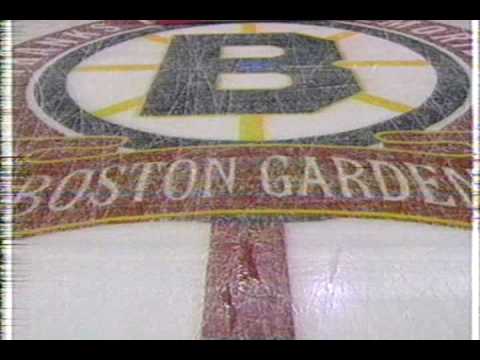
For their first four seasons, the Boston Bruins played at Boston Arena (now Matthews Arena, home of the Northeastern University Huskies). Then Tex Rickard, owner of Madison Square Garden, had the Boston Madison Square Garden built. The name soon simplified to Boston Garden. On November 17, 1928, President Calvin Coolidge (from the White House) turned on the lights at the new arena. During that first event, the Boxing Carnival Extravaganza, Boston’s Dick “Honey Boy” Finnegan defeated Andre Routis. Three nights later, on November 20, 1928, the Boston Bruins became the first team to play a game at Boston Garden.
Boston Garden was situated near public transportation and closer to the center of the city. It also could fit over twice as many spectators. As part of recapping the first game, John J. Hallahan described Boston Garden’s ice for Boston Globe readers. “The rink, which measures 190 by 85 feet, presented a good layer of ice. It was soft at the start, but improved as the game wore on. The players cut ridges in the surface at the beginning, but evidently the ice freezing apparatus was turned on fully, for in the second and third periods no better ice could have been asked for.” Since Boston Garden was built before the NHL standardized rink sizes, it featured an undersized rink, nine feet shorter and two feet thinner than standard. The Bruins used this to their advantage since visiting teams were used to more space.
As to space, getting into that first game caused major problems. Even with a capacity for over 14,000, when the “rush seats in the top gallery were placed on sale, a line stretched from the box office down Causeway st around the North Station Industrial Building and down Beverly st as far as Warren Bridge” and all tickets completely sold out. City and state policemen in plain clothes reported that Causeway Street and those nearby were “infested with speculators,” with some grown men posing as newsboys but selling tickets instead. They arrested and fined three men but “surmised that at least 2000 men did business with them, buying tickets at twice and three times the face value.”
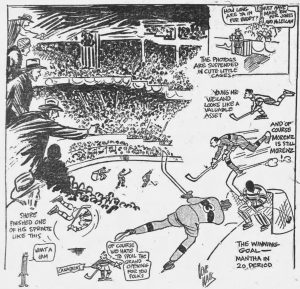
Boston Globe Cartoon as found on Newspapers.com
The Montreal Gazette reported that “thousands of wild hockey fans, unable to buy either seats or standing room, stormed the doors, swept aside police lines and flowed into the building, filling every inch of standing space and almost bulging out onto the ice. Windows were smashed and doors were broken in the wild assault on the building.” Their report noted that the game started 25 minutes late “with half the crowd still battling to get in.” They tallied 17,000 attendees, “the largest that ever saw a hockey game” in Boston. Hallahan of the Boston Globe admitted that the “fans were slow in arriving,” and that “Boston went hockey mad last night when a record crowd of almost 16,000 stormed their way into the new Boston Garden to see the first ice hockey game this season.” He claimed that beyond just Boston, “the crowd was the largest that had ever attended a game in any city of the world excepting New York.”
Those who made it in to see the game did not leave happy with the score. According to Hallahan, “The game, a slow starting one, finished strong, making it a pleasing one for the big crowd.” However, as the Montreal Gazette gloated, the Canadiens “spoiled the opening of the gigantic new Garden tonight by beating the Boston Bruins, 1 to 0.” The lone goal was scored by Canadiens’ defenseman Sylviao Mantha seconds before the second period ended. According to the Gazette, he “made a weaving dash the length of the rink, and scored with a knee-high shot that bounded off [Cecil] Thompson’s pads into the side of the net.” Bruins’ wing Dit Clapper put the puck in the net during the third period, but referee George Mallinson disallowed it as Clapper was offside when he took the pass. The rowdy crowd showed their displeasure at the call by jeering and throwing items from the balconies. This left Canadiens’ goalie George Hainsworth with the shutout. As Hallahan wrote, “He made many remarkable saves, especially in the last period, when his citadel was stormed by the Boston players, trying to equalize the score.” He summarized, “The Bruins played aggressive hockey but were met at every stage by the Canadiens, who appeared to be satisfied with their slim margin. The Boston team kept banging away and boring in.”
The Bruins played at Boston Garden for 67 years. Their final game there was a preseason exhibition against the Canadiens held on September 26, 1995. Boston Garden was demolished in 1998, but the current TD Garden is located right next to the old site.
Additional Sources:
John J. Hallahan, “Great Outpouring of Hockey Fans to See Bruins in First Home Game – Crowd Packs Boston Garden,” Boston Globe, 21 Nov. 1928, p. 15.
“On Watch for Boston Garden Speculators,” Boston Globe, 21 Nov. 1928, p. 17.
“Crowd of 17,000 Watch Canadiens Down Boston, 1-0,” Montreal Gazette, 20 Nov. 1928, p. 18.
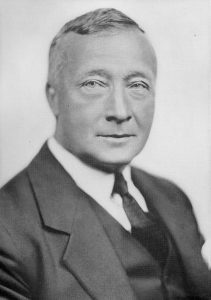
During the era of bench-clearing brawls, fans may have wondered where the referees were. Well, Bruce Hood was there through all of that until, on November 19, 1983, he refereed his 1,000th NHL game. At Maple Leaf Gardens, he officiated a 5-4 win for the home team over the Detroit Red Wings.
He was the first NHL referee to reach that milestone. Before him, Wally Harris had reached 952 regular-season games. Although, eight linesmen and 48 players had already passed 1,000 games by that point. Having started refereeing back in 1959 at the age of 23, Hood also officiated in six other leagues: the Milton Minor Hockey Association (which he formed), the Ontario Hockey Association, the International Hockey League, the Western Hockey League, the Eastern Pro Hockey League, the Central Hockey League, and the American Hockey League.
As a referee, Hood had quite a few other significant moments. He was the “last referee to officiate in all of the ‘Original Six’ buildings” and the last to wear No. 1 as a referee. In 1969, he led the formation of the NHL Officials Association (NHLOA). The following year, his left hand was immortalized in the bottom right corner of the iconic photo of Bobby Orr’s flying overtime goal when the Boston Bruins won the Stanley Cup. Shortly before retiring in 1984, he awarded all the penalties resulting from the “Good Friday Massacre” between the Montreal Canadiens and Quebec Nordiques. In 1985, the year after retiring from the NHL, Hood became the first professional referee to officiate at the World’s Championships (held in Prague). As his son, Kevin Hood, commented, “He was always a change agent. Once you got used to that, you were good with it, because typically his changes were great.”
Kevin also told The Canadian Press, “He wanted to be the best at everything he did in his life, and refereeing was no exception. He would always say, ‘You’re only half right most of the time.’ Half the crowd’s with you and half the crowd’s against you. The games when you weren’t noticed, those were the best.”
Hood’s career as an NHL referee spanned 21 seasons, including 1,033 regular-season games, 157 playoff games, 4 Stanley Cup finals, 3 All-Star Games, and 3 Canada Cup Series. “Bruce Hood brought professionalism and integrity to every game he worked,” said National Hockey League Commissioner Gary Bettman in an official statement upon Hood’s death in January 2018. “In addition to his command of the game and his ability to communicate on the ice, Bruce had a characteristic calmness that brought his excellence to the fore when the pressure was greatest.”
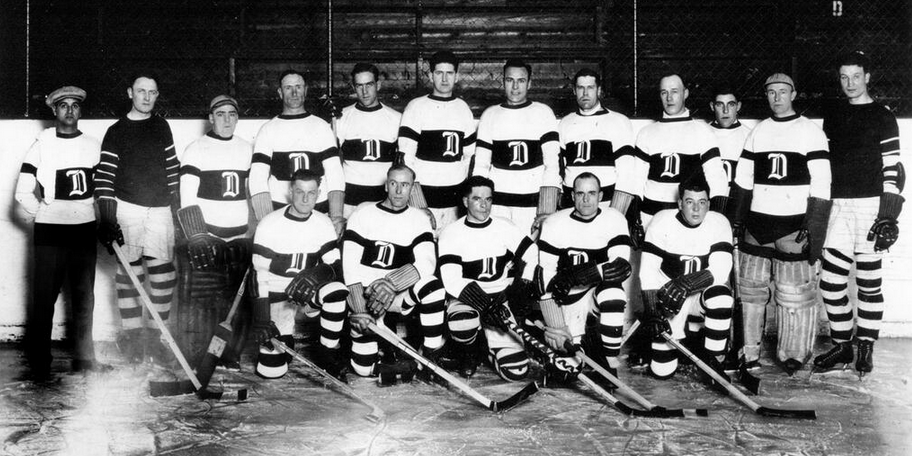
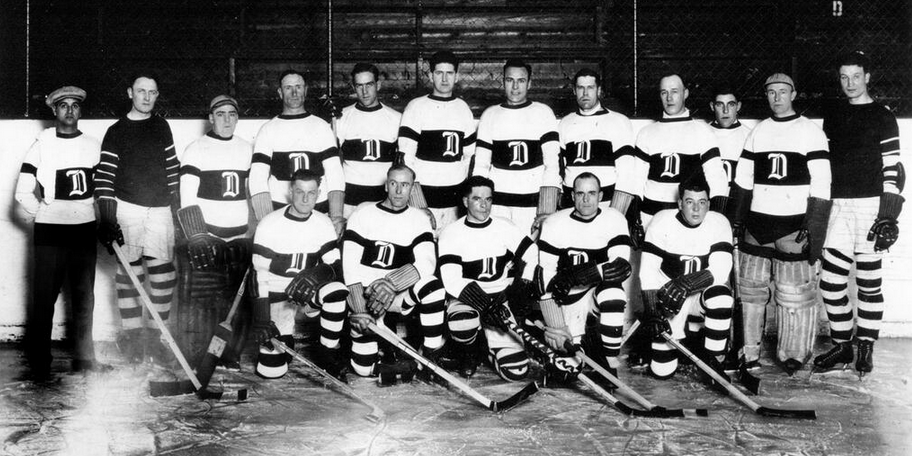
(Photo: Detroit Cougars hockey club [Public domain], via Wikimedia Commons)
Detroit was awarded its NHL franchise at the same time as Chicago, so it was only natural that they had their first games on back-to-back nights. Detroit’s first game, on November 18, 1926, came at the end of a three-day streak of first games for new NHL franchises.
Since Detroit actually had multiple applicants for a franchise, they grouped together. John Townsend, Charles Hughes, and Wesley Seybourn led the group that founded the team on May 15. They paid $100,000 to acquire players from the Victoria Cougars. This team already had a history going back to the 1912 founding of the Pacific Coast Hockey Association (PCHA). The team was founded as the New Westminster (B.C.) Royals, but when they could not find enough audience to pay their debts, they moved to Portland, Oregon in 1914. They became the first iteration of the Portland Rosebuds (the second being the one to man the Chicago squad). In 1919, the Rosebuds moved back over the border to become the Victoria Aristocrats. Two years after changing their name to the Victoria Cougars in 1923, they became the last non-NHL team to win the Stanley Cup. At that point, they played in the Western Hockey League (WHL), which folded, allowing the NHL to buy up every player contract for $258,000. Although the team home and name had changed so many times, Detroit decided to honor the legacy by keeping the name Cougars.
For their first coach, Detroit chose Art Duncan, a captain in the Royal Flying Corps during World War I. He had played eight seasons with two Vancouver teams (the Millionaires and the Maroons) before serving as player-manager with the WHL’s Calgary Tigers. His contract was purchased by Chicago, so it cost Detroit two players to obtain him as captain and coach. Duncan struggled in Detroit and was fired as coach before being traded to Toronto as a player. He did not even make it until Olympia Arena was completed in Detroit.
Since Olympia Arena still had not been finished, the Cougars played their first season across the border at Border Cities Arena in Windsor, Ontario. The arena had a capacity for 6,000, and despite grumblings over high ticket prices and having to pay taxes in both countries, it was “packed to the doors” on November 18, 1926, for the Cougars’ first game. Right before the start, their goalie, Hap Holmes, admitted he was too ill to play, so Herb Stuart replaced him in net. Their opponent, the Boston Bruins, already had two seasons under their belt. The extra time to gel helped the Bruins score two goals within the first three minutes of the game. Duke Keats scored the first at the 1:45 mark and assisted Archie Briden on the second. Ironically, Keats would be traded to the Cougars in January and serve as their player-coach for the end of the season. For the rest of this game, the Cougars played catchup. The Border Cities Star reported, “Almost as speedy as their opponents, the Detroiters did not show the same smart teamwork” by missing passes and getting out of position frequently. In the end, the Cougars could not score, giving Bruins goalie Doc Stewart the shutout with 21 saves. Still, between the two teams and the referee, the game featured eight future Hockey Hall of Famers.
The Cougars’ Harold Halderson potted the franchise’s first goal two nights later (during a 4-1 loss), and the Cougars finally won their third game (defeating the Chicago Black Hawks 1-0). Although that launched a four-game winning streak (including three shutouts), multiple losing streaks followed. Even after Coach Duncan was replaced, Detroit finished last in the NHL with 28 points (12-28-4). In 44 games, they had scored 76 goals, the second-fewest in the league. The team finally moved into Olympia Arena in Detroit for their second season, but it would take a two-year stint as the Falcons before, in 1932, they became known as the Detroit Red Wings. They won their first Stanley Cup championship in 1936, at the end of their tenth season, and they followed that with another the next year.
Additional Sources:
Stephen Laroche, Changing the Game: A History of NHL Expansion (Toronto: ECW Press, 2014), 43-49.
Kevin Allen, 100 Things Red Wings Fans Should Know & Do Before They Die (Triumph Books, 2014), 38-40.
Mike Commito, Hockey 365: Daily Stories from the Ice (Toronto: Dundurn, 2018), 362.
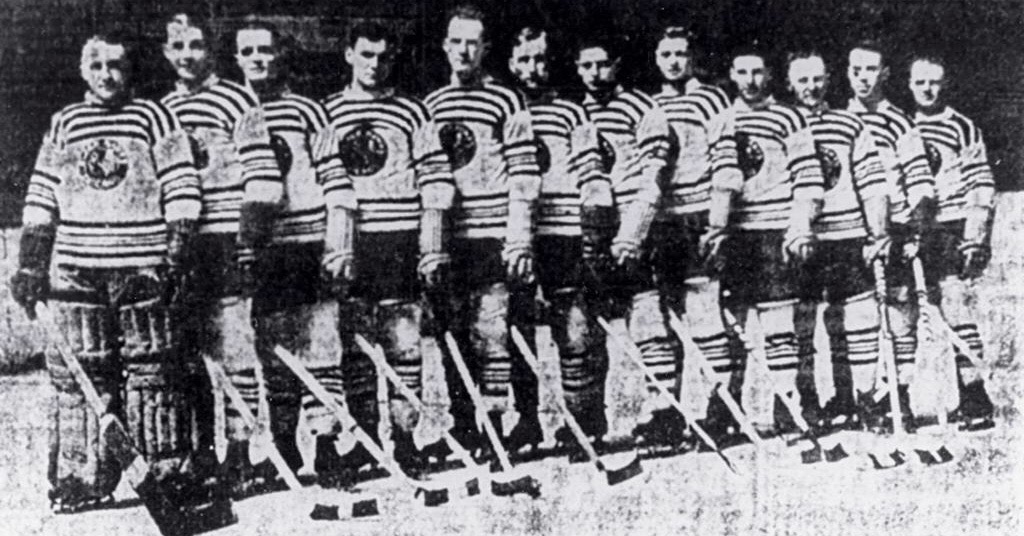
On November 17, 1926, the day between the first game for the New York Rangers and the first game for the Detroit franchise, the Chicago Black Hawks (as the name was then listed) played their first NHL game.
Chicago had been granted the franchise in April, and in September, the $12,000 entry fee was paid by Major Frederic McLaughlin, a coffee tycoon and associate of Tex Rickard. McLaughlin had served during World War I with the 333rd Machine Gun Battalion of the 86th Infantry Division, and these soldiers nicknamed themselves Blackhawks after the Sauk chief of that name. Although the original charter indicated that McLaughlin named the team Blackhawks (after his division), his wife, actress Irene Castle, created the logo with a Native American profile and the name on the sweaters listed as Black Hawks.
While McLaughlin did not know much about hockey, he still served as his own general manager and remained very involved in running the team. He promoted American hockey players until the Black Hawks had the first all-American born starting lineup in the NHL. To stock his team, McLaughlin bought up the contracts for the Portland Rosebuds upon the folding of the Western Hockey League (WHL). The WHL team had only been in Portland for one season, 1925-26, when they formed the second incarnation of the Rosebuds. The team had originated as the Regina Capitals back in 1921.
The Chicago Coliseum was packed, well over its capacity of 6,000, for the franchise’s first game. According to the Chicago Daily Tribune, “There were cheers from the time the game started until the final whistle.” Only 3:20 into the first period, George “The Western Wizard” Hay, scored Chicago’s first ever goal. Hay had come through the Regina Capitals and Portland Rosebuds, but he only remained with Chicago for that first season before being traded. A minute later, Chicago had another goal. During the third period, Chicago scored twice more to defeat the visiting Toronto St. Pats (predecessors to the Maple Leafs) 4-1.
During their first season, the Black Hawks had to compete with the Chicago Cardinals, an American Hockey Association team. McLaughlin had allowed them to start playing at the Coliseum about the same time but then had to reduce prices for Black Hawks to remain competitive. The reputation of the NHL’s quality of play kept the Black Hawks the more popular choice, and the Cardinals were sold at the end of the year.
Over the course of that season, the Black Hawks led the league in goals, but veteran goalie Hugh Lehman also let in the most goals (despite having five shutouts and leading the NHL in minutes played). For the first season, the Black Hawks earned 41 points (19-22-3), ranking them third in the American Division. They made the playoffs but immediately lost to the Boston Bruins. Chicago’s growing pains over the next few years have been blamed on the Curse of Muldoon because their first coach, Pete Muldoon, lasted only one year due to conflicts with the controlling McLaughlin. The team went through many coaching changes under McLaughlin before they won their first Stanley Cup in 1934.
Additional Sources:
Stephen Laroche, Changing the Game: A History of NHL Expansion (Toronto: ECW Press, 2014), 35-42.
Tab Bamford, 100 Things Blackhawks Fans Should Know & Do Before They Die (Triumph Books, 2016), no. 61.
New York was already a happening place for hockey by the time the Rangers came on the scene playing their first game on November 16, 1926. With the opening of the Ice Palace, St. Nicholas Rink, and Clermont Avenue Rink in 1896, New Yorkers had had years of hockey before they were granted their first NHL team, the New York Americans. The Americans had played at the opening of Madison Square Gardens (the third of its name) in December 1925.
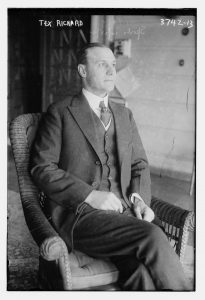
The following April, the Garden’s owner/president, George “Tex” Rickard, was granted another New York franchise. When sportswriters referred to the team as Tex’s Rangers, Rickard kept the name and set it diagonally across the sweaters to set them apart from the Americans with their horizontal lettering. Rickard originally hired Conn Smythe, who travelled North America signing on the best players he could find. When management and Smythe butted heads, Rickard brought Lester Patrick on board as the Rangers’ coach.
On November 16, 1926, for a crowd of over 13,000 spectators, the New York Rangers faced off against their first opponent, defending Stanley Cup champions Montreal Maroons. The Rangers’ captain, Bill Cook, scored the only goal of the game (and thus the Rangers’ very first goal) at 18:37 of the second period. Cook became just the player needed to draw the crowds to the new team when he scored the franchise’s first hat trick at their second game. With his brother, Fred “Bun” Cook, and center Frank Boucher, they formed the Bread Line that kept the goals coming. In that first game, Boucher brawled in the only fight he would have during his ten years in the NHL. In the Rangers’ goal, Hal Winkler had the honor of being the first to shutout the opponent in his NHL debut.
The Rangers became popular by playing hard and clean, earning a reputation as “the classiest team in hockey.” Their teamwork led to a first-season record of 25-13-6, the best in the NHL, and a trip to the playoffs. Although they did not make the finals on their first try, they won the Stanley Cup on their second, one year later. In fact, in their first six seasons, they made it to the finals four times.
The first game for the Rangers was followed by the first games for two other Original Six teams. Stay tuned!
Additional Sources:
Stephen Laroche, Changing the Game: A History of NHL Expansion (Toronto: ECW Press, 2014), 50-58.
The Dallas Stars hosted the Colorado Avalanche at the American Airlines Center on November 15, 2002. Both franchises had experienced significant moves in the mid-1990s. The Stars moved from Minnesota to Texas in 1993, and the Avalanche had been the Quebec Nordiques until 1995. The Avalanche had won the Stanley Cup championships in 1996 and 2002, while the Stars won the Cup in 1999. This particular game in 2002 would not have been significant but for a player from each team – Mike Modano and Patrick Roy – reaching milestones.
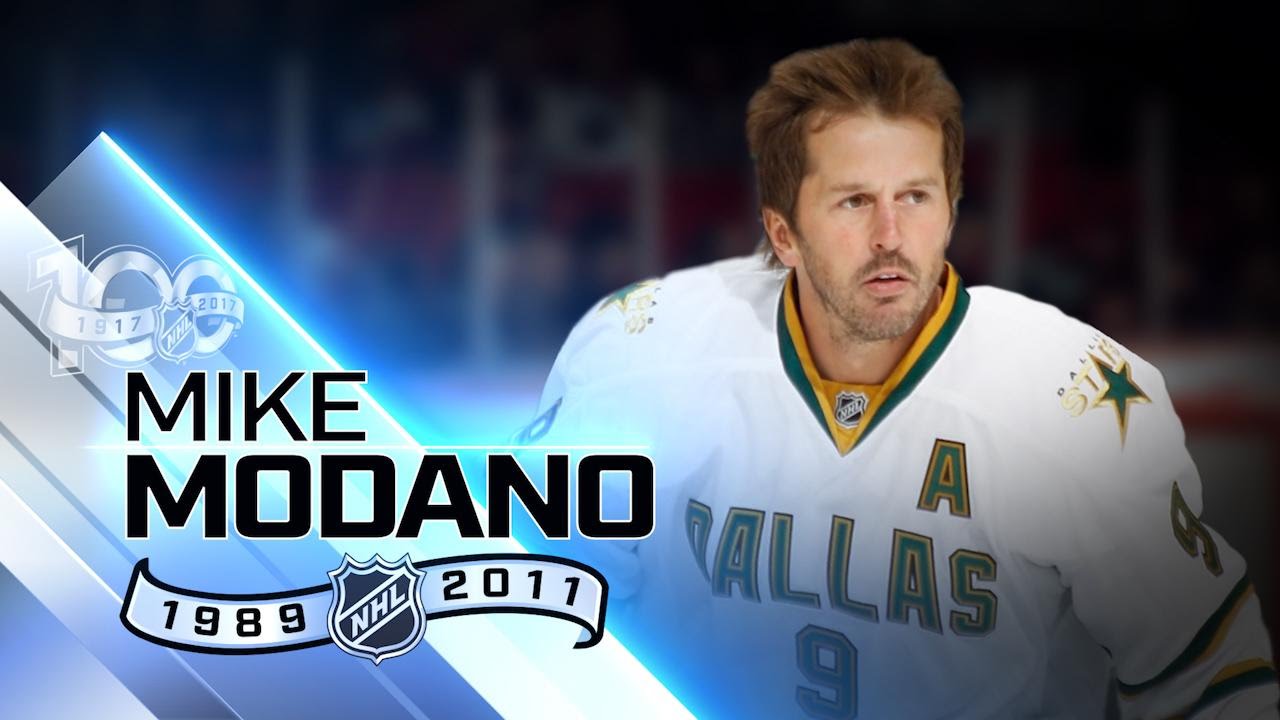
Forward Mike Modano was the first draft pick for the Minnesota North Stars in 1988, which meant that he made the move with them five years later. About halfway through the first period of the game on November 15, 2002, he assisted on Ulf Dahlen’s goal. Although that was Modano’s only point of the game, it was the 1,000th point of his career. He was only the fifth American-born player to earn that many. On another November day, November 7, 2007, Modano surpassed Phil Housley to become the American-born player with the highest number of points. It took him 242 fewer games to accomplish. His two goals in the first five minutes brought him up to 1,233 points. When Modano retired in 2011, he had accumulated 1,374 regular-season points (561G, 813A), which is still the record for American-born players (and 24th overall). From playoffs, Modano earned another 146 points (58G, 88A), also the most by any American-born player. Modano played all but his last season for the Stars.
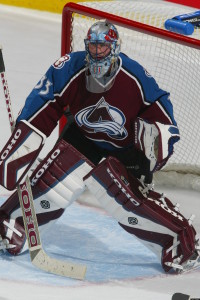
Patrick Roy
Goalie Patrick Roy had already had 12 stellar years with the Montreal Canadiens before joining the franchise he’d cheered on as a child. However, he joined them for their first year in Colorado instead of remaining in Quebec, Canada. Rather than midway through the first period like Modano, Roy did not reach his milestone until halfway through the third. At that point, he passed Terry Sawchuk’s record of 57,194 minutes played. It took Sawchuk 21 seasons to accomplish, and Roy had passed him in his 19th. Roy finished the night with 57,202 minutes and had stopped 18 shots of 22. The Avalanche still lost 4-2. When Roy retired at the end of the season, he had played 60,214 minutes. Only one goalie, Martin Brodeur (with 74,439 minutes), has passed him thus far.
Of the four games the two teams played against each other during the 2002-03 season, the Stars won two games and tied two games with the Avalanche. Both teams finished first in their divisions, but the Stars had more points at 111 (46-17-15-4) than the Avalanche with 105 points (42-19-13-8). During the playoffs, the Stars failed to make it through the conference semi-finals while the Avalanche could not make it past the quarter-finals. Still, Modano was tenth in points and fourth in assists for that season. Roy was sixth in save percentage and goals against average.
Additional Sources:
Liam Maguire, Next Goal Wins! (Toronto: Random House of Canada, 2012), 176.
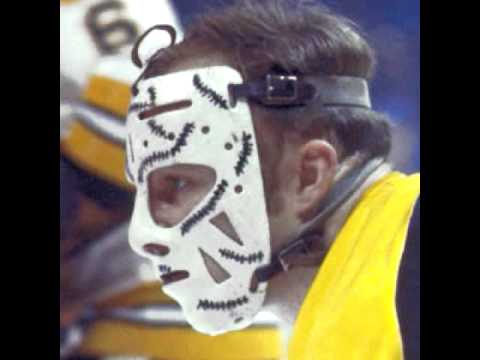
Gerry Cheevers’s claim to fame started with 30 stitches drawn on his facemask, but his greatest achievement was an unbeaten streak of 32 games. Cheevers began his professional career with the Toronto Maple Leafs franchise in the early 1960s but really began playing in the NHL with the Boston Bruins in the mid-1960s. With the Bruins, Cheevers had won the Stanley Cup in 1970 and had a surprise upset early in the 1971 playoffs. For the 1971-72 season, he and Eddie Johnston shared time in the Bruins’ net. Although they both posted excellent records that season, Cheevers stood out by beginning a streak on November 14.
Going into the game, Cheevers had three wins and three losses. The streak began with Cheevers stopping 29 (of 31) shots by the Los Angeles Kings. To top that off, his teammates Bobby Orr and Phil Esposito (among others) kept finding the Kings’ net. The game ended with a score of 11-2. From that point, Cheevers was not defeated for the next 32 games he played achieving 24 wins and 8 tied games. Meantime, the Bruins with Johnston in net only lost five games. Cheevers ended his streak with a tie on March 25 before backing the Bruins’ for two of the three straight losses between March 29 and April 1. Fortunately, on April 2, the Bruins (with Johnston) won their final game of the season.
When the 1971-72 season ended, the records for Cheevers (27-5-8) and Johnston (27-8-3) gave the Bruins 54 wins, 13 losses, and 11 ties. Their 119 points put them first in the East Division. For the playoffs, Cheevers received credit for six wins and two losses, and Johnston had six wins and one loss. Of his final game during those playoffs, Cheevers said, “I have never played in a game where the puck went by me so often without going in! . . . We were two men short in the second period and the puck went by me five times! Eventually, you think, ‘This is going to be our night!’” That was indeed his night when he shutout the New York Rangers in the final game of the Stanley Cup finals. He reminisced, “That was a great feeling winning the Cup in New York in ’72.”
For Cheevers, his team held precedence over his own record. He once said, “I don’t care much about my average. My philosophy has always been that the other team can fill the net on me as long as we get one more goal.” Shortly after his big finish, in 1972, Cheevers was drafted into the WHA, and he briefly played with the Cleveland Crusaders. He returned to the Bruins in 1976 after refusing to play for the Crusaders, and he remained in Boston to 1980. He holds numerous Bruins career records like most ties, most points, most penalty minutes, most playoff games/minutes played, most playoffs shutouts and season records for most points, most penalty minutes, and most playoff shutouts. Five years after retiring, he was inducted into the Hockey Hall of Fame.
The 32-game unbeaten streak crushed the 23-game record set by Frank Brimsek in 1940-41. Thus far, Cheevers’s streak remains unbeaten. The only goaltender to come close was fellow-Bruins Pete Peeters, who had a 31-game unbeaten streak during the 1982-83 season. The Bruins coach at the time was Gerry Cheevers.
Additional Sources:
Don Weekes, Hockey’s Top 100: The Game’s Greatest Records (Vancouver: Greystone Books Ltd., 2008), 90.

 Prev
Prev