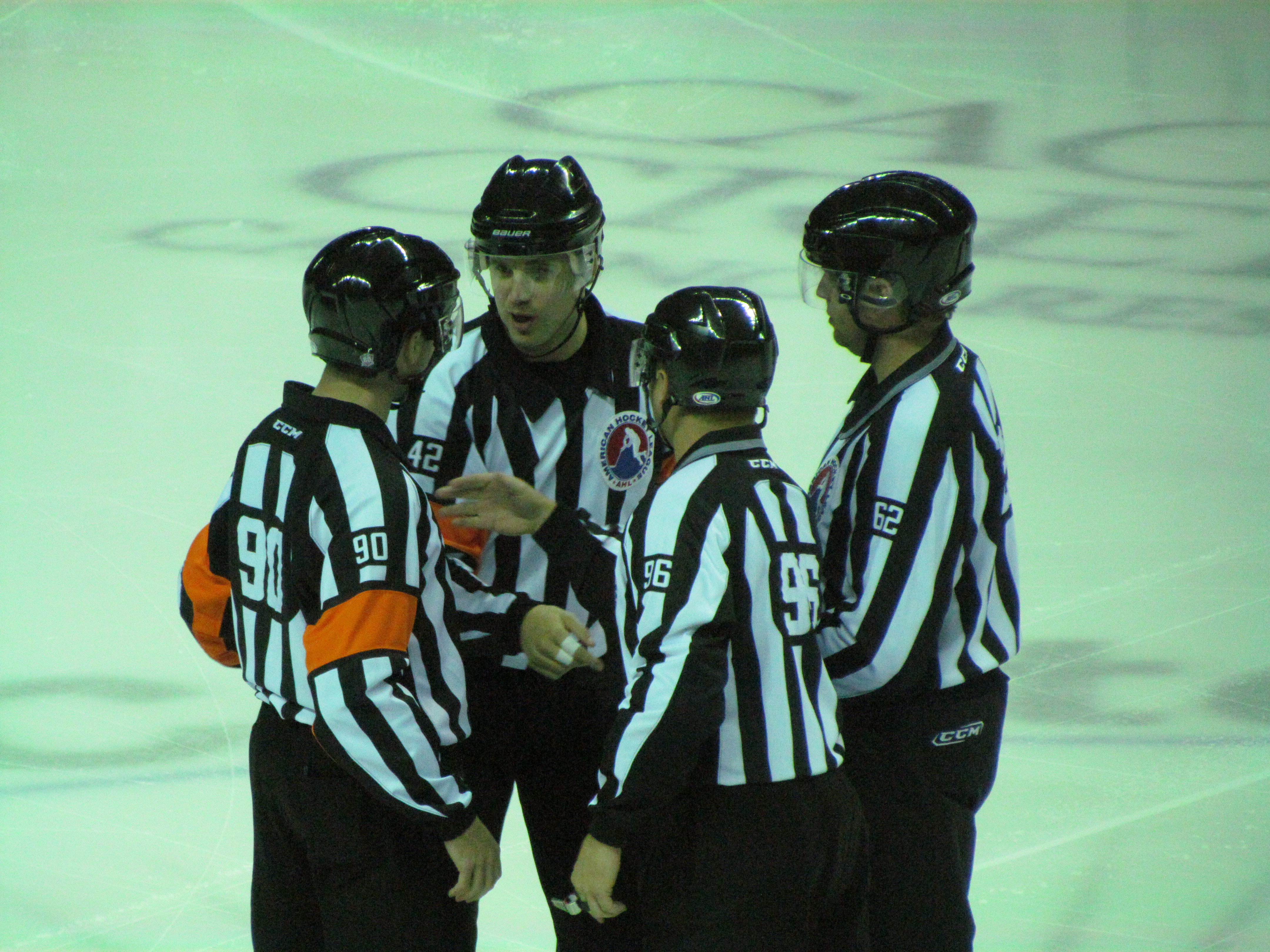
A professional career spanning 26 years with some time spent down in the AHL and other minor leagues before getting a big break during Stanley Cup playoffs and then permanently joining the NHL with expansion opening up more teams. It sounds like the career of a hockey player, but this was the timeline for a linesman turned referee, Ron Wicks. His fellow referee, Bruce Hood, may have reffed 1,000 games first, but Wicks outlasted him. On December 14, 1985, Wicks refereed his 1,034th regular-season game in the NHL. At the Met Center, the Minnesota North Stars and Toronto Maple Leafs tied 6-6. Wicks called three minor penalties on the visiting Maple Leafs and five on the North Stars, so he probably was not very popular that night.
Wicks chose refereeing early on, as he said, “I realized I had a lack of talent as a player. But reffing allowed me to stay involved in hockey.” He explained, “There were no referees’ clinics in those days. You just got yourself a rule book, tied on the skates and went out and did the job. On the ice I was the referee, both linesmen, both goal judges, and game and penalty timekeeper. There was no passing the buck.”
Having just turned 20, Wicks became the youngest official in the NHL when he worked as a linesman during an October 1960 game at Madison Square Garden. For most of the 1960s, Wick refereed in the American Hockey League (AHL), the Central Hockey League (CHL), and the Western Hockey League (WHL). Though he was brought up to serve as linesman during the 1964 Stanley Cup playoffs. With the 1967 expansion, Wicks jumped up to the NHL full time.
In his autobiography, Wicks laid out his philosophy. “I put them [NHL stars], and hundreds of others, in the penalty box because they deserved it. Rules are rules, and I called ’em whenever anyone broke ’em.” However, he also realized, “The rule book is just a guide. If you called the game by the book, you’d be the only guy left on the ice. Officiating is a very unscientific profession.”
As Wicks hit the ripe old age of 45, the NHL began training his replacement. As one Washington Post article about NHL referees stated, “There is no mandatory retirement age, but by 45 most referees show signs of slowing down and are phased out as gracefully as possible.” Thus, in 1986, the NHL had 11 full-time referees, 3 being trained to replace Wicks and two others, and 21 full-time linesmen. As Wicks’ last hurrah, he refereed the All-Star game on February 4, 1986 held at Hartford. The cover of his memoir features a photo of him dropping the puck to Wayne Gretzky and Mario Lemieux at that game. When he retired at the end of the season, he held the record for most NHL games officiated (1,400 regular-season, 175 playoff, 5 finals, and 3 All-Star).
Wicks was inducted into the Brampton Sports Hall of Fame and the Sudbury Sports Hall of Fame before he passed away in 2016.
The Anaheim Ducks, currently in their 25th season, had their most successful season as a franchise about halfway through their history. The 2006-07 season was the 13th for the franchise but the first under the new name. Prior to that, they were known as the Mighty Ducks of Anaheim. The slight change seemed to have made quite the difference when the team set a new record for the first 15 away games. As of Anaheim’s win on December 13, 2006, their road record was 12-1-2 (for 26 points), which was one point higher than the record holder, the Detroit Red Wings, with 10-0-5 (25 points) during the 1951-52 season.
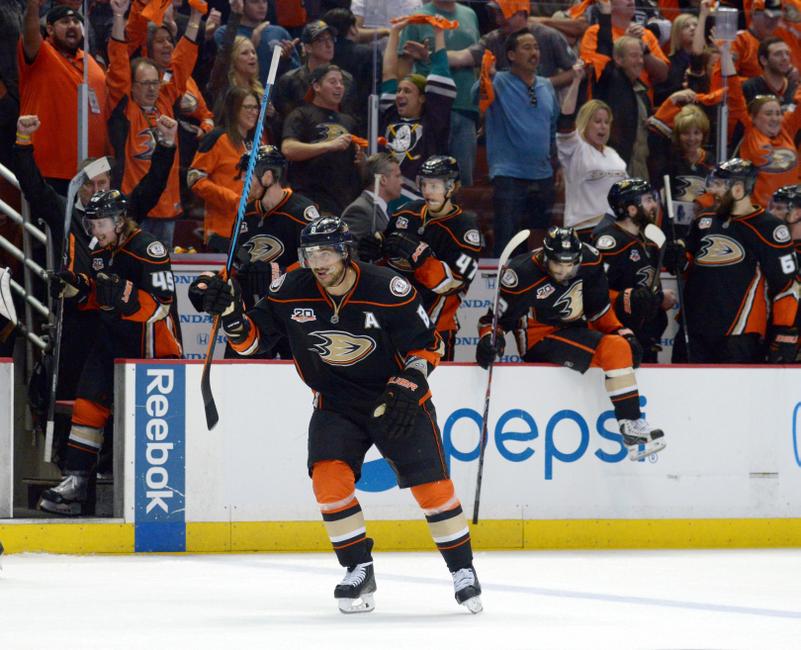
Anaheim’s extra point can be attributed to one star player, Teemu “The Finnish Flash” Selanne. He scored both goals in the 2-1 win over the Atlanta Thrashers at Phillips Arena. According to the recap, “Selanne’s power-play wrist shot over Lehtonen’s glove broke a scoreless tie 15:41 into the second period.” During a power play at 11:49 of the third period, Atlanta’s Niko Kapanen tied up the game. However, “About one minute after the Thrashers pulled even at 1-1 in the third period, Selanne skated alone into the slot and scored on a pass from Andy McDonald to restore the Ducks’ lead.” Towards the end of his career Selanne said, “I think I like to take advantage of the speed, and try to be in the right place at the right time.” This was Selanne’s fifth two-goal game of the 2006-07 season. His 43 points put him in second over Marian Hossa of the Thrashers.
On defense, Ducks goalie Jean-Sebastien Giguere made 34 saves. He had won every game he started that season but for one home game, giving him the best record (25-3-6). His teammate Selanne praised, “Both goalies were outstanding. They really kept the score down. (Giguere) was there when we needed him.” Thanks to the two of them, the Ducks maintained a seven-game winning streak on the road. Selanne again gave the press a good soundbite, “I know what we are capable of. We raised the bar higher.”
After such a great start, the Ducks finished the season 48-20-14 (110 points), first in the Pacific Division. Anaheim brought home its only (so far) Stanley Cup after defeating the Ottawa Senators four games to one. When they won, Selanne said, “”I can’t describe the feeling I had when I hoisted the Stanley Cup. I had dreamt of winning something big for fifteen years, and had waited for that moment with every fiber of my body.” As for Selanne, he holds at least four Ducks records: all-time goals leader (457), all-time points leader (988), most goals in one season (52 in 1997-98), and most points in one season (109 in 1996-97). He retired and earned a bronze Olympic medal in 2014, had his No. 8 retired by the Ducks (as their first retired number) in 2015, and was voted into the Hockey Hall of Fame in 2017.
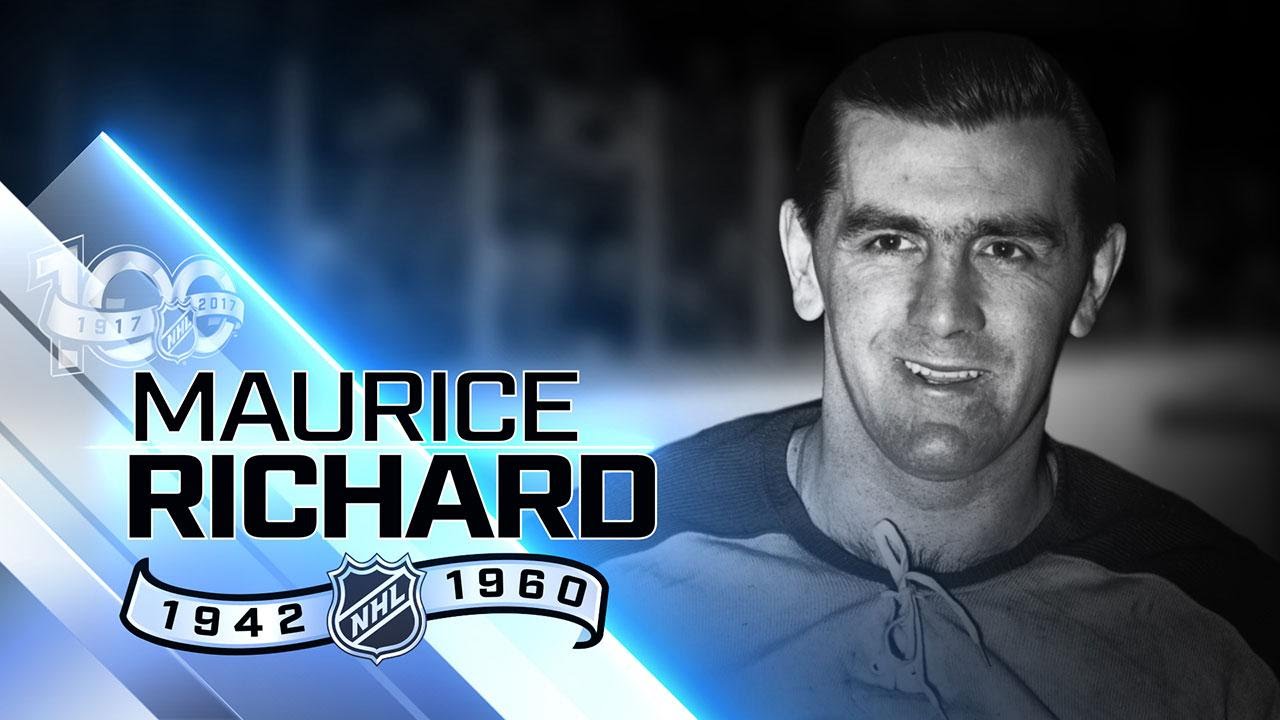
To the Montreal Canadiens, Maurice “Rocket” Richard was a great among greats. Throughout the beginning of the 1953-54 season, he already had the most goals for his team (16) and the most goals of all-time (over 325). With his goal and two assists on December 12, 1953, he reached 611 points to set the new NHL scoring record.
At the Forum, the game started off better for the New York Rangers, who led 2-1 after the first period. However, those were the only goals the Rangers would score, while the Canadiens and their first goal scorer, Ken Mosdell, would continue to score. During both the second and third periods, the Canadiens had a “three-goal outburst.” Dink Carroll described the tying and winning goals for the Montreal Gazette. “The Rocket set up the first one [at 4:11 in the second period] when he centred the puck for Ken Mosdell and the latter notched his second counter of the night. Then [at 5:26] the Rocket scored by netting his own rebound with Calum MacKay and Doug Harvey being credited with assists.” During this period, Canadiens defenseman Jean Belliveau was sent to the hospital with a fractured cheek bone from being sent to the ice by goalie Johnny Bower “trying to shove a jam from the goalmouth.” Richard earned his final assist on the second-to-last goal of the night, Calum Mackay’s at 9:34 in the third.
The Canadiens had expected Bernie “Boom Boom” Geoffrion to fare well (as he always seemed to) against the Rangers. He had 27 points so far for the season, which put him second only to Gordie Howe’s 32 points. Richard was in fifth with 24 points. Geoffrion kept up with Richard in points for the game by scoring two goals and earning one assist (on Paul Masnick’s goal).
All in all, the teams were matched with three minor penalties apiece, but the Canadiens outshot the Rangers 36-22. In the end, the Candiens defeated the visiting Rangers 7-2. They had earned their 15th straight home game and remained at the top of the standings.
According to sportswriter Trent Frayne, “Richard scored goals from all angles and positions.” The Rocket led the NHL in goal-scoring five times, was the first to score 50 goals in 50 games, and was the first to score 500 goals. When he retired in 1960, he had 544 goals (and 421 assists for 965 points). He held the NHL scoring record until late 1963, when Gordie Howe scored his 545th goal. Richard’s scoring accomplishments are remembered through the Maurice Richard Trophy, annually awarded (since 1999) to the NHL’s leading goal-scorer. Richard reminded everyone, “What counted above all is that I worked hard. I set a good example. I helped other players.”
Additional Sources:
“Habs Seek 15th Home Win; Geoffrion Second In Scoring,” Montreal Gazette, 12 Dec. 1953, p. 10.
“Canadiens Rip Rangers, 7-2,” New York Daily News, 13 Dec. 1953, p. 120.
Dink Carroll, “Mosdell, Geoffrion Lead Attack With 2 Goals Each; 15th Home Win,” Montreal Gazette, 14 Dec. 1953, p. 24.
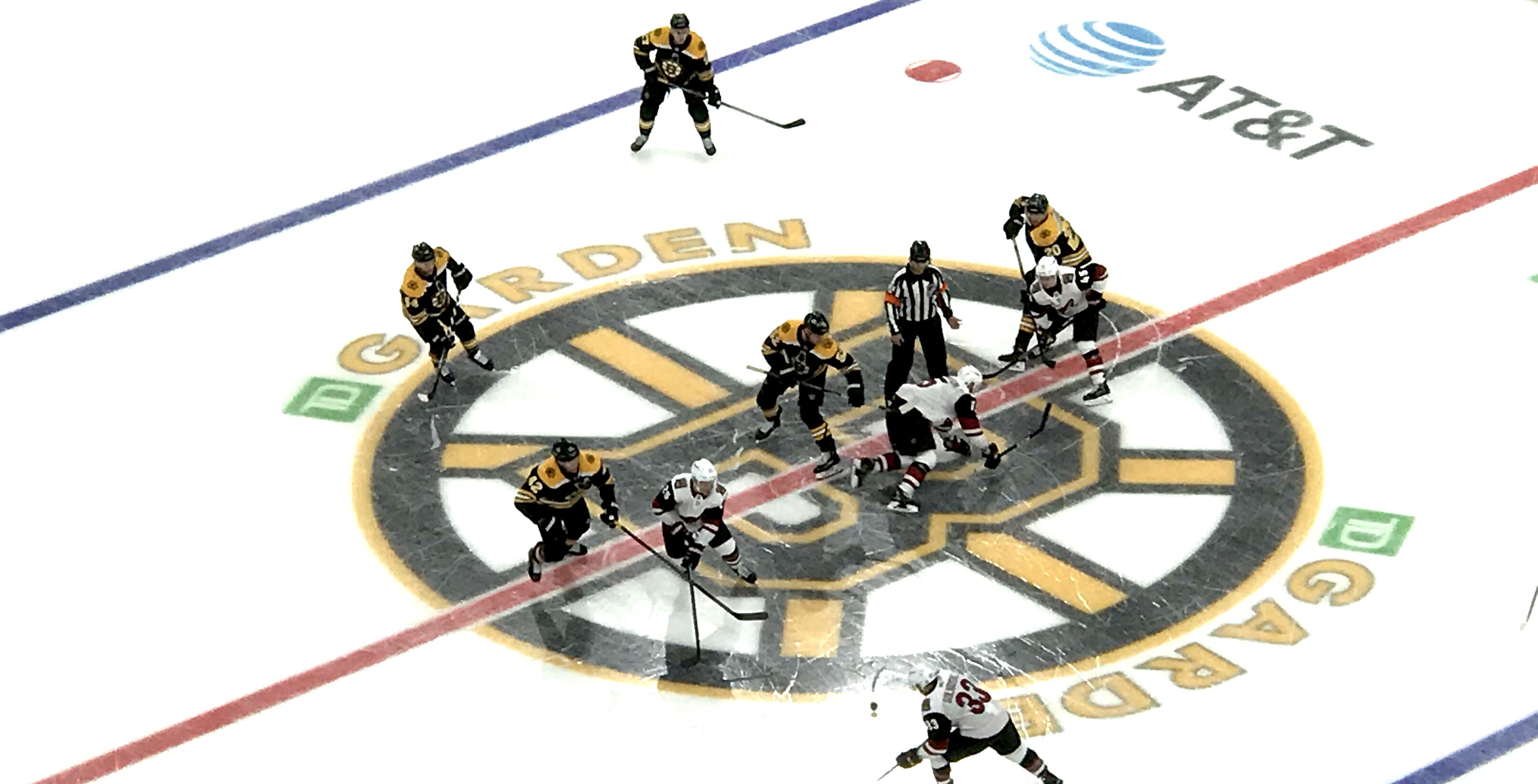
The Boston Bruins came into Tuesday night’s game carrying a 2-3-0 record in their last five games and hoping to notch their third consecutive win. After losing at home to the Detroit Red Wings 4-2 (12/1) and then twice on the road first in Sunshine against the Florida Panthers 5-0 (12/4) and two nights later in a slightly better attempt against the Tampa Bay Lightning 3-2 (12/6), they returned home for a Saturday game against the Toronto Maple Leafs that reinvigorated their confidence as they tallied a 6-3 victory. The Bruins then headed to Ottawa for another game on Sunday, December 9, 2018, playing again in less than 24 hours. They pulled out another physical game and another win.
During their pregame discussions with the media after the morning skate they talked about the necessity of continuing to play to the level that got them those two wins, but as the first period began, their response to the visiting Arizona Coyotes was anything but high paced and physical. In net for the Bruins was Tuukka Rask who was 7-6-2, 2.50 GAA, and a .917 Save % on the season. Against the Coyotes he was 10-1-0, with one shutout, a 1.54 GAA and a .942 Save % in 11 career games. At the opposite end, Darcy Kuemper was starting for Arizona bringing a 4-5-2 record, 2.71 GAA, and .914 Save %. Against the Bruins he was 0-3-0 with a 2.71 GAA, and .884 Save % in three career games.
Just under three minutes into the game, Clayton Keller caught fellow Boston University Terriers alum Charlie McAvoy with a high stick. McAvoy headed down the tunnel for repairs as the stick caught him up under his visor and Keller took a seat in the penalty box for four minutes. Indicative of their sluggish start in the game, Boston was unable to capitalize while on the extended man advantage. Fortunately for the Bruins, McAvoy who was in just his fourth game back after a concussion and had experienced a dangerous hit late in Saturday’s game against the Leafs, was back before the end of the period.
Matt Grzelcyk was whistled at 10:31 of the opening period for a hook, and the Coyotes would make him do the skate of shame from the penalty box to the bench when they scored with just nine seconds remaining on the power play. Nick Schmaltz, assisted by Oliver Ekman-Larsson, and Keller with a little redemption for his penalty, managed to get his Coyotes on the scoreboard first. That goal wasn’t necessarily anything for the Bruins to worry about, but 40 seconds later and Nick Cousins, putting it glove side high on Rask, with assists from Alex Goligoski and Josh Archibald was the moment that it looked like perhaps Boston wasn’t going to be able to make things happen.
“I think we talked about, for the most part, it wasn’t anything crazy. It was about respecting what was going on. I thought we were a little disrespectful to the game, showed in our power play. We were trying to force plays, not being hard enough, supporting one and another. Then we talked about making some adjustments and closing our gaps and allowing our d to stay forward if our forwards worked back, and then we got some good transition opportunities and goals off of that. So, that was it for the most part. Listen, let’s play the way we’re capable of and let’s see what happens,” Bruins Head Coach Bruce Cassidy shared.
Listen, let’s play the way we’re capable of and let’s see what happens — Bruce Cassidy
More concerning than the score was yet another injury to a Bruin. This time it was David Backes. At first it looked like another high stick, what with how fast things were moving, but as Backes cupped his hands to his face and began skating for the bench, it was clear he was hurt. As the door to the bench flung open, Backes continued to sprint down the tunnel. It was only upon watching the replay that it became clear that Backes had been hit in the face by Ekman-Larsson’s skate. Undoubtedly, while the rest of the Bruins tried to soldier on it would not be surprising if some of them were trying to get that image out of their minds.
With what was said during that first intermission and undoubtedly the return of Backes—who would have to take one more trip for repairs when he started bleeding again—a message had been sent. Somehow, watching them play, it seemed that if they could just solve Kuemper on one goal, that they would open a scoring gate. Danton Heinen, with his fourth goal of the season would do just that, going to the net, glove side low, off an impressive cross-crease pass by Jakob Forsbacka Karlsson, getting the Bruins on the board at 8:40 of the middle period.
Thirty-three seconds later, David Pastrnak in almost the same place as Heinen, with almost an identical shot on net, tied the game, with assists from Brad Marchand and David Krejci, who was playing in his 800th NHL game. And 2:18 later, Marchand with another attempt on the glove side, would get the Bruins their first lead of the evening. Krejci was awarded the secondary assist on this one as well. Three goals for the Bruins in just 2:51 of game time.
The Bruins top line of Marchand, Krejci, and Pastrnak was not finished. Marchand would get his second goal of the game, this time the primary assist being Krejci’s and the secondary Pastrnak’s, as he caught a rebound and put it in on the blocker side low. Marchand’s goal was scored just 1:39 after their previous one, with all four of their goals coming in the span of 4:50 of game time.
And for the Coyote’s top line of Lawson Crouse, Schmaltz and Keller? They found themselves sitting on the bench. Every time Arizona’s Head Coach Rick Tocchet put them out, Cassidy countered with the Marchand-Krejci-Pastrnak line.
“I didn’t like that line. Any time I put them out there, I didn’t have the last change. [Bruce] Cassidy put his Marchand [line] in, so that tells you, to me, you know, that line, if the other coach is going to put their best line against you, you’ve better have some pride. I didn’t like that line at all. They were a little better in the third, but not good. Not good at all,” Tocchet said after the game.
Arizona would get one more goal in the second period just 90 seconds after the Bruins fourth goal. This time it would come from Michael Bunting who was playing in his first career NHL game.
After that flurry of scoring, the remainder of the game was a lot of north and south play, and what looked like perhaps the Bruins trying to protect their lead. Despite each team getting another power play in the third—Coyotes Jakob Chychrun for holding and Boston’s John Moore for tripping—neither team would get another puck past the opposing goaltender. As the final seconds ticked off the clock, while Arizona had six players in Boston’s end and an empty net at the other, Rask would have to make one last big save to keep things in favor of the Bruins.
The Bruins won their 14th straight game against Arizona, with their last loss going all the way back to October 9, 2010, while the Bruins and Coyotes were playing in Prague. The Coyotes won that game 5-2. However, the current streak for the Bruins is the longest active win streak by one team versus an opponent in the NHL.
Even with four goalies, the game on December 11, 1985 between the Edmonton Oilers and Chicago Blackhawks seemed to be all about offense with little defense. Between the two teams, they scored the most goals (21) in one game since the adoption of the red line in 1943, the most goals (12) in one period (the second), and the most goals (12) the Blackhawks had ever given up at Chicago Stadium.
Post-game Oilers defenseman Kevin Lowe said, “After something like this the only way to look at it is the fans [all 17,973 of them] had fun. They got their money’s worth. The thing I can’t understand is how the scorekeeper kept up.” The first period was all about the Oilers, who scored four times without any response from the Blackhawks, which turned into six goals in the first 23 minutes of the game. Then came the crazy second period with six goals apiece. Finally, the Oilers scored two goals to the Blackhawk’s three for the final period.
For the Oilers, Glenn Anderson and Jari Kurri came out with hat tricks, Marty McSorley had two goals, and the other four goals were scored by Lee Fogolin, Dave Lumley, Dave Semenko, and Kevin McClelland. The big news of the night was that while Wayne Gretzky did not score a goal, he contributed seven assists, tying the NHL single-game record he held from 1980. Gretzky commented, “I actually thought I had eight . . . but I lost count, I guess. It was one of those freaky nights.”
On the Blackhawks side, it took much longer to get on the board until Denis Savard put a stop to an Oilers shutout during a second-period power play. In addition to his goal, Troy Murray and Ken Yaremchuk each scored twice while Curt Fraser, Bill Watson, Jerome Dupont, and Keith Brown had one goal apiece.
Gretzky called the game “absolutely absurd” and described the final moments, “The funniest thing was the clock messed up with four minutes left. All of a sudden it flipped to 19:31. I don’t know if they were trying to tell us something or not? If we’d played that long we might have scored 16 and we’d have beat them by a field goal.” The final score was 12-9 in favor of the Oilers.
Interestingly, despite getting to the point of losing 6-0, the Blackhawks waited to pull their starting goalie until the Oilers beat them to it. In the Oilers’ net Andy Moog kept his net clear until the second period shooting spree. He said, “This was a street hockey game all the way. The kind played in front of your house. I gave up five goals in six minutes and that was all she wrote.” Moog said he felt sorry for his reliever, Grant Fuhr, who was “thrown into a hornet’s nest.” Fuhr let in another four goals before the game ended and told the press, “The best thing to do after a game like that is laugh. I can’t remember ever being in a game this bad.” At least his poor showing still earned the win, so he commented, “It’s got to be the strangest win I’ve ever got.”
In the other net, the Blackhawks kept Murray Bannerman in for two whole periods and 10 goals by the Oilers. Bannerman seemed at a loss when he commented, “I felt fine going in…although I guess it didn’t look that way.” He was relieved by Bob Sauve, who was quite pessimistic with the loss. “It was a sad show to watch and be part of it. There was no excuse for it.”
All told, the 21 goals were scored on 90 shots, so the four goalies all had save percentages in the .75 range. The number of shots on goal were about even with 44 for the Oilers and 46 for the Blackhawks. Obviously, the losing goalies fared worse with Bannerman having a save percentage of .722 and Sauve having one of .750. For the Oilers, Moog actually had the highest save percentage, .815, while his reliever, Fuhr, had .789.
As Jim Matheson wrote for the Edmonton Journal, “The 21-goal outburst tied a mark going back 65 years when Newsy Lalonde was dancing for the Montreal Canadiens in a 14-7 demolition of Toronto St. Patricks.” Gretzky, with his seven assists, exclaimed, “There’s never going to be another game like this.”
Additional Sources:
Jim Matheson, “Oilers on top when smoke cleared,” Edmonton Journal, 12 Dec. 1985, p. 67 (E1).
Jim Matheson, “Gretzky’s record a special treat,” Edmonton Journal, 12 Dec. 1985, p. 68 (E2).
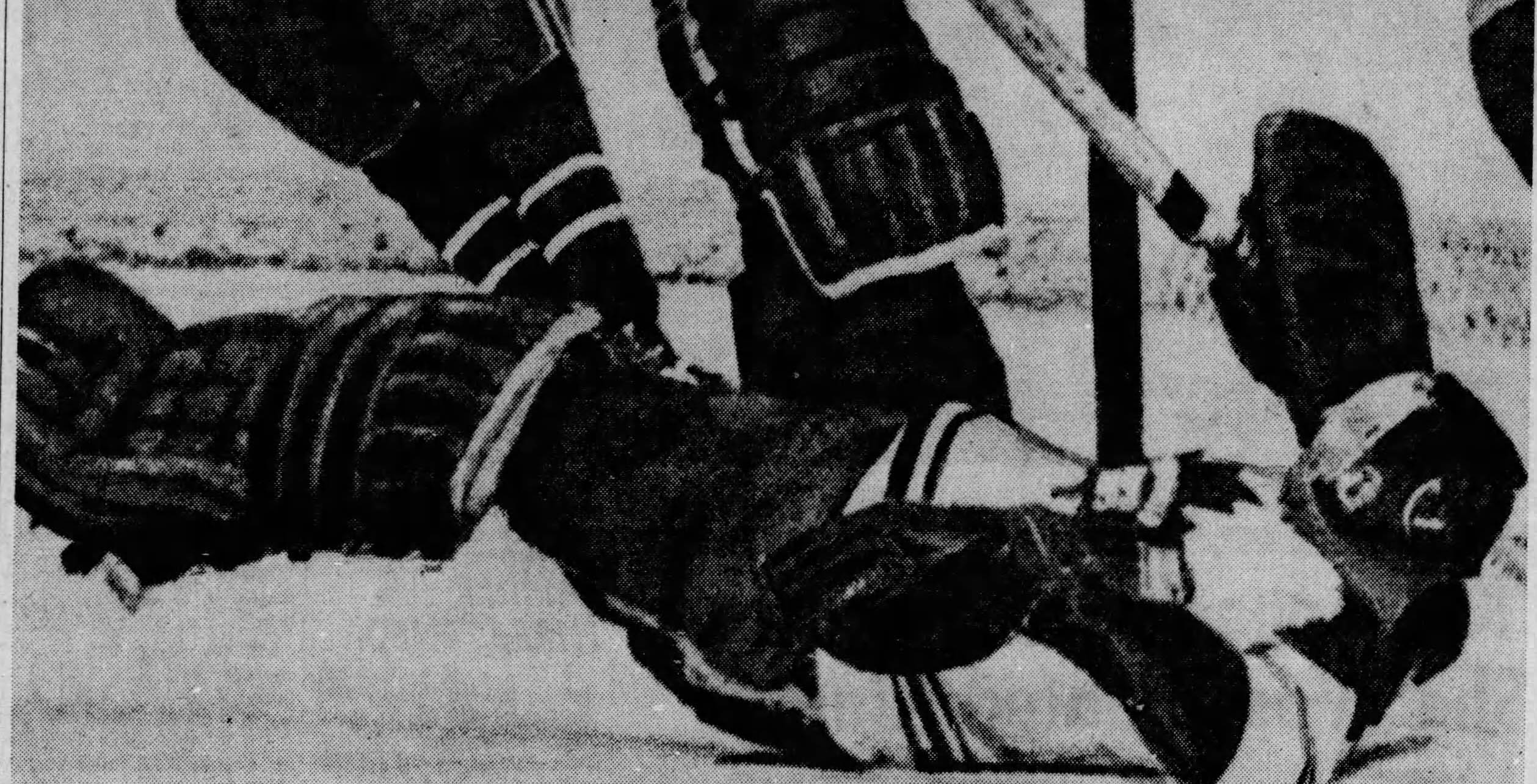
(Photo: The Vancouver Sun, as found on Newspapers.com)
The night of December 10 was not a good one for two goalies playing in away games. In 1969, Johnny Bower of the Toronto Maple Leafs played his season opener and final NHL game in a 6-3 loss against the Montreal Canadiens. Exactly one year later, Joe Daley of the Buffalo Sabres made 72 saves only to lose 8-2 against the Boston Bruins. Though they played for different teams, they had the same coach, Punch Imlach, who coached the Leafs until 1969 and then began coaching the Sabres in 1970.
Although Bower, who had begun his NHL career in 1958, had planned to retire, the Toronto Maples Leafs convinced him to stay one last season to help groom the younger goalies. He was allegedly 45 when he manned the net for the only time during the 1969-70 season. The new coach, John McLellan, said he chose to put Bower in net “because there’s one thing about the old guy, he’ll give everything he’s got.” On December 10, 1969, according to Pat Curran of the Montreal Gazette, “Bower making his first start of the season, deserved a better fate on the strength of some fine saves in the first two periods and a total of 33 stops. However, he was the victim of a weak defence and a late drive by the Canadiens intent on snapping their short slump of two losses last weekend.” Bower held them off until nearly the third period, when the Leafs proceeded to lose their 3-1 lead. The Canadiens scored four goals in the third period, including their final one on an empty net when Bower was pulled with one minute remaining. Still, Bower’s save percentage of .868 was not much worse than his opponent, Rogatien Vachon’s (.880).
Bower retired with a record of 250-195-80, a .922 save percentage, and a goals against average of 2.51. He had earned four Stanley Cups (with the Leafs) and two Vezina Trophies.
At the opposite end of his career, Joe Daley had just broken into the NHL (as the first player chosen by the Pittsburgh Penguins) during the 1967 Expansion Draft and had just been selected (as their first player) by the new Buffalo Sabres in the 1970 Intra-League Draft. On December 10, 1970, his primary opponent was Johnny Bucyk, who was given a $1,000 bill to celebrate his 1,000th game with the Bruins. Joe Ahern, writing for the Boston Globe, summarized, “The old Chief, the Bruins senior citizen both in age (35) and years of service (14), had the greatest game of his long career” so his teammates ribbed him “about his improvement with age and he liked it.”
The Bruins proved that persistence pays off, and Daley seemed to be the only defense the Sabres put up. As Boston Globe writer Tom Fitzgerald noted, Daley “practically stood on his head in blocking off Boston shots, and for the first two periods kept out 40 of them.” The teams were tied at 2-2 going into the third period, but outshooting the Sabres 30-10, “the Bruins finally got to Joe in the last period for six goals.” Bucyk led the scoring, earning six points – a career high. He had already assisted in each of the goals scored in the first and second periods, and in the third, he scored two goals of his own and assisted on two others. His teammate Fred Stanfield wasn’t far behind with his two goals and three assists. The battered Daley had faced 72 shots on goal and came out with a save percentage of .889. Eddie Johnston, the Bruins’ goalie, had a .929 save percentage on just 28 shots. He said of Daley, “The guy was fantastic. I know how he felt. I had some nights a lot like that for six years here.” The 72 shots were the “third-highest single-game total in modern-day NHL history.” Bruins general manager Milt Schmidt had been a player back in 1941, when the Bruins won 3-2 despite Chicago Blackhawks goalie Sam LoPresti making 82 saves. Schmidt commented, “I don’t know that I’ve seen that many shots since.”
After the 1970-71 season with the Sabres, Daley played with the Detroit Red Wings for a season until he was drafted by the WHA’s Winnipeg Jets in 1972. He retired in 1979 before the Jets moved into the NHL. With the NHL, he had a record of 34-44-19, a save percentage of .899, and a goals against average of 3.36. With the WHA, he had a goals against average of 3.37. He won three championships with the Jets.
Additional Sources:
Pat Curran, “Canadiens’ rally beats Toronto 6-3,” Montreal Gazette, 11 Dec. 1969, p. 11.
Wayne Overland, “John Bower outlasts a durable team-mate,” Edmonton Journal, 11 Dec. 1969, p. 54.
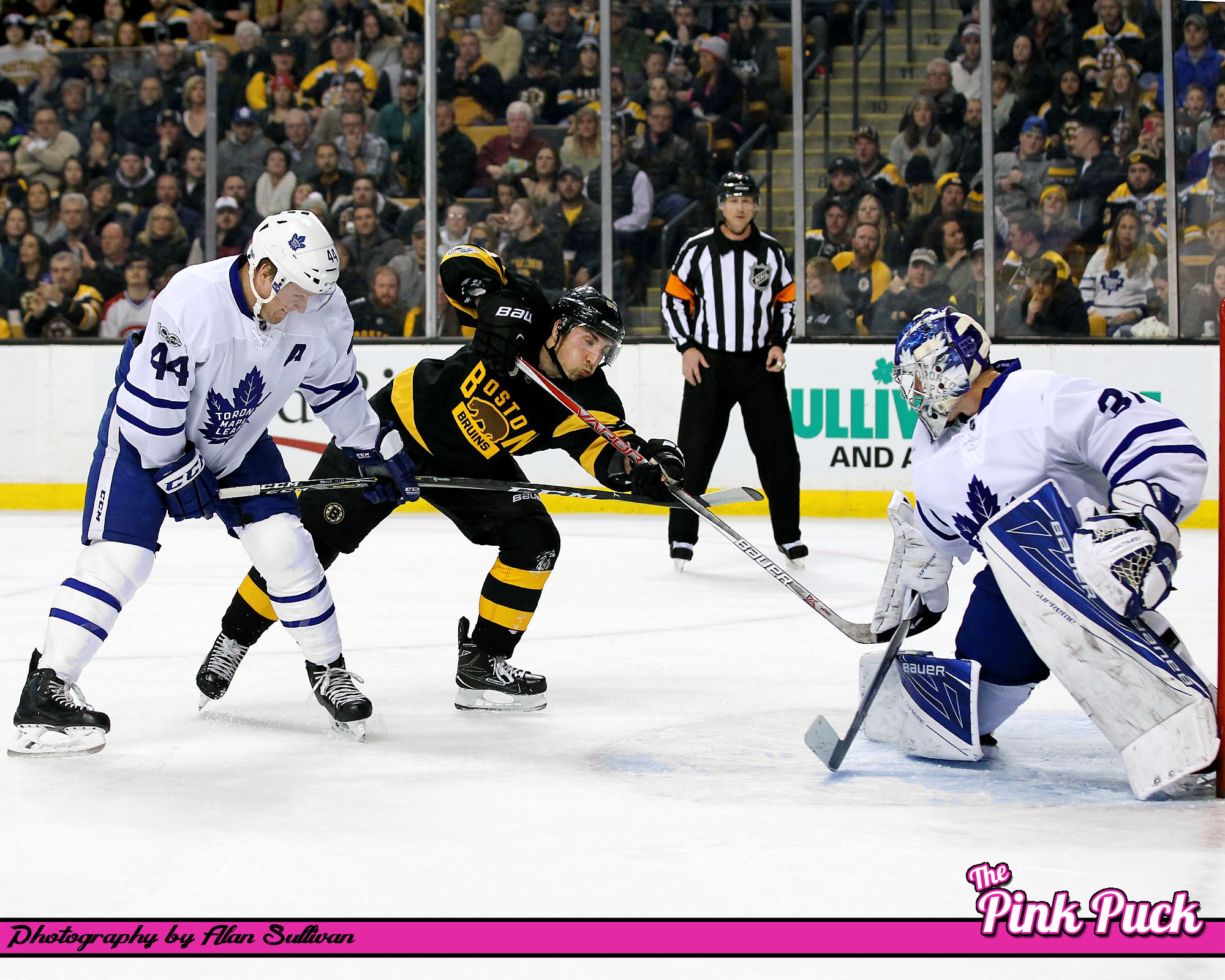
The Boston Bruins came into Saturday night’s game against the Toronto Maple Leafs on a three-game losing streak—the longest so far this season despite their ongoing injury issues of key players. The Bruins are a physical team and when they play to that edge, they often control the game and limit the other team in chances.
The chippiness started almost immediately with some pushing and shoving after the first whistle. And it also resulted in Charlie McAvoy going to the box for a cross check just thirteen seconds into the game, as he hit Mitch Marner. While the Bruins would make the kill, this incident would undoubtedly be the impetus for a late hit on McAvoy much later in the game when the Bruins were up 6-1 and McAvoy had passed the puck and perhaps should have been keeping his head on a swivel.
In such a fast-paced game, it is hard for referees and sometimes players to think in terms of tenths of seconds, but the NHL says that 0.6 seconds is all a player gets in time to hit the opponent who has passed the puck. Zach Hyman’s hit on McAvoy was late, and many suspect it was a result of McAvoy’s earlier penalty. For the Bruins, who had just got McAvoy back—he was playing in only his second game after being out with a concussion—it was not a hit they felt was appropriate.
“Obviously, we took exception to it. I find that we’re at a state of kind of flux with no instigator, the tough guys kind of being out of the game. I think there [was] typically a tough guy on each team that kind of policed their own team even more than other teams because if shenanigans go down now he’s got to face…or the tough guy goes after the offender,” David Backes shared after the game. “You know, Griz [Matt Grzelcyk] stands up for our teammate and rightfully so and does a heck of a job. Tip your cap to him. But, you know, hopefully Charlie is okay. And exceptions like that, in a game that’s solely in hand, you need to stick up for your guys and I think we made a little bit of a statement after that. But, the old days, it made you yearn for it a bit, at least from my perspective on the bench.”
Grzelcyk, who played with McAvoy at Boston University, happened to be the closest to Hyman after the hit, and he was willing to take Hyman to task. That was actually the second fight of the game, the first taking place between Nazem Kadri and Brandon Carlo earlier in the second. Kadri felt he had taken enough cheap hits and wanted to make his statement. He was also hoping it would ignite the Maple Leafs, who at that point were down 2-0 on the score board. Instead, as the horn sounded the end of the second period, the Bruins would head off with a 3-0 lead.
The third period picked up where the previous one left off, with physical play and goals being scored. Ryan Donato’s goal at 6:13 was the sixth of the game for Boston and the third of the period. Toronto replaced Frederick Andersen with Garret Sparks, and about three and a half minutes later Hyman’s hit on McAvoy would put the match to a powder keg that had been close to igniting a few times. This was just twenty seconds after the Maple Leafs had scored their first goal of the game, Auston Matthews making it a 6-1 game. Many felt that given the score that Hyman should have considered easing up on his hit.
The Bruins would not get a power play from Hyman’s hit. With 10:07 remaining in the final frame, Hyman was assessed a five-minute major for interference, five minutes for fighting and a ten-minute game misconduct. Grzelcyk got a five-minute major for cross checking, five minutes for fighting and two ten-minute game misconducts, one likely a result of his fight strap coming loose while he and Hyman were tussling. They would both head to the showers early.
Roughly a minute later, as Toronto’s Morgan Reilly was in the neutral zone coming close to the Bruins’ blue line and passing the puck, Chris Wagner came along at quite a speed and hit Reilly, who went down. Like the Bruins before, Toronto’s players took exception to this hit and Ron Hainsey invited Wagner to drop the gloves. It wasn’t much of a fight, though for the third home game in a row, Wagner’s nose would get the brunt of things, but both players were sent off for fighting, while Wagner accrued an additional two minutes for charging and a ten-minute misconduct. It was during this power play that Andreas Johnsson notched his seventh of the season for Toronto and gave his team a second goal, and the last goal scored of a 6-2 game.
#NHLbruins coach Bruce Cassidy on his team's response to Hyman late hit on McAvoy: "I thought Wagner delivered a good check to Rielly, open ice. He was clean with his shoulder. They want to play hard to the final whistle then we’ll certainly go right along with them."
There certainly is no love lost between these two teams, especially since the 2013 playoffs when the Bruins were losing 4-1 in Game 7 of Round One and managed to come back to win it in overtime. Bitterness like that doesn’t go away easily. However, the Bruins, when playing true to their identity, use their hits and physicality to take the time and space away from skill players. And given that the Leafs iced the likes of John Tavares, Matthews, and the recently re-signed William Nylander, among a host of skilled players, it was perhaps not surprising that Boston pulled out all the stops while on home ice.
What a difference almost a quarter century makes in the NHL. On December 9, 1933, Montreal Canadiens center Howie Morenz only needed 246 goals to tie for all-time lead goal-scorer. Exactly 23 years later, in 1956, Detroit Red Wings Gordie Howe needed 324 to tie for second. Interestingly, despite both player’s achievement, both of their teams lost to the New York Rangers 4-2.
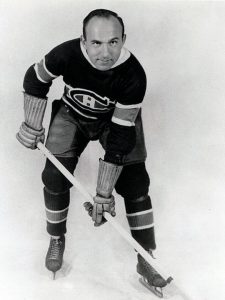
Howie Morenz, star center for the Canadiens since 1923, had a goal for goals. After 11 seasons with the Ottawa Senators and a final season with the Boston Bruins in 1928-29, Cy Denneny retired with 247 goals, the most in the NHL. In actuality, the NHL and other statistical sites cannot seem to agree on how many goals Denneny had and thus when Morenz tied and surpassed him. Morenz scored goals on December 9, 14, and 23 in 1933 that helped him become the top goal-scorer in NHL history to that point. On December 9, Morenz scored at 3:07 in the second period and was followed by a teammate scoring in the third. The Canadiens still lost to the visiting Rangers 4-2. On December 14, Morenz scored the first goal of the game in a 2-0 shutout against the visiting Toronto Maple Leafs. In addition to no goals for the Leafs, no penalties were called. On December 23, Morenz scored the last goal in the final minute of the 3-0 shutout against the visiting Detroit Red Wings. When he died (following an on-ice collision) in 1937, Morenz had a career total of 271 goals.
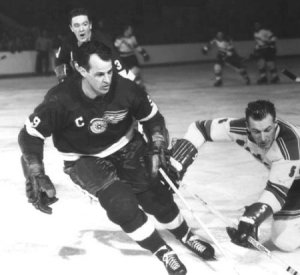
A little over 20 years later, Gordie Howe, the most famous right wing of the Detroit Red Wings, chased the still-active Maurice “Rocket” Richard, the Canadiens’ most-famous right wing. On December 9, 1956, Howe scored “on a 12-foot blast” at 11:31 of the first period, but his team could not catch up to the Rangers. As the article published in the Detroit Free Press bemoaned, “Even a ‘milestone’ goal by Gordie Howe failed to help the Detroiters. Howe scored once, the 324th goal of his 11-year career. That tied him with the retired Nels Stewart as the second highest goal scorer in NHL history. The leader is Rocket Richard, still 143 ahead of Howe with his current total of 467.” It was not until November 10, 1963 that Howe finally passed Richard (who had retired in 1960) in goals scored. Howe scored his 545th goal on a penalty kill against the visiting Canadiens, of all teams. “Mr. Hockey” finished his NHL career with 801 goals, which did not even count all the goals he scored playing for the WHA.
Additional Sources:
“Rangers Defeat Canadiens, 4-2, on Montreal Ice,” New York Daily News, 10 Dec. 1933, p. 101.
“Red Wings Drop Second Straight Road Game, 4-2,” Detroit Free Press, 10 Dec. 1956, p. 41-42.
A goalie’s job is to stop pucks, not shoot them. Yet, on December 8, 1987, Philadelphia Flyers goaltender Ron Hextall became the first to purposefully shoot and score a goal. He had already tried a shot during a game the previous season (against the Washington Capitals), but “Scott Stevens knocked the puck down with his glove before it had gone 60 feet.” This time, his shot on the Boston Bruins’ net succeeded. Philadelphia celebrated the feat with multiple-paged spreads (by four different reporters) in the Philadelphia Daily News and the Philadelphia Inquirer.
In the Philadelphia Inquirer, Al Morgan began his article stating, “After one of the most emotionally draining regular-season games ever played in the history of their storied franchise, the Flyers and an exhausted crowd of 17,345 left the Spectrum last night in a frenzy.” Jay Greenberg of the Philadelphia Daily News, pointed out that it was not smart of those guests who left early. “Hextall had been promising for more than a year that he was going to do this very thing. All he needed was a two-goal lead so he could risk the icing, the puck on his forehand and just a little bit of luck.” His fellow reporter, Elmer Smith, pointed out that everyone treated Hextall’s goal as inevitable. “Hextall is the only NHL goalie to fire a successful shot at the other goal with the intention of scoring. Yet, in the aftermath of Hextall’s feat, you couldn’t find anybody in either locker room who had not known he was going to do it. They didn’t know it would be last night or that it would against the Boston Bruins at the Spectrum. But they knew it would be soon.” True enough, Flyers coach Mike Keenan said, “I thought it was inevitable. He shoots as well as anyone in the league, if not better. It was just a matter of time.”
For the shot itself, it came with 1:12 left in the game. With 1:19 remaining, the Boston Bruins, who trailed 4-2, pulled their goalie, Rejean Lemelin. Hextall thought about making the shot after Ray Bourque’s shot on net, but, as he said, “They were too close. I didn’t have time. I just had to get it out of our zone.” So, as Greenberg reported, “Hextall banked the puck off the glass back out to center, where Bourque retrieved and fed cross ice to Kluzak, who was on the red line when he flipped it in. Hextall jumped out of the crease to the bottom rim of the circle and laid the shaft of his stick flush against the ice to block the puck. The closest Bruin, Lyndon Byers, was still 15 feet away. The crowd was already realizing what Hextall was going to try to do, when he climbed up off his one knee, stood and wristed the puck on its way. It lifted about 20 feet in the air, straight up the middle of the ice, with enough force to send it on a fly to within a foot of the Boston blue line. Bourque, the closest Bruin, was near the boards and had no way to cut it off.” Jere Longman described the shot for the Philadelphia Inquirer, noting that Hextall lifted “the puck 120 feet from the Flyers’ goal to the Bruins’ blue line. From there, the puck trickled 60 feet into Boston’s empty net.” It had drifted so that the puck slid in “just inside the right post.” Greenberg commented that it was worth the delay-of-game penalty for the “shriek that had accompanied it on its path turned into an explosion. Hextall leaped into the air.” According to Longman, “After he scored, Hextall pumped his right arm up and down and was mobbed by his teammates. One of them retrieved the puck for Hextall, and he said it would never be for sale. ‘No price,’ he said. ‘That’s mine.’”
The two newspapers included many locker-room quotes by Hextall, including:
“I don’t mean to sound cocky, but I knew I could do it. It was just a matter of when. I always said I would try it if we had a two-goal lead.”
“When they pulled their goalie, it crossed my mind. I’ve always said that when we were two goals up, I’d go for it. I did. What the heck. I got lucky.”
“The way I shoot it, the spin I put on it, the puck always curls off to the right. This one did, too, quite a bit at the end. It may have even hit the post.”
“Really, I thought it was going to hit the post. It was just inside. I was kind of holding my breath for a minute.” “It was a thrill, one of the things I’ll talk about when I leave hockey. I can’t wait to look at the stats before the next game to see my one goal.”
“It’s hard enough to believe. I mean, I scored a goal. I mean, it just doesn’t happen every day.”
“It’s really surprising, when you think about it, that nobody has ever done it before. It’s not the biggest thrill of my career, but it is pretty great. It’s something I’ll have when I finish hockey. And I may even get a few more.”
Hextall’s goal brought the Flyers up to a 5-2 win over the Bruins. As Morgan noted, “The victory also marked the first time this season that the Flyers had won a game in which they trailed after two periods. They had previously been 0-8-0 in such games.” Meanwhile, Elmer Smith summarized Hexall’s accomplishments, stating, “He got 37 W’s last year, the highest tally ever by a Flyers rookie goaltender and the fourth highest ever for any NHL rookie netminder. He led the NHL in wins, games played, minutes and save percentage (.902). When you win the Bobby Clarke Trophy as the Flyers’ MVP, the Conn Smythe Trophy as the playoff MVP and the Vezina Trophy as the NHL’s top goaltender all in your rookie season, even last night’s brush with history pales by comparison.” In fact, Hextall would go on to score again, on April 11, 1989, as the first goaltender to score in a playoff game.
Additional Sources:
Al Morgan, “Flyers win as Hextall scores goal,” Philadelphia Inquirer, 9 Dec. 1987, p. D-1 and D-3 (49 and 51).
Jere Longman, “A long shot into NHL record books,” Philadelphia Inquirer, 9 Dec. 1987, p. D-1.
Jay Greenberg, “Hextall’s Goal One For Books,” Philadelphia Daily News, 9 Dec. 1987, p. 93-94.
Elmer Smith, “For Hextall, It Was Just a Matter of Time,” Philadelphia Daily News, 9 Dec. 1987, p. 95.
Johnny Bucyk played for the Boston Bruins for 21 seasons (after playing two for the Detroit Red Wings before being traded in return for Terry Sawchuk). He captained the team in 1966-67 and again from 1973-77, after winning the Stanley Cup with them in 1970 and 1972. With all this time playing for the team, it seemed that good things came in threes. Bucyk had three milestone scoring nights on December 7 – in 1967, 1968, and 1975.
In 1967, Bucyk played a major role in the Bruins’ 3-1 victory over the visiting New York Rangers and broke the Bruins’ scoring record. Bucyk told reporters, “I went out there tonight looking for two points. I wanted that record and I didn’t care how I got the points.” For the first point, during the first period, he scored a “sizzling slider that found the far corner” on a power play by tricking goalie Ed Giacomin into looking over at Phil Esposito. For the second point, he scored “a 30-foot skimmer at 16:39 of the third period.” The full house went wild chanting, “Chief, Chief, Chief.” Bucyk said, “It does something to you. Then it hits you they’re cheering for you. It hits hard. But it’s wonderful.” He kept the puck and returned to the bench, where teammates “Sanderson threw his left arm around Bucyk, ruffled his hair” and “Orr put his right arm around him and tapped him affectionately on the ribs.” The two points broke Milt Schmidt’s record of 575 points, so Schmidt, then general manager, said in the locker room, “I hope he brings a million records.” Bucyk had already tied his total number of goals from the previous season and was only five goals away from 250.
Exactly one year later, in 1968, Bucyk scored his 250th goal for Boston. For a Boston Garden audience of 14,653, Bucyk scored a goal and assisted on all three of the other goals in the Bruins’ 4-1 victory over the Detroit Red Wings. During the first period, he assisted on Ted Green’s first goal of the season. Then, at 16:03 in the second, Bucyk took a short pass from Stanfield on the right then “weaved in front and triggered one quickly through Crozier’s feet.” It was his first goal in 13 games. In the third period, Bucyk helped Johnny “Pie” McKenzie score two goals. The first was McKenzie’s 100th. Bucyk picked up “a loose puck deep in the Detroit zone” and “popped a pass across in front of the crease” to McKenzie, who “practically leaped in from the right to left the plug behind Crozier.” The two succeeded again during a power play from a penalty Gordie Howe earned for hooking.
In 1975, the Bruins faced their oldest rival, the Montreal Canadiens, before Boston Garden’s “first capacity figure of 15,003 for this hockey season.” The Bruins drew first blood with Terry O’Reilly’s goal in the first period, but the Canadiens followed with Peter Mahovlich’s in the second. Then, “very early in the third period,” Bucyk’s “backhand flip” put him in a tie with former Canadiens’ Jean Beliveau for “sixth place in the all-time standings.” Bucyk explained, “Dallas (Smith) got a good shot through. The puck was bouncing a little but I got good lumber on it to get the shot up high in the corner.” The tempo of the game “picked up furiously in the third after Bucyk’s goal” until the Canadiens tied the score with Guy Lafleur’s goal with seven minutes remaining. Although they tied, the game increased the Bruins’ unbeaten streak to 14 games (9-0-5).
Bucyk retired in 1978 having played 1,540 games (556G, 813A, 1369P), which put him in the top five for the NHL. Of those, he played 1,436 with Boston (545G, 794A, 1339P), which at the time, made him the Bruins’ all-time leader in every category. The Bruins retired his No. 9 in 1980, and he was inducted into the Hockey Hall of Fame in 1981.
Additional Sources:
John Ahern, “Defense Corps Sparking B’s Success,” and “Campbell Action Pays Off; B’s, Rangers Stick to Hockey,” Boston Globe, 8 Dec. 1967, p. 51-52.
Francis Rosa, “Bucyk ‘Corners’ Giacomin,” Boston Globe, 8 Dec. 1967, p. 59-60.
Tom Fitzgerald, “Bruins Win, 3-1; Bucyk Sets Mark,” Boston Globe, 8 Dec. 1967, p. 59-60.
Tom Fitzgerald, “Bruins Stop Red Wings, 4-1,” Boston Globe, 8 Dec. 1968, p. 97-98.
Tom Fitzgerald, “Bruins, Montreal tie one on, 2-2,” Boston Globe, 8 Dec. 1968, p. 25 and 30.



 A little over 20 years later,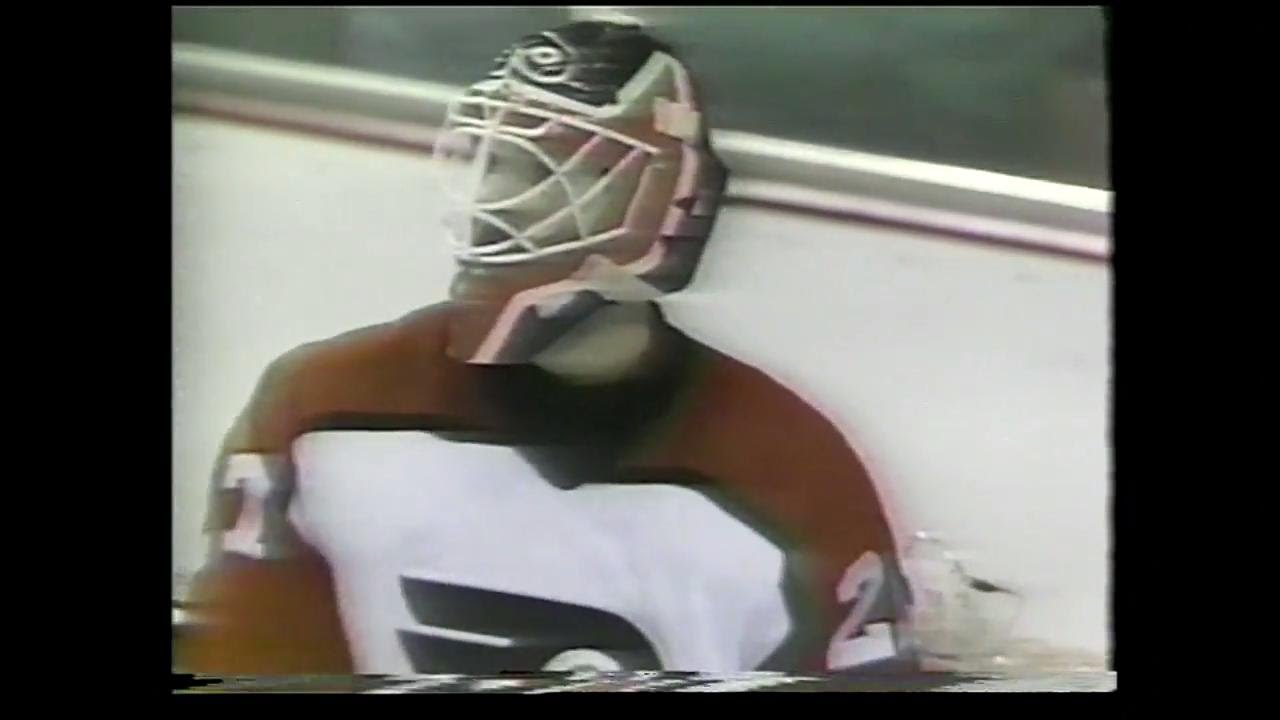

 Prev
Prev