Patrice Bergeron missed 16 games with a shoulder injury after taking a funny hit while the Bruins were on the road in Dallas on November 16th. He was a game time decision as the Boston played their last home game before the holiday break against the Nashville Predators on Saturday, December 22, 2018.
Everyone on the team knows what an important piece he is to the team and to their overall chemistry. To paraphrase a line from Disney’s Return of the Titans, “You cannot replace a Patrice Bergeron.” Though, the Bruins did a great job of picking up and carrying on—showing the character of that room—there was a missing piece.
However, to a man, it was obvious that they were all pleased to see him back on the bench and more importantly on the ice. Watching him play during Saturday’s matinee, it was truly impossible to say he showed any rust.
“Yeah, he was obviously good… Real good composure on the last power play goal to sort of give us a little breathing room, thought it was a real nice play by him,” Boston Bruins head coach Bruce Cassidy shared. “That’s where you worry a little bit with the – when you’ve missed some time is the rust and the speed of the game, are you going to rush plays? But, no he didn’t look like he didn’t miss a beat.”
Bergeron was also happy to be back out on the ice, after having to watch the last 16 games. His passion for the game is unmistakable.
“I was very excited before the game. It’s one of those things where you get that adrenaline and nervousness right before and it’s actually a good thing, you know, I was looking forward to that for a while. So, you know, I was very happy this morning that I was back at it,” he said. “Sometimes when you’re in it, you play for a while – it’s game whatever, 35 of the season – you don’t appreciate it as much. I told [the team] to be thankful because I’ve been missing it for so long. So, it’s one of those things that I was just trying to talk to the guys and be vocal that we’ve got to enjoy it and just go out there and have fun.”
As had been mentioned before Bergeron’s return, Cassidy did break up the Marchand-Bergeron-Pastrnak line that had been scoring before Bergeron’s injury. David Pastrnak went to the second line with David Krejci, who had been playing center most recently with Pastrnak and Brad Marchand. Danton Heinen moved up to play the right wing with Marchand and Bergeron.
It took a bit of time, but perhaps no one was surprised when Bergeron not only got the first goal for the Boston Bruins, but he got the first goal of the game at 15:10 of the first period. With that the Bruins went into the locker room during the first intermission with the lead.
The second period saw Nashville’s Ryan Johansen tie things up at 13:01. And while the first period had no penalties, the middle frame had three: Matt Grzelcyk (Bruins-hooking, 17:55); Johansen (Predators-interference, 19:04); and Mattias Ekholm (Predators-roughing, 20:00).
Ekholm’s ill-timed roughing on Pastrnak at the end of the second period allowed the Bruins 1:05 of 5-on-3 time to start the third period and then 55 seconds of 5-on-4. While Boston couldn’t capitalize during the 5-on-3, it only took them 39 seconds of the remainder of Ekholm’s time in the box before Bergeron had the Bruins leading once again, and became only the sixth player in Bruins’ history to get 300 goals.
Though Nashville’s Kyle Turris would again knot things up at 9:17 of the third, a tripping penalty called on his teammate Ryan Hartman two minutes later would allow the Bruins back to the man advantage, and they would again capitalize. This time Marchand got the goal, with assists from Pastrnak and Bergeron. Less than three minutes later a reunited Marchand-Bergeron-Pastrnak top line would give Boston a little breathing room, when Pastrnak put the puck home. The assists were, of course, Marchand and Bergeron. An empty netter by Sean Kuraly, assisted by Charlie McAvoy and Jaroslav Halak (his second assist this season), gave the Bruins the 5-2 win.
Perhaps Marchand said it best about Bergeron’s return.
“It’s a lot of fun. He is an incredible player. He makes so many great plays. He is so easy to read off of so it’s a lot of fun having him back,” he grinned.
In the end Bergeron had two goals, reached a milestone of 300 NHL goals, and got two assists. Four points in his first game back. He was also 52% on the faceoff. No rust on him.
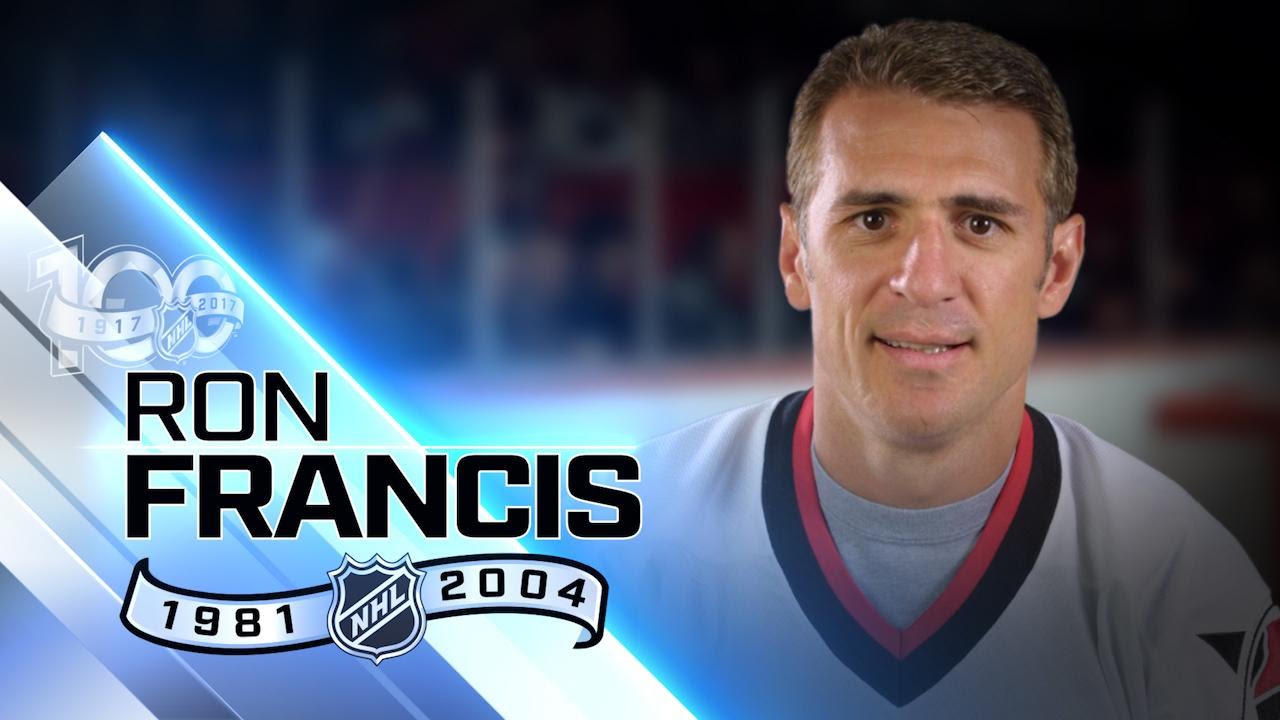
Over twenty years into his NHL career, on December 22, 2002, Ron Francis became only the second player to have 1,200 assists. He still has the second-highest total regular-season assists at 1,249 (behind Wayne Gretzky with 1,963).
Ron Francis began his career with the Hartford Whalers in 1981 (when he was drafted fourth pick overall). During his tenth season, the Pittsburgh Penguins snapped him up before the trade deadline. In his first two seasons with the Penguins, they won the Stanley Cup championships in 1991 and 1992. Then in 1998, two years after the Whalers relocated to become the North Carolina Hurricanes, Francis signed with them.
The Hurricanes hosted the Dallas Stars on December 22, 2002. Neither team scored in the first or second periods. The Stars had 28 shots on goal, but Kevin Weekes blocked them all. This was his second shutout of the season and tenth overall – just two games back from concussion recovery. Head Coach Paul Maurice made note of Weekes’s solid play. “He was just so solid in that net. It looks like he never missed a beat.” Finally, at 11:28 of the third period, Francis (and Sami Kapanen) set up Jeff O’Neill to score the only goal of the game. Francis’s old teammate from Hartford, Dave Tippett, then coached for Dallas. He commented after the game, “It’s hard to find words to express what this guy is to the history of the game. He’s right there with the elite of the elite.”
Over his career, “Captain Class” received the Lady Byng Memorial Trophy three times, the Frank J. Selke Trophy, and the King Clancy Memorial Trophy. Unsurprisingly, he spent twelve seasons in the top 10 for assists. In addition to holding second place in assists, Francis ranks fifth in points (1,798) and fourth in number of games played (1,731). He officially retired in 2005 and was inducted into the Hockey Hall of Fame in 2007.
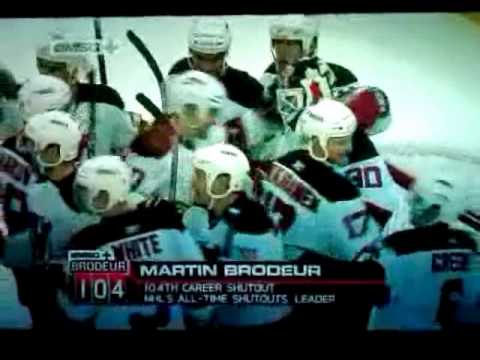
Mere days after Martin Brodeur, already the winningest NHL goalie, broke the NHL goaltender record for career appearances, he set a new NHL shutout record. The year 2009 produced quite the timeline of records (previously held by Patrick Roy) broken by Brodeur – on March 17, Brodeur became the regular-season victories leader (with 552 wins); on November 27, he played the most career minutes (60,235); and on December 18, he had appeared in the most games (1,030). To top off all that, on December 21, 2009, Brodeur broke a 39-year record by earning his 104th shutout.
The shutout record was set at 103 shutouts on February 1, 1970, when Terry Sawchuk of the New York Rangers had his final shutout against the Pittsburgh Penguins. Sawchuk had held the record of most shutouts since his 95th shutout on January 18, 1964. Then playing for the Detroit Red Wings, he surpassed George Hainsworth’s record in a 2-0 victory against the Montreal Canadiens. It took 45 years for another goalie to take Sawchuk’s place.
Marty Brodeur began his journey with his first NHL shutout on October 20, 1993, during his stellar rookie season that earned him the Calder Memorial Trophy. It took him 16 years, 2 months, and 1 day to amass 104 shutouts. His first shutout only needed 17 saves, but his record-breaking game required 35 – including a fantastic glove save with 42 seconds remaining. Like for Sawchuk’s final shutout, Brodeur blanked the Pittsburgh Penguins (4-0). During the final minute of play, it seemed that the crowd (of 17,132) was holding its breath, even though Brodeur played for the visiting team. Brodeur later commented, “It was almost like winning a playoff game. The guys kept chipping the puck out and everybody was blocking shots everywhere. It was a great effort from my teammates.” Finally the clock ran out. “The horn signals a new record!” exclaimed the TV commentator. “He celebrates shutout number 104 with the same team that he got number one with, the New Jersey Devils!” The 104th shutout was Brodeur’s 580th win in his 1,032nd game. NHL Commissioner Gary Bettman released the following statement:
“Terry Sawchuk set a shutout record that stood for more than 45 years and withstood the challenge of more than 500 goaltenders who have played in the National Hockey League since then. By surpassing that record tonight, Martin Brodeur reached yet another level of goaltending supremacy. The entire NHL family congratulates him, the Devils and every member of the organization who contributed to this marvelous accomplishment.”
Brodeur enjoyed the pressure of playing all 60 minutes and, as he said, “the way you play will decide the outcome of the game.” He explained, in his autobiography, Brodeur: Beyond the Crease, how, as “the most creative player on the ice,” he developed his own unpredictable goaltending style. “I needed to be able to poke-check, to stack the pads and be able to play the puck behind the net.” He also “didn’t mind making the first move if I could dictate the moment.” Goaltending, he wrote, “demands innovation and imagination, an ability to adapt and consider alternatives in a split second, the capacity to generate multiple answers to the same, or similar questions.” That was in addition to how, as Lou Lamoriello (then Devils general manager) stated, “Marty’s mental toughness, his ability to overcome a bad game, is just phenomenal.”
It will be some time before the shutout record can be broken. Jacques Lemaire, then the Devils’ coach, commented, “I think it will never be broken. It’s hard for a goaltender. They do have a lot of pressure…you get into the playoffs and the run is tough for a goaltender, especially Marty. The thing is, he’s in the net for 60 of the (82) games. It demands a lot.” At the time, the active goalie second to Brodeur only had 50 shutouts. Currently, the closest active goalies are Robert Luongo with 77 and Henrik Lundqvist with 63. However, by the time Brodeur retired, he had set the bar even higher – ending his career with 125 regular-season shutouts. In addition, Brodeur holds the record for playoff shutouts at 24. Of those still active, Marc-Andre Fleury, at 14, would need ten more to match.
As is only fitting, Brodeur’s final win was a 3-0 shutout (on December 29, 2014). He finished his stunning career first in wins (691), saves (28,928), games played (1,266), and minutes played (74,438). His 2.24 goals against average is currently ninth overall. In the postseason, Brodeur ranks second only to Roy in wins (113), saves (4,830), games played (205), and minutes played (12,717).
In hardware, Brodeur earned the Vezina Trophy four times and the William M. Jennings Trophy five times. With the Devils, he won three Stanley Cup championships. With team Canada, he won two Olympic gold medals. In early 2016, a year after he retired, the Devils retired his No. 30, and earlier this year, Brodeur was inducted into the Hockey Hall of Fame.
When Don Sweeney, General Manager of the Boston Bruins, announced the signing of Jaroslav Halak during the offseason, there were a few who questioned the move. Some felt that the 33-year-old netminder may have been past his prime, and certainly there were those who brought up the fact that he was on his fifth NHL team by signing with the Bruins organization.
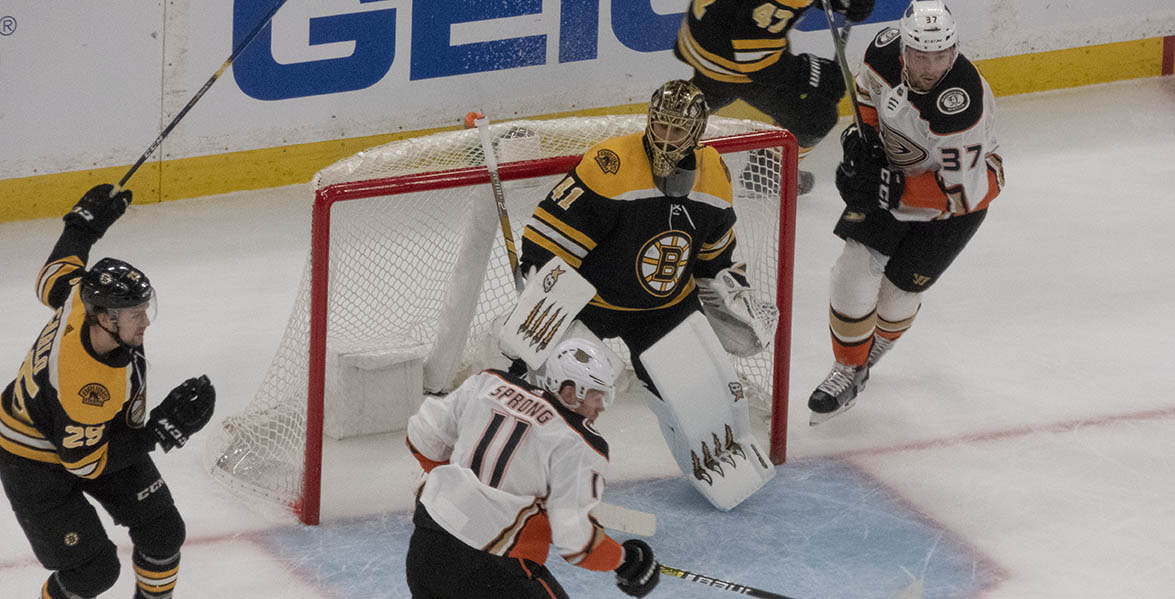
The back-up goaltender for the Bruins, he has been proving himself a worthy adversary. With his win on Thursday night, December 20, 2018, against the Anaheim Ducks, he holds an 11-5-2 record while wearing the Spoked-B, and his current goals against average is 2.20 with a save percentage of .930.
The soft-spoken tender talked consistency in his preparation to help him be ready for a game.
“No, I just, you know, take it shot by shot. You know, I try and always warmup the same way or whatever. At the start of the game you just want to feel the puck, have a few shots against,” Halak said.
Coming off his third shutout victory as a Bruin (and his 45th career shutout) from Monday night’s road game in Montreal against the Canadiens, it perhaps should not have been a surprise to see Bruins Head Coach Bruce Cassidy start him again during their home game against the Ducks. His first two shutouts with the Bruins came in his first start back on October 4, while the team was in Buffalo, against the Sabres and then on October 25, back in Boston against the Philadelphia Flyers. He was the first Bruins goaltender to get a shutout in his first start since Jeff Hackett did it back in the 2002-03 season. And he is only the third netminder in team history to notch two shutouts within his first five starts as a Bruin.
The native of Bratislava, Slovakia has also found himself busy in the crease from time to time. In his 11 games, he has already faced 40 or more shots four times, going 2-2-0 in those games. While he didn’t see that many shots from Anaheim—they got 25 shots on net—some of his saves were definitely game changers. Had the Ducks scored, it could have resulted in an immediate momentum shift in favor of the Ducks. Twice during the game, he robbed Anaheim.
“Obviously in the first period they didn’t have much and in the second, you know, they had some chances on the [man advantage]. But I think for the most part we didn’t give them anything on the PK. Our PK was great in the first and in the third and in the second they only had a few chances, so I think our PKers did an outstanding job tonight. And our power play as well – scoring two goals for us,” Halak said.
Jaroslav Halak
And while it was true that the entire team had stepped up during both the games against the Canadiens and the Ducks, there were still some big stops that Halak had to make.
As the clock ticked under the five-minute mark during the third period Thursday, it was beginning to look like Halak might get back-to-back shutouts. However, rookie Josh Mahura for the Ducks, would put an end to that when he notched his first career NHL goal at 15:44 of the third.
“Yeah I really wanted him to get another shutout, just kind of a tough break. I won the face-off, hit my shin and bounced back the other way, it happens sometimes,” David Krejci said. “He still should be happy with these last couple games, he played really well.”
As for Halak, he commended his teammates for their strong play in front of him.
“I think it was more of a team effort than anything because I think for one thing we played really well defensively, offensively, and we skated well. We were good on the forecheck and I think tonight we did the same thing. You know, we stayed aggressive at the times that we needed to and everybody was on the same page throughout the 60 minutes,” he said.
Signed through the 2019-20 season at the bargain price of $2.75 million a year, he has shown that he is worth every penny of that contract. And if he continues to play at such an elite level, he could make things hard for Cassidy when it comes to picking a starting goaltender in upcoming games.
The anthem has been sung, the game has started, and before anyone can even take a sip of their beverage of choice, the first goal has been scored. On December 20, 1981, a new record was set when the Winnipeg Jets only took five seconds to score on the St. Louis Blues. Exactly ten years and one day later, on December 21, 1991, the Buffalo Sabres matched the feat with their initial score against the Toronto Maple Leafs. The previous record, of six whole seconds, was set in 1973. Five seconds – neither goalie had a chance to even blink.
In 1981, at Winnipeg Arena, the quick shooter was left winger Doug Smail. He began skating with the Jets in 1980, so this was only his second professional season. His opponent, Paul Skidmore, was making his debut as the Blues’ backup goalie after having an “impressive 14-3-0 record and a 3.05 goals-against average for Salt Lake City of the Central Hockey League.” Unfortunately for Skidmore, Smail was in the right place at the right time. As Smail described his 15-foot wrist shot five seconds into the game, “I was held up a little bit on the play, but I think that was fortunate. When they threw the puck over after the faceoff, their defense mishandled it, and I just walked in at the right time. It was a lucky goal.” His luck apparently held as Smail scored another goal in the third period. Meanwhile, the Blues had trouble getting their shots passed goalie Ed Staniowski, who had been the Blues’ former backup goalie. Smail said, “The Blues outplayed us all over the ice. Our goaltender kept us in the first period, but in my mind they could have had the win.” Thanks to Smail, the Jets won 5-4, causing the two teams to switch places in the Norris Division standings.
In 1991, at Maple Leaf Gardens, Sabres right winger Alexander Mogilny tied Smail’s record. According to a news report sent out from Toronto, “It was the fastest goal from the start of a game ever scored against the Maple Leafs. The previous fastest was nine seconds by Kenny Wharram on April 13, 1967, for the Chicago Blackhawks.” That recap described the event, “Mogilny intercepted a Michel Petit pass, broke in alone on goalie Jeff Reese and whipped in a low shot.” As the game neared the end, Mogilny had a breakaway that resulted in the final goal, so he scored two of the Sabres’ four goals. The Maple Leafs only managed one goal on Clint Malarchuk, who had 41 saves. However, that one goal happened to be Mike Foligno’s 700th career point. The win finally put a halt to the Sabres’ 12-game winless streak (0-8-4). They had not gone that many games without a win since the 10-game streak in 1971.
Between the two, on March 22, 1984, New York Islanders Bryan Trottier had also scored within the first five seconds of the game.
Additional Sources:
“Winnipeg Gives Blues Rookie Rude NHL Welcome,” St. Louis Post-Dispatch, 21 Dec. 1981, p. 1C and 4C.
“Sabres 4, Maple Leafs 1,” St. Louis Post-Dispatch, 22 Dec. 1991, p. 6F.
Once the NHL formed in late November 1917, it took almost another month before the first two games were scheduled. On opening night, December 19, 1917, both Montreal teams won – one hosting Toronto and the other visiting Ottawa. According to the Ottawa Citizen, this was “a night of surprises in the National Hockey League as the supposedly dilapidated Wanderers came through with a win over the Torontos, giving both Montreal clubs splendid starts.”
In Montreal, the Wanderers defeated the Toronto Arenas 10-9. Only about 700 spectators, “one of the smallest crowds that has ever attended at an opening fixture,” witnessed Wanderers defenseman Dave Ritchie score the first NHL goal, 1:00 into the game. The Wanderers proceeded to score five goals in the first period, four in the second, and one in the third, while the Arenas scored three in each. The Montreal Gazette commented that the high scores showed “that the play was ragged and dragged tediously at times” and demonstrated the “scarcity of players.” The Arenas received twice as many penalty minutes as the Wanderers, but “the game could not be called rough, the penalties, with two exceptions, were for minor offences.”
About 200 kilometers west, the Ottawa Senators hosted the Montreal Canadiens in a 7-4 defeat. Their audience was a more respectable crowd of nearly 6,000. The Senators had struggled to get their team ready due to a misunderstanding in the players’ contract (concerning the newly scheduled 24 games instead of the 20 planned with the National Hockey Association). Then, their rink’s “ice was sticky, preventing the Ottawas from showing their usual speed and helping the heavier Canadiens, the hockey dished up was, under the circumstances, surprisingly good,” explained the Ottawa Citizen. “In the early stages, it looked as though the Canadiens would make a runaway of it, but Ottawa rallied and displayed some brilliant flashed of aggressiveness in the second and third periods.” Then the play slowed considerably “with the ice growing heavier and heavier and the players tiring rapidly.” According to the Montreal Gazette, “Canadiens were in great fettle, and they appeared to have it over the Ottawa team in every department.” Interestingly, the Ottawa Citizen agreed, stating that the Canadiens “skated out with one of the finest all round hockey machines they have ever had.” Furthermore, “They stuck to their positions more consistently, checked back faster and made nearly all their opportunities count.”
The NHL has changed greatly since these four original teams played. Currently, the NHL has 31 teams with at least one more on the horizon.
Additional Sources:
“Wanderers Won From Toronto: Canadiens Beat Ottawa,” Montreal Gazette, 20 Dec. 1917, p. 18.
“Champion Canadiens Won Opening Game From Ottawa in National Hockey League,” Ottawa Citizen, 20 Dec. 1917, p. 8.
The New York Rangers seem to have been in the giving mood on December 18 in 1952 and 1965 as they just kept letting in their opponents’ goals. In both games, they tied up in the first two periods but then let their opponents go on scoring sprees in the third. In 1952, the Montreal Canadiens defeated the Rangers 6-2, and in 1965, the Toronto Maple Leafs beat them 8-4. Both winning teams had two players score hat tricks, while one of the Rangers managed their own in 1965. That means that there were five hat tricks between the two games.
On December 18, 1952, the Rangers faced a tough time in Montreal thanks to the debut of a new Canadiens player, Jean “Gros Bill” Beliveau, and their previous rookie-of-the-year, Bernie “Boom Boom” Geoffrion. The former scored his first NHL hat trick while the latter scored his second, and the two were the first two of the season for Montreal. According to the New York Daily News, “[The] unusual double feat [occurred] in a bristling, scrappy game in which two Montreal goals were disallowed [early in second period] and two major penalties were handed out, culminating a rousing fight.”
Beliveau had not even signed with the Canadiens yet. He played on a three-game lend-lease basis from the Quebec Aces. Playing on the Punch Line, Maurice “The Rocket” Richard earned assists on all three of Beliveau’s goals. The Montreal Gazette crowed, “Beliveau was really flying last night at the Forum, much to the chagrin of New York Goaler Chuck Rayner and his defensive crew. They could do little to stop the broad-shouldered centre player.” Beliveau scored the first goal of the game off Richard’s rebound. “He pulled the puck instead of slapping at it and lifted it over the prostrate Rayner.” Geoffrion followed with his first goal of the night.
During the second period, as the Daily News summarized, “The Rangers, who battled the Canadiens all the way, then struck for their two goals. Mickoski’s long angle shot, whipped into the net off goalie Gerry McNeil’s glove and Ronty scored on Neil Strain’s passout.” Unfortunately for the Rangers, Beliveau then swooped in with his tie-breaking back-to-back goals. After a major fight, the Canadiens were on a power-play when Beliveau sent “a whistling slapshot that was past Charlie Rayner before he could move. One minute and 50 seconds later, just after MacIntosh had returned and the sides were even, Beliveau took a pass from Maurice Richard and scored on a shot that caromed in off Rayner’s pads to make it 4-2 for the Habitants.”
The third period was all about Geoffrion. As Dink Carroll wrote for the Gazette, “The first of Geoffrion’s two markers in the final period was a beauty. He took a pass in the corner, stickhandled out in front and beat Rayner clearly.” Finally, “His closing goal came as a result of a passing play with Billy Reay.” All in all, he summarized, “Canadiens outshot the Rangers, 32 to 22, and had much the better of the territorial play.” The 6-2 win continued the Canadiens’ undefeated streak of five games.
On December 18, 1965, the Rangers played at Maple Leaf Gardens. Between theirs and two from the Maple Leafs, the game featured a hat trick of hat tricks. Toronto started strong with the first goals by Dave Keon and Bob Pulford. New York’s Earl Ingarfield responded with two goals in just over four minutes to tie the game. The first period ended with another New York goal, by Bob Nevin. The second period saw the completion of two of the hat tricks. In the first seven minutes, Keon scored two goals to earn his first NHL hat trick. Less than 30 seconds later, Ingarfield tied the game up again by scoring his third goal. Ingarfield was the one to keep the Rangers in the game, but after this, they failed to score again. Within the first three minutes of the third period, Keon “set up Frank Mahovlich for the tally that broke a 4-4 deadlock.” Towards the end of the game, as the Associate Press reported in the New York Daily News, “Pulford, Eddie Shak and Pulford again beat goalie Ed Giacomin within less than four minutes.” This gave Pulford his second NHL hat trick. Despite the score, both teams had 39 shots on goal. However, Toronto came out with their third consecutive win while the Rangers faced their eleventh defeat.
Additional Sources:
“Beliveau Performs ‘Hat Trick’ To Lead Canadiens to 6-2 Win,” Montreal Gazette, 19 Dec. 1952, p. 1.
Dink Carroll, “Beliveau Scores Three as Habs Win,” Montreal Gazette, 19 Dec. 1952, p. 23.
“Rangers Bunnies for 2 Canuck Hat Tricks, 6-2,” New York Daily News, 19 Dec. 1952, p. 76.
“Leaf Hat Tricks Fit Rangers, 8-4,” New York Daily News, 19 Dec. 1965, p. 144.
Minnesota has loved hockey since the late 1800s, so the state felt a sense of loss when their NHL team moved to Dallas in 1993. Only four years later, Minnesotans got together and obtained a new franchise that would begin play in 2000. On December 17, 2000 at the Xcel Energy Center in St. Paul, the new Minnesota Wild hosted the Dallas Stars (the 1999 Stanley Cup champions) for the first time.
Darby Hendrickson, forward for the Wild (later the team’s assistant coach), was raised in Minnesota, and his father worked with the North Stars in the late 1980s. “I was around and got to meet a number of North Stars because of my dad being a strength coach. You know some of those guys, there are a lot of North Stars that still live around here, so you are always going to respect them.” Hendrickson then played college hockey for the University of Minnesota Gophers. He commented how “everybody was shocked” about the NHL move after the North Stars had played in the Stanley Cup finals in 1991. “When the North Stars left there was a void for that, for kids to have role models that were at the pro level. Certainly I know our state loves college, Gopher hockey and all that, but the pro level is pretty special from that side, and that was a void that was missing.” After playing for the Toronto Maple Leafs, the New York Islanders, and the Vancouver Canucks, Hendrickson was drafted by the Wild in the 2000 Expansion Draft. He and Jeff Nielsen were the only Minnesotans on the initial team. “The Wild was new, there was something fresh and exciting about that, and that was taking off. But the history and the connection there … I think personally it was a big thing.” According to Hendrickson, “I think with Dallas that was really built up from the start of the year. Everybody was not only excited hockey came back, but they also wanted to see that Dallas game. I just remember the hype, and just so many connections from the Dallas team that hadn’t been that far to me.”
One of those connections was Mike Modano, who had been drafted by the North Stars in 1988 and moved to the Dallas Stars in 1993. Seven years later, he returned to Minnesota as the opponent, which he found “really tough. It was hard to come back, it was hard to play, and it was hard to really focus and concentrate.” “The hype was a lot,” he commented. “I knew that when we circled that date on the calendar leading up to it that it was going to be quite a night. Just waiting in the tunnel going out there the final four, five minutes before we headed out, it was like a Stanley Cup game. The buzz was amazing: the afternoon in the hotel, the lead-up to the pregame skate, and the whole thing. Fans were outside the hotel. Once we headed out to the ice, it was just bedlam. We knew it was going to be a tough building to play in that night.” In the end, he was correct that, “The result was probably pretty favorable for the Minnesota fans.”
For the game itself, a ceremonial first puck was dropped by former Minnesota Governor Arne Carlson. With a record crowd of 18,834, the Wild saw their 17th straight sellout (tying for the expansion team record). Everyone for the Wild (Hendrickson, coach Jacques Lemaire, and radio broadcaster Bob Kurtz) could feel the crowd’s excitement. Coach Lemaire commented, “We could feel it in the locker room. And the fact that we scored got them excited, too. We could sense how much the fans wanted us to win this one.” Both Hendrickson and Kurtz described Neal Broten’s presentation. According to Kurtz, “Neal Broten went up on stage to do the ‘let’s play hockey’ tradition they had. He was wearing a Dallas sweater. He took it off and had a North Stars sweater underneath. Everybody went nuts.” Hendrickson added, “That just kind of set the tone for the whole night.”
The Wild lived up to the hype without allowing the Stars to respond. After scoring twice in under a minute during the first period, Minnesota scored twice more in each of the remaining two periods. Hendrickson thought, “They probably weren’t as fired up or felt the energy we did. And everything just kind of went our way. And we got better, and they got more frustrated, and it was just the timing of the night. It was fun to be a part of.” The new Minnesota team beat the former Minnesota franchise 6-0. It was, as Kurtz stated, “The real homecoming back for the Stars.”
The man who kept the Wild on top that night was Manny Fernandez, who had been Dallas’s backup goalie the year before. He made 24 saves for his second shutout of the season and broke his former team’s year-long streak of scoring every game. Fernandez chose focus over friendships, commenting later, “I decided that today was going to be war time. This wasn’t a time for friends.” He used what he knew of Dallas’s strategies to block them. His former coach, Ken Hitchcock admitted, “Manny made some big second and third saves, but it was an easy night. This game was over in the first period.”
True Minnesotan Hendrickson summarized, “It was fun to be around those different chapters, from opening night, to Dallas, to in year three we were in the playoffs. It was an incredible group the early years. And the city, the support, the surrounding part of Saint Paul made it awesome.”
Additional Sources:
Brian McFarlane, Brian McFarlane’s History of Hockey (Champaign, Ill.: Sports Publishing Inc., c1997), 94-95.
Stephen Laroche, Changing the Game: A History of NHL Expansion (Toronto: ECW Press, 2014).
Kirk McKnight, The Voices of Hockey: Broadcasters Reflect on the Fastest Game on Earth (Lanham, Md.: Rowman & Littlefield, 2016), 95-96.
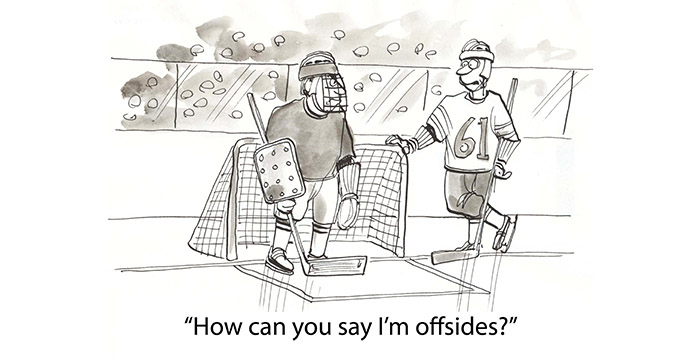
The whistle blows halting an offensive drive in its tracks forcing a faceoff. Why? An attacking player skated over the blue line into the offensive zone before the puck – making the play offside. The offside rule was not necessary until hockey began allowing forward passing – first in the defensive and neutral zones in 1927 and then in the attacking zone in 1928. At that point, players would camp out in front of the net waiting for a teammate to pass the puck down to them. Naturally, scoring shot up – just much more than officials intended. At a meeting in Chicago on Monday, December 16, 1929, the NHL Board of Governors voted to establish the offside rule to go into effect that Saturday.
On the day of the meeting, John J. Hallahan of the Boston Globe shared a few opinionated observations concerning the potential rule change. In his view, “the rules were changed for this season” because “more scoring was wanted,” and “that end has been accomplished.” He continued, “Little, however did the moguls realize the game was going to develop into more or less a burlesque.” Teams like the Pittsburgh Pirates would have a man offside sticking close to the goalie so that “much sloppy play, shinny and interference has developed in the scoring sector” to the point where “the goalie’s life is in jeopardy.” The new rule would not “allow any player of the attacking team to cross the blue line into the scoring zone ahead of the puck carrier. Under such conditions they feel the defense would have an excellent change to form, and protect the goalie.” Hallahan could “hardly believe a 10-foot radius zone in front of the nets . . . would help the conditions.” At the end of the day, he bragged, “It will make little difference to the Bruins what changes are made in the rules. They have accustomed themselves to the rules as none of the other teams have done, and are able to make their play confirm with any style. They stand out as the leaders of the league.”
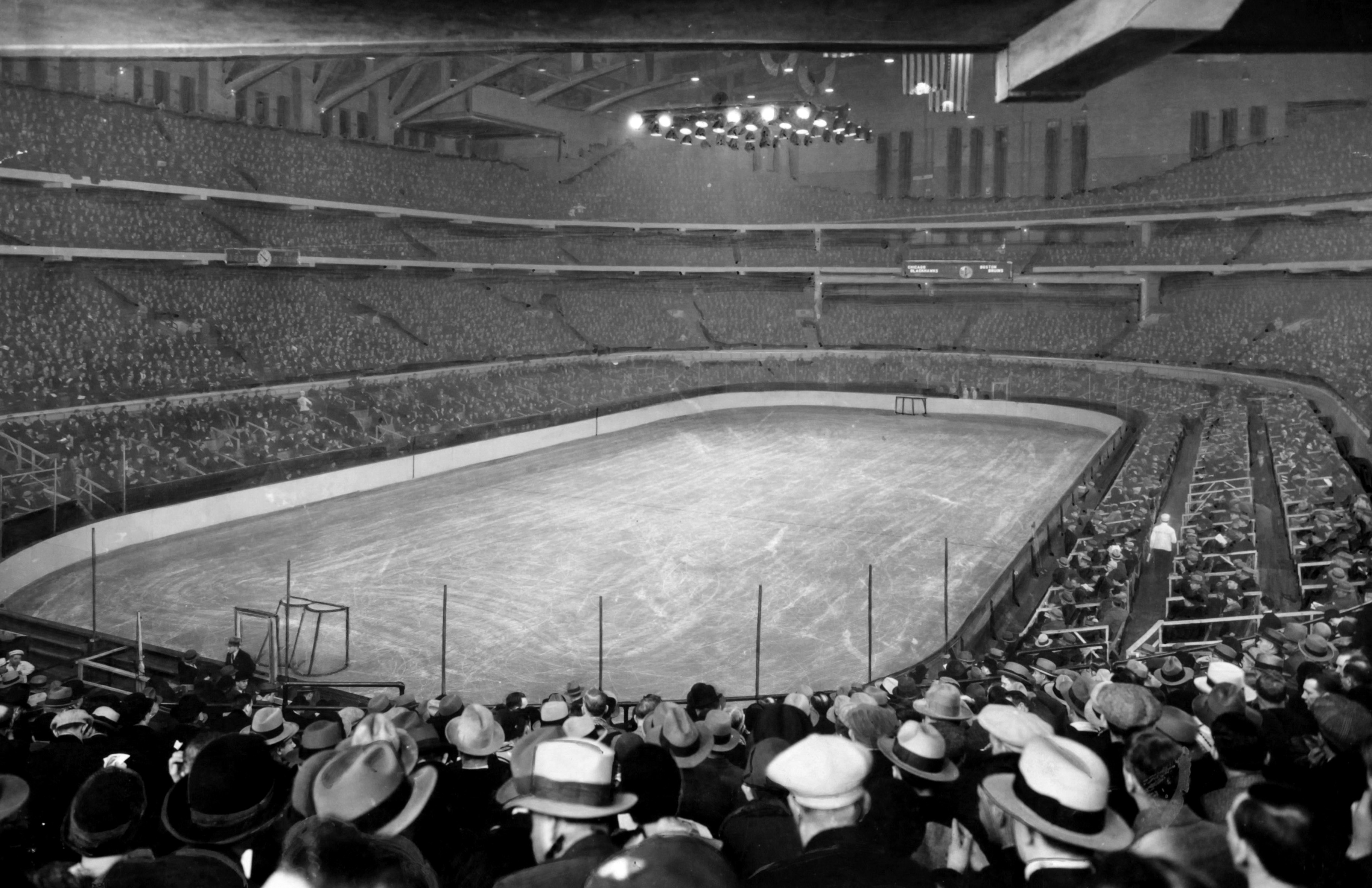
The Bruins faced the Chicago Blackhawks to test out the new rule decided at the Chicago meeting. Hallahan noted that the team practiced with the new rule but that it was “not looked upon as anything that will handicap the Boston aggregation.” He predicted that the game would require more defense and noted that the Blackhawks had speed and “the best defensive team in the league as measured by the number of goals scored against them.”
The Bruins defeated the Blackhawks 4-1. After the game, Hallahan began his recap with quite the statement:
“The amendments to the National League Hockey rules may or may not have been aimed indirectly at the mad rush of the world champion Bruins, but if other National League clubs believed that the Bruins’ spectacular forward passing would be stopped under the new code, they may be due for a surprise.”
He went on to explain, “It took the Bruins a period to discover the possibilities of the new rules . . . but as the game went on the ability of the various lines to blend their forward passing into the new game was more pronounced. The Bruins were getting over the line well together, and then the forward passing was clicking.” Even so, “The rule called for the blowing of the whistle many times, at one time the spectators feeling that a factory town had been let off work. In justice to the officials it must be admitted the players have not had time to work under the change.”
Although, it was too soon to say “just how well or how poorly the rule is going to work,” Hallahan urged “a fair trial is needed before arriving at conclusions.” Considering that as of next December, the rule will have been in use for 90 years, it has certainly been given its fair place in the rulebook.
Additional Sources:
John J. Hallahan, “May Change Hockey Rules at Chicago Meeting Today,” Boston Globe, 16 Dec. 1929, p. 20.
John J. Hallahan, “Speedy Hockey Due at Garden: Change in Rule Not in Effect Until Saturday,” Boston Globe, 17 Dec. 1929, p. 27.
John J. Hallahan, “Speedy Hawks Tackle Bruins,” Boston Globe, 21 Dec. 1929, p. 8.
John J. Hallahan, “Blackhawks Meet Champions Tonight,” Boston Globe, 21 Dec. 1929, p. 13.
John J. Hallahan, “Fast Traveling Bruins Too Good for Rivals,” Boston Globe, 23 Dec. 1929, p. 17.
John J. Hallahan, “Trio of Games in Four Days,” Boston Globe, 23 Dec. 1929, p. 20.
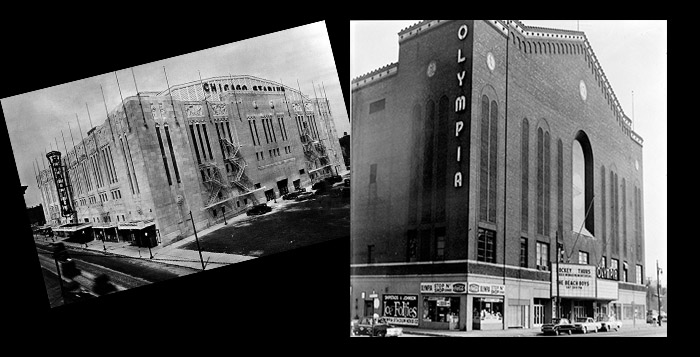
New York, Chicago, and Detroit set December 15 as opening or closing night when moving into new rinks. In 1925, the New York Americans played their first game at the new Madison Square Garden. Four years later, in 1929, the Chicago Blackhawks inaugurated the new Chicago Stadium. Fifty years later, in 1979, the Detroit Red Wings bid farewell to Olympia Stadium before moving into the Joe Louis Arena.
The first NHL team in New York opened (the third) Madison Square Garden with a high-society affair with the full house of about 17,000 dressed for a night out. The New York Daily News predicted that it would be the “greatest throng that ever witnessed a hockey contest” and that judging by their enthusiasm, “professional hockey is an assured success in New York.” The Americans had already played their first game, in Pittsburgh, on December 2. For their first home game, Tex Rickard insisted they play the Montreal Canadiens, a decision he may have regretted once the Canadiens defeated the Americans 3-1 and brought home the Prince of Wales Trophy. However, of Madison Square Garden, the Daily News enthused, “Never before has hockey been staged in such a splendid setting.” It had an “ice field” of 185×85 feet that the audience would be able to see “no matter what part of the amphitheatre they may be seated in.”
Leading up to the game on December 15, 1925, the team conducted an exhibition at their workout on the morning before. That afternoon, the Royal Foot Guards of Governor General Lord Byng paraded up Broadway to City Hall. The day of the game, the Royal Foot Guards and the West Point Cadets marched up 5th Avenue from the Canadian Club to the Neurological Institute of New York at 2:30 for a concert. The game would be for the benefit of the Institute. Both groups led the musical program before the game by playing the national anthems of their respective countries. The pre-game and intermission performances included “a program of fancy skating by some of the foremost skaters, including the famous Charlotte and the team of Peterson and Charlotte.” Mayor Hylan performed the first ceremonial puck drop at Madison Square Garden.
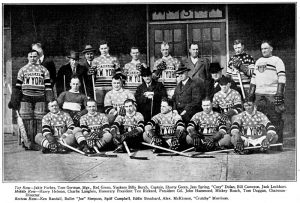
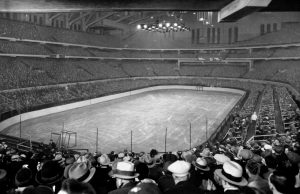
In Chicago, the Blackhawks and their fans had said goodbye to Chicago Coliseum on December 12, 1929. They went out “in a blaze of glory” when they defeated the Montreal Maroons “in the closing seconds,” 4-3. Three days later, they said hello to Chicago Stadium, where the “setting was excellent” because of the “wide tiers of red seats” and the ice was “far keener” because the Stadium was kept colder. According to the Chicago Tribune, the “opening of hockey in the largest indoor stadium on the continent” would have the “largest crowd ever to see a hockey game in Chicago.” The NHL governors – including President Frank Calder and owners of each team – planned to attend since they were in town for a meeting the following day. As of the day before the game, only about 10,000 tickets had been sold, but the final count put the crowd at 14,212. The biggest crowd at the Coliseum was only 8,500. The Chicago fans happily watched their team win their fifth straight game by defeating the Pittsburgh Pirates 3-1.
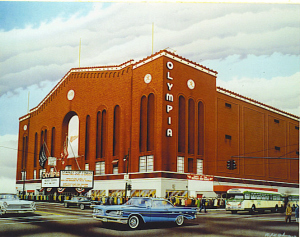
Detroit seemed to delay building and moving into each of their stadiums. It took them an extra year to actually begin playing in Detroit, at Olympia Stadium (and just six months later, Gordie “Mr. Hockey” Howe was born). After 52 years there and 1,790 home games, the Red Wings played there for the last time. Ironically, their opponents, the new-to-the-NHL Quebec Nordiques, were playing in Detroit for the first time. By that point, Olympia Stadium – a 4-story brick building a block wide and another long – was in the “inner city” and “sometimes the roof leaked and sometimes it was hard to find a clean, dry towel in the men’s room.” Bill McGraw wrote for the Detroit Free Press, “Hockey games at 14,200-seat Olympia in many fans’ memories have been characterized by big crowds, witty banners, a smoky atmosphere and aggressive behavior – by the fans if not always the players.” Uncertain whether Olympia would be torn down or sold to Wayne State University, Howe said, “Save me a brick.”
Olympia Stadium 1963
For their last game there, 15,609 fans entered Olympia Stadium “armed with banners (such as ‘Thanks for 7 Cups and 52 years of memories’), boat horns, toilet paper, eggs and a fish. Much of the garbage ended up on the ice during the game, delaying play many times.” The Nordiques pulled ahead scoring four goals before the Red Wings got on the board in the second period. They managed to tie to end the game at 4-4, and it was their second tie in a row. The fans “lingered after the game had ended, booed the mention of the Joe Louis Arena on the Olympia p.a., and listened to the organist play ‘Auld Lang Syne.’”
As for the new rink, Red Wings defenseman Reed Larson commented, “Nothing against the (Olympia) rink, but the new place looks beautiful on the water. It’ll be good for the crowd and players. This is getting a little dingy down here.” The city spent $28 million constructing the new Joe Louis Arena with 19,274 seats and no pillars. However, the seats would curve at a more gentle angle “so many fans will be farther away from the action.” The important thing was that the ice-making methods would not change, assured Louis Arena assistant general manager Art Whalen. “It’s the exact same system – we’re using hot, softened water.” The Red Wings would move in after four games on the road and played their first game at Joe Louis Arena against the St. Louis Blues on December 27, 1979.
Additional Sources:
Al Copland, “Hockey Says ‘Howdy’ to New York,” New York Daily News, 15 Dec. 1925, p. 36.
Paul Gallico, “Canadiens Win Hockey Inaugural: Packed Garden Sees Thrilling Spectacle,” New York Daily News, 16 Dec. 1925, p. 44 and 48.
“Blackhawks to Play in New Home Tonight,” Chicago Tribune, 15 Dec. 1929, p. 31 (2-3).
Harland Rohm, “14,000 See Hawks Whip Pirates, 3 to 1,” Chicago Tribune, 16 Dec. 1929, p. 27-28.
Bill McGraw, “Red Wings say farewell to Olympia tonight vs. Quebec,” Detroit Free Press, 15 Dec. 1979, 1C and 5C.
Joe Lapointe, “It’s goodby to Olympia Stadium,” Detroit Free Press, 16 Dec. 1979, 1A and 19A.
Bill McGraw, “Wings tie in Olympia farewell,” Detroit Free Press, 16 Dec. 1979, 1D and 8D.


 Prev
Prev