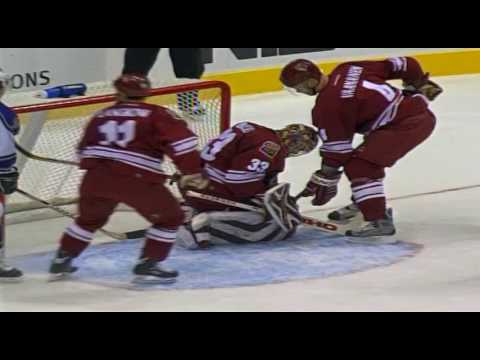
As the world prepared to celebrate the beginning of 2004, Brian Boucher was a backup goalie for the Phoenix Coyotes who had recently been demoted to third, had only started once in the first 15 games of the season, and had been exposed to the waiver draft. What’s more, he had not had a shutout in 85 games. Then, on December 31, 2003, he had the first of five consecutive shutouts. He tied the 55-year (modern) record set by Montreal Canadiens goalie Bill Durnan with the fourth shutout on January 7, 2004 and passed it with the fifth on January 9. At that point he said, “I’m really not sure how to keep this in perspective. It’s just an unbelievable ride right now. The great thing is, it’s a team game. Everybody’s enjoying it, not just myself.”
For the first shutout, on December 31, the Coyotes hosted the Los Angeles Kings. Boucher made 21 saves for his first shutout with the Coyotes and eighth of his career. At the time he promised, “It won’t be 85 games until I get another one.” The 4-0 victory was the first win at Glendale Arena and before their third straight sellout crowd.
The Coyotes then went on the road. For the second shutout, on January 2, they defeated the Dallas Stars 6-0 at the American Airlines Center. Boucher made 35 saves for the Coyotes’ first back-to-back shutout since March 2000. He humbly told the press, “It’s nice to contribute. . . . I certainly want to do my part to give them the chance to win.”
On January 4, Boucher joined a more exclusive club. Only 17 goalies had had three straight shutouts (since 1948-49). He made 26 saves for the 3-0 win over the Carolina Hurricanes at the RBC Center. Coyotes coach Bobby Francis explained, “Right now, the puck looks like a beach ball to Bouch. He’s following it, he’s seeing it, he’s squared up and his concentration level is outstanding.” According to defenseman Brad Ference, Boucher told his teammates, “I’ll make the first save, you guys just get the rebounds.” The team did their best to block shots to help him. Boucher himself commented, “I’ve felt good the last little while, but there’s a lot of things that go into it. It’s a team game, and there’s a little bit of luck involved, too. If not, everybody would get a shutout every single night. But it’s a special time right now, for sure. I’m just enjoying it and, hopefully, ride it as long as you can ride it.”
Although Coach Francis was letting Boucher ride his heat wave, both coach and goalie made sure to clarify that Sean Burke remained the Coyotes’ first goaltender. Francis told Burke, “Brian’s playing extremely well, he deserves the opportunity, and you’d want the same if you were in the same situation.” Burke has been “overly gracious” saying “his only concern is seeing the team get into the playoffs and that Boucher’s recent play can help get Phoenix there.” Burke had the best save percentage (.919) in the NHL over the past five seasons. Boucher jokingly said, “When I allow my first goal, they should pull me.”
On January 7, he tied a record that had stood for 55 years when he earned his fourth consecutive shutout. “It’s quite an honor,” said Boucher. “I can’t even think of the words to describe it.” His 27 saves led to a 3-0 victory over the Washington Capitals at the MCI Center. Boucher “never seemed to let his emotions get to him” and stopped himself from fist bumping with about 23 seconds remaining in the game. He explained, “As a goalie, you never want to let your guard down. They might have scored.” Although he had not gone into the game expecting another shutout, he commented, “But we’ve pulled together on this road trip, and it’s pretty awesome.”
The record-breaking fifth shutout came on January 9 in a 2-0 victory over the Minnesota Wild at the Xcel Energy Center. Boucher’s 21 saves not only gave him the most shutouts but also the longest time without a goal against, 325:45. The only two goalies to have more time dated back to before players could forward pass with the old records (six shutouts and 461:29 in minutes) held by Alex Connell from 1927-28.
“It’s so extraordinary, and for a lot of reasons. You think of the history of the game and the accomplishment that has been made…it’s just incredible.” Wayne Gretzky, the Coyotes’ managing partner, commented, “We may never see anything like this again in sports.” Even though the Coyotes were away, the crowd gave a loud standing ovation when Boucher was given the first star of the game. Boucher said, “It’s taking on a thing of its own. Guys are playing so hard right now. They don’t want to be the line that goes out there and blows coverage. It feels like a playoff atmosphere.”
Boucher’s wild ride finally came to an end on January 11, at the first game back at Glendale Arena. With a fluke bounce off a Coyotes defenseman, the Atlanta Thrashers scored a power-play goal on Boucher at 6:16 of the first period. Boucher had made 147 saves in 332:01 before his streak ended. At that point, the Coyotes (having received permission in advance) stopped the game to congratulate Boucher and play a tribute video. Boucher later commented, “It was very nice and I’m flattered they did that. I certainly wasn’t expecting that.” The game ended in a 1-1 tie without any scoring in overtime, so Boucher at least remained undefeated.
The goaltender equipment from the shutout streak was sent to the Hockey Hall of Fame right after the January 11th game. It was good timing, according to equipment man Stan Wilson, because Boucher’s pads were falling apart. Although Boucher himself only had one other season of playing at least 40 games, he remained in the NHL until 2013.
Additional Sources:
Tim Tyers, “Boucher’s shutout gives team 1st win in new arena” and “Boucher tosses shutout; Coyotes control temper,” Arizona Republic, 1 Jan. 2004, p. C1 and C6.
Bob McManaman, “Coyotes post 2nd straight shutout” and “Wins make Boucher unlikely to be traded,” Arizona Republic, 3 Jan. 2004, p. C1 and C4.
Bob McManaman, “Boucher stays on fire, nets 3rd straight shutout” and “Discipline keys shutout run,” Arizona Republic, 5 Jan. 2004, p. C1 and C6.
Bob McManaman, “Coyotes play hot hand,” Arizona Republic, 6 Jan. 2004, p. C7.
Bob McManaman, “4 the record: Boucher ties 55-year-old shutout mark,” Arizona Republic, 8 Jan. 2004, p. C1 and C6.
Paola Boivin, “Coyotes goalie on a roll” Arizona Republic, 9 Jan. 2004, p. A1-2.
Bob McManaman, “Streaking goalie Boucher goes from outcast to Coyotes star,” Arizona Republic, 9 Jan. 2004, p. C1 and C6.
Bob McManaman, “Boucher remains perfect” and “Game’s evolution makes record more impressive,” Arizona Republic, 11 Jan. 2004, p. C1 and C6.
David Vest, “Chasing shutout No. 6,” Arizona Republic, 11 Jan. 2004, p. C1 and C6.
Tim Tyers, “Bad bounce doesn’t make Tanabe regret spot on ice” and “Fluke goal was a record breaker,” Arizona Republic, 12 Jan. 2004, p. C1 and C6.
Bob McManaman, “Amazing ride concludes,” Arizona Republic, 12 Jan. 2004, p. C1 and C6.
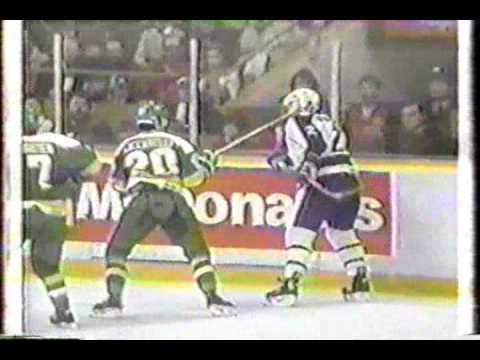
Minnesota North Stars right wing (and leading scorer) Dino Ciccarelli had had it. Since the beginning of the 1987-88 season, he had served a three-game suspension for pushing a linesman (during an exhibition game) and was arrested for indecent exposure (on November 25). He was also sick of the referees not calling slashes and other hits on him that three years before had put him out of commission with injuries. North Stars general manager Lou Nanne even said, “We’ve been telling the officials all season that if they don’t call the slashing and the cheap shots closer, Dino is going to snap.” On January 6, 1988, he finally snapped.
At Maple Leaf Gardens, rookie defenseman Luke Richardson cross-checked Ciccarelli along the boards near the North Stars’ bench, for which he received minor penalties for slashing and roughing. This was apparently after Ciccarelli had already been hit four times after the whistle. With about three minutes left in the second period, Ciccarelli “hit Richardson on the side of the head and neck, and then on top of the helmet before missing with a third swipe” for which he “received a major penalty for high-sticking and a match penalty for deliberate attempt to injure.” This gave the Maple Leafs a six-minute power play, and they scored twice to tie up the game. Minnesota’s assistant coach, Pat Price, commented, “If the referee (Bob Hall) won’t help him, Dino has to help himself. He did what he had to do to protect himself.” Ciccarelli later told the press, “The same guy got me twice. He’d stuck me in the neck and then cross-checked me into the boards and nothing gets called. If they (the officials) call everything and call it early, then this stuff doesn’t happen.” Richardson, wearing a helmet, was not injured. The game ended in a 5-5 tie without any scoring during overtime.
Ciccarelli’s slashes on Richardson came at a bad time, as the NHL was cracking down on stick incidents. Immediately after the game, NHL executive vice president Brian O’Neill scheduled a hearing for January 8 and flew to Toronto.
In the meantime, although Nanne claimed that the NHL director of officiating, John McCauley, told Ciccarelli, “Dino, do what you have to do,” McCauley made comments that this was “the worst stick-swinging display that he had seen at Maple Leaf Gardens in at least two decades.” Minnesota coach Herb Brooks asked Gordie Roberts (the North Stars’ NHL Player Association representative) to file a complaint with the union about McCauley. “It’s inappropriate to make comments like that. Don’t prejudice the hearing before it happens.”
When Nanne accompanied Ciccarelli to the hearing, everyone predicted he would be suspended for three to eight games. Nanne said, “Dino wasn’t right by any means, but it wasn’t as bad as I was led to believe. It was his first (stick) offense and it was provoked.” However, O’Neill gave Ciccarelli a ten-game suspension and justified it with the statement, “It was apparent that through anger he lost control and although no serious injury resulted, his actions were potentially very dangerous.” Ciccarelli thought the long suspension was “a little severe” but said, “If this is what it takes for the league to clean things up, then I’ll accept it.” Still, he defended himself saying, “Sure, I over-reacted, but I’m not going to have my career end because someone does that to me. It was a build-up of a lot guys slashing me, running me. I’m a little guy (5-foot-10, 180), I’m not going to fight. My only self-defense is to keep my stick in my hands and that’s what I did. If the officials don’t protect me, I have to protect myself.” Brooks looked to the future, “Obviously, it hurts us but it’s just one of those things we have to accept. Dino can’t let it and the hockey club can’t let it get the best of us. . . . We have to accept it and everybody will have to pick up the slack.” The NHL granted a three-game grace period for an appeal, so Ciccarelli’s suspension was scheduled to last from January 15 until February 4.
As fate would have it, the last game Ciccarelli was due to play in before the start of his suspension was the January 13 rematch with Toronto at the Met Center. The weekend before, Richardson trash talked that he might get Ciccarelli back (with harder legal hits). Like their previous game, the North Stars and the Maple Leafs tied (3-3) without scoring in overtime. That meant that Minnesota remained last in the Norris Division, one point behind Toronto.
Unfortunately for Ciccarelli, beyond the NHL, Toronto law enforcement also decided to make an example of him. The police issued a warrant for his arrest on charges of common assault. As reported in the Star Tribune, “police superintendent Walter Tyrrell said it was issued because a weapon, a hockey stick, was used to hit a man on the head.” Even though Richardson was uninjured, Ciccarelli could face up to five years in prison or up to $2,000 in fines. None of the players previously charged in Toronto since 1970 had been convicted. Ciccarelli was baffled saying, “I don’t understand it. Hundreds of things like that have happened before. Why now? I could have seen it if the guy was hurt. But if I wanted to hurt him, I could have hurt him . . . I don’t see what the police have to do with it.” Nanne said, “I don’t consider it serious. They’ve arrested a lot of guys in Toronto over the years and nothing has happened.”
There is a first time for everything, as Ciccarelli found out in August, when he became the “first NHL player given a jail term because of an on-ice incident.” He was sentenced to one day in jail and a $1,000 fine. Judge Sidney Harris sanctimoniously stated, “It’s time now (that) a message go out from the courts that violence in a hockey game or in any other circumstances is not acceptable in our society.” Nanne felt that Ciccarelli had already paid enough with his ten-game suspension costing him $25,000 in salary. “The judge is apparently saying that the courts are going to be involved in anything that’s violent.” North Stars general manager Jack Ferreira did not like the sound of that saying, “It seems that hockey’s been able to police its own and deal with these matters instead of going to court.” Minnesotan teammates, captain Craig Hartsburg and Basil McRae, found it all ridiculous that the courts should go after individual players rather than holding the league accountable. On the other hand, NHL President John Ziegler said, “Although we are disappointed in the outcome of this case, it has long been our belief that sports are not above the law.”
Ciccarelli served less than two hours in prison and mostly signed autographs the whole time. His attorney, Don Houston, filed an appeal leading to his release. He reflected, “I just think the judge wanted to use me as a precedent, but if I’m being made an example, then the NHL is going to have to step in and stop all the fighting and stick swinging.”
After all Ciccarelli went through, he and his agent decided to stick to their guns regarding his contract with the North Stars. Although the team offered him the biggest salary the North Stars ever offered, he felt it wasn’t enough and refused to attend training camp. He was fined $250 a day and held out until early October, three days before that price would have jumped to $1,000 per regular-season day. The new four-year contract would give him $350,000 a year and incentive bonuses. He ended up being traded to the Washington Capitals in March 1989 then remained in the NHL for another ten years. Ciccarelli was inducted into the Hockey Hall of Fame in 2010.
Additional Sources:
Jerry Zgoda, “Tie Brings Stars no relief,” Minneapolis Star Tribune, 7 Jan. 1988, p. 1C and 4C.
Jerry Zgoda, “Ciccarelli’s suspension could be at least 8 games,” Minneapolis Star Tribune, 8 Jan. 1988, p. 1C and 4C.
Jerry Zgoda, “Ciccarelli suspended 10 games,” Minneapolis Star Tribune, 9 Jan. 1988, p. 1C and 4C.
Jerry Zgoda, “Richardson might get payback on Ciccarelli,” Minneapolis Star Tribune, 10 Jan. 1988, p. 14C.
Jerry Zgoda, “It’s fitting to be tied for Leafs and Stars,” Minneapolis Star Tribune, 14 Jan. 1988, p. 1C and 8C.
Diana Ettel Gonzalez, “Ciccarelli changes his plea to guilty,” Minneapolis Star Tribune, 21 Jan. 1988, p. 1C and 10C.
Dennis Brackin, “Convicted of assault, Ciccarelli gets day in jail and $1,000 fine,” Minneapolis Star Tribune, 25 Aug. 1988, p. 1C and 8C.
Jerry Zgoda, “Ciccarelli’s agent blasts Stars for ‘lip service,’” Minneapolis Star Tribune, 11 Aug. 1988, p. 5C.
Jerry Zgoda, “Ciccarelli, Stars reach agreement on contract,” Minneapolis Star Tribune, 4 Oct. 1988, p. 1C and 3C.
Saturday night, January 5, 2019, the Boston Bruins hosted the Buffalo Sabres in a crucial divisional game. This was the fourth, and final, time these two teams met in the regular season. Boston was 2-1-0 in the previous three, having won both games in Buffalo and dropped the previous game played in Boston.
For Chris Wagner, a native of Walpole, Massachusetts, the game was helping to take his mind off the loss of his maternal grandfather, Jim Phelan, who passed away on Friday morning, January 4, 2019.
“It’s been obviously a tough couple weeks for my family. We’ve been going through some struggles, especially—it’s my mom’s dad—so I feel bad for her, but, sports is a great outlet and he loved sports. It definitely meant a lot,” Wagner said after the game.
Twenty seconds into the game, you had to wonder if perhaps he had a guardian angel or was under a lucky star, because he got the first goal of the game. Like almost all hockey players he gave a little celebration for the goal—unaware that it had been disallowed—and acknowledged his grandfather.
“Yep, yeah, give him a little tribute. He’d probably be a little upset that I even acknowledged him. He’s a humble guy and I’m going to miss him a lot,” he said.
Unfortunately, the call on the ice was no goal, the result of his linemate Sean Kuraly losing his footing and running into Linus Ullmark who was in net for Buffalo. The Bruins head coach, Bruce Cassidy, challenged the call, which was upheld after the video review. And Wagner’s teammates felt bad for him.
“You kind of clench your teeth a little bit when the first one gets called back,” said David Backes, who was in his first game back after serving a three-game suspension.
The hockey gods, and perhaps his grandfather, were not to be denied in seeing him score and celebrate because 9:50 later he would again score the first goal of the game, an almost identical goal, and this one would count, and he again did his celebration.
“This was a special game for me. Maybe he was watching out for me, making the puck follow me around, who knows, but he was probably laughing after that first goal was disallowed,” Wagner said, a little huskiness in his voice.
It was obvious that he was taking the death of his grandfather hard, and yet there he was talking to the media after the Bruins got a 2-1 win over the Sabres—the game winning goal coming from Backes. Despite it being difficult to share, Wagner seemed to want to talk about his grandfather.
.@chriswags23 was playing with a heavy heart on Saturday night:
"My grandfather passed away yesterday morning. This was a special game for me. Maybe he was watching out for me and making the puck follow me around…he was probably laughing after that first goal was disallowed." pic.twitter.com/2Ain2rsYzq
“He’d drive me around when my parents couldn’t and went to all my games and watched all these games even up till the Winter Classic the other day, so, it means a lot,” Wagner offered. “If anyone knows Norwood, he was a Norwood guy through and through, so, yeah, he watched anything, by himself, if we were playing or we weren’t—my brothers, my cousins—so, yeah, special.”
Had he not mentioned during the intermission about his grandfather’s passing, it is unlikely that anyone watching the game would have known what he was going through. And while he was clearly dialed into the game, as evidenced by his goal(s) and the six shots he had on net, he admitted his grandfather was in his thoughts.
“You think about it. You think about it on the bench too, to be honest, but then I started getting so many chances, maybe this was a night to get a couple more,” he said.
His grandfather, as Wagner said, was a humble man, and it was clear that some of that humbleness runs in Wagner’s veins as well as he talked about the disallowed goal.
“That happened so quick, I was like ‘too good to be true, that shouldn’t happen to our line,’ but then luckily we got another chance. We kept getting chances. I thought we played a pretty solid game tonight and it was nice getting off to a good start, even though that goal didn’t count,” Wagner chuckled.
For the team it was an important two points in the standings. For the individuals who make up the team, they were happy for Wagner.
“You know, Chris Wagner’s effort tonight, in the rears of his grandfather passing it—that’s a pretty special night, you couldn’t be more happy for the guy. Good for him and well deserved, and hopefully he can have a day off, more family time, and bid farewell to his grandfather,” Backes said.
“Yeah, we knew he was hurting and it was really cool, unfortunately the first one didn’t count, but just being able to follow up with another one and, as a team, we feel for him, but it was really cool to see that for him,” linemate Noel Acciari offered.
For Wagner, it was his fifth goal of the season. And while normally game pucks are saved and given to a player who has achieved a milestone such as a hat trick, Wagner was given the game puck after the Bruins victory.
“I got the game puck, so keep that one around for a couple of days,” he said after the game.
Perhaps having that puck will bring him a little comfort when he looks at it and remembers what he was able to do and to consider that his grandfather really was watching over him.
A little over four years after Hockey Night in Canada was first televised, the U.S. began nationally televising NHL games. The network CBS broadcast a series of ten Saturday afternoon games for the NHL beginning on January 5, 1957.
As of late December 1956, the Boston Globe reported that WEEI staffer Fred Cusick would serve as “color” man for Bud Palmer, who would do play-by-play for the upcoming television series. The duo kept their roles for three seasons before Cusick took over the play-by-play and Brian McFarlane was brought on for color commentary and interviews. The series would be called Game of the Week.
The first of the televised games featured the Chicago Blackhawks visiting the New York Rangers at Madison Square Garden. Rangers president Gen. John Reed Kilpatrick disapproved of censorship and said, “The camera will be on the action wherever and whatever it is.” His general manager, Muzz Patrick, concurred. “The people will want to see what goes on. The camera will be on the action.” Going into the game, the Rangers only worried about their current slump, having lost five of their last six games. To their relief, the “merry matinee” went their way before the 9,853 at the Garden and the national television audience. The Rangers scored in each of the first two periods. Although the Blackhawks managed one goal in the first minute of the third, the Rangers came back with two goals in 20 seconds of the final minute. After ten penalties and a couple fights, the Rangers defeated the “cellared Chicagoans” 4-1.
The television experiment seemed a success after that initial game. NHL President Clarence Campbell said that knowing “there’s a lot of interest in hockey in this country,” the televised games “can’t help but stimulate interest around the country.” After all, as Gene Ward wrote for the New York Daily News, hockey would be “sent into such locales as Mobile, New Orleans, Houston, Los Angeles and Hollywood, places where, until now, the only ice seen has been in a highball glass.” Despite the difficulties the cameras had in following the “speedy action,” Campbell “heard good results” and was “certain it’ll get better in the other games.” In fact, cities with NHL teams had already seen increases in attendance after the first few games aired. Campbell’s true goal in national televising was to “create new fans in the United States and eventually result in bringing some American players into our league.” Out of the 100 or so NHL players, only Gerry Foley of the Rangers was American-born instead of Canadian. However, his aim was to strengthen the Original Six teams before even considering expanding into new cities. On the other hand, Bruins owner Walter Brown noted, “TV will introduce the game and excite interest in a lot of places where ice hockey is dormant. I think it’s entirely possible TV will create a few new potential ‘areas’ for the N.H.L.” Already by the end of January, the channels carrying the games had doubled and, according to Jerry Nason of the Boston Globe, “an astonishing interest in ice hockey is evident now in Dixie.” Nason noted that although the NHL might like to expand to eight teams, the shortage of players (primarily only coming out of Canada) would hinder that expansion.
The 10-game series was scheduled through March 9. Three U.S.-based teams (the Rangers, Bruins, and Red Wings) would play in half the games, and the Blackhawks would play in four. The only Canadian team to appear would be the Montreal Canadiens for a Boston matchup. When the first season “proved so successful,” the NHL increased the number of Saturday afternoon games to be televised. For the 1957-58 season, 21 NHL games would be broadcast between November 2 and March 22. However, ratings eventually slumped, and the CBS series only lasted four seasons. The hoped-for NHL expansion took ten years to come to fruition.
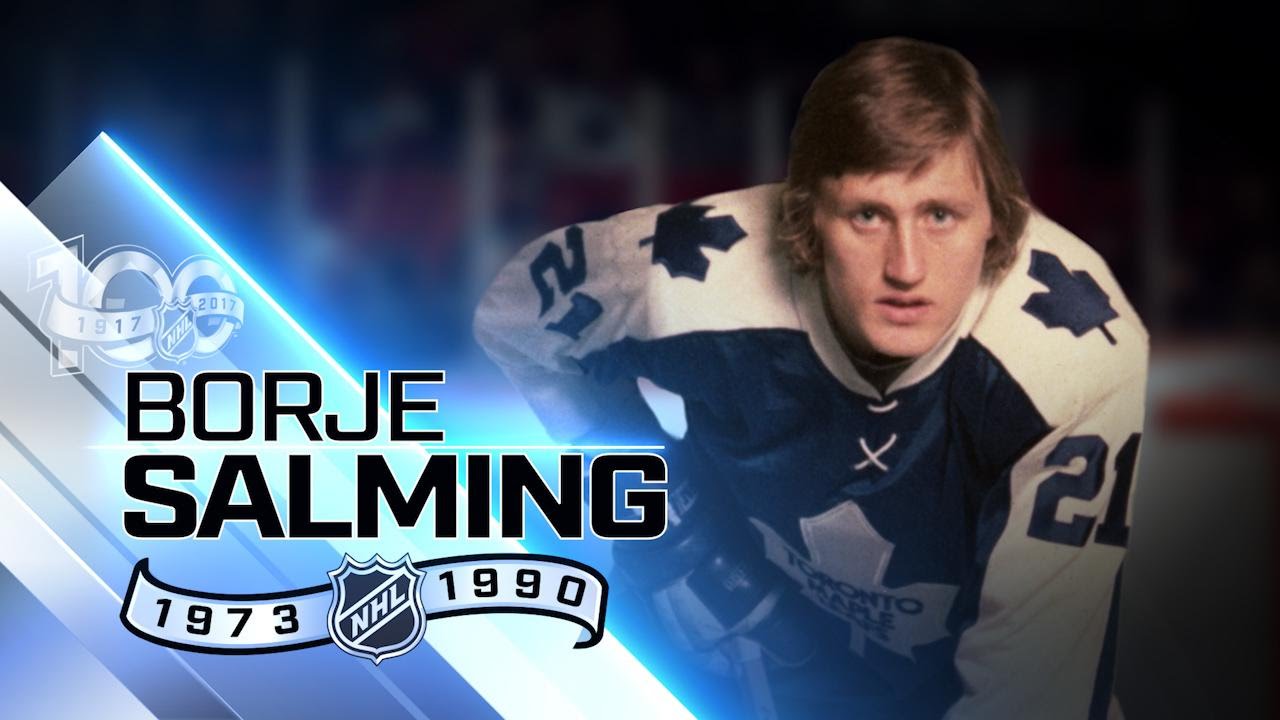
Swedish Borje Salming was not the first European to play in the NHL, but he was the first European-trained player to reach all-star status and to play in 1,000 NHL games. On January 4, 1988, he became the fifth member of the Toronto Maple Leafs to make 1,000 appearances.
Back in 1972, Toronto scout Gerry McNamara attended the Christmas tournament while Salming was playing for Stockholm. According to Salming, “He came in and asked me if I wanted to play for the Toronto Maple Leafs. That was sort of the first time I ever thought about it and I thought, ‘Wow. That would be fun to play there.’ Before that I was never even thinking of the National Hockey League. I’d heard of it but never thought I was going to play there.” He later said he had no problem adjusting once he came to play for Toronto in 1973. As a defenseman, he felt the 2-3 week training camp prepared him to play on the smaller rink. “I adjusted pretty good. The only problem I had was with my English.”
During Salming’s 15th NHL season, he played in his 1,000th game at Toronto. The Toronto Maples Leafs and Vancouver Canucks seemed like they were playing shinny in that the last to score wins. They alternated scoring through the first two periods in which each team scored two goals in the first and one in the second. While Toronto had led the scoring until that point, Vancouver scored the first goal of the third period. Then, beginning at the 11-minute mark, “seven goals [were] scored, by seven different players in seven minutes.” Vancouver brought the score up to 5-3, but over the next three minutes, Toronto scored three times for a 6-5 lead. Salming had an assist on the second of these. In the next 18 seconds, Vancouver scored again followed by another goal about two minutes later. Finally, Toronto swooped in for the tie at 17:44. Frustrated that his team gave up the lead, Vancouver coach Bob McCammon commented, “That was pathetic defence by both teams.” He half-heartedly joked, “I guess I can tell you why my hair is this thin and John Brophy’s is white.” Toronto coach John Brophy said, “Bizarre is a good word for it. . . . It was one of those nights where the last shot wins.”
Salming played another season with the Leafs and a final NHL season with the Detroit Red Wings before retiring in 1990. He still holds Toronto’s records for assists (620) and rating (plus-155), as well as for goals (148), assists (620), and points (768) by a defenseman. Throughout the NHL, Salming holds the record for points (787) by an undrafted defenseman. He then returned to Sweden and represented his country in the 1992 Albertville Olympics. In 1996, Salming became the first European-trained player (and third European) inducted into the Hockey Hall of Fame. Salming gushed, “I was so extremely happy about that. When they called me I was actually crying. I couldn’t believe it.” Then, in 2015, his statue was added to the Maple Leafs “Legends Row,” and the following year, the Leafs retired his No. 21. Salming felt the statue was “pretty cool.” “Basically when I’m gone, my grandkids and everybody can go there and say, ‘I know that guy.’ That’s fantastic.”
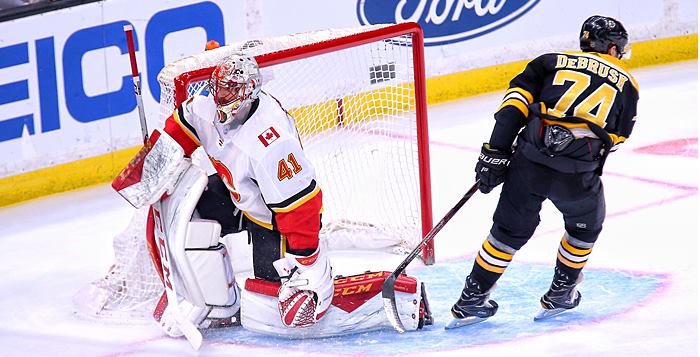
While the Boston Bruins were certainly riding a high from their participation in the 2019 Winter Classic that had been held at Notre Dame Stadium in South Bend, Indiana on New Year’s Day, where they beat the Chicago Blackhawks, for David Krejci and Kevan Miller, Thursday’s game against the Calgary Flames had some other reasons to be motivated and happy.
David Krejci (Photo: Alan Sullivan)
It was reported Thursday morning that during the morning skate, Krejci was absent. Given the extensive injuries Boston has been plaqued with throughout the first half of the season, that was the natural thought in regard to his absence. Instead, Krejci and his wife were welcoming their latest child into the world—a son. For Krejci that meant a slightly different preparation on game day than he normally does. He did manage to get a short nap before heading to the arena to dress for the game.
“Yeah, yeah, I mean, it’s pretty crazy. But my wife, she did a great job. And all the nurses and doctors there, they’re so good at the hospital. They made it as easy as it could be for us. So, that was big. But like I said, it’s a special day and to get two points, it feels really good,” Krejci said. “There are lots of thoughts going through your head, so just trying to stay in the moment, but obviously it’s hard. You just bring one of your kids into the world so it’s always going to be on your mind so it was tough to focus sometimes on the game. But just try to stay focused, tried to keep my head in the game, talk on the bench, and things like that. And my teammates did a good job too, and like I said, it was a special day. With a win at the end it was just a cherry on top of the cake.”
Krejci must not have struggled as much as he thought he did to stay focused in the game, because he garnered two assists on the night on both of Jake DeBrusk’s goals.
Kevan Miller (Photo: Alan Sullivan)
“Obviously a special night for him and wanted to actually get him a goal and sad that he couldn’t, but just shows what kind of person he is. He can put that aside for a little bit and I’m sure he’s racing home right now to see him,” shared DeBrusk.
Meanwhile for Kevan Miller, the night was a milestone as he played in his 300th NHL game. The gritty defenseman had one shot on net, two takeaways, one blocked shot and four hits—one of which left no questions as to his toughness.
Miller’s recent return to the lineup after taking a puck to his larynx shows he continues to give everything he has in each game and in each shift. His grit helps the Bruins to focus on their style of play and get the job done. Thursday’s hit on Calgary’s Michael Frolik, almost sent Frolik backwards over the boards and into the visiting bench. Frolik got feisty and was either taunting Miller trying to get him to drop his gloves or was originally planning to fight Miller, but then changed his mind.
While he may have reached that career milestone of 300 NHL games and he perhaps smiled and reminisced a little after the game Thursday night, no one should be surprised to see him return to the ice for practice on Friday morning at Warrior Arena, ready to go again. The Bruins will be back at it in an important division game against the Buffalo Sabres on Saturday evening.
Thursday night, January 3, 2019, the Boston Bruins returned to the TD Garden after having played in their third New Year’s Day Winter Classic. They beat the Chicago Blackhawks 4-2 at Notre Dame Stadium in South Bend, Indiana in what was possibly one of the most perfect outdoor games in regard to weather, clouds and ice surface. They embraced the entire experience, having decided as a team to arrive at the stadium on game day in Peaky Blinders inspired suits.
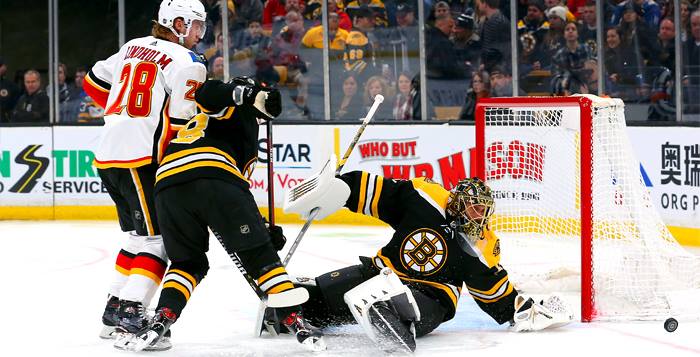
Riding that high, from both the win and playing in front of more than 70,000 hockey fans, there were those who wondered if they could focus on Thursday night’s game against the Calgary Flames. The Flames’ visit was the second, and final regular season game, that these two teams would play against each other. Back on October 17, 2018, the Bruins played in Calgary, losing to them 5-2. Coming into Thursday’s game the Bruins had won their previous two games and were 3-2-0 in their last five. The Calgary Flames were 3-1-1 in their last five games, and likewise had won their previous two. Of course, the Flames have Johnny Gaudreau, who came in with 10 goals, and 10 assists for 20 points in 7 of his last 10 games.
What was good to see from Boston was their unwillingness to give up. Despite giving up their ninth shorthanded goal, a league leading number, the team responded 1:16 later, while still on the power play, to tie things up during the first period, with a solid shot by John Moore from the right circle. Jake DeBrusk would put the Bruins up 2-1 going into the first intermission on a deflection of a David Krejci shot.
Elias Lindholm and Jaroslav Halak (Photo: Alan Sullivan)
The lead would be short lived as Elias Lindholm, assisted by Gaudreau and Noah Hanifin, would tie the game 1:05 into the second period. Once again, the Bruins would respond quickly, this time Brad Marchand, assisted by Torey Krug and Patrice Bergeron, would put the Bruins ahead just 36 seconds later. The remainder of the second period was played predominantly by special teams. For the Bruins it meant lots of time on ice for their penalty killers, as first Zdeno Chara was called for a cross check (7:09), DeBrusk for a high stick (10:13), a bench minor for too many men on the ice served by Danton Heinen (11:31), a cross check by Brad Marchand (18:39), and then the Flames’ Lindholm with interference (19:53). Lindholm’s interference call negated the final 46 seconds of the Flames fourth power play in the middle frame as well as giving the Bruins 1:14 of power play time into the third period.
While the second period had five penalties, the third period had five goals. David Pastrnak scored off a 160-foot pass by Krug that hit the end board and bounced right onto Pastrnak’s stick. He deked on Calgary’s goaltender Mike Smith, and once again the Bruins were leading. Jaroslav Halak, who made some strong saves for the Bruins on quality shots throughout the game, got his third assist of the season on that goal. And while some may have thought it was just a lucky bounce, it was actually by design.
“Yeah, we actually had that in our pre-scout. They stack the blue line pretty hard, and we were going to do it the first entry when we were all together in the first period. Those power plays kind of rolled together, so I don’t know how many entries we had, if any, with that group. It might’ve been a five-on-three entry if we did. We tried it earlier this year in Carolina. It worked from [Torey] Krug to [Brad] Marchand, got a shot on goal. It was late in the period but still, it was by design. We thought if anything it would back them off. We were just hoping it wouldn’t be icing or we’d get there at least first, or close to…tied so that maybe the next time up the ice they’re aware of it so they don’t hold the blue line as hard. It happened to work, Pasta [David Pastrnak] had to crowd the puck, made a great move, so, good timing for it and great execution,” Bruins Head Coach Bruce Cassidy said.
“I think we’ve done it three times this year where we’ve actually gotten a chance off of it, maybe two other times where we didn’t get a chance off of it. A great play by him [David Pastrnak] to collect it and bring it to his backhand. I think the first two times we connected on it he shot on it and on the other one Marchy [Brad Marchand] was the guy so. It’s a good courage-play to bring it to the backhand because you don’t know who is coming from the other side. Obviously, it turned out to be a big goal in the game,” Krug shared.
Gaudreau got the next goal at 9:27 of the third, in his typical below-the-goal-line style, making it a one-goal game with a score of 4-3, and lots of time left on the clock. Debrusk’s second goal of the game gave the Bruins their two-goal lead back. The way that goal played out showed how important it is to be patient, as DeBrusk was able to get the puck on his backhand, looked for a bit of an option and then sent it five-hole on Smith.
“The whole time I was thinking pass. Actually, I wanted to feed to Krech [David Krejci] and then their defenseman I think slid and I had to go to my backhand and once that happened, I just tried to get it, I guess, five-hole. I didn’t really look at the net and I think I caught him off guard to be honest with you, and it was lucky, but I’ll take it and obviously at that time of the game to give us two goals it was huge and then the boys held the fort,” DeBrusk described.
Meanwhile for Smith in net, things looked a little different.
“Yeah, he just held it for an extra second and kind of froze me a little bit and…backhand’s always one that’s a little bit more difficult to read where it was going. I just tried to be patient there, and he kind of froze me and obviously, you know, it goes five hole, but one that you don’t like to see go in,” he said.
With DeBrusk’s goal, the Bruins had a bit of breathing space, but Calgary continued to try to close that gap. Mikael Backlund got the Flames back within one, with 3:33 remaining in the final period. As the clock ticked down to the remaining 2:03 of the game, Smith vacated the Flames’ net, but 13 seconds later Marchand would get his second of the game, and Smith would be back between the pipes.
In the end it was a strange game of back and forth goals that resulted in the 6-4 final score, and perhaps a bit more activity than some coaches like. For the Bruins they continue their winning streak, which they hope to extend further when the Buffalo Sabres come back to Boston on Saturday night in an important divisional game.
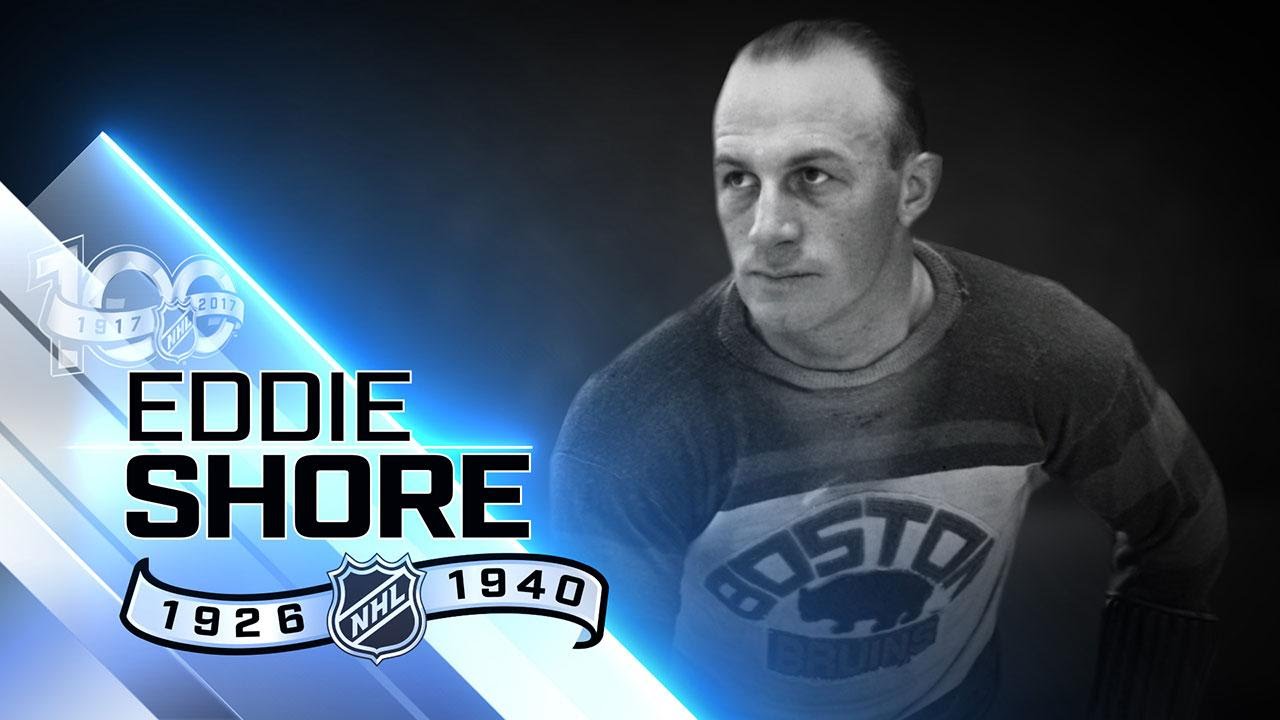
Travelling still isn’t easy, especially in poor weather, but back in 1929, Eddie Shore had a full-on adventure trying to get from Boston to Montreal for an important hockey game. Even though the trip took him over 20 hours, on January 3, he led the Bruins to victory over the Maroons.
The Boston Bruins took an overnight train to Montreal on January 2. A friend was driving Shore to North Station to catch the train when his car broke down. Shore tried to fix the car, but he only arrived in time to watch the train leave. As Shore later told Stan Fischler, “Mr. Ross didn’t know it, but I was running down the station platform trying to jump on the last car of the train. I didn’t make it and had just missed the train because my taxi had been tied up in a traffic accident coming across town.” Shore knew that he would be heavily fined by Bruins general manager Art Ross for missing the train and that his team was short on players thanks to injuries. “I knew I’d be in a jam if I blew that game.” Unfortunately, the next express train would not reach Montreal before the game, and all flights had been cancelled because of the Nor’easter sleet storm.
Shore’s only option was to drive over 320 miles to Montreal. He hired a car for $100 and left Boston at about 11:30. As Shore put it, “It was a lot of money, but I figured it would cost me twice as much if I didn’t show.” The winding roads through New Hampshire’s White Mountains were not highways or sanded/salted, and the sleet turned into a blizzard. Shore told his driver that he “was not happy at the rate he was traveling. . . . He apologized and said he didn’t have chains and didn’t like driving in the winter. The poor fellow urged me to turn back to Boston.” When the car almost skidded into a ditch, Shore took over the driving and stopped at a service station for tire chains. Back on the road, the wiper blades froze, and Shore recalled, “I had no visibility so I removed the top half of the windshield.” That left Shore’s face exposed to the elements but able to steer. As dawn approached, the car “began losing traction. The tire chains had worn out.” Fortunately, Shore saw lights (for a construction camp) and was able to get new chains. As Shore remembered the ride, “We skidded off the road four times, but each time we managed to get the car back on the highway again.” By the afternoon, Shore needed a rest. “I felt that a short nap would put me in good shape. All I asked of the driver was that he go at least 12 miles an hour and stay in the middle of the road.” However, the second pair of chains broke, and the driver crashed into a ditch in the Quebec countryside.
Since neither Shore nor his driver was injured, Shore hiked about a mile to the nearest farmhouse for help. According to Shore, “I paid $8 for a team of horses, harnessed the horses and pulled the car out of the ditch. We weren’t too far from Montreal, and I thought we’d make it in time if I could keep the car on the road.” According to his biographer, C. Michael Hiam, the farmer gave Shore and the driver a ride on the sleigh to the railroad station to catch a train to Montreal. Either way, about 5:30 p.m., Shore finally made it to the Windsor Hotel, where the Bruins were staying and where the NHL had been founded 11 years before.
When Shore staggered in, Ross assessed the scene. “He was in no condition for hockey. His eyes were bloodshot, his face frostbitten and windburned, his fingers bent and set like claws after gripping the steering wheel so long. And he couldn’t walk straight. I figure his legs were almost paralyzed from hitting the brake and clutch.” To recover, Shore had a big steak dinner and took a nap. “I was tired all right, but I thought a 20- or 30-minute nap would be enough, then I’d be set to play.” His teammates Dit Clapper and Cooney Weiland had trouble waking him again until Weiland poured several glasses of water on his face. Although Ross told him not to play, Shore insisted. Ross explained, “I knew how durable he was, but there’s a limit to human endurance. I finally decided to let him get on the ice, but at the first sign of weakness or sleepwalking I’d send him to the dressing room.” Instead, Shore played for 56 minutes, only stopping for his two penalties.
During the game, Shore drew the first penalty of night, a minor for charging Hooley Smith. He had another minor called on him in the third period. These four minutes amounted to half of the Bruins’ total penalty minutes for the game. On the other hand, the Maroons amassed 21 penalty minutes. About mid-way through the second period, Montreal had two men in the penalty box at the same time when Nels Stewart earned a major for cross-checking (and then was fined $50 for his remarks to the referee) and Hicks received a minor for holding. With a two-man advantage, Shore scored the only goal of the game. The Montreal Gazette described his play. “Shore blocked a Maroon attack and taking the puck down alone, picked his way through the Maroons one by one. Dutton shied him off to the side, and the big Bruin defenceman raced in behind Walsh’s goal and around to the other side where he flipped a backhander past the bewildered Maroon net minder. Shore was barely three feet from the left goal post when he let fly and Walsh had no chance to save.” Shore later told an interviewer, “I can remember exactly how my shot went. It was low, about six inches off the ice, and went hard into the right corner of the net.” The Gazette noted, “The Bruins won on a craftily planned offensive that made the most of every opportunity offered, back up by sound defensive play.” The paper credited Shore with holding off the Maroons in the third “last ten minutes of scraggy hockey.”
The game was the first complete appearance for Maroons goalie Flat Walsh, and the Gazette thought he played in “sensational fashion.” Although, the Gazette admitted, he was not as sensational as rookie Tiny Thompson, who earned his fifth shutout. The only puck to get past him that game was “disallowed owing to offside.” The Bruins went on to win their first Stanley Cup at the end of the season.
At the turn of the twenty-first century, two goalies each scored a goal before earning a shutout. On January 2, 1999, Damian Rhodes became the first NHL goalie to have both a goal and a shutout in the same game. Exactly two years later, in 2001, Jose Theodore matched him. The two goals were very different. Rhodes was credited as the last member of his team to touch the puck on a goal in the first period while Theodore himself sent the puck down to score an empty-netter as the game ended. They made 30 and 32 saves, respectively, to keep their opponents scoreless.
Damian Rhodes
In 1999, Damian Rhodes played for the Ottawa Senators, who, on January 2, hosted the New Jersey Devils at the Corel Centre for a crowd of 18,037. The Senators were already up by one in the first period when, as described by Allen Panzeri for the Ottawa Citizen, “with a hooking penalty about to be called on Senators defenceman Jason York and the Devils goalie Martin Brodeur on the bench in favour of an extra skater, Rhodes deflected the puck into the corner.” Devils defenseman Lyle Odelein “tried to send it to the point” but “the puck slid past” everyone else “before ending its long journey in the empty New Jersey net.” Ottawa coach Jacques Martin said, “It’s one of the few flukes you get. You don’t see too many of them, but we’ll take it. We’ve had our share of misfortune.”
Rhodes commented, “I probably couldn’t even shoot the puck all the way down the ice. It’s probably the only way I’m going to get a goal.” In almost identical circumstances, he had been credited with a goal ten years beforehand, on January 21, 1989, while playing for Michigan Tech. With this goal for Ottawa, Rhodes became only the third goalie credited with a goal during the 1990s (following Chris Osgood in 1996 and Martin Brodeur in 1997). Rhodes kept the puck as a souvenir. He was more excited about having earned his first shutout of the season and the ninth of his career. “As far as it goes, I’m paid to keep the puck out, not to score,” Rhodes reminded the press. “We’ve been really working for our chances. We not only got our chances, we got some bounces.”
Jose Theodore
The Senators scored two goals in each period to win 6-0. It was their third straight win though their record (18-13-4) was slightly worse than the Devils’ (21-10-4). The teams would have to face each other three more times in the same month.
In 2001, Jose Theodore was made the No. 1 goalie for the Montreal Canadiens when fellow goalie Jeff Hackett had a broken hand. On January 2, the Canadiens played the New York Islanders as Nassau Coliseum before a reported attendance of 7,916. During the first period, the Islanders outshot the Canadiens 13-9, but Montreal reversed that in the second by outshooting 16-5. Montreal scored one goal in the second period and another in the third when (with nine seconds remaining) Theodore became the first Canadiens goalie to score after the Islanders pulled their goalie, John Vanbiesbrouck.
Theodore described the play for the press. “It’s the first time I’ve ever scored a goal. I’m not the kind of guy you expect to score because I’m not known for using my stick. But when I go to my backhand, I can get some strength behind it. I was just trying to flip it out of our zone, but it was right down the middle. I thought one of the defencemen would catch up to it, but they didn’t.” His was the sixth goal scored by an NHL goaltender. The 3-0 win “snapped a four-game losing streak” for the Canadiens.
Additional Sources:
Allen Panzeri, “Senators stun Devils,” Ottawa Citizen, 3 Jan. 1999, p. 1B.
Pat Hickey, “Jose Does It All,” Montreal Gazette, 3 Jan. 2001, p. E1 and E3.
As the 1990s began, the world was changing in ways that had major impacts on international sports. The timing of the annual IIHF World Junior Ice Hockey Championship made it center stage for introducing these changes. As 1991 ended, the Soviet Union dissolved, and on January 1, 1992, its World Junior team changed its name to the Community of Independent States (CIS). Exactly one year later, Czechoslovakia separated on December 31, and at the game the next day, the combined team became Czech-Slovak. Neither team let the altered identities hold them back from medaling.
The dissolution of the Soviet Union coincided with the start of the World Juniors, held at Fussen, Germany on December 26, 1991. Out of the Soviet Union, the Commonwealth of Independent States (CIS) was formed. Its World Juniors team continued to use the name Soviet Union for their four December games, all of which they won (beating Switzerland 10-2, Sweden 4-3, Finland 4-1, and Germany 7-0. Then, on January 1, 1992, “the era of Soviet hockey officially ended” when the team changed names to the Community of Independent States. The arena lowered the Soviet flag, and the anthem was replaced with the International Ice Hockey Federation anthem. The team was able to keep their traditional jerseys for the tournament. Their coach, Piotr Vordhiov, told the press, “I think the reaction will be calm. I am sure nobody will leave the team.” However, he “had not informed the players of the change and refused to allow reporters access to the teenagers.” On the first day of the new year and new team name, they faced their only defeat of the tournament (losing 5-2 to Czechoslovakia). They went on to defeat team USA 5-0 and team Canada 7-2 to win the gold medal. The 1992-93 World Juniors was the first in which Russia competed as such.
Czechoslovakia was formed from separate countries in 1918 and divided again briefly during the Second World War. In 1989, they went through a nonviolent “Velvet Revolution” that ushered in a non-Communist government. However, this served to highlight some of the differences (especially political) between the formerly separate countries, and as a negotiated “Velvet Divorce,” they chose to separate into the Czech Republic and Slovakia. The split would go into effect on December 31, 1992.
By that time, the Czechoslovakian team had played four games at the World Junior Ice Hockey Championships in Gävle, Sweden in December, 1992. They lost to Finland 5-2, defeated the USA 6-5, lost to Sweden 7-2, and (on December 30) tied Russia 1-1. As the year ended, officials at the World Juniors, once again, lowered the flag of a country, this time Czechoslovakia, and replaced it with that of the International Ice Hockey Federation. Slovak goalie Igor Murin commented, “We are a team without borders.” For their next game, on January 1, 1993, the Czechoslovakian references on their jerseys were blacked out. They crushed Japan 14-2 on that January 1 game.
“That was very tough. At that time, we had a very tight group,” Pavol Demitra told IIHF.com in an interview published in May 2011. “I remember after the New Year, we’d won a couple of games, and then they didn’t play our national song anymore. That was very weird.” Demitra would lose his life just four months later in the catastrophic plane crash in Russia that killed the entire Lokomotiv Yaroslavl team of the KHL on September 7, 2011.
According to the Canada Press, “The Czech and Slovak players appeared to remain neutral during the historic event. They stood shoulder-to-shoulder and smiled for their official team picture.” However, coach Jan Sterbak told them, “The separation is not pleasurable but it is not a tragedy. The majority of the players regret it. It is the wish of the politicians and not hockey players.”
Their last two games were first on January 2, when they beat Germany 6-3, and finally on January 4th, where they won 7-4 against Canada.
Starting with the next World Juniors, the new Czech team would remain in Pool A, but the new Slovak team would have to work its way up from Pool C (which it managed in 1996). For that last World Juniors as a combined team, they earned the bronze medal.
“I remember that after we won the bronze medal, everybody sang the Czechoslovakian national anthem all together, and that was very special,” Demitra said.
Additional Sources:
Canada Press, “Players, coaches take breakup of Czechoslovakia in stride,” Vancouver Sun, 2 Jan. 1993, p. F3.
“Ice hockey,” Racine Journal Times, 1 Jan. 1992, p. 2B.
“Junior hockey team drops Soviet name,” Tampa Bay Times, 1 Jan. 1992, p. 2C.



 Prev
Prev