The Nashville Predators have a busy week with having to play three games in seven days. They’ll start the week with an afternoon game on the road and then have three consecutive games at home to close out the week.
1) Sunday, Jan. 13: Predators vs. Hurricanes- 12:30 p.m. ET
The Preds will visit the Carolina Hurricanes on Sunday and they better be prepared to work because this Hurricanes team can win games. The Predators should look to set the pace early in the game and establish the forecheck and cycle game. The team has had some struggles on the road this season so they’ll want to make sure that they play a consistent 60 minutes of hockey. Nashville needs to be aware of where Sebastian Aho and Teuvo Teravainen are on the ice at all times since they are the leading scorers for the Hurricanes. The Hurricanes don’t have the best home penalty kill so the Predators have to take advantage of that and get the power play going.
The Hurricanes should look to get the first goal of the game and build momentum from there with a solid forecheck game. The goaltending is going to have to come up big for the ‘Canes as the Predators are going to get chances in this game because they are too good of a team to not get some really good chances. The Hurricanes will want to watch out for the Nashville defensemen since they like to contribute on the offensive side of the puck whether making a stretch pass, joining the rush or getting a shot off with traffic in front. Ryan Johansen had been the Predators leading scorer for most of the season and he has been reunited with Filip Forsberg and Viktor Arvidsson, who are healthy after suffering injuries.
2) Tuesday, Jan. 15: Capitals vs. Predators- 8 p.m. ET
On Tuesday night, the Predators take on the Washington Capitals at home. The goalies both have decent career numbers against the Capitals so if the team wanted to rest Pekka Rinne then the backup, Juuse Saros, could start this game. The Predators need to come up with a plan to slow down Alex Ovechkin and Nicklas Backstrom, which could be to establish time in the offensive zone early. The sloppy play and mental breakdowns are going to need to be avoided in this game for the Preds or it could get ugly because the Caps know how to take advantage of opposition’s mistakes.
This game is a revenge game for the Capitals since they lost to the Predators on New Year’s Eve. The goaltending will need to be stellar by making saves all game long and not allowing any soft goals. The Predators power play hasn’t exactly lit it up this season, but the Caps would still like to avoid the penalty box. The Capitals need to win the battle at even strength in this game, if they want to get two points.
The Preds have a huge divisional game on Thursday night as the Winnipeg Jets come to town. When these two teams get together, it tends to be played like a pond hockey game and wide open. Roman Josi has 20 points in 22 games played against the Jets in his career, while Ryan Johansen has 24 points in 20 career games against the Jets. The Predators need to avoid the penalty box whenever possible since the Jets have the third best power play in the League. The biggest key to the game is finding a way to keep the balanced attack of the Jets in-check and that won’t be an easy task.
The Jets want to get off to a fast start and set the pace early on the road. They’ll want to play a solid even strength game since the Predators lack a good power play this season. The Jets should clog the neutral zone and not let the Predators get a transition game going because when they establish one, the Preds can be a dangerous team. The Jets need to have a lead after the second period with the Predators only having three regulation wins when trailing after two periods.
4) Saturday, Jan. 19: Panthers vs. Predators- 8 p.m. ET
The Predators close out the week with a home game against the Florida Panthers. They should be sure to not give any time and space to defenseman Keith Yandle since he has 23 power play points on the season. The Preds should avoid the penalty box since the Panthers have the fourth best power play in the League. The Panthers have been struggling of late, but the Preds want to make sure that they don’t play down to their opponent or overlook them. When Jonathan Huberdeau and Mike Hoffman are on the ice, you need to be aware of where they are and make sure a man has them covered.
The Panthers want to use their speed early in this game so they can get chances and possibly draw some penalties. The goaltending will need to be good in this one since the Preds can put the puck in the back of the net. The Panthers should try to make smart decisions with the puck and avoid turning it over especially in the neutral zone since the Predators are a good transition team. In order to stop that transition game of the Predators, the Panthers need to do a good job clogging up the neutral zone to slow down the Preds attack.
Preds Prey Weekly Prediction
The Predators will have a good week and go 2-1-1 getting points in three of the four games they play. They will manage to get regulation wins over the Hurricanes and Panthers. The regulation loss is going to come against the Capitals, but it will be a close game. The Predators will suffer an overtime loss to the Jets at home, which should be an entertaining, high scoring game.
During World War II, everyone tried to do their bit for the war effort. The Boston Bruins set aside proceeds from four games to raise money for the war fund of the Boston Metropolitan chapter of the Red Cross. In October 1942, the Army Emergency Relief Fund and the Navy Relief Society announced that they would not sanction sporting events to raise funds, but the local Red Cross obtained permission from the national chapter to accept. According to the Boston Globe announcement, “The players themselves will purchase tickets to gain admission, as will officials and the hockey writers.” With the extra motivation, the Bruins ended up winning all four games.
In their first game, on December 12, 1942, the Bruins defeated the Montreal Canadiens 3-2 and raised $6,296.
For the second game, on January 12, 1943, the “New Year’s night poll” set the start time at 8:15 (fifteen minutes earlier than their typical puck drop). That left time for Maj. Gen. Sherman Miles and Rear Admiral Wilson Brown, “top military men in this area,” to speak on “the vital role the Red Cross plays in the war.” Instead of the usual organ, the music would be played by the 40-piece Coast Guard Band of the Captain of the Port.
The Bruins wore Red Cross uniforms to play the Chicago Blackhawks. Perhaps they brought good fortune to the Sprout Line, who scored all of Boston’s goals and earned themselves seven points. Don Gallinger scored at 19:25 of the first frame, assisted by 16-year-old rookie Bep Guidolin and Jack Schmidt. Gallinger commented, “Maybe we’ve hit our stride now.” In the second, Guidolin served a penalty for high sticking and then, on his way out of the box, swept up a controversial puck for an unassisted goal at 8:35. The Blackhawks were adamant that the puck was offside, but the linesman said it hit a Chicago player before Guidolin picked it up and referee King Clancy claimed he missed the play. Less than three minutes later, Guidolin scored again, with assists from Gallinger and Schmidt. Guidolin, who had not scored in the past 15 games, said, “It felt good to score for a change.” Bruins goalie, Frank Brimsek, was due to experience the 100th goal scored against him but instead earned his first shutout of the season (26th overall). Brimsek, who had gone 43 games without a shutout, noted, “It wasn’t the toughest game of the season. It wasn’t exactly easy either.”
Ironically, in a game meant to help the Red Cross, Bruins captain Dit Clapper left the game in first period “when he twisted and hurt the end of his breastbone” and had to be x-rayed the following day. The Blackhawks Earl Seibert left three minutes before the game ended with a gash in his forehead.
At any rate, the Red Cross received $10,624.15 from 8,170 fans that game. According to Harold Kaese of the Boston Globe, this was a “decent showing, considering the OPA driving order, the Sunday game here with Toronto, and the fact that the Hawks are not a leading attraction in Boston.”
The third game, held on February 9, was the most highly anticipated and made the most money. The Bruins defeated the Toronto Maple Leafs 3-1 for $17,274.54.
Finally, on March 9, in the game reschedule from being the first to being the final, the Bruins crushed the New York Rangers 11-5 and raised about $11,077.
The grand total for the four games was $47,204, just shy of their $50,000 goal.
Additional Sources:
Tom Fitzgerald, “Bruins Will Play 4 Charity Games,” Boston Globe, 14 Oct. 1942, p. 19.
“Red Cross War Fund to Get About $70,000,” Boston Globe, 15 Oct. 1942, p. 25.
Tom Fitzgerald, “Bruins-Canucks Play for Red Cross,” Boston Globe, 12 Dec. 1942, p. 9.
Tom Fitzgerald, “Art Ross Says Bruins-Hawks Tilt Tonight Is Doubleheader,” Boston Globe, 12 Jan. 1943, p. 10.
Harold Kaese, “Two Bentleys and Hawks Face Bruins Here Tonight,” Boston Globe, 12 Jan. 1943, p. 26.
Harold Kaese, “B’s Stage Stiff, 10-Lap Workout for Reporters,” Boston Globe, 13 Jan. 1943, p. 14.
Tom Fitzgerald, “Bruins Now Lead by Four Points,” Boston Globe, 13 Jan. 1943, p. 16.
Harold Kaese, “B’s and Red Cross Win Spoils as Leafs Tumble,” Boston Globe, 10 Feb. 1943, p. 14.
Tom Fitzgerald, “Cowley’s 2 Goals Beat Leafs, 3 to 1,” Boston Globe, 10 Feb. 1943, p. 20.
Tom Fitzgerald, “Bruins Overpower Rangers, 11 to 5,” Boston Globe, 17 March 1943, p. 18.
Chuck Fletcher has had about a month to dissect the play of the Philadelphia Flyers as the team’s new General Manager, and he finally made his first trade. The trade was not a major one, but it could be the start of something bigger.
Fletcher traded center Jordan Weal to the Arizona Coyotes for a sixth round pick in the NHL Entry Draft and defenseman Jacob Graves. Weal was due to become an unrestricted free agent in the summer, and it was clear that he was not in the Flyers’ future plans. It makes sense for Fletcher to make a move and get something for the 26-year-old forward instead of just letting him go for nothing in free agency.
Weal has been a healthy scratch for most of this season, but in the 28 games played he had three goals, six assists and nine points. The forward only averaged 13:57 of ice time per game when in the lineup, but he was impressive on face-offs, winning 59.7% of the ones that he took. He was starting to get to see the ice with regularity once Scott Gordon was named the Flyers’ interim head coach, but the the numbers just weren’t there. It hasn’t helped that the Flyers have been terrible this year and he didn’t exactly get to play with the higher skilled players at times.
The forward was acquired by the Flyers on Jan. 6, 2016 when he was traded along with a third round Draft pick (Carsen Twarynski) by the LA Kings in exchange for forward Vincent Lecavalier and defenseman Luke Schenn. In four plus seasons with the Flyers, Weal played in 124 games, where he had 19 goals, 23 assists and 42 points while averaging 13:25 of ice time per game. His best season came during the 2017-18 campaign where he played in 69 games scoring eight goals and getting 13 assists for 21 points.
The biggest problem while he was with the Flyers was the fact that former head coach Dave Hakstol would play veteran players over Weal, even though Weal brought more to the lineup than those players did. It seemed like the only way that the center could get into a game was for there to be an injury, and once he managed to get on the ice, it was hard for him to stay there. Weal’s biggest problem while he was with the Flyers was consistency both in-game and game-to-game. He would disappear during games or try to do too much, which would sometimes lead to scoring chances or extended offensive zone time for the other team.
It may seem like he didn’t get a fair shot while with the Flyers, but this could be the fresh start that he needs to get going again. He will add some speed to the Coyotes lineup along with some good neutral zone play. Weal can setup his teammates or score some of his own goals created by his speed. The center can think of this as an audition for the summer when teams will likely be looking for a top nine forward that won’t break the bank.
If Weal can become a more consistent player overall and improve on the defensive side of the puck then he has a chance to get into the top six of a lineup, but even if he doesn’t do that he can still manage to be a productive bottom six forward. He can also be used on the power play should the Coyotes need any help on the man advantage.
Graves will be coming to the Flyers since the Coyotes already were at the maximum number of contracts allowed per team before the addition of Weal. The defenseman is 6’2” and 194 pounds. He spent his season playing for the Norfolk Admirals of the ECHL, where he compiled two goals, five assists and seven points in 32 games this season. Graves has a physical side to his game and will take some penalties.
The 23-year-old defenseman seems like he will be a depth defenseman for the Flyers should the injuries start piling up or call-ups to the NHL start happening. He was assigned to the Reading Royals, the Flyers ECHL affiliate earlier today.
This trade seemed like a good one for both sides since the Coyotes can see what Weal can bring to their lineup, while the Flyers were able to get something for a player that is clearly not in their future plans.
The Tampa Bay Lightning finally traded defenseman Slater Koekkoek so he can get a fresh start and some playing time with another team, which just happens to be the Chicago Blackhawks. The two teams also swapped 2019 Draft picks with the Bolts getting a seventh round pick and the Blackhawks getting a fifth round pick.
The 24-year-old has been a healthy scratch for most of the season, and only played in nine games so far this year. In those nine games, he has one goal while averaging 14:20 of ice time per game. Koekkoek was relegated to third pairing duties when he actually managed to get into a game. He became the team’s eighth defenseman on the defensive chart with the emergence of Erik Cernak in training camp.
Koekkoek is a mobile defenseman who can move the puck. He would be an option for the Blackhawks’ power play should they need one since he can move the puck with ease. One of his best assets is probably his ability to move the puck and make that stretch pass out of his own zone. The defenseman does need to work on his defensive coverage and improve his play without the puck, but if he can manage to see some ice time this could be the fresh start that he needs to prove himself.
He will be a restricted free agent at the end of the season. The Blackhawks can either try to reach a deal with him or not qualify him and then he would become a free agent in the summer. He will likely see some ice time with the Blackhawks since they will probably want to see what he brings to the table before deciding on if he is in the team’s future plans.
In return the Lightning are getting a 28-year-old defenseman who is struggling in his own right. Jan Rutta started the season with the Blackhawks but struggled a bit after having a good rookie campaign so he has been with the Rockford IceHogs of the AHL since December 14, 2018. In 23 games in the NHL this season, he only had two goals, four assists and six points while averaging 16:18 of ice time per game.
The Bolts are getting an older player with some NHL experience, who can be readily called up from the minors should someone get hurt and be out for an extended period of time. Rutta has played 80 games over the past two seasons and has eight goals, 18 assists and 26 points. He had a good rookie season, but then his play dropped off and he became a healthy scratch.
The Lightning are getting a player that has some size. He can be used on the power play since he has a good shot. Rutta can move the puck and contribute in the offensive zone. His defensive game needs some work but he may still be adjusting to the North American style of the game since he played most of his career overseas. If the Lightning decide to assign him to the Syracuse Crunch they would still be on the hook for $1.225 million of his salary counting towards the cap.
This was another minor trade that made sense for both teams. The Bolts now have a veteran call up option that has recent NHL experience and should be able to jump right into the lineup should they need it. The Blackhawks were able to get younger on the blue line and shed some more cap space in the process.
Back-to-back penalty-free games in Toronto when New York teams were visiting. Was everyone on their best behavior or were the officials lax? The news out of Toronto only cared that they were clean. It helped that the Maple Leafs won both games – against the Rangers on January 9 and against the Americans on January 11, 1941.
When the Rangers came to town, they put up a fight (without fighting). Both teams scored in the first period, and the Rangers took the lead in the second. The Maple Leafs tied up the score in the third, so the game went into overtime. The Maple Leaf Garden crowd of 10,556 surely enjoyed watching Syl Apps score the winning goal. The 3-2 finish for the Leafs made this the second overtime victory in three nights. From Toronto’s recap, the New York Daily News printed the line, “Though hard fought, the battle was the first of the season free from penalties.”
Two nights later, the other New York team, could have used some power plays to give them an extra-man advantage. The Americans held off the Maple Leafs for almost six minutes. Then the 10,326 fans watched as the home team scored two goals in the first period, four in the second, and three more in the third. According to the recap, “The Americans new brand of hockey, streamlined, was a total failure, as the New Yorkers were continually hung up in Toronto territory while some Leaf stole the disk for a solo charge on poor Earl Robertson.” The game ended in a devastating shutout of 9-0. The newspapers noted, “The battle may not have been hard-fought, but it was clean. For the second successive time on this ice, a NHL game was played without any player penalties.” Fortunately, the Americans did not have to stick around but flew home that night for a matchup against the Rangers back in New York.
On January 9, Bert McCaffrey, a former NHL defenseman, refereed the game without calling a penalty. He then, on January 11, served as linesman under referee King Clancy, a more-famous former NHL defenseman. McCaffrey played for Toronto teams from 1924 to 1927 and then for two seasons each with the Pittsburgh Pirates and Montreal Canadiens. He was perhaps best known for his role in winning Canada the gold at the 1924 Olympics in Chamonix, France. As for Clancy, he played for the Ottawa Senators from 1921 until 1930 and then for the Maple Leafs from 1930 until his retirement in 1936. Although short, Clancy was tough, and he did not shy from checks and fights, often instigating with comments. In his final playoffs, he helped the Leafs win by telling Boston Bruins Eddie Shore that the referee was unfair. An enraged Shore “fired a puck at the ref, earning a 10-minute misconduct,” during which time the Leafs scored four goals. With their reputations as tough guys, were these officials letting things slide or did the Toronto and New York teams really play clean games back-to-back?
This was by no means the same type of game the Bruins played in Washington in the season opener on October 3, 2018, where they fell 7-0 and basically didn’t show up. No, if you were looking at the number of shots on net and how the Boston Bruins were doing in the faceoffs and other statistics, you would have assumed they won the game. However, they fell for the 14th time to the Capitals on Thursday night, January 10, 2019, in the second of the three games they will play against Washington.
Braden Holtby protects Capital’s net (Photo: Alan Sullivan)
Of course, Braden Holtby was in net for the Capitals, and when it comes to the Bruins, he has almost been a form of kryptonite to them. They definitely tried to solve him on Thursday. When the teams went into the the first intermission, Boston had fired 17 shots on Holtby and had nothing to show for it. Unfortunately for them, the Washington Capitals, while only having five shots on Jaroslav Halak had a goal on the scoreboard—the result of a breakdown by the Bruins in the offensive zone that allowed Jakub Vrana a breakaway opportunity on which he capitalized. By the end of the game, the Bruins outshot the Capitals 17-5 in the first, 11-7 in the second, and 13-10 in the third, but lost the game 4-2.
Ryan Donato, even strength, and David Krejci, on the power play, would manage to tie the game twice, only to have the Capitals regain the lead. Alex Ovechkin responded 39 seconds after Donato’s goal in the second period and Nicklas Backstrom regained the lead 1:09 after Krejci’s goal in the third.
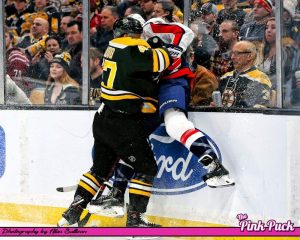
Torey Krug with a big hit (Photo: Alan Sullivan)
“I thought we certainly gave ourselves a chance to win the game, didn’t happen again against this team. So, have to get over that hurdle. A lot of nights that would be good enough for a point, if not two points, but not tonight,” shared Bruins Head Coach Bruce Cassidy. “First of all, it starts with defending well because they’re a very good offensive team. We did that for the most part. We, again, gave up some quality chances, but it wasn’t a lot of quantity. Obviously, another save, the difference-making play in the game. It’s 2-2. We get that save and come down, who knows how long it goes. That could’ve made a difference. We got some saves after that, but we weren’t able to put one by him to get the equalizer. Usually that play that makes a difference in a close game. They made it.”
There were a lot of hard hits, some pushing and shoving and words exchanged after the whistles, and not surprisingly Lars Eller was looking for some retribution from Brad Marchand for the October 3rd game when Marchand basically forced Eller to drop the gloves. Eller tried to get Marchand to go about 7:30 of the second period when the Capitals were up 1-0. Marchand chose not to reciprocate, keeping his gloves firmly on his hands. This resulted in Eller going off to the penalty box for unsportsmanlike conduct and gave the Bruins a power play—which they were unsuccessful on.
Lars Eller (Photo: Alan Sullivan)
“Obviously he didn’t want any part of it and everybody saw. You can’t fight a guy who doesn’t want to fight. Everybody saw what he is. I don’t know what else to say, I mean, we got out of here with two points. We got what we wanted,” said Eller.
“It’s a one-nothing game and to go on the power play in a situation like that, I don’t feel I need to prove anything to that guy,” Marchand said.
Marchand’s coach, of course, was pleased that his top line left winger showed restraint.
“Well, there was obviously some bad, some leftover residual effect from the previous game, but I think [Marchand] recognized the situation. We’re trying to win a hockey game. You take care of business, as [Marchand] did, when the game was basically decided last time. So, I thought he did – showed very good discipline. Did what he needed to do for the team to help us get on the power play, and unfortunately, we weren’t able to cash in,” Coach Cassidy said.
In the end, this was not to be the game to break the losing streak against the Capitals for the Bruins. However, Holtby recognized the efforts he saw from the team in black and gold.
“Yeah, I mean, they worked to generate what they got, and obviously power plays were where they got probably their best opportunities, but I mean, I guess with shot totals, goals, you can never really tell, but it’s two good teams, and you know, probably tonight, they deserved to win just as much as we did. That’s how good the game was, and that’s fun hockey to play,” he said.
The Bruins need to put this one behind them because they will be playing on the road Saturday night against another team that is doing well—the Toronto Maple Leafs. While the Bruins fell 4-2 to the Capitals on Thursday, the Leafs won 4-2 over the New Jersey Devils on Thursday and go into Saturday’s game with a 7-3-0 record in their last ten games. They also sit in second place in the Atlantic Division ahead of the Bruins by four points with a game in hand.
Moving from the Pittsburgh Pirates to the Philadelphia Quakers only gave the NHL one of the worst teams in its history. The Quakers only lasted one season, 1930-31, partly due to having a 15-game losing streak, the second-longest ever in the NHL. They finally snapped the streak on January 10, 1931, when they defeated the Montreal Maroons in overtime.
Until that point, the only game the Quakers won was on November 25, when they defeated the Toronto Maple Leafs 2-1. They lost the next game, on November 29 (a 6-3 loss against the New York Rangers), and every other game through January 8 (a 4-0 loss to the Chicago Black Hawks).
Philadelphia hosted its first victory in sixteen games. Montreal drew first blood, but the Quakers answered before the first period ended. In the second period, the Quakers gave themselves a nice lead by scoring two more goals, and then the Maroons could only manage one. Then about four minutes into the third period, the Quakers’ rookie goalie, Wilf Cude, was “stricken down and carried from the ice. In a fierce scrimmage in front of the net he was upset and fell on his shoulder, causing a hemorrhage underneath the collarbone.” Although recovering from the flu and fifteen pounds underweight, their senior goalie Joe Miller suited up. Facing a barrage of shots from the Maroons, Miller only let in one. At 13:43, while the Maroons were on a power play, a puck “bounded off his shoulder and caromed into the net.” The teams being tied at 3-3, they had a 10-minute overtime period. The Quakers scored at 5:20 and won the game 4-3. For the Philadelphia Inquirer, Stan Baumgartner poetically wrote, “As the fiercely driven rubber burned its way into the twine it snapped a losing streak which had reached fifteen straight and turned a meek downtrodden team into a proud fighting machine.”
The moment of victory would be brief. On January 13, the Quakers lost to the Montreal Canadiens (2-1). Philadelphia only managed two more wins, both against the Detroit Falcons (later renamed the Red Wings), on February 17 and March 12. Their abysmal record (4-36-4) made the Quakers one-season wonders.
Additional Sources:
Stan Baumgartner, “Quakers Triumphant in Overtime Tussle,” Philadelphia Inquirer, 11 Jan. 1931, p. S1 and S5.
In a game that is decided by how many more goals one team scores over the other, it is often easy to lose sight of the little details that a player may do that actually contributes to his teammates making those important goals. Those little details usually don’t show up on the stats sheet in the form of goals or assists. Recently one player has been able to do that in addition to making a couple of critical goals.
Sean Kuraly was acquired, along with a 2016 first round draft pick (which saw the Bruins take Trent Frederic) from the San Jose Sharks for Martin Jones on June 30, 2015. The Lewiston, New York native was originally drafted by the Sharks in the fifth round (133rd overall) of the 2011 NHL Entry Draft. Kuraly is playing in his second season of the NHL and has found a solid spot for himself on the fourth line of the Bruins along with Noel Acciari and Chris Wagner. The three of them are sometimes called the energy line, and they are most definitely a grinder line.
Sean Kuraly gets some info from Noel Acciari (Photo: Alan Sullivan)
“I think a lot of it’s that [communication and chemistry] and playing together for a few games, for a while now, and I know how Noel [Acciari] plays and have learned how [Wagner] plays and they both work really hard and that’s kind of like a staple of what we want on our line and it’s been fun to play with them and I think the reason for a lot of our success is each other,” Kuraly shared. “And on a line like ours we kind of need three guys to all be doing their job and it kind of depends on all three of us, so, we know that, and we come in every night and the best thing about that is we’re kind of trusting that the other guys are going to do their job and no one is trying to do two jobs. That’s when we get in trouble, when guys try to do too much because our nature is to just work.”
The Bruins are a team built on blue-collar work ethic, and do their best in a season when they can count on their fourth line to contribute offensively. And recently that has been the case. For Kuraly, who will turn 26 later this month, he recently had two important game-winning goals. The first during overtime in Buffalo against the Sabres on December 29, 2018 and the second was the third goal for the Bruins during the 2019 Winter Classic on New Year’s Day against the Chicago Blackhawks which was played at Notre Dame Stadium in South Bend, Indiana. For his linemate Wagner, this meant having to score the first goal of the game twice, when his first attempt was waved off and, upon review, disallowed 20 second into the game on Saturday, January 5, 2019, when the Bruins this time played host to the Buffalo Sabres. Wagner would score again at 10:10 of the first to put the Bruins on the scoreboard first.
In his last five games, Kuraly has played an average of 23 shifts per game, with an average TOI of 16:30. This is an increase of almost five shifts per game and an additional 3:13 ice time. Such increases speak to the confidence Boston Bruins Head Coach Bruce Cassidy has in his fourth line, and in Kuraly.
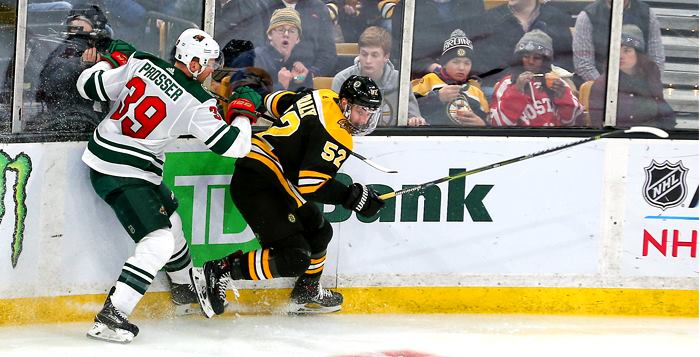
During the Bruins 4-0 shutout over the Minnesota Wild on Tuesday, January 8, 2019, Kuraly saw time on the penalty kill which kept the Wild from making any shots on net throughout their three power plays. Throughout the feisty forward made three shots on net, had two blocked by Wild players, and one missed shot. While he did turnover the puck once, he offset that with two takeaways. He also blocked a shot from the Wild and was 50% in the faceoff.
Sean Kuraly (Photo: Alan Sullivan)
“I was really just trying to play, and I think I’m making some mistakes that maybe I wouldn’t but I’m also making some better plays than I would. I’m just trying to live with the bad that’s going to come with a lot of the good and luckily the staff and the team is letting me play like that and I think they’ve seen that it’s better for the team to kind of just go on my toes and keep going and, yeah I’ve just, yeah just go and play and kind of be myself as a player. Usually it works out, like sometimes I feel like I’m turning the puck over, but I just keep going and sometimes I’ll get it back, so it kind of works itself out,” he said of his recent on-ice play.
Not only does he appear to have confidence in himself, but his head coach does as well, and his teammates are recognizing what he has been doing of late.
“I think your teammates kind of take care of you when you have some moments like that, and it definitely feels good when our top guys are noticing and are vocal and communicate with you that you’re helping the team win and contributing. And as a guy that doesn’t always score, it feels good to be able to help the team win,” he told The Pink Puck.
Along with confidence for Kuraly has come a better understanding of his own strengths on the ice and the importance of not overthinking when he’s taking a shift.
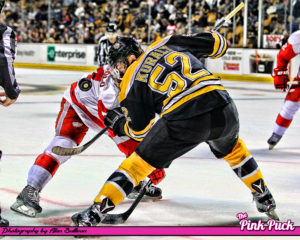
Sean Kuraly wins a draw against Kyle Criscuolo (Photo: Alan Sullivan)
“I’m thinking about it less. I’m kind of just trusting my instincts and trusting my game, that if I play hard and play like myself, you know, really my game is hard and that’s how I like to play and I feed off that. So when I let myself play like that, it kind of just takes care of it and I’m just kind of telling myself going into games that, just be myself as a player and everything else kind of takes care of itself, which it kind of has,” he explained.
For quite some time this season the Bruins were a one-line scoring team, with goals only from their top line. The secondary scoring that has been coming, especially from Kuraly and his linemates, makes Boston a formidable team. And right now Kuraly’s line with Acciari and Wagner has helped the Bruins to a season-high five-game winning streak.
“First off, is both of their work ethics and they both finish really well on their checks and go through their body and create some space and they both play downhill and they like to be F1. [Wagner], you’ve seen he can finish and plays well in the o-zone and finds good spots on his forehand side. I think a lot of times he finds good spots offensively and [he’s] just super responsible defensively. And [Acciari], I think a lot of the same. I think Noel is smart, he’s really smart. I don’t think he gets enough credit for how smart he is and kind of in the right spots and he’s patient. I think he brings probably the most patience and timing to our line,” Kuraly said of his linemates.
Yes, Kuraly had two timely goals, but it’s his ability to play a fierce game full of blocked shots, hard hits in the corners, and solid offensive zone time that is helping him to contribute in many ways during each of the Boston Bruins recent victories. He’ll be the first to admit that he has things to work on, but in recent games he has been able to overcome any mistakes he has made and helped his team to take the win.
The NHL had just formed and begun to play when, on January 9, 1918, President Frank Calder announced an important rule change that would have a lasting impact on the game. From that point on, goaltenders could move however they like to block a shot.
Until then, goalies were penalized for dropping to the ice and had to sit out for three minutes, leaving their team to scramble for a replacement netminder. Referees knew how much delay this could cause and were reluctant to make the call. In early 1918, the worst offender was Ottawa Senators goalie Clint “Praying Benny” Benedict, who often dropped to his knees to block. Benedict knew his moves were against the rules so, he explained, “if you made it look like an accident, you could get away without a penalty. I got pretty good at it.”
However, the leader in the push for the rule to change was Art Ross, who had just folded his Montreal Wanderers. He was friends with the Patrick brothers, whose Pacific Coast Hockey Association had allowed goalies to drop for some time, and followed their lead with his amateur Art Ross Hockey League. Mere days before the NHL began playing in December 1917, Ross proposed that the NHL “allow the goal-tender to take any position he wishes in stopping a shot – to bite the puck, if necessary.” After all, every other player on the ice was already allowed to “go into the nets and get down on his knees or elsewhere.”
A mere three weeks into the NHL’s inaugural season, Calder announced the official rule change. “Section 13 of the rules, and that portion of Section 9 dealing with the goalkeeper, are hereby deleted, thus permitting the goalkeeper to adopt any attitude he pleases in stopping a shot. Please be governed accordingly.” Calder clarified that this rule change would “help the entire league, the public, the teams, and the officials. Very few of the teams carry a spare net-minder, and if the goaler is ruled off it means a long delay in equipping another player, and in a close contest, would undoubtedly cost the penalized team the game. The old rule made it hard for the referees, so everybody will be helped.” Perhaps the most legendary comment Calder made at the time was, “In the future, they can fall on their knees or stand on their heads, if they think they can stop the puck better in that way than by standing on their feet.”
This was the first rule amended in the NHL and caused the amount of goals per game to dramatically decrease (from an average 12.2 goals a game to 8.9).
Decades later when Glenn “Mr. Goalie” Hall pioneered the butterfly style, goalies still were not encouraged to drop to the ice. Hall said, “They often called me a flopper. I’d get upset with that. I was the opposite of a flopper. I was under control.” He considered himself a standup goaltender that played in a crouch. By January 9, 1992, Dominik Hasek was throwing himself all over the place to stop the puck and earned his first NHL shutout. Hockey today would look quite different without the ability for goaltenders to move as they wish when blocking shots.
Additional Sources:
“Goalers in N.H.L. Can Now Lay Down in the Nets,” Ottawa Journal, 10 Jan. 1918, p. 8.
“Art Ross Wants the Hockey Rules Changed,” Ottawa Journal, 17 Dec. 1917, p. 12.
Bob Duff, The First Season: 1917-18 and the Birth of the NHL (Ontario: Biblioasis, 2017).
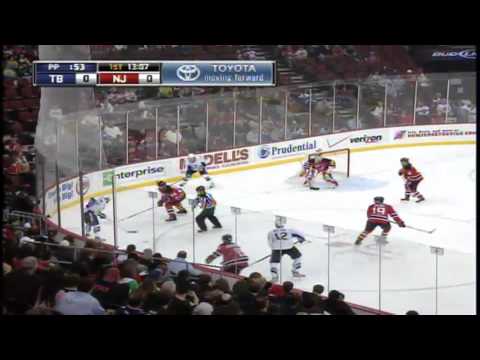
It was Friday, January 8, 2010 at the Prudential Center in Newark, and everything was normal for the first half of the game between the New Jersey Devils and Tampa Bay Lightning. The latter had just scored their third goal while the former had yet to get on the board. Then, at 8:18 pm, as the teams prepared for a faceoff outside New Jersey’s zone, the lights at the Edison Street end of the arena went out.
As the arena tried to fix the problem, the players first waited on their benches, then skated laps to keep loose, and after eight or nine minutes were sent to their locker rooms by officials. At 9:37, the referees left to speak with the coaches and general managers. Devils GM Lou Lamoriello explained, “A circuit breaker went down. They found which one it was and they could not get the computer to work with the circuit breaker.” He continued, “We tried our darndest to get this game in. We waited as long as we could.” Meanwhile, the fans were literally left in the dark without any announcements and began booing after an hour and a half. Devils coach Jacques Lemaire said, “We all looked at the ice the way it is with the lighting that we have right now and, to all of us, it would be dangerous to keep playing.” When Lightning GM Brian Lawton joked that they would accept a forfeit, he officially said, “Things happen. Obviously the Devils feel terrible about it. It’s tough on the fans, obviously tough on players and coaches. Sometimes things happen out of control.” Finally, a little after 10 pm, NHL commissioner Gary Bettman decided to postpone the game “due to concerns for the safety of the players and the officials.” They would reschedule picking up the game where it left off midway into the second period with the Lightning leading 3-0.
On Saturday night, the Devils played at the Bell Centre in Montreal, where they defeated the Canadiens 2-1. The Lightning played in Philadelphia and lost to the Flyers 4-1.
Both teams and about 3,000 of the 15,000 plus ticket holders returned to the fully-lit Prudential Center on Sunday evening. Resuming the game at 6:10 pm, the teams had had a break of 45 hours and 52 minutes. Mike Smith returned to Tampa Bay’s net, but Yann Danis took over New Jersey’s for Martin Brodeur. Having only a period and a half, the Devils could not catch up to the Lightning. Devils coach Jacques Lemaire commented afterwards, “We were rushing all the time. We had to rush to try to get the game going, get in their zone and get some plays because we knew that there was only a period left. It was weird.” The Devils scored in the third before and after a final goal by the Lightning to lose 4-2 in what the Hackensack Record called “one of the strangest – and longest – games in the team’s 27 ½ year history.” The game that began at 7:08 pm on Friday finally ended 48 hours later at 7:15 pm on Sunday.
Additional Sources:
Tom Gulitti, “Lights out! NHL ‘postpones’ Devils,” Hackensack Record, 9 Jan. 2010, p. S1 and S6.
Tom Gulitti, “Devils light on offense,” Hackensack Record, 11 Jan. 2010, p. S1 and S8.







 Prev
Prev