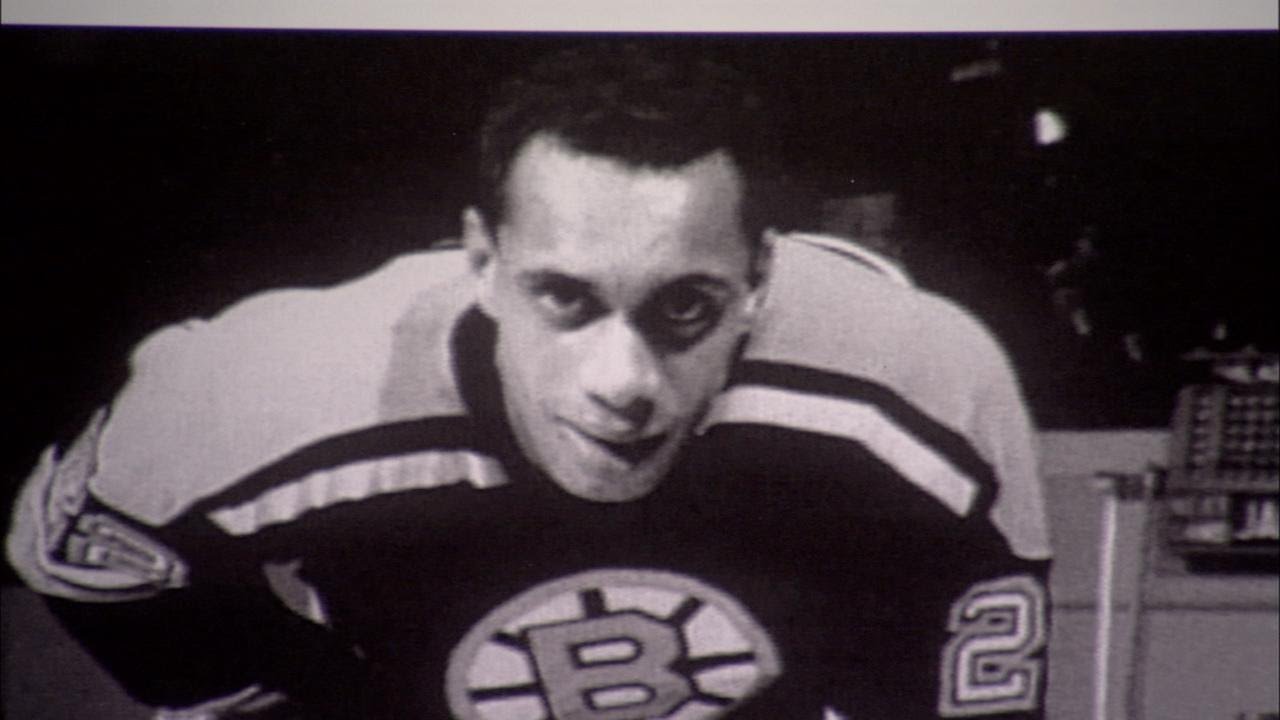
Two athletes – Willie O’Ree and Jackie Robinson – tied together by their accomplishment in breaking color barriers, actually met at least twice. At 14, O’Ree told Robinson how much he loved hockey, and 13 years later, after O’Ree played professionally, Robinson remembered their first meeting. “It was the media that gave me the name the Jackie Robinson of hockey,” O’Ree later said. “It makes me feel good.” On January 18,1958, 11 years after Robinson joined Major League Baseball, O’Ree first played in the NHL.
Although O’Ree had played the last two seasons with the Quebec Aces of the Quebec Senior Hockey League, getting hit with a puck had cost him 95% of vision in his right eye. The left wing had not even told his parents about the vision loss, so only his sister and friend knew. “At first, I had a little trouble and I finally said, ‘Willie, forget about what you can’t see. Concentrate on what you can see.’ Once I started doing that, my game began to pick up.”
Without knowing about his eye, the Boston Bruins called up O’Ree to debut in back-to-back games against the Montreal Canadiens. The Canadiens had just defeated the Bruins in the Stanley Cup finals and in eight consecutive matchups. According to O’Ree, “When I stepped on the ice on Jan. 18, 1958, we were playing the Montreal Canadiens in Montreal. We beat the Canadiens 3-0, then we got on the train and went to Boston. The Canadiens beat us 5-3 [6-2] and then I left. I was just there for the two games.” In fact, O’Ree commented, “To me, I didn’t know I was breaking the color barrier until the next morning when I read it in the paper.”
The Boston Globe did mention that this was the “first time a Negro hockey player has ever appeared in an N.H.L. game.” Before the game, teammates teased O’Ree for the large number of telegrams he received (mostly from New Brunswick) wishing him well. In the Montreal game, Milt Schmidt split O’Ree’s shifts to “ease the pressure.” The Globe claimed, “He had one excellent chance in that game when he was sent in alone with a pass from McKenney, but was robbed by goalie Jacques Plante.” Little good did that do for Plante as Johnny Bucyck, Larry Regan, and Bronco Horvath scored on him, one each period. Bruins goalie Harry Lumley, purchased from Chicago the week before, earned the shutout.
The next night, both teams relocated to Boston. According to the Globe, “Boston fans constantly shouted encouragements to O’Ree on his appearances last night, although he did not see much action in the later stages.” The paper described one of his plays. “In the early minutes last night, McKenney again fed Willie a good leading pass, but he fired into the goalie’s pads as Plante moved to meet his bid.” That game, the Canadiens came out on top winning 6-2.
With two players returning to their lineup, the Bruins returned O’Ree to the Quebec Aces following the two games. However, he was still one of two black players (the other being Stanley Maxwell) who the Bruins had been grooming since training camp. Bruins GM Lynn Patrick commented, “He’s a very fast skater, but there are some things he naturally has to learn yet.” Even the opposing Canadiens GM Frank Selke noted, “O’Ree is not only fast, but he’s a strong skater. He looks as if he could go all night. I know he always has played well in the Forum when he’s been in with Quebec.” As for O’Ree himself, he commented, “I’m just happy to get a chance up here, that’s about all I can say.” He also told the Globe, “I’ll never forget this. It was the greatest thrill of my life.”
That was not the end of O’Ree’s NHL career. During the 1960-61 season, he played 43 games (4G, 10A, 14P) with the Bruins. Although he was then traded to Montreal, he played his remaining 13 seasons in the Western Hockey League before retiring in 1979. Beginning in 1998, O’Ree became the NHL’s “diversity ambassador,” “director of youth development for the League’s diversity task force, encouraging boys and girls from diverse backgrounds to play hockey.” O’Ree said, “Hockey has opened up for everybody. I can see more [black] players coming in. A lot has changed and that’s good.” NHL commissioner Gary Bettman gave a statement that “Willie O’Ree has devoted his life to our sport and our young people, to diversity and inclusion. His words of encouragement, and the life lessons he has taught, have inspired thousands not only to play hockey but to incorporate our game’s values and ideals into their lives. We marvel at Willie’s strength and his courage, at his willingness to blaze a trail for future generations of players, and we are honored by his continuing presence as a role model, mentor and ambassador for our sport.”
O’Ree and Bettman, along with Martin Brodeur, were inducted into the Hockey Hall of Fame in 2018. As the third black athlete inducted, O’Ree was honored as a Builder.
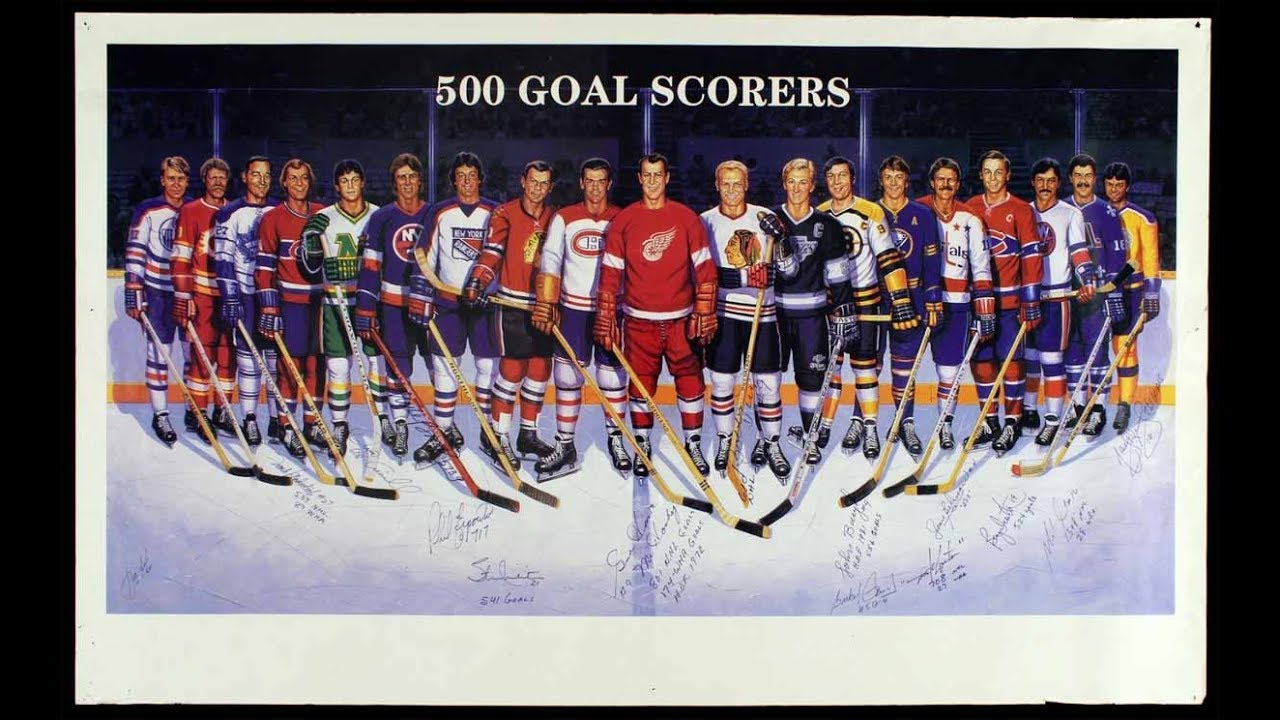
Exactly seven years apart, two NHL stars each scored his 500th goal. On January 17, 1996, Steve Yzerman became the 22nd to reach that milestone, and in 2003, Joe Nieuwendyk became the 32nd.
Although the two centers managed the same feat on the same date, the only other thing they had in common was that their teams won by one goal that night. Yzerman captained the Detroit Red Wings to a 3-2 win over the Colorado Avalanche, and Nieuwendyk’s New Jersey Devils defeated the Carolina Hurricanes 2-1.
For Yzerman, he found it particularly special to celebrate at Joe Louis Arena in Detroit, where 19,983 fans “erupted in a way normally reserved for an overtime playoff goal.” It also just happened to be the Avalanche’s first time playing there. Whereas, Nieuwendyk scored his milestone goal away at Raleigh.
During each game, Yzerman scored the second goal of the game at 7:52 of the second period while Nieuwendyk scored the first goal of the game at 11:18 of the first period. On a power play, as the Detroit Free Press described it, “Yzerman circled to the slot while linemate Greg Johnson dug the puck off the boards over goalie Patrick Roy’s left shoulder. Roy used his pad to reject Yzerman’s shot from close range. But the rebound bounced toward Yzerman, and he backhanded the puck into an open net.” Yzerman reminisced, “You know, my first goal was kind of like that, too, sort of a rebound and a backhand.” As for Nieuwendyk’s goal, the Hackensack Record noted, “It started when he picked off an errant pass by Carolina’s Glen Wesley along the right wing boards in the neutral zone. Nieuwendyk moved from his right to left as he carried over the Canes’ blue line and went around defenseman Sean Hill in the left circle before cutting hard to the net. After deking Kevin Weekes on his forehand, he pulled the puck to his backhand and reached around the Carolina goaltender to deposit it in the net.” Nieuwendyk explained, “I caught the puck in the neutral zone in strike and I knew I had an opportunity to break in. I hadn’t made up my mind what I was going to do until the last second, but when I saw it go in I was extremely happy.”
In celebration, Yzerman “raised his stick over his head – as he had 499 other times in his 13-year career.” Nieuwendyk only reacted with a “slight pump of his arms,” saying, “That’s probably about as animated as I’ll get.” Just as Yzerman felt “simply happiness,” Nieuwendyk was “awfully pleased” because “it’s a big thrill.” According to Yzerman, “I didn’t feel relief at all because I’ve been enjoying all the buildup leading up to it the last couple of weeks.” When their teams mobbed them to celebrate on the ice, Yzerman smiled widely while Nieuwendyk yelled at them to “get back on the bench.” However, Nieuwendyk later commented, “That was quite a scene, all those guys coming out there like that. That was awfully nice of them.” He also planned to keep the puck, stick, and game sheet for his son, which he said would “be something they’ll keep forever.”
It was Yzerman’s 19th goal of the season. Nieuwendyk began the season six goals away from 500 but had a 20-game drought. It had been four games since he scored his 498th and 499th goals (on January 7).
Both players had long careers. Yzerman played for Detroit through 22 seasons, and he was only the seventh player to score all 500 with one team. Meanwhile, Nieuwendyk played on five different teams throughout his 20 seasons. His 500th was during the only full season he played for New Jersey. Yzerman’s 500th came during game 906 of a career total of 1,514 regular-season games. Nieuwendyk took 1,094 games of his career 1,257 to reach 500. The former ranks 9th on the all-time goals list while the later is tied for 23rd. The two were inducted into the Hockey Hall of Fame two years apart, 2009 and 2011, respectively.
Additional Sources:
Keith Gave, “500 for the Captain,” Detroit Free Press, 18 Jan. 1996, p. 1D and 5D.
Mitch Albom, “It’s the best kind of applause – for one who deserves it so,” Detroit Free Press, 18 Jan. 1996, p. 1D.
Tom Gulitti, “Devils Celebrate Joe’s 500th,” Hackensack Record, 18 Jan. 2003, p. S1 and S3.
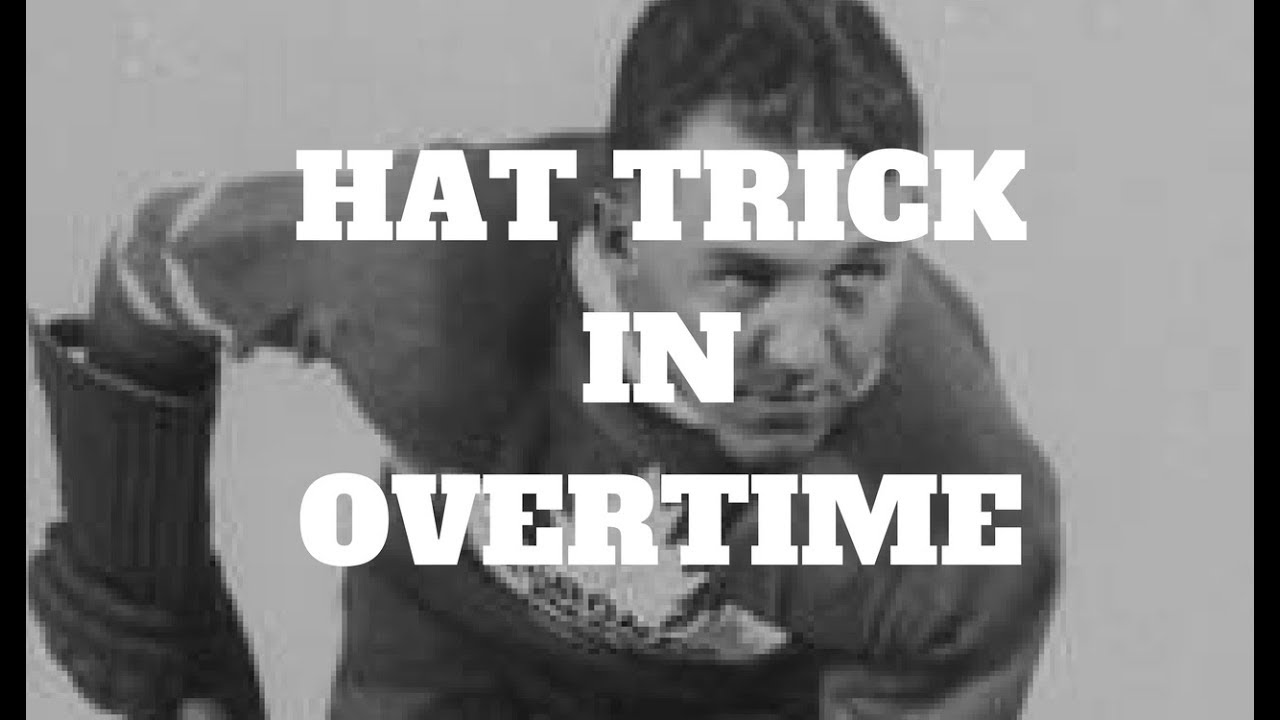
Only one NHL hat trick has been scored in overtime, and it happened to be the only NHL hat trick scored by Ken Doraty. Until the NHL suspended overtime play during World War II, a tie at the end of the third period called for an entire 10-minute additional period. Doraty was able to put all that time to good use when his Toronto Maple Leafs played the Ottawa Senators on January 16, 1934.
Doraty, a “diminutive right winger,” played professional hockey in various leagues between 1923 and 1939, but he only spent five seasons in the NHL. After playing for the Chicago Blackhawks for their inaugural season, he spent the early 1930s with Toronto. His final NHL games were with the Detroit Red Wings during the 1937-38 season. In all, Doraty played 103 NHL games scoring only 15 goals and 26 assists for 41 points.
The highlight of his entire career seems to have been January 16, 1934, when the Maple Leafs visited Ottawa. According to the Ottawa Citizen, the audience of 8,000 was the largest of the season. After a scoreless first frame, the Senators scored twice in the second. During the first five minutes of the third period, the Maple Leafs were able to tie up the score. Then Ottawa again pulled ahead by two goals. About three minutes later, Toronto scored again and a final time fifty seconds after that. Tommy Shields wrote for the Ottawa Citizen, “It was fast, wide-open hockey from start to finish, with plenty of spirit being shown by both teams.” When regulation time expired, the teams were tied 4-4.
To attempt to break the tie, the teams took the ice for another 10 minutes. In the very first minute, Ottawa’s Earl Roche was called for boarding Doraty. The power play gave Doraty the advantage, and he scored twice in just 45 seconds. On the first goal, Hec Kilrea got the puck, and Doraty pushed it through Ottawa defenseman Bowman’s feet and “under [goalie] Beveridge’s toe.” The same line earned the second goal, which was “rifled home by Doraty from short range.” The Ottawa Citizen described the final goal of the game. “With slightly more than a minute remaining to play, Kilrea broke away again, passed to Doraty to evade one of the forward-defence players on for Ottawa, and the little fellow jammed it home to bring the total to 7-4.”
In Washington, D.C. on January 15, 1990, general manager David Poile decided the Capitals needed a change. Their coach, Bryan Murray, had just celebrated his 300th win (one of only seventeen coaches to reach that milestone). Bryan had begun coaching the Capitals back in 1981 and brought them to their first playoffs. Though they made the playoffs every season, they never advanced beyond the second round. Joining Bryan was his younger brother, Terry Murray, who played his final NHL season with the Capitals in Bryan’s first season as their coach. Then Terry worked as assistant coach under Bryan until 1988, when he was given the head coach position of the Capitals’ AHL affiliate team, the Baltimore Skipjacks.
The 1989-90 season began slowly but improved until the Capitals reached first place in the Norris Division. Multiple injuries took their toll and plummeted the Capitals down to last in their division, and they had lost the eight games leading up to January 15. Bryan commented, “It’s a very disappointing thing. We were in first place, and then we get five guys hurt. It’s pretty tough to win without your team leaders. That’s what’s so frustrating.” In Poile’s point of view, he said, “I felt we needed a change. We just didn’t have the consistency we should have. Not one player during the last eight games stood up and became a team leader.”
That change came in the form of Poile firing Bryan and replacing him with his brother Terry. Poile said at the announcement, “I’ve done a lot of pleasant things in my years with the Washington Capitals. This is not a very pleasant moment for me. I have relieved Bryan Murray of head-coaching duties and replaced him with his brother Terry Murray, the head coach of the Baltimore Skipjacks.” Even though they were brothers, Poile never considered anyone but Terry and called him immediately after informing Bryan. “When I asked him if he would be our head coach, he paused for a while. Then he said that he had been preparing and working all his life for the chance to coach in the NHL and, yes, he would take the job. I know he is disappointed that he is replacing his brother. But I didn’t get rid of Bryan because he was a bad person or a bad coach. I did it because the team needs a change, and I believe that Terry Murray is the change that’s needed right now.” The ousted Bryan commented, “I’m disappointed for myself, but I’m happy for Terry.”
That season, the Capitals finished third in the Norris Division and again could not make it past the second round of playoffs. Terry remained head coach until 1994 and then spent three seasons coaching the Philadelphia Flyers. Although he was fired, Terry returned to the Flyers as a pro scout in the early 2000s and then as assistant coach from 2004 to 2008. Terry then coached the Los Angeles Kings until 2011, just missing their Stanley Cup win in 2012. After coaching the AHL Lehigh Valley Phantoms, in 2015 Terry became an assistant coach for the Buffalo Sabres. His NHL coaching record was 499-383-89-41 with a percentage of .557.
At his firing, Bryan had said, “At this moment, I don’t have a clue as to what I’ll do in the future.” He ended up taking the head coach position with the Detroit Red Wings from 1990 until 1993 and making the playoffs each season. The following year, he became general manager of the Florida Panthers and was the NHL executive of the year in 1996 (when the Panthers lost the Stanley Cup finals). Bryan coached the team in the 1997-98 season and then had his brother Terry take over as coach until 2001. For the next season, Bryan coached the Mighty Ducks of Anaheim and then became their general manager until 2004. From 2005 to 2008, Bryan coached the Ottawa Senators, and he became their general manager in 2007 (the year he reached 600 coaching wins). Bryan finished his NHL coaching career with a record of 620-465-131-23 and a percentage of .563.
Additional Sources:
Brian McFarlane, Brian McFarlane’s History of Hockey (Champaign, Ill.: Sports Publishing Inc., c1997), 239-242.
James H. Jackson, “Capital account: Bryan Murray out, Terry Murray in,” Baltimore Sun, 16 Jan. 1990, p. 1E-2E.
The Dallas Stars have been the model of inconsistency this season, which prompted the management team to make a trade. The Stars acquired forward Andrew Cogliano from the Anaheim Ducks in exchange for forward Devin Shore. The trade has pros and cons to it, but regardless Cogliano has the potential to make an impact on the Stars lineup.
Addition of Speed and Veteran Presence
The 31-year-old Cogliano will bring the addition of his speed to the Stars lineup, which is needed. He can use his speed to create and make the opposition’s defensemen back into the zone instead of being able to attack. His acceleration can be used to get in behind some defensemen and start the forecheck, which might lead to some more offensive zone time and possibly more scoring chances. Cogliano should be able to use his speed to get to loose pucks and open up the ice for his teammates. The quickness of Cogliano should help to stretch the ice, which can help the Stars transition the puck out of their zone a little bit easier and possibly defend less.
The Stars have some veteran leadership on the ice, but a team can always use more of it especially in the locker room. The forward has played 912 of a possible 914 career games, and the only two he missed were due to a suspension last season. He puts the work in on and off the ice, which could have an impact on the younger players in the lineup.
Improve the Penalty Kill
The Stars already have the ninth best penalty kill in the NHL, but with the addition of Cogliano it could be even better. Cogliano plays both ends of the ice so he’d be a good addition to the penalty kill. The Stars have four shorthanded goals, but if they add Cogliano to the penalty kill then his speed could make an impact here as well. The forward would be able to get down the ice and potentially get some shorthanded breakaway chances. He won’t block many shots, but he gets good positioning and keeps his stick in the lanes to keep the opposition from getting the pass or shot that they wanted.
Depth Scoring and Line Combination Options
The Stars have four major players that contribute to the offense and three of them play on the same line most nights. The top line of Jamie Benn, Tyler Seguin and Alexander Radulov have combined for 115 points so far this season. These three players are also the top three leading point getters for the Stars. The Stars have lacked scoring depth all season long and the addition of Cogliano could really help generate secondary scoring and balance out the line combinations.
Cogliano could play on either the Stars’ second or third line. There’s always a possibility of playing on the top line but that has been a good line and Seguin has been playing much better of late so why break it up at this point? If he slides onto the second line with Jason Spezza then it would balance out the lines and add speed to that second line. Cogliano is averaging third line minutes this season and he’d be a really good defensive fit to play against team’s top lines while adding some scoring depth to the bottom six of the lineup. No matter where he plays, he’s going to play a solid defensive game and use his hustle to create.
Cogliano Will Make an Impact
The Stars did get older in making the trade, and they took on a higher cap hit along withan additional year with Cogliano’s contract versus Shore’s contract. The potential impact of Cogliano in the Stars lineup versus him not in the lineup makes this trade a good one for the Stars. It’s not a matter of if he will have an impact, but when the impact starts to be seen because the addition of Cogliano will influence the Stars in a positive way.
The Boston Bruins had announced that at Monday’s game they would wear their Winter Classic sweaters for their home game, and last game of the regular season, against the Canadiens. In addition, a special poster would be given to every fan at the game of them in their vintage suits inspired by the Netflix show Peaky Blinders that they wore when arriving at the Winter Classic game on New Year’s Day. The suits and the photo of them all had been a hit on social media.
All fans at tomorrow's game will receive a poster presented by @TDBank_US that features the B's wearing vintage suits in the style of the television series, Peaky Blinders, as worn when entering Notre Dame Stadium on New Year's Day.
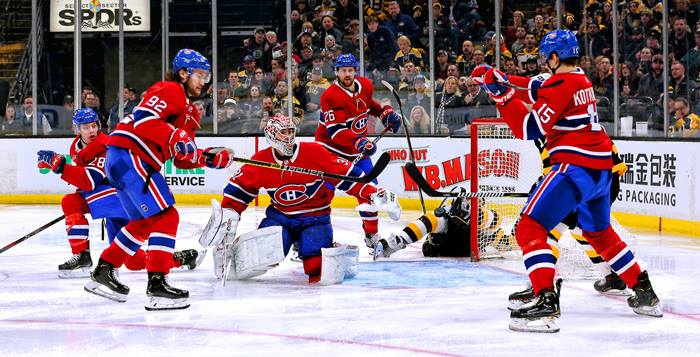
Because they were wearing the white sweaters, the Montreal Canadiens were in their reds. In addition to the Bruins sweaters representing the team from the 30s, the fact they were wearing them at home also harkened back to a time long gone when the home sweaters were the whites.
The game itself had the feel of a playoff match between these two almost centennial rivals. Monday night’s game was the 746th meeting between them and is an NHL record. The rivalry was palatable and it looked like the Bruins were off to a good start when Brad Marchand got his 17th goal of the season while the teams were playing 4-on-4 in the first after Zdeno Chara (interference) and Jesperi Kotkaniemi (tripping) were sent to their respective boxes. Going into Monday night’s game the Canadiens had given up four goals while playing 4-on-4 as opposed to the Bruins who had scored four and only given up one in the same situation.
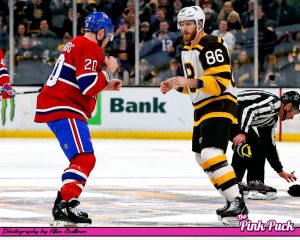
Nicolas Deslauriers and Kevan Miller (Photo: Alan Sullivan)
A couple minutes after the Bruins scored, Nicolas Deslauriers asked Kevan Miller if he wanted to fight. Miller obliged and actually took down Deslauriers. This was not a fight for the faint of heart. In fact, it reminded many of games of long ago as the two heavy hitters threw punch after punch. While those voting on HockeyFights.com were 18-10 in favor of Deslauriers for the win, the result was that it did give the Habs some momentum.
As the first period ticked down to under 1:40, the Bruins found themselves taking a defensive zone faceoff. Not surprisingly, Patrice Bergeron was there to take the draw, but ended up getting thrown out of the faceoff dot. While he said after the game that he was not told why that happened, it appeared it could have been because David Pastrnak was not lined up in time. This resulted in Marchand taking the draw, which he lost. Phillip Danault won it back to Jeff Petry at the point who put it on net where Brendan Gallagher made the tip and it was a tie game.
The Bruins had outshot the Habs 11-6 in that first period, but really had nothing to show for it given the game was tied.
“I don’t think we were happy with how we were playing. I think we had some chances but at the same time, I don’t think it was our best night all around,” said Miller.
The second period saw the momentum in the Canadiens’ favor as it was a more equal game with shots on goal still favored Boston 15-11. However, when the period came to an end the Canadiens would be the team leading 2-1. Once again, the Bruins allowed a shorthanded goal while on the power play. Their tenth this season, this phenomenon has happened too frequently often when the first power play unit is on the ice.
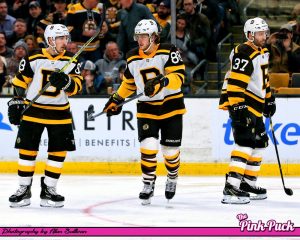
Marchand, Pastrnak, and Bergeron (Photo: Alan Sullivan)
The puck was traveling up the left board and it hopped over Pastrnak’s stick. Much like in the Winter Classic game when Pastrnak did cough up the puck, Bergeron rushed back to try and disrupt the play. Unlike the Winter Classic where he succeeded, in this instance Paul Byron was able to beat Bergeron and then going in on Tuukka Rask, Byron went backhand, glove-side high to give his team the lead.
“I wouldn’t say concerning, I think we know we have to be better. We’ve been good all year, [giving up a SHG] is going to happen during the year. We know we can do a better job and be better but it’s about looking at the video and doing that. We can make those plays and we got to take what’s there sometimes, and we’ve been forcing a little too much,” Bergeron said.
The Bruins lost 3-0 when the Canadiens were in Boston in October, and it looked like they were going to lose in regulation again when Michael Chaput miscalculated and sent the puck over the glass and was whistled for delay of game, giving the Bruins one more opportunity on the man advantage with 2:05 remaining in the third. The Bruins began the power play 5-on-4, but then they pulled Rask and had the extra man. With 38 seconds remaining in regulation, David Krejci put it passed Carey Price and the game went to overtime.
The overtime was shortlived as the Canadiens got possession of the puck on the draw and went in on Rask. While Rask was able to deny Max Domi’s attempt, he couldn’t quite glove it. The juicy rebound was then put in by Petry just 15 seconds into the extra inning.
The Bruins outshot the Canadiens 43-22 in the game, but many of those shots were not quality shots, and it was clear that Price was on his A-game. In fact he seems to thrive when playing in Boston.
“It’s just the atmosphere. Like I said, it’s a great place to play hockey, I’ve always enjoyed the rivalry between our two teams. Like I said, it’s just a great place to play,” Price shared after the game.
As one person posted on Twitter, the “Peaky Bruins met Peak Price,” and perhaps the rest was history.
Looks like the Peaky Bruins ran into Peak Price… #Habs
The Philadelphia Flyers are 1-7-2 in their last ten games and are currently in last place in the League. This week doesn’t get any easier as they face three teams fighting for playoff spots.
1) Monday, Jan. 14: Wild vs. Flyers-7 p.m. ET
The Minnesota Wild visit the Wells Fargo Center tonight and they have been struggling in their own ways. The Wild have only scored 33 first period goals in games this season so the Flyers want to get out to a fast start and get pucks on net early and often. The Flyers should try to stay out of the penalty box since the Wild have the ninth best power play in the League at 22%. The team is going to need to find a way to shut down Zach Parise and Mikael Granlund as they are the Wild’s top two point producers. The key to the game for the Flyers is going to be getting plenty of screens in front of the Wild goalie so he can’t see the shots coming and the players in front can get some deflections.
The Wild want to avoid getting off to another slow start, and set the pace early in this one. The Flyers goalies have been letting some pucks in the net so they’ll want to just get a ton of shots on goal. The Wild need to take advantage of their power play opportunities since the Flyers have one of the worse penalty kills in the NHL. Claude Giroux is the Flyers leading scorer so the Wild need to keep an eye on him since he can create and put the puck in the net. The key to the game for the Wild is to have a lead entering the final period since the Flyers have only one regulation win when trailing heading into the final period.
2) Wednesday, Jan. 16: Bruins vs. Flyers- 7:30 p.m. ET-NBCSN
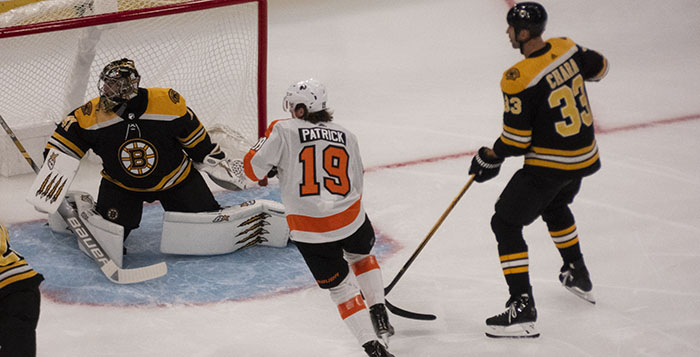
The Boston Bruins are in town and the game will be featured as part of NBCSN’s Wednesday Night Hockey broadcast. The Flyers will need their depth scoring to step up in a big way in this one since Sean Couturier will likely draw the job of defending the Bruins’ top line. The Bruins have the third best power play so the Orange and Black will need to stay disciplined and avoid the penalty box whenever they can. The team is going to need to have their skating legs and try to keep up with Bruins. The goalie will need a big game and have to make saves, whether routine or spectacular since the Flyers give up chances. The key to this game will be finding a way to keep the Bruins’ top line of Brad Marchand, Patrice Bergeron and David Pastrnak off of the board or limit their chances.
The Bruins need to play a physical game and establish offensive zone time early in the game. The Bruins need to keep an eye on James van Riemsdyk, who has been playing better of late and going to the net for some goals. The Flyers may not have a great power play this year, but Boston still needs to stay out of the penalty box. The goalie will need to have a good game for the Bruins since the Flyers still have some guys that can score and create. The Bruins want to play their game and don’t play down to the opposition.
3) Saturday, Jan. 19: Flyers vs. Canadiens- 7 p.m. ET
The Flyers will visit one of the more surprising teams this season, the Montreal Canadiens. The Orange and Black will want to get the first goal or at least set the tone early in the game since they’ve struggled on the road. The Flyers’ special teams will need to be better than the Canadiens’ special teams especially on the penalty kill. The team is going to want to get plenty of traffic in front of the net so the goalie can’t see the puck. They’ll want to keep an eye on Max Domi since he is the leading scorer for the Canadiens.
This would be a good game for the Canadiens to get their power play going since the Flyers aren’t very good when killing the penalty. They should play a physical game and try to set the tone early. The Habs want to have the lead entering the final period since the Flyers are not a good third period team.
Flying Forward Weekly Prediction
The Flyers should finish the week out 0-3-0, but they will likely grab a regulation win and finish 1-2-0. The Flyers one win will come against the Wild. The Flyers will end the week losing two straight against the Bruins and Habs.
The Cleghorn brothers may not have been twins, but they were a matching set. Sprague, the defenseman, was born in 1890 and Odie, the center/right wing, in 1891. They both joined the NHL in 1918 and played with the league for ten seasons – though Odie only played in 182 games to Sprague’s 259. Odie played with the Montreal Canadiens from the start, while Sprague’s path to the Canadiens was more complicated. After playing with the Ottawa Senators for his first two seasons, the NHL tried to reassign Sprague so that he eventually played most of the 1920-21 season with the Toronto St. Patricks. Although he then signed with Ottawa again as a free agent, the NHL again transferred his rights to the Hamilton Tigers, and Sprague again refused to report. He was sold to Montreal, where he became captain of the Canadiens.
Both Cleghorn brothers played for Montreal on January 14, 1922 before a crowd of 4,000 at the Mount Royal Arena. The visiting Tigers could not seem to stop them. At four minutes into the game, Sprague took the puck and skated up the ice alone for the first goal. Although he repeated his play a minute later, instead of scoring, he followed “the puck around the net, he passed to Odie, who scored.” Their goals were followed by a Hamilton goal and a third Montreal goal.
Then, only 40 seconds into the second frame, Sprague scored again by “caging a shot which he took from his own hard rebound from the boards.” The Tigers scored again before, what the Montreal Gazette called, the “most spectacular piece of hockey of the night.” Sprague took “a loose puck from centre ice through the entire Hamilton team to score.” Odie again followed his brother’s lead by scoring the next goal. Both teams scored one last time that period.
The Cleghorn boys did not slow down in the final period. For the third time that game, Sprague opened the scoring – even sooner than before. And for the third time, Odie followed up his brother’s goal with one of his own, which was assisted by Sprague. After another Hamilton goal, Odie took up “a loose puck, shot, easily beating [Tigers goalie] Lockhart.” The Tigers finished the game with two more goals, but the damage by the Cleghorn brothers had already been done.
Montreal won 10-6. Each Cleghorn brother had four goals, and Sprague had two assists on top of that. It was only the second of a career total of two hat tricks for Sprague and the seventh of nine for Odie. This was the first time brothers playing on the same NHL team scored four goals each in the same game.
The Cleghorn brothers remained with the Canadiens until they had won the Stanley Cup in 1924 and 1925. Odie had already won with them back in 1919, and Sprague won with Ottawa in 1920. From 1925 to 1928, Sprague played for the Boston Bruins while Odie played for the Pittsburgh Pirates. As a forward, Odie had more goals (94 to Sprague’s 83), but Sprague had more assists (60 to Odie’s 35). In the end, Sprague’s additional 77 games only amounted to 14 extra points over Odie. Still, Sprague was inducted into the Hockey Hall of Fame in 1958, two years after the brothers died within days of each other. As the Montreal Gazette proclaimed in the recap of the four-goals-each game, “Sprague Cleghorn was Outstanding Figure of Game,” and “rivaling Sprague for individual honors” was Odie Cleghorn.
Additional Sources:
“Hamilton Proved Easy for Locals in N.H.L. Fixture,” Montreal Gazette, 16 Jan. 1922, p. 16.
The Tampa Bay Lightning will play four games in seven days this week. The team willplay the first two games on the road and then finish the week up with two games at home.
1) Sunday, Jan. 13: Lightning vs. Islanders- 7 p.m. ET – ESPN+
The Lightning start the week off against the New York Islanders, who have been one of the surprising teams so far this season. The Bolts will need to keep an eye on Mathew Barzal when he is on the ice and not give him any time or space to make plays. The Lightning should not have a problem taking care of their power play opportunities since the Isles have only killed 78% of their penalties taken this season. The key to grabbing two points in this game for the Lightning will be to get plenty of pucks on the net with traffic in front so the goalie has problems seeing the puck.
The Islanders have exceeded most fans expectation this season, but that should be no surprise since Barry Trotz is behind the bench. The Isles will have to find a way to stop the balanced attack of the Lightning, which could happen if they spend more time in the offensive zone than in the defensive zone. The Islanders will want to be physical to try to wear down the Bolts since they had a game against the Buffalo Sabres last night. The biggest key to the game for the Islanders is going to be the play of their goaltender, who has a chance to be able to steal two points if he can stop pucks and not allow any soft goals.
2) Tuesday, Jan. 15: Lightning vs. Stars- 8:30 p.m. ET
On Tuesday night, the Dallas Stars play host to the Lightning. The Bolts should try to establish the forecheck game early because the Stars tend to turn the puck over during the course of a game. The Lightning need to try to limit the point production of Jamie Benn, Tyler Seguin and Alexander Radulov, who have accounted for much of the Stars offense this season. It would help if the Lightning could get off to a fast start and get the first goal of the game to take the home crowd out of the game.
The Stars have been a team of mediocrity and inconsistency this season, but are still in third place in the Central Divsion. They’ll want to make sure that they stay out of the penalty box since the Lightning have the top ranked power play in the League. The Stars want to play a smart hockey game and limit turnovers especially in the neutral zone since the Lightning have a good transition game. The goalie is going to need to be sharp and make some saves. The key to the game will be getting some secondary scoring from the other lines, which have struggled to contribute when needed this season.
3) Thursday, Jan. 17: Maple Leafs vs. Lightning- 7:30 p.m. ET – ESPN+
On Thursday night, the Bolts return home for a huge divisional matchup against the Toronto Maple Leafs. The Lightning will want to watch Mitch Marner and John Tavares since they are the leading point producer and goal scorer for the Leafs. They will want to play solid defense since the Maple Leafs have a balanced lineup and can put some pucks in the net. The Bolts should avoid turnovers and limit mistakes since the opposition has a decent transition game of its own. The goaltender will be a key part in this game and if he can make some saves then the Lightning should be able to get two points.
The Maple Leafs are without goalie Frederik Andersen, but he could be back for this game depending on how he is feeling. Discipline is going to be necessary in this game since the Lightning have the number one ranked power play in the League at the moment. The Maple Leafs need to establish the forecheck early and often in this game to stop the Bolts’ offense. The key to this game is going to be clogging the neutral zone so the Lightning can’t use their speed or establish a good transition game.
4) Saturday, Jan. 19: Sharks vs. Lightning: 7:00 p.m. ET
The Bolts finish off the week against the red hot San Jose Sharks, who have really turned a slow start around. The Lightning need to keep an eye on defensemen Erik Karlsson and Brent Burns, who are like having an extra forward out on the ice. The team should try to limit their mistakes and make sure that they have a lead after the second period of the game since the Sharks have only two regulation wins when trailing after two periods.
This game will be a good challenge for the Sharks, who are playing one of the best teams in the League. The team will need to get good goaltending in order to steal two points in this game. The Sharks need to attack and not sit back especially if they get behind because the Bolts have given up some goals when leading. The key to the game will be to watch out for Brayden Point, who is the leading goal scorer for the Lightning.
Lightning Strikes Weekly Prediction
The Bolts will finish the week with a 2-1-1 record for five points. The Lightning will win their two games on the road. They’ll come home and only get one point against the Maple Leafs. The Bolts will finish the week off with a regulation loss to the Sharks.
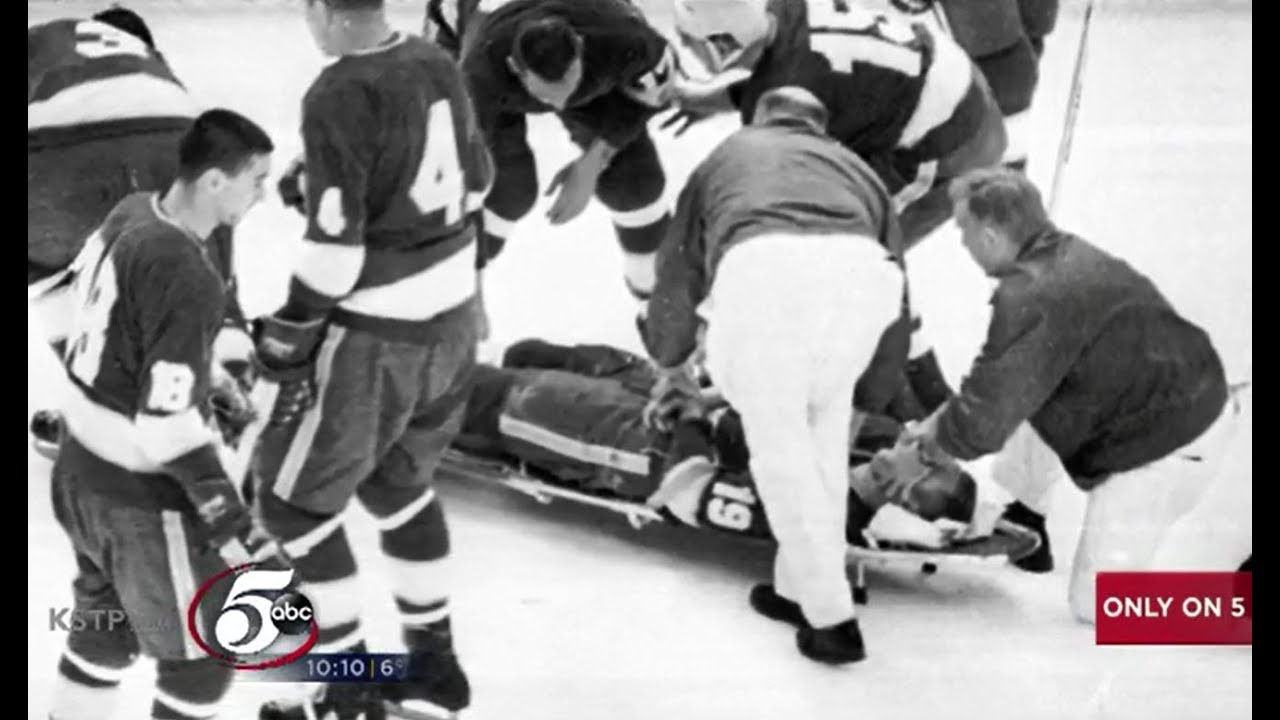
After the exciting promise of 1967, Americans would witness multiple tragedies in 1968. That season in the hockey world, the NHL doubled its franchises then lost one expansion team’s most promising player in the only on-ice-injury-related death in NHL history. In an age in which few players wore helmets, on January 13, 1968, 29-year-old Bill Masterton of the brand new Minnesota North Stars hit his head on the ice and never regained consciousness.
Leading up to the 1967-68 season, Masterton had excelled in college hockey, leading the Denver University Pioneers to the NCAA championship in 1961 as the MVP of the tournament. After graduating, he signed with the Montreal Canadiens, but they already had too much depth for the center position. Playing for their AHL affiliate, the Cleveland Barons, he finished sixth in scoring in 1962-63, the season before they won the Calder Cup. He retired to earn his masters degree in finance and work for Honeywell Corporation, who manufactured aerospace products (among other things). In 1966-67, he played amateur hockey for the U.S. National Team, catching the attention of Wren Blair, the first coach and general manager for the North Stars. After, as he said, he asked “Bill if he would consider giving pro hockey another fling,” Blair bought his contract from Montreal. Masterton was one of the first two to sign with the North Stars.
With Minnesota, Masterton was surprised that he made the team after training camp. He then scored the very first North Stars’ goal at their first regular-season game on October 11, 1967. Over the next three months, he earned 11 points (4G, 7A). On January 13, the North Stars were in first place and hosted the also-new California Seals at the Met Center. During the first five minutes, Masterton skated into the offensive zone and passed the puck to his right wing Wayne Connelly. Ron Harris of the Seals cleanly checked Masterton, who then crashed into Seals defenseman Larry Cahan and then the ice. The impact of his head on the ice and an accompanying pop was audible around the rink, and he began bleeding. His team knew immediately there was something seriously wrong. Coach Blair later tried to put the moment into words, “He hit so hard that I’m sure he was unconscious before he fell. I’ve never seen anybody go down that way. We heard him crash to the ice from the bench.”
As quickly as possibly, one of the team’s physicians and the trainers looked Masterton over, loaded him onto a stretcher, and carried him off the ice. Four more physicians did what they could for him in the dressing room before an ambulance carried him to Fairview Southdale Hospital in Edina. There, the chief neurosurgeon of the University of Minnesota and his team realized that he had “suffered a massive internal brain injury” and “no surgical procedure could repair an injury that serious.” They put Masterton on life support and warned Blair that he probably would not recover. Bob Reid, the Met Center’s building manager, stayed at the hospital, and the next night he told Blair to prepare the team because the doctors intended to remove Masterton’s life support. His parents (from Winnipeg) and his wife were at his bedside. At 4 a.m. on January 15, 27 hours after the on-ice collision, Blair received word that Masterton was gone.
Meanwhile, the North Stars struggled to keep it together. After the game, they had to leave for Boston in a snowstorm. Because it “took several flights for all the players to reach their destination,” their game with the Bruins was already half over by the time everyone made it there. Unsurprisingly, considering their distractions, the North Stars lost 9-2 that night. At dawn the next morning, Blair went room by room informing his players of Masterton’s passing. Blair wrote in his autobiography, “Most players broke down. Most of these young men had never experienced a death in their own families, and yet here they were facing the loss of a teammate.” North Stars president Walter Bush made the statement, “I’ve lost a person I valued as a friend as well as one of the finest players in our organization. Bill certainly exemplified the type of person I would want my children to become.”
Despite the grief, everyone agreed that the hit was clean. Naturally, Ron Harris was deeply affected and haunted. As he told the St. Paul Pioneer Press in 2003, “It bothers you the rest of your life. It wasn’t dirty and it wasn’t meant to happen that way. Still, it’s very hard because I made the play. It’s always in the back of my mind.” But Masterton’s teammates and family never blamed hockey or anyone for the injury. Masterton went out doing something he loved.
The day after Masterton’s death, a moment of silence was observed before the NHL All-Star Game. Then, since NHL president Clarence Campbell would not reschedule the game for January 18, the North Stars and the visiting Philadelphia Flyers sat across the aisle from each other at Masterton’s funeral. The Flyers defeated the home team 4-2 that night. Blair did everything he could to pull his players out of their shock and establish some normalcy, and by the end of the month, they were able to bounce back competitively.
To aid Masterton’s family, the NHL gave them $60,000 out of the pension fund. The North Stars gave his widow a full share from the playoffs and gave scholarship money to their two children (a 3-year-old son and 1-year-old daughter). Although no one had worn Masterton’s No. 19, the North Stars officially retired it in 1987.
The heartbreaking incident with Masterton has left two lasting legacies in hockey. First, a stronger advocacy for wearing helmets arose. Although Masterton had worn one in college and the minors, he was discouraged in the NHL. In looking back, it seems that Masterton already had a concussion from a recent game when he struck the ice and hemorrhaged. His teammate and close friend, Cesare Maniago said, “He had been complaining about a steady headache. In retrospect, you would think he had a concussion.” Although President Campbell granted that only “the inordinate skill of the players” prevented injuries from happening, he stated that the NHL did not plan to make helmets mandatory. Until the 1979-80 season, players could choose whether to don protective head gear. More and more made that choice. Before the incident, the only Minnesota player to wear one was Andre Boudrias, and former teammate Dave Balon became one of the first to begin wearing a helmet afterwards.
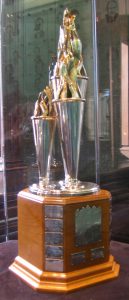
The other Masterton legacy was the creation of an annual award cup. The North Stars first established the Bill Masterton Memorial Cup for their team MVP (won by Cesare Maniago that season). Meanwhile, the Professional Hockey Writers’ Association began honoring an annual “unsung hero” with the Bill Masterton Memorial Trophy. Claude Provost of the Montreal Canadiens won the 1968 award. The trophy is given “to the National Hockey League player who best exemplifies the qualities of perseverance, sportsmanship, and dedication to hockey,” as had Masterton.
Additional Sources:
Adam Raider, Frozen in Time: A Minnesota North Stars History (2014), kindle version.
Stephen Laroche, Changing the Game: A History of NHL Expansion (Toronto: ECW Press, 2014), 92-95, 104-107.


 Prev
Prev