Nobody wants to be a zero. For 26 games during the 1987-88 season, defenseman Neil Sheehy was the only NHL player to wear No. 0 since 1950.
Sheehy was traded to the Hartford Whalers (by the Calgary Flames) on January 3, 1988, but due to a groin injury, he had to sit out his first ten games with the team. Sheehy told the Hartford Courant, “You never feel accepted until you’re in the lineup. The guys have been great to me, but you still don’t feel an integral part of things until you play.”
Finally, on January 24, Sheehy took the ice wearing No. 0. Hartford’s equipment manager, Skip Cunningham, had had to help Sheehy and at least one other player with their new numbers. Although Sheehy was given No. 6, he “asked for and received No. 0.” He had worn the number while playing for the Moncton Golden Flames in the minors, and his college and Calgary numbers (15 and 5) were already taken by other Whalers. At the time, Sheehy joshed, “Everybody think I’m wearing number zero. Actually, when my grandparents came over, the name was O’Sheehy. I’m reclaiming the O.”
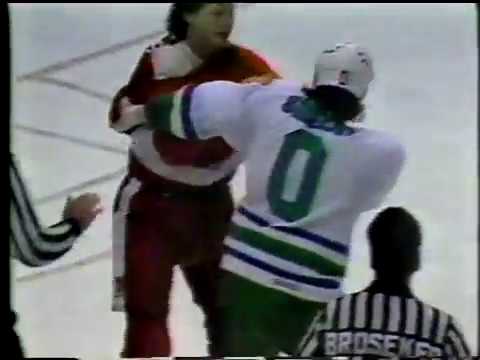
That first game took place at the Civic Center, where 14,267 fans watched the Whalers take on the Detroit Red Wings. On his first shift of the night, captain Steve Yzerman gave Detroit an early lead. Hartford tied up the score during a power play at 18:53 in the first period. The rest of regulation remained scoreless, despite Hartford’s 41-17 advantage in shots on goal. Sheehy’s contribution was to get a minor penalty for delay of game at 14:45 of the first period and a major for fighting at 7:58 of the second. Both times, he was dancing with Bob Probert. The Whalers scored with 2:39 left in overtime to win their fifth consecutive game. All Coach Jack Evans had to say was, “Well, we’re finally over .500. The game was nerve-wracking.”
Sheehy’s specialty was being tough, so it comes as little surprise that in his 26 games, he only had one goal and four assists. On July 6, 1988, Hartford traded him to the Washington Capitals, but he only played for them for two partial seasons. After a final 35 games with Calgary, in 1992 Sheehy retired, while wearing No. 15.
A big reason why the Tampa Bay Lightning are leading the way in the NHL at the annual bye week and All Star Break is because of the play of the special teams.
The Bolts have drastically improved on the penalty kill this season and that has made a big difference for them. Last season, they only killed off 76.1% of penalties taken, which was good for 28th in the League. Overall this season, the Lightning have been successful in killing off 83.5% of their penalties taken and are ranked sixth overall on the penalty kill. The power play is ranked first overall because they are converting on 29.5% of their opportunities. The man advantage has ranked in the top 10 of the NHL for the past two full seasons.
The Lightning’s penalty kill has seen the same players most of the season in Anthony Cirelli, Ryan Callahan, Cedric Paquette, Yanni Gourde, Alex Killorn, Dan Girardi, Victor Hedman, Ryan McDonagh, Anton Stralman and Erik Cernak. The penalty kill units have a good mixture of youth and experience. The players are good two-way forwards and the defensemen are mostly veterans with the exception of Cernak. They are willing to block shots and are getting saves from the goaltenders, whether it be Andrei Vasilevskiy or Louis Domingue.
When Tampa is down a man, they are winning some face-offs, which is leading to possession and easier clears. The penalty killers are applying pressure to the puck carrier and not sitting back in the box, just hoping that a shot hits them or the goalie makes the save. Since they are applying pressure, they are forcing some turnovers and making it harder on the opposition to get easy offensive zone entries. They are also getting into shooting and passing lanes forcing the opposition to the outside and making it easier for the goalies since there are less high danger scoring chances.
The biggest reason for the improvement on the penalty kill has been avoiding the failed clears, which were leading to prime scoring chances last season. The Bolts are making smarter plays and finding open teammates so the clears are easier and are less likely to fail. The Lightning are also winning some board battles, supporting each other and getting the puck out of their zone.
The Lightning’s power play just keeps on rolling and with the talent on the two units, it should. The two units each have four forwards and one defenseman, which is the norm in the NHL. There are a few teams with five forwards on their top unit. Tampa’s first unit is made up of Nikita Kucherov, Steven Stamkos, Ondrej Palat, Brayden Point and Victor Hedman. The second unit usually has Tyler Johnson on it, but he is out injured so it consists of Alex Killorn, Anthony Cirelli, Yanni Gourde, Ryan McDonagh and J.T. Miller.
The power play is slightly better on the road (32%) than at home (27.5%), but the Bolts have 16 less power play chances on the road. The first unit has combined for 36 of the total 49 power play goals that the Lightning have scored. The top unit has most of the production because they see a majority of the time and are so talented that they usually convert. It is hard for opposing teams to defend because they have so many options that can put the puck in the back of the net. The Lightning do have a solid option for their second power play unit, which some teams really lack.
The second unit doesn’t see as much time on the power play because the top unit is so good. The top unit is either converting on the man advantage or is in the offensive zone for a long time creating chances and making it difficult for the second unit to get on the ice. This doesn’t mean that the second unit can’t get it done because they do create chances and chip in on the scoreboard every once in a while.
It really doesn’t matter which unit is on the ice because the puck and player movement on the man advantage is a work of art. When watching the Lightning power play, one rarely sees a player standing still and if someone is then they are surveying the lay of the land before deciding what to do with the puck or waiting for a play to develop. The quick, crisp passes make it hard for the opposition to get setup or to get into shooting and passing lanes. The Lightning will use the quick, cross ice pass to get a goalie moving from post-to-post and the goalie usually doesn’t get there in time to stop the puck from going into the net.
When players are on the move, other players cover up so they don’t give up too many shorthanded goals. The team will support each other to outnumber the opposition and win the puck battles. They often have traffic in front of the goalie for rebound chances. The quick puck movement makes it hard for a defender because they think the shooter is covered but the next thing they know the puck is in the back of the net.
The special teams are going to be a big part of the Lightning’s success down the stretch especially the penalty kill. The better the penalty kill is heading down the stretch, the better the Lightning’s chances to make a deep run in the postseason.
The Philadelphia Flyers signed left wing James van Riemsdyk to a five-year deal worth, $35 million in the offseason. Has he been a disappointment so far this season? Yes, but it looks as though he is getting back on track and finding his way under Head Coach Scott Gordon.
In his last five games played, van Riemsdyk has six goals, two assists and eight points. He has seen his ice time increase to around 18:00 per game. The left winger just looks more comfortable with his line mates and playing in the top six. Van Riemsdyk is playing with confidence and that is resulting in some points and wins for the Flyers, who entered the bye week on a three game winning streak.
A big reason why his game looks so much better is that he is healthy and finally in game shape.He was injured during the second game of the season when he was hit in the leg with a clearing attempt. Van Riemsdyk missed the rest of the game on October 6th against the Colorado Avalanche and didn’t return to the lineup until November 15th against the New Jersey Devils.
There was no conditioning stint in the minors so he was not really in game shape even though he had been skating and practicing. When van Riemsdyk returned to the lineup he was thrown right into the fire playing consistent third line minutes and seeing power play time. Practicing doesn’t necessarily mean that a team is going full speed because they’re playing against one another and they certainly don’t want to injure their own teammate. It should have been expected that it would take some time for him to get back to game level, but some fans didn’t think it would take this long after the return.
Yes, this is his second time with the Flyers, but the whole team including the system is completely different. The first go around he was a young kid and he sorely lacked defensive abilities, but was able to get away with it because of his goal scoring ability. In Toronto, he was playing third line minutes and rarely had to play much defense because the top two lines went against the opposition’s better players. Van Riemsdyk was used as more of an offensive depth threat than a defensive player in his six seasons with the Maple Leafs.
JvR was in a similar situation under former Head Coach Dave Hakstol in that he was playing third line minutes and seeing some power play time. The difference was that after van Riemdyk signed the five year deal in the offseason, he expected to be in the top six forward rotation, but for whatever reason that just didn’t happen under Hakstol, who was eventually fired. Scott Gordon took over for Hakstol and he has reunited JvR with a familiar face in Claude Giroux.
Giroux and van Riemsdyk were teammates early in their careers and developed some chemistry, but the impatience of Ed Snider and the Flyers organization traded van Riemsdyk to the Maple Leafs for defenseman Luke Schenn. The chemistry took some time to come back, but in the past five games or so the chemistry has really been visible between the two and Travis Konecny. The stability and familiarity has clearly made an impact on the play of van Riemsdyk, who has steady linemates for the first time this season.
The line of van Riemdyk, Giroux and Konecny can cause some fits for teams since there is a combination of goal scoring, playmaking and speed on the line. The line is good in transition, which has helped van Riemsdyk get some goals, but each member can also put the puck in the net. JvR knows that he just needs to go to the net or be around the net when those two are on the ice to get some goals or scoring chances since both guys are decent passers, though they will take the shot if available.
The left winger finally knows his role and what is expected of him in Gordon’s system. He knows that he needs to go hard towards the net because when he’s doing that he usually has a decent game. If he’s around the net, he may take some punishment but he can also deflect some pucks or get rebound chances. Van Riemsdyk wasn’t going to the net when he returned and that really affected his play and he wasn’t getting chances. He also knows that in Gordon’s system he needs to be aware defensively and play up to his ability or he could be dropped back down in the lineup.
In his past five games, he has actually seen some time on the ice when the Flyers have been up by a goal or two in the late minutes of the game. If he keeps playing this way, then the points will start going up and he could help the Flyers go on a potential run after the All Star Break.
The Quebec Nordiques were having a terrible season in 1988-89. That January, they stopped talking to the press when a Calgary newspaper calling them a “goose [goalie Mario Gosselin] and 19 turkeys” led to a Quebec radio show composing the song “Un club de dindes.” On January 23, when 14,227 came to Le Colisee to watch them play the Hartford Whalers, their spirits tanked further.
It took 14 minutes before the Nordiques even got a shot on net. Nordiques then proceeded to waste nine power-play opportunities and gave up three power-play goals. They were given 41 penalty minutes (compared to 29 minutes for Hartford). In the end, the Whalers rookie goalie, Peter Sidorkiewicz, earned his second shutout when Hartford crushed Quebec 5-0.
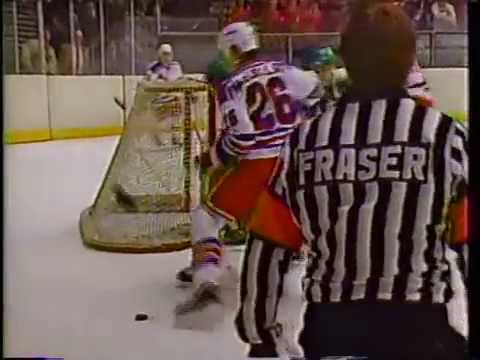
However, the worst part of the night came with 9:30 remaining in the game. Kevin Dineen had just scored the final Whalers’ goal on a power play, and the crowd had had enough. They threw “several rolls of toilet paper,” and one hit their target, referee Kerry Fraser. Back in the 1987 Adams Division finals, he “disallowed a third-period goal by the Nordiques’ Alain Cote that would have given Quebec the lead.” They had had it in for him ever since, and that combined with the calls on the Nordiques leading to power-play goals for the Whalers incited the crowd to throw anything they could. In addition to toilet paper, they threw “coins, cigarette lighters, galoshes and just about anything else” onto the ice. Nordiques Mario Marois said, “Fraser had nothing to do with the result. We got what we deserved. But I won’t cry [for Fraser] because referees always haven’t been fair to us here.” The victorious Whalers had a bit of a laugh. Rookie Scott Young joked, “I’d like to know where they got all the toilet paper. They must have been selling it at the concession stands.” Then Ulf Samuelsson remarked, “All they kept throwing were pennies; they couldn’t afford quarters.” The man with the shutout, Sidorkiewicz, joined in commenting, “You can call this one The Toilet Bowl.”
For many, this was not a laughing matter. After ten minutes of enduring the onslaught, Fraser and the coaches finally brought the teams back to the locker rooms to take cover. Dineen, whose goal had sparked the incident, said, “If it were my decision I would have cancelled the game. In the third period we were concentrating only on not getting hurt and that is a very dangerous way to play a hockey game.” Whalers Coach Larry Pleau commented, “I didn’t mind the fans at first because they’re part of the organization and have a right to let their feelings be known. But they really carried it too far.” Several of the Whalers noted that the fans would have been arrested anywhere else and that security was too lax. Captain Ron Francis went as far as to say, “It’s an embarrassment to the National Hockey League.”
After about 13 minutes in the locker rooms and some action by the maintenance crew, the teams returned to the ice. It seemed the game would resume until Fraser appeared again. Somehow, the crowd still had toilet paper to throw at him. The game took another three minutes to resume. Although several were ejected, no one was arrested for their rowdy behavior.
Over the next couple of days, the NHL and the Nordiques looked into the situation to try to improve the security. The Nordiques’ vice president of marketing and communications, Jean Legault, met with Provincial Exhibition Commission (the security firm) and the Quebec police department. According to their director of public relations, Jean Martineau, “Everyone looked foolish because of 30 or 40 people, and now we’re all working to make sure it doesn’t happen again.” They discussed increasing the security force to 30 and “decided that dispensers with single sheets of toilet paper will replace those holding rolls.” Nordiques President Marcel Aubut said, “I think it’s an isolated incident. We don’t have that style of fans on a usual basis, like in New York or Boston. I don’t know if we have enough security, but it’s never been tested like that.” Unfortunately, the Nordiques leased Le Colisee and did not have much control over its security.
With the shutout, the Whalers moved 5 points ahead of the Nordiques for 4th place in Adams Division. The Nordiques finished their lousy season 5th in the Adams Division with 61 points (27-46-7). Still, they would manage to do even worse the following season.
Additional Sources:
Bruce Berlet, “Sidorkiewicz, Whalers shut out Nordiques, 5-0,” “Rowdyism Forces 20-minute Suspension,” and “Talking turkey helps to solidify Nordiques,” Hartford Courant, 24 Jan. 1989, p. E1 and E5.
“Nordiques get bum rap again,” Montreal Gazette, 24 Jan. 1989, p. F2.
Bruce Berlet, “Quebec rolls out new security,” Hartford Courant, 26 Jan. 1989, p. B6.
The scene was the Montreal Forum, and the dates were January 21 and 22, 1966. The victims were the Detroit Red Wings, who were tops in the NHL. Since there would be two sets of Montreal-Detroit games, Detroit trainer Lefty Wilson packed both their home and away uniforms. Upon arrival at the Forum the morning of January 22, the Red Wings found that all 44 of their sweaters had been stolen from the locker room.
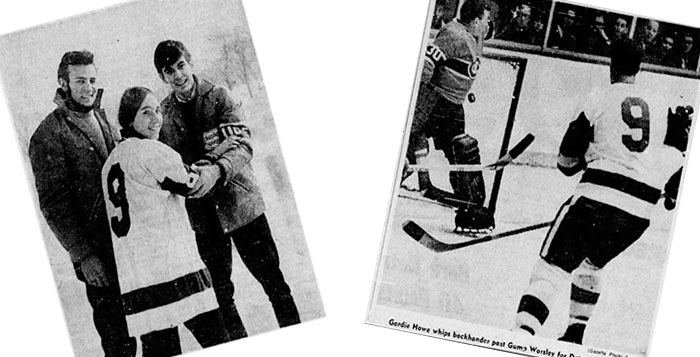
The night before, Detroit and Montreal oldtimers had played a game that included the famous Gordie Howe (though he still played for the Red Wings). About 15,000 watched the Quebec team win after Maurice Richard tied up the score. After the game, thieves remained behind and snuck into the locker room to take the sweaters, which then began appearing around Montreal. When first informed of the theft, Detroit manager-coach Sid Abel thought their rivals may have removed the sweaters. “If it’s a joke, we’re not laughing.” However, the same night, many other items were taken, including a black bear from the Garden of Wonders Zoo. Director Andre Champagne of the Montreal Parks Department remarked that he was “not too pleased” about the bear’s kidnapping. Witnesses claimed to have seen the bear wearing Howe’s No. 9 jersey.
Instead of postponing the game, the Red Wings found a solution. Their junior affiliate team, the Hamilton Red Wings, were scheduled to play the junior Canadiens on January 23. The team flew over their uniforms a day early. Although identical in design, naturally the jerseys needed alterations to fit the different players. At least one had to wear a different number than usual, and the captain’s C was on the wrong player.
The Red Wings did not let ill-fitting sweaters slow them down. Paul Henderson, Gordie Howe, and Ron Murphy each scored while Roger Crozier made 31 saves. As Jack Berry wrote for the Detroit Free Press, “Someone stole the Red Wings’ jerseys, so little Roger Crozier returned the favor Saturday night, stealing the Montreal Canadiens blind.” Crozier had only allowed 13 goals over his last ten games, and none of them were that night. The 3-0 game gave Crozier his fifth shutout in those ten and 15th overall. Detroit’s lead in the league increased to three points, and their unbeaten streak increased to eight games. Writing for the Montreal Gazette, Pat Curran bemoaned, “As far as Canadiens were concerned it’s too bad that thieves didn’t take Detroit’s skates.” Fortunately, the Red Wings had another set of red sweaters back in Detroit that they could wear when hosting the New York Rangers the next night.
On January 26, the case was cracked. After the Canadiens lost to the visiting Chicago Blackhawks, 44 students from the Physical Education School of the Universite de Montreal crowded the ice wearing the stolen sweaters. For their winter carnival, there was a contest to steal the most original object. They had not only taken the jerseys (valued at $20 each) but also three paintings from the Forum’s lobbies (valued at $200 each). At least the bear was recaptured and returned to the pen. As one NHL article about the event jested, the bear would “resume its life as it should have. As a bruin.”
At least 33 of the thieves (three women and thirty men) were arrested and brought to Montreal police station Number 10. Canadiens president David Molson firmly stated, “We are going through with the charges of destroying public property and I hope the Detroit Red Wings also press charges so that those responsible will feel the full consequences.” On January 27, all of them were “charged under provisions of Article 296 of the Criminal Code having to do with possession of property obtained by crime,” and a preliminary hearing was set for February 3.
The Canadiens and Red Wings dropped the charges once the sweaters and paintings were returned, but the police pursued the matter. Finally, on January 18, 1967, all 33 were acquitted, adjudged to have not had criminal intent. However, the judge chastised the students saying, “You are all future leaders in physical education. I must ask myself what kind of educators you will turn out to be.”
As for the Red Wings, they may have won the game in their borrowed sweaters, but they lost the Stanley Cup to the Canadiens that year. Case closed.
Additional Sources:
Pat Curran, “May Have Last Laugh With Leading Red Wings,” Montreal Gazette, 22 Jan. 1966, p. 7.
Jack Berry, “Wings Risk Top Spot,” Detroit Free Press, 22 Jan. 1966, p. 1C.
Jack Berry, “Crozier Keeps Wings in Top Spot,” Detroit Free Press, 23 Jan. 1966, p. 1C-3C
Pat Curran, “Habs Tie Hawks 3-3, Lose to Wings 3-0,” Montreal Gazette, 24 Jan. 1966, p. 31.
Hubert Gendron, “Hockey Sweaters Returned, But Students Face Charges,” Montreal Gazette, 27 Jan. 1966, p. 3.
Russell Gilliece, “33 U of M Students Charged Over Hockey Sweater Hijinks,” Montreal Gazette, 28 Jan. 1966, p. 3.
On January 21 almost 60 years apart, two teams set NHL records for fastest goals by one team. In 1945, the Boston Bruins scored four goals in just 1:20 during the second period of a game against the visiting New York Rangers. In 2004, the Minnesota Wild scored two goals in only three seconds during the third period of a game against the visiting Chicago Blackhawks. In both cases, the home team won, 14-3 and 4-2, respectively.
The Bruins had more than one significant moment in that 1945 game against the New York Rangers. The 14 goals they scored beat their previous team record, set when the Bruins defeated the Rangers 13-3 on January 2, 1944. However, the Bruins remained one goal shy of the NHL record, set when the Detroit Red Wings crushed the poor Rangers 15-0 on January 23, 1944. Obviously, the Rangers were struggling in back-to-back seasons.
About 11,000 fans came to Boston Garden to see the Bruins play their rivals for fourth place. The Rangers held them off for 11 minutes before the barrage began. After two Bruins goals, the Rangers squeezed in their first. Then Bill Cowley scored back-to-back goals in 24 seconds followed by another Bruins goal within 51 seconds. At 6:34 into the second period, Bill Thoms scored his first tally for Boston. Then Frank Mario scored back-to-back goals in 19 seconds followed by Ken Smith’s within 46 seconds. The four goals had only taken one minute and 20 seconds. The Bruins finished the period with one more tally. For the third period, the Rangers started things off, and after another Bruins score, managed to get a final goal in between Cowley’s two additional goals. Smith finished out the scoring for the night. Cowley had the most with four goals, while Smith had three and an assist. Even with all the scoring, Rangers goalie Ken McAuley still made 46 saves. That was more than three times the 15 saves of Bruins goalie Phil Bibeault.
A major reason for the Bruins’ scoring extravaganza was the Rangers dismal luck leading up to the Sunday night game. That Thursday, they arrived in Detroit three hours late, so they did not finish their game against the Red Wings until almost 1 am. That caused them to miss another train and connections in Toronto on Friday. They arrived in Montreal several hours late, and during the Saturday night game, Grant Warwick was sent to the hospital. The Rangers finally arrived in Boston an hour and forty minutes before the game, only to discover that their skates, sticks, and uniforms were in a baggage car removed from the train and left back at Concord, N.H. While waiting for their equipment, the Rangers (including Coach Frank Boucher) napped on benches in the locker room. Their equipment finally arrived about 8 pm, so the Rangers missed the national anthem as they dressed and delayed the game 10 minutes. The Boston Globe was absolutely correct in describing the Rangers as “leg-weary, injury-riddled, travel-worn.” The New York Daily News joked that after that game, “the Rangers should have been placed on the wrong train – one which never came near the Hub.”
Exactly 59 years later, in 2004, the four-seasons-old Minnesota Wild set a record while defeating the struggling Original Six Chicago Blackhawks. The Xcel Energy Center had a crowd of 18,568 as witness to the event.
Wild Coach Jacques Lemaire had not been happy with his team at practice, and all he said after the game was, “We looked better tonight than we did this morning.” Center Jim Dowd explained, “You know when the coach is not happy. We just came in and said, ‘Let’s try to be focused and ready to go. We just have to keep working on it.’ That’s the bottom line. . . . Work hard together as a group and see what happens.”
Minnesota definitely put in the effort for their coach and led 2-0 until late in the first period. However, they gave Chicago some lucky breaks leading to goals at 18:57 of the first and 8:47 of the second. The Blackhawks had tied when the puck “went off the skate of the Wild’s Andrew Brunette during a scramble in front of the net.” Everyone thought the game was going into overtime. Then, at 19:44 with only 15.5 seconds remaining, “Dowd gained control of the puck in the Blackhawks zone and attempted a shot that he got back. He then blasted the puck past goalie Craig Anderson, who lost his stick on the play.” Although Dowd counted himself as having “three shots at it,” he credited his goal as “the result of good pressure by the whole line.” To try to make up the score, Chicago pulled its goalie. However, Minnesota’s Richard Park shot “off the face-off at center ice” right into the empty net at 19:47. It had only been three seconds from Dowd’s goal to Park’s second of the night. Prior to that, five teams had scored two goals in four seconds.
After all these years, the Bruins still hold the record for the fastest four goals scored by one team. The Wild’s record was beaten on November 1, 2018, when the Montreal Canadiens scored twice in only two seconds.
Additional Sources:
Roger Birtwell, “B’s Rout Rangers, 14-3,” Boston Globe, 22 Jan. 1945, sports, p. 4.
Harold Kaese, “‘Stalingrad’ Stand by Bruins Makes Playoff Berth Seem Certain,” Boston Globe, 22 Jan. 1945, sports, p. 6.
“Bruins Whip Rangers, 13-3; Cowley Gets 4,” New York Daily News, 22 Jan. 1945, p. 30.
Judd Zulgad, “A Happy Ending,” Minneapolis Star Tribune, 22 Jan. 2004, p. C1 and C11.
“Road killed,” Chicago Tribune, 22 Jan. 2004, p. 33-15.
On January 20, 1970, St. Louis hosted the 23rd NHL All-Star game. It seemed like just another game for show. However, there were a few firsts and lasts.
It was the first time the All-Stars came to St. Louis, and the arena had a record crowd of 16,587. This was only the fourth season since the big expansion gave the NHL the West Division and teams like the St. Louis Blues. As the coach of the host team, Scotty Bowman led the West Division All-Star team. He had hoped to show the closer parity between the new West and the established East since the teams had tied at the previous All-Star game. However, the East Division beat the West Division 4-1 instead. Worse still, the West had a record low of only 17 shots on net while the East jammed a record high of 44.
Naturally, the two All-Star team coaches had different views on the game. Claude Ruel, coach of the Stanley Cup champion Montreal Canadiens, led the East Division and commented, “When a man like Gordie Howe gives it everything, the other guys can’t do less. Bobby Orr, Bobby Hull and everybody gave it 125 per cent. They were so great. I’m not surprised the way they worked. I’m so proud of everyone. What they did for me! They gave me a helluva hockey game.” Bobby Hull joked, “That Ruel. He said all the right things – skate, check, shoot, get three men back. We couldn’t lose with help like that.” On the other hand, Bowman felt that Ruel did not let up even after he had a decent lead. Bowman looked ahead stating, “Next year, with the realignment of teams, (Chicago will join the West Division), we will have Hull and Stan Mikita. I just hope I can be there.” As it happens, he was.
In Bowman’s final year with the Blues, he coached the West Division at the 24th All-Star Game held on January 19, 1971. This was the first All-Star game hosted by Boston, so Bruins coach Harry Sinden led the East Division. As Bowman predicted, his team was packed with Blackhawks, and Bobby Hull scored the game winner and was named MVP (for the second year in a row). The West Division won 2-1. However, Bowman himself then switched from West to East by becoming coach for the Montreal Canadiens the next season.
Back at the 23rd annual game of 1970, both divisions set a record for the quickest scoring at an All-Star game. The East Division scored first 20 seconds into the game. Just 17 seconds later, Dean Prentice scored the only goal for the West, from outside the blue line. Ed Giacomin of the New York Rangers commented, “It was routine. I put my stick down with my glove behind it, but about four feet in front of me the puck hit an ice chip or something and hopped about a foot and a half in the air and into the net.” As planned, Tony Esposito took over for the second half of the game.
Two individual performances stood out – one in offense for the East and the other in defense for the West. In offense, Gordie Howe, in his 21st of 23 All-Star appearances, scored his final All-Star goal “on a power-play pass from Hull” at 7:20 in the first period. It happened to be the tie-breaker and game-winner. As his tenth goal, Howe remained the all-time All-Star goal leader until Wayne Gretzky scored his eleventh in 1991. The East scored two more goals (by (Walt Tkaczuk and Bobby Hull) on the West’s Bernie Parent (of the Philadelphia Flyers) during the second period.
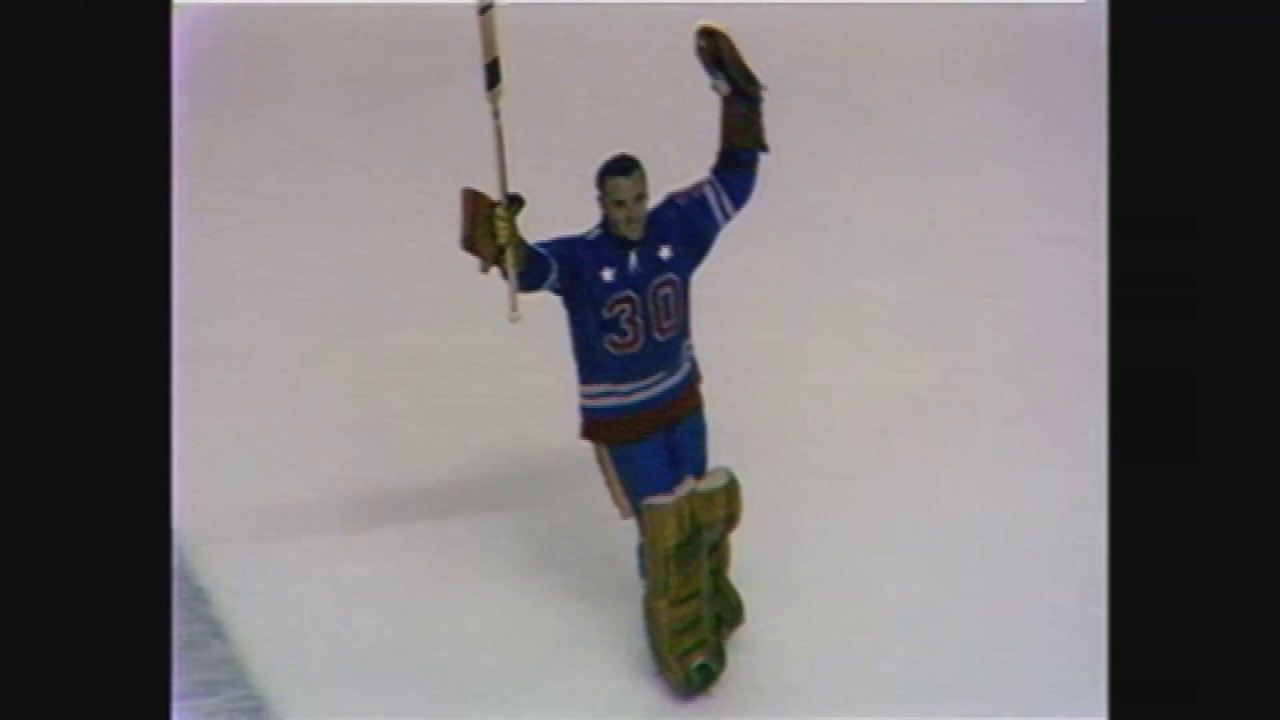
Then, the West Division switched goalies, and Jacques Plante of the Blues blocked all comers for the rest of the game. Plante hadn’t started because Parent had been the one to blank the East the previous year. This time, Plante’s 20 saves set a one-period record for most saves in an All-Star game. That was despite having a pulled hamstring in his left leg and nearing the end of his career at age 41. Plante commented, “That’s probably the last one. I’m thankful I didn’t disgrace myself. I’ve never felt more pressure.” He was correct that his eighth appearance would be his last. Plante went out on top. Ron Ellis of the Maple Leafs described one save, “Plante was down. I had the whole top of the net to shoot at. But suddenly this leg flies up from out of nowhere and my shot hits it.” As Plante explained, “And then, too, every man on the East team fires the puck like a bullet. You can never relax.” As coach of the East Division, Ruel noted, “With a little luck, we could have won by 10 goals. Plante made it a game.” In the end, Plante said, “I can’t recall ever having a greater night.”
Additional Sources:
Wally Cross, Plante, East Stars Shine,” St. Louis Post-Dispatch, 21 Jan. 1970, p. 1E.
Bill Beck, “Howe’s ‘Everything’ Is Example for East,” St. Louis Post-Dispatch, 21 Jan. 1970, p. 3E.
The Boston Bruins were playing their last game before going into their bye week and the NHL All Star Weekend. Of their previous three games throughout the week they were 1-1-1, and were trending some bad tendencies in regard to their inability to keep the opposition from scoring a tying or leading goal almost immediately after the Bruins had put one in the net. In reality of their prior ten games the Bruins were doing well, coming into Saturday’s tilt with a 7-2-1 record, but despite having beaten St. Louis on Thursday, that game ended up tied in just such a manner in the second when the Bruins got on the scoresheet first.
Within the first nine minutes of the game against the New York Rangers, on Saturday night, the Bruins had been on the power play for six minutes. Jesper Fast had been whistled for a hold on Brad Marchand 1:03 into the game and then roughly five minutes later Ryan Lindgren sat for a high-sticking double minor on David Krejci. With all of that man advantage time, what happened was Mats Zuccarello had a shorthanded bid on the Bruins net that Tuukka Rask was able to deny. In fact Zuccarello would make the exact same exit from his own zone three times in the opening frame to get quality chances on Rask.
While the Bruins inability to capitalize during those six minutes was distressing, the team needs to be more concerned with the ongoing issues that are allowing the opposition to make shorthanded bids that all too frequently amount to shorthanded goals. Though the Bruins still have the best power play in the league, the gaffs that were questionable back during December and going into the Winter Classic, are now a disturbing trend that for some reason Boston hasn’t been able to fix.
The Bruins ultimately got on the scoreboard first with a gritty goal, the result of Jakob Forsbacka Karlsson’s commitment to winning a puck battle in the corner and then putting that puck squarely on Danton Heinen’s stick. Heinen’s shot beat Henrik Lundqvist with 2:32 remaining in the opening period.
Unfortunately, 1:04 later young gun Filip Chytil had given the New York Rangers the tying goal, and worse, had made serious contact with Rask, who could be seen prone on the ice not moving. Bruins trainer Don DelNegro was at his side almost before the people in TD Garden had registered that Rask was truly injured.
Rask being helped off the ice.
While Chytil was definitely coming in fast on Rask, what made the entire thing go from bad to ugly was Charlie McAvoy’s attempt to deny Chytil’s opportunity. It was a play that just went horribly wrong in every way possible. Chytil ends up launched into the air after scoring, and comes down on Rask, who is shoved backwards into the goal with his head making contact with the crossbar before he slams onto the ice in an awkward fashion.
There was no question after seeing the replay that Rask was seriously hurt and at the very least going to have to go through the concussion testing now required for any hard hits like that. And there was no real surprise when it was later announced that Rask would not be returning to the game due to concussion.
“I tried to just take away the pass, he brought it to the net and he jumps through. I had two hands on my stick, I didn’t feel like I shoved him at all, just unfortunate, it sucks, you hate to see it. Obviously Tuukka’s a huge part of our team, he’s been playing great for us so you don’t want to see that,” McAvoy said post game. “He’s taking the puck hard to the net, I think contact there is unavoidable. He’s trying to get across he’s jumping, obviously I’m in there but I don’t feel like I played a massive part he goes right into him.”
There was no penalty called on the play and the goal stood. The teams continued until the buzzer signaled the end of the period and went into the first intermission tied. But for the Bruins, they had a difficult image of their teammate being hurt now etched in their brains. Something horrible happened to their teammate and one of their own was partly involved in what led up to that event. No matter how tough and professional you are, seeing your teammate hurt in such a way is something that is difficult to block out of your mind even though the players had to come back out and still continue to play.
“Yeah, he obviously didn’t mean to – you know [McAvoy’s] coming back hard to try and kill a play and when things are going at that speed you can’t anticipate what’s going to happen so, you know, stuff like that happens. By no means is it [McAvoy’s] fault. Plays happen like that in the game of hockey and – but we’re all very concerned about him and thinking about him and hope he’s feeling better here soon,” Brad Marchand said after the game.
The Bruins overall game didn’t really improve in the second and eventually, with zone time mounting for the visitors, the Rangers took the lead. Mika Zibanejad scored at 5:22 of the second period. The Bruins Patrice Bergeron was whistled for high-sticking just 24 seconds into the period, and then Matt Grzelcyk received a slashing call at 13:42 of the middle twenty, which was quickly negated by Kevin Shattenkirk when he received a tripping penalty 17 seconds later But the teams left the ice for the second intermission with the Rangers in the lead. And when the Bruins are behind at the end of the second period, their record coming into Saturday night’s game was an underwhelming 1-13-2 in such previous games.
Marchand would tally an equalizer 3:24 into the final period of regulation, but then Zdeno Chara would be sent off to the box less than five minutes later on a delay of game penalty—one of the more frustrating penalties. Zibanejad would get the go-ahead goal, his second of the game, and the ultimate game-winner, 58 seconds into the Rangers man advantage.
An occasional misplay that gives the opposition a possible shot on net is expected. However, the number of mistakes that have given their opposing teams shorthanded goals, coupled with their inability to keep the opposition from scoring almost immediately after them, are two areas that are the norm rather than the exception. And that is something that the Bruins cannot allow to continue.
“You know, I think there comes a time – we have Stanley Cup Champions in the room. We talk about leadership with this team all the time and how good it is, and it didn’t change today. But, at some point, it does have to come from within that hey you know what, you learn from your previous – the things you need to correct you usually learn from. We’ve done a good job with that, just not lately coming out of scoring goals, so I have to take a long look in the mirror to see if I’m putting the right people out on the ice after. But I’d like to think all of our guys are good players, and you’re kind of sticking with a matchup. Generally, you’re not throwing your least dependable players against their – you know what I mean. You’re trying to stay with the matchup, so I think some of that is incumbent on our group to recognize it. It’s like I think tonight our starts were good for a long time, but we went backwards a little tonight. You have to be a self-motivator to be a successful player in this league. It can’t be up to the coach every night to rev you up. We give them information, we prepare them the day before, we do some stuff in the morning, but when that puck drops it’s the individuals job to be ready to play, energy-wise and focused on the task at hand. We had a faceoff goal that the lining was wrong, and they scored on it, second goal. We were just not in the right spots, and part of that’s on our staff and part of that’s on our players to get it right. We get there late, and it’s in the net. So, some of those things crept into the game tonight. I was asked this morning would our focus be on – maybe it was on the break, but I don’t want to use that as a crutch because it’s happened to us how many games now – four, five, six where we’ve kind of let off the gas, got comfortable, maybe thought it was going to be an easy shift the next one and wanted to extend the lead but not playing the right way. So, there’s a lot of those things that go into it. Yeah, we’ll address it, but you’re not a teacher to the student that listens, right? That’s kind of part of it. We have to buy in,” said head coach Bruce Cassidy.
The Bruins have nine days before the Winnipeg Jets come to Boston on April 29th. During the nine days, most of the Bruins players will take vacations with their families, resting not only their banged up bodies but also their undoubtedly weary minds. They will hopefully return rejuvenated in body and focused. For David Pastrnak, his time off will be shorter since he will find himself participating in the All-Star Weekend events out in San Jose. But perhaps after a few days off, having the opportunity to just play hockey for the pure love and joy of the sport will help him to regain something that he seems to have lost as well.
Operation Desert Storm began just three days before the 42nd NHL All-Star Game held on January 19, 1991. Some organizers and players wondered whether they should cancel the game, but President John Ziegler decided against that. After the game, Wayne Gretzky, then of the Los Angeles Kings, commented, “It doesn’t seem right that we’re here having a good time while soldiers are getting killed in the Persian Gulf. During intermissions between periods, we came down to the locker room and watched the news updates.” New York Islanders Pat LaFontaine seemed to reflect the sentiments seen in many fan banners when he said, “We know the real All-Stars are sacrificing their lives in the Persian Gulf. We know this is just a game.”
Chicago Stadium sold out with a crowd of 18,472 patriots. As part of the opening ceremony, they observed a moment of silence for the troops. Gretzky said afterwards, “And today was just unreal. The bedsheets for troops overseas. The moment of silence. The only moment of silence. I’m Canadian, but like I was saying to Messier on the blue line, these Americans really rally behind a cause.” All the players wore United Nations flag decals on their helmets.
Following the announcements, Wayne Messmer came out to sing both national anthems. The crowd began cheering during “O Canada” and only increased in enthusiasm throughout “The Star Spangled Banner.” They waved sparklers and flags and really let loose during the last line of the song. Gretzky, in his 11th of 18 All-Star appearances, leaned over to tell Mark Messier, “This is unbelievable.” He told the press afterwards, “I’ve heard it as loud in here before but never as emotional. The flags of both countries, the banners, the vibrations. You could tell that the fans, like us, were thinking of other things.” Blackhawks coach Mike Keenan said, “The passions and feelings they demonstrated were extraordinary. It showed everyone viewing the game what everyone’s emotions were here.” He continued, “The unfortunate aspect of the war, its lingering thought, could have spoiled the weekend. But the patriotism shown here was special.”
Once the game began, it seemed to be all about scoring while ignoring defense. Loyal Chicago Blackhawks fans felt that their goalie, Eddie Belfour, should have been on the Campbell Conference team instead of watching from the stands with his son. However, it wasn’t the Campbell Conference that struggled. Their coach, John Muckler of the Edmonton Oilers, pushed for high scoring since the Campbell Conference had lost to the Wales Conference 12-7 at the previous All-Star game (at Pittsburgh). Muckler commented, “The passing skills out there were tremendous, and I feel sorry for the goaltenders, really, left alone and isolated.”
For the Campbell Conference, Gretzky scored mid-way into the game with his 11th All-Star goal. Being one more than Gordie Howe had scored, this made Gretzky the all-time leader. The three Blackhawks on the team (Steve Larmer, Jeremy Roenick, and Chris Chelios) earned seven points between them, to the delight of the home crowd. The MVP of the game was Vincent Damphousse of the Toronto Maple Leafs, in his first of three All-Star appearances. He scored once in the first period and thrice in the third to match the record for most goals scored in one All-Star game. Gretzky had set the record back in 1983, and Mario Lemieux had tied that the previous year. At the end of the night, the Campbell Conference beat the Wales Conference 11-5. Gretzky summed it up. “But there was such a good mood in that rink, such patriotism. It was good for hockey. It was a good show, period.”
Additional Sources:
Bob Verdi, “Meaningless? Not here, not now,” Chicago Tribune, 20 Jan. 1991, section 3, p. 1 and 13.
Mike Kiley, “Hawk trio stars in big show,” Chicago Tribune, 20 Jan. 1991, section 3, p. 1.
The Boston Bruins came into Thursday night’s game having lost in overtime to the Montreal Canadiens in Boston on Monday and losing in regulation to the Philadelphia Flyers on Wednesday night on the road. While they were sitting in third place in the Atlantic Division, their struggles to garner critical points going into the All-Star Break were raising questions about the team, especially as they gave up a league leading tenth shorthanded goal in the game against the Canadiens. Returning to the Garden to host the St. Louis Blues, it was looking like crunch time, with the Canadiens breathing down their necks in the standings.
The first period saw neither team score. There was a lot of north and south, and Jake Allen did make some important saves for the Blues to keep the Bruins off the scoresheet. However, neither team was thrilled with their performance in the opening 20.
“[The Bruins] just had more jump, we were complicated at the start. Trying to make too many plays early when they played last night, their heads are still in it. We need to find a way to simplify early when they’re playing on less than 24 hours. A little better in the second when we simplify our game,” shared defenseman Alex Pietrangelo after the game.
Pietrangelo’s teammate Patrick Maroon did his best to get his team motivated. With 2:30 remaining in that first period, Maroon finished a check on Charlie McAvoy, which sent McAvoy onto the ice. Bruins captain, and defensive partner Zdeno Chara took exception and the gloves were off.
“You know, he’s a physical guy, he’s a big guy, and he forechecks hard and you know, it was just one of those things that, he was doing his job and he was doing it well. He went on a heavy forecheck and finished the check pretty hard on [McAvoy], you know, he was kind of being heavy and I wanted to push back and start a fight,” explained Chara.
“I hit McAvoy in the forecheck and obviously he crosschecked me and whatever I think it just kind of happened. He’s a big man but whatever. I was just trying to get the team going, I’m sure he was doing the same thing,” responded Maroon.
Perhaps their tilt motivated both of their respective teams because the second period saw four goals scored—two for each side.
The Bruins got on the scoreboard first from a Torey Krug wrister in the slot. Assists went to David Krejci and Peter Cehlarik, who continues to prove it was a good choice by Bruins management to recall him from Providence. The Bruins’ lead was shortlived—as many of them have been in the last few games—as the Blues responded 52 seconds later when Ryan O’Reilly got his own rebound and put a wrister past Tuukka Rask.
With less than seven minutes remaining in the second period, St. Louis would go up 2-1, when Carl Gunnarsson got his first goal of the season, assisted by Jaden Schwartz and Braydon Schenn. Approximately 30 seconds later, Sean Kuraly drew a crosschecking penalty on Robert Bortuzzo—the Bruins first power play of the game. They had killed two penalties up to that point—one in the first when David Pastrnak was whistled for high-sticking and the second just a minute into the second when Cehlarik was sent to the box for tripping.
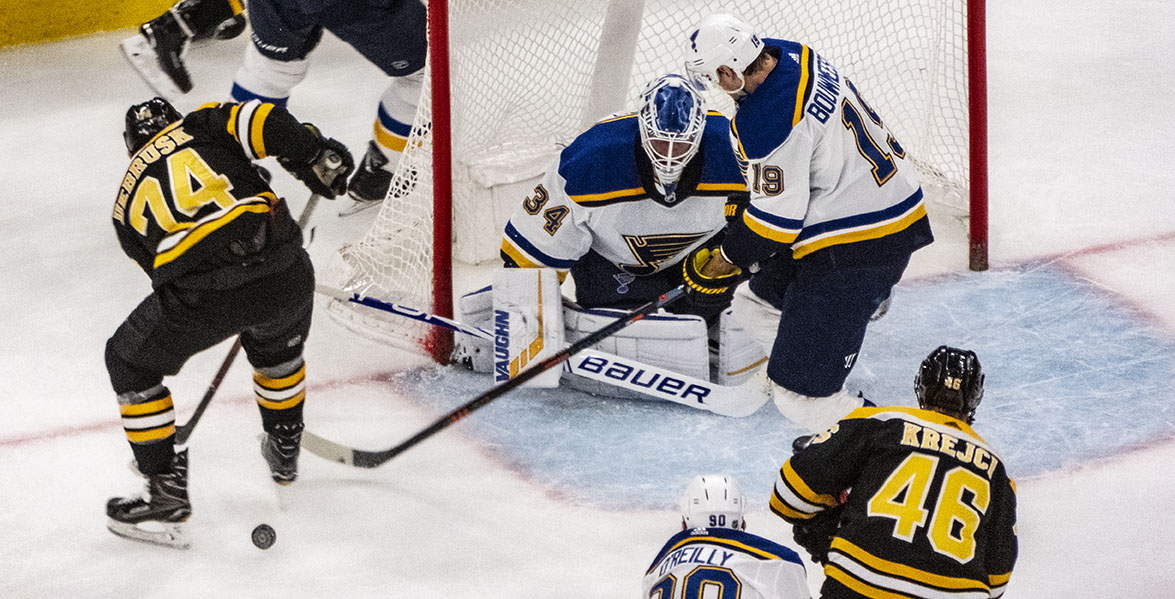
It looked like the Blues were going to make the kill, as the clock ticked down to the final seconds for the Bruins on the man advantage. That’s when Chara made his move from the point, and David Backes—a healthy scratch for the Flyers game—who was falling to the ice, managed to deflect the hurtling puck past Allen. Krejci got the secondary assist. The clock showed just four seconds remaining on the power play. And for the Blues that goal may have affected them more than anything else in the game.
Backes’ PP Goal behind Allen (Photo: Rhonda McClure)
“It just felt like it was kind of a, someone’s falling down and it hits his stick, I mean it was a hell of a tip. It’s a dagger, but in that situation our power play needs to capitalize on our opportunities also,” Maroon said.
Backes’ recollection of the goal seemed to be a bit more about self-preservation, after all it was a Chara slap shot headed his way as he was being pushed around in the lane.
“Just trying to – Zee’s [Chara] winding up – you’re trying to not take it in the face, first of all, and if you can get a piece of it change directions. I think coverage was pretty good on the play. I mean, he’s knocking me off my feet and I’m kind of pole vaulting on my stick just to try to not be on the ground too soon and try to keep something around that can maybe get a chunk of it and it worked out in that instance,” Backes stated.
For the Bruins, going into the second intermission tied, they came out in the third period with new resolve. They picked up the speed and increased their physicality. And their efforts were rewarded five and a half minutes into the final frame when Chris Wagner stuck with it despite the hard backcheck to give Boston the lead.
“Yeah, I kind of got lucky there. I got by Pietrangelo but I made a pretty good move out of nowhere, I guess and it worked out. I kind of like that better because you don’t have that much time to think. You just get around the defenseman there and maybe I’ve done that move before, I don’t know. Just kind of faked to the left and the goalie slides to the net so I just tucked it in,” Wagner described.
Of course, the question remained could they sustain it this time. As the game continued, the Bruins did not allow St. Louis to tie things up again which looked like it gave them even more confidence as they continued to play a fast and physical game. Brad Marchand put one in 13:12 of the third to give the Bruins a bit of breathing room as they went up 4-2. And with roughly three minutes remaining the Blues pulled Allen which allowed Kuraly to put the puck in the empty net and wrap up the win for the Bruins.
There was definitely a level of confidence and conviviality in the Bruins locker room after the game. However, they recognize they still have some things to work on, especially with the New York Rangers coming to town on Saturday.





 Prev
Prev