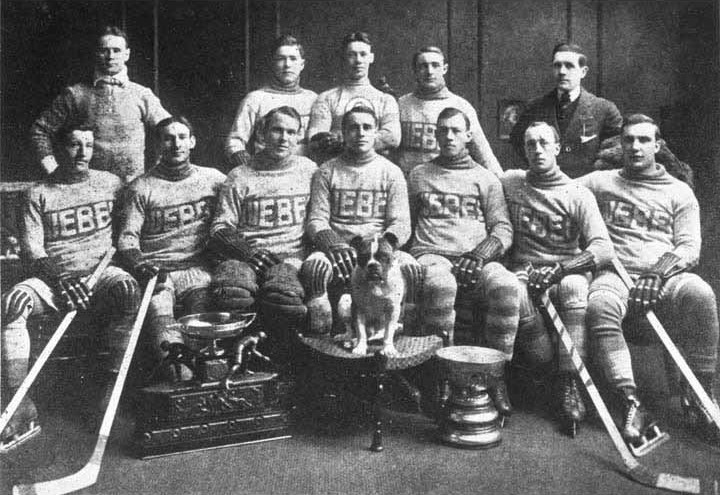
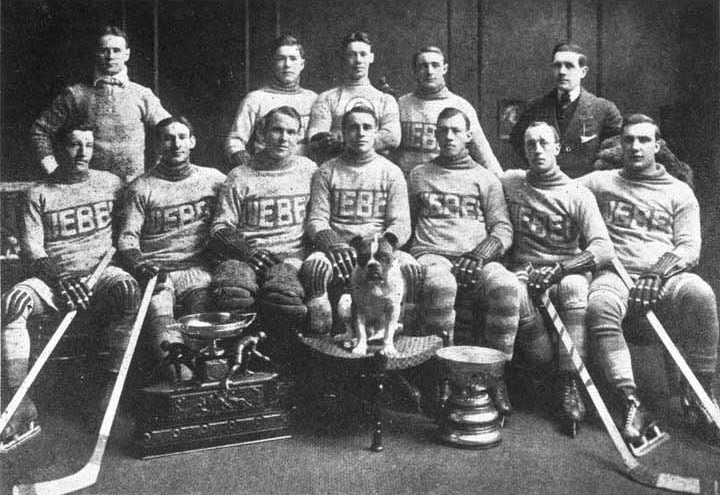
(Photo: Quebec Bulldogs, 1913 Stanley Cup champions [Malone is behind the bulldog], via Wikimedia Commons)
Joe Malone, the man to score the very first NHL goal for the Montreal Canadiens in their very first NHL game, still holds the record for the most goals scored in one game.
By the time the NHL formed, Malone had already skated with the Quebec Bulldogs since 1908 and won two Stanley Cup Championships with them. Since Quebec would not have an NHL franchise, Malone was claimed by the Montreal Canadiens in the 1917 Dispersal Draft. He scored their first goal and four more on the NHL’s opening night, and he ended that first season with 44 goals. He spent two seasons there wearing No. 7 and would have played for the Stanley Cup again (but for the 1919 flu epidemic) before Quebec regained its franchise. Malone skated for the Quebec Bulldogs during their only NHL season, 1919-20.
On January 31, 1920, the Bulldogs closed out the first half of the season against Toronto, which had just changed names from the Arenas to the St. Patricks. The crowd in Quebec was the smallest of the season “partly due to the extremely cold weather.” Those who came were rewarded by seeing Malone make history.
During the first period, the talented center almost scored on the first faceoff of the night, but Toronto’s goalie “turned the shot aside.” Malone still scored the first goal of the game at 6:50, when he “got the puck near centre ice and went through alone.” According to the recap in the Montreal Gazette, “Just before the end of the period, Joe Malone rushed near the Toronto goal and shot from the side, the puck striking Mitchell on the chest, rolled up over his left shoulder, then dropped right behind him, but the goal umpire would not allow the point.” The score at the end of the session was 3-2 with the Bulldogs leading.
For the middle period, Malone scored every other goal. For two of the goals, he received passes from teammate Harry Mummery. Finally, “Malone scored again for Quebec just before the close of the period, when going through alone he sagged the twine behind Mitchell for Quebec’s sixth tally.” Both teams doubled their tallies for a score of 6-4.
In the third period, Toronto sent in a different goalie. That seemed to make little difference to Malone. While Toronto’s Cully Wilson sat a major penalty (for hooking George Carey as he was about to shoot), “Malone later scored the point that made the players feel sure of victory when he accepted Harry Mummery’s pass and beat Lockhart.” Two minutes later, he scored again “with a side shot from a difficult angle,” but he was then sent to the penalty box for hooking Wilson as he reentered the game. For the last play, “Malone in turn stole the disc away from the Toronto defenceman, drew Lockhart out, slipping the rubber past him for the final goal of the match.” His three consecutive goals wound up the scoring, and the Bulldogs won 10-6. Unfortunately, it was only their second win of the season, and they were in last place. According to the recap, “For the locals, Malone was the star. The lanky forward had his biggest night of the year, setting up an individual performance such as has not been equaled this year. He scored seven tallies and played a great game.”
Since then, NHL players have only managed six goals in one game. That record had briefly been held by Newsy Lalonde of the Canadiens, who scored six on January 10, 1920. Malone also had a six-goal game later that season. Otherwise, only five others have scored six in one game, the most recent being in 1976.
As for Malone, although he did not beat his personal best, he finished the season with the most goals (39), followed by Lalonde with 36. Then, the franchise relocated to become the Hamilton Tigers. For two seasons, Malone played for and coached the Tigers. Upon refusing to report for training camp in 1922, he returned to the Canadiens for his final two years in the NHL. He capped off his career with one last Stanley Cup. Malone had spent four seasons in the top ten goal scorers and in 126 games, he had 143 goals, 33 assists, and 176 points. He was inducted into the Hockey Hall of Fame in 1950.
Additional Sources:
Brian McFarlane, Brian McFarlane’s History of Hockey (Champaign, Ill.: Sports Publishing Inc., c1997), 18.
Canadian Press, “Quebec Furnished Hockey Surprise,” Montreal Gazette, 2 Feb. 1920, p. 16.
Tuesday night’s return to hockey for the Boston Bruins, after their bye week and the All-Star break, saw the recall of Peter Cehlarik and the first call up for Trent Frederic from the Providence Bruins. In addition, with Tuukka Rask currently on injured reserve, Jaroslav Halak started in net and Zane McIntyre was recalled from Providence to serve as the backup goaltender.
The Bruins played host to the Winnipeg Jets who were playing in the second of a back-to-back set of games, having lost to the Philadelphia Flyers on Monday night. Despite coming into the game on Tuesday with a two-game losing streak, the Winnipeg Jets sit first in the Western Division. And like the Bruins they have one very strong scoring line in the Kyle Connor, Mark Scheifele, Blake Wheeler line, just as the Bruins have Brad Marchand, Patrice Bergeron and David Pastrnak. The two teams are similar in other ways as well—their speed and physicality, and both teams seem to be back-end loaded when it comes to goal scoring with both of them getting their most goals in the third period.
“I mean we’re built the same way, you know. They got some big bodies, we got some big bodies. They play really fast, we play really fast. That’s a heck of a team over there, so we tried to give them all they could handle tonight and it was good enough to get two [points],” said Jets captain, Wheeler.
The Bruins jumped on the Jets almost from the start of the game, and it looked like perhaps the Jets were tired from playing and traveling on Monday. Bergeron put the Bruins on the scoreboard first and the team did manage to defend for a decent length of time before the Jets were able to tie things up. This was a solid improvement for the Bruins who, going into the break, had been giving up goals almost immediately after scoring one. And with Pastrnak adding a second goal late in the opening period the Bruins were leading 2-1 going into the first intermission.
The second period saw the physicality of the teams in glorious color. It was clear that the Jets had found another gear in their play. Having been outshot 20-8 in the first period, they were now determined to try to turn the tables on the Bruins. The second period has been a struggle for Boston throughout much of the season. As the period continued the hits became a bit harder. The first sign that things were ratcheting up was at the 14:14 mark as Jake DeBrusk was going in on Jets netminder Connor Hellebuyck. He ultimately shot wide of the net, the result of defenseman Dmitry Kulikov, who was back-checking him, and essentially driving him into the net. DeBrusk hit the left post hard, the net came off its moorings and DeBrusk went down, only to look up and see Brendan Lemieux standing over him giving him lip and waving his arms a bit—even went so far as to shake off referee Ghislain Herbert’s hand as Hebert came in to calm things down.
Jake DeBrusk says hello to the Jets net.
(Also it looked for a split second like Brendan Lemieux was ready to lose it on the ref lmao) pic.twitter.com/d24NnLWIvk
Roughly a minute later Marchand’s snap shot was blocked by Josh Morrissey—who had gotten Winnipeg’s goal in the first period. At 15:37 there was a series of three hits. The first was Bruin Noel Acciari on Jacob Trouba in the neutral zone. At 15:43 Winnipeg’s Adam Lowry put a defensive zone hit on Chris Wagner. But what really got things going was the hard, clean hit, Kevan Miller put on Brandon Tanev as Tanev was coming into the Bruins end along the right board. Miller landed him on the ice and Adam Lowry invited Miller to drop the gloves. Miller has never been one to shy away from such an invite.
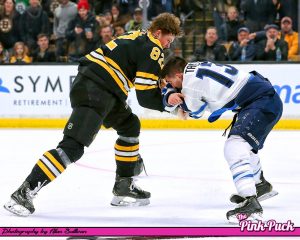
As the combatants headed down their respective tunnels, given that there was less than five minutes remaining in the second period, the puck was dropped. Frederic won the draw in the Bruins end against Bryan Little and as the play turned to head in the other direction, Frederic put his own hit on Tanev in the neutral zone. Things headed down in front of Hellebuyck where a hand pass resulted in a whistle at 16:16 with a bit of a scrum in front of the Jets goaltender. And that’s when Tanev decided he would welcome Frederic to the NHL while teaching him a lesson. However, that fight didn’t go exactly the way Tanev expected, as Frederic came out swinging and just never stopped until he took down Tanev.
First NHL game, first NHL scrap for Trent Frederic, and his parents in the stands love it ?? pic.twitter.com/IJJ4W03dWt
After the fight, as once again two more players headed down their respective tunnels—29 seconds after the last pair, Frederic’s parents, who were among his friends and family at the forward’s first NHL game, were shown on the Jumbotron. His father was quite proud of his son and he high-fived someone behind him. And when his wife went to high-five him he was going in for the fist bump.
“Yeah, that’s tough, we’ll have them work on that. But one of these days,” Frederic joked about the incoordination of his parents.
Of course, there was nothing uncoordinated about Frederic’s fight. Showing the signs of what will likely be quite a shiner to his left eye on Wednesday, it was clear that Frederic felt he had stood up tall for the team.
“It just kind of happened naturally. It just kind of got chippy a little bit at that point of the game, just kind of happened naturally. I wasn’t really going in trying to get one tonight, but it just happened,” Frederic said.
As the buzzer signaled the end of the second period, the Bruins were still leading 2-1. However, going into Tuesday’s game, Winnipeg had scored 66 goals in the final frame throughout their previous 49 games—the most in any period for them, while limiting their opponents to 48.
Kyle Connor and Mark Scheifele
The third period began with Winnipeg getting a shot on Halak before the Bruins put two on Hellebuyck. A neutral zone faceoff after an offside play saw some players changing on the fly. For the Jets, it looked like they drew it up that way, as Connor came off the bench and received a solid pass to go into the offensive zone. Had the Bruins not been making an ill-timed line change, there may have been someone who could have stopped Connor, but instead he put the puck in the net to tie the game at two each at 4:27 of the third. Thirty-four seconds later Connor put his second of the game past Halak to give Winnipeg their first lead in the game.
Once again, the Bruins top line would have to bring things together as Bergeron got his second of the game at 11:39 of the final twenty of regulation. From the middle of the second throughout the third, the Bruins seemed to be trying to pass the puck a bit too much—especially during the second period when they had a man-advantage but spent more time passing than shooting. And while the cycling and zone time were strong, had they put a couple more shots on Hellebuyck during that and played the way they had in the first period, the score would likely have been different. They allowed the Jets back into the game to a degree.
The Bruins did manage to garner a point from the game. They took it all the way to the shootout, when once again Connor got the only goal, while Hellebuyck denied DeBrusk, Pastrnak, and Marchand. As for Frederic, he saw 8:39 of ice time through 13 shifts. He had two shots on goal, an additional two that were blocked, two hits, a takeaway and was an impressive 59% on the draw (4 out of 7) in addition to his first NHL fight.
It lived up to the hype of a first NHL game. — Frederic
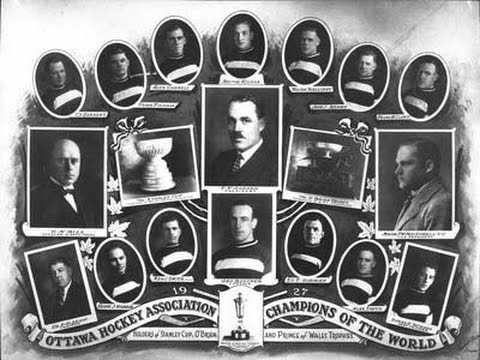
He played for the Senators, but for at least two seasons, Alex Connell was the king of shutouts. On January 30, 1926, he set an NHL record for the most shutouts in one season. Then two years and one day later, he began his record-setting streak of most consecutive shutouts.
Connell began tending goal for Ottawa in 1924. In his second season, he topped all his fellow goaltenders in shutouts and set a record for the most in a single NHL season. In December 1925, he had six shutouts, and he added four more in January. On January 30, Madison Square Garden oversold their capacity to cram in 18,000 spectators. Tex Rickard claimed the crowd was bigger than the one at their grand opening. The visiting Senators had left behind 20-below-zero weather for more autumnal climes in New York City. The last time they had been in town, on January 11, they beat the Americans 1-0 in overtime. At the end of the month, they matched that score thanks to Connell, who “foiled them” when the Americans bombarded his net in the third period. According to Ed Baker’s synopsis in the Ottawa Citizen, Connell “stopped many shots that would have beaten a less capable net guardian.” Even after becoming the first NHL goalie to have ten shutouts in one season, by the end, he became the first to have fifteen. The next-closest goalie that season only had seven. By the end of the season, the Senators had at least one shutout on all six opposing teams.
The next season, 1926-27, Connell came in second (with 13) to George Hainsworth’s 14 shutouts. However, Connell came out the winner leading his team to the Stanley Cup.
For the 1927-28 season, Connell made history with his shutout streak. Coming in to the streak, Connell already had six shutouts. Then, on January 31, he earned his seventh in front of only 3,500 fans. According to the Ottawa Citizen, “The attack was functioning in faultless fashion and the defence was superb, Boucher and Clancy working together so effectively that Alex Connell got off with one of the easiest nights of his career. Alex had plenty of shots to handle in the latter stages of the game, but nothing compared to what little John Roach had to face in every period.” The Senators defeated the Toronto Maple Leafs 4-0 and increased their winning streak to four games.
Connell proceeded to blank his opponents for the next five games. In the second and sixth games of the streak, the Senators defeated each Montreal team 1-0. Between those, Ottawa tied at 0-0 with the New York Rangers (twice) and the Pittsburgh Pirates. The final game of the streak, the 1-0 win over the Montreal Canadiens, set a new attendance record of 8,500 at the Auditorium on February 18, 1928.
Although the Chicago Blackhawks snapped the streak on February 22, Connell and the Senators added two back-to-back shutouts right afterwards. When they tied the Detroit Cougars 0-0 on February 23, the Ottawa Citizen proclaimed, “Alex Connell master wielder of the white-wash brush, laid it on in large gobs here this evening.” The very next night, they defeated the Pittsburgh Pirates 2-0. Connell’s six consecutive shutouts (in 461:29) remains the streak to beat.
When the season ended, Connell and Hal Winkler (of the Boston Bruins) had tied with 15 shutouts, but Hainsworth (of the Montreal Canadiens) was not far behind with 13. The following year, Hainsworth smashed Connell’s record of 15 shutouts in one season by collecting 22. That record still stands, and Connell still remains in second (with Winkler and Tony Esposito).
Connell remained in the NHL for 12 seasons, and unsurprisingly, he spent ten of them in the top ten for shutouts. He finished his career with 81 shutouts, which puts him in sixth place overall (after Hainsworth in third place with 94). Two weeks after being inducted into the Hockey Hall of Fame, Connell died 10 May 1958.
Additional Sources:
Ed Baker, “Ottawas Triumphant in New York,” Ottawa Citizen, 1 Feb. 1926, p. 11.
“Senators Outplay Leafs and Gain Second Place,” Ottawa Citizen, 1 Feb. 1928, p. 10.
“Ottawas in Second Place; Rack Up Fourth Straight Victory,” Ottawa Journal, 1 Feb. 1928, p. 16.
“Goal by Len Grosvenor Defeats League Leaders,” Ottawa Citizen, 20 Feb. 1928, p. 11.
“Senators and Cougars in Scoreless Tie,” Ottawa Citizen, 24 Feb. 1928, p. 11.
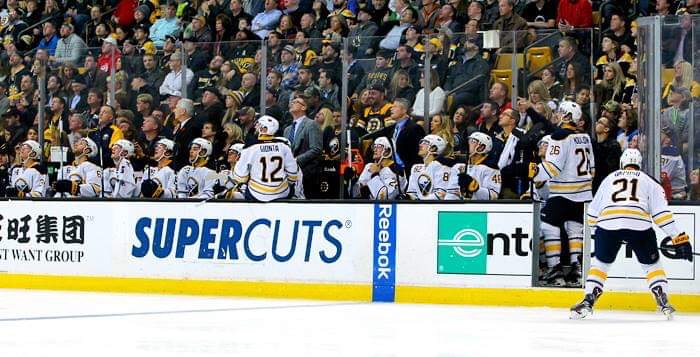
The Buffalo Sabres are coming off of a 10-day break to face a tough schedule this week. They’ll face two teams fighting for playoff positioning and a team that has won two games in a row. The Sabres resume action tonight as they face the Columbus Blue Jackets on the road. They’ll travel to Dallas after the game to face the Stars tomorrow night and then they’ll come back home for a game against the Chicago Blackhawks on Friday night.
1) Tuesday, Jan. 29 @ Blue Jackets- 7p.m. – ET
The Sabres have the speed to matchup against the Columbus Blue Jackets, but the over all advantage in this game goes to the Blue Jackets. The Sabres top line of Jack Eichel, Jeff Skinner and Sam Reinhart has combined for 140 points, and the rest of the forwards need to start chipping in more to make this a more balanced team. The Blue Jackets have a balanced lineup from top to bottom with the defense contributing at times this season.
If the Sabres want to grab two points then the team needs to get off to a strong start and avoid sloppy play early in this game. An effective way to stop the Blue Jackets lineup would be to get the cycle game going and force Columbus to defense instead of being on the attack. The Sabres need to play team defense and avoid turnovers especially in the neutral zone because the Blue Jackets will take advantage of their miscues. The defensemen for the Blue Jackets are known to be involved in the offensive zone so the Sabres should try to take away their time and space to create. The top two scorers for the Blue Jackets are Artemi Panarin and Cam Atkinson so Buffalo needs to make sure that they know where those two are when they are on the ice. The Sabres should try to get pucks on net because the goalies will allow soft goals from time to time.
2) Wednesday, Jan. 30 @ Stars- 8:30 p.m. – ET
These two teams are very similar to each other. The top lines are producing a majority of the team’s points, but the Dallas Stars have elected to put Jamie Benn on the second line in an attempt to spread the wealth in the lineup. The teams lack depth with a couple of defensemen pitching in on the offensive side of the puck. The Stars do have the goaltending advantage over the Sabres.
One reason for the Stars’ inconsistency this season has been the slow starts and lack of first period goals. In 49 games, they only have 23 first period goals. The Sabres want to play a good even strength game since the Stars have solid special teams numbers. If the Sabres can generate some of their own offense while shutting down Tyler Seguin and Alexander Radulov then they’ll have a decent shot at grabbing two points. The key to the game for the Sabres is making sure that they have a lead entering the third period since the Stars only have one regulation win in 14 tries when trailing after two periods.
3) Friday, Feb, 2 vs. Blackhawks- 7p.m. – ET
The Sabres matchup well against the Chicago Blackhawks in that they have speed and their goaltending has been better than the opposition. The Blackhawks have been getting some production from their centers this season. The Sabres have a slight edge in the special teams department, but both teams had their struggles in this area in the first half of the season.
The biggest key to the game for the Sabres is to hold Patrick Kane in check since he leads the Blackhawks in both goals and points. Buffalo will need to take advantage of their power play opportunities since the Blackhawks ranked last in the NHL in penalty killing. The goaltenders are going to want to make some stops since both teams have players that can put pucks in the net. The Blackhawks may not have the best of records, but the Sabres can’t play down to the competition and need to limit their mistakes.
Sabres Slashes Weekly Prediction
The Sabres will go 2-1-0 on the week and get four of a possible six points. The Sabres will lose a close game to the Blue Jackets, but they will bounce back and win the final two games of the week in regulation against the Stars and Blackhawks.
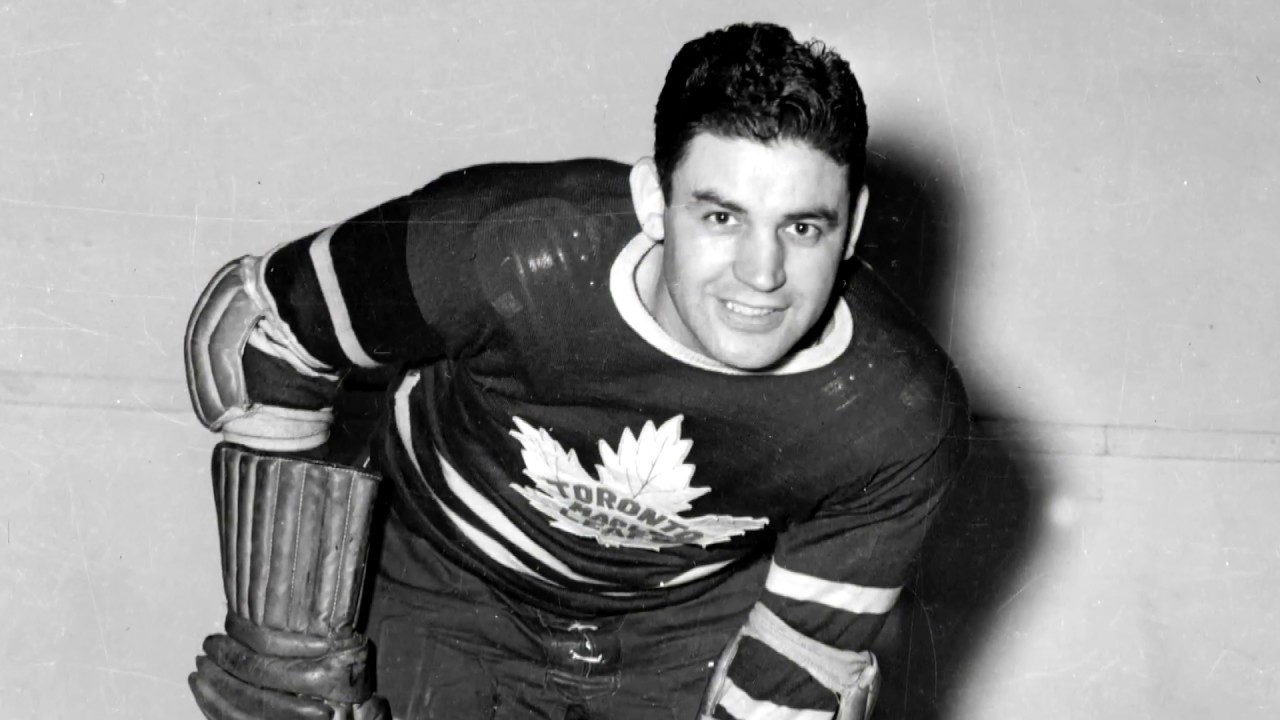
Everyone seemed to like the big guy and hated to bust him, but an example had to be made to prevent further wrong-doing in the future. Evidence was found that Walter “Babe” Pratt, star defenseman of the Toronto Maple Leafs, had gambled on NHL games. On January 29, 1946, NHL president Mervyn “Red” Dutton announced that Pratt was expelled.
Pratt had joined the NHL playing for the New York Rangers from 1935 until he was traded to Toronto for the 1941-42 season. Two seasons later, he was selected for the All-Star team and became the first Leaf to receive the Hart Trophy as MVP. In 1945, he helped lead the Leafs in winning the Stanley Cup championship. The 1945-46 season was his 11th in the NHL. Conn Smythe proclaimed, “He was the best all-around defenseman we ever had on the Leafs.”
Although Pratt was enjoying a great career, he worked as a railway switchman on the side and spent time with known gamblers. The NHL had a rule that gambling was not allowed. Despite Toronto officials warning their team a year prior and again a month prior, Pratt continued to keep up suspicious activities. While in New York, Dutton caught wind of the activities and went to Toronto to investigate (with the full support of the Maple Leafs officials). There, he “uncovered evidence to prove that Pratt had been gambling,” and when “confronted with this evidence, Pratt admitted he had been gambling.” He signed a statement for Dutton that was not disclosed to the press. Dutton clarified, “I want to emphasize the fact that there is no scandal in connection with this case. Pratt is being disciplined for violating rules against gambling, but, in fairness to the Toronto player, it should be kept in mind there is no evidence he was betting against his own team.”
This was not a witch hunt. Dutton explained, “If a player refuses to conform to the rules of the league, there is only one thing to do and that’s to discipline him.” From his Montreal office, Dutton announced that Pratt was being expelled for “conduct prejudicial to the welfare of hockey” by gambling on the results of games and for “failure to report an unsuccessful attempt to bribe him to throw a game.” Officials of the NHL and the Maple Leafs stressed that absolutely no evidence indicated that Pratt had made bets against his own team. Still, said Dutton, “The good name of professional hockey can’t be jeopardized to protect one player.”
The announcement came as a surprise for most. Pratt himself was not officially notified of the expulsion beforehand. A Rangers official said, “That’s a surprise to us. We know of no similar activities during the six and one-half years he was with us.” Pratt declined to comment. This was the first ruling of this kind in organized professional hockey.
As Dutton had made clear, Pratt had the right to appeal the ruling. His opportunity would come at the league governors’ next meeting, held at New York on February 15. Dutton encouraged Pratt to appeal but commented that they were “determined to keep our game clean and if Pratt’s appeal fails, it may serve to impress other players that we intend to enforce the anti-gambling rule.” When the appeal date came, Dutton actually pushed for leniency. After a 16-game suspension, Pratt was reinstated.
During the suspension, Selke announced that rookie Doug Baldwin would take Pratt’s place and that Pratt was not allowed to practice with the team. At the end of the season, having missed the playoffs, the Maple Leafs traded Pratt to the Boston Bruins. After only one season with Boston, they traded him to an AHL team. He bounced around the AHL and PCHL until 1952. In their first season without Pratt, the Leafs won the Stanley Cup again, and they proceeded to win the next two seasons to become the first NHL team to win three consecutive championships.
Additional Sources:
Brian McFarlane, Brian McFarlane’s History of Hockey (Champaign, Ill.: Sports Publishing Inc., c1997), 57.
Dink Carroll, “Babe Pratt, Toronto Defenceman Expelled by N.H.L. for Gambling,” Montreal Gazette, 30 Jan. 1946, p. 1 and 14.
Fraser MacDougall, “Babe Pratt Expelled From NHL For Conduct Prejudicial To The Welfare Of Hockey,” Ottawa Evening Citizen, 30 Jan. 1946, p. 10.
The NHL was busy on Saturday, January 28, 1989. A record number of fans (164,223) showed up to watch the ten games that were played that day. That sold out eight of the ten arenas. In some cases prompted by the extra cheering, the teams showed their audiences good close games. By the numbers, three games ended with ties. Of the remaining, the home teams won three while the visitors took four. Five of those games were won by one goal, and two of those were in overtime.
The two games in Pennsylvania went very well for the home teams. Pittsburgh filled to capacity with 16,025, for the 13th consecutive game. Their 25-game attendance totaled at 388,971, an average of 15,159 per game. The maxed-out crowd witnessed the Penguins defeat the visiting Detroit Red Wings 10-5. Philadelphia hosted a rare morning game at 11:05 am, which 17,423 came out to watch. The breakfast the Flyers had together before the game must have been good because they won 7-4 over the visiting New York Islanders.
The three tie games took place down the center of North America – in Toronto, Bloomington (Minnesota), and St. Louis. The Maple Leafs managed to tie the New York Rangers 1-1 at 5:29 of the third period. Neither team scored in overtime. In Minnesota, the crowd of 13,502 did not quite reach the maximum 15,000. Still, the North Stars looked poised to win until the New Jersey Devils’ Jack O’Callahan scored a power-play goal with only 1:58 remaining. After the overtime session, they were still tied at 4-4. Matching that score were the St. Louis Blues and visiting Washington Capitals.
Both teams had had issues just getting to St. Louis on Friday. The Blues left Boston only to have their plane turn back 20 minutes into the flight when a warning light indicated an engine had caught fire. They were put on another plane after about three hours and made it home safely. The Capitals had their flight “abort its landing” because another plane was on its runway. Fortunately, both teams made it for the 17,591 fans, the seventh sellout crowd in the last eight games held at St. Louis. “The fans we have here, they never die here,” enthused Blues left winger Gino Cavallini, “When we’re behind, they are at their loudest.” Cavallini scored two of the four goals, while Greg Paslawski scored the other two. Playing in his 900th game, Bernie Federko earned his 700th and 701st assists.
Two games tied in regulation did have a winning goal in overtime. Before a sellout crowd of 15,223 in Hartford, the Whalers led 2-1 until the third period. Five minutes in, the Quebec Nordiques Peter Stastny tied during a power play. Only 32 seconds into overtime, Marc Fortier scored the winning goal for the Nordiques. At 3-2, the last place team snapped the Whalers’ five-game unbeaten streak. In another international matchup, again the Canadian team won but at home. A whopping 20,002, the largest crowd of the day, gathered at the Calgary Saddledome. In only 2:20 during the first period, the Flames gave up three goals to the Chicago Blackhawks and had to swap goalies. They made up for it over the remainder of the game. With only two minutes remaining in overtime, Dana Murzyn gave the Flames a 5-4 win and added a third game to their winning streak.
In the other three games of the night, the winners managed to retain a one-goal lead during regulation. Of them, only the Montreal Canadiens won at home. Their 17,809 fans watched them defeat the visiting Buffalo Sabres 2-1, snapping their nine-game unbeaten streak. It seemed only fair since the Sabres had beaten Montreal at Buffalo the night before. In Boston, 14,261 Bruins fans came to watch Ray Bourque’s return after a knee injury forced him to miss 20 games. He rewarded them by scoring a goal and an assist. However, that was not enough to overcome the Winnipeg Jets, who won 4-3. Some fans blamed the referees. With 1:56 left in the game, fan Frank Baro “climbed over the lower glass beyond the visitors’ bench and went running toward referee Bill McCreary” after McCreary chose not to call a high sticking on the Jets. He was checked by a player and arrested. Finally, over on the west coast, Los Angeles sold out to a crowd of 16,005. The Kings were down 5-0 when Jay Miller, who had only been with them a week, refused to fight back earning them a five-minute power play. That’s when Bernie Nicholls stepped in and scored two quick goals, his 49th and 50th in 51 games (tying a Kings record). By the time the second period ended, the Kings had caught up to the Edmonton Oilers at 6-5. During the last period, Miller managed to tie up the score, but Oilers Craig Simpson scored the winning goal at 11:53 of the third.
On that day with so many watching so much hockey, only the Vancouver Canucks did not play.
The Philadelphia Flyers had eight straight days off for their bye week and the All-Star weekend, but now it’s time to get back to work. They jump right back into it since they will be playing four games in six days including a back-to-back situation right out of the break.
On Monday night, they’ll face a tough Winnipeg Jets team, who are favored to go far in the Western Conference playoffs. Then Tuesday night, they’ll play in the famous Madison Square Garden to take on the New York Rangers. It doesn’t get any easier for the remaining two games. On Thursday night, the Flyers take a trip to Boston to face the Bruins and then the team will return home on Saturday to take on Connor McDavid and the Edmonton Oilers.
1) Monday, Jan. 28 vs. Winnipeg Jets- 7 p.m. ET – NBCSN
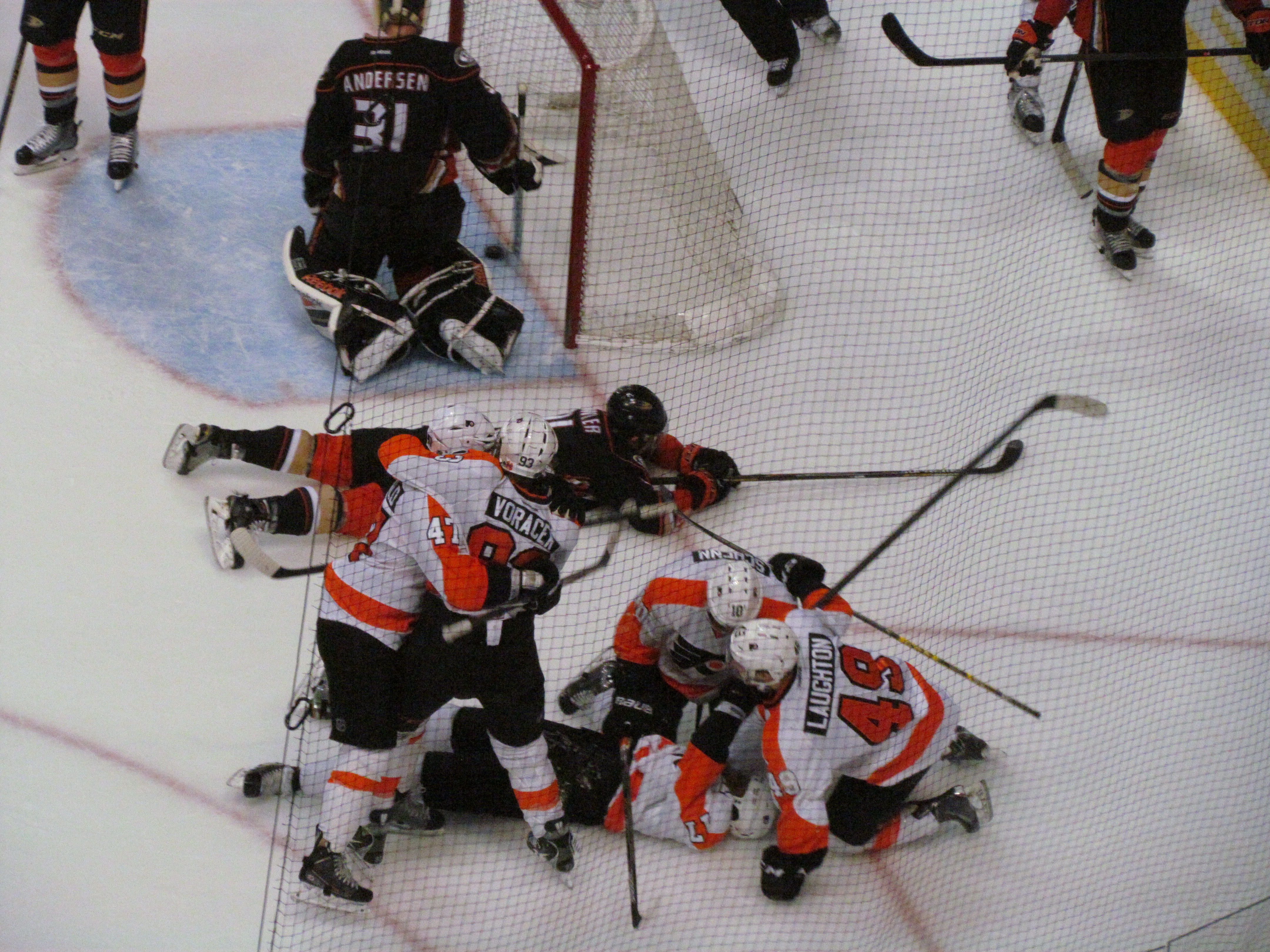
The Flyers don’t match up well against the Winnipeg Jets team, who are currently first in the Central Division. The Jets are a big, physical team that can play a fast game while the Flyers lack speed in their lineup. Winnipeg has a balanced lineup but the Flyers tend to rely on Claude Giroux, Sean Couturier and Jake Voracek. The Flyers are a work in progress on the blue line while the Jets have a solid group that plays well together.
If the Flyers want to steal two points from the Jets then they are going to have to be willing to work to create their own space to get some scoring chances. The Orange and Black have to play a disciplined game since the Jets power play is ranked fourth in the NHL. The Flyers should feel compelled to limit their mistakes and find a way to contain the line of Kyle Connor, Mark Scheifele and Blake Wheeler. Wheeler leads the Jets in points with Scheifele tied for the team lead in goals. Since this will be the first game after the bye week and All-Star weekend, the teams should try to get off to a good start by getting involved in the game early and often. The key factor in this game for the Flyers will be the goaltender, whether it be Carter Hart or Mike McKenna.
2) Tuesday, Jan. 29 @ NY Rangers- 7:30 p.m. ET – NBCSN
The Flyers have managed to win both games over the New York Rangers so far this season. The Flyers have balanced out their lineups and James van Riemsdyk has been coming on of late, whereas the Rangers have been relying on one line to produce. The Orange and Black have been able to beat Henrik Lundqvist, but he has also had some really good games against them. This will be the Rangers first game back from the break and the Flyers will have played the night before so the pace to start this one may be a little slow, but should get better as the game goes on.
The Flyers are trying to get some wins and get back in the playoff picture, or at least out from the bottom portion of the League’s standings. They should get some bodies in front of the net to redirect pucks and screen the goalie. Mika Zibanejad is the Rangers’ leading scorer and assists guy so the Flyers need to be aware of where he is whenever he’s on the ice. The Rangers’ penalty kill is towards the bottom of the NHL so this would be a perfect time to get the power play going for the Flyers, who can’t seem to take advantage of being up a man. The Orange and Black need to get the first goal of the game to take the home crowd out of the game and get some momentum.
3) Thursday, Jan. 31 @ Bruins- 7 p.m. ET – NHLN
There have been some entertaining games between these two teams over the past few years and they usually end with the Boston Bruins getting a late game winning or game tying goal to force overtime. The Bruins won’t shy away from the forecheck game so the Flyers defensemen will have to move the puck quickly but also be smart about it. Jaroslav Halak has played both games against the Flyers this season and has a shutout in one game while allowing four goals in the other. The Bruins can play with speed in transition so the Flyers need to play a solid defensive game.
The Bruins top line of Brad Marchand, Patrice Bergeron and David Pastrnak is one of the best in the NHL so the Flyers need to find a way to limit the damage done by this line. The Bruins have the second best power play in the League so the Flyers should feel compelled to play with discipline and stay out of the penalty box. The whole team needs to play defense in this game including the forwards. The Flyers should get plenty of pucks on net and make sure there is someone in front to distract the goalie.
4) Saturday, Feb. 2 vs. Oilers- 1 p.m. ET – NHLN
The Edmonton Oilers beat the Flyers the only time they’ve faced each other this season, but the Flyers have been better since that meeting. Brandon Manning will face his former team for the second time this year. The Oilers are a physical team so the Flyers are going to have to play fast and create their own space in this game. The Flyers seem to have the goaltending advantage in this one since the Oilers goalies have not been particular well at stopping the puck this year. The Oilers are going to play with speed so the Flyers need to find a way to slow them down.
If the Flyers want to control this game then they are going to need to stop Connor McDavid and Leon Draisaitl, who are the top two leading scorers on the team. The Oilers penalty kill may be struggling, but the Flyers should stay out of the penalty box since their power play seems to be dangerous. The Orange and Black need to get a ton of shots on goal and get the puck towards the net since the goalies have struggled so far this season.
Flying Forward Weekly Prediction
The Flyers are going to finish the week with a 2-1-1 record. They’ll pull out regulation wins against the Rangers and Oilers. The Jets game won’t be close and they’ll take the loss in regulation time. The Bruins game will be an entertaining one, but the Flyers will ultimately continue their overtime struggles and lose in the 3-on-3 session.
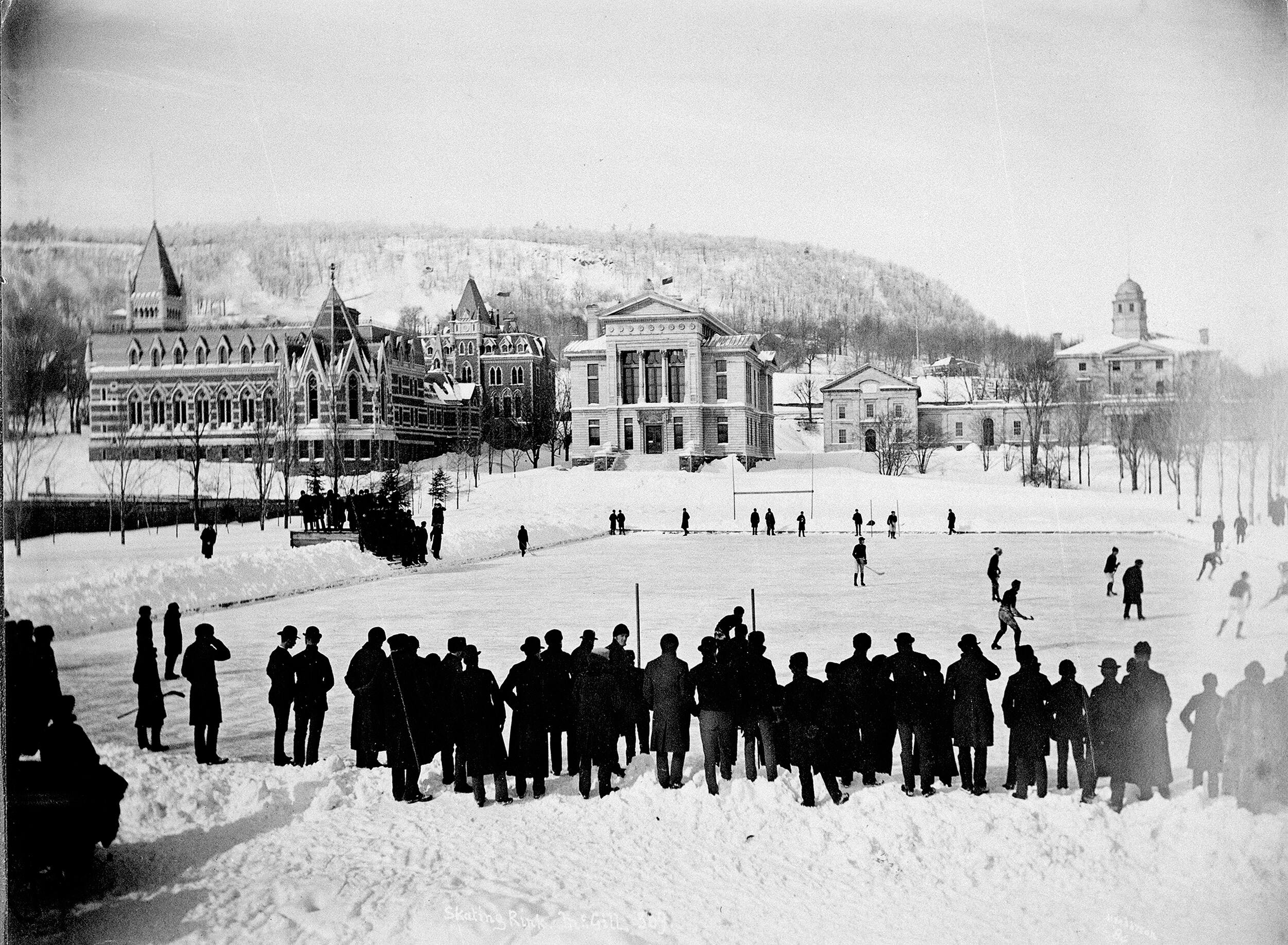
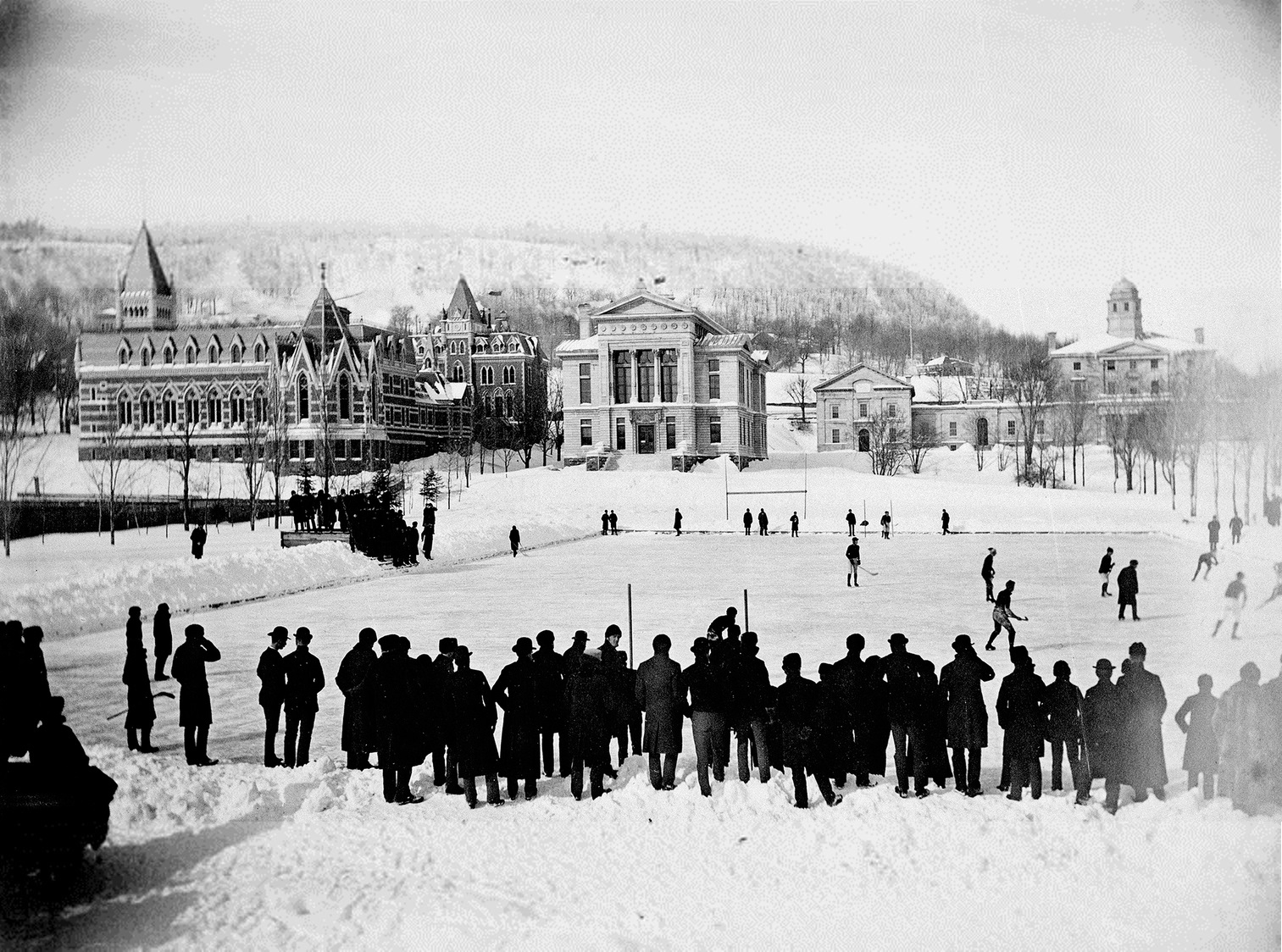
(Photo: McGill University, 1884 Winter Carnival, via Wikimedia Commons)
In Montreal, it did not take hockey long to catch on. Six years after the rules first were published there in 1877, hockey’s popularity dramatically increased after the 1883 Winter Carnival. Local businessmen and politicians organized the annual celebration to boost the seasonally sagging local economy,” and usually at least 50,000 visitors attended. “As part of the festivities, three teams played a round-robin tournament that is considered the world’s first championship ice hockey tournament.
The Montreal Gazette helped advertise the upcoming tournament calling for “all bona fide hockey clubs, will be played under the standard rules of hockey.” Two Montreal teams, the Victorias and McGill University, and a Quebec team signed up. Since Quebec only brought seven players, the other teams agreed to sit two of their nine.
The tournament featured two games on Friday, January 26 and two more on Saturday, January 27. The scraped surface on the frozen St. Lawrence River was in terrible condition on Friday and couldn’t be used on Saturday. Instead, the morning game was held at Crystal Rink and the afternoon game at Victoria Rink. Each game included two half-hour sessions with a 10-minute intermission. The games were well attended, especially by fans of McGill.
As it turned out, the teams must have been fairly evenly matched because three of the four games ended in a draw. After the first matchup between the Victoria and Quebec clubs, the Montreal Gazette noted, “Although the Victorias played with the sun it was evident from the start that their chance of victory was slight.” However, after their second matchup, the analysis was that “Victoria, as usual, was strong in its back play, while the forward play of Quebec was simply superb.” According to the Gazette, for the next set of opponents, “Victoria made much the neatest play, but McGill had the advantage in weight.” In comparing the Quebec team to McGill’s team, the Gazette decided, “The teams were very closely matched; what Quebec lacked in weight and strength they made up in skill.”
The first game took place at 11 am on Friday between Quebec and the Victorias. Although the “Quebecers played a splendid game all round,” the only goal of the game was disallowed because the “rubber” had “been out of play.” The game ended 0-0.
The Victorias lost the toss, so they had the double-header. Two of their players had been injured, so they swapped them out for their two remaining. The Victorias played McGill at 3 that afternoon. The first half of the game remained scoreless, but McGill scored about fifteen minutes into the second. Victoria’s goal was fouled, so McGill won 1-0.
The next day, McGill and Quebec played at 11:30. McGill scored about nine minutes into the game, but then Quebec scored twice. At the very end of the game, McGill tied at 2-2. The Montreal Gazette summarized, “The game was rather rough all through, and the play was by no means what might have been expected, but this may have been on account of the small space [at Crystal Rink].”
Finally, Quebec and the Victorias played each other again that afternoon. The Gazette crowed that this was “an exhibition of how the game should be played.” Victoria scored first because Quebec was stiff from their morning bout. However, this “seemed to work [Quebec] up,” and they scored ten minutes later. After half time, they switched sides, but neither managed another goal. The tournament ended with their 1-1 draw.
In the end, McGill was the only team to actually win a game, and it was only by one goal. As the winners, they received a “solid silver Carnival cup and clasps.” The Winter Carnival Cup can be viewed at the McCord Museum in Montreal. Then it was valued at $750, which now is worth about $20,000. “The idea that players could and would compete for a trophy – and a valuable one,” wrote Michael McKinley in Hockey: A People’s History, “reveals just how quickly hockey had taken hold of the Canadian imagination.”
Montreal’s Winter Carnival continued to impact the sport. After the tournament in 1886, the Amateur Hockey Association of Canada was established. The 1889 tournament was the first time Lord Stanley watched hockey, and since 1893, his cup has been awarded to the winners of the highest level of tournament played in North America.
Additional Sources:
“The Winter Carnival,” Montreal Gazette, 20 Jan. 1883, p. 7.
“The Carnival: The Hockey Matches,” Montreal Gazette, 27 Jan. 1883, p. 8.
“The Carnival: The Hockey Matches,” Montreal Gazette, 29 Jan. 1883, p. 2.
“The Winter Carnival,” Montreal Daily Witness, 27 Jan. 1883, p. 8.
“The Winter Carnival,” Montreal Daily Witness, 29 Jan. 1883, p. 4.
Michael McKinley, Hockey: A People’s History (McClelland & Stewart, 2009), kindle version.
Malcolm G. Kelly and Mark Askin, The Complete Idiot’s Guide to Hockey (Penguin, 2001), 8.
John Chi-Kit Wong, Lords of the Rinks: The Emergence of the National Hockey League, 1875-1936 (University of Toronto Press, 2005), kindle version.
Jenny Ellison and Jennifer Anderson, Hockey: Challenging Canada’s Game – Au-delà du sport national (University of Ottawa Press, 2018), 27-28.
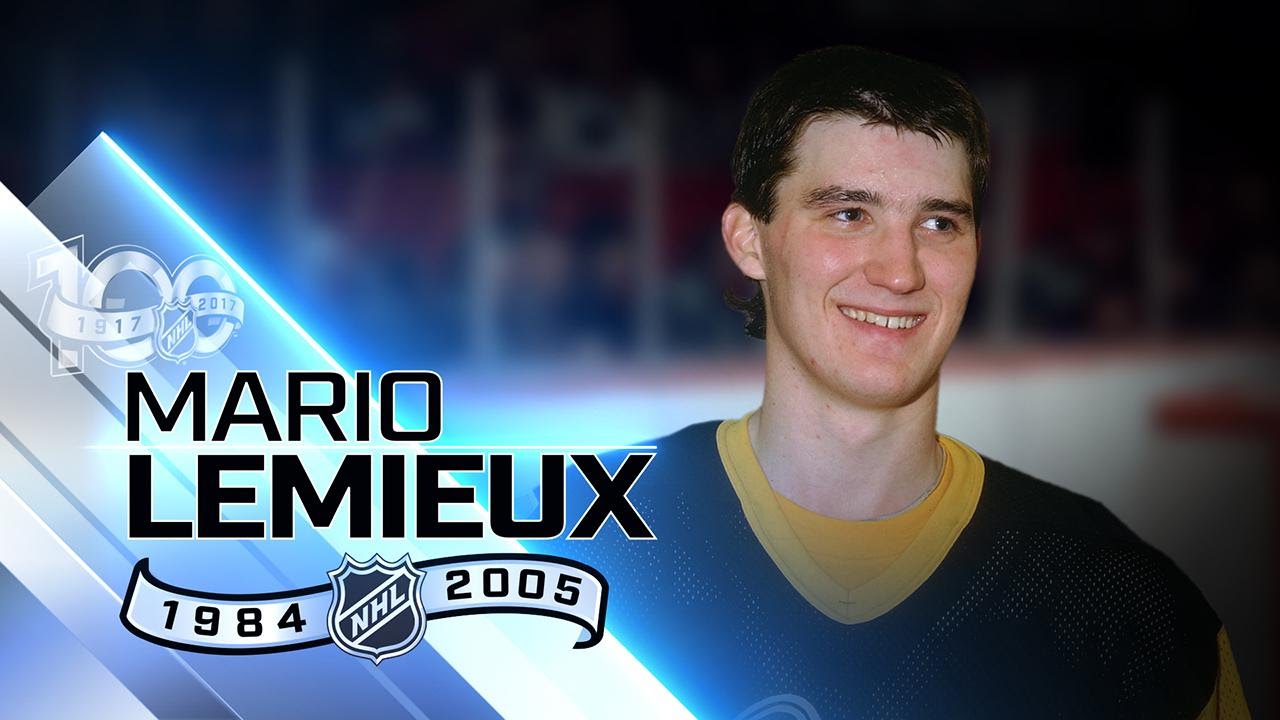
Mario Lemieux of the Pittsburg Penguins was a comeback king. On the same date, January 26, in two years, 1991 and 1997, he faced two different French Canadian teams, the Quebec Nordiques at Le Colisee and the Montreal Canadiens at Molson Centre, and exceeded everyone’s high expectations.
Having left a game with a back injury on February 21, 1990, Lemieux had only played in one game since, on March 31 that year. In July, he had surgery leading to an infection that could have prevented Lemieux from ever walking again. He had vertebral osteomyelitis, which the Pittsburgh Press described as “an infection that attacks the bony portion of the spine.” Lemieux finally started skating with his team about a month before January 26, 1991, his first game back. It had been 50 games since he was last in the Penguins’ lineup. He told the press, “I felt pretty good. I’m just a little sore, but that’s muscle soreness.” His coach, Bob Johnson, cautioned, “You can’t judge Mario Lemieux until about four weeks from now. We hope he’s going to be better than ever.”
Even without being fully conditioned or getting his usual playing time, Lemieux managed three assists. Although his first shift was 52 seconds into the game, the first assist came during his sixth shift, at 1:31 into the second period. He fought off a defenseman to feed the puck to Mark Recchi, and on his next shift, he “carried the puck into the Quebec zone and split defensemen” he fended off a hook and “slid the puck to Errey near the left post.” “I was a little bit nervous in the first period,” confessed Lemieux. “My confidence was a lot better in the second and third.” According to teammate Bob Errey, “It doesn’t take Mario that long to get ready. The best thing for him is to get into the action and get it going.” Lemieux’s final assist was to Cullen at 11:25 of the third period. He was named No. 1 star of the game.
Somewhat overshadowed by Lemieux’s comeback was defenseman Larry Murphy, who had his own worthy assist at 16:47 of the first period. It was his 500th. With all these assists, the Penguins defeated the Quebec Nordiques 6-5.
Despite his late start, Lemieux earned 45 points and then another 44 in the playoffs. Lemieux earned the Conn Smythe Trophy, and the Penguins won their first Stanley Cup.
By 1997, Lemieux seemed to be at the end of his NHL career. Even if that had been true, he had at least one big hurrah remaining. On January 26, he was credited with all five shots on net in the final period, and he scored on four of them. The first occurred at 9:06 and the fourth slid down the length of the ice into the empty net with about 30 seconds remaining. It was his tenth four-goal game, which would have been a record if the NHL tracked that.
Since they were all in the same period, he tied an NHL record as the 11th to manage the feat (but first ever for the Penguins). Up until that point, he had never even had a hat trick at Montreal, and he had just scored his 39th (putting him second only to Wayne Gretzky with 49). Coach Ed Johnston called him amazing because “he was flying all night. He could have had three or four more.” Lemieux was more humble saying, “If you keep getting chances, sooner or later it’s going to go between the posts.” However, he did comment that the game was “by far the best game I’ve ever played here.” It was little wonder the crowd gave him a standing ovation. Center Ron Francis noted, “In what appears to be his final season in the NHL, for him to come in here and put together a game like that, it’s great to see. What a nice treat for him to be able to do that today.” Perhaps the nicest thing for the Penguins was that they defeated the Canadiens 5-2 in only their fifth ever win at Montreal.
Before the playoffs that season, Lemieux announced his retirement. “Physically and mentally it was too difficult,” he said. “I didn’t have the stamina I had before. I couldn’t do the things I used to be able to do.” Not knowing that he would make yet another comeback, almost immediately, he was inducted into the Hockey Hall of Fame and had his No. 66 retired by the Penguins.
Additional Sources:
Dave Molinari, “He’s back: Lemieux helps Penguins win, 6-5,” Pittsburgh Press, 27 Jan. 1991, p. D1 and D12.
Bob Smizik, “Penguins take aim at their 24-year history of misfortune,” Pittsburgh Press, 27 Jan. 1991, p. D13.
“For the Record,” Pittsburgh Press, 27 Jan. 1991, p. D19.
Dave Molinari, “The best kind of homecoming,” Pittsburgh Post-Gazette, 27 Jan. 1997, p. D1 and D8.
In Chicago, the United Center cost $175 million and took up about one million square feet. The old Chicago Stadium had been built for $7 million back in 1929 and was only 600,000 square feet. According to a special feature in the Chicago Tribune, the United Center did not have the same grandeur or design as Chicago Stadium, but the roof had 28 times the amount of steel in the Statue of Liberty. It also featured much better sightlines (instead of about 1,500 seats with pillars obstructing views).
The first event at the newly constructed United Center was the World Wrestling Federation’s SummerSlam ’94 in August. Over the next two months, the arena was intended to become the home of the Chicago Blackhawks then the Chicago Bulls. It was already slated to host the 1996 Democratic National Convention.
On September 16, 1994, the Blackhawks did play a preseason exhibition game, which they lost 2-1 to the St. Louis Blues. Only 16,429 fans came out, but they were still loud. The Hawks had their first taste of the regulation-sized ice surface. Their old surface was only 185 feet long compared to regulation at 200. Coach Darryl Sutter assured the press, “It really won’t affect our style of play at all.” The team favored the strategy to “dump the puck into the offensive zone and chase it,” but the longer rink would “open more ice” for skilled offensive players.
However, by the time September was ending, it seemed inevitable that there would be a lockout. Although the Bulls were able to move into the United Center (and even retired Michael Jordan’s No. 23 at the beginning of November), the Blackhawks had to wait four months to even officially begin the 1994-95 season. Then, their first two games (of 48) were on-the-road losses.
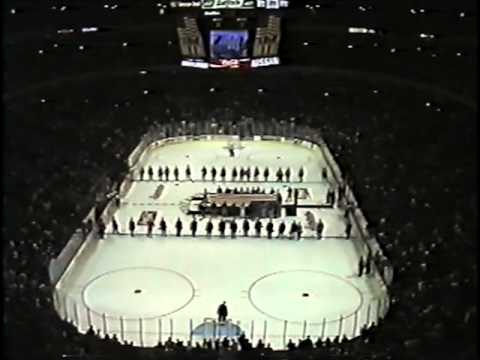
Finally, on January 25, 1995, the Blackhawks played their first regular season hockey game at the somewhat new United Center. Brent Grieve, new to the Blackhawks that season, said, “All through the lockout I couldn’t wait to play the first game in the United Center. I hope it will be memorable.” Star Jeremy Roenick seemed assured. “When they start screaming and see what it’s like, I guarantee it will be louder. I think they’re a little tentative to try it out. They’re a little in awe of the building and thinking of the old building.” Sure enough, an over capacity crowd of 20,536 “rocked” the new rink during Wayne Messmer’s final performance of the national anthem for the Blackhawks. “It’s home. It’s our rink,” began Chris Chelios. “If we play well and work hard the fans will have the same effect as in the old building.”
The Blackhawks did not let their fans down. Joe Murphy scored the first goal at 11:33 of the second period. After two more goals in that period and another in the third, Bernie Nicholls scored his first Blackhawks goal on an Oilers’ power play. He commented, “It was a very special night. The crowd was great; they were an extra player for us.” After that, the Oilers pulled goalie Bill Ranford at 1:30 in the third period. Meanwhile, Chicago goalie Ed Belfour only faced six shots during the first two thirds of the game. He lost his shutout opportunity with only 3:46 remaining. The Blackhawks won 5-1. Defenseman Steve Smith summarized, “The United Center has some nice attributes and I’m excited about playing in there. It’s important for us to look at it as our home.”
The United Center had some down sides. It took much longer to switch from the basketball floor to ice. As the director of operations, Jim Koehler, explained, “There’s more mechanics like the retractable seats in the end zones.” That meant that the Blackhawks did not have as much time to practice on their own rink but usually had to use the UIC rink instead. On the other hand, its greater seating capacity meant that the Blackhawks set the NHL record when it averaged 20,833 fans over that season. No other team had topped 20,000 on average. At the end of the season, Chicago made it to the conference finals.
Additional Sources:
Howell J. Malham Jr., “Pro wrestling crowd christens new United Center,” Chicago Tribune, 30 Aug. 1994, section 5, p. 1.
“A Fan’s Guide: The United Center,” section 7, of Chicago Tribune, 7 Sept. 1994.
“No. 23 Flies to the Rafters” and “Tribute Fails to Reach Proper Heights,” Chicago Tribune, 2 Nov. 1994, section 4, p. 1 and 5.
Robert Markus, “New home a lot noisier than Hawks,” Chicago Tribune, 17 Sept. 1994, section 3, p. 1-2.
Robert Markus, “At long last, Hawks take Center stage,” Chicago Tribune, 25 Jan. 1995, section 4, p. 3.
Robert Markus, “Hawks enjoy move into new home with big victory party” and “Practice time on United Center ice melts away,” Chicago Tribune, 26 Jan. 1995, section 4, p. 5.
Michael Hirsley, “Hawks’ home opener has it all: Light show, Messmer and victory,” Chicago Tribune, 26 Jan. 1995, section 4, p. 1 and 5.




 Prev
Prev