The Beanpot tournament has been played the first two Monday’s of February since 1958. The tournament pits four of Boston’s college hockey teams against each other: Boston College Eagles, Boston University Terriers, Harvard University Crimson, and Northeastern University Huskies. Of course, since the event takes place in February, it is usually not a huge surprise if some snow falls on the night of either the semi-final games, or the night of the consolation game and the Championship Game. It is Boston—snow is just something expected.
Such was the opinion as the snow began to fall on February 6, 1978. The semi-final games took place as expected in the 26th annual Beanpot, at the Boston Garden. Harvard edged out Northeastern in overtime, 4-3 in the first match-up. Meanwhile, the BU Terriers took it to the BC Eagles in an amazing 12-5 victory in the second game.
“It was a great win for us. We were going to the Beanpot final—everybody was excited about that,” shared BU head coach Jack Parker in 2008. “Then we got outside, and the game was forgotten. It was like a shock. The streets were full of people, because they couldn’t move their cars. We were picking up BU students along the way. The bus was mobbed by the time we got to Kenmore Square.”
While the Boston University team had their bus, that was plowing its way back to the university, many of the 11,666 fans who had stayed to watch the BU and BC tilt found things dramatically different as they tried to leave the game. In fact, some of the spectators would end up camping out at the arena—eating hot dogs and sleeping in the bleachers and locker rooms.
The storm, which began Sunday night and continued into Tuesday, dumped 27.1 inches of snow on the city of Boston. Boston would see a similarly snowy February in 2015, when roughly eight feet of the fluffy and not so fluffy stuff fell from the sky—and it would again impact the playing of the Beanpot.
For the Terriers, there was a tradition of celebrating at the Dugout after a hockey game.
“Believe it or not, these were the prescholarship days,” said former BU goaltender Brian Durocher in 2014 in a BU Today piece. “and players needed part-time jobs to get by. It was a hockey tradition that your junior or senior year, you’d get hired at the Dugout.”
Patrick L. Kennedy went on to describe in his piece about the Dugout, “The whole team gathered in the old alehouse after games, along with the usual mix of fans, sportswriters, and assorted hangers on. The Jukebox featured ‘O Canada’ for those players who hailed from north of the border.”
“We were coming into Kenmore, and Jack O’Callahan [team co-captain] came up to the front of the bus and said, ‘If we go all the way up to Walter Brown Arena just to unload our stuff, everybody is going to trudge all the way back to get back to the Dugout.’ He was right, but I didn’t want it to be known that I was encouraging people to go to the Dugout,” continued Coach Parker.
“We get to Commonwealth Avenue and we stop at Marsh Chapel, and Jack Parker says, ‘Anybody who wants to get out and go into the chapel and pray may do so.’ Well, half the bus got off, but they weren’t going to Marsh Chapel. They went across the street to the Dugout. The bar was their home for a week,” former sports information director for BU, Ed Carpenter said.
O’Callahan, along with a few others of the 1978 Terrier squad, including Dave Silk, would end up playing together again two years later on a much bigger stage—in Lake Placid, New York in the 1980 Winter Olympics. However, their week at the Dugout as they waited for some of the snow to be cleared and the city to regain its control, would be a fond memory mentioned as years went by.
The Blizzard of ’78 postponed the Beanpot Championship game until March 1. Even the snows in February of 2015 didn’t force the Beanpot out of February. This has been the only time since 1958, the 6th annual tournament, that both sets of games were not played in February.
Additional Sources:
Northeastern United States Blizzard of 1978 on Wikipedia
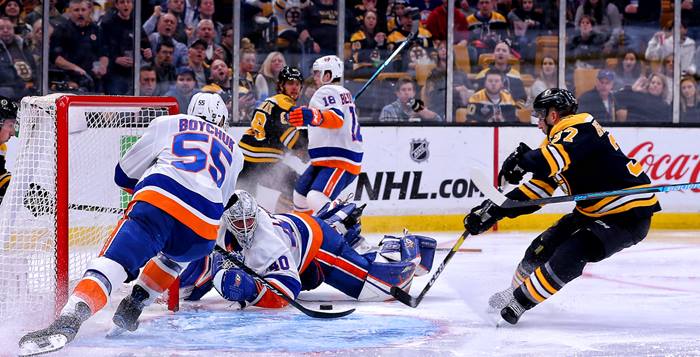
No, Patrice Bergeron is not 1000 years old, but he did reach a milestone in his NHL career by playing in his 1000th game on Tuesday night, February 5, 2019, as the Boston Bruins hosted the New York Islanders in the second of three games those two teams will play this season. Oh, and since the New England Patriots were in town having celebrated their sixth Super Bowl win from Sunday with a rolling rally (“Get the Duck Boats ready”) earlier in the day, it seemed only fitting that they should hang with the Bruins and maybe drop a ceremonial puck. Instead of Captain Zdeno Chara taking that faceoff, Bergeron was invited to participate.
For Bergeron, who really doesn’t seem to like it when the attention is all on him, he was very happy that the Patriots were there.
New England Patriots
“Yeah, thank God. That was perfect. I was very happy with that,” he joked. “It was awesome. There was so many of them too. It was actually great to see, and you know, they came in the locker room before the game and we told them obviously we were cheering for them and it was an amazing ride again this year, and you know, I thought that the crowd was really into it and that set the tone for a great night.”
Bergeron joins a relatively small group—as he becomes the 334th NHL player to reach 1000 games. This season he is the 12th to do so. Only 30 other players have played all their career games with a single team. And he is just the fifth Bruin to reach that milestone wearing just the Spoked-B. He joins Ray Bourque (1,518), John Bucyk (1,436), Don Sweeney (1,052) and Wayne Cashman (1,027).
There was a nice montage shown and after it was finished, they showed Bergeron as he had been watching it and he waved to the fans. So, what was going through his head?
“Yeah, it was special. I just wanted them to drop the puck basically, but it was special,” Bergeron admitted. “It’s always a little awkward for me, but I very much appreciate it of course. It’s been 15-16 years…15 here, 16 with the organization…it has a special place in my heart obviously. Boston, it’s been great. Obviously, my kids were born here and it’s definitely a second home now. So yeah, it’s very much appreciated, and they’ve been here supporting us since day one so it meant a lot.”
And, if he wanted the puck to drop so quickly after that montage, one has to wonder how he will handle the big ceremony scheduled to take place before the Bruins’ Saturday matinee game, when they play the Los Angeles Kings. Of course, he will have his wife and three children with him, which undoubtedly will make it memorable.
Perhaps, though, it is his always wanting to point the attention at his team that makes him all the more deserving of the awards and praise he gets. Bergeron feels his job is to contribute, and one of those ways is scoring goals. And he doesn’t seem to believe that this makes him special.
“That guy just steps up in every situation. You know he’s going to have a big game on a milestone night like tonight. It was great to see. He’s one of the top players in the game and he steps up in big moments. He did that again tonight,” Brad Marchand said of his centerman.
Patrice Bergeron became the 53rd player in NHL history to score a goal in his 1,000th NHL game and the fifth to do so this season.
But the reality is that he has long been a player who plays right, works hard, is willing to play elsewhere if necessary. His first lockout, he played in Providence, with the Bruins AHL affiliate, the Providence Bruins. During the shortened 2012-13 season he played in Switzerland on HC Lugano before representing Canada in the Spengler Cup, where yes, the team won the tournament. He is a member of the Triple Gold club — those players who have won gold in the World Championship and the Olympics, and won a Stanley Cup. Oh, and he got his gold in the World Championship (2004) before he got one in the World Junior Championship (2005), well because he’s Bergeron.
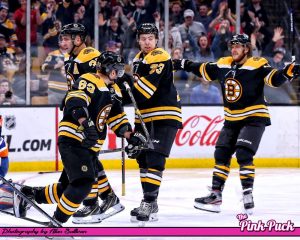
The respect of his teammates was evident Tuesday night as David Pastrnak and he headed into the Islanders end with an empty net in front of them. Pastrnak could have just put that puck right in the net. Instead he dropped it back so that Bergeron would have a second goal on the night.
“Yeah, you know, means a lot obviously. I was surprised. I saw him look a couple times. I was like oh no, he’s going to drop it, but we were definitely alone and very much appreciate it,” Bergeron said.
“That’s the respect they have for Patrice, I think, in that particular situation and for one another. They’ve done it before where they try to include everybody. Sometimes they’ve messed up empty-net goals. That one would’ve been hard to, but they’ve done that in the past. And again, they play for one another, that line, and it shows every night, how good they are,” Bruins Head Coach Bruce Cassidy stated.
He comes to play every night and he works hard. The day his first son was born, he was up most of the night with his wife as she gave birth. He got a couple hours nap, and was on the ice that night to play—and yes he got the first goal that night.
Bergeron, Marchand, McAvoy, and Miller
This past off-season he had surgery, and then had some delays during recuperating that kept him from participating in training camp. The Bruins third game of the season, and their home opener, he got a hat trick—only his fourth career hat trick. Then later he missed 16 games due to another injury. In his first game back, on December 22, against the Nashville Predators, he scored two goals and added two assists. And before the team took to the ice that night, he reminded them how fortunate they were to be playing, as he had been forced to sit and watch, and he truly missed the game.
But perhaps the biggest example of how he walks the walk was during the 2013 Stanley Cup Finals against the Chicago Blackhawks, when the Bruins painfully lost in Game 6. While it was clear that there was something ailing Bergeron, it wasn’t until after that game that the laundry list of injuries was released. In Game 4 he ended up with torn rib cartilage. Game 5 he suffered a broken rib on his left side. And in Game 6, he added a separated right shoulder and a punctured left lung. And still he was out there playing, despite the tremendous pain he was in.
It is this effort and his skill and abilities that have earned him the respect of not only his own teammates and organization, but also the respect of players throughout the league.
“I mean, his resume speaks for itself. He’s won pretty much everything, and he plays the right side of the puck, he plays the right way, he doesn’t really cheat out there, so he’s definitely a great ambassador for the game, and he’s had a hell of a career,” Islanders forward Jordan Eberle said after the game.
Bergeron honors the game of hockey in so many ways, and he leads by example. But he also encourages conversations about plays with his linemates, about the organization and what is expected when rookies arrive.
His approach to the game and to the training has earned him the respect of the Boston Bruins—which is why he’s been able to reach this milestone wearing only one sweater—the Spoked B.
Boston is fortunate to have him. And there will come a time when new players will point to Bergeron as their motivation in playing the game as it should be and doing all those little things—like he has—and perhaps even why they decided to try hockey in the first place.
The Tampa Bay Lightning look to continue its push to the playoffs with three tough games in front of the home crowd. On Tuesday night, they will face the Vegas Golden Knights. On Thursday night, a resurgent St. Louis Blues team comes to town fighting for its own playoff life. On Saturday night, it’s a revenge game against the Pittsburgh Penguins.
1) Tuesday, Feb. 5 vs. Golden Knights- 7:30 p.m. ET – ESPN+
The Vegas Golden Knights may be on a four game losing streak, but that doesn’t mean that it’s going to be an easy two points for the Lightning on Tuesday night. The Bolts needs to stay focused and play their game in order to grab two points from a team that is struggling.
The Lightning Will Win If….
They play a solid game in the neutral zone to keep the Golden Knights’ transition game in-check. They will need to have active sticks with a good gap between the forwards and defensemen. The Lightning should get plenty of bodies and traffic in front of the net to take the goalie’s eyes off the puck. It would be a good idea if the Bolts had the lead after two periods since the Golden Knights have only four regulation wins when trailing entering the third period of games. The Golden Knights have a pretty balanced lineup so the Lightning want to establish a forecheck game early and often in this game to keep them defending and not on the attack.
Matchup of the Game
The goaltending matchup should be a good one especially if the goalies are Andrei Vasilevskiy and Marc-Andre Fleury. Vasilevskiy missed some time with a broken foot, but is 21-7-2 with a 2.46 goals against average and .925 save percentage in 30 games. Fleury has been an important part of the Golden Knights’ success again this season. He is 27-15-4 with a 2.48 GAA and .911 save percentage in 46 games. If both of these goalies start and are on their game than it should be a low scoring affair.
Game Prediction
The Lightning pull to the 3-2 win in regulation and grab two more points on home ice. The Lightning goals will be scored by Nikita Kucherov, Tyler Johnson and Yanni Gourde. The Golden Knights goals will come from Alex Tuch, the leading goal scorer, and William Karlsson. The Golden Knights losing streak will extend to five games.
2) Thursday, Feb. 7 vs. Blues- 7:30 p.m. ET
The St. Louis Blues have managed to climb its way back into the playoff picture after looking like they had a good shot at the number one draft pick early in the season. The Blues have offensive weapons so they can’t be taken lightly or overlooked.
The Lightning Will Win If…
The team plays a solid 60-minute game with effort and limits its mistakes. The Blues have some players who can put the puck in the back of the net off of a mistake in a team’s own end. The Lightning need to move their feet to draw penalties since the Blues have only killed off 79.5% of penalties taken. When Ryan O’Reilly is on the ice the Lightning should make sure that he is covered since he is the Blues leading point producer. The Bolts want to get plenty of players in front of the opposition’s net as well as get shots on net.
Matchup of the Game
Nikita Kucherov has picked up right where he left off last season, while Vladimir Tarasenko has really struggled. Even though these two have gone in opposition directions this season, they are still the players to watch in this game. Kucherov is scoring, dishing and just flat out producing, as he leads the NHL in points. Tarrasenko may be struggling but he can still be dangerous especially if he gets open around the net.
Game Prediction
The Lightning will lose this one in regulation by a score of 4-3. The Blues goals will come from Ryan O’Reilly, Brayden Schenn, Vladimir Tarasenko and Tyler Bozak. The Lightning will frantically try to tie the game late in this one with the goalie pulled, but they’ll fall just short with goals coming from Nikita Kucherov and Steven Stamkos (two goals).
3) Saturday, Feb. 9 vs Penguins- 7 p.m. ET – NHLN
The Lightning look to get revenge for a 4-2 loss on January 30 at Amalie Arena against the Pittsburgh Penguins. The game was an intense one with scrums after whistles, but the Lightning need to stay away from that this time around. This should be another exciting game.
The Lightning Will Win If…
They play their game and don’t get roped into the extra circular activities after the whistles. The goaltender, whether it be Louis Domingue or Vasilevskiy, will need to make some saves to keep his team in the game. The Lightning need to stay focused and use their speed in transition. Another key to this game for the Lightning will be for them to remain disciplined since the Penguins have the sixth best power play in the League.
Matchup of the Game
The specials teams for both teams are something to pay attention to in this game. The Lightning have the top ranked power play (29.4%) and the fourth ranked penalty kill (84%). The Penguins have the sixth ranked power play (24.5%) and the ninth best penalty kill (81.9%). The special teams could wind up being a difference maker in this game and possibly even play a role in a team winning or losing.
Game Prediction
The Lightning will avenge their prior loss to the Penguins and take the game by a score of 3-1. The three Bolts’ goals will be scored by J.T. Miller, Victor Hedman and Steven Stamkos. The Penguins lone goal will be scored by Jake Guentzel with an assist from Sidney Crosby. The Bolts finish off the week with a 2-1-0 record.
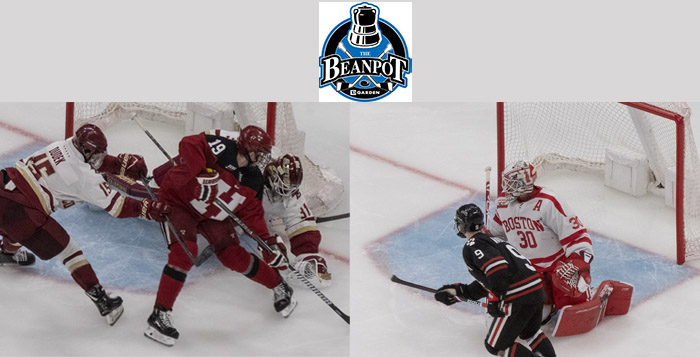
If it’s the first Monday in February then it is time for the semi-final games for the Beanpot — played at TD Garden. Unlike the ridiculous amount of snow that the 1978 semis received, instead on Monday, February 4, 2019, the weather was exceptionally nice—a high in the 60s. Despite some frigid days leading into it, that nice weather didn’t stop people from heading to the Garden to cheer on their favorite teams.
Harvard University Crimson vs. Boston College Eagles
The first match-up was between the Harvard Crimson and the Boston College Eagles. The players were ready, the pep-bands were tuned up and the puck dropped. Despite the Crimson outshooting the Eagles, Patrick Giles put the Eagles on the board first with an assist from Graham McPhee. The Eagles Oliver Wahlstrom (tripping) and Marc McLaughlin (cross-checking) would both get whistled, but Joseph Woll stood strong in between the pipes for the Eagles. That’s how things would stand going into the first intermission.
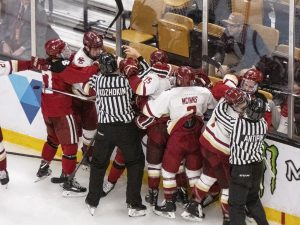
Emotions run high.
The second period for both teams was a revolving door to the penalty boxes. Just ten seconds into the middle frame, Harvard’s Baker Shore was sent off for boarding, a penalty the Crimson was able to kill. At 3:33 a bit of frustration boiled over and the Eagles’ JD Dudek and Harvard’s Jack Drury were both sent off for hitting after the whistle, and the teams played four-on-four. With 31 seconds remaining in the four-on-four, Henry Bowlby for Harvard was sent off for hooking, giving the Eagles some four-on-three time, and then after Dudek was released the power play continued for Boston College. Once again Harvard was able to kill the penalty, but 13 seconds after being released, Bowlby was right back in the box, again for hooking. One can only guess what Bowlby was told after his teammates killed off his second penalty. The last penalty of the second period was a holding penalty on the Eagles’ Chris Grando. Despite all of the man advantage time neither team was able to capitalize and the second half of the middle period was penalty free. Amazingly, regardless of all of the power play time, the shots on goal were limited for both teams—speaking to the skills of their penalty killers. In fact, the next goal would be scored even strength, and perhaps would get Bowlby a little out of Harvard head coach Ted Donato’s dog house, since Bowlby got Harvard on the scoresheet at 15:37 with his fifth goal of the season, assisted by John Marino and Reilly Walsh.
The third period had some people wondering if the game would go into overtime, as has happened with a few of the Beanpot semi-final games in recent memory. However, 12:22 into the final twenty, the Eagles Jack McBain got his sixth goal of the season, with assists from Wahlstrom and Luke McInnis to put the Eagles up 2-1. After the Crimson was able to kill off Jack Badini’s tripping penalty at 14:58, they seemed to get a little life. And when Julius Mattila got called for a tripping for the Eagles with 1:57 remaining in regulation, it was not surprising to see Harvard use their time out to hopefully work one of their set plays on the faceoff and tie the game.
Thirty seconds into their power play, Hess coach Donato pulled Michael Lackey to give the Crimson a six on four opportunity. Coach Jerry York used th Eagles’ time out just after that. And when the horn sounded the end of regulation, Harvard had been unable to find something that worked, and it would be the Boston College Eagles going to the Championship Game.
Northeastern University Huskies vs. Boston University Terriers
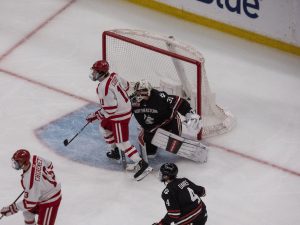
The second game of the evening pitted the Northeastern University Huskies and the Boston University Terriers in a rematch of sorts from the Championship game of 2018 — the first Beanpot that Northeastern had won since 1988, when they beat the Terriers 6-3. The 2018 tournament saw the Huskies get a 5-2 win over the Terriers. However, Monday night’s game would not have anyone with a big lead, despite the attempts by the Huskies throughout the game. By the time the game was over, Northeastern would have peppered Terriers’ Jake Oettinger with 49 shots on goal, 47 of which he stopped. For the Terriers, it wasn’t quite as many shots on Cayden Primeau, but what they lacked in numbers, they made up for in quality chances—freshman Joel Farabee had two quality breakaway opportunities that Primeau denied.
Cayden Primeau guards the net.
Coming into Monday night’s game, both Primeau and Tyler Madden, had some bright lights, big game experience having both played in the World Junior Championships in Vancouver over the winter break. And for Primeau, he definitely saw more time than perhaps was expected when fellow goaltender Kyle Keyser ended up injured and unable to play. Primeau came on the scene slow for the Huskies in his freshman season last year until Ryan Rusk ended up hurt and then Primeau grasped his opportunity and made himself their starter for the remainder of last season. For freshman Madden, he definitely is not lacking in confidence.
“I just kind of had all the time in the world,” Madden said about his OT winner. “It was bright lights out there and I shine in those.”
Huskies head coach Jim Madigan could be seen smiling at that comment and stressed later on that Madden’s confidence is not arrogance. Which if you didn’t see him play you could mistake as such.
The lights were definitely bright when the Terriers and the Huskies were unable to determine a winner throughout regulation. In fact, after Northeastern had notched the first goal of the game at 3:14 of the first period from Patrick Schule and Farabee, for BU, got things tied up at 19:39 of the opening twenty, no one scored another goal until overtime. Northeastern gave the Terriers four opportunities on the man advantage, but the Huskies limited many of their chances, and what did get through Primeau saw and defended.
For the Terriers, who gave up two penalties in the third — both interference calls on Kasper Kotkansalo — Oettinger likewise was stingy between the pipes. Despite his difficulty at the start of the season, Oettinger had no issues with his confidence in Monday’s game and gave his teammates every opportunity to get the win.
As the clock ticked down it became clear that indeed overtime would be needed to determine who would meet the Boston College Eagles in the Championship Game. In games past, this has sometimes taken more than one overtime. The Beanpot games are played like Stanley Cup Playoff games in that full 20-minute periods are used and there are no shootouts.
However, with those bright lights on him, and lots of space—Madden took advantage of a misplay by the Terriers and was off to the races, putting the puck behind Oettinger just 51 seconds into the first OT period.
The Boston University Terriers and the Harvard Crimson will meet in the consolation game on Monday, February 11, 2019 at 4:30pm. Following that game, or at 7:30pm, the defending champion Northeastern Huskies will take on the Boston College Eagles. The last time these two teams met in the Championship game, the Eagles beat the Huskies 4-1, which was in 2014.
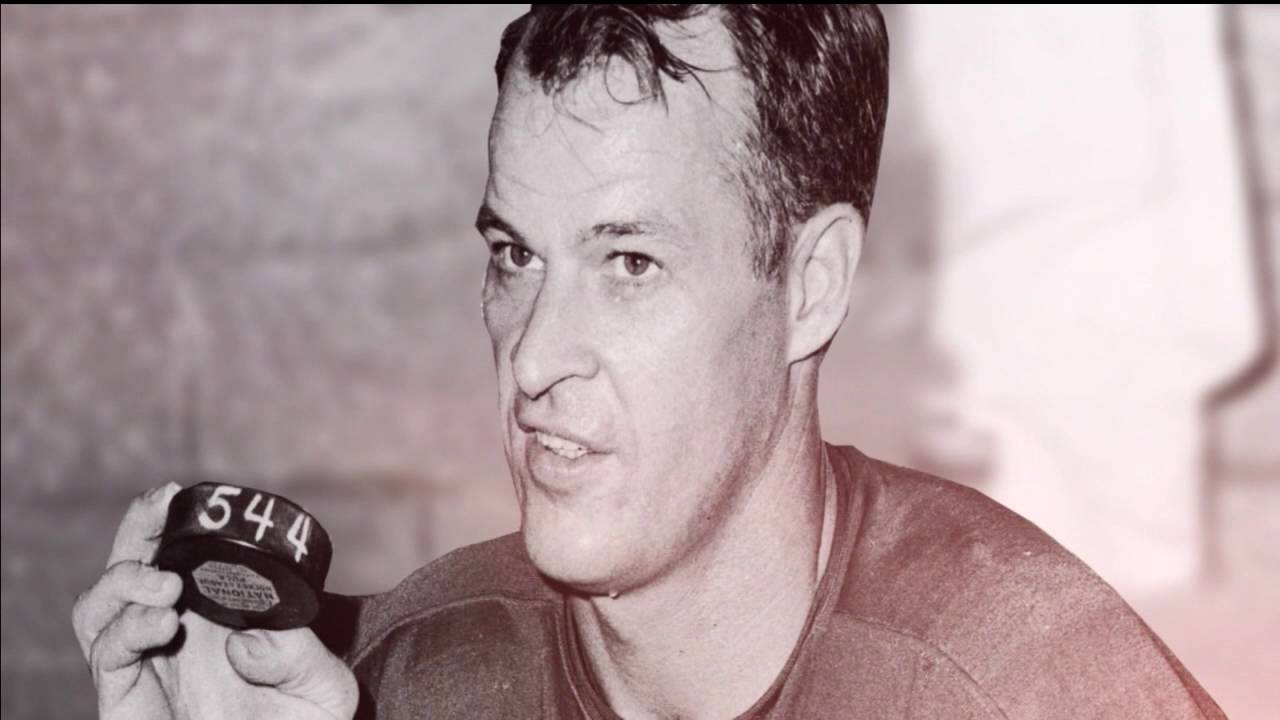
The 1980 NHL All-Star Game was held on February 5, 1980, at Joe Louis Arena, and it was much more than a the typical All-Star game. First it had the largest crowd to that point to watch an NHL game — as 21,002 were there. Second, all of them gave a four-minute standing ovation for Gordie Howe, who was the last player announced. The chanting of “Gordie, Gordie” continued until the national anthem singers were announced.
This was Gordie Howe’s 23rd, and final, All-Star Game, and the only one in which he was not actually wearing a Detroit Red Wings sweater. Instead, he was representing the Hartford Whalers. Despite having retired in 1971, he’d decided to strap on the skates again in 1973, this time with the World Hockey Association — with whom he played four seasons with the Houston Aeros from the 1973-74 season through the 1976-77 season. The next year found him playing three years with the Hartford Whalers (the first two years under the name New England Whalers before the team became one of the four teams from the WHA to be absorbed by the NHL).
Howe was 51 in that last season with the Hartford Whalers, and in his final All-Star Game. And the hockey world was honoring a player who had begun his NHL career at the age of 18, playing 25 seasons with the Detroit Red Wings before his brief retirement and then five years with the WHA before retiring once more as an NHL player. Throughout his storied career he set so many records. “Mr. Hockey” played in five different decades and had the opportunity to play with his sons professionally—something that we are unlikely to ever see again given the toll that today’s game of hockey takes on a body, especially with how fast everything is played making hits all the harder.
Throughout his career he would win six Hart Trophies and six Art Ross Trophies. He would score no less than 23 goals in 22 consecutive seasons with the Red Wings. And his name can be found inscribed four times on the Stanley Cup. But like so many of those who are great at their profession or skill, he was a humble individual who loved to put people at ease with his sense of humor, even if his sons didn’t find it quite as funny.
As was shared on the NHL 100 Greatest NHL Players, “In 2012, on his final visit to Montreal, where he played some of his greatest hockey, Howe was having the kind of fun that he’d never deny himself, spinning one wonderful yarn after another. ‘Kids enjoy it when I do this,’ he said with a grin, his tongue pushing roughly half his teeth out of his head. ‘I wish,’ Howe’s son Marty said with a sigh, rolling his eyes, ‘that you wouldn’t do that.’”
And yet, I’m sure that the kids who didn’t understand just how those teeth worked stared in awe and amazement when he did it.
At that same All-Star Game, there was a young player who grew up idolizing Mr. Hockey, who himself would get his own nickname. The Campbell Conference team included a 19-year-old Wayne Gretzky. The “Great One” would go on to break most of Howe’s offensive records.
One has to wonder how the Joe Louis Arena did not implode from the amount of hockey greatness that radiated from those two individuals—let alone all the other talent that was on the ice for that game. And how fortunate were those 21,002 individuals who got to see that game in person.
The Philadelphia Flyers look to extend its winning streak to eight games and beyond this week. They’ll try to extend the streak in the confines of the Wells Fargo Center. On Monday night, they’ll face the Vancouver Canucks. Then they’ll have a few days to rest up before taking on the Los Angeles Kings Thursday night, and the Anaheim Ducks on Saturday afternoon.
1) Monday, Feb.4 vs. Canucks- 7 p.m. ET
The Flyers take on Elias Pettersson and the Vancouver Canucks tonight and it won’t be an easy task. Goaltender Carter Hart will look to extend his personal winning streak to seven games. The Flyers have managed to find ways to win during their seven game winning streak including coming from behind overtime wins. This should be a good matchup since the teams are very close on paper.
The Flyers Win If…
They can manage to stop Pettersson and his linemates. The Canucks will be without key player Sven Baertschi due to injury. The Flyers will have to play a solid game at even strength since the special teams haven’t been the best this season. The Canucks will want to stay out of the penalty box since the Flyers power play has been red hot the past few games. Hart will need to have another good game and make some saves to keep his team in the game, which he has been doing since being called up. The Flyers need to get the first goal of the game and make sure they have the lead entering the final period since they only have three regulation wins when trailing entering the final period this year.
Matchup to Watch
The goaltending matchup should be a good one. The 20-year-old rookie, Hart, will start for the Flyers and he will be opposed by Jacob Markstrom. Markstrom has been decent for the Canucks this season with a 2.79 GAA and .910 save percentage in 28 games played. Hart has been the story of the League since being called up and has been the main reason for the Flyers confidence on the ice of late. He has been making saves when needed and that is something the team lacked earlier in the year. Hart has a 2.58 GAA and a .921 save percentage in his 15 games this season.
Game Prediction
The Flyers extend their winning streak to eight games while playing in front of the home crowd. Hart and Markstrom will each have good games and this will be a close game. The Flyers will manage to win the game by a score of 3-1 with an empty net goal late in the game to seal the win. I’d look for Pettersson to have a point on the Canucks goal with Nolan Patrick, Sean Couturier and Oskar Lindblom scoring for the Flyers.
2) Thursday, Feb. 7 vs. Kings- 7 p.m. ET
This should be an easy game for the Flyers to win with the Los Angeles Kings being one of the worst teams in the NHL. The Kings have had problems scoring goals all season long. Anthony Stolarz will get the start for the Flyers, which will be his first since Tuesday, January 29, when he shutout the New York Rangers. It will have been about nine days between starts for Stolarz so the Kings should try to get plenty of pucks to the net early and often. This could be a trap game for the Flyers since they tend to play down to their competition.
The Flyers Win If…
They get out to a good start and finish when they have the opportunities. The Flyers should make sure that they have plenty of traffic in front of the goaltender especially if Jonathan Quick starts since he doesn’t like players in the crease area. The Orange and Black should try to get out to a good start since the Kings have been outscored by a substantial margin in the first period of games. They should be aware of when Anze Kopitar’s line is on the ice since they pretty much lead the way offensively.
Matchup of the Night
The matchup to watch in this game will be the two Selke finalists from last season in Anze Kopitar and Sean Couturier. Kopitar is the leading goal scorer and leading point getter on a Kings team that has struggled to put the puck in the net. Couturier started the season off slow since he missed mostly all of preseason, but he has turned it on since then and is on pace for another 30 goal season. Even on a struggling Kings team, the Flyers need to be aware of Kopitar since he is a good two-way player, but the same goes for the Kings as Couturier is managing to pile up the points.
Game Prediction
The Flyers will fall victim to this “trap” game and lose in overtime. The Kings will find a way to win the low scoring affair by a score of 2-1. The Flyers goal will come from Wayne Simmonds and the Kings goal scorers will be Jeff Carter and Anze Kopitar. It should be a close game from start to finish but the Flyers won’t find a way to capitalize on their chances early and it will cost them the two points.
3) Saturday, Feb. 9 vs. Ducks- 1 p.m. ET
The Flyers will take on a Anaheim Ducks team that has had its share of injuries this season. It seems like every time that news come out about the Ducks, it’s injury news. The Ducks still have some weapons on their team so the Flyers can’t play down to their competition especially with the Penguins coming into town on Monday night.
The Flyers Will Win If…
They can cash in on their chances especially if John Gibson is in net for the Ducks. He has been one of the bright spots on the Ducks so far this season. The Flyers need to get Gibson moving from side-to-side and make sure there is plenty of traffic in front for rebounds and deflection chances. They’ll want to take advantage of terrible special teams and cash in on their power play opportunities. The Ducks should want to get the first goal of the game so they can quiet the crowd and build from there.
Matchup of the Game
The goalie matchup should be an interesting one especially if it is Gibson against Hart. Gibson has had a decent season so far for the Ducks. He is 17-17-8 with a 2.86 GAA and a .916 save percentage in 44 games played. His numbers are more of a mirror of how the team has played in front of him not how he has played. Hart has been sensational since being called up. He may not have his best game, but he has managed to keep the Flyers in every game that he has been in so far. He is 9-5-1 with a 2.58 GAA and .931 save percentage in 15 games so far this season.
Game Prediction
The Flyers will take care of business and beat the Ducks in regulation by a score of 4-2. The Ducks goals will be scored by Getzlaf and Rakell. The Flyers goals will be scored by Giroux, van Riemsdyk, Patrick and Laughton. The goalies will be the difference in this game and the Flyers will bounce back after their overtime loss to the Kings on Thursday night.
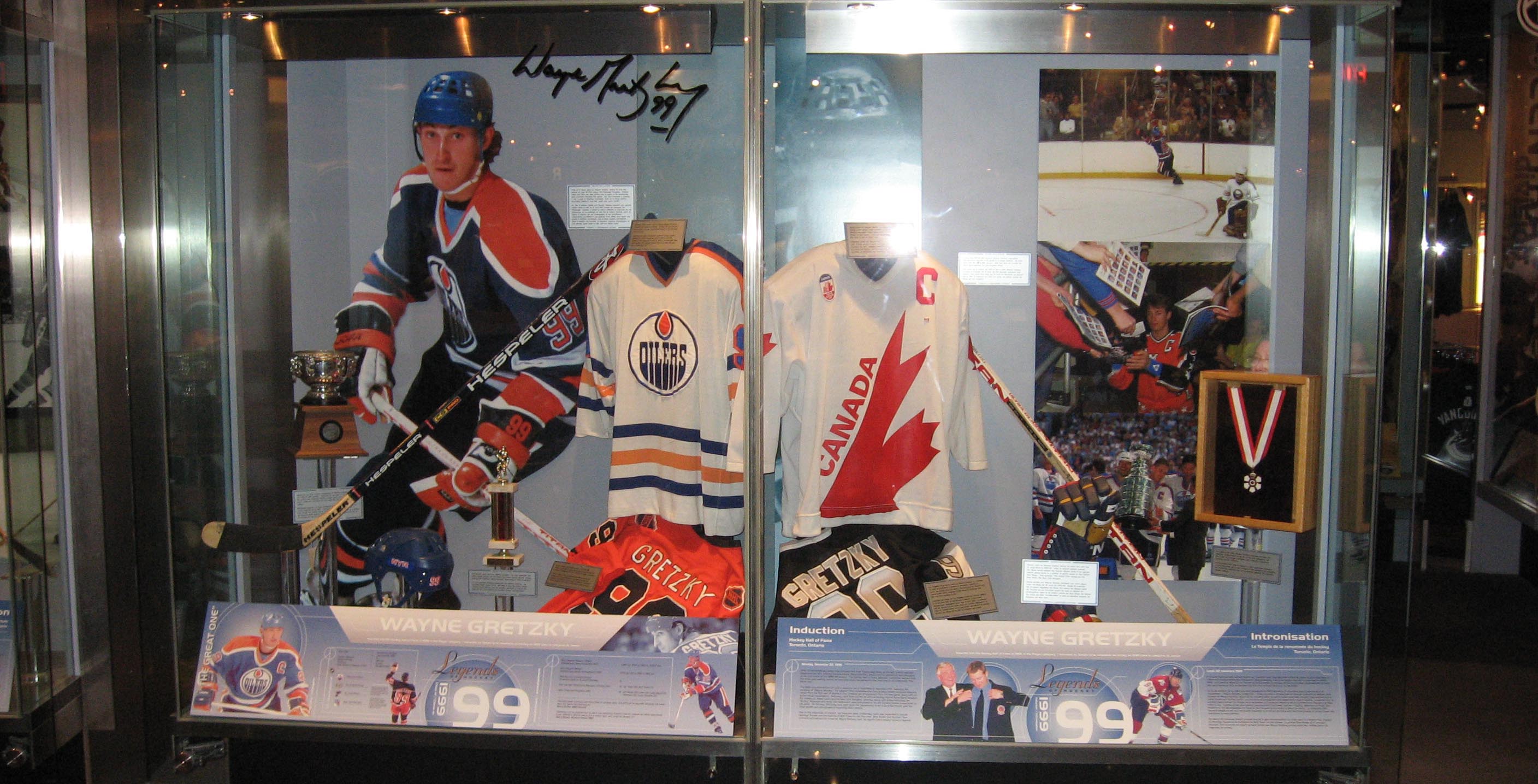
The Great One is at the top of almost all the statistics sheets, so it should not be surprising that he tops the records for having the most hat tricks. At the time of his retirement, after playing 20 seasons, Wayne Gretzky retired with 50 games in which he scored three or more goals in a game. He had 37 hat tricks, nine games where he scored four goals and four games where he notched five goals.
But perhaps one of the strangest hat tricks in his career was the one he scored on February 4, 1989, his first wearing the Los Angeles Kings sweater during his first season after the biggest trade in all of NHL history that had taken place in August of 1988. That night the Kings played host to the Buffalo Sabres at the Forum in Inglewood, California.
The Kings didn’t start off the night on the plus side of the scoreboard. In fact, the Buffalo Sabres were up 2-0 at 13:10 of the second period before the Kings got on the scoreboard—a shot from Steve Kasper on the power play. The third period saw five additional goals—four of which were for the Kings. Seven minutes into the final period Luc Robitaille, assisted by Gretzky and Dale Degray tied the game. Gretzky would get his first goal of the game at 10:34 of the game to give the Kings their first lead of the game. At 17:20. Christian Ruuttu tied things up for the Sabres, but Gretzky was still to get credit for two more goals on the night—both unassisted—the first at 18:12 and the second at 19:59.
Given his statistics, and his ability to put the puck in the net, he certainly didn’t need any help in the scoring department, but that turned out to be the case on two of the goals he was credited with during that game in which the Kings would win 5-3 over the Sabres. One of the goals was actually knocked into the Sabres net by a Buffalo player. But perhaps the hardest one for the Sabres to swallow had to be Gretzky’s last goal of the game with one second remaining on the clock. He was awarded the empty-net goal after the referee ruled that the Buffalo net had been intentionally dislodged by a Buffalo player.
Any doubt as to Gretzky’s abilities of course couldn’t be questioned, and just eight days later while the Kings were on the road in Chicago, Gretzky got his 45th hat trick in a 6-2 win over the Blackhawks. The first of his goals tied him with Marcel Dionne for most 40-goal seasons.
Ten years later, again on February 4, Gretzky was now wearing a New York Rangers sweater. With his only goal of the game at 16:21 of the second period against the Vancouver Canucks at Madison Square Garden, Gretzky tied Gordie Howe for total career goals scored—1,071 professional goals (which included all goals in regular season and playoffs in both the NHL and WHA).
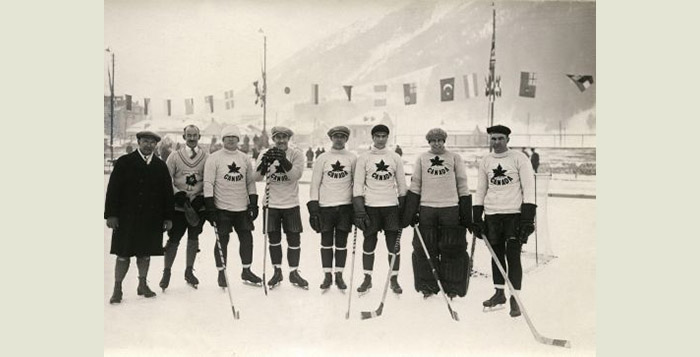
Toronto Granites (Photo: Nationaal Archief [Public domain], via Wikimedia Commons
Hockey had been added to the 1920 Games of the VIIth Olympiad for the first time when it was actually played in April among the summer sports. The 1st Olympic Winter Games were held at Chamonix, France in 1924, beginning January 25, 1924 and ending on February 5, 1924. In the sport of hockey eight nations competed, split into two groups of four. Group A consisted of Canada, Czechoslovakia, Sweden, and Switzerland. Group B saw Belgium, France, Great Britain and the United States battling. In a round robin within each group, the teams played each other with the top two teams of each advancing to the semi-finals.
At the end of the round-robin, Canada and Sweden advanced from Group A and the United States and Great Britain were the surviving teams from Group B. February 1, 1924 saw Canada—the first place in Group A—take on Great Britain, who was in second place in Group B. Likewise, after that game, the United States, leader of Group B, took on Sweden from Group A. Just as with many of the round-robin games, there were no shortages of goals scored by Canada and the United States in the semi-final round. Canada beat Great Britain 19-2 while the United States scored 20 goals while blanking Sweden.
The Bronze game saw Great Britain squeak out the win over Sweden 4-3. And then later on that day, February 3, 1924, the two nations who would become powerhouses in their own ways, Canada and the United States, would vie for the gold.
The Toronto Granites represented Canada. The team, an offshoot of the Toronto Granite Curling Club—which is still active today—was formed in the 1880s and is recognized as the first organized ice hockey team in Toronto. Their beginnings were exhibition games only with no championships or tournaments. They joined the Ontario Hockey Association in its inaugural season in 1890-91 and would continue to play in the OHA until 1924.
Team USA was made of mostly players from Massachusetts who were playing iAA in Boston. Among them was Clarence “Taffy” Abel who became the first U.S.-born player to become an NHL regular, joining the New York Rangers for the 1926-27 season. Additionally, two players who were born in Canada became naturalized citizens: Herb Drury and Frank Synott.
As described in the February 4, 1924 edition of The Winnipeg Tribune, “Canada reigns supreme in the amateur hockey world. This fact was decided here [Chamonix] yesterday when their merry little band of puck-chasers disposed of the United States team by a six to one score in the final of the Olympic hockey classic.”
The article went on to describe how the Americans seemed more focused on trying to stop the Canadians rather than scoring goals. The game played by the Canadians was called unselfish, pointing out how the team looked for the man who had the shot, passing the puck when necessary.
The Vancouver Daily World described the game as “a fast and furious contest from start to finish, and when the referee blew his whistle and the game was over, the United States players were physically exhausted and stumbling from fatigue.”
Not surprisingly the fans enjoyed the game. “The thousands of spectators watching the most hard-fought and swiftest hockey that Europe had ever seen, thrilled by the desperate stand made by the United States under the pressure of the better co-ordinated Canadian team. Time after time cheers broke from the crowd as Drury or Rice clashed <sic> away for a rush into Canadian territory only to be foiled as he reached [Beattie] Ramsay or [Dunc] Munro,” reported The Winnipeg Tribune.
The Scottish born Munro, who was born in 1901, immigrated to Toronto, Ontario as a small child. He would play two years with the University of Toronto Schools team from the age of 17 to 19. He went on to pay with the Toronto Granites for five years before joining the Montreal Maroons during the 1924-25 season, winning the Stanley Cup that year and remaining with them through the 1930-31 season. He played his last season with the Montreal Canadiens.
Many times since these two teams have found themselves looking at each other over a puck, striving to be the team to show that their system is the best.
Additional Sources:
“Beat United States in Chamonix Final,” The Winnipeg Tribune, February 4, 1924, p. 10.
“Canadians Win Olympics Hockey Title, American Puck Team Outclassed,” Vancouver Daily World, February 4, 1924, p. 12.
The Toronto Maple Leafs were playing host to the Detroit Red Wings on Wednesday, February 2, 1977. Going into the game, Leafs defenseman Ian Turnbull was experiencing a bit of a dry spell in the scoring department. According to The Ottawa Journal’s article on February 3rd, he “hadn’t scored in his last 30 National Hockey League games.” In looking at the statistics for the 1976-77 season it wasn’t quite as bleak as that, he had managed to score three goals—one in the Leafs away game against the Minnesota North Stars on January 23, 1977 and two goals in their away game against the Los Angeles Kings on January 18, 1977. However, aside from those two blips, Turnbull had no goals in the 25 other games, with his previous goal dating all the way back to November 30, 1976 when Toronto was at Nassau Veterans Memorial Arena playing against the New York Islanders.
Despite his difficulties Turnbull got the opportunity to play in the 1977 All-Star game on January 25, 1977 in Vancouver, after teammate Darryl Sittler was unable due to injury. However, he spent most of the game warming the bench. Prince of Wales Conference Coach Scotty Bowman gave him a couple of shifts at the start of the All-Star game, and then sat the d-man.
Bowman was quoted in the Daily News-Miner newspaper of Fairbanks, Alaska in the February 3rd edition, “I don’t care what he thinks of me for not playing him and I don’t think the fans do, either.”
Perhaps the hockey gods wanted to show Coach Bowman that he’d made a mistake, or maybe Turnbull simply used that benching as motivation, because he would accomplish something in the game against the Red Wings that no defenseman had ever done before.
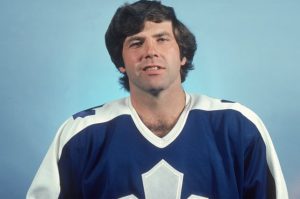
Ian Turbull
After a terrible first period that had the Maple Leafs’ fans booing their team, Turnbull would put Toronto on the scoreboard 1:55 into the second period with his first shot on net in the game, off a pass from Lanny McDonald. As the period continued, Pat Boutette, Don Ashby and Dave Williams would add three more goals before the period was half over. Then at 10:26, on his second shot on goal of the game, Turnbull, unassisted, “on a breakaway while the teams played with three skaters on each side because of penalties,” Turnbull would add his second of the game and Toronto would go into the second intermission up 5-0.
As the third period began, the Red Wings sat goaltender Ed Giacomin and played Jim Rutherford for the final twenty. It wouldn’t stop the Leafs though, as they would notch two more in the first ten of the final frame. Turnbull got this third, again unassisted, at 4:58, giving the Maple Leafs six goals. McDonald got the team’s seventh at 6:13. It would take the Red Wings more than 46 minutes to get on the score sheet, when Danny Grant finally scored for Detroit at 16:18. Turnbull wasn’t done though. He got his fourth of the game at 17:10 and his fifth at 18:30 to put the Maple Leafs up 9-1.
“It was a tough drought, although I had just as many chances in the last 30 games and nothing happened.” Turnbull told reporters. “When they go in, you smile. When they don’t you try again.”
Even with them going in, Turnbull didn’t stop trying. And by the end of the game he had become the first defenseman to get five goals on five shots on net.
“No defenseman had even scored four since Hap Day, also of the Maple Leafs did it against the old Pittsburgh Pirates on Nov. 19, 1929,” stated the Daily News-Miner.
Turnbull, who had been drafted by Toronto in 1973 in the first round (15th overall), would go on to play five more seasons with the Maple Leafs—a total of nine—before playing with the Los Angeles Kings during the 1981-82 season and finishing up his career with the Pittsburgh Penguins in the 1982-83. He retired having played 628 games in which he scored 123 goals and had 317 assists for 440 points.
Additional Sources:
“New goal mark for Turnbull,” Daily News-Miner (Fairbanks, Alaska), February 3, 1977, p. A-14
“Turnbull sets record,” The Ottawa Journal, February 3, 1977, p. 22.
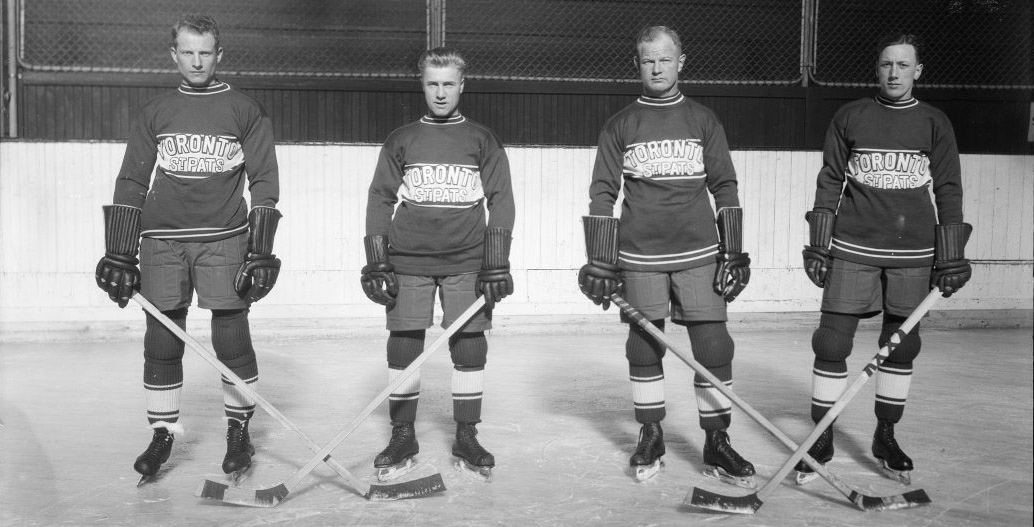
If J.P. Bickell hadn’t reached out to see if Conn Smythe might be interested in taking over coaching the struggling Toronto St. Patricks of whom Bickell was the senior member of the partnership that owned the team, it is possible that there may never have been a Toronto Maple Leafs team in the NHL. And who knows if they would have gone on to become as successful as they did or if Clarence Henry “Hap” Day would have had the success he ultimately did even after his playing career ended.
Originally, after having been fired by the New York Rangers, Conn Smythe had gone to Bickell suggesting that he let Smythe coach the Toronto St. Patricks who were having a tough season. Bickell opted instead to hire Mike Rodden. Smythe was not shy in pointing out to Bickell that this would turn out to be a terrible mistake. Smythe would be right. Bickell sought out Smythe and invited him to take over, but by then Smythe didn’t want to just coach. Instead he wanted to own part of the club. Long story short, on February 14, 1927, Smythe and his investors joined Bickell as owners of the club and Smythe was the general manager.
The Maple Leafs were born of tradition and of those who had been with Smythe in the World War I. The emblem chosen for the team sweater was not just an idle selection.
“The Maple Leaf, to us, was the badge of courage, the badge that meant home. It was the badge that reminded us of all our exploits and the different difficulties we got into, and the different accomplishments that we made. It was a badge that meant more to us than any other badge that we could think of, so we chose it, hoping that the possession of this badge would mean something to the team that wore it, and when they skated out on the ice with this badge on their chest, they would wear it with honour and pride and courage, the way it had been worn by the soldiers of the first Great War in the Canadian Army,” shared Smythe during a speech at a Maple Leafs’ banquet in October of 1945.
At the start of his involvement, the St. Patricks were in sad shape. They were last in place in their division having only won 19 of their 31 games, and with the exception Day, the team’s captain, and a rookie in his first season as a professional hockey player named Irvine Bailey (a player who would eventually gain the nickname of “Ace”), the team had nothing to speak of on the bench. After changing the name of the team, they did begin to do a little better, but Smythe would have his hands full in trying to improve the team as well as improve the number of fans who came to see them play.
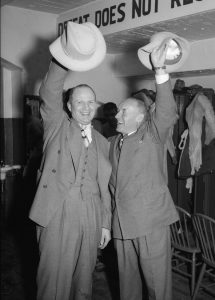
Conn Smythe and Hap Day (Photo: City of Toronto Archives)
Smythe and Day would ultimately be involved together both on the ice and off. “Happy” Day as he was called then ended up with a season ending injury during a game against the Montreal Canadiens on February 2nd. Another player stepped on the back of his leg, cutting into his Achilles tendon. It would take him eight months before he could skate again, and his tenacity through the painful rehabilitation earned him not only the respect of Smythe but also 16% ownership in Smythe’s profitable sand and gravel company.
“I wanted him with me summer as well as winter for a long time, which turned out to be one of my best decisions. He was one of the best men I ever met,” Smythe said of his talking Day into the partnership.
Day served as the captain of the team from 1926 through 1936 and played his last season with the New York Americans in 1937-38. From 1938 to 1940 he served as a referee and also did some coaching, but in 1940 he would return to the Toronto Maple Leafs organization when Smythe—after firing Dick Irvin as coach—offered Day the job. Day served in that capacity for ten years, during which time he would become the most successful coach in the NHL. One of his biggest accomplishments was coaching the Leafs team in 1942 when, after finding themselves down three games in the Stanley Cup finals to Detroit, the team rallied to take the next four games and the coveted Cup of Lord Stanley. During his ten years coaching the Leafs he won five Stanley Cups, which included a three-peat from 1947 to 1949.
Day retired from coaching in 1950, but he didn’t leave the Leafs. He became the assistant to the general manager, which was still Conn Smythe. While Smythe continued to be the general manger on paper, in effect on February 1, 1955, Day took over most of the daily operations—though his tenure as general manager with the team would last only until March 25, 1957, when he resigned after Smyth publicly humiliated Day by calling the previous season a “season of failure.” Day was inducted into the Hockey Hall of Fame in 1961.
“Day New GM of Leafs,” Ottawa Journal, February 1, 1955, p. 16.
D’Arcy Jenish, The NHL: A Centennial History, 100 Years of On-Ice Action and Boardroom Battles (Toronto, Canada: McClelland & Stewart, Ltd., 2013)
Kelly McParland, The Lives of Conn Smythe, From the Battlefield to the Maple Leaf Gardens: A Hockey Icon’s Story (Toronto: McLelland & Stewart Ltd., 2011).




 Prev
Prev