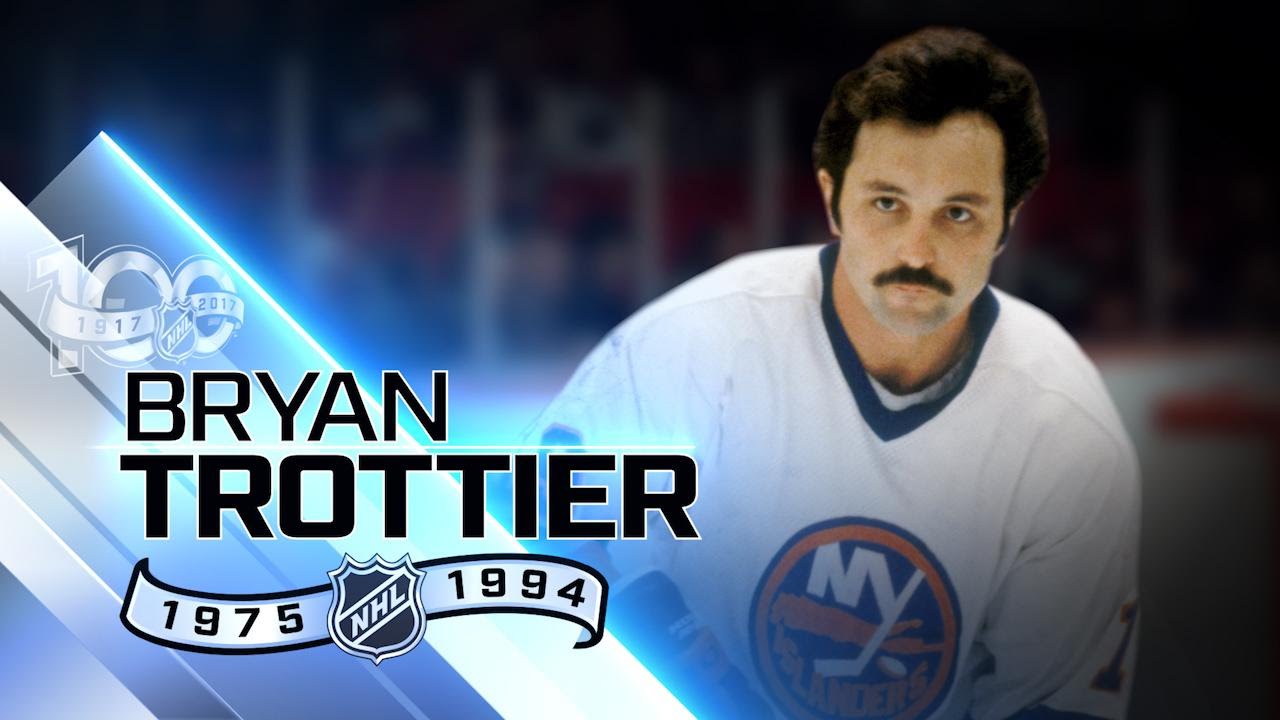
If Bryan Trottier wrote this post, he would be so humble that readers might not realize his achievements. The center said once, “Right from the start, I just wanted to contribute somehow, whether it was by bumping somebody, making a pass or scoring a goal. I liked to earn my pay every day.” At Nassau Coliseum on February 13 eight years apart, Trottier’s goals were definitely worth bragging about and came in multiples of five.
In 1982, the New York Islanders were on their way to the Stanley Cup championship for their third of four straight victories. Trottier played in all four of them. On February 13, before the regular season ended, Trottier set a NHL record for number of goals in one period and tied the Islanders’ record for most in one game. Records really had not been kept by the period, but Ron Andres, the NHL’s director of information and statistics, said a record had been set.
The game started at 5 p.m., earlier than usual, to allow the Islanders to leave for another game. Only 66 seconds later, rookie Brent Sutter scored the first Islanders’ goal. Trottier followed that during a power play. As his teammate left the penalty box, he passed the puck to Mike Bossy “who deked a Flyer defenseman and ripped the puck off the right post. It caromed out to Trottier, who tipped it past Peeters at 9:02.”
Then came the third period. Among the Philadelphia Flyers opposing the Islanders was Darryl Sittler, who (when playing with the Toronto Maple Leafs) had set a modern record for goals in one game. He (and everyone else) could not help noticing Trottier. “In the third period I knew he’d have a shot at [beating the record]. It was one of those games where the puck came to Bryan. He was in the right place at the right time. I was thinking about the night I had the six goals and four assists. This reminded me of the way things went for me.”
Trottier’s spree began at 1:04 during another power play. The New York Daily News reported, “Bossy took a swipe at the loose puck. Trottier got the rebound and chipped it in.” Near the middle of the period, the Islanders enjoyed and took advantage of 1:37 of five-on-three. Trottier earned his third hat trick of the season and eleventh of his career when “Bossy backhanded the puck toward the net and the 25-year-old center tapped it in.” Then, according to the recap, “Bossy slipped a pass through the crease that went past two Flyers before Trottier, standing unguarded at the right post, knocked the puck into the net.” To finish off the game, at 18:32, Trottier scored his only goal of the night while at even strength. Again, Bossy “stole a rebound” and “backhanded the puck to Trottier.”
Trottier had scored four goals in one period and five in the game. His first four goals were during power plays. “Right place, right time,” commented the humble Trottier. “A lot of the goals were the result of hard work by the other players. We should have had more goals. We would have, if I’d passed the puck better.” While Bossy had not had any luck scoring his own goals, he certainly passed. He assisted on all four of Trottier’s third-period goals to set his own record. The Islanders defeated the Flyers 8-2 and extended their winning streak to eleven games.
In 1990, Trottier was playing in his second-to-last of 15 seasons with the New York Islanders and was the last active player remaining from the Stanley Cup streak. On February 13, the 15,011 fans witnessed the Islanders’ 4-2 loss to the Calgary Flames. However, they were also able to celebrate Trottier’s 500th goal. Trottier was the 15th NHL player to score 500 goals and the second for the Islanders, after Bossy.
Almost halfway through the game, Pat LaFontaine kept feeding the puck to Trottier until they succeeded. The first pass and shot was blocked by Rick Wamsley. The puck came back out and LaFontaine passed to Gary Nylund whose shot also failed. When the puck bounced off to the side, LaFontaine again sent it over to Trottier. According to the Daily News, “He took one swing, then poked his own rebound through Wamsley’s legs at 9:57.” Trottier himself described the sequence, “Pat LaFontaine made a great play to set me up, but I handcuffed myself the first time. But Pat got the puck back to Gary Nylund, who pounded it. Wamsley got a piece of it, I poked at it and the second time I got it.” Having given up the goal, Wamsley did not feel too bad. “Even though you’re down 1-0, it’s one of those special moments in sports. You can kind of be happy for him. You like to see good people succeed.”
Immediately, recapped the Daily News, the “new multi-million dollar scoreboard flashed a big 500, the fans gave their hero a standing ovation, and GM Bill Torrey got up from his seat in a skybox with a clenched fist in the air.” His coach made Trottier stand for a curtain call. As predicted, Trottier commented, “It was kind of embarrassing. It was humbling in a way at the same time. Their feelings for me are no different than mine for them. It’s a very special relationship.” He continued, “It was very, very special and the reaction was fantastic. It’s something I will always treasure and now I have to go out and get 501.” Instead, the celebration slowed the Islanders’ momentum and less than a minute later, the Flames tied up.
After one more season with the Islanders, Trottier signed with the Pittsburgh Penguins. Immediately, they won back-to-back Stanley Cup championships (in 1991 and 1992). Trottier retired in 1994 having played 1279 games (524G, 901A, 1425P). He was inducted into the Hockey Hall of Fame the requisite three years later.
Additional Sources:
Mary Flannery, “Trottier’s 5 goals demolish Flyers for Isles 11th in row,” New York Daily News, 14 Feb. 1982, p. 108.
Larry Weisman, “Trottier scores 5 in Isles rout,” White Plains Journal News, 14 Feb. 1982, p. D1.
Sam Marchiano, “Trot’s 500th up in Flames,” New York Daily News, 14 Feb. 1990, p. 53.
John Kreiser, “Trottier scores 500th goal but Calgary trips Isles, 4-2,” White Plains Journal News, 14 Feb. 1990, p. D4.
Earlier on Tuesday, the General Manager of the Boston Bruins, Don Sweeney announced that forward David Pastrnak would be out at least two weeks having undergone surgery on his thumb. He’d injured it in a freak accident after attending an event with some of the other players. Not surprisingly, many were questioning how the Bruins would do on Tuesday night when they took on the Chicago Blackhawks who were riding a seven-game winning streak.
As things got underway, it did look like the Blackhawks were going to control the game. They were preventing the Bruins from getting a shot on net while at the other end, they put four shots on Tuukka Rask with the fourth one going in. Chicago was on the scoreboard first and the Bruins were playing from behind. And then the Bruins found themselves down first Brad Marchand, who was sent to the box for goaltender interference at 7:12, with Zdeno Chara following 1:11 after for roughing — affording the Blackhawks a 49 second five-on-three opportunity followed by more power play time after Marchand got out of the box. The Bruins were able to kill both of the penalties.
Perhaps it was the penalties themselves, or the momentum the Bruins got from their ability to kill them both, but the ice began to tilt in their favor and while Chicago was down a man—Brent Seabroook was whistled for a trip—the Bruins took advantage of their man advantage. With a solid pass by Patrice Bergeron through the slot to David Krejci who was set up in the left circle (some could call it Pastrnak’s Office), and Krejci put it past Collin Delia to tie things up at 14:47.
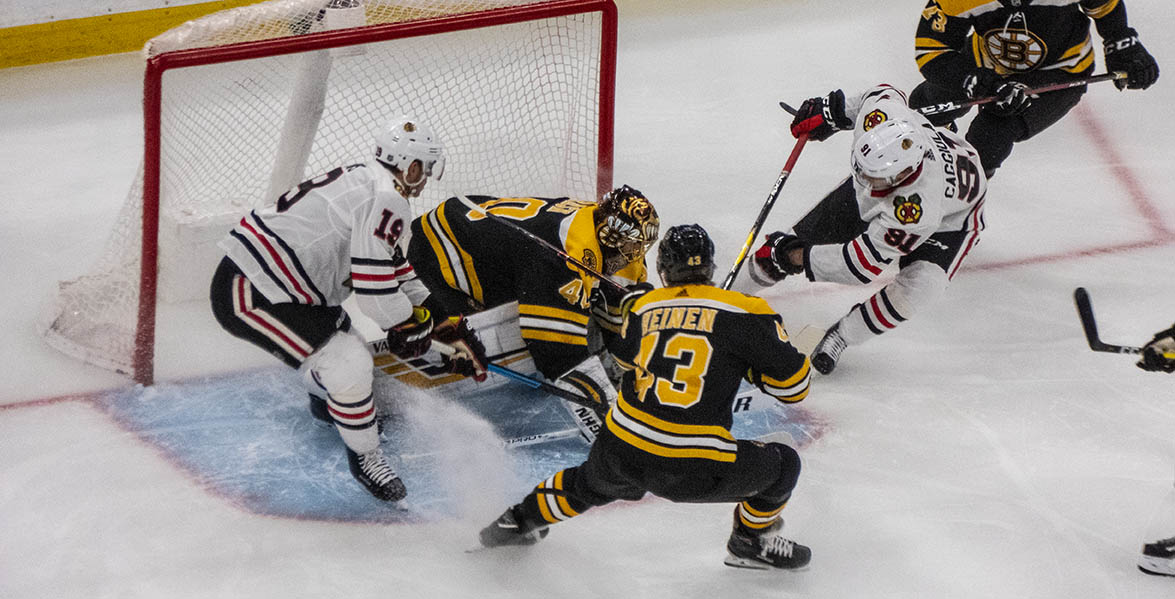
Just 49 seconds later, Danton Heinen, who has been playing on the top line with Bergeron and Marchand, was right on the Delia’s doorstep and he put a Marchand pass home to give the Bruins their first lead of the game. Boston wasn’t done yet in the opening frame. With 1:01 remaining in the period, Marchand added his marker, assisted by Heinen and Bergeron. Going into the first intermission the Bruins were leading 3-1 and the top line had combined for six points: Bergeron with two assists and both Marchand and Heinen had a goal and an assist.
The second period saw the Blackhawks get called for three more penalties: Erik Gustafsson for a tripping at 11:49, Connor Murphy with a cross-check at 15:42, and then Jonathan Toews with high-sticking at 16:02. Despite having an extended five-on-three opportunity when Murphy and Toews were sitting, the Bruins weren’t able to capitalize until four seconds after Toews left the box and Jake DeBrusk gave Boston a 4-1 lead.
Jake DeBrusk on Collin Delia
Through the first two periods DeBrusk had put five shots on Delia with the fifth one giving him his first goal in 13 games. He had been struggling to be sure but watching him Tuesday night it was clear that he was hungry—or perhaps even a little “hangry”— to get his game going again.
“I think I was sick of everything to be honest with you, so I just tried to play hockey and have fun with it no matter what happens – even if I wasn’t scoring, I was just trying to enjoy every moment. It’s obviously not that hard to enjoy every moment, but I’m pretty hard on myself so obviously my frustration and different things, it was getting to a point where I was just like okay, I’m kind of sick of doing this. It isn’t working at all. So I was just like go back and be yourself. It worked, so try to do the same thing next game,” DeBrusk said.
It looked like the Bruins would be going into the second intermission with a three-goal lead, but the Blackhawks had other plans. With 23 seconds left on the clock, Duncan Keith put a fast one past Rask to go into the intermission with a 4-2 score. And the two-goal lead for the Bruins going into the third period has often not been their friend this season.
It was clear that Chicago was planning on riding the momentum from that late second period goal into the third. Once again, they were outshooting the Bruins, aided by an early penalty assessed to Sean Kuraly for hooking at 1:16. Shortly after he was out of the box, Noel Acciari for Boston and John Hayden for Chicago were both sent off with matching roughing minors, giving the teams some four-on-four play. Gustafsson got the Blackhawks within one goal while on the four-on-four, and there were questions swirling as to if this was going to be another game where the Bruins left points on the table.
However, the. Bruins weren’t backing down Tuesday night. Chicago’s Dylan Strome was sent off for slashing. Torey Krug worked the puck into the offensive end and then set up a beautifully executed tic-tac-toe pass from himself to Heinen to Peter Cehlarik. The Bruins regained their two-goal lead at 7:18 of the period. Responding just 3:30 after the Gustafsson goal showed that the Bruins were determined not to give up their lead as they had in recent games. They notched one more goal, the second of the game for Krejci, at 15:42 assisted by Marchand and DeBrusk to put a bow on it, winning the game 6-3.
Going into the game, the team knew they were without Pastrnak, and secondary scoring was going to be necessary. Everyone needed to step up. And when the final buzzer sounded, five different players had tallied goals, three of them being secondary scorers. Heinen, Krejci and DeBrusk all had three-point nights and Marchand had a four-point game.
“Yes, we got results tonight. The buy-in, I thought our fourth line was physical, played their game, controlled pucks low. Bergy’s [Patrice Bergeron] line was Bergy’s line. They matched up today against [Jonathan] Toews. We got them away from a different line the other night. Today, we stuck with that matchup. They had good energy. They were controlling the puck. I thought our D did a good job limiting the entries. Chicago’s dangerous at that. It did lead to a couple goals, but for the most part I thought we handled that part well. Scoring came with it. Chicago, at least by their analytics, not a great slot-coverage team. It’s probably why their goals against is high. So we focused on getting pucks and people in there. We did a real good job with that, especially the second period. The goalie made some terrific saves, but we stuck with it and eventually did get rewarded,” shared head coach Bruce Cassidy, who got his 100th win as the Bruins coach on Tuesday night.
There will be a forward called up as the team heads out west for a road trip, but the energy, determination, and doggedness of the team on Tuesday showed that they can get goals from more than just the Bergeron line.
“We’re going to need contributions from everybody with [Pastrnak] going down there for a bit. Heinen was unreal tonight, made a lot of big plays; Jake [DeBrusk] was very clutch tonight as well, so great games by them. You know, it’s fun to see them play like that and add so much depth to our group. Heinen has been great the last little bit, so we need that to continue,” said Marchand.
Since their first meeting in October 1970 (the first month of the new Canucks franchise), the Canucks had only managed to tie five games and lost 25. In 1976, Coach Phil Maloney scoffed, “Those games don’t count. I wasn’t here. I’ve never lost to them.” After one of the ties, winger Dennis Ververgaert commented, “We gotta quit thinking of moral victories and start beating those guys.”
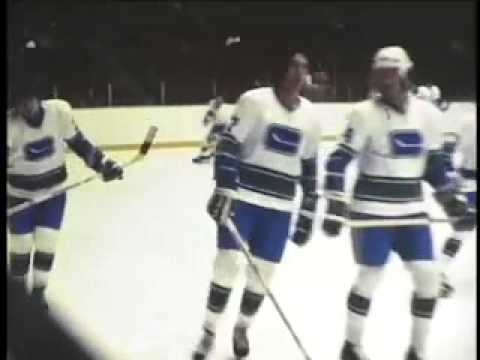
The Canucks finally “beat those guys” 2-1 during one playoff game in 1975. The following season, the Canucks had just lost 6-4 against the Canadiens on November 24, 1975, and that was followed by 2-2 ties in two games. After the victory at Montreal Forum on February 12, 1976, the Vancouver Sun crowed, “The Canucks reached celestial heights by defeating Montreal Canadiens for the first time in a regular [NHL] contest – a stretch of purgatory 30 games long and almost six seasons wide.”
The Monday before the game, Maloney had suspended their starting goalie, Gary Smith, so Ken Lockett suddenly found himself in net full-time. Lockett made 31 saves, and the Candiens did not even score on him until 8:55 of the second period. By that time, the Canucks already had a four-goal lead. As the Vancouver Sun pointed out, the subpar performance by the Canadiens’ goalie factored in just as much as “effort was the great equalizer.” With half a period to go, the score was 6-2, and Lockett let in two final goals. In the end, the Canucks won 6-4. Coach Maloney told the press, “I’m very pleased for those guys in there.” While opposing coach Scotty Bowman shrugged. “Sometimes you just keep playing but nothing happens.”
The Canucks had finally defeated every other NHL team at least once. Meanwhile, this was only the second home loss of the season for the Canadiens. Still, Prime Minister Pierre Trudeau (of Montreal) made a crack during a Liberal fund-raising dinner at Hotel Vancouver. “It’s truly the end of an era when the Montreal Canadiens can be beaten by a bunch of …”
To this day, the Canucks have played the Canadiens in 130 games and won just shy of a quarter of them (31-84-13-2). Naturally, the Canucks fared better at their own rinks. The Canadiens came out the victor in 28 of 43 games played at the Pacific Coliseum and 11 of 23 at Rogers Arena. However, in Montreal, the Canucks only won 4 of 18 games at Bell Centre and 8 of 46 at Montreal Forum. Through their match-ups, the Canucks have earned 77 points to the Canadiens’ 188.
Additional Sources:
Archie McDonald, “Canadiens just human (but it took 31 games),” Vancouver Sun, 13 Feb. 1976, p. 1, 21, 24.
Tom Watt, “Canucks finally break their Hab-it,” Vancouver Province, 13 Feb. 1976, p. 1, 13, 15.
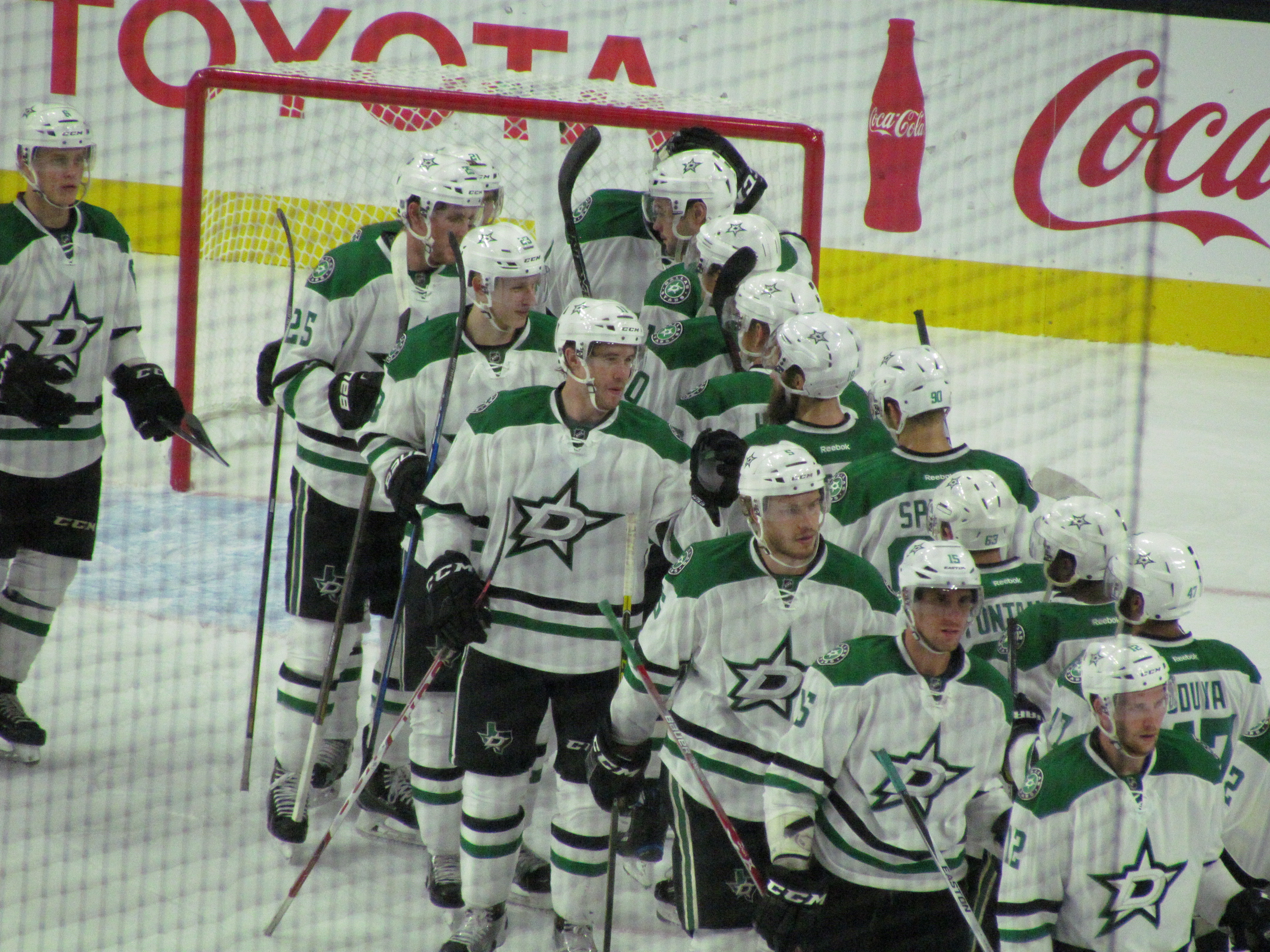
The Dallas Stars look to get some important points while on a three game East Coast road trip this week. On Tuesday night, they’ll take on the Florida Panthers. The team will stay in the state of Florida and take on the Tampa Bay Lightning on Thursday night. The Stars end the week with a game against the Hurricanes.
1) Tuesday, Feb. 12 @ Panthers- 7 p.m. ET
The Stars need to get the depth scorers going especially since the season is heading down the stretch. The Florida Panthers have the depth scoring and can spread the wealth around the lineup. The Stars have the advantage with even strength play while the Panthers have the special teams advantage especially while on the power play.
The Stars Win If…
They play with discipline and stay out of the penalty box. The Panthers have the second best power play in the NHL and operate at a 26.5% clip. The Stars need to be able to skate with the Panthers and not take the lazy penalties or a lot of stick infractions. The Panthers have scored 50 first period goals on the season and the Stars only have 25 so it would benefit the Stars to make sure that they get off to a good start.
Matchup of the Game
One thing to watch in this game is the play of the Panthers power play against the Stars penalty kill. The Panthers’ power play is dangerous and is the second-best behind the Lightning. The Panthers top unit has combined for 104 points so the Stars want to make sure that they clear the puck when they get the chance. The Stars penalty kill is the sixth best in the NHL at 83.2%. They have been a much better team defensively this season and are getting some decent goaltending, which has made a difference especially when down a man.
Game Prediction
The Stars will avenge a loss from earlier this season against the Panthers and pull out a 3-1 win. The Stars goal scorers will be Tyler Seguin, Alexander Radulov and Jamie Benn. The Panthers lone goal will be scored by Mike Hoffman. The Stars take the important two points from this game and keep pace in the Western Conference.
2) Thursday, Feb. 14 @ Lightning- 7:30 p.m. ET
The Stars will have a tough time matching up against a balanced Tampa Bay Lightning team. These two teams have yet to play each other this season. Goaltender Ben Bishop is still injured for the Stars but the team is hoping that he can be ready for this game and if so, it would be a huge boost for the team.
The Stars Win If…
They can manage to play a solid team defensive game and they have been doing a lot of that this season. The Stars need to establish a forecheck early and often so the Lightning are the team defending and not attacking. The Stars should limit their mistakes because the Bolts are one of the better teams at cashing in on the opposition’s mistakes.
Matchup of the Game
The two players to pay attention to in this game are Tyler Seguin and Nikita Kucherov. These two each lead their teams in points on the season. Seguin has 51 points and Kucherov has 84 points. Seguin has been one of the more consistent players for the Stars this season, while Kucherov started off the season slow. The teams are going to need to be aware of where each of these players are while they are on the ice because both of them can set up or score goals.
Game Prediction
The Stars get off to a slow start in this game and never recover. They’ll lose 4-2 in regulation to the Bolts. The Stars goals are scored by Alexander Radulov and John Klingberg. The Bolts goal scorers will be Brayden Point (x2), Steven Stamkos and Tyler Johnson.
3) Saturday, Feb. 16 @ Hurricanes- 8 p.m. ET
This will be the first time that the two teams are getting together this season. The Carolina Hurricanes have more depth scoring but both teams can get some points from the guys on the blue line. The Stars have the all around advantage in this game but that means nothing on paper. The team needs to go out play a good solid road game.
The Stars Win If…
They can play a solid defensive road game for about 50 minutes of this game. They need to avoid turnovers and mistakes because the Hurricanes have guys that can put the puck in the back of the net. The Hurricanes also have some speed in their lineup so the Stars need to be prepared to skate in this game.
Matchup of the Game
These two teams have defensemen that have no problem jumping into the play on the offensive side of the puck. They also have players on the blueline who can skate and move the puck. The Hurricanes six defensemen have combined for 105 points on the season. The Stars top six defensemen have combined for 101 points. This should be a good defensive game, but the defensemen won’t be afraid to jump in the play on the offensive side of the puck either.
Game Prediction
The Hurricanes will win the game by a score of 3-2 after getting off to a fast start and building from there. The Stars goals come from Jamie Benn and Andrew Cogliano. The Hurricanes will get their goals from Sebastian Aho, Dougie Hamilton and Justin Williams. The Hurricanes fans should get ready for another Storm Surge celebration after this win. The Stars finish out the week with a disappointing 1-2-0 record.
The Detroit Free Press called it an “improbable, tense, weird game,” and the Vancouver Province described it as “one of the most bizarre National Hockey League games the team has been involved in over the 12-year history of the franchise.” For most of the game on February 11, 1982, the 11,117 Red Wings fans at Joe Louis Arena enjoyed themselves. Then, in the third period, referee Kerry Fraser called not one but two penalty shots for the visiting Vancouver Canucks.
The first call came at 5:55 in the third “after a goal-crease scramble in front of Detroit netminder Gilles Gilbert.” According to Fraser, “The puck was grabbed by a hand. It slid under (Jody) Gage’s leg. That is a penalty shot, awarded to a player on the ice at the time.” As Gage saw it, “I was pushing someone out of the crease. He fell. I fell. I fell on the puck. I don’t know if I touched it or not.” After the game, Detroit’s coach, Wayne Maxner, watched the replay repeatedly and heatedly claimed, “Look, on the first one he’s already blown his whistle to stop the play before he awards the penalty shot. Then he makes the call when he gets behind the net. Hell, he can’t even see over the net, he’s too short.” His counterpart for Vancouver, Coach Harry Neale, stated, “The first one was a good call.” The Vancouver Sun stated, “The replay in the press box immediately after the call clearly showed that Gage had covered the loose puck with his glove.”
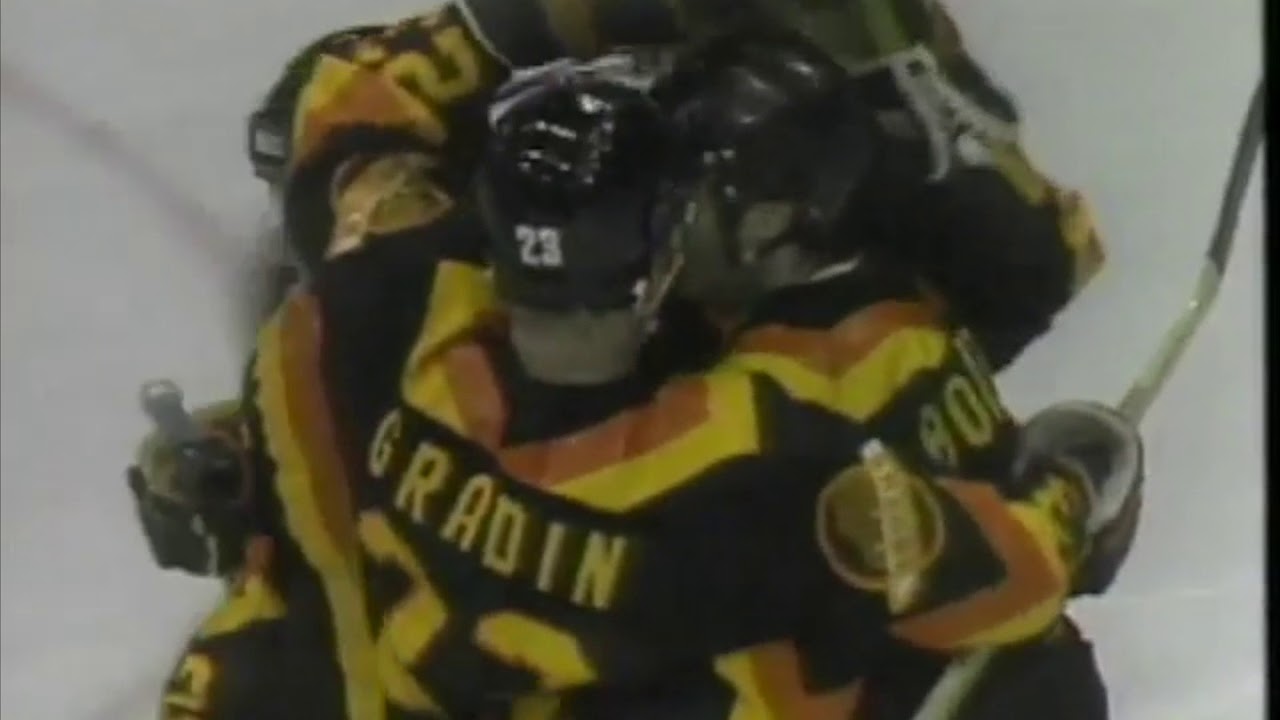
Since the player had to be on the ice at the time, Thomas Gradin took the penalty shot. He said afterwards, “I came in thinking two things. If he slides, put it behind him along the ice. If he drops, put it between his legs. He slid.” As the Detroit Free Press described the play, Gradin “faked Gilbert to his left, and pushed the puck through to the opposite side.” What’s more, Gradin followed that up with another goal in the last five minutes of the game.
For the last minute or so of the game, Vancouver pulled goalie Richard Brodeur, and Detroit nearly scored on the empty net. Instead, according to the Free Press recap, “Stan Smyl picked it, raced in on Gilbert, but was tripped from behind by Huber. Smyl rammed hard into the goal post, and had to be helped from the ice.” With only 30 seconds remaining, Fraser again made the call when he “pointed dramatically to center ice.” He justified the call “because Huber fouled Smyl from behind, preventing a shot on goal.” Coach Maxner claimed there was a high stick by the Canucks beforehand that should have nullified the call, but Fraser disagreed that there was a high stick. The replay, according to the Sun, also did not show Huber having swept the puck before Smyl’s skates. Naturally, Coach Neale reaffirmed, “Stan was in the clear and he was hauled down from behind, prevented from getting a shot away.” He also said, “It was a gutsy call, but the right one.”
There was a five-minute delay as fans tossed trash onto the ice in protest and “Fraser was verbally berated by Maxner and Gare, who was assessed a misconduct penalty.” During this time, Gradin skated around center ice as if he planned to take the penalty shot again. This turned out just to be a tactic to get in Gilbert’s head because Ivan Hlinka took the shot instead. Neale’s only advice to Hlinka was a teasing “If you miss, you can keep right on skating out the door and back to Czechoslovakia.” Apparently, just as Hlinka began to skate, a spectator slid a puck his way, but “he didn’t even notice it.” Hlinka commented to the Sun, “The ice was poor by now so I, too, went for the fake when he came three metres out as I was skating in.” He told the Province, “I was going to shoot, but when I saw the goalie backing up, I had to deke.” According to the Vancouver Province, he “made a spectacular move to deke Detroit’s Gilles Gilbert and lift the puck into the ceiling of the net on the backhand.” Hlinka summed up the feeling, “I’m three years older after something like that.”
Both Canucks had converted using backhand dekes. As Europeans, they both had more experience with penalty shots. Gradin told the press, “I had two or three penalty shots in my years in Sweden and I don’t think I missed any of them. Maybe I missed one in junior hockey.” As for Hlinka, he explained, “In Czechoslovakia the last two years, if teams are tied after overtime, the game is settled with each team taking three penalty shots. I scored on two of three last year. I’ve had about five or six in my career. The fans find it very exciting.” Having been outmaneuvered twice, Gilbert said, “I’ve been facing penalty shots for a long time. It wasn’t the pressure. They didn’t beat me cleanly. It’s a question of quickness. I did make the right move.”
The final score was 4-4. Coach Maxner was spitting mad, feeling that Fraser had given away the game to the Canucks. “We should have two points,” he groused. “The little guy with the arm band helped to take it away from us.” During his half hour or so abusive tirade after the game, Maxner said things like that Fraser was “incompetent” and “should be fired.” Coach Neale, of course, begged to differ. “Some refs wouldn’t have dared call it twice in favor of the visiting team. He showed some stuff – and I think he was right both times.” The Detroit Free Press reported, “Fraser cited sections in the rule book to support both calls. He was backed by Matt Pavelich, a supervisor of officials, who watched the game from the press box.” Still, as he left the ice, “someone threw a water bottle at him from the area around the Wings’ bench. It came close, but missed.”
These were Vancouver’s sixth and seventh penalty shots ever, since their first season in 1970-71. Two of the first five had been converted. Whereas, since 1963, Detroit had had 25 penalty shots, 10 of which were successful. The penalty shot rule was introduced in 1934-35. The most shots awarded in one season was 14, and the most successful in one season was six. However, as Wings trainer Lefty Wilson said, “In 37 years, I’ve never seen two in one game.” This seemed to be the first time in NHL history that two penalty shots were successful in one game and especially in one period.
Additional Sources:
Bill McGraw, “Canucks tie Wings on 2 penalty shots,” Detroit Free Press, 12 Feb. 1982, p. 1D and 6D.
Bill McGraw, “Penalty-shot call is one of hockey’s rarest,” Detroit Free Press, 12 Feb. 1982, p. 6D.
Tony Gallagher, “Canucks resort to the bizarre,” Vancouver Province, 12 Feb. 1982, p. C2.
Arv Olson, “Bizarre rally nets point” and “Penalty shots click two times,” Vancouver Sun, 12 Feb. 1982, p. C1.
During the 1930s and 1940s, the Boston Bruins sent out onto the ice three young men of German heritage – center Milt Schmidt (No. 15), left winger Woody Dumart (No. 14), and right winger Bobby Bauer (No. 17). They hailed from Kitchener, Ontario, where they had played together for the Kitchener Greenshirts. For the 1936-37 season, all three played on one line for the Providence Reds, the Bruins’ farm team. Coach Albert Leduc dubbed this line of Germans the “Sauerkraut Line,” and that was soon shortened to “Kraut Line.” The nickname followed the three to Boston, where they were so close they shared an apartment.
The Kraut Line was so successful that by the 1939-40 season, Schmidt, Dumart, and Bauer became 1-2-3, respectively, leading the NHL in scoring. That was the first time three from the same team ranked in the top three. Together, they won the Stanley Cup championships in 1939 and 1941.
With Canada and the U.S. fighting in World War II, the line received the less-German nickname “Kitchener Kids.” The three players felt more patriotism than a simple name change could reflect and enlisted in the Royal Canadian Air Force (RCAF). They had registered for the Canadian home guard on July 15, 1940, when Bauer falsified his age “so that he would be called for duty at the same time as his life-long pals, Schmidt and Dumart.” The Boston Globe reported that he “refused point blank to alter the situation when the summons came for all three to report to the colors recently.” Schmidt then enlisted (as a physical fitness instructor) in the RCAF on January 29, 1942. In February 1942, the trio put their NHL careers on hold to serve.
The last game before the Kraut Line reported for duty was held on February 10, 1942 before a crowd of 10,400 at Boston Garden. It was the last home appearance of the Bruins, who would be traveling for two weeks, and the final regular-season visit of the Montreal Canadiens. At the end of the first period, the Bruins already led 2-1 with Toe Blake scoring the only Canadiens goal. Dumart scored the Bruins’ third goal (with both linemates assisting) at 16:52 of the second session. Schmidt assisted Jack Shewchuk in scoring only eleven seconds later. Within the first seven minutes of the third period, the Bruins doubled their score. Bauer scored the first two back-to-back at 1:15 and 1:29. Dumart assisted on both and Schmidt on the second. At 6:19, both Bauer and Dumart assisted Des Smith on the final goal of the game. According to the Boston Globe, “The trio worked like fury to set up Schmidty in the closing minutes and once succeeded only to have the play ruled offside.” All told, the Kraut Line wings each had four points while their center had three. Their combined 11 points accounted for exactly half of the Bruins’ total points in their 8-1 victory.
After the game, the three RCAF men were feted on the ice and off. In the midst of “terrific ovations,” they were placed at center ice. Bruins management presented them each with full-season paychecks and bonuses. General manager Art Ross, presented by his sons (John Ross and Pilot Officer Arthur Ross Jr. of the RCAF), gave them chronograph watches. Ross called them “the most loyal and courageous players in the Bruins history.” The Boston Globe reported, “Farewell messages from Lieut. Adams and Ross were read by Secretary Frank Ryan. Both stressed the loyalty of the Krauts to the Bruins, confidence they will perform even more brilliantly in the greater conflict and hope that the trio will soon return to the hockey wars.” Finally, their Bruins teammates gave them engraved bracelets, “solid gold identification tags.” Bauer said over the loudspeakers, “I have never been more speechless in my life. You will all be proud of us.”
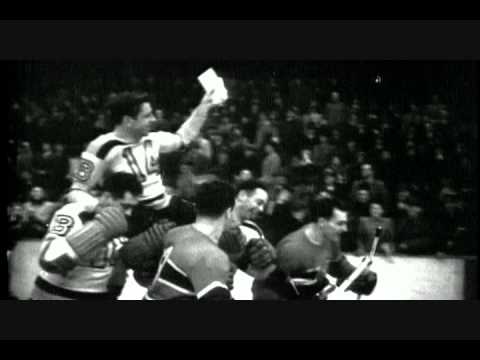
As the organ played and the crowd sang “Auld Lang Syne,” both the Bruins and the Canadiens shouldered the Kraut Line and carried them off the ice. Schmidt never forgot what that night meant to them. “It just goes to show that you can have pretty bitter enemies out on that ice, but after the game is over, we’re all friends, and I think that has a lot to say about the people who play the game.”
That night at Hotel Manger, the Royal York A.C. and Boston hockey writers’ association hosted a party for the Kraut Line. The three servicemen received portable radios, “beautiful writing kits in portfolios,” and “handsome pocket knives.” Bauer thanked everyone on his line’s behalf saying, “We’ll make you proud of us. All we ask is that you give the fellows a break now that we are gone. It’s a strain on a team to lose one player and the Bruins are losing three. They’ve felt the strain already. There have been good Bruins teams before us and there will be good teams after us so do give the boys a helping hand.” The Kraut Line surprised all their gift givers by presenting all of them with monogrammed pencils in return.
The following day, the hockey writers unanimously voted all three as recipients of the Elizabeth C. DuFresne Trophy honoring Boston’s MVP at home games. Manager Art Ross had to make arrangements to have the accompanying souvenirs (bronze ashtrays with the Bruins’ bear logo) manufactured in time for their upcoming charity game. The three would also have their names inscribed on the plaque at the Bruins’ offices.
Once the three had begun serving in the RCAF (at Station Rockcliffe near Ottawa) they played for its hockey team. Only a week after leaving, the RCAF played the Bruins in a benefit game. That year (with the Kraut Line), the RCAF won the Allen Cup as Canada’s top senior amateur team. In October, Schmidt and Dumart went overseas to England with No. 6 Group, part of Bomber Command. There, they played against each other in the RCAF League, and Dumart (of the Linton-on-Ouse team) defeated Schmidt (of team St. George) for the championship. In the summer of 1943, Schmidt was promoted to Pilot Officer and Bauer finally arrived in England. The two played together during the 1943-44 RCAF season, and they defeated Dumart’s team for the league championship. In 1945, Bauer returned to Canada first, and later Schmidt and Dumart followed on the same ship.
After three years with the RCAF, the Kraut Line returned to the Bruins for the 1945-46 season, in which they played in the Stanley Cup finals against the Canadiens. In the NHL, Schmidt, Dumart, and Bauer only played for the Bruins, and they retired one season after each other – Bauer in 1952, Dumart in 1953, and Schmidt in 1954. Almost immediately, Schmidt stepped in as the Bruins’ coach and led them for a total of 11 seasons. In 1966, he became the Bruins’ general manager, and they went on to win the Stanley Cup twice, in 1970 and 1972. Schmidt was the first inducted into the Hockey Hall of Fame, in 1961, and he was followed by Dumart in 1992 and Bauer in 1996. Of them, only Schmidt has had his No. 15 retired by the Bruins.
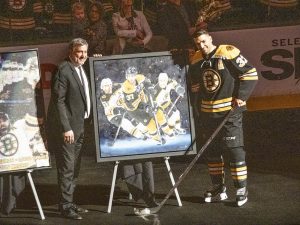
Saturday afternoon the Boston Bruins played host to the Los Angeles Kings. However, before the game began, there was a ceremony to honor Patrice Bergeron who had played in his 1000th game on Thursday.
His wife and children, along with his parents, joined him at ice level as he watched a video of many of his current and past teammates congratulating him. He was then given a lovely Tiffany crystal award to commemorate the milestone, which was presented by John Bucyk. This was followed by a large painting of him holding the Stanley Cup and a vacation for he and his family presented by his teammates Zdeno Chara, David Krejci, David Backes, Tuukka Rask and Brad Marchand. Bruins president Cam Neely presented Bergeron with a silver hockey stick and another painting. And then during the game additional well wishes were played on the Jumbotron from players on other Boston sports teams.
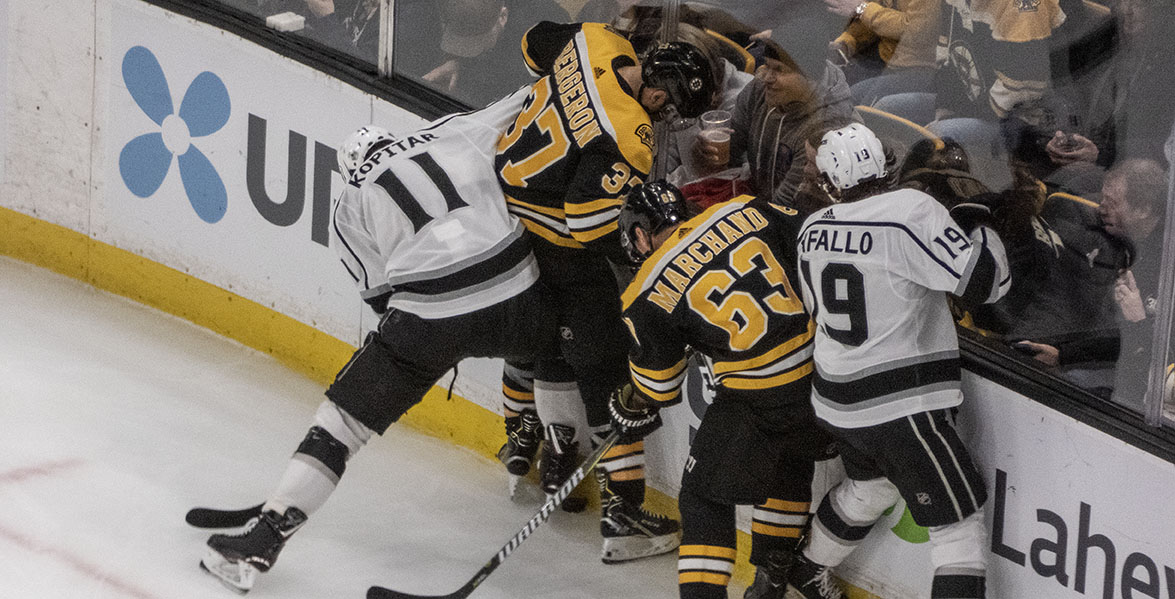
Doughty, Quick, Kopitar, and Bergeron
As the game got underway, the Bruins were outshooting the Kings, but as the teams went into the first intermission there was no score. The second period saw the Bruins score the first goal of the game as Danton Heinen made a solid pass to Bergeron, who put it right on Charlie McAvoy’s stick. McAvoy was right in front of the net and had a wide-open net, as Jonathan Quick had slid to his right expecting Bergeron to shoot on net. The Bruins lead would last about four minutes before Alex Iafallo would get his 11th goal of the season while the Kings were on the power play. The Bruins had killed a Chara interference penalty and then found themselves right back on the penalty kill when Krejci was sent off for a slash. The middle frame ended with the Kings up 2-1, after Anze Kopitar got a goal at 14:02.
The third period saw a more determined Bruins team hit the ice. It looked like they were the same team that had begun the game, and this time they were rewarded for their efforts. Heinen, assisted by McAvoy and Marchand got the game tied again 3:27 into the third. And then Krejci put one in at 4:57. Torey Krug had received a pass from David Pastrnak and shot it, but it hit the pipe and rebounded. It was that rebound that Krejci corralled to give the Bruins the lead. As Chris Wagner was in the penalty box for tripping, the Bruins found themselves in an odd-man rush as Bergeron carried the puck down the ice with Marchand parallel to him. A quick pass from Bergeron and Marchand had the Bruins up by two goals.
Once again the Kings would fight back, first a goal by Nate Thompson, at 9:19, and then Oscar Fantenberg at 15:13. So, once again the Bruins gave up a two-goal lead in the third period, which is something they need to look at and fix quickly. They cannot continue to give up leads as the games begin to count down. Perhaps the one good thing was that they were able to take this one to overtime. And Rask played a large part in that – making some important stops throughout the game.
During the overtime period, Ilya Kovalchuk was whistled for tripping 1:27 into the extra inning. The Bruins would get a four-on-three. However, once again it looked like the opposition would get a shorthanded goal, as there was a breakaway for the Kings, but Rask tracked it all the way and kept the Bruins in the game. As the Bruins turned to come back the other way and gained entry into the Kings end, Krug passed the puck to Bergeron, who put it right in the net. Given that it was Bergeron, it somehow seemed fitting. And in his 1001st game he had a goal and two assists, because he continues to be that kind of player.
“Yeah, the legend continues. You know, it’s great to see him have the game that he had. It was a great ceremony to start and he deserves all the recognition that he’s been getting and has gotten over the last few years. So, he’s an incredible player, teammate, friend, and family man, so it was great that he had the night that he did,” shared Marchand.
Cam Neely and Patrice Bergeron
After the game, Bergeron was asked about the ceremony and about some of the comments that had been said as well as the fact that the Kings were on the bench during the ceremony.
“Yeah it means a lot, obviously. Actually, a lot of guys from their team congratulated me, obviously a lot of class from their side. Obviously, I played with one of their coaches [Marco Sturm], an amazing guy as well. Yeah it meant a lot,” he said. “Had to look away a few times (from the video tribute]. It was pretty special to hear from all these guys. Like I said, to me winning and the friendships I’ve made over the years are what is most important and that was really special.”
Sturm had told a reporter that he could sum up Bergeron in one word: Pro. When asked if he agreed, Marchand reached a little higher.
“Yeah, or God. One of the two. No, he is. He’s the ultimate pro, the way he conducts himself and prepares himself each and every day and shows up consistently and in the big moments continues to prove himself. So, yeah, pro is a great word, but I think God is a little more fitting,” he said.
Bergeron acknowledge that he considered Sturm to be a professional as well.
“I can say the same. I learned a lot from him, especially … he came in when I was 20 years old and just the energy that he brought every day at the rink was great for a young guy like me. I realized that he was enjoying and making the most of the moment and that’s something real important that you forget sometimes. He was an amazing teammate,” he said.
The Bruins have little time to enjoy this overtime victory. They play at 3:00pm on Sunday against the Colorado Avalanche, who lost to the New York Islanders on Saturday in overtime. The Avalanche come into the game with a 22-22-10 record, while the Bruins are 30-17-8. These are two important points that the Bruins need to get.
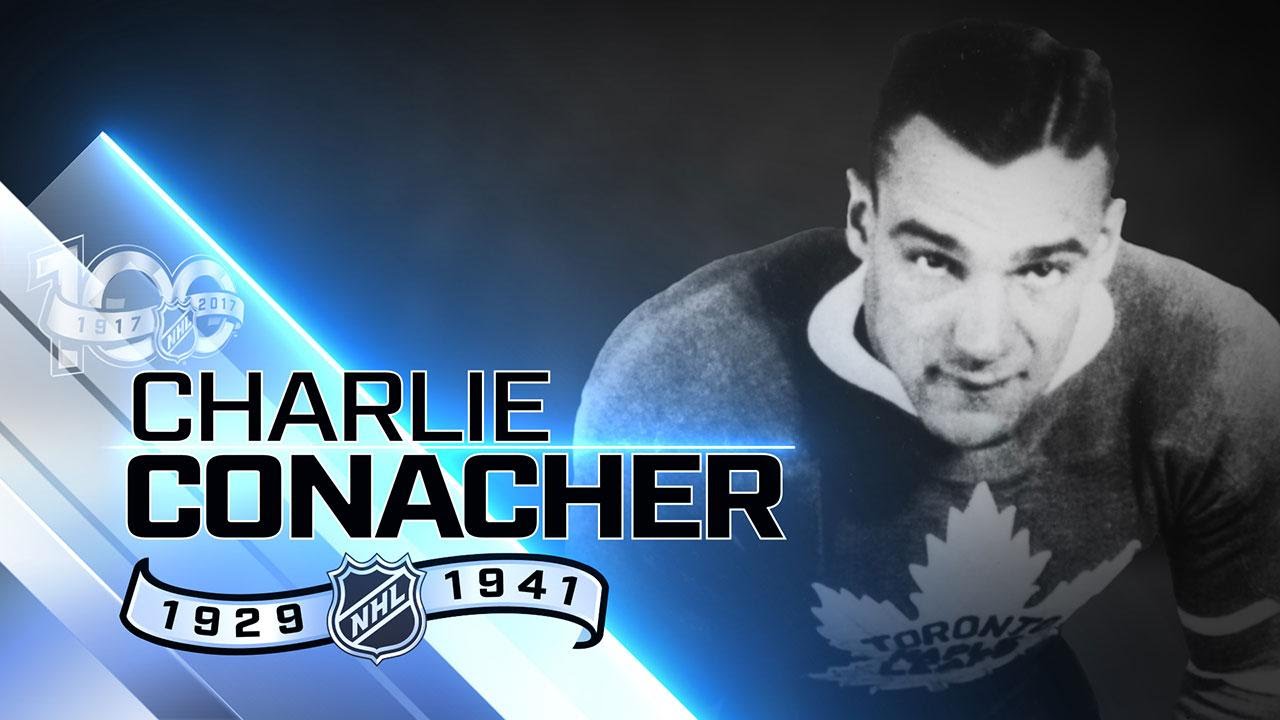
Charlie Conacher, who as a player played 12 seasons in the NHL—nine of them with the Toronto Maple Leafs—began his coaching career six years later at the start of the 1947-50 NHL season. He coached the Chicago Blackhawks for three years.
While playing, Conacher earned the nickname of “The Big Bomber,” due to his size, powerful shot and goal scoring. However, during his last year of coaching with the Blackhawks, he may have earned a new nickname “Haymaker.”
On February 9, 1950, while reporters were in the Blackhawks dressing room after a loss to the Detroit Red Wings, Conacher and Lew Walters of the Detroit Times got into an argument about supposedly about something Walters had written in regard to the Blackhawks. Walters accused Conacher of hitting him. The next day, Conacher—who was no longer in Detroit—was charged with assault and battery. Connacher was to be served the next time the Blackhawks played in Detroit—which was to be March 11, 1950.
As reported in The Cumberland News (Cumberland, Maryland) on February 10, 1950:
“Conacher admitted in Chicago that he punched reporter Lew Walter in the Hawks dressing room at the Olympia last night. Conacher claimed: ‘He called me “the worst of all the coaches to talk to.” I resented the remark and punched him. I don’t have to take that from anyone.’”
Walter had gone to the dressing room to ask Conacher about his assault on NHL Referee Bill Chadwick during the game. Conacher had grabbed and shaken Chadwick when Chadwick wouldn’t penalize a Red Wing. With that Conacher was already likely to get fined by the National Hockey League.
As reported in The Cumberland News according to the article that Walter wrote, as he started to leave the dressing room “Conacher approached me, made a number of baseless charges and then landed his sneak punch…a terrific overhand right.”
It’s clear that Walter thought little of Conacher, because he had started out his story by saying “All the coaching brains Charlie Conacher can muster on his most lucid days aren’t enough to teach his last-place Blackhaws to drive their way out of a wet paper sack. But old Charlie himself hasn’t lost his punch.”
At that time Clarence Campbell, president of the National Hockey League, indicated that he wouldn’t take any action on either of the incidents that Conacher was involved in that night. Campbell indicated that the fight between Conacher and Walter was outside the jurisdiction of the NHL, and he felt the incident with Chadwick was actually blown out of proportion due to the fight. As was reported in the February 10, 1950 issue of The Ottawa Journal “Campbell commented that any newspaper reporter entering a club’s dressing room does so at his own risk.”
Interestingly enough, a month later Campbell would change his tune about Conacher’s fight with Walter. Conacher received a $200 fine from he NHL for punching Walter.
“The sports writers and radio men have a job to do in covering the activities of the league and its clubs and they are entitled to decent, courteous treatment from all hockey personnel while they are carrying out their duties,” Campbell was quoted.
This was quite an about face from Campbell’s comments just after the incident.
For Conacher, that was his last year of coaching in the NHL. Of the three years he was behind the bench the Blackhawks were in last place in the first and last year and only made it up to fifth place in his middle year.
Additional Sources:
“Charlie Conacher Charged with Assault for Slugging Writing,” The Ottawa Journal, February 9, 1950, p. 1
“No NHL Reprimand for Chuch Conacher,” The Ottawa Journal, February 10, 1950, p. 4
“Walter Walloped, Warrant Issued for Hockey Coach who Socked Detroit Sports Writer,” The Cumberland News (Cumberland, Maryland), February 10, 1950, p. 23
“Charlie Conacher Drew $200 Fine,” The News Palladium (Benton Harbor, Michigan), March 10, 1950, p. 15.
Harry “Apple Cheeks” Lumley was born in Owen Sound, Ontario, November 11, 1926. He took to hockey and found himself playing for the senior ice hockey Owen Sound Mercurys and the Junior A Barrie Colts. It was while playing with the Barrie Colts that the Detroit Red Wings signed him—he was only 15.
He spent most of the 1943-44 season with the Indianapolis Capitals, then the AHL affiliate of the Detroit Red Wings. However, he was called up to the National Hockey League briefly—largely due to the fact that most of the adult hockey players were over in Europe fighting in World War II. He has the distinction of being the youngest goaltender to play in the NHL, having been only 17 at the time.
When he was called up to play with the Detroit Red Wings, he didn’t make the best of impressions. Despite having been a star in the lower levels, in his two games played he allowed a total of 13 goals in the two Red Wing losses. Not surprisingly he was returned to the Capitals, where in the 52 games he played in the 1943-44 season he had a 19-18-15 record with a goals against average of 2.84.
The following year, after spending half of the season with the Capitals, he was again recalled to Detroit. This time he would stick. He helped the Red Wings win the Stanley Cup in 1950, in which he had three shutouts and a 1.85 goals against average. However, Red Wings manager Jack Adams had seen something he liked when, while Lumley was injured towards the end of the 1949-50 regular season, Terry Sawchuk was called up, playing in seven games. As a result, Lumley found himself traded to the Chicago Black Hawks (as they were known at the time).
Harry Lumley
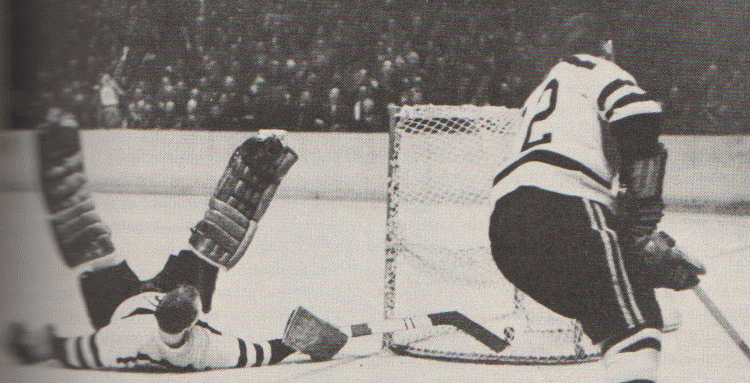
Two years after being traded to Chicago, he would then spend four seasons with the Toronto Maple Leafs—the team he had helped the Red Wings beat in the Stanley Cup Championship in 1950. It was during his time with Toronto that he would win the Vezina Trophy in 1954. During the 1953-54 season he earned 13 shutouts, an NHL record that would not be surpassed until Tony Esposito got 15 in 1970.
His 1956-57 season was found playing back in the AHL, this time with the Buffalo Bisons, after being sold that summer back to the Black Hawks, with whom he refused to sign. His final NHL team was the Boston Bruins. He had 11 games with the Boston club and the rest of his 1958-59 season was spent playing for the AHL Providence Reds.
It was while he was a member of the Black and Gold that on February 8, 1958, that he became the second NHL goaltender to reach the milestone of 300 wins. Perhaps not surprisingly, the win came in a game against the Maple Leafs, played at the Maple Leaf Gardens. Boston would win 7-3.
Lumley retired after the 1959-60 NHL season with a career 803 games, a record of 330-329-142, 71 shutouts, and a goals against average of 2.74 He was inducted into the Hockey Hall of Fame in 1980.
The game of hockey has always been a physical one. Men with blades on their feet, sticks in their hands, and doing their best to go skate past an opponent to get possession of a small rubber disk. Inevitably opposing players will run into each other. The “check” has long been a method of crashing the body into that of a player of the other team to force that player off the puck. When done correctly, there is no real harm to either player and the game continues. Every so often though, whether angles of the bodies or how close they are to the boards, among other things can lead to an injury on the player who is getting checked.
The most famous of these hits was when Boston Bruin Eddie Shore checked Ace Bailey of the Toronto Maple Leafs in 1933. Shore’s check sent Bailey to the ice where he hit his head, became unconscious and went into convulsions. Bailey was taken to the hospital with a fractured skull and went into surgery that would take more than four hours. Bailey would never play hockey again.
It would be 14 years before such an event would happen again to such a shocking level.
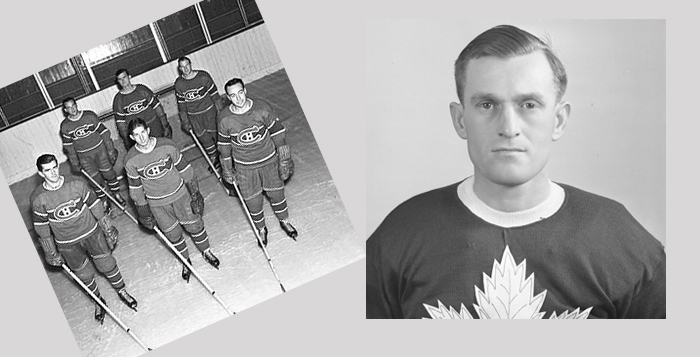
The game, played at the Montreal Forum on February 7, 1947, as the Montreal Canadiens were hosting the Toronto Maple Leafs. This was the era of the “Punch Line” for the Canadiens that consisted of forwards Elmer Lach centering Toe Blake and Maurice Richard and the Habs were certainly the favorites to repeat as Stanley Cup Champions.
“When Lach launched an attack from his zone, forechecking Don cut across the ice; Lach, doing an NHL version of the Titanic, swerved into him. The collision sent the helmetless Canadiens star tail-spinning, his head violently striking the ice,” described hockey author and historian Stan Fischler in a 2017 piece on Don Metz.
Lach was taken to the hospital with a fractured skull. His recuperation would keep him out of the Canadiens lineup throughout the remainder of the season and the playoffs. He would return to play with Montreal in the 1947-48 season, ultimately retiring after the 1953-54 season.
As Ottawa Journalist Bill Westwick wrote the next day, “Even the most rabid of [Maurice] Richard’s French-Canadian following in Montreal never have attempted to underrate the importance of Lach’s position as key-man on the high-scoring Canadien first line. He has been an unselfish, good-natured athlete, in addition to being one of the most talented of centre ice players. The injury is a terrific blow to Canadiens’ chances at this stage.”
While the Maple Leafs and the Canadiens have always been fierce rivals, the injury to Lach escalated that “dislike” a hundred-fold. The question was, would NHL president Clarence Campbell hand down some justice. He had been vocal up to that point in the season “warning against increasing rough play.”
“Some sections of the Montreal press suggest that the Toronto management is overdoing it in encouraging robust hockey on the part of their hirelings and there is bound to be an inquiry into the circumstances surrounding this serious injury to one of the game’s top stars,” continued Westwick.
Metz pleaded innocent stating that he had hit Lach from the side and hadn’t seen him fall. President Campbell would ultimately exonerate him.
As the season got to the playoffs, Canadiens head coach Don Irvin decided that it would be up to a higher being to determine if Metz’s hit was an accident or intentional.
“Irvin prophesied that the outcome of the series rested solely in the hands of Providence,” wrote columnist Jim Coleman in the Globe and Mail. “He said that if the accident was only an accident, the Leafs would win the series. If the injury was deliberate, Providence would intervene and the Canadiens would win the Cup.”
When the playoffs were over, the Maple Leafs had won the cup, so it must have been an accident.
Additional Source:
Bill Westwick, “The Sport Realm,” The Ottawa Journal, February 8, 1947, p. 24

 Prev
Prev