Twenty years before “Miracle on Ice,” the unlikely U.S. surprised the hockey world by winning its first gold medal at the 1960 Olympic Winter Games. Like the better-known miracle, this “Quiet Miracle” or “Forgotten Miracle” took place on home ice, at Squaw Valley, Utah.
This time, the Canadians, who had won the World Championships in 1958 and 1959, were the clear favorites. However, their first pick for the team, the Whitby Dunlops, declined, so they wound up with the Waterloo Dutchmen, whose top three players were ineligible as professionals. In addition, the Canadians did not do themselves any favors by playing like arrogant bullies. According to Bill Riley, one of the referees, “The Canadians didn’t hit it off with anybody. They came to Squaw Valley saying they only had the Russians to beat. That wasn’t bad. After all, nobody else gave the United States a chance. But the Canadians acted as if all they had to do was go on the ice and the game was theirs. They threw their weight around literally, knocking around everybody, even the teams that were obviously outclassed.” The reaction to that was that almost everyone pulled for the Americans instead.
The tournament schedule was considered cruel because it meant each team had to play eight games in ten days. Finding rink time became very difficult because the indoor rink was booked for the figure skaters. The hockey practices were relegated to the outdoors, but a thaw left the ice conditions quite poor. For the preliminaries, the national teams were divided into three groups to play round robin, and the top two from each advanced to a final round robin. Finland, Japan, and Australia played a consolation round instead.
For the finals, the games were scheduled based on which would draw the best television audiences, so the U.S.-Canada game was on Thursday and the Canada-Soviet Union game was on Sunday. On February 22, the Soviets beat the Czechs 8-5, U.S. defeated Sweden 6-3, and Canada blanked Germany 12-0. Two days later, the Americans had their turn at the Germans, winning 9-1, and the Canadians shutout the Czechs 4-0. What was telling was that the Soviet Union only tied (2-2) the Swedes, who had decidedly lost to the Americans.
On Thursday, February 25, Germany still was no match for the Soviet Union, which won 7-1, and Czechoslovakia edged out Sweden 3-1. The biggest shock came when the U.S. defeated Canada for the second consecutive Olympics. The Americans led 2-0 until the Canadians managed one goal in the third. Goalie Jack McCartan (of the University of Minnesota) was credited with holding back their northern neighbors. After all was said and done, everyone had high praise for the top goaltender. His coach claimed he had “been the best player on the team,” while teammate Bill Cleary enthused, “McCartan, he’s the boy. We haven’t lost a game with him. You make a mistake and he comes up with a save that’s tremendous. You can’t help but be inspired by that kind of playing.”
Two days later, the Czechs duplicated the U.S.’s score against Germany, and Canada topped Sweden 6-5. Again, the Americans unexpectedly beat their better-ranked foe by one goal. Thanks to Bill Cleary, the U.S. drew first blood, but the Soviets then scored two quick goals. About halfway through the game, Bill Christian produced the tying tally, and he scored again with 5:01 remaining. With the score at 3-2, the Americans had defeated the Russians for the first time. Referee Riley later commented, “Our guys built up friendships with the Russians in the past couple of years. There never were any hard feelings.” American captain Jack Kirrane (a fireman from Brookline, Massachusetts and a veteran of the 1948 Olympics) claimed, “It was our spirit, our desire to win, that beat both the Canadians and the Russians.”
The U.S. was undefeated and would have the gold if they won their last game. Alternately, Canada could win gold only if they beat the Russians and the Americans lost. Because of their tie against Sweden in addition to their loss against the U.S., the Soviet Union could only hope for silver. Because everyone had assumed Canada and the Soviet Union would be playing for gold, their matchup received the primetime slot on Sunday, February 28, while the U.S.-Czech game was squeezed in at 8:00 that morning. With that early time slot, very few spectators came.
After the first period, the U.S. and Czechoslovakia were tied 3-3, but then the Czechs scored the only goal of the second period. American coach Jack Riley (head coach at West Point) went for a rousing speech to motivate his men, but the real motivator came from the unlikely source of Russian defenseman and captain Nikolai Sologubov. As a friendly tip (and to give his team a better shot at silver), he went into the locker room and told trainer Ben Bertini, “Use oxygen. There’s an oxygen tank in the arena. We used it yesterday.” Bertini paid attention because, as he said, “We’ve been friendly for quite a while. I was the American trainer with the Russians last year. And our U.S. team has played them a lot, got to know them well. Did you see them in the stands? They were all rooting for us.” He had the American players use the oxygen to recover. “I didn’t know whether we’d come back or not,” confessed Coach Riley, “But that Bertini, he’s the best trainer in the business.” According to Dr. Thomas “Bart” Quigley of Harvard, the Oxygen would not effect the body but “might very well have a psychological effect on an athlete.”
Whether or not the oxygen helped, the Americans returned to the ice and scored an astonishing six goals in the final period. In another twist, all the goals were scored by two sets of brothers. Roger Christian (of Warroad, Minnesota), having already scored once, sunk three more. His younger brother, Bill Christian, assisted on three of them. Bracketed by Roger, Bob Cleary (of Harvard University) scored two goals, and his older brother, Bill Cleary (also of Harvard), scored one and had two assists. “It was pretty hard. But when we got ahead they couldn’t cover,” commented Bill Cleary. “I’ve never played with a team that came back so much.” Of them, Coach Riley exclaimed, “Bill Cleary and Roger Christian are fantastic. . . . That Roger, what a money player. One of the team bet him he couldn’t do it between periods.” Furthermore, the victorious Coach Riley said, “I’ve never coached a team like this in my life. This is the greatest team ever put on ice for Olympics.” Thanks to their efforts, the U.S. won 9-4.
That night for primetime, Canada defeated the Soviet Union 8-5, earning silver and leaving the Soviets with bronze. The U.S. officially had their first gold, and it was the first time one of the top six defeated four of the other top six to earn gold. The legacy of that win was reflected in the 1980 U.S. team, who earned the only other American gold medal in ice hockey.
Additional Sources:
Andrew Podnieks, Where Countries Come to Play (Toronto: McClelland & Stewart, 2013), kindle version.
Mike Commito, Hockey 365: Daily Stories from the Ice (Toronto: Dundurn, 2018), kindle version.
Mike Beatrice, “U.S. Wins on Russian Oxygen Tip,” Boston Globe, 29 Feb. 1960, pp. 1, 11, and 13.
Arthur Siegel, “Referee Raps Canadians’ Tactics, Lauds Russians,” Boston Globe, 29 Feb. 1960, p. 13.
Before the NHL of 1917, the National Hockey Association (NHA) of 1909, and even the Canadian Amateur Hockey League (CAHL) of 1898, Nova Scotians began a Coloured Hockey League (CHL). Like many hockey origin stories, its beginnings remain murky with only scattered newspaper articles helping to piece together the timeline. As best as brothers George and Darril Fosty, authors of Black Ice, have determined, the first recorded game of the CHL was played on February 27, 1895.
The CHL was organized by Baptist leaders in Nova Scotia as a way to generate employment opportunities and income in Halifax’s black community. In doing so, the goal was also to raise black awareness and pride. Henry Sylvester Williams (father of the Pan-African movement) helped lay the groundwork and then promoted the first organized black hockey clubs, the Dartmouth Jubilees, the Halifax Eurekas, and the Halifax Stanley. Many of the players for these teams came from all-black baseball teams.
Rather than setting a schedule, one team would invite another to a game, often printing the challenge in the local newspaper. Many spectators would come out for the game, including enthusiastic ladies and eventually many white neighbors. Typically, the CHL could only play outdoors or indoors after the ice was so terrible the white teams had finished their own season. In the beginning, “all sorts of skates were worn,” but eventually, the CHL teams had better equipment and standardized uniforms. After the games, the home team would host the visitors for dinner.
The game on February 27, 1895 was hosted by the Dartmouth Curling Rink, where evangelists often met. The players also were Baptists, but the style of play was described as “extremely rough and physical” with “body checking” and “cross counters.” The Halifax Eurekas and Dartmouth Jubilees tied at 1-1.
Also at the end of February 1895, the Jubilees took on the Halifax Stanley, who won 3-1. Their rematch in March also took place at the Dartmouth Curling Rink, where they used curling stones to mark the goal posts. Despite protests by the Jubilees’ goalie, the Stanley scored first and then again before forward Charles Flint got the Jubilees on the board. A follow-up Jubilee goal was disallowed leading to an argument lasting until the first half ended. Throughout the second half, every goal was protested. The Jubilees scored twice, and then Stanley scored right at the end “with an all out fight on the ice.” Ignoring the disallowed goals, both teams claimed a 4-3 victory, but the official score was 3-3. The game was described as “one of the most exciting and amazing matches of the season” watched by ladies who “shouted and danced and expressed their joy.” Although the Jubilees asked for another rematch, the Stanley declined.
At the time, the league suffered from racist coverage by the newspapers. That March, the Acadian Recorder printed an open letter penned by an anonymous black Halifax resident, who chastised the Halifax Herald for its coverage of a game. He wrote, “Such trashy articles have a very deteriorating tendency of elevating the race in no well-thinking citizen can endorse. Thanking you for the space for this vindication of a simple game of hockey played by two colored teams.” Between 1899 and 1904, because the press printed more articles and in less-racist terms, the CHL experienced the height of its popularity and acceptance. Despite the press then swinging back the other way and even intentionally ignoring the CHL, the league continued into the 1930s.
The black Maritime Canadians who played in the CHL left a legacy that lingers in the game as it is played today. The origins of the slapshot and goalies who drop to the ice can be traced back to these players, who followed Halifax rules rather than adhering to the established Montreal set.
Sources:
George and Darril Fosty, Black Ice: The Lost History of the Colored Hockey League of the Maritimes, 1895-1925 (Nimbus Pub., 2008), kindle version.
Sheldon Gillis, “Putting it on Ice: A Social History of Hockey in the Maritimes, 1880-1914,” thesis for Saint Mary’s University, Halifax, N.S., 1994, pp. 72-96.
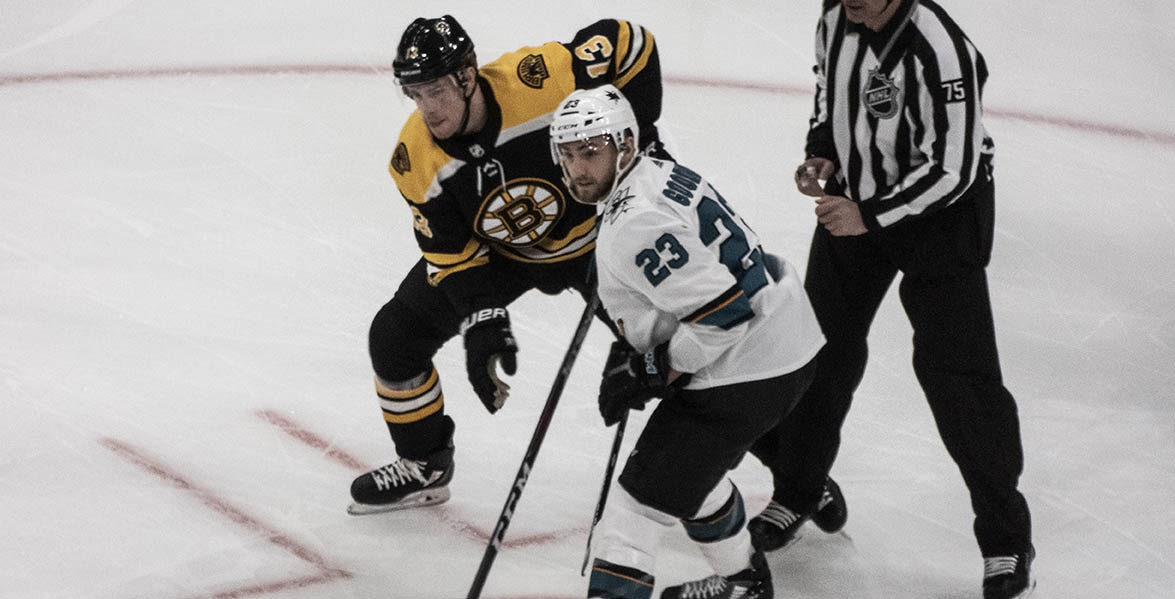
The first game after the trade deadline is one where everyone is watching the new guys like they are specimens under a microscope. But it is also sometimes an adjustment for the players themselves, especially if the team they are coming to focuses on a different system, such as defensive as opposed to offensive. For Charlie Coyle, while it was his second game wearing the Spoked-B, it was his first game in Boston on home ice. And for Marcus Johansson, it had been a lively 24 hours.
Coyle had the added opportunity of representing the Bruins for a ceremonial puck drop, when the wife and two children of slain Weymouth police officer Michael Chesna dropped the puck. Originally Zdeno Chara was called to take the face off opposite the San Jose Sharks’ captain, Joe Pavelski, but Chara felt it was fitting for Weymouth-native Coyle to do the honors.
It was an honor to have the family of fallen Weymouth police officer Michael Chesna participate in tonight's ceremonial puck drop on First Responders Night. pic.twitter.com/0MXAeCMpmn
“Yeah [Zdeno Chara], he knew they were from Weymouth so he said ‘you should go take it.’ That was pretty classy by him and it was a great honor to do that so hats off to [Chara] for that,” said Coyle.
Johansson was slotted into the second line with Jake DeBrusk and David Krejci, and for him, he quickly earned a healthy respect for DeBrusk.
“I think I found out a lot tonight. I think he’s an unbelievable hockey player. He works hard, and he made a lot of good plays out there and just really simple to play with. It was really fun to play with him and I think he’s, like I said, an unbelievable hockey player and I think he’s just gonna keep getting better,” Johansson said.
Jake DeBrusk takes high-stick.
Additionally, with DeBrusk getting a goal—and losing a chiclet earlier in the game—on which Johansson and Krejci earned the assists, it shows how quickly these three have managed to come together and very possibly what can be expected going forward. Before the Bruins overtime loss against St. Louis this past Saturday, DeBrusk had a five-game scoring streak going. And it looks like he’s determined not to let things get cold. With his goal in Tuesday night’s game against the San Jose Sharks, DeBrusk has reached 20 goals on the season joining Patrice Bergeron (21) , Brad Marchand (25) and currently injured David Pastrnak (31) in having 20+ goals on the season. His previous NHL season, as a rookie, DeBrusk notched 16 goals.
“Yeah it’s a good feeling obviously. It comes in a win, so that’s nice. You set goals before the year and I think you guys asked me before day one if I thought I was going to score 20, well I got 20,” DeBrusk shared.
DeBrusk also recognized the upgrade his line received with the addition of Johansson, and how the chemistry of the three of them came together so quickly.
Marcus Johansson
“Yeah just shot-ready kind of everywhere. Obviously looking to make plays but it’s something that is good, it’s something that is nice but obviously right now pucks are going in for me. There were a couple plays that we just missed on too as well where I could benefit from that, so I’m just trying to get my feet moving and trying to get some pucks for them and just trying to play my style,” he said.
While Coyle didn’t notch a point as a Bruin, he had a very different line, slotting in as center on the third line with David Backes and Joakim Nordstrom. However, he saw some time on the power play and was an impressive 64% in the faceoff circle, winning seven of eleven draws. In the meantime, Bruins head coach Bruce Cassidy isn’t worried about what he saw from Coyle Tuesday night and looks to see more out of him and his line mates in the coming games.
“I think they were more of a cycle line. They kept more pucks alive, were able to generate a little more. [Nordstrom’s] more of a check, speed guy, a little bit still searching for his game. But I thought they were good. You know, they’re going to provide offense. I’m not worried about that with Charlie. He was in all alone the one time, and they’ll get their looks. Obviously, not as many as in St. Louis, but I thought they were fine for us,” Cassidy said after the game.
For Coyle, this was certainly a homecoming. Not only did he grow up in Weymouth, but he spent some time playing at Boston University before he elected to go north and take the Major Juniors’ route to the NHL.
“There were a few signs out there and just pretty cool to be on that side of it. A lot of excitement building up and I just tried to stay calm and treat it as another game,” he described.
Like Johansson, Coyle has a healthy respect for his new team and how they continued to play despite going down 1-0 to the Sharks in the first period.
“A lot of character. You know even when things aren’t going your way, they jump out early and you come back and nothing fazes you. We did a good job of just playing our game. No matter what if things weren’t going our way, we didn’t get the first one, it doesn’t matter, we just keep plugging away and keep working and play simple and it eventually comes. A lot of nice plays out there and it starts with battling and working hard and that pays off,” Coyle shared.
In the end the Bruins took the 4-1 win over San Jose. Both newcomers to the Black and Gold will have some quality practice on Wednesday and Thursday and will be back at it with the rest of the Bruins when they take on the Tampa Bay Lightning on Thursday night.
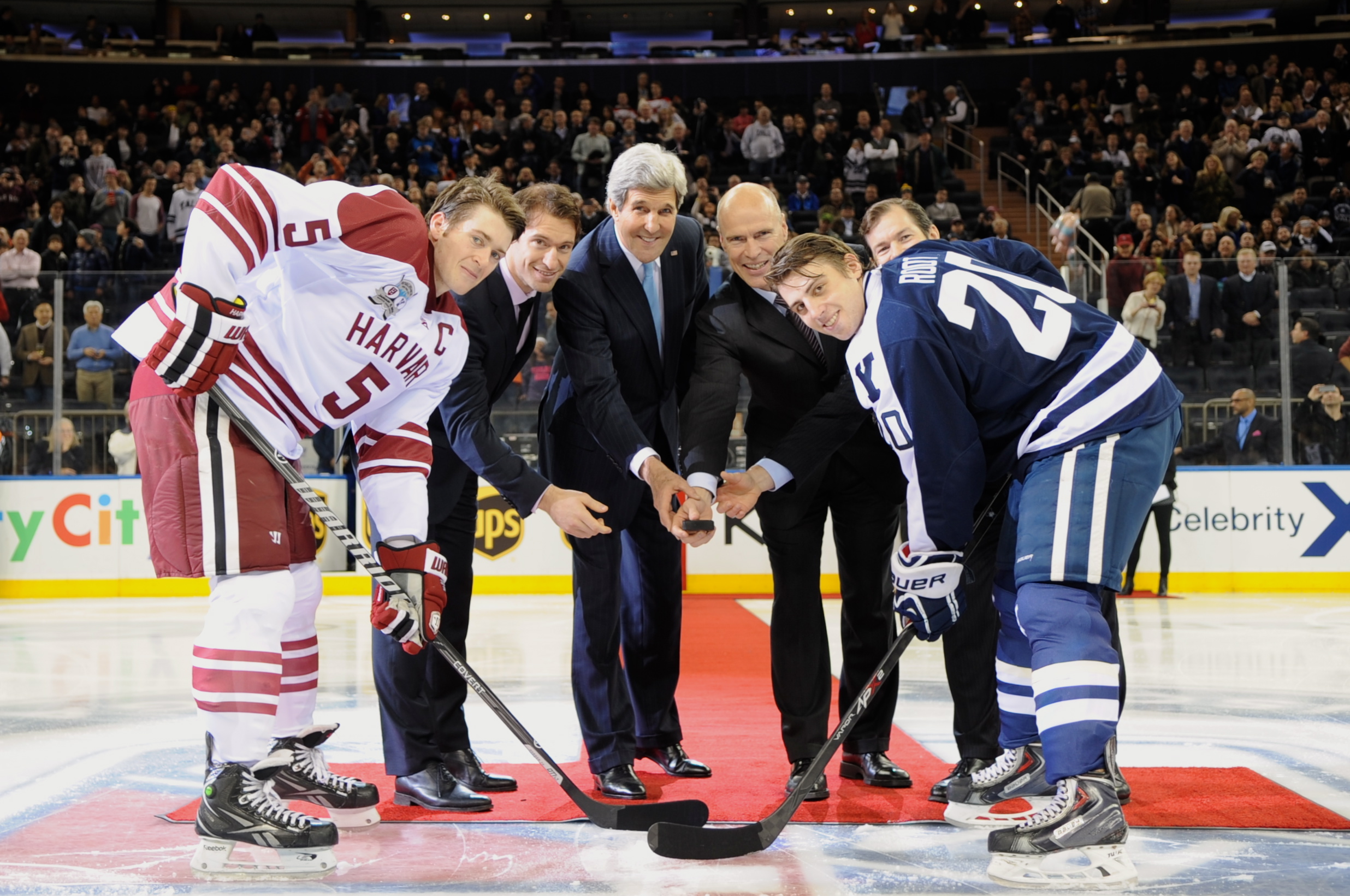
(Photo: Harvard-Yale Hockey Game at Madison Square Garden in 2014, U.S. Department of State from United States, via Wikimedia Commons)
Not many can claim a rivalry as old as Harvard and Yale. Theirs dates back to an 1852 crew race on Lake Winnipesaukee in New Hampshire. On February 26, 1900, as the New York Tribune reported, “Yale and Harvard, long time traditional rivals on field and stream, met for the first time in their history in a hockey game.”
The first Harvard-Yale hockey game took place at St. Nicholas Rink in New York City. Beginning at 8:30 pm, it lasted for two twenty-minute halves. Instead of selling tickets, only invited guests of the two teams and the St. Nicholas Skating Club were allowed to attend. Of the almost 2,000 spectators in black-tie, reportedly about 1,500 of them were “women friends of Yale and Harvard undergraduates and gray-haired graduates.”
Newspaper recaps compared the two teams. The New York Times stated, “The Harvard players were heavier, but the excellent team work of the New Haven men told the story and, despite the fierce rushes of their opponents, kept the Crimson players’ score down.” According to the New York Tribune, “The teams were very evenly matched.” However, the paper, clearly biased for Yale, went on to claim, “Harvard’s team work was slightly inferior to Yale’s, and the men with one exception were only of ordinary speed.” In addition, Harvard had two big disadvantages in that they were used to playing outside (rather than in a rink) and they only had “ordinary clamp” skates (rather than “specially prepared hockey skates”). The one compliment the Tribune had for them was that the “Cambridge forwards played an aggressive game, and constantly used body checking and stick work to excellent effect.” Overall, the Tribune described, “The game was one of the most exciting ever played at the rink, and stands unsurpassed among intercollegiate matches.”
The scoring certainly went back and forth, tying up three times. The Harvard Crimsons got on the board first but two goals by the Yale Bulldogs followed. In the second half, Harvard came back with two more goals. Then, according to the Boston Globe, New Haven rallied “with a typical Yale rush” and “scored three goals in succession so quick that the boys from Cambridge were completely knocked out of their stride.” Harvard managed one last goal in the final 40 seconds. Yale came away with a 5-4 victory. The Globe summarized, “It was the first time the two colleges had met on the ice and Yale’s unbeaten hockey team upset what for the best part of the game looked like a good thing for the Harvard boys.”
Although Yale won their first and only game in 1900, Harvard then won their only matchup in 1901. The two school teams played each other three times in 1902 with Yale sweeping them all. Between their first hockey game in 1900 and November 2018, Harvard and Yale played each other 259 times. Of those, Harvard has the definite lead, having won 145 games (and lost 92 and tied 22). These hockey games are only a fraction of the over 3,000 times in about 40 sports in which Harvard and Yale have competed against each other.
On February 25, 38 years apart, the New York Rangers scored six goals in big victories over the Montreal Canadiens. The 1940 win was the first televised in the U.S., and the 1978 win snapped a long unbeaten streak.
The weekend of February 24 and 25, 1940 went well for the Rangers and rough for the Canadiens. On Saturday, they played at Montreal Forum before 6,000 fans. According to the Montreal Gazette, the “Blueshirts had no noticeable edge over the Habitants – except in one department: getting the puck in the net. They did it twice, while Canadiens, with their earnest but aimless and systemless play, could not do it at all, and that was the story of the game, which was evenly-waged, frequently fast and exceptionally clean.” The two Rangers goals were scored by Bryan Hextall (with an assist from Phil Watson) and Alex Shibicky.
On Sunday, the game at Madison Square Garden was the first shown on U.S. televisions. In addition to the 8,273 fans who came to the game, viewers watching the 300 televisions with W2XBS also saw the game. The locals were in for a treat, the Rangers’ 14th consecutive win on home ice. Like the night before, right winger Bryan Hextall scored first and then scored second for good measure. Both of his goals were assisted by Phil “Fearless” Watson. The Rangers had three goals in the first 14 minutes and ended the first period leading 3-1. After two more goals in the second and one at the beginning of the third, the Rangers led 6-1 with nearly an entire period remaining. Watson had assists on the last two of those goals as he had with the first two. The Canadiens managed another goal in the last minute of the game to make the loss 6-2.
The Canadiens struggled that season. By the time of the back-to-back defeats against the Rangers, they were on their third goalie, Mike Karakas (who had retired from the Chicago Blackhawks). They had not won on home ice in two months (since December 14), and they had lost 23 of 27 games (earning only six points of a possible 54). These games contributed to a five-game losing streak. Over the course of the entire season, the Rangers won six games against the Canadiens, lost one, and tied once. The Rangers then went on to win the Stanley Cup.
Exactly 38 years later, Montreal was experiencing a complete reversal in fortunes. By the time they met the Rangers on February 25, 1978, they had a record-setting unbeaten streak of 28 games (23-0-5). In fact, they had only lost seven games all season. At the opposite end of the spectrum, the Rangers were in last place. Still, their game drew a crowd of 17,870 (including six busses of Rangers fans) to Montreal Forum.
This time, the Rangers had the new goalie, having called up Swede Hardy Astrom from their AHL team in New Haven (due to injuries to their top two goaltenders). Having received the call that very morning, Astrom said, “Even when the game got closer, I didn’t get any more nervous.” He also commented, “I knew what was going on. I knew that Montreal had not lost in 28 games, that they were a fast-skating team and that they swarmed all over you.” Quite logically, Astrom pointed out, “If I lost to Montreal, everybody would say, that it was understandable because it was Montreal. Nobody would blame me. But if I won, everybody would say I did a great job and would give me credit. I’m glad we won though. I hate to lose.” Astrom’s 29 saves helped the Rangers stop the Canadiens in their tracks.
The Rangers scored twice every period, and their six goals were made by six different players. Captain Phil Esposito scored second and summarized their feelings on the way the game went. “We got lucky, but isn’t it about time? I hit my goal out of the air and Ron Duguay got his on a deflection, but now they know how we feel. This kind of thing has been happening to us all season. Now it’s happening for us. We’ve been playing well but we haven’t been getting any breaks.” His teammate, defenseman Don Awrey added, “They had to have a bad game sooner or later. I don’t think they were as sharp as they have been on this streak. We wanted to play well for ourselves but we also knew we had to play for Hardy.”
From the Canadiens’ perspective, goalie Ken Dryden acknowledged, “Those kinds of things happen when you’re just not quite sharp to begin with. Instead of being able to clear the puck, you clean it half way. It’s too easy to pass it off to bad bounces.” His teammate, Larry Robinson, said, “It wasn’t so much that we lost as the way we lost. We played so badly. We knew this is a hockey team that is capable of putting the puck in the net and we gave them all kinds of two-on-ones and three-on-twos.” That led to a Rangers’ win of 6-3.
The Canadiens’ streak was snapped. It had been the longest to date. Prior to that, the longest was a 23-game streak by the Philadelphia Flyers in 1976, a 23-game streak by the Boston Bruins in 1940-41, and twice Montreal had 21-game unbeaten streaks (in 1974-75 and in 1977). On the other hand, this was the first regular-season victory the Rangers had at the Forum since February 22, 1972. Despite the disruption, the Canadiens went on to win the Stanley Cup that season having defeated the Rangers in their other three matchups. Not only that, but the following season, after the Rangers won the first game of the finals, the Canadiens claimed victory on the next four games to win the Stanley Cup finals.
All-in-all, the Rangers have only been able to get in the Canadiens way occasionally. In the 628 games the two teams have played against each other, the Rangers have earned 491 points while the Canadiens have raked in 773 points.
Additional Sources:
Gene Ward, “Rangers Rip Canadiens, 6-2, in Clash at Garden,” New York Daily News, 26 Feb. 1940, p. 35.
“Canadiens Facing Elimination,” Montreal Gazette, 26 Feb. 1940, p. 16 and 19.
Al Strachan, “Canadiens back to earth – with a jolt,” Montreal Gazette, 27 Feb. 1978, p. 11.
“Rangers Upset Canadiens,” New York Daily News, 26 Feb. 1978, p. 104.
The 13th Olympic Winter Games were held at Lake Placid, New York in February 1980. At the time, the U.S.-Soviet relations were extremely shaky in the midst of the Cold War. The Soviet Union had not lost a single Olympic game since 1968 and were poised to win their fifth consecutive gold medal. On the other hand, the U.S. team, filled with 20 young men primarily from colleges in Minnesota and Boston, was not considered a threat. Yet, through teamwork and great coaching, the U.S. not only defeated the Russians but went on to win the gold medal on February 24, 1980.
The Olympics tournament began with the 12 teams divided into two groups to play round robin. The top two teams from each group advanced to the medal-round, but their prior results carried over. The Soviets won all five of their preliminary games. When they advanced, their 4-2 win over Finland counted towards the final standings. The U.S. won their latter four games – against Czechoslovakia, Norway, Romania, and West Germany. In their first game, the U.S. trailed Sweden 1-0 until Dave Silk (of Boston University) scored with 28 seconds remaining in the second period. The Swedes scored again in the third, and it was not until the U.S. pulled goalie Jim Craig that Bill Baker (of the University of Minnesota) scored in the final 27 seconds of the game. When the U.S. and Sweden advanced to the finals, their tie carried forward.
On February 22, at 5:06 pm, 8,500 watched the U.S. face off against the Soviet Union. Both coaches, Herb Brooks (head coach at the University of Minnesota) and Viktor Tikhonov (head coach of the Soviet National Team since 1977), were known for relentlessly pushing their players. Twenty years earlier, Brooks had been cut from the 1960 gold-medal Olympic team but played in 1964 and 1968. Tikhonov had led his team to the gold in both World Championships leading up to the 1980 Olympics. When their teams played an exhibition game at Madison Square Garden on February 9 (shortly before the Olympics opened), the Soviets won 10-3.
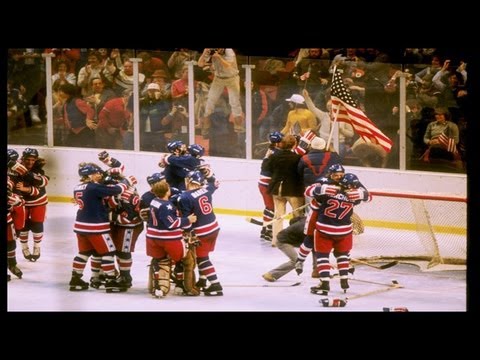
Despite being extreme underdogs, the U.S. kept up with the Soviet Union as the game progressed. After Vladimir Krutov scored first midway through the first period, Buzz Schneider (the only Olympic veteran on the team) matched him. Then Sergei Makarov gave the Russians another lead. At the very last second of the first period, Mark Johnson (of the University of Wisconsin-Madison) tied up the game. The teams left the ice but had to return to play the final second. Tikhonov blamed the Russian’s star goalie, Vladislav Tretiak (who already had two gold medals from the 1972 and 1976 Olympics), and replaced him in net with the less-experienced Vladimir Myshkin. The Soviets again took the lead when Alexander Maltsev scored. As the game dwindled down to the last half of the last period, Johnson took advantage of a power play to again tie the score. Only 81 seconds later, team captain Mike Eruzione (of Boston University) “blasted in a 30-footer” to give the U.S. a much-needed 4-3 lead. The rest was up to goalie Jim Craig (of Boston University). He thought to himself, “If we’re gonna lose, and I’ve seen them come back 1000 times, it’s gonna be a good goal, goddamit. I don’t want to have people asking me if I was nervous. I don’t want people telling me I couldn’t play in the big games.” He blocked 39 shots in total as his team held off the Soviet Union. As the final seconds ticked off, play-by-play announcer Al Michaels asked, “Do you believe in miracles?” The Americans could not help but believe and went wild as the “Miracle on Ice” ended in their favor. Team U.S.A. had come from behind three times to win. “Maybe they’re relieved. Maybe now they [the Soviet team] can go back home and just be considered another hockey team,” mused game-winner Eruzione, “And maybe I can go home Sunday and say I was on the best team in the world.”
The captain and his teammates had to be reminded by Coach Brooks that they still had another game to play before they could win a medal. That night, after their miraculous win, Finland and Sweden played for a 3-3 tie.
The final two games to decide the medals were held on February 24. At 11 am, the U.S. played Finland. Describing the feeling as the game began, Johnson said, “When we got on the ice out there, everybody knew that we would never have another 60 minutes together. We knew we would never have another time like this.” Again, the Americans had to come from behind as the Finns scored during the first nine minutes of the game. Four seconds into the second period, Steve Christoff (one of the nine players from the University of Minnesota) got the U.S. on the board. Before the period ended, Finland scored again during Schneider’s penalty for slashing. Eruzione later commented, “I thought from the first shift of the game there was no way they could skate with us. We didn’t feel they’d had any great scoring chances, at least not consistently. The two goals they had we more or less gave them. They wanted to win 2-1 or 3-2. We thought if we could go up 4-2, there was no way they could generate enough offense to win.”
Again, Craig and the American defense stayed strong to hold off Finland during an offensive push in the third period. Phil Verchota (of the University of Minnesota) tied up the game. Then Rob McClanahan (of Boston University) scored the game winner on a pass from Johnson, who finished the game with a goal during a penalty kill with only 3:35 remaining. Of their opponents, Finnish team leader Frank Moberg commented, “They have that spirit. You can almost touch it.” With that score of 4-2, the U.S. won the gold medal. As Joe Soucheray wrote for the Minneapolis Star Tribune, “On Friday night, America’s team gave a medal in heart and soul to everyone in this land. Yesterday, America’s team played for the gold medal and they won it 4-2, and they did it for themselves. That was the difference yesterday and it made the game every bit as good as Friday’s.”
Coach Brooks declared, “We startled the athletic world. Not the hockey world. The athletic world.” Someone came out on the ice and handed Craig an American flag which he wore wrapped around his shoulders as he and his teammates celebrated. Brooks admitted to crying with joy after seeing his wife’s tears. He described the scene his team made in the locker room, “The players were singing ‘God Bless America’ over and over. They were laughing and crying. I don’t think I’ll ever witness anything like it.” As he watched his team receive their medals, he joked, “Helluva deal. I missed one in 1960 and I miss another one in 1980. But Bob Fleming said he’d buy me one, and I said I’d hold him to that.”
Having kept the players from the press because “America’s team was a family without individual stars,” Brooks finally introduced them at the headquarters of world press (Lake Placid High School). When they asked Craig if he was surprised at the outcome, he replied, “If there’s anyone in this room who’s not surprised, would he please raise his hand?” Craig was the leading goalie for the games with a 91.57 save percentage, having blocked 163 shots. Johnson, the only American to make the top ten in scorers, confessed, “I still can’t believe what we have done. I’m still in awe of it, sitting here.”
President Jimmy Carter called the team to congratulate them. He told Brooks, “We were trying to do business and nobody could do it. We were watching the TV with one eye and Iran and the economy with the other.” Then Carter told Eruzione, “Tell the team how much I love them. They played like true champions. We’re so proud of you, and I’m looking forward to seeing all of you (at the White House) tomorrow.” The four boys from Boston-area asked for lobster to be served when they were brought there via the presidential jet.
Although the four Boston University alum retained pride in their hometowns, the team had become a family. Captain Eruzione explained, “For six months, coming from different areas of the country and from different ethnic backgrounds, we lived and worked together. No coach or team ever has experienced what we experienced. Right now, all we are is 20 guys from the United States. We don’t live anywhere. We’re 20 guys who live in the same complex in the Olympic Village.” After so much time together, Craig also felt some freedom at the end. “You know, we really had to let loose. You go for six months together, through all we’ve been through, putting yourself on the line practically every day. Living with all this pressure, you have to let go.” Coach Brooks noted, “After this, everybody will be gone. Everybody splits. But as years go by, this’ll mean something.”
While the Americans celebrated, the Soviet Union defeated Sweden 9-2 for the final game of the tournament. In the end, the U.S. won gold (with two wins and a tie), the Soviet Union silver (with two wins and a loss), and Sweden the bronze (with two ties and a loss). Although the Russians would go on to win gold at the following three Olympics (in 1984, 1988, and 1992), the U.S. “Miracle on Ice” sparked a surge of interest in American hockey influencing the next generation. On February 22, 2002, exactly 22 years after the “Miracle on Ice,” the U.S. (led by Brooks) again defeated the Russians and went on to win their next Olympic medal, the silver.
Additional Sources:
Andrew Podnieks, Where Countries Come to Play (Toronto: McClelland & Stewart, 2013), kindle version.
“US upsets Soviets in hockey, 4-3,” Boston Globe, 23 Feb. 1980, p. 1.
John Powers, “A great day for US hockey,” Boston Globe, 23 Feb. 1980, p. 21.
Leigh Montville, “Yes, America, your boys did it,” Boston Globe, 25 Feb. 1980, p. 1 and 38.
“All eyes were on the gold rush,” Boston Globe, 25 Feb. 1980, p. 1, 38, 40.
John Powers, “US wears the flag . . . and crown,” Boston Globe, 25 Feb. 1980, p. 37.
Joe Soucheray, “An Olympian moment to remember,” Minneapolis Star Tribune, 25 Feb. 1980, p. 1 and 4A.
John Gilbert, “Brooks, his wife moved to tears,” Minneapolis Star Tribune, 25 Feb. 1980, p. 1 and 4A.
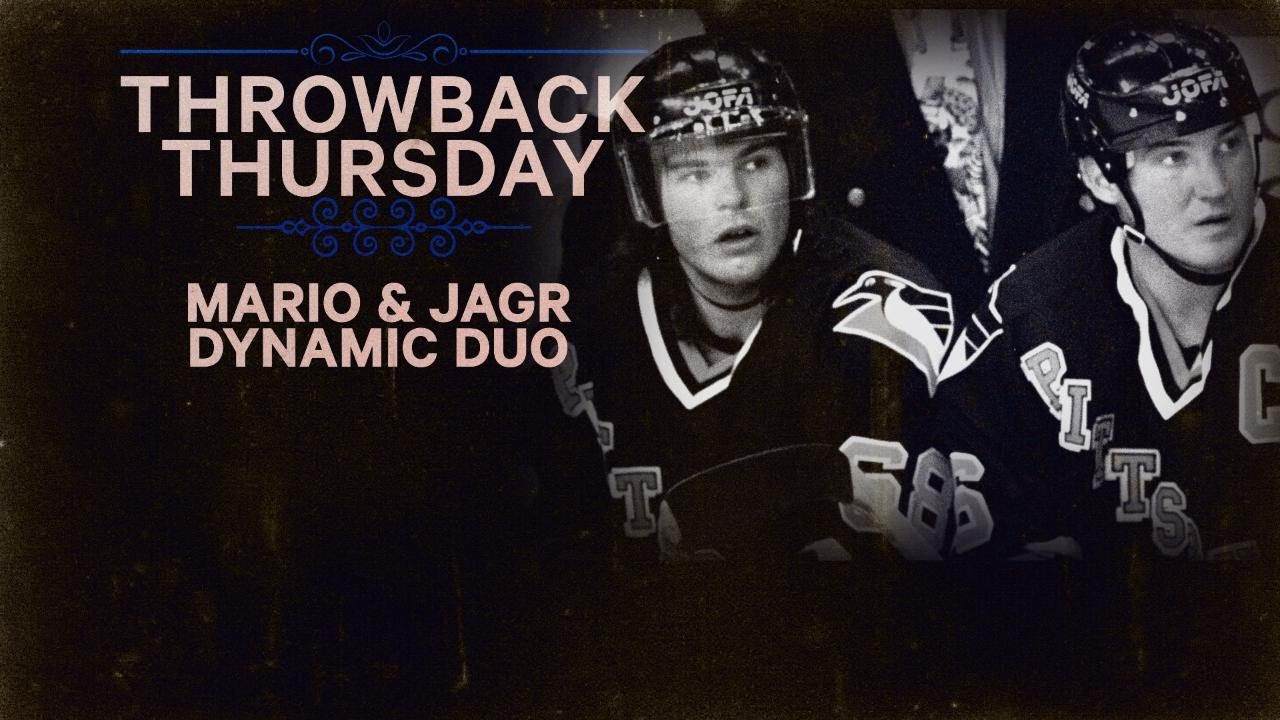
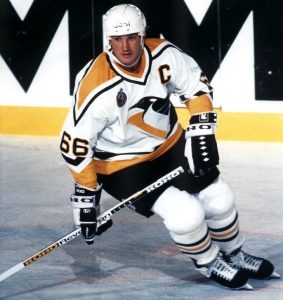
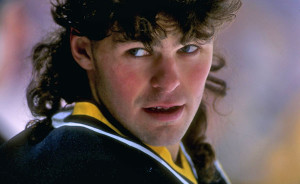
Two of the top 100 NHL players spent seven seasons as teammates with the Pittsburgh Penguins. Mario Lemieux, No. 66, was drafted first overall in 1984. After scoring more than 50 goals during his third season, Lemieux had his highest scoring seasons with 70 goals in 1987-88 and 85 in 1988-89. Then, in 1990, Jaromir Jagr, No. 68, was drafted fifth overall. Together, they proceeded to win back-to-back Stanley Cup championships in 1991 and 1992. Lemieux won the Conn Smythe Trophy as playoff MVP both years, and he also picked up his third Art Ross Trophy as top points scorer in 1992. After sitting out the 1994-95 season, Lemieux was at peak performance, matching his scoring accomplishments from the 1992-93 season. This time, Jagr followed closely.
On February 23, 1996, Lemieux played in his 50th of the Penguins’ 59 games played so far that season. A crowd of 17,235 filled the Civic Arena in Pittsburgh to watch the Penguins play the Hartford Whalers. Both Lemieux and Jagr scored twice, and three of them were power-play goals. What’s more, these were the 49th and 50th goals of the season for each player.
At 7:49 of the first period, Lemieux flipped a “Ron Francis rebound past Whalers goalie Sean Burke while straddling the goal line to the right of the net.” Before the period ended, Brendan Shanahan had scored twice for the Whalers. Less than a minute into the second period, Lemieux set up Markus Naslund to tie up the score. During a power play at 6:22, Jagr “created one lead – and wiped out another – by backhanding a Sergei Zubov rebound past Burke.” Shanahan did not let that lead continue past 14:12, when he completed his seventh hat trick (and first with Hartford). He later set up the fourth and final goal for the Whalers.
With the teammates both having scored 49 goals for the season, Lemieux said to Jagr, “Hey, kid, let’s bet who’s going to be first to get to 50.” Jagr confessed, “We had a little bet about champagne.” In the third period, as the Pittsburgh Post-Gazette reported, “Lemieux nosed out Jagr for the honor of being the first player in the league to get his 50th by a total of three minutes, 46 seconds.” Lemieux’s 50th came during a power play at 5:37, “when he lashed a slap shot by Burke from the top of the left circle.” It was his fifth time scoring at least 50 goals in a season and the third time he’d needed 50 games or less to score that many. The goal was also Lemieux’s 544th overall, which tied him with Maurice Richard as 12th-highest in NHL scoring. At 9:23, during another power play, Jagr won the game with his 50th goal. He was the first Czech player in the NHL to score that many in one season. He commented, “I wanted to get to 50, especially at home. It’s a nice feeling.” This was the second time that teammates had reached 50 together. Lemieux had also done so with Kevin Stevens back on March 21, 1993. After the 1996 game, Lemieux said, “It was nice to do it on the same night. It’s a special night.”
Coach Ed Johnston told the press, “I’m very fortunate. Anytime you have the two best players in the game sitting on the same bench, that’s pretty good.” He continued, “I don’t think there’s anybody who could ever touch these two guys. They’re pretty amazing.” He was probably right, because in 11 other NHL teams, the top two scorers combined did not even equal 50 goals.
Jaromir Jagr
For that season and the next, Lemieux earned the Art Ross Trophy as top scorer (with 69 and 50 goals, respectively). Then Jagr came up and earned the same for the following four seasons. However, he did not top 50 goals again until that final season, 2000-01, when he scored 52. The two remained teammates until Lemieux’s first retirement in 1997 and for the first year of his return in 2000-01. Throughout that time, the Penguins always made the playoffs. Jagr was then traded to the Washington Capitals, and the Penguins did not return to the playoffs until 2007, the season after Lemieux retired for good.
Additional Sources:
Dave Molinari, “A 50-50 proposition,” Pittsburgh Post-Gazette, 24 Feb. 1996, p. C1-C2.
The 1998 Olympics in Nagano, Japan not only stood out as the first to feature women’s hockey but also as the first to allow NHL stars to play for their countries. At the end of the 18th Winter Games, on February 22, the Czech Republic won their first ever gold medal in ice hockey.
When the NHL’s Collective Bargaining Agreement (CBA) expired in 1994, the ensuing lockout lasted half the season as players and management negotiated. Players felt that it was important to represent their countries in the Olympics, so the January 1995 agreement allowed the NHL to shut down for 17 days every four years. The first time they had the chance to do so was in February 1998.
Naturally, the Canadians, who had complained for years that their best players were barred from the Olympics, stocked their team with 23 NHL stars (like Wayne Gretzky). This made them the favorites to win. The runners-up were the Americans, who had seen a rise in interest thanks to the 1980 Olympics and the 1996 World Cup finals, and they had also filled their team from the NHL. However, thanks to the NHL opening up to European players throughout the 1980s and 1990s, the playing field was more even. Russia chose 22 of its 23 players from the NHL, while the Czech Republic’s team was about half NHL. Sweden, Finland, and Slovakia also had NHL players on their teams. These NHL stars would have to get used to the international rules and the larger ice used for the Olympics.
For the first round, the eight weakest teams were divided into two groups to play round robin. Some of these teams were at a disadvantage because the NHL players were not released early enough. The winning team from each group (Kazakhstan and Belarus) went on to play the top six teams (Canada, Russia, Czech Republic, Sweden, Finland, and U.S.) for the second round robin. These eight teams were again divided in two to play three games each. However, no one would be eliminated in order to give everyone time to acclimatize to the time zone and their new teammates. Instead, the positions at the end of the round would determine the quarter-final matchups. The Russians and Canadians each went undefeated followed by the Czech Republic and Sweden, each with two wins and one tie.
The four quarter-final games were played on February 18. These were playoff-style, so the winners advanced while the losers were eliminated. Unsurprisingly, Russia defeated Belarus and Canada defeated Kazakhstan, each with a score of 4-1. Thanks to two goals by Teemu Selanne of the Mighty Ducks, Finland edged out arch-rival Sweden 2-1. The Swedes faced quite the controversy because New York Ranger Ulf Samuelsson’s U.S. passport nullified his Swedish citizenship, and he had to leave the team. With the largest attendance, of 9,822, the Czech Republic defeated the U.S. 4-1. In response, to Americans’ embarrassment, three to five U.S. players caused $3,000-worth of damage at the Athletes’ Village, prompting a NHL investigation.
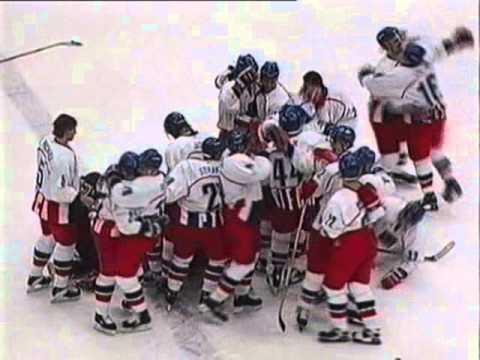
The four remaining teams played the semi-finals on February 20. Russia handedly defeated Finland 7-4. The Canada-Czech game remained scoreless until Pavel Patera scored midway through the third period, but Trevor Linden tied the game during the final 63 seconds. The Czech team ran down the clock in overtime to push for a shootout. Robert Reichel of the New York Islanders shot first for the Czech Republic and “scored when his shot bounced off the stick-side post and in” past Patrick Roy of the Colorado Avalanche, in his only international competition. Then it was all up to Czech goalie Dominik Hasek of the Buffalo Sabres. He blocked Theo Fleury, Ray Bourque, Joe Nieuwendyk, Eric Lindros, and finally Brendan Shanahan. The Czechs defeated the Canadian superstars with a final score of 2-1.
The next day, Canada and Finland played each other for the bronze medal. Despite a team full of NHL stars, the Canadians lost 3-2 and failed to medal. Three of the top ten scorers played for bronze-winning Finland, including Selanne.
On February 22, the Czech Republic and Russia played for gold and silver. The game drew a crowd of 10,010, the highest but for the Canada-U.S. game in the second round. Although North American media thought the Czechs would not have any defense but for Hasek, they turned out to have the strongest defense of all. Hasek, described as a “floppy, unpredictable, wildly unbeatable goalie,” would only have a 0.97 goals-against throughout all six games. After the Russians built up a 9-6 shot advantage, Hasek said, “Maybe the Russian team was better in the first period. But after the first period, we were the better team. . . . The Russian team has speed, but we kept stopping them in the neutral zone.” Hasek and his teammates successfully held off the Russians.
The only score of the game occurred about halfway through the third period when Czech defector Petr Svoboda of the Philadelphia Flyers made a “lucky” goal on goalie Mikhail Shtalenkov of the Mighty Ducks. At 32, he was the second-oldest on the team, but since he had defected 14 years earlier, this was his first time playing with the Czech national team. After making his only Olympic goal, Svoboda thought of his father, who had been fired when Svoboda defected. “But I know how happy I felt, and I’m sure he [father] felt even happier.” The Czechs had won their first gold medal with a score of 1-0.
After the medal ceremony Hasek commented, “When I saw the flag go up, I saw my whole career flash before my eyes from the first time my parents took me to a hockey game until now.” His teammate, Robert Reichel of the New York Islanders, proclaimed, “We’ve got the gold medal; we don’t care about the money. We care about this. It’s never happened before.”
Czech president Vaclav Havel came with his presidential jet to bring the team back to Prague. He personally invited Svoboda to return with them. The following day, Prague held a victory parade attended by over a million people.
Since then, the Czech Republic (with Hasek still on the team) also won a bronze medal in the 2006 Winter Olympics held at Turin, Italy. The NHL played in every Olympics up until 2018.
Additional Sources:
Andrew Podnieks, Where Countries Come to Play (Toronto: McClelland & Stewart, 2013), kindle version.
“World Beaters,” Boston Globe, 23 Feb. 1998, p. D1 and D8.
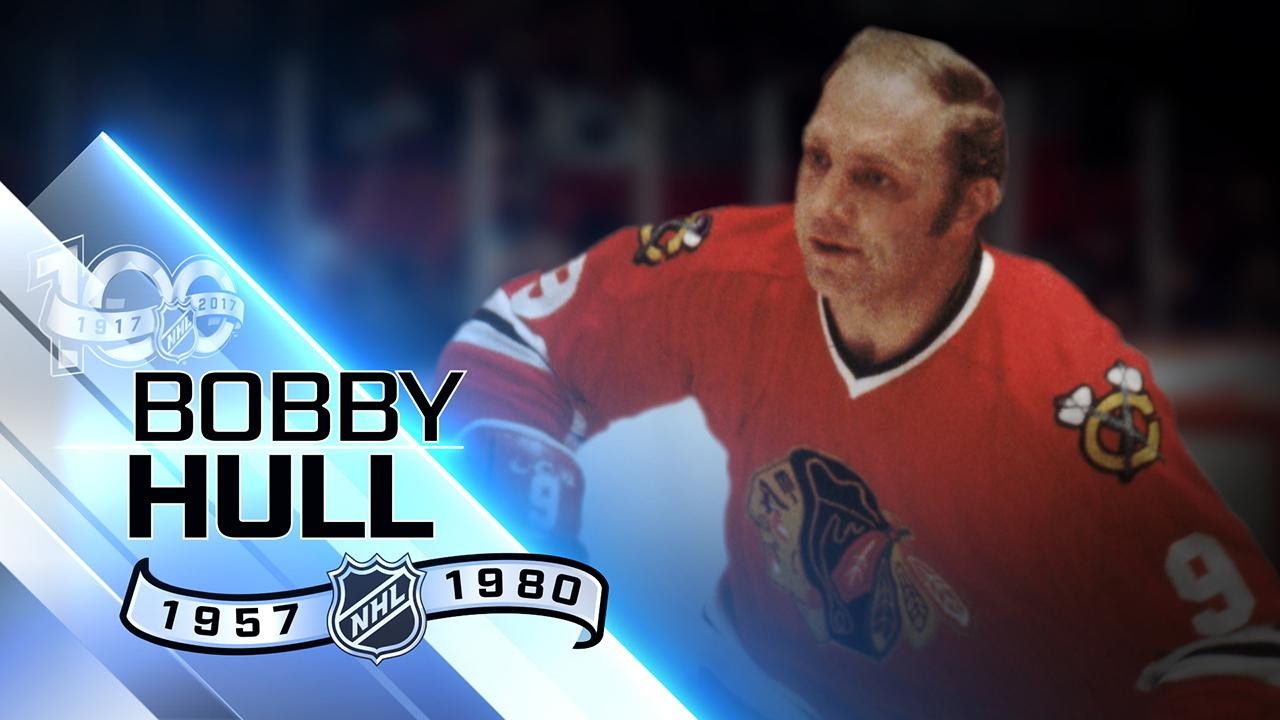
The name of Bobby Hull speaks to a level of hockey that few can get to. “The Golden Jet” got his nickname for his flowing blond hair as he rushed up the ice with the puck ready to be fired at the opposition’s goaltender. His shot was something to fear—especially if you did happen to be in the one who was supposed to stop it from entering the net. The name of Hull speaks to a hockey legacy as well—Hull’s brother Dennis “The Silver Jet’ and Hull’s son Brett “The Golden Brett” both had stellar careers in the NHL as well.
Hull understood that hockey was more than a game, and it was more than scoring goals—though he definitely knew how to do that and knew that was important. “Fans who pay good money to watch us play hockey deserve to be royally entertained. This is show business, and we’re here to put on a show.”
As the Chicago Black Hawks (as they were known at the time), were in New York taking on the Rangers on February 21, 1970, Bobby Hull was just two goals away from his 500th, and was playing in his 13th season with Chicago.
The New York Rangers got on the board first during the game at 13:18 of the first period and went into the first intermission with that lead. They would double that 1:06 into the second period. The Hawks though weren’t going to go away. Chicago got their first of the night, a goal credited to Bobby Hull when it caromed off his skate at 9:26. Less than two minutes later brother Dennis Hull got the game-tying goal. With 3:09 remaining in the second period Bobby would get his second of the game, and his milestone 500th. And Pit Martin would give Chicago their fourth.
As The Gazette shared two days later, “Chicago’s Bobby Hull slammed in two goals Saturday night to become only the third player in the history of the National Hockey League to score 500 in regular-season play.”
On February 22nd, Hull notched his 501st which prompted the press to ask him about reaching his second 500.
“’Wouldn’t that be something,’ said an awed Bobby Hull yesterday in response to the question, ‘When do you think you’ll score your second 500th goal?’
“’Let’s see,’ kidded Hull, ‘If I score 50 a season for the next ten years, that would do it. No, I think I’ll space it out in 13 seasons. It’ll be easier that way.’
“’No,’ said Hull ‘I never set my sights on any records. You never know. This is a rugged game and any games could be your last. I just want to stay healthy and play as long as I can.’
“’Sure, No. 500 was a great thrill especially with the ovation fans game me,’ said Hull.”
In fact, when Hull got number 500, which was the game-winning goal against the New York Rangers, the crowd gave him a two-minute ovation.
After the 1971-72 season, Hull would spend the next seven seasons with the Winnipeg Jets of the WHA, and then returned to the NHL as the Jets were absorbed into the National Hockey League in 1979-80. His final season was in 1979-80 with the Hartford Whalers, another of the NHL-absorbed teams.
Upon his retirement Hull had played 1063 NHL games with 610 goals, 560 assists for 1170 points. During his years with the WHA he played 411 games, notched 303 goals, had 335 assists for 638 points. So, if you combined his goals from the two leagues, he had 913 coming very close to reaching that second 500 goals, though because it wasn’t all in the NHL it wouldn’t have counted. However, it speaks loudly to his skills.
In today’s game of hockey, goalie masks are not only expected but are also often works of art. In fact, they play such a critical role for the goaltender, that a game is immediately halted when the goaltender’s mask comes off. However, the goalie masks are less than 75 years old, with Jacques Plante attributed with truly making the mask a part of the goaltender’s equipment.
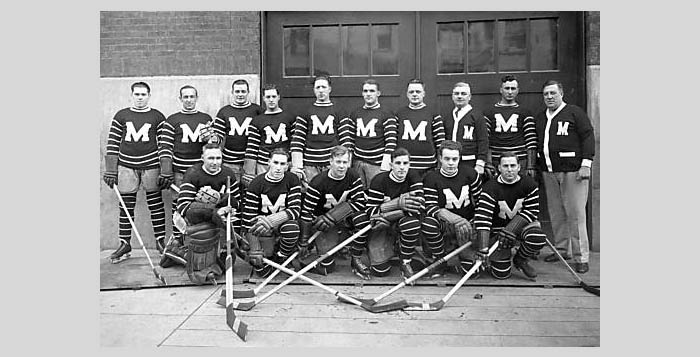
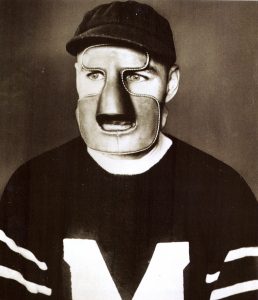
Even Plante would take some lip for wearing a mask, and over the years as the mask has morphed it’s been quite an interesting journey. The first actual mask though was worn by Clint Benedict, otherwise known as “Praying Benny” of the Montreal Maroons, when he wore protection in playing on February 20, 1930.
Benedict had suffered a couple of head wounds earlier in the year beginning with a Dit Clapper shot on January 4 that knocked him out cold. He was able to return to that game, but three days later after a puck off the stick of Montreal Canadiens Howie Morenz, Benedict’s nose was broken and it ultimately required him to go to the hospital for repair. While he returned to the Forum to catch the end of the Maroon’s 2-1 win, he would be unable to play for roughly a month.
As reported in the Victoria, British Columbia Times Colonist “Early in January he was struck in the face by a hard-driven puck from the stick of one of hockey’s hardest shooters, Howie Morenz, of the Canadiens. He received a broken nose and serious cuts about the face, and it was reported that he was through for the season and probably for good.”
But Benedict was back between the pipes when the Montreal Maroons took on the New York Americans in New York on February 20, 1930. He was wearing the protector that looked like it had been made partially out of leather and it covered much of the front of his face. The mask itself was manufactured by a Boston sporting company and was sometimes compared to a football face guard or boxer’s sparring mask.
Not much was really said of the mask on that first game back by The Gazette in its recap of the game against the Americans. “The game was featured by the return of Clint Benedict, Maroon goalie, who has been out of action a month with a broken nose and other injuries received when he was hit by a flying puck. He wore a large protector over the upper part of his face, but was not hampered by it turning in a fine game.”
Clint Benedict
When the Maroons returned to the Forum to take on the Black Hawks on February 25, 1930, the mask had a slightly more prominent place in the game’s description by The Gazette, perhaps because they lost or perhaps because it was a home game. “Clint Benedict came back to Forum games last night to make his local debut after nearly six weeks’ absence wearing the famous new mask that has been designed specially to protect his broken nose. Clink looked as if he had stepped out of the Dumas novel, ‘The Iron Mask,’ or in the more modern manner, was appearing as a visitor from Mars. The mask, made of thick leather, covers his face almost completely, leaving only two holes over the eyes. Benny played as if he were still unaccustomed to the thing. On a couple of occasions he seemed to lose sight of the puck completely, but on the whole the contraption seemed to fill the bill.”
For Benedict, the season would end a few weeks later, when once again a Morenz shot would make contact with his head—this time his throat. In his final season, Benedict played just 14 games and though he didn’t come right out and say so, it turned out it would be his last year between the pipes.
In the meantime, there is a possibility that George Hainsworth of the Montreal Canadiens may have worn something to protect his nose roughly a year before. He apparently had what may have been a plaster or bandage to protect his face while he was healing from a friendly fire incident. However, as things stand now what Benedict wore is much more of a true mask of sorts.
Additional Sources
Jim Hynes and Gary Smith, Saving Face, The Art and History of the Goalie Mask, rev. ed. (2015), Kindle Edition
“The Man in the NHL’s First Mask: Not Clint Benedict” on PuckStruck
Mike Commito, Hockey 365 (2018), Kindle Edition
The Gazette (Montreal, Canada), February 26, 1930, p. 16
The Gazette (Montreal, Canada), February 21, 1930, p. 18
Times Colonist (Victoria, British Columbia), February 21, 1930, p. 11

 Prev
Prev