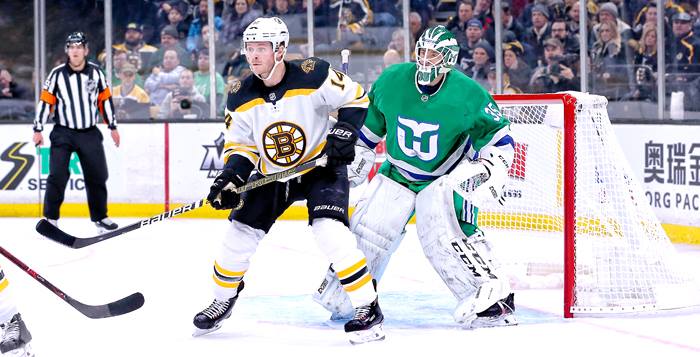
Tuesday night, the Boston Bruins played host to the Carolina Hurricanes. The Bruins came into the game riding a 16-point streak and were hoping to continue the momentum. Meanwhile the Hurricanes paid homage to their roots by wearing Hartford Whaler throwback jerseys and riding their own strong stretch, having a 21-6-1 record in their last 28 games. This was the third meeting of these two teams this season and the only one to be played in Boston. The Bruins took the first game in overtime back in October, but fell mightily in a 5-2 defeat on December 23, and were undoubtedly looking to get the win on home ice.
Physical First
Maybe it was the throwback jerseys, but the first period definitely had a throwback feel to it with the physicality. Both teams were throwing some heavy hits, especially after Michael Ferland’s hit on Marcus Johansson at 3:15 of the first. The Ferland hit was a clean, solid hit, but unfortunately Johansson went down to the ice and appeared to be in some serious pain. He was helped off the ice and did not return to the game and it was later reported that he had been taken to the hospital. No further word was released. This ramped up the hits from the Bruins—who dished out five hits in the next 35 seconds of the game. This approach saw them getting away from their style as they concentrated on perhaps the hits rather than the purpose of being on the ice.
Michael Ferland and David Backes
At 3:53 of the first, while David Backes’ line was on the ice, he asked Ferland to go. To his credit, Ferland agreed to the fight.
“You have to stick up for your teammates. Whether it was a liberty taken or you know, tonight’s hit which was a hard, clean hit, but if guys are running at our skilled guys, we need to hold them accountable and I thought there was an opportunity for me to step up and you know, fill that role,” Backes said after the game. “I asked [Bruce Cassidy], when we were in Vegas and we had a meeting, if I could be put in roles or places that would have a bigger impact on games and you know, whether that’s with my gloves off or my gloves on I think he’s provided me those opportunities and hopefully I’ve done my job for him.”
When you consider the injuries that Backes has sustained, especially the concussions, there are always concerns about him potentially being sidelined, something he says he cannot think about while in a game. His willingness to do whatever is necessary to stick up for his teammates and to be effective in any way possible speaks to his leadership qualities.
Despite the fisticuffs, it appeared that the Bruins were allowing the Hurricanes to take the game to them. Carolina’s strong forecheck was making it hard for the Bruins. So perhaps it wasn’t a surprise when Sebastian Aho notched the first goal for Carolina at 6:30 of the first.
Sebastian Aho
Aho came into Tuesday’s game leading his team in goals (27), assists (46), and points (73). The goal was originally credited to Calvin de Haan, who was returning from being out with an injury, but later was given to Aho. The puck itself actually ricocheted off of Zdeno Chara’s skate and past Jaroslav Halak, though this in no way takes away from how Aho was playing. During that first period, in his nine shifts, he had four shots on net—one of which turned into the goal—along with one hit and he won four of his six faceoffs (67%). It was clear that Aho was definitely playing a hard game and making the Bruins work to contain him.
“He’s getting better and better, really been solid all year. Picks it up right when we need a big play he seems to be there. Like I mentioned [Justin] Williams is the same, they’ve been solid for us. Obviously we need that,” shared Hurricanes head coach Rod Brind’Amour.
Besides Backes’ fight, the Bruins struggled to stay out of the penalty box in the first period. John Moore took an ill-advised cross-checking minor roughly 30 seconds after Aho scored, putting his team down a man. Fortunately, 42 seconds later Carolina’s Justin Williams was whistled for a hooking which put the teams at even strength. That didn’t last long though, as 43 seconds after that Bruin Charlie McAvoy was sent to the box for a tripping. Somehow the Bruins managed to keep the Hurricanes from capitalizing during the ensuing four-on-three. Boston would end up with one more penalty in the first, a too many men on the ice, which Peter Cehlarik served. It was probably fortunate for the Bruins that they got out of the first down just a single goal.
Second Period Tie
It was expected that Boston would come out with more determination in the second period, but 1:10 into the middle frame, Aho scored his second of the game and put the Hurricanes up 2-0. It looked like the combination of Johansson’s injury and playing on their heels during the first had somehow deflated the Bruins. Certainly, many who were watching the game believed they were done.
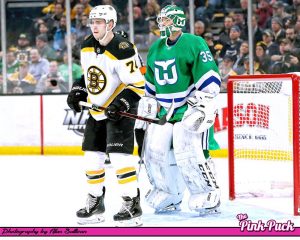
Jake DeBrusk in front of Curtis McElhinney
But that’s the thing with the Bruins. They believe in their line mates, their teammates, their coaches, and their system. And that means that they should never be counted out.
“Just play our game. I think it sounds cliché and simple, but we weren’t really playing our style and kind of playing into Carolina’s hands… trying to make sure their forecheck wasn’t as aggressive and holding up guys in the neutral zone and different things like that. But, most importantly just play our style and play our game and do what’s been working. It was a big response, big goal by [Chris Wagner] to get us going there and then I thought we found our legs,” Jake DeBrusk said of their resolve in the second period.
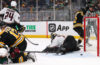
The first half of the game was certainly the Hurricanes with the better opportunities and controlling the game, but the ice began to tilt a bit in Boston’s favor when Wagner once again went to the dirty areas, hanging out in front of the crease. Brandon Carlo, who was having one of his best games this season, put the puck on Curtis McElhinney, from the top of the right circle. McElhinney let up a rebound and Wagner put it in the net. Getting on the scoreboard did wake up the Bruins.
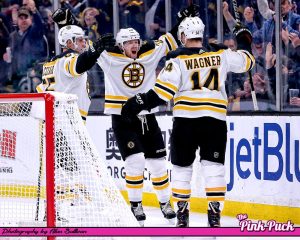
Wagner, Acciari and Nordstrom celebrate goal.
“I think we started getting more pucks behind them like we talked about. And they kind of had to start backing off and we could create more offense. So, once that one went in, I kind of felt as if we were going to get a couple more. And, you know, we ended up doing that,” Wagner said.
As the clock ticked under two minutes, the Bruins were working the puck out of their end, and Jaccob Slavin, who was on his knees in the neutral zone, did his best to try and keep the puck in the offensive end for the Hurricanes, but instead David Krejci pushed hard and moving up the left side to transition the puck the other way. As Krejci was coming up on McElhinney, he made a cutback move that bought him the space to put the puck on McElhinney, who again let up a rebound, and DeBrusk was there to put it in the net. The Bruins had come from being down two goals to tied going into the second intermission.
Third Period Shorty
Shortly after the beginning of the third period, the Bruins found themselves once again on the penalty kill, having been caught again with too many men on the ice. Up to this point the Bruins had been excellent at killing off the penalties, but each one brought another opportunity for the Hurricanes. However, while shorthanded, Brad Marchand stole the puck from Williams and immediately headed out of the Bruins end with Patrice Bergeron rushing up the left side in stride. As they closed in, with only one Hurricane back, Marchand made the perfect pass at the right moment, and Bergeron put the puck home. It was the first lead for the Bruins in the entire game. However, there was still 17:15 remaining in the game, and that’s a lot of time when playing hockey. With 7:43 remaining in regulation Williams tied the game for the Hurricanes, and that’s where things stayed until the end of regulation.
Overtime
For the second time between these two teams this season, they would have to take it to the extra inning. Boston came into the overtime period with a 7-6 record while Carolina had a 4-4 record. Once again the combination of Krejci and DeBrusk would work their magic. DeBrusk, who was coming around behind the Hurricanes’ net, with Justin Faulk trying to knock him off the puck, made a little spin, and put the puck right on Krejci’s stick as Krejci was skating hard to the net. The Bruins won it just 1:46 into overtime.
The 19,539 spectators at Wachovia Center had enjoyed a fairly normal game up until the final 1:45 on March 5, 2004. For once, the Philadelphia Flyers were about to defeat the Ottawa Senators. Since it was not likely the Senators would catch up before the end, the Flyers took the opportunity to pay them back for an event during their previous matchup. The result was a record-setting 419 penalty minutes.
The first period only had one penalty, a holding by the Flyers. The call came after Ottawa’s Chris Neil scored on a rebound at 4:07 and before Philadelphia responded with Claude Lapointe’s goal six minutes later and Mark Recchi’s goal less than a minute after that. The Flyers finished out the scoring that period at 16:10, when defenseman Danny Markov scored their 10,000th goal as a franchise.
In the middle session, the number of penalties picked up. When the Senators were called for tripping at 3:57, Kim Johnsson scored a power play goal at 5:22. The Senators were caught holding shortly thereafter. At 13:08, the Flyers received a penalty for slashing, allowing Zdeno Chara to score on the power play. However, the Senators finished the period with one more penalty, for high-sticking, before the period ended.
Near the start of the third period, Alexei Zhamnov scored the final Flyers’ goal, earning his 700th NHL point. About two minutes later, at 9:03, the teams became restless. Zhamnov and Ottawa’s Alfredsson both received penalties for roughing. At 12:18, another pairing were sent to the box for roughing. A silly too many men on the ice penalty was incurred by the Flyers at 15:57.
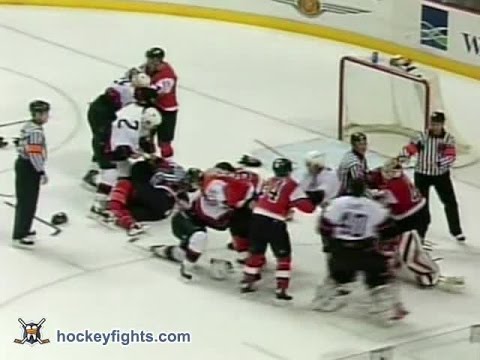
As of 18:15, the teams began fighting so much the announcers worried that not be enough men on the ice would remain to finish the game. These two teams carried some bad blood between them. When they last met, on February 26, Ottawa’s Martin Havlat swung a “two-handed high stick” at the face of Philadelphia’s Mark Recchi. Knowing Havlat was a target, Ottawa coach Jacques Martin sent him to the penalty box. Recchi said after all the fights, “It got to 5-2, and that type of thing happens. This game was played with a lot of emotion. My team didn’t forget what Havlat did last game. Brash made a statement. They responded and we responded back. We played a terrific game.”
Flyers’ Donald Brashear confirmed, “I started. Why wouldn’t I? There was a little emotion built up from past years, past games. We wanted to win the game in every department.” He chose his moment and his opponent, Rob Ray, saying, “I went out and fought a tough guy. I could have jumped on one of their good players and hurt him.” The Ottawa Citizen claimed that after Brashear bloodied Rob Ray, he sucker-punched defenseman Brian Pothier. Senators’ center Mike Fisher justified the brawl that ensued, “Obviously for us it was a disappointing effort and we got frustrated. What started it was Brashear going after (Pothier), one of our skill guys. After that, we weren’t going to sit there and let it happen. Then everything started. It was like a gong show, I guess. We didn’t win, but the guys stood up for each other, and I guess we can be proud of that.” Brashear received a “double minor-double major-misconduct-game misconduct” (for roughing, fighting, and being the instigator) for a total of 34 penalty minutes. Ray was given a major for fighting.
In the general melee instigated by Brashear and Ray, even the goalies became involved. Patrick Lalime of the Senators was penalized a “minor-major-game misconduct for leaving the crease and fighting (for 17 penalty minutes), while Robert Esche of the Flyers received the same but for his being a double game misconduct (for 27 penalty minutes). Their backup goalies, the Flyers’ Sean Burke and the Senators’ Martin Prusek, had to finish the game. The others receiving multiple penalties during that round included Van Allen and Simpson for Ottawa and Radivojevic and Markov for Philadelphia. Flyers coach Ken Hitchcock commented, “I’ve seen a lot of those before. I coached in a lot of these type of games. It’s the wild, wild West.”
Finally, the referees cleared the ice. They set up for a faceoff, but players immediately dropped the gloves. During this round, Ottawa’s Chris Neil “speared” and “jumped” Philadelphia’s Radovan Somik while Mattias Timander and Zdeno Chara fought nearby. Another faceoff had just begun when Flyers’ center Michal Handzus went after Mike Fisher. Handzus said, “When it was time to go, we knew it was our turn [to fight]. We stuck together as a team. I’m proud of our guys.”
At the next faceoff, the players actually skated for a bit before two fights broke out. Recchi took on Bryan Smolinski, and John LeClair fought to a draw with Ottawa defenseman Wade Redden. Afterwards, Redden commented, “Obviously it wasn’t a great game for us. But the guys did a good job and stood up for each other. It’s probably a wakeup call to lose a game like that, and that’s something we can build on.” With 1:15 still remaining in the game, the teams lined up with four for the Senators and three men for the Flyers. Once more, players immediately dropped the gloves. Philadelphia’s Patrick Sharp and Ottawa’s Jason Spezza received the final penalties of the game.
All in all, the game restarted four times. A total of 23 players were ejected. Some were even confused as to who was kicked out and who was supposed to remain on the bench. It seemed that for the last minute or so, the Flyers only had seven players and the Senators only six. Once the game was allowed to finish, Ottawa’s Peter Bondra scored the final goal at 19:47, leaving the score at 5-3.
Overall, the two teams combined had a whopping total of 419 penalty minutes. That broke the record of 406 minutes held by the Boston Bruins and Minnesota North Stars from February 26, 1981. It only took one period for them, since the third period tally came to 409 minutes. The most in one period prior to that was when the Flyers took on the Los Angeles Kings on March 11, 1979. Philadelphia also took away the record for penalty minutes for one team with 213. Ottawa came close with 206 minutes of their own.
As something of a justification, Flyers goalie Esche said, “I don’t like speaking for the team, but I think collectively we all wanted to say we’re not scared of Ottawa, we’re not scared to play them, and we’re not intimidated by their talent, and I think that may have been the problem with all the stuff [coach Ken] Hitchcock talked about over the last few years, about the mental advantage they have on us. We just got tired of hearing it, and it worked out to our advantage.” Coach Hitchcock agreed. “This wasn’t about putting our foot down. They’ve been the better team in every aspect, in offense and checking and special teams. We needed to change, and we did.”
Additional Sources:
Mike Commito, Hockey 365: Daily Stories from the Ice (Toronto: Dundurn, 2018), kindle version.
Tim Panaccio, “Flyers win as things get wild,” Philadelphia Inquirer, 6 March 2004, pp. E1 and E4.
“Summary,” Philadelphia Daily News, 6 March 2004, p. 41.
Edward Moran, “Flyers Knock Some Sens Into Ottawa,” Philadelphia Daily News, 6 March 2004, p. 42.
Allen Panzeri, “It was like a gong show,” Ottawa Citizen, 6 March 2004, p. F1.
Some days, like March 4, are filled with highs and lows. In 1941, the Boston Bruins bombarded the Chicago Blackhawks’ goalie with 83 shots on goal. Nearly 60 years later, in 1999, the Toronto Maple Leafs managed to win with only 9 shots on the St. Louis Blues. Such a difference between 83 and 9, imagine if that were the high and low temperature forecast!
In the year that would see the Americans officially join the Second World War, the Bruins were fighting for first place while the Blackhawks just needed one win to clinch a playoffs berth. The Bruins had defeated the Blackhawks (4-3) in Chicago on March 2, and two nights later, the rematch was played at Boston Garden before a crowd of 11,000.
The action seemed centered solely on the net of Blackhawks’ rookie Sam LoPresti. He (and the Bruins’ goaltender) had been born in Eveleth, Minnesota 24 years back. His NHL debut came on January 5, 1941, against the Bruins. On March 4, despite already having faced 42 shots, LoPresti had a shutout going until Roy Conacher finally started the Bruins’ scoring at 4:24 of the second period. It was not until the 55th shot on his net, at 18:52 that period, that the Bruins managed another, from Milt Schmidt’s stick. LoPresti stayed firm until 17:29 of the final period, when Eddie Wiseman ““golfed his original shot at Big Sam, who flopped and deflected it out of a wild melee” before Wiseman backhanded his own rebound.
Despite facing 13 shots by Dit Clapper, 12 shots by Bill Cowley, 10 shots by Eddie Wiseman, and 32 shots by the Bruins’ four defensemen, LoPresti only allowed three goals. The exhausted goalie exclaimed, “Whew. They certainly kept me busy. Why I’ll bet I lost a couple of pounds.” According to the Boston Globe, “For the first time in Garden history, announcer Eddie Cummings was instructed to make known the official stops over the amplifiers.” LoPresti had made 27 saves in the first period, 31 in the second, and 22 in the third, for a total of 80 saves. “Easy or hard, they all had to be handled. They could have scored just as well on an easy one as a hard one,” explained LoPresti. “Eighty stops, eh? That beats my previous record of 62 which I made with St. Paul a couple of years ago.” In truth, as the Boston Globe crowed, “LoPresti smashed all known records for goalers, professional, amateur or otherwise, when he blocked 80 (count ‘em) of the 83 shots fired at him by the relentless Ross Rollers.” As best as could be determined, the only goalies close to that many saves were Bill Beveridge and Benny Grant, with 70-odd saves each. Bruins defenseman Jack Crawford said of LoPresti, “He was good all right. If he hadn’t been good he wouldn’t be alive now.”
LoPresti only played that season and the next in the NHL before leaving to serve his country. One month shy of two years after his record-setting night, LoPresti escaped the sinking SS Roger B. Taney after a German submarine torpedoed the ship. It took over a month (42 days) for the remaining crew to be rescued (off the coast of Brazil).
In the Bruins’ net, Frankie Brimsek had so little to do that “he complained between stanzas that he got cold out there in the rink.” During the game, he only faced 20 shots and made 18 saves. He faltered early on, when Blackhawks’ “Mush” March scored the first goal at 4:07 of the opening period. Eight minutes into the third, Brimsek allowed Max Bentley to even the score (on a rebound).
The other news of the night were Bill Cowley’s assists. He assisted Conacher and Wiseman for his 37th and 38th assists of the season. With that, he passed Toronto’s Joe Premeau, who had held the record since the 1931-32 season. Combined with his 14 goals (for a total of 52 points), Cowley was then leading the scoring race by eight points. Cowley finished the season as scoring champion with 62 points. The closest rivals were five players with 44 points each.
The 3-2 win put the Bruins in first place. After the game, Dit Clapper said, “Toronto had better forget first place and start resting for the playoffs. We are on top now and we are going to stay there.” They did, and they went on to beat first the Maple Leafs and then the Detroit Red Wings to win the Stanley Cup.
Only the Bruins have come close to breaking their own shots on goal record, as no other team has even shot more than 70 in one game. Boston topped that at least twice, shooting 73 on March 21, 1991 (in a 3-3 tie against the Quebec Nordiques) and shooting 72 on December 10, 1970 (in an 8-2 win over the Buffalo Sabres). Only recently, on October 21, 2018 (against the Tampa Bay Lightning), have the Blackhawks faced so many shots on goal in one period (33).
On the complete opposite end of the spectrum, the Toronto Maple Leafs were able to win a game on March 4, 1999 with only nine shots on net. At the Kiel Center in St. Louis that night, the issue seemed to be in the goaltenders.
The Blues chose to start their rookie, Brent Johnson. At 11:03 of the first period, he missed Steve Sullivan’s breakaway shot. That let Toronto score on one of only three shots that frame. Then, in the second period, Mats Sundin “fired a partially screened and deflected shot past him at 2:13 of the second period.” Less than four minutes later, at 5:58, Lonnie Bohonos blew a “slapper through his pads on a rush off the right rig.” All in all, Johnson had let in three goals on only five shots, so his coach pulled him. “I couldn’t save a beach ball tonight. There’s no excuse for the way I played. I was no good. … I didn’t try hard enough to keep the puck out of the net. I just wasn’t in the right frame of mind,” commented an ashamed Johnson. ““The team expects a lot more from a goaltender than what they got tonight. I want to get another chance out there so I can redeem myself.”
To replace him, the Blues sent Jim Carey to the net. He had been playing in the NHL since 1994 and had received the Vezina in 1996), but this was his first game for St. Louis. At 18:29 of the second period, Carey was the victim of “a goal that never should have happened.” Garry Valk had tripped Jim Campbell by the Blues’ bench, but instead of being called, he skated off with Igor Korolev. Once Korolev had drawn everyone’s attention, he passed to Valk, who “fired the puck into a wide open net.” Carey only faced four shots and made three saves.
In the other net, Curtis Joseph, who had tended goal for St. Louis between 1989 and 1995, played his first season with Toronto. That night, he faced 28 shots on goal, three times that of his opponents. The difference was, he did not let any in his net. With the 4-0 victory, Joseph earned his third shutout and eighth win in the past eleven bouts with the Blues.
Meanwhile, the Blues had been handed their eighth shutout that season, which was the most since the 1977-78 season. Coach Joel Quenneville realized, “I can’t blame it on the goaltending because we didn’t score any goals. It’s across the board. You need to score in this league.”
Nine shots on goal is the fewest ever for the Maple Leafs and the fewest for an NHL win.
Additional Sources:
Mike Commito, Hockey 365: Daily Stories from the Ice (Toronto: Dundurn, 2018), kindle version.
Brian McFarlane, Brian McFarlane’s History of Hockey (Champaign, Ill.: Sports Publishing Inc., c1997), 49-50.
Gerry Moore, “LoPresti Makes 80 Stops as Bruins Win by 3 to 2,” Boston Globe, 5 March 1941, p. 19.
Herbert Ralby, “LoPresti’s 80 Stops in One Night Reduce Goalie’s Extra Poundage,” Boston Globe, 5 March 1941, p. 21.
“Bruins Beat Hawks, 3-2; Take Lead League Lead,” Chicago Tribune, 5 March 1941, p. 25.
Dave Luecking, “Joseph shuts down Blues,” St. Louis Dispatch, 5 March 1999, pp. D1 and D7.
The Nashville Predators are looking to keep pace with the Winnipeg Jets for the top spot in the Central Division, and gain points in three important games this week. They will play the Minnesota Wild twice, once on the road and once at home. Then the Predators will take on the red hot Carolina Hurricanes on Saturday night at home.
1) Sunday, Mar. 3 @ Wild- 7 p.m. ET – NBCSN
The Predators and Minnesota Wild will see some familiar faces that have switched sides in the Central Division matchup. Kevin Fiala and Anthony Bitetto are now with the Wild, while Markus Granlund is with the Predators. The Predators are a little bit deeper than the Wild since they have 12 players with 20 or more points while the Wild only have six on the active roster. The Wild hold a big advantage on the power play (21.6%) over the Predators, who have the worst power play percentage in the League (12.5%).
The Predators Will Win If….
They get good goaltending in the game and the starting goalie doesn’t allow any soft goals. The team will want to stay out of the penalty box since the Wild have a pretty good power play and can cash in on their opportunities. The Predators should get the first goal of the game and keep building from there. The more shots and traffic they get in front of the Wild net, the better chance the puck may end up in the back of the Wild net.
Matchup of the Game
The goaltending will be the difference in this game. The teams don’t really score too many goals per game and the Wild are looking to extend their win streak to five games and put more distance between them and the teams behind them. The Predators have been struggling of late, and could use this game as a chance to turn around their season. The goalies are going to steal the show, even with all the talent on both sides, because they’ll make highlight reel saves and routine saves.
Game Prediction
The Predators pick up another two points in regulation in this game. They will win by a final score of 2-1. The Predators goals come from Mikael Granlund and Viktor Arvidsson. The Wild goal comes from Jason Zucker. There will be a late push by the Wild to tie the game, but they will fall just short.
2) Tuesday, Mar. 5 vs. Wild- 8 p.m. ET – NBCSN
The Wild look to grab two points in regulation in this game. The two teams will be coming off of battling each other in Nashville, but this time the Wild will have home ice, and that could be a good thing for them.
The Predators Will Win If…
The team cashes in on their power play advantages. The Predators have really struggled scoring goals while a man up for the caliber of players that are on the power play units. The Predators should take the shot, if it’s there, and not pass it up. The team should try to avoid the slow start because the Wild seem to get better as the game goes on. They need to be disciplined and not let the Wild get too many power play opportunities since they are good at cashing in on them.
Matchup of the Game
These two teams have defensemen that are not afraid to pitch in on the offensive side of the puck. The Predators’ starting six defensive corp has 165 combined points with Roman Josi (51), Ryan Ellis (35) and Mattias Ekholm (42) having 35 or more. The Wild’s starting six on defense have a combined 109 points, but the Predators will really need to watch out for Ryan Suter (42 points) and Jared Spurgeon (38 points). This should be interesting to see which team, if not both, activate their defensemen often and early in this game to try to get on the board early.
Game Prediction
The Wild get their revenge in this game and win in regulation by a final score of 3-2. The Wild goals come from Eric Staal (scores twice) and Kevin Fiala gets a goal against his former team. The Predators two goals come from Filip Forsberg and Wayne Simmonds, who will get his first goal with his new team. The Predators try for a late regulation push but it just doesn’t come.
3) Saturday, Mar. 9 vs. Hurricanes- 8 p.m.
The Carolina Hurricanes have a balanced lineup and have four lines that can put up points. The Predators have a relatively balanced lineup, but have been struggling to get big saves and put the puck in the net. Their even strength game is similar so this game could come down to the special teams.
The Predators Will Win If…
They can play a solid, defensive team game. The Hurricanes can score goals and have a good transition game. The Predators will want to have the lead after the second period since the Hurricanes aren’t very good at coming back from trailing after two periods. The Preds want to set the tone early and establish the forecheck early to get some offensive zone time. They’ll also want to get the first goal of the game to keep the crowd in the game.
Matchup of the Game
This game could very well come down to special teams specifically the teams’ power plays. The Hurricanes have the 22nd best power play, which isn’t great, but is better than the opposition’s. The Predators have the worst power play in the league at 12.5% and it has been around there all season long. The Predators will need to figure out a way to get some power play goals especially with the amount of talent they have on their two units.
Game Prediction
The Hurricanes will come away with another two points in this game. The final score will be 3-1 in regulation. The Predators goal is scored by Viktor Arvidsson. The Hurricanes three goals come from Sebastian Aho, Nino Niederreiter and Dougie Hamilton.
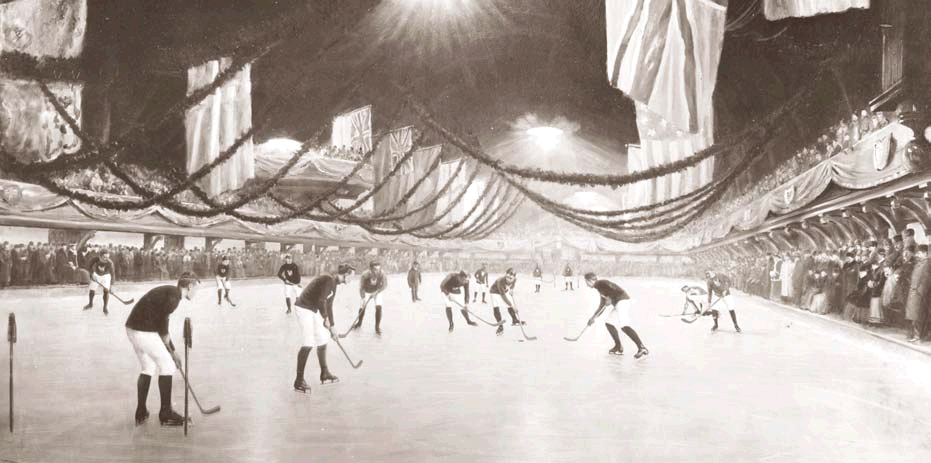
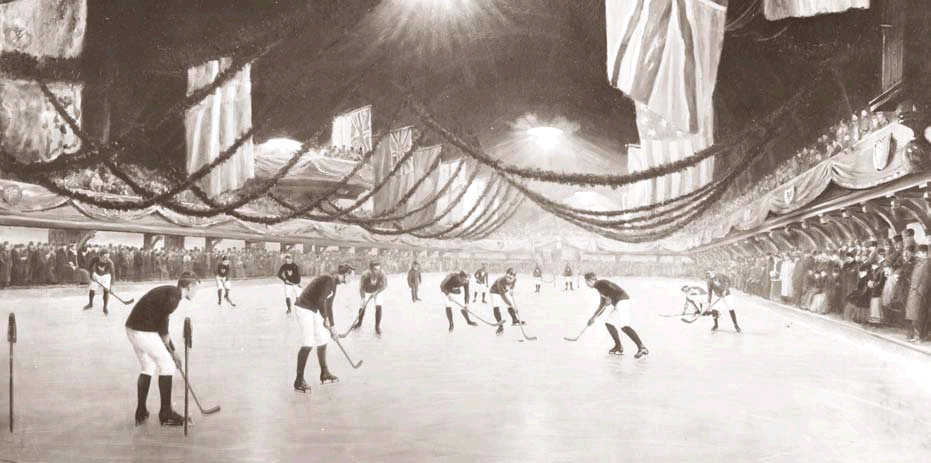
On March 3, 1875, the Montreal Gazette advertised, “A game of Hockey will be played at the Victoria Skating Rink this evening . . . Good fun may be expected, as some of the players are reputed to be exceedingly expert at the game.” The claim of expertise is interesting because that would be the very first recorded public indoor hockey game in North America.
Victoria Skating Rink was located downtown, at 49 (now 1187) Drummond Street, bracketed between Drummond Street and Stanley Street and between Saint-Catherine Street and Dorchester Boulevard (now René Lévesque Boulevard). It was in the vicinity of McGill University, and the Bell Center (Centre Bell) is just a couple blocks down. The rink was built in 1862 and let the cold weather naturally create and keep the ice surface (measuring 204 by 80 feet (62 by 24 meters)). It later became the first electrified building in Canada. Until 1875, Victoria Skating Rink hosted figure skating, speed skating, and masquerade balls, but hockey was only played outdoors. Although unheated, Victoria Skating Rink would at least protect players from the elements and provide smooth ice. Thus, James Creighton of McGill asked (perhaps bribed) the caretaker to allow hockey players in when the rink was otherwise closed.
Outside, ice surfaces varied in size, so as many participants as would fit could play. With the move indoors, the teams would have to be more restricted. They decided to play with nine men on each side (without substitutions), and that would hold until the number was reduced at the Montreal Winter Carnival in 1883. The players mostly were McGill University students, including key organizer and captain Creighton, who left his native Halifax to study law at McGill in Montreal and was a member of the Victoria Skating Club. Creighton’s team consisted of Robert Esdaile, Henry Joseph, Frederick C. Henshaw, William B. Chapman, Robert H.W. Powell and Edward S. Clouston, Lorne Campbell, and his brother George Campbell. The other captain, Charles E. Torrance, had teammates Daniel Meagher, Thomas J. Potter, Edwin H. Gough, William M.S. Barnston, George W. Gardner, W.O. Griffin, Francis Jarvis and a man who’s last name was Whiting.
Soon the players wanted to move beyond practicing and play before audiences. The first game drew “a very large audience gathered to witness a novel contest on the ice.” Playing inside had the benefit of better viewing for spectators, but having them all in the confined space generated additional logistical challenges. According to the Montreal Gazette advertisement of the first game, “Some fears have been expressed on the part of intending spectators that accidents were likely to occur through the ball flying about in too lively a manner, to the imminent danger of lookers on, but we understand that the game will be played with a flat circular piece of wood, thus preventing all danger of its leaving the surface of the ice.” Instead of using a lacrosse ball or road apple (frozen horse manure), they invented something that would give players more control, the hockey puck.
With these first games, the players had a hand in codifying rules for the game of hockey, including setting the time for the two halves and preventing forward passing. The Montreal Gazette explained, “The game is like Lacrosse in one sense — the block having to go through flags placed about 8 feet apart in the same manner as the rubber ball — but in the main the old country game of shinty gives the best idea of hockey.”
As for that first match, the Gazette summarized, “The match was an interesting and well-contested affair, the efforts of the players exciting much merriment as they wheeled and dodged each other, and notwithstanding the brilliant play of Captain Torrance’s team Captain Creighton’s men carried the day, winning two games [goals] to the single of the Torrance nine. The game was concluded about half-past nine, and the spectators then adjourned well satisfied with the evening’s entertainment.”
Apparently, the game ran over its allotted time, causing an “unfortunate disagreement” in the crowd. The Daily Witness reported, “One little boy was struck across the head, and the man who did so was called to account, a regular fight taking place in which a bench was broken and other damage caused.” The Daily British Whig (a Kingston, Ontario paper) reported that the fight broke out when figure skaters arrived and became angered at not being able to use the ice. “Shins and heads were battered, benches smashed and the lady spectators fled in confusion.” Either way, the first indoor hockey game had the first indoor hockey fight among the fans rather than the players.
Additional Sources:
Mike Commito, Hockey 365: Daily Stories from the Ice (Toronto: Dundurn, 2018), kindle version.
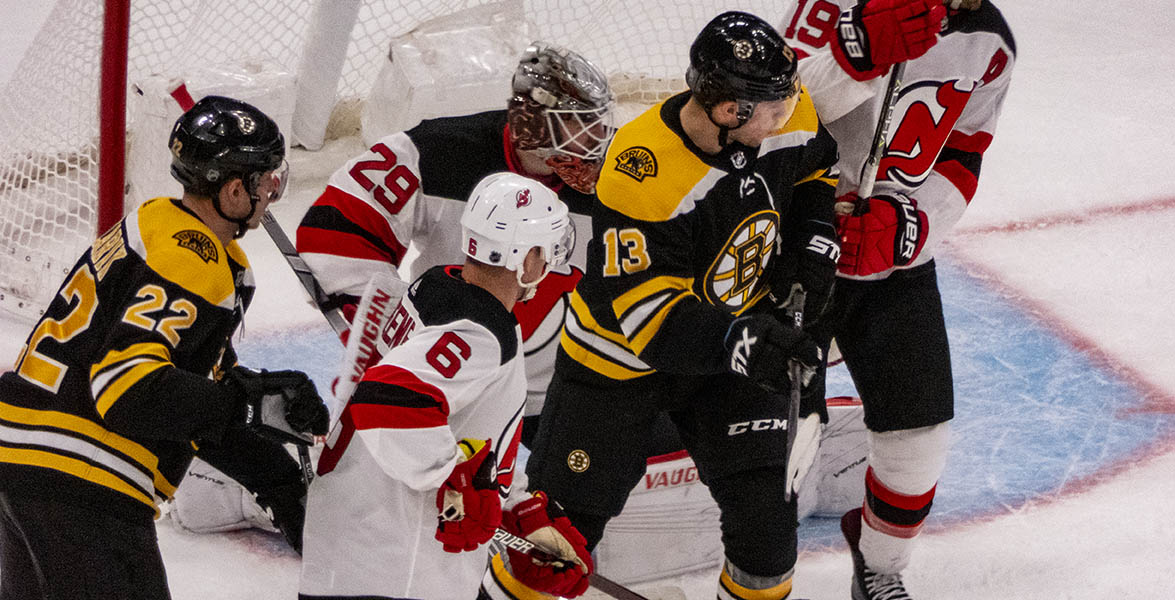
Saturday night’s game between the Boston Bruins and the New Jersey Devils was hardly a barn burner. The Bruins came into the game riding a 15-game point streak, and had impressively put away the Tampa Bay Lightning, who lead the league, in a 4-1 victory on Thursday. The last time the Bruins hosted the Devils, December 27, 2018, New Jersey took it to the Bruins handing them a 5-2 defeat. Coming off the physical, fast-paced game on Thursday, there were questions as to how the Bruins would respond against a team that is out of playoff contention and riddled with injuries.
It looked like things were going well for the Bruins, especially when Brad Marchand put Boston on the scoreboard 13 seconds into their first power play of the game at 2:37 of the first period. And then roughly five minutes later Marchand had a penalty shot opportunity that rookie netminder Mackenzie Blackwood denied. That was all she wrote for scoring for the remainder of the game.
Even the penalties were few. Besides the Kenny Agostino goaltender interference that netted the Bruins their power play goal and the hooking by Damon Severson that gave Marchand his penalty shot attempt, there were only two additional penalties called in the remainder of the game. Toward the end of the first period Brandon Carlo took a slashing penalty that couldn’t be ignored when Devil Michael McLeod’s stick broke in half. And then at 15:15 of the second period Peter Cehlarik was whistled for a tripping penalty on Connor Carrick.
As things got underway in the third period, it was soon apparent that Cehlarik wasn’t taking any shifts. He could be seen on the bench, so it didn’t seem to be an injury that was preventing him from being out on the ice. As the period continued, it was clear that he had been benched by Bruins head coach Bruce Cassidy. Was it the penalty that he had taken in the second? Or was it something else?
“Yeah, there was a few things we didn’t like. We’ve talked about allowing guys to play through certain parts of their game and sometimes it’s better to sit and watch. Tonight, we chose the latter. There were some things we had talked to him about. It wasn’t the penalty. Penalties happen. It was a little more about his routes, responsibility away from the puck, managing it at the end of the second period in your own end. Those are things we’ve talked to him numerous times about, so we went a different route, and we’ll see where it leads,” Coach Cassidy shared bluntly after the game.
Over the last week, Cehlarik had been in a revolving door of callups to the Bruins and then almost immediately assignments back to their AHL affiliated Providence Bruins. It shouldn’t have affected him, but half of hockey is how strong you are in your mind. Perhaps that had put him off his game.
“I have no idea. He’s here in the NHL. He’s earned his right to be in the lineup. I think we’ve used him up in the lineup with [David] Krejci. We’ve used him with Charlie Coyle, two very good players, so I think at some point the responsibility falls on the player to be ready to play and play the Bruins’ way. I thought he got away from that a little bit, so that’s it. Only he can answer whether he’s, frustrated or the travel—it’s certainly not the hour travel. Maybe the fact that he got sent down might have bothered him. I don’t know, I can’t answer that. We made some decisions at the deadline too – as much as for roster purposes than anything. We’ve got past that. He got called up because he deserves to be here, and tonight we just made a decision to just cut back and use other people,” Coach Cassidy continued.
The responsibility falls on the player to be ready to play and play the Bruins’ way. — Bruce Cassidy
Clearly a message has been sent to the 23-year-old in actions this time rather than words, which apparently weren’t being absorbed. Sometimes it takes being benched or being a healthy scratch to get the coaching message across.
The onus is now on Cehlarik to change his game. It’s up to him to “be ready to play and play the Bruins’ way” as Coach Cassidy said. If he isn’t willing, he could find himself assigned back to Providence and the next callup opportunity could go to another Providence Bruins forward.
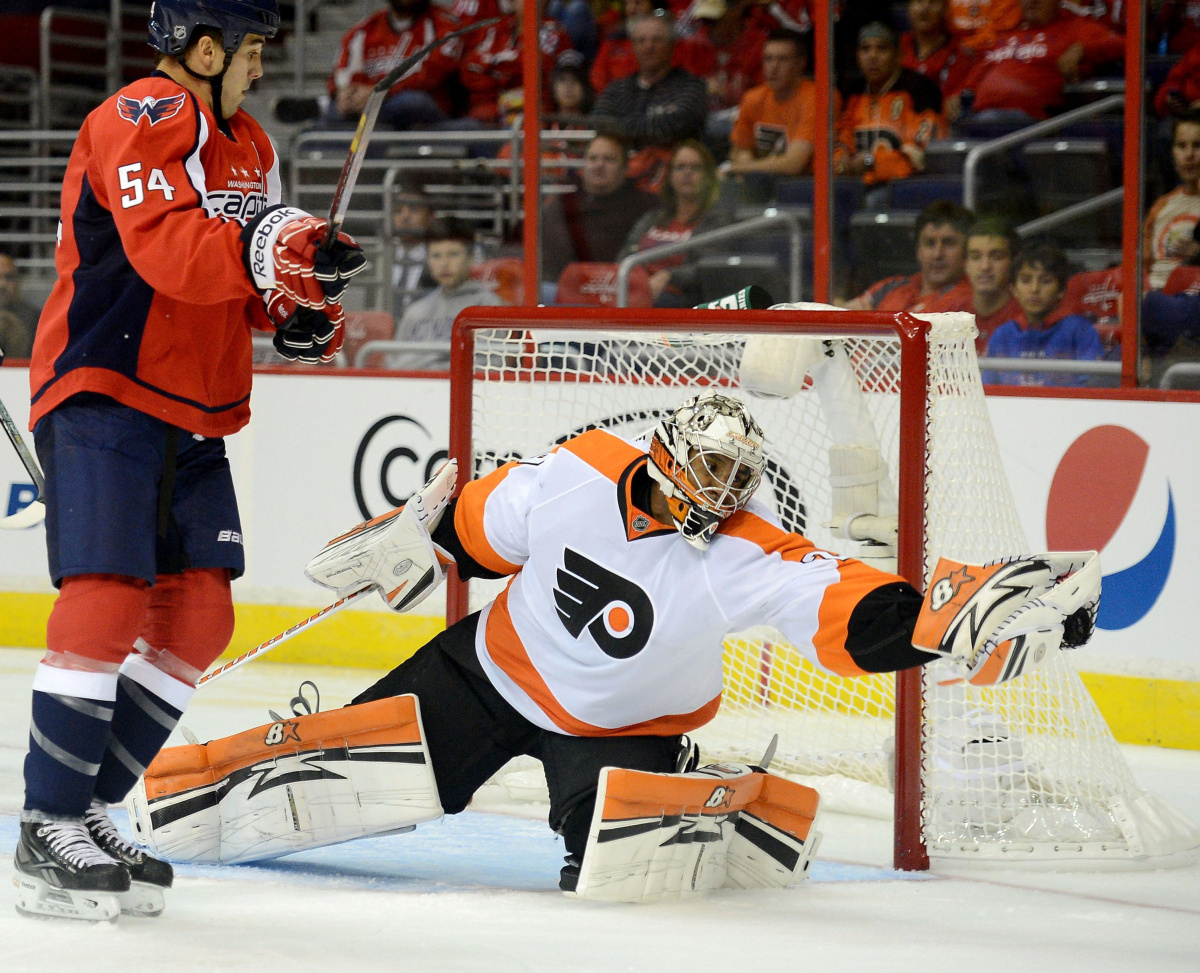
The Philadelphia Flyers look to stay in the playoff race and to do that they will need to win some games within the Metropolitan Division. The team will face the New York Islanders twice on the road this week and the Washington Capitals at home on Wednesday night.
1) Sunday, Mar. 3 @ Islanders- 3 p.m. ET
The New York Islanders have been the biggest surprise this season and Head Coach Barry Trotz will likely win the Jack Adams Award for the League’s best coach. The Islanders have a big advantage over the Flyers at even strength play and goaltending.
The Flyers Will Win If…
The team can get off to a fast start and not look back. The Flyers are going to need to be ready from the drop of the puck for this one since the Coliseum will likely be rocking. The Islanders are coming off of a loss and are looking to get some points to start pulling away from the Capitals. The Flyers will need to limit their turnovers because the Islanders will take advantage of sloppy play.
Matchup of the Game
The Flyers are going to have to be very good at even strength since the Islanders have only given up 93 even strength goals this season. The Flyers are on the opposite end of the spectrum having given up 142 even strength goals. The Orange and Black need to make sure that they play a good defensive game and that the gaps between forwards and defensemen are good. The team should try to support each other and not try to force plays or make the dangerous clear up the middle of the ice.
Game Prediction
The Flyers will get a point out of this game but will lose 3-2 in overtime. The goaltending for each team will be good and make this game go the extra session. The Islanders goals come from Anders Lee, Brock Nelson and Mathew Barzal. The Flyers goals are scored by Sean Couturier and James van Riemsdyk
2) Wednesday, Mar. 6 vs. Capitals- 7:30 p.m. ET – NBCSN
The Washington Capitals have struggled this season, but are still battling it out with the Islanders for the top spot in the Metropolitan Division. The Flyers and the Capitals both have weak penalty kills so the teams will want to avoid the penalty box. The Capitals also have the goaltending advantageover the Orange and Black.
The Flyers Will Win If…
They can manage to stay out of the penalty box since they have the 28th ranked penalty kill. The Flyers’ goaltending will need to come up big and make saves to keep the team in the game. The team needs to get plenty of shots on net with traffic in front of the goalie to take his eyes away. This would be a good game to get some power play goals since the Capitals’ penalty kill is at 79.3% for the season and has been a weak spot.
Matchup of the Game
The special teams could potentially play a pivotal role in this game. The Flyers’ power play has been much better recently but the Capitals have a dangerous one ranked in the top 10 of the NHL. The Capitals power play units can both produce; whereas, the Flyers power play production has mostly come from the top unit, but the second unit has been chipping in of late. The penalty kill of both teams has been pretty bad this season and both are operating at under 80%, but the Capitals have the slight advantage with having killed penalties at a better clip than the Flyers.
Game Prediction
The Flyers manage to get good goaltending in this game and come away with two important points. The Orange and Black manage to win the game 4-1. The Capitals goal comes from Alex Ovechkin. The Flyers goals come from Jake Voracek, Sean Couturier (two goals) and Nolan Patrick.
3) Saturday, Mar. 9 @ Islanders- 7 p.m. – ET
This will be the second time within a week that the Flyers and Islanders face each other. The games are important as the points will pay dividends in the standings. The Islanders are a deeper team than the Flyers, but the Flyers have been on quite a streak of late.
The Flyers Will Win If…
They can manage to limit the mistakes and get really good goaltending. If the Flyers can manage to get in on the forecheck early to establish a cycle game then that would help them manage the first 10 minutes of an important road game. The Orange and Black aren’t one of the best defensive teams in the League, but have been better since Scott Gordon took over.
Matchup of the Game
The goaltending will be an important piece in this game. If the teams can manage to get good goaltending then it will be a close, entertaining game. The goalies are going to need to make some key saves to keep their teams in the game but they will also need to make the routine saves eliminating any soft goals.
Game Prediction
The Flyers mange to pull this one out on the road by a final score of 4-3 in regulation. The Islanders goals are scored by Josh Bailey, Val Filppula and Casey Cizikas. The Flyers goals are scored by Claude Giroux, Travis Sanheim, Travis Konecny and Oskar Lindblom.
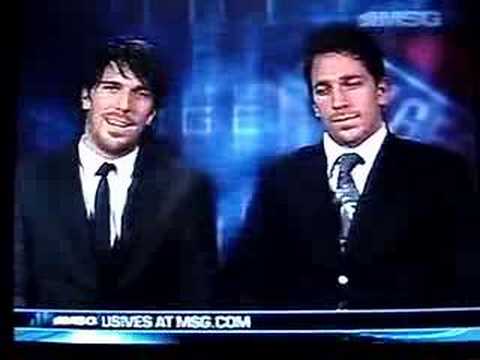
At Åre, Jämtland, Sweden, March 2, 1982, the Lundqvist family welcomed the births of identical twin boys. Henrik arrived first with Joel following 40 minutes later. Despite living in a small town of 1,200 residents in the shadow of alpine skiing mountains, the boys began skating on an iced-over sandpit in kindergarten. Because his company sponsored the professional team Västra Frölunda HC, Peter Lundqvist (ski instructor) brought his sons to games at Scandinavium, Gothenburg, and the boys became big fans.
In 1989-90, when they were 8, the brothers joined their first hockey organization, Järpens IF. Henrik wrote that the goalie’s gear fascinated him, and that “in rural Sweden, this kid is the coolest person” he had seen. It changed his life when the coach pointed to the other net and asked, “Who wants to play goalie?” According to Henrik, he did not have the courage to raise his hand, but Joel knew and raised it for him saying, “My brother!” When Henrik was all strapped into the pads, he felt like his “hero Pekka Lindmark, the goalie for the Swedish national team,” minus the mustache. He imitated Lindmark, tapping both posts with his stick and squaring up, but then he glided back all the way into the net and fell under the weight of the pads. Henrik wrote to his younger self, “As you’re laying there on the ice, completely helpless, your own brother will skate down on a breakaway and bury the puck in the open net. He’ll skate away with a big smile on his face, arms in the air, while you lay there staring at the puck in the back of the net.”
As children, the brothers frequently competed one-on-one on the nearby frozen lake “switching on and off doing the commentary.” Henrik said, “We skated before that and we took turns, he was in the net a couple times. But in the first practice [with a youth team], I was the goalie.” Joel later compared them, “When we were smaller kids, we were more like one person. But when we got to be 16 or 17, we had our own personalities. He’s a goalie so he’s maybe stronger about himself. I’m more like a team player; he’s a team player, but as a goalie you’re more left alone. If he had played forward, he would be a goal scorer, because he likes to be in front. I’m a hard worker, a two-way player.”
A few years later, in 1993, the Lundqvist family moved south to Båstad, Skåne (for their sister Gabriella’s tennis career), and the younger brothers played for Rögle BK. They were also selected for the regional team between 1995 and 1997. Henrik remembered his father driving them home from practices in his gray BMW as they did homework in the back. Peter would tell them, “Dream big. Picture yourself playing for Frölunda. Picture yourself playing for Sweden. Picture yourself pulling on the sweater.” When Rögle played for the 1998 Scandinavium Cup in Gothenburg, the Lundqvist twins were scouted by their favorite team, Frölunda.
The twins were only 16 when they left home to play for the Västra Frölunda HC franchise. They started out playing for the Junior and U18 teams. “When you go off to play for Frölunda, hockey will get pretty serious pretty fast. The pressure will go up every step of the way,” wrote Henrik. Then, in 2000, the Lundquvist brothers were drafted by the NHL. Joel was selected 68th overall by the Dallas Stars, and Henrik was drafted 205th overall (as the 22nd goaltender) by the New York Rangers. From that point, the twins began playing an increasing number of games with Västra Frölunda’s professional club.
Henrik began collecting awards and breaking records. He won the Honken Trophy (as Swedish goalie of the year) in 2003, 2004, and 2005. Also in 2005, having broken four Swedish records (lowest goals against average (1.05), highest save percentage (.962), longest goalless streak (at 172:29) and most shutouts in a season (6)), Henrik received the Golden Puck (Guldpucken) as MVP and the Gold Helmet (Guldhjälmen) as the player-voted MVP. That was all while leading Frölunda through four playoffs and to titles in 2003 and 2005.
That marked the end of Henrik and Joel playing together for Frölunda. Henrik began his long career with the Rangers in the 2005-06 season, while Joel remained with Frölunda an extra year. After debuting on October 8 and earning his first NHL shutout on October 17, Henrik broke all kinds of Rangers rookie records. Joel commented, “I’m not surprised he’s played in the NHL. He had three or four really good years in Sweden, but I’m surprised how really big he has become in New York.”
Since then, Henrik has racked up the recognition and records, both for the Rangers and overall in the NHL. On the sillier side, he was named “Best Dressed” in Sweden in 2004, made People Magazine’s top 100 “Most Beautiful People” in 2006, and was in Page Six Magazine’s top 25 “Best Dressed” in 2008. He received the Vezina Trophy in 2012. On February 11, 2017, he became the first European-born, the first Rangers, and the quickest goalie to win 400 games. On January 16, 2018, he became the only NHL goalie to win at least 20 in 13 straight seasons. Most recently, on January 19, 2019, Henrik passed Terry Sawchuk to hold sixth place on the all-time win list, and he did it in 131 fewer games. He currently has 448 wins, six fewer than fifth-place Curtis Joseph and 36 fewer than fourth-place Ed Belfour. Henrik has the most NHL wins by a European-born goaltender.
In 2006, as a center, Joel signed a one-year, entry-level, two-way contract with the Stars and began playing for the AHL Iowa Stars, scoring 38 points in 40 games. He was first called up in early December 2006, and he soon sent Henrik a text stating, “’They have a great scorer in Dallas right now, so you better be ready.” Henrik laughed, “I realized right away that he was called up.” After playing four games with Dallas, Joel was returned to Iowa, only to come back to Dallas when Mike Modano was injured.
On December 14, 2006, at the American Airlines Center, the 24-year-old Lundqvist twins played against each other for the first time. “It’s a pretty big deal for both of us,” said Henrik. “We’ve never played against each other.” They became the third set of twins to play against each other in the NHL. Patrik and Peter Sundstrom played 18 games against each other, and Rich and Ron Sutter played their 17th and final game as opponents on March 14, 1994. The Lundqvists were the only twin set to feature a goalie and a forward. Henrik confessed, “I’m excited, but it feels a little bit strange, I’ll tell you that.” The Rangers won 5-2.
Joel scored his first NHL goal on January 17, 2007 and finished the season with six points in 36 games. He yo-yoed back and forth between Dallas and Iowa over the course of three seasons. In November 2007, Henrik had commiserated, “The only thing I can do is just push him and try to motivate him. I realized it was tough for him. He worked so hard last year to be up, so it was a big surprise to get sent down. It was tough for him, but things change so fast here.” Whereas, Joel said of his twin, “He’s really playing well. It’s awesome. I’m really, really proud of him. It’s a special feeling.”
In 2009, Joel returned to his true team, Frölunda HC, and he soon became team captain. He led them to back-to-back championships of the Champions Hockey League, earning himself MVP honors.
Throughout their professional careers, the Lundqvist brothers frequently have represented Sweden in international play. Henrik participated in three Olympics, winning gold in 2006 and silver in 2014. He also earned silver medals at the 2003 and 2004 World Championships. Joel has played in at least six World Championships, earning gold in 2006, bronze in 2009, gold in 2013, bronze in 2014, and gold in 2017.
For the most recent World Championship gold, in 2017, the brothers played together for the first time in 12 years. As captain of the Swedish team, Joel reached out to Henrik after the Rangers’ playoffs ended early. Joel said, “I wanted him to come, for sure, but I wanted it to be his decision. I told him how great it was here in Cologne and that we had a great team and that it would be awesome to play together again.” Henrik decided he would join Joel for the remaining five games. “When I looked at why I wanted to come, the first thing was simply playing for Team Sweden. I don’t know how many other times I will get the opportunity to play for my country.” When the final against Canada ended in a shootout, Henrik blocked all four shots to give Sweden a 2-1 win and their tenth World Championship title. “I had tears in my eyes, standing on the ice with my brother,” Henrik said. “This is what I dreamed of when I came over here from New York. I’ve dreamed of this since I was a kid.” Joel added, “We grew up watching Team Sweden play in the world championship, and to be here today together and with a gold medal, it’s a dream come true for sure.” About two months past their 35th birthday, the Lundqvist twins shared gold.
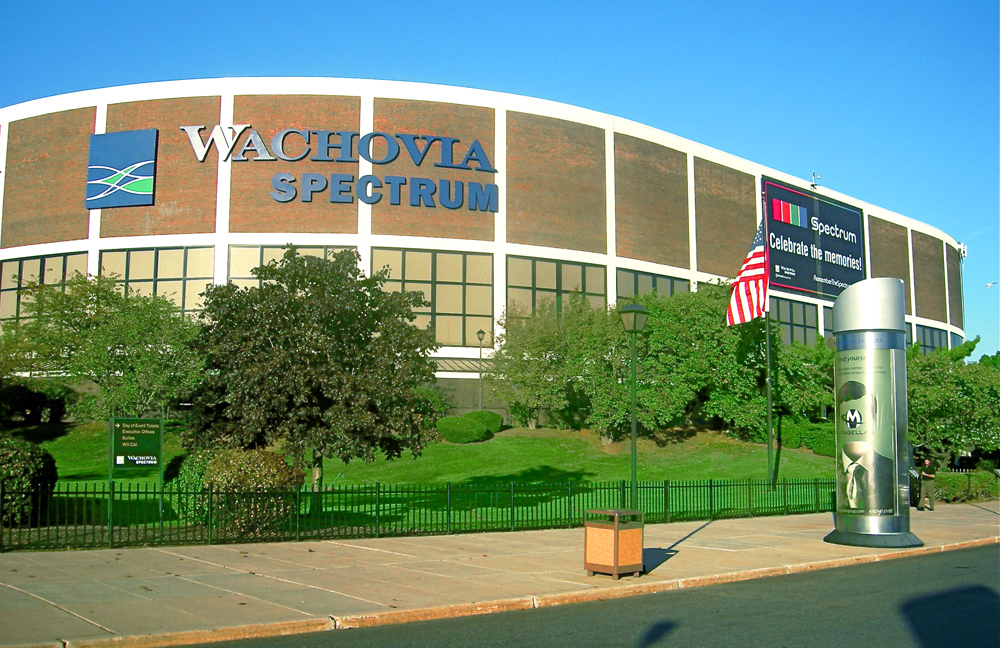
The six-story-high, $12-million Spectrum in Philadelphia was practically brand new. It had opened September 30, 1967 to house the Philadelphia Flyers, one of the six NHL expansion teams. However, mother nature had her say on February 17 and March 1, 1968, when high winds literally raised the roof.
As explained to the Philadelphia Inquirer, the Spectrum’s “metal roof is covered by layers of fiber board and tar paper.” When windows and doors are open while the air vents are closed, “interior pressure then rises” and the roof “balloons.” Winds of 40 mph (or more) “blowing under a ballooned section lifts off the covering.”
This first happened during an Ice Capades performance on February 17. With a crowd of 17,000 inside, a section (150 by 50 feet in size) of the roof was torn off. For the repairs, the Spectrum closed for three days, and four upcoming performances had to be canceled, costing the venue $150,000 in returned sales. At the time, City Managing Director Fred A. Corleto had called it a “freak accident,” saying, “This is a very unusual thing to happen.”
Just two weeks later, at about 9:45 am on March 1, 50-mph gusts ripped three more holes in the Spectrum’s roof covering six sections at the end near Broad Street. The largest hole (40 by 20 feet) was over Section 1, and the smaller holes spanned 8 by 8 feet and 2 by 6 feet. The damage was adjacent to the area under repair from two weeks earlier, and workmen were inside at the time. Spectrum superintendent Wayne Lalor said, “It was just like if a shingle from your roof blew off.” A Philadelphia Inquirer article began with a cheeky, “The Spectrum’s on again-off again roof came off again Friday morning”
At 2:45 that afternoon, Mayor James J.H. Tate met with twelve Spectrum and city officials at the Blue Line Restaurant, where the nervous bus boy dropped their coffee cups. All the press heard was Tate’s exclamation, “The only thing to do is get the hell up there and look at it. We have to make a decision!” He and a few others climbed up on the roof to inspect the damage. Upon their return, Tate announced, “I have concluded that the Spectrum will be required to shut down until such time as the Property Department is satisfied it is safe. It is possible that the wind would lift up other sections of the covering and blow them away also.” Although he first thought the arena might be ready by the Flyers’ game on Sunday afternoon, he later thought it may take more like three weeks. He left the closure indefinite saying, “We have great basketball and hockey teams and we are proud of the Spectrum. But the safety of the people is paramount.” The Philadelphia Daily News reported, “Commissioner [Frank L.] Rizzo ordered a cordon of police to guard the Spectrum against the curious, so they might be spared from injury by flying debris. With Rizzo in charge, the wind dared not kick up again.”
The NBA game scheduled for that evening, between the 76ers and the Los Angeles Lakers, was postponed to be rescheduled for an upcoming Monday. The Lakers arrived at 3:30 and had to turn back around to fly home at 6 pm. The ticket sales were for about 10,000-12,000 attendees. Even more (14,000) planned to attend the Flyers’ match against the Oakland Seals in two days. It was the only Sunday afternoon game on their schedule, so CBS (which had already begun its setup when the winds hit) had no substitute programming. The Flyers played the New York Rangers at Madison Square Garden on Saturday, so they just stayed there for the Sunday game.
Although the 76ers were able to remain local and play at the Convention Hall, the Flyers found themselves homeless for the rest of March. After playing the Toronto Maple Leafs at Maple Leaf Gardens on March 6, they remained there to play a “home” game against the Boston Bruins on March 7. For their remaining five “home” games, the Flyers played at Quebec Coliseum. Coach Keith Allen said, “It’s a tough situation, being forced on the road so much. But we can’t let that interfere with what we do on the ice. We’ve got to make sure we’re up for every game and we play our best, no matter where we’re playing. We’ve come too far to let first place slip through our hands now, and the guys would like nothing more than to reward our struggling owners with an NHL title.” That they did. The Flyers placed first in the West Division (for its first season), earning the newly-created Clarence S. Campbell Bowl.
Meanwhile, Corleto had “called for city engineers to come up with a new roof design” to make the Spectrum wind-proof. He said that “engineers have recommended a slag roof to cover the fiber board and tar paper which has been at the mercy of high winds” because it “probably would be sturdy enough to withstand the blustery gusts that blow across the black topped parking lot surrounding the Spectrum.” They estimated the cost at $30,000.
At the very end of March, the end of the reroofing and the reopening was in sight. Their hired Chicago testing firm concluded that the “strengthened roof should be able to withstand wind pressure.” Corleto announced, “We have evaluated the tests as submitted to us and we have issued a temporary statement of occupancy good for 90 days. Our decision has been cleared with Mayor Tate who is in Washington today.” Although there was no guarantee, he confirmed, “From the tests which have taken place, the Spectrum will be able to meet the types of winds normally expected in this area.” The teams would return the following week – after the 76ers played their already-scheduled game at Convention Hall and when playoffs began for the Flyers. The Flyers returned to the Spectrum for four games between April 4 and 18, when they lost the first playoff round to the St. Louis Blues.
The two teams remained at the Spectrum through the 1995-96 season. Both lost their final games there. They then moved across the lot to the CoreStates Center (now Wells Fargo Center). The AHL Philadelphia Phantoms used the arena until its closure at the end of the 2008-09 season, and the Flyers visited to play two pre-season games as afarewell. The Spectrum closed on Halloween 2009 and was demolished on November 8, 2010.
Additional Sources:
Mike Commito, Hockey 365: Daily Stories from the Ice (Toronto: Dundurn, 2018), kindle version.
Stephen Laroche, Changing the Game: A History of NHL Expansion (Toronto: ECW Press, 2014), 114-115.
Brian McFarlane, Brian McFarlane’s History of Hockey (Champaign, Ill.: Sports Publishing Inc., c1997), 104.
Jeremy Heymsfeld and George Ingram, “Spectrum Closed After New Damage,” Philadelphia Inquirer, 2 March 1968, pp. 1 and 23.
Sandy Padwe, “The House That Blew Its Top,” Philadelphia Inquirer, 2 March 1968, pp. 19 and 22.
Roger Keim, “76ers and Flyers Await Repairs At Spectrum,” Philadelphia Inquirer, 2 March 1968, p. 19.
Nels Nelson, “All Games Are Called At ‘Big Sardine Can,’” Philadelphia Daily News, 2 March 1968, pp. 5 and 20.
Joseph H. Trachtman, “Spectrum Cleared for Reopening,” Philadelphia Inquirer, 29 March 1968, pp. 1 and 50.
Let’s face it, no one outside of the organization expected the Bruins to win Thursday night as they played their third regular season game this year against the Lightning, who sit in first place in the league. Given what happened in the playoffs last season between the Boston Bruins and the Tampa Bay Lightning coupled with their losses in the previous two regular season games this year, the Bruins have fallen short when it comes to playing against Tampa. Add to that the fact that Tampa was riding a ten-game winning streak, and, well, it would have been no disgrace if Boston lost.
However, the Bruins’ players didn’t get that memo.
Krug, Krejci, DeBrusk goal celebration.
While they couldn’t claim that ten-game winning streak like Tampa, they did share a 14-game point streak which was equal to the Bolts. Additionally, there has been something almost magical about a few of the players in black and gold, especially Jake DeBrusk who continues his hot streak, notching seven goals in his last eight games, coupled with five assists for 12 points in those eight games. That included a goal against Tampa on Thursday night.
“Compared to what it was before, I’m just getting some nice bounces right now, it went off the defenseman’s stick into the net, also some great passes so I’m just trying to continue to execute and try to put that puck in the net as much as possible,” DeBrusk said.
Meanwhile, the Bruins’ fourth line has been the starting line in recent games, speaking to the confidence Bruins head coach Bruce Cassidy has in Sean Kuraly, Noel Acciari, and Chris Wagner. They have given a lot of energy to the team as a whole, setting the tempo from the first puck drop, and have continued to play strong giving the Bruins opportunities each night.
Noel Acciari wearing full face shield.
Acciari took a puck to the face on Tuesday night, losing two teeth and cutting both his upper and lower lips. At practice Thursday morning, though he was sporting some stitches and has a good gap in his smile, he had no doubts that he would be playing Thursday night. He currently wears the “bubble” as his full-face shield has been called to protect his face while he heals. Kuraly wore it when he was hurt, and it seemed to turn his game around. It appeared that as Kuraly wore the “bubble” his game began to improve. So perhaps it shouldn’t have been too surprising that Acciari notched a goal and got an assist Thursday night while he was wearing the “bubble.”
“[Kuraly’s] like ‘it’s a lucky helmet – they’re lucky bubbles so good things will come,’ and he was right,” Acciari shared.
“It was a huge goal by [Acciari], that bubble is working for everybody who has it. I might need one of those,” added DeBrusk. Though he currently has no issues in the scoring department.
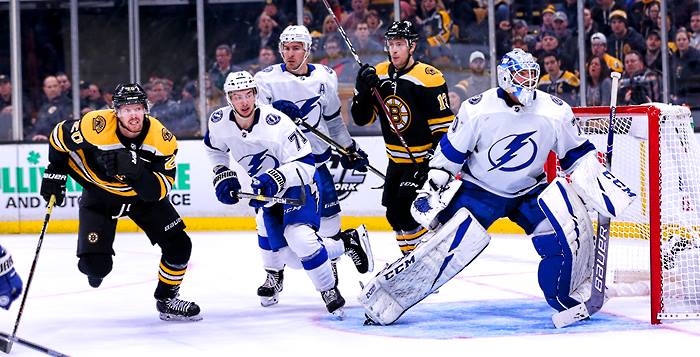
Every line for the Bruins went onto the ice and showed defensive determination in rendering Tampa’s offense to little in the way of shots on Tuukka Rask. In the first period, the Lightning had but four shots, while the second period saw them limited to just five more. It wasn’t until the third period that they hit double digits getting 12 shots which also saw them get their one goal of the game.
At the other end, the Bruins were treating Tampa’s goaltender Louis Domingue like a duck in a shooting gallery, throwing 17 pucks at him in the first and another 15 in the second. They only managed nine on him in the third, though by then it really was just a matter of time.
“[Domingue] played really well tonight and we just couldn’t get discouraged and we had to just keep it coming. The pucks will eventually go in, like you saw in the third, we had that stretch of the quick three goals and it was good for our team tonight,” Acciari said.
It was not quite halfway into the second when DeBrusk put the Bruins on the scoreboard first, but that’s where things stalled until 11:47 of the third. That’s when Acciari put the B’s up 2-0 and less than two minutes later Boston had two more goals by Patrice Bergeron and Brad Marchand for a commanding 4-0 lead. For Domingue that fourth goal may have gotten the better of his emotions. He took his frustrations out on his stick as he whacked it on the goal posts until it broke.
Considering how hard he had played to keep Tampa in the game until that flurry of scoring, it was certainly understandable. And perhaps it motivated his teammates some, as they responded with their lone goal by Anthony Cirelli 37 seconds later.
Yes, the Tampa Bay Lightning still sit in first place in the league, but for the Bruins this game spoke volumes as to their confidence at this point. Of course, they’ve believed strongly within their locker room of what they can do, and now it’s coming together and showing on the ice.
“We’re a tight group and, you know, we all believe in each other. And that road trip definitely helped our confidence and we’re just kind of rolling from there. I think everyone’s bought in and we’ve added two great players and I think we’re just going to continue from there,” Acciari said.


 Prev
Prev