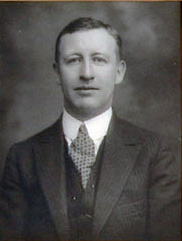
(Photo: Art Coulson, Blackhawks, from Newspapers.com)
In the long-storied career of the Chicago Blackhawks, they have had only one forfeited game, and that one took place 86 years ago on March 14, 1933, the result of a physical disagreement between the Black Hawks’ head coach and general manager Tommy Gorman and referee Bill Stewart.
Victor O. Jones of the Boston Globe shared the experience of the entire evening with the following introduction “Arthur H. Ross, a hockey manager too hardboiled ordinarily to put too much faith in the potency of rabbits’ feet, black cats or mystic numerals, slept last night with a horseshoe under his Hotel Manger pillow. The only reason he was willing to let the horseshoe, a good-luck token given by Fred Hitchman in Toronto—of all places—get that far away from him was because the pocket of his pajamas would not accommodate the charm which last night pulled the Bruins through an evening of unprecedented melodrama. This morning some 10,000 fans who witnessed what was supposed to be a routine game against the tail-end and crippled Chicago Hawks, are vainly endeavoring to recover from a severe case of the jitters. These jitters were induced by various and sundry situations which would shame a dime novel, but whose sum totality can be expressed in the following summary…”
Jones went on to report the scoring which showed how close the Bruins were to actually losing the game, tying it just two seconds from the end of the third period using six forwards, having pulled the goaltender. However, such experiences while not common are not what most of the fans would find the most surprising on the night.
“Something new went down on National Hockey League records today as Boston Bruins were credited with the first forfeited game in many seasons, aftermath of one of the wildest of Boston’s many wild games,” shared The Daily Province of Vancouver.
The Black Hawks were playing the Boston Bruins in Boston, and despite having been up 2-0, were now playing in an overtime period.
“Before [Tiny] Thompson had had a save to make, [Red] Beattie carried down the left center, and got half through the Hawk defense before losing the puck. In the melee which ensued, the rubber drifted out to Clapper, parked 20 feet away, slightly to the right. Dit let one go, but [Charlie] Gardiner half-smothered the puck. Before he could clear, Beattie and Barry rushed up and shoveled the gallant Gardiner and the biscuit into the goal.” Jones described the overtime goal.
As the Black Hawks were vocalizing their displeasure with goal judge, Louis Raycroft, Hawks defenceman Art Coulter decided perhaps actions would speak louder than words and started to shove his stick through the wire netting attempting to “knock some sense into Raycroft” as he poked Raycroft with the butt end of his stick.
Tommy Gorman
The officials broke things up and sent Coulter to the box for 10 minutes. Things were set for the puck to drop to resume play.
“Before the puck could be faced, Referee Stewart skated past the Chicago bench. The next thing anybody knew, Gorman was punching Stewart over the dasher and the referee, his bald dome positively the color of tomato catchup, was trying to fight off Linesman Bill Cleary and four Bruins in order to get at the Chicago manager,” Jones reported.
There is a sort of irony in the idea of Bruins players of this era stepping in to break up a fight.
“Stewart ordered Gorman to the dressing room and the latter waved his team off with him,” stated The Leader-Post.
At that point the score sat at 3-2 in favor of Boston. The goal had been scored at 3:13 of the overtime period and the Bruins were waiting to conclude the 10-minute overtime period. The currently played sudden death overtime system was not brought into the sport until 1983.
After the Black Hawks exited the game, Stewart dropped the puck for a face off and then called a forfeit with the Bruins getting the win with a score of 3-2.
In addition to whatever possible supplemental discipline may have come from the NHL, by having his team leave the ice before the game was finished, Gorman had opened the Black Hawks up to a possible $1,000 fine.
On March 20, the president of the National Hockey League, Frank Calder questioned Gorman and Coulter on just what happened. “Gorman was charged with having taken a punch at Stewart when he declined to disallow the final goal. Gorman contended the goal judge had flashed his light even before the scorer had made the shot,” stated The Winnipeg Tribune.
Calder stated he was not prepared at that point to make any decision about the incident as he had not yet talked to the Boston team and the referee.
However, by March 24, there had still been no type of fines or suspensions handed to Gorman for his actions. Meanwhile, it was reported that since the March 14th game, referee Bill Stewart had not worked a single NHL game.
Additional Sources:
Matt Commito, Hockey 365, Daily Stories from the Ice (Toronto: Dundurn, 2018), Kindle version
Victor O. Jones, “Gorman Gives His His Hawks the Gate and Bruins Win Anyway,” Boston Globe, Wednesday, March 15, 1933, p. 17.
“Fist Fight Breaks Up Bruins-Hawks Game,” The Daily Province (Vancouver, British Columbia), Wednesday, March 15, 1933, p. 28.
“Manager Tom Gorman and Referee Stewart Have Pitched Battle,” The Leader-Post (Regina, Saskatchewan), Wednesday, March 15, 1933, p. 11.
The Winnipeg Tribune (Winnipeg, Manitoba), Monday, March 20, 1933, p. 13.
Victor O. Jones “Cracked Ice” The Boston Globe, Friday, March 24, 1933, p. 18.
From March 13 to March 22, 1950, nine hockey teams came to London to participate in the 17th Ice Hockey World Championships and 28th European Championships. One team that meant to compete was prevented from leaving their home nation, (then) Czechoslovakia.
The two years leading up to 1950 had been turbulent for the Czech team. In 1948, they won silver at the Winter Olympics held at St. Moritz while the Communist party took power in Czechoslovakia. In November, a few short months before the 1949 World Championships at Stockholm, the plane carrying six members of the Czech national team disappeared when crossing the English Channel. Despite the tragedy, the team went on to win gold after defeating Canada for the first time ever. Their return home was triumphant and much celebrated with the train station packed with cheering fans and government officials, like Prime Minister Antonin (“Tonda”) Zapotocky. Czech star Gustav Bubník joked, “If Zapotocky had had his accordion with him, he would have had played for us.” However, the Communists soon banned travel abroad requiring special permission to leave.
In March 1950, the Czech hockey team made plans to attend the World Championship in London. At the last minute, as the team awaited its flight on Saturday, March 11, Czechoslovakia withdrew from the tournament. The explanations became muddled, and the international press questioned the official story. Czechoslovakia claimed that the withdrawal stemmed from England’s refusal or delay in providing visas for two journalists who planned to travel with the team. The players were also told that there was an administrative issue and still thought they would leave when that cleared. Czech player Václav Rožiňák told Czech Radio (in 1968), “In London, we wanted to prove that the team was good, that the world title we won in 1949 had not been a coincidence. But, then some people appeared and said that we would not be going because visas for the reporters had not been obtained. Two days later it was clear we would have to stay. Of course, we were annoyed.” Canadian newspapers, like the Victoria Times Colonist, received news from London that the “mix-up concerning British visas for two newspaper men who were to accompany the team” was cleared up late Saturday when the Foreign Office telegraphed Prague. The team had received their visas on Thursday despite having left their applications to the last moment.
The true reason for the withdrawal seemed apparent right from the start. The Communists in power feared the athletes would defect. They had seen many do so already. In 1949, a couple of LTC Praha (LTC Prague) club team players defected at the Spengler Cup in Davos, Switzerland. One of them was Oldrich Zabrodsky, brother of Vladimir Zabrodsky, captain of the national team. Another star of the 1948 and 1949 national team (and a tennis champion), Jaroslav Drobný, also defected that year. A total of eight Czech hockey players had defected in the four months leading up to the World Championships – two went to Switzerland and six to France then England. The government had already prevented a Czech club game from being played in France because “Too many of our finest sportsmen sent out to represent the national flag remain abroad.” This time (as printed in the Ottawa Citizen), the Communist paper Rude Pravo claimed the withdrawal from the World Championship was in order to “conceal from the British people the increasing well-being of Czechoslovakia’s working people and the high level of their new culture.”
When the tournament started on March 13, without the Czech team, J.F. Ahearne, secretary of British Ice Hockey Association and tournament organizer, explained that the loss of one team would not necessitate shifting the schedule. With nine teams, there could be three even groups of three for the preliminary round.
While disappointing for the Czech team, that would have been the end of the story, but instead, national team members were immediately arrested back in Czechoslovakia. Some sources claim that either the majority or the entire team was arrested right at the airport where they waited to fly to London. However, players have told the alternate story that only a few of them were arrested after a bar fight two days later, on March 13.
When the tournament opened and the team realized they would not be allowed to leave, several players met up at U Herclíků in downtown Prague. Gustav Bubník claimed, “We all felt pretty bold. I have to admit we swore a fair bit and every now and again would even run out onto the little square and yell: ‘Death to the Communists’ or ´We will not let you cut off our wings.’” Rožiňák’s story on Czech Radio continued, “The whole thing peaked at a pub when undercover secret police showed up. Somehow a fight broke out and we ended up at the police station. We thought it was all a joke and thought we’d only stay there over night. Even in court, when we were suddenly found guilty of treason and espionage, we laughed and didn’t take the charade seriously. But the fun was over when we ended up in prison with our hair shaved off. We [realized] then they truly were not going to let us go.”
The international press reported that three or four players had been arrested after vocally protesting the trip’s cancellation at the bar. The Montreal Gazette, for example, listed the players as forward Vaclav Rozniak, reserve goalie Zlatko Cerveny, defenseman Jiro Macelis, and Augustin Bubinek. According to the Gazette, “Several others were reported to have fled.” Later, Czechs affiliated with the national team said that at least one player probably reported to the police and/or Communist government. Apparently, the bar incident involved a fight with 30 police, including one that was punched by a player for objecting to toasts “offensive to the people’s democracy.”
The players sat in Pankrac Prison until their three-day trial in October 1950. By that time, 12 team members faced charges of espionage, plotting to defect, assaulting a police officer, and “slandering the republic.” After the “kangaroo court” “show trial,” every single player was convicted and sentenced to serve six months up to 15 years. They made an example of goalie Bohumil Modrý, somehow cast as the leader of the defection plan, by sentencing him to 15 years. Next were Bubník with 14 years, Stanislav Konopásek with 12, and Rožiňák and Vladimír Korbanov with 10 years. Combined, the players faced 77 years and 4 months working in uranium mines.
National team members first mined uranium at Jáchymov (near the German border) before being relocated to Příbram (near Prague). David Luksu (a Czech sports reporter who interviewed surviving members) explained, “The whole team, besides a couple of players, was sent into jail and they spent about five years in the uranium mines. They were in mines in a little town. They dug materials for atomic bombs for the Soviets.” In 1955, after Soviet leader Joseph Stalin and the Czech president died, the new Czech president, Antonin Zapotocky (the former prime minister) granted amnesty to the players. This was shortly before those at Příbram (with its less-harsh conditions) received the equipment to play a hockey game there. Bubník told an interviewer, “On January 23, 1955, we were unfortunately discharged from the prison, so I did not succeed in playing ice hockey as a prisoner.” Although they were released, many, like Modrý, had serious health issues from the radiation. He and six others died young from complications.
Unknowing of what was to come for their fellow hockey players, the 1950 World Championship began on March 13 and continued as scheduled. The home team, for Great Britain, came in at fourth. Switzerland, the location of the contentious defections of 1949, took home the bronze. The North Americans came out on top with the silver for the U.S. and gold for Canada.
Additional Sources:
Tal Pinchevsky, Breakaway: From Behind the Iron Curtain to the NHL– The Untold Story of Hockey’s Great Escapes (John Wiley & Sons, 2012).
Andrew Podnieks, Where Countries Come to Play (Toronto: McClelland & Stewart, 2013), kindle version.
The end of the final season of the Original Six approached. All six teams played on March 12, 1967, and the results essentially set the rankings. When the season officially ended on April 2, only the second and fourth placed teams had switched positions.
As it happens, the games ended up pairing teams almost by their rank going in. The biggest news came from the top, when the Chicago Black Hawks defeated the Toronto Maple Leafs before a standing-room crowd of 16,666 at Chicago Stadium. Lured out of retirement, Glenn Hall made 39 saves for the shutout. Coach Billy Reay attributed the 5-0 win to his “team’s classic defensive performances – the back and forechecking of the forwards that in turn eased the pressure on the defensemen and the goalie.” In the scoring, Ken Hodge lodged the first two goals followed by a goal from Bobby Hull with Hodge’s assistance. After a blank second period, Lou “Boom Boom” Angotti finished off the scoring with two goals. Captain Pete Pilote told the press, “My knees were shaking out there. You can’t believe the pressure. You fellows said we had it all wrapped up, but we didn’t think so.” Score-starter Hodge said, “I’ve never seen so much desire, so much team spirit. You’d have to be blind not to see it.”
The crowds roared at the final whistle and when the announcer proclaimed, “39 shots on goal for the Chicago Black Hawks, the new National Hockey league champions!” Chicago’s victory was their 37th of the season, which equaled that of the prior season when they finished second in the League. This time, it gave them a total of 84 points, without enough games for the other teams to earn more than 83. Chicago had clinched first place for the only time since they joined the NHL in 1926, after 40 years, 3 months, and 23 days. Coach Reay cheered, “We buried Muldoon!” As the story went, the Blackhawks first coach, Pete Muldoon, put a curse on them when he was fired, saying, “This team will never finish in first place.” Chicago won the Prince of Wales Trophy, which then was given to the first-place finisher, and that meant that it had finally been won by all of the Original Six NHL teams. It was Chicago’s last chance to do so before the big NHL expansion. Hall left early after the game, with the justification, “We’ve got celebrating to do.”
At Madison Square Garden, the second and fourth-placed teams played each other before a crowd of 15,763. At 2:45 of the first period, Jean Ratelle gave the New York Rangers a 1-0 lead. Almost immediately thereafter, a 25-year-old spectator took his own shot at the Montreal Canadiens’ goalie, Lorne “Gump” Worsley. He had brought a carton of eggs and threw one down from the balcony (about 100 feet away). It hit Worsley’s right temple leaving him dazed enough to need first aid. Worsley said, “I didn’t know it was an egg until I felt the gook.” He had to leave the game, so rookie Rogatien Vachon took the ice while Charlie Hodge suited up as backup. Vachon made 23 saves but allowed one more Rangers’ goal (at 12:06 of the third). The game ended in a 2-2 draw. Meanwhile, security apprehended the egg thrower, but Worsley declined to press charges. Soon after, Worsley commented, “The doctor said it was a mild concussion and I still feel a bit dizzy.” His concussion kept him out for six weeks.
The tie was the second in two nights for the Rangers and the third in their last seven games. Still, Canadiens’ coach Toe Blake was satisfied, stating, “That’s another point ahead of Detroit.” He meant that the tie had clinched at least fourth place and a playoff spot.
Finally, the two basement teams, the Detroit Red Wings and the Boston Bruins, played each other. Boston Garden had 12,625 in attendance, the smallest NHL crowd on March 12. Detroit scored one goal in each period, with Gordie Howe starting the scoring and Norm Ullman ending it. Bobby Orr, who was about to turn 19 on March 20th, not only put the Bruins on the board but put himself in the scoring lead for defensemen (and only six goals shy of the Bruins’ goal-scoring record for a defenseman). The crowd honored him with a standing ovation. That sparked a Boston spree with three more goals in the first, two in the second, and one in the third. It seemed like Detroit’s new goalie, George Gardner, was made of holes, but in actuality, he made 32 saves, five more than Boston’s Eddie Johnston.
With a score of 7-3, the Bruins had their first victory in a month. It was their 16th victory of the season, giving them two points more than they earned all of the previous season. This loss prevented Detroit from moving up into fourth place.
Thus, after the three games held on March 12, the NHL rankings basically were decided. After the remaining eight or nine games had been played, Chicago stayed in first place with 94 points (41-17-12). Montreal moved up into second with 77 points (32-25-13). Toronto remained third with 75 points (32-27-11). New York dropped to fourth with 72 points (30-28-12). Detroit and Boston were stuck at fifth and sixth with 58 points (27-39-4) and 44 points (17-43-19), respectively. However, the final Original Six playoffs saw some upsets. Despite finally winning the Prince of Wales Trophy, Chicago failed to even make it out of the semi-finals. They were defeated by Toronto (4-2), who went on to defeat Montreal (4-2) for the Stanley Cup.
The Boston Bruins had just won the Stanley Cup in 1970 and looked well on their way to more excitement from the 1970-71 season. On March 11, 1971, some of their biggest stars – Phil Esposito, Bobby Orr, and Johnny Bucyk – knocked aside some records set by Bobby Hull and themselves.
The record-breaking took place about as far from Boston as possible among NHL opponents, at the Forum the Los Angeles Kings called home. With a 7-2 victory, the Bruins had won 20 games on the road – tying the records of Montreal and Detroit.
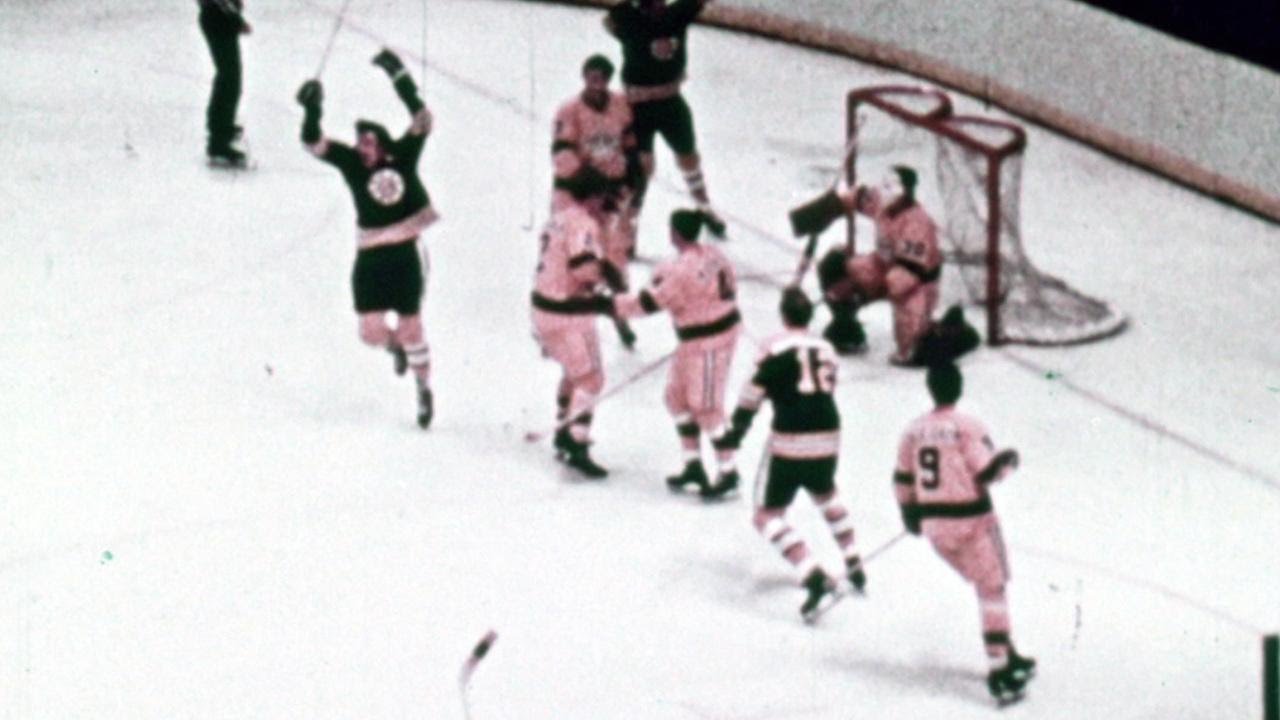
Although the Kings drew first blood, one second shy of four minutes later, at 7:03, Esposito owned a “garbage goal.” From about five feet in front of Denis DeJordy’s net, Esposito tipped in Teddy Green’s shot. That gave Esposito his 59th goal of the season, one more than Bobby Hull’s record of 58. Afterwards, he commented, “It was a good feeling, sure. But all I could think of was that now we were back in the ball game. They scored that early goal and were ahead of us. Now, it’s a tie game. We’re moving again. That’s all I could think of then.” For a moment after his score, the game pretty much stopped as Kenny Hodge ducked into the net to grab the record-breaking puck while Gerry Cheevers and the rest of the team mobbed Esposito, who stood with his arms raised and stick over his head. At the very end of the first period, Bucyk broke the tie with assists from Orr and Esposito.
In the bottom half of the second, the Bruins went on a four-goal scoring spree. To start things off, Orr earned another assist at 12:04. Then, at 15:40, Esposito topped his own record and broke Jean Beliveau’s record for most goals in one season including playoffs. For that 60th goal, the Boston Globe described the full play. “Ken Hodge had set up Dallas Smith, who went to the left of the goal and to the boards. The puck came back towards the net. Phil picked it up, brought it back to the left corner, which Dejordy had vacated and flipped it in. A masterpiece.” Back home in Salem, Massachusetts, Esposito’s wife Linda hosted six ladies to watch the game on TV and listen on the radio. Linda told the press, “He always said he wasn’t thinking of records. That’s Phil’s way. But it couldn’t be any other way. Everywhere he went people spoke to him about the records that were possible to break and you knew he had to be thinking about them. You could tell by looking at him. He would be in serious thought and it had to be about the possibility of the record and when and if he would get it.” Not even a minute after Esposito’s second goal of the night, the Bruins scored again. Like it had begun, the spree ended with Orr, when he scored at 17:49.
The game and the Bruins were not quite done. At 6:11 of the third, Bucyk sunk the final Bruins goal with an assist from Orr. The Kings, unable to make a comeback, managed one last goal about halfway through the final period.
All in all, Esposito had two goals and one assist, having broken the records for most goals in one regular-season and most in one season including playoffs. His 128 points already surpassed his own seasonal record (of 126 points) set in 1968-69. Esposito thought back and ahead when commenting to the press after the game. “Two years ago, when I was the first to score more than 100 points, I felt the pressure more because no one else had ever done it and I wanted to be the first. How many more goals can I score? I’ll be happy with 65, maybe 70.” At the end of the season, he had actually scored 76 goals, which put him in fifth place all-time for most goals scored in one regular season.
Meanwhile, Orr finished the game with one goal and three assists. The 88 assists he had already earned for the season broke a record he set the previous season, 1969-70. His 123 points thus far beat his personal best (of 120 points). When the season ended, Orr had 102 assists, which puts him tied at 12th overall for most assists in the regular season. He and Mario Lemieux are the only ones besides Wayne Gretzky to hold spots in the top 12.
Finally, Bucyk ended the night with two goals and an assist. That gave him 99 points, which passed Hull’s record for most points in a season tallied by a left wing.
The Bruins finished first in the East Division with 121 points (57-14-7). They were the first NHL team to win over 50 games in one season. Unfortunately, that did not help them advance to the Stanley Cup finals. They had to wait until the next season to win the Cup again.
Additional Sources:
John Ahern, “Espo rocks Forum . . . while in Salem,” Boston Globe, 12 March 1971, pp. 23 and 25.
“Espo’s 59th, 60th shatter record in 7-2 win,” Boston Globe, 12 March 1971, pp. 29-30.
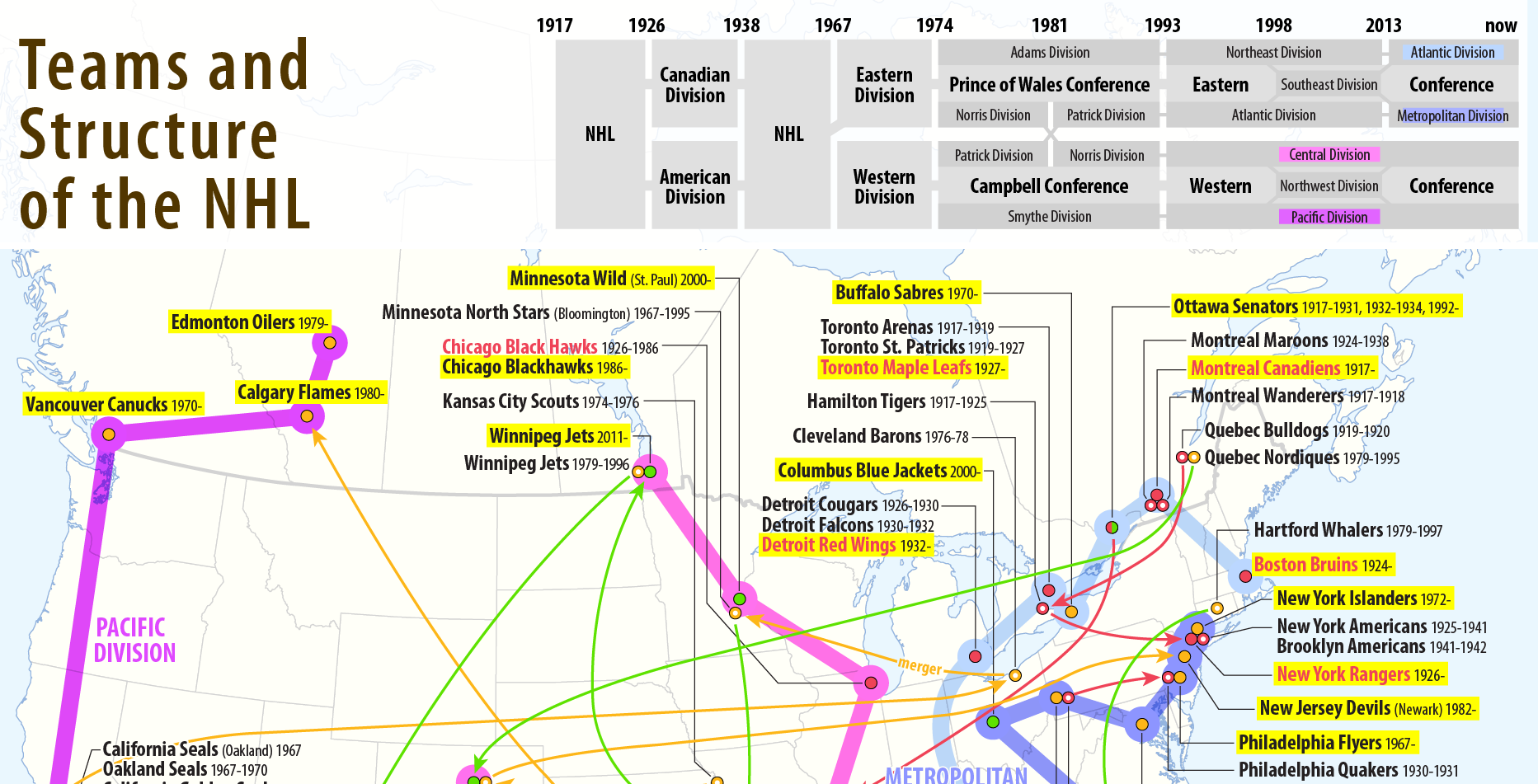
Being traded to a new team, especially one in a far off city, is never easy for a player. For Dennis O’Brien and Dave McLlwain, they had to make that move four times in one season. O’Brien bounced around during the 1977-78 season, and McLlwain’s shuffle occurred throughout the 1991-92 season. They were the first and second to have four teams in one season, and their final move took place on March 10.
Defenseman Dennis O’Brien began his NHL career in 1969, when he was drafted 14th overall by the Minnesota North Stars. He remained a Star until that topsy-turvy 1977-78 season. After only 13 games, on December 2, O’Brien was claimed on waivers by the Colorado Rockies. In his shortest stint, O’Brien only played 16 games with the team before being traded to the Cleveland Barons on January 12. After 23 games, on March 10, 1978, O’Brien was again acquired on waivers.
The Boston Bruins gave O’Brien a home to finish out his career. They picked him up after defenseman Gary Doak was injured by a hard hit by Dennis Hextall. Doak commented, “When Hextall hit me, I swallowed my gum. That’s why Schmautz had to pull my tongue out.” With Doak needing surgery for his fractured left cheekbone, the Bruins needed some defensive help. Boston’s general manager, Harry Sinden, joked that O’Brien “came cheap.” He did not have any goals and only seven assists yet that season, but in 52 games, he had racked up 75 penalty minutes. As Bruins historian John G. Robertson explained, O’Brien was “basically perceived as a reliable, long-term substitute defenseman – and nothing more.”
Not only did O’Brien finish the final 16 games with the Bruins, but he helped them as they made it to the Stanley Cup finals. His three former teams failed to even make playoffs. O’Brien then stayed in Boston throughout the 1978-79 season, but due to his teammates’ healthy status, he did not play during the playoffs. When the WHA merged into the NHL, a draft was held, and the Bruins left O’Brien unprotected. After no other teams snapped him up, he played a mere three games in 1979 before the Bruins cut him loose. In 592 NHL games, he only tallied 122 points but over 1,000 penalty minutes.
Exactly 14 years after O’Brien set the record for most teams in one season, Dave McLlwain matched him. The forward was selected 172nd overall in the 1986 Entry Draft by the Pittsburgh Penguins. At the end of the 1988-89 season, Pittsburgh traded McLlwain to the Winnipeg Jets, and he scored 25 goals the following season.
Then came the 1991-92 season, in which McLlwain played in all four NHL divisions and had to cross the Canadian-American border twice. After the first three games, on October 11, the Jets traded him to the Buffalo Sabres. No sooner had he begun settling in at Buffalo, when on October 25, after just five games, he was traded to the New York Islanders. Unfortunately, not everything made each move. McLlwain explained, “I had a car that was in Winnipeg, shipped it, and it didn’t pass U.S. standards. … My father picked it up and sold it in a few days, so I got lucky there with my car. I wound up buying something in New York, but I couldn’t get it back across the border when I went to Toronto. Little things like that honk you off. I leased a vehicle and you are not supposed to bring leased vehicles from one country to another. I had to take a hit on the buyout, which the team helps me pick up a bit. So I left it here (in the U.S.). I think I had three different leases that year. The teams are always responsible for it, but it’s the hassle of trying to get your money.” In addition to the car trouble, McLlwain had just rented an apartment in Buffalo when he had to move to Long Island. “I just rented the night before I got traded. They (the landlord) let me out of it, but my furniture was just arriving and I ended up leaving it in storage in Buffalo and sent it home to Ontario at the end of the year.”
On March 10, 1992, after 54 games, the Islanders traded McLlwain to the Toronto Maples Leafs. He headed back to Canada to join his fourth team that season. Coach Cliff Fletcher said that McLlwain “adds speed to the team. He’s a good checker and penalty killer.” He had 9 goals and 16 assists at that point in the season. McLlwain finished the final 11 games with Toronto and the whole of the next season. “It’s hard mentally,” McLlwain said of making so many moves. “You start doubting yourself and start doubting your confidence. It was just a year I would like to put behind me. I guess you got to take the positive out of being traded, that there always are teams looking at you and want to use you.” He continued, “Yeah, it is tough, you take a lot of ribbing, but you go on with it. Once you leave a city, you try to pretty well take everything out of there and move to the next one.”
McLlwain’s journey did not end with Toronto. In October 1993, he was claimed by the Ottawa Senators in the Waiver Draft, only to be traded to his original team in Pittsburgh on March 1, 1996. That summer, he signed with the Islanders again but only played four games with their NHL team and most of the season with their farm team. He ended his NHL career after 501 games (100G, 108A, 207P). In 1997-98, he began his European career with Landshut EV in Germany. He then spent two years in Bern’s Swiss A League before, in 2000, permanently joining the Cologne Sharks (Kolner Haie) of the Deutsche Eishockey League.
Additional Sources:
Steve Marantz, “Doak facing surgery,” Boston Globe, 11 March 1978, pp. 20 and 22.
“Hockey: National Hockey League,” New York Daily News, 11 March 1992, pp. 60-61.
Joe LaPointe, “Hockey: Dealing of Baumgartner Called Strictly Business,” New York Times, 11 March 1992.
Dave Fuller, “Leafs add some muscle,” Toronto National Post, 11 March 1992, p. 35.
When most people hear the name of Theo Fleury today, they immediately think of his autobiography Playing with Fire that was published in 2009 in which he admitted to having been sexually abused by his hockey coach Graham James. Despite an attempt to return to the NHL that same year, he announced his official retirement from hockey September 28, 2009. Unfortunately, his addictions and the subsequent disciplinary issues arising from his alcoholism and drug use overshadowed what was an amazing NHL career that ended in April 2003 when he was once again suspended by the NHL for violating their substance abuse program.
And yet the Oxbow, Saskatchewan native had such talent on the ice. In his 1,084 NHL games he scored 455 goals and added 633 assists to garner 1,088 points. Of course, he also had 1,840 penalty minutes to go along with those goals. He was drafted by the Calgary Flames in 1987 in the eighth round (166th overall). He would go on to play 11 seasons with them before bouncing around from team to team over the next five seasons: one season with the Colorado Avalanche, three seasons with the New York Rangers, and the last with the Chicago Blackhawks.
Internationally, Fleury won a gold medal at the 1988 World Junior Championship with Team Canada; a silver medal with Team Canada in the 1991 World Championship; a gold medal in the 1991 Canada Cup and a gold medal in the 2002 Olympics. During the 2005-06 season he played with the Belfast Giants of what is now known as the Elite Ice Hockey League, the British ice hockey league, in which the team won the championship. That year Fleury was the top points scorer with 81 points and was named Player of the Year.
On March 9, 1991, Fleury made NHL history setting a record that still stands 28 years later. It was during this road game against the St. Louis Blues that Fleury contributed a hat trick to the Calgary Flames 8-2 win—a hat trick of shorthanded goals.
“Fleury, who also had a hat trick in a 7-4 victory over the Blues on Feb. 17 in Calgary, ripped a slap shot over the right shoulder of Vincent Riendeau for the only goal of the first period at 5:52. At 24 seconds of the third period he fought off defenseman Scott Stevens and scored from close range. He completed his fourth hat trick of the season, getting his 44th goal when he stole the puck at the St. Louis blue line and scored unassisted at 17:25,” reported the Southern Illinoisan, a Carbondale newspaper, on March 10.
Fleury also got a helper on Doug Gilmour’s goal at 14:52 of the third which had put the Flames up 7-4. He rounded out the game by adding a 10-minute misconduct 27 seconds after scoring that third shorthanded goal.
“It was the sixth straight victory for the Flames, who are 12-1-2 in their last 15 games… There were several fights in the final minute, and four separate altercations took place with five seconds to go,” added the Southern Illinoisan.
In Fleury’s 79 games during the 1990-91 season, he scored 51 goals (which included seven shorthanded goals, and five hat tricks). He added 53 helpers for 104 points that season.
Additional Sources
Theo Fleury with Kirstie McLellan Day, Playing with Fire (Chicago: Triumph Books, 2009).
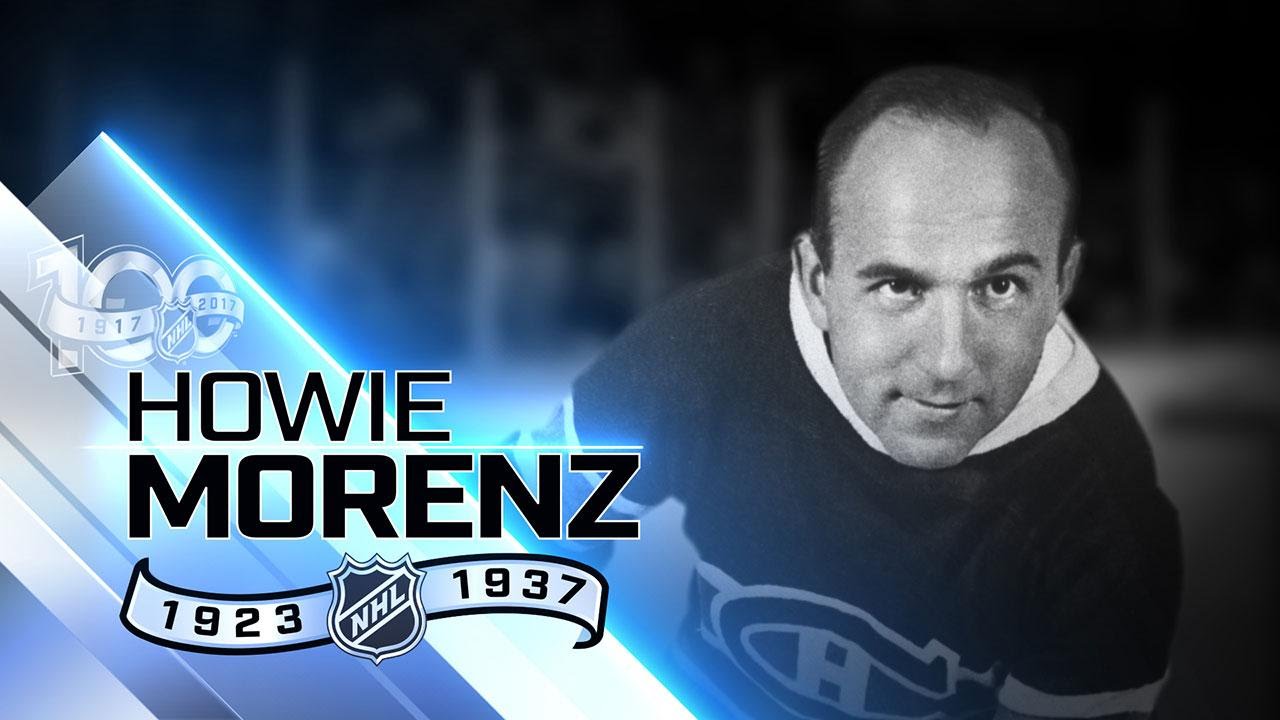
If hockey had royalty, then certainly Howie Morenz would be among them. In many ways he was the first true superstar of the National Hockey League and while he had other nicknames, he was often referred to as the “Babe Ruth of hockey.”
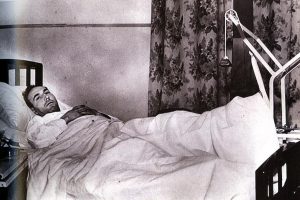
Morenz’s career had come to an uncomfortable end when, on January 28, 1937, he shattered his left leg during a game against the Chicago Black Hawks at the Montreal Forum. He had tripped along the boards and found himself on the ice under Chicago’s defenseman Earl Seibert, who had finished a check on him. After being taken to St. Luke’s Hospital it was discovered that his leg was fractured in four places. He was still in the hospital when, on March 8, 1937, he died of a coronary embolism (blood clot).
Sadly, the doctor had diagnosed the clots in Morenz’s leg that morning and Morenz was scheduled for surgery to be performed on March 9, but that would turn out be too late. Blood clots are a serious issue and doctors now understand that they can travel from the legs to the arteries between the heart and the lungs and are often fatal.
Over the years many stories arose that he died of a broken heart when it became clear he would never play hockey again or that he had committed suicide, but none of those things were true.
However, his death stunned the hockey community. Many would feel the loss of this player throughout the NHL. And for the Black Hawks Seibert, he took his guilt to his own grave in 1990, despite having nothing to be guilty of. His hit had been perfectly clean, something that Morenz had stated in the hospital. The damage to Morenz’s leg was the result of his skate getting caught in a rut just before Seibert’s hit.
“Play against him? I killed him,” Seibert told a reporter one time who asked if he had squared off against Morenz.
And though Morenz had insisted it wasn’t Seibert’s fault, the defenseman would be booed for years afterward by the Montreal fans.
The Gazette on Tuesday, March 9, announced the death of Morenz on the front page—“Howie Morenz Canadien Star, Dies Suddenly.”
“Howie Morenz, famous Canadien Hockey Club star, numbered among the all-time hockey greats, died suddenly in St. Luke’s Hospital about 11:30 o’clock last night, victim of a heart attack. Morenz, who returned this season to the club with which he broke into the National Hockey League in 1923-24 after a two-year absence, was again climbing to his former heights of brilliance when a fractured leg cut short his sensational comeback on January 28 last. He had been in hospital ever since.”
Further coverage elsewhere in that issue included quotes from many of the NHL’s leaders at the time.
“I can’t believe it… It’s an upsetting thing. And it is certainly hard for an athlete of Howie’s type to go so quickly. It is a terrible loss to the game and a terrible loss to Canadiens themselves. I certainly feel sorry for his family, for Howie thought a lot of his young boy, who surely will miss him,” said Conn Smythe, general manager of the Toronto Maple Leafs.
“This is a terrible loss to organized hockey. Myself and everybody in hockey is going to feel a deep sense of personal loss at Howie’s death. He was one of the all time greats of the game and it was only for the good of that game that the Rangers let him return to the Canadiens he loved so well. I knew he was in bad shape but his death comes as a great shock,” shared Lester Patrick, general manager of the New York Rangers.
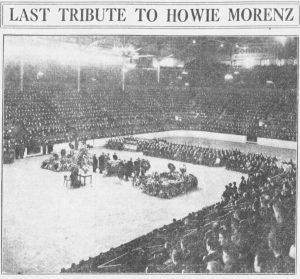
Howie Morenz’s Funeral at the Forum (Photo: Newspapers.com)
Morenz’s funeral, which was held three days later on March 11, would actually take place at the Montreal Forum, with his casket lying in state on the ice.
“’Peace hath her victories no less renowned than war.’ It follows that peace also has her heroes. Ten thousand men and women and small boys paid homage to one of them yesterday afternoon when they thronged into the Forum to take part in the funeral of Howie Morenz. The ice he used to skate over was covered with grey boards. The centre where he played so brilliantly as to bring the crowds out of their seats with cheers was heaped with flowers—so strange in a hockey arena—and he lay there, still, in his coffin. At his head and at his feet stood his friends and admirers. All around the rink, tier on tier, to the very rafters, were gathered the fans, strangely quiet,” described The Gazette of his funeral.
The service was even broadcast over the radio and the road the cortege took to the cemetery was lined as well. It was estimated that 25,000 mourners came to honor the fallen hockey great.
So great was his legacy to the sport that he would be one of twelve inducted into the Hockey Hall of Fame in its inaugural year in 1945.
The Mitchell, Ontario native died at the age of 34, having played in the NHL for 13 seasons in which he played 550 games, amassing 271 goals, 201 assists for 472 points in regular season play. He also played 39 Stanley Cup playoff games notching 13 goals and nine assists for 22 points. He won the Hart Memorial Trophy three times in 1928, 1931, and 1932. In many ways his name is synonymous with the Montreal Canadiens.
Additional Sources:
The Gazette (Montreal, Canada), Tuesday, March 9, 1937, pp. 1, 14.
The Gazette (Montreal, Quebec), Friday, March 12, 1937, pp. 13, 15.
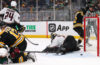
The Boston Bruins looked like their point streak was perhaps coming to an end as they played the Florida Panthers on Thursday night. Going into the second intermission the Panthers had a 2-1 lead and seemed to be dictating the game. Even when the Bruins tied things in the third, the Panthers came right back, going up a goal.
However, with 2:36 remaining in regulation, Florida’s Mike Hoffman was sent to the box for a tripping penalty, and 23 seconds after the Bruins pulled Tuukka Rask for the extra man on the power play, Matt Grzelcyk notched a tremendously important game-tying goal with 37 seconds left on the clock.
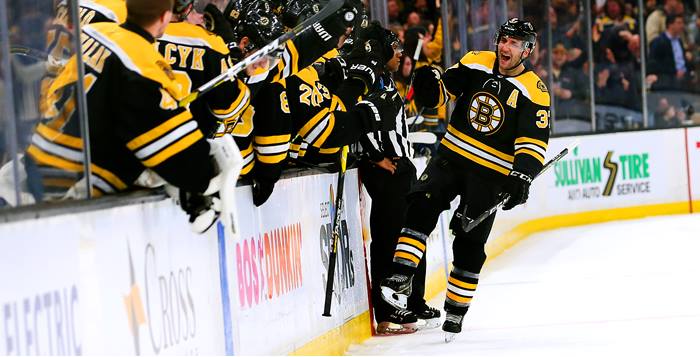
Having been down 2-0, it looked like the Bruins would now be assured at least one point if they could hold on for the remaining 37 seconds to push the game to overtime. Doing so would garner them a continuation of their point streak. However, Patrice Bergeron, who had already scored a shorthanded goal earlier in the third to tie the game at two each, wasn’t content to just kill off the clock. Instead, he scored his second of the night with seven seconds remaining in the final frame to give the Bruins their first lead of the game.
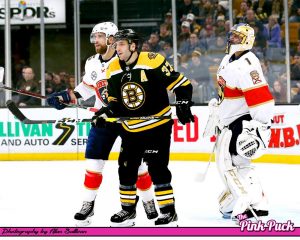
Patrice Bergeron in front of Roberto Luongo
“Again, fall behind, not a good formula. Listen, our guys have a lot of resiliency, a lot of belief in themselves. Again, we lose another player out of our lineup that’s been real good for us scoring wise, but we manage to get four. [Grzelcyk] is the guy tonight that you probably don’t suspect, gets on the scoresheet. Again, [Bergeron] I thought was, you know, leadership off the ice but real good on the ice. He was very good on the bench about ‘keep playing for the next one,’ and they wanted it,” shared Bruins head coach Bruce Cassidy after the game.
The Florida Panthers had dictated the game, outshooting the Bruins much of it, and generally stymying the black and gold, limiting what few chances they had to outside shots that Roberto Luongo could see and deny.
“We have some looks, then we get into the line-rush game, maybe, where they’re good. So, that’s the part where you’d like to stay with the same formula all game, but they’re human, and it’s not easy to do that every night. And then we got back to it. And then we win, and it’s like the way we win: different guys contributing, shorthanded goal, so never quit. I love that about the guys. They play for one another every night. It’s not always perfect, but they’re great that way, and they’re happy for each other. You don’t see that in every team, trust me. Some guys are not happy for others. They want to be the guy, and I think our guys are genuinely happy for each other’s success,” continued Coach Cassidy.
His comments to the joy that the players take regardless of who scores is obvious both on the ice after the goal as well as on the bench and later in the locker room. It is one of the things that makes this team tick and speaks volumes of the atmosphere that the core leadership has instilled, especially in a team with so many young players who on other teams may feel jealous of the success of a younger player or one who hasn’t spent much time with the NHL club. However, you will not see that attitude with the Bruins.
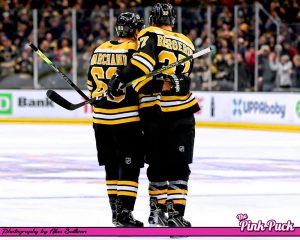
Brad Marchand and Patrice Bergeron
“We’re all very happy for one another. You know, when you look at teams that are good and make good runs, everyone is happy for each other and pushes each other. You know, we’re just as happy if the defense scored or the forwards scored, or the goalie scored. Doesn’t matter to us, as long as we win games. I mean when you have team success, everyone has success, so it goes hand in hand, and we just want to win. That’s all we’re about in here and doesn’t matter how we do it,” stated Brad Marchand.
Of course, it would be better if they didn’t give their opponent a two-goal lead before they decide to take control and work to get the win. They went down by two on Tuesday when they played the Carolina Hurricanes, who were representing their roots by wearing Hartford Whalers throwback jerseys that night. And a slow start on Thursday saw them ultimately having to dig out of a similar hole against the Panthers.
“Yeah, I think that’s fair to say. I think we’ve – in this, lately the last few weeks – the way that we’ve been playing is always finding ways and it’s not always going to be perfect, it’s not always going to be your best game, but you’re one shot away from being back in the game. That’s what we talked about in the third. I thought we were better but then giving up that third goal, we could have crumbled but we stuck with it and we found a way. So, we’re going to definitely take it, but we also know that we’ve got to be better,” Bergeron said of their tenacity to pull out the win on Thursday.
Adding to the woes of the team, who played a slow and undisciplined game that allowed the Panthers to not only score first but also have a number of power play chances, was the announcement before the game that hot winger Jake DeBrusk would be out of the game with a lower-body injury that was day-to-day. A few weeks ago they had lost David Pastrnak, the team leader in goals scored, and now they would not have DeBrusk’s hot hands to help the team. However, their “next man up,” mentality coupled with their belief that it doesn’t matter who scores the goal as long as he’s wearing black and gold, has gone a long way in helping this team step up at the most difficult of times.
It certainly wasn’t the best recipe for success, but they definitely gave their fans a rollercoaster ride during the third period that undoubtedly had them soaring high when the four-time Selke-winning Bergeron did what he does so well, ensuring that the Bruins point streak lives to fight another day.
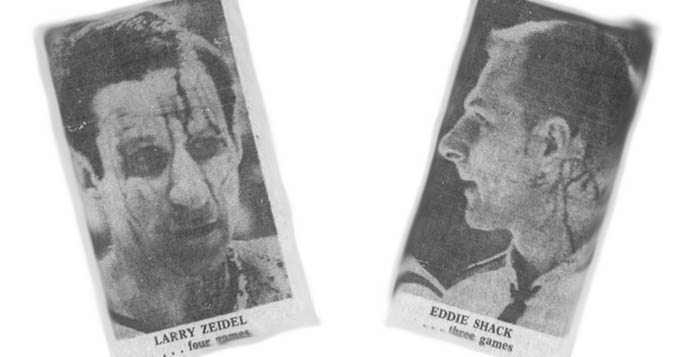
(Photo: Zeidel and Shack as found on Newspapers.com)
If you look closely at the players during a hockey game, you can make out that they are talking to one another. Of course, unless the station does a “Mic’d Up” episode, you may never know what they are saying, and generally what gets aired is the tamer of the taunts and comments.
On March 7, 1968, the taunts hurled toward Philadelphia Flyers Larry Zeidel were anything but tame. Zeidel, who was born in Montreal, Quebec in 1928, was the grandson of Romania Jews who did not make it out of the Holocaust. According to Zeidel they were burned in the concentration camps. From 1951 to 1954, he played with the Detroit Red Wings and the Chicago Blackhawks before then playing with the Cleveland Barons of the AHL during the 1966-67 season.
When the first expansion took place to go from the Original Six teams to a league of twelve, he created a 10-page pamphlet “A Resume with References and Testimonials of Larry Zeidel, Professional Hockey Player, Sales Promotion and Public Relations Executive” and sent it to each of the new teams. It worked and he ended up with the Flyers, which is how he came to be playing on March 7, against the Boston Bruins club.
Though it was a home game for the Flyers, some issues with the Philadelphia Spectrum arena’s roof forced the teams to play at the Maple Leaf Gardens that fateful night.
“Nearly the whole Boston team tried to intimidate me about being the only Jewish player in the league. They said they wouldn’t be satisfied until they put me in a gas chamber,” Zeidel said. “Boston started pulling this kind of stuff when we played them earlier in the season. I didn’t let it get to me even though it hurt me to hear it. It was bad on my part to try and ignore it then, because things only got worse and they really got bad just before the start of our last game in Boston Garden [January 20, 1968]. That bit about me being a ‘Jew boy’ is music to my ears, but when they brought up the business of the gas chamber and extermination, well, I didn’t buy it.”
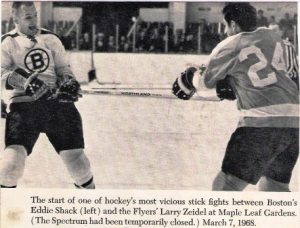
With the taunts increasing, Zeidel finally decided to deal with it on the ice, cross-checking the Bruins’ Eddie Shack during the first period of the game in Toronto that set off a “nasty stick-swinging incident.” While the two had a history that dated back to their days in the AHL, it was said that Shack had not made the comments and he just had the misfortune to be the one who made physical contact with Zeidel.
“TORONTO – Boston Bruins defeated Philadelphia Flyers 2-1 here last night in a National Hockey League game which was marred by wild stick-swinging duel between Bruins’ Eddie Shack and Larry Zeidel. Shack and Zeidel were each given match penalties in the first period after exchanging a series of wild swings after colliding at the Philadelphia blue line. The match penalties an automatic $100 fine and possible suspension,” reported The Gazette.
However, according to fellow Flyer Andre Lacroix, Shack wasn’t as innocent as the reports made him out to be.
“From my perspective, it was Shack saying something like ‘I’m going to get you, you [bleeping] Jew.’ With all of the reporters around, you would think that somebody would have found out who said it.”
As was later reported in The Windsor Star, “Zeidel, one of two Jewish players in the NHL, and his wife Maria said in published statements that the Boston bench had been riding the defenceman because of his religion. However, both exonerated Shack of this charge.”
On March 9, National Hockey League president Clarence Campbell suspended Zeidel, who as the instigator of the stick-swinging, received a four-game suspension while Shack received just three games. They were also each fined $300. And ended up with quite a few stitches each. Campbell wanted to send a message.
“This was undoubtedly the most vicious stick-swinging episode the league has experienced in many years and both of the principals are very fortunate that their injuries were of a minor nature. The force of any one of the blows could have easily have produced a disaster. This conduct is absolutely intolerable. A very realistic effort will be made to stamp out such conduct in the future. This incident was so vicious, the fines were not sufficient and thus the suspensions.”
But what of the taunts that may have been the real cause of Zeidel’s going after Shack?
“Campbell said today [March 13] he is currently attempting to get an authentic claim that the brawl was precipitated by anti-Semitic remarks hurled at Zeidel by Boston players. ‘I must first ascertain that these remarks were made and by whom,’ Campbell said,” The Windsor Star reported.
Campbell went on to suggest that if it was true that it paralleled similar experiences faced by French-speaking players of the Montreal Canadiens over the years in various arenas.
“I think this type of baiting is contemptible and there is no place in the game for it. However, every small town in the U.S. now has an anti-defamation league and it gains attention,” Campbell said. “I think it curious that this has being <sic> going on since the 20th of January and Zeidel has said nothing about it.”
Interestingly enough on Friday, March 15, Edward M. Snider, chairman of the board of the Philadelphia Flyers, and himself Jewish, said “he was satisfied that the stick fight between Zeidel … and Shack … was triggered by ‘rough hard-hitting hockey play,’ and not be anti-Semitic remarks,” reported the Star-Phoenix of Saskatoon.
“It appears that in the heat of battle during an important game, Larry might have struck the first blow,” Snider said. “Shack had nothing to do with any vicious name-calling and reports of competitive baiting were blown far out of proportion.”
However, at least two attendees of the game, Mary Patterson who was sitting near the Boston players’ bench, and Mike Meade and his wife, who were sitting near the ice, sent their statements of what they heard to NHL president Clarence Campbell.
“The remarks were uncalled for and ignorant. When they were putting Zeidel off the ice, he was called over and over again a ‘. . . Jewish . . .’” stated Patterson.
“After the fight, involving Zeidel, I heard one Boston player shout to him ‘you Jewish . . . you Jewish . . .’” said Meade’s statement, though in the statement he not only included the actual obscenities, he also named the Boston player, which was not reported in the Star-Phoenix.
Regardless of the witness statements, Campbell came out and agreed with Snider that it was all the result of hard hits in the game.
As can be seen today, ethnic and other slurs unfortunately still occur occasionally on the ice at many different levels of hockey. Additionally some of them come from the fans in the stands. And when the players do use them against an opponent, in some instances they may find that the players unite in solidarity with their teammate, such as has most recently been seen when Divyne Apollon II experienced them and his Metro Maple Leafs rallied around him.
Additional Sources
Stephen Laroche, Changing the Game: A History of NHL Expansion (Toronto: ECW Press, 2014), 115, 123-126.
Brian McFarlane, Brian McFarlane’s History of Hockey (Champaign, Ill.: Sports Publishing Inc., c1997), 104.
The Gazette (Montreal, Quebec), Friday, March 8, 1968, p. 23.
The Windsor Star (Windsor, Ontario), Wednesday, March 13, 1968, p. B2.
Star-Phoenix (Saskatoon, Saskatchewan), Friday, March 15, 1968, p. 20.
Star-Phoenix (Saskatoon, Saskatchewan), Monday, March 11, 1968, p. 12.
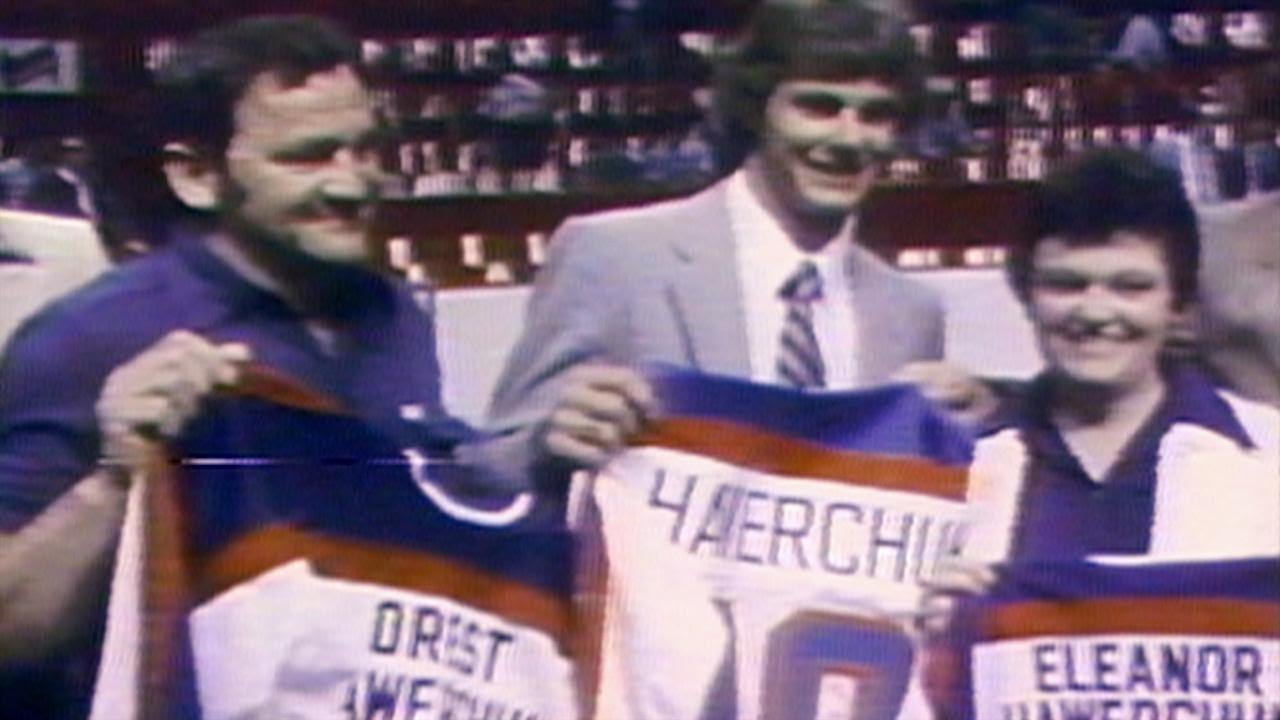
Dale Hawerchuk was the gift that kept on giving to the Winnipeg Jets. In return for their lousy, last-place finish (9-57-14) in 1981, they were able to draft Hawerchuk first overall. Having earned 103 points in his first season, Hawerchuk was the youngest to reach 100 and received the Calder Memorial Trophy as top rookie. Then, on March 6, 1984, Hawerchuk set an assist record that still stands.
That night, the Jets visited the Los Angeles Kings at the Forum to play before an audience of 8,392. The visitors had Marc Behrend, goalie for the 1984 U.S. Olympic team, in net for his second start. The home team had Markus Mattson in net during what would be his last month in the NHL (since joining in 1979). Neither team was having a super stellar season, but the Kings were especially struggling and unlikely to make playoffs. Coach Roger Neilson said, “Tonight was our last gasp. If we would have won all three games against Winnipeg we would have had a slim chance.”
The Jets took the lead by scoring the only goal of the first period. Teammates Paul MacLean (right wing) and Morris Lukowich (left wing) began their back-and-forth with MacLean’s goal from Lukowich’s assist. They continued their success throughout the second period thanks to center Hawerchuk’s help. At 3:31, Lukowich scored on Hawerchuk’s first assist of the night. After two Kings’ goals (by Terry Ruskowski and Charlie Simmer) tied the scoring, Hawerchuk assisted defenseman Wade Campbell at 7:45. Then MacLean came out to score a power-play goal at 9:29 followed by earning his hat trick at 13:27. Naturally, Hawerchuk set up both. Just as the period was about to end, at 19:51, both Hawerchuk and MacLean helped Lukowich score again. After all that excitement, the Jets scored a final goal at 8:34 of the third while the Kings notched one more at 13:43. Thanks to the five-goal spree in the middle, the final score was 7-3.
Hawerchuk’s five assists in one period set a record that has not been broken despite numerous players notching three or four assists at a time. After being named captain going into the 1984-85 season, Hawerchuk was traded to the Buffalo Sabres in 1990. He signed with the St. Louis Blues in 1995 but was traded to the Philadelphia Flyers. Plagued by arthritis in his hip, Hawerchuk retired in 1997. He had spent five seasons in the top ten for assists and ended his career with a total of 891 assists, which places him 21st in the all-time list. All those assists (with 518 goals) added up to 1,409 career points, which places Hawerchuk 20th overall. He had recorded more than one point each game for 13 seasons. For all his accomplishments, Hawerchuk was inducted into the Hockey Hall of Fame in 2001.



 Prev
Prev





.jpg)

