For fans, what’s not to love about overtime? It basically means more hockey without any additional costs and that at the least your team earns one point if not two. Now what if the amount of overtime doubles or triples the length of the game? In March 1936, the Detroit Red Wings and Montreal Maroons and their fans found out what it felt like to push through the longest NHL game.
About 9,000 showed up at the Forum in Montreal to watch the first game of the best-of-five semi-final series. According to the Montreal Gazette, “most of them stayed to the bitter end, every minute watching and waiting for one or other to crack.” The game began at 8:30 p.m. on Tuesday, March 24, and those diehards remained until it ended at 2:25 a.m. on Wednesday morning.
After the 60 minutes in regulation, the Red Wings and the Maroons had both failed to score. With a completely blank scoreboard, the game went into overtime. As the Gazette summarized, “It was not a spectacular game by any means. It was more a doggedly-fought defensive tussle, in which caution reigned supreme. Relentless back-checking prevailed throughout, stout work by the rival defencemen played a prominent part every step of the way, and backing it all up were the invincible displays of the goaltenders.” The game had not even had that many penalties, with only eight in regulation and one to come in all of the overtime.
The overtime sessions kept coming as the teams could not get anything past the goalies. The Detroit Free Press described the exhaustion creeping in as the overtime dragged on. “Both teams started the sixth period just pretending they had energy.” After that session, they had essentially played two full games back-to-back. The Free Press continued, “As the game went into its eighth period it was evident that a break probably would decide it. They players were missing passes that normally would be easy.” As the sixth overtime session began, the Free Press noted, “Once again the two teams sent in their first lines as the ninth period opened. The two clubs were playing like a team of flagpole sitters. They were trying hard but they found it difficult to skate and shoot.”
Despite the difficulties, one player managed to finally break the all-null tie. At 16:30 of the sixth overtime, Detroit rookie Modere “Mud” Bruneteau shot on the Maroons’ net, and the “puck bobbled up over [Lorne] Chabot’s foot to break the scoreless deadlock.” The right wing had been called up from the Detroit Olympics for that season and then remained with the Red Wings until 1946. Over in the opposite net, Detroit’s Normie Smith had been considered the team’s weakest link, but he blocked 90 shots to earn the NHL’s longest shutout. Oddly enough, Chabot (who blocked 67 shots) had previously held that record.
In total, the game lasted 176 minutes and 30 seconds. The Detroit Free Press exclaimed that the game “shattered all records for longevity in hockey battles.” Similarly, the Montreal Gazette reported, “all records for prolonged overtime play had been eclipsed.” Before that, the record had been held by the Toronto Maple Leafs and Boston Bruins. Their game at Toronto on April 3, 1933 lasted 164 minutes and 46 seconds, which still remains the second-longest NHL game after the 1936 Detroit-Montreal game.
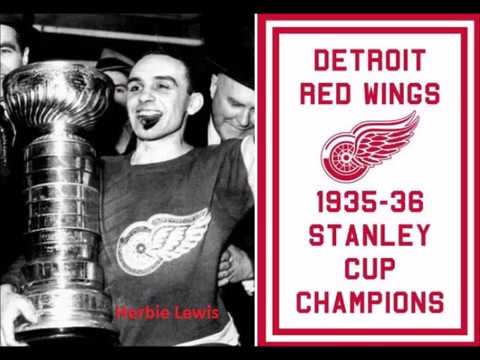
Although the Maroons had won the Stanley Cup just the year before, the 1935-36 season would be Detroit’s. The Red Wings swept the Maroons and went on to defeat the Maple Leafs (in four games) to win their first ever Stanley Cup championship.
Additional Sources:
Mike Commito, Hockey 365: Daily Stories from the Ice (Toronto: Dundurn, 2018), kindle edition.
Brian McFarlane, Brian McFarlane’s History of Hockey (Champaign, Ill.: Sports Publishing Inc., c1997), 40.
Marc T. McNeil, “Bruneteau’s Tally Gives Detroit Win in Sixth Overtime,” Montreal Gazette, 25 March 1936, p. 14.
Doc Holst, “Red Wings Win Record Game, 1-0,” Detroit Free Press, 25 March 1936, p. 19.
What a strange but jubilant feeling Wayne Gretzky must have experienced as he surpassed his idol, Gordie Howe. Everything he did in his career, even choosing No. 99, he did in pursuit of the greatness of No. 9. Gretzky scored his first NHL goal on October 14, 1979, at the start of Howe’s final professional season. That goal was scored on the Vancouver Canucks, the same team on which Gretzky scored his 802nd NHL regular-season goal on March 23, 1994. Howe had held the record with 801 regular-season goals at the end of his NHL career. The way Gretzky smashed through scoring records, it had only been a matter of time before he truly owned the moniker “The Great One.”
The day approached when, on March 20, 1994, Gretzky tied Howe’s NHL career total of 801 goals. The tying goal was made on goalie Arurs Irbe at San Jose. At this point, Howe seemed less-than-pleased because he thought his WHA goals should count towards his record. Those six seasons gave him another 174 goals for a total of 975.
On March 23, 1994, a sellout crowd of 16,005 filled the Forum to watch Gretzky and the Los Angeles Kings host the Vancouver Canucks. Among that crowd were actors Goldie Hawn, Kurt Russell, Martin Short, and Tom Hanks (who received a standing ovation). Los Angeles’s mayor, Richard Riordan, also made an appearance. The game proceeded until 4:31 of the second period before the Kings finally scored the first goal. That was followed by two Canucks goals. Gretzky tied the game to no avail. The Canucks scored again before the period ended then twice again when the third began. The Kings managed one more goal, but the Canucks ended the game with a final tally.
Vancouver beat Los Angeles 6-3, leaving the Kings tied for ninth place in the Western Conference. The Canucks had a much better season. They defeated the Kings five times in six games. Vancouver went on to the Stanley Cup finals, where they lost to the New York Rangers at the end of seven games. As would become something of a habit, Vancouver rioted after the loss.
Gretzky’s goal was the real big news for March 23. He had an inkling it would be his night to break Howe’s record. His agent, Mike Barnett, told the press, “He called it. It was a big goal at the time and he wanted it to be a big goal. He has a flair for the dramatic. He has always been able to take it to a bigger level when he wanted something desperately. This he wanted desperately, to do it in front of the home fans.” Before the game, Gretzky’s wife, Janet, told him, “Try to enjoy it. It only happens once in your life. Try to take it all in and enjoy it.”
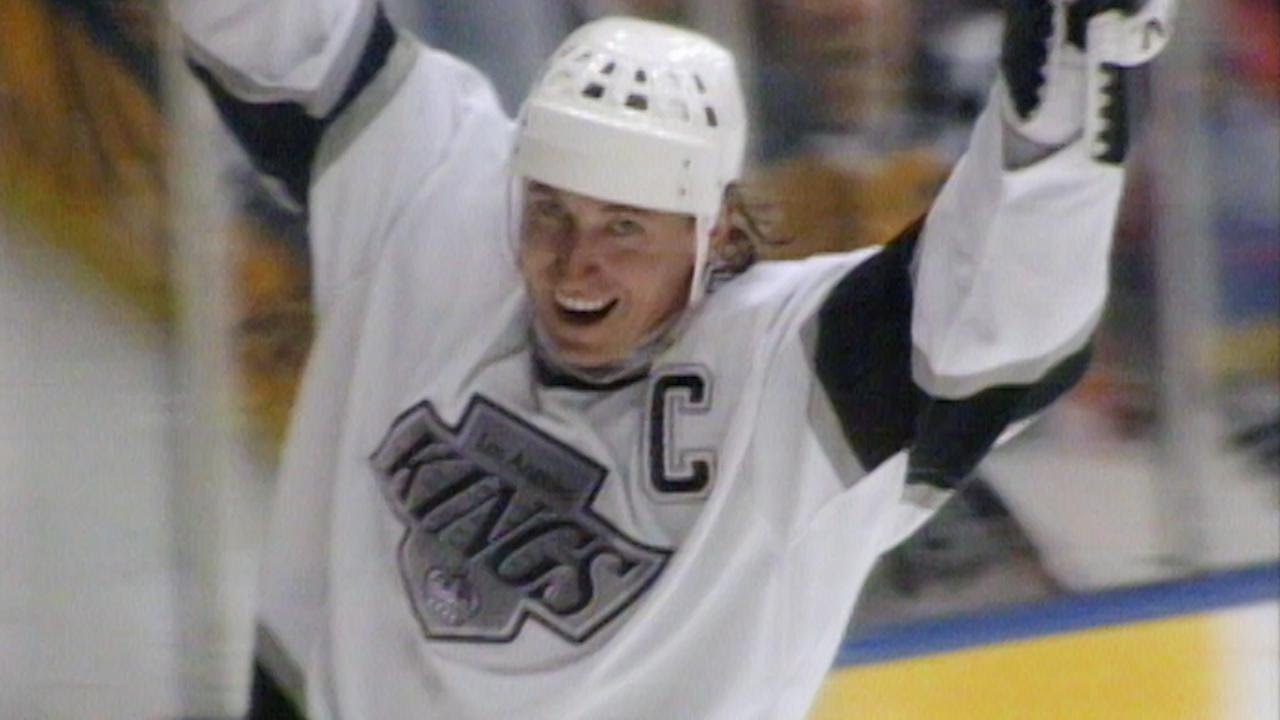
On a power play at 14:47 of the second period, as the Los Angeles Times described, “Luc Robitaille started the play with a drop pass just inside the blue line to Gretzky. Gretzky found [defenseman Marty] McSorley and headed for the net. McSorley was patient and perfectly timed the pass and waited until he skated past the middle of the right circle.” They had drawn Vancouver Canucks goaltender Kirk McLean out to “play the angle,” leaving the net virtually empty. From McSorley, “Gretzky took a cross-ice pass” and made the shot “with a neat but unspectacular wrist shot from near edge of the left faceoff circle.” According to one Times writer, “Gretzky put his own unique signature on the historic goal, jamming it into the net out of the air before the puck dropped to the ice.” Another praised the shot as “Nothing flashy, just subtle, smart and well executed.” McSorley, who had played with Gretzky on the Edmonton Oilers, and Robitaille received credit for the assists. The former assisted Gretzky on 17 of his 802 goals, while the latter had assisted on 42. Jari Kurri, another former Oilers teammate, was also on the ice at the time, and he assisted Gretzky with more goals than anyone else. In addition to being the record-breaker, this was Gretzky’s 37th goal of the 1993-94 season. He commented later, “I don’t think words can describe the emotion that I felt, and the feeling that I had. I was pretty tickled. It was a pretty fun moment.”
As soon as the puck landed in the net, the crowd erupted and the game paused. According to the recap, “Gretzky threw his arms in the air and the first player to hug him was Robitaille,” followed by McSorley and the rest of the team. The Kings held a 15-minute on-ice ceremony to honor Gretzky’s accomplishment. He wife Janet and parents Walter and Phyllis joined Kings owner Bruce McNall and NHL Commissioner Gary Bettman for the presentation. “It was the greatest moment I’ve ever had in my business career,” admitted McNall, who had brought Gretzky over to the Kings. “Wayne made a point of coming over, and that meant a lot. He had a billion things on his mind, everyone was hassling him and he came over to me.” McNall rewarded Gretzky with a $275,000 Rolls Royce. In giving his thanks, Gretzky told the crowd, “As I’ve said many times, to me, this is the greatest game in the world. Six years ago, they said California wasn’t a great hockey area. In six years, we have a pretty strong franchise and we’ve shown the rest of North American they’re wrong.” He also proclaimed, “I’ve played here six years and I hope I play here another six.”
At that point in his career, Gretzky had played for almost 15 seasons and a total of 1,117 games. It had taken Howe 26 seasons and 1,767 games to score 801. Doing the math, the Los Angeles Times pointed out that Gretzky thus averaged about 55 goals per season and 2.19 points per game whereas Howe had averaged about 1.05 points per game to earn his 1,850. Gretzky finished his career in 1999 with 894 goals and 2,857 points. In his first 802 NHL goals, 21 had been game-tying and 78 game-winners. He made 46 on empty nets, 72 of them shorthanded, and 179 during power plays. He already held 62 NHL scoring records by the time he finally broke this last remaining significant record. Gretzky and Howe still top the charts for most NHL goals.
It quickly became the ultimate prize that every professional hockey player strove for each year. NHL teams continue to define themselves in terms of winning the right to this piece of hardware. However, the annual reward predated the NHL by a quarter of a century.
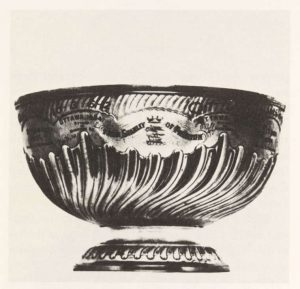
The quest for the Cup began with Frederick Arthur Stanley, Baron Stanley of Preston, 16th Earl of Derby, the governor general of Canada from 1888 to 1893. Upon watching his first hockey game at the Montreal Winter Carnival on February 4, 1889, according to the Montreal Gazette, he “expressed his great delight with the game of hockey and the expertise of the players.” To promote the sport, in 1892 he paid $48.67 for a gold-lined silver bowl to reward the top Canadian team. Although inscribed as the Dominion Hockey Challenge Cup, the award has taken on the name of its original donor, the Stanley Cup.
The Cup was intended to reward the top challenger, the leader of the Amateur Hockey Association of Canada (AHAC) at the end of the 1892-93 season. Thus, the Montreal Hockey Club (affiliated with Montreal Amateur Athletic Association (MAAA)) received the recognition first. Having won seven of eight games, they ranked first in their five-club league.
Teams first challenged for the Stanley Cup in March 1894 because four AHAC teams finished the season with the same record (5-3-0). Since a tie-breaking system did not exist, the Cup trustees and league governors created a tournament. The Quebec team withdrew, leaving three teams to vie for the championship. As the only remaining team not from Montreal (and thus without “home ice” advantage), the Ottawa Hockey Club (later the Ottawa Senators) was given a pass to the finals. That left the Montreal Hockey Club and the Montreal Victorias to play a preliminary elimination round.
On March 17, 1894, the two Montreal teams played the first Stanley Cup playoff game. The Victoria Rink was crowded that Saturday night, and the audience was “pretty well divided” between the teams. The Gazette noted how water on top of the ice interfered with passing and lifting even as the skating remained fast. “The combination play of the Victoria forwards was excellent, and shot after shot was sent skimming through the water and kept missing the goals by inches.” Thus, Montreal HC scored first, in the first minute of play. The Victorias managed to tie before the session ended and then scored again as the next began. However, Montreal HC responded with two more to win 3-2. The Gazette praised the “rattling, dashing clean game” and bragged that “with truth it may be said that better hockey is played in Montreal than anywhere else.”
Montreal Hockey Club advanced to play Ottawa Hockey Club for the first Stanley Cup final, held on March 22, 1894. Victoria Rink welcomed its largest ever crowd to that point, of about 5,000, with the majority cheering for Montreal. As the Gazette commented, “It was a case of blood being thicker than water.” That crowd was loud and colorful. “There was ‘siss-boom-ah,’ ‘rah-rah-rah’ and several other audible tokens of imbecility and enthusiasm mixed.” The Gazette reporter complained that tin horns “made a much more certain sound, which the acoustic properties of the Victoria rink despatched back in heart-rending reverberations.” However, the view seemed to make up for the noise. “One of the pleasing features of the match was the display of ribbon. Every lady almost in the rink wore the favours of their particular club and never did belted knight in joust or tourney fight harder than the hockey men.”
The ice itself, the Gazette noted, “could not be expected to be good, and the conditions generally could be much improved upon if these great deciding games could be held earlier in the season.” The Globe agreed, “Team play was marred by the softness of the ice. Rough and foul play was frequent, both defences indulging freely in tripping and slashing.” With these conditions, Montreal dominated offensively during the first eight minutes but were effectively blocked by Ottawa’s goalie. Ottawa took charge long enough to score the first goal. Although their goalie stayed strong, he did allow a Montreal goal in before the end of the first half. In the second half, as the Gazette described, “the visitors made great efforts and their attack was splendid” but “Montreal defence seemed impregnable.” Montreal scored twice more to win the final 3-1.
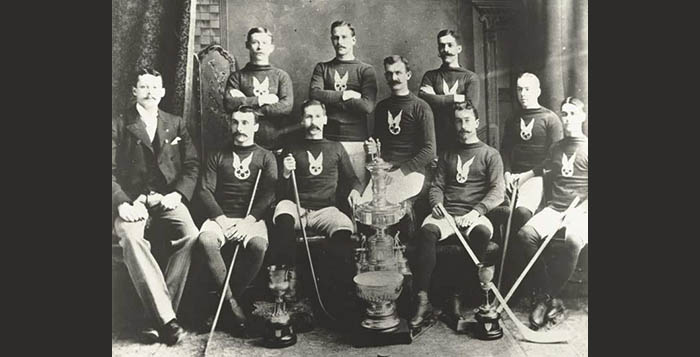
After what the Montreal Gazette termed “perhaps the most brilliant [season] in the history of the game,” the Montreal Hockey Club successfully defended their title, became the first to win the Cup after a contest, and became the first to win the Cup in back-to-back seasons. The Gazette rightfully concluded, “Not only the Canadian championship, but the Governor-General’s cup depended on this match, and Montreal can fly its colors in the face of any hockey breeze that ever blew.” Montreal still holds the record for most Stanley Cup championships.
Additional Sources:
Brian McFarlane, Brian McFarlane’s History of Hockey (Champaign, Ill.: Sports Publishing Inc., c1997), 5-6.
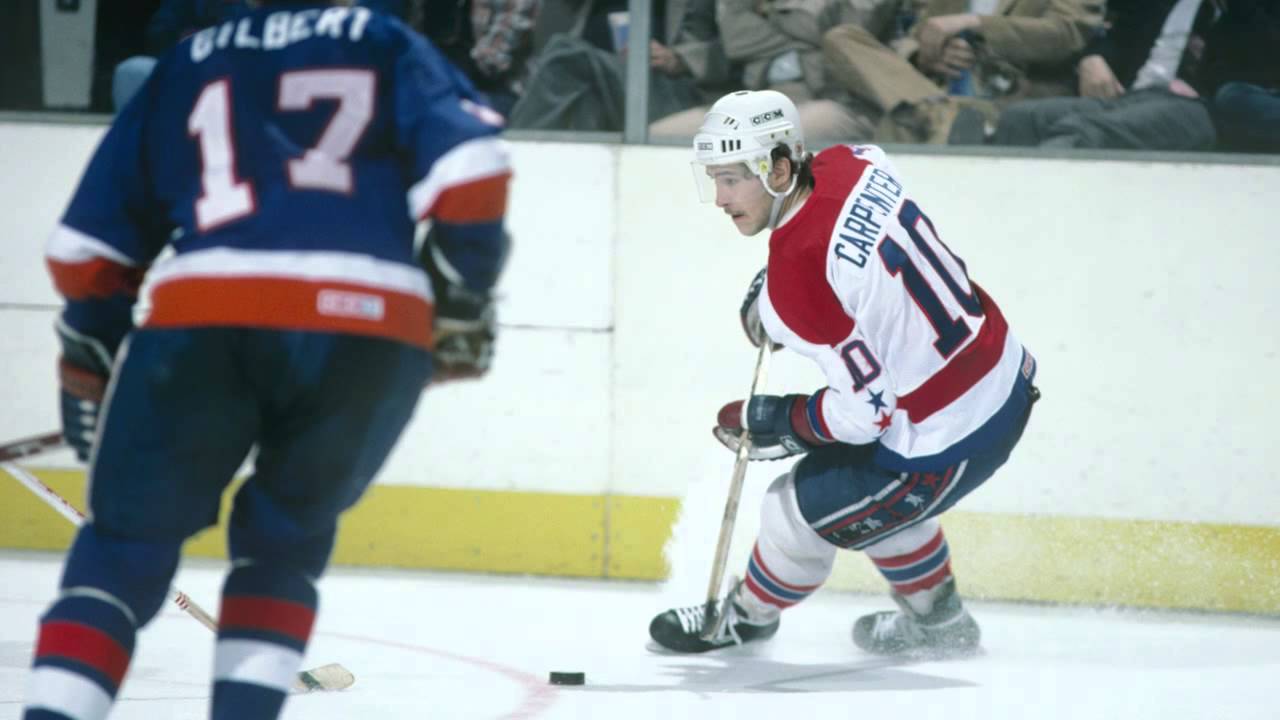
It all started for Carpenter in 1981. As a student at St. John’s Preparatory School in Danvers, Carpenter landed the cover of Sports Illustrated, which called him “The Can’t-Miss Kid.” Even before making the NHL, he had become the first American-born hockey player on the cover. While still in high school, the Capitals drafted Carpenter third overall at the 1981 NHL Entry Draft. That made him only the second American ever chosen during the first round. Since he began playing for the Capitals right away, he became the first to join the NHL right out of high school. Carpenter had planned to attend college and play for the U.S. at the 1984 Olympics, so he told the press, “A million players come into the league, but I came from somewhere different – the U.S. So it was a new story, something different to write about.”
During his first three seasons playing center for the Capitals, Carpenter scored 92 goals and had not missed a single game. However, the best season of his career would be 1984-85. At the end of December, the press already referred to him as the “Can’t Miss Kid Who Didn’t” and counted how many goals he would need to match Joe Mullen (of the St. Louis Blues) for the single-season highest-scoring American. Carpenter joked, “That’s not much of a record, you know. I think there are bigger ones available.” At the time, he also had just tied Ryan Walter’s record streak for most consecutive games. Upon notching his 40th and 41st goals on February 8, Carpenter tied Mullen’s record from the previous season. Five days later, on February 14, Carpenter scored his 42nd goal of the season, giving him the record for most goals in a season by an American-born player.
All of these accomplishments came to a head on March 21, 1985 at the Forum in Montreal. The game was not going well for the Capitals. The Montreal Canadiens scored in the first 14 seconds. Then, on a power play in the last two minutes of the first period, the puck bounced off Washington defenseman Scott Stevens and was shot into the net by Montreal’s Alfie Turcotte. Whatever was said during the period break, the Capitals (and Carpenter especially) came back swinging in the second. Carpenter took advantage of a power play to send “a wrist shot past Montreal goaltender Steve Penney” at 15:24. With that, Carpenter became the first American-born hockey player to score 50 NHL goals in one season. In leading up to the historic goal, Carpenter had said, “You don’t make the good passes and the great plays when you’re trying to do something like that. It seems that when you try not to think about it, that’s when you end up thinking about it the most.” However, after the game, he told the press, “The team needed the win, but it was a great honor to score that 50th goal. It’s hard to do and scoring it here at the Forum in Canada adds something to it.”
Carpenter went for the win by setting up teammate Mike Gartner’s 45th goal at 18:02 that period, which tied up the game going into the third. Gartner only commented, “We did some good things out there, but then again we made a lot of mistakes in our own zone which we have to correct fairly soon.” One of those things to work on was again poor Stevens. He had already inadvertently assisted on a Montreal goal when he actually made the game-winning goal for his opponents with less than six minutes remaining. According to the Montreal Gazette, Montreal’s Guy Carbonneau had the puck, and as Washington goalie Pat Riggin went down for it, “Stevens’ deflection flopped over his outstretched leg.” As the Baltimore Sun reported on the play, Guy Carbonneau “flicked a backhand pass from the left boards that deflected off defenseman Scott Steven’s stick and over Washington goaltender Pat Riggin’s shoulder at 14:18 of the third period to break a 2-2 tie.” Stevens could only mutter, “That’s the way the puck bounces some nights.” Either way, Montreal won the game 3-2. The Canadiens had needed the win to keep even with the Quebec Nordiques in first place. Meanwhile, the Capitals had lost six of their last eleven games, which put them eight points behind the Philadelphia Flyers in the Patrick Division.
The high point of Carpenter’s career ended with 53 goals for the 1984-85 season. Only six others scored more that season, and teammate Mike Gartner also reached 50. Carpenter and Gartner together were called the “Gold Dust Twins.” Carpenter’s 95 points that season topped the rankings for American-born players, though closely followed by Mullen with 92 points. Carpenter held his record until the 1987-88 season, when Michigan-born Jimmy Carson scored 55 goals. For the remainder of Carpenter’s career, he never even reached 30 goals in one season. On January 1, 1987, Carpenter was traded to the New York Rangers only to be traded to the Los Angeles Kings that March. After his trade to the Bruins in January 1989, he remained with Boston until signing back with the Capitals in 1992. The following year, he signed with the New Jersey Devils and had his name added to the Stanley Cup with them in 1995. Carpenter officially retired in 1999 having played 1178 games (320G, 408A, 728P). By career points, Carpenter still ranks 29th out of American-born players.
Additional Sources:
Mike Commito, Hockey 365: Daily Stories from the Ice (Toronto: Dundurn, 2018), kindle edition.
Mark Whicker, “Carpenter builds a success story,” Baltimore Sun, 28 Dec. 1984, p. 3D.
“Carpenter ties record as Capitals top Kings, 6-1,” Baltimore Sun, 9 Feb. 1985, p. 5C.
“Jets rally to top Caps,” Baltimore Sun, 14 Feb. 1985, p. 8C.
“Caps put in hat,” Baltimore Evening Sun, 14 Feb. 1985, p. B8.
Dick Bacon, “Caps’ Stevens helps out Habs,” Montreal Gazette, 22 March 1985, p. B-10.
“Capitals’ Carpenter becomes first American to score 50 goals in 3-2 loss,” Baltimore Sun, 22 March 1985, p. 9F.
“Carpenter gets 50th goal, but Caps fall,” Baltimore Evening Sun, 22 March 1985, p. C6.
Although hard to believe, little more than 70 years ago, hockey reached such a small audience in the U.S. that only about 24 colleges featured competitive men’s ice hockey teams. For that reason, it took the National Collegiate Athletic Association (NCAA) about 40 years to finally hold a championship tournament. The NCAA had been formed as early as 1906 and took its name in 1910, but it was not until the 1947-48 season that the NCAA had hockey teams conform to regulations.
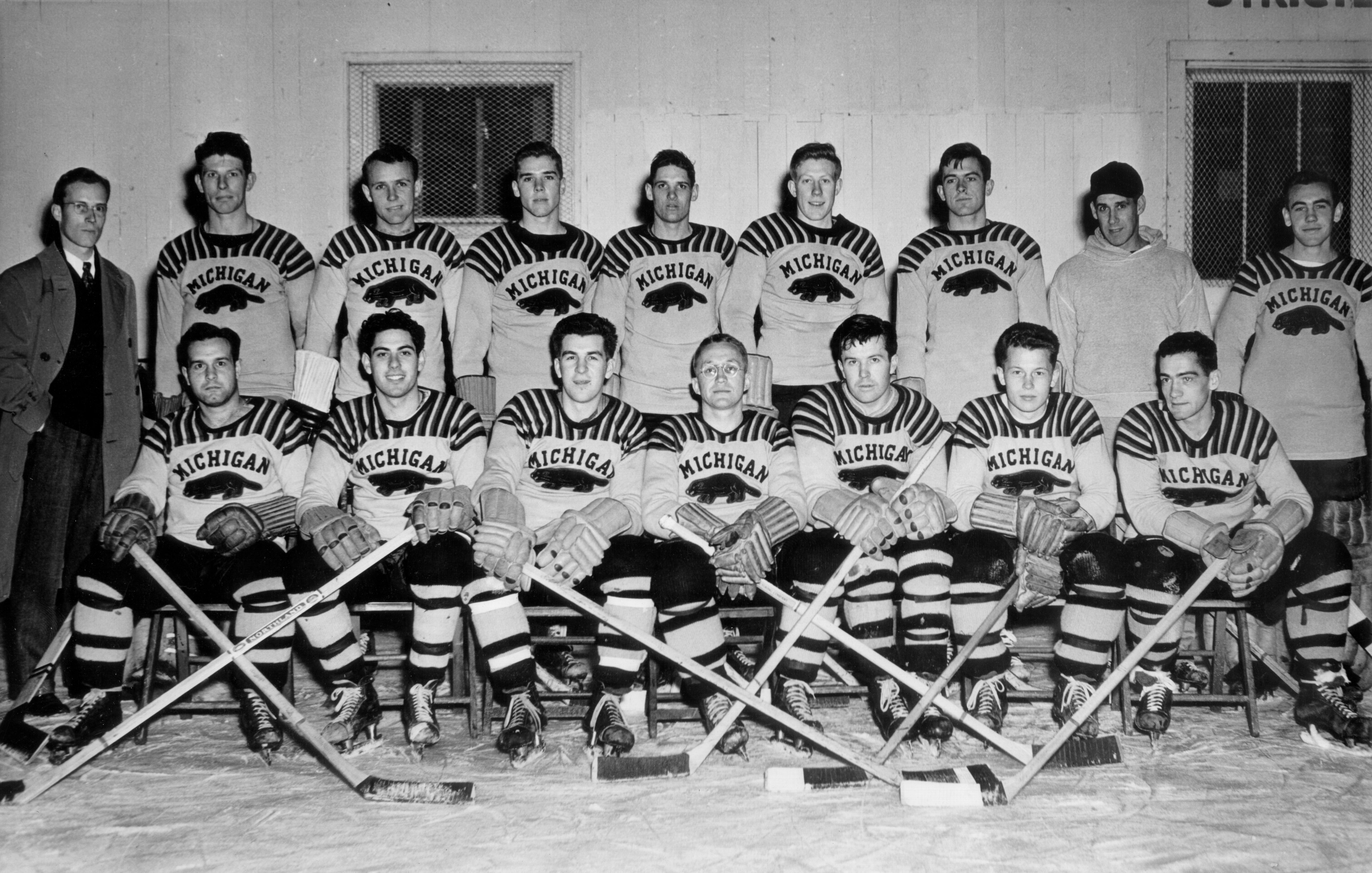
The first NCAA Men’s Ice Hockey Tournament was held in March 1948. Although few in number (thanks in part to the expense of maintaining indoor rinks), the college clubs had rivalries and wanted to compete for the title of best collegiate squad in the U.S. A committee selected four teams, the top two eastern and the top two western teams based on record and opposition strength, to participate. The Dartmouth Indians (with a 20-2-0 record) and the Boston College Eagles (14-4-0) represented the east, while the Michigan Wolverines (18-2-1) and the Colorado College Tigers (19-7-0) topped the west. As this was a single elimination competition, they would only need three games, the fewest ever played for the NCAA tournament. All of the games were played at Broadmoor Ice Palace in Colorado Springs, Colorado.
The first game, on March 18, featured the first eastern seed, Dartmouth, and the second western seed, Colorado College. Dartmouth advanced with a victory of 8-4.
On March 19, the first western seed, Michigan, played the second eastern seed, Boston College. The game had to go into overtime, which was not sudden-death, and lasted three hours. As the Lansing State Journal crowed, the “favored Michigan Wolverines had to go all out to subdue Boston college 6-4 in a rousing overtime fray Friday night to reach the finals.” The NCAA tournament would not feature another overtime game until 1954.
Newspapers in New Hampshire and Michigan praised the coaches for getting the Indians and Wolverines to the finals. Dartmouth’s coach, Eddie Jeremiah, had a winning average of .950 since 1938. He led the team to streaks of 32 victories and then 34 victories. Since he returned to the team in 1945 (after serving with the Navy), Dartmouth had won 100 games. Michigan’s Vic Heyliger had played for Michigan and then, upon graduation, for the Chicago Blackhawks. When his NHL career was cut short due to a “serious throat ailment,” he returned to Michigan to earn his masters’ degree in physical education. According to the Detroit Free Press, “He authored a history on the origin and development of hockey as part of the work toward his degree. It is regarded as one of the most comprehensive treatises ever compiled on the game.” He coached four seasons at the University of Illinois before becoming Michigan’s coach in 1943. He also “worked untiringly and against high odds to gain recognition for college hockey. The Michigan coach was a prime mover in the organization of a college hockey association and the staging of an annual tournament.”
The first NCAA championship game was held at 8:15 on March 20, 1948. At the end of the first period, Michigan and Dartmouth stood tied at 2-2, having alternated goals. Within the first 11 minutes of the second, Dartmouth had scored twice more. Then Dartmouth failed to find the net for the remaining 29 minutes. Instead, the Wolverines “fought from behind” scoring twice in the last five minutes of the period. However, the referees had disallowed the tying goal “because a penalty box official had piped his whistle on the play.” So the teams went to the locker rooms thinking the score remained 4-3. As the Nashua Telegraph summarized, “But the NCAA rules committee overruled them and gave the Wolverines the point.” That rejuvenated Michigan and paralyzed Dartmouth so that the Wolverines “completely overpowered the Indians in the closing stanza.” Michigan doubled its score thanks to Wally Gacek completing a hat trick and assisting on three other goals. Wally Grant had assisted on all of Gacek’s goals and scored two of his own. Michigan won the first NCAA championship with a score of 8-4.
Michigan’s win was unsurprising considering they had Canadian players and had defeated Toronto, the Canadian champions. The school had already won the Rose Bowl in football and the Big Nine in basketball. Considering Coach Heyliger’s involvement in establishing the tournament, the Detroit Free Press felt, “It is fitting that his team took the crown the first year the event was held.” Heyliger kept on winning championships, with his six as the record high for a coach. Michigan also holds the record with nine championships. The Broadmoor Ice Palace in Colorado Springs, Colorado continued to host the tournament throughout the first ten years and has hosted the most of any venue. The NCAA Men’s Ice Hockey Tournament remained a competition between four teams through 1976 and, since 2003, has grown to feature 16 teams.
The NHL schedules numerous afternoon games every season, and that number has increased this season. Surprisingly, the NHL took until the very end of its 16th season to hold the first matinee match. The date was March 19, 1933, and the time was 3:30 p.m. The timing of the game was considered an experiment. As the Chicago Tribune explained, “Sunday afternoon sports are permitted in all the American cities represented in the league and if today’s test is successful New York, Boston, and Detroit may hold Sunday afternoon hockey next fall.”
Chicago Stadium served as the laboratory with the Chicago Blackhawks and the visiting Detroit Red Wings as opponents. At that point, the teams were on opposite ends of the spectrum. Chicago had sunk to the bottom of the American Division rankings in their most disappointing season thus far. Meanwhile, Detroit had risen far above its predicted last place to lead the league. Both teams had their share of injuries with Chicago’s Taffy Abel and Detroit’s Ebbie Goodfellow unable to play.
NHL President Frank Calder attended the game, both to see how the fans reacted to the afternoon schedule and to follow-up on the incident involving the Blackhawks’ recent forfeit. About 5,500 to 6,000 attended the game, which was more than expected. The numbers and responses of the crowd led Chicago’s officials to deem the afternoon experiment a success.
The game itself was more of a success for the visitors than the home team. Most of the action took place in the second period. Chicago defenseman Billy Burch (Abel’s replacement) crashed into Detroit’s Frank Carson and hit the boards so hard he fractured his leg in two places. That led to a skirmish that led to one of his teammates leaving the ice with a severe cut on his face. This was also the period when Detroit took a three-goal lead. Shortly thereafter, Chicago’s Mush March scored twice within 30 seconds (at 16:10 and 16:40) while both teams were short from penalty calls. Although Chicago tried using five forwards in the third period, Detroit had no problem slipping around them to score a final goal, ending the game 4-2. The victory definitively gave Detroit first place in the standings.
After the rough game, a fight brewed as the players left the ice. According to the Chicago Tribune, Chicago’s Johnny Gottselig clashed with Detroit’s Voss, and then all team members “wedged into the stairway leading down to the dressing room, swinging and wrestling.” The Detroit Free Press thought it was actually Hap Emms that “almost came to blows” with Gottselig, but that “as other players moved toward the scene of the impending battle, the officials intervened and peace was restored.”
Detroit then went on to the playoffs, where they defeated the Montreal Maroons but fell to the New York Rangers, who would go on to defeat the Toronto Maple Leafs for the Stanley Cup.
Additional Sources:
Mike Commito, Hockey 365: Daily Stories from the Ice (Toronto: Dundurn, 2018), kindle edition.
John Kreiser, So You Think You’re a Chicago Blackhawks Fan?: Stars, Stats, Records, and Memories for True Diehards (Simon and Schuster, 2017), kindle version.
“Hawks to Meet Red Wings Today in Season Final,” Chicago Tribune, 19 March 1933, part 2, p. 2.
“Hawks Drop Last Home Game to Detroit, 4 to 2,” Chicago Tribune, 20 March 1933, p. 19.
“Wings Regain First Place by Beating Hawks in Final, 4-2,” Detroit Free Press, 20 March 1933, pp. 13-14.
The start of the 1939-40 playoffs would have been typical but for one change in transportation. The Chicago Blackhawks flew to and from their first game.
When the season ended on March 17, 1940, the Blackhawks finished in fourth place with 52 points (23-19-6). Their first playoff opponents would be the Toronto Maple Leafs, who finished in third with 56 points (25-17-6). During the regular season, the two teams had faced each other eight times, with Chicago winning four games, losing three, and tying once.
This was only the fourth time Chicago would participate in the playoffs, and they ended up traveling in style. The 17 players, Dr. Hugh Meacham, manager Paul Thompson, and President Bill Tobin boarded an American Airlines DC-3 flagship at 11:30 on the morning of March 18. Apparently, Thompson was “leading all of his rivals in the voting for the honor of being the league’s No. 1 pilot.” When they arrived at 3 or 4 p.m., it was the first time a plane of that kind had even landed in Toronto. More importantly for the history books, theirs was the first chartered flight for an NHL team.
The Blackhawks still seemed to be flying high on game night, March 19, when they scored two goals in the first period. The Maple Leafs did not respond until the third period, when they managed to tie up the game. That meant that the 13,078 spectators were treated to a sudden-death overtime. At 6:35, with eight seconds remaining on a power play, Sylvanus Apps won the game for Toronto.
Having some ground to make up, the Blackhawks flew back home to Chicago Wednesday afternoon. The second game of the series took place at Chicago Stadium on Thursday, March 21. Although 18,000 were expected to come due to the rivalry with Toronto, the crowd was more like 15,306. The Blackhawks sent a barrage that was effectively blocked by Turk Broda and the Leafs’ defense. With the 2-1 loss, the Chicago Tribune bemoaned the end of their season at 10:54 pm.
Toronto went on to defeat the Detroit Red Wings in two games as well. In the finals, the Leafs lost the first two games, won the next two, and finally lost two more games to the New York Rangers.
Additional Sources:
Brian McFarlane, Brian McFarlane’s History of Hockey (Champaign, Ill.: Sports Publishing Inc., c1997), 48-49.
John Kreiser, So You Think You’re a Chicago Blackhawks Fan?: Stars, Stats, Records, and Memories for True Diehards (Simon and Schuster, 2017), kindle version.
Liam Maguire, Next Goal Wins!: The Ultimate NHL Historian’s One-of-a-Kind Collection of Hockey Trivia (Random House of Canada, 2012), 31.
“Blackhawks to Open Stanley Cup Series in Toronto Tonight,” Chicago Tribune, 19 March 1940, p. 23.
Charles Bartlett, “Blackhawks end Season, Beating Red Wings, 3 to 1,” Chicago Tribune, 18 March 1940, pp. 21 and 23.
“Leafs Beat Hawks in Playoff Opener, 3-2,” Chicago Tribune, 20 March 1940, p. 29.
Charles Bartlett, “Hawks Battle to Even Hockey Playoff Series,” Chicago Tribune, 21 March 1940, p. 29.
Charles Bartlett, “Leafs Put Hawks Out of Playoffs, 2 to 1,” Chicago Tribune, 22 March 1940, p. 25.
Hockey fights are nothing new. The rivalry between the Montreal Canadiens and the Boston Bruins dates back to 1924. It seems that riots by displeased hockey fans also harken back quite a ways. In March 1955, all three were in full force. After a stick fight between Montreal’s Maurice “Rocket” Richard and Boston’s Hal Laycoe resulted in Richard’s suspension, Canadiens fans rioted at the Forum on St. Patrick’s Day, later known as the Richard Riot.
The trouble began at Boston Garden before a crowd of 12,023 on March 14. With about six minutes remaining in the third period, the Canadiens had pulled their goalie for a sixth man during a penalty on the Bruins. According to Laycoe, he had the puck, and “I checked the Rocket on the play. He slapped me across the face with his stick. Sure I let him have it good right over the head with my stick. Then I dropped my stick as he came after me. But he didn’t want to fight. I yanked off my glasses and instead of fighting he grabbed his stick and swung at me. I put up my hand and blocked it. Got it on the arm. Then he swung at me again. This time I turned away and got the stick on the back. I was plenty mad and went after him. I fell down and he hit me a good punch when I was down.” The Boston Globe reported that Richard first used a two-handed swing that hit Laycoe on the side of the face and then swung again. Linesman Cliff Thompson threw Richard to the ice or boards to break up the fight, but Richard hit him with a “wicked right-hand punch” that caught Thompson under the eye “raising a large swelling.” Richard needed five stitches on the left side of his head, Laycoe had two or three stitches over his left eye, and Thompson wound up with a gash over his eye.
Referee Udvari called a match penalty for Richard, which meant that he was ejected from the game and faced a $100 fine and NHL board review. Fans yelled, “Lock him up.” Laycoe received a major for a high stick that caused injury and a 10-minute misconduct for throwing his bloody towel at the referee (which came with a $25 fine). The police (led by Lt. Frank Gannon and Detective John Hommel from Station 1) wanted to arrest Richard for assault and battery by means of a dangerous weapon, but Bruins President Walter A. Brown and GM Lynn Patrick convinced them the NHL would handle the incident. After the game, the police escorted the Canadiens to the railroad station for their train home. They had lost 4-2, breaking their unbeaten streak at 11 games.
Two days later, on March 16, a 3.5-hour meeting/hearing was held at the Montreal office of NHL President Clarence Campbell. The referee and linesmen from the game, along with the two fighters, and their club leaders all spoke with Campbell. He then, in a 1,200-word decision, passed down the heaviest punishment of his career (since becoming president in December 1946). Richard was suspended for the rest of the regular season and all of playoffs “for punching linesman Cliff Thompson and repeatedly attacking Boston player Hal Laycoe with his stick.” He did not buy the Canadiens excuses that Richard did not recognize Thompson as a linesman instead of a player or that the hits to Laycoe were only defensive. Richard had recently (in December) had a similar fight with Toronto’s Bob Bailey in which his punched linesman George Hayes. At the time, he was only charged $250, and he was the “most heavily-fined player in hockey history.” Campbell stated that with this incident, the “time for probation or leniency (for Richard) is past. Whether this type of conduct is the product of temperamental instability or willful defiance of the authority in the games does not matter. It is a type of conduct which can not be tolerated by any player, star or otherwise.”
Although the Canadiens would be able to appeal the case, Montreal supporters were naturally upset that Richard was definitely out for the remainder of the regular season. At the time, they were fighting for first place against the Detroit Red Wings, and Richard’s suspension could result in his teammates making $500 instead of $1,000 if they dropped to second place. In addition, Richard was in the lead for the scoring title for the first time in his career. Richard refused to comment much but did say, “I can’t blame Dick Irvin or Kenny Reardon for anything that happens. They did everything they could to help me.” Montreal general manager Frank Selke blamed the harsh punishment on “hysterical” Boston and Toronto news and later said, “But how can anyone say that I am not on Richard’s side. I have done everything I could to for this boy and I think I’ve helped to steer and guide him to become the greatest player in hockey.”
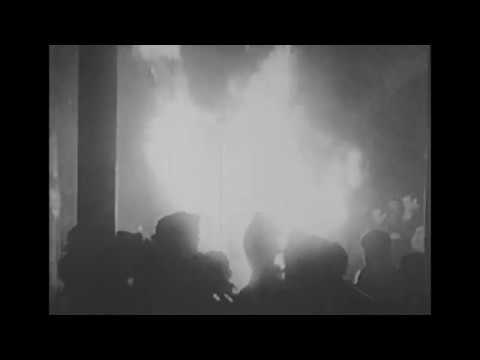
Montreal fans inundated NHL office phones and radio stations to relay their displeasure and issue threats against Campbell. Assistant Police Director Pacifique Plante said, “We will probably have to have an extra squad at the Forum tomorrow night.” The Canadiens were playing the Red Wings, their rivals for first place, on March 17. The police spread out around the Forum about two hours before the start time. At 6:45, many had already arrived and packed the lobby, some even trying to break in before the police turned them back. Students, carrying signs, paraded down St. Catharine Street chanting, “We want Richard, down with Campbell.” As 8 pm approached, the youths tossed firecrackers into the crowd. As the police pushed people back, some threw stones breaking windows at the front of the Forum. Demonstrators also threw “frozen snow and bottles at the police, street cars and automobiles” and pulled down “some overhead wires of the trolley lines.”
Inside, before the game began, spectators threw coins, peanuts, and programs on the ice until an announcement that the Canadiens would have to forfeit to Detroit if they littered the ice again. When Campbell arrived about 11 minutes into the first period (through the exit behind the nets on the south side), he was “greeted by catcalls and assorted epithets” and a “barrage of programs, peanuts and eggs,” He reportedly kept his composure, only once standing to brush himself off. However, the crowd worsened, and Campbell was “assaulted and pelted with fruit and overshoes.” A man “slipped through police lines on the pretext of being a friend,” “walked up to Campbell and offered his hand before punching him.” Another tried but was “brought down by ushers and police.” Not many even noticed Richard sitting along the rails at the back of the nets the whole time.
As the second period ended, Detroit led 4-1. After both teams retreated for the intermission, “there was a hollow boom and a heavy grey vapor started to rise from near the ice in the south end.” A spectator had thrown a tear-gas bomb, causing a rush as people fled. Then another bomb was thrown so that the smoke rose into the higher seats. Campbell made his escape from the rink along with most of the south end. Fire chief Armand Pare ordered the game be halted and building cleared for the “protection of the people.” He even ordered his men to leave so as not to further panic the 14,000 spectators. An aerial ladder truck, smaller fire truck, and several emergency vehicles were sent to the scene. About an hour after the game was halted, Campbell had a note sent to the Red Wings’ locker room stating, “The game has been forfeited to Detroit. You are entitled to take your team on your way any time now. Mr. Selke agrees with this decision as the fire department has ordered the building closed.” The police escorted the team out the rear entrance.
Two hours after the game ended abruptly, the police had cleared three sides of the Forum leaving about 6,000 demonstrators still gathered in the park across from the front. Surprisingly, there were not any immediate reports of injuries even though the papers reported, “At least a half-dozen demonstrators, some with blood streaming down their faces, were hauled off by police.” Later, it was determined that 25 fans and 8 policemen were injured, while 16 were arrested and charged $25 each. Damages added up to about $100,000. Even after the whole thing was over, the threats to the NHL phones continued. Selke told the press, “I’m sorry this happened. We did everything we could to prevent it.”
The forfeit gave Detroit the lead in the standings, which they held onto. Even without Richard, the Canadiens easily eliminated the Bruins in the playoffs. However, they lost the Stanley Cup finals against the Red Wings.
Additional Sources:
Brian McFarlane, Brian McFarlane’s History of Hockey (Champaign, Ill.: Sports Publishing Inc., c1997), 76.
Herb Ralby, “Richard May Miss Playoffs,” Boston Globe, 14 March 1955, pp. 1 and 12.
Tom Fitzgerald, “Richard Stick Duels Laycoe, Fights With Official,” Boston Globe, 14 March 1955, p. 6.
“Rocket Goes Wild At Boston, Clouts Laycoe, Linesman,” Montreal Gazette, 14 March 1955, p. 22.
“Fight Costs Richard Ban for Ice Season, Playoffs,” Boston Globe, 17 March 1955, pp. 1 and 17.
Tom Fitzgerald, “Hockey Men at Garden Back Ban for Richard,” Boston Globe, 17 March 1955, p. 17.
Herb Ralby, “Wings Hit Richard Ruling,” Boston Globe, 17 March 1955, p. 9.
Jerry Nason, “Richard Had It Coming to Him,” Boston Globe, 18 March 1955, p. 22.
“Richard Out for Season and Playoffs,” Montreal Gazette, 17 March 1955, p. 1.
“‘Couldn’t Do Anything Less’ Says Adams,” Montreal Gazette, 17 March 1955, p. 18.
“City Agog Over Rocket Richard Sentence,” Montreal Gazette, 17 March 1955, p. 19.
“Hockey Chief Attacked, Detroit Wins by Forfeit,” Boston Globe, 18 March 1955, pp. 1 and 18.
“Detroit Awarded Game While Leading Canadiens 4-1,” Montreal Gazette, 18 March 1955, p. 24.
“‘Rocket Richard is Not Retiring From Hockey’ – Selke,” Montreal Gazette, 18 March 1955, p. 25.
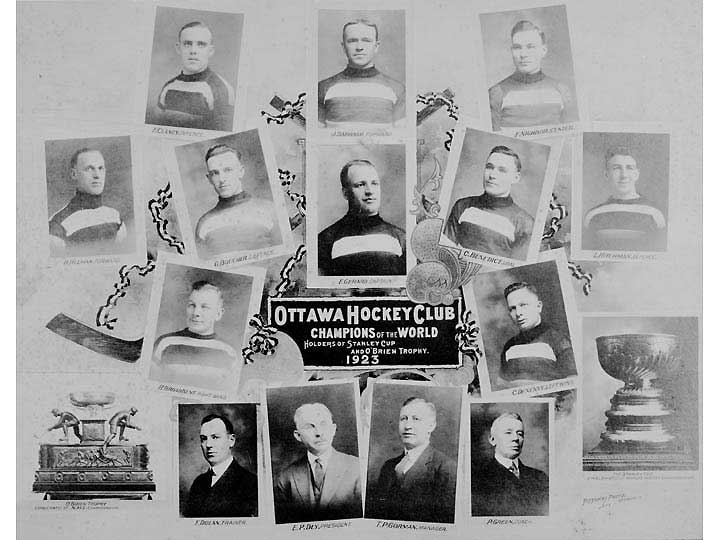
Brothers who play professional hockey is nothing new, but in 1923, brothers played against each other in the playoffs for the first time. Not just one, but two sets of brothers, squared off in the first round of playoffs starting on March 16, 1923. That season, the NHL champ would play the Pacific Coast Hockey Association (PCHA) champions. The winner of that best-of-five series would play the champions of the Western Canada Hockey League (WCHL) for the Stanley Cup. The Ottawa Senators led the NHL, the Vancouver Maroons the PCHA, and the Edmonton Eskimos the WCHL.
Defenseman George Boucher was the oldest of four brothers in professional hockey. He joined the Ottawa Senators in 1915 and remained with the team through most of the 1928-29 season (which meant he transitioned from the NHA to the NHL with the team in 1917). The next Boucher brother, Billy, skated for Montreal in 1923. Although joined the Senators for the playoffs (with the intention of filling in for the injured), Billy was not allowed to play. The third Boucher brother, Frank, was a center and became the best known, especially for his gentlemanly reputation. After spending the 1921-22 season with Ottawa, Frank was sold to the Vancouver Maroons of the PCHA. That put him in direct opposition to George for the playoffs.
Meanwhile, left winger Cy Denneny had first joined the Toronto Shamrocks in 1914-15, and they brought on his younger brother, Corb the following season. In 1916, Cy was traded to Ottawa, so he, like George Boucher, transitioned with the Senators to the NHL and then remained with them until 1928. Corb remained with Toronto until he was traded to Vancouver in December 1922. When they played against each other that playoffs, Corb was a sub. His career was never steady after that as he bounced between teams and leagues.
The first game pairing off the brothers occurred on March 16, 1923 at Vancouver’s Arena before a crowd of nearly 9,000. The leagues still played by different rules, so the games held at Vancouver on that Friday and the next would be played according to coast rules. The games on Monday and (if needed) the following Monday at Ottawa would follow the eastern rules.
After the game, the Canadian Press noted, “The fans were much interested to watch the fraternal duels in skating and stickhandling staged by the Boucher brothers and Denneny brothers. Frank and George Boucher for the Maroons and Senators respectively, were regulars, and were given plenty of opportunity to test each other’s ability. George was trickier perhaps, but Frank showed the greater speed, and worried brother George and his fellows all evening with his hookcheck.” Both the Ottawa and the Vancouver papers delighted in comparing the four.
Surprisingly, the papers were harder on their own players. Ottawa papers commented on the “unsteadiness” of George Boucher, while the Vancouver papers named him the star of the game noting how their own fans cheered him. They praised his stickhandling and skating, and The Province stated, “George Boucher is the star that he was two seasons ago. He is the same wizard stickhandler, and his rushes last night were finely staged and thrilling. He is the daddy of them all as a manipulator, and the crowd got considerable ‘kick’ in the numerous exchanges he had with his younger brother.” Of his brother, Frank, the Vancouver papers thought he was “just fair” until the third period. “Then he opened up and skated and stickhandled in his best form. His hookchecking broke up many a prospective Ottawa rush.” Whereas, the Ottawa Evening Journal, stated, “Ottawa went right for the key of the Vancouver system – little Frankie Boucher – and when they solved him they had a great part of their power turned off.” The article continued, “Frank Boucher has a good hook check, but is no particular sensation as a shot. He, however, is the most improved player in the game, and the same thorough little gentleman.”
As a sub, the media could comment little on Corb Denneny. The Vancouver Sun stated only, “Corbett Denenny had little chance to show his wares.” Tommy Gorman, manager and part-owner of the Senators, noted, “Corbett Denneny also appeared lost in the maze of speed.” Big brother Cy was another matter. He was treated as a warrior because he had sustained a head injury (referred to as a “slight fracture of the skull”) in the previous series against Montreal but still played most of the game. Gorman praised, “Plucky little, Denneny, his head plastered and stitched, went nearly the full route and turned in a beautiful game. Cy complained of dizziness but repeatedly refused to come off.” The Vancouver newspapers remarked that he was an “alleged cripple” because he “played brilliantly.” He “gave an exhibition at left wing for Ottawa that drew cheer after cheer from the benches” and “probably was the pick of the forward line.”
Still, not one of the brothers actually scored. In fact, George’s multiple penalties could have cost his team. Instead, during a four-on-four, his teammate, Harry “Punch” Broadbent, scored the only goal of the game with exactly five minutes to spare. That meant their teammate, Clint Benedict (who had needed stiches to his head after getting hit with a stick in the third period), had earned a shutout. This was despite Vancouver leading the shots on goal with 43 compared to Ottawa’s 30. The Ottawa papers attributed the low scoring to both Benedict and his counterpart, Hughie “Eagle-Eye” Lehman. Vancouver had come into the game as seven-to-ten favorites, but the upset would ensure that even bigger crowds came out for the remaining games between the two teams.
At the end of the series, George Boucher and Cy Denneny came out the winners with Ottawa winning three games. After the first win, Vancouver did bounce back for a 4-1 triumph, but Ottawa finished the series with two back-to-back victories (3-2 then 5-1). Despite his team’s loss, Frank Patrick purportedly called Ottawa “the greatest team he had ever seen.” The Senators went on to play the Edmonton Eskimos and won the first two games in the best-of-three series. Again, in the second game, Broadbent scored the only goal. George Boucher and Cy Denneny had helped Ottawa win the Stanley Cup.
Three of the four brothers went on to careers worthy of the Hockey Hall of Fame. Frank Boucher was inducted first, in 1958. He had remained in Vancouver until the PCHA disbanded in 1926, and he ended up with the New York Rangers thanks to Bill and Bun Cook, with whom he formed the famous Bread Line. After retiring during the 1937-38 season, he filled in for a partial season during World War II. From 1939 to 1949, Frank coached the Rangers before concentrating on being their general manager through 1955. One year after Frank’s induction, in 1959, Cy Denneny joined the Hockey Hall of Fame. Being one of the first to use a curved stick, Cy retired (after a season with the Boston Bruins in 1928-29 and winning the Stanley Cup) as the top goal scorer and point earner (with 331 points). For the next couple of years, Cy worked as a referee before coaching in Ottawa leagues. One year after Cy’s induction, in 1960, George Boucher joined their ranks. George was picked up by the Montreal Maroons in the 1928-29 season and then finished his playing career with the Chicago Blackhawks in 1931-32. Like the others, he took to coaching, beginning with the Montreal Maroons in 1930-31. George coached the Ottawa Senators in 1933-34 and the next season, when they moved to St. Louis before folding. He continued coaching various teams and helped with choosing and training players for Canada’s gold-winning team for the 1948 Winter Olympics. Many brother pairings came after the Boucher and Denneny siblings, but they were quite famous during their time.
Additional Sources:
Brian McFarlane, Brian McFarlane’s History of Hockey (Champaign, Ill.: Sports Publishing Inc., c1997), 21-23.
Ed Baker, “Ottawa 1, Vancouver 0; Broadbent Scored,” Ottawa Citizen, 17 March 1923, p. 12.
Tommy Gorman, “Senators Won the First Game of Series with Vancouver by Sheer Nerve, Pluck and Determination,” Ottawa Evening Citizen, 17 March 1923, p. 1.
Basil O’Meara, “Ottawa Takes the First Game; Score is 1 to 0 at the Finish; Broadbent Scores Lone Goal,” Ottawa Evening Journal, 17 March 1923, pp. 1 and 4.
Canadian Press, “Vancouver Men Offer No Alibi,” Ottawa Journal, 17 March 1923, image 13.
“Ottawa Wins Opener; Edmonton in Stanley Cup Finals,” Vancouver Sun, 17 March 1923, pp. 8-9.
Ralph Young, “Lone Tally Wins First Game for Ottawa,” Vancouver Daily World, 17 March 1923, pp. 24-25.
“Maroon Sharpshooters Can Not Penetrate Wonderful Defense of Benedict and Eastern Champions Win Opening Game,” Vancouver Province, 17 March 1923, p. 14.
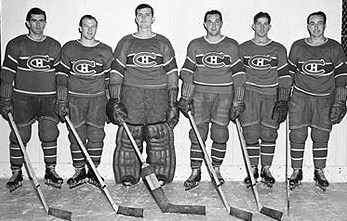
Coach Dick Irvin decided to try something interesting on March 15, 1941. It was the final game of his first season coaching the Montreal Canadiens, and he wanted a better look at the two goaltenders. Instead of just putting one in and later replacing him with the other, Irvin experimented with switching them back and forth throughout the game against the New York Americans.
The goalie experiment and Children’s Night drew a crowd of 5,000. This game would end the season as the Canadiens already looked ahead to next week, when they began playoffs at Chicago. Bert Gardiner was the more experienced goalie and expected to start for the playoffs. Irvin had him start and finish this alternating game. Gardiner manned the net for 16 minutes of the first period, with Irvin sending in Paul Bibeault for 4 minutes partway through. Bibeault began and ended the second period by playing a total of 11 minutes with Gardiner covering for 9 minutes in the middle. For the final period, Gardiner started with Bibeault stepping in for 7.5 minutes before Gardiner finished with a total of 12.5 minutes. In total, Gardiner was in net five times for an overall time of 37.5 minutes, and Bibeault played goal four times for a total of 22.5 minutes.
Of his decision, Irvin commented, “I’ll admit that it was not a fair test against a club like Americans in a game like that. I’d really have preferred to try it out against a team like Boston which maintains pressure at a torrid pitch all through a game.” Still, he thought alternating had the advantage of keeping the goalies fresh and competitive with each other. The two goalies found it a disadvantage not to have time to warm-up. In brief, Bibeault merely said, “I was stiff when I went out there first each time.” Gardiner elucidated, “You can’t tell off one game whether it’s good or not. It’s a lot easier on you in one way, of course, but you’re going out there cold several times in a night instead of just once. I imagine that if the opposition ganged up on you as soon as you went out, they might easily rap in a few. But if you’re not under heavy fire for the first few minutes while you get warmed up, you’re all right.”
Despite that disadvantage, both goalies (according to the Montreal Gazette) “played remarkably well” and “the pair of them made a raft of sensational saves despite the fact that Americans were pretty thoroughly outplayed.” Gardiner and Bibeault shared credit for a shutout, only Montreal’s second of the 48-game season. Irvin felt satisfied with his experiment. “Well, it couldn’t have worked out better, could it?”
On offense, the Canadiens scored six goals that game. Rookie Stu Smith scored his first two goals. His first, at 16:31 of the first period was the first goal in three games for the Canadiens. Murph Chamberlain, Toe Blake, Joe Benoit, and Tony Demers scored the rest in the second and third periods.
The Canadiens still finished the season second-to-last, above only the Americans. Montreal’s record was 16-26-6 for 38 points. The two teams finished in the same positions the following season, which would prove to be the Americans’ last.
Additional Sources:
Marc T. McNeil, “Casual Closeups,” Montreal Gazette, 17 March 1941, pp. 16 and 19.
Marc T. McNeil, “Gardiner and Bibeault Combine to Score Shutout Against Amerks, 6-0,” Montreal Gazette, 17 March 1941, p. 17.



 Prev
Prev