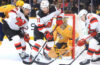
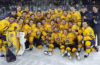
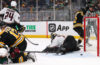
The final night of the 1987-88 regular season, April 3, 1988, saw a few firsts. The Calgary Flames claimed the President’s Trophy for the first time since becoming a franchise (in Atlanta) in 1972. Their right wing, Hakan Loob, scored his 50th goal for the season as the first Swedish-born player to reach 50 NHL regular-season goals. Meanwhile, the New Jersey Devils made it to the playoffs for the first time since moving to New Jersey in 1982. They had only been once before, while still the Colorado Rockies, in 1977-78.
The Calgary Flames earned home-ice advantage for the playoffs by winning that game on home ice at the Saddledome before a crowd of 19,626. Their unlucky opponents were the Minnesota North Stars. Taking charge from the start, the Flames scored the only two goals in the first period. According to the Minneapolis Star Tribune, the “Flames’ tight-checking limited the Stars to just three shots in the second period.” At the top of the third, Flames Captain Lanny McDonald potted his 10th goal of the season, which gave him a career total of 988 points. That ranked him 24th in all-time points, and he ended up winning the King Clancy Memorial Trophy (for Leadership and Humanitarian Contribution). McDonald said, “It’s a proud moment. It took 15 years to do. I think it feels better when you have to wait a while. It’s something no one can ever take away from you.” Minnesota’s Gord Dineen came back with the only Stars’ goal at 8:31 of third.
Although the game was all but won, at least one record remained on the line. At 16:55 of the third period, with just over three minutes remaining, Loob “tipp[ed] a perfectly-timed pass from Gary Suter past goaltender Don Beaupre. Loob saw it was in, turned up ice and started to windmill his arm around and around in an uncharacteristic display of emotion.” That was his 50th goal of the season, and he was the first NHL player born in Sweden to reach the milestone. Prior to that, his former teammate Kent Nilsson brushed the record by scoring 49 during the 1980-81 season. Loob commented, “I’m not going to think about it much now or in the next couple of years, but when I’m retired, I’m going to sit back and think . . . 50 goals, that’s a great accomplishment.” He had already received the Molson Cup (during a between-period ceremony) for having the most three-star selections over the course of the season. He finished the season as lead-scorer with 106 points.
The competition for the Molson Cup and lead-scorer was Joe Nieuwendyk. He finished the season with 51 goals, just two shy of Mike Bossy’s rookie goal-scoring record of 53 (1977-78). Nieuwendyk put things in perspective at not topping the record, “It has been a battle the last little while. I put too much pressure on myself. But I thought I had a good game today and I’m confident that I’m back on track. I had some good opportunities and I know things are going to go in for me now.” He did set a team record of 31 power-play goals that season, and with 92 points, he earned the Calder Trophy as best rookie.
Calgary won the game 4-1. That knocked Minnesota out of the playoffs, having their third-worst record. Coach Herb Brooks commented, “We died an honorable death. They had a lot at stake. We had a lot at stake. But let’s face it, the better hockey team won today.” Meanwhile, Calgary had their best season yet reaching 105 points (48-23-9), first in the Smythe Division, and first in the NHL. Flames General Manager Cliff Fletcher was satisfied, “To finish first out of 21 teams over a full 80-game schedule is a true accomplishment. I’m proud of the team and proud of the job the coaches did….It’s been 16 years. It’s a great feeling.” The Calgary Herald listed out all the club records set this season: points (105), wins (48), home wins (26), road wins (22), goals (397), power-play goals (109), and short-handed goals (23).
After defeating the Los Angeles Kings in five games, the Flames were knocked out of the playoffs by the Edmonton Oilers in four games. However, Calgary only had to wait one more season to come out on top. At the end of the 1988-89 season, they earned the most points (117) in their franchise history to date and again won the Smythe Division. That year, they made it to the finals and took home their only Stanley Cup. In the final game against the Montreal Canadiens, Loob and Nieuwendyk assisted McDonald on his final NHL goal. It turned out to be Loob’s last hurrah as well. He returned to Sweden to play for Farjestads BK Karlstad (his team prior to the NHL) and remained with them until 1996. During that time, Loob played for the Swedish national team that won gold at the 1994 Winter Olympics at Lillehammer.
While the Flames were clinching the President’s Trophy, the New Jersey Devils were just struggling to make the playoffs. On April 3, they were hosted by the Chicago Blackhawks. Going into the game, the Devils were tied with the New York Rangers at 80 points, but if they both won their final games, the Devils would receive the playoffs berth by having won more games. Before the final period, the Devils heard that the Rangers had indeed won. Coach Jim Schoenfeld explained, “I just told them a tie is no good for us. We have to win the hockey game. It’s difficult, because this was our seventh game in 11 nights.”
The Devils had started off the scoring at 11:07 in the second period. However, it did not take long before Chicago answered with two goals. With about eight seconds remaining in the period, the Devils tied up the game on a power play. That’s when the team learned that a tie would not cut it. The Blackhawks put up a fight when Troy Murray scored on a breakaway at 9:27 of the third. Right wing John MacLean demonstrated the Devils’ discipline, “We kept pretty level-headed about it. We stayed positive. I think earlier in the season, you’d see our bench just sink right down if a goal like that went in. But when they scored, we just kept on an even keel.” It was a good thing he kept his cool, because only two and a half minutes later, MacLean “tied the game 3-3 on a rebound with 8:03 to play. Mark Johnson’s shot from the right circle rebounded to the left side, and MacLean was there.” Unfortunately, the rest of regulation trickled away without further scoring. At 2:21 of overtime, MacLean came to his team’s rescue again to give them a 4-3 victory. MacLean exclaimed, “This is my hugest goal so far, and I love it.”
“The Devils leaped over their bench and celebrated as if they had won the seventh game of the Stanley Cup finals – after being down three games to none,” described the Chicago Tribune. Defenseman Jack O’Callahan (formerly from the Hawks but then for the Devils) commented, “These guys have waited a long time. We deserve this. This game meant a lot more to us. It was justice out there.”
With 82 points (38-36-6), the Devils edged out the Rangers for fourth place in the Patrick Division and a playoff berth. It was the franchise’s second time making the playoffs but the first since moving from Colorado to New Jersey. The Devils made it one round beyond what the Flames had but dropped in the Conference Finals. They had defeated the New York Islanders in six games and the Washington Capitals in seven, but they could not make it past the Boston Bruins after seven games. The Devils would not win their first Stanley Cup until 1995, but they have won three in total.
Additional Sources:
Eric Duhatschek, “No. 1 Flames Ready for Playoffs,” Calgary Herald, 4 April 1988, p. 1.
Christopher Donville, “Fans want to paint Calgary red again,” Calgary Herald, 4 April 1988, p. 1.
Eric Duhatschek, “50: How Swede it is for Loob” and “Discipline returns to Flames’ game,” Calgary Herald, 4 April 1988, p. C1.
Jerry Zgoda, “Stars’ season is over,” Minneapolis Star Tribune, 4 April 1988, pp. 1C and 8C.
Tim Tierney, “Devils in playoffs, beat Hawks,” Chicago Tribune, 4 April 1988, section 3, pp. 1 and 6.
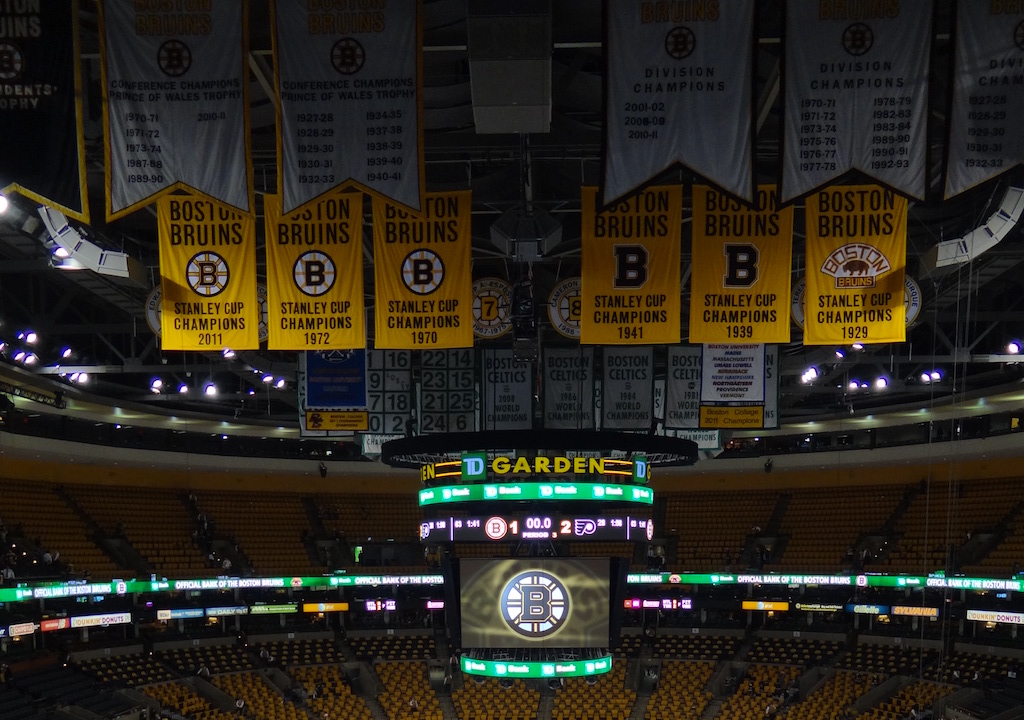
At the end of the 1938-39 season, the NHL-leading Boston Bruins came into the playoff series against second-place New York Rangers with a regular-season record of 74 (compared to 58 for the Rangers). The playoffs began just two days after the regular season ended on March 19. For the rest of March and through April 2, 1939, rookie right winger Mel Hill earned the nickname “Sudden Death.”
Hill had attended training with the Rangers, but Lester Patrick dismissed him. Instead, he signed with the Bruins in October 1937 and played six regular-season games (scoring two goals). The following season, he notched ten goals in 46 games. However, his teammate, rookie goalie Frank Brimsek, received most of the attention throughout the season, culminating with earning the Calder Memorial Trophy and Vezina Trophy.
Right from the beginning of the series, Hill made the Rangers regret setting him loose. At Madison Square Garden on March 21, the teams were tied 1-1 when the clock ran out. Finally, after 59 minutes and 25 seconds of overtime, center Bill Cowley set up Hill for the game-winning goal. From this point, his teammates began calling him “old Sudden Death.” Back at Boston Garden on March 23, the score was tied at 2-2, until Hill put another puck from Cowley into the net at 8:24 of the overtime session.
After the Bruins won the March 26th game 4-1, they looked sure to continue on to the finals. However, the Rangers rallied to win the next three games. Returning to New York, they won 2-1 on March 28. The Boston game on March 30 also went into overtime, but the Rangers came out on top, 2-1. For the last New York game, on April 1, the Rangers won 3-1. That meant that the teams were tied, having won three games each, after having three of the six games dip into overtime.
The seventh and decisive game of the series took place on April 2 back at Boston Garden, which completely sold out. With 16,981 paying spectators but likely over 17,000 inside, the crowd broke Boston’s record for largest attendance. This was the third time in that series alone that the record had been broken. They got more than they paid for when the game stretched from 8:30 p.m. until 12:40 in the morning, 108 minutes in total. The late plane and trains back to New York were held especially for these spectators.
Both teams scored only once in regulation. At 15:52 of the second period, Ray Getliffe scored for the Bruins. Less than two minutes later, at 17:45, Murray Patrick tied up for the Rangers. Brimsek and his counterpart, Bert Gardiner, maintained the score for the remainder of regulation. During the first 20-minute overtime session, the Bruins kept firing on Gardiner while the Rangers only managed one shot on goal. Then the ice had to be completely resurfaced, which took about half an hour. Throughout the second overtime, the chances appeared pretty even. The game stretched into a third overtime session. Brimsek had 27 saves to Gardiner’s 49.
Exactly eight minutes into the third overtime, “Bill Cowley recovering a wild shot of Roy Conacher’s [fed] Hill a perfect pass.” Hill described the play saying, “Bill (Cowley) gave me a perfect pass. I had plenty of time and was in close. Gardiner made the first move, opening his legs, and I just smacked it through. I had to take plenty of time to make it good because I would have been awfully mad with myself if I had missed.” The Cowley-Hill one-two had done it a third time, winning the game and series for Boston.
According to the Boston Globe, “The scene following Hill’s goal last night almost beggars description.” Still, the paper tried to set the scene. “Ten-inch salutes were exploding all over the ice. Hill was torn almost limb from limb by his mates. The crowd was frantic, littering the ice with hats, coats, umbrellas and everything they could throw. Fans were dancing in the aisles, kissing each other, whooping like Indians at the release from their long pent-up emotions, with sheer relief from the agony of putting their hearts through a ringer for four solid hours.” Afterwards, Hill joked “that he took more of a beating from his teammates coming off the ice than he did in the entire game.” Security had a tough time clearing his path to the locker room. There, Getliffe thanked Hill. “Nice work, Mel, and thanks for the birthday present. I turned 25 after midnight and was wondering whether my present was going to be good or bad.”
Hill had won the game with overtime goals in three of the seven that series. He remains the only NHL player to have triple overtime winners in one playoff series.
The Bruins went on to play the Toronto Maple Leafs in the Stanley Cup finals. It was only the fourth time the Bruins had even reached that level (having lost to Ottawa in 1927, defeated the Rangers in 1929, and lost to the Montreal Canadiens in 1930). Between April 6 and April 16, 1939, the Bruins proceeded to defeat the Leafs by winning four of five games. Thanks in good part to Cowley and Hill, the Bruins took home the Stanley Cup. The two were still on the team when the Bruins won again in 1941. That June, Boston traded Hill to Brooklyn, and when they dispersed in 1942, Hill was transferred to Toronto. He won his third and final Cup with the Leafs in 1945.
Additional Sources:
Mike Commito, Hockey 365: Daily Stories from the Ice (Toronto: Dundurn, 2018), kindle edition.
Brian McFarlane, Brian McFarlane’s History of Hockey (Champaign, Ill.: Sports Publishing Inc., c1997), 44-45.
Victor O. Jones wrote an open letter to Hill concluding, “And now perhaps you understand why I rate your goal of last night as perhaps the most valuable which has ever been recorded in hockey.”
Victor O. Jones, “Bruins Take Playoff Final, 2-1,” Boston Globe, 3 April 1939, pp. 1 and 5.
“What About It,” “Cracked Ice,” and “‘Cowley Gave Me Perfect Pass,’ Says Hero Hill,” Boston Globe, 3 April 1939, p. 8.
Gene Ward, “Bruins Gain Finals, 2 to 1,” “Bruins, Rangers Tied Up In ‘Battle of Boston,’” and “Rangers Beat Bruins – to Boston Garden,” New York Daily News, 3 April 1939, pp. 38-41.
Joe Haggerty, “‘Overtime’ Hill Boston’s Hero,” New York Daily News, 3 April 1939, p. 39.
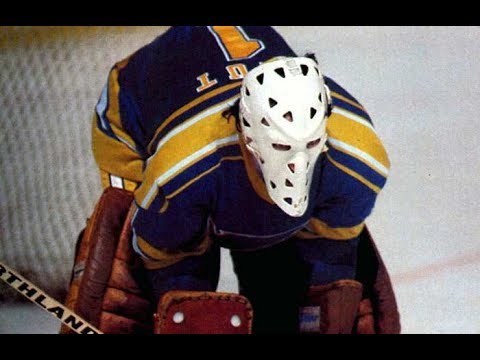
During the 1979-80 season, goalie Mike Liut may have been playing for the St. Louis Blues, but he wasn’t singing the blues. He became the 30th NHL goalie to win 30 games in one season. After playing for the WHA for two seasons, Liut was new to the NHL, so he was only the third to reach the 30-wins milestone in his first NHL season. He followed Frank Brimsek (who accomplished the feat during his rookie season with the Boston Bruins in 1938-39 with a record of 34-8-1) and Bill Durnan (who did so in his rookie season with the Montreal Canadiens in 1943-44 with a record of 38-5-7). Of the 30 goalies to have 30 or more wins in one season, Liut was the first to play for the Blues. He just so happened to lodge his 30th victory the same night the Blues won their 250th home game as a franchise, as only the second expansion team to win as many.
That night was April 1, 1980, when 15,236 fans gathered at the Checkerdome in St. Louis. The Blues defeated the visiting Chicago Blackhawks 5-2. In the process of scoring once in each of the first two periods, the Blues outshot the Blackhawks 20-2, so Chicago goalie Tony Esposito received credit for keeping his team in the game. Late in the second period, Liut made a spectacular save. After blocking Tom Lysiak’s shot, Ted Bulley “knocked the skates out from under Liut,” but Liut “dived across and somehow stopped [Bob] Murray’s shot inches short of the goal line.” Humbly, Liut said, “He didn’t get all of his shot. If he had, there’s no way I’m going to stop it. I could turn handsprings from that spot and I’m not going to stop him if he gets off a good shot. I’m down and out and I figure it’s a sure goal.” After that, the Blues went on a three-goal scoring spree while Chicago managed a second goal. Three of the goals were on power plays and assisted by Mike Zuke. However, the winning and losing goalies, respectively, received the first and third stars of the game.
At that point, they were tied at 30 for having the most wins that season. Liut’s record was 30-23-9, while Esposito’s was 30-21-16. This was Esposito’s eighth (and final) season notching 30 or more wins. Former Blues coach Barclay Plager said, “Right now, I’d say Esposito is the best goalie in hockey and Liut is No. 2.” To the press, Liut commented, “It’s a nice milestone. I mean, I’d rather win 30 than get stuck on 29, but I’ve lost too many games to really make a big thing about winning 30. If I was maybe something like 30 and 20, that wouldn’t be too bad, but I’ve lost 23 games, too. If it turns out that I lead the league or am tied for most victories, I’d be proud of that, but I’d rather have about four or five fewer losses.”
Still, Liut’s accomplishment received its due credit. Chicago’s coach Eddie Johnston (who had reached the 30-game milestone himself with a 30-6-2 record for the Bruins) acknowledged, “Liut played well for them. I’ve only seen him once before, but from what I’ve seen and heard around the league, he’s one of the best. When you win 30 in this league, you’re doing something.” Naturally, the Blues’ general manager Emile Francis (also a former NHL goalie) praised, “I’d say when a goalie comes into this league and wins 30 games his first season, he’s established himself. I can think of a lot of goalies who have struggled before becoming excellent goalies, but I can’t think of a one who had a great start and then couldn’t repeat it.” Liut himself had doubts. “A goalie isn’t established until he’s played well in the playoffs. And once a goalie has established himself as one of the best, then he has to maintain that status. If you can’t maintain that status, what does it mean? Our whole team found out this season that it can be easier to get there than it is to stay there.”
As it turns out, Liut was right about playoffs. After the game, the Blues won their last two games of the regular season, with a 6-0 shutout and then defeating the Blackhawks at Chicago 5-4. They finished second in the Smythe Division with 80 points (34-34-12). However, in the first round of playoffs, St. Louis was completely swept by Chicago. In the first two games, held at Chicago, the Blues lost 3-2 in overtime and then 5-1. Despite returning to St. Louis, they lost game three 4-1. Chicago did not make it past the next round, losing to the Buffalo Sabres, who lost to the New York Islanders, who went on to win their first of four consecutive Stanley Cup championships.
As for Liut himself, he remained with the Blues until February 21, 1985, when they traded him to the Hartford Whalers. After five years there, he was traded to the Washington Capitals on March 6, 1990. His career ended in 1992 after playing 663 games (293-271-74). Liut surpassed 30 wins in three seasons, finishing with 32 in 1979-80, 33 in 1980-81 (when he won the Ted Lindsay Award), and 31 in 1986-87.
Additional Source:
Gary Mueller, “Blues’ Liut Stifles Hawks,” St. Louis Post-Dispatch, 2 April 1980, pp. 1-2F.
Talk about being a team player! During the Stanley Cup playoffs of 1923, Frank “King” Clancy played every single position as the youngest member of the Ottawa Senators. He remains the only NHL player to have been that versatile.
In March 1923, the Senators had accumulated injuries as they defeated the PCHA’s Vancouver Maroons by winning three of four playoff games. To win the Stanley Cup, the Senators then had to defeat the Edmonton Eskimos, the Western Canada Hockey League (WCHL) champs in a best-of-five series. In the process of winning the first game of the series, on March 28 (with a score of 2-1 in overtime), Ottawa suffered further injuries. The Senators would have to struggle through the March 31 bout.
The Senators’ manager and part-owner, Tommy Gorman, listed off the players who were mostly sidelined by the final game. The biggest problems were the defensemen. Captain Eddie Gerard had a dislocated shoulder and was “unable to raise his left arm as high as his chin at any time since he was injured in the last game with Vancouver.” Still, he “laced on his elastic bandages” to enter the game. According to the Ottawa press, he “did not attempt to do much beyond coaching his players, but at that he could not refrain from making a few dashes into enemy territory. He received a bad fall in the second period, and had to be helped off the ice but pluckily returned to the fray.” That was more than fellow-defenseman George “Buck” Boucher could manage. In the first game against Edmonton, his foot had been wounded. Even though he shot cocaine into the foot before the game, his inability to move his foot forced him to leave the ice almost immediately. Another defenseman, Lionel Hitchman, “went into it with injuries to his hip that ought to have sent him to the hospital.” Harry Helman, right winger, had his “face almost covered with plaster.” Left wing Cy Denneny had a bruised leg. That left only goalie Clint Benedict, center Frank Nighbor, right wing Harry “Punch” Broadbent, and substitute King Clancy as more-or-less healthy.
The news out of Vancouver, where the games were held, noted, “It was thought when the series opened that Ottawa was weak in spares. The work of Clancy and Hitchman, throughout the series belied this report, however. Both were most effective.” At the start of the final game, Clancy joined Gerard on defense. Ottawa preferred a defensive style, usually having Nighbor drop back to aid defense while the two wings rushed as forwards. Meanwhile, Edmonton had ten healthy players to rotate.
Both rounds of playoffs were held at Vancouver, and this final game saw about 7,000 in a crowd fairly evenly divided between the two teams. Since the first game had been played by western rules, the second game on March 31 followed NHL rules. Halfway through the first period, Broadbent scored what turned out to be the only goal of the game. The following 50 minutes were all about Ottawa holding off Edmonton.
Defense became even trickier when Ottawa’s goalie received a penalty in the second period. Benedict apparently struck Edmonton’s Joe Simpson “in the legs with his stick” or at least “chomp[ed] at the puck too close to Joe Simpson’s feet” and had to sit for two minutes. Clancy hopped in the net to cover. His teammates helped keep the shots on goal to a minimum, and according to Gorman, “Once Joe Simpson whipped in a long one, whereupon ‘King’ dropped his stick, caught the puck with the skill of a baseball catcher, and tossed it aside while the crowd roared its approval.”
Having previously covered defense, center, right wing, and left wing, Clancy’s time in the net meant that he played every single position during those playoffs. Frank Patrick, head of the Vancouver team Ottawa beat on the way to the finals, remarked, “The hero of the series, to my mind, was young Clancy. Tommy Gorman turned the tide in Ottawa’s favor in the third game against Vancouver when he threw Clancy in and out of the play ten or fifteen times. He transformed Clancy from a mediocre substitute into another super-star, and thus saved Ottawa.” Gorman himself commented, “In the last period Clancy outskated every other man on the ice.” His injured captain praised, “Look at Clancy playing the whole Edmonton team. He’s the greatest kid in the world.”
Thanks to hard-working players like Clancy, Ottawa won the Stanley Cup for the third time in four seasons. Gorman held a luncheon at the Vancouver Hotel to congratulate them and wired Mayor F.H. Plant of Ottawa, “Easter greetings to yourself and all our friends at home from the World’s Champions. We have ordered the Stanley Cup sent to you. Please guard it carefully. It’s pretty precious to us after this series.” The mayor replied, “Heartiest congratulations. Ottawa delighted with your success. I will take good care of the Stanley Cup. Arranging celebration for the homecoming of world’s hockey champions.” About 30 local Ottawa officials met to choose committee to plan homecoming celebration. The team headed back home on their private train car, the Neptune. Reporter Ed Baker, who had traveled with them to Vancouver, gushed, “The Senators, world’s hockey champions of 1923, will go down in history of sport as one of the greatest, if not actually the greatest, band of athletes ever assembled.”
Additional Sources:
Mike Commito, Hockey 365: Daily Stories from the Ice (Toronto: Dundurn, 2018), kindle edition.
“Ottawa Senators Are World’s Hockey Champions,” Ottawa Citizen, 2 April 1923, p. 10.
Tommy Gorman, “Ottawa Hockey Team Jubilant Over World’s Series Success,” Ottawa Citizen, 2 April 1923, p. 10.
“Ottawas Win the Stanley Cup,” Ottawa Journal, 2 April 1923, p. 14.
“Senators are on Way Home with Famous Stanley Cup Win Final with Lone Goal,” Ottawa Journal, 2 April 1923, p. 15.
“City to Welcome Home World Champions,” Ottawa Journal, 2 April 1923, p. 1.
“Ottawa Annexed Stanley Cup But Esks Put Up Game Fight,” Edmonton Journal, 2 April 1923, p. 14.
In 1916 and 1918, the Stanley Cup finals ended on March 30. The former saw the first American team to compete for the Cup, and the latter was the first to feature a team from the newly-formed NHL.
When a PCHA team moved from New Westminster to Portland, Oregon in 1914-15, the Portland Rosebuds became the first American team eligible to challenge for the Stanley Cup. In 1916, they played the Montreal Canadiens of the NHA as the first U.S.-based team to make the finals. The games were held at Montreal Arena and alternated between the eastern rules and the western rules.
The first two games shocked the teams and spectators. Since the first game, held on Monday, March 20, would feature the eastern style and since the Rosebuds had just arrived after such a long journey, everyone predicted the Canadiens would win easily. Instead, Portland’s “Tommy Murray Plays Brilliant Game in the Net” to earn a shutout. Smokey Harris scored in the first period and Charlie Uksila (who replaced him) scored in the second to give Portland the 2-0 victory.
The Rosebuds’ strength coming in and the switch to their western rules combined with the Canadiens playing without Newsy Lalonde and Jack Laviolette, made most bet on Portland to win again on Wednesday, March 22. However, the Portland news admitted, “The Canadiens owe their victory to the wonderful work of their forwards, who outskated the Rosebuds practically throughout the whole evening.” The Montreal Gazette noted that “to [goalie Georges] Vezina goes the greatest share of the credit of scoring the victory.” All of the scoring took place in the first period with Montreal winning 2-1.
The third game, held on Saturday, March 25, featured the biggest fight of the series. The Montreal Gazette tutted that the “free-for-all fight marred a brilliant exhibition.” It began shortly after the third period started with a “cowardly attack of Ernie Johnson’s on Newsy Lalonde.” The police had to assist in breaking up the melee. The Gazette pointed to the subsequent penalties for Portland’s 6-3 loss.
Although the Tuesday, March 28 game had a “disappointingly small attendance,” the “exhibition of hockey furnished was perhaps the most brilliant ever witnessed in a local arena.” The Portland press agreed that the game featured “a regular carnival of scoring and with considerable rough play, as well as spectacular rushes by players on both teams.” The Rosebuds scored the only first-period goal and then twice more in the second. The Canadiens answered with four goals that period. In the third, Portland scored thrice while Montreal only managed one more. As the Gazette succinctly put it, “Twice was the game won and lost by both teams.” In the end, Portland won 6-5 to tie up the series and force a fifth game.
The final Stanley Cup final was held Thursday, March 30 and played by eastern rules “over a sheet of ice that was as nearly perfect as possible which enabled the players to maintain the fast pace at which they started.” As the Portland paper lamented, “There was little to choose between the teams in the matter of skating and stick handling, but the Canadiens had the luck to back up their hard fight and they recaptured the silverware for the east.” The scoring was low with just one goal in the first for Montreal, one goal for Portland in the third, and finally Goldie Prodgers’ winning goal with less than four minutes remaining. The Montreal Gazette celebrated the victory explaining, “In winning this series the Canadiens added to hockey history. They are the first French team to ever hold the coveted trophy.”
The Canadiens were unable to defend their title in 1917, but that autumn, they broke away from the NHA and helped form the new NHL. Since then, the Montreal Canadiens have won the Stanley Cup 23 more times, the most of all NHL franchises.
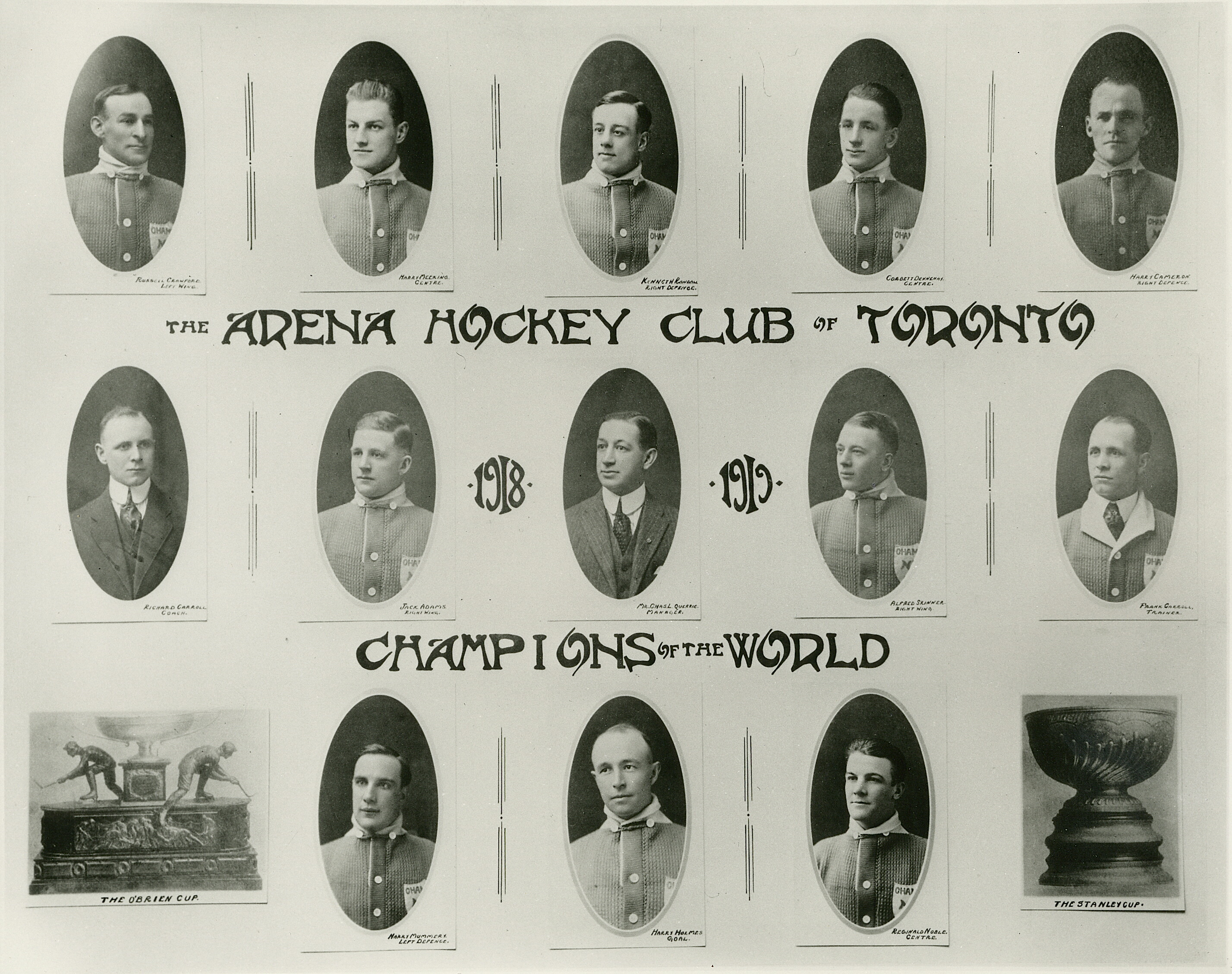
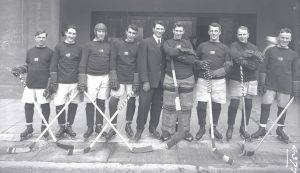
The NHL first joined the challenge for the Stanley Cup in 1918. Toronto won the right to represent the NHL with their team sometimes being referred to as the Arenas and at others as the Blues. Eventually, this team became the Toronto St. Patricks then the Toronto Maple Leafs. Their opponents were the PCHA’s Vancouver Millionaires. The best-of-five series was held at Toronto Arena. All odd-numbered games followed the NHL’s six-man rules, while all even-numbered games added the rover position per the Pacific Coast rules.
About 6,000 spectators came out for the opening game on March 20. Despite Vancouver’s unfamiliarity with the NHL rules and the “strangeness of the rink and the heavy ice,” they were able to “break quick and develop speed as they progress. Finished skaters, they can turn in surprisingly small space, rush well and shoot hard, if inaccurately.” Meanwhile, their president, Frank Patrick, sent his brother Lester the summary, “Toronto looks like a good team. Vancouver boys seemed nervous, Cook and Mackay only in form. Officials good. … May have better luck in next game.” Toronto essentially had already won by the time the first period ended, with the final score being 5-3.
The second game was held Saturday, March 23 before a slightly smaller crowd, and the “ice was faster and more to the liking of Vancouver.” According to the press, “When the Blues realized that they were in for a beating, they cast all decency aside and gave the visitors a rough passage. . . . For the greater part of the last period, the Torontos were playing short-handed, owing to penalties.” It was so rough that a “flying puck struck Frank Patrick’s father in the face but he was not hurt seriously.” Still, it took 12 minutes before the first goal, and the Millionaires took off during the final two periods to bring the score up to 6-4. Vancouver’s Mickey Mackay and Toronto’s Alf Skinner both had hat tricks.
By the third game, on Tuesday, March 26, it was obvious the teams were best in their own styles and miserable in the other. Again, Toronto essentially won the game in the first period when they had a 3-0 lead. Skinner, Harry Cameron, and Corbett Denenny all scored twice, while Vancouver only had Cyclone Taylor scoring twice and Ran McDonald once. The final score for Toronto’s victory was 6-3.
The audience must have picked up on the pattern, because the fourth game, on Thursday, March 28 had the “poorest crowd of the series.” Toronto fans were smart not to watch their team only score once at the beginning of what the press called “one of the most uninteresting burlesques that the local sporting public have been asked to watch.” Vancouver proceeded to crush Toronto when Taylor, Barney Stanley, and Lloyd Cook each scored twice while Mackay and McDonald scored one goal each. The Millionaires won handily with 8-1.
With Toronto having won the two NHL-style games and Vancouver having won the two Pacific Coast games, it came down to the fifth game, which would be played by NHL rules. On Saturday, March 30, the large crowd was “wrought up to the highest pitch of excitement.” According to the newspaper recaps, “Vancouver probably had an edge in the initial 20 minutes of the play, but the Blues assumed the aggressive in the next stanza and clearly outplayed and out-lasted the visitors.” Neither team scored until the third period. Skinner scored for Toronto, then Taylor for Vancouver, and finally Denenny scored the winning goal for Toronto. As the Stanley Cup winners, Toronto players would split $350 while Vancouver players received $250 as consolation. In the first appearance by an NHL team in the finals, Toronto became the first NHL team to take home the Cup.
See Part 1 for the history of the 1917 and 1919 Stanley Cup finals.
Additional Sources:
Brian McFarlane, Brian McFarlane’s History of Hockey (Champaign, Ill.: Sports Publishing Inc., c1997), 12 and 17.
“Portland Team Here for Series,” Montreal Gazette, 20 March 1916, p. 16.
“Western Rules in Second Cup Match,” Montreal Gazette, 22 March 1916, p. 12.
“Rosebuds Defeat the Canadian Champions by Score of 2 to 0,” Oregon Daily Journal, 21 March 1916, p. 12.
“Canadiens Won Second Cup Match,” Montreal Gazette, 23 March 1916, p. 10.
“Canadiens Win Second Hockey Match By Point,” Oregon Daily Journal, 23 March 1916, p. 14.
“Eastern Rules in Third Game,” Montreal Gazette, 25 March 1916, p. 18.
“Rowdyism Shown by Hockey Players,” Montreal Gazette, 27 March 1916, p. 17.
“Johnson Not Likely to Play,” Montreal Gazette, 28 March 1916, p. 14.
“Portland Nosed Out the Canadiens,” Montreal Gazette, 29 March 1916, p. 14.
“Rosebuds Trim Canadiens 6-5 in Fourth Bout,” Oregon Daily Journal, 29 March 1916, p. 11.
“Flying Frenchmen Lift Stanley Cup,” Montreal Gazette, 31 March 1916, p. 14.
“Canadiens Win World Hockey Title in Game,” Oregon Daily Journal, 31 March 1916, p. 10.
“Toronto Wins First Game of World Series 5 to 3,” Vancouver Sun, 21 March 1918, p. 8.
Len Brown (of Toronto Mail and Empire), “Millionaires Lose First Stanley Cup Game to Toronto,” Vancouver Daily World, 21 March 1918, p. 10.
“Vancouver Team Wins Second Hockey Game: Fans Hoot Torontos,” Vancouver Sun, 24 March 1918, p. 24.
“Toronto Wins,” Vancouver Sun, 27 March 1918, p. 10.
“Toronto Blues Double Score On The Millionaires in the Third Cup Game,” Vancouver Daily World, 27 March 1918, p. 12.
“Will Meet Again to Discuss Rules,” Vancouver Sun, 29 March 1918, p. 8.
“Vancouver Gives Toronto One Record Whaling: Score 8 to 1,” Vancouver Sun, 29 March 1918, p. 10.
“Vancouver Swamps Toronto 8 to 1” and “Informal Meeting Of Hockey Moguls On Uniform Rules,” Vancouver Daily World, 29 March 1918, p. 12.
“Toronto Wins 2 to 1 Game Decides Series,” Vancouver Sun, 31 March 1918, p. 22.
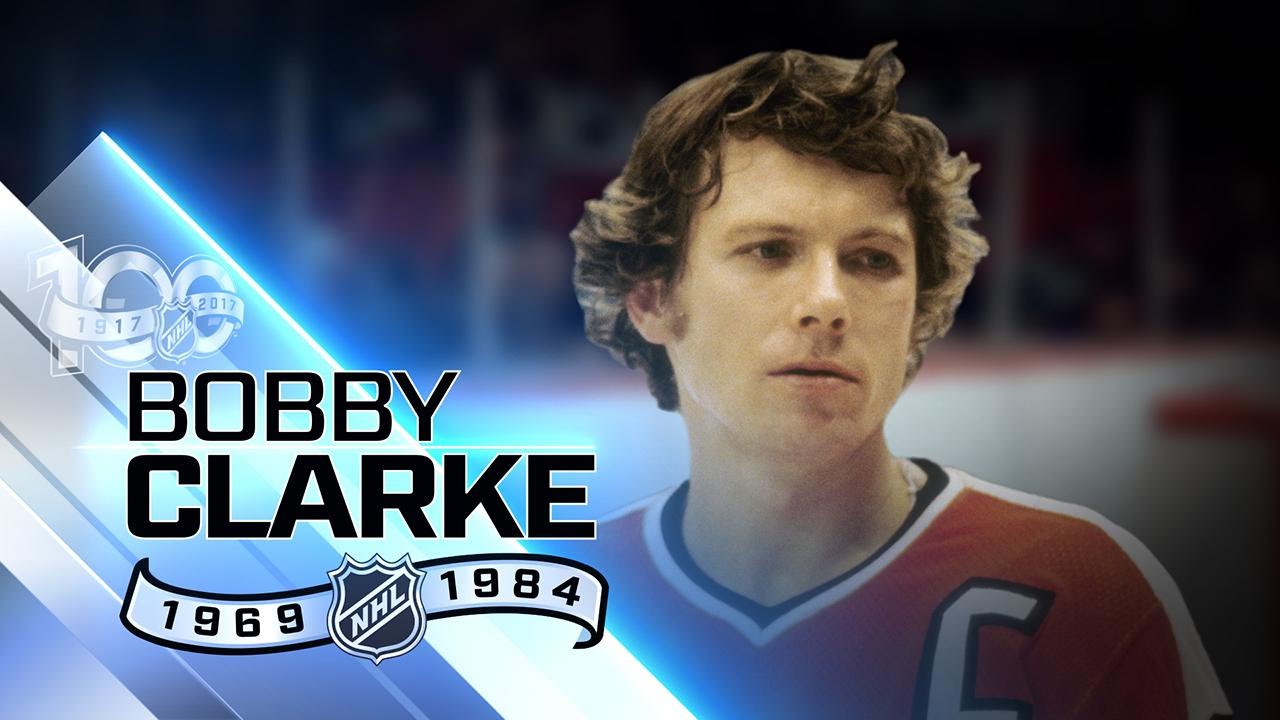
The Philadelphia Flyers joined the NHL as part of the major expansion in 1967. Two years later, center Bobby Clarke joined the Flyers and soon became the face of the franchise. Despite having diabetes, he was drafted 17th overall when Flyers’ scout Gerry Melnyk exclaimed, “I don’t give a damn if this kid’s got one leg; he’s the best player I’ve seen at this level. He’ll right away be our best player.” In January 1973, at 23, Clarke became the youngest captain in the NHL. Only two months later, on March 29, 1973, he became the first expansion-team player to score 100 points.
A crowd of 16,600 filled the Spectrum that night. Their recent losses had led to a sign being hung there that referred to the Flyers as “chokers,” and they were set on proving their doubters wrong. However, their opponents, the Atlanta Flames, drew first blood just 1:09 into the game. In the middle of the second period, right winger Simon Nolet (subbing for Gary Dornhoefer) came to the rescue by scoring twice in 40 seconds. As any good teammate, Nolet brushed off the later overshadowing of his own accomplishments saying, “I don’t mind tonight. I’m just happy it happened for Bobby.”
So what did Bobby do? At 18:26 of the second, while the Flames were two men short, Clarke scored his 34th goal of the season, earning his 99th point. Of that goal, he commented, “When you play on the power play with guys like (Rich) MacLeish, (Bill) Flett, and (Bill) Barber you’re bound to luck in on some points.” Rather than stop there, at 14:43 of the third period, he scored again, his 35th goal and 100th point of the season. He became the ninth NHL player to get 100 points and the first ever to reach the milestone playing for an expansion team. According to the Philadelphia Daily News, the 100th point “Triggered a thunderous ovation from the Flyers’ 21st sellout and overwhelmed the message board, sending it into fits of gobbledygook after it flashed ‘100, 100.’” Clarke sounded pretty humble afterwards when he commented, “It’s always nice to get results from your work. It’s the same in any job. But I’ll feel a lot better if we finish ahead of Minnesota. We’ve worked hard all year for something. Sometimes you can set goals, but on a team that didn’t make the playoffs last year how can you make personal goals? Right now everyone is working hard to get second.” Thanks to Nolet and Clarke, the Flyers defeated the Flames 4-2.
At the end of the season, Clarke had 104 points and won the Hart Memorial Trophy (as MVP) and the Ted Lindsay Award (as chosen by fellow players), becoming the first expansion team player to receive them. He and the Flyers made it to the semifinals, only to lose to the Montreal Canadiens. They then went on to win the Stanley Cup the next two seasons, while Clarke again earned the Hart in 1975 and 1976. Those were the only two seasons he topped his 104 points, scoring 116 and 119, respectively.
Clarke never played for anyone but the Flyers, remaining with them for 15 seasons before retiring in 1983-84. Chosen as one of the 100 Greatest Players, the NHL biography described him, “On one hand, he was a supreme playmaker, a crafty and timely goal-scorer, an indefatigable checker, a virtuoso faceoff specialist — a complete player. On the other hand, he could also be a vicious stickman, a cheap-shot artist and an incorrigible instigator.” He said of himself, “I loved to get on the ice. I loved to practice and I loved to play. The rest of the time, I wasn’t that good at anything else, but playing and practicing, that’s what I loved to do. So I could at least demand from other people that they work hard because I would always be able to do that.” So when he retired after 1144 games (358G, 852A, 1210P), Clarke was fourth in NHL assists and eleventh in points. He also tops the Flyers’ lists for: seasons (15), games (1,144), assists (852), points (1,210), playoff games (136), playoff assists (77), and playoff points (119). He was inducted into the Hockey Hall of Fame in 1987.
Additional Sources:
Chuck Newman, “Flyers Win, 4-2, On Nolet’s 2 Goals,” Philadelphia Inquirer, 30 March 1973, pp. 1C-2C.
Bill Fleischman, “Second More Important Than 100 Points,” Philadelphia Daily News, 30 March 1973, pp. 81, 84, and 88.
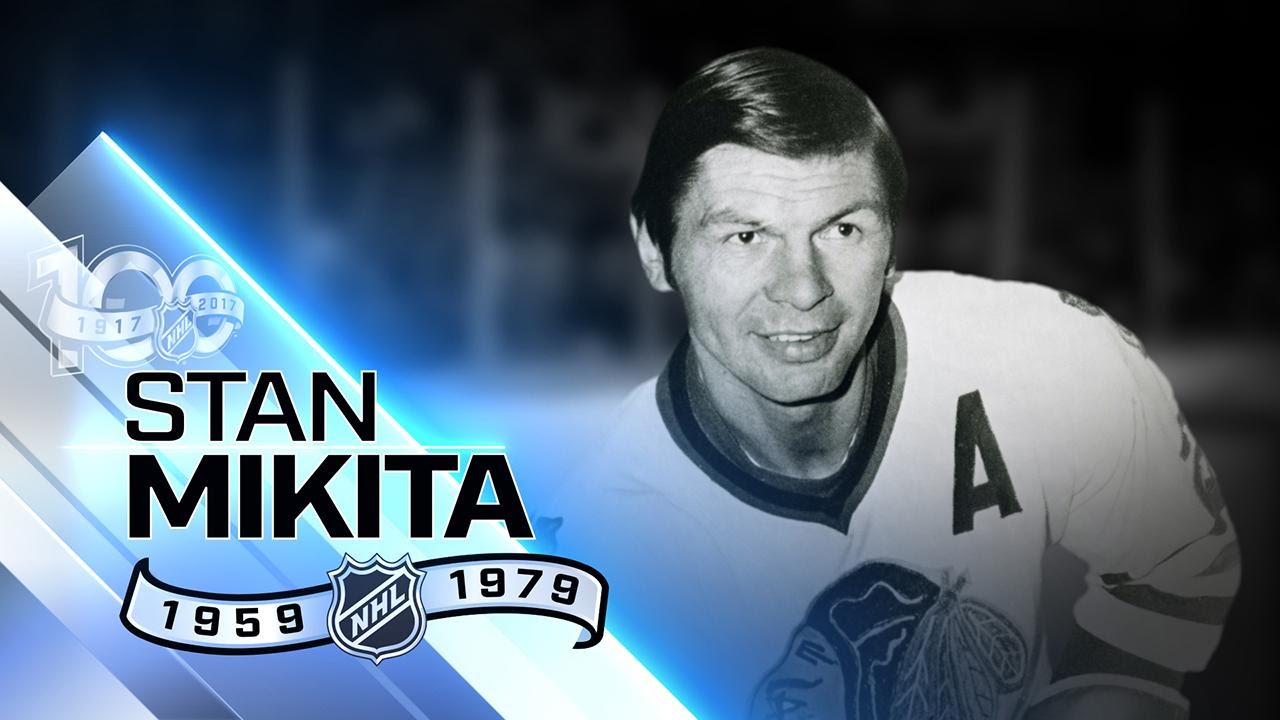
At the end of the final Original Six season, the Chicago Blackhawks had scoring power houses who pushed the team to the top of the rankings. Back on March 12, 1967, Chicago had clinched the league title, but their players kept pushing for records. Sixteen days later, on March 28, center Stan Mikita set a new record for assists while teammate Bobby Hull faced a setback in his goal-scoring hopes.
The game that night at Chicago Stadium meant nothing as to standing because their opponents, the Detroit Red Wings, would not even make playoffs. However, the Blackhawks ran up the score to 7-2. Mikita started things off with the first goal (his 34th of the season) at 5:53 of the first period. On Chicago’s third goal, at 1:51 into the second period, Mikita assisted Ken Wharram for his 60th assist of the season. This beat the record of 59 regular-season assists that he set in 1964-65. His points for the season totaled 94, which put him only four points from Bobby Hull’s record of 97 points in one regular season. The Chicago Tribune called these “the only significant gains made by either club in the game.”
On the subject of Hull, he had two significant moments during the game. About halfway through the first period, a slapshot of his shattered the glass pane behind Detroit’s goal. The efforts to fill the hole caused a 51-minute delay because the first glass did not fit, the second glass crystalized (like ice), and finally, they installed chicken wire over the opening. Late in the third period, Hull injured himself in response to a teammate’s injury. Defenseman Matt Ravlich’s left ankle twisted until his leg broke when Detroit defenseman Bob Falkenberg grabbed Ravlich by the hips and basically threw him into the boards. Shortly after Ravlich left on a stretcher to be sent to the hospital, Hull checked Falkenberg. Unfortunately, as Hull described, “Falkenberg’s knee just hit mine as I was striding and drove it in. I felt it pop.” Hull’s doctor told him not to play the remaining few games before playoffs, so he could not break his 54-goal record.
After the last regular-season game on April 2, Mikita claimed he should have had another assist on Doug Mohns’ goal in the third period of that game. Official Lamie Crovat said he would belatedly award the assist after checking the films, but the films showed that the original ruling was correct. That meant that Mikita ended the 1966-67 season with two new records and a tied record. His assist on Ken Hodge’s goal at 14:19 of that same third period gave him his 97th point of the season, tying him with Hull for most points in one regular-season. Mikita’s 97 points set a new record for most points by a center, beating Jean Beliveau’s 91 points from 1958-59. Finally, Mikita ended the season with 62 assists to set his record even higher.
With all of these record-setting points, naturally Mikita earned the Art Ross Trophy as the scoring champion. Hull came in second with 80 points. This was Mikita’s third time taking home this trophy, having recently won in 1964 and 1965 with Hull winning it in 1966. In addition, Mikita received the Lady Byng Memorial Trophy (as most gentlemanly player) and the Hart Memorial Trophy (as MVP). He remains the only player to win these three major awards all in the same year, and he did it again the next season.
At the end of the 1966-67 season, Chicago also had set records as a team. They had the most goals (264), a record previously held by the Montreal Canadiens from 1961-62 (with 259 goals). Their total points (701) surpassed the Canadiens’ record (of 697) from 1958-59. Within their club, this season set the record for the most wins (41), most game points (94), fewest losses (17), and least goals against (170).
Mikita retired in 1980 after having played all 22 seasons for Chicago, who retired his No. 21 that same year. Just three years later, he was inducted into the Hockey Hall of Fame. In 2011, a bronze statue of Mikita was placed outside the United Center. At that time, he still led Chicago in regular-season games played (1,394), playoff games played (155), regular-season assists (926), and playoff assists (91).
Additional Sources:
Ted Damata, “Hawks’ Cup Chances Hurt by Injuries to Hull, Ravlich,” Chicago Tribune, 29 March 1967, section 3, pp. 1 and 4.
“Hawks Rewrite Record Book; Win, 8-0,” Chicago Tribune, 3 April 1967, section 3, pp. 1-2.
“Hawks Find New Ice; No Mark for Mikita,” Chicago Tribune, 4 April 1967, section 3, pp. 1 and 4.
Brian McFarlane, Brian McFarlane’s History of Hockey (Champaign, Ill.: Sports Publishing Inc., c1997), 99-100.
Like most sports, hockey was traditionally considered the realm of men – from the players to management and even to the media covering the sport. In the U.S., on March 27, 1993, the latter had a breakthrough for women, when Sherry Ross became the first woman to give the play-by-play during an NHL game. Some sources even credit her as the first woman to broadcast for a male professional sports team.
Ross graduated from Rutgers University-Newark in 1977 and the following year began covering hockey for the Daily Record in Morristown, New Jersey. She later wrote for New York Newsday and the New York Daily News and freelanced for Sports Illustrated and The Hockey News, covering both hockey and horse racing. Her writing extended to the Hockey Scouting Report for 14 seasons between 1990 and 2004. During her career, Ross has served as secretary-treasurer for the Professional Hockey Writers’ Association and on the board of directors for the National Turf Writers’ Association. Beginning in January 1992, Ross joined the New Jersey Devils as a radio analyst, a position she kept through their successful bid for the Stanley Cup in 1995.
On March 27, 1993, the New Jersey Devils defeated the Washington Capitals 5-2. The Devils’ usual announcer, Gary Thorne, had been in Winnipeg to call a game for ESPN, and he ran late when his flight back was delayed. Radio announcer Chris Moore filled in on TV for SportsChannel New York. Thus, Ross stepped in for him and called the first period for WABC Radio while Devils’ beat writer Rich Chere provided the color commentary. Chere gave her a lot of credit. “She did a fine job, but that wasn’t surprising to me. She proved her great knowledge of the game of hockey and really seemed to have a lot of fun calling the contest.” The New York Daily News praised, “Real nice spur-of-the-moment play-by-play job by Devils radio analyst Sherry Ross on Saturday.”
The following year, Ross became the first woman to do color commentary during the Stanley Cup finals. She worked as an analyst for NHL Radio when the New York Rangers defeated the Vancouver Canucks in 1994. As of 2009, she had covered 15 Stanley Cup finals and 6 Kentucky Derby races.
On September 20, 2007, the Devils rehired Ross as a radio color commentator to work with play-by-play announcer Matt Loughlin. She held that position for nearly ten years before being relieved of her duties on May 23, 2017. During that time, Ross had another female first on November 25, 2009, when she called the play-by-play for the entire game between the Devils and the Ottawa Senators at the Prudential Center. Loughlin had suffered a death in the family, so Ross became the first woman to do the full play-by-play for an English broadcast. Her color commentator was former Devils forward Rob Skrlac, who said, “She’s a seasoned professional — how can she fail.” Beforehand, Ross commented, “I have a feeling it’ll fly by, like when I did the play-by-play for that one period in 1994.” After the first period, she graded herself a C-plus, saying, “I think hockey is kind of unique to do play-by-play — not that I’ve done other sports, but hockey is different because there aren’t a lot of set play stoppages like baseball and football. So a color person has to get a lot in during the flow of the play. We stepped on each other a little bit but it wasn’t too bad.”
For all her accomplishments (and for Women’s History Month), Ross was honored by the state of New Jersey with a ceremony at the Statehouse in Trenton on March 22, 2010. At the time of her 2009 play-by-play experience, Ross said, “If it doesn’t exist for anybody as an opportunity, then nobody thinks to do it, so if you think nobody could ever do this, then nobody will ever try. Now, maybe some girls will think, ‘It’s been done once so maybe if I go to school and pay my dues and get better, I could do it too.’” The women of The Pink Puck can and do!
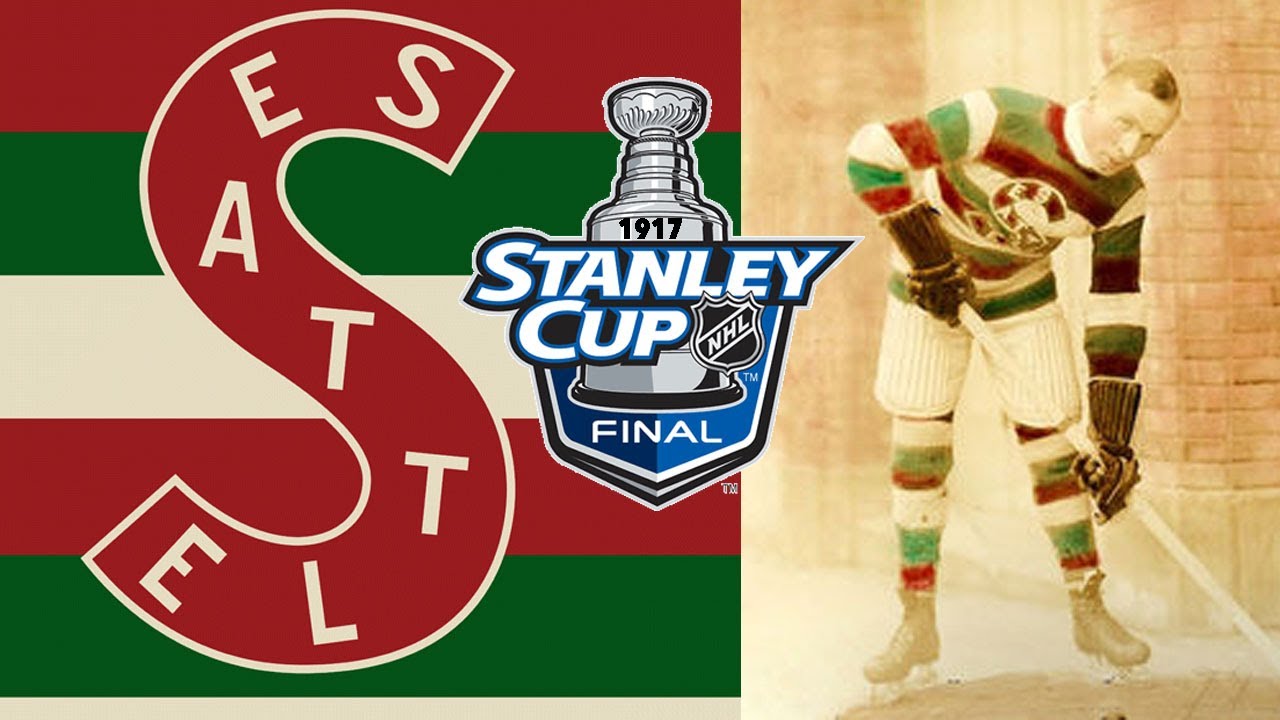
By a twist of fate, during the late 1910s, the Stanley Cup championship ended on the same day every other year. In 1917, the final game was played on March 26, while in 1916 and 1918, that game took place on March 30. Then, in 1919, the game on March 26 ended in a draw that could not be counted towards the series, which never actually was finished. All four years held significance in the history of professional hockey.
In March 1917, the Montreal Canadiens, in their final season before the NHA made way for the NHL, played the top Pacific Coast Hockey Association (PCHA) team for the Stanley Cup. Although the Cup had originally been intended to reward “the championship hockey club in the Dominion of Canada,” the PCHA was represented by the Seattle Metropolitans, who hosted the championship series in the U.S. All games would begin at 8:30 p.m. at the Arena (on Fifth and University Streets, Seattle), which did not allow smoking. The teams would play a best-of-five series alternating between the Eastern rules and the Pacific Coast rules. The latter still used a rover and called off-side while the former allowed for any player called for a penalty to merely be swapped for another player (rather than skate shorthanded). Although this would be Seattle’s first title competition, they were considered to have a slight advantage (other than the Canadiens having top goalie Georges Vezina).
The Canadiens passed through Vancouver, British Columbia, on March 16 to arrive at Seattle in time for a workout before the first game on March 17. They brought ten men, including Newsy Lalonde, who was supposed to have been “ruled off the ice for the rest of the season for undue roughness.” He was allowed to play and earned himself the first penalty of the series. That first game was practically sold out, and young fans climbed on the roof to watch through the transoms. Following the Pacific Coast style with seven men, the Canadiens had 31 penalty minutes compared to just three for the Mets. However, Seattle had poor defense (especially in goalie Harry Holmes) and later claimed to have partied too hard coming into the game, resulting in their 8-4 loss to Montreal.
The second game followed Eastern rules on Tuesday, March 20. Seattle Coach Pete Muldoon promised, “It will be a different team that faces the Canadiens tonight.” Indeed, Holmes “evidently didn’t like what the fans said of his work in the first game,” so “he left nothing to be desired. Meanwhile, the Seattle Star reported, “The poor Canadiens looked like a bunch of wooden-legged men on skates compared to the flashy speed work of the local lads.” Lalonde again caused trouble, when during a third-period fight he hit the referee “below the belt” with his stick, earning himself a 10-minute penalty and $25 fine. Seattle won this round 6-1, which boosted public opinion on the Eastern style of play. “It seems faster and apparently leaves more room for action than the Pacific Coast brand,” claimed the Star.
For the third game, on Friday, March 23, the rules reverted to Pacific Coast style, and there were even more fans who were even more wild. Seattle’s “speed and youth triumphed over age and experience” because their “combination plays were put over with snap and zip and their long rushes down the ice were zig-zagged most successfully.” Poor Vezina felt like “some one was shooting pucks at him a basketful at a time out of a cannon.” Thus, Seattle won 4-1.
On Monday, March 26, 1917, the championship series came to a close. The Seattle Star commented, “Last night’s game lacked the dash and vim of the earlier contests. Members of both teams were evidently pretty much fagged with the pace they have been forced to go in this series.” They must have been too tired to fight because “not a man was sent off the ice for roughness.” The Mets blew away the Canadiens 9-1, so Seattle became the first U.S. team to win the Stanley Cup. That was also the last championship played without the NHL.
Two years later, the Seattle Metropolitans and the Montreal Canadiens again played each other for the 1919 Stanley Cup championships. As before, the best-of-five series would be played at the Arena in Seattle with each game beginning at 8:30 and alternating between the two styles of play.
The first game, held on Wednesday, March 19, 1919 followed the Western rules. According to the Star, “The visitors, who are used to the six-man hockey, without the regulations governing center ice, were puzzled by the Mets’ passing game.” Seattle’s goalie, Holmes still, earned a shutout when he “put up the most finished goal-tending job that has ever been seen in the local rink.” The Mets scored seven goals while blanking the Canadiens.
Following Eastern rules, the second game was played on Saturday, March 22. This time, the “Easterners outskated and outplayed the Coast kings of the ice in every frame except the last ten minutes of the struggle.” Although fans booed the Canadiens for playing rough with much tripping, their “bad boy” Captain Lalonde was more concerned with offense and made all four of their goals. Thanks to him, the Canadiens won 4-2.
That Monday, March 24, the teams played the third game by Western rules. It became obvious that the teams had the advantage in their own style of play as Seattle “played a dazzling combination game” while Montreal’s defense suffered. The Seattle Star wise-cracked, “Vezina, the Canadien goalie, stopped the puck last night with about as much effect as an eggshell fort would stop a ‘Big Bertha’ shell. If this bird is the best goalie in hockey, we would like to see the worst.” Seattle took the lead with a 7-2 victory.
As of Wednesday, March 26, 1919, the series was completely thrown off course. “The play was rough and both teams put up a defensive, close-checking game that made scoring impossible,” summarized the Star. The teams had a scoreless tie after regulation and two ten-minute overtime sessions. According to Eastern rules, the game should be called a draw at that point, and despite debating the issue, the officials chose to adhere. That meant that the game would not count towards the series and the fourth game essentially had to be played again on Saturday, March 29. Since it was a do-over, the game stuck with Eastern rules. Both teams were injury-ridden, but Seattle was deemed slightly worse off. Still, the Mets led 3-0 until Montreal rallied up a tie during the third period. After 15 minutes of overtime, Jack McDonald scored the winner for Montreal. That tied up the series to force a fifth (and deciding) game.
Unfortunately, the deciding game was never played. Thanks to the delay with the fourth game, the final was rescheduled from Friday, March 28 to Tuesday, April 1. Before it could be played, Canadiens manager George Kennedy and five of his players came down with the influenza sweeping across the globe. Captain Newsy Lalonde, Louis Berlinquette, and Billy Coutu were confined to their beds, while Joe Hall and Jack McDonald were sent to the local hospital. Hall died in mere days, and Kennedy’s weakness from the flu led to his death in a few years. Kennedy had offered to borrow players from Victoria to finish the series or to forfeit, but Seattle and the PCHA refused both offers. Instead, officials decided to distribute payments for the series evenly to all the players (instead of the intended 60-40 split between the winners and losers). The Seattle Star reported on April 2, “There is absolutely no chance of the series being finished, as the lease on the Arena has expired and the ice has been taken up.” All exhibition games were also canceled.
The 1918-19 season was the first of only two in which the Stanley Cup was not awarded and the only one in which the playoffs were not completed. For 1919, the Stanley Cup was engraved, “Montreal Canadiens, Seattle Metropolitans, series not completed.”
The Seattle Metropolitans folded in 1924, but the NHL recently awarded Seattle a franchise to begin play in the 2021-22 season. Perhaps someday Seattle will face the Montreal Canadiens again to claim the Stanley Cup.
Stay tuned (on March 30) for Part 2!
Additional Sources:
Mike Commito, Hockey 365: Daily Stories from the Ice (Toronto: Dundurn, 2018), kindle edition.
“Canadiens Won Title Series Last Season,” Seattle Star, 15 March 1917, p. 9.
Edward Hill, “First Game of Ice Hockey Series on Tonight,” Seattle Star, 17 March 1917, p. 5.
“Hockey,” Seattle Star, 19 March 1917, p. 9.
“Second Game of Ice Hockey World’s Series Scheduled in Arena Tonight,” Seattle Star, 20 March 1917, p. 9.
Edward Hill, “Seattle Beats Montreal Canadien Hockey Team in Arena, 6 to 1,” Seattle Star, 21 March 1917, p. 9.
“Seattle and Montreal Teams Tangle in Third World’s Series Game Tonight,” Seattle Star, 23 March 1917, p. 13.
“Seattle Winner in Third World’s Series Ice Hockey Contest in Arena, 4 to 1,” Seattle Star, 24 March 1917, p. 7.
“Seattle Squad Wins World’s Ice Hockey Championship from Fast Montreal Canadiens in 4 Games,” Seattle Star, 27 March 1917, p. 9.
Leo H. Lassen, “Seattle Mets Trounce Flying Frenchmen, 7-0, in the First Title Game,” Seattle Star, 20 March 1919, p. 11.
Leo H. Lassen, “Les Canadiens Annex Second Ice Title Mix,” Seattle Star, 24 March 1919, p. 10.
Leo H. Lassen, “Mets Trounce Les Canadiens in Third Mix,” Seattle Star, 25 March 1919, p. 10.
“Les Canadiens Fighting With Backs to Wall,” Seattle Star, 26 March 1919, p. 10.
Leo H. Lassen, “Crucial Mix of Puck Classic Ends in Draw,” Seattle Star, 27 March 1919, p. 12.
“Seattle Mets May Win Hockey Title Tonight; Teams Are Banged Up,” Seattle Star, 29 March 1919, p. 10.
Leo H. Lassen, “Frenchmen, With Backs to Wall, Stage Heroic Rally and Cop Ice Tilt,” Seattle Star, 31 March 1919, p. 10.
“Greatest Ice Series a Tie; ‘Flu’ Did It,” Seattle Star, 2 April 1919, p. 10.
Women’s hockey truly came into its own at the turn of the millennium. Although some colleges had teams as early as the 1970s, it was not until 1998 that women first competed internationally in the Olympics and nationally in a championship. The U.S. Olympic Committee financed the American Women’s College Hockey Alliance (AWCHA) to hold the first national championships, and that was also the first year rewarding the Patty Kazmaier Award (for the top women’s hockey player each season). However, it took until August 2000 before the NCAA sanctioned a division of women’s ice hockey and held its championship at the end of the 2000-01 season. The first official NCAA National Collegiate Women’s Ice Hockey Tournament took place in March 2001.
For the first women’s Frozen Four, Dartmouth Big Green (26-3-1) came in ranked No. 1 having both placed first in the Eastern College Athletic Conference (ECAC) and having won its tournament. The No. 2 seed was the University of Minnesota-Duluth (UMD) Bulldogs (26-5-4), who placed second in the Western Collegiate Hockey Association (WCHA) but won its tournament. Their coach, Shannon Miller, had coached Team Canada in the 1998 Olympics, and when she realized that most American players preferred Big 10 schools, she recruited seven players from Swedish, Finnish, and Swiss national teams. Harvard Crimson (23-9-0) held the No. 3 spot with their second-place finish in the ECAC rankings and tournament. Finally, the St. Lawrence Saints (23-7-3) made it to No. 4 as third place in the ECAC despite having lost their semifinal game in the tournament.
The Frozen Four semifinals took place at Mariucci Arena in Minneapolis, Minnesota on March 23. At 4 p.m., top-seed Dartmouth played bottom-seed St. Lawrence. Everyone was shocked when the Saints sunk three unanswered goals on top-ranked goalie Amy Ferguson (who had a 92.9 winning percentage) before the first period had ended. St. Lawrence coach Paul Flanagan said, “I thought, if anything, we probably caught them off guard. At first it was almost too much too quick. Our kids were almost too giddy on the bench and we had to get them focused.” Dartmouth replaced Ferguson with Meaghan Cahill, but the Saints only managed five shots on goal in the remaining periods. Meanwhile, their rookie goalie, Rachel Barrie, blocked 30 shots and only let in one shorthanded goal during the last four minutes of play. With a score of 3-1, St. Lawrence advanced to the finals.
At 7:30 p.m. on March 23, the UMD took on Harvard. Going into the game, Coach Miller commented, “We’re proud to be representing the Midwest. Actually, it’s quite a good feeling. Any time we come down to play the Gophers, they’re very hospitable. Now to be here and have it be the home ice is a very good feeling.” Still, Harvard looked to be tough opponents considering they had two finalists for the Patty Kazmaier Award, and both Tammy Shewchuck and Jennifer Botteril had played for Miller on Team Canada. To loosen up the Bulldogs before the game, Miller and her assistants wore wigs to their Friday morning skate. The Minneapolis Star Tribune teased that the team was “so laid-back it took two periods before they awoke from their slumber,” and Miller said afterwards, “I’ve got to apologize for the first period, I think, for both teams. It was not pretty hockey.” In reality, they scored first (on a power play in the second period) before Harvard tied up. Then in the first eight minutes of the third period, UMD scored four goals. “Obviously, there was about a 10-minute period there where we really turned it on offensively and got a lot of shots on net and put the puck in the net,” said Miller. Although the Crimson sunk two back-to-back goals within 1:21, the Bulldogs finished the game at 6-3. Harvard coach Katey Stone merely commented, “We lost a game to a really good hockey team. We knew how good Duluth was back in December.”
Mariucci Arena hosted the first NCAA finals on March 25, 2001. At 1 p.m., Harvard defeated Dartmouth 3-2 for third place. Harvard’s Botterill took home the Patty Kazmaier Award but commented, “It’s a huge honor, but I definitely would trade it any day for a NCAA championship, that’s for sure.”
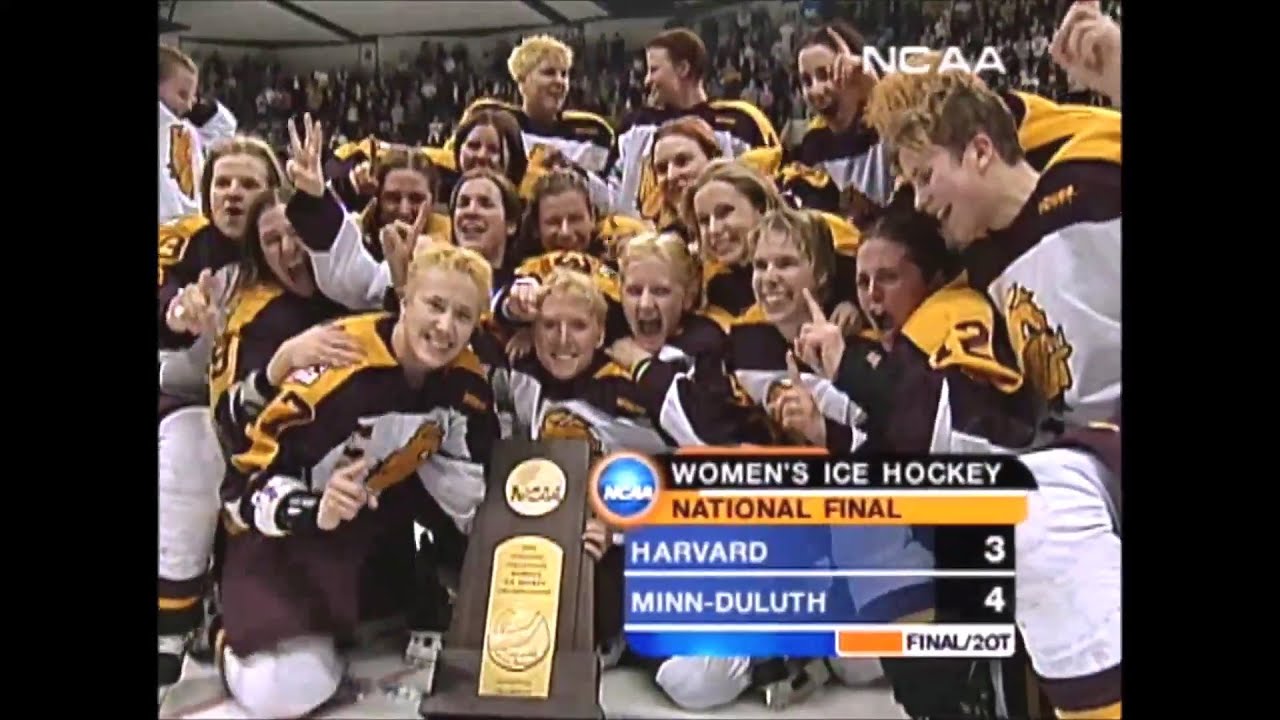
At 5 p.m., a crowd of 3,079 watching the championship game between No. 2 UMD and No. 4 St. Lawrence. Back in their season openers, the Bulldogs had defeated the Saints 7-0 and 4-3, but that was due in part to the Saints still auditioning four goalies for the top spot. Both teams featured a high number of underclassmen. Duluth had the advantage in number of shots per game (with 43.6 over St. Lawrence’s 31.3). After the Saints scored first (at 11:22 of the first period), the Bulldogs proceeded to score four goals between the last three minutes of the first period and the first six minutes of the third. As the Star Tribune summarized, “Duluth’s solid forechecking and relentless offense simply overwhelmed St. Lawrence after the first period ended at 1-1. The Bulldogs scored four consecutive goals before the Saints scored during a 6-on-4 situation with 54 seconds remaining.” With a score of 4-2, UMD won the first NCAA championship. Swedish import Maria Rooth was named the tournament’s outstanding player. She commented, “This is extremely big, because this is the national championship and you can’t get any higher in college hockey.” Coach Miller celebrated but looked ahead. “Any time you go to a national championship, it’s a big deal. I think we’ve built a really, really solid foundation in Duluth, and I think you’ll see UMD women’s hockey in the top teams in the country for a long time to come.”
For the next two years, UMD defended their title, and to this day, they have won the championship more than any other team besides their fellow WCHA Minnesotans, the Gophers. In fact, until 2014, only those two teams and the University of Wisconsin-Madison Badgers ever won the tournament. That year (and again in 2017 and 2018), the Clarkson Golden Knights became the only ECAC team to win. The most recent championship game, held on March 24, 2019, was won by the Badgers when they shutout the Gophers 2-0. This brings them tied with the Bulldogs for number of championships.



 Prev
Prev