After Thursday night’s disappointing loss on home ice in the first game of the series against the Toronto Maple Leafs, it should not have been a surprise to anyone that the Boston Bruins ratcheted up their intensity and their physicality when the puck dropped Saturday night. Head Coach Bruce Cassidy started the game with his fourth line of Joakim Nordstrom, Noel Acciari and Chris Wagner, which certainly gave an insight into what had been discussed before the game began.
“Well, we need to be on time with our start. We knew that we didn’t play to our identity in Game 1. We’re aware of it and we want to move past it and have a good response game. How do you respond? You’re physical, win the puck battles, control momentum in the first period, attack when you have the chance, puck possession. We had a lot of check lists. Basically, let them know how we’re going to play and kind of tilt it in our favor after that,” Coach Cassidy said after the game.
The Bruins have long relied on their physical side—it is a part of their identity—and when they embrace it, they tend to play a much better game. By the end of the first period, David Backes was leading the team with four hits, while David Krejci had three. Three other players—Zdeno Chara, Jake DeBrusk, and David Pastrnak—each had two hits.
“You saw [Pastrnak] play a few bodies and that kind of gets you jacked up. We didn’t want to chase hits by any means, but you know it kind of builds momentum and gets the crowd into it. Yeah, definitely energizes the bench. We think we turn into a bunch of cheerleaders when they do that. It just means they’re invested like we are. It’s not like I’m going to go toe drag somebody after they go hit someone but, yeah, it’s fun to watch because you know they care and that’s one way to show it,” Wagner said of the skill players throwing the hits.
That physicality may also have forced the Maple Leafs players to toss the puck before they were ready in an attempt to avoid the hit. When the game was finished the hit totals were 44-39 in favor of the Bruins, with every player on the Boston bench registering at least one hit. While the first game had its moments of physicality, Game 2 brought it to an entirely new level, but at the same time the Bruins were playing a much better puck game as well. They were able to limit the Leafs takeaway chances to just seven in the second game, compared to the astounding 19 takeaways Toronto had in the first game. Likewise, the Bruins increased their chances to regain the puck by doubling their takeaways from six to 12.
Nazem Kadri and Jake DeBrusk
There had been some question after Thursday’s game if DeBrusk would be playing, as he had not been on the ice for practice on Friday. He definitely did play and it seemed that he and Nazem Kadri were drawn to each other, like magnets, whenever they were both on the ice. The two of them got matching minors for roughing in the first period. There was a hit by DeBrusk on Kadri during the second period that appeared to be knee-on-knee, though nothing was called on the ice. Kadri went down the tunnel, but he was back on the ice for the third period. And it was in the third, after DeBrusk’s hit on Patrick Marleau, that Kadri cross-checked DeBrusk in the face. DeBrusk went down and was quite still on the ice for a bit. The Bruins’ trainer came out to attend to him, and DeBrusk headed down the tunnel to be looked after. Kadri, likewise, headed down his respective tunnel, when he was served a five-minute major and a game misconduct.
“I did a series of tests. Just hoping [they] come back negative at this point,” DeBrusk said after the game about how he was doing.
Unfortunately for Toronto, Kadri’s decision to make that hit on DeBrusk took the momentum away from his team. They had been the stronger of the teams during the third period. They’d begun to outshoot the Bruins, and Kadri had tipped in a puck to make the score 3-1 with 9:16 remaining in the game. However, instead, Patrice Bergeron put the Bruins up 4-1 one minute into the five-minute power play, and that would be the final score. And it was announced after the game that Kadri will have a hearing with NHL Player Safety.
Toronto’s Nazem Kadri has been offered an in-person hearing for Cross-checking Boston’s Jake DeBrusk. Date and time TBD.
With all the physical play, there were a couple of additional situations that resulted in the Bruins having just four defensemen to finish the game. Torey Krug took a hard hit from Jake Muzzin in the second period, which saw Krug go down on the ice while his helmet went flying. He went down the tunnel and did not return to the game. Then during the third period, Connor Clifton took a hit and had to exit the game.
However, as the teams head to Toronto, it is no surprise that the Bruins plan is to continue their physical game.
“We didn’t over play one line. We were able to share that a lot and from that play some good hard minutes on each line and get everyone into the game but not overtax anyone, so we were able to keep up the intensity. When they made a push, we had enough juice in the tank to push back. We’re going to need to keep that intensity for the next five games if necessary and we’ll see what happens. But I loved our intensity tonight,” Backes said.
The series is tied as the teams head to Toronto for Games 3 and 4 to be played on Monday and Wednesday nights. The Bruins will indeed need to take the crowd out of things as quickly as possible on Monday, but also need to be sure to keep their physicality on the right side of the refs. Meanwhile it is likely that the Maple Leafs will be without Kadri for at least a game or two.
Toronto fans must have experienced the worst case of déjà vu. On the exact same date (April 13) seven years apart (in 1933 and 1940), the New York Rangers took the Stanley Cup with an overtime win at Maple Leaf Gardens.
At the end of the 1932-33 regular season, both the Maple Leafs and the Rangers finished with 54 points. However, that was enough to put Toronto in first for the Canadian Division but sink New York to third in the American. Based on those rankings, the defending champions only had to defeat the Boston Bruins (3-2) to make the finals. The Rangers had to knock out first the Montreal Canadiens (1-0-1) and then the Detroit Red Wings (2-0).
When the Leafs and Rangers met on April 13, the latter had won the first two games in the best-of-five finals on their home ice. The third game moved the series over to Toronto, who won 3-2. In the fourth game, according to the New York Daily News, “Play started at a fast clip, but the opposing defense men broke up every thrust before it became especially dangerous.” That held true throughout the game as it ended null all. During the overtime session, “after three minutes of wide open attacking by both teams, they settled back to stricter checking at mid-ice.” Then about seven and a half minutes in, the Rangers’ Butch “Keeling broke up the game at the next face-off, passing to Bill Cook who scored with a neat corner shot from close in.” The Rangers’ veteran captain and future hall-of-famer won the Stanley Cup for the second time in their franchise’s history.
Seven years later, New York and Toronto finished the 1939-40 season ranked second (with 64 points) and third (with 56 points), respectively. This time, it was the Rangers who knocked out the Bruins (4-2) while the Leafs eliminated the Chicago Blackhawks then the Red Wings (2-0 each). The first two games of the best-in-seven finals were held at New York, and the Rangers won both. After the series moved to Toronto, the Leafs won the next two games but lost the fifth. The first and the fifth game had ended in overtime.
With 14,894 gathered at Maple Leaf Gardens on April 13, the home team scored in each of the first two periods to lead 2-0. The Rangers finally joined the party at 8:08 of the third period. The New York Daily News recapped, “Neil Colville shook Red Horner out of his hair and made it 2-1. One minute 54 seconds later in the third period Alf Pike feinted Goalie Broda out of position and delivered the tying goal.” With the game tied, at 17:14 the Rangers ganged up on Turk Broda, and “there was a big pile-up with Broda on the bottom. The red light flashed, but Stewart ruled it no goal although the Rangers protested long and loudly.” Like with seven years prior, the game went into overtime. This time, it only took until 2:07 for New York’s Bryan Hextall, another destined for the Hockey Hall of Fame, to score the winning goal. With that, the Rangers won their third Stanley Cup almost exactly like they had won their second.
The Rangers would have to hold tight to the memories from those two championships to sustain them through the next 54 years, the longest drought in Stanley Cup history. Meanwhile, the Maple Leafs won five championships just during the 1940s.
Additional Sources:
“Bill Cook’s Goal Gives Rangers Stanley Cup,” New York Daily News, 14 April 1933, p. 55.
Gene Ward, “Rangers Win, Take Cup,” New York Daily News, 14 April 1940, p. 84.
The 1995-96 season sure went out with a bang. On April 12, the day after the Boston Bruins clinched their record-breaking 29th straight playoffs berth, the Winnipeg Jets clinched their last before relocating. Their first opponent would be the Detroit Red Wings, who on the same night, set a record for number of regular-season wins. Both teams won 5-3 after scoring an empty-net goal in each game.
At Winnipeg Arena, 15,567 came out to watch the final regular-season home game of the franchise. During the summer, the Jets would officially move to Phoenix, Arizona to play as the Coyotes. Their opponents that night were the Los Angeles Kings, who scored the first goal in every period. Fortunately for the soon-to-have-a-new-home team, the Jets scored all five of the other goals. The highlight of the game was the last one. With one second to spare, Keith Tkachuk sunk an empty netter as his 50th goal of the season. He was only the third Winnipeg player to reach that plateau and would be the last for that franchise while still at Winnipeg. Tkachuk commented, “The party’s just starting.”
The 5-3 victory clinched a playoff berth for the Jets. As with everything else, it would be their last. Throughout the game, the fans made clear how unhappy they were with the team leaving. After “booing during the American national anthem,” they frequently shouted, “Phoenix sucks!”
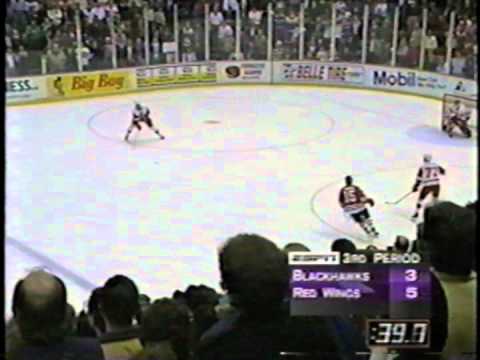
Meanwhile, at Joe Louis Arena, 19,983 fans gave the Detroit Red Wings a standing ovation as they chanted, “Sixty-one! Sixty-one!” Before the game, Detroit held a ceremony honoring two players. Captain Steve Yzerman received a Rolex watch and a crystal milestone award for his 500 career goals. Defenseman Vladimir Konstantinov was awarded a crystal trophy for being voted team MVP. Unfortunately, the first 25 minutes of the game then had gone in favor of their opponents, the Chicago Blackhawks, who led 3-1.
During the second period, the home team came back with a vengeance. Detroit scored twice in 33 seconds on a power play. About six minutes later, Paul Coffey scored while short-handed. It was his second goal that game, having scored on a power play in the first period. With about 45 second left on the clock, Kris Draper got an empty-netter so that Detroit won 5-3. Yzerman commented, “After Drapes scored that goal there we really had a chance to appreciate the reaction of the fans. For a minute, anyway.” His team “leapt over the wall and plowed into a happy huddle by the net.”
This victory was the 36th that season at Joe Louis Arena. That tied them with the 1975-76 Philadelphia Flyers for the record number of home wins in one season. Not only that, but this was Detroit’s 61st victory of the season. That meant that they had broken the record set by the Montreal Canadiens in 1976-77. Some noted that Detroit had 82 games compared to Montreal having played only 80, which meant that the Canadiens lost fewer games. Either way, Coach Scotty Bowman had broken his own record having coached both the teams during their winningest seasons. The team kept things in perspective knowing playoffs were what mattered. Right winger Darren McCarty said, “Obviously it’s exciting. It’s pretty cool. It’s never been accomplished before, and we took a lot of pride in it.”
Two nights later, on April 14, the Red Wings grabbed their 62nd victory in a 5-1 win over the Stars at Dallas. Unsurprisingly, Detroit easily nabbed the Presidents’ Trophy.
The 1995-96 postseason turned out to be all crushed hopes for Winnipeg and Detroit. Although the Red Wings defeated the Jets (and then the St. Louis Blues), they lost the Conference Finals to the Colorado Avalanche. Detroit went on to win back-to-back Stanley Cup championships for 1996-97 and 1997-98, despite only winning 38 games in the former and 44 in the latter regular season.
The total 62 games remains the highest number of regular-season wins for Detroit. The only NHL team to even tie them is the Tampa Bay Lighting for this season, 2018-19. However, Detroit had more points with 131 compared to Tampa Bay’s 128.
Additional Sources:
Mike Commito, Hockey 365: Daily Stories from the Ice (Toronto: Dundurn, 2018), kindle edition.
“Jets clinch playoff spot in final regular-season home game,” Arizona Republic, 13 April 1996, p. C5.
“61, The Most,” Detroit Free Press, 14 April 1996, pp. 1A, 1B, and 6B.
Thursday night saw the Boston Bruins take to the ice in the first postseason game, having earned home ice in the first round, where they are once again taking on the Toronto Maple Leafs. The energy in the building spoke to the importance of the game, and one would have thought that the electricity from the fans would have resonated with the team. As things got underway, it looked like the Bruins were energized and focused.
For a couple of the Bruins players on the back end this was their first experience of playoff hockey at the NHL level. While this is Brandon Carlo’s third year as a Boston Bruin, injuries at the end of the regular season the previous two years kept him from doing more than watching during the postseason. Meanwhile, Connor Clifton, who spent the bulk of the regular season with the Bruins AHL affiliate, the Providence Bruins, this was his first playoff game. Both were a little off during the game, and Bruins Head Coach Bruce Cassidy expected that.
“Obviously, two guys are playing in their first game. [Matt Grzelcyk] and Charlie [McAvoy] haven’t been around that long, so there could have been some nerves. I think there was clearly for Brandon [Carlo] early. We knew that would happen. That’s fine. Play through it. Other guys tried to force it a little bit. Maybe turn down some opportunities to make an easier play, especially in the offensive end of it, offensive blue line, opportunity on the two-on-one we had with [Grzelcyk]. Next thing you know it’s in our net, so some of that hopefully they’ve learned that you have to make a quicker decision with it, and that’s, again, individual based on how Toronto, how they play,” Coach Cassidy said after the game.
DeBrusk screens Andersen
Despite some of the tentative play, it was actually the Bruins who got on the scoreboard first, while on the power play. Not surprisingly it was Patrice Bergeron taking a pass from Brad Marchand. And Jake DeBrusk did a good job of helping to screen the Maple Leafs goaltender, Frederik Andersen, though his play doesn’t show up on the scoresheet.
Unfortunately for the Bruins, Mitch Marner would make sure the Leafs took a tie game into the first intermission.
“Another great shot by [Jake] Muzzin just got the stick on it, hit the post, when I looked up I saw [Danton] Heinen and their two defensemen on that far post with [Tuukka] Rask not knowing where the puck was. I shot it as quickly as I could getting it towards the net, luckily enough it hit the post, hit him, and went in,” described Marner of his view of that game-tying goal.
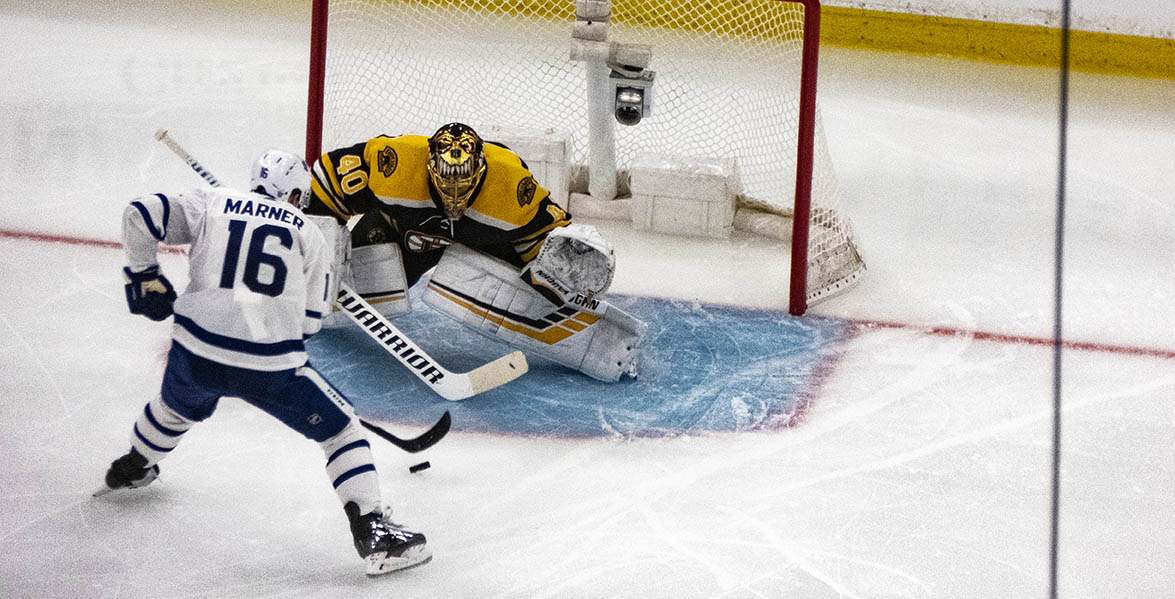
However, it was undoubtedly Marner’s second goal, during the middle frame that tilted the ice and may have played some mind games with the Bruins. And it was once again the result of puck management issues for Boston that resulted in the breakaway that Marner had, despite the fact that the Bruins were actually on the man advantage.
The Bruins gave up the most short-handed goals during the regular season—fifteen in all. And Marner’s breakaway certainly looked like that could be the result, however, DeBrusk, in an effort to perhaps get the puck loose, took a penalty that resulted in Marner being awarded a penalty shot. Certainly not what the Bruins wanted on the power play. DeBrusk may have learned a valuable lesson about what not to do in that situation. For the Leafs, it put them up 2-1, as Rask was unable to keep the puck out of the net.
“Yeah, you know, we didn’t skate our routes in the entry first, so that’s where it started. I mean, [DeBrusk] should be driving wide and Torey [Krug] is right behind him so there was a little miscommunication there, probably get in clean. Second part of it, I think it’s reactionary. I think that I would have preferred he let him, you know – one of the things [Patrice Bergeron’s] done really well in those situations is take one side of the ice away from that player, especially a guy with speed like [DeBrusk], maybe you know, pick – in that case he’s a right shot, Marner – so go to his other side if you don’t think you can lift his stick. At least eliminate maybe that side of the ice so maybe the goalie can say, okay he’s probably going to stay on his forehand. You know, unfortunately [DeBrusk] tried to create a loose puck situation. I don’t fault his effort. [Bergeron] won a Selke for a reason; I think that’s part of the learning curve for the younger guys and we can certainly discuss it in the heat of the moment and that’s what Jake decided to do,” Coach Cassidy said of the play that resulted in the penalty shot.
While the Bruins were giving away the puck, the Leafs were also actively taking it away. The turnovers by the Bruins throughout the game were the physical evidence of the team’s struggles. It was clear that they were not playing their game, perhaps concentrating too much on the Leafs’ game. Instead of taking their style of game to the Leafs, it seemed more like they were allowing the Leafs to dictate much of what happened.
Of course, each round of the Stanley Cup Playoffs is a best of seven series. Yes, the Toronto Maple Leafs took the first game, but that doesn’t signal the end of things. For the Boston Bruins, Friday’s practice will undoubtedly find them regrouping, reviewing, and addressing what went wrong to ensure that it doesn’t happen again on Saturday. And for the younger guys, they have now been through that first game and can perhaps put the jitters on a shelf and get back to playing their style of hockey.
Spring was in the air, and as one Boston Globe correspondent wrote, “perhaps the ultimate certainty was watching the Bruins in the Stanley Cup playoffs” every year at that time. When the Bruins clinched a playoff berth on April 11, 1996, it marked a record-breaking 29th consecutive season of playoff hockey for Boston.
The 80th game of the Bruins’ 1995-96 season was held at Boston’s FleetCenter, where they hosted the Hartford Whalers. Although Hartford scored first on a power play midway through the first period, Boston tied up as the final seconds of the period ticked down. Each scored again during the second period, but Boston’s Sandy Moger potted the game winner at 11:32 of the third.
The victory nudged the Bruins up to 89 points, putting them in a four-way tie (with Washington, Florida, and Montreal) for fourth place in the Eastern Conference. After losing the rematch at Hartford, the Bruins defeated the Pittsburgh Penguins in the season finale. Boston ended the season with 91 points (40-31-11), ranked second in the Northeast Division.
One of the reasons credited for Boston squeaking into the playoffs was the re-attainment of goalie Bill Ranford. After his first two seasons in the NHL, in March 1988 Boston traded Ranford to the Edmonton Oilers only to take him back on January 11, 1996. After clinching, Ranford commented, “It’s a pretty big accomplishment. The team can finally relax a little. We’ve been playing playoff hockey for the last two months. It was good to let off a little steam.”
In contrast to Ranford’s short time with the Bruins, captain Ray Bourque already had been with the team for 16 years of consecutive playoff appearances. Based on his experience, he said, “I think everyone was worried. We couldn’t see the light at the end of the tunnel. We weren’t playing consistent and couldn’t get anything going. I’m just happy this team got together and went out and got it done.”
The Bruins’ coach, Steve Kasper, had just been hired the previous May. He claimed, “I’ve said it over and over again – the goal was to make the playoffs.” It took much more effort than expected, but under his leadership, the Bruins pulled it off. “It took a long time to wrap it up. But the last 25 games, this team has really come together. When you fall behind, you worry because you can’t control what the other teams are doing,” Kasper explained. “I believed in what we were doing and I said when we went on the road in February that I felt it would be a good opportunity to come together. That was a starting point and we never really looked back. It took us 80 to nail down a spot, but we’re happy to be in it. I’m really happy with the club. We battled some long odds and came out on top.”
Making it to the playoffs was one thing but making it through the rounds was another. It only took five games for the Bruins to be eliminated by the Florida Panthers in the Conference Quarter-Finals. The following season, the playoff streak ended, as did Kasper’s time as Boston’s coach.
All in all, Boston has only missed the playoffs 22 seasons, less than a quarter of their total 94 since joining the NHL in 1924. Their 72 playoff appearances is second only to that of the Montreal Canadiens, who have appeared in 83 postseasons. However, the Bruins still lead the NHL in consecutive appearances, for the seasons from 1967-68 to 1995-96. The Chicago Blackhawks simultaneously trailed them by one when their streak lasted from 1969-70 to 1996-97. On the other side of the coin, the Bruins also have one of the worst droughts for missing the playoffs with eight seasons from 1959-60 to 1966-67. Only four other teams have nine or ten-season droughts. Going beyond hockey, the Boston Bruins’ 29-season playoff streak is still the second-longest in North American major professional sports. Only the Canadian Football League’s Edmonton Eskimos have gone longer, with 34 consecutive postseasons.
Additional Sources:
Nancy L. Marrapese, “Bruins join ‘in’ crowd,” Boston Globe, 12 April 1996, pp. 87 and 93.
Todd Archer, “A not-so-sure sign of spring,” Boston Globe, 12 April 1996, p. 94.
The San Jose Sharks finished second in the Pacific Division with 101 points. The 101 points came with spotty goaltending all season long and missing Erik Karlsson for a significant amount of time. The Sharks managed to score 289 goals, or 3.52 goals for per games played, which had them second in the League in both categories behind the Tampa Bay Lightning. The offense pretty much carried the team to a spot in the postseason.
The Vegas Golden Knights finished third in the Pacific Division with 93 points, and didn’t allow too many goals throughout the season (228). The Golden Knights are a balanced team, but with finding the right line combinations, the team has finally started clicking on offense. Max Pacioretty, Paul Stastny and Mark Stone have been finding some chemistry since Stone was acquired around the NHL Trade Deadline in February. The Golden Knights played much better at home (24-12-5) than on the road when they finished under .500 (19-20-2).
The Regular Season Series Rundown
The two teams played four times and split the season series. The two teams first faced off on Nov. 24 in Vegas, and the Golden Knights easily pulled out the 6-0 victory. The second game was on Jan. 10, again in Vegas, but this time the Sharks pulled out the 3-2 win. The third game was in San Jose on Mar. 18, where the Golden Knight pulled out the 7-3 win. The fourth and final game was on Mar. 30 in San Jose where the Sharks managed to get the 4-3 win in overtime.
Special Teams Recap
The San Jose Sharks are in the same boat as most of the playoff teams with only one part of the special teams play being really good. The Sharks power play finished at 23.6%, which was good enough for sixth overall. They had 57 power play goals while allowing nine short-handed goals, which can be cut down come postseason play. The Sharks penalty kill finished at 80.8%, which had them at 15th overall. The Sharks allowed 45 power play goals and scored nine short-handed goals of their own.
The Golden Knights power play needs some serious work to have an impact on this series. The team finished 25th overall in the NHL at 16.8%. The Golden Knights scored only 39 power play goals, but only allowed two short-handed goals all season. The penalty kill was just okay in the regular season. The penalty kill finished at 80.9% to rank 14th overall in the NHL. The team allowed 44 power play goals, but scored 11 times while down a man.
Key Players
The key players for the Sharks this series are going to be Logan Couture and Tomas Hertl. The two players are the first and second line centers so they will be playing against the Golden Knights’ best defensive forwards at any given point during the series. If Couture and Hertl can find a way to produce whether at even strength or on the power play then the Sharks will force the Golden Knights into some matchup problems.
The key players for the Golden Knights in this series are the second line, which consists of Max Pacioretty, Stastny and Stone. The three are finally starting to find some chemistry and the Golden Knights will need them to continue finding it. The team will need at least two lines to compete with the Sharks, who can put the puck in the opposition’s net.
Series X-Factors
Martin Jones will need to step up his game in the playoffs because he has been allowing goals all season long. Sometimes the goals are because of bad team defense in front of him, but Jones has allowed his share of soft goals/savable goals this year. He needs to come into this series focused and ready to go so he can track the puck to make saves for his team that they’ll need him to make. Jones needs to be in position to make timely saves to keep his team in games.
The Golden Knights need to find a way to win some games on the road since they haven’t played well away from T-Mobile Arena this season. The lack of success on the road will make the home ice advantage even more important even though they only play three games at home this series. A nice way to start the series would be to come out in game one and get the road win to get that monkey off their backs.
The Sharks Advance If…
The team can play solid defense and get some good goaltending. The offense has carried the team this season so scoring the goals shouldn’t be a problem for this team. The defense will need to tighten up and play smart hockey. They’ll need to avoid the turnovers and mistakes in their own zone especially around their own net.
The Golden Knights Advance If…
The good playoff Marc-Andre Fleury shows up in the net. Fleury can either run hot or cold in the playoffs. The goalie can either look spectacular or look like he couldn’t stop a beach ball from getting behind him. They’ll need to steal a game or two on the road to have a shot at advancing into the second round.
Sharks-Golden Knights Series Prediction
The Golden Knights will find a way to win a game or two on the road and take the series in six games. Fleury won’t necessarily be amazing, but he’ll make more stops for his team than Jones will. Jones may actually get pulled in a game in this series because he is playing so bad. The Golden Knights will play disciplined hockey and win the even strength battle.
The Nashville Predators had an inconsistent regular season, but still managed to win the Central Division. They started off with a rocky road record, then straightened that out just in time to catch an injury bug. The goalies were decent enough through all of this, but they could be more consistent. The Predators ended the season on a nice little run, finding ways to win to clinch a playoff berth.
The Dallas Stars were also inconsistent this season, but it was mainly due to a lack of depth scoring. The Stars didn’t get much production beyond the big four of Tyler Seguin, Jamie Benn, Alexander Radulov and John Klingberg. The goalie duo of Ben Bishop and Anton Khudobin was the reason the team remained in so many games despite not getting depth production. The defense was also good in front of the goalies, who only allowed 212 goals against.
The Regular Season Series Rundown
These two teams played each other five times over the course of the regular season. The first meeting came on Nov. 10 in Dallas and the Predators wound up winning the game 5-4 in overtime. The second game was on Dec. 27, again in Nashville, but this time Khudobin pitched a shutout for the 2-0 Stars’ win. The middle game of the series was played on Feb.2 in Nashville and the Stars managed to win the game by a final score of 3-1. The fourth game was just five days later on Feb. 7 in Nashville, and the Predators won 3-2 in overtime. The fifth and final game of the series came on Feb.19 in Dallas, where the Predators grabbed the 5-3 victory.
Special Teams Play
The Predators power play was god awful all season long. They were kept to the outside and couldn’t find a way to get the puck through to the net, and that was even after they acquired both Brian Boyle and Wayne Simmonds, who are both big bodies to distract the goalie. The Predators were, however, good on the penalty kill all year long. They finished sixth overall at 82.1% on the season.
The Stars are one of the few teams in the playoffs that had decent numbers on the power play and while shorthanded. The Stars finished the season converting on 21% of their power play opportunities, which was good for 11th in the NHL. The penalty kill finished fifth in the NHL, operating at 82.8%. The Stars have a slight edge in the special teams because of the power play being so much better than the Predators.
Key Players
If the Predators want to win this series then they will have to get production from its top line of Filip Forsberg, Ryan Johansen and Viktor Arvidsson. The trio had been the best line for the Predators, when they were all healthy, during the regular season. It seems like the line combinations are finally figured out so now the players can build on the chemistry they had in the final push for the playoffs. The top line is one of speed and skill, but they can also put the puck in the net, and they’ll need to have an impact on this series.
The biggest key to this series for the Stars will be the play of one Ben Bishop. Bishop put up Vezina-like numbers during the regular season, but may not be a Finalist for the Award due to the lack of playing time either due to injury or splitting the duties with Anton Khudobin. Bishop is going to need to continue his play from the regular season into the postseason because the Predators can score some goals and create plenty of chances.
Series X-Factors
The Predators defensemen are not shy to join in on the action in the offensive zone, whether it be pinching to keep a puck in the zone or getting down low for a scoring chance. Their defense accounted for 193 points in the regular season. The Stars need to be aware of the defensemen jumping into the play in the offensive zone because they can act like a fourth forward when doing work in the offensive zone. They aren’t too bad locking it down in their own zone either.
The x-factors for the Stars are going to be their special teams. Both their power play and penalty kill ranked in the top 11 in the League. The power play can get some goals while the penalty kill getting a big kill helps gain the team some momentum during a game. The special teams can change the course of a game with a big power play goal or a big penalty kill, both can be a potential momentum swinger.
The Predators Advance If…
They get good goaltending and play smart, disciplined hockey. Whether it be Pekka Rinne or Juuse Saros in the net, the goalie will need to make some saves. The Predators want to avoid the penalty box as often as they can because the Stars have a good power play. The team should also avoid turnovers in the neutral zone and their own zone so the Stars can’t make them pay for their mistakes.
The Stars Advance If…
Ben Bishop and Anton Khudobin play the way they’ve been playing all season long. The defense will give up some chances, but they’ve been pretty good all season long and that goes a long way in helping a goalie out during a game. Bishop/Khudobin need to make timely saves and try not to allow the soft/fluky goal.
Predators-Stars Series Prediction
The Stars are going to make this a series because of their defense and goaltending. The Predators have some good defense and goaltending of their own, but the active defense in the offensive zone is going to have a huge impact on this series. The series will go the distance of seven games, but the Predators find a way to win and advance to the next round.
The Winnipeg Jets finished with 99 points on the season and just missed out on the Central Division title, and the reward is having to play the red hot St. Louis Blues in the postseason. The Jets have a balanced lineup that can put the puck in the net. The problem for them this season has been that goaltender Connor Hellebuyck has fallen back to earth a little bit after his Vezina-like season last year.
The St. Louis Blues were in last place at one point this season, but they managed to turn the season around mainly due to rookie goaltender Jordan Binnington. Binnington gave the team some confidence because he started making saves and keeping the team in games. The rest of the team started to buy in and managed to climb out of last place and finished third in the Central Division. Ryan O’Reilly was certainly a boost for this team as he led the team with 77 points on the season.
The Regular Season Series Rundown
These two teams met four times during the regular season and the Jets came away with three wins, but they didn’t face the Blues after the team went on their streak. The first meeting came on Oct. 4 in St. Louis where the Jets took away the 5-1 win. The second time the two teams met was on Oct. 22 in Winnipeg where the Jets pulled out the win 5-4 in overtime. The third time these two teams met came on Nov. 24 in St. Louis and the Jets came away with an 8-4 win. The final meeting came on Dec. 7 in Winnipeg and the Blues got the win in that game.
Special Teams Recap
The Jets have a really good power play, but a not-so-great penalty kill, which seems to be a common theme among the playoff teams. The Jets power play was ranked fourth overall at 24.8% for the season. They scored 62 power play goals while allowing seven short-handed goals to the opposition. The penalty kill could use some work as the Jets finished 22nd in the League at 79.2%. They allowed 52 power play goals against but also scored 10 goals while a man down.
The Blues are one of the few teams that had both its power play and penalty kill stats ranked in the top 10 of the League during the regular season. The Blues were ranked 10th on the power play at 21.1%. The team managed to score 50 goals on the man advantage while giving up seven short-handed goals. The penalty kill was ninth best in the NHL finishing the season at 81.5%. The Blues allowed 43 power play goals and score five short-handed goal.
Key Players
The key player for the Jets in this series will be Patrik Laine. Laine got off to a good start to the season, but then hit a major snag with a goal scoring slump. Laine is going to need to find a way to put the puck in the net to help his team in this series. The forward produced 20 less points this season than last year. He needs to shoot the puck and hit the net when he gets the chance to build his confidence back up.
Ryan O’Reilly will be the key for the Blues to take this series. O’Reilly was the leading scorer with the Blues this season with 77 points. He will also be a key component in face-offs needing wins to help the team gain possession, get offensive attack time or to win key defensive zone draws.
Series X-Factors
Connor Hellebuyck is going to be the key to winning this series. He needs to find a way to get back to the great goaltending of last season. The Blues will get their chances and the defense will sometimes jump into the play offensively. They will also have plenty of bodies around the crease area so Hellebuyck’s rebound control is going to need to be good. Hellebuyck will need to make some saves for his team or they could very well be going home after the first round.
Jordan Binnington has been fantastic for the Blues since his call up earlier in the regular season. It is easy to forget that he is still a rookie, even though he is 25-years-old. He is the reason that the team turned their season around, but he is still unproven in the postseason. Will the pressure of a potential seven game series get to him? Likely not because he has looked calm in doing what he has done so far this season. If he can make saves for his team then he could lead them into the second round.
The Jets Advance If…
They can get in on the forecheck to try to wear down the defense and force turnovers. They will need to get off to a good start in games to build momentum. The Jets do have some depth scoring which could create some matchup problems for the Blues. They’ll need to play a disciplined game because the Blues have a fairly decent power play.
The Blues Advance If..
The Blues just need to keep doing what they were doing when they turned the season around. The goaltending and defense are going to need to be really good in this series. The Jets will take advantage of turnovers and sloppy play. The Blues need their special teams to be good and try to stay out of the box since the Jets have a good power play.
Jets-Blues Season Series Preview
This will likely be a low-scoring and physical series, if the two teams play their game. The series goes the distance, but in the end, the Blues get just enough offense and better goaltending to advance to the next round.
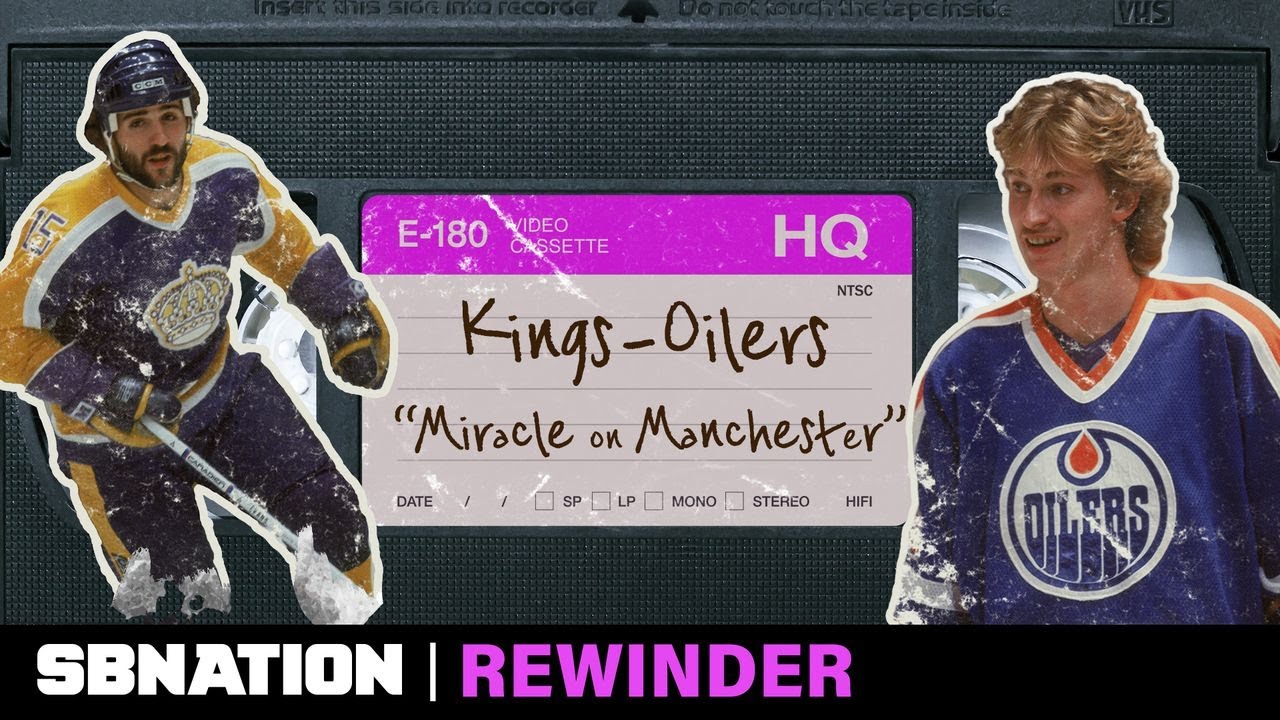
To the Forum’s sellout crowd (of 16,005), the third game in the best-of-five Smythe Division Semifinals, held April 10, 1982, seemed like a done deal by the third period. In what became known as the “Miracle on Manchester” (because of the Forum’s location on Manchester Boulevard), the Los Angeles Kings achieved the greatest playoff single-game comeback in NHL history.
At the end of the 1981-82 season, the Kings’ 63 points (24-41-15) placed them fourth in the Smythe Division. Their first playoff opponents would be the Edmonton Oilers, who had tallied 111 points (48-17-15) to lead the division. While the Oilers had set an NHL record with 417 goals, the Kings only won one of the eight matchups with them. Despite their seeming disadvantage, the Kings took the first game of their series, on April 7, 10-8. The Oilers came back to defeat them 3-2 in overtime the following night.
Although Wayne Gretzky of the visiting Edmonton Oilers was the big attraction, selling out the Forum for the third time that season, the local Los Angeles Kings fans had had enough of his scoring contributions. After Mark Messier scored first for Edmonton, at the end of the first period Gretzky scored their next goal unassisted and short-handed. Less than a minute into the second period, Gretzky assisted on the Oilers’ third goal. About four and a half minutes later, he assisted on Risto Siltanen’s shot that put the puck through the back of the net. For his finale, at 14:02 of the second period, Gretzky scored a power-play goal as the Oilers’ last. As the penalties mounted, the “crowd chanted obscenities at him and booed every time he touched the puck.” Edmonton had a 5-0 lead that seemed unbeatable.
Instead of giving up, like Kings owner Dr. Jerry Buss who left the game around that time, the team began catching up. Thanks to defenseman Jay Wells, the Kings finally made it on the board at 2:46 of the third period. Although Wells had been playing for Los Angeles since 1979, he had only notched one regular-season goal, and this became his only postseason goal. At 5:58, rookie center Doug Smith made a power-play goal by “lifting a rebound just inside the crossbar.” By the time playoffs ended, Smith ranked seventh among the team’s scorers. The only real veteran to score, left winger Charlie Simmer (playing since 1974 and for the Kings since 1977), made fans start believing the Kings had a chance when, at 14:38, he “scored from behind the net.” According to the Los Angeles Times, “His shot appeared to go off the stick of Edmonton defenseman Randy Gregg.” Another defenseman drafted in 1979, Mark Hardy, “took a drop pass from Bozek, cut around Fuhr and beat Gretzky stick side” with four minutes and one second remaining. He had been sixth in scoring during the Kings’ regular season. Los Angeles was one goal away from tying Edmonton.
For once, the odds were in the Kings’ favor. With five minutes remaining, Garry Unger (who had been traded by the Kings a year earlier) had to serve a high-sticking major and ten-minute misconduct. Kings Captain Dave Lewis only received a minor in addition to his ten-minute misconduct. That left the Kings with a power play for the final three minutes. The Los Angeles Times described the situation: “Wayne Gretzky simply had to clear the puck from his team’s zone, but with 10 seconds remaining he had his pocket picked by Jim Fox, and the Kings regrouped for a final rally. Fox shoveled the puck to Hardy, who got a shot off that was stopped by Edmonton goaltender Grant Fuhr. As the rebound trickled out, with just five seconds remaining, Steve Bozek directed the puck into the net.” Left wing Bozek was also a rookie, and during the regular season, he had ranked fifth for Los Angeles scorers. With five seconds remaining, the Kings had their fifth and tying goal.
The game went into sudden-death overtime. At 2:35, Smith beat Messier on the faceoff and sent the puck back to fellow-rookie Daryl Evans. The left wing “blasted a 25-foot shot over the right shoulder of goalie Grant Fuhr.” Reminiscing, Evans later commented, “It was just close your eyes and hope it hits the net. It found a hole over Grant Fuhr’s shoulder.” Evans had only played 14 games with the NHL, having spent most of the season with the AHL affiliate and nursing a broken hand. Not only did he score the winning goal in the comeback of the century, but he also became the Kings top postseason scorer.
Although tempted to feel bad for poor Grant Fuhr after letting in so many goals, he came out a winner in the long run. At that game, he was only a 19-year-old playing in his first NHL season. His save percentage was .898 with 3.31 goals against. However, he stayed with the Oilers until 1991 and, in the process, won four Stanley Cup championships. He bounced around a bit until his retirement in 2000 and was inducted into the Hockey Hall of Fame just three years later.
After the “Miracle on Manchester,” the Oilers tied up the series on April 12 with a 3-2 victory. However, the Kings took the series back the next night winning 7-4. Their playoff run only lasted five more games before Los Angeles was eliminated by the Vancouver Canucks, who went on to lose the Stanley Cup to the New York Islanders. Two years later, in 1984, the Edmonton Oilers won their first Stanley Cup championship to break the Islanders’ dynasty and begin their own.
Additional Sources:
Mike Commito, Hockey 365: Daily Stories from the Ice (Toronto: Dundurn, 2018), kindle edition.
Gordon Edes, “Kings Are Winners Over Oilers in the Comeback of Year, 6-5,” Los Angeles Times, 11 April 1982, sports, pp. 1 and 6.
The Calgary Flames finished second in the NHL with 107 points, which was well behind the 128 of the Tampa Bay Lightning. The Flames seemed to have figured out the goalie situation with splitting time between David Rittich and Mike Smith. They’ve been lead on the back end by Mark Giordano, who should be a finalist for the Norris Trophy as the League’s best defenseman. The big three of Johnny Gaudreau, Sean Monahan and Elias Lindholm did struggle down the stretch, and that needs to be fixed for the postseason.
The Colorado Avalanche had a bit of an inconsistent season and clinched a playoff berth the last week of the season. Amazingly, they have a chance at picking first in the NHL Entry Draft, if the Ottawa Senators should win the Lottery. The Avalanche seem to have straightened out the goaltending situation with Philpp Grubauer taking over the number one spot from Semyon Varlamov. They relied a lot on the offense of Gabriel Landeskog, Mikko Rantanen and Nathan MacKinnon, who combined for 261 points on the seaon.
The Regular Season Series Rundown
The Calgary Flames managed to take all three games from the Avalanche in the regular season, but the games were close. The three games were all played in the first half of the season when the Avalanche were struggling in every facet of the game. This is a different Avalanche team and they had to battle and straighten things out just to make the playoffs.
The first game of the season series was played on Oct.13 in Colorado and the Flames managed to pull out the 3-2 win in overtime. The second game was played on Nov. 1 in Calgary with the Flames pulling out the 6-5 win in regulation. The final game of the season series between these two teams was played on Jan. 9 in Calgary, where the Flames earned the 5-3 win in regulation.
Specials Teams Recap
The Flames special teams play in the regular season has been mediocre, at best. The Flames finished 19th on the power play at 19.3% on the power play. The team had 53 power play goals and allowed seven short-handed goals on the season. The penalty kill finished 21st in the League at 79.7%. The Flames allowed 50 power play goals against, but made up for some of that by scoring 18 short-handed goals of their own.
The Colorado Avalanche finished the season with the seventh best power play in the League at 22%. The Avs scored 63 power play goals and only gave up five short-handed goals. They’ll need to watch out for the short-handed goals from the Flames. The penalty kill was not as good as the power play having finished at 78.7%, which left them sitting at 25th in the NHL. They allowed 58 power play goals while scoring nine short-handed goals of their own.
Key Players
The key players for the Flames will be the goaltenders. The goalie duo of Rittich and Smith split the season in net and it seemed to work especially for Smith, who put up some okay numbers except that .898 save percentage needs to be higher. The goalies will need to make sure that they make saves and don’t lose focus should they allow a soft goal. The Avalanche will get their chances and that is where the defense needs to help the goalies out with some blocked shots, boxing out and clearing the puck when there is a rebound.
The power play for the Avalanche will be a key component in the series. The Avalanche need to find a way to take advantage of their power play opportunities especially with the Flames penalty kill not being great. If they can manage to get some puck and player movement then that should help to find the open man on the ice for the goal. It would also make it harder for the Flames to defend against the power play.
Series X-Factors
Mark Giordano has led the Flames on the back end all season long and should be a Norris Trophy Finalist come NHL Award season. Giordano plays against the opposition’s top line every night and logs a ton of minutes, whether it is at even strength or on special teams. The defenseman has played a good all around game for the team this year and needs to be recognized for it. Giordano plays big minutes and yet has still managed to chip in on the offensive side of the puck in a big way this year.
The key to this series will be for the Avalanche to get some depth scoring especially since Mikko Rantanen could possibly miss the first game of the series with an injury. The top line of Landeskog, MacKinnon and Rantanen combined for 261 points on the season. The depth scorers are going to need to contribute in this series to make it harder to defend against the team.
The Flames Advance If…
They can get good goaltending and the first line produces to its ability. Rittich and Smith have been better this year, but the players in front of them need to avoid turnovers and play smart hockey. They will need to make the routine save and the timely save. Gaudreau, Monahan and Lindholm combined for 259 points and need to get back to producing for this team. The production has fallen off for the big three, but they need to find a way to get their mojo back.
The Avalanche Advance If…
They can get decent goaltending and manage to put some pucks in the net, while playing decent defense. Grubauer has taken over the starter’s net with his play of late for the Avalanche and the team will need him to be solid to have a shot at winning this series. This could turn into a high scoring series, and in that case, the Avalanche will need to find a way to put some pucks in the net.
Flames-Avalanche Series Prediction
The Avalanche pull off the upset in this round even though the numbers say otherwise. The Avalanche has the talent to play a high-scoring game or can buckle down and play defense. Grubauer or Semyon Varlamov will make the timely saves and help the team advance to the second round of the playoffs.

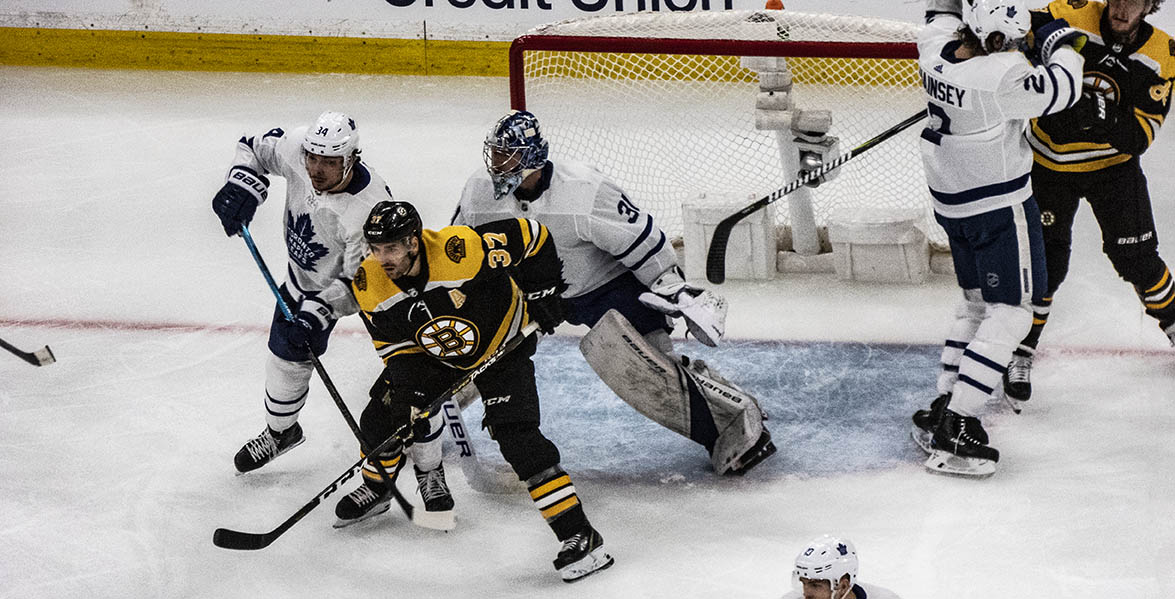




 Prev
Prev