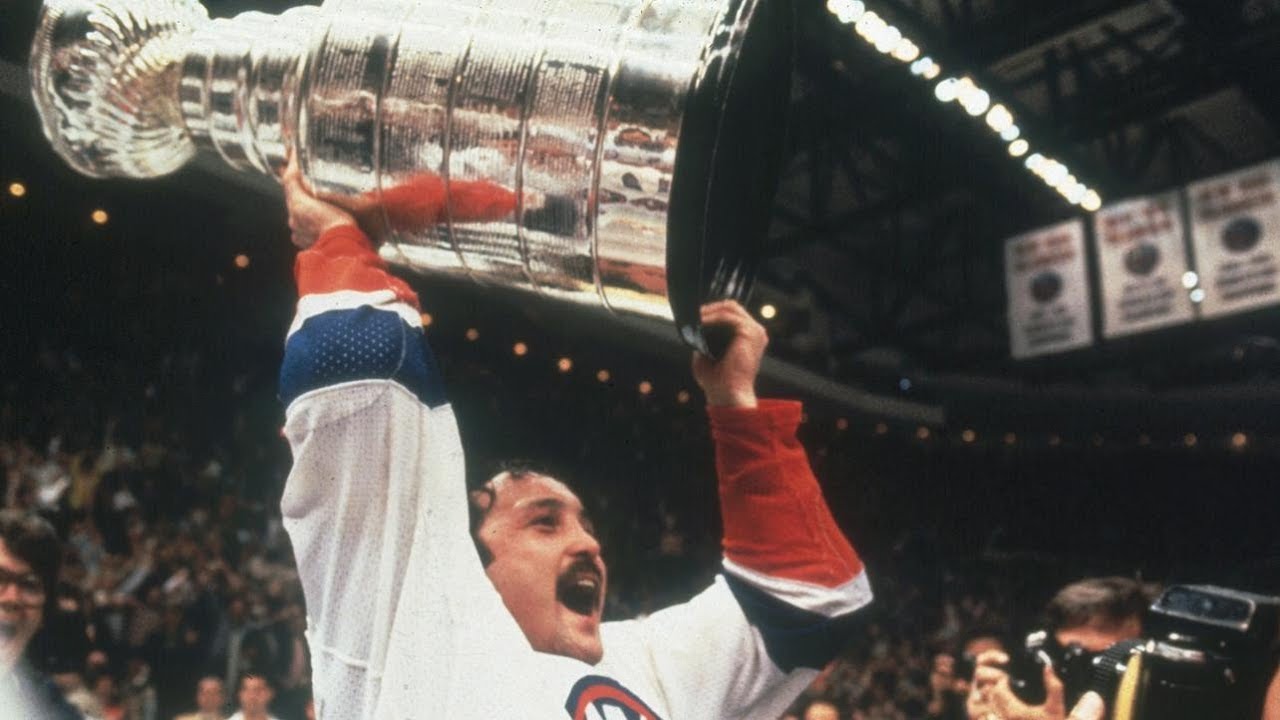
As most NHL fans know, the New York Islanders won four consecutive Stanley Cup championships. They are the only team besides the Montreal Canadiens to win so many in a row. The date they official won their fourth was May 17, 1983.
To get to the Stanley Cup
finals, the Islanders defeated the Washington Capitals (3-1), the New York
Rangers (4-2), and the Boston Bruins (4-2). “A lot of people figured this was
the year we could be had, and it’s got to bother some of them that this year we
probably had a better playoff than any of the others,” said Islanders GM Bill
Torrey. “Washington was a good team, and people even thought they could upset
us. When you play the Rangers, you know what you’re getting. The Boston Bruins
had the best record in the league, and against Edmonton, we were the underdogs.”
The Edmonton Oilers would be the opponents in the finals. In the first three
games, the Oilers only managed four goals and no victories.
Game 4 took place at Nassau
Coliseum for a crowd of 15,317. After a somewhat slow start, the Islanders had
a “97-second blitz” midway through the first period. Like with the series thus
far, the Islanders took a 3-0 lead. Bryan Trottier scored first at 11:02. Only
43 seconds later, at 11:45, John Tonelli followed with the second goal.
Finally, Mike Bossy scored third at 12:39. Bossy ended up having the
game-winner for the second season in a row. He was the first to do so since
Jack Darragh in 1920-21.
The Oilers came back by scoring
twice in the second period. Jari Kurri potted the first only 35 seconds in, and
Mark Messier finished the period with a goal at 19:39. Their teammate, Wayne
Gretzky, made an effort to score at the very end of the game, but Islanders
goalie Billy Smith “caught the puck in the glove on his left hand.” Gretzky had
not been able to score in the entire series, all 240 minutes.
In the third period, the Oilers
missed out on a scoring opportunity thanks to Smith’s performance – acting not
goaltending. After New York’s Tomas Jonsson was called for holding at 8:16, Edmonton
had a power play, for about 16 seconds. At that point, Glenn Anderson received
five-minute major for slashing Smith because the goalie milked it after
Anderson tapped him with his stick “on the left side of the helmet during a
skirmish in front of the net.” Smith blamed Gretzky’s performance in Game 1 for
his behavior, saying, “So I threw myself on my back and squirmed a bit and played
dead. Like I said, tit for tat.” From Anderson’s point of view, “He pushed me
in the back and I lost my balance. My arms went back and I guess my stick hit
him. He went down and I was wondering what he was doing.”
With 1:09 remaining, Ken Morrow “stole the puck” and skated the length of ice to fire on the open net. The Islanders won 4-2 in Game 4 for their fourth Stanley Cup championship. In the finals for the past four seasons, New York only lost three games, none of them at home.
Smith had only allowed six goals throughout the four games and made 24 saves in the last. He received the Conn Smythe Trophy as playoff MVP and thus a new car. Smith said, “I want to tell the people in Canada and all over the world that two can play that game.” His captain, Denis Potvin, had quite a bit more to say. “We are the best who ever skated. Anybody who says anything else is just kidding themselves. We have won 16 straight damn series. We have beaten the best, again and again. I will say it now. We are the best who ever skated.” He continued, “And now we have won four. The fourth is the best. I know I have given my most to the best people I know.”
Additional Sources:
“Smitty Laughs Last,” New York Daily News, 18 May 1983, pp. 52 and 55.
“The best who ever skated,” New York Daily News, 18 May 1983, p. 52.
“Langevin masked pain with guts,” New York Daily News, 18 May 1983, p. 55.
“Dynasty? Isles own the word,” New York Daily News, 18 May 1983, p. 53.
“Four on the Isle,” New York Daily News, 18 May 1983, pp. 56 and back page.
The Detroit Red Wings had just lost the Stanley Cup finals in 1994 and were heavily favored to win in 1995. After all, they ended the season in first place (with 131 points) with second place Colorado Avalanche trailing by 27 points. Somehow though, in the Western Conference semi-finals, Detroit was pushed to the edge of elimination by the St. Louis Blues, the team ranked 14th with 51 fewer points. In Game 7, held May 16, 1996, Captain Steve Yzerman saved his team with a double-overtime goal.
Having won the first two games
of the semi-finals, the Red Wings lost three in a row before coming back to win
Game 6. With the semi-finals tied at 3-3, 19,000 gathered at Joe Louis Arena
for the end of the series. The night started off on an odd note during the
national anthem, when a tossed octopus “clipped” signer Englebert Humperdinck. Quite
the professional, he “didn’t miss a note.”
By the end of regulation, both
Detroit’s Chris Osgood and St. Louis’ Jon Casey had shutouts going. The game
went into overtime, but no one got past them in the first session. Still,
Captain Yzerman commented, “This was as relaxed an overtime game as I can
remember playing, as far as the players were concerned. We just felt we were
going to win.” Not only was he correct, but he made it happen.
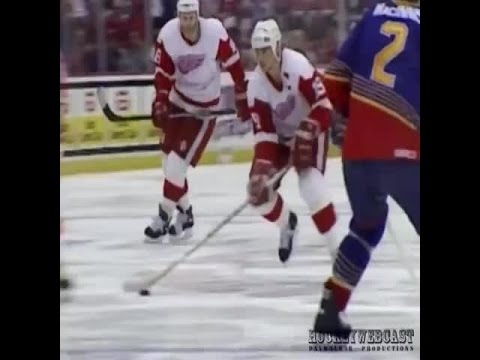
Finally, at 1:15 into the second, minutes before midnight, Yzerman “skated across the blue line and whistled a 55-foot shot” over Casey’s shoulder. The puck hit the crossbar and bounced into the net. “I don’t usually score that way,” admitted Yzerman. “It’s the kind of goal every player dreams about in his career. Including me.” Unsurprisingly, he was able to keep the puck. Of Yzerman, Detroit owner Mike Ilitch said, “As far as a captain, he’s a total captain. He does it all.” Even the Blues’ coach, Mike Keenan, called Yzerman “the best player in the series.”
This would be the sixth time the Red Wings had finished a decisive playoff game with a 1-0 score. Kris Draper said of his team, “Anyone who doubted the character of this team should think again after tonight.” Detroit advanced to the Western Conference finals to play Colorado. Coach Scotty Bowman warned that they would not win the Cup just because they were the favorites. “You have to do it yourself. It’s in their hands. I told them before the last game, the world’s waiting for the biggest parade in hockey history. The only people who can rain on the parade is yourself. The ones in the dressing room.”
The Red Wings did not make it past the Avalanche, who went on to win the 1996 Stanley Cup. However, they returned for back-to-back championships in 1997 and 1998. Yzerman remained with them through another Cup in 2002. He finally retired in 2006 after 22 seasons (including 20 postseasons) with Detroit.
Additional Sources:
Mitch Albom, “Yes!” Detroit Free Press, 17 May 1996, pp. 1A and 6A.
“Yzermania!” Detroit Free Press, 17 May 1996, pp. 1C and 6C.
Viv Bernstein, “It’s a rocky road to the Stanley Cup finals,” Detroit Free Press, 17 May 1996, p. 7C .
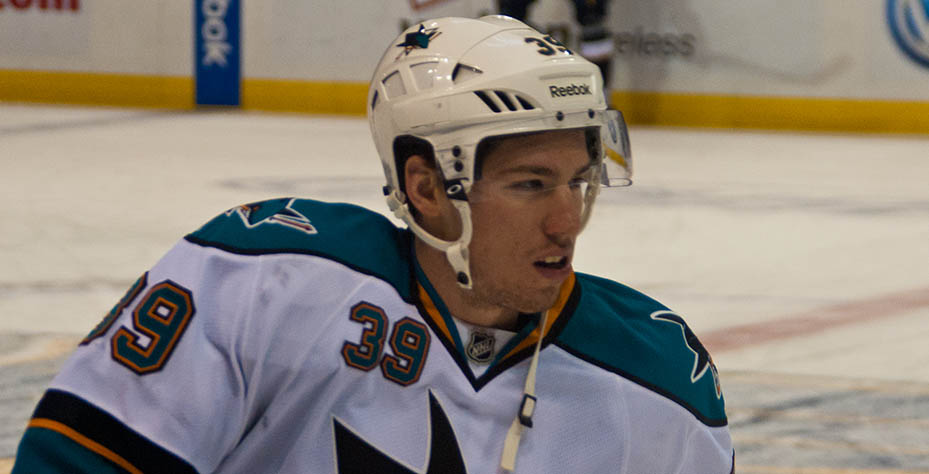
Some professional athletes don’t do as well under pressure as others, but Logan Couture tends to thrive under the bright lights of the Stanley Cup Playoffs.
Couture manages to produce points no matter the situation he finds himself in during the playoffs. He has had some big moments in his career during the postseason, but he is one of the more underrated players in the league come playoff time. In this year’s postseason, he stepped up his game after Captain Joe Pavelski went down with an injury and missed a majority of the second round.
2019 Stanley Cup Playoff Accomplishments
In 16 games played this postseason, Couture has 13 goals, six assists and 19 points. His 13 goals and 19 points are the best in the NHL this postseason. He has contributed nine even strength goals, three power play goals and one shorthanded goal so far during these playoffs. He only has one game-winning goal, but helped to start the comeback in Game 7 during Round 1 against the Vegas Golden Knights. The Sharks were down 3-0 when Pavelski was injured and that’s when Couture got the first goal and helped to fuel a major comeback. The Sharks eventually won the game in overtime to advance to the second round of the playoffs against the Colorado Avalanche.
Couture has one hat trick to go along with four multiple goal games. He has five multi-point games and his 13 playoff goals are just one shy of the Sharks’ single postseason record set by Pavelski, who had 14 goals during the 2016 Stanley Cup Playoffs. In the second game of the Western Conference Finals, Couture became just the second player, along with Bruins’ David Pastrnak, this postseason to score two goals in two minutes or fewer. Couture had just the sixth playoff hat trick in Sharks franchise history and the last one came in 2011 by Devin Setoguchi.
Career Stanley Cup Playoffs Accomplishments
In 112 postseason games, Couture has 47 goals, 53 assists, 100 points and one hat trick. He has one shorthanded goal, eight game-winning goals and has only missed the postseason once since 2010. Couture became just the 11th active NHL players to have at least 100 postseason points when he scored two goals in Game 2 against the St. Louis Blues in the Western Conference Finals. His 47 postseason goals, are just second behind Alexander Ovechkin for most in the League since Couture’s first postseason in 2010. Couture has two overtime game-winning goals in the postseason.
Since his playoff debut in 2010, only three players have more points than Couture and they are Sidney Crosby (123), Patrick Kane (109) and Evgeni Malkin (106). Those three players do have Stanley Cups to their names, so could this be the year that Couture joins them? He became just the sixth active NHL player to reach the 10 goal mark in multiple postseasons.
Clutch Stanley Cup Playoffs Moments
Couture managed to produce in the postseason, but not every point or goal comes at big moments during a game or series. He does have a few of those clutch goals in his postseason career though. During the semifinals in 2013 against the Los Angeles Kings, Couture scored the game-winning goal in overtime to give the Sharks a 2-1 win. It was an important win because the Sharks managed to cut the Kings’ series lead from 2-0 to 2-1. If the Kings had won then the series would have been 3-0 Kings. He added a double overtime goal during the second round in the 2018 postseason against the Golden Knights to even the series at one game a piece. The Sharks eventually lost both series, but not for lack of production from Couture.
Yes, some of Couture’s points have been meaningless in his team’s defeats, but overall he has scored some timely goals in his career. In the first round against the Golden Knights, the Sharks were down 3-0 and headed to a major power play. Couture managed to score the first goal and the game-tying goal and his team eventually won the game 5-4 in overtime. In Game 2 of the Western Conference Finals, the Sharks were down 2-0 and Couture scored two goals, one shorthanded, in less than two minutes to tie the game. Unfortunately, the Sharks eventually lost 4-2.
The fans and critics of the game are going to say that Couture doesn’t have a Stanley Cup to his name so the production is meaningless. The Sharks have been to the Stanley Cup Final once in his career and that was in 2016. There are guys who rack up the points in the regular season and then can’t produce in the postseason. Couture produces in the regular season and in the postseason and that speaks to how important he is to the Sharks.
Although predecessors of ice hockey were played across the pond, in 1908, hockey truly came into its own in Europe. On 15 May, a meeting at 34 rue de Provence in Paris, France established the organization that became known as the International Ice Hockey Federation (IIHF).
According to the IIHF website,
France first hosted unofficial hockey games in 1897. About five years later,
England held the first competitive games. In 1905, Belgium and France played
each other in the first two international games, at Brussels. That French team,
Club de Patineurs de Paris, was formed by Louis Magnus.
In an effort to codify rules for
ice hockey, Magnus hosted a meeting at his home. In addition to two fellow
Parisian executives, five representatives from Great Britain, Belgium, and
Switzerland attended. Signing the founding document, they formed the Ligue
International de Hockey sur Glace (LIHG). Naturally, they chose Magnus as
president, and they also named Robert Planque (of France) as general secretary.
The LIHG would focus on hockey, unlike the preexistent International Ice
Skating Union. From that point on, the sport would be regulated throughout the
member organizations.
The LIHG held their second congress
early in 1909. They established various rules and held the 1909 Coupe de
Chamonix. Great Britain’s team, Princes Ice Hockey Club, won. The following year,
the championships took place at Switzerland, and Great Britain again won.
Before 1908 ended, Bohemia
(later Czechoslovakia, now Czech Republic) joined. The following year, Germany
became the sixth member. The next group to join, in 1912, included Austria,
Luxembourg, and Sweden. Canada and the U.S.A. joined for the 1920 Olympics. Today,
the IIHF membership totals 56, with 19 associate members and one affiliate.
The IIHF sets international rules and officiating
guidelines and supervises the Olympic Games and World Championships (for
juniors, men, and women).
The Belfast Giants, member of the Elite Ice Hockey League (EIHL) of the United Kingdom announced today that they have re-signed forward Jordan Smotherman for the coming 2019-20 season.
Giants’ head coach Adam Keefe said “Jordan is a player we
had been tracking for a while and it was great to have him hit the ground
running in 2018-19 to contribute to the Elite League and Challenge Cup success.”
In fact, the 6’3”, 225-pound Corvallis, Oregon native, signed with the Giants in January of this past season, having been playing for the Iserlohn Roosters of Germany’s DEL. He had made arrangements to arrive in Belfast already when he heard that the Giants’ roster was a man down due to injury. He immediately changed his flight, arriving the next day in time to play with the team against the Nottingham Panthers on February 3, 2019.
However, he is probably most appreciated by not only the
team, but the fans, for his overtime, game-winning goal against the Guildford
Flames on March 10, 2019 that secured the Challenge Cup for the team in teal.
Though born in America, Smotherman elected to travel the Major Junior route, playing for the Québec Remparts of the QMJHL from 2002-2006, helping the Remparts to win the Memorial Cup in 2006. Throughout his junior career he played in 225 regular season games with a 72-67-139 record. During his 52 playoffs games, he garnered a 14-11-25 record.
Drafted in the fourth round (116 overall) by the Atlanta Thrashers (now the Winnipeg Jets) in 2005, Smotherman played his first professional year with the AHL Chicago Wolves in 2006-07 season. His second season with the organization he played two games with the Thrashers, scoring one goal and getting one assist, but spent the bulk of the 2007-08 season back in Chicago. The Wolves went on to win the Calder Cup Trophy in 2008. His next two seasons saw him continue at the AHL level, first with the Syracuse Crunch (2009-10) and then the Providence Bruins (2010-11).
Beginning with the 2011-12 season, Smotherman headed to Europe, playing first in Denmark with EfB Ishockey. While with them he was named to the Danish League All-Star Team, was Player of the Month in January, and topped the league with the most goals (31) and the most points (60).
In 2015, Mattias Persson of Elite Prospects said “Smotherman is an offensive winger with a good shot. Excels in front of the net on the powerplay. Also skates well, and is a hard worker.”
The 33-year-old winger continued his time in Europe playing for both Sweden’s Allsvenskan and SHL leagues as well as the Finnish Liiga before returning to the United States in 2016 to play for the Manchester Monarchs of the ECHL, though during the 2016-17 season he was loaned to the Springfield Thunderbirds (AHL) for five games, and then returned to the Allsvenskan league the middle of the season to play with MODO Hockey. He signed again in 2017 with the Manchester Monarchs for the 2017-18 season and served as an alternate captain that season, helping to take them to the Kelly Cup playoffs, where they unfortunately fell in the second round, the Division Finals, to the Adirondack Thunder.
“He is [a] big forward who will bring offence and work ethic
to our 2019-20 team. I know our fans loved hearing about the lengths Jordan
went to in order to be in Belfast for his debut and I know they will love
watching him in teal again this season,” Coach Keefe said.
The Belfast Giants fans do indeed appreciate a hard-working player, but it was clear when he was willing to change his flight to help the team out that he believes in putting the team first and that resonates with all hockey fans.
Press Eye – Belfast – Northern Ireland – 22nd February 2019 – Photo by William Cherry/PresseyeBelfast Giants’ Jordan Smotherman with Cardiff Devils’ Ben Bowns during Friday nights Elite Ice Hockey League game at the SSE Arena, Belfast. Photo by William Cherry/Presseye
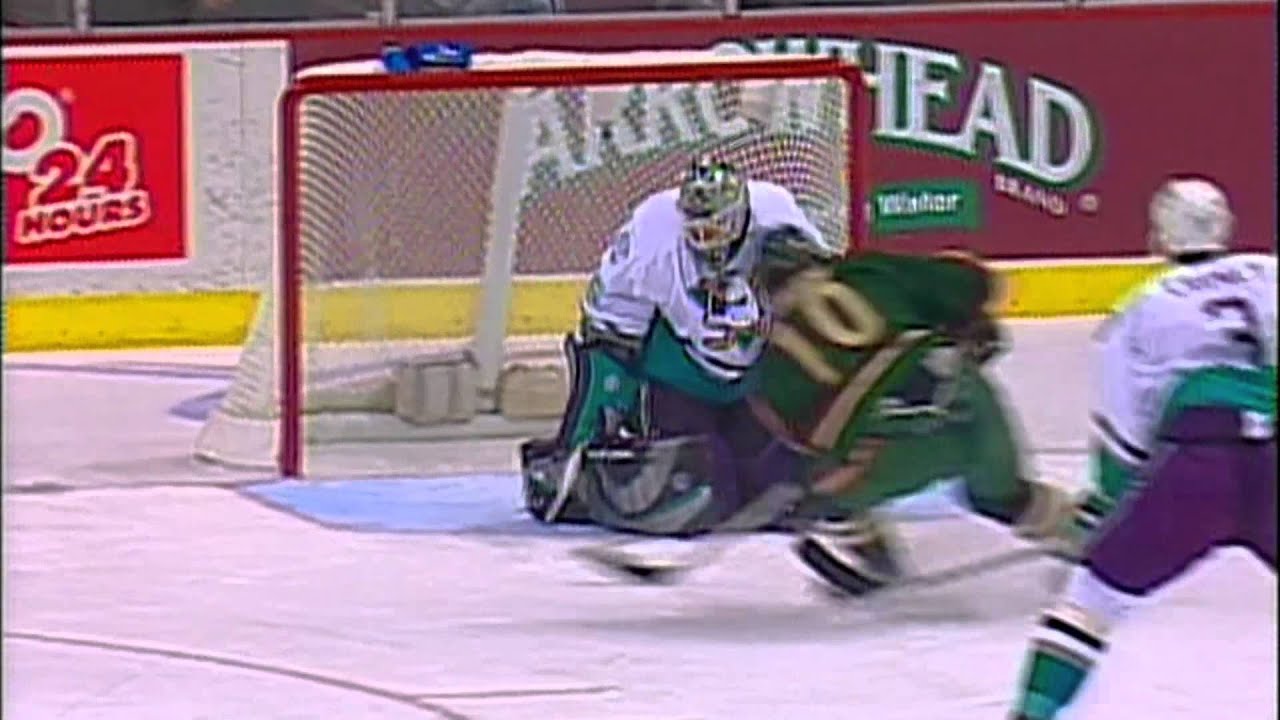
For the 2002-03 Western Conference finals, the Anaheim Ducks swept the Minnesota Wild. In Game 3, held May 14, two records were set, one for each side.
Before 17,174 at Arrowhead Pond, Jacques Lemaire led the Wild through his 100th playoff game as a coach. He had already played 145 games during his 11 NHL postseasons with the Montreal Canadiens, in which he helped them win a whopping eight Stanley Cup championships. His former linemate, Steve Shutt, said, “Once he got into the playoffs, Lemaire was probably one of the best players I’ve ever seen.”
The same season Lemaire began
coaching in Quebec, 1983-84, he was inducted into the Hockey Hall of Fame.
After seven years coaching the New Jersey Devils (including leading them to a
Stanley Cup in 1994-95), Lemaire began coaching the Minnesota Wild in 2000. In
this third year as their coach, he became the first to coach 100 postseason
games after playing 100 or more. As former teammate Jean Beliveau said, “He was
a hockey intellectual, but few people realized this until after his playing
career was over. Jacques constantly brought out the best in Guy Lafleur, but
his post-playing contributions have proved even more important.”
Unfortunately for Lemaire, his 100th game as an NHL coach did not go well for his team. Instead, Anaheim’s goalie, Jean-Sebastien Giguere, shut them out. With 35 saves, Giguere had his third consecutive shutout, matching Frank McCool’s 1945 record. The shots he faced throughout all three games totaled 98 shots. His streak had lasted 213 minutes and 17 seconds, which was 35 minutes shy of Normie Smith’s 1936 record.
Naturally, Giguere’s teammates
supported him generously. Captain Paul Kariya, who had scored two goals that
game, said, “He [Giguere] should be center stage. He deserves to be there.”
According to defenseman Keith Carney, “He [Giguere] has been the best player in
the playoffs. It is not a surprise to us.” Fellow defenseman Ruslan Salei
commented, “He [Giguere] is making history.” Giguere himself told the press, “I’m
taking it shot by shot and game by game, but it’s still a little surreal.”
Offensively, the Ducks scored
once in the first period and then three times within about five and a half
minutes during the second. “The more they score, the more you slow down,”
explained Coach Lemaire. He was forced to switch out Minnesota’s goalies about
midway through the game. Without any goals thus far in the series, the Wild
were on track to set the record for fewest goals scored in a four-game series.
Back in 1952, the record of two goals for four games was set. Trying not to
lose confidence, Wild right wing Sergei Zholtok said, “Any team that gets shut
out three times in a row would be frustrated. But we were playing hard until
the end. The coaches were stressing that, and nobody quit. That’s a good sign.”
By the third period, the fans
chanted, “Sweep, sweep, sweep.” The Ducks had won their 11th of 13 playoff
games. “They outplayed us tonight,” admitted Coach Lemaire. “We should have dug
a little deeper. We’ve got to get our you-know-what’s together.” Hoping to stay
in the series, Minnesota left wing Andrew Brunette said, “We’ve just got to win
one game. There’s no quit in us. There never was and there never will be. We’ll
regroup and get excited about it and play our best game the next game. We’ve
just got to worry about one game.” On the other hand, his goalie, Manny
Fernandez, rationalized, “If we lose in four, I think everyone should be happy
with the season we had. If there isn’t anymore juice in the tank, everybody
should be happy because it has been a great season. But we have never given up,
and it’s not going to happen . . . not now.”
The Ducks completed their sweep on May 16. In the process, Minnesota scored at 4:37 of the first period, so Giguere did not have another shutout nor beat the record for the length of his shutout streak. Having advanced to the Stanley Cup finals, the Ducks lost to the New Jersey Devils, Coach Lemaire’s former and future team. Though they lost, Giguere was honored by winning the Conn Smythe Trophy. In 2006-07, the Ducks and Giguere earned their first Stanley Cup.
Meanwhile, for the Wild, Lemaire stayed on as coach through the 2008-09 season before returning to New Jersey. In his 17 years coaching in the NHL, his record (617-458-187) tallied 1421 points.
Additional Sources:
“A Wild Goose-Egg Chase,” Los Angeles Times, 15 May 2003, pp. D1 and D8-D9.
“Wild’s Game Plan Has Been Pointless,” Los Angeles Times, 15 May 2003, p. D9.
“Game 3,” Minneapolis Star Tribune, 15 May 2003, pp. S1 and S3.
“This is all too familiar,” Minneapolis Star Tribune, 15 May 2003, p. S3.
“Wild vs. Anaheim,” Minneapolis Star Tribune, 15 May 2003, p. S4.
Let’s face it – Sunday’s game was an absolute schooling of the Carolina Hurricanes by the Boston Bruins. It seemed that as soon as the Boston Bruins got on the scoreboard first, that there was no turning back for them.
After having taken a huge hit from Michael Ferland, who dished out three solid hits during the game, Matt Grzelcyk came back a few shifts later, with 4:38 remaining in a scoreless first period, and buried the puck to show that he could and would take a hit, but it wouldn’t stop him from doing his job and then some. Grzelcyk doesn’t shy away from a physical game and has been known to do his fair share of hitting. And perhaps the hockey gods were rewarding the hometown guy. He had two shots on net and both of them went in.
“You know, you kind of shirk it off and back to work and
scores a goal, whatever it was, two shifts later, so certainly gives us a lift.
I’m not surprised. He’s a tough kid, and in this playoff season – any playoff
season – you’re going to take some hits, take a number, get back out there and
play the game. Keep discipline and at some point, if you get a chance to be
physical against them, you take advantage of it, and that’s the way it works,”
said Bruins head coach Bruce Cassidy.
However, that first goal after the hit started a watershed of goals for the Bruins, with five different players putting the puck in the net. A second goal was scored in the first period—this one by Jake DeBrusk while the Bruins were on the power play at 18:32.
Usually Boston’s weaker period in the playoffs has been the second, but they came out with the same drive and determination that they brought to the first. With a wide-open net—the result of the Carolina Hurricanes netminder Petr Mrazek overcommitting to his left side as Marcus Johannson held onto the puck for just a second longer before passing it, it rebounded off the skate of Canes Greg McKegg to Connor Clifton who put it in. For Clifton it was not only his first goal scored in the playoffs, but it was his first NHL career goal as well. Though drafted by the Arizona Coyotes, he went unsigned by them after he graduated from Quinnipiac University in 2017. Instead he signed with the Boston Bruins, spending all of his first year as a professional with the Providence Bruins. This season found him splitting his time between the Providence AHL club and the Boston Bruins.
“Had a little rush there and ended up behind the goal line,
I threw it to—I think it was [Danton Heinen] there—something bobbled around and
I stayed net-front and had a wide-open net. It was pretty easy,” Clifton said
of what he saw.
He was understandably quite happy, with a big smile. And
when he was asked about if he would be giving the puck to his mother—since it
was Mother’s Day when he scored—he joked that he would think about it before
saying that he likely would. His mother was in the arena and got to see him
score that goal that put the Bruins up 3-0 just 3:46 into the middle frame. He
also became the 19th player on the Bruins roster to contribute a goal in the
playoffs.
Grzelcyk got his second goal of the game, while the Bruins were on the power play, at 17:56 of the second period. Meanwhile Tuukka Rask continued to deny the Hurricanes, having stopped 17 shots in the first 40 minutes of the game. As the teams left for the second intermission the score was 4-0 in favor of the Bruins.
Things seemed to pick up right where they left off, when the
teams returned for the third period. Just 1:10 into the final frame of
regulation, David Backes put the team in black and gold up 5-0, as he stayed
near the net front putting the errant puck in. Roughly 90 seconds later, Danton
Heinen notched the Bruins’ sixth goal of the game.
Despite the Bruins being up by six goals, Carolina did not stop playing and captain Justin Williams finally got his team on the scoresheet at 11:17 of the third to at least ruin any chances Rask had of getting another playoff shutout. Six minutes later Teuvo Teraveinen added a second goal for the Hurricanes, perhaps showing that they weren’t going to go down quietly, and maybe giving his team a little momentum to carry forward as the games head south.
“I thought we had a great game all around. One of our best
efforts this playoffs, like 60 minutes. We took care of business at home. We
know it’s a tough place to play in there, so we are going to have to be ready,”
Heinen said after the game.
While much had been made of the “storm warning” and the threat of the Hurricanes, there was a lot of chatter on social networking indicating that Carolina had been downgraded to a tropical depression during the game. They indeed seemed to be completely unprepared for the way the Bruins were playing. Perhaps they had underestimated that the Bruins enjoy a physical game. In the first period alone there had been 34 hits between the two teams, 20 for Boston and 14 for Carolina. The Bruins thrive on that style of game.
The next two games will be played in Raleigh, where the Hurricanes have done well this postseason. After all they eliminated the Washington Capitals in the first round, despite having been down two games. And they swept the New York Islanders in the second round. The Bruins are not expecting the next two games to be easy, knowing that they must bring continue to play hard and bring a solid effort once again.
Twenty-six years apart, on May 13, special teams scoring in overtime led to victories for the visitors. In 1980, Denis Potvin’s power-play goal started the Stanley Cup finals right the New York Islanders. In 2006, Jason Pominville’s short-handed goal advanced the Buffalo Sabres into the Eastern Conference finals.
The Islanders were unleashing a
dynasty. They passed the Los Angeles Kings, the Boston Bruins, and the Buffalo
Sabres on their way to their first Stanley Cup finals. To that point, they had
won four of five playoff games that went into sudden-death overtime. According
to the New York Daily News, the Islander’s
motto seemed to be, “When the first goal wins it, we know we’re gonna do it.”
Game 1 of the finals took place
at Philadelphia Spectrum. The opponents scored one goal apiece in every period.
Well, actually, Potvin scored on his own net in the first period though credit
was given to the Flyers. Fortunately, teammate Mike Bossy was able to take
advantage of a power play about a minute and a half later. Potvin was also able
to start the second period with a goal for the Islanders. After two Philadelphia
goals, Potvin and Bossy assisted Stefan Persson in tying the game at 16:18 of
the third period.
Just over two minutes into
overtime, Philadelphia defenseman Jimmy Watson “grabbed [John] Tonelli’s stick
arm and hauled him down to the ice, preventing a pass” in front of the net.
Although uncommon to call a penalty during overtime, Referee Andy Van Hellemond
called him on holding at 2:08. Tonelli commented, “It took a lot of guts to
call it, but it was a penalty.” His coach, Al Arbour, justified, “They
(penalties in overtime) are not called very often, but if there is an
infraction, it should be called. And it was an infraction.” Even Philadelphia
Coach Pat Quinn agreed, “[I]t musta been a pretty gross penalty to call it
after what they let go.”
Although Potvin had been on the
ice for a couple of minutes already, Arbour left him out there for the power
play. Arbour then attempted to call a timeout to give Potvin a rest, but the
referee told him he’d waited too long. Soon, Arbour’s decision paid off.
Teammate Bob Nystrom sent the puck to Tonelli behind Philadelphia’s net. Potvin
skated in from the blue line to catch Tonelli’s pass and “whip to the far
corner of the goal.” Potvin simply said, “I had to come in at just the right
speed. And that’s what happened.” He became the first (since the NHL began such
record-keeping in 1934) to score an overtime power-play goal in the Stanley Cup
finals. Bossy complimented, “Denis is Denis. He’s capable of being the best
defenseman out there. He realizes that, and we realize that.”
At that point, the Islanders had
five overtime victories, all on the road. Tonelli told the press, “I don’t
think it has anything to do with destiny. I think we’re just working for it. We
go into those overtimes and, man, we’re working.” According to Potvin, they won
so many because, “We just seem to care so much about the victory. When we go
out there for an overtime, we know we’re as good as anybody, if not better.”
Fortunately for the Islanders,
they had more games remaining at New York because they lost the other two games
at Philadelphia. Still, they ended the same way they began the series. The Islanders
scored in overtime to win Game 6 and their first of four consecutive Stanley
Cup championships.
Twenty-six years later, the NHL
was only in the conference semi-finals on May 13. The Buffalo Sabres had
eliminated the Philadelphia Flyers in the quarter-finals. They looked like they
were about to sweep the Ottawa Senators after winning the first three games. In
fact, they had won the first and third in overtime. The Senators saved
themselves in Game 4.
Game 5 took place at Ottawa Scotiabank
Place with an over-capacity crowd of 20,024. The opponents matched each other
with one goal each in both the first and second periods. Ottawa scored on a
power play in the first while Buffalo scored during a second-period power play.
Neither managed to score during the final period in regulation.
At 1:44 into overtime, Buffalo’s
Jay McKee was penalized for tripping. About 40 seconds later, at 2:26, teammate
Jason Pominville “sweeps around Alfredsson on the left wing and puts a shot
around Emery into the far side.” He was the first NHL player to score an
overtime shortie that ended a playoff series. Even though the Senators had outshot
the Sabres, they lost all three of their home games. Meanwhile, the Sabres had
won all the odd games in overtime.
Despite pushing hard through seven games, including
two in overtime, the Buffalo Sabres lost the Eastern Conference finals. They
made it to that round again the following season but have not managed since.
Additional Sources:
Mary Flannery, “Potvin the hero in overtime 4-3,” New York Daily News, 14 May 1980, pp. 50 and 68.
Lawrie Mifflin, “Potvin works overtime in OT – and gets one for the book,” New York Daily News, 14 May 1980, p. 50.
“These men in blue are overtime’s finest,” New York Daily News, 14 May 1980, pp. 51 and 62.
Chuck Slater, “Two minutes that shook the Flyers’ world,” New York Daily News, 14 May 1980, pp. 51.
Wayne Scanlan, “Sneaky, dangerous – deadly,” Ottawa Citizen, 14 May 2006, pp. D1-D2.
Allen Panzeri, “Sudden death, indeed,” Ottawa Citizen, 14 May 2006, p. D3.
Imagine having 10 minutes remaining in a do-or-die game when the team is down 5-2 and trailing 3-2 in the series. It would require a lot of effort to maintain confidence in that situation. When the St. Louis Blues found themselves in that situation on May 12, 1986, Coach Jacques Demers told his team, “Keep your head up. No matter what happens, we walk out of here with our head up.” The Blues certainly made their coach and themselves proud when they proceeded to tie up the game and then win in overtime. The event became known as the “Monday Night Miracle.”
Game 6 of the Campbell Conference finals was held in St. Louis’s fully packed Arena. The Blues were already underdogs, having finished the regular season in twelfth place. Though they had won the first game of the conference finals, their opponents, the Calgary Flames, led the series and hoped to move into the Stanley Cup finals by winning this game.
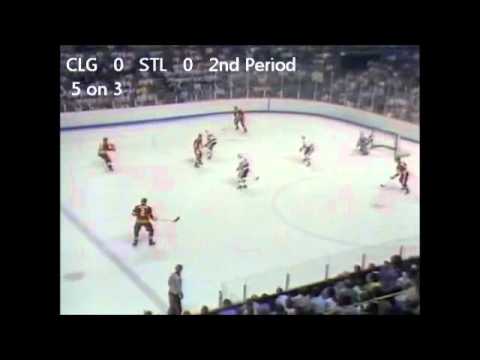
The scoreboard remained blank as the first period ended. However, the closing moments produced a big fight that resulted in multiple penalties, especially on the Blues. With the fighting centered around the Blues’ net, referee Kerry Fraser had to actually pull goalie Rick Wamsley out from underneath. In total, the first 20 minutes saw 21 penalties amounting to 70 minutes. The Flames capitalized on their five-on-three advantage by scoring twice within the first two minutes. The Blues responded with their own power play goal at just shy of six minutes. The latter half of the second period saw two more Calgary goals. The St. Louis fans were so unhappy with Fraser that they threw things on the ice throughout the remainder of the game.
“I told the players we could get
about 20 shots in the third period,” Coach Demers commented. “We just didn’t
want to lose.” So the Blues began battling their way back. On a 35-foot
slapshot, center Doug Wickenheiser scored an unassisted power play goal at six
minutes into the third. About a minute later, former Blues Joe Mullen responded
for Calgary. After a little more than a minute, Blues captain Brian Sutter
scored his first goal of the playoffs. His linemate who had assisted, Greg Paslawski,
then sent in back-to-back goals during the final five minutes of regulation.
For the tying goal, he stole the puck from defenseman Jamie Macoun as he came
out from behind net with 1:08 remaining on the clock. Captain Sutter summarized,
“We had 14 shots (as a line) in the third. We had two chances, and the puck hit
the post. Then we scored on three straight shots.”
The Blues had survived
regulation and pushed into overtime. All seemed lost when Mullen took a shot on
the Blues’ net, but the puck hit the post. Soon after, at 7:30, Wickenheiser
picks up a blocked shot and puts the puck in the net for his second goal of the
game. Bernie Federko, on his 30th birthday, was credited with the assist. Miraculously,
the Blues had won the game 6-5. “You’ve got to work hard to be lucky,”
commented Captain Sutter. “Let’s say I’m not surprised.”
Having forced a Game 7, the Blues only temporarily held off the inevitable. Two days later, on May 14, Calgary won 2-1, eliminating St. Louis. The Flames were the first Calgary team to make the Stanley Cup finals since the Hamilton Tigers did in 1924-25. Having fallen 4-1 to the Montreal Canadiens, the Calgary Flames did not win their first championship until 1988-89. The St. Louis Blues have not returned to the Stanley Cup finals since their first three seasons as a franchise.
Additional Sources:
Mike Commito, Hockey 365: Daily Stories from the Ice (Toronto: Dundurn, 2018), kindle edition.
Tom Wheatley, “Calgary Bound,” St. Louis Post-Dispatch, 13 May 1986, pp. C1 and C5.
“All-Time Goal for Paslawski,” St. Louis Post-Dispatch, 13 May 1986, p. C1.
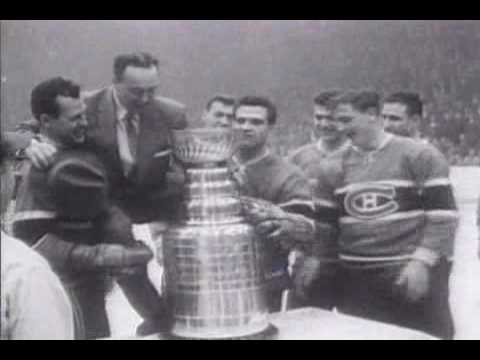
Toe Blake had a 14-year career as an NHL player followed by a 13-year career as a coach. Between the two, he played in the minors for three seasons while coaching there for eight. Other than nine games played with the Montreal Maroons during the 1934-35 season, Blake remained with the Montreal Canadiens for 26 seasons. After his lengthy and successful career in hockey, he finally retired immediately following the Canadiens’ Stanley Cup victory on May 11, 1968.
It seemed that Blake collected Cups
better than anyone. In his only season with the Maroons, his one playoff game
entitled him to have his name etched after they won the 1935 championship.
While playing for the Canadiens, Blake played in ten postseasons, and they won
twice, in 1944 and 1946. As head coach, he led the Canadiens to the postseason
every single year, and they won an unprecedented eight championships. Those
included his first and final seasons as head coach, 1955-56 and 1967-68.
The NHL had just doubled in size
the season of Blake’s last championship. Because of the way the six expansion
teams were put into their own division, one of them would play the best of the
established teams for the Stanley Cup finals. Montreal made it to the finals
for the fourth (of five) consecutive years, and the brand new St. Louis Blues
were unlucky enough to have to fight them for the Cup. Unsurprisingly, the
Canadiens led the series 3-0.
By the beginning of the postseason,
Blake had already decided to retire and informed Canadiens owners, the Molson
brothers. He explained, “The tension is just too much. It gets tougher every
year.” That particular season, he said, “The pressure started building as soon
as we won the league title and I was shaking like a leaf.” Blake did not have
long to wait to make the official announcement. On May 11, Montreal completed
the sweep with a score of 3-2. As somewhat of a joke, he told the press, “I’d
like to coach for 100 years, it’s the only thing I can do.” In reality, he
turned his attention to the tavern in Montreal that bore his name.
Throughout his first NHL career,
Blake played 577 games (235G, 294A, 529P). He was inducted into the Hockey Hall
of Fame as a player in 1966. Under his direction as head coach, the Canadiens
had a record of 500‑255‑159 totaling 1159 points. Blake was officially the most
winningest Montreal coach. When he retired in 1968, Blake said, “Maybe I can’t
live without hockey but for my health’s sake I have to try it.”
Additional Sources:
Mike Commito, Hockey 365: Daily Stories from the Ice (Toronto: Dundurn, 2018), kindle edition.
Pat Curran, “With A Sigh Of Relief, Toe Blake Steps Down,” Montreal Gazette, 13 May 1968, p. 1.





 Prev
Prev