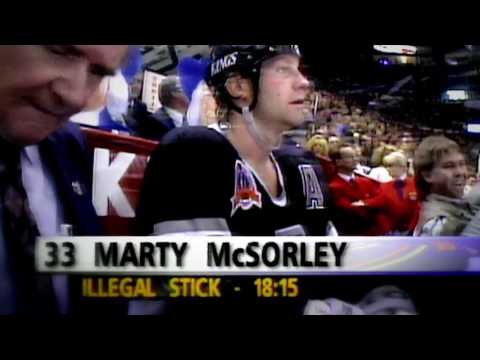
If a player only has one hat trick his entire NHL career, what better time than to turn his team’s fortunes during the Stanley Cup finals. If a player has to sit a penalty for having too much curve on his stick, what worse time than when his team had a one-goal lead going into the final two minutes of a Stanley Cup finals game. During Game 2, on June 3, 1993, Los Angeles Kings defenseman Marty McSorley was caught using an illegal stick, and the subsequent Montreal Canadiens power play gave defenseman Eric Desjardins the edge to tie the game and then win it in overtime.
After the Kings won Game 1 (their first ever finals game) with a score of 4-1, they had some confidence towards facing the remainder of the finals. Game 2 took place at Montreal’s Forum for a sellout crowd of 17,959. Desjardins scored the only goal of the first period, but then the Kings came back with Dave Taylor scoring the only goal of the second and Pat Conacher the only tally of the third. Montreal’s coach, Jacques Demers, commented, “We were down 2-1 in the third period but we had something like 40 shots on net and the only reason we were behind was that Kelly Hrudey played like Patrick Roy. He was playing that kind of great game.” Still, based on what then happened, he said, “I thought we played a helluva game.”
With 1:45 remaining in
regulation, Demers acted on a tip from his captain, Guy Carbonneau, and called
for officials to measure the curve of McSorley’s stick. According to rule 20B,
the curve could not exceed half an inch. A move like this could cost Demers’
team a delay-of-game penalty if the he was wrong. “I was surprised when they
asked for my stick,” said McSorley. “I was talking to (goaltender Kelly Hrudey)
and getting ready for a faceoff in our end when they asked for it.” Upon
measurement, McSorley’s Christian 20-20 Excel model indeed curved beyond the
legal limit, so referee Kerry Fraser sent him to the sin bin.
McSorley first justified, “I was playing with some new sticks that I got earlier today. Some of them had a bigger curve than I like and I put the torch to them. I should have checked and shaved it down a bit.” He also admitted, “I made a mistake. I usually have one stick in the rack that I know is good, but I got caught up in the emotion of the game and I guess I picked the wrong stick.” In the end, he commented, “You do what you have to do to win. I’m a veteran. I should have known better.”
According to the Montreal
Gazette articles, the Canadiens almost chose to check Luc Robitaille’s
stick, but he had switched his out as they went into the final four minutes.
Apparently, it was typical for players who preferred a greater curve to switch
for a more-legal curve as the clock showed five minutes remaining. Montreal
center Denis Savard explained, “You cheat because you think it’s going to make
you a better player, and Marty decided that stick made him a better player. I’m
sure every team in this league has four or five guys who use illegal sticks. It’s
all a question of timing.” “It’s unfortunate that it happened to a guy who
plays as hard as Marty. I don’t think there’s another guy who wants to win as
much as he does,” commented McSorley’s teammate Wayne Gretzky. “[Demers] is a
smart coach . . . they have 23 [Stanley Cup] banners for a reason.” Their
coach, Barry Melrose, said of Demers’ call, “I don’t believe in winning that
way.” However, he also was not very surprised. “This is a pressure-packed place
to play. Pressure breeds things like that.” Melrose then ordered that McSorley
check all of his sticks before Game 3.
Because of the illegal stick,
Montreal had a power play, which they magnified by pulling their goalie,
Patrick Roy. With the extra men, Desjardins was able to tie up the score, with
only 1:13 remaining in regulation. Of his second goal, Desjardins commented, “You
feel good because you know you’re in the game . . . but you don’t know you’re
going to score.”
The overtime session lasted less
than a minute, only 51 seconds. Desjardins made an attempt on net saying, “I tried
hard on my first shot. I had all my weight on it.” He ended up getting the puck
back from Benoit Brunet, and Desjardins’ second shot made it past Hrudey.
Desjardins was the first defenseman to score a hat trick in any Stanley Cup
finals. Thanks to him, the Habs won their eighth consecutive overtime 3-2.
The next two games, held in California, ended the same way. In both, the Canadiens scored the first goals only to have the Kings catch up before regulation ended. Montreal then won each in overtime. Game 6, back at the Forum, had the same score as Game 1 but for opposite teams. The Canadiens’ 4-1 victory gave them the Stanley Cup for the 24th time. They have not returned to the finals since. Having lost the 1992-93 finals, the Kings missed the playoffs for the next four seasons and then could not make it through the conference semi-finals. Finally, at the end of the 2011-12 postseason, Los Angeles won their first ever Stanley Cup championship and then took their second just two seasons later.
Additional Sources:
Mike Commito, Hockey 365: Daily Stories from the Ice (Toronto: Dundurn, 2018), kindle edition.
“Habs stick it to Kings,” Montreal Gazette, 4 June 1993, p. A1.
Red Fisher, “Cup now a best-of-five series,” Montreal Gazette, 4 June 1993, p. C1.
Michael Farber, “McSorley stick call recalls Cherry’s blunder,” Montreal Gazette, 4 June 1993, pp. C1-C2.
“L.A. Kings – Canadiens,” Montreal Gazette, 4 June 1993, pp. C2-C3.
If you can stand the heat, bring the Flames on the ice. On June 2, 1972, half a year after receiving a franchise and mere days before the Entry Draft, the Atlanta franchise announced that the team would be named the Flames.
Georgia gained a professional
sports team back in 1968, when Tom Cousins bought and relocated the St. Louis
Hawks of the National Basketball Association (NBA). Since they had to build a
new arena in Atlanta anyway, the Omni Sports Group began thinking about adding
a NHL team as well. In light of the formation of the World Hockey Association
(WHA), in 1971, the NHL chose to add Atlanta and Long Island in order to
broaden their markets. Thus, the Atlanta franchise was granted on November 9,
1971, with Cousins as the owner and the new Omni Coliseum as the arena.
As the arena went up, the new NHL
franchise set up a team-naming contest. A total of 9,415 Georgians submitted
entries. Bill Putnam, president of the Flames (and Hawks and the coliseum) exclaimed,
“What amazes me is the public’s reaction. Almost 10,000 entries is fantastic.” Of
them, 198 suggested the name “Flames.” Putnam commented, “Our judges agreed on
49 of 50 points that the Flames was the ideal name.”
In choosing one winner from the
198 suggesting “Flames,” the judges looked to the person who gave the best
rationale behind the choice. Mickey Goodman, a 19-year-old college student at
DeKalb University, had the best explanation and thus won the grand prize of
four season-tickets.
The Flames paid homage to the American Civil War, specifically when U.S. Army General William Sherman had his forces burn Atlanta. During Sherman’s March to the Sea, they burned Atlanta as they left on November 15, 1864 and burnt a swath through Georgia until they reached Savannah on December 21. That march devastated the Confederacy and led to the Union’s victory the following spring.
The new name was announced at
what would become center ice at Omni’s new arena. Attendees seemed impressed
with what they could see so far. After the announcements, a party with Canadian
flare (including mint juleps made with Canadian Club) were served.
Then the newly-minted Flames
focused on the Entry Draft held on June 6th. After selecting the players, the
franchise announced that their colors would be red, white, and gold.
Unfortunately for Atlanta, they only held on to the team for eight seasons, though they made the playoffs in six of them. On May 21, 1980, the Flames were sold to Nelson Skalbania (and his group) then moved to Calgary. Despite holding another naming contest, the Calgary team chose to keep the name Flames and simply altered the letter in the logo (from “A” to “C”). The Canadian team is the only one in the NHL to have a name referencing another nation’s war.
In 1997, the NHL awarded Atlanta another franchise. They chose the name Thrashers, which had been an option from the 1972 contest. The Thrashers also played in the same location as the Flames, and they, too, relocated to Canada.
Additional Sources:
Stephen Laroche, Changing the Game: A History of NHL Expansion (Toronto: ECW Press, 2014), kindle version.
Richard Hyatt, “Of All the Names, Winner Is Flames,” Atlanta Constitution, 3 June 1972, pp. 1C and 4C.
Steve Clark, “Who’ll Be The First Flames?” Atlanta Constitution, 3 June 1972, pp. 1C and 4C.
Jesse Outlar, “Flames Is the Name,” Atlanta Constitution, 3 June 1972, p. 1C.
Only three seasons into their now 25-year franchise, the Florida Panthers made it to the Stanley Cup finals. To do so, they finished third in the Atlantic Division with 92 points (41-31-10), knocked out the Boston Bruins (4-1), and then defeated both Pennsylvanian teams. Having eliminated the Philadelphia Flyers (4-2), the Panthers dove into a gritty seven-game conference finals battle with the Pittsburgh Penguins. The decision-game took place on June 1, 1996.
The Miami-area received an NHL
franchise in 1993. In drafting players, the Panthers focused on defense. Still,
they ran into trouble with the Penguins early on. Florida’s home-opener was
marred by a 2-1 loss to Pittsburgh. Another loss to the Penguins, on February
1, 1994, resulted in a hand-injury that put Panthers goalie John “Beezer” Vanbiesbrouck
out of commission for about a month. Although that cost Florida a spot in the
playoffs, they still set a record for the best first-season finish by an
expansion team.
The Panthers began the 1995-96
season by firing of coach Roger Neilson and hiring his replacement, Doug MacLean.
To add to the feeling of instability, their owner mentioned relocating the
team. Despite this, the Panthers pulled through and advanced through the
playoffs.
Heavily favored to win the
series, the Penguins were stalled by the stellar goaltending of Vanbiesbrouck, the
first player ever chosen by the Panthers in the 1993 Entry Draft. Throughout
the first six games, he mostly kept the powerhouses (Mario Lemieux and Jaromir Jagr)
from the scoreboard and only allowed 14 goals. In Game 7, held at Pittsburgh’s
Civic Arena, Vanbiesbrouck blocked 39 of 40 shots on goal. Throughout the
series, he had made 210 saves. The Penguins coach, Ed Johnston, complimented, “I
don’t think I’ve seen anybody in the zone Beezer’s been in. We couldn’t get a
pea past him.”
The one goal that snuck past Vanbiesbrouck
in the final was not enough to cost the team the victory. Of their goaltender, Captain
Brian Skrudland commented, “He means everything to us. He’s just been
unbelievable from Day One of this thing.” Vanbiesbrouck himself could hardly
express his joy. “I’m so happy and spent, the emotions are hard to show right
now. But I know that everybody in South Florida is showing their emotion. I can
feel that emotion just sitting here.”
On the offensive side, center Tom
Fitzgerald (the first forward ever drafted by the Panthers) potted the
game-winner on a dumped puck. The game was tied 1-1 at 6:18 into the third
period, and Fitzgerald’s only thought was to get off the ice after a lengthy
shift. Not seeing anyone to pass to, he skated past the blue line and fired a
slapshot towards the net. After knocking against defenseman Dean Wilkinson’s
stick, it popped over goalie Tom Barrasso’s shoulder or elbow. Fitzgerald
described the play, “I just put the shot on net, it went off Wilkinson’s stick,
and the next thing I knew the red light was on. I never even saw it go in, to
be perfectly honest. I don’t even know how fast it was going. It hit the stick
and went on end. It dropped a little on him. I think it would have been on net
anyway.” Scoring a goal off what he jokingly called “A Fitzgerald Special” or “A
knuckleball off a stick,” Fitzgerald admitted, “It surprised me. I’m sure it
surprised Barrasso.” After the game ended with a 3-1 victory, he commented, “I’m
kind of numb right now. This is every boy’s dream – we’re going to the Stanley
Cup finals. We’re going. I can’t believe it. This team deserves it.”
By winning 3-1, in their 100th
game of the season, the Panthers became the 14th team to rally from a 3-2
deficit to win the conference final or Cup final. A third-year team had not
made it to the Stanley Cup finals since the New York Islanders of 1975. That
Islanders team and this Panthers team had three members in common. One of them,
Panthers President Bill Torrey, commented, “The backbone of this team, from day
one, from the first game we ever played, was to play hard. It’s just drive, drive,
drive.”
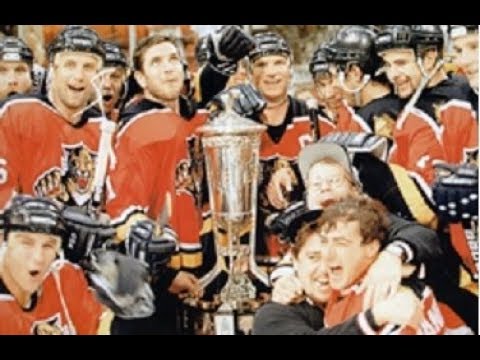
In the locker room after the
game, Captain Brian Skrudland noted, “Just three years ago we came into this
league. Now we’re having some fun, huh?” His teammates donned tees and hats
embossed with “Eastern Conference Champions” and danced around the trophy
perched on a table in the middle of the room. Coach MacLean cautioned, “You
have to get ready and get back to work. It’s been a fairy-tale, dream-type
season. But let’s hope it continues.”
Although they had made it to the Stanley Cup finals, the Panthers found themselves outmatched by the Colorado Avalanche, who had been the Quebec Nordiques the season prior. Colorado swept Florida to take home the Cup for the first time in their franchise’s history.
Since then, the Panthers have returned to the playoffs four times. They set a record for the longest stretch between postseason appearances of ten consecutive years between 2000-01 and 2010-11. However, in the two times they reached the playoffs since then, they placed first in their division at the end of the regular season.
Additional Sources:
Stephen Laroche, Changing the Game: A History of NHL Expansion (Toronto: ECW Press, 2014), kindle version.
“Pinch Yourself,” South Florida Sun Sentinel, 2 June 1996, pp. 1A and 12A.
“Rats in the Cup Unbelievable!” South Florida Sun Sentinel, 2 June 1996, pp. 1C and 5C.
“Stanley Cup Playoffs,” South Florida Sun Sentinel, 2 June 1996, pp. 3C-5C.
Dave Molinari, “Panthers frustrate Penguins and advance to the Stanley Cup final,” Pittsburgh Post-Gazette, 2 June 1996, pp. D1 and D4.
Gerry Dulac, “Beezer’s Game 1 save was a shot in the arm,” Pittsburgh Post-Gazette, 2 June 1996, p. D5.
Fourteen years apart, on May 31, two announcements made and moved two franchises. In 1997, a company in Columbus, Ohio promised to finance an arena in return for an NHL franchise. In 2011, the NHL franchise in Atlanta, Georgia announced they had sold the franchise to be relocated to Winnipeg, Manitoba.
Something New
Ohio had briefly had an NHL
franchise, the Cleveland Barons, for the 1976-77 and 1977-78 seasons. Columbus
had had an ECHL team, the Chill, since 1991. Come late 1996, on November 1,
Columbus Hockey Limited (a group of five investors including John H. McConnell)
applied for an NHL franchise and paid the necessary $100,000 fee. The following
January 13, they formally presented to the NHL but had to wait until June for
the verdict.
In the meantime, they had
concerns over the lack of a suitable arena in Columbus. A referendum to publicly
fund the arena failed in May 1997. Nationwide Mutual Insurance Company came to
the rescue on the final day of that month. They promised to finance a
$150-million arena next to One Nationwide Plaza, their national headquarters.
Once built, the new franchise would play at Nationwide Arena, which became the
focal point of Columbus’s Arena District in the Short North neighborhood.
Thanks to Nationwide’s pledge, the NHL granted Columbus a franchise on June 25, 1997. Joining them would be new teams given to Nashville, St. Paul, and Atlanta. Columbus’s team would begin playing at the start of the 2000-01 season.
Something Blue
Throughout August 1997, with the
help of Wendy’s, a “Name the Team” contest drew about 14,000 entries from all
throughout central Ohio. After first selecting a top ten, McConnell supplied a
bit of Ohio history and helped the NHL narrow the list to two names – Blue Jackets
and Justice.
The name “Blue Jackets” drew the most interest. Rather than being named for a chief from Xenia, Ohio, the name honored Ohio’s Union Army soldiers from the Civil War. More of Ohio’s population served than any other state, and most of the uniform coats were made right there in Columbus. On November 11, 1997, officials formally announced that Columbus’s team would be called the Blue Jackets.
Something Old
What happened to Atlanta’s
franchise in 2011 could trace its origins at least back to 1996. That year, the
Winnipeg Jets (because of their small market and inadequate arena) relocated to
Arizona to become the Phoenix Coyotes. Having a great enthusiasm for hockey, Winnipeg’s
residents were devastated.
About a year later, the NHL
chose to try another franchise in Atlanta. The Flames had begun playing there
back in 1972, but eight seasons later, they had relocated to Calgary. Some had
doubts that a hockey franchise could succeed in that part of the south, but
this new franchise was backed with high profile money. Named the Thrashers for
the state bird, with they start of the 1999-2000 season, they began playing at
the same location where the Flames previously played.
Those doubtful about supporting
a hockey team in Atlanta turned out to be right. By the 2010-11 season, the
Atlanta Spirit Group who owned the team (and Philips Arena operating rights)
had already lost $130 million and could not afford to keep funding the team.
One of the owners, Michael Gearon, Jr., explained that they had searched for additional
investors at least as early as 2007 but had received limited interest. The
other owners also had a legal dispute with former part-owner Steve Belkin that lasted
until December 2010. With that settled, they looked for buyers, but they could
not find anyone who could keep the team in Atlanta.
Meanwhile, in mid-May 2011, Glendale,
Arizona paid $25 million to cover the Coyotes’ losses. That prevented the team
from returning to Winnipeg, who really wanted the NHL to return.
Something Borrowed
Finally, on May 31, 2011, the
owners announced that they had sold the franchise. Their open letter to their
fans began, “Earlier today, we, along with our partners, signed an asset
purchase agreement to sell the Atlanta Thrashers to True North Sports and
Entertainment. If ratified by the NHL, Commissioner (Gary) Bettman and the
league’s Board of Governors, this will result in the relocation of the Atlanta
Thrashers to Winnipeg, Canada, beginning with the 2011-2012 season.” The sale
price was $170 million, with $60 million of that going to the NHL to pay the
relocation fee.
In order for this to all go
through, the NHL Commissioner and Board of Governors had to ratify the sale
(with 75% of the vote) and the relocation (with a majority vote). It was
understood that was just a formality. Commissioner Gary Bettman said at the
time of the announcement, “We’re not happy about leaving Atlanta. This was never
about whether Winnipeg is better than Atlanta.” So it came to pass on June 21
that the NHL officially approved.
Atlanta became the first
American city to lose two NHL franchises. Gearon commented, “Fans deserve to be
angry. It’s an emotional process and I can understand it and appreciate it. Dealing
with that with my own family has been brutal.” Yet, his open letter ended, “Thank
you for the opportunity to be entertained, thrilled and inspired alongside you
by Atlanta Thrashers hockey. None of this would have been possible without your
support.”
Meanwhile, Winnipeg celebrated in the streets. They
wore old Jets gear and the former team’s red, white, and blue. They gathered at
“The Forks” to watch the announcement on a big screen. Being warned that they
would need to sell out their small 15,015-seat arena did not seem to dim the
enthusiasm at having the NHL return. True North Sports and Entertainment
already had an AHL team, the Manitoba Moose, that they planned to move to a
different town and offer their fans first dibs at NHL season tickets. As
Winnipeg had hoped, their new franchise would take the old one’s name, the Jets.
Additional Sources:
Stephen Laroche, Changing the Game: A History of NHL Expansion (Toronto: ECW Press, 2014), kindle version.
Apparently, good things come to those who wait. After six postseasons in the span of ten years, left winger Craig Berube finally scored his first playoff goal on May 30, 1998, in his twelfth NHL season.
Berube’s NHL career began in
1986, when he signed with the Philadelphia Flyers. After some trading at the
beginning of the 90s, he ended up with the Washington Capitals as of June 1993.
He remained with them until he was traded back to the Flyers in March 1999.
However, he was not finished with Washington and signed with them in July 2000.
He bounced to two more teams in 2001 before signing with Philadelphia’s AHL
team, the Phantoms, in November 2003.
During his 17-season NHL career, Berube’s teams reached the playoffs nine times. He only scored one assist during those playoffs, back on April 21, 1993, when his Calgary Flames defeated the Los Angeles Kings 9-4 in the Smythe Division semi-finals. Berube, known more for fighting than scoring, then scored one goal in each of his last three postseasons, in 1998, 1999, and 2000.
At the beginning of the 1997-98 postseason, the Washington Capitals defeated the Boston Bruins (4-2) and the Ottawa Senators (4-1) to face the Buffalo Sabres in the Eastern Conference finals. After being shutout in the opening game, the Capitals then scraped through two overtime wins.
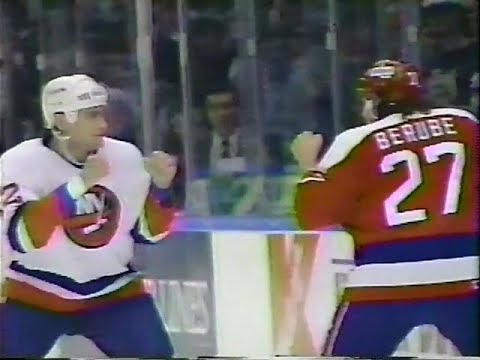
Game 4 took place at Buffalo’s Marine Midland Arena. With a blank scoreboard going into the third period, it seemed another overtime battle may have ensued. Instead, after Washington’s Dale Hunter won the faceoff, his defenseman Phil Housley sent the puck back to Berube. At 2:34 into the final session, Berube scored his first ever playoff goal with a “blast made it through a screen and under Hasek’s right arm.” Berube explained, “[Housley] made a great drop pass to me and I just had time to shoot. I really didn’t look, I just shot as hard as I could, and it went in.” As the only forward in NHL history to pass 50 playoff games scoreless, Berube finally tallied in his 59th playoff game.
About 11 minutes later, Berube’s teammate, Joe Juneau, added a short-handed goal. Although the Sabres had 30 shots on goal compared to the Capitals’ 19, Washington’s Olaf Kolzig came out with a shutout. He was the ninth goaltender to have four shutouts in the same postseason. “Olie’s been strong. He made some saves tonight in the first and second periods that were unbelievable,” praised Berube. “He gives us a chance to win every night and that’s the key.” Unsurprisingly, Berube, Kolzig, and Juneau were named the three stars of the game.
It took another loss at home followed by another win in Buffalo to take the Capitals into the Stanley Cup finals for the first time. There, Berube and his team were swept by the Detroit Red Wings, who had just won the championship the previous season. In their 44-season history, the Capitals have only ever returned to the Stanley Cup finals once, in 2017-18, when they won their only championship to date.
Recently, Berube has turned his attention to coaching. He led his first NHL team, the Flyers, in 2013-14 and 2014-15. During the current 2018-19 season, Berube took over as head coach of the St. Louis Blues and is leading them through their first Stanley Cup finals since their first three seasons as a franchise.
Additional Source:
“Kolzig puts Caps in driver’s seat, 2-0,” Baltimore Sun, 31 May 1998, pp. 1C and 10C.
After Monday night’s game in which the Boston Bruins had been able to control much of the play, especially during the second period, their performance on Wednesday night was a tad disconcerting. The St. Louis Blues seemed to have more chances and dominated during the second period. Surprisingly, after having gone into the first intermission tied at two each, that was where the score would stay until 3:51 of the overtime period.
Despite having scored first and then responded quickly after
the Blues tied it up the first time, the Bruins just couldn’t seem to shake St.
Louis throughout much of the game.
“They seemed to play with more urgency tonight than they did Game 1. What they did was I thought they were on top of us, tighter than they did the first game. They didn’t allow us to get the space. As a result, we didn’t seem to win as many races as we did Game 1 to pucks. Some of that is on us. I don’t think we managed it well enough. I think we got spread out all over the ice. So, give them credit for being tighter than us and getting to pucks first. As a result, spent a lot of time in our end. So, that was self-inflicted,” stated Bruins head coach Bruce Cassidy after the game.
The more concerning issue at this point for Boston is the likely loss of defenseman Matt Grzelcyk for the remainder of the series. He took a serious hit to the head toward the end of the first period and ultimately had to be helped off the ice by Zdeno Chara and the Bruins trainer. He did not return.
“Well he got hit
from behind. That’s what was called. His head got driven into the glass. So, he
went to the hospital to get some tests,” said Coach Cassidy.
Grzelcyk was near the boards and was losing his balance when Oskar Sundqvist came behind him and leveled him. There was some suggestion that NHL Player Safety planned to look into the hit, but there was no indication Wednesday night if they would be seeking supplemental discipline. When asked about the hit, Sundqvist himself did not wish to comment.
“I don’t think that’s a hit we want in our game, I think it’s from behind, elevated in to his head into the glass. If that’s a two-minute penalty, there’s going to be a shortage of defensemen in this series by the end of it. That’s in somebody else’s hands. That’s something I think that if I’m making that hit, I’m probably watching from the bleachers for a few but we will see what happens with their player,” shared Bruins forward David Backes.
This is not to say that Backes believes that hits shouldn’t be in the game. Physicality, especially in the Stanley Cup Final, is to be expected.
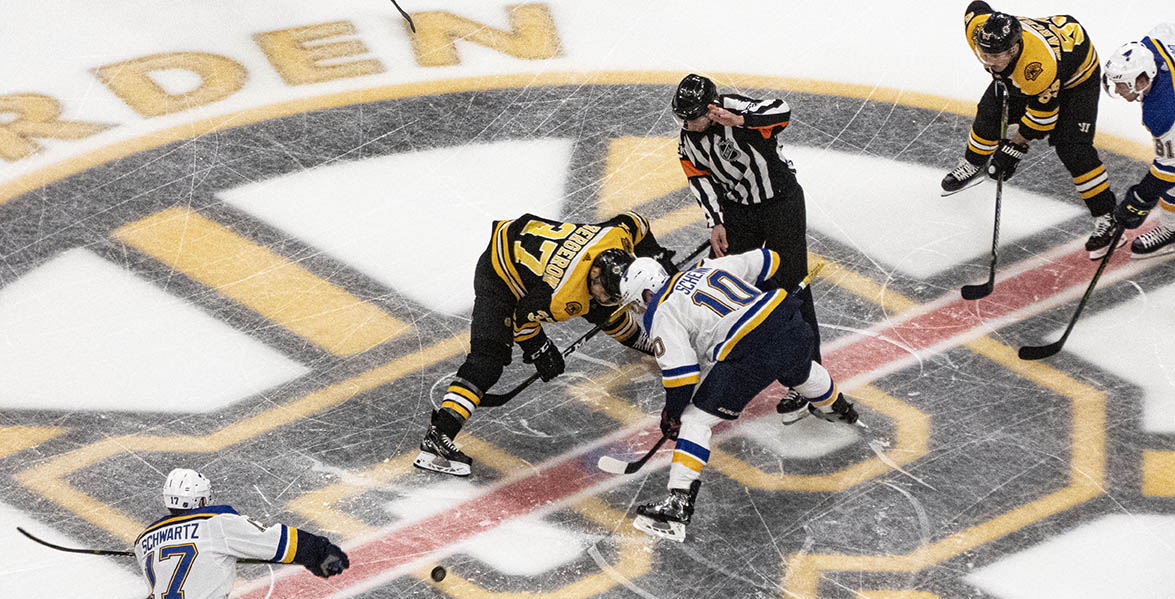
While Grzelcyk’s absence was huge, the overall play of the Bruins was, as Coach Cassidy assessed, not their best. Patrice Bergeron who is normally well above 50% in faceoffs was a surprisingly nominal 38%. Meanwhile his line mates Brad Marchand and David Pastrnak struggled with the puck throughout the night. Marchand tallied at least four give aways.
“We need to be better. Personally, I wasn’t good the last
two games so we can’t be playing like that,” said Marchand. “Taking care of
little details. I think that’s the biggest thing. It will come. That’s how it
is.”
The Bruins know that their first line will get back to doing what they do best. Charlie Coyle mentioned that Bergeron’s line had similar issues during the earlier games of previous rounds and managed to get things going.
One of the advantages to having players like Bergerson,
Marchand, Chara and David Krejci is that they have been through this before.
The stakes are high, definitely. But it is important for the team to not allow
themselves to get too high or too low.
“We just got to
reset. Tie ball game right now. No team’s ahead. No team’s behind. It’s
one-one. We have a chance next game and time to prepare now, but we just reset,
refocus, come back ready to go for the next one,” said Coyle.
In truth the Blues
probably deserved to win Game 2, but this series is still up for grabs. The
teams will travel to St. Louis on Thursday. They won’t play again until
Saturday night. By then, Coach Cassidy will have decided how to fill Grzelcyk’s
spot, and the entire Boston squad will be looking at where their mistakes hurt
and how to minimize that going into Game 3.
Boston has been a good
road team and have gotten some important wins on the road during the post
season. They are not intimidated by the fans of the opposing team. Of course,
St. Louis’ fans will be loud and proud for sure. Sometimes though that kind of
a challenge is just what the Bruins need.
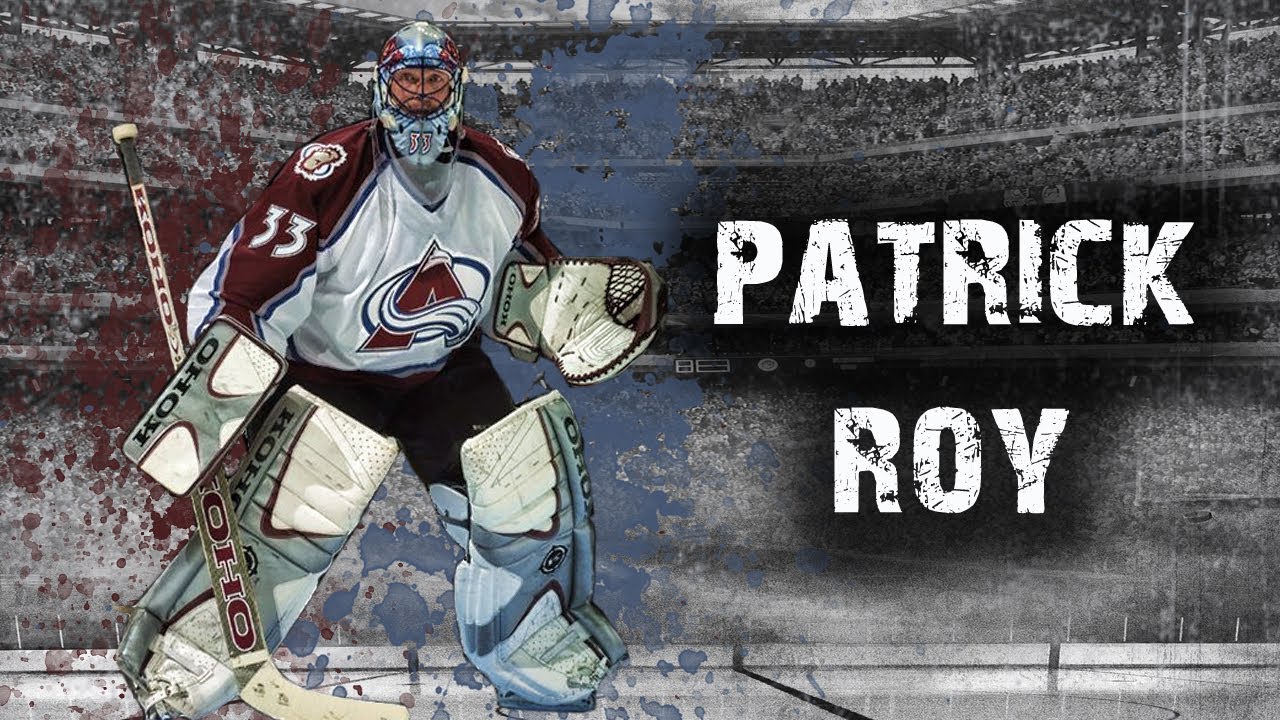
Patrick Roy, the goalie who holds the record for most playoff games (247), just happened to reach milestones on May 29 in both seasons the Colorado Avalanche won the Stanley Cup.
Two big moves in the 1995-96 seasons contributed to the Stanley Cup victory. First, the Quebec Nordiques moved and became the Colorado Avalanche. Then, in December 1995, Colorado traded with the Montreal Canadiens for Roy after he made clear his wishes to move on. “I guess in Montreal I was carrying too much on my shoulders and at the end, it was getting harder and harder to accept to lose. I have never been able to accept to lose.” Roy continued, “I could never accept just trying to make the playoffs. My objective has always been to win the Stanley Cup, and Montreal’s objective this year was just to make the playoffs. I didn’t agree with that.”
In their first season in
Colorado, the team finished the regular season with 104 points, second only to
the Detroit Red Wings (with 131 points). Winning 4-2 in each series, the
Avalanche passed the Vancouver Canucks and Chicago Blackhawks to play Detroit
in the conference finals.
Going into Game 6, the Avs led
the series 3-2. Denver’s McNichols Arena hosted a crowd of 16,061 watching to
see if the new team would advance to the Stanley Cup finals. Captain Joe Sakic
explained, “This is all new to people in Colorado, but I think they can feel
the championship fever. They never had a championship hockey team here, and we
want to be the first.” He went on to score his 16th and 17th playoff goals, a
total that only two others in NHL history had topped.
That game, on May 29, 1996, was Roy’s
132nd playoff game. He had tied Billy Smith’s record dating back to 1987. Roy
would go on to set a much higher career playoff record. Thanks to Roy’s 23 saves,
Colorado won 4-1 and advanced to the Stanley Cup finals. Writing for the Detroit Free Press, Mitch Albom stated, “Colorado
won because its goalie was great, while Detroit’s goalie was only good.” After
the game, Roy wore a big smile as he said, “I don’t have to talk because it’s
easy to see I’m happy, right? It’s unreal. When a team like Montreal gives up
on you, you want to prove that you still have good hockey in you.” He had
commented earlier in the series, “I’m more focused in the playoffs.
Concentration comes a lot easier. I enjoy myself more in the playoffs because
there’s pressure. There’s always the possibility it’s going to be the last game
and I love to play in that situation. Also, I had the chance to win two Stanley
Cups and I feel like I have a chance now, so why not go for it?”
With Roy manning the net, the Avalanche
swept the Florida Panthers to win their first Stanley Cup championship. Roy only
allowed four goals throughout the series. The last one got past him at 11:19 of
the first period of Game 3. He held off all comers through three overtime
sessions in Game 4. Throughout the 1996 postseason, Roy played 22 games (16-6),
with three of them ending in shutouts. His save percentage was .921, and his
goals against average was 2.10.
Colorado again made the Stanley Cup finals in 2001, after sweeping the Vancouver Canucks and defeating the Los Angeles Kings (4-3) and St. Louis Blues (4-1). For the finals, the Avs faced the defending champions, the New Jersey Devils, with Roy’s rival, Martin Brodeur. Still, with 25 saves, Roy shut them out 5-0 in Game 1.
On May 29, Game 2 took place at
Denver’s Pepsi Center. That marked the first time in NHL history that a goalie
played 100 consecutive playoff games for the same team. Even as he set that
record, Roy missed another by only one minute and 41 seconds. Back in 1925-26,
Clint Benedict had set the record at 229:22 for the most minutes without
letting in a goal during the Stanley Cup finals. When New Jersey’s Bob Corkum
scored at 14:29 into the game, Roy’s scoreless streak ended at 227:41. As Ken Daneyko
said on behalf of the Devils, “When you go that long without scoring against a
quality goaltender like him, you start to get a little doubt.” Once they scored
that first goal, they were able to score again before the first period ended.
Roy made 18 saves, but the damage was done since the Avs had only scored one
goal about six minutes into the game. Losing the game also broke Roy’s winning
streak at nine finals games. He had won every finals game dating back to Game 2
in 1993.
The team who lost Game 2 of the finals had only managed to win the Stanley Cup four times in the past 29 seasons. One of those times was the previous year when the Devils lost Game 2 but won the Cup. Roy and the Avalanche managed to do the same. Colorado won Game 3, lost the next two, had a 4-0 shutout in Game 6, and won 3-1 in Game 7. Roy had played in 23 games (16-7), tallying four shutouts. His save percentage was .934, and his goals against average was 1.70. He earned the Conn Smythe Trophy as playoff MVP as the first to receive the award three times.
Throughout his 19-season career, Roy participated in 17 postseasons, a record he shares with Brodeur. The first nine, he played with Montreal, and the latter eight with Colorado. He led his teams to two Stanley Cup championships each, one more than Brodeur. Roy holds the record for most playoff saves (6,559) and most playoff shots against (7,143). In addition to his record for most playoff games (247), Roy also has the most playoff wins (151).
Some players really come into their own in make-or-break situations. Any team who had to play a Game 7 would wish to have Justin Williams scoring for them. His offensive abilities earned him the nickname “Mr. Game 7” after he helped the Los Angeles Kings win Game 7 of the Western Conference semi-finals on May 28, 2013.
Williams, drafted 28th overall
in 2000 by the Philadelphia Flyers, played in his first Game 7 during the
2002-03 playoffs. Three games of the quarter-finals went into multiple overtime
sessions before the Toronto Maple Leafs forced a Game 7. At Philadelphia on
April 22, Williams assisted on the first and third goals and scored the one in between,
leading the Flyers to a 6-1 victory. Having made it to the semi-finals, the
Flyers lost to the Ottawa Senators (4-2).
Williams was traded to the Carolina Hurricanes in early 2004. The next time Williams participated in a postseason was in 2006. That season, Carolina made it through all four rounds of the playoffs. They played two full series, and both of the final games were played away. Game 7 of the Conference finals took place at Buffalo on June 1, and Game 7 of the Stanley Cup finals was played at Edmonton on June 19. In the former, Williams assisted the first and third goal then scored the final goal in Carolina’s 4-2 win. For the final game of the finals, Williams sunk an empty-netter, the concluding goal of the postseason, as the Hurricanes took home the Stanley Cup.
The Los Angeles Kings became
Williams’ team following a trade in March 2009. They failed to make playoffs that
season and lost the quarter-finals the next two. The Kings won their first
Stanley Cup championship at the end of the 2011-12 season. None of the four
playoff rounds needed a seventh game.
For the 2012-13 postseason, the
Kings eliminated the St. Louis Blues in six games before taking on the San Jose
Sharks for the conference semi-finals. This was only the fourth time two
California teams played each other in the playoffs. Despite two shutouts by the
Kings, the Sharks forced them to a Game 7. The Kings had home ice advantage
before 18,593 fans.
During the second period,
Williams scored the only two Kings goals. The first was on a power play at
4:11, and the second came almost three minutes later at 7:08. Williams
commented, “I think I could have had three or four goals tonight. I had quite a
few opportunities. It’s funny how the puck comes to you a little bit more often
sometimes in different games.” His goalie, Jonathan Quick, made 25 saves and
only allowed one goal (at 5:26 of the third period). Quick reminded everyone, “We’re
only halfway up the mountain.” Having advanced to the conference finals, the
Kings lost to the Chicago Blackhawks (4-1).
Still, Williams was the first
NHL player to score in all of his first four Game 7 appearances. After William’s
triumph in Game 7, one reporter called Williams “Mr. Game 7.” Williams
responded, “I’m going to have to play a few more Game 7s and have a little more
success to get that name.”
He did just that in the 2013-14 postseason. The first three rounds all required seven games for Los Angeles to advance, and none of them were played at home. Round 1 against the Sharks took place on April 30, and the Kings won 5-1. Williams had an assist on the second of Los Angeles’s goals. Round 2 against the Anaheim Ducks ended with a 6-2 victory on May 16. This time Williams scored the first goal and assisted on the last. On June 1, Round 3 against the Chicago Blackhawks ended 5-4. Williams potted the second of Los Angeles’s goal, and assisted in the game-winner. The Kings advanced to the Stanley Cup finals, where they defeated the New York Rangers (4-1) for the Stanley Cup. Williams took home the Conn Smythe Trophy, too.
All told, Williams had scored seven goals and seven assists in seven Game 7s. During the 2018-19 playoffs, Williams again made his mark in a seventh game. Having rejoined the Carolina Hurricanes in 2017, he helped them defeat the defending-champion Washington Capitals. On April 24, Williams assisted Brock McGinn in scoring in double overtime. Mr. Game 7 had done it again.
Additional Sources:
“It’s Justin Time,” Los Angeles Times, 29 May 2013, pp. C1 and C6.
After a very lengthy layoff for the Boston Bruins, the puck finally dropped on Game 1 of their Stanley Cup Final bout against the St. Louis Blues. It was 49 years ago when these two teams played opposite each other in a Stanley Cup Final. And it has been 49 years since the Blues were in a Final.
Though the shots on goal in the first period didn’t show it, it was clear that the Bruins were shaking off a bit of rust. While they weren’t completely outplayed by the Blues, there were some situations in which it was clear that the Bruins weren’t completely up to their normal speed. So perhaps it shouldn’t have been a surprise when Brayden Schenn notched the first goal for the Blues at 7:23 of the opening period.
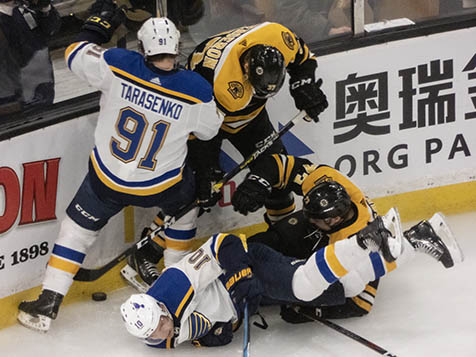
One minute into the middle period and things looked like they were going to go St. Louis’ way, as they got their second goal of the game, this one coming from Vladimir Tarasenko—marking his 9th goal in the postseason. The Bruins didn’t waste any time in responding, when defenseman Connor Clifton got the Bruins on the scoresheet a little over a minute later. And it became clear that Boston was tilting the ice in their favor. From the moment that Tarasenko scored, the Bruins denied the Blues any opportunities to shoot on net for almost seven straight minutes. The Blues would get one more puck on Tuukka Rask in the second period exactly four minutes after their second at 11:44, and that would be the last time Rask would have to stop the puck during the middle frame.
Meanwhile, while again on the power play, Boston’s Charlie McAvoy tied the game at 12:41. The man advantage for the Bruins was the result of a high sticking call on Joel Edmundson who got his stick up around the throat of David Backes. It was the third penalty for the Blues, and it was apparent with each opportunity on the power play that the Bruins were getting back to what makes them dangerous when they are on the man advantage.
Going into the second intermission the teams were tied, but the shots on goal were an astounding 26-11, with the Bruins having put 18 shots on rookie goaltender Jordan Binnington, as opposed to the three that Rask saw.
Physicality throughout the first two periods had certainly
been a factor, as both teams seemed happy to trade hits. During the first
period the edge went to St. Louis who had one more hit than the Bruins. During
the second period the Bruins edged the Blues by one hit.
The Bruins have been strong in the third period throughout much of the postseason, so it was perhaps not surprising when they came out strong in that final frame once again. At 5:21 of the third, Sean Kuraly showed how important the fourth line is to the Bruins, by getting the B’s the go-ahead goal. Of course, a one-goal lead in a Stanley Cup Final game is not as much breathing room as any team would like, but Boston continued to limit the Blues in shots on Rask at that point.
Perhaps the biggest hit, and biggest “controversy” of the game, depending on whose take was read afterward, was the solid hit by Torey Krug on Robert Thomas at 9:41 of that third period. There had been some pushing, shoving, what have you, at the other end in front of Rask, between David Perron and Krug. It resulted in Krug’s helmet coming off. He continued up the ice and landed a huge hit on Thomas that had everyone at TD Garden on their feet.
With 2:13 remaining in regulation, the Blues head coach Craig Berube pulled Binnington for the extra attacker and 24 seconds later, Brad Marchand put the puck in the empty net to ensure the Bruins would win the first game with a final score of 4-2.
The Bruins know that this was just one game, and they expect a response from the Blues when they gather again on Wednesday night for Game 2 in Boston before the teams head off to St. Louis for the following two. However, it was certainly a big win for the team in black and gold, especially as many were concerned that their lengthy layoff would make them ineffectual in the first game.
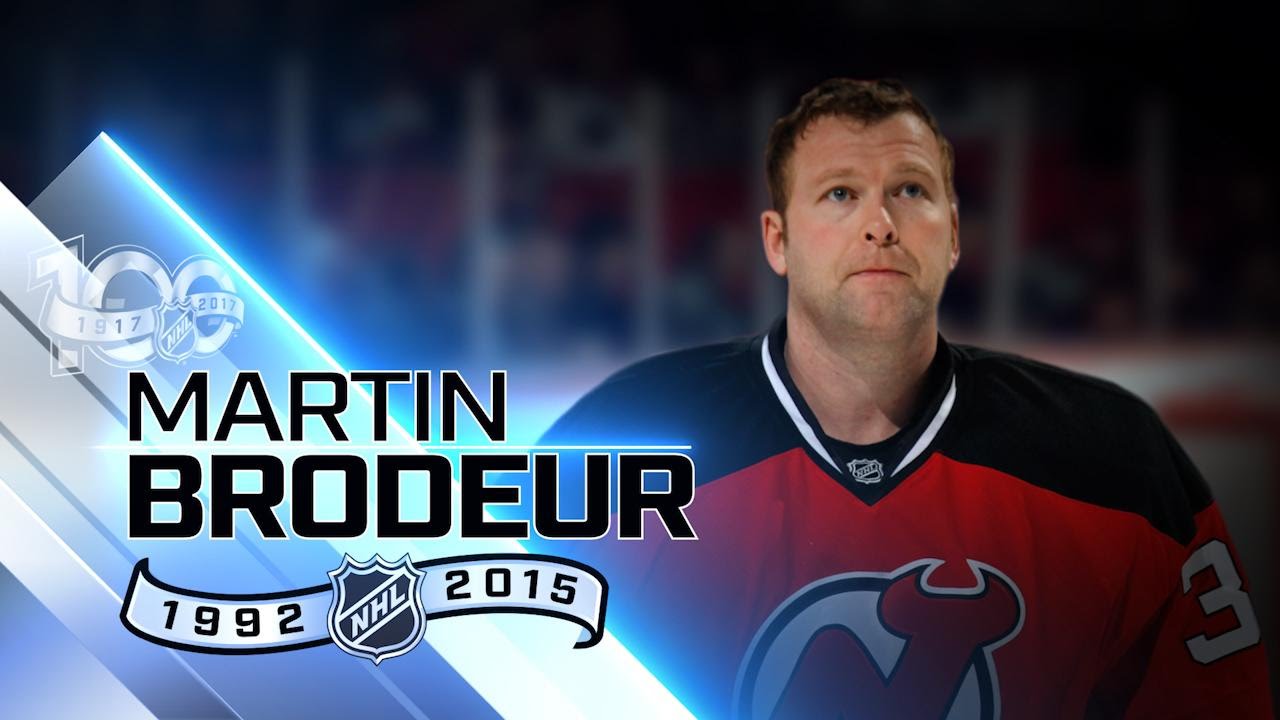
Goalie Martin Brodeur had a 22-season career in the NHL, playing all but the last for the New Jersey Devils. As a rookie, May 27, 1994 marked the end of the line. Nine years later, in 2003, Brodeur started his team off right in the Stanley Cup finals they would go on to win.
At the end of the 1993-94
regular season, Brodeur took home the Calder Memorial Trophy as the top NHL
rookie. The Devils (with 106 points) finished second to the New York Rangers
(with 112 points) in the Atlantic Division.
When the two faced each other in
the conference finals, they battled to the bitter end. The first, third, and seventh
games of the series extended into double overtime. After the Devils won Game 1
(4-3), they lost the next two games (including a 4-0 shutout and the 3-2 double
overtime loss). Bouncing back, the Devils won Game 4 (3-1) and Game 5 (4-1). New
York won Game 6 to force a deciding Game 7.
On May 27 at Madison Square
Garden, the Rangers had the only score until less than eight seconds remained in
regulation. New Jersey’s Valeri Zelepukin snuck in a tying goal as the clock
ticked down. It took 24:24 of overtime before the tie could be broken. Rookie Brodeur
had made 46 saves, but somehow he missed the puck that Stephane Matteau wrapped
around the net. As the New York Daily
News recapped, “Fetisov slid in the crease to try and block. Brodeur, on
his knees, laid his stick flat to cover as much of the net as he could. The
puck somehow squeezed off or under Fetisov, off or under Brodeur and between
his pads.” Brodeur commented, “I didn’t see the puck where it went. I just
tried to cover the net.”
Matteau had also scored the
game-winner during Game 3’s double overtime. “I realized what I did as soon as I
scored in Game 3, but I still don’t believe what happened out there in Game 7.”
Matteau remarked, “It’s going to take a while to sink in. I only know it was a
huge goal for the New York Rangers.” Radio announcer Howi Rose just called, “Matteau,
Matteau, Matteau!”
According to the New York Daily News, 22-year-old Brodeur was “practically inconsolable. He bent over for a long time after the red light went on. He cried a little on line during the post-game handshake.” Veteran defenseman Ken Daneyko sympathized, “Marty’s going to be a great goaltender for a long time. He’s going to be around for a long time. That was a really crushing goal to see that go in.” Their teammate, winger Randy McKay, gave Brodeur much of the credit for how well they did. “Marty’s unbelievable for such a young kid. He’s calm and composed. He made some key saves to keep us in the game tonight. He made the saves at the right time in order for us to win the game. We just didn’t finish any of our chances.”
When the game finally ended,
Mark Messier accepted the Prince of Wales Trophy on New York’s behalf. The Rangers
advanced to the Stanley Cup finals for the first time since 1979. There, they defeated
the Vancouver Canucks for their fourth Stanley Cup championship, the only one
since 1940.
Brodeur’s turn came in 1995, when
the Devils won the Stanley Cup for the first time. He and his team won another
championship in 2000.
The Devils again made it to the Cup
finals in 2003. Brodeur earned the William M. Jennings Trophy (having the fewest
goals scored against) and the Vezina Trophy (as top goalie). During the first
round of playoffs, he had two 3-0 shutouts (on April 13 and 17) to eliminate the
Boston Bruins (4-1). Brodeur began round two with a 3-0 shutout (on April 24)
and went on to eliminate the Tampa Bay Lightning (4-1). Round three against the
Ottawa Senators took seven games. Brodeur shut them out of Game 3 (on May 15)
with a score of 1-0.
The Stanley Cup finals began on May
27. Before the sellout crowd at New Jersey, 31-year-old Brodeur blocked all 16
shots on goal by the Mighty Ducks of Anaheim. Grant Marshall made a goal
between the two by Jeff Friesen to give the Devils yet another 3-0 shutout. Ducks
coach Mike Babcock bemoaned, “I knew it was going to be tough to generate
offense against them. But I thought it was going to be tough for them to
generate offense against us, too. That was the part I wasn’t expecting.”
Brodeur explained, “We need to put doubt in their minds that this is going to be
a series and they’re not going to walk all over us like they did the other
teams they played.”
Two days later, the Devils
duplicated the score with Brodeur making another 16 saves for his shutout. They
lost the next two games in overtime but came back to win Game 5. The Ducks
forced a Game 7, held June 9, which the Devils ended their favorite way – 3-0. For
the Cup-winner, Brodeur made 24 saves.
Brodeur was only the second NHL goalie to earn a shutout in all playoff rounds throughout one postseason. After Game 1, he commented, “What I’ve accomplished right now, it’s a lot of a great ride, and I hope it’s not going to be over soon.”
All but the first of Brodeur’s shutouts that postseason took place in New Jersey. Brodeur’s record of seven shutouts in a single postseason still holds. He had one more than Dominik Hasek obtained (in 2002) and two more than his opponent, Jean-Sebastien Giguere, had (in 2003). Both Brodeur and Giguere had three shutouts in a single series that season, which tied the record. When Brodeur retired, he had 24 playoff shutouts (one more than Patrick Roy’s record) and 125 career shutouts. Both records still stand.
Additional Sources:
“Battle of the Hudson,” New York Daily News, 28 May 1994, pp. 36-38.
“Sudden Life,” New York Daily News, 28 May 1994, p. 34.
Colin Stephenson, “Rookie Brodeur played like a vet,” New York Daily News, 28 May 1994, p. 38.
“For Rangers,” New York Daily News, 28 May 1994, pp. 35 and 39.
“Stanley Cup Finals,” New York Daily News, 28 May 2003, pp. 64-65.




 Prev
Prev