The 2011-12 season did not go smoothly for the Kings. After the firing of head coach Terry Murray, Darryl Sutter replaced him in December. The change meant moving from a defensive mindset to bringing on some offense. In a last-minute trade, the Kings welcomed Jeff Carter. Sutter summarized what happened next. “These guys, you know what, since March 1 they’ve lost about six games. They’ve taken a lot of public negativity toward them. Look what they’ve just done. It’s pretty awesome. Tells you what type of players they are.” Despite improving their record, it took until the second-to-last regular-season game to clinch a playoff berth.
With their 95 points (40-27-15), the Kings were the No. 8 seed in the Western Conference. That meant that in the first round they had to face the winners of the President’s Trophy and thus No. 1 seed, the Vancouver Canucks. In what would become a pattern, the Kings won the first three games of the series. They then completed their victory in Game 5 to win their first playoff series since 2001. Thus began their “rampage” through the Western Conference in only 14 games, matching the record (since the system changed in 1987). The Kings swept the No. 2 seed St. Louis Blues and needed five games again to defeat the No. 3 seed Phoenix Coyotes. Along the way, the Kings won all ten road games and even eliminated the first and third opponents on the road. They were the first to defeat the top three seeds in their conference and the first three games in each of those series.
Having made it to the Stanley Cup finals for the first time since 1993, the Kings took on the New Jersey Devils. The Devils had won the championship in 1995, 2000, and 2003. This season in the league, they were the No. 9 seed overall, which was still higher than the Kings at No. 13. That made this the first time a playoff matchup had such high-numbered seeds. Both Los Angeles and New Jersey had arenas built since the last time their teams made the playoffs, so this would be the first Stanley Cup finals at the Staples Center and Prudential Center.
As they had become accustomed to, the Kings won the first two games despite being on the road. They both ended 2-1 after overtime. On home ice, the Kings shutout the Devils 4-0 in Game 3 but then lost 3-1. The series started to look shaky after they also lost Game 5 (2-1) back in New Jersey.
Game 6 took place at the Staples Center for a crowd of 18,858. Los Angeles took control during the first period thanks to a major penalty. At 10:10, Steve Bernier received five minutes for boarding and a ten-minute game misconduct after hitting defenseman Rob Scuderi face-first into the boards. Despite what some Devils supporters thought about the fairness of the call, the NHL sent the message that hits from behind would not be tolerated. During what must have felt like the longest five minutes of the Devils’ lives, the Kings scored three power-play goals. Captain Dustin Brown led the charge, followed by newbie Jeff Carter and Trevor Lewis.
The second period began (at 1:50) with a second goal from Carter and ended (at 18:45) with the only goal New Jersey would score that night. The only scoring action in the third period took only 15 seconds. At 16:15, Lewis scored an empty-netter, and at 16:30, with Martin Brodeur returned to the net, Matt Greene sunk the final postseason goal. In this one game, Lewis had two goals, Brown had a goal and an assist, and Drew Doughty, Mike Richards, and Dwight King each had two assists. Other than the 1991 8-0 finale, this game was the most lopsided to win the Cup.
As soon as the game ended, the victorious Kings crowded around goalie Jonathan Quick, near his net. Black and silver streamers rained down on them. Quick, with his 1.41 goals-against average and .946 save percentage, earned the Conn Smythe Trophy as playoff MVP. He was the third American winner (after Brian Leetch (1994) and Tim Thomas (2011)).
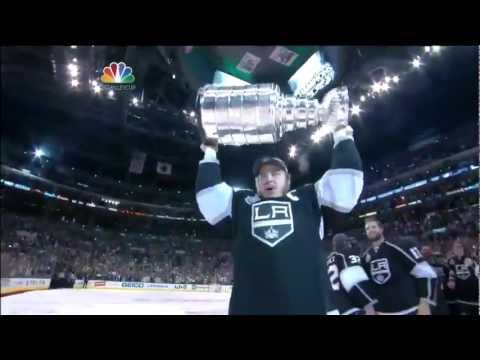
NHL Commissioner Gary Bettman handed the Stanley Cup to Captain Brown to hoist first. He noted the Cup was “heavier than I thought . . . There’s no words to describe, lifting that thing.” Brown then reflected, “It’s one of those things you dream all your life for as a player. The city of Los Angeles has been dreaming of this for 45 years. There were about 20 million dreams coming true tonight.” Even though the city had been waiting longer, Brown said, “You dream of winning the Cup, and you know what, I’m glad I was the first King to ever lift it.” Brown and his counterpart, New Jersey’s Zach Parise, were the first U.S.-born captains to face off against each other in the championship round. Only one other American captain (Derian Hatcher in 1999) had hoisted the Cup before Brown.
As for Coach Sutter, though he had never won the Cup as a player, two of his brothers (Duane and Brent) had done so multiple times. He merely remarked that winning the Cup “It was pretty awesome.” A retired trainer, Pete Demers, poured a beer that he had kept from the locker room of the 1993 loss into the Cup to taste. He enthused, “And that old rotten beer tasted great.”
So far, the Kings have been the only No. 8 seed, the lowest to date, to win the Cup since the seed system began in 1994. They were only the second team (after the Devils in 1995) to win without having the home-ice advantage in any playoff round. The Kings were also the second Californian team to win since the Anaheim Ducks had done so back in 2007. They were the second-to-last of the 1967 expansion teams to win. Finally, the Kings were the fourth consecutive team to take home the Cup at the end of a season that began with a European Premiere.
Los Angeles followed up this victory with another in 2014.
The Buffalo Sabres finished another disappointing season without making the postseason, which led to the firing of head coach Phil Housley. The Sabres took care of hiring a new head coach and getting a coaching staff in place well before the upcoming NHL Draft. Ralph Krueger will be the new bench boss for the Sabres, who look to get out of the NHL’s basement and into the postseason. The associate coach to Krueger will be Davis Payne. The three assistant coaches are Steve Smith, Chris Hajt and Tom Ward.
The Sabres had so many problems last season that it was tough to know where to begin with this wish list. They were a one-line team with little depth production, the defense was disastrous at times last season and the goaltending duo of Carter Hutton and Linus Ullmark was just flat out inconsistent. The team as a whole has a lot of needs, but will General Manager Jason Botterill be able to get rid of some of the dead weight and cap space to improve this team enough to finally get to the postseason? We shall see, but for now here is some of what Botterill and company should be looking for to improve the roster.
1) Top Line Scorer
Jason Botterill took care of this one early in the offseason by not letting Jeff Skinner get away from the team. Skinner signed his eight year, $72 million extension late Friday night. Yes, the cap hit is a bit high for someone who has only played one season with the team, but the Sabres have some wiggle room with the cap. Buffalo couldn’t let Skinner get away since he was the leading goal scorer last season with 40 goals and developed good chemistry with Jack Eichel.
The $9 million cap hit is a bit high for Skinner, but he is ultimately going to be a top line scoring winger on this team so the team had to pay up if they wanted to keep him. If Eichel can manage to stay relatively healthy next season then these two could wind up having career highs and Skinner may even be able to hit 50 goals. This wasn’t the only thing that needed to be fixed on the offensive side of the puck, but it is a solid start for the Sabres to the offseason to keep one of the bigger free agents with the team.
2) Second Line Center
The organization needs to find a way to land a solid second line center, whether it be via trade or a free agency signing. The Sabres were a one-line team last season, which cost them from being nothing close to consistent after their hot start. It seemed that if the Eichel line didn’t produce in any single game then there was a good shot the team wasn’t picking up the two points, night in and night out. The second line center by the end of the season wound up being Evan Rodrigues, who is not the best option for a second line center in the League. If the Sabres can land a solid second line center then Casey Mittelstadt can stay on the third line and Johan Larsson can be the fourth line center.
The biggest free agent center out there is Matt Duchene, who will be a highly coveted player for a lot of teams. Duchene helped the Columbus Blue Jackets to make it past the first round of the playoffs after coming over in a trade. Kevin Hayes, who is likely the second best center option, could already be locked up by the Philadelphia Flyers by the time free agency rolls around since they acquired his rights from the Winnipeg Jets on June 3. Some other free agent options could be Derick Brassard, Marcus Johansson or Jason Spezza. I doubt the Sabres would go after Spezza because of his age but he is an option. The other option would be to try to land one via trade, but that would most likely require giving up someone on the current roster.
3) Solid Wingers
The Sabres should add some wingers that can play two-way hockey and put the puck in the net. The biggest problem was that the team just didn’t compete most nights. It would be nice if the Sabres could add a veteran winger with some leadership skills, but not at a costly price. Botterill will have some cap space but he needs to think down the line too, and not go out and trade for, or sign, an older veteran player that is on the decline.
There are some options for solid wingers in free agency but some are pricier than others. Carl Hagelin could be an option because he would be able to give the team production and he would be an excellent addition to the penalty kill. Hagelin like Anders Lee would be the more expensive options in free agency. Brandon Tanev had 29 points in 80 games last season so he could be more of a bottom six option for the Sabres. Joonas Donskoi, who played for the San Jose Sharks the past few seasons, would likely be the cheapest wing option in free agnecy, and would be a good one. There are always kids that could come out of camp, impress and make the team or the Sabres could even make a trade because there will be teams looking to move players to get younger and better.
4) 3rd Pairing Defenseman
The Sabres are in a decent spot with the top four defensemen, but they definitely need to add a depth defenseman or two. The top four will likely include Rasmus Dahlin, Brandon Montour, Rasmus Ristolainen and Zach Bogosian, if he can stay healthy. The defense was a weakness of the Sabres almost all of last season. There were too many giveaways and misplays that led to goals or great offensive chances, which usually meant the goalies were left hung out to dry. The goalies did allow a good amount of soft goals, but they also had to make their fair share of odd man rush saves.
There aren’t a ton of good defensemen out there in free agency, but there are a few that if Botterill can get under contract at good terms and cheap then it’s worth a risk. Michael Del Zotto is younger and could be a cheap fit for the bottom pairing. A couple of older, more expensive free agent options could be Ron Hainsey, Braydon Coburn or Brooks Orpik. It will be interesting to see what the team does or doesn’t do to improve the blueline.
5) Get Rid of Dead Weight
There is definitely some dead weight throughout this Sabres lineup, and it needs to be shed. The Sabres need to start with not re-signing Jason Pominville to another contract because he will just take up a younger player’s spot. Vladimir Sobotka absolutely needs to go because he did nothing but take a roster spot from a younger player last season, and didn’t contribute much when he was on the ice. It wasn’t his fault that the coaching staff seemed to like to have him in the lineup for whatever reason last season. Sobotka is under contract for one more season, but the best option would be to buy him out in the offseason.
Zemgus Girgensons is a restricted free agent and is artbitration eligible, but he still needs to go even though he is young. Girgensons hasn’t really done anything in his time with the Sabres and is really a bottom six player. On the blue line, the two veterans that need to go are Marco Scandella and Matt Hunwick. Scandella was brought over in a trade with the Minnesota Wild a few seasons ago and hasn’t done much since, but he only has one more season left on his current contract. Matt Hunwick could go either way because if the Sabres decided to keep him, his salary is affordable and he could be the seventh defensemen option, but paying him $2.25 million to sit in the press box seems like a lot.
No matter who won the Stanley Cup in 1996, it was going to be a first. The finals pitted the Colorado Avalanche against the Florida Panthers. Both teams played in the finals for the first time, which was the only time that had happened since the NHL’s inaugural year. The former had just relocated at the beginning of the season, and the latter wrapped up their third season. In Game 4, held on June 10, 1996, the Colorado Avalanche swept up the Cup.
The road to the Stanley Cup essentially began with the Nordiques’ final season in Quebec, a half season thanks to a lockout. According to their captain, Joe Sakic, “I have to go back to our last year in Quebec. We had a real strong team. We finished first but we lost in the first round (of the playoffs) [to Detroit]. But we had a strong core. Getting Sandis Ozolinsh on the back end for the powerplay and acquiring Claude Lemieux, who had just won the Conn Smythe (Trophy) the year before, really helped the team.” The summer of 1995, the franchise moved to Colorado.
The Avalanche finished their inaugural regular season leading the Pacific Division with 104 points (47-25-10). Meanwhile, the Panthers’ 92 points (41-31-10) only gave them third in the Atlantic Division and seventh in the NHL rankings. By defeating the Vancouver Canucks in the quarter-finals, Colorado had won the franchise’s first playoff series since 1987. They went on to defeat the Chicago Blackhawks and then the first-place, heavily-favored Detroit Red Wings. The latter series launched a bitter rivalry thanks to Lemieux’s injury-causing hit on Kris Draper. All three series required six games for Colorado to advance. Florida’s series took progressively longer as they worked their way through the Boston Bruins (4-1), Philadelphia Flyers (4-2), and Pittsburgh Penguins (4-3).
All but one of the four games played between Colorado and Florida during the finals remained close. The series began with two games in Colorado that ended 3-1 and 8-1. Upon moving to Florida, the series ended with scores of 3-2 and 1-0. For Game 4, Miami Arena sold out with 14,703. Over in Denver, fans went to McNichols Arena to watch the game on the big-screen with televised feed.
The final game turned out to be a goaltender battle. Back in December, Colorado took Patrick Roy in a trade that he had demanded of the Montreal Canadiens management after a humiliating game. According to defenseman Adam Foote, “We were able to create a core of players that could play a long time together and we won a couple of Cups, but we wouldn’t have got there without a guy like (Patrick) Roy. I loved playing in Quebec City and they treated me great there but I’m not sure that the Roy trade would have happened if we had still been in Quebec.” In the other net, John Vanbiesbrouck, was the first player drafted when the Panthers joined the NHL in 1993. His captain, Brian Skrudland, remarked, “I said to Johnny after the game, if he wasn’t so good we could have been out of here three hours ago. This was just a classic matchup between two great goalies. They’re the reason why these two teams were here.” Roy made 63 saves, and Vanbiesbrouck blocked 55 shots. Throughout the series, Roy only allowed four goals in 151 shots to give him a save percentage of .974. Vanbiesbrouck had allowed 15 goals, and his postseason save percentage was .932.
With 44 seconds remaining in regulation, Panthers fans mistakenly thought Ray Sheppard had scored and threw plastic and rubber rats on the ice in celebration (as had been their custom throughout the playoffs). Play had to be stopped to wait for the ice clearing. Commissioner Gary Bettman chided them. “It’s not good that fans get used to throwing things on the ice.”
None of them knew then that it would take three overtime sessions for any goal scoring. It was just after 1 am (11 am for those watching in Denver), at 4:31 of triple-overtime, when the game finally ended. It was the longest game to end 1-0 since 1936. “An immense game, an epic,” Vanbiesbrouck called it. “It seems like we played games 4, 5 and 6 right here.” After nearly five hours in real time and 104:31 on the clock, the 119th shot of the game went in the net. Uwe Krupp, who had been injured most of the regular season, scored unassisted on a slap shot from the point. He said afterwards, “The obvious play is just to get it to the net. I leaned on it and got a little extra juice on it.” With that, he became the first German-born player to have his name on the Stanley Cup.
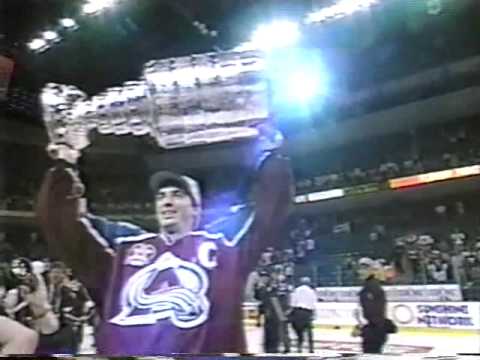
The Cup was presented to Colorado Captain Joe Sakic. Throughout the playoffs, he had scored 18 goals, just one less than the record (held by Reg Leach and Jari Kurri from 1976 and 1985, respectively). Six of them were game-winners, a new record. Obviously, he led the scoring with his 34 points. For these accomplishments, he received the Conn Smythe Trophy as playoff MVP. Sakic commented, “I’ll always remember this moment for the rest of my life.” Surprisingly, he was the only player from the Avalanche or the Panthers to win any of the awards that season.
Despite their loss, the coaches of both teams had pride for the Panthers. Marc Crawford, the third-youngest coach to win the Cup, said, “It was a Florida Panther-style game. [The Panthers] were an incredible story this year, and obviously hockey is in good hands here.” Of his team, Coach Doug MacLean, remarked, “I’m disappointed but I’m really proud of the players and the whole organization. A first-year coach couldn’t ask for any more.”
With the win, Colorado Governor Roy Romer won a bushel of oranges from his bet with Florida’s governor. And the Avalanche became the first Denver-based professional sports team to win a championship. One neighborhood even rioted in celebration, forcing the police to disperse the large crowd.
By the numbers, the 1995-96 Stanley Cup finals certainly held significance. The Panthers making the finals in their third season makes them the fifth-fastest. The fastest four included the first finals after the formation of the NHL and the first finals after the 1967 expansion in which the playoff system guaranteed a new team would play. Otherwise, the New York Rangers had made the 1928 finals in their second season, and the Vegas Golden Knights made it in their first in 2018.
As for the Avalanche, they were the seventh expansion team and second former-WHA franchise to win the championship. At that point, only two other teams had ever won after relocating, the Calgary Flames (former Atlanta Flames) and the New Jersey Devils (former Colorado Rockies). Since then, the Dallas Stars (former Minnesota North Stars) and the Caroline Hurricanes (former Hartford Whalers) have won. However, the Avalanche remains the only franchise to win the very year of relocation.
Additional Sources:
Brian McFarlane, Brian McFarlane’s History of Hockey(Champaign, Ill.: Sports Publishing Inc., c1997), 276-277.
Hockey Chronicle: Year-by-Year History of the National Hockey League(Lincolnwood, Ill.: Publications International, Ltd., 2006), 572-574 and 580-581.
Anyone who thought the snapping of a 42-year dry spell (in 1997) was amazing, just had to wait until 2010 to see an even longer drought come to an end. After nearly half a century, on June 9, 2010, the Chicago Blackhawks won their first Stanley Cup championship since 1961, when they still used the space in Black Hawks.
The Blackhawks began turning their franchise around in 2007, when they drafted Patrick Kane first overall. Of Chicago’s changes in marketing and management, Commissioner Gary Bettman said, “I think (the changes) were bold, they were aggressive, they were innovative, and they were just what the doctor ordered.” The improved team finished the 2009-10 season with 112 points (52-22-8) as first in the Central Division and third in the NHL. Chicago kept the momentum as they knocked out the Nashville Predators (4-2), Vancouver Canucks (4-2), and the San Jose Sharks (4-0).
In the Stanley Cup finals, the Blackhawks took on the Philadelphia Flyers. Throughout the first five games, each team won whenever on home ice. Game 6 took place at Philadelphia’s Wachovia Center, but that’s where the Blackhawks checked the pattern. They scored first and had the lead until the final four minutes. Then, Scott Hartnell scored his second goal of the game to deadlock the score at 3-3.
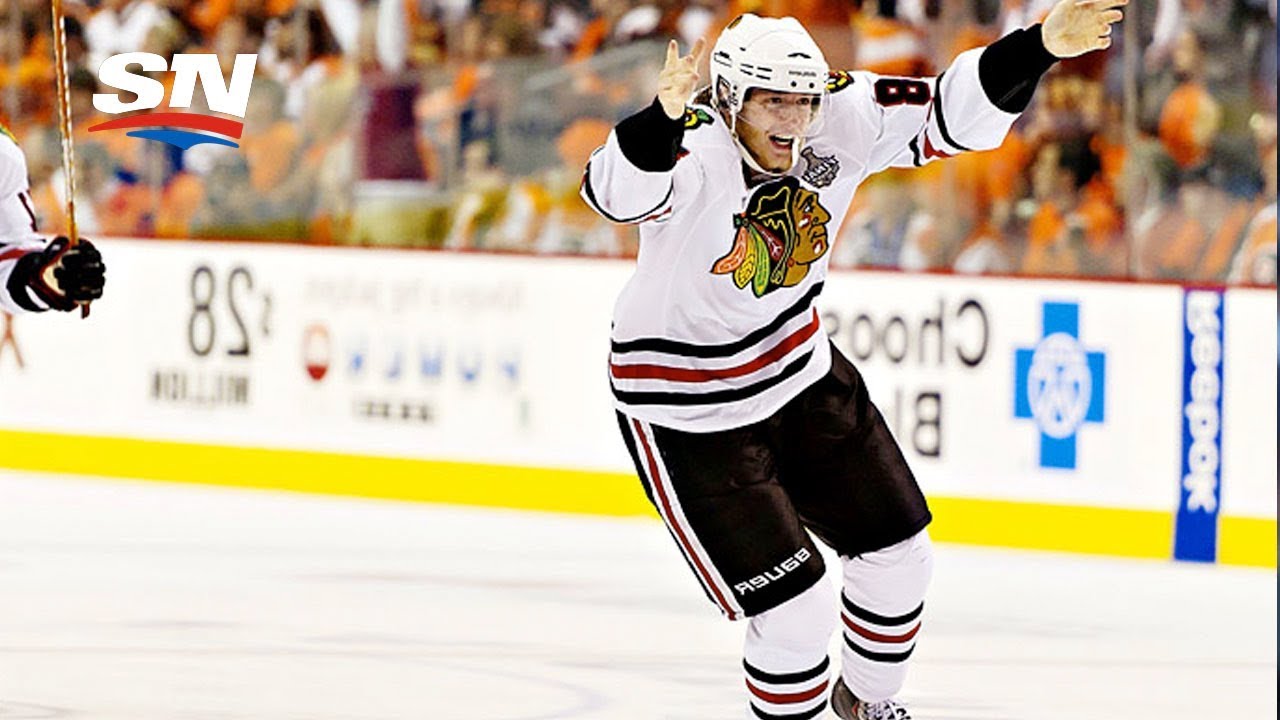
At 4:06 into overtime, Kane deked around defenseman Kimmo Timonen then, he shot from a sharp angle as he skated past the net the goal line. The puck slid by goalie Michael Leighton to get stuck in the back netting. No one but Kane seemed to see what happened to the puck. He said afterwards, “I knew it was in right away. I just kind of tried to take off and book it to the other end and try to start the celebration.” He sprinted away from the net raising his arms in celebration and then ditched his gloves and stick on the way. Still, it took a moment for officials to catch on that the goal was good. Calling the game, WGN-AM 720’s John Wiedeman exclaimed, “It’s in the back of the net! The Hawks have won the Stanley Cup! Blackhawk fans around the world, you’ve endured 49 years of frustration, but your patience has finally paid off!” Kane commented, “It was crazy. At the moment it’s just like, ‘We won the Stanley Cup’ and that’s all you’re thinking about. To play this game, this is the only thing I want to do in the world and be a part of moments like this”
With the 4-3 victory, Chicago’s goalie, Antti Niemi, had a team-record 16th postseason win. His teammate, Marian Hossa, had finally won the Stanley Cup, in his third consecutive season playing in the finals. Hossa had lost with the Penguins in 2008 and the Red Wings in 2009. He was so used to heartbreak that he double-checked with an official that they had won before beginning to celebrate. “I’m so glad. What a relief. Third time is the lucky charm. I got a Stanley Cup. What a feeling.” He was able to carry the Cup second.
Their captain, Jonathan Toews, then the youngest captain in the NHL at 22, hoisted the Cup first. “So many great things have happened for this team and this is the height of it all. It was awesome,” said Toews. “I just wanted to rip (the Cup) off that table and go give it to the boys. It’s everything it was hyped up to be.” He was named MVP (just as he had with the Olympic team) and received the Conn Smythe Trophy. “The most special thing is to be on the two special teams like that, but nothing compares to grinding every single day and every single week with a group of these guys for the city of Chicago. Winning a Stanley Cup, I don’t think compares to anything. To be at the center of that is the most amazing feeling and the most you can ask out of the game of hockey.” Toews had pretty much said it all.
Chicago’s coach, Joel Quenneville, added his own comments, “It’s just the greatest feeling. We had some good momentum and mostly positive and upsides all year long. From the start of the year to the end of the year, you can’t ask for a better bunch of guys to work with.”
Many of those guys went on to win the Cup for Chicago again in 2013 and 2015.
Additional Sources:
Mike Commito, Hockey 365: Daily Stories from the Ice(Toronto: Dundurn, 2018), kindle version.
“Champs!” Chicago Tribune, 10 June 2010, section 1, pp. 1 and 4.
“The Cup,” Chicago Tribune, 10 June 2010, section 2A.
In such a Canadian sport, it took until the 1983 Entry Draft for a U.S.-born and trained player to be picked first overall. At the Montreal Forum, on June 8, Brian Lawton became not only the first American but also the first (and only) U.S. high schooler drafted first. In fact, 1983 was the first time the top five draftees included three Americans. On a side note, this was the only entry draft in which a franchise did not participate, a result of the NHL blocking the St. Louis Blues from relocating to Saskatoon, Saskatchewan.
Lawton, born in New Brunswick, New Jersey, attended Mount Saint Charles Academy in Woonsocket, Rhode Island. The hockey team, the Mounties, had a 121-3-2 record and won the Rhode Island High School championship all four years he played. He scored 85 goals and 86 assists in the final two seasons, becoming the Rhode Island high school points leader in both. As a senior, he co-captained the team and won R.I. High School Athlete of Year from USA TODAY. Upon graduating (with a 3.2 GPA), he planned to play for Providence College but chose instead to turn pro.
Meanwhile, he also represented the U.S.A. In 1983, he skated with the national teams at both the IIHF World Junior Championship (in Leningrad) and the IIHF Men’s World Championships (in Tokyo).
With all of these accomplishments, the NHL Central Scouting Bureau ranked Lawton as the top prospect while the Hockey News draft preview issue ranked him fifth for the 1983 NHL Entry Draft. The Minnesota North Stars had first pick after a trade with Pittsburgh. Their general manager, Lou Nanne, claimed that he traded center Mike Eaves to Calgary to make room. Many teams were looking to cut deals for a shot at the top players, but Nanne did not think they were good enough offers. “’We were looking for a forward line or a lot of draft choices. We wanted a lopsided deal. You don’t make even deals when you’re picking No. 1.” Nanne then talked to young Lawton, who said, “I had talked to Mr. Nanne, and he had given me an indication he would take me if there wasn’t a trade.” Naturally, he felt it “a thrill” to be the first American chosen first.
Upon selecting Lawton, Nanne commented, “’We just picked the best player available.” Then he explained their plan for Lawton, “’We’ll bring him along slowly. We’ll use four lines all year and not use him too much at the beginning of the year. That should take the pressure off him and let him play.” Lawton initially had some concerns noting, ‘It will be tough but it’s probably better to get drafted by a strong team. A weaker team might be looking for a franchise player and that would have been a lot tougher on me.” The two of them also discussed whether Lawton would play for the U.S. Olympic team or join the North Stars right away. Nanne said, “He’s got plenty of time. I think the best thing would be for him to go to the Olympic camp and then come to ours. It’s fine with us, if he wants to come with us or go to the Olympic team and join us in February.” Lawton had not decided at that point but ultimately chose to play for Minnesota.
Lawton’s time with Minnesota did not go as either hoped. They only made it to the playoffs three times, and Lawton failed to produce as expected. He even played under three different jersey numbers. When he refused to report to their affiliate in the International Hockey League (IHL) in 1988, they assented to his wish to be traded. The New York Rangers took the trade but two months later shuffled him off to the Hartford Whalers. In late 1989, he was claimed on waivers by the Quebec Nordiques, with whom he played only 14 games. He moved, voluntarily, twice more in 1990, first to the Boston Bruins and then the Los Angeles Kings. Lawton signed with the San Jose Sharks in 1991, and although they traded him to New Jersey in 1993, he retired instead. He never wore the same number for more than one team. Lawton had played in a mere 483 NHL games, scoring 112 goals and 154 assists for 266 points.
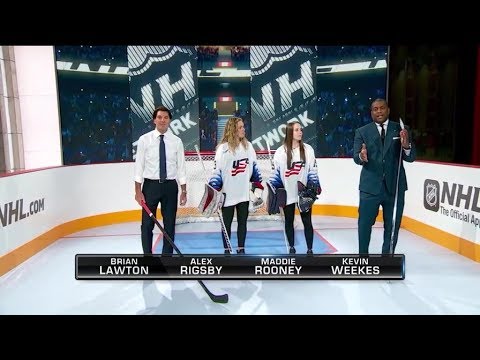
After his playing days, Lawton started his own company (Lawton Sport and Financial). By the time Octagon Athlete Representation bought it in 1998, he represented 12 NHL players. Lawton became the managing director leading the second-largest hockey agency in the NHL. Having had his eye on a management position in the NHL, Lawton served as acting general manager of the Tampa Bay Lightning from 2008 to 2010. He then became an on-air analyst for the NHL Network.
Considering Lawton’s career and the careers of his entry-draft class, Minnesota probably deeply regretted their draft pick. The top ten included three hall-of-famers and four other All-Stars. Draftees two through nine were: Sylvain Turgeon (Hartford), Pat LaFontaine (NY Islanders), Steve Yzerman (Detroit), Tom Barrasso (Buffalo), John MacLean (NJ), Russ Courtnall (Toronto), Andrew McBain (Winnipeg), and Cam Neely (Vancouver). Drafted in later rounds, the soon-to-be-superstars included Claude Lemieux, Bob Probert, Esa Tikkanen, Vladislav Tretiak, Viacheslav Fetisov, Dominik Hasek, and Sergei Makarov.
The 1983 draft seemed to favor the Americans. Lawton was the first of 58 drafted that year. In the first round alone, a record-setting five U.S.-born skaters were selected. The press stated that this was “a sign that U.S. hockey programs have reached maturity.” Within the top five, three Americans were taken. Following Lawton, the New York Islanders drafted Pat Lafontaine third overall and the Buffalo Sabres nabbed Tom Barrasso fifth. Thus far, 1983 held the only draft to feature three Americans in the first five. Since then, six more U.S. players have been drafted first overall – Mike Modano (1988), Bryan Berard (1995), Rick DiPietro (2000), Erik Johnson (2006), Patrick Kane (2007), and Auston Matthews (2016).
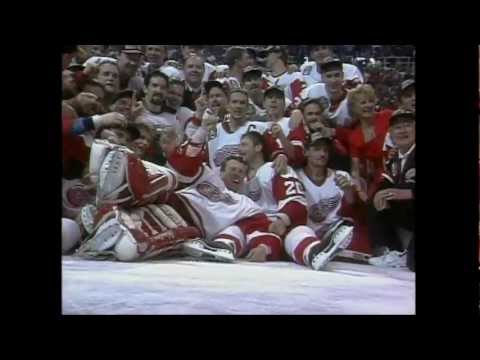
It had been 42 years since Detroit last took home the Stanley Cup. None of the Red Wings who played in the 1996-97 finals had even been born the last time the team won the championship. On June 7, 1997, they ushered in a new era after sweeping the Philadelphia Flyers. Upon winning, Captain Steve Yzerman exclaimed, “It’s unbelievable. It’s been a long time coming in Detroit.”
The last time Detroit won the Stanley Cup was back in 1955. Over the next decade, they lost five Stanley Cup finals, losing two of the final games on their own ice. They did not return to the finals until 1994-95, the season after Scotty Bowman took over as coach. In both seasons, the Red Wings received the Presidents’ Trophy. In 1995, they came so close to breaking their dry spell only to be swept by the New Jersey Devils.
Two years later, at the end of
the 1996-97 season, Detroit earned 94 points (38-26-18). That ranked them
second in the Central Division and fifth in the NHL. In the playoffs, they
easily sailed past the lower-ranked St. Louis Blues (4-2) and Mighty Ducks of
Anaheim (4-0). Then, Detroit defeated the Colorado Avalanche (4-2), winners of
the Presidents’ Trophy.
The first two games of the
Stanley Cup finals took place at Philadelphia. The Red Wings beat the Flyers 4-2
in both of them. When the series moved to Detroit’s Joe Louis Arena, the home
team crushed the visitors 6-1. To complete the sweep, the Red Wings won Game 4
with a score of 2-1.
For the game, Gordie and Colleen
Howe shared a private box with Commissioner Gary Bettman. The Howe couple’s son
Mark worked for the Red Wings as a scout. The elder Howe had skated with the
team the last time they won the championship. “This has been my life,”
commented Howe. “I just want to see it happen.”
What the crowd saw was Nicklas Lidstrom and Darren McCarty scoring the only goals in each of the first two periods. Eric Lindros prevented a shutout by scoring during the final 15 seconds. Goalie Mike Vernon had made 26 saves to that point. Throughout the playoffs, Vernon had a 16-4 record, a 1.79 goals-against average, and a .927 save percentage. The goalie everyone assumed would be benched instead earned the Conn Smythe Trophy as postseason MVP. Vernon told the press, “Every hockey player dreams of situations like this, but I never really thought it could happen. It’s been a lot of fun. When it’s said and done, I’ll look back and reflect and analyze how it all happened.”
When the series ended, Commissioner Bettman presented the Stanley Cup to Steve Yzerman, who had captained the team for 14 seasons. Yzerman had said, “It’s really the only thing I want to accomplish. I want to win a Stanley Cup like everybody else and play a few more years, and then I’ll be done.” With the ultimate prize in sight, he advised, “You always try and seize the moment, I guess, and make the most of it. Because you never know what will happen in the future.”
The Detroit Red Wings had won their eighth Stanley Cup championships. This one was the seventh for Coach Bowman, having previously led the Montreal Canadiens to five championships and the Pittsburgh Penguins to another. His mentor back in Montreal, Toe Blake, had set a record by coaching the Canadiens to eight Stanley Cup victories in 13 years. Bowman commented, “I don’t think anybody will be able to ever beat his records, eight Stanley Cups in 13 years, so I don’t think about trying to catch him or anything like that.” During Bowman’s tenure, Detroit would go on to win the next season as well and then another in 2002. Bowman surpassed Blake’s number of Stanley Cup victories but needed almost 30 years (instead of 13) to do it. The Red Wings most recently brought home the Cup in 2008.
Additional Source:
“Quest for the Cup,” Detroit Free Press, 8 June 1997, pp. 1C-7C.
Chuck Fletcher is in his first offseason as general manager of the Philadelphia Flyers, and he will look to make it an aggressive one to fill the needs of his team. This offseason is going to be an important one for the Flyers, who can best be described as inconsistent for the past few years. The team was cap strapped at one point, but former general manager Ron Hextall, helped the team out of cap hell, but he took a patient approach with his prospects, and made some bad decisions with signings.
The Flyers will have some money to play with under the cap and they will need it to make a few offers to free agents to improve this team heading into next season. If necessary, they also have the prospects on the defensive end to make a trade to fill some roles. Fletcher has some work to do and here is what should be on the Flyers offseason wish list.
1) Second Line Center/Top 9 Winger
Fletcher has already made a tree to try to secure the team’s second line center for next season. He acquired the rights to Kevin Hayes from the Winnipeg Jets for a 2019 5th round pick in the NHL Entry Draft. In making this move, the Flyers essentially now have exclusive rights to the unrestricted free agent until June 23 when other teams can start talking to him about a contract. There is no guarantee that Hayes and the Flyers will get a deal done, but Fletcher is taking the aggressive approach early this offseason. Hayes is coming off of one of his better seasons in the NHL, so he will be looking to get paid. The Flyers need to be realistic about the type of player he can be and not overpay him based on one really good season.
The top nine needs to be solidified with the addition of a solid winger, who can play both sides of the puck. The Flyers lack of depth scoring killed them early in the season, but after the kids got some playing time, they looked better. The team still could use another veteran player who can produce at a decent level and possibly contribute to the penalty kill. It would be nice to get a third line player, who won’t break the bank with his cap hit.
2) Experienced Puck Moving Defenseman
The Flyers are young on the blue line and if they keep this crop together, they’ll be good for a long time. They have had their struggles but have made strides in their game after seeing more playing time. Radko Gudas, who is more known for his physical play, was the Flyers’ most consistent defenseman last season. The Flyers are still going to have to add another puck moving defenseman, who can play top four minutes. Alain Vigneualt’s teams are known for pushing the pace and that starts with good breakouts from the team’s own end so another puck moving defenseman is an offseason must get.
There isn’t much out there on the free agent market to fit this bill in the way of big names. One name is Tyler Myers, but the Flyers need to stay away from him. He is a big body out there, but his game is declining and he is a slow skater. Myers could also be an expensive option and he is an older player. Another big name out there is Erik Karlsson, but he is too injury-prone for my liking so the Flyers should stay away from him as well.
3) Back Up Goaltender
The Flyers will likely rely on young goaltender Carter Hart a lot this season, but they still need a veteran that can back him up. The Flyers traded for Cam Talbot last season, but he didn’t see much playing time because the Flyers were out of the playoff race and Brian Elliott was playing good in goal. The problem with even attempting to re-sign Elliott to back up is that he is injury prone and is used to being in the starter’s net. Elliott would be a cheap, familiar option, but he has a history of hip problems the past few seasons and that’s not the best thing for a goalie.
Talbot would make sense to be the backup for the Flyers in a lot of ways. He is the goalie that Hart looked up to as a kid. Talbot also played two seasons (2013-2014 & 2014-2015) under Vigneault while he was the head coach of the New York Rangers. Talbot had his break out season under Vigneault, and then was promptly traded to the Edmonton Oilers that summer.
4) Do Not Trade Shayne Gostisbehere
The Flyers blue line is riddled with young, up-and-coming players, and Shayne Gostisbehere is one of them. Gostisbehere made his NHL debut during the 2015-16 season, and he finished second on the Calder Trophy race to 24-year-old Artemi Panarin. Ghost quickly showed off his offensive abilities and racked up 17 goals, 29 assists and 46 points in just 64 games played. He was a major reason for the team’s turnaround that season and making the postseason.
Yes, he has struggled in his game since that brilliant rookie season, but the Flyers haven’t exactly help his cause by switching his defensive partners every few games. There were even times that he was up in the press box as a healthy scratch when he shouldn’t have been. There have been glimpses of the complete player that he can be throughout his career, but he needs to develop better game-to-game consistency. He is still young and has the potential to be a solid top four defenseman so I hope the Flyers don’t trade him for a veteran player who can help now.
5) Sign Restricted Free Agents to Bridge Deals
The Flyers have some big name restricted free agents to try to get deals done with this summer. They include Ivan Provorov, Travis Konecny, Scott Laughton, Ryan Hartman, and Travis Sanheim. Laughton and Sanheim are coming off solid years and both players improved as the season went on. Hartman played about half a season with the Flyers and was decent. Provorov and Konecny were inconsistent last season, mainly due to some bad luck. Provorov was coming off of a shoulder injury and Konecny just couldn’t find the back of the net early in the season.
Even though Provorov was decent in his first two seasons in the NHL, he just wasn’t himself last season, and that’s why I think a bridge deal may be better for him, just to see if he returns to himself once it is not a contract year. I would let the other four kids prove themselves more before committing long-term to them and make sure that they develop into the kind of players that you want on the team.
Three goals during a single two-minute power play? Many critics pointed to that incident as the reason the NHL changed the rule regarding serving a minor penalty. Back in the day, all guilty parties had to remain in the penalty box for the full two minutes. As of June 1956, a player serving a minor penalty would be released immediately if the other team scored a goal. The NHL listed the date of the rule change as June 6, but the Montreal Gazette indicated that the rule change may have been passed on June 4. Either way, the same NHL meeting at Montreal established the rule that would go into effect at the beginning of the 1956-57 season and continues to stand to this day.
When the NHL Board of Governors
met for their 1956 annual meeting, the penalty rule was the biggest change they
made that year. Rule 26c stated: “If while a Team is ‘short-handed’ by one
or more minor or bench minor penalties, the opposing Team scores a goal, the
first of such penalties shall automatically terminate.” Lynn Patrick,
manager of Bruins, told the Montreal Gazette, “I’ll tell you the
reasoning behind the rule. If a player draws a minor penalty for doing
something illegal which may have saved a goal – like tripping or holding or
hooking – and while he is off the opposing team scores, there is no reason why he
shouldn’t be allowed to return to action immediately. The opposing team got the
goal he may have saved by doing the thing he did which led to the penalty.”
The new rule was favored by five
of the NHL clubs, represented by Tommy Ivan (Chicago), Hap Day (Toronto), Jack
Adams (Detroit), Muzz Patrick (NY), and Lynn Patrick (Boston). Only Montreal,
represented by Assistant General Manager Ken Reardon, opposed the rule change.
In a follow-up article, Frank Boucher (former Rangers coach), remarked, “The
new rule makes sense. We tried it out in the Western Hockey League last winter
and everybody liked it. I see it was reported that the Canadiens were outvoted
on the rule five to one. That’s wrong. They were outvoted 19 to one. The A.H.L.
and the W.H.L. and the other five N.H.L. clubs voted for it. Only the Canadiens
voted against it and that’s why it’s being said the rule was aimed at wrecking their
power play.”
At the time, the Montreal
Canadiens had the most success at scoring power play goals. During the previous
season, they had scored twice during each of eight power plays. Most
infamously, on November 5, 1955, the Boston Bruins led by 2-0 but incurred a
minor penalty. Within the span of 44 seconds of the two minutes, Canadiens
superstar Jean Beliveau scored the second-fastest hat trick in NHL history.
Many felt that the new penalty
rule was directed at hindering the Canadiens. Their coach, Toe Blake, went off
about the “that definitely is a rap at Montreal’s power play” saying, “I’ll put
it this way. It’s like asking baseball to put in a rule that says Mickey Mantle
can’t hit more than one homerun in one inning.” He continued, “If hockey keeps
putting in rules to check scoring, they’ll be asking scorers like Beliveau and
The Rocket and others to carry lead weights in their hip pockets as a handicap.
We’ll wind up with a handicapping system for hockey players like they have in
horseracing. Every time you win a game or score a goal, you’ll be asked to pick
up extra pounds.” Maurice “Rocket” Richard was more realistic when he
commented, “I think it’s all right. How many times do you think we scored more
than one goal while the other team was a man short? . . . Think of all the
times we didn’t score when we had a one-man advantage.”
Lynn Patrick, whose team lost thanks to Beliveau’s power play hat trick, justified, “Jack Adams advocated the new rule three years ago when Detroit had the best power play in hockey. He did so because he thought it would improve the game. There’s always resistance to suggested rule changes, but once they’re adopted the criticism stops because it becomes obvious that they did work an improvement.” He also squashed worries that crowds would not find power plays as exciting under this new rule. Sure, they were happy when it was their team doing the scoring, but they did not enjoy the experience of waiting out the penalty kills. Patrick gave an example. “We blew a lead and the hockey game because of a penalty and the people left the rink muttering against the Bruins. They didn’t get over it right away, either. We had about 4,000 fewer people at our next game than we could have had if it hadn’t happened.”
Because of the timing, the rule change was known as “The Canadiens Rule.” Indeed, Montreal scored ten fewer power-play goals with the new rule in place. However, the rest of the league saw an increase from 251 to 265 in power-play goals during that first season. While some have called for a return to the old method of sitting out the full two minutes, so far, the rule remains.
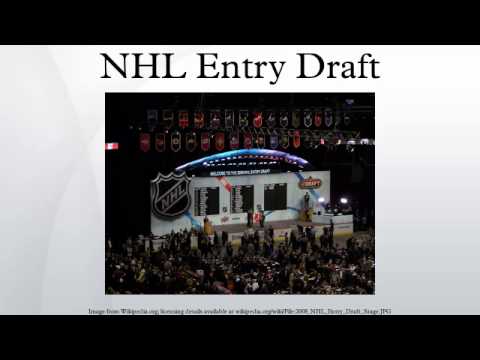
The NHL began in 1917, but it took until 1963, just five years before the NHL doubled in size, for the league to hold an amateur or entry draft. The six teams that existed back then took turns drafting amateur players for the first time at the Queen Elizabeth Hotel in Montreal on June 5, 1963.
Until that time, NHL teams
sponsored junior hockey clubs in order to reserve the rights to sign their
players. Each NHL team stocked up with many junior clubs to ensure they had many
young players to choose from. The other way of obtaining up-and-comers was
through a variety of contracts. The infamous C Form secured the player
indefinitely. That meant a player needed to be released to skate for anyone
else.
President Clarence Campbell was
one of those in the NHL that wanted to phase out this system and give all the
teams a fairer shot at new talent. During the 1962-63 season, he explained, “I’m
trying to work out a system whereby all amateur players who will attain their
17th birthdays before August of each year will be available for drafting by NHL
teams in the reverse order of the standing. We’re ultimately hopeful it will
produce a uniform opportunity for each team to acquire a star player.” Thus,
they developed an amateur draft.
Those eligible for the draft were 16-year-olds who would turn 17 between August 1, 1963 and July 31, 1964. The teams would not be allowed to set up contracts with the players until they turned 18. Then, they would have 72 hours to either sign them or add them to negotiation lists. Teens already playing for sponsored clubs could not be drafted.
The six NHL teams chose their selection
order in reverse order of the season’s standings. They would take turns
drafting players in the order of Montreal Canadiens, Detroit Red Wings, Boston
Bruins, New York Rangers, Chicago Black Hawks, and finally, the Toronto Maple
Leafs. Although the draft would have four rounds, Detroit and Chicago passed on
the final rounds as prospects dried up.
At the first amateur draft, with most eligible talent already locked into sponsored clubs, only 21 players were drafted. Every single one hailed from Canada. Only five draftees went on to careers in the NHL. Montreal scooped up one by selecting forward Garry Monahan first overall. He began playing for the Canadiens in 1967 and then played for four other teams during his 12-season NHL career. The second player drafted, by Detroit, was forward Peter Mahovlich, the only one from this draft to take home the Stanley Cup. Although he began his NHL career with Detroit during the 1965-66 season, Mahovlich’s four championships came with Montreal during the 1970s. His NHL career ended back at Detroit during the 1980-81 season. Both Monahan and Mahovlich played for the St. Michael’s Juveniles at the time of the draft.
The only draftee, besides Mahovlich, to play in an NHL All-Star Game was defenseman Jim McKenny. Toronto picked him late in the third round, and he played for them from 1965 until 1978, all but one of his NHL seasons. They also chose the other two who made the NHL, centers Walt McKechnie (first-round pick) and Gerry Meehan (fourth-round pick). McKechnie ended up starting his career with the Minnesota North Stars during the 1967-68 season and bounced around teams until 1983. Meehan did not even last the 1968-69 season he started with Toronto before he too shuffled around until the 1978-79 season.
Since the first amateur draft, a few things have changed. Over the 1967-68 season, the NHL phased out the sponsorship of junior clubs and eliminated the contract forms. Players could be drafted upon graduation from junior hockey or signed as a free agent after they turned 20. Until they came of age, the NHL would pay development fees. From the 1968 draft until 1994, the draft order was determined by the previous season’s standings. Since 1995, the draft order has been a lottery for the teams that missed the playoffs. In 1979, the name changed to the NHL Entry Draft so that it could include those who had been connected with the defunct World Hockey Association (WHA). The following year, the draft was open to public viewing, and after another four years, television entered the event.
Additional Sources:
Mike Commito, Hockey 365: Daily Stories from the Ice (Toronto: Dundurn, 2018), kindle edition.
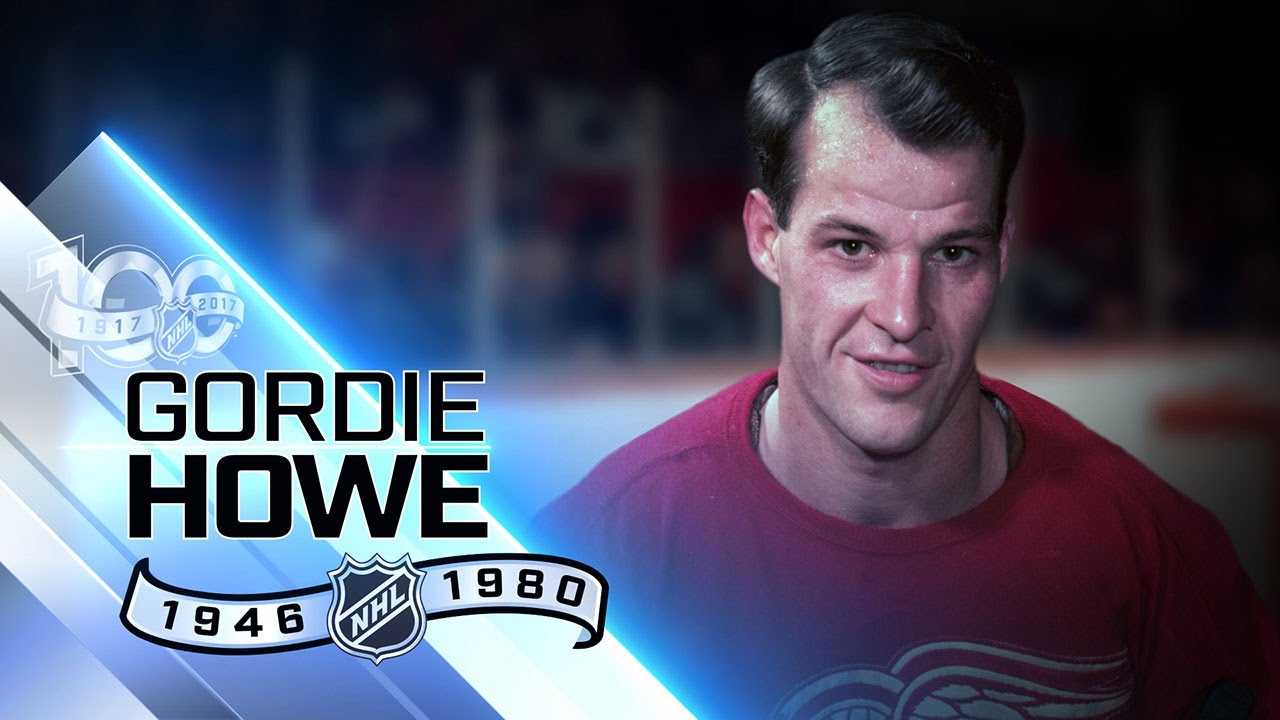
Gordie Howe, having already retired but then returned to the ice to skate with his two sons, often made the “dad” joke that he would not retire again until the usual retirement age, 65. As a professional athlete, it was amazing how close he came when he retired at 52. The legend had skated for 32 seasons that spanned five decades when he announced his retirement on June 4, 1980. Howe wrote in his autobiography, “When I say it out loud, it almost seems unreal that I played in five different decades. At the time, however, it felt completely natural. When winter arrived, it always just felt like time to put on my skates. It didn’t matter whether I was a kid or a grandfather, those feelings didn’t change.”
When Howe retired the first
time, in 1971 after 25 seasons, he meant to help run his team, the Detroit Red
Wings. They did not give him enough meaningful work, so after two years, he
signed with the Houston Aeros of the WHA. He wanted to play hockey with his
sons, Mark and Marty. The three of them then joined the New England Whalers in
1977. When the Hartford Whalers joined the NHL in 1979, Gordie Howe enjoyed one
final season back in the NHL.
He planned to take the summer of
1980 to decide whether he had enough energy to make it all the way through the
next season. However, he only needed until the beginning of June. Howe told the
Whalers management and his sons about a week before making the formal
announcement at the Hartford Hilton Hotel ballroom. His sons were surprised,
but as Howe told the media, “I feel I probably have another half year in me. I
think I could still enjoy and participate with the hockey club. But I feel the
idea is to leave something behind. I’d hate to play another year and find out
I’d left it short. I think I’m still damn good enough to play but in my mind I
think I might not make a whole year.”
Whalers officials praised Howe. According
to Jack Kelley, the director of hockey operations, “There is a certain sadness
knowing that Gordie will no longer be a player. We will never see a player like
Gordie in our time. He is a man for all seasons – 32 of them to be exact.”
Coach Don Blackburn stated, “It’s tough when you’re a coach and a fan. I never
thought I’d see the day I’d be coaching Gordie Howe. I’m just happy to have
been a part of the greatest sports story in history.” In summary, Bob Casey
(director of public relations) commented, “This is one of the biggest days in
history. It is truly the end of an era. Gordie Howe is the greatest player to
ever play the sport as well as a great human being. He is a credit to the game
and his family.”
All this led to the announcement
that Howe would take on a new role as the Whalers’ director of player
development. That would entail “on-ice coaching during training camp, scouting,
evaluation of both junior and NHL players and player acquisition.”
Even though he accepted the position,
Howe and his wife Colleen made comments about him focusing on Amway Corp. (short
for American Way), the second-largest and controversial direct sales
organization based at Ada, Michigan. Colleen explained, “Gordie just wants to
be a crown ambassador in Amway.” Howe felt Amway offered more freedom than
hockey, saying, “We’re very strong with Amway, you know. We’re totally involved
and have dedicated ourselves to that because that will give us professional
mobility (so we are) not nailed down to a specific job.”
Whatever Howe ended up doing,
his sons would miss him on the ice. Mark noted, “I’ll miss him. There’s no doubt
about that. We’ll miss him for the 30-40 games he’s playing well. When he plays
well he controls the whole game. That’s where we’ll miss him most.” Marty
wished everyone could have had a chance to skate with his father. “I’ll miss
him and the team will miss him. You always miss a good hockey player.”
Howe definitely had the longest professional hockey skating career. He still ranks third (behind Mark Messier and Jaromir Jagr) for most NHL games played, at 1,924. He actually played more regular-season games than them but fewer playoff games. However, Howe also played 497 games for the WHA. Were that included, Howe’s professional play would top the list.
“My career, though, feels like
much more than a collection of numbers,” Howe wrote. “It’s playing for the fans
and my teammates, and all of the friendships [my wife] Colleen and I made over
the years. It’s being part of something bigger than just myself. It’s being on
the ice, sweating and bleeding with the boys. It’s the wonderful life that
hockey allowed me to give my family. It’s a game I love.” On June 10, 2016, 36
years and about one week after his retirement, Howe passed away leaving his
skates behind for good.


 Prev
Prev