Kevyn Adams and the Buffalo Sabres have had an offseason to forget. The team underperformed again in a shortened 2020-2021 season. Granted, the Sabres missed their best player and captain, Jack Eichel, for most of the season. The team looked like it wasn’t even trying most nights and leaving the goalies to make the save. Ralph Krueger was fired late in the season, and Don Granato took over. Under Granato, players looked looser, more relaxed, and started to look like they were having fun again.
Eichel was out of the lineup due to an upper-body injury, and this was just the beginning of the soap opera. There were reports that Eichel needed to get neck surgery to improve, and the Sabres’ organization was not allowing him to get it. The surgery was not a common one among hockey players, and the team wasn’t sure how he would recover. The Sabres did have him on the trade block around the NHL Entry Draft, but the asking price was too high for most teams because of the injury situation. As of now, Eichel is still on the Sabres’ roster and it will be interesting to see how this saga turns out. Does he not report to camp, sit out, or get traded? Only time will tell.
Adams and the Pegulas decided to remove the interim tag from the head coach and sign Don Granato to a three-year deal. This was the right move for the team. Granato seemed to let the players play and keep it simple after he took over the bench last season. He used players right and put them in situations to succeed. The team will likely be on a bit of the younger side this season, and I think Granato could help make them better, even though they’ll be in the hunt to win the NHL Lottery again this season.
Adams started the offseason with Will Borgen going to the Seattle Kraken in the NHL Expansion Draft. He quickly bounced back and managed to pull off a good trade before the NHL Entry Draft. The Sabres traded defenseman Rasmus Ristolainen to the Philadelphia Flyers for the 2021 13th overall pick in the 2021 Draft, a third-round pick in the 2023 Draft, and defenseman Robert Hagg. The trade was a good one by Adams, and the Flyers overpaid for Ristolainen. There were probably other teams looking for Ristolainen’s services, which could have played a part in the haul. Hagg is a serviceable third-pairing defenseman who can kill penalties and doesn’t shy away from playing a physical game.
Drake Caggiula signed a one-year, $750,000 contract extension for the 2021-2022 season. Caggiula played 11 games with the Sabres last season and had two goals, one assist, and three points. The left winger has never played a full season in the NHL and will likely be a bottom-six depth player for the Sabres. Then again with the way this roster is shaping up, he could very well be a top-six player. It was a cost-effective deal for the Sabres, and Caggiula will have a chance to prove himself while with the team.
The Sabres lost players in free agency like Linus Ullmark, Jake McCabe, and Carter Hutton. Sabres fans would probably agree that it was time for these guys to go since the team didn’t turn around with them on the roster, but they were better than anything brought in by the Sabres brass in free agency. Adams and the Sabres couldn’t come to terms, and by the time Ullmark hit free agency, there wasn’t much left in the goalie market, so the team wound up signing Craig Anderson and Aaron Dell. There wasn’t an upgrade made in goal for the team this offseason.
Will Butcher and Mark Pysyk were the notable defensemen that were acquired in the offseason. Butcher was acquired in a trade with the New Jersey Devils, and Pysyk signed a free agency deal. Butcher had a decent first three seasons in the NHL but only played 23 games last season and became expendable after the Devils signed Dougie Hamilton to a substantial free agency deal. Butcher is a mobile defenseman who can move the puck, play top-four minutes and contribute offensively. Pysyk will likely play bottom-pairing minutes or be the oft-scratched seventh defenseman.
Adams was able to re-sign some restricted free agents to decent bridge deals. Brandon Davidson signed a new one-year deal worth $750,000. Forward Rasmus Asplund got a new two-year deal worth $825,000 per season. He had seven goals, four assists, and 11 points in 28 games last season. Casey Fitzgerald, the 24-year-old defenseman, signed a new two-year contract with a $750,000 cap hit per season. Fitzgerald has yet to make his NHL Debut, but has a good shot to do that this season. Adams re-signed Henri Jokiharju and forward Casey Mittelstadt to new three-year deals with a $2.5 million cap hit per season.
The Sabres did manage to get something for forward Sam Reinhart, who was a restricted free agent and due a big payday. It is just like the Sabres to trade a guy who has scored 20-plus goals in five of his last six seasons played because he was due a pay raise. In Adams’ defense, he was able to get a goalie prospect and a first-round 2022 Draft pick for Reinhart. I think that the Sabres will miss the goal-scoring and his ability to play top-six minutes. Reinhart wasn’t the best 200-foot player, but his ability to find the back of the net will be missed.
The Sabres still do not have defenseman Rasmus Dahlin under contract for the 2021-22 season. He is a restricted free agent and could opt to sit out until he has a new contract. The 21-year-old had a good rookie season under Phil Housley including 44 points in 82 games. His second season, first with Ralph Krueger, his numbers dipped a bit, but he was a bit better defensively. Last season was a strange one. Dahlin’s game was a complete disaster. Adams needs to get a deal done before camp starts because the last thing you want is another potential distraction off the ice for this team.
There are two reasons why the Sabres received a D-, and not a F for their final offseason grade. The first reason was the big haul that Adams managed to bring in for Ristolainen. The other reason was signing Don Granato to a new contract, and removing the interim head coach tag from last season. Once he took over behind the bench, the team played looser and were actually making some games competitive.
The Philadelphia Flyers general manager, Chuck Fletcher, has had one of the busier offseasons around the NHL. There was some work to be done after a disappointing season last year. He worked both the trade and free agency angles to fill the team’s needs. Those needs included a top-pairing defenseman, a second-pairing defenseman, some penalty killers, and veterans to help in the locker room. Fletcher had players in mind to fill those holes and started working the phones to acquire those players.
There were a few players on the roster who were restricted free agents and needed new contracts. The team was going to have to part with some players for trade and cap space purposes. While trying to improve the team, there was also the daunting task of figuring out who would be left unprotected for the Seattle Kraken Expansion Draft. Somehow, Fletcher managed to get things done and improve the roster for the upcoming season.
The first splash of the offseason for Fletcher came with the acquisition of defenseman Ryan Ellis from the Nashville Predators in a three-team trade. The Flyers lost Philippe Myers and Nolan Patrick, two young players with potential, in the deal. Myers and Patrick both struggled last season, a change of scenery could be a good thing for both players. A team needs to give up pieces to get a top-pairing defenseman who can play in all situations. Ellis has six seasons left on his contract, which has a $6.25 million cap hit per season. He is 30 years old, but defensemen were getting paid this offseason, and by paid, I mean between $8-$9 million per season over seven to eight seasons. Ellis will likely play beside Ivan Provorov, on the top-pairing, and hopefully, bring steadiness and leadership as Matt Niskanen did a few seasons ago.
The NHL froze rosters so teams could decide on what players were left unprotected for the Kraken Expansion Draft, so Fletcher’s next move had to wait a few days. In the meantime, the team left some big names and contracts unprotected including Shayne Gostisbehere and Jakub Voracek. The Kraken decided to take Carsen Twarynski off the Flyers’ hands instead of going for a big-name, veteran player. Dave Hakstol, the Kraken head coach, was familiar with Twarynski from being the Flyers head coach. Since the Kraken didn’t take the bait, Fletcher went to work to clear cap space.
They say it takes two to tango, so Fletcher found a partner and cleared more cap space. He traded Shayne Gostisbehere along with two 2022 draft picks to the Arizona Coyotes for no return. He gained $4.5 million in cap space over the next two seasons. This was an overpayment, but Fletcher had to sweeten the pot for a team to take a chance on the defenseman. Gostisbehere hit the waiver wire last season, and not one of the other 30 teams claimed him. Injuries and the defensive depth led to the team being able to make the trade.
Next on the agenda was to find a defenseman who could play top-four minutes. The Buffalo Sabres were willing to part with Rasmus Ristolainen, and Fletcher took the bait. He overpaid to get Ristolainen, giving up the 13th overall pick in the 2021 Entry Draft, a 2023 second-round pick, and defenseman Robert Hagg. Ristolainen played for a horrible Sabres team, and was put in situations he should never have been in, but his underlying stats were worth what the Flyers gave up for him. He only has one year left on his contract with a lot to prove. This is one of those trades that I’m willing to take a wait-and-see approach.
There was still more cap space to shed, and that came from Jakub Voracek’s contract going to the Columbus Blue Jackets in exchange for Cam Atkinson. Voracek did a lot for the Flyers the past decade, but the team never got him and Claude Giroux much support. The Blue Jackets are going in a different direction and have lost players the past few offseasons. It was a swap of veteran players that gave the Flyers more cap space and flexibility down the line. Atkinson will help the Flyers penalty kill and is familiar with Kevin Hayes from his college days. This was another good trade by Fletcher since it brings cap flexibility, a veteran leader, and a shorthanded threat. Atkinson has scored 15 or more goals in seven of the last eight seasons played.
In free agency, Fletcher addressed veteran leadership, bottom pairing defenseman, the penalty kill, backup goalie, and got some roster depth. The Flyers signed Keith Yandle, Nate Thompson, Martin Jones, and Derick Brassard to one-year contracts. Yandle, Thompson, and Brassard are all making under $900,000 for the year. I can live with those contracts, but if Morgan Frost or Cam York earns a roster spot out of camp, he better be playing over the vet. Martin Jones, at $2 million after the past three seasons he’s had, worries me. Hart should bounce back and the defense is improved, but I’m not sure I trust Jones in net for 30 to 35 games this season.
There was some in-house business to handle with res-signing some of the restricted and unrestricted free agents to new contracts. Samuel Morin signed a new one-year deal that he earned after battling back from serious injuries the past few seasons. Carter Hart got a new three-year contract with a $3.979 million cap hit per season, a substantial raise over his entry-level contract. Travis Sanheim and the Flyers avoided arbitration by agreeing to terms on a new two-year contract with a $4.675 million cap hit. Sean Couturier signed a new eight-year extension with a cap hit of $7.75 million per season.
I’m giving Fletcher an A- for his offseason moves. If there weren’t some head-scratching moves like giving up so much for Ristolainen and signing Jones, then the Flyers offseason grade would have been an A. He saw the weaknesses on this team and set out to fill those holes to improve the team. He is banking on some players having bounce-back seasons, but the fact that he signed Couturier to a new contract and the cap hit was under $8 million per season was another reason for the grade that Flyers received for the offseason moves.
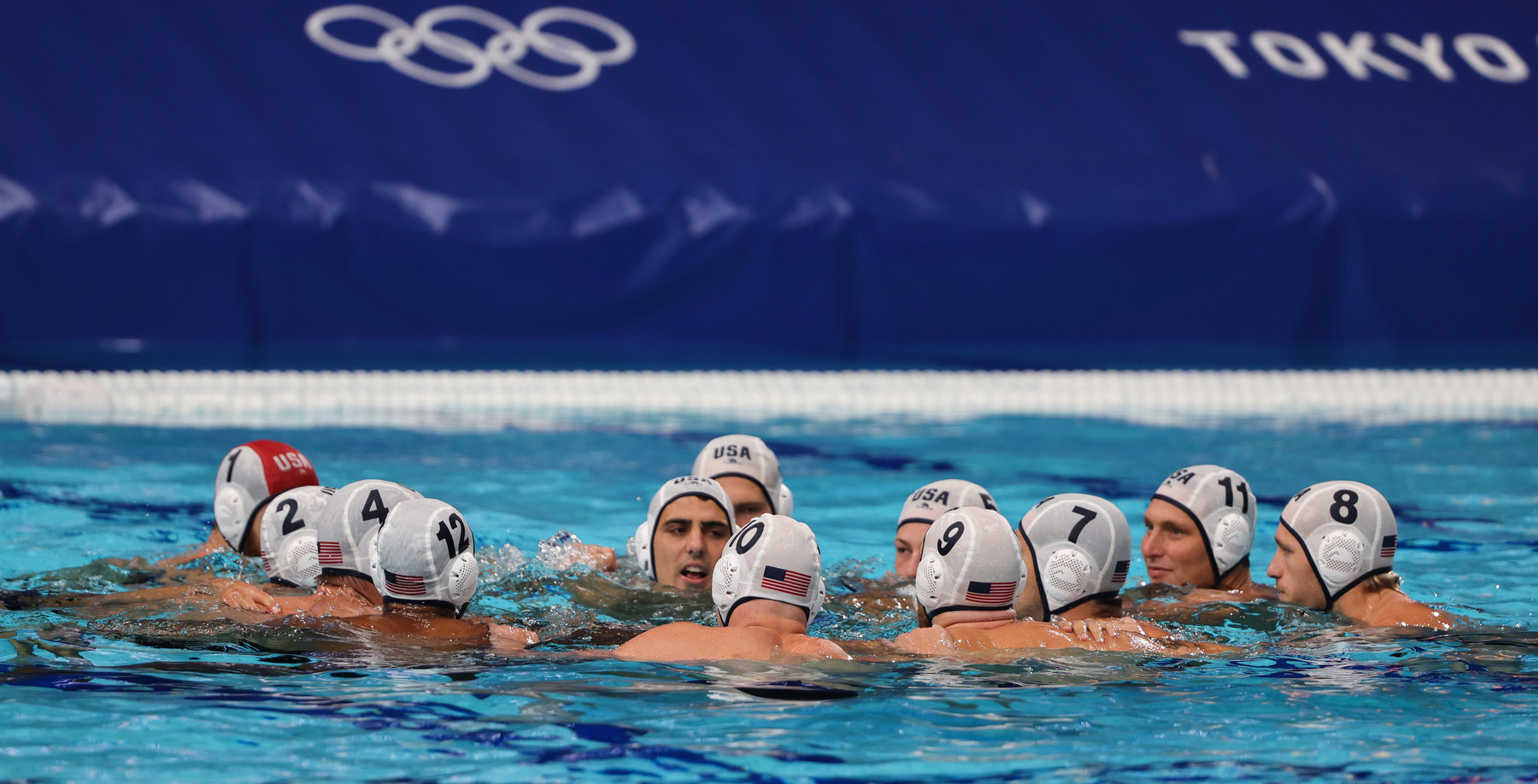
On Sunday morning, August 8, the USA Men’s Water Polo Team took on the men from Croatia to determine their final finish in the Tokyo 2020 Olympics. They wanted to come in higher than they had in Rio in 2016, and by making it to the quarterfinals they did. In Rio they took 10th place. At Tokyo the Americans were eliminated by Spain in the quarterfinals on August 4th in a tough game. They went on to defeat Italy in their first classification game on August 6th.
It definitely wasn’t the game that the USA team had hoped for. Despite getting on the board first with a couple of goals from Johnny Hooper and Max Irving, Croatia continued to battle. They scored their first goal at 5:45 of the first. Alex Bowen put USA up by two goals at 5:04. Croatia responded a minute later getting back within one.
The second quarter saw Croatia tie the game at 7:23 while on the power play after Luca Cupido was sent off. From that point on, it was the Americans who were having to play catch up, which they never did. By the end of the half, Croatia was leading 6-5. During the third quarter the Croatians put in four goals as compared to the two that USA managed, giving Croatia a 10-7 lead.
Team USA certainly wasn’t going away. And there was a question, certainly by some of the team and USA’s head coach Dejan Udovicic, on a couple of the calls that went against the United States. Coach Udovicic was quite vocal, and it earned him a yellow card. Even Drew Holland, who was in net for the Americans, was commenting to the officials about a couple of the calls.
In addition to what appeared to be many exclusions to both teams—including a couple of double exclusions—there were three penalty throws awarded: two for Croatia and one for USA.
As the clock ticked down it was not to go Team USA’s way. Croatia won with a score of 14-11 to be awarded the fifth place, while USA found themselves finishing in sixth place. This was still a four-slot improvement over their games in Rio, but there was disappointment on some of their faces.
Because there are no professional water polo teams or leagues in the United States, many of Team USA’s men who have continued to play beyond college have done so in Europe. Playing in the Olympics pits them against some of their teammates and when some of the Americans haven’t been playing with the Croatians, they seem to find themselves up against them frequently during international competitions.
“Oh, every single one of them. I mean, we’ve played Croatia a lot. We’ve matched up with them a lot in the past. They were in our bracket in 2019 for World Championships. We were there in early February and we had like a two-game match with them before. I played with like four of the guys that are on that team—Lovre [Milos], [Luka] Bukic ,[Ivan] Marcelic, and [Josip] Vrlic. I played with all four of them and Alex Obert played with I think four or five of them. [Ben] Hallock played with one of them. I think there’s like three of them that we haven’t played with. But we’ve played against all of them so many times. Outside the water they’re good friends. Inside the water we get in a tussel and we talk sh%t. It’s a good friendship.”
These two teams will certainly see each other sooner than the three years until Paris 2024, and it will be interesting to see how the teams look over the next few years. Both teams had a player in Tokyo representing his country in his fifth Olympics. For the United States it was Jesse Smith and for Croatia it was Javier Garcia Gadea.
Note: If you love the photo, be sure to check out more by visiting Jeff Cable’s Photography Blog here.
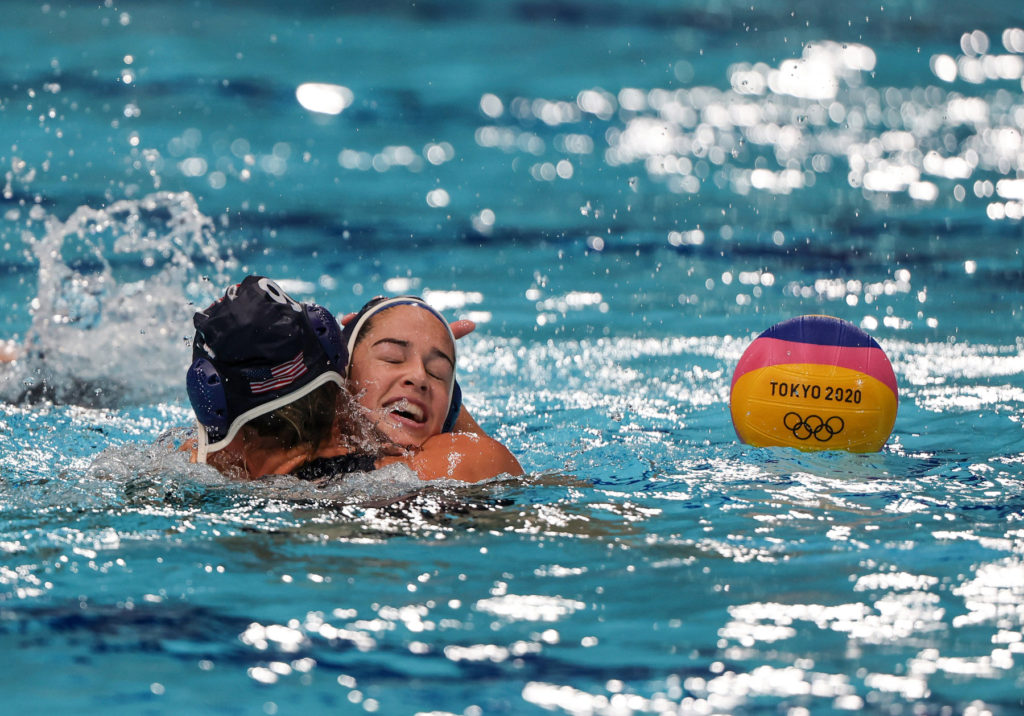
There was something different about Saturday’s game between the USA Women’s Water Polo Team when they took on the team from Spain. Yes, it was a medal game, which always feels a little different, but there was a mood among the Americans that was different. There was a confidence that was palpable.
The women were much more animated and vocal throughout the entire game. Every blocked shot, every save by Ashleigh Johnson, the goalkeeper, every goal they scored, those on the bench were cheering and clapping.
There wasn’t a point in the game in which the USA was trailing. In fact the closest Spain got to the Americans was a three-goal gap—the first time at 3:24 of the second quarter, when the score was 6-3, and the second time at 0:38 of that same period, when the score was 7-4. Once the third quarter began, the women playing for the USA were scoring even more than they already had.
They seemed to be seeing every shot that might go in—blocking most of them. Johnson was having one of the best games of the tournament and was herself making incredible saves. The team as an entity was in harmony and it showed from the start of the first quarter to the end of the game.
“I think one thing that our team has been really focused on, not only in this Olympics but through this quad plus year of this journey is to enjoy the moment as much as possible. I think, you know, with the pandemic, the postponement, so many challenges, so much adversity, so many setbacks that our team has gone through individually and as a group, and we kept coming out of those stronger. And always stronger together utilizing what the team is for, is to be stronger together and create that unit. And today, I think, that was just the show of who we are as a team, no matter the adversity that’s thrown our way, we stick together as a team, and we rise up and we thrive in those moments. It was really amazing to see the balance and full team effort. You could see it from every single player on our team. That’s what it’s about. It’s about the unit that you build, the unit you create, and that’s really where the magic lies and I’m really grateful to be a part of it and to have been able to show the world that magic that we’ve created as a circle of our unit,” said captain Maggie Steffens.
They did look strong and not just physically. It was clear that they all had their focus on the game and they were there for each other. They had worked hard in each game up to that point earning their place in the ultimate game. They were going to guarantee that they deserved that medal when they won.
Many have made a point of bringing up that the USA women’s team has now won the gold medal in three consecutive Olympics; 2012 in London (where the beat Spain, coincidentally), 2016 in Rio and now 2020 in Tokyo. There were many questions about the “three-peat” but their head coach, Adam Krikorian, tended to shut that talk down.
““To my point earlier, I think what I was trying to say was, I know there’s going to be a lot of talk about ‘This is three gold medals’ and so on and so forth and that’s great for the press and all of you, but the reality is this was the very first gold medal for this team,” he said.
The winning of the gold medal game for Team USA wasn’t something that they just woke up one day and said, “Let’s play water polo and win a medal.” These women have been training since they were young girls. Some, who have graduated college, have had to move overseas to join European teams because there is no professional league in the United States. These athletes and their families along with all the coaches, trainers, and other staff have put in so much time and effort to get the team to where it was on Saturday in Tokyo; it somehow just couldn’t have gone any other way.
Note: If you love the photo, be sure to check out more by visiting Jeff Cable’s Photography Blog here.
After losing to Spain in the quarterfinals, the USA Men’s Water Polo Team were set up to take on Italy in a classification game to determine their overall placement in the tournament. Team USA fell to Italy late in their preliminary round game on July 29.
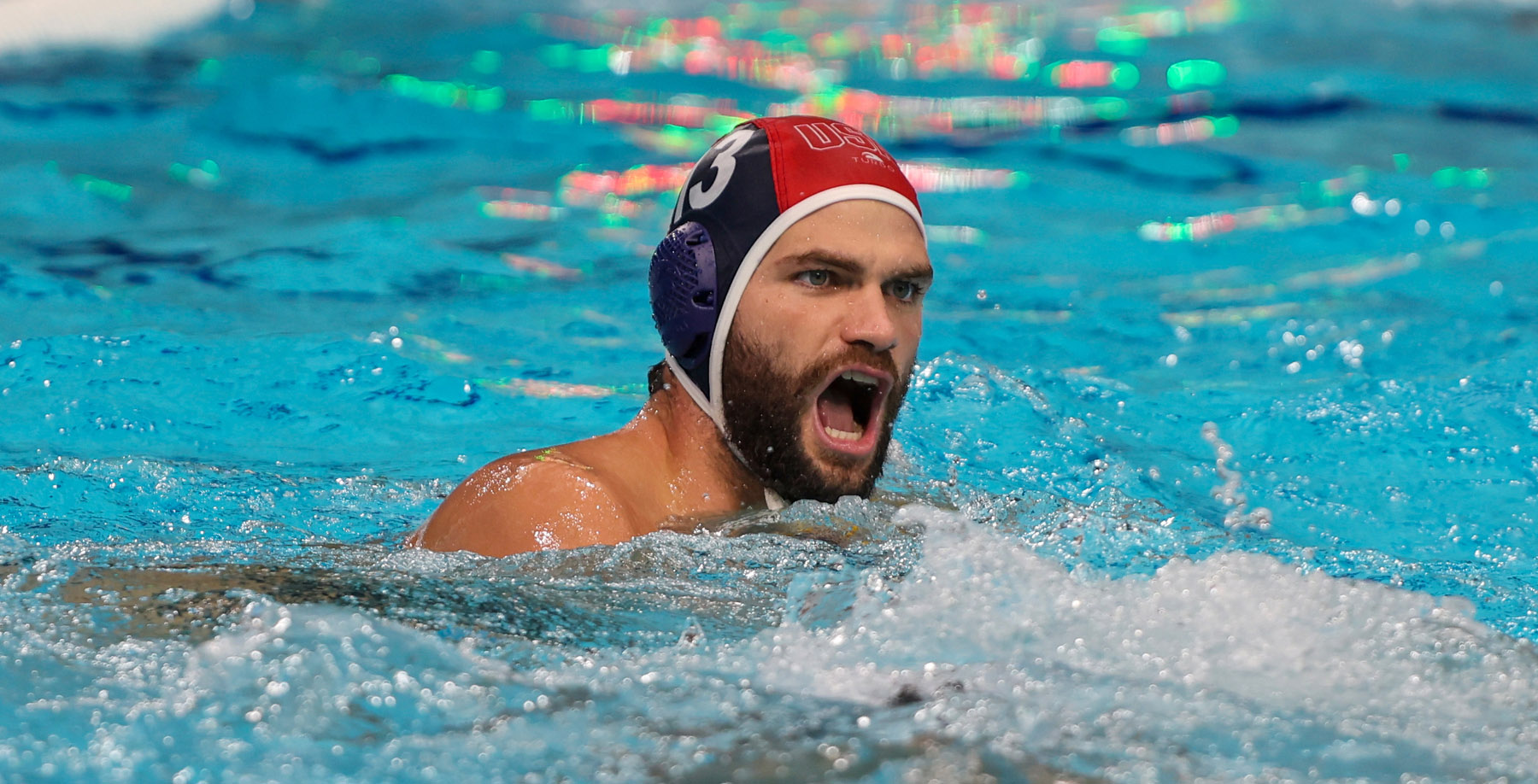
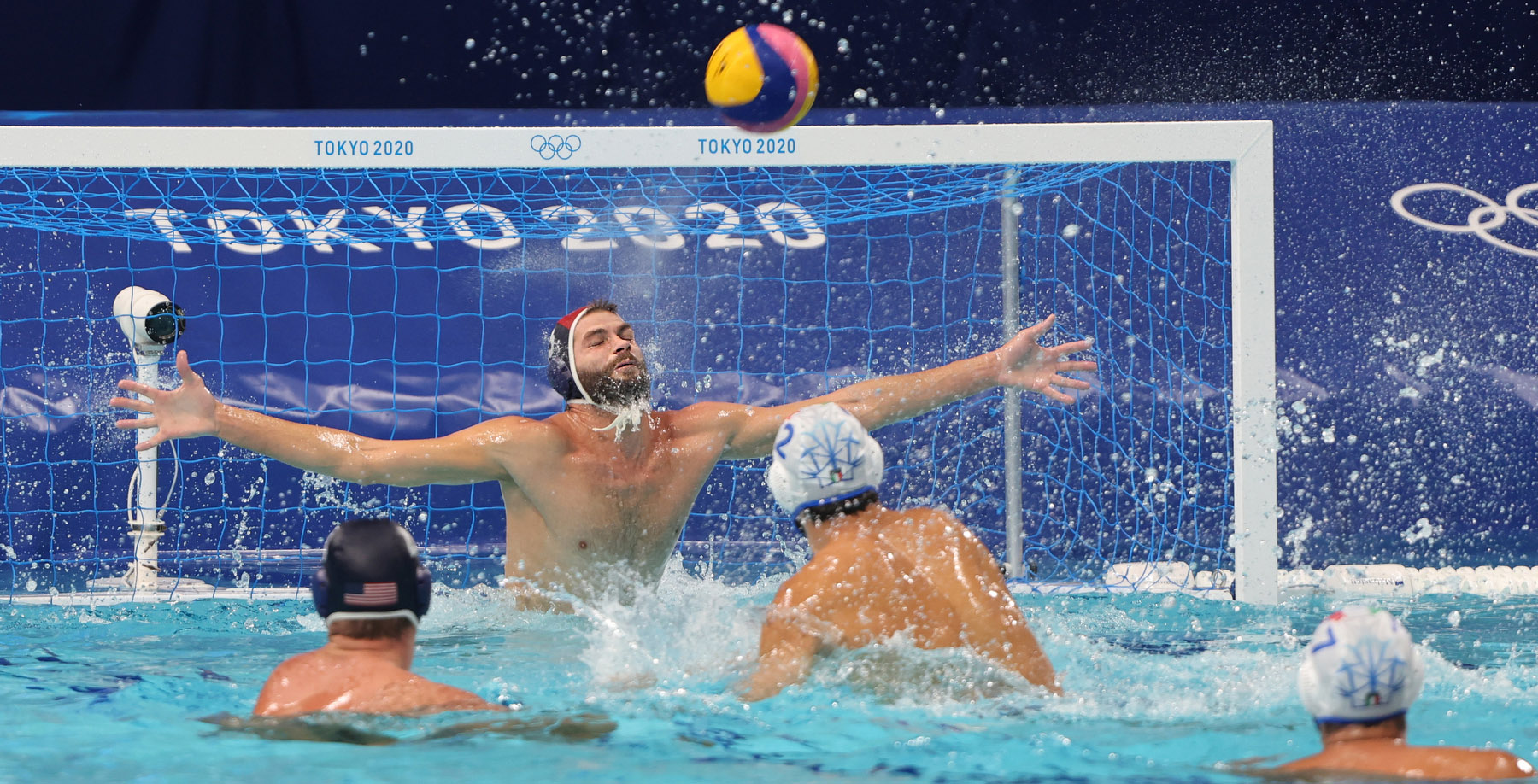
Though the game started slowly, the Americans seemed to be in a different head space. And it was perhaps that space they were in that was keeping Italy from scoring. Goalkeeper Drew Holland was an impressive 60% save percentage by the end of the game and he was determined to save everything he could. At one point in the game, it was his face that denied the ball from going in (see photo above). The speed of that ball, it most definitely had to hurt, but when he realized it hadn’t gone in, the look on his face and his yell of joy showed that he would do that again if it meant keeping the ball out. He also made a huge save on a penalty shot at 2:10 of the final quarter when the teams were tied and it was likely that the next team to score would win the game.
“It feels really good to win. We’re fighting for fifth place. Our coach said that that’s our new medal. That’s our target. We can’t control the past but we’re all doing our best to pick each other up and focus and play sports. You know, that’s why we’re here, so we’re thrilled to have the opportunity to compete. And that was a really good team. Our guys played great,” said Jesse Smith, captain of the USA Men’s team.
The attitude described by Smith shows that each game is important. And each game offers experience, especially for the new players on the team.
“It’s a huge win for this young team…to beat the World Champions at the Olympic Games is an important thing. I can’t be more proud how we react after the tough loss against Spain. There is rumors that the system is not good because the games between 5th and 8th place should not be played out. Everyone has got their own opinion, but from our side, for my team every game on this high level stage is important for us. We treat this game as a final, we treat every game as a final because we don’t have enough games as the Europeans have. From my point of view this (game) is a great reaction from our team. We just need to prepare for the game against Croatia,” said head coach Dejan Udovicic.
For Johnny Hooper his shot on Friday with just 1:35 remaining in the game displayed Coach Udovicic’s thoughts in action. The play was drawn up during the time out just as the clock showed 1:48 remaining in the game and Team USA was going on the power play. The play was going to rely on Hooper to put the ball in and was a play that he had struggled with throughout the tournament.
“A few times I actually failed at that shot this tournament and I can say I learned from my mistakes during this tournament. It’s an Olympic Games, everyone comes with their A game so if you don’t shoot it almost perfectly, it’s not going in. And I missed it a few times in big games this tournament and when that play was drawn up, I almost tried to make it impossible to mess up on that. Gave it everything I’ve got,” said Hooper
While Hooper’s shot gave the Americans the win, he plays a critical role in each quarter of the game. He is Team USA’s primary sprinter when it comes to the start of each quarter.
“I sprint four quarters for our team. Not a lot of guys in different countries do that, so I definitely have a little bit of a different routine or ritual during practice and before games. I think the start, the start is by far the most important part of any sprint for any game. At this level, when you’re starting at, like, basically dead water, which is you’re starting from nothing, it’s all about being fair but also, you’re deceptive. I think that every country, every person who’s sprinting for the ball has their own way of doing it. For me, the most important part is my start, by far,” Hooper said.
And it must work for him because in the tournament he leads the sprinters up to this point in the matches, having won 14 of the 17 he has taken for 82%. Team USA will take on Team Croatia to determine who is the fifth-place team and who is the sixth-place team. The Americans certainly are aiming to take the win in the game which will be played Saturday, August 8th at 11:00am JST.
Note: If you love the photo, be sure to check out more by visiting Jeff Cable’s Photography Blog here.
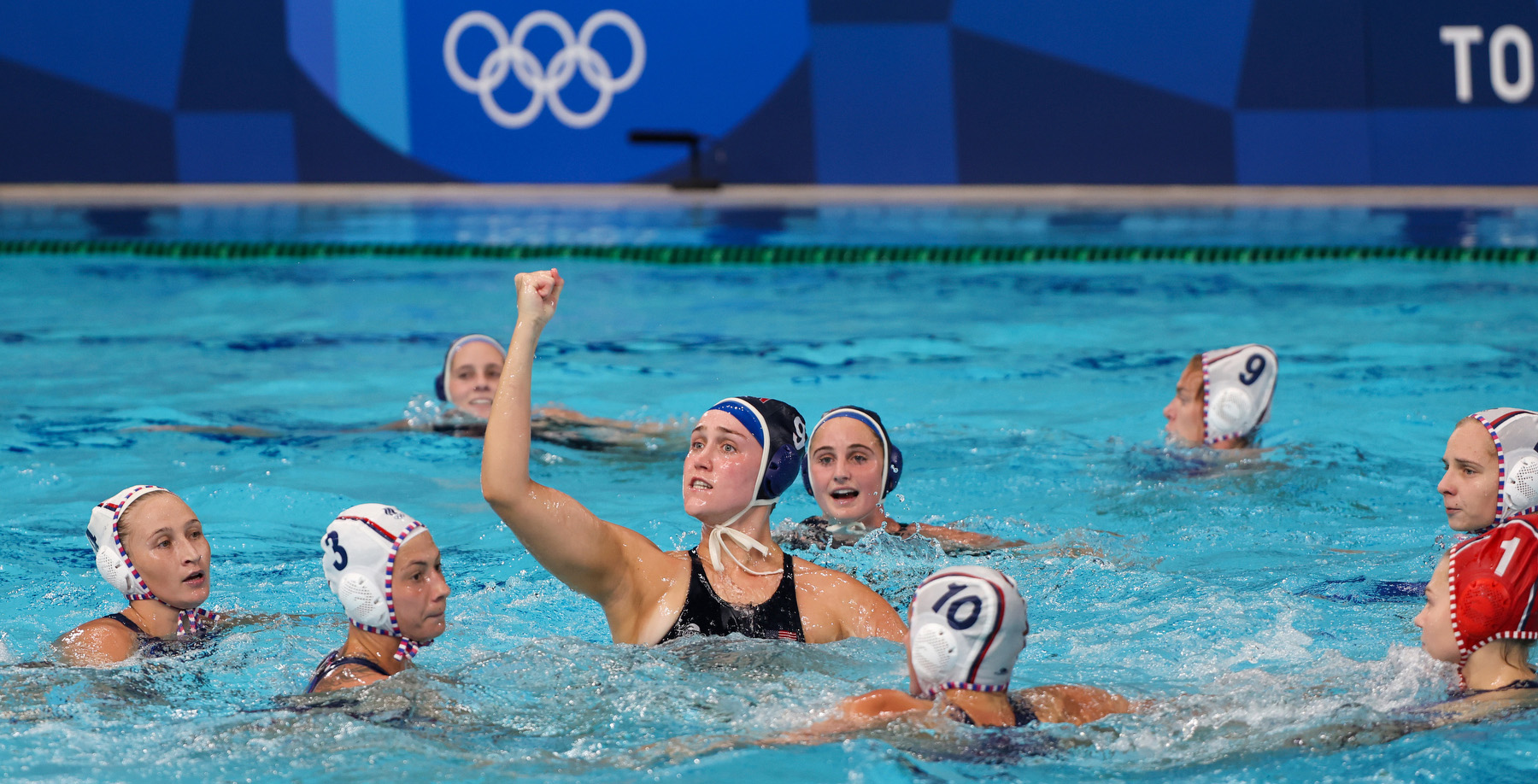
There are probably many who were expecting the USA Women’s Water Polo Team to get to the gold medal game in Tokyo. The women on the team are not among them. They truly take each game as it comes, and in order to reach that final game, they first had to eliminate the Russian Olympic Committee’s (ROC) women’s team. The two teams had already met in competition during the preliminary round, a game in which Team USA won 18-5.
As the game got underway, it was clear that the ROC women were coming out strong and hard and it wasn’t long before they were on the scoreboard with their first goal of the game at 7:11 of the first quarter. Team USA responded, when Rachel Fattal scored on an extra player shot. The Americans then took the lead at 5:43 from a power play goal by captain Maggie Steffens. The Russians were not phased and tied things up at 4:45 before taking the lead at 3:03 and maintaining the 3-2 lead through the end of the first quarter.
The second quarter started a little slower, with posts and goalkeepers getting in the way of attempts for both teams through almost the first half of the quarter. At 4:24, tbe ROC team got a little breathing room, when they scored their fourth goal of the game. A minute later they were leading by two goals.
Despite being down by two goals, there was no panic on the part of the Americans, who just kept working. They cut the lead in half ten seconds after the Russians got their fifth, when Stephania Haralabidis put home a penalty shot.
It looked like the Russians were pulling away, when they kept going up two goals, only to find the Americans cutting that lead in half—always working their way back.
“I think the experience really helps. Like we go down and, I mean, we probably weren’t up until, I don’t even know when, later in the game. It’s being able to look at each other and know that it’s going to be okay. We’re going to keep pushing. We’re going to keep working and, you know, things weren’t really going great for us in the beginning. And to know that we’re going to get our looks, we’re going to get our opportunities and we’re going to eventually put them away as long as we keep working, keep pushing and just the faith that you have in each other is awesome and you get that every day from the grind,” said Fattal.
And then with one second remaining in the second period, Melissa Seidemann gave Team USA an important goal to go into the halftime break, with a score of 7-6 in favor of the Russians.
As the third quarter got underway, it was clear that the women playing for the United States had refocused and were back on their game and taking no prisoners. Steffens tied the game at 7:19. The Russians once again took the lead at 6:46 with an extra player shot, but that was the last time they lead in the game. Team USA would tie the game at eight goals each at 6:22 and then go on to add three more goals before the quarter was done as opposed to the one additional goal from the Russian team.
Russia opened up the scoring in the fourth quarter, managing to tie the game at 11 goals at 5:30 of the quarter. However, the Americans kept playing as they had and went on to add four more goals in the last 5:05 of the game.
Maddie Musselman, who had already scored one goal in the second and two goals in the third, went on to add two more as part of those four goals Team USA scored in the fourth quarter. She lead the team in goals, with five, in the game.
“Something that’s really special about Maddie is she can really do it all. A lot of teams think of her as a sharpshooter, as do we. She clearly was that today, which we needed, but she’s one of our best defenders. She’s the one getting lots of fields, lots of blocks. She can drive. She draws a lot of attention, and she is somebody that is huge for our team and you saw she got some big goals for us today, some big stops, really lit a fire as a team that we needed. All I’ll say is I’m very grateful that she’s my teammate, ‘cause she’s special,” said Alys Williams.
When the clock ticked down Team USA was heading toward the Gold Medal game where they will take on the team from Spain on Saturday, August 7th, at 4:30pm JST after the Russians have played for the bronze, competing against the Hungarians at 1:40pm JST.
Despite having lost their last three games in the preliminary round, Team USA Men’s Water Polo Team advanced to the quarterfinals in which they competed against Spain on Wednesday, August 4th. Given the low scoring percentage for the Americans in their previous few games, it was unknown how the team would fare. Sometimes though, the bigger the game, the more a team steps up.
“We expected a tough match against a tough opponent and that’s what we got. We were able to stick to the game plan pretty wellr,” said goalkeeper Alex Wolf.
In fact, Wolf played quite well as the game progressed. Neither he nor Spain’s goalkeeper, Daniel Lopez Pinedo, stopped anything that was thrown at them in the first quarter, which resulted in a tie game at three goals for each team.
For Team USA, the improvement in their scoring percentage, which was at 30% at the end of the game, gave insight into why for much of the game, the score was quite close—often just a goal difference for one team or the other.
Things were sticking to the game plan as Wolf said, though I am sure they would have liked to have capitalized on more of their extra player shots. They scored on five of the 15 shots they attempted when on the man advantage.
What definitely didn’t go to plan though was a lengthy delay for a video review in the fourth quarter. The Americans were trailing by a single goal, the only goal scored during the third quarter. At 6:08 of the fourth, Hannes Daube was whistled out for a centre forward exclusion. Nine seconds later, Ben Hallock received the same penalty—which for him was his third major foul. He was sent off and Luca Cupido was substituted for him and joined Daube in the re-entry araa. At 5:48, play in the pool stopped and a VAR (video) review was indicated.
The review took quite a few minutes, as the men of both teams were instructed to stay on their side of the middle line. There they stayed treading water while on the side there was discussion and viewing of something. And everyone waited.
“It’s an odd thing to happen. You really need to mentally reset. For me, I spent the whole time trying to reset, lock in and think about the next play,” said Wolf.
And the next play? Well, eventually, the game clock was reset to 5:53 and Cupido was assessed a penalty foul for apparently having exited the re-entry area before Hallock’s 20-second exclusion time was up. Spain was awarded their second penalty throw of the game, which Alberto Munarriz Egana put past Wolf. It seemed that the momentum that Team USA had been showing disappeared after that.
In the end Spain advanced to the semifinals and Team USA, despite a good game, were relegated to the classification games. Their first opponent will be Team Italy, a team they lost to in the preliminary round, who they will play on Friday, August 6th at 6:20pm JST.
Note: If you love the photo, be sure to check out more by visiting Jeff Cable’s Photography Blog here.
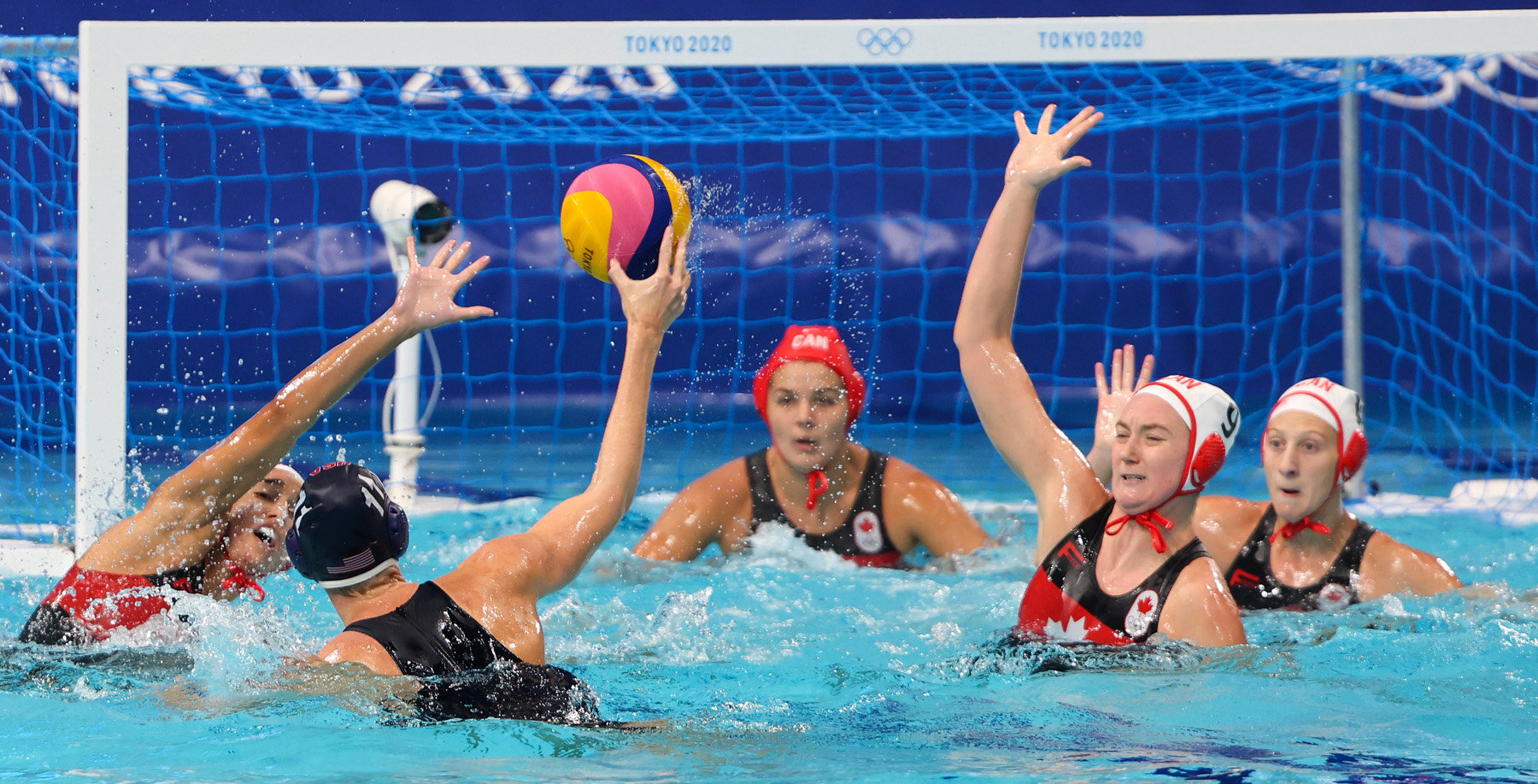
As the USA Women’s Water Polo Team began their quarterfinal game against Team Canada Tuesday afternoon, I couldn’t help thinking how fitting it was that I should see a women’s team bout between USA and Canada. I was in PyeongChang in 2018 when the USA Women won gold against their ever-present rivals, Canada, in ice hockey.
Though the animosity certainly wasn’t the same between the two teams during Tuesday’s quarterfinal game, it was still clear that Team USA was intent on winning and moving forward in the tournament. For the women of Canada, the Tokyo games was their first chance to represent their country in water polo since 2004.
Team USA came out fast and hard, putting up five goals in the first half of the opening quarter. It was a cornucopia of ways in which a team can make a goal in water polo: penalty shot, counter attack shot, centre shot, extra player shot and a shot in a driving situation. As soon as Canada had possession of the ball after that fifth goal was scored by Team USA, their coach, David Paradelo, signaled for a time out.
Canada got on the scoreboard right after the time out and would continue putting balls on the net and on USA’s goalkeeper Ashleigh Johnson, throughout the first three quarters. At the start of the fourth quarter, the Americans had a commanding 11-3 lead, though all the goals for both teams had been scored in the first two quarters. Johnson was swapped out with Amanda Longan going in for USA.
Not surprising, coming in cold, the first couple of opportunities for Canada got past Longan, but she then denied the next three shots she faced, and when the game was over the final score was 16-5. Team USA would continue on to the semifinal and Canada would play in a classification game.
For the Americans, there are some on the team who have been here before, having competed in Rio in 2016. Their captain, Maggie Steffens also competed in London in 2012 and understands that you need to focus on the game at hand never looking ahead.
“This is what you train for. Bracket play is kind of tournament one and tournament two is do or die in a sense. That’s what you’re training for. All of those years, all of those hours in the pool when you think you couldn’t go any further and you kept going, this is that part of the tournament where you’re able to kind of take all of your preparation and just let go and have fun. At the end of the day, you don’t know what’s going to happen. We don’t know who’s going to win. We don’t if we’re going to play well or play badly. But what we do know is that we can give our best effort, we can give our best focus, we can give the best game we can and hopefully that means we win, but we also don’t know that,” said Stefffens after their win over Canada.
Team USA will face the Russian Olympic Committee (ROC), winner of their quarterfinal game against Australia. The semifinal game will take place Thursday, August 5th, at 3:30pm JST.
Note: If you love the photo, be sure to check out more by visiting Jeff Cable’s Photography Blog here.
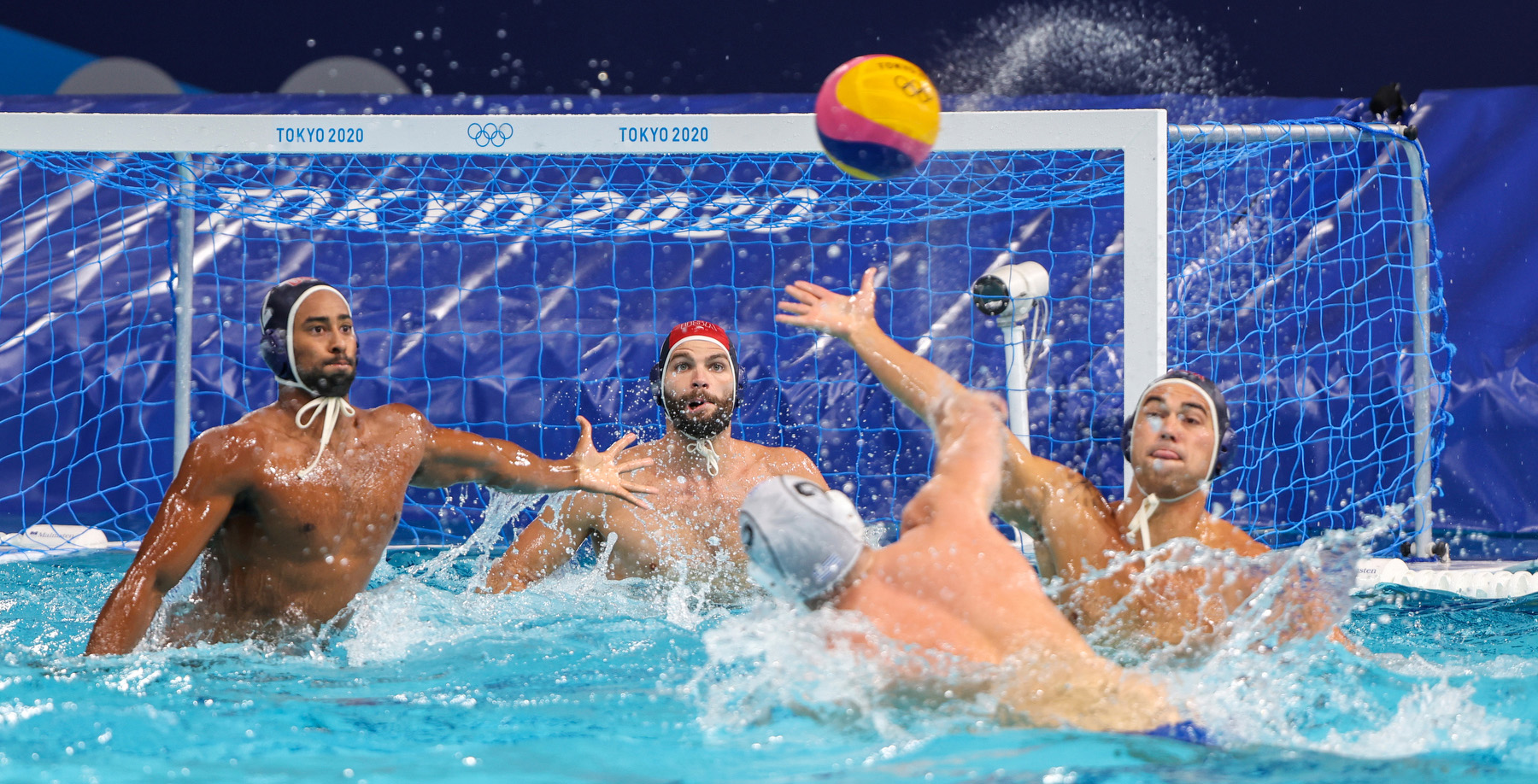
The USA Men’s Water Polo Team came into their bout with Greece having lost their previous two games, first to Italy and then to Hungary. They were in fourth place and despite the outcome of the game against Greece, they would still have be in fourth place, given that the tie between Italy and Hungary in the game before that of Team USA gave Italy eight points while Hungary had seven. With a win, the most the USA could get would have been six. Meanwhile, Greece was sitting at seven points going into the game and needed the win to maintain the first seed in Group A.
Despite Johnny Hooper coming out fast at the start of the quarters—winning three of the four sprints for the Americans to get initial possession, they weren’t able to capitalize on those opportunities. Greece on the other hand was up two goals with 4:17 remaining in the first period and would keep that pressure up throughout the game.
Alex Bowen did put the Americans on the scoreboard at 3:52 of the opening quarter while the team was on the extra player. Throughout the game, Bowen attempted a total of ten shots, five of those while on the man advantage, and it was only that goal in the first quarter that actually went in.
Once again Team USA was able to draw the exclusions, but they seemed to struggle even more in this game against Greece to take advantage of the power play. Two days ago they converted on 31% , while in Monday’s game against Greece, they were only able to score on two of the 11 chances they had for just 18%. That was definitely not what they were hoping for. Meanwhile the Greeks, though they only had eight extra player opportunities, put home four of them.
Many of Team USA’s shots seemed off—going too high so that they went over the net or missing the net on the sides. Even their shots that looked good seemed to hit posts and stay out. Of the 29 shots attempted by the American players, only 15 made it to Greece’s goalkeeper, Emmanouil Zerdevas, and he denied ten of those for a save percentage of 67%. Drew Holland, on the other hand, saw 21 shots and was only able to save seven of them giving him a save percentage of 33%. To be fair, two of those shots were penalty shots to go with the four extra player shots Greece scored on.
The Americans certainly had to know that Greece was going to bring all it had in the game with so much at stake for them. Perhaps it was just one of those games where somehow communication is off or the ball just refuses to bounce off the posts the right way to get past the goalkeeper and into the back of the net. Whatever the reason, Greece won with a resounding 14 goals to USA’s 5.
For Team USA, despite having lost their past three games, they will advance to the quarter finals which will take place on Wednesday, August 4th. At present, it looks like they will have to play Spain, who won all five of their games in the preliminary round in their group.
Note: If you love the photo, be sure to check out more by visiting Jeff Cable’s Photography Blog here.
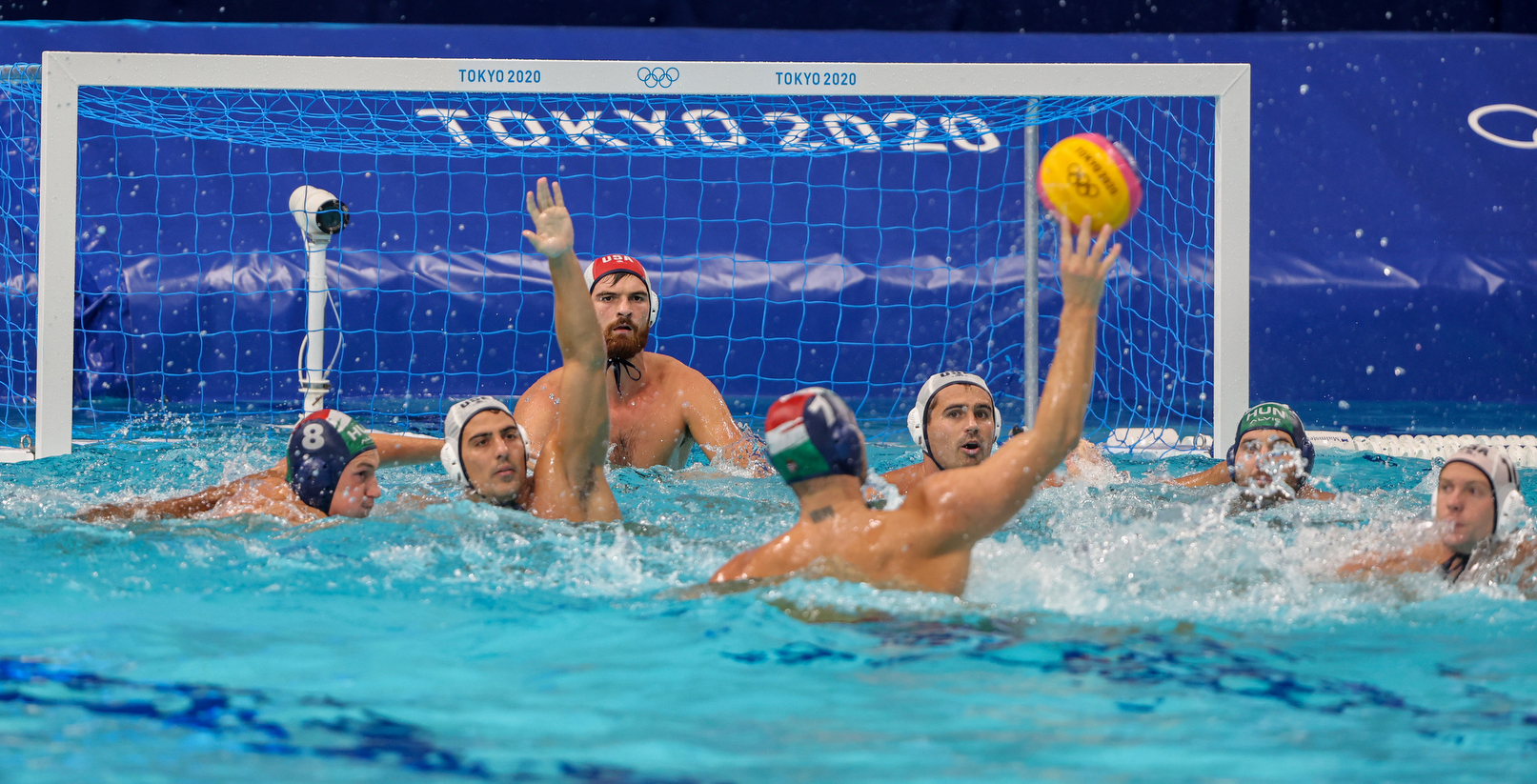
Watching the USA Men’s Water Polo Team play Hungary on Saturday, July 31, 2021, it was clear that this was not their best game and that no one on the team would be happy afterwards. This was also a prime example of how possession time does not guarantee a win in this game. Team USA was consistently leading in the amount of time that they had the ball, however, their scoring was far below average; at one point dipping to just 17%. By the end of the game, they had managed just eight goals on 31 attempts.
As a team, five of the players didn’t manage a goal and two of those players didn’t even manage a shot. Alex Bowen and Ben Hallock were each able to get two goals – which constituted half of the goals the Americans would get in the game.
It wasn’t that the Hungarians were far outshooting the Americans or that Team USA’s goalkeeper Alex Wolf was performing badly in net—he was able to stop 10 of the 21 shots that got to him for a 48% save percentage. Many of the American shots were simply not getting on Hungary’s goalkeeper Viktor Nagy. Of the 31 shots that the Americans took, just 16 of them actually reached Nagy and he denied eight of those.
“We definitely didn’t capitalize on our 6-on-5 exclusions, so the extra man was big for us. I think we went 31 percent overall. With a team like Hungary, who are very good shooters, we need to keep pace. The positive thing is that we draw those exclusions, so if we keep trying it, going forward, hopefully we can get that 31 closer to 50 percent,” said Luca Cupido.
Indeed, of the 16 opportunities Team USA had on the man advantage, they were only able to garner five goals. Coupling that with the three goals at even strength of the 15 shots, it came back to hurt them on the scoreboard.
Though Hungary was scoring on the extra player at about the same percentage as Team USA, they got a penalty throw which they got past Owen, and they garnered an overall scoring percentage of 35%.
For the American men, they now sit with two wins and two losses. They have one more game on Monday, August 2, 2021 to finish the preliminary round. They currently sit in fourth place in their group and must take on Greece who sits in first place having won three games and tied one.
The men’s teams finish their preliminary games on Monday and the top four in each group will then move on to the quarter finals, scheduled to take place Wednesday, August 4th. In addition to the USA game against Greece, Group A (the group which the USA is in) also has a game between the Italians and the Hungarians. All four of these teams are currently in position to move on to the quarter finals. The final game in Group A is between Japan and South Africa, neither of which has won a game in the preliminary round.
After winning their first two games against Japan and South Africa, the American men have lost their last two games and are undoubtedly hoping to turn that around against the Greek team.
Note: If you love the photo, be sure to check out more by visiting Jeff Cable’s Photography Blog here.





 Prev
Prev