The Tampa Bay Lightning finished as the NHL’s best regular season team, but managed to be ousted in the first round of the Stanley Cup Playoffs. The team cruised through the regular season, but hit a road block known as the Columbus Blue Jackets, who were just the hungrier team in the series. The Bolts seemed as though they thought they could just coast through the playoffs without having to put any of the work in. The Lightning have a majority of its players signed to longer term contracts, but there is always room for improvement season-to-season.
Here is my offseason wish list for the Tampa Bay Lightning:
1) Veteran Depth Defenseman
The Lightning already took care of this need when the team announced that Braydon Coburn signed a new two-year deal worth $3.4 million. The cap hit is only $1.7 million per season. The defenseman took a $2 million per season cap hit loss from his pervious contract for an opportunity to try to win the Stanley Cup with a stacked Lightning team. The Bolts definitely underachieved in the postseason last year as they were ousted by a more desperate Blue Jackets team.
Coburn was a decent third pairing defenseman for the Bolts last season. He had four goals, 19 assists and 23 points in 74 games played. He is a veteran player that has been in the League and understands his role. Coburn is more of a stay-at-home defenseman and has always been throughout his career. The extension makes perfect sense for both sides with the Lightning getting a cap discount and a player they are familiar with, while Coburn stays with a team who has a decent shot at getting back to the Stanley Cup Final.
2) Brayden Point Extension
Brayden Point is a restricted free agent and the sooner a deal can get done, the better for both sides. The Lightning will likely want to wait until the cap limit is set, which could be as late as June 25. Since coming into the League in 2016-17, Point has 91 goals, 107 assists and 198 points. It helps when you have linemates name Nikita Kucherov and Steven Stamkos, but the kid can flat out play himself.
The 23-year-old creates space for himself and his teammates by using his speed. He uses that speed in transition and to get to loose pucks in the offensive zone. The center also has great vision and isn’t afraid to shoot the puck. Point can be clutch, when needed, since he has 21 game-winning goals in his career. He balances out the Bolts’ lineup without having to overload on one line or rely on top line for all of its production.
3) Create Cap Space
Julien BriseBrois, the Lightning’s General Manager, is going to have to figure out a way to clear some cap space. The cap limit hasn’t been set yet, but the team already has $76 million tied up its roster. The Lightning will have four restricted free agents to get under contract with one of them likely to receive a big raise. Adam Erne, Cedric Paquette and Brayden Point all played a role in the team’s success last season so they should be re-signed. Danick Martel was lucky if he could get into a game last season, but he is a gritty player that can score.
The Bolts announced on June 20 that they have put Ryan Callahan on long term injury reserve, aka LTIR. He has been suffering from injuries the past few season and was diagnosed with a degenerative back disease. This essentially means that Callahan’s $5.8 million cap hit won’t count against the cap while he is on LTIR, which will likely be the entire season. BriseBrois may still need to clear a bit more cap space, just to have some wiggle room.
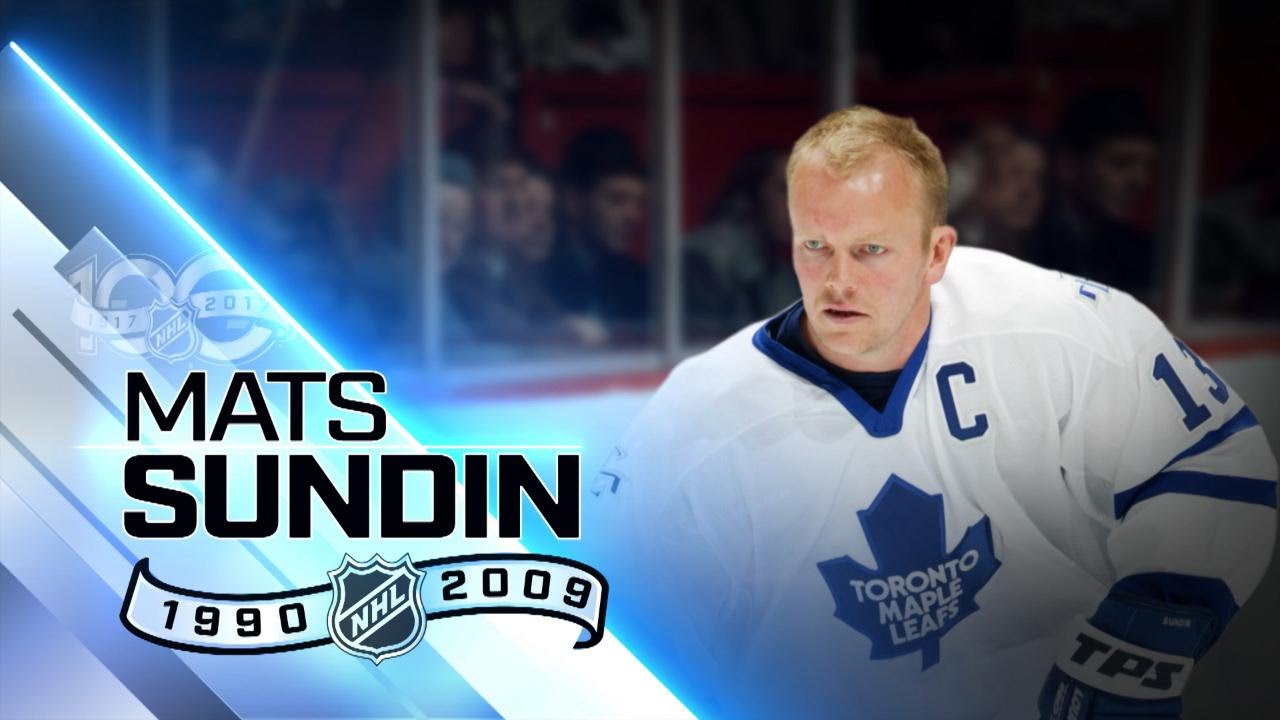
The Quebec Nordiques had first pick out of the 1989 NHL Entry Draft. They had only had their eye on one player for the two months leading up to June 17. When the moment came, they picked Mats Sundin of Sweden, making him the first European ever selected first overall. Prior to that, the earliest a Swede had been drafted was seventh overall.
In 1989, the Mets Sports Center in Bloomington, Minnesota hosted the entry draft. Until that point, Montreal had hosted all of the drafts but for 1985 (held in Toronto) and 1987 (held in Detroit). Among the 2,500 spectators was a group of fans who had traveled there from Quebec to hang a Nordiques banner and cheer as Sundin’s name was announced.
Most expected Sundin to be drafted in the top two. Having gone to Sweden to watch him play, scouts liked the 18-year-old forward’s “size, speed and skills.” He was a “finesse player” with “tremendous skills, [who] skates well and is a natural scorer.” The Nordiques’ chief scout, Pierre Gauthier, said, “He was the best talent available. We think this guy’s got the exceptional hands and great talent. It gives us a chance to have a very good hockey player down the line.” Gauthier greeted Sundin on stage with a Nordiques jersey and ball cap. Little did Gauthier know how right he would be when he said, “He has the potential to become a superstar in the National Hockey League.”
Others expressed concerns that the Swedes tended to play five or six seasons in the NHL before returning home to Sweden. Meanwhile, Swedish players preferred Nikla Andersson, whom the Nordiques chose in the fourth round. In addition, Sundin had two years remaining on his contract with Djurgardens IF Stockholm and seven to eleven months of military service to complete before he could skate for the Nordiques. Gauthier said they were planning to try to get the military service out of the way as soon as possible and then perhaps buy out Sundin’s hockey contract.
Although he had spoken with the Nordiques the day before, Sundin admitted, “I still had no idea if they would pick me. I was really nervous.” He was pleasantly surprised to be chosen first. Of his future home, Quebec City, Sundin joked, “I know it’s a nice town and it has a lot of girls. That’s about it.” He then stuttered through saying hello in French. Taking in the big picture, Sundin remarked, “I think this is a great moment for European hockey.”
As it turned out, Sundin was able to skate in Quebec beginning in 1990, scoring 59 points as a rookie. After four seasons, Quebec traded him to the Toronto Maple Leafs in June 1994. His first season in Toronto would be his former team’s last in Quebec before relocating to Colorado.
Sundin skated with the Maple Leafs for 13 seasons, and for all but one, Sundin led the team’s scoring. To this day, his 420 goals and 987 points remain Toronto records. In fact, his career totals, 564 goals and 1,349 points, remain the most of any Swedish player in the NHL. He was the first Swede to reach 500 goals and 1,000 points. Sundin also served as Toronto’s captain for over a decade, between 1997 and 2008. He was the first European to lead the Maple Leafs. In honor of his contributions to the team, Legends Row, outside Air Canada Centre in Toronto, features his statue. Toronto voted him their fifth-best player of all time and retired his No. 13.
In December 2008, Sundin signed with the Vancouver Canucks, which basically meant that his career moved westward across the entire country of Canada. After this last hurrah, he officially announced his retirement in September 2009, about 20 years and 2 months from when he was drafted.
Meanwhile, Sundin had continued to represent Sweden. He helped them win the World Championship in 1991, 1992, and 1998. He also skated for his country at the 1998, 2002, and 2006 Olympics. For the last of these, he captained the gold-medal team and assisted on the game-winning goal.
Sundin was inducted into the Hockey Hall of Fame in Toronto in 2012. Though he would have like to have won a Stanley Cup championship, he said, “It feels like I’ve experienced so much more than I could ever have imagined.”
Additional Sources:
Mike Commito, Hockey 365: Daily Stories from the Ice(Toronto: Dundurn, 2018), kindle edition.
“NHL Draft,” Minneapolis Star Tribune, 18 June 1989, pp. 4C-6C.
“Quebec drafts Swede first overall” and “Habs surprise scouts by drafting Vallis,” Montreal Gazette, 18 June 1989, p. C4.
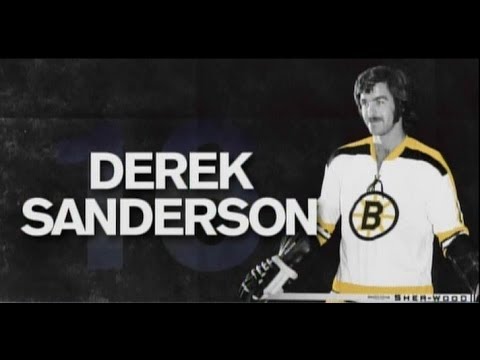
Derek Sanderson, who enjoyed the rush and roar of the crowds, was born near the roar of rushing water, at Niagara Falls, Ontario, on June 16, 1946. Just 21 years later, he won the Calder Memorial Trophy as NHL rookie of the year. He would go on to win two Stanley Cup championships with the Boston Bruins, each just a month before turning 24 and 26. Eight years after playing his last NHL game two months shy of his 32nd birthday, Sanderson went on to become a TV analyst for the Bruins and then a financial advisor. He wrote in his autobiography, “I lived well and I lived hard.”
In the midst of World War II, Canadian Harold Sanderson met Caroline Gillespie in Scotland, where he had been sent to recover from an injury. Harold wooed Caroline in letters sent from the front, and she had their daughter while he served in France. With the end of the war, the family moved to Canada shortly before Derek’s birth. Harold decided his son would become a hockey star, so Derek began skating at the age of 8 and received an expensive pair of skates at 12 with the promise that he would give his dad a Stanley Cup ring someday.
Sanderson’s teammates soon began calling him Turk. As a teen, Sanderson played for the Niagara Falls Flyers and helped them win the Memorial Cup as Canada’s best junior team in 1964-65. The next season, he took home the Eddie Powers Memorial Trophy as top scorer of the Ontario Hockey Association. At an exhibition game at Boston Garden, he fought Bobby Orr just to get noticed. Despite being opposites, the two would become lifelong friends.
After playing a couple of games with them, 21-year-old Sanderson officially joined the Boston Bruins for the 1967-68 season. He took the No. 16 sweater when its 1950s wearer, “Leo the Lion” Labine, said, “Let Sanderson wear my number, because he’ll toughen it up.” Indeed, he was an agitator and tough, leading the charge of the Big Bad Bruins. But he was also really good at penalty kills (with Ed Westfall) and scored many shorties. With his 24 goals (two shy of the record at the time) and 49 points, Sanderson received the Calder Memorial Trophy. Orr had just earned it the season before, so they became the only teammates to win back-to-back.
The teamwork between the two stars directly led them to the 1970 Stanley Cup, the Bruins first championship in 29 years. The passing from Orr to Sanderson and back to Orr resulted in perhaps the most famous game-winner in NHL history. They followed that up with another Cup victory two years later, this time against their biggest rival at the time, the New York Rangers.
With the arrival of the WHA in 1972, Sanderson asked the Bruins for $80,000, twice his annual salary. When they refused, he signed a contract with the Philadelphia Blazers for a record $2.6 million. That made him the highest-paid athlete in the world. However, in Philadelphia’s home opener, the Zamboni ruined the ice forcing the cancelation of the game. When Sanderson, the team captain, came out to apologize, fans threw their souvenir pucks at him. After only eight games, Sanderson was out with a back injury. His behavior led the Blazers to pay him $1 million not to return.
In February 1973, 27-year-old Sanderson returned to the Bruins. He only lasted one tumultuous year there until he refused to return to Boston with the team after a road game. The Bruins suspended him and traded him to the Rangers. Dashing their hopes of using the one who riled up their fans for their benefit, Sanderson was undisciplined in his health, attitude, and performance. The Rangers traded him to St. Louis, where he had a career high of 67 points (24G, 43A) in 1975-76. He resumed his substance-abuse behaviors the next season, so he was sent to the minors then traded to Vancouver in February 1977. After mere weeks, he was back in the minors. Sanderson had one last hurrah in the NHL when he finished out the 1977-78 season with the Pittsburgh Penguins.
After about three terrible years as an alcoholic addict, losing money, and living on the streets of New York City, Sanderson finally made it through rehab in 1980. While going through hip surgeries, in 1984, he was recruited by Boston’s mayor to speak to students about substance abuse. Two years later, at age 40, Sanderson became a TV broadcaster for the Bruins. For the next eleven years, he partnered with Fred Cusick, who had called the 1970 Stanley Cup Final. Their highlights included covering the last game at the old Boston Garden and the first game at the new Fleet Center. Around the same time, 40-year-old Sanderson passed an exam qualifying him to be a financial advisor. He set up the Sports Group with three goals – to “protect athletes from themselves,” to help athletes not be taken advantage, and to “educate players.”
In the conclusion of his autobiography, Sanderson summarized everything in one long sentence. “In the span of an extraordinary life, I made the National Hockey League, won two Stanley Cup championships, became a trendsetter, gained celebrity status, became a millionaire, descended into addiction, was homeless, almost died, asked for salvation, kicked booze, drugs, and cigarettes, climbed back from the wreckage, met an amazing woman who gave us two great sons, taught kids about the evils of addiction, was a broadcaster and now advise athletes about their finances.” As he put it, “That’s a lot to pack into one life!”
Additional Sources:
“Center of Attention: The Unreal Life of Derek Sanderson,” NBCSN, 2015.
Derek Sanderson, Crossing the Line: The Outrageous Story of a Hockey Original(Triumph Books, 2012).
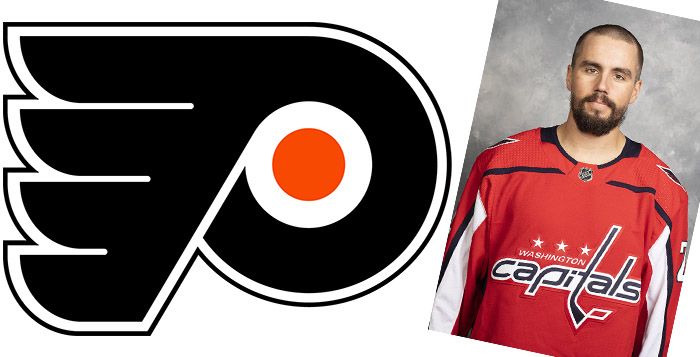
The Philadelphia Flyers were looking to acquired a veteran defenseman to help groom one of the young blue-liners. It looks like Chuck Fletcher and company have landed their man in Matt Niskanen. Niskanen was acquired from the Washington Capitals on June 14, 2019, in exchange for defenseman Radko Gudas. The Flyers will also retain 30% of Gudas’ salary, or a little over $1M will count towards their salary cap next season.
There are pros and cons to this specific trade, just like there are any trade in the NHL. I will wait until the season is over to reserve my final judgment on the trade, but when the new first broke I was not a big fan of it. Niskanen is older than Gudas and there are cap implications that I didn’t like. This is a big offseason for the Flyers, who have a decent amount of cap space to play with, and are looking to add pieces to win now.
1) Andrew MacDonald Contract Buy Out
Chuck Fletcher, the Flyers’ GM, announced Saturday that the Flyers were putting Andrew MacDonald on unconditional waivers for the purpose of a buy out. Having cleared waivers the Flyers are on the hook for about $2M next season, according to CapFriendly. MacDonald has underachieved since the team brought him over in a trade during the 2013-14 season. After just 19 games with the team, he was signed to a six-year, $30-million contract that had a cap hit of $5M per season. It wasn’t his fault that Flyers’ management completely over valued him at the time. He was only ever going to amount to a fifth or sixth defensemen, but management signed him like he could be a top four guy.
He has been anything but good since coming over in the trade with the Islanders. Yes, he hasn’t played terrible but MacDonald also never played up to the value of his contract. His signing took playing time away from the kids like Shayne Gostisbehere and Travis Sanheim because the former coach liked to play washed up veterans over the young kids. In five plus seasons with the Flyers, he played in 291 games and had 11 goals, 61 assists and 72 points while averaging 19:33 of ice time per game. In his 11 year career, MacDonald has 28 goals, 133 assists and 161 points in 21:23 of ice time per game.
2) Bring Stability to the Defense Pairings
It seems as though the Flyers are willing to go with some youngsters on the blue line this season. Niskanen is expected to be a leader for them and his presence will also stabilize the back end. Gostisbehere has had an up-and-down start to his career and is looking to have a bounce back year. He hasn’t been able to find that one steady partner, but that could happen this season if the Flyers choose to put him with Niskanen. Gostisbehere could really benefit from playing with a veteran guy, who can play both ends of the ice and move the puck.
The other route could be to put Niskanen with Ivan Provorov, but that would mean logging top pairing minutes and at this stage of the game, I don’t know that Niskanen would be able to do that. Either way, the back end becomes stabilized somewhat with the addition of Niskanen because you have a defenseman that can play in all situations and log some big minutes. The veteran presence and knowing what it takes to make a Cup run will help this youthful blue line group immensely.
3) Fits Alain Vigneault’s System
Niskanen may be getting older, but he can still skate and get the puck out of the defensive zone. Vigneualt’s teams are known for pushing the pace and the addition of Niskanen will help the team do exactly this. He can either skate the puck out of the zone or make the stretch pass to a forward in the neutral zone and the team can be off to the races. The 32-year-old defenseman can also get through the neutral zone and the Flyers had trouble doing just that at times last season.
Niskanen can get the team set up faster in the offensive zone and get them some chances in transition with his puck movement and skating ability. He also has a decent point shot so he could be used on the second power play unit, which really struggled to get shots through last season. The Flyers also don’t have to worry about one wrong move and Niskanen being suspended for multiple games.
Here are three things that I don’t like about the trade, which I am willing to give a chance since all of this is being based off of previous seasons.
1) Niskanen on the Decline
Niskanen has been on the decline for the past few seasons. In 2017-18, he only played 68 games amounting in seven goals, 22 assists and 29 points while averaging 22:36 of ice time per game. During the 2018-19 season, he played in 80 games, scoring eight goals, 17 assists and 25 points in 21:56 of ice time per game. It doesn’t look like much of a decline, but he is getting older and with age comes decreased minutes and injuries.
The defenseman has logged over 20 minutes per game during the course of his career, and he will be counted on for at least top four minutes in Philly, maybe even top pairing minutes. The more minutes he plays during the regular season could mean, the more fatigued he could get during certain points of the season. The Flyers will have to manage his ice time and his play. If his play starts to decrease at any point in the season then his minutes may need to be brought down or even sat a game or two.
2) Loss of Physicality on Team
Gudas was one of the defensemen with the most hits in the League last season, and they’ll be losing that from the back end with traded away. Niskanen isn’t the most physical guy on the blue line. Yes, the Flyers will likely still have Robert Hagg back there, who likes to throw hits, but Gudas also had an intimidation factor when he was on the ice. Gudas would stand up for his teammates and drop the gloves, if necessary.
The addition of Niskanen and loss of Gudas means the Flyers may not be as physical on the back end, and that could either help or hurt them. Niskanen is a better skater than Gudas so that should help to push the pace, but the Flyers really don’t have that one guy that is going to stand up for a teammate or finish a check. There isn’t that factor to make team intimidated to go through the middle of the ice against the Flyers anymore, and who knows what will happen with big Samuel Morin, who has not had any luck staying healthy the past two years.
3) Helping Out a Division Rival
The Flyers retained a little over $1M of cap space of Gudas’ contract and took on the $5.75M salary of Niskanen. In total, the Flyers helped to clear about $4 million in cap space. The Capitals are still trying to re-sign Carl Hagelin, who was added around the trade deadline last season and helped to improve the penalty kill immensely. This could very well lead to nothing since the Capitals will still need to find a way to clear more cap space and sign their own restricted free agents. However if they do, then the Flyers could have handed them some of that cap space with this trade.
Toronto, the home of the Hockey Hall of Fame, has hosted all of the formal induction ceremonies but for three. On June 15, 1987, the Class of 1987 was inducted at the Westin Hotel Renaissance Ballroom in Detroit. That was the only time the U.S. has hosted an induction since the ceremonies formally began in 1959.
The inductees included three players, one linesman, one builder, and five hockey writers. Having the writers outnumber the players did not sit well with some raising discussions of limiting the writers to no more than two a year. The issue was that the category was relatively new (having a large backlog of nominees) and did not require a three-year waiting period. With these newest reporters, the total in the Hockey Hall of Fame reached 39.
The other controversy surrounded the builder, John A. Ziegler, Jr. He was still serving as NHL president at the time. Since he had grown up near Detroit, that seemed to be the reason for inducting him in this particular year instead of waiting. He entered the presidency in 1977, succeeding Clarence Campbell, after having done some legal work for the NHL a decade earlier. One of his major contributions was arranging for four teams (the Edmonton Oilers, New England Whalers, Quebec Nordiques, and Winnipeg Jets) to survive the end of the World Hockey Association (WHA) by joining the NHL in 1979. Ziegler stepped down in 1992 and was replaced by Gary Bettman. At the 1987 ceremony, Ziegler’s namesake son announced, “It is with great honor, pride and love that I induct my father in to the hockey Hall of Fame.” Upon accepting, Ziegler remarked, “I haven’t figured out why or how it’s happened, but I’m damned glad it did happen.” He was the 69th builder inducted.
In 1987, the Hockey Hall of Fame opened up the officials’ category to allow linesmen in addition to referees. As their first linesman inductee, they chose Matt Pavelich, whose career as an NHL official spanned 23 years. After a season in the AHL, he debuted at the beginning of the 1956-57 season (while his brother Marty still played for the Red Wings). Pavelich officiated 1,727 regular-season games (and another 14 as a referee) and 245 playoff games, totals only beaten by one person for each category. These playoff games included 56 Stanley Cup Final games. When inducted, Pavelich had already spent eight years as a Supervisor of Officials, and he continued in that role until the end of the 1993-94 season. Both Scotty Morrison and Frank Udvari noted that Pavelich was dedicated and hardworking. At his induction, Pavelich said, “This is a great game. I’ve had a lot of fun. I’ve given my all. Thank you all.” He was the 10th on-ice officials inducted but first linesman.
One of the three players in the Class of 1987 was center Bobby Clarke, former captain of the Philadelphia Flyers. During his 15-year career with the Flyers, he led them in back-to-back Stanley Cup championships in 1974 and 1975, won the Hart Trophy three times, made the All-Star team four times, and once each took home the Masterton, Pearson/Lindsay, and Selke. He was rough and one of the best checkers, but he also finished 1,144 regular-season games with 1,210 points (358G, 852A). Upon hanging up his skates in 1984, Clarke became the Flyers’ general manager, leading them to the finals in 1985 and 1987. After some moving around in the early 1990s, he returned to Philadelphia in 1994. “I had an opportunity to live my dream,” Clarke commented at the induction ceremony. “It’s up to us in hockey to keep the dream alive.” When asked about the pinnacle of his career, Clarke answered, “More important than any individual award was going into the Hockey Hall of Fame. For me, as an individual player, nothing is as good as going into the Hall of Fame in your own sport. That’s so special.”
The inductees also included Montreal Canadiens defenseman Jacques Laperriere. In 12 seasons, he helped his team win six Stanley Cup championships (though he missed one due to injuries). Despite never scoring more than seven goals in each regular-season, his steadiness in defense really worked in their favor during playoffs. He had won the Calder Memorial Trophy as a rookie and the Norris Trophy for best defense. Laperriere suffered a career-ending knee injury that forced him to retire in 1974. He then turned to coaching, working as an assistant coach for the Canadiens between 1980 and 1997. During that time, the Habs won the Stanley Cup in 1986 and 1993. Laperriere then served the Boston Bruins as assistant coach for four seasons before moving on to the New Jersey Devils. As a Hockey Hall of Fame inductee, Laperriere wanted to thank everyone. “My first thought was that I had a lot of help from a lot of people – coaches Toe Blake and Scotty Bowman, and, of course, all the great players on so many great Canadiens teams. This is a night that I will never forget.”
The remaining member of the Class of 1987 was a goalie, Ed Giacomin. In his decade with the New York Rangers, he played 539 games, the fourth-highest for a Rangers goaltender. With them, he had a record of 267-172-89 and a save percentage of .905. After missing the playoffs in his first season, they made it every other season he backstopped the team. During the 1970-71 season (and the following season), they set a franchise record of 109 points, and Giacomin (with Gilles Villemure) earned the Vezina Trophy. In 1972, they made it to the Stanley Cup Final. Despite holding the franchise records for shutouts, Giacomin was placed on waivers in 1975 and was picked up by Detroit. The goalie never quite felt at home there, especially once the Red Wings chose other goalies over him in 1977. He retired with 54 shutouts, which still ranks him at 23rd in the NHL. Giacomin stayed on working in Detroit, where he was inducted in 1987. “My biggest thrill would have been winning the Stanley Cup, but an individual can get no greater honour than this.”
At the time of the 1987 induction, the Hockey Hall of Fame honored 182 players. As of 2019, the Hall has 280 players, 109 builders, and 16 officials. Since 1993, the induction ceremony has been held only at the Hockey Hall of Fame in Toronto.
Additional Source:
Keith Gave, “Players live out dreams” and “Five media inductees is bad news,” Detroit Free Press, 16 June 1987, p. 7D.
The Colorado Avalanche managed to get off to a hot start, but then went on a bit of an inconsistent stretch. The biggest bright spot for the team was the line of Gabriel Landeskog, Nathan MacKinnon, and Mikko Rantanen, who combined for 261 total points. Rantanen had a career high in goals (31), assists (56) and points (87). The Avalanche thought that Semyon Varlamov would be the number one goalie all season, but Philipp Grubauer took over that spot as the season went on and played quite well for them.
Once in the postseason, the Avalanche managed to beat the top seeded Calgary Flames in just five games. The Avalanche faced the San Jose Sharks in the second round, but lost the series in seven game. One of the bright spots in the playoffs, besides the Avs’ top line was the emergence of defenseman Cale Makar. Makar joined the team after his college season was over and jumped right into the Stanley Cup Playoffs, where he showed off his offensive ability. The Avs don’t have a lot to change this offseason, but there are still things that management needs to get done to improve the team.
1) Long-Term Deal for Mikko Rantanen
Yes, Rantanen is only a restricted free agent this offseason, but it is imperative to get this kid signed to a long term deal. He has proven himself in his three NHL seasons with the Avalanche. Rantanen is a crucial part of the offense since he uses his speed to create chances as well as back the defense into their own zone, but he isn’t afraid to go to the net and score some greasy goals. The forward has been relatively healthy over the course of his three plus years in the NHL, only missing 16 regular season games.
In his first full season in the League, Rantanen managed 20 goals, 18 assists and 38 points in 75 games played. The Avalanche missed the playoffs in the 2016-17 season. During the 2017-18 season, he managed to have his breakout season with 29 goals, 55 assists and 84 points in 81 games played. In six postseason games, he didn’t register any goals but managed four assists. Last season, he had 31 goals, 56 assists and 87 points, all of which were career highs, in 74 games. In 12 postseason games, he had six goals, 12 assists and 18 points. In just 239 career games, he has 80 goals, 129 assists and 209 points.
2) Goaltending Help
Philipp Grubauer eventually took over the starting goaltending spot from Semyon Varlamov, who is an unrestricted free agent this summer. Grubauer played in 37 games, and had a record of 18-9-5. The goalie managed to have a .917 save percentage to go with a 2.64 goals against average and three shutouts. The Avalanche look to have the number one goalie spot locked up with Grubauer, but that doesn’t mean the team doesn’t need some goaltending help.
Sure, the Avalanche could always bring back Varlamov if he is willing to be the backup goalie and they can get good terms on the contract. It’s not exactly the best field of free-agent goalies this offseason, but teams are usually looking for a veteran backup and there are plenty of them available. Some goalie options for the Avalanche could be Cam Talbot, Brian Elliott, Chad Johnson, Curtis McElhinney, Cal Pickard or Cam Ward. There will be options out there this free agency, just not the best ones. The best options out of this group are probably Cam Talbot, Chad Johnson and Brian Elliott.
3) Bottom Six Center
Jerad Bednar does have center depth on the team, but they could use someone to fill the fourth line role. Last season it was Derick Brassard centering that line, but he is an unrestricted free agent this summer. A younger kid from the minors could very well compete for a spot if there is nothing done in free agency. There are some older, veteran players available in free agency, if the Avalanche decide to go this way.
They could very well bring back Brassard, if he wants to come back at a reasonable price. Another option could be Valtteri Filppula, who played an important role with the New York Islanders last season, but he may be a bit expensive for a fourth line role. An interesting option could be Marcus Kruger, who has been bounced around a little bit in his career. He is only 29-years-old, and if the Avalanche can get him for a cheap deal at about $2-$2.5 million per season for two or three years, it may be a chance worth taking. He can penalty kill along with being the fourth line center.
4) Restricted Free Agents Signed to New Deals
The most important players for the Avalanche future seem to be restricted free agents this summer, and it should be a goal for the team to get them signed before the season starts. They have seven players that are RFAs including Sven Andrighetto, Alex Kerfoot, J.T. Compher, Mikko Rantanen, Ryan Graves, Nikita Zadorov and Vladislav Kamenev. Kamenev seems to be out of the lineup more than he is in the lineup due to injuries so if the team doesn’t re-sign him then it wouldn’t be the worst thing in the world.
Andrighetto, Kerfoot, Compher, Graves and Zadorov are arbitration eligible so hopefully the Avalanche’s management team can avoid the arbitration process and get these players signed to new deals. Rantanen needs to be signed to a new long-term deal while it may be more judicious to offer some of the others bridge deals. Andrighetto and Graves could be two of those RFAs signed to bridge deals instead of longer term deals. Kerfoot, Compher and Zadorov played an important role to the team’s success last season so it wouldn’t be surprising if they are signed to longer term deals.
5) Tyson Barrie Extension
Tyson Barrie is under contract for the upcoming season, but is an unrestricted free agent after the 2019-20 season. It will be interesting to see if they can get a deal done with Barrie since there will be another expansion draft in a few years. Barrie carries a $5.5 million cap hit for the upcoming season, and he will likely get an increase in pay due to his play.
In 484 career games, Barrie has 75 goals, 239 assists and 307 points in the regular season. In 21 postseason games, the defenseman has scored one goal, has 13 assists and 14 points. He has elevated his game the past two seasons. Last season, he tied his career high in goals with 14. Barrie set a career high in assists with 45. The defenseman also set a career high in points with 59, just edging his previous by two points in the 2017-18 season.
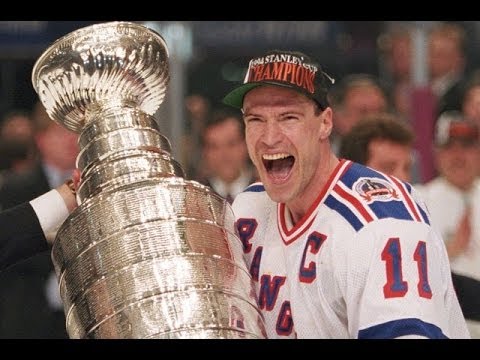
All New York Rangers players and fans wanted to change the chanting from “1940” to “1994.” The last time the Rangers had won the championship was all the way back in 1940, and they considered themselves cursed ever since then. After the longest Stanley Cup drought in NHL history, of 54 years (53 seasons), the Rangers finally won their fourth Stanley Cup championship on June 14, 1994.
After missing the playoffs entirely the season before, the Rangers hired a new coach, Mike Keenan. They also were ambitious about getting the right players. Having already acquired Mark Messier, Adam Graves, and Jeff Beukeboom in 1991, Kevin Lowe in 1992, and Esa Tikkanen in 1993, the Rangers added two more former-Oilers stars, Glenn Anderson and Craig MacTavish, on March 21, 1994. To backstop these seven members of the 1989-90 Stanley Cup team, Kennan chose Mike Richter right from training camp. After Richter set a team record with his 20-game unbeaten streak (surpassing Dave Kerr’s record from 1939-40), Keenan said, “Obviously, it worked out for the best.”
The Rangers pulled into first place midway through the regular season and maintained the spot until they had the President’s Trophy. Their 112 points (52-24-8) was six more than the second-place New Jersey Devils. In the postseason, the first round featured New York on New York as the Rangers swept the Islanders. It then took five games to eliminate the Washington Capitals. From there on out, the going got tough and the tough kept going. The Rangers and Devils kept the series close. Although his team trailed 3-2 going into Game 6, Captain Mark Messier promised, “We will be back for game seven.” Not only did Messier’s three goals in the third period force a seventh game, but the Rangers were able to take Game 7 in double overtime. Upon Messier’s receipt of the Prince of Wales Trophy, the Rangers returned to the Stanley Cup Final after fifteen years.
As the Eastern Conference representatives, the Rangers played the Vancouver Canucks, who had entered the postseason as fourteenth seed but winner of the Western Conference. For the opener, the underdog Canucks managed an overtime win thanks to Kirk McLean’s 52 saves. The Rangers then took control, winning the next three games. Edmonton Cup-winner Glenn Anderson scored the game-winner in the first two of these, and Brian Leetch (the Rangers’ first-round pick (9th overall) in 1986) had two goals to win Game 4. Before the New Yorkers could really celebrate, Vancouver came back to win the next two games and force a Game 7.
On June 14, 1994, fans paid big money to pack Madison Square Garden in the hopes that their long wait would end. The air conditioning on the ice had been cranked all night as temperatures outside reached 98 degrees. According to Messier, Keenan gave them the “most inspirational talk” he had ever heard. “He came through for us. He took control.” This was despite rumors (that turned out to be close to the truth) that Keenan planned to jump ship after the series ended. He used the excuse of his bonus being paid one day late to get out of his five-year contract and take a huge paycheck from the St. Louis Blues for the following season. Not only did he and the Blues get slapped with fines, they ended up losing the quarter-final to Vancouver.
Right off the bat in Game 7, the Rangers did all the scoring in the first period with goals by Leetch and Graves (on a power play), both assisted by Sergei Zubov. Vancouver’s Trevor Linden responded with a shorthanded goal at 5:21 of the second period. Messier did not let that stand, and (assisted by Graves) he scored on a power play at 13:29. Even though Linden managed another power play goal at 4:50 of the third, Messier’s goal gave the Rangers a 3-2 victory. Despite delaying tactics employed by the Canucks, the Rangers held them off as MacTavish took one last faceoff just before 11 pm.
The Rangers and their fans exploded into celebrations, much like the fireworks that filled the ceiling. This was the first time in franchise history that they had won at Madison Square Garden. Mayor Giuliani was present and commented, “The Rangers won in dramatic style, just like New Yorkers always win in dramatic style.” Still, the New Yorkers did not riot though the heartbroken did back in Vancouver.
In the on-ice ceremony, Leetch received the Conn Smythe Trophy as the first American-born and second defenseman ever to be named playoff MVP. He led the team in scoring throughout the postseason with 34 points (11G, 23A). Messier followed with 30 points. Leetch said shortly thereafter, “Mark Messier told me this would be the toughest game in my entire life. Mark underestimated it a little bit.” He went on to say that it was not the Conn Smythe that mattered so much as the Stanley Cup. “I’ve never even been to the Finals. That’s exciting enough for me.” In fact, he later admitted, “We had played so much hockey and had so much emotion — the semifinals and Final both went seven games — that the biggest thing I felt after the game was relief.” Leetch said they all “spent the next few days celebrating.”
The Stanley Cup was brought onto the Garden’s ice for the first time since it was turned over to the Boston Bruins 22 years earlier. Then NHL Commissioner Bettman announced, “After 54 years, the nightmare is over! Captain Mark Messier, come get the Stanley Cup!” As Messier went to hoisted the Cup at 11:06 pm, long-time Ranger announcer Sam Rosen declared, “The Messiah has delivered.” Messier remarked, “Everybody deserves to hold it. I’ve won five other Stanley Cups, but I’ve never seen anything like this. All the history, the bad luck. This is so completely different. Fifty-four years of things gone bad . . . you can’t be afraid to slay the dragon.” In what could be considered the perfect summary, Messier said, “All the ghosts, all the bad luck for this organization . . . that’s what made this one different. Nineteen-forty, rest in peace.”
With the Rangers having broken their curse, Detroit was left with the longest drought. Their last Cup had been in 1955, but they broke their losing streak shortly thereafter. Currently, the Toronto Maple Leafs have the longest active drought, at 51 years. Not having won the Cup again since 1994 (despite making the finals in 2014), the Rangers have an ongoing drought of 25 years (24 seasons).
For nearly four months, it looked as though the NHL would not play a 1994-95 season. When the lockout ended in January, the New Jersey Devils got to work implementing their “neutral zone trap” strategy. They had come within one goal (scored in double-overtime) of making it to the Stanley Cup Final the season before and refused to let that happen again. On June 13, 1995, they won the Prince of Wales Trophy and their first ticket to the Cup Final.
The franchise that settled in New Jersey started over 1,000 miles west, in Kansas City, Missouri. The area had been a “hotbed for minor league hockey action,” so in 1974, the NHL chose to expand there to counter the growing competition of the WHA. Unfortunately, Kansas City started off without a suitable place to play and then could barely fill their arena halfway as the team struggled through two terrible seasons there. In light of that, the NHL chose to move the franchise to Denver instead of setting up a new franchise. The Colorado Rockies played there for eight seasons but only made the playoffs once. The owners had wanted to move to New Jersey as early as 1978 and finally made the move in 1982. It took until their sixth season in New Jersey for the Devils to start making the playoffs. During the 1995 season, their owner threatened to move the franchise to Nashville.
Thanks to the shortened regular season, New Jersey only had 48 games to earn 52 points (22-18-8). That put them just four games over .500 and into fifth seed in the Eastern Conference. However, their defensive style really served them well in the postseason. Goalie Martin Brodeur earned three shutouts in five games against the Boston Bruins. After losing the first game of the next round, they won the next four against the Pittsburgh Penguins.
For the Eastern Conference finals, called the Turnpike Series, the Devils faced the Philadelphia Flyers, who had topped them in the Atlantic Division. Unlike the typical pattern, each of the teams won two games on the road and lost two games at home. In Game 5, held in Philadelphia on June 11, Flyers goalie Ron Hextall held off the Devils, facing down 32 shots, until the final minute. Claude Lemieux stole the game at 19:15, giving the Devils a 3-2 lead.
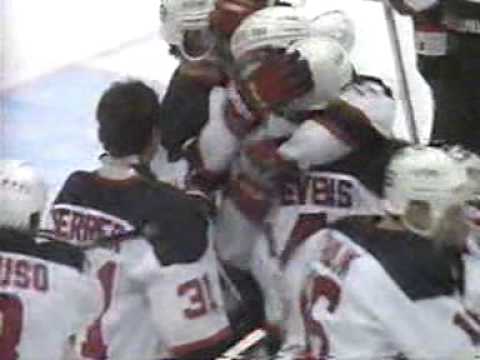
The Devils hosted Game 6 in Brendan Byrne Arena at Meadowlands Sports Complex in East Rutherford for a sellout crowd of 19,040. Philadelphia managed the first and final goals of the game, but New Jersey potted double in between. While the Devils took 29 shots on Ron Hextall, they only allowed 16 on Brodeur. Stephane Richer (in his fourth season with the Devils) tied the game at 10:25 of the first period when he scored on a power play. Rookie center Brian Rolston finished the period with a goal at 18:15. Another four-year veteran of the team, Randy McKay, netted the only goal of the second period, which ended up being the game-winner. Finally, at 10:11 of the third period, Claude Lemieux (in his fifth season with the Devils) scored his eleventh goal of the postseason. Lemieux led the team in scoring and would receive the Conn Smythe Trophy as playoff MVP.
In an on-ice ceremony following the game, NHL VP Brian Burke presented the Prince of Wales Trophy to Devils captain Scott Stevens. He too had been playing for the Devils for four seasons. His job in this series was to block the Flyers’ top scorer, Eric Lindros, and he succeeded.
For the first time in their 21 seasons as a franchise, the Devils made it into the Stanley Cup Final. Captain Stevens explained, “There’s no question you learn from the past. I don’t think many people expected us to be here this year.” Lemieux commented, “I think as a team we definitely learned a lot. Last season . . . was a good learning experience and, of course, we came out on the short end of the stick. We had to watch the finals last year. This year, we’re part of it. It’s a great feeling.” As a 12-season veteran, John MacLean enthused, “I’ve always wanted this opportunity – always. Now it’s here, the chance to go for the Stanley Cup.” Their coach, Jacques Lemaire, had won the Cup eight times while playing for Montreal, but this was his first time leading a team there. “I am very proud to see the guys enjoying what they have right now, making the finals,” he said. But like I told them, we just won part of it. The other part is to come.”
The finals went even better than the Devils expected. They swept the favored Detroit Red Wings to take home the Stanley Cup. They went on to make the finals four more times, winning two more championships, in 2000 and 2003.
Additional Sources:
“One Final Step,” Asbury Park Press, 14 June 1995, pp. D1 and D4.
Brian McFarlane, Brian McFarlane’s History of Hockey(Champaign, Ill.: Sports Publishing Inc., c1997), 267-272.
Stephen Laroche, Changing the Game: A History of NHL Expansion(Toronto: ECW Press, 2014), 234-237.
Hockey Chronicle: Year-by-Year History of the National Hockey League(Lincolnwood, Ill.: Publications International, Ltd., 2006), 564-571.
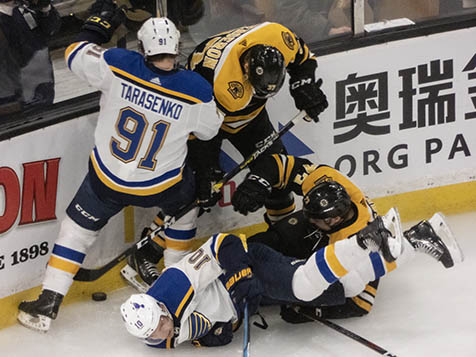
The Boston Bruins played their final game of the 2018-2019 season on Wednesday night in a Game 7 of the Stanley Cup Final against the St. Louis Blues. It definitely didn’t go the way the Bruins wanted, as they lost 4-1.
Throughout the game, there were tons of “fans” throwing in the towel and blaming players for their inability to score, keep the puck out of the net, and many more things that I stopped reading because those fans missed the point.
Watching a hockey game, it is easy to say “Tuukka Rask should have had that goal.” or “What’s wrong with David Pastrnak, the Bruins should shop him this summer.” And so many more criticisms of the team they say they believe in. Wednesday night there were people who had given up at the end of the first period when the Blues were up 2-0. There were “fans” who paid inordinate amounts of money to see the Bruins play that game who left the game before it was over.
Imagine how the players felt? They have played 82 regular season games and then another 24 postseason games. Zdeno Chara was out on the ice the last three games playing with a broken jaw. Matt Grzelcyk had just returned to the lineup from a concussion. Chris Wagner had a puck go off his wrist, ending his season and forcing him to just watch. In the coming days the laundry list of unknown (though suspected) injuries, upcoming surgeries, and more will come out, but it won’t be enough for those “fans” who felt the Bruins somehow failed them.
I often wonder if those fans think the players woke up and said “You know, today is a good day to just lose the game.”
Was Wednesday night’s game the Bruins best game? Absolutely not. Rask would like to have one of those first period goals back. But that is not to say that the loss is on Rask. The team was unable to solve Jordan Binnington in that first period when they had twelve shots on the rookie netminder, including the only power play of the game. Brad Marchand made a bad decision going off the ice with seven seconds remaining in the first period that helped contribute to the Blues second goal. Yes, Pastrnak and Torey Krug each had four giveaways, which were eight of the 13 unforced giveaways in the game. Patrice Bergeron was only six of 12 in the faceoff.
And while the Bruins had struggles, the Blues had Binnington stopping 32 of the 33 shots he saw. The Blues saw their defensemen in the correct place almost all night long to keep the Bruins from doing much damage with some of those shots. The Blues had the season for the ages, especially once the calendar turned to 2019..
The Bruins and the Blues are cut from much the same cloth as teams go. Strong leadership in both rooms. Hard hitting, blue-collar style teams, that know the meaning of hard work. And just as the Bruins in 2011 had the ending of a drought, for the Blues it was their opportunity to win the franchise’s first ever Stanley Cup.
As the Blues were shouting with joy as the game came to an end, the Bruins were holding back tears. As the Blues players, while still out on the ice, continued to share in their happiness and answer questions of the media about something that they still had yet to grasp as real, the Bruins players were in their locker room likewise grappling with immense emotion and trying to answer questions of the media they weren’t yet prepared for. Some, like Jake DeBrusk, were sitting in their stall, still in full gear and speechless. Others, like Chara and Marchand, showing that there is crying in hockey. Broken bones? Stitches? No tears. Not getting to hoist the Stanley Cup? They would rather give up a body part then come that close and not be the players hoisting the silver chalice.
So, to the St. Louis Blues congratulations are in order for the precision with which they played Game 7. And for the Bruins, no amount of criticism by the fans will be as harsh as their own self recriminations, despite what they told the media. No amount of condolences will heal the giant gaping wound that only they can see and feel at the moment.
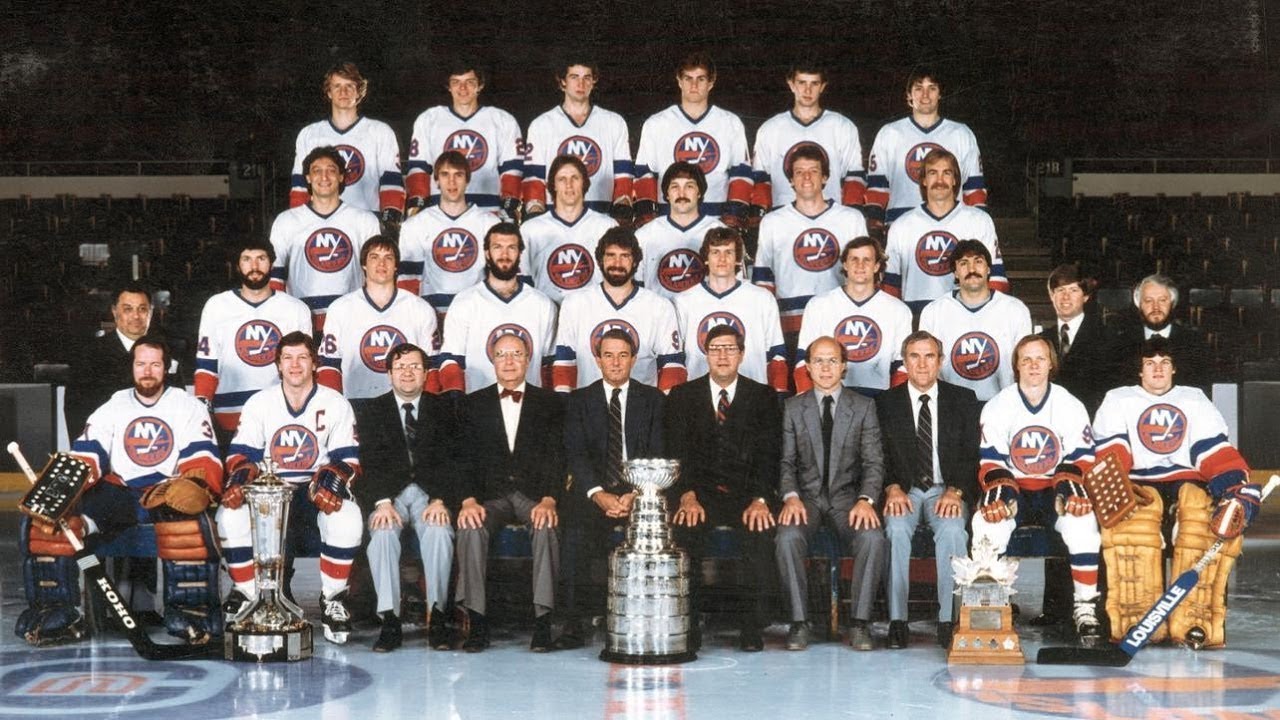
How do you build a dynasty? Apparently, you draft players who start their NHL careers by receiving the Calder Memorial Trophy, named for past NHL President Frank Calder and given annually “to the player selected as the most proficient in his first year of competition in the National Hockey League.” During the 1970s, the New York Islanders had three players win the award on even-numbered years. The third such superstar, Mike Bossy, received his award on June 12, 1978. It also helps if one of those stars, Denis Potvin, also thrice wins the Norris Trophy as best defenseman. He received his third on June 12, 1979, at the same time as the third teammate, Bryan Trottier, received the Hart Trophy as regular-season MVP and the Art Ross Trophy as leading scorer. Together, they all went on to lead the team to four consecutive Stanley Cup championships at the beginning of the 1980s.
The dynasty-building began back in 1973, when the Islanders drafted defenseman Denis Potvin first overall. In his first season, Potvin earned 54 points with 17 goals and 37 assists. His ambitions at the start included setting a new goal-scoring record for a rookie, setting a new points record for a rookie, and earning the Calder. On June 11, 1974, Potvin received the trophy in light of having reached the other two targets. By accomplishing all three, he said he had a personal “hat trick.” When asked about his next aims, Potvin remarked, “I’ve set no targets, but any athlete looks to better himself and I hope I do. But the most important thing is that the Islanders prove themselves and I think we can win 20 more games next season. If we do, and keep our goals-against down, we should make the playoffs.”
Just two weeks before Potvin accepted the Calder Memorial Trophy, the Islanders drafted center Bryan Trottier in the second round (22nd overall). Unlike his teammate, Trottier did not start playing with the Islanders right away. In his inaugural season, 1975-76, his 95 points (32G, 67A) placed him 12th in NHL scoring. On June 7, 1976, he was almost unanimously elected for the Calder Memorial Trophy, receiving 262 points in the poll. That was 163 more than his runner-up (and teammate) goalie Glenn Resch.
At the same time, Potvin received the James Norris Memorial Trophy as the “defenseman who demonstrates throughout the season the greatest all-round ability in the position.” He was the first recipient following Bobby Orr’s epic eight-season streak. With 98 points (31G, 67A), Potvin led the Islanders’ scoring (for the second straight season). He received 237 points in the polling, 141 more than the Bruins’ Brad Park. Potvin even came in second in the voting for the Hart Trophy.
In 1977, New York drafted Bossy 15th overall. That initial season, he accumulated 91 points (53G, 38A), which put him sixth in NHL scoring. Thus, he became the third member of the Islanders to receive the Calder within a five-year span. At the same ceremony, teammate Potvin took home his second Norris, though more closely followed by Park. Trottier came in a distant second to Guy Lafleur in the Hart Trophy voting.
With all three teammates making a difference for the Islanders, the 1979 NHL awards also acknowledged Potvin and Trottier. The former took home the Norris for the third time in four seasons. The latter had led the league in scoring with 134 points (47G, 87A), his career best. That earned him the Art Ross Trophy, given annually to the one who “leads the National Hockey League in scoring points at the end of the regular season.” Trottier also won the poll for the Hart Memorial Trophy, awarded to the “player judged to be the most valuable to his team.”
In the off years, 1975 and 1977, Atlanta Flames players Eric Vail and Willi Plett received the Calder Memorial Trophy. After the Flames moved to Calgary, the Calgary Flames became the only other team to have three Calder winners in alternating years – Gary Suter in 1986, Joe Nieuwendyk in 1988, and Sergei Makanov in 1990.
The New York Islanders made the playoffs every year during the careers of Bossy (who retired after 1986-87) and Potvin (who retired after 1987-88). Both of them were inducted into the Hockey Hall of Fame together in 1991. Trottier hung on a bit longer, finishing his time with the Islanders when he signed with the Pittsburgh Penguins in 1990. He won two championships with them in 1991 and 1992. He joined his teammates in the Hockey Hall of Fame in 1997. Even today, Mike Bossy holds the Islanders’ records for most goals (573), most goals in a season (69), and most points in a season (147). Bryan Trottier is the all-time points leader for the Islanders at 1353 points, which includes leading in assists (853).



 Prev
Prev