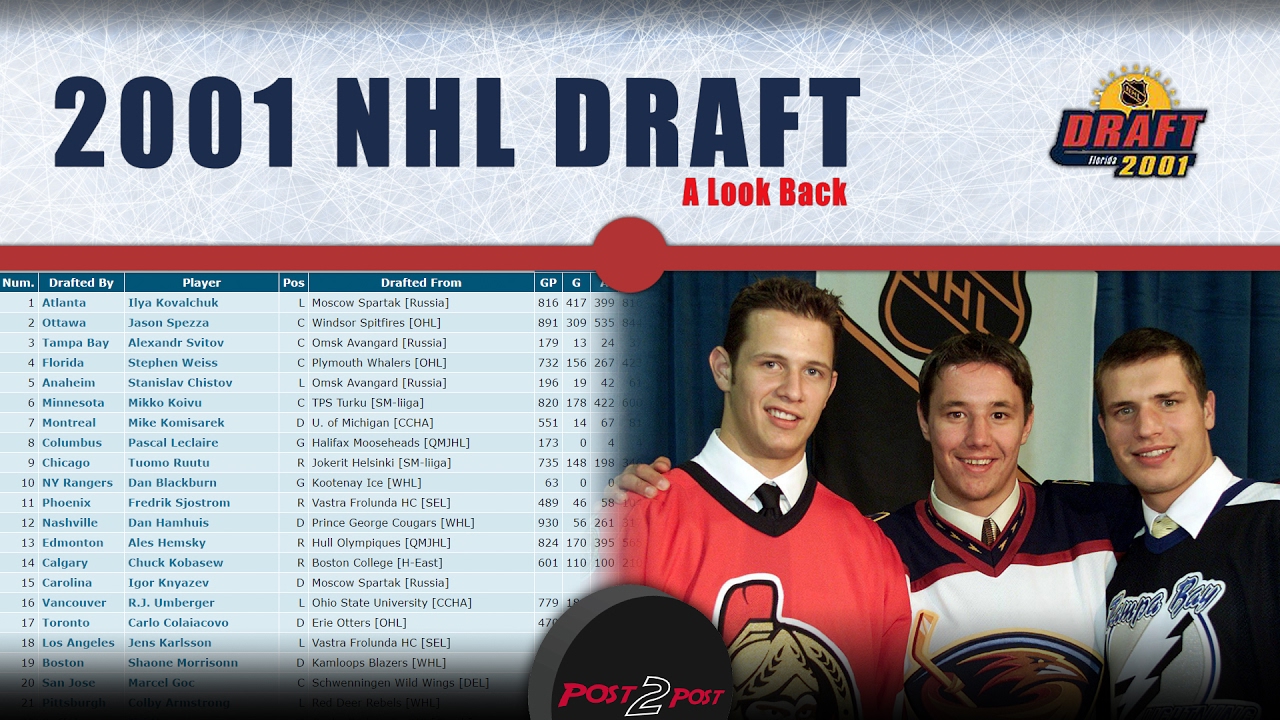
One U.S.-based NHL team turned down all offers for the chance to draft the first No. 1 Russian. Another gave up their No. 2 pick in trade for a Russian they considered a star player. As a result, a Canadian team drafted the top Canadian player. All this occurred at the 2001 Entry Draft held at National Car Rental Center in Sunrise, Florida on June 23.
The Atlanta Thrashers won the draft lottery, so they would have first pick at the 2001 Entry Draft. Leading up to the draft, they turned down multiple trade offers. Thrashers GM Don Waddell told the press, “Well, we certainly in the last two weeks had about 11 or 12 teams that called us, and truthfully when it came down to it, there was two teams that were very persistent. We pretty much told them we were keeping our pick.” He continued, “We could’ve really gotten some good players, but in the end, quality won out over quantity. We took the best player for our franchise.” Who was that player? As expected, they selected the top-rated European player, right wing Ilya Kovalchuk, as the first Russian player to be taken first overall. According to Waddell, “He’s the first pick in three years that our staff was in 100 percent agreement on.”
Kovalchuk, who had played for Russia at 2001 World Junior Championships at Moscow, said his main goal was to win the Calder Trophy as best rookie. “I understand it’s a young team but I will do the best I can to make the team a lot better. I wanted to be on this team.” He scored 29 goals that season and was the runner-up for the Calder. In his third season, 2003-04, he earned the Maurice Richard Trophy as the NHL’s top goal scorer. In February 2010, shortly before the Thrashers relocated to Winnipeg, they traded Kovalchuk to the New Jersey Devils, and he retired in July 2013.
In 2001, Kovalchuk was the first of three Russians who made up the top five draftees. Alexander Svitov was selected 3rd overall by Tampa Bay, and Anaheim selected Stanislav Chistov 5th overall. They were among the 38 Russians drafted that year. They made up 13.1% of the total number of players drafted, third behind Canada (at 37%) and the U.S. (at 14.2%).
Before the draft began, New York Islanders GM Mike Milbury sought a big trade. The one he made was just another in a long list of questionable trades and draft picks that had some referring to him as “Mad Mike.” Of the “maligned” player he traded for, Milbury said, “You know, I think everybody deserves a chance to make some mistakes. God knows, I feel that way about my situation.” Milbury traded the Islanders’ No. 2 draft slot and Slovakian defenseman Zdeno Chara and Canadian right wing Bill Muckalt to the Ottawa Senators in return for center Alexei Yashin.
Yashin, drafted second overall in 1992, had not had an easy time in Ottawa. When the Senators would not rework his contract, he held out during the 1999-2000 season. Ottawa GM Marshall Johnston remarked, “We’re looking forward to turning the page. To be critical of him would be unfair because Alexei brought us a lot of success. But we’re going to be in Ottawa a long time, and we felt it was time to move on.” Milbury justified the trade saying, “We felt we needed somebody with his credentials, somebody with star power that we can rally around. You never want to give up a pick that high, but you have to give to get.” The Islanders had to be prepared to give a lot because Yashin was looking to more than double his $3.6 million salary to at least $8 million a year.
As it turns out, Yashin only played five seasons for the Islanders before moving back to Russia to sign with the KHL. As for the Senators, they only kept Muckalt one season, and due to injuries, he only played one more in the NHL. Chara has been the most successful of the players involved in the trade. After playing for Ottawa for four seasons, in 2006 he signed with the Boston Bruins, who made him their captain. He earned the Norris Trophy in 2009, won the Stanley Cup in 2011, and has made it to the Stanley Cup Final twice more since then.
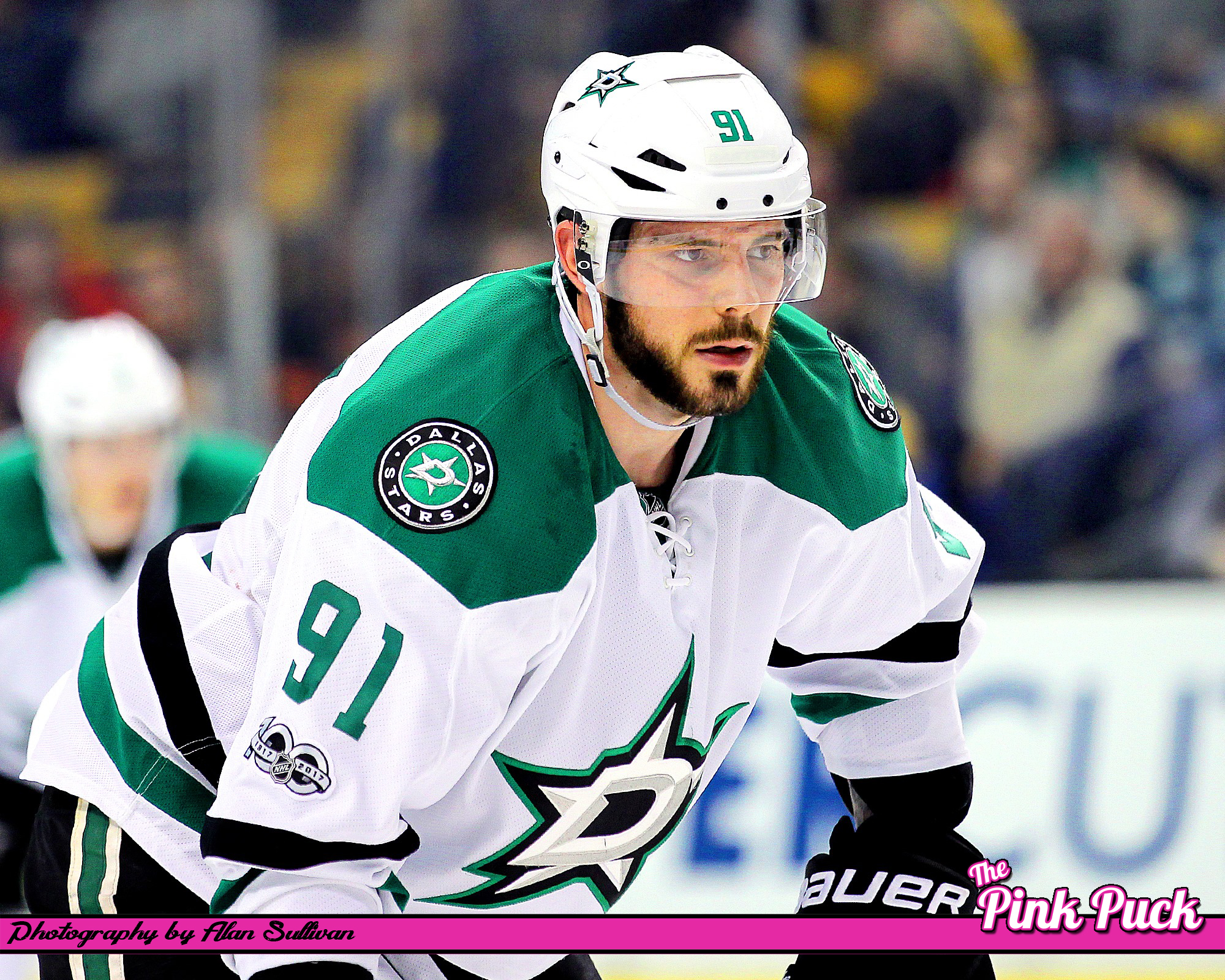
The other part of the trade gave Ottawa the No. 2 draft pick. They chose the top-rated North American, Canadian junior star, center Jason Spezza. Though Spezza was expected to go quickly, some were surprised that Ottawa went for the forward instead of a more-needed defenseman. Spezza was thrilled not to end up with a cellar dweller team. “It’s unbelievable growing up in Canada and getting the chance to play on a great team now. I’ll go in there and ease my way in and try and do as much as I can.” Spezza also exclaimed, “It’s going to be unbelievable, and I grew up on the home turf. It’ll be pretty awesome.” He played for Ottawa for 11 seasons, which included a Stanley Cup run in 2006-07. In July 2014, they traded him to the Dallas Stars, his current team.
All of these players (but for Muckalt) have represented their countries on national teams.
As the 1970s waned, the NHL went through some big changes that involved John Ziegler, Jr. A Michigan lawyer then in his 40s, Ziegler was confirmed as NHL President on June 22, 1977. On the two-year anniversary of that date, he officially announced the merger/expansion in which four teams from the folding World Hockey Association (WHA) joined the NHL. His work to reach an agreement with the WHA is the most recognized contribution during his tenure as president.
Ziegler’s NHL affiliation began in 1959, when he first provided legal services to the Detroit Red Wings. For most of the 1970s, he acted as their vice president and owner, alternate governor on the NHL Board of Governors, and general counsel. In 1976, he became chairman of the NHL’s board. Soon thereafter, Clarence Campbell decided to retire after 31 years as NHL President. The 71-year-old had held the post since 1946. In following such a mainstay, Ziegler remarked, “I object to being called Clarence Campbell’s successor. No one will ever succeed Mr. Campbell. I will be looking forward to Clarence’s continued counsel.”
Naturally, some negotiation was involved in hiring a lawyer as president. When he was first approached in March 1977, Ziegler declined the offer because “he felt the president’s powers were too limited.” He proposed that he keep his chairman powers and add the presidential responsibilities onto that. At their meetings on June 9th, the NHL accepted. To make this kind of structural change, they had to wait until their next meeting on June 22 to finalize. “I have worked with most of these gentlemen for 11 years and I have great respect for them,” said Ziegler. “So the feeling that they would ask me to accept this job is an honor, but one that must be earned.”
The NHL unanimously selected Ziegler as the fourth NHL president and as the first American to fill that position. Campbell explained Ziegler’s appeal, “He’s singularly well equipped. There is no training ground for this job. There is nothing corresponding to it any place in the world. . . . John will be able to adapt. Coming from the ranks of the owners is substantially helpful for him. He knows what is tolerable and what is less tolerable.” The Montreal Gazettedisagreed, arguing that Ziegler’s role as owner would make him more concerned with profits than fans. Indeed, when asked his main aim, he told the press, “I would like to see a full house in every arena for every game.” Ziegler’s salary was set at $225,000, and his term was set for four years. He stepped into his new role on August 26, 1977.
At the same meetings that confirmed Ziegler as president, the NHL discussed the logistics of a possible merger with the WHA. Both Campbell and Ziegler said any merger would not happen right away. After all, each WHA team would have to apply separately but none had by that point. The floundering rival league would continue for two more seasons.
After seven years of combatting the WHA, peace finally arrived in 1979 under Ziegler’s guidance. The initial vote to merge failed when the NHL’s Canadian teams, Boston, and Los Angeles voted against the proposed merger. With some assurances, Vancouver and Montreal changed their votes by the end of March, so the vote passed. The two leagues set June 15 as a deadline but only needed until June 9 to ratify the merger and sign the agreement. Finally, on June 22, 1979, all the documents were in order and fees were paid, “to mark the official demise of the World Hockey Association.”
Only four of the WHA teams joined the NHL as expansion cities – the Edmonton Oilers, Winnipeg Jets, Quebec Nordiques, and Hartford Whalers. They each had to pay $6 million to the NHL. Meanwhile, $1.5 million each had to be paid out to the other two former WHA franchises, the Birmingham Bulls and Cincinnati Stingers. Instead of the NHL, they were offered the chance to join the Central Hockey League (CHL). With the four new franchises, the NHL would have 21 teams starting the 1979-80 season. That necessitated some realignment in the four divisions. In adding Hartford to the Norris Division, the NHL moved the Washington Capitals to the Patrick Division. Quebec joined the Adams Division, and both Edmonton and Winnipeg were placed in the Smythe Division.
Ziegler did not stop there. Throughout the 1980s, he and the NHL laid the groundwork for the next big expansion that would occur throughout the 1990s. In a statement made to honor Ziegler’s passing, Commissioner Gary Bettman summarized his achievements. “From 1977 until 1992, as just the fourth President in NHL history, John oversaw the growth of the League from 18 to 24 teams, including the 1979 addition of four teams from the WHA. He was instrumental in the NHL’s transition to becoming a more international League – during his tenure, the share of European-born players in the NHL grew from two to 11 percent, players from the former Soviet Union first entered the League and games between NHL and European Clubs became a nearly annual tradition.” Although the end of his 15-year presidential term came about due to a 1992 players’ strike, Ziegler’s services were recognized via the Lester Patrick Trophy and induction into the Hockey Hall of Fame as a Builder.
Additional Sources:
Mike Commito, Hockey 365: Daily Stories from the Ice(Toronto: Dundurn, 2018), kindle edition.
Hockey Chronicle: Year-by-Year History of the National Hockey League(Lincolnwood, Ill.: Publications International, Ltd., 2006), 388, 393, 398.
Brian McFarlane, Brian McFarlane’s History of Hockey(Champaign, Ill.: Sports Publishing Inc., c1997), 143, 167.
Stephen Laroche, Changing the Game: A History of NHL Expansion(Toronto: ECW Press, 2014), 263-265.
Al Strachan, “It’s official: owner Ziegler takes over from Campbell,” Montreal Gazette, 23 June 1977, p. 27.
“NHL Zeroes In on Wings’ Ziegler,” Detroit Free Press, 22 June 1977, p. 4D.
“NHL to fold Cleveland?” Detroit Free Press, 23 June 1977, p. 8D.
“Ziegler to become 4th NHL president,” Chicago Daily Herald, 23 June 1977, section 2, p. 3.
“NHL merger now official,”Montreal Gazette, 23 June 1979, p. 61.
“It’s Official Finally; Whalers Join NHL,” Hartford Courant, 23 June 1989, p. 31.
The Toronto Maple Leafs managed to get to the playoffs last season, but didn’t get very far. The hurdle known as the Boston Bruins knocked them out in the first round yet again. The biggest issues with the team going forward are trying to keep the core group of kids together and getting a number one defenseman. It will all need to be accomplished while staying under the cap limit. There are ways to do this and the Leafs are looking to make some trades to get it done.
Here is an offseason wish list for the Maple Leafs:
1) Create Cap Space
This is the very first thing the Leafs are going to have to do before they can even attempt to fill some holes in this roster. They have to land a number one defenseman, re-sign restricted free agents and find a back up goalie. There are some trade options, but the question is what can these players bring back in return and I don’t think any of them will bring in a number one defenseman. The best trade options are Nikita Zaitsev, Patrick Marleau and Nazem Kadri. There is also a possibility of trading William Nylander if he can bring back a good return.
Of the four options, the easiest to move may be Nylander since he doesn’t have a no movement or modified trade clause in his contract. Zaitsev could be a little easier to move as well because he only has a 10-team no trade list in his contract. Kadri also has a 10-team no trade list as part of his modified no movement clause. Kadri may be a little harder to move just because of his discipline problems at key moments during a game or playoff series. The hardest player to move will be Patrick Marleau since he has a full no movement clause and would have to waive it to be traded. The Leafs need to find a way to move one or more of these players to get some cap relief.
2) Keep the Kids Together
The Leafs have three major players that are restricted free agents this summer including Mitch Marner, Kasperi Kapanen and Andreas Johnsson. Johnsson is arbitration eligible, but he was still a big part of the Leafs scoring depth last season. Marner and Kapanen combined for 46 goals, 92 assists and 138 points in the regular season. Kapanen is going to be the easier of the two to re-sign since he had 20 goals, 24 assists and 44 points, and wasn’t the team’s leading scorer.
It looks as though Marner is going to be demanding a big contract since the he was the team’s leading point getter last season. He had 26 goals, 68 assists and 92 points on the year. Marner contributed in just about every facet of the game including the power play. The forward brings speed and skill to the Leafs lineup, but will it be worth getting a contract done if he is looking to get around $11 million per season. There will be teams out there that offer sheet the restricted free agent and push the Leafs into deciding if he is worth the money to keep.
3) Number One Pairing Defenseman
The Leafs have been lacking a number one defenseman for years, and it has been costing them in the playoffs. The Maple Leafs as a team aren’t very good defensively so a lot of pressure is put on Frederik Andersen to make some saves, and he’s been very good at it. It will cost the Leafs to get a top pairing defenseman since Erik Karlsson just signed an eight-year deal with the San Jose Sharks with an $11.45 million cap hit per season. The best route for the Maple Leafs may be to go the trade route.
Do the Maple Leafs actually have anyone on the current roster that can bring them back a top tier defenseman? There is the Nylander option, which could bring back the return that the team wants and clear some cap space, but do they really want to get rid of a young kid for an older experienced defenseman? Another problem is finding a trade partner to tango with because not many teams are going to be willing to give up a number one guy. They may be able to swing a deal with the Nashville Predators for P.K. Subban, but that would come with a $9M cap hit over multiple seasons.
4) Back Up Goalie
The Leafs currently have a back up goalie on the roster in Garrett Sparks, but he just hasn’t lived up to expectations. In 20 games last season, he had an 8-9-1 record to go with a 3.15 goals against average and a .905 save percentage. There will be some options out there in free agency, but there are a lot of teams looking to add a back up. Another option would be having the young goalies compete for a spot in training camp.
The free agents include Curtis McElhinney, Michael Hutchinson, Calvin Pickard and others. It would come full circle if McElhinney signed with the Maple Leafs again since he played with them during the 2017-18 season. He had a 11-5-1 record in 18 games played. He also had a .934 save percentage and 2.14 GAA, but would he want to play the backup role after coming off of a decent season splitting time with Petr Mrazek in Carolina last season? Hutchinson played okay during his limited time with the Maple Leafs last sesaon, but Pickard had a not-so-hot season last year after bouncing around the League.
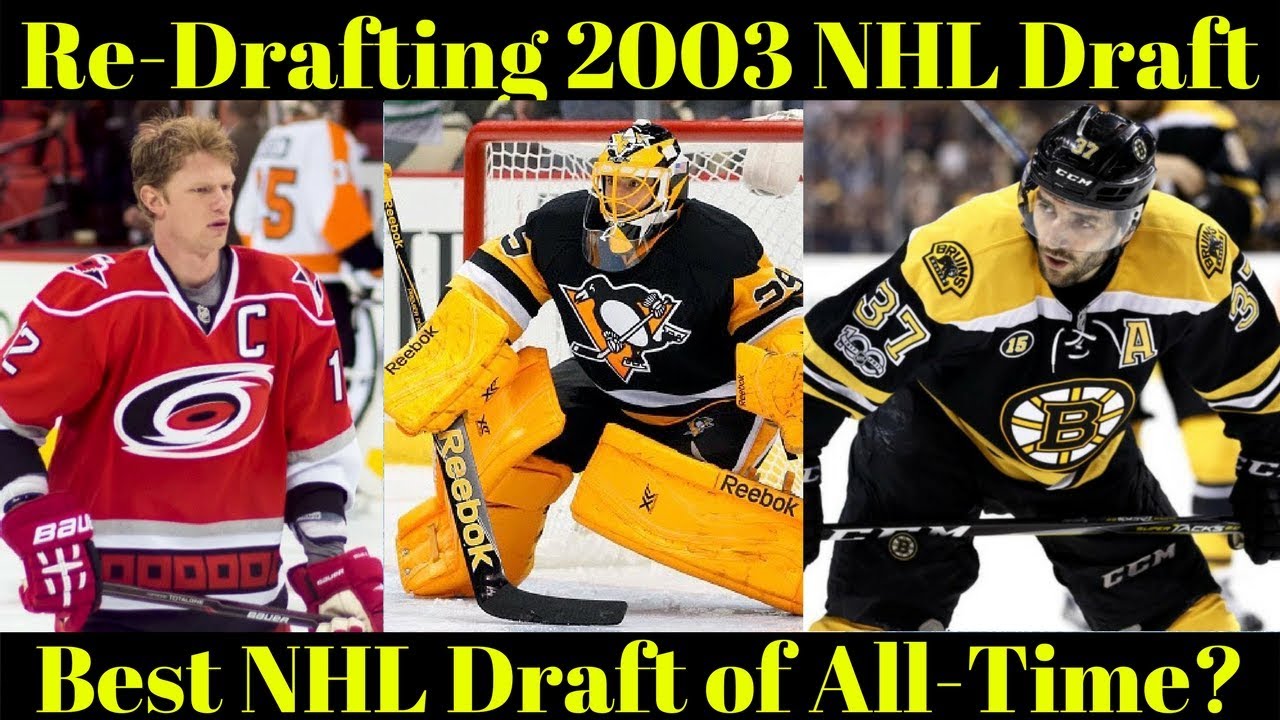
Of all the NHL Entry Drafts, the Class of 2003 really made the grade. Bridgestone Arena of the Gaylord Entertainment Center at Nashville hosted the draft and over 13,000 enthusiastic spectators. They were all in for a treat as the players drafted on June 21, 2003 produced one of the strongest and deepest pools of talent in NHL history.
To start things off, the Pittsburgh Penguins had first pick after switching turns with the Florida Panthers. It would be their only first pick other than 1984, when they chose Mario Lemieux who had become their owner. The Penguins chose goaltender Marc-Andre Fleury, only the third goalie to take the No. 1 spot. (The previous No. 1 goalies were Michael Plasse of the Canadiens in 1968 and Rick DiPietro of the Islanders in 2000.) Fleury commented, “I think it’s great to be the second. I don’t know [Lemieux] personally, but I know he’s a great guy. I am looking forward to meeting him.” Penguins General Manager Craig Patrick explained their choice, “We think he is a tremendous, tremendous goalie. Very good quickness, very good style. I think he’s going to be a great NHL goaltender.” Further, “We’re in a rebuilding mode in Pittsburgh, we have made that pretty clear. We decided the best place to start building was in goal.” Fleury did indeed help with that, backstopping the Penguins to three Stanley Cups. In their inaugural season, he recently led the Vegas Golden Knights all the way to the Final.
For the No. 2 draftee, the Carolina Hurricanes selected center Eric Staal. The NHL’s Central Scouting Service deemed him North America’s top-rated player. At the time, Staal said, “I am just happy to go where I am. I’m glad it’s over.” But he was going places and brought the Hurricanes with him to a Stanley Cup in 2006. Of everyone in the Class of 2003, he has been the top scorer. After the 2018-19 season, he has 974 points, 51 more than the next-highest scorer, Ryan Getzlaf (drafted 19th overall) and 161 more than the third-highest, Patrice Bergeron (drafted 45th overall). “Over your career, you always compare yourself to your draft class just naturally,” mused Staal later in his career. “During your draft year, you want to be first overall, but when that didn’t happen, you just try and prove you’re worth the pick you are taken. It’s amazing how many phenomenal players came out of that draft and a lot of key pieces to a lot of teams in the league. It’s really a source of pride for me to be among so many talented players.”
The third player was drafted by the Panthers, who had received Pittsburgh’s No. 3 pick and third-round pick in return for having first choice. The Panthers had had their eye on Oshawa center Nathan Horton, so they were happy with their trade. Although Horton played for the Panthers for six seasons, the season he was traded to the Boston Bruins, 2010-11, they won the Stanley Cup. Things went downhill for the Panthers in later rounds when they attempted to draft Alex Ovechkin a year early.
Since the draft took place in Nashville, a lot of attention was given to the Predators’ first pick (7th overall), defenseman Ryan Suter. As the son of Bob Suter and nephew of Gary Suter, David Poile noted, “Being the son of a hockey player and a general manager, I think bloodlines mean a lot, so I’m big on that. But that certainly wasn’t the overriding reason we took Ryan Suter. The overriding reason was that we thought he was the best defenseman, and that’s what we’ll be judged on down the line.” Poile then said that before joining the Predators, “He’s on to the University of Wisconsin, which has a terrific hockey program.” About the draft, Suter enthused, “It was awesome. The crowd just went nuts when I got announced. It was pretty neat.”
Of the other 26 players drafted during the first round, standout forwards included Thomas Vanek (5th by Buffalo), Jeff Carter (11th by Philadelphia), Dustin Brown (13th by Los Angeles), Zach Parise (17th by New Jersey), Ryan Getzlaf (19th by Anaheim), Ryan Kesler (23rd by Vancouver), Mike Richards (24th by Philadelphia), Brian Boyle (26th by Los Angeles), Corey Perry (28th by Anaheim), and Patrick Eaves (29th by Ottawa). Highlights from defensemen included Braydon Coburn (8th by Atlanta), Dion Phaneuf (9th by Calgary), Brent Seabrook (14th by Chicago), Brent Burns (20th by Minnesota), and Mark Stuart (21st by Boston).
The second round featured stars like forwards Loui Eriksson (33rd by Dallas), Patrice Bergeron (45th by Boston), Maxim Lapierre (61st by Montreal), and David Backes (62nd by St. Louis). Two defensemen, Matt Carle (47th by San Jose) and Shea Weber (49th by Nashville), and two goalies, Corey Crawford (52nd by Chicago) and Jimmy Howard (64th by Detroit), have also really stood out.
Later rounds saw still more depth. For example, the fifth round included Lee Stempniak (148th by St. Louis) and Brad Richardson (163rd by Colorado). The sixth round had Marc Methot (168th by Columbus) and Drew Miller (186th by Anaheim). Then Joe Pavelski (205th by San Jose) and Kyle Brodziak (214th by Edmonton) were selected in the seventh round. They still had an eighth round back in 2003, and it included Toby Enstrom (239th by Atlanta) and Dustin Byfuglien (245th by Chicago). Even after that, at the very end of the draft, goalies Jaroslav Halak (271st by Montreal) and Brian Elliott (291st by Ottawa) were selected. They went on to share the 2012 William M. Jennings Award for having the NHL’s lowest goals-against average. Astoundingly, Antti Niemi (the first Finnish goalie to win a Stanley Cup) went undrafted in 2003.
As David McNab, the Ducks Senior Vice President of Hockey Operations, commented, “For whatever reason, it was just one of those years. Every now and then you get a draft year that’s just off the charts, and that was one of them. Even before the draft, everyone recognized there was a good chance you could get a good player, even late in the first round or beyond. The number of guys who have been significantly important players to franchises is incredible.”
How incredible has this class been? All 30 of the first-round draftees played in the NHL, with 22 of them playing over 500 games. Over half of them were still active this past season. By 2012, a record-setting seven members of the Class of 2003 served their teams as captain, and at least eight others have served as assistant captains. As of 2018, 28 draftees from 2003 have been named an NHL All-Star at least once. A whopping 14 of them have won the Stanley Cup at least once. On the international stage, 14 of the 2003 draftees played in the gold-medal game between Canada and the U.S. at the 2010 Olympics. As the 17th overall pick, Parise, exclaimed, “It really crazy how many good players — star players, captains, even — can come from one draft.”
Additional Sources:
“NHL Draft 2003,” Nashville Tennessean, 22 June 2003, pp. 1C and 5-7C.
The Nashville Predators had a disappointing season last year, but they have the ability to bounce back and get further into the playoffs. Yes, it will be harder with an improved Dallas Stars team and the defending Stanley Cup Champion, St. Louis Blues in the same division.
The Predators have one of the best, if not the best, top four defensemen in the NHL, and a good first line, but there are still some pieces that could be added.
Here is my Predators’ Wish List for the Offseason:
1) Roman Josi Contact Extension
Roman Josi has one year left on his current contract, which has a cap hit of $4 million for the 2019-20 season. The Predators could wait to start talking about an extension until later in the summer, but why not just get it done and over with since it won’t affect this season’s cap hit? During the 2018-19 season, he had 15 goals, 41 assists and 56 points in 82 games played. He was the second leading scorer on the team behind Ryan Johansen who had 64 points. Josi and Ryan Ellis were the only two players to dress for every regular season game last year.
Josi’s next contract will likely include a hefty raise since he has proven that he can be a good all-around defenseman. He averaged 25:10 of ice time per game, which led the team. The 29-year-old can skate, move the puck and has no problem joining the play in the offensive zone. Josi can be used in any situation that arises during a game whether it be at even strength, on the power play or even the penalty kill. If his next contract is well over $8 million per season, I wouldn’t be shocked.
2) Depth Scoring
The Predators found themselves in a similar predicament as the Dallas Stars with the top six scorers on the team being from the top line and its top three defensemen. Filip Forsberg and Viktor Arvidsson did miss significant time last season and no one really stepped up in their absence. When those two were in the lineup, they had no problem producing, but the rest of the lineup just couldn’t follow suit. It would help the team tremendously if Nick Bonino and Kyle Turris, both of whom had down seasons, could bounce back and contribute more to the lineup.
There are some players in free agency that wouldn’t cost an arm and a leg to sign to improve the depth scoring. Thomas Vanek is 35-years-old, but can still produce top nine numbers in the NHL. Vanek had 36 points in just 64 games played last season. Riley Sheahan may not be the best option, but he is still an option with having scored 19 points in 82 games played. Joonas Donskoi had 37 points in 80 games with the San Jose Sharks last season. Ryan Dzingel may be the most versatile option since he can play all three forward positions. Dzingel had 56 points in 78 games last year.
3) Improve the Power Play
The Predators were god awful on the power play last season and it cost them some games. They just couldn’t convert on the opportunities they were given, but they’d have to shoot the puck to score. The team seemed to be hesitant to even shoot the puck and instead would pass it around looking for the perfect play. They finished the season converting on just 33 of the 255 opportunities they had for a 12.9%. The 12.9% ranked dead last in the regular season, and they didn’t register a power play goal in the post season either.
In order to improve the power play, they need to find someone who is willing to shoot the puck. The Predators could also use a net front presence guy, who can take the goalie’s eyes away or go for deflections. It would be nice to have a bigger body there to make it harder on the defender to push him out of the way. They went the Wayne Simmonds route at the end of last season but unless they can get him cheap, I don’t see the Predators bringing him back. Another option, would be Anders Lee, who had 10 power play goals last season while with the New York Islanders.
4) Top Six Help
The Predators were mainly a one line team last season with Forsberg, Johansen and Arvidsson doing most of the scoring. They could use another top six players to balance the lines out, preferably a winger. If they can land a winger that could be useful in the top six and on the power play then they could kill two needs with one stone. It is going to be hard to do this via free agency since not many players fit this bill. They could also offer sheet a restricted free agent like William Karlsson or Kyle Connor, but I just don’t see this happening.
The best way to fulfill this need would be via trade or free agency. They may have to go the trade route and use one of their top four defenseman as trade bait to land someone. The only real free agency option that could fit the bill would be Anders Lee, who scored 10 of his 28 goals on the power play last season for the Islanders.
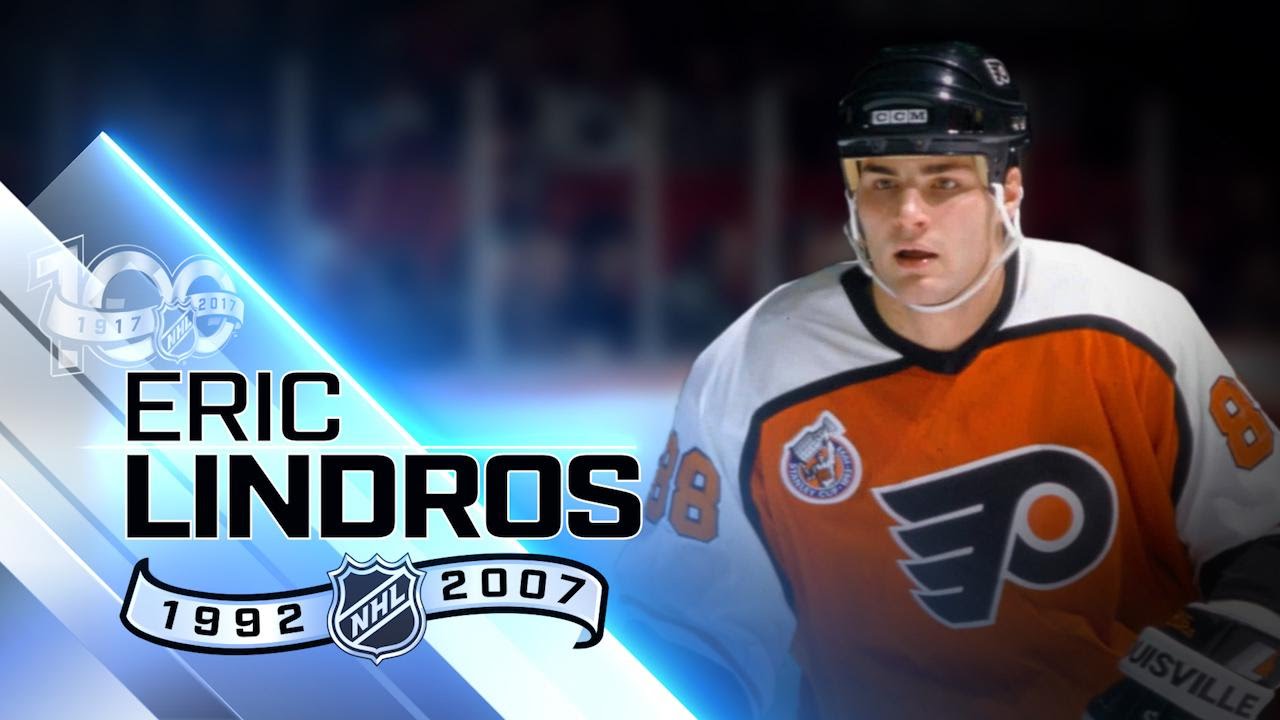
Eric Lindros could have starred in a reality TV show if not hockey. For a whole year, he refused to sign with the Quebec Nordiques. To get something out of having drafted him first overall back in the 1991 NHL Entry Draft, the Nordiques shopped him around looking for the best deal. Within an hour and a half the morning of the 1992 draft, on June 20, the Nordiques traded Lindros to both the Philadelphia Flyers and the New York Rangers. It took until June 30th before the matter was settled, in the Flyers’ favor.
At the 1991 entry draft, everyone wanted center Eric Lindros, called the “complete package.” But the Nordiques had first pick, and Lindros made clear his absolute refusal to play for them. He explained that his reasons were financial and because he did not want to live in French-speaking Quebec. After his career was over, he claimed, “The decision to not play for Quebec was based solely on the owner [Marcel Aubut]. It had nothing to do with language, culture, city.” Lindros declined to put on the sweater when drafted, and then he failed to report. Instead, he played for the Canadian Olympic team (which won silver) and waited to be traded.
During the “Eric auction,” the Nordiques found not one but two good deals and ended up trading Lindros twice. The Flyers had been scouting Lindros for four years and repeatedly asked Nordiques president Marcel Aubut for permission to talk to Lindros. He would say, “Not until we have a deal.” At about 10:30 am on June 20th, the Flyers’ general manager, Russ Farwell, and president, Jay Snider, had that deal. Aubut gave them Lindros’ phone number. According to Lindros’ agent, Rick Curran, “The Flyers called to receive comfort that Eric Lindros would be willing to play in Philadelphia. They received that comfort.” Aubut even checked in on the call around 11:30 am.
Meanwhile, the Rangers were unaware of the Flyers’ agreement, so they discussed a deal with the Nordiques. Liking this option better, the Nordiques agreed at about 11:50 am. Around noontime, Aubut told Snider they were accepting the Rangers’ offer instead. “The guy who made the deal claimed he hadn’t made a deal,” said Farwell. “So it’s in dispute. It has to be sorted out with the league, with the arbitrator.”
The Flyers immediately filed a complaint with the NHL. They had the choice between letting NHL President John Ziegler decide or placing the matter in the hands of an outside arbitrator. They chose the latter in the hopes that everything would be settled while Ziegler was still attending meetings. At the time, some NHL officials commented that trades were not official until they were submitted in writing. They cited a 1991-92 trade that had been nullified because the fax was not received before the deadline. As it happened, it took a whole week for the arbitration.
Toronto lawyer Larry Bertuzzi served as arbitrator. He interviewed 11 witnesses, resulting in 400 pages of testimony. For him, the key was that Aubut gave the Flyers permission to contact Lindros, indicating that the deal had in fact been made. Bertuzzi announced, “Having considered the matter carefully and having reviewed and assessed the evidence of all witnesses, I find that Philadelphia made an enforceable deal with Quebec.” He put a pin in the whole situation saying, “The decision was black and white – and orange.”
The Rangers conceded gracefully in a statement by General Manager Neil Smith, “The New York Rangers are naturally disappointed by the arbitrator’s decision. However, we have an exciting, young, winning team and will continue to pursue every opportunity to make it even better.” On the victorious side, the Flyers expressed their excitement when President Snider said, “This is a great, great day for the Flyers. I don’t think any of us have ever experienced the highs and lows that we went through last week. . . . Today, we’re up on top of the mountain again.”
With the Philadelphia trade deemed valid, the club gave up five players (Ron Hextall, Mike Ricci, Steve Duchesne, Kerry Huffman, and Peter Forsberg) and $15 million in return for Lindros’ rights. The original deal included the Flyers’ first-round draft pick, but because of the double dealing, they selected their own choice (Ryan Sittler, son of former Flyer and Hockey Hall of Famer Darryl Sittler). Instead, the trade would include Philadelphia’s first-round picks for 1993 and 1994. According to Farwell, “We drew a line going into the negotiations for Lindros, and we did not step over that line. It’s been proven lately that a dominant player is the key to a successful team in a successful year. I think we might get to where we want to go more quickly.” He further justified the trade, “Very seldom do you get a chance to trade for this kind of player. I think the general feeling is that once in every 10 years this kind of guy comes along.” Rather than fans being upset over the high cost, Flyers ticket sales sprang up dramatically.
Lindros seemed satisfied with his new team, saying, “Philadelphia has a great, young, up-and-coming team, and it will be a lot of fun to be part of it.” He continued, “I’m happy I’m in Philadelphia because it’s a great place to be and a great place to play. Everything I’ve heard about it is really positive. I don’t know much about the city or the organization. I know that they’re building a new Spectrum, and I’m happy to be a part of it.”
It did not take Lindros very long to prove his worth. During the 1994-95 season, No. 88 won both the Hart Memorial Trophy and the Ted Lindsay Award. He played for the Flyers until 2000, averaging 1.36 points per game and making playoffs most of those seasons. They came the closest to winning the Stanley Cup when they lost the finals in 1996-97, as he led the scoring during playoffs. Controversy still followed him, and the Flyers took away his captaincy in 1999-2000. Lindros then missed the next season with a concussion and a contract dispute. The Flyers traded him to the Rangers, of all teams, on August 20, 2001. He finished his NHL career with Toronto in 2005-06 and Dallas in 2006-07. During his time in the NHL, Lindros continued to represent Canada. He played in the 1998 and 2002 Olympics, taking home a gold medal in the latter. Lindros was inducted into the Hockey Hall of Fame in 2016.
Additional Sources:
Mike Commito, Hockey 365: Daily Stories from the Ice(Toronto: Dundurn, 2018), kindle edition.
Glen Macnow and Ray Parrillo, “Flyers say Lindros deal was done,” Philadelphia Inquirer, 21 June 1992, pp. D1 and D9.
Gary Miles, “Flyers draft Darryl Sittler’s son in first round,” Philadelphia Inquirer, 21 June 1992, p. D9.
“The Lindros decision,” Philadelphia Inquirer, 1 July 1992, pp. A1, A6, D1, D4, D5.
I’m 5’8, 178 pounds, played
hockey my whole life, and love the game almost more than my family, but I never
made the National Hockey League nor even came close.
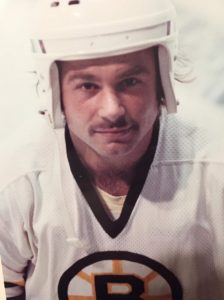
Bobby Lalonde (Photo: From Court Lalonde)
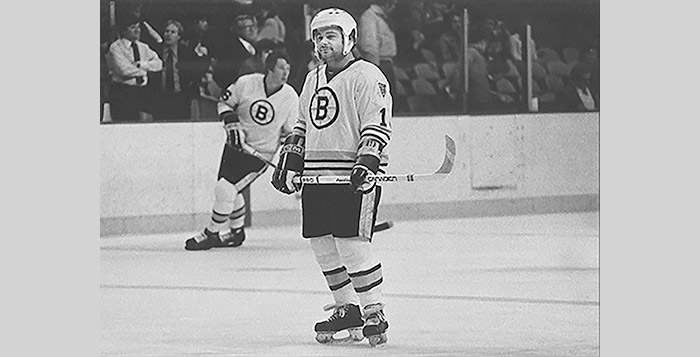
My father, Bobby Lalonde, played for 11 years in the NHL, and I don’t remember a single moment of it. It’s one of the biggest regrets I have in life that I never got to see him play and remember it.
Growing up in Canada, the majority of people I know live and breathe hockey, especially the NHL. I have followed the NHL since I can remember, pretended to be Wayne Gretzky in the driveway scoring the big goal. I never pretended to be my father because I couldn’t wrap my head around that concept because I couldn’t remember him playing.
My father gave me every
opportunity to learn from him on how to play the game and play it well, but
unfortunately, I lacked the skill that he had. I would tell anyone that would
listen that my dad played in the NHL and that I was going to do the same.
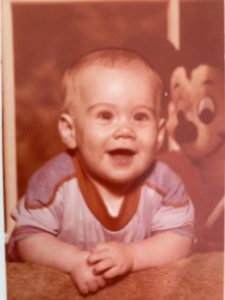
Court Lalonde (Photo: Court Lalonde)
When I was a little kid, I was the best player out of my friends and could say so. Unfortunately, as I got a little older, I found out that this was not the case. However people expected me to be a top player because of who my dad is. I would end of being picked first whenever we got together to play road hockey and shinny, but then people would realize that I wasn’t this first overall pick that they thought they got and more of a first-round bust because I played more like a later-round pick.
The look of disappointment from
people that I wasn’t the best out there or what they thought I should be is not
the greatest feeling and can get tiresome. It even can make you resent the game
you love so much. On those occasions that I did have a good game when I was young,
it didn’t matter because it wasn’t good enough. Somehow I should have got that
one more goal or assist.
As I got older, it got even worse because people started to look at me as a failure when compared to my father. I couldn’t even use the excuse that I wasn’t tall enough because my dad was only 5’5, so that doesn’t work.
So I changed the way I played
the game, became a defense-first type of player and would hit everything that
moved on the ice – got pretty good at it, too. At one point, I was playing rep
hockey and high school hockey and loving every minute of it.
My father was very encouraging and drove me to every game, and it didn’t matter what time or how early that game or practice was.
I grew up with a father that, if I did, say, score a hat trick–and that was the rare occasion–he would talk to me about my defensive side of the puck or how many face-offs I won that game instead. At the time I wished he’d have commented on my scoring. I can’t blame him now. As I’ve gotten older, I’ve learned that playing a well-rounded game is as essential to winning as getting on the scoresheet and that successful teams always have room for a player whose defense is his best attribute.
In my teenage years, I wouldn’t tell anyone that my dad played in the NHL if they didn’t already know because I didn’t want to look like I was bragging. I didn’t want them to develop a preconceived idea of who I was before really getting to knowing me. And to be honest, I was almost ashamed of it, denying it if people did ask me, because I wasn’t the next in line to the NHL just like my dad.
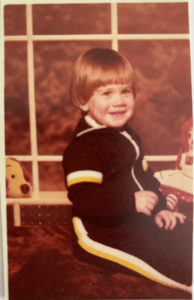
Court Lalonde in Bruins track suit
I even lost interest in hockey for a couple of years after high school because I wasn’t good enough for any high-level hockey. I went to college and found I wasn’t good enough even to play on that team. I used to follow many players growing up like Brett Hull and Gretzky as a young kid, but I didn’t really have a favorite team. Instead I always cheered for the teams my dad used to play for which were Vancouver, Atlanta (which moved to Calgary), and Boston.
The Boston Bruins are the team I’ve always had a soft spot for and cheered for the most and think it was because my grandfather would always wear his Boston Bruins hat and be so proud that my father played for an original six team.
Before he passed away, he would always tell me stories, with such pride in his voice, about my dad playing for the Bruins. My grandfather loved the fact that my dad got to play for such a historic franchise in the NHL, as well as having played side such great players as Rick Middleton, Wayne Cashman, Brad Park, and Ray Bourque to name a few.
My dad played with great
players on his other teams, but after I finished college, it was the Bruins
that got me back into the NHL and hockey for that matter.
As a kid, I could name every player and discuss any aspect of the game, but I had lost that connection. The Bruins revived my interest to the point I watched every game on TV and started playing men’s league hockey as well.
I consider myself a die-hard
Bruins fan and sometimes think of my grandfather when I see the spoked B, and
that is something I will cherish forever. Despite the fact my family now lives
in Greater Toronto, my wife loves the Bruins and shares my passion. I have been fortunate the past couple of
years to take advantage of the fact that my dad played in the NHL and as a
result have been to several games in Boston including the two Winter Classics
that the Bruins hosted. I no longer hide
the fact that my dad played in the NHL. These days I’m very proud of it, to be
honest. I understand that some people don’t want to hear about it or might even
be envious, but they really shouldn’t be. After all he is also my father, not
just an ex-NHL player, and I’m proud of him for that just as much.
Someone recently suggested that
I think the fact my dad played in the NHL makes me somehow superior. I disagree
with that and I don’t share it to brag. If I seem overly enthusiastic, it’s
because I’ve come to realize it’s not a burden but a blessing. Few people can
love a game so much and have a father that played it professionally. Regardless
of what anyone else thinks, I’m just so proud to say that my dad played in the
NHL.
The Dallas Stars had some success under first year head coach Jim Montgomery last season, but there is still work to be done. The Stars may have lost in the second round to the eventual Stanley Cup Champions, but there are still improvements that need to be made to the current roster to get even further. They have the goaltenders covered with the duo of Ben Bishop and Anton Khudobin. There is plenty of room for improvement on the offensive and defensive side of the puck.
Here is my offseason wish list for the Stars:
1) Re-Sign Mats Zuccarello
The Stars acquired Mats Zuccarello on Feb. 23, 2019, prior to the NHL’s trade deadline. The forward blocked a shot in his first game with his new team and went on to miss about four weeks of action. Zuccarello came back for the playoff-clinching game against the Philadelphia Flyers on Apr. 2, and then sat out until the playoffs. The downside of not playing was that he didn’t get to know his teammates’ on-ice habits.
Zuccarello brought a balance to the Stars’ lineup that was lacking all season. He could play up or down in the lineup, producing wherever he was slotted to play. The winger seemed to form chemistry with his teammates, no matter what line he was playing on. The Stars had more than one scoring line and this helped them to defeat the Nashville Predators in the first round of the Stanley Cup Playoffs. Zuccarello brought speed and consistency to a top line heavy offense.
2) Depth Scoring
The Stars relied too much on the top line of Jamie Benn, Tyler Seguin and Alexander Radulov. The trio combined for 89 goals, 116 assists and 205 points during the regular season. The next three leading scorers on the team after them were the defensive trio of John Klingberg, Miro Heiskanen and Esa Lindell. This is a major part of the reason why the Stars were inconsistent and streaky at times last season. There was a major lack of depth scoring from the forwards.
There are some free agent options that may not be costly, but the Stars could also explore some trade options. The team has already signed forward Mattias Janmark to a one year contract extension. One free agent option could be Thomas Vanek. Yes, he is 35-years-old but he manages to produce and chip in offensively no matter where he is playing. Another option could be Derick Brassard, but he could come at too big of a cap hit. Joonas Donskoi and Ryan Dzingel have the potential to be cheap, yet effective, options in free agency.
3) Top Six Help
If the Stars can’t get a deal done with Zuccarello then they are going to need to add someone else who can play in the top six. The emergency of Roope Hintz is an option, but can he sustain the level of play from the playoffs throughout a full NHL season. The Stars can’t live-or-die by the production of one line so a top six forward is necessary if this team wants to take the next step.
There are a few options still available in free agency. The first option is Gustav Nyquist. The 29-year-old had 22 goals, 38 assists and 60 points in his time with the Detroit Red Wings and San Jose Sharks last season. The second option could be Anders Lee, who has a 40-goal season under his belt. Lee knows what it takes to score goals and doesn’t have a problem going to the net to get some of his goals.
4) Julius Honka Decision
The Stars need to make a decision on whether the 23-year-old defenseman has a future with the team. Julius Honka was the odd man out last season with the emergence of rookie, Miro Heiskanen. Esa Lindell also improved his game playing with John Klingberg. The Stars also reacquired Jamie Oleksiak and signed him to an extension. The Stars had a crowded blue line last season, but even when injuries happened, Honka couldn’t manage to get into the lineup.
The health of Stephen Johns, who is still recovering from a concussion last preseason, will factor into what happens with Honka. If the Stars decide to put Honka on the trade block, he could get them something in return since right-handed defensemen seem to be in high demand this offseason. Honka is a restricted free agent so another team could sign him to an offer sheet to force the Stars’ hand. The team currently has five defensemen on the roster for the 2019-20 season.
5) Depth Defensemen
The Stars defense did a decent job as a whole last season and it helped to have both Bishop and Khudobin make saves to cover up some of the mistakes. The six defensemen on the roster are younger in age, but have some experience. The oldest blue liner is 33-year-old Roman Polak, who has already signed a one-year, $1.75 million extension for next season. The team could use a veteran blue liner to play third pairing minutes or be an option as the seventh defenseman in case of injuries.
The team could bring back Ben Lovejoy since he is familiar with the team’s style of play since he was on the Stars’ roster last season. They could also bring back 31-year-old Taylor Fedun on a cap friendly contract. Fedun played decent when he was in the lineup last season. The third option is a long shot, but Michael Del Zotto could fit this role pretty well.
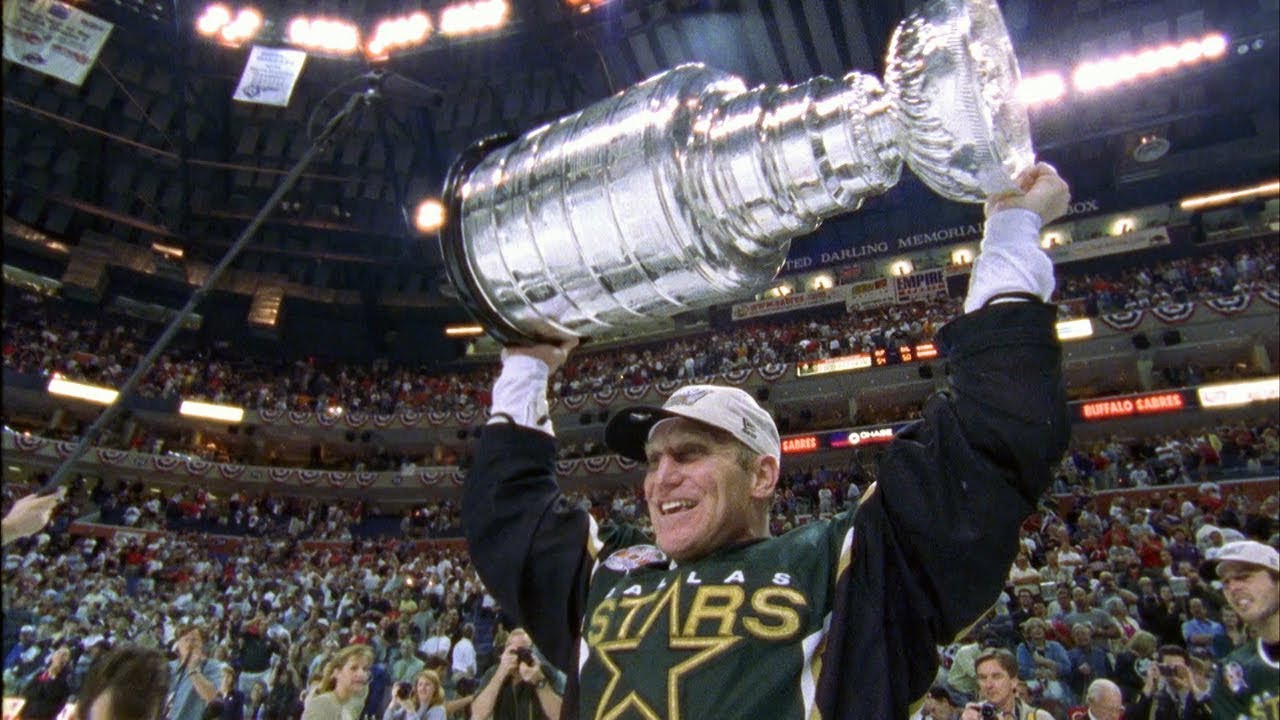
The time approached 2 am, when the second-longest Stanley Cup Final ended the longest NHL season. Game 6 of the finals between the Dallas Stars and Buffalo Sabres began on June 19, 1999 and lasted until 14:51 of the third overtime, just 22 seconds behind the record-setting game in 1990 between Edmonton and Boston. The Stars finally won the game and their only championship thanks to Brett Hull. He scored with his skate inside the crease, causing a controversy with an NHL reviewing rule that was subsequently altered.
Going into playoffs, the Dallas Stars (with 114 points) were again the leader in the standings, whereas the Buffalo Sabres (with 91 points) were the seventh seeded. As expected, the Stars made it through to the finals. The Sabres were more of a surprise, making the finals for only the second time in their history. It had been 24 years since the Sabres lost the championship in 1975.
Still, the Sabres came out strong by winning Game 1 in overtime with a score of 3-2. The Stars came back to win the next two (4-2 and 2-1). Buffalo took Game 4 (2-1), but Dallas shutout Game 5 (2-0). That gave Dallas a 3-2 lead in the series.
Game 6 began at about 8 pm on June 19. Despite temperatures in the high 80s, fans tailgated outside Buffalo’s Marine Midland Arena. The Stars drew first blood when Jere Lehtinin scored “a fluky goal” through a crack between the post and Dominik Hasek’s hip at 8:09 into the game. Buffalo bounced back when Stu Barnes “fired a wrist shot over Belfour’s blocker” at 18:21 of the second period. The only penalties called the entire game, all during the second session, were two minor penalties for each team. Despite 54 shots on net, the Sabres failed to score again. They actually set a record for the fewest goals scored during a six-game series. Their nine goals totaled two less than the record set by the Toronto Maple Leafs back in 1940.
The game went into overtime, double overtime, and even triple overtime. Then came the moment of truth, at 14:51 into the third overtime session. Thanks to Mike Modano’s second assist of the night, Hull had the puck by the crease. He nabbed the rebound, slid the puck to a better spot, and slid it by the prone Hasek into the net. Hull considers that his most important goal (of the 844 in his career). “It ranks No. 1 to me. There was a boatload of people saying when I was leaving St. Louis, ‘You’re never going to win with Brett Hull on your team.’ To go to Dallas and be the missing piece of the puzzle that’s going to help them win their Cup, and then to go out and score the goal in overtime – who hasn’t sat as a kid on the ice with his buddies and dreamt or pretended that’s the goal they’ve scored? To do it in real life was something special.” Dallas immediately began celebrating, having won their first Stanley Cup championship.
Hasek, as the defeated goalie, tried to put things in perspective later. “But once the game is over, you always have to look forward. That’s the way I always approached hockey. It was my most exciting year of my career in the ’90s. We had a talented team, hard workers, players who could score. We were close. But you never know in this game what can happen. I can still see when Brett Hull got the third shot and put it behind me. Disappointing. So disappointing.”
The furious Buffalo Sabres wanted answers. All season, officials had used video review to disallow goals when players stood inside the crease to shoot. Hull was clearly partially in the blue paint when he scored the game-winner. Yet, the goal was not reviewed during the game. The team was already changing in the locker room when they found out. Buffalo’s coach, Lindy Ruff, yelled at Commissioner Bettman. He explained, “I wanted Bettman to answer the question of why this wasn’t reviewed. He turned his back on me. It was almost as if he knew this goal was tainted.” He told reporters this situation was “our worst nightmare.”
After meeting with the Sabres, officiating supervisor Bryan Lewis and his team reviewed the “sequence dozens of times.” They determined that the goal was good because Hull had possession of the puck the whole time he was in the crease. According to Lewis, they had sent a memo towards the beginning of the season informing everyone that the player could be in the crease as long as they had possession of the puck. Hull later said, “The NHL decided they weren’t going to tell anybody but the teams. … They changed the rule to say if you have control in the crease, you can score the goal, and that’s exactly what it was. But nobody knows that. You can tell people that a million times and they just will not listen.”
On June 21, 1999, the NHL officially announced that video review would no longer be used to overturn goals due to a player being inside the crease. Instead, it was again solely up to the on-ice officials to determine goalie interference. Bettman justified, “We’re relying too much on replay.” This rule adjustment was meant to avoid delays, and according to him, was not related to Hull’s goal.
Hull and Hasek won a championship together in 2002, when they played for the Detroit Red Wings. They never discussed the 1999 ending until their mutual victory. “I just didn’t want to talk about it. He didn’t want to say a word about it, so we walked around it and we’re good friends,” explained Hasek. “Brett is a fun person. He never said one thing about it but then the reporters were asking and we were making fun about it that evening. I think right after the game in the locker room we talked a little and just agreed it was one of those crazy things.”
Back in 1999, Lehtinin won his second consecutive Frank Selke Trophy. His teammate, Joe Nieuwendyk received the Conn Smythe after scoring the winning goals for six playoff games. On the other side, Hasek earned his fifth Vezina Trophy in six years.
Additional Sources:
Mike Commito, Hockey 365: Daily Stories from the Ice(Toronto: Dundurn, 2018), kindle edition.
Hockey Chronicle: Year-by-Year History of the National Hockey League(Lincolnwood, Ill.: Publications International, Ltd., 2006), 606-611.
Sal Maiorana, “Sabres’ dream ends,” Rochester Democrat and Chronicle, 20 June 1999, pp. 1D and 4D.
Leo Roth, “Sabres dig deep, but it’s still not enough,” Rochester Democrat and Chronicle, 20 June 1999, p. 4D.
What began as a bit of a joke, ended with the only time a coach has been traded in the same manner as a player. On June 18, 1987, the New York Rangers traded a first-round draft pick and $100,000 to the Quebec Nordiques in return for their coach, Michel Bergeron.
The New York Rangers had a terrible time with coaching during the 1986-87 season. After the first 19 games, they replaced Ted Sator with Tom Webster. Only 18 games later, Webster had to quit because his inner-ear infection kept him from traveling. Phil Esposito, the general manager, had to pull double duty for the majority of the season. Was it any wonder he grew desperate to find a solid coach for the Rangers?
At the 1987 NHL Entry Draft, held at Detroit on June 13, Esposito approached Quebec’s general manager, Maurice Filion. According to Esposito, “I happened to walk over to Quebec’s table to try to do some dealing. I said to Maurice Filion, ‘Why don’t you let me have Bergeron?’ I must have gone back and forth to his table 15 times. . . . It (the negotiation) was back and forth all night until finally, he said, ‘A first (first-round pick) or nothing.’ I said, ‘You got it.’”
Bergeron had a reputation as “fiery, flamboyant” with a temper that earned him the nickname “Le Petit Tigre.” After seven years coaching the Nordiques, rumors indicated tension between Bergeron and Filion. That may have been why Quebec was willing to trade him two years before his contract ended. Esposito wanted that passion to spark something in the Rangers. As soon as he received the rights, Esposito called Bergeron on Sunday and then flew him to New York to meet on Tuesday. Upon accepting the offer, Bergeron claimed, “I am confident. I am very confident.”
The New York Daily News listed three reasons Bergeron should be good for the Rangers. First, he knew enough “show business” to get by in New York. Second, his French Canadian background would help with the handful of players on the team with the same heritage. Third, his experience through coaching 622 games put him as the second-most experienced NHL coach. Pat Price, who had been traded to the Rangers after five years under Bergeron, commented, “I’m probably a lot happier having him back than he is having me back. He’s one of the most astute coaches I’ve had in my 13 years, and I’ll tell you one thing – if anybody can pull a team together and get it to play up to its potential, he can do it.” Madison Square Garden owner Richard Evans , “We believe we have the best coach in the NHL joining us today. We believe we have the best GM in hockey, and as of today I believe we have the best coach in hockey. We’ve concluded a search that will help the Rangers for a long, long time.”
That last statement turned out to be incorrect. Esposito fired Bergeron before he had even finished his second season with the Rangers. The team had failed to make playoffs the first season, and they had a record of 73-67-18 with Bergeron. Esposito had to coach the last two regular-season games and the only playoff round (in which the Rangers were swept) of the 1988-89 season. Roger Neilson became the new Rangers coach. Meanwhile, Bergeron actually returned to Quebec for a final season.
The Nordiques did not get much out of their first-round draft pick either. Using the Rangers’ fifth slot, they selected Daniel Dore. He only ended up playing 17 NHL games, scoring two goals and five assists. Otherwise, he spent most of the 1990-91 and 1991-92 seasons playing for the Halifax Citadels in the AHL. Dore signed with the Philadelphia Flyers in December 1992, but he only played for their AHL affiliate, the Hershey Bears.
All-in-all, the coaching trade of 1987 was a bust and has yet to be repeated.
Additional Sources:
Mike Commito, Hockey 365: Daily Stories from the Ice(Toronto: Dundurn, 2018), kindle edition.
Frank Brown, “Espo Names Bergeron as Coach,” New York Daily News, 19 June 1987, pp. C29 and C36.




 Prev
Prev