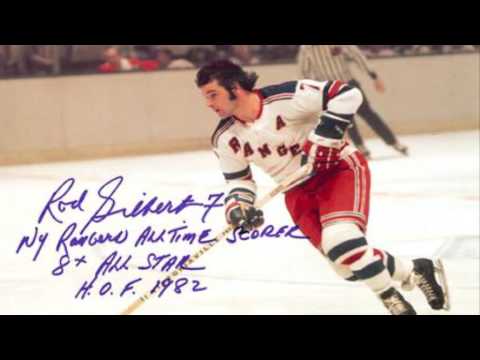
During the 1960s and 1970s, no one represented the New York Rangers more than right wing Rod Gilbert. With his skating partner since childhood, center Jean Ratelle, and left wing Vic Hadfield, they had great success on the G-A-G Line (Goal-A-Game). It all started with Gilbert’s birth on July 1, 1941.
Gilbert was born in Princeville (between Montreal and Quebec City), and he was raised in the Pointe-Aux-Trembles neighborhood of Montreal. The arena there has since been named the Rodrigue Gilbert Civic Centre. The Gilbert family had five children, and the brothers would share equipment and spend their days skating outdoors. The second-youngest Gilbert was a huge fan of the Montreal Canadiens and emulated his favorite player, Bernard “Boom Boom” Geoffrion. “‘Boom Boom’ had this big slapshot and (we loved it because) it made a lot of noise against the boards.”
At 12, Gilbert began his hockey partnership with Jean Ratelle. According to Gilbert, “When I first saw him on the ice, I said, ‘You play with me all the time, okay?’” Naturally then, when 14-year-old Gilbert was recruited for the Rangers’ Junior B team, he convinced Yvon Prud’homme to sign Ratelle “without ever seeing him play.” Gilbert then played for the Rangers’ Junior A team, the Guelph Biltmores. After a season there, the 17-year-old told the coach to bring Ratelle saying, “We’d like to play together.” They finished the season with 61 and 51 points, respectively. The next season, 1959-60, they won the Memorial Cup. Just as Gilbert was finishing his junior career, he fell into the boards after skating over some debris, which basically left him paralyzed until he had surgery on his vertebra.
Finally, in 1962, Gilbert began playing full-time with the Rangers. “My career didn’t start out on fire,” noted Gilbert. He still managed to score 31 points despite issues from his back injury forcing him to wear a custom-fitted brace until he could have another operation. The Rangers also struggled during that time. Gilbert remarked, “When I got to New York, the Rangers were in last place. We were re-building. . . . We fought with the Bruins for fifth place. We had Muzz Patrick as our general manager. Lynn Patrick was in Boston. We used to say that whoever finished sixth won the Patrick Trophy.” Gilbert had another back surgery in January 1966, and his scoring took off soon thereafter. After having basically died and come back, Gilbert said, “A doctor here in New York saved my career. He took a bone from the pelvis and interwove it between the fourth, fifth and third vertebrae. It made a solid piece out of it. I played another thirteen or fourteen years after that.”
The high point of Gilbert’s career began in 1970-71, when the GAG Line formed. “It was quite a formation. Jean and I had played together since peewee. We were good together. We needed somebody to complement us. Jean Ratelle was a left-handed shot and he came to the right wing all the time with the puck. Jean and I needed somebody to go to the front of the net and hold his ground. Emile Francis decided that Vic Hadfield was the guy. Vic had a very short fuse. He was a tough guy; very robust. He established himself well in front (of the net) and could shake himself loose from the defense.”
That season, the Rangers set a new record for themselves with 109 points (49-18-11). The next season, the line became the NHL’s first in which all three topped 40 goals, and they ranked third through fifth in the top NHL scorers. The only two to beat them (Phil Esposito and Bobby Orr) played for their Stanley Cup rivals, the Boston Bruins. Gilbert commented, “The bottom feeders of the NHL for so long became forces. And so did the Boston Bruins. . . . We were supposed to win the Stanley Cup in ’71, ’72 and ’73. We had a really good team, but Bobby Orr made the difference between the two of us. Boston won two Cups instead of the Rangers. What a rivalry we had! We were very close in talent.”
In 1972, Gilbert and his linemates joined Team Canada playing the USSR for the Summit Series. “Team Canada ’72 was the greatest accomplishment of my career. It was the event of the century in Canada,” said Gilbert. He and the team improved dramatically over the course of the series. “That win with Team Canada in 1972 was my Stanley Cup.”
Gilbert played 18 seasons for the Rangers, becoming their all-time leading scorer in points (1,021) and goals (406). In addition to still holding those records, he also had the most game-winning goals (52). In 12 of those seasons, he scored 20 plus goals, and in five straight years, he scored at least 75 points. Gilbert became the first Ranger to score 300 goals back on March 24, 1974. In the NHL, he ranked in the top-ten scorers five times. With the start of the 1977-78 season, Gilbert’s contract negotiations had not gone well, so he only ended up playing 19 more games before retiring.
Over time, Gilbert earned numerous awards. For his dedication and perseverance, he received the Bill Masterton Memorial Trophy in 1975-76. He was named Rangers MVP at least three times. The Rangers retired his No. 7 on October 14, 1979, as the franchise’s first ever retired sweater. For his contribution to hockey within the U.S., he received the Lester Patrick Trophy in 1991. Upon his 1982 induction into the Hockey Hall of Fame, 41-year-old Gilbert remarked, “At no time do you foresee that there is any possibility that at the end of your career, your peers and the fans are going to recognize you by being elected to the Hall of Fame. You never think that. I had played all those years in New York. I didn’t even think about the honour. You don’t even know the meaning of it until you get the phone call. You say, ‘Oh my God, I’ve been elected to the Hall of Fame!’”
Third time must have been the charm. The struggling franchise moved from Kansas City to Colorado to New Jersey, where on June 30, 1982, the team was named the Devils.
Kansas City, Missouri received an NHL franchise on June 8, 1972, as part of an expansion meant to combat the rival World Hockey Association (WHA). The Scouts played their first game on October 9, 1974. However, they had two poor seasons that barely filled their arena halfway, and they owed money to the NHL and nearby St. Louis Blues. Thus, instead of expanding into Denver in 1976, the NHL moved the Scouts to Colorado.
The Colorado Rockies spent six seasons in Denver, but they only made the playoffs once. When he bought the franchise in 1978, Arthur Imperatore planned to move the team to his home state of New Jersey. It took three tries before relocation went through. During Imperatore’s time, the main issue was that the arena at East Rutherford, New Jersey would not be built in time, and his proposal to temporarily share Madison Square Garden failed. The next owner, Peter Gilbert, also tried to relocate, but the NHL wanted to keep a franchise in Denver. Having lost about $4.5 million on the team in 1981-82, Gilbert sold to John McMullen and his group.
Finally, the NHL approved the relocation with the stipulation that McMullen pay over $20 million in territorial compensation fees because three big franchises already played in the area (the New York Rangers, the New York Islanders, and the Philadelphia Flyers). New Jersey joined the Patrick Division, and the Winnipeg Jets moved from the Norris to Smythe Division after the Rockies left.
As many new and relocated teams did, New Jersey held a “Name That Team” contest. The statewide contest featured 11 names and some write-ins. With over 10,000 ballots cast, the Devils came out on top with 2,400 votes. The runner-up, Blades, received 1,700 votes. The other names up for consideration included, Meadowlanders, Colonials, Americans, Meadowlarks, Lightning, Coastals, Generals, Gulls, Jaguars, and Patriots.
At the press conference held at Brendan Byrne Arena of the Meadowlands Sports Complex in East Rutherford, McMullen announced that the team would be known as the New Jersey Devils. He said, “According to Webster’s dictionary, one of the definitions of devil is ‘a person of notable energy, recklessness, and dashing spirit. I’m very pleased with it in spite of the fact we didn’t think of it ourselves.” Unsurprisingly, he received some letters and calls due to the negative religious connotations, including one sportswriter being called “an agent of Satan.” Surprisingly, New Jersey Sports and Exposition Authority reps actually conferred with clergymen, who didn’t object. Goalie Chico Resch joked, “I’ve always said I thought goalies were God’s chosen people. We’re the only people that, when we sin, the red light goes on and you hear sirens.”
The new name actually referred to the legendary Jersey Devil. Similarly, an Eastern Hockey League team had played under the name Jersey Devils from 1964 to 1973. The Jersey Devil, often called Leeds Devil, was a mythological beast described as “part dog, part kangaroo, part goat, and with cloven feet.” According to the folklore, since the 1730s, he has roamed the Pine Barrens of South Jersey frightening folks or worse.
To go with the new name, the team chose the color red. They added dark green to represent the Pine Barrens and their location in the Garden State. At the time, these “Christmas colors” were unique in the NHL. The inconsistency of the green color led them to switch to black in 1992. A simple “N” and “J” with devil horns and tail form the team logo. It was modified from the one designed by McMullen’s wife around the time of the 1982 relocation.
After winning three Stanley Cup championships – in 1995, 2000, and 2003 – the Devils moved from East Rutherford to Newark, New Jersey in 2007. Since then, they have made the playoffs in five of twelve seasons, while one of those included the Stanley Cup Final. During years without playoffs, rumors of relocating yet again rise, and some even mention returning to Kansas City. Despite financial struggles and injuries, the Devils cannot be counted out yet. They just recently had the No. 1 pick at the 2019 NHL Entry Draft, so who knows what future is on the New Jersey horizon.
Additional Sources:
Stephen Laroche, Changing the Game: A History of NHL Expansion(Toronto: ECW Press, 2014), 234-237.
Hockey Chronicle: Year-by-Year History of the National Hockey League (Lincolnwood, Ill.: Publications International, Ltd., 2006), 438.
Tim Sullivan, Battle on the Hudson: The Devils, the Rangers, and the NHL’s Greatest Series Ever (Triumph Books, 2012), kindle version.
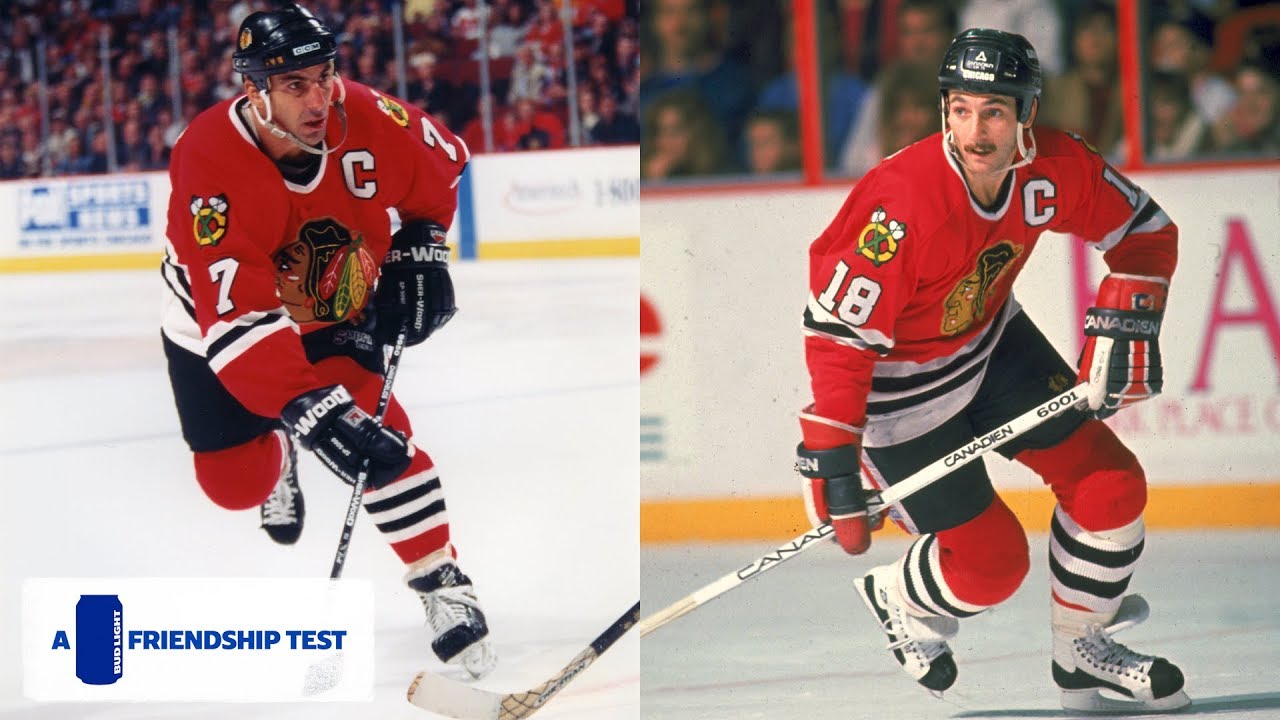
Twice, 26 years apart on June 29, the Montreal Canadiens traded away one of their most famous players in return for a star player from down the middle of the U.S. In 1990, they traded defenseman Chris Chelios and a second-round draft pick to the Chicago Blackhawks in return for French-Canadian center Denis Savard. In 2016, they swapped defensemen so that P.K. Subban went to the Nashville Predators while their Shea Weber came up to Montreal.
Chelios and Savard each felt that they were returning home in 1990. The former had grown up in Chicago but was drafted by Montreal in the 2nd round (40th overall) during the 1981 NHL Entry Draft. Meanwhile, the latter hailed from Pointe Gatineua, Quebec and played for the Montreal Juniors only to be passed over when Montreal had first pick overall at the 1980 NHL Entry Draft. Instead, Chicago drafted Savard third overall, leaving him to worry about knowing so little English.
Though Chicago was his hometown, Chelios played well for the Canadiens for seven seasons, helping win a Stanley Cup and earning the Norris Trophy in 1989. After the trade, he took home the Norris Trophy as best defenseman twice more. Chelios also helped Chicago make it to the Stanley Cup Final in 1992. According to his former coach, Mike Keenan, “Chris Chelios changed the culture of the Chicago Blackhawks. He was one of the fiercest competitors I ever coached. He was without fear, courageous in his play, a risk-taker, but also an intelligent hockey player.” Unfortunately, within five seasons, contract negotiations fell through resulting in another trade.
Meanwhile, Savard set Chicago’s record for points during a rookie season with his 75 (28G, 47A). The very next season, he set a team record for points with 119 (32G, 87A), which he beat in 1987-88 by scoring 131 points (44G, 87A). In fact, he remained Chicago’s top scorer for seven straight seasons. After moving to Montreal, Savard could not keep up his high scoring. In his final season with them, 1992-93, he scored a personal low of 50 points, but the team went on to win the Stanley Cup.
As for the next generation of players traded, Montreal drafted Subban as their second-round pick (43rd overall) of the 2007 NHL Entry Draft. He had already become a big deal at the 2008 and 2009 World Junior Championships, helping Canada win gold at both. Also selected in the second round, Weber was chosen 49th overall by the Predators at the renowned 2003 NHL Entry Draft. He too had earned a gold for Canada at a World Junior Championship.
Subban, in his first full-time season of 2010-11, led Montreal in power-play goals (9) and became their first rookie to score a hat trick. Two seasons later, he earned the Norris Trophy and tied for top scoring defenseman with 38 points. After the trade, Subban scored even more for the Predators and helped them take their first trip to the Stanley Cup Final in 2017. The following season, Nashville won the Presidents’ Trophy.
Just before Subban began playing in the NHL full-time, Weber won a gold medal with Canada at the 2010 Winter Olympics and had been named the Predators’ captain. He was so valuable to the team that they matched an offer rather than let him play for the Philadelphia Flyers. Weber earned the Mark Messier NHL Leadership Award for 2015-16 just before the trade. He had a decent season for his first in Montreal, but he has not been able to play a full one for the past two seasons.
Three of the four players ended up moving on to other teams. Chelios was traded to the Detroit Red Wings in 1999, despite hoping to finish his career in Chicago, because in his nearly ten seasons there, he helped them win two Stanley Cup championships in 2002 and 2008. Along the way, he also managed a silver medal for the U.S. at the 2002 Winter Olympics. He finally retired in 2010, after spending some time with Chicago’s AHL team and the Atlanta Thrashers, after 26 seasons, matching Gordie Howe’s record. Savard quickly signed with the Tampa Bay Lightning in 1993, but they traded him back to Chicago in 1995. He finished his career there, retiring in 1997. Mere days ago, on June 22, 2019, Nashville traded Subban to the New Jersey Devils for Steven Santini, Jeremy Davies, New Jersey’s 2nd-round pick in 2019 NHL Draft, and their 2nd-round pick in 2020 NHL Draft.
When they retired, Chelios had played the most games by any NHL defenseman (1,651), and Savard had the third-highest number of points (1,096) in Chicago’s club history. The latter went on to serve the Blackhawks as assistant coach (1997-2006) then head coach (2006-2008). They named Savard a Blackhawks ambassador in 2010 and Chelios one in 2018. Savard was inducted into the Hockey Hall of Fame in 2000, and Chelios followed him in 2013.
Additional Sources:
Mike Commito, Hockey 365: Daily Stories from the Ice(Toronto: Dundurn, 2018), kindle edition.
The same day, June 28, 1938, that the league that would become the American Hockey League (AHL) became official, they welcomed what would become the longest-continuous hockey franchise after the NHL’s Original Six, the Hershey Bears.
At an annual meeting, held in New York City, two professional leagues officially disbanded and formed a new combined league. The Canadian-American Hockey League (Can-Am League) and the International Hockey League (IHL) had each formed in the 1920s (in 1926 and in 1929). By 1936, the former had lost two teams, so they had the Springfield Indians, Philadelphia Ramblers, Providence Reds, and New Haven Eagles. The latter league had lost four teams, leaving the Buffalo Bisons, Syracuse Stars, Pittsburgh Hornets, and Cleveland Falcons. To survive, the Can-Am teams became the East Division and the IHL became the West to play a “circuit of mutual convenience.” When the governors of the active teams met in 1938, they permanently consolidated the leagues into the International-American Hockey League (IAHL).
To lead the IAHL, they chose Maurice Podoloff of New Haven, Connecticut as president. He had headed the Can-Am League through its role as the East Division. Podoloff would remain president for 16 years (while dividing his time as president of the NBA). John Digby Chick of Windsor, Ontario, former IHL president, became vice-president in charge of officials. The new IAHL then chose to expand the seasons, beginning with 1938-39, to 54 games.
As a top priority, the new IAHL wanted to bring their total back up to an even eight clubs (since the Buffalo Bisons had dropped out of the West Division back in December 1936). Thus, they admitted the Hershey Bears to begin playing that coming season with Herb Mitchell as coach and J.F. Sollenberger as their head. Hershey already had three amateur players from their team willing to turn pro and had recruited seven more players from IAHL’s Pittsburgh team.
As the Scranton Times-Tribune printed the next day, “Hershey has long been a hot hockey center, drawing large crowds for its eastern amateur league games.” The first amateur games were played there in 1931. The next year, Milton S. Hershey, of chocolate fame, established the Hershey Hockey Club, and they played as the Hershey B’ars in the Tri-State Hockey League. The year after that, Hershey became a founding member of the replacement seven-team Eastern Hockey League (EAHL). When criticized for “B’ars” being “too commercial,” the team officially took the name Bears in 1936. After building the Hershey Sports Arena that spring, the Bears placed first in the EAHL standings and won the league title for the second time in a row. They repeated the feat the next season.
With the IAHL affiliation, the Bears kept winning, finishing their inaugural season at the top of the Western Division. However, they failed to beat Philadelphia’s team in a rousing Pennsylvanian playoff series. Playing in their original arena until 2002 and since then at Giant Center, the Bears have won 11 Calder Cup championships, making them the winningest AHL franchise. They are also the longest-lasting. After the Rhode Island Reds were sold and relocated in 1977, Hershey became the only remaining team from the original eight.
When their second season ended in 1940, the IAHL dropped the “International” to become the American Hockey League. The AHL has mostly flourished and grown since then, primarily through absorbing teams from defunct leagues. Currently, the AHL includes 27 U.S.-based teams and four in Canada. These teams are all affiliated with an NHL team and serve to develop their players. Since 2005, the Hershey Bears have been the development team for the Washington Capitals, who won the Stanley Cup championship in 2018.
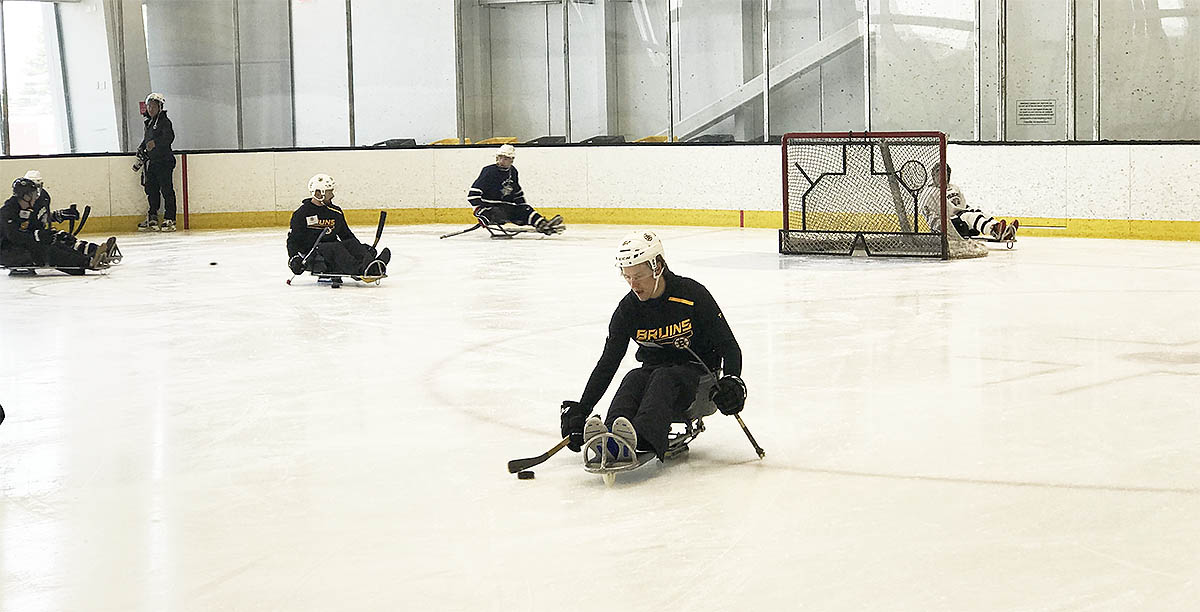
Part of every Boston Bruins Development Camp is an afternoon where the players participate in community events. This year’s camp is no different. After their morning on-ice drills and a little scrimmaging, the prospects were divided up into three groups:
Being involved in the Boston community has been a part of Bruins teams for many, many years. And the Boston Bruins Foundation is focused on children, so it was not surprising to see that two of the three group events were devoted to children. And in fact, there were some young people out on the ice as part of the Northeast Passage Sled Hockey group as well.
Those prospects who participated in the sled hockey included Jack Becker (F), Victor Berglund (D), Jakub Lauko (F), Josh Maniscalco (D), Matias Mantykivi (F), Justin Richards (F), Linus Sandin (F), Oskar Steen (F), Jack Studnicka (F), Dan Vladar (G), and Marek Zachar (F).
What was interesting to watch was the interaction between the Bruins prospects who were listening to some of the more vocal Northeast Passage players about how to do things with their sled, body, and using the specialized sticks. There are two sticks, roughly 27 inches from end of the blade to the top of the stick, in sled hockey as opposed to the one stick in stand-up hockey. The sticks are used both as traditional hockey sticks for moving the puck but also through the picks on the other end as the method of propelling the players along the ice.
Like any hockey practice all of the players were put through some drills. It was clear that the view from the sleds and the inability to use their feet to turn was causing the Bruins prospects to re-learn hockey to a degree. Some of them were a bit more tentative than others. And there were a few shouts of “Woah, woah,” when a couple of the players were heading into the boards, much as someone new to skating in general might have said when unable to stop.
After the drills, there were some battle drills, where they played a scrimmage on just half of the ice with nets set up east and west. The smaller “rink” for this scrimmage was a little easier for the Bruins prospects to stay in the game, but as things opened up to the full length of the ice, it was clear who the faster players were—and it wasn’t the prospects.
At one point, Lauko acted as bench boss, and he wasn’t against calling out Vladar for his lack of ability. It was, of course, all in good fun. However, at that point Lauko—who had indicated that he was eager to try the sled, but sure he wouldn’t be very good—had yet to get on the ice in the sled. Vladar took the ribbing in stride and soon Lauko found himself in the seat of a sled, trying to get a handle on how to navigate across the ice.
One of the things that the prospects did quickly adapt to was
getting shots off on net. They even managed to score a couple of goals. And
their passing improved as long as the game wasn’t going too fast. Zachar could
be overheard as he glided into boards in front of the visitor bench that the
game was “too fast.” It was also clear that the prospects appreciated the
skills of the sled players.
I can’t help wondering how the prospects’ arms will feel in
the morning. Even with their off-ice training, it was apparent that their upper
body strength was indeed lacking in comparison to their counterparts. Another
thing that I noticed was that the prospects found their posteriors were a tad
uncomfortable when they extricated themselves from the sleds. Some of them took
to almost laying on their sides on the ice while still in the sleds to try and
find a comfortable position when they weren’t playing.
What was obvious throughout the entire experience was that it didn’t matter to any of them that they weren’t up on their legs playing hockey. The sled players had skills that the prospects didn’t—evening the playing field in a way. The competitiveness, body checks, and speed of the sled players spoke to their drive and desire to win, something that the prospects understood all too well. In the end, perhaps what made the entire afternoon great was the simple love of the game that exuded from all the athletes on the ice. There was a camaraderie from the very beginning as they all recognized each other as brothers because they all spoke the same language—the language of hockey.
With the stroke of 11 pens, on June 27, 1972, Bobby Hull left the Chicago Black Hawks of the NHL for the Winnipeg Jets of the new World Hockey Association (WHA). He had crossed leagues and borders to serve the WHA as encouragement for other NHL players to make the switch.
Hull had played for Chicago since 1957, for 15 seasons. To this day, he still holds Chicago’s record for most career goals (604), most game-winning goals (98), most hat tricks (28), and most goals in one season (58).
His contract with them was due to expire on September 30, 1972, so Hull tried to negotiate to improve his salary. According to Hull, he told the Black Hawks and publicly stated that he wished to remain with Chicago and would accept much less than the WHA had offered. “They didn’t need me as much as the new league did, and I knew that. But they never took any serious steps to offer me a contract, not even sit down and talk and start negotiating.” The owners did not approach him until about a week before he made his choice, and they offered $1 million for five years. Hull felt the effort came too late. “Even before that I felt I owed the W.H.A. and Winnipeg something. They showed that they cared.” So Hull took the better offer, remarking, “I have no hostility and no regrets about leaving Chicago and I don’t suppose they have any either.”
Black Hawks owner William Wirtz claimed that he was not able to comment until the NHL issued an official statement. However, the Sunday before Hull made his choice on Tuesday, Wirtz had noted that he did not feel any hostility considering how well Hull had played for them until that point. “If the W.H.A. doesn’t come thru with the money, our offer stands. Our door is always open,” he offered.
Some concerns lingered about the end of the Chicago contract which included the option to keep Hull on for another season. Donald Regan, WHA Counsel, claimed that clause would not be enforceable but that they would definitely fight back legally as necessary.
To add another twist, Hull’s brother Dennis had just re-signed with Chicago a couple months earlier. He remained with the Black Hawks between 1964 and when they traded him to Detroit in December 1977. By signing with a new team, Bobby Hull left his baby brother behind.
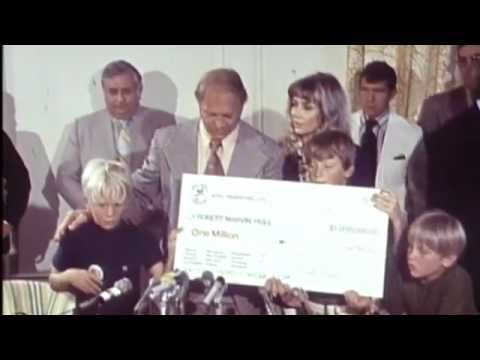
The WHA paid a fortune to obtain Hull. With the ten-year contract, the Winnipeg Jets intended to pay him $2.75 million, an unprecedented sum. For the first five seasons, he would receive a salary of $250,000 per year to play. For the latter five seasons, he was meant to receive $100,000 each year to work in their front office. The contract included the clause that he could not be traded against his wishes. To sign the contract, they flew Hull into St. Paul, Minnesota (so that he would receive a U.S. tax break). As the 95th signee of the WHA, he used 11 pens to represent the 11 clubs in the new WHA. In return, the clubs all pitched in to pay Hull’s signing bonus. At a press conference, 33-year-old Hull received an oversized check for $1 million. “This has been the greatest day, the greatest thrill in my hockey career,” he told them.
The “Golden Jet” then flew to Winnipeg to participate in a downtown motorcade before thousands of fans. Along the way, his driver accidentally bumped and dented a police car. At the press conference, he donned his No. 9 Jets sweater for the first time. He told spectators, “The pressure is on me to help this league get off the ground and believe me I’ll try.”
True to his word and the WHA’s intentions in signing him, Hull paved the way for many NHL players to switch leagues. Hull said, “The W.H.A. will be as good as the N.H.L. in a few short years. And we’re going to have some more players coming over here soon.” At the time, a WHA spokesman claimed, “With the signing of a star of Bobby Hull’s magnitude, our league has achieved instant credibility.” In his book about the WHA, Ed Willes went further, stating, “Hull didn’t just give the league instant credibility; without him, it is doubtful the league would have survived its first year, and the NHL would have gone about its business of printing money and exploiting players.”
Hull led the Jets to the 1976 and 1978 Avco Cup championships. He remained with them even when the franchise was absorbed into the NHL in 1979. After a brief reclaiming by Chicago at that point, Winnipeg kept him until they traded Hull to Hartford on February 27, 1980. He only played 12 games there to finish out the season and playoffs before retiring. Hull was inducted into the Hockey Hall of Fame in 1983, and Winnipeg retired his No. 9 in 1989.
Additional Sources:
Mike Commito, Hockey 365: Daily Stories from the Ice(Toronto: Dundurn, 2018), kindle edition.
Hockey Chronicle: Year-by-Year History of the National Hockey League(Lincolnwood, Ill.: Publications International, Ltd., 2006), 338.
Brian McFarlane, Brian McFarlane’s History of Hockey(Champaign, Ill.: Sports Publishing Inc., c1997), 116-119.
Bob Verdi, “Hull Jumps to W.H.A. Jets,” Chicago Tribune, 28 June 1972, section 3, pp. 1, 4, 11.
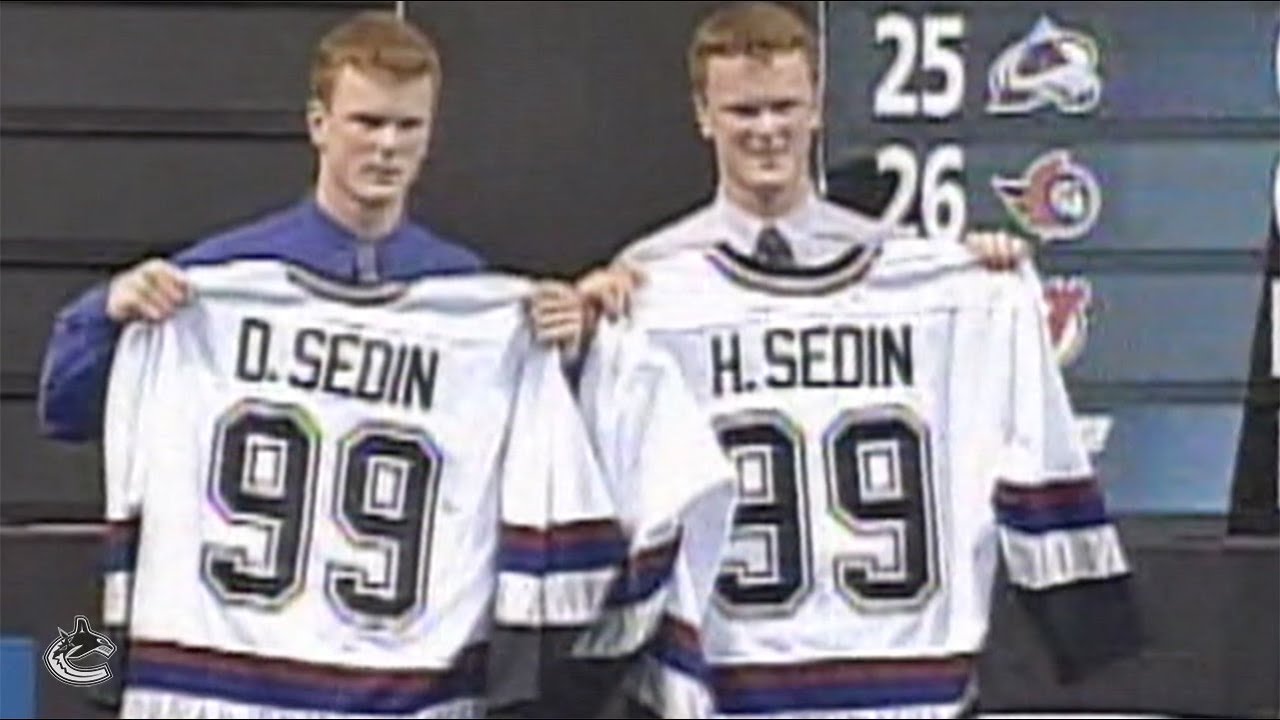
Never before or since June 26, 1999 have twins been drafted back-to-back at the NHL Entry Draft. Thanks to some savvy dealing, the Vancouver Canucks wound up with the No. 2 and No. 3 picks. They wisely used them to draft Swedish twins Daniel and Henrik Sedin.
The 1999 NHL Entry Draft took place at Boston. Vancouver, who had just finished the season with the second-worst record, held the No. 3 slot. Their European Scout, Thomas Gradin, had identified these seemingly perfect twins and believed in them enough to push the general manager to draft them both. Canucks GM Brian Burke agreed and noted, “They were co-MVPs in the Swedish (Elite) League this year and that’s impossible. At 17 or 18, that’s an incredible accomplishment.” Burke firmly stated, “We said from the get-go that we weren’t going to trade our pick and that we’d take a twin if one was there, no matter what. I think we were convinced that no one else was going to leave with the twins. Someone might leave with one but no one else was going to leave with both of them.”
The Sedin twins followed in the skates of their father and two older brothers by playing for MoDo, of the Swedish Elite League. Daniel, a left wing, was older by six minutes, but Henrik, a center, was taller by an inch (at 6’2”). Gradin called Daniel “the more creative player,” whereas Henrik was “a more conservative player. He’s a guy who takes responsibility defensively.” Meanwhile, Burke (who at the time could not remember which twin had a chip in his tooth as the way to tell them apart) said Daniel was “a shooter and a scorer” while Henrik was “a play-maker.” A Vancouver Province writer described Daniel as “a bigger, faster, stronger version of Markus Naslund” and Henrik as “a virtual clone of Peter Forsberg.”
To ensure he could get both twins, Burke began making deals. On Father’s Day, the Sunday before the draft, he traded defenseman Bryan McCabe and either the 2000 or 2001 No. 1 pick to Chicago in return for pick No. 4. “We gave up an excellent defenceman and a first-round pick,” explained Burke. “The price was worth it because we felt one twin standing alone had very little value . . . We felt there was a chemistry they have that was worthwhile.” “I wasn’t surprised at all by the deal,” commented McCabe. “I really enjoyed my time here, but I’m sure I’ll enjoy Chicago as well.” He continued, “They’ve got a good team still, it’s just a matter of putting it all together. The Sedin twins are supposed to be great players and they should give the team some scoring.”
Burke started working out a deal with Tampa Bay for the No. 1 pick that went into motion on draft day. He gave them the 75th and 88th picks in return. Then Burke approached the Atlanta Thrashers (who had just had their expansion draft the day before) to swap slots No. 1 and No. 2. He cajoled them saying this would make them the first expansion team to choose first overall. In return, Atlanta gave Vancouver a conditional third-round pick in 2000. Recently, Burke was humble about his role in these deals, remarking, “To get the two picks together was hard, but it was the worst first-round in the history of the League. And that’s the reason people were willing to make trades.”
Thanks to Burke’s efforts, he was able to announce the twins together. He selected Daniel Sedin as No. 2 and Henrik Sedin as No. 3. When they officially joined the Canucks, Burke assigned them to sweaters No. 22 and No. 33 in honor of this historic draft moment. As they neared the end of their playing careers, he joked that he picked them in the wrong order because Henrik turned out to be the better player. At the draft, Burke told the press, “We’re very pleased to get both of them. They’re great players.” The No. 1 and No. 4 picks went to Czech players Patrik Stefan and Pavel Brendl. The top four draftees all hailed from two European nations.
The twins only learned of Vancouver’s ability to take them both about five to ten minutes before the draft began. Already, before draft day, the brothers had claimed the Canucks as their favorite team with two of their favorite players. One of them told the press, “We’re glad it’s Vancouver. We’ve never been to Vancouver but we’ve heard good things about the city and the team.” They also said that mostly they had wanted to play on same team and that ideally, they would like stay in Sweden one more year to hone skills and finish high school. Gradin agreed saying, “In my opinion he and Daniel could come to the NHL next year and be third- or fourth-line players, but I’d prefer another year in Sweden.”
On draft day, Coach Marc Crawford mused, “Their development has been done in a different country and different culture. The future will unfold as it unfolds. I don’t have a crystal ball, but I’m excited about this and excited about the franchise.” Later, Burke credited Crawford for turning the twins into players. Unlike Crawford’s claims not to know the future, Vancouver Province writer Ed Willes made an uncanny prediction in an article defending Burke’s dealing. “Ten years from now, it will be remembered as the most significant deal in team history and the start of a new era for the NHL’s most tortured franchise.” As it turned out, it took 11 seasons (the twins’ tenth) for the Canucks to make it within one game of winning the Stanley Cup.
Both twins played for the Canucks throughout their entire NHL careers, 17 seasons, and made playoffs 11 times. Along the way, Henrik earned the Art Ross Trophy as top scorer (along with the Hart Memorial Trophy) in 2009-10, and Daniel took the prize the very next season (along with the award for most outstanding player). Henrick received the King Clancy Memorial Trophy (for Leadership and Humanitarian Contribution) in 2015-16, and he shared the award with Daniel in 2017-18. Between the two of them, they hold most of the Canucks’ team records. Daniel has the most goals (393) and game-winning goals (86). Henrik has the most assists (830) and points (1,070). With only 24 more games than his brother, Henrik’s 1,330 games is the most ever played for Vancouver.
During all that time, they also represented Sweden in multiple World Championships and Olympics. They won gold together in 2006, played together in 2010, and Daniel won silver in 2014 (when Henrik was injured).
Mere days before the 20th anniversary of the Sedin twins’ draft, Commissioner Gary Bettman brought them onstage to open the 2019 NHL Entry Draft, hosted at Vancouver. There, he announced that the Canucks planned to retire No. 22 and No. 33 at the franchise’s 50th anniversary celebration this coming February.
Additional Source:
“NHL Draft ’99,” Vancouver Province, 27 June 1999, pp. A86, A88-A91.
You betcha, on June 25, 1997, the NHL made official the most recent multi-team NHL expansion. To reach the goal of 30 teams by the turn of the millennium, the NHL laid plans to gradually add four franchises. The Nashville Predators would begin play during the 1998-99 season, followed by the Atlanta Thrashers the next season. The 2000-01 season would introduce the Columbus Blue Jackets and the Minnesota Wild. Having posted about Atlanta and Columbus already, this post focuses on St. Paul, Minnesota.
The new franchise announcement came about 30 years after the Minnesota North Stars joined the NHL in the great expansion of 1967. They had played at the Metropolitan Sports Center (Met Center) in Bloomington for 26 seasons until 1993, when they relocated to become the Dallas Stars.
Minnesotans truly felt the loss of their professional hockey team. “I think we missed the NHL more than we ever thought we’d miss it,” said investor Bob Naegele, Jr. “The enthusiasm for NHL hockey has been pent up and is starting to emerge and manifest now into an unbelievable groundswell.” The mayor of St. Paul, Norm Coleman, campaigned to bring in a franchise, whether by relocation or creation. To their disappointment, Minnesota failed to secure the Winnipeg Jets (who moved to Phoenix in 1996) or the Hartford Whalers (who moved to Carolina in 1997).
Finally, Naegele headed the Minnesota Hockey Ventures Group and applied for an expansion franchise. The third time had proved the charm. At a six-hour meeting at New York City, NHL owners unanimously voted in favor of a new Minnesotan franchise. “We’re going back to hockey country because I feel we belong in Minnesota,” pronounced Commissioner Gary Bettman. “It hasn’t sunk in that I’m a sports owner,” commented Naegele. “I feel more like the ambassador from Minnesota.”
Soon after the June 25 meeting, 500 to 600 Minnesotans celebrated at Rice Park in St. Paul with “confetti, live music, free hot dogs and pizza, the St. Paul Bouncing Team, Camp Snoopy characters, [and] Goldy Gopher.” Naegele declared, “On behalf of more than 4 million fans in Minnesota, we’re very proud to bring hockey back to a place of its real heritage in the United States. This gives an opportunity for 50,000 boys and girls playing hockey at the youth, high school and college level to see the best hockey players in the world. And they deserve it because of our rich hockey heritage.” Mayor Coleman told the crowd, “It’s a great day for St. Paul, it’s a great day for Minnesota. Three years ago, people said it would take a miracle to bring the NHL back. My friends, a miracle has happened.”
The miracle had two caveats. Each of the four franchises had to give the NHL a $10 million non-refundable downpayment (on the $80 million entrance fee) by end of the week and sell 12,000 season tickets and 75% of their suites within four months of their first game. Despite having three years before their first game, Minnesota opened ticket sales the very next day.
The team also needed an arena. They had demolished the Met Center back in 1993, and, in June 1998, they tore down the inadequate St. Paul Civic Center to make way for a replacement. The state approved a $65 million loan to the city, which added its own $65 million in sales tax revenue bonds. The NHL franchise formed a 26-year partnership with the Minnesota Amateur Sports Commission (MASC). They would play in the brand-new Xcel Energy Center in St. Paul.
For the team name, they announced six finalists on November 20, 1997. The team could have been called Blue Ox, Freeze, Northern Lights, Voyageurs, White Bears, or Wild. On January 22, 1998, at Aldrich Arena at Maplewood, Steppenwolf’s “Born to be Wild” blared as the team was christened the Minnesota Wild.
Having built up their team through the Expansion Draft on June 23, 2000 and the NHL Entry Draft the following day, the Wild played their first ever home opener on October 11, 2000. That inaugural season, Minnesota set a record for largest expansion-team attendance hosting over 750,000 ticket-buying fans. Those fans voted the return of NHL Hockey as the seventh (of ten) moment in the Wild’s first decade. The “Land of 10,000 Lakes” sure goes wild for ice! Minnesota has earned the nickname “State of Hockey.”
Additional Sources:
Stephen Laroche, Changing the Game: A History of NHL Expansion (Toronto: ECW Press, 2014), 404-409.
John Millea, “League makes it official, and hockey fans celebrate,” Minneapolis Star Tribune, 26 June 1997, pp. B1 and B5.
Curt Brown, “Bettman: NHL is back in ‘hockey country,’”Minneapolis Star Tribune, 26 June 1997, pp. C1 and C11.
The Philadelphia Flyers have signed the first of its restricted free agents, who happens to be defenseman Travis Sanheim. Sanheim signed a bridge deal for two years, $6.5 million. The cap hit $3.25 million per season and the defenseman will be a restricted free agent again come the end of the 2020-21 season. The Flyers will look to get the other three restricted free agents signed before free agency so they know how much cap space they have to play with for a back up goalie.
There are a few reasons to like this contract, but here are the three reasons this contract makes sense for both sides.
1) Sanheim Can Prove Himself
There is no doubt that Sanheim made some big strides in his development once Dave Hakstol was fired. He went from being on the third pairing or benched to top pair by the end of the season. Sanheim got a chance to play consistent minutes, without restraint, under interim head coach, Scott Gordon, and he seemed to flourish. The 23-year-old defenseman seemed to develop into an all around defenseman that could be used in any situation by the end of the season.
During the 2018-19 season, he had nine goals, 26 assists and 35 points in 82 games played. He was second on the team’s defense in scoring and his 26 assists ranked fifth on the team. Sanheim was just one of three Flyers’ defenseman to play in all 82 games so he is a durable player. The bridge deal will allow the defenseman to prove himself and keep developing into a better all around defenseman than he already is, and he could wind up being a solid top four guy by the end of the contract.
2) Cap Hit
The Flyers came into the offseason with a lot of cap space, but with all the wheeling and dealing that Chuck Fletcher has been doing, it has dwindled. Fletcher picked up veteran defensemen Matt Niskanen and Justin Braun. Fletcher then went and signed free agent Kevin Hayes to a deal that has a cap hit of $7.14 million over the next seven seasons. The Flyers still need to sign Ivan Provorov, Travis Konecny, Scott Laughton and possibly Justin Bailey to new contracts before the season starts. They also need to add a backup goalie, and only have $17 million in cap space to get it all done.
The cap hit is a fair one for both player and team. Yes, it was only Sanheim’s first full NHL season last year, but the improvement from game-to-game was there. After he had a solid second half of the season, management had to realize a big pay day was coming for the kid. The only unfortuate thing about this contract is that it didn’t buy out any of his unrestricted free agent years, and he will be a restricted free agent after the 2020-21 season.
3) Expansion Draft Implications
Sanheim could possibly not be under contract once the 2021 NHL Expansion Draft rolls around for the new Seattle team. This means he may not be left exposed, and that would be a bonus for the team. The team has to leave one defenseman exposed who is under contract for the 2021-22 season and has played 40 NHL games the prior season or 70 NHL games the prior two NHL seasons.
Also, by the time he is a restricted free agent again he will only be 25 years old, and possibly in the prime of his career.
The Suter family of Madison, Wisconsin is all about winter sports, though Gary Suter was born at the beginning of summer, on June 24, 1964. The youngest of five, he followed his figure-skating sister and hockey-playing brothers onto the ice. Their father, Marlow, also played and then coached the minor hockey team that he helped found, the Madison Capitols. The family tradition has continued into the next generation as Suter’s sons and nephews (especially Ryan Suter) have suited up.
For two seasons, 1981-82 and 1982-83, Suter played for the Dubuque Fighting Saints of the United States Hockey League (USHL), who just had begun play in 1980. As captain, he led Dubuque to the Anderson Cup and the Clark Cup Championship. Passed over for the NHL draft in both 1982 and 1983, Suter took a full scholarship to play for the Badgers at his brothers’ alma mater, the University of Wisconsin–Madison. He played there for the next two seasons and worked at a Madison brewery during the summer.
The Calgary Flames’ scouting coordinator, Ian McKenzie, saw Suter play for the Badgers and realized that Central Scouting had never updated his height record since 1982. Thus, at the 1984 Entry Draft, a couple weeks before Suter’s 20th birthday, Calgary drafted him in the 9th round (180th overall).
In his rookie season, 1985-86, Suter proved himself a wise investment. With 68 points, he became the first American-born defenseman (third overall American) to earn the Calder Trophy. Although he tallied another 10 points during playoffs, he only made it through ten games before suffering a knee injury (after a hit by Mark Messier). The Flames carried on without him to ultimately lose the Stanley Cup to the Montreal Canadiens. During the 1987-88 season, Suter set a career high of 91 points (with 70 assists), which made him a runner-up for the James Norris Memorial Trophy as the NHL’s top defenseman. In the opening round of the 1988-89 playoffs, Suter broke his jaw. Calgary again had to play in the Stanley Cup Finals without No. 20. In a rematch against Montreal, Calgary prevailed to take home its only Stanley Cup.
Suter played for Calgary for over eight seasons. He scored his 100th goal and played his 500th game in early 1992. During that time, he spent four seasons ranked fourth among defensemen and scoring 60 plus points. However, after failing to renegotiate his contract, in March 1994, Suter was traded twice. On March 10 Calgary traded him to Hartford, who turned around the very next day and traded him to Chicago. Suter was surprised saying, “Calgary’s meant a great deal to me. You always hear how trades are part of the game and that you don’t have any control over them. When it happens, it’s a shock. It just blows me away.”
After finishing out the 1993-94 season with the Chicago Blackhawks, Suter played for them through four more seasons. During the 1995-96 season, he became the team’s first defenseman in six years to score 20 goals. However, as Suter was about to become an unrestricted free agent, it became obvious that Chicago was going to cut ties. The San Jose Sharks traded their ninth-round draft pick for the rights to speak to him.
The 1st of July 1998, Suter signed a three-year, $10 million contract with the San Jose Sharks. Unfortunately, injuries continued to interrupt Suter’s career. Still, he made it through the three years and signed on for one final season after that. He played his 1,000th game on October 25, 2000 and scored his 200th goal on January 2, 2002. He announced his retirement that September, having played 1,145 NHL games. His 844 points (203G, 641A), ranked fourth among American defensemen.
In addition to his NHL career, Suter carried on another family tradition, that of representing the U.S. in international competition. Before beginning his NHL career, Suter participated in the 1984 World Junior Ice Hockey Championships and the 1985 World Championship (in which he was named the team’s co-MVP). At the 1987 Canada Cup, he swung his stick at Andrei Lomakin of the Soviet Union in retaliation for getting speared in the neck and received a six-game suspension (compounded with an NHL four-game suspension). The 1991 Canada Cup also marred Suter’s reputation when he injured Wayne Gretzky, checking from behind, and then had two turnovers result in a 4-2 win for Canada. Suter then played at the 1992 World Championship and helped the U.S. team win the inaugural 1996 World Cup of Hockey.
Suter was also a two-time Olympian. He played in the first Olympics in which the NHL participated, the 1998 Olympic Winter Games in Nagano, Japan. Unfortunately, before leaving for the Games, Suter cross-checked Paul Kariya in the head, preventing him from joining the Canadian team. The NHL’s four-game suspension was meant to carry into the Olympics, but the IIHF allowed him to play. Neither the U.S. nor Canada medaled. Suter and the U.S. turned things around in 2002 at Salt Lake City. Just as Suter approached retirement, he had a last hurrah, and 22 years after his older brother Bob won goal in the 1980 “Miracle on Ice,” he helped the U.S. win silver.
For his eight international events and his NHL career, Suter was inducted into the U.S. Hockey Hall of Fame in 2011.




 Prev
Prev