Hockey leagues rise and fall. In 1983, the three branches of NCAA Division I ice hockey within the Eastern College Athletic Conference (ECAC) essentially split into two. When the Ivy League schools broke away with some of the West schools, the East schools chose to set up their own league, Hockey East. Their founding charter was dated July 11, 1983.
Despite the increased attendance during the 1982-83 season, the Ivy League schools began discussing restructuring the division. Harvard’s athletic director, Jack Reardon, explained, “My wish is to try to keep everything under the ECAC umbrella. I also think that if we end up in two leagues within Division 1, those two league champions could meet to decide an overall champion. I don’t want to see the ECAC get hurt.” ECAC commissioner Scotty Whiteclaw told the press, “The colleges are reviewing their situations. I do know that last year’s format gave us our best overall attendance ever. I have to wait and see what happens. They just may want to have their own playoffs and shoot for automatic berths in the nationals. Naturally, I’d hate to see us lose a great tournament.” The ECAC tournament held at Boston Garden usually raised the most revenue outside of TV and memberships.
To decide their response, the athletic directors for five of the schools in the ECAC’s East division met at Boston University on July 11. Bill Flynn of Boston College (BC), John Simpson of Boston University (BU), Andy Mooradian of the University of New Hampshire (UNH), Joe Zabilski of Northeastern University (NU), and Lou Lamoriello of Providence College (PC) laid the foundation for a new Division I men’s ice hockey conference. Simpson commented, “This is not a bolt from the ECAC. We just want to do what is best for our programs.” His colleague Flynn added, “But you have to go with the times. This concept has plenty of potential.”
The five hoped to become a league of eight. Flynn said, “I see good drawing power. And most people feel that an eight-team league is the best way to go.” Thus, in August, they added the University of Maine, and in September the University of Lowell (now UMass Lowell).
In mid-October, the “new super league” (as the press called it) named Lamoriello as its first commissioner. They also announced that they would begin operations with the 1984-85 season. They set up a 34-game schedule that included interlocking with the eight-team Western Collegiate Hockey Association (WCHA). The Beanpot (between BC, BU, NU, and Harvard) would be preserved.
Since they had only seven teams, the postseason tournament would give the regular-season winner a bye while the other six faced off in a preliminary round. Those three winners and the regular-season winner would then play in the semi-finals. The overall winner would earn a spot in the NCAA championships. Simpson remarked, “Right now, we are not interested in playing the winner of the other league. We plan to approach the Boston Garden people about holding our tournament there. We have the teams that will draw. Some members of the other league tried to make us look bad and we didn’t like it. We made our move, and we’re pleased about it.”
On January 18, 1984, the league held a kickoff luncheon at the Parker House in Boston. There, they announced that they would henceforth be called Hockey East. Jack Parker, the BU coach, commented, “It will bring all of us up a step. It’s only going to enhance our recruiting. We’re going to be able to sell the best hockey league in the United States.”
Today, Hockey East has eleven members for the men and ten for the women, who joined in 2002. In addition to the original seven, the men have added Merrimack College, University of Massachusetts Amherst, University of Vermont, and the University of Connecticut. The women have teams for nine of them (excluding Lowell and Massachusetts) and also added Holy Cross.
In 2005, Canada’s Governor General, Adrienne Clarkson, publicly wondered why a women’s team could not take home the Stanley Cup. After all, the women kept playing while the men’s NHL had cancelled their 2004-05 season due to a lockout. As she learned, the women actually had their own hockey trophy, albeit one without a name. Clarkson took the initiative to commission a new cup to reward the best women’s team. She first presented the Clarkson Cup on July 10, 2006.
Like her Governor-General predecessors, Lord Stanley and Lord Grey, Clarkson would donate an athletic trophy. In her announcement in September 2005, she said, “The Clarkson Cup is something that has evolved in the most wonderful and meaningful way. I thought [it was] an intriguing idea of giving the Stanley Cup to women’s hockey if no men were going to get it. It seemed to be perfectly logical — the women were still playing. I’m very pleased I’m going to be connected with women’s hockey and the [Clarkson Cup] is a personal gift from me.”
The silver cup was designed by a Canadian silversmith (Beth Biggs) and three Inuit artists (Okpik Pitseolak, Therese Ukaliannuk, and Pootoogook Qiatsuk). They were affiliated with the Nunavut Arctic College in Iqaluit. The decorations feature Inuit designs, Arctic animals, and Canadian flowers.
Clarkson was so keen to reward Canada’s finest female hockey players that she presented the Clarkson Cup as soon as it was finished, rather than wait for a challenge or championship tournament system to determine the winner. At the Westin Harbour Castle Hotel at Toronto, Clarkson named the Olympic Team that had just won gold at Turin/Torino as the first recipient. She told them, “We will give it to the best in women’s hockey this year because I wanted to do it as soon as the Cup was done and what is better than what you have done as a team?” Cassie Campbell, as team captain, accepted the Clarkson Cup and said, “It’s definitely a first step. This is going to be our Stanley Cup in the future, there’s no question about that. It’s truly an honor to have Adrienne Clarkson step up and give us this and it gives women’s hockey the legitimacy that it deserves.”
The Olympic Team also received their rings. They were joined in receiving rings by the sledge hockey team and the national junior team, both of whom also took home gold. For the first time, Canada had clinched all three international competitions.
After the inaugural presentation, the Clarkson Cup was meant to become more like the Stanley Cup. As Clarkson explained, “I’m hoping very much that in the future we’ll be able to have this as a challenge Cup so it will be played for across the country in an annual way.” The Western Women’s Hockey League and National Women’s Hockey League (and then the Canadian Women’s Hockey League) were meant to work out a tournament to determine the champion.
Unfortunately, it took three years for the Clarkson Cup to be put to its intended use. The artists and Hockey Canada had legal issues over licensing rights. Clarkson wanted the rights turned over to Hockey Canada, but the artists wanted royalties. They finally resolved the issue in 2009.
Beginning in 2009, the Clarkson Cup has been presented to the top women’s hockey team, the winner of the Canadian Women’s Hockey Championship. With the dissolution of some of the women’s leagues, time will tell the fate of the Clarkson Cup.
Additional Sources:
Mike Commito, Hockey 365: Daily Stories from the Ice(Toronto: Dundurn, 2018), kindle edition.
Almost as soon as Nashville received an NHL franchise on June 25, 1997, they hired a general manager on July 9. Since then, David Poile has been Nashville’s only general manager, and as such, he truly has built the team from scratch.
Poile came with a hockey background; his father Bud played right wing for seven NHL seasons and won the 1947 Stanley Cup with the Toronto Maple Leafs. Bud then spent time coaching in various leagues until the 1967 expansion. He became the Philadelphia Flyers’ first GM and then switched to the Vancouver Canucks in 1970. He finished out his career as vice-president and president of other leagues and was inducted into the Hockey Hall of Fame as a Builder in 1990.
Meanwhile, David Poile graduated from Northeastern University, where he had captained the hockey team, led the scoring, and been named MVP twice. In 1972, he became an administrative assistant for the Atlanta (later Calgary) Flames, and over his ten years with the Flames, he was promoted to assistant GM. On August 30, 1982, Poile became GM for the Washington Capitals, and his decisions led them to 14 consecutive postseasons and a record of 561-414-123. At the same time, Poile served on the GM committee, leading the drive towards the 1991 instant replay rule. He was recognized for this work when he was named Man of the Year by Inside Hockey and twice named NHL Executive of the Year for The Sporting News. However, the Capitals fired him as soon as they missed the playoffs in 1997.
It turned out to be good timing when Nashville was given a brand new franchise that summer. One of the first orders of business was hiring Poile. The franchise’s president, Jack Diller, told the press that Poile “not only has some of the highest credentials in professional hockey but a great excitement about helping build a new franchise from the ground up.” Poile issued the statement, “I’ve been involved with hockey on many levels, but the chance to build a new team in Nashville is a unique opportunity. Fan support comes from the team working and serving the community. Nashville is a center of growth for families and entertainment and this team will strive to bring the two together.”
Poile’s first task as Nashville’s GM was to hire the coach, and he hired Barry Trotz on August 6. Trotz coached the team until 2014, when Poile replaced him with Peter Laviolette. It was not until November 13 that Nashville announced that the public vote made their team name the Predators. They had already designed a sabre-toothed cat as the logo because a partial Smiloden skeleton was unearthed in Nashville back in 1971.
In the 22 years since Poile took over management of the Predators, he had provided them with stability and shrewd trades. Since 2004, they have only missed the playoffs four times. They finally made the Stanley Cup Final in 2017.
In 2001, Poile followed in his father’s footsteps by receiving the Lester Patrick Trophy for his contributions to U.S. hockey (having served as GM for the U.S. Olympic Team in 2014 and a few World Championship teams). Poile was also the only General Manager of the Year Award finalist in all three of its initial years (2010, 2011 and 2012). He finally won the award in 2017. As of March 2018, Poile is the winningest NHL general manager. He is the only one to have reached the milestones of 1,000 games and 500 victories for two different franchises. Considering his ongoing career, unsurprisingly, Poile has the longest active tenure of any NHL GM.
Edmonton’s Coliseum hosted the NHL Entry Draft for the only time (thus far) in 1995. Over 300 media personnel attended even though one stated that this draft “lacked thrills” because the “talent pool [was] not especially deep.” On July 8, three big defensemen were drafted right off the bat.
The Ottawa Senators had the No. 1 pick for the third consecutive year. They chose the predicted top choice, Bryan Berard of Rhode Island, making him only the third American-born player to be the top draftee. Senators GM Randy Sexton explained, “I just feel (Berard) comes from a home with a lot of pride and commitment. … He doesn’t want to be a good player. He wants to be a great player.” From Berard’s point of view, “There will be pressure. I know, but I handle pressure well. In fact, I think I play better with it.” Sexton concluded, “You can’t pass up a player with Bryan Berard’s (potential).”
As it turned out, Berard refused to report for the Senators. They traded him to the New York Islanders for their No. 2 pick from that same draft. After two and a half seasons with the Islanders, they traded him to the Toronto Maple Leafs on January 9, 1999. He then hopped teams almost every season. In 2001, he signed with the New York Rangers, in 2002 with the Boston Bruins, in 2003 with the Chicago Blackhawks, in 2005 with the Columbus Blue Jackets, and finally in October 2007 back with the Islanders. Berard’s NHL career ended after 619 games (76G, 247A, 323P). He then spent a final season with the KHL.
The No. 2 pick was Wade Redden of Saskatchewan, selected by the New York Islanders. Although they had considered trading away their first-round pick, instead the Islanders went with the “safest pick.” Islanders GM Don Maloney remarked, “He’s a good player now and he’s going to be a good player in the NHL. He could be a special player. He’s an effortless player. He does so many things you don’t notice. He’s got the intelligence and the ability to go with it.” Redden himself said, “I guess when you’re drafted this high the team has a lot of plans for you. Hopefully, I can make them happy.”
However, before Redden could play for the Islanders, they had traded him to Ottawa. Redden spent ten seasons with Ottawa but never played more than 20 NHL games per season. He then signed with the New York Rangers in 2008 but mostly played for their AHL affiliate in Hartford. On January 18, 2013, he signed with the St. Louis Blues, who within three months traded him to the Boston Bruins. He finished out his NHL career with five games for them. Overall, he had played 1023 NHL games (109G, 348A, 457P).
The third defenseman, drafted No. 3 by the Los Angeles Kings, was Aki-Petteri Berg of Finland. At the time, he was the highest draftee from Finland. The Oilers had wanted to draft him, but the Kings had moved up in the lottery. Berg would have to finish the eight remaining months of his compulsory military stint in Finland before joining the Kings.
Still, Berg started his NHL career during the 1995-96 season. He remained with the Kings for five seasons until March 13, 2001, when they traded him to the Toronto Maple Leafs. He finished out his NHL career in Toronto during the 2003-04 season. Berg totaled 606 NHL games (15G, 70A, 85P). Throughout, he had played practically every major competition with Finland’s national team. After the NHL, he continued playing in Sweden and Finland.
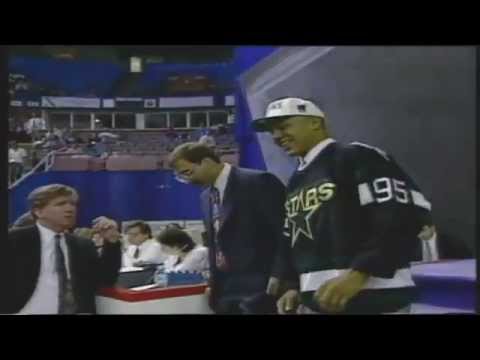
Although none of the top three draftees became superstars, the No. 11 pick from 1995 did. Right wing Jarome Iginla was drafted by the Dallas Stars, but he was traded that December to the Calgary Flames. Iginla was not predicted to be chosen in the top 15, so he commented, “It was a nice surprise for me. Eleventh, I thought it would be nice just to get drafted. This is gravy. I didn’t want to get myself up to be let down.”
Iginla played 20 seasons in the NHL, all but the last five with Calgary. Along the way, in 2002, he received the Art Ross Trophy, the Maurice Richard Trophy, and the Ted Lindsay Award. In 2004, he took home the King Clancy Memorial Trophy and the Maurice Richard again. Finally, in 2009, he earned the Mark Messier Leadership Award.
After 13 seasons playing in the NHL and a few more assistant coaching, Joel Quenneville is about to begin his 23rd season coaching an NHL team. He has served three teams as head coach and is about to add a fourth. On July 7, 2004, Quenneville accepted the offer from the second of these, the Colorado Avalanche.
Quenneville already had ties to Colorado. He played defense for the Colorado Rockies from the time he was traded, on December 29, 1979, through the relocation to New Jersey in 1982, only to be traded again the following year. After his playing career ended, he became an assistant coach for the Quebec Nordiques and transitioned with them when they became the Colorado Avalanche. With his assistance, they won the Stanley Cup championship in 1996.
At that point, the St. Louis Blues lured Quenneville away. He was promoted from assistant to head coach midway through the 1996-97 season (when Mike Keenan was fired). They made the playoffs for the next seven seasons. During the 1999-2000 season, the Blues set a franchise record of 51 wins and earned the Presidents’ Trophy for the first time. In recognition of that, Quenneville received the Jack Adams Award for his coaching contribution. When it looked as though the Blues would not secure a playoffs berth in 2004, they fired Quenneville three quarters of the way through the season. They then promoted the assistant, Mike Kitchen, who had played for the Rockies with Quenneville. Still, Quenneville had been their longest-serving coach and their winningest (with 307 wins).
One team’s trash becomes another team’s treasure. After the firing, Quenneville talked with other franchises like the New York Rangers, Columbus Blue Jackets, and Ottawa Senators. In July 2004, he took a break from mowing the lawn to accept an offer from his former team, the Colorado Avalanche. They had decided to send Tony Granato back to the assistant coach position he had held in December 2002, when they promoted him to head coach. As GM Pierre Lacroix explained, “Having one of the best hockey minds in the business available made us believe it was an opportunity we simply could not miss. Tony has done a great job for us since taking over a year and a half ago, and he’s looking forward to working alongside Joel.”
Quenneville felt the decision to become the Avalanche’s fourth coach “was the easiest decision I had to make. ‘Absolutely’ was my answer. I’d love to be a part of it. Pierre [Lacroix] moved quickly. Real quick. One minute I’m talking to him on the phone and the next I’m jumping in the shower to jump on a plane.” He remarked, “It’s great to be part of this family again.” Lacroix agreed, stating, “Joel knows our organization very well – as a matter of fact we know him very well. … I can tell you we’re much more excited to have him back in our family.” It truly was in the family, since the Avalanche owner Stan Kroenke was brother-in-law to the Blues owners, Bill and Nancy Laurie.
After the first season was cancelled (due to the 2004-05 lockout), Quenneville brings the Avalanche through three seasons, reaching 95 points in each. In 2007, he became the seventh active coach to reach 750 games. When the team failed to make it beyond the semi-finals, on May 9, 2008, the Avalanche and Quenneville mutually decided to part ways. According to GM Francois Giguere, “Joel Quenneville has an outstanding reputation in this business. When I was hired as a GM, I was a big believer in Joel. I still am a big believer in Joel. Sometimes, for whatever reasons, you need to go in separate ways. It doesn’t mean you’re not a good coach.” Indeed, his record with Colorado was 131-92-23. Quenneville stated, “Whatever happens going forward, my memories are all going to be positive here.”
As it turned out, Quenneville had greener pastures. Soon after joining the Chicago Blackhawks as a pro scout, he was named their head coach on October 16, 2008 (after Denis Savard was fired). Under his guidance, the Blackhawks broke their long drought and won the Stanley Cup championships in 2010, 2013, and 2015. On February 21, 2018, he became the third coach to reach 1,600 games, and less than a month later, he passed Al Arbour to have coached more NHL games than all but Scotty Bowman. When the Blackhawks fired him (after a slow start) on November 6, 2018, Chairman Rocky Wirtz stated, “During his tenure as head coach to the Chicago Blackhawks, Joel brought the city of Chicago and our fans three Stanley Cups and an incredible era of hockey.” Quenneville was (and remains) the second-winningest NHL coach (with 890 wins).
At the end of the regular season, on April 8, 2019, 60-year-old Quenneville took the head coach position for the Florida Panthers. Their GM, Dale Tallon, said in the announcement, “Joel is a three-time Stanley Cup champion head coach who will be a transformative leader for the Florida Panthers franchise. We’ve seized the opportunity to add one of the most successful head coaches in hockey history and we’re thrilled that Joel has agreed to take on the challenge of leading our promising young team. I’ve worked with Joel previously and have seen firsthand how his passion for the game, head coaching experience and leadership can impact an organization. Joel will accelerate our growth into a club that qualifies for the playoffs consistently and competes every year toward our goal of winning the Stanley Cup.”
Additional Sources:
Derrick Goold, “Quenneville quickly accepts Avs’ job,” St. Louis Post-Dispatch, 8 July 2004, pp. D1 and D8.
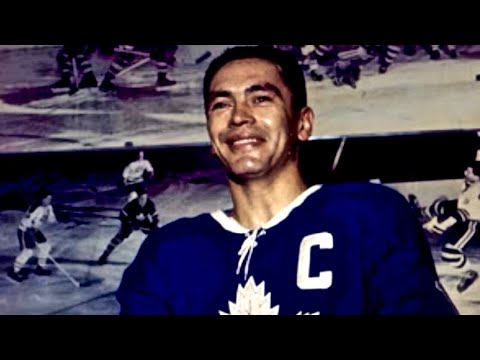
George Armstrong’s summer birthday on July 6, 1930 gave little indication that he would become a professional ice hockey player. However, his birthplace 25 kilometers northeast of Sudbury in Northern Ontario certainly did. He would not leave the province as he grew up to become the longest-serving captain of the Toronto Maple Leafs.
Armstrong was born and raised in Ontario. His birthplace, Skead, is on the south shore of Lake Wanapitei. He then grew up in Falconbridge, less than 15 kilometers south. His father, of Scottish (or Irish) background, mined for nickel. Armstrong’s mother had Ojibwe (or Algonquin) heritage. When he played with the senior Marlboros for the Allan Cup in 1949, the Stoney Indian band (in Alberta) named him “Big Chief Shoot-the-Puck” in honor of her heritage. The Marlboros were affiliated with the Maple Leafs, who had signed Armstrong when he was 16.
After a couple of NHL games in December that year, Toronto brought Armstrong up from their AHL affiliate during the 1951-52 season (having just won the Stanley Cup). On February 9, he became the first player of First Nation descent to score in the NHL when he potted the game-winner. Toronto’s assistant manager, King Clancy, claimed, “This kid’s got everything. He has size, speed, and he can shoot ’em into the net better that any hockey player I’ve known in a long time. I’ll be surprised if he doesn’t become a superstar.”
Owner and manager Conn Smythe noticed Armstrong’s leadership qualities and made him the team captain in 1957. The Leafs switched his sweater to No. 10. Smythe had often been quoted as referring to Armstrong as “the best captain, as a captain, the Leafs ever had.” He ended up being the last Leafs captain to play his entire career with the team.
During Armstrong’s 21-season career with the Maple Leafs, they made the playoffs 15 times and the Stanley Cup Final during six of those. Under Armstrong’s captainship, the Leafs won four Stanley Cup championships, three consecutive times from 1962 through 1964 and again in 1967. They first defeated the defending-champion Chicago Blackhawks then the Detroit Red Wings twice. For the last hurrah, Armstrong scored an empty-netter as the ultimate goal of the 1967 Final (against the Montreal Canadiens) and consequently of the entire Original-Six era. The Maple Leafs have not won the Cup again since.
Armstrong tried to retire in 1970 but agreed to play one last season. He retired in 1971 at the age of 40. He had played the most seasons (21), regular-season games (1188), and playoff games (110) in Toronto’s history. At the time, he had the second-most regular-season points (713) and the most playoff points (60).
Once his playing days ended, Armstrong returned to the Toronto Marlboros as coach, and they won the Memorial Cup twice. Following a stint as scout for the Quebec Nordiques, he returned (in 1988) to the Maple Leafs as an assistant general manager and scout. Armstrong was inducted into the Hockey Hall of Fame in 1975 and had his No. 10 retired by the Maple Leafs in 1998.
Coincidentally, July 5 has become a day of saying hello to NHL coaches. In 1979, the Boston Bruins hired Fred Creighton. In 1995, the New York Islanders welcomed Mike Milbury. And in 2000, the Columbus Blue Jackets selected their very first coach, Dave King. The earliest of these, Creighton, had quite the suit to fill after the Bruins fired their most-colorful coach, Don Cherry.
Neither Creighton nor Cherry ended the 1978-79 season happy. The former, after five decent seasons coaching the Atlanta Flames, had an early end to the playoffs (their fourth under his watch). The Toronto Maple Leafs swept the Flames in the preliminary round, so Atlanta chose not to keep Creighton. Meanwhile, under Cherry’s direction, the Bruins had made it to the Stanley Cup Final in two consecutive seasons (only to lose to the Montreal Canadiens). Rather than return for a third season in a row, the Bruins lost the semi-finals to the Canadiens thanks to the infamous too-many-men-on-the-ice penalty. The Bruins consequently fired Cherry, releasing him from his coaching contract.
The Colorado Rockies were on the hunt for a coach after having Aldo Guidolin take over for Pat Kelly mid-season. They actually approached Creighton first, but before he could decide, at the end of May they secured Cherry to a multi-year contract for $125,000. Cherry’s reputation led to a bump in Colorado season tickets sales. With his leadership, Denver billboards proclaimed, “Come to the fights and watch a Rockies game break out!” However, he fought with Rockies GM Ray Miron and missed the playoffs with a record of 19-48-13. Knowing he was fired, he wore cowboy boots and hat to his final game. Cherry then turned his attention to a broadcasting career. The Rockies would move to New Jersey in 1982.
Meanwhile, looking to replace Cherry, the Bruins chose Creighton. After losing his gig with the Flames and then missing out on Colorado’s offer, Creighton said, “I considered leaving hockey, but I felt I was a good hockey coach and I wanted to show some people they were wrong. I felt unfulfilled. This (Boston) is the only job in hockey I wanted.” As one of the reasons he wanted to coach in Boston, he said, “The Bruins play the game the way I think it should be played … Aggressiveness is a trade mark of the Bruins; they force you into mistakes.”
The Bruins announced their coaching decision to the media at Garden’s Blade and Boards club. Everyone worried about inevitable comparisons between Cherry and Creighton. Bruins GM Harry Sinden said at the announcement, “It’s the first thing I told him the first interview. I explained it all and told him that if he didn’t think he could handle it, talking with the press and all the rest, then we really shouldn’t go any further. He said – and I liked it – that he surely didn’t have any book of one-liners that was going to keep people laughing for five or eight years, but that he would always talk and try to be honest. That was the best he could do.” Creighton himself told the press, “The way I’d like it to be is that everyone would say, ‘All right, Don Cherry did a fine job, let’s get back and see what Fred Creighton can do now. I’d like people to say that Fred Creighton is on the scene, and we’ll give him a chance, not prejudge him one way or the other.” Cherry gave advice to Creighton, saying, “He’s got to do two things. One, don’t get too much publicity. And two, do as you’re told. I think he’ll be a good coach. He’s a good guy, and probably the best choice they could have made, with all the jerks running around here looking for jobs. In addition, I know he’ll treat my boys right.”
As it turned out, the Bruins’ season record slightly improved in 1979-80 (from 100 to 105 points). However, Creighton only coached 73 of those games (40-20-13). He had not quite followed Cherry’s advice and had issues with Sinden, who fired Creighton and coached the remaining 15 games himself (until the Bruins lost the quarter-finals). That marked the end of Creighton’s NHL coaching career.
Creighton then coached the Central Hockey League’s Indianapolis Checkers, an affiliate of the New York Islanders. They won the Adams Cup championships twice. In 1984, he became their GM. The following year, he moved on to the Islanders’ AHL affiliate, the Springfield Indians. All told, Creighton was credited with 713 wins in the 1,311 games he coached over his long career. In 2009, he was inducted into the Manitoba Hockey Hall of Fame, and despite battling Alzheimer’s and nearing the end of his life, he was able to attend the ceremony.
Additional Sources:
“Creighton: He Looks the Part,” Boston Globe, 6 July 1979, pp. 45 and 49.
Steve Marantz, “Cherry: ‘I’ll make it go,’” Boston Globe, 1 June 1979, p. 51.
After seven years playing for their original NHL teams, Midwesterners Zach Parise and Ryan Suter joined up to play the past seven seasons for the Minnesota Wild. On the most American date of 2012, July 4, these Team U.S.A. teammates returned to their roots.
The two legacy players were born about six months apart in neighboring states. Parise, the elder, was born July 28, 1984 in Minneapolis, the “twin” to the Wild’s home St. Paul. His father, J.P. Parise, skated with and coached the Minnesota North Stars. The slightly-younger Suter was born January 21, 1985 in Madison, the capital of Wisconsin. His father, Bob Suter, earned a gold medal at the 1980 Olympics. Their close birth dates meant that they both became members of the much-touted Class of 2003. Even with all the talent at that NHL entry draft, they both were selected in the first round – Suter as 7th overall and Parise as 17th overall.
Both Parise and Suter began their NHL careers in 2005, and over the next seven seasons, they became players “pursued by every heavy-weight team.” In his final season with the New Jersey Devils, Parise captained the team to the Stanley Cup Final. A left wing, he averaged .82 points per game. Meanwhile, Suter scored 46 points in his final season with the Nashville Predators, which ranked him tenth among NHL defensemen. Parise ranked fourth in goals (194) in Devils history while Suter ranked fourth in assists (200) out of the Predators. In points, Suter was eighth (with 238) out of the Predators, and Parise ninth (with 410) for New Jersey.
On Sunday, July 1, 2012, Parise and Suter became free agents and began texting each other. Parise explained, “Ryan and I had talked throughout the year. You always say to each other, ‘Wouldn’t it be great to have a chance to play with each other and to play on the same team?’ I know how great of a player Ryan is … and to have an opportunity to play with a guy of that caliber, it’s a great opportunity.” They had become even better friends at the 2010 Olympics in Vancouver and won the silver medal even though Parise scored the tying goal that forced the finale into overtime.
That Sunday, the Wild began talks with Parise, and he was on board by Monday. After Suter met with the Wild on Tuesday, he and Parise called each other to review their options. Wild owner Crain Leipold (who had recently owned the Preds) said, “At the end, we felt like everything was coming together. Ryan and Zach were communicating with each other and were almost in control of the whole process, and it was at that point you really felt like this was going to happen.” According to Parise, “Ryan and I like what they’re doing here in Minnesota. We like the young players they’ve drafted, the goaltending. They’ve got the pieces. Our hope is we can come in and help this team get to where everyone wants it to go.”
To do that, they proposed and received matching 13-year contracts for $98 million each. Leipold handed them each $10 million signing bonuses to sweeten the pot and said, “These guys could go to any team. They were offered more money. We know it – by a number of teams. These guys decided this was the team. They spent so much time looking at our prospects, looking at our players and talking to some of the players. And they made the decision that they were coming here.”
In the end, both players, the Wild, and the teams that lost out on the players all felt that the decision to sign with the Wild could be boiled down to home and family. Leipold admitted, “It was Minnesota. It was the Midwest. I’m not trying to get corny here, but it was the ‘State of Hockey.’ … They’re not just coming here because it’s Minnesota. They’re coming here to win in Minnesota.” Parise, who said he would be sporting his father’s No. 11, told the press, “Just the opportunity to play at home, it really meant a lot to me, it meant a lot to my family. Every kid who’s grown up in Minnesota would love to play for the Wild. That’s the way it is.” Suter’s wife Becky hailed from Bloomington (former home of the North Stars), so they wished to raise their family in Minnesota. Newly retired former star of the North Stars Mike Modano tweeted, “Can I come back and play in Minnesota too?” Leipold kidded, “They drove this bus, and we’re just lucky they drove it to Minnesota.”
Naturally, the Wild celebrated their coup in signing both Parise and Suter. GM Chuck Fletcher noted, “Our goal in signing them wasn’t to make a splash. It’s to make our team better.” However, he also exclaimed, “This is a great day in the history of the Minnesota Wild … As for Ryan and Zach, we are extremely excited to add their skill, their experience and their character to what we feel is already a pretty promising roster.” Wild defenseman Tom Gilbert, who lived near Parise and played at Madison with Suter, commented, “I wish the season was starting right now. I mean, could we have gotten better news today?”
In an open letter to the fans, Leipold wrote, “Finally and most importantly, I felt like we had a ‘secret weapon’ working in our favor during these negotiations…the spirit and dedication of you fans of the State of Hockey. It’s no secret that both Zach and Ryan have strong ties to this area. They’ve had first-hand experience with the extraordinary pride and unrelenting passion of our fans. Ultimately, I firmly believe that you fans were the deciding factor in their decision and so my final ‘thank you’ is reserved for you.” The fans responded by purchasing 700 full-season tickets in less than five hours – the biggest rush since the franchise was first announced.
Since they signed, Minnesota has only missed the playoffs twice, whereas they had not made the playoffs in the four seasons before the signing. Parise had injury issues during the 2017-18 season, but he returned showing how much he still brings up the play of everyone around him. Suter, despite spending last summer recovering from an ankle injury, is considered the Wild’s top defenseman, steady not flashy. Their contracts still have six more seasons, taking them to 2025.
Additional Sources:
Michael Russo, “Wild Lands Biggest Catch,” Minneapolis Star Tribune, 5 July 2012, pp. A1 and A9.
“Double Major,” Minneapolis Star Tribune, 5 July 2012, pp. C1-C4.
What would you like for your 33rd birthday? Teemu Selanne, who was born in Helsinki, Finland, on July 3, 1970, decided that he wanted a different NHL team and invited a former teammate to the party. On Selanne’s birthday in 2003, he and Paul Kariya signed with the Colorado Avalanche together.
Known as “The Finnish Flash,” right wing Selanne said, “I think I like to take advantage of the speed, and try to be in the right place at the right time.” At the beginning of his career, he was. He went quick in the first round of the 1988 NHL Entry Draft, when the Winnipeg Jets drafted him 10th overall. In his rookie season, 1992-93, he scored 11 goals within the first 12 games and went on to surpass Mike Bossy’s rookie record of 53 goals by scoring a hat trick during a home game. He famously celebrated by “shooting” his glove out of the air with his stick. At the end of the season, Selanne had 76 goals and 132 points, tying as leader in goals and fifth in points. Unsurprisingly, he took home the Calder Memorial Trophy. Selanne reflected, “The first year was something magical. It was just like a snowball going down a hill. I just started gaining more confidence and more confidence.”
After dealing with an injury throughout the next season and a half season, on February 7, 1996, the Jets traded Selanne to the Mighty Ducks of Anaheim. There, right wing No. 8 instantly connected with left wing No. 9, Paul Kariya. Due in part to their chemistry, in 1996 the two tied as seventh-place in the scoring race with 108 points. The following year, Selanne moved up to second (with 109 points), and Kariya came in third (with 99 points). They repeated the rankings in 1998-99, when Selanne also topped the goal-scorers with 47, earning the Maurice Richard Trophy. In 1999-2000, Kariya finished with 86 points and Selanne one point behind to give them the fourth and fifth spots.
Then, on March 5, 2001, the Ducks traded Selanne to the San Jose Sharks. He did not fare as well there. By 2003, Kariya had set Anaheim’s franchise record with 300 regular-season goals. Selanne was the one behind him at 225. They also held first and second for club records in assists (369 for Kariya and 257 for Selanne) and points (669 for Kariya and 482 for Selanne). Kariya later said, “He’s probably the best pure goal-scorer in the League.”
The linemates obviously missed each other because when they had the chance to choose their own team, they called each other to decide on the Colorado Avalanche together. Kariya explained, “This was a hockey decision, not a money decision. Teemu and I both asked ourselves, ‘Where is it we want to play?’ It was like ‘Boom, Colorado,’ instantaneously. So it was nothing against Anaheim.” Despite the fact that he was their captain, the Ducks had failed to match Kariya’s $10 million salary, making him an unrestricted free agent as of June 30, 2003. Meanwhile, Selanne turned down the Shark’s offer of $6.5 million. The two sent their agent Don Baizley to work out a one-year deal with the surprised Avalanche GM Pierre Lacroix. Selanne accepted $5.8 million, and Kariya stuck to a mere $1.2 million (so he could remain an unrestricted free agent).
The decision to sign with the Avalanche baffled Ducks GM Bryan Murray. “They heard us loud and clear, we wanted them in Anaheim. I don’t understand it. We’re the team that went to the Stanley Cup final, we’re the team that looked like it had kids coming. They decided to phone Colorado and go there. From my point of view, that’s not the way business is.”
Indeed, it had only been a month since Kariya and the Ducks had lost their first Stanley Cup Final. The Avalanche had won the 1996 and 2001 championships. Upon signing with Colorado, Kariya said, “Teemu and I are absolutely thrilled. We’re so excited about this chance to play in Colorado. We think we’ve got a terrific opportunity to win the Stanley Cup, and that’s why we came here.” Selanne reiterated, “Me and Paul were thinking that we wanted to go to the best place to play hockey and I think we are right there right now.”
Unfortunately, things did not work out as hoped, and for once, Selanne was in the wrong place at the wrong time. Both players battled injuries, resulting in one of their least productive seasons. Colorado lost the conference semi-finals (4-2) to San Jose. However, Anaheim failed to even secure a playoff berth.
With the next season cancelled due to a lockout, Selanne took the time to have his knee reconstructed. When the NHL resumed, on August 22, 2005 he signed with Anaheim again. (Kariya moved on to the Nashville Predators.) Selanne jumped back up to 90 points, and the Ducks passed the Avalanche on the way to the Western Conference Finals. After all of his knee issues, Selanne received the Bill Masterton Memorial Trophy for perseverance and sportsmanship. Then came the fateful season, 2006-07. Selanne’s 94 points helped the Ducks place first in the Pacific Division, and his 15 points during playoffs helped them win the Stanley Cup.
Selanne finished out his career with the Ducks, retiring after the 2013-14 season, his 21st in the NHL. He set a record for Finnish-born players with his 1457 points (684G, 773A), and he still holds at least four scoring records for the Ducks.
In the year he retired, at age 43, Selanne became the oldest to score during the Olympics and was rewarded as MVP. He was the leading Olympic scorer with 24 goals and 19 assists throughout 37 games. With his help, between 1998 and 2014, Finland won three bronze medals and one silver medal.
The year following his retirement, the Ducks retired No. 8. His was the first number the franchise ever retired. Fittingly, both Selanne and Kariya were inducted into the Hockey Hall of Fame together in 2017. As Kariya once remarked, “Every day, Teemu finds something to be happy about. [He] gets as mad as anyone else when we lose, but I think he forgets it quickly. Teemu keeps everybody on an even keel. When things are going poorly, he’s upbeat and he keeps everybody loose. When things are going well, he’s the same, so we always know what to expect from him. Guys get down, but he’s there picking us up.”
Like the eagle of his nickname, goalie Ed Belfour tended to migrate around the same time. On July 2, five years apart, he signed with the Dallas Stars in 1997 and the Toronto Maple Leafs in 2002.
Belfour began his career in the north, signing with the Chicago Blackhawks on September 25, 1987. His rookie season, 1990-1991, was so stunning that he earned the Calder Memorial Trophy, the Vezina Trophy, and the William M. Jennings Trophy. Two seasons later, he repeated as recipient of the Vezina and Jennings. He took home a third Jennings Trophy in 1995. Then, on January 25, 1997 (exactly eight months shy of the tenth anniversary of having signed with them), Chicago traded Belfour to the San Jose Sharks.
When the Sharks failed to make playoffs, Belfour declined a lucrative offer they made to keep him. That season, he had been fourth-highest paid goalie at $2.75 million. Instead, he signed with Dallas as a free agent. Dallas had finished first in their division and hoped that Belfour, unlike his predecessor Andy Moog, could bring them further in the playoffs. Stars president Jim Lites explained, “It’s an important step in our process of building a Stanley Cup champion.” Belfour’s three-year contract totaled $10 million, by increasing the salary each year, and he would receive a deferred bonus of $750,000. Belfour commented, “I really had to look at what my goals were as a professional athlete, and money isn’t everything in my life. My main goal is to win the Stanley Cup and be a part of a team that is heading in that direction at the present time, and that’s the reason why I chose to make myself available to Dallas.”
At the time of the signing, Stars GM Bob Gainey said, “The background Eddie Belfour brings to the goaltending position puts us in strong hands.” As hoped, Belfour’s record that first season (37-12-10) gave the Stars their first Presidents’ Trophy. They made it all the way to the conference finals before losing to the defending champion Detroit Red Wings. In his second season with the Stars, 1998-99, they repeated as winners of the Presidents’ Trophy and then went on to win their only Stanley Cup. Belfour earned his fourth (and final) William M. Jennings Trophy for having the fewest goals scored against. In his third season, the Stars almost repeated but lost the Stanley Cup Final to Detroit in double overtime during Game 6.
Then Belfour’s performance declined as he found himself at odds with coach Ken Hitchcock and having issues with anger management. During the 2001-02, it became obvious that Hitchcock and the Stars favored Marty Turco. Belfour requested a trade, and they traded him to Nashville on June 29. Instead, Belfour went north again by signing as a free agent with the Toronto Maples Leafs on July 2, 2002.
Toronto needed to replace Curtis Joseph, who chose to sign with Detroit to replace Dominik Hasek. For the chance of winning a championship, Joseph accepted a smaller salary than he could have had by staying put. Joseph and Belfour had much in common, from both having been adopted as children to both being in their mid-30s to having similar records. The worry for Toronto fans was that Joseph was beloved and Belfour had a bad reputation for doing crazy things. However, Toronto’s GM, Pat Quinn, had coached them both recently at the Salt Lake City Olympics, where he had to bench Joseph. Belfour came as Canada’s third goalie, impressing Quinn. “He said … it didn’t matter what he had to do, he’d carry the buckets if he had to just to be involved with the Olympic team. His attitude there was outstanding.”
Belfour signed a two-year contract to receive $6.5 million for the first season and $7 million in 2003-04. Maple Leafs president Ken Dryden justified, “We know we have to improve our team, but we think we will contend next year.” The team did make playoffs during both of those seasons. Belfour had 37 wins for a team record, his 400th career victory, and then his 448th victory to put him second behind Patrick Roy in all-time wins. He also was runner-up for the Vezina. In 2005-06, Belfour played one extra season for Toronto.
For his final NHL season, Belfour signed with the Florida Panthers on July 25, 2006. There, he had a record of 27-17-10, 2.77 goals against average, and .902 save percentage. Not quite ready to retire, he crossed over to play for Leksands in a Swedish league for 2007-08. Belfour was inducted into the Hockey Hall of Fame in 2011.
Additional Sources:
Mike Commito, Hockey 365: Daily Stories from the Ice(Toronto: Dundurn, 2018), kindle edition.
“Belfour Turns Down Sharks for Chance to Be a Star,” Los Angeles Times, 3 July 1997, p. C3.
“Stars sign All-Star goalie Belfour,” Marshall News Messenger, 3 July 1997, p. 2B.
Ira Podell, “Joseph goes to Red Wings, Belfour to Maple Leafs,” Longview News-Journal, 3 July 2002, p. 2D.
“Joseph Leaves for a Winner,” Toronto National Post, 3 July 2002, pp. S1 and S5.
Joe O’Connor, “St. Joseph out, Crazy Eddie in,” Toronto National Post, 3 July 2002, p. S5.








 Prev
Prev