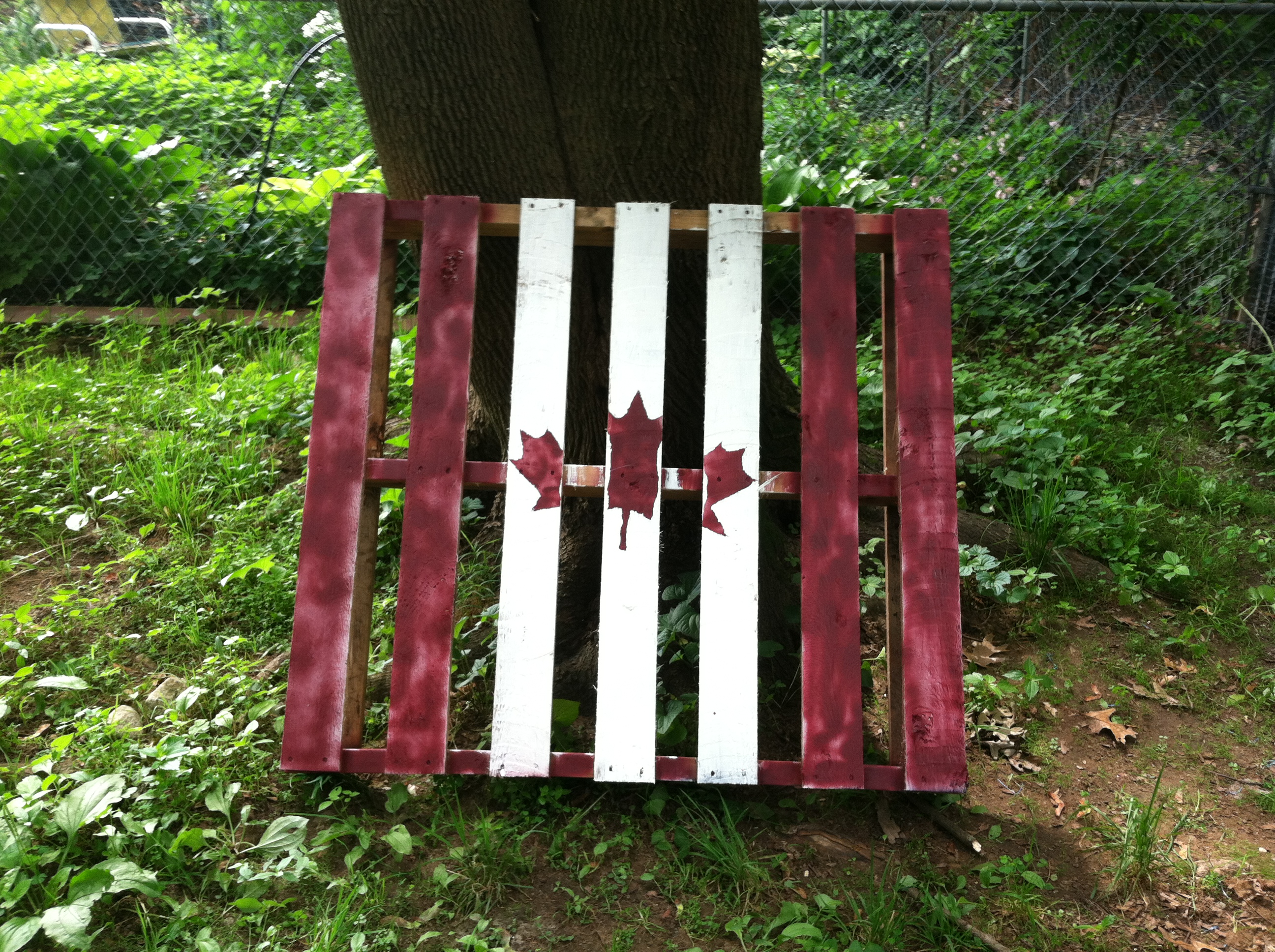
July 1st is an important day – In Canada it’s cause for celebration because it’s Canada Day!
What better way to celebrate your Canadian allegiance than a fun tutorial to make a Canadian Flag pallet. If you have a camp, a house on the lake or even space in your front garden this is a creative piece that withstands the elements and showcases your Canadian pride.
You’ll need:
1 pallet
1 can white spray paint or small can white paint
1 can red spray paint or small can red paint – We chose a rustic red vs. fire engine for a more country feel. But any red will work.
*Spray paint it a lot easier with less cleanup*
Printed Maple Leaf
Tape
Scissors
1. Wipe down your pallet – we used our kitchen broom for a quick sweep down.
2. In a well ventilated, outdoor area, spray paint your entire pallet red. Let it dry until it’s dry to the touch.
3. Free hand or print out a maple leaf we used this as our guide, maple leaf – you’ll need an 8×10 (or larger, your choice) maple leaf template.
4. Cut out your maple leaf and place it on the center of your pallet. Our pallet was 7 boards across, so we placed the leaf in the center of the 3 middle boards. Place tape on the back of your leaf and place it on the board.
5. Spray paint your middle three boards, over the leaf template white. Let air dry.
6. Once dry to the touch, peel up your leaf template.
Cory Schneider, a Vancouver Canucks goaltender with two years remaining on his 3-year contract, was traded to the New Jersey Devils for their first-round pick (No. 9). Schneider is due $4,000,000 (2013-14), and $4,500,000 (2014-15), with a cap hit of $4,000,000 per season (per CapGeek.com).
Both Martin Brodeur and Johan Hedberg are two of the oldest goalies in the National Hockey League. Both Brodeur (41) and Hedberg (40) have been sharing duties in goal for the New Jersey Devils since 2010-11. Schneider (27) shared his duties with Roberto Luongo in Vancouver.
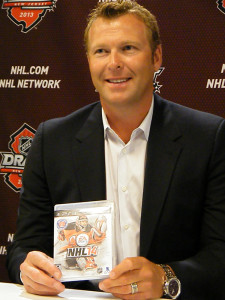
The New Jersey Devils’ own Martin Brodeur was in attendance at the 2013 NHL Entry Draft, not only to make a media appearance to discuss winning the popular vote to appear on the cover of EA SPORTS NHL 14, but also to see if his son, Anthony, would be drafted.
Brodeur spoke of how his kids wanted him to win the cover vote for EA SPORTS NHL 14, so they started a massive social media campaign to get him on the cover. The all-time winningest goaltender started a Twitter page, run mainly by his brother, and they launched a Twitter campaign to get the legend on the cover of NHL 14. See more here.
There are a lot of Canadian-born players in professional hockey. A big reason for this is the success of the three main junior leagues in developing players. On any given NHL roster, you can find a number of players from either the OHL, WHL, or QMJHL. However, there are also players that take a different junior route from Canada and even end up playing hockey in college.
That is just what Brandon Pirri did. Being from Toronto, the closest major junior league would be the Ontario Hockey League. Instead, he spent two years in the Ontario Junior Hockey League, closer to home. In his second season in the OJHL, he scored 94 points in just 44 games.
“I was smaller come my draft year for the OHL. I was drafted by Sudbury but it wasn’t really an option for me for the first couple years,” Pirri said of his decision to go to the OJHL. “I just figured staying at home and living with my family. I could spend more time with them. I also found a good program to prepare me for college hockey.”
With those numbers that he put up during the 2008-2009 season, he gained notice from NHL teams. He showed up at the 2009 draft and was not disappointed. The Chicago Blackhawks selected him with their second round pick.
“I went to the draft in Montreal as an 18 year old. You hope to hear your name called and it’s a long day,” Pirri said. “I was lucky, I didn’t end up waiting too long. My whole family was there. Then to be drafted by a storied team like Chicago, it’s exciting. It was a lot of fun.”
After being drafted by the Blackhawks, Pirri went to start his first season at RPI. It was a plan that he had had since after his first year of juniors in the OJHL when he was recruited.
“I always liked the idea of college. I wasn’t really sure what to expect going to a US school,” Pirri said. “Going to school for a year I got bigger and stronger and that’s what helped me make the jump to pro.”
RPI was a great experience for him in terms of growth and development. But, Pirri ultimately decided that it was best for him to leave after his first year. It was not a decision he made lightly but also one he would make again if he had to.
“For every kid, the dream is to play in the NHL. I just looked at it and I didn’t want to waste my opportunity,” Pirri said. “The option was there but it was a tough decision because my best friends go to school there. I had to jump ahead a little though.”
As tough as it was for Pirri to make the decision to leave college, he had a chance to follow his dream and he had to take it. Playing professional hockey was something he had always wanted. He started at a young age and finally felt like he was realizing his dreams.
“You know in Canada, you’re thrown on skates as soon as you can walk so I probably started playing around 3 or 4. Then I started having good success when I was drafted into the OHL,” Pirri said. “Until I was drafted into the NHL I didn’t really believe I could make a career out of it. It’s your dream, but you aren’t sure it’ll happen.”
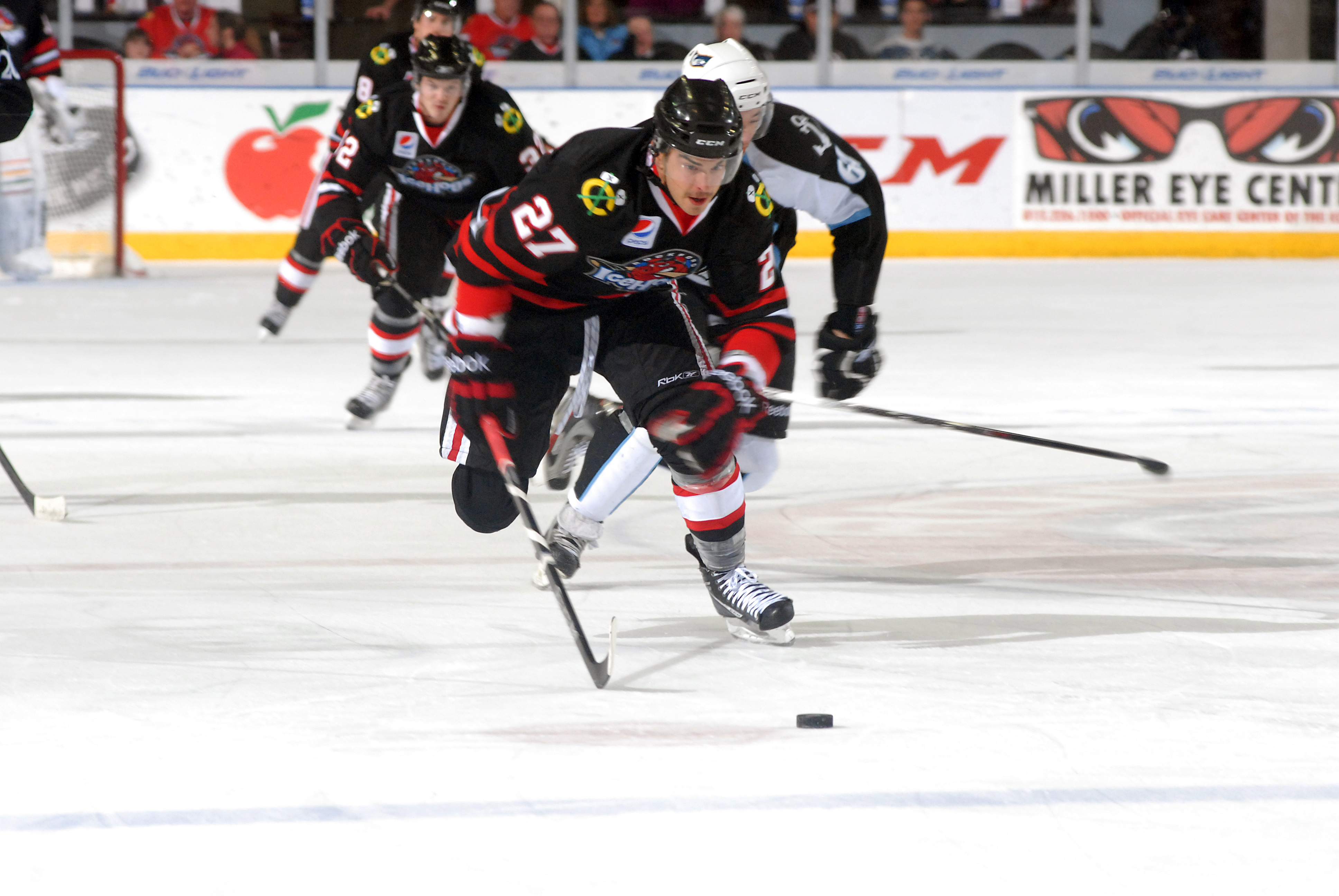
Now, Pirri is coming off his third season in the Chicago organization, having spent the bulk of the time in the AHL with Rockford. This third season with the Rockford IceHogs is the most successful professional season he has had to date. Over 76 games, he had a team-leading 75 points. He also lead the team in assists with 53.
“I think the team just got hot. A lot of guys took charge and scored big goals for us and that’s when it makes things easy,” Pirri said of his season, not taking the credit for himself. “I just tried to give them the puck and let them do the rest. It’s a combination of a hot team and lines that worked for everyone.”
Even though Rockford missed the playoffs, Pirri thinks it was a successful year. They came together really well. “For a lot of guys, it was our third year there, at least for the core group. Then they brought in a guy like St. Pierre who helped a lot too,” Pirri said. “We were just really comfortable with each other and knew what we were doing. The chemistry was there and we took advantage of that.”
After the strong offensive season that he has had, Pirri hopes to continue to build on his success for next year. He is going into the final year of his initial contract with the Blackhawks and hopes to crack the NHL roster. He was in Chicago for their Stanley Cup run and now will go back to Toronto for a couple weeks before coming back to train with the Blackhawks staff.
“The roster in Chicago is something that’s hard to crack. At the same time, I have to keep doing what I’m doing. I had a good year this year,” Pirri said about making the Blackhawks. “Consistence is the biggest thing for me to get up there because every day you would be playing at the top level in the world. That’s something that I have to work on that will help me in the long run.”
The whole experience this past year was great for Pirri. He got a chance to dress in a game with Chicago during the regular season. Then, during the postseason, he got to be at the United Center to watch as his team marched on to become Stanley Cup Champions. The city of Chicago has been an excellent hockey community that he has thoroughly enjoyed playing in.
“Chicago is a great hockey market, the whole city is behind the team here especially in the playoffs. It’s exciting and there’s definitely a large buzz in the city,” Pirri said of his time in the Blackhawks organization so far. “Even as far as Rockford, which is an hour and a half away, everyone is going out to bars and restaurants to watch. It’s even been exciting for the town of Rockford.”
Throughout his whole hockey career, Pirri still sites his parents has having the greatest influence on him as a player. He understands that he might not even have these chances to follow his dreams were it not for them supporting him every step of the way. Family is important to him and he truly gives thanks for all the help.
“They had to drive me to the rink every day for practice and they made some sacrifices. They supported me through the good times and the times that didn’t turn out so well. They had a huge influence on me and helped me. I have to give all the thanks to them,” Pirri said. “They had to switch around their work schedules and travel and all that. It’s a big sacrifice, but I was lucky to have two great parents who were so supportive.”
Shortly, Pirri will be getting to work with offseason training now that the Stanley Cup Finals are over. However, now that he has seen the atmosphere of a Final, he hopes to be on a team that hoists the Stanley Cup as well instead of just watching. Next season could find him getting much more playing time in Chicago if he works hard and makes a good impression during training camp in the fall. Either way, Brandon Pirri is certainly a talented young player to keep an eye on.
Months ago, I posted an article under the Health section of Pink Puck talking about High Intensity Interval Training (HIIT) and the benefits that this type of work out has. An important aspect of HIIT, or any workout for that matter, that I didn’t discuss is target heart rate.
You’ve probably seen this mentioned on posters or flyers in fitness centers or on the elliptical or treadmill. Unlike weight bearing exercises where you can count the number of repetitions, cardiovascular exercise doesn’t have an obvious way to measure progress or success. You can use time or distance but if you run three miles per day at the same pace; your body isn’t challenged because it becomes comfortable with this routine. This is where target heart rate comes in. Knowing and using your target heart rate can increase the intensity of your workout and challenge your cardiovascular fitness as you strive to meet your fitness goals. Below we will discuss two ways to calculate your target heart rate. Calculating Your Target Heart Rate
Though the equation isn’t all that complicated, there are easier ways to calculate your target heart rate. In fact, LiveStrong has developed an online widget to make our lives easier! This widget involves two easy steps:
1) Enter your age
2) Enter your intensity level (moderate or vigorous)
That’s it! And your target heart rate zone for your desired level of intensity is calculated for you. LiveStrong’s heart rate calculator.
So before you head out to your next boot camp class, circuit training class, or run, go online and find out what your target heart rate is for both moderate intensity exercise and vigorous intensity exercise. Now, I want to show you to calculate your target heart rate using the formulas.
Step 1: Calculate your Maximum Heart Rate
Your Maximum Heart Rate (MHR) is the amount of beats per minute your heart is capable of. The simplest way to calculate this is to subtract your age from 220. Please keep in mind that this is an estimate and any heart medications or heart conditions could alter this number.
220-age = MHR
Step 2: Calculate Moderate Intensity Heart Rate
The moderate intensity heart rate zone falls within 50-70% of your maximum heart rate. So to calculate the full range, use these formulas:
MHR x .50
MHR x .70
Step 3: Calculate Vigorous Intensity Heart Rate
Healthy vigorous activity should fall within 70-85% of your maximum heart rate. To calculate the full range, use these formulas:
MHR x .70
MHR x .85
After finishing these formulas you will have your target heart rate zone for moderate and vigorous intensity. Again, the formulas aren’t difficult but using LiveStrong’s online tool would be a quick and easy way to learn your target heart rate zones. Keep in mind that going above 85% of your maximum heart rate puts unnecessary strain on your heart and there are no added benefits to exceeding this number.
Benefits of Knowing or Monitoring Target Heart Rate
Knowing your target heart rate zone is beneficial for a couple of reasons. First, you can achieve an optimal workout by knowing where you are within your zones and having this information can also help you pace yourself during your workout. Second, if you’ve ever had any heart conditions or are on any medications, monitoring your heart rate during a workout is extremely important.
To bring this all full circle, knowing your target heart rate can help you achieve your optimal performance. When performing interval training or a Tabatta, check your pulse before and after, (or use a heart rate monitor) and see if you’re within your target heart rate zone for vigorous exercise. Striving to stay in this zone will keep your workouts challenging, but safe, as you continue on your path to achieve your fitness goals.
Ask any hockey player when they had the first notion to get in the game, and you’re bound to get a list of memories from the early years. The interest has to spark from somewhere, and for Toronto Maple Leafs forward James van Riemsdyk, like many, it began with two greats, his Dad and Gretzky.
“Thank my dad, when I was younger he always had a Wayne Gretzky VHS tape called “Above and Beyond” on TV and I would be captivated by it. It kind of started with that,” said van Riemsdyk. “Took some steps to start skating and then a learn to play hockey program and it kind of built up from there.”
While Gretzky, like many of his peers unknowingly got him into the game, it was a different player that peaked interest for the Middletown Township, New Jersey native growing up.
“Adam Graves, he was always the guy that I would watch,” said van Riemsdyk. “Being a big Rangers fan when I was younger, he takes the cake. Gretzky would’ve been the easy answer, but Graves was my favorite.”
It’s easy to look up to players on the ice, but a key factor to success is remembering the people that surround you off of it.
“No hockey players get to where they are without their support system,” said van Riemsdyk. “For me, that’s my family, my parents, my brothers, aunts and uncles, all of them. They all helped along the way, to get me to where I am today. Obviously they’ve made a lot of sacrifices for me and I appreciate all that they’ve done.”
In hockey, there comes a definitive time in a players career where the game changes. While you still hold the passion, the expectations and work ethic needed to take you to the next step can be overwhelming. Often, a small piece of advice at a young age can help mold the way you think about the game. While sources will vary, for van Riemsdyk, it was his Dad’s advice that still plays a part to this day.
“Around 13 or 14, when guys started to train off the ice in the gym and all the extra stuff, he put a quote in my room. It still rings in the back of my head, every season it helps me to get ready for the year,” said van Riemsdyk. “‘By failing to prepare, you are preparing to fail.’ That’s just something I’ve tried every year since then, just to be as prepared as possible for a season. It’s putting in time in the summer, to make sure you’re ready to be the best player you can be when the season comes around.”
Professional hockey players generally come from traditional hockey markets, Canada and Minnesota for example, even New England. New Jersey isn’t often found on the list of states to produce NHL talent, but it is a great state with a growing hockey population. The passion for the sport within the community will certainly be showcased as the 2013 NHL Entry Draft hits the Garden state this month.
“I think it’s very exciting for hockey in Jersey, you look over the years and it’s come a long way,” said van Riemsdyk. “I think Jimmy Dowd did a great job with kind of a rough start, which paved the way for a lot of us. Now you see there’s probably, 5,6,7 guys from Jersey that are playing in the league. It’s come a long way and hopefully it continues to get better.”
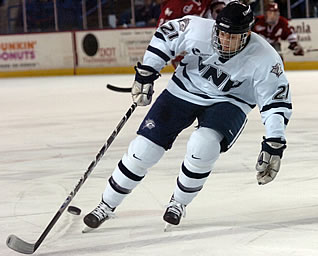
Photo: UNH
The oldest of three boys, it’s easy to understand why both younger brothers, Trevor and Brendan are following in van Riemsdyk’s skate strides. Setting a good example is customary for an older sibling and van Riemsdyk lends support and advice where he can to both brothers, chasing the same dream he’s successfully found.
“I do try to go about my business and do stuff that my family would be proud of,” said van Riemsdyk. “I try to help them whenever I can. If I see things that I know I would have wanted to know, when I was a little bit younger at their age, I try to pass that stuff along. Hopefully I can help chase after their dreams. They’re the same way that I was at their age, they dream of playing in the NHL one day. Obviously it’s a one day at a time process, but I try to help them out whenever I can.”
The van Riemsdyk’s middle son Trevor, is currently finding collegiate success at the University of New Hampshire (UNH), the same university that helped develop James’ career. Two years at UNH proved to be a learning experience both on and off the ice.
“That was huge, I think that’s when I did a lot of growing up. For me, personally, just the college hockey experience in general, I wouldn’t trade it for the world,” said van Riemsdyk. “The quality of competition on the ice, while learning how to grow up off the ice. You try to get that transition where you’re learning to live with a billet family in junior for a year and then you’re going to college and living in the dorms for a year by yourself. Then, the next year you’re paying rent in an apartment and buying groceries and taking care of all that stuff. I think it helped me grow up a bit. Socially as well, just learning different aspects that you need to take care of in the real world.”
Drafted second overall in the 2007 NHL Entry Draft by the Philadelphia Flyers, van Riemsdyk chose to forgo his final two years of college eligibility at UNH in April of 2009. The decision allowed the remainder of the 2008-09 season to be spent on an amateur tryout agreement with the Flyers American Hockey League affiliate Phantoms. Signing an entry-level contract with the Flyers for the 2009-10 season gave van Riemsdyk ice time in an NHL arena, and an assist in his first game. But the art of transition proved to be a key point during the summer of 2012. In exchange for Luke Schenn, the Flyers organization, sent van Riemsdyk from Broad Street, to Maple Leaf Square.
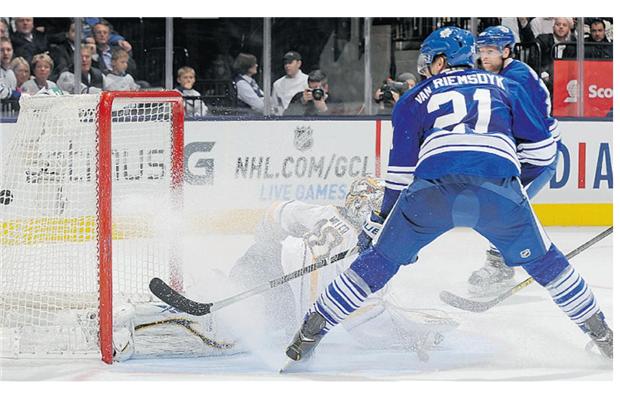
Photo: Leafs
“It’s been exciting for me, they both have a great passion for hockey. The key difference is off the ice, when you’re not around the rink, the passion that they have for the Leafs up in Toronto is second to none,” said van Riemsdyk. “You can be walking into a restaurant, going to pick up your dry cleaning, people know exactly who you are and what you’re doing and what you’re up to, all that good stuff. They just want to see the game do well, they live and die for Maple Leaf hockey. It’s an honor to play for a city with that kind of passion and hopefully we can have some success going forward for our fans.”
The city of Toronto has an undeniable love for the game and bringing playoff hockey back to the city is an experience that all the Leafs players want to have again, and again.
“When people ask me about hockey in Toronto, I think the one image you can always go to is, one of our games on the road when you have 10-15,000 people in Maple Leafs square outside in the rain going nuts, watching the game on the big screen out there,” said van Riemsdyk. “It just goes to show the passion that the fans really have. We feed off that enthusiasm and excitement that they bring, so we’re all really excited for next season.”
Playoff hockey is and will always be a cut above the rest. It’s teams from the greatest sport in the world, fighting for the ultimate prize, Lord Stanley. It’s a fight that never stops, even when the last horn sounds and you’ve been eliminated from the running.
“To see the growth that we’ve made as a team. We got better and better as the year went on, obviously the way the season ended left a sour taste in a lot of our mouths,” said van Riemsdyk. “We did a lot better than people were expecting, the bar has been raised again and it’s going to be up to us to continue to raise that bar, continue to get better and hopefully keep chasing after it and get closer to our goal of winning the Stanley Cup.”
The off-season schedule holds different regimes for many, but the premise is ultimately the same – perfect the game and improve yourself.
“[My trainer], he does 1 hour slots throughout the day, 1-on-1 with the guys. I’m usually in the afternoon, so I generally sleep in until 10 or 11, get some breakfast, maybe get some treatment if that’s on the docket for that day,” said van Riemsdyk. “Then I head over to the gym from 2:30 – 4 pm, get my work in and then kind of relax for the rest of the day. Maybe watch some movies or TV shows, it’s pretty low key for me on an average day in the off-season.”
Photo: Leafs
Anyone can attest to the type of dynamic play van Riemsdyk brings to the ice, but it’s often more difficult to see a players personality off of it.
“I’m laid back, I’d say I’m a pretty easy guy to get along with,”said van Riemsdyk. “I like to enjoy life in the summer, but at the same time, I know there’s work to be done as far as putting in the time and making sure you’re a better player when you come back in the fall. There’s a fine line between doing all that and knowing when the time to work is, and what you’ve got to do to make sure you’re ready to go.”
Hockey players are often marked as some of the nicest, most relate-able athletes in professional sports, van Riemsdyk is certainly no exception.
“I’m glad I still have that, I remember the first couple of interviews I did during the draft and stuff. That’s one of the things people would comment on,” said van Riemsdyk. “I’m always in a good mood, laughing, having a good time and enjoying the moments. We’re lucky to be able to do what we’re able to do, I think I have some fun with it, but I love what I do and it brings it out of me.”
While hockey players are generally nice, they often face misconceptions about themselves based upon on ice actions or lack thereof.
“People might say that I don’t show enough emotion, but my personality, I’m one of those guys that keeps things inside a lot. I know how much I care about what I do, I know how much I love it,” said van Riemsdyk. “But I don’t necessarily wear it on my sleeve as far as maybe banging your stick on the ice, or breaking it on the boards and stuff like that. I think that’s the biggest misconception about guys that are a little bit more reserved, people might perceive it as we don’t have the same passion for the game and that’s very, very far from the truth.”
One perception that should ring true for Toronto fans, van Riemsdyk is a perfect addition to the Maple Leafs roster. While fans may hold passion for their home team, James van Riemsdyk holds something as well, the perseverance to bring continued excitement and success to a city that he now calls an in season home.
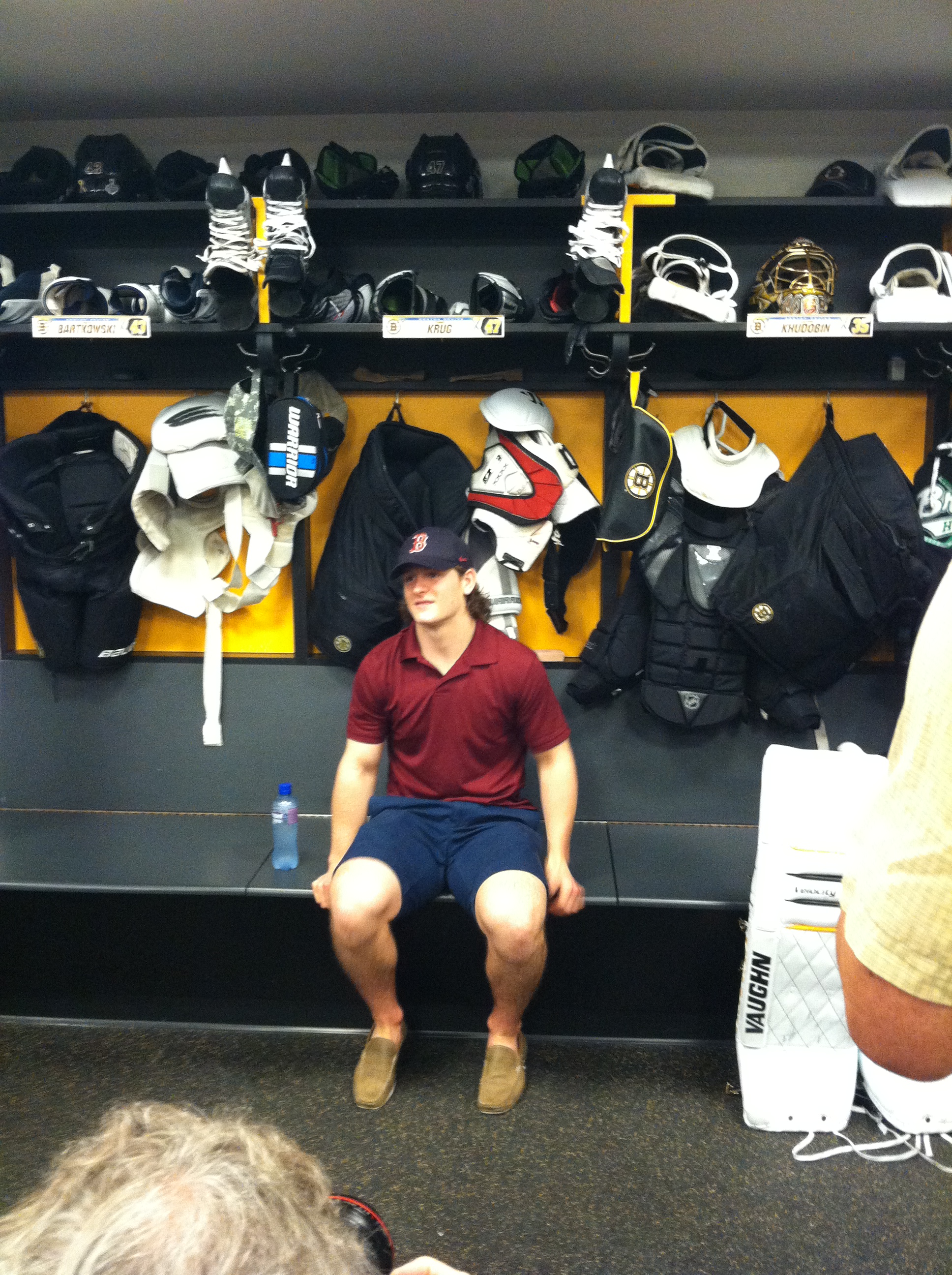
Torey Krug awaits the media storm on break-up day in Boston
Friends come and go and in hockey, teammates can be teammates for a single season or many. But all good things come to an end eventually and for Boston, the end came on Monday night. As the Chicago Blackhawks hoisted the Stanley Cup, a reality set in. With a relatively untouched roster since the 2011 Stanley Cup winning season, the band of brothers that Bruins GM Peter Chiarelli has kept together, finally skated their last game as a unit.
It’s never easy to say goodbye, but the time has come. Some players are at the forefront of negotiations, goaltender Tuukka Rask for example, who had a stellar run and proved himself as starting goaltender material game in and game out. Nathan Horton, will also be on the negotiations table.
“I’ve always said, like I said, I love the guys,” said Horton. “The team is great, it’s a fun place to play. Other than that, I don’t know what’s going to happen. I couldn’t tell you throughout the year that was going to happen, I don’t know and we’ll see what happens.”
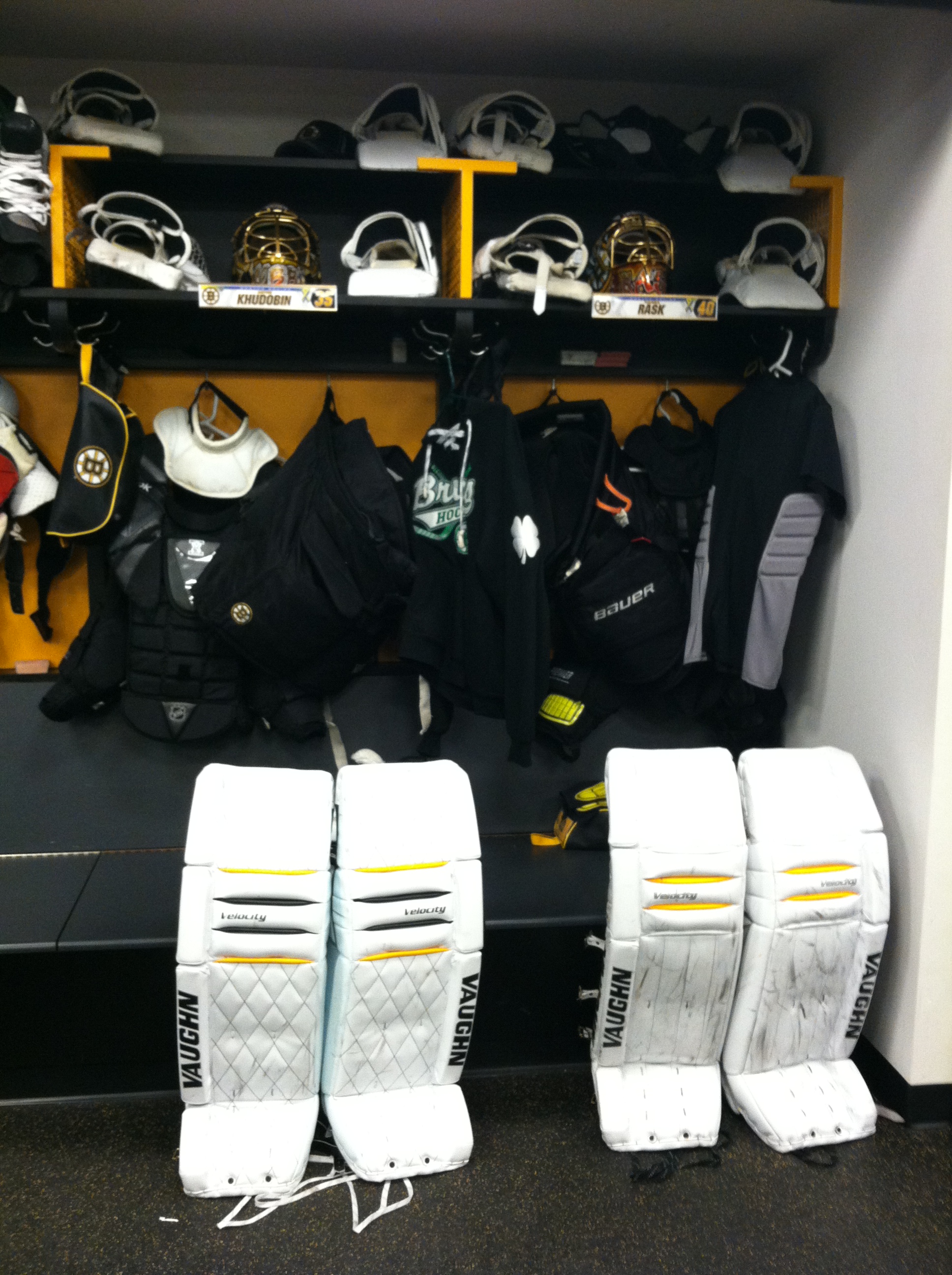
As is customary, some players are at the top of the negotiations list, while others find themselves in limbo, back-up goaltender Anton Khudobin and Wade Redden both fall into that category. Although the Jaromir Jagr acquisition was a good one and helped the overall cause, he will not be donning a Bruins sweater next season. Jay Pandolfo is another no-go for Boston, and is unclear of his plans moving forward. It’s always sad to see a player go and the final confirmation that defenceman Andrew Ference is among those to leave Boston, will certainly be a blow to fans.
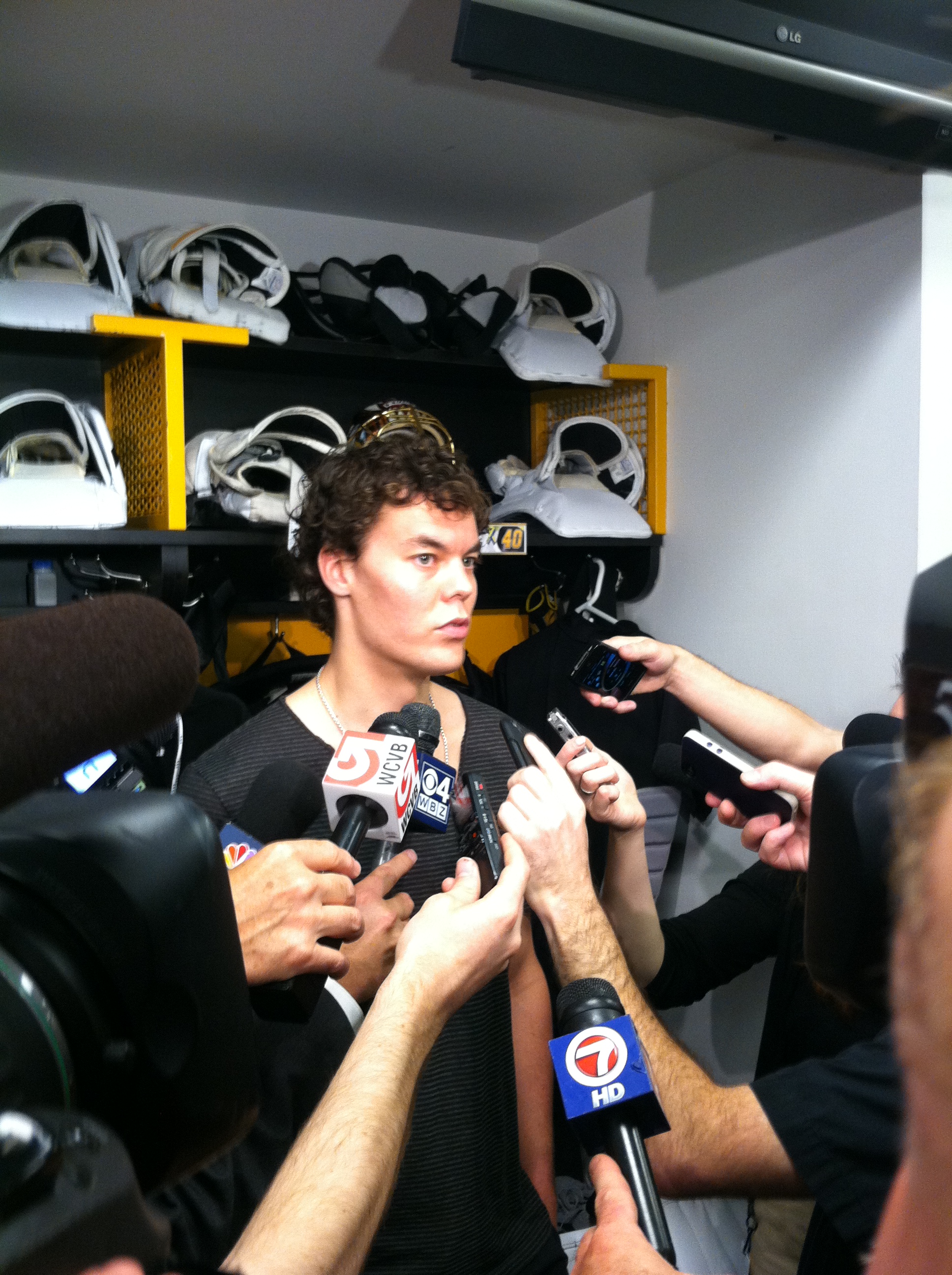
Tuukka Rask weathers the media storm at break-up day
Wednesday morning brought a banged up, bruised and heartbroken group of players together for break-up day. Despite a shortened season for the league, it’s been a lengthy and emotional road for Boston.
The feeling in the room was best summed up Bruins forward Brad Marchand. “What’s injured?”, asked a member of the media. Marchand’s simple response, perhaps applicable to his entire team, “just my heart.”
Playing through pain is par for the course, that’s playoff hockey.
Reluctant to disclose too many injuries, Bruins GM Peter Chiarelli simply said, “we were banged up.” Zdeno Chara had a really bad hip flexor, Dennis Seidenberg has been battling a hamstring issue since the first round, while Jaromir Jagr had both a back and hip issue. Nathan Horton had a dislocated shoulder that will require surgery this summer, although he’s the only player as of now who will undergo surgery.
Gregory Campbell speaks to the media during break-up day
By now, the hockey world is familiar with Gregory Campbell’s on-ice heroics, playing a shift with a broken leg during the Penguins series. Another prime example of battling on and playing through pain can be found in Patrice Bergeron. Bergeron, who was absent from break-up day, is currently under observation at the hospital. The face of on-ice perseverance wears a #37, Bergeron battled through the final games with a punctured lung, broken rib, torn cartilage and a separated shoulder. The dedication showed to the team has not been lost by anyone within the organization, teammates included.
“You can’t say enough about him. He’s an inspiration,” said enforcer Shawn Thornton on Bergerons’ dedication. “He’s a man amongst boys, as far as the toughness goes. I think what he played through, I’m not sure how many guys could play through that, so it was pretty impressive. That’s for sure.”
It isn’t about focusing on the past, but looking ahead to the future. For players, that future will start in just 9 short weeks, when they return to Garden ice for another season. For management, scouting for the future starts this weekend during the 2013 NHL Entry Draft, being held in New Jersey. Following the draft, Bruins development camp with face-off beginning July 10th at the Bruins practice facility in Wilmington, Ma.
What’s worse than a break-up? Breaking up with an entire team, and that’s just what fans are faced with as the summer finally begins. Enjoy the rest hockey fans, because a new NHL season is just around the corner.
The morning after, it’s a phrase that can hold many definitions and emotions. It’s when the excitement or disappointment from the previous nights adventures ebb away, and you’re faced with the reality of a situation.
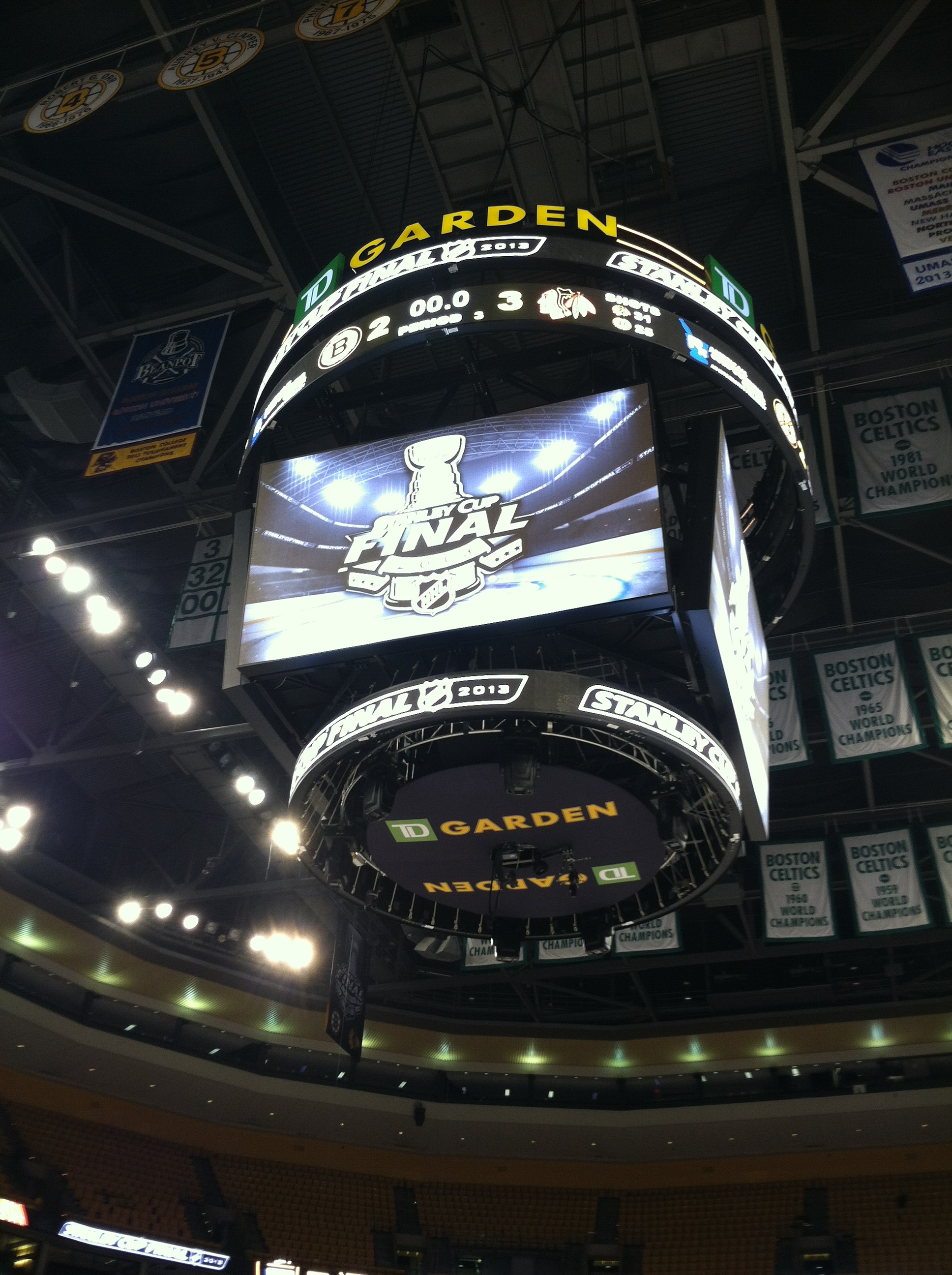
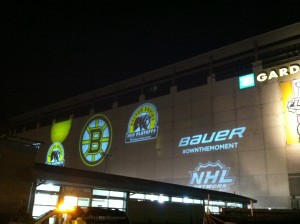
With a sell-out crowd of 17,565 on hand for a Game 6 Stanley Cup Final, the atmosphere at TD Garden in Boston was, as always, a cut above the rest. Chants of “We want the Cup”, and “Go Bruins”, rained upon the ice for 58 minutes. An entire city stood behind their home team and waited with baited breath as the clock ticked down. The Bruins held a 2-1 lead in a do or die contest and the results were leaning in their favor. It was at 18:44 of the third period that fear set in, as Chicago’s Bryan Bickell sent a snap shot past Bruins Tuukka Rask. Fear turned into heartbreak at 19:01 as Dave Bolland secured the ultimate prize for the Chicago Blackhawks with a wrist shot that put his team just 59 seconds away from the Stanley Cup. Perhaps the longest 59 seconds in history for a team protecting not only it’s lead, but the title to call themselves champions.
10 seconds, the Blackhawks bench stares at the puck as it goes whizzing past.
9 seconds, players fidget anxiously among themselves.
8 seconds, the bench stands up.
7 seconds, players begin to cheer.
6 seconds, the bench begins to hop up and down in excitement.
5 seconds, all eyes are trained on the scoreboard.
4 seconds, the hugs begin.
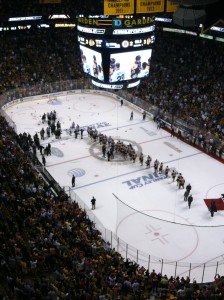
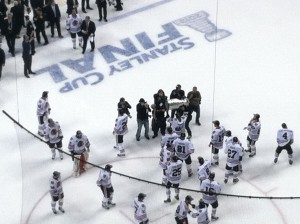
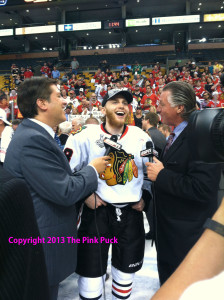
3, 2, 1… over the boards they spill, enveloping any teammate they can get their hands on. Equipment flying, tears spilling, the Blackhawks have won the Cup.
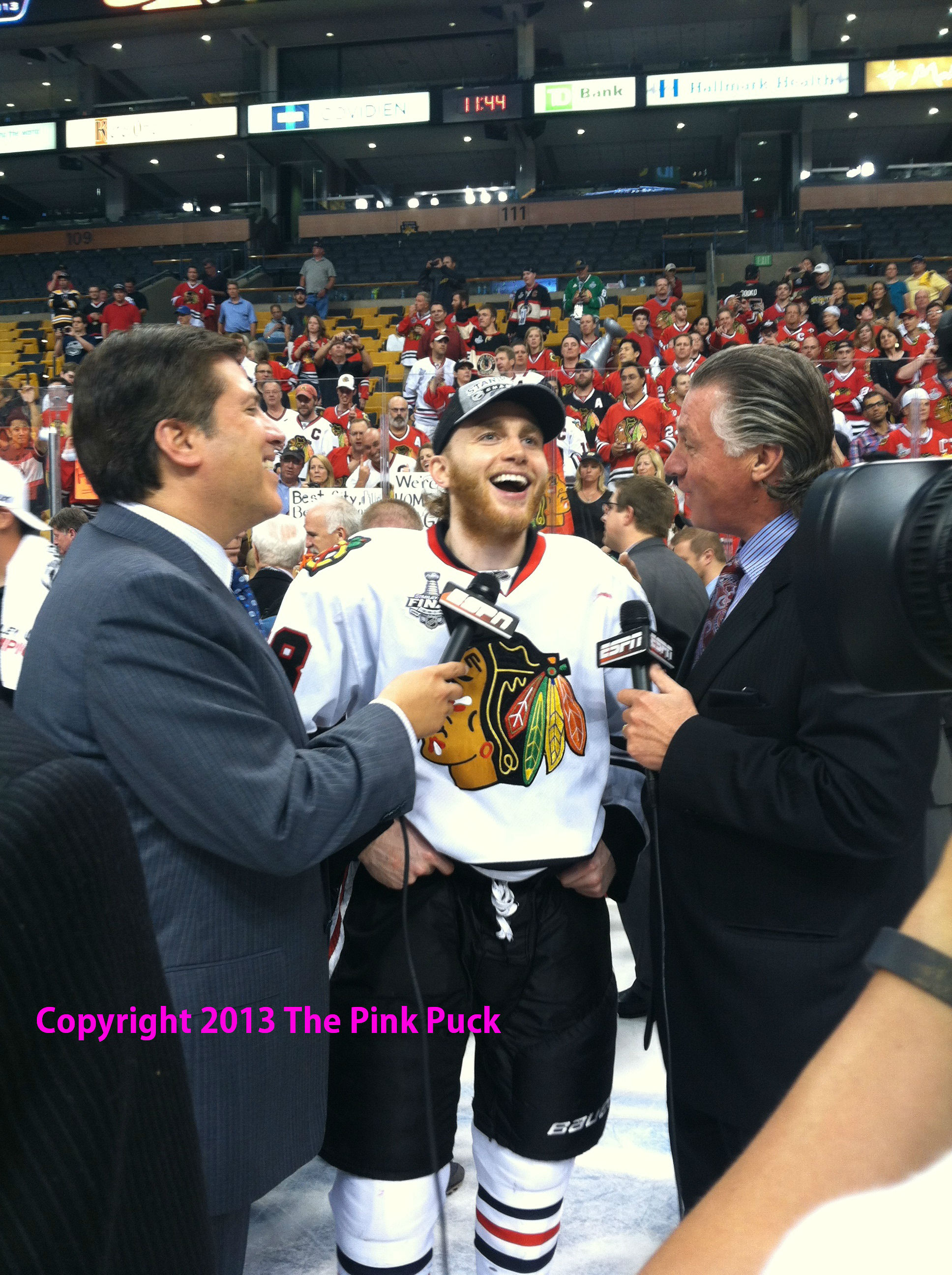
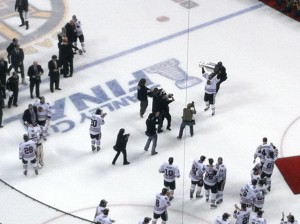
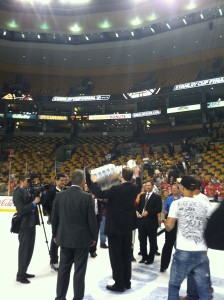
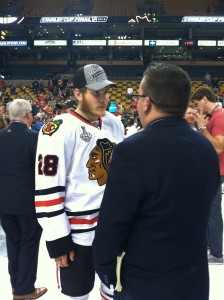
It’s a dream for all, fought for by many, experienced by few. As Chicago fans spilled to the lower bowl of the arena, looking for a piece of glass to witness history, hockey’s ultimate prize was carried onto the ice. But in true form, the Cup isn’t truly yours until it’s hoisted, and that’s exactly what Blackhawks Captain Jonathan Toews did – 34 pounds of glory, held high above his head.
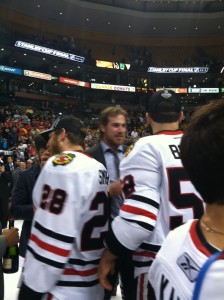
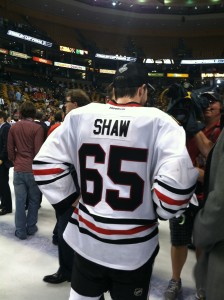
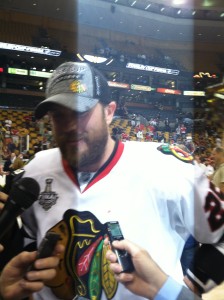
Friends and family flooded the ice to congratulate their heroes. It’s because of them, that the players have gotten so far. As the on ice celebrations slowly died down, the parties were just beginning. A relatively small visitors locker room in Boston didn’t deter the celebrations, as champagne showers covered the stalls.
It was at 1:37 am EST that the Cup and it’s champions were seen departing the Garden in Boston.
For Chicago, the celebration of winning the Stanley Cup continues.






















 Prev
Prev