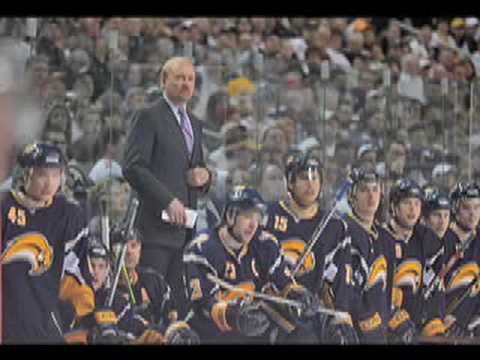
For someone who has played and coached in the NHL for nearly 40 years, Lindy Ruff spent over half that time with the Buffalo Sabres. They drafted him in 1979, and 18 years later, on July 21, 1997, they hired him as head coach.
Ruff’s long tenure with the Sabres began on August 9, 1979, when they drafted him in the second round (32nd overall). Though he started out as a defenseman, he primarily turned into a tough winger throughout his ten seasons in Buffalo. He served as captain for the last three seasons there, before they traded him on March 7, 1989, the trade deadline. Ruff finished the season and played the next two for the New York Rangers, eventually returning to defense. He spent the next two seasons playing for the Rochester Americans of the AHL (1991-92) and the San Diego Gulls of the IHL (1992-93). All told, Ruff had played 743 NHL games (116G, 208A, 321P), earning 1,457 penalty minutes.
After his playing career ended, in 1993 Ruff joined the Florida Panthers as their assistant coach. The highlight there was making it to the Stanley Cup Final in 1996.
In 1997, Buffalo sought a new head coach when the new GM, Darcy Regier, found Ted Nolan difficult to work with despite the team’s improvement and having just received the Jack Adams Award. Nolan was the third coach in the eight seasons since Ruff was traded away. Ruff said of Nolan, “Obviously he’s going to have bad feelings and he’s going to hope the next guy fails.” In the running for the position were at least two NHL coaches and Don Lever, longtime associate coach for the Sabres (and head coach of the Rochester Americans the season Ruff played there).
Despite his relative inexperience, Ruff was named Buffalo’s 15th head coach at 11:05 am, July 21, 1997, at Marine Midland Arena. Regier justified his choice saying, “I liked his passion for the game, his knowledge of the game, his ability to work with young players and his ability to develop young defensemen.” He also felt that Ruff’s previous ties to the Sabres “were an added bonus.”
In accepting the three-year contract, Ruff stated, “This will never be my team or someone else’s team, this team belongs to the people in Lockport and Cheektowaga and the rest of the area, the people who used to wear the Bethlehem Steel T-shirts. This team reeks of what I was as a player: hard work, determination and character. We’re going to put together something that’s very special. Losing will not be tolerated in this city.” He continued, “If we play a system and we’re a dedicated team, I think that’s an attainable goal.” Despite the pressures to produce, Ruff could not help but comment, “Obviously I’m very excited about coming back to Buffalo, which I considered my home town.”
Buffalo would remain Ruff’s hometown for the next 15 years. Right off the bat, he led the team to the 1998 Eastern Conference Finals and the 1999 Stanley Cup Final, where they lost to the Dallas Stars after Brett Hull’s controversial goal. That was the closest Ruff came to winning a Stanley Cup. The Sabres then went through a slump just before the 2004-05 lockout due to financial problems. In 2005-06, Ruff brought the team back to the Eastern Conference Finals, in the process earning himself a Jack Adams Award as coach of the year. The following season was the best record-wise (with 113 points) for the Sabres, and they returned to the Eastern Conference Finals. Ruff was runner-up for the Jack Adams Award. As of January 8, 2011, Ruff (beating Toe Blake’s record) became the winningest coach for one team with 501 Sabres’ victories.
Although the Sabres had extended Ruff’s most recent contract in 2011, on February 20, 2013, they fired him as head coach. At the time, he was the longest active-serving coach with a single team and one of only four to coach over 1,000 games with one team. Ruff’s coaching tenure with the Sabres had lasted 1,165 games, earning 1,304 points (571-432-78-84).
Interestingly, Ruff’s replacement, Ron Rolston, did not last through the next season and was replaced by Nolan, Ruff’s predecessor. At the same time, Regier, who had hired Ruff, was fired as GM.
Exactly one month shy of the 16th anniversary of the announcement that Ruff would coach the Sabres, on June 21, 2013, their Stanley Cup rivals, the Dallas Stars, named Ruff their head coach. Hull’s infamous goal had occurred in the wee hours of the morning on June 20 back in 1999. That first season, Ruff led the Stars to their first playoff berth since 2008. He coached them until the end of the 2017 season, when the Stars announced he would not be returning. For Dallas, Ruff coached a total of 328 games for 371 points (165-122-41).
Since July 10, 2017, Ruff has served the Rangers as an assistant coach. During his long career, he also assisted in coaching Team Canada for the 2010 and 2014 Winter Olympics. He does not quite seem ready to stop coaching.
Additional Sources:
Kevin Oklobzija, “Ruff says he’ll heal wounds,” Rochester Democrat and Chronicle, 22 July 1997, pp. 1D and 3D.
“The NHL used to be a good ol’ boys organization, but it’s changing.” With those words, Ray Payne, a scouting supervisor for the San Jose Sharks, laid the foundation for women to work in new capacities for the NHL. On July 20, 1992, the Sharks hired 26-year-old Deborah Wright as a part-time scout, making her the first female NHL scout.
Wright had a solid hockey background. She played right wing at Carleton University in Ottawa and in the Ottawa Women’s Senior Hockey League between 1982 and 1984. During the 1985-86 season, she coached an Ottawa boys’ team. She then lived in Anjou, Quebec and scouted throughout that province. Between 1987 and 1990, she scouted for Trois-Rivieres, and from 1989 to 1991, she did scouting for the Drummondville Voltigeurs of Quebec Major Junior Hockey League. During that last season alone, she attended 325 games. Payne said of her, “She’s got a tremendous track record. She is simply right a lot of the time.”
Some people are drawn naturally to certain aspects of the game. Wright commented, “I like hockey but mostly I enjoy seeing the development of players.” She explained how she realized this. “I was marking too many notes in my line-up when I went to watch games. I did it out of habit. Someone suggested that I get into scouting.” She continued, “Even if there were 20 women working as scouts in the NHL, I’d still do it. I didn’t do it to prove a female can do it. I just wanted to advance.”
To advance her scouting work, Wright actively pursued the San Jose franchise for two years. They had just debuted the season before and did not have a regular scout in Quebec. She felt that being bilingual would give her an advantage there. “It is very important in the interview process with players. You want a player to feel at ease so that he can speak to you in whichever language is comfortable and natural for him. It also helps to speak French when dealing with scouts and team personnel in Quebec.”
The Sharks hired Wright to scout part-time for a year, joining the fifteen others scouting for the franchise. She would be based in Montreal and “evaluate talent for the club at the junior and collegiate levels” in the province, eastern Ontario, and eastern parts of the U.S. Payne noted, “Knowledgeable people in hockey circles spoke very highly of Deborah’s capabilities. She was clearly our best candidate. Because of her ability, we were not afraid to make this progressive move.” The Sharks vice president and director of player personnel, Chuck Grillo, added, “Having a female in the business is unique, but more importantly, the hiring is a credit to her ability and love for the game of hockey.” He continued, “We are concerned with drafting the right people and Deborah shows that she can evaluate playing talent, as well as help us determine what kind of person we are selecting. She provides us with a good opportunity to upgrade our staff.”
Wright did her best not to be intimidated by being the first female scout (even beyond the NHL). “Once you show you know what you’re doing, it shouldn’t be a problem being accepted. The most important thing was being accepted by the Sharks. It’s going to be nice to work with people who are willing to give me a chance to show what I can do.”
Ultimately, the Sharks decided not to renew Wright’s contract. However, the news broke on July 1, 1993 that Angela Gorgone had been hired as the inaugural scouting coordinator for the Mighty Ducks of Anaheim. Throughout her NHL career, Gorgone broke still more barriers as she became the first female assistant general manager and then manager of hockey operations. Since then, the NHL has continued to hire women in select positions but has lagged behind the other three major leagues in other full-time positions. To date, females remain under-represented in NHL operations.
Additional Sources:
Mike Commito, Hockey 365: Daily Stories from the Ice(Toronto: Dundurn, 2018), kindle edition.
“Sharks scout breaks the ice,” San Francisco Examiner, 21 July 1992, pp. C1 and C3.
Jane Gottesman, “Shark’s new scout helps break barriers,” Santa Cruz Sentinel, 23 Aug. 1992, p. B3.
Gregg Drinnan, “Quarterback gives it up for hockey,” Regina Leader-Post, 17 July 1993, p. F3.
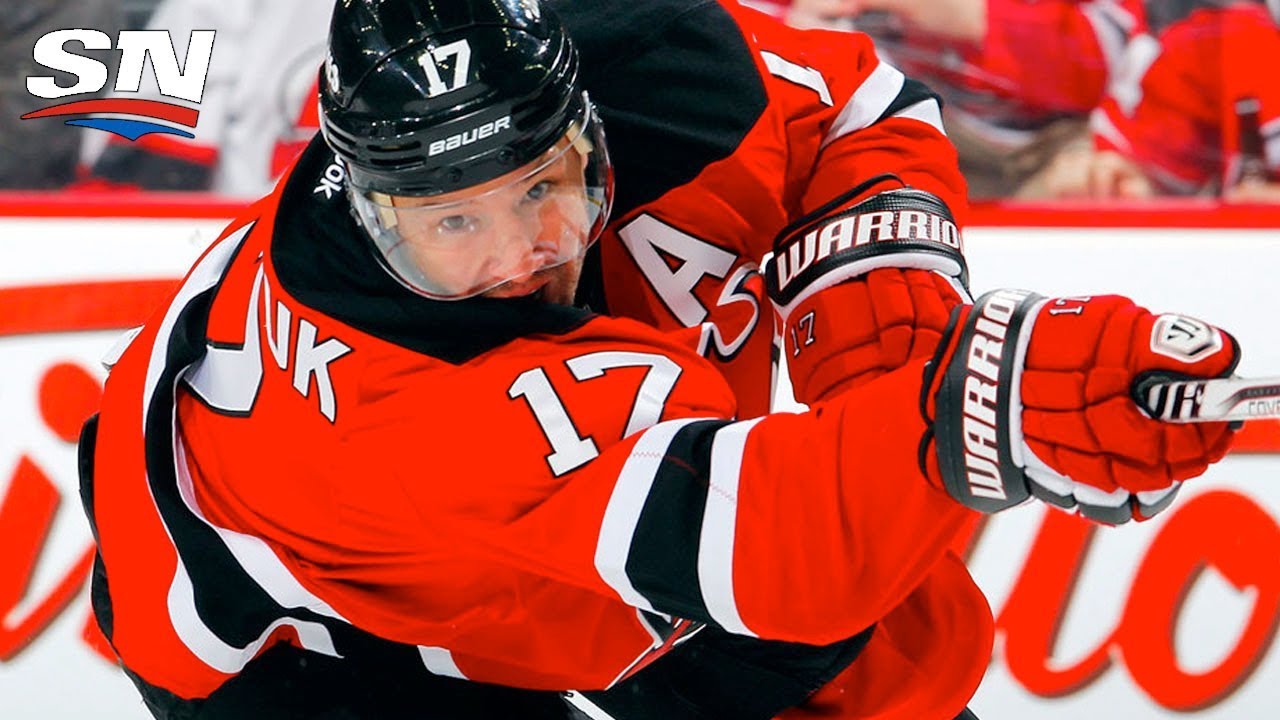
On July 19, 2010, the New Jersey Devils signed left winger Ilya Kovalchuk to what was a monstrous 17-year contract worth $102 million. The Devils had acquired Kovalchuk earlier on February 4, 2010 from the Atlanta Thrashers who had been unable to come to terms with Kovalchuk on a contract extension. At the time it was the longest contract in the history of the NHL.
It is said that during the 2009-2010 season Thrashers’ general
manager Don Waddell had offered Kovalchuk a 12-year, $101 million deal first
and then a seven-year, $77million deal, both of which Kovalchuk turned down.
Waddell then elected to trade the forward so as to get something in return
before Kovalchuk entered free agency as an unrestricted free agent that summer.
While the Devils assumed they had Kovalchuk locked up through 2027, the NHL immediately blocked the contract, asserting that the Devils had tried to circumvent the salary cap in terms of both the length of the contract as well as the structure of the deal in regard to salary. The NHL Players Association fought back and things went to arbitration.
“It’s back to the drawing board for Ilya Kovalchuk and the Devils.
After arbitrator Richard Bloch ruled Monday that the NHL was justified in rejecting
the 17-year, $102 million contract Kovalchuk signed with the Devils on July 19
as a circumvention of the salary cap and the collective bargaining agreement,
the sides immediately began negotiating another deal that they hope will be
approved,” reported Tom Gulitti of The Herald-News.
“While we do not currently have a contract with Ilya
Kovalchuk discussions have resumed and we are hopeful that a contract will be
reached that meets with the principles in arbitrator Bloch’s [ruling] and the
NHL’s approval,” Devils general manager Lou Lamoriello stated.
Two of the key points
in Bloch’s ruling had to do with the age that Kovalchuk would have been by the
end of the contract, and the structure of the salary.
The contract would have taken Kovalchuk until “just short of his 44th birthday.” Such a contract is “markedly rare. Currently, only one player in the league has played past 43 and, over the past 20 years only 6 of some 3,400 players have played to 42,” the ruling stated. “The dynamics of this [contract], with particular reference to its final six years, are such that there is scarce reason for either player or club to continue the relationship. By year 11, the player will have received $98 million of his $102 million contract.”
In the end, Kovalcuk
and the Devils were able to come to terms on a 15-year, $100 million contract which
the NHL agreed to on September 4, 2010.
There were reprisals and sanctions handed out to the Devils for their craftiness in the original contract. New Jersey was forced to surrender $3 million, a third-round draft choice in the 2011 NHL Entry Draft and one future first-round draft pick within the next four seasons. Because the Devils chose to use their first-round picks in both 2011 and 2012, it was expected that they would surrender their pick in 2014.
The NHL had a change of heart on some of its sanctions.
“The New Jersey Devils won’t have to forfeit a first-round pick after all for attempting to circumvent the salary cap by signing Ilya Kovalchuk to a 17-year deal in 2010, the NHL announced on Thursday [March 6, 2014]. Instead the Devils will be given the 30th pick in the draft and thus not be eligible for the lottery. New Jersey’s fine was also reduced, the league announced. TSN, which first reported the story, said the team was getting back US$1.5 million. Kovalchuk leaving for the KHL last summer appeared to be the reason for the change.”
Officially, Kovalchuk retired from the NHL July 11, 2013, with
12 years still remaining on the revised contract he signed in September of
2010. This could have been in part a result of the lockout shortened 2012-13
season which prompted many NHL players to look to European teams to play on
until the new collective bargaining agreement was agreed to and the NHL managed
a half season with a slightly delayed playoffs. Having the opportunity to play
for the KHL during the lockout meant not only that Kovalchuk could play in his
native Russia, but also that he got to keep more of his salary, not having to
pay taxes to the United States.
His retirement from the NHL was indeed an effort to return
to Russia so that he could play in the KHL. It was announced on July 15th that
Kovalchuk had signed a four-year deal with SKA St. Petersburg of the KHL.
“SKA did not disclose the terms of the deal in announcing
Kovalchuk’s signing. Alexander Medvedev, the former president of SKA, told the
Russian daily Sport-Express that Kovalchuk’s earnings would be ‘absolutely
comparable’ to what he would have made in four years with the Devils,” wrote New
York Times reporter Jeff Z. Klein.
While at the time of the signing it was true that Kovalchuk
would have made an impressive salary, the crash of the Russian ruble in
December, 2014 undoubtedly affected his contract. One has to speculate if he
would have been better off remaining with the Devils to finish out the 12 years
and earn the remaining $77 million.
Five years after announcing his retirement from the NHL, Kovalchuk expressed an interest in returning to the NHL. The Los Angeles Kings were among the several teams who reached out to Kovalchuk and they signed him to a three-year contract with an average yearly value of $6.25 million, making him a King for the 2018-19 season..
Additional Sources:
Mike Commito, Hockey 365, Daily Stories (Toronto, Ontario: Dundurn Press), Kindle edition.
Tom Gulitti, “Arbitrator’s ruling sends them back to the table,” The Herald-News (Passaic, New Jersey), August 10, 2010, Sec. C, p. 1.
“NHL reduces Devils penalty for Kovalchuk deal,” Calgary Herald (Alberta, Canada), March 7, 2014, p. B11
Jeff Z. Klein, “Kovalchuk Signs With SKA St. Petersburg of K.H.L.” The New York Times, Juy 15, 2013, as found online.
The Detroit Red Wings had just ended their 42-year drought when, on July 18, 1997, they made arrangements to ensure their continued success. They implemented a plan that had been in the works for three years by promoting Ken Holland to general manager. At the same time, they established the parameters for keeping Coach Scotty Bowman and Senior VP Jimmy Devellano. Holland explained, “It’s been a long process to get to this point in time. We wanted to go with a traditional coach/GM setup.” Thanks to these moves, the Red Wings went on to win more division championships, conference titles, Presidents’ Trophies, and (most notably) Stanley Cup championships.
Holland found his calling as a GM. After being drafted in the 12th round in 1975, he struggled his way through eight seasons goaltending for the AHL. He only made one NHL appearance for the Hartford Whalers (a loss during the 1980-81 season) and three for the Detroit Red Wings (including one loss and one tie during the 1983-84 season). Having retired from playing in 1985, Holland scouted for Detroit and became the chief pro scout in 1989. Beginning in 1994, he served the organization as assistant general manager, apprenticing under Devellano. In 1997, he was promoted with a four-year contract that gave him full authority to make decisions on all hockey operations as Detroit’s GM. “Certainly, it’s a tremendous opportunity for me,” said Holland. “I’m excited about my new role in the organization. I’ve been training to reach this point for a long time, and I’ve had the opportunity to work with a lot of great hockey people.”
As Devellano had wished, he took a more backseat role as senior VP without GM responsibilities. He was looking ahead to retirement. He explained, “I feel much more fulfilled about it now that we’ve won a Stanley Cup here. We won a couple of Presidents’ trophies and appeared in the finals, and it’s been three pretty darn good years since I returned to a more active role. Now, I look forward to getting out from under the duty of day-to-day operations.” Devellano had practically hand-picked his successor. “We put in this plan three years ago, and Ken Holland becoming the GM is something I’m very excited and very proud about. He’ll probably be around here for another 10 to 15 years.”
That was an understatement. Holland stuck around for 22 seasons, becoming the second-longest tenured NHL general manager. This past May 2019, he handed the reigns over to longtime-captain Steve Yzerman. “The Ilitches offered me a very, very incredible offer to remain with the organization as senior vice president. My thinking at that point in time was that I was going to be a Red Wing for life and work with Steve and support him.” However, plans changed. “I thought I would be there for life, but I also wasn’t sure if I was going to get restless. I told that to Chris Ilitch. I got restless sooner than I thought.” Instead of remaining with Detroit, Holland took a five-year contract for $25 million and full autonomy from the Edmonton Oilers. Holland commented, “I think there is an opportunity here for me to try to make a real positive impact on this franchise.”
Scotty Bowman had been coaching the Red Wings since 1993, after four seasons coaching St. Louis, eight seasons with Montreal, seven seasons with Buffalo, and two seasons in Pittsburg. By that point he already had five championships with the Canadiens (1973, 1976-1979) and one with the Penguins (1992). Bowman also earned the Jack Adams Award in 1977 and 1996. After bringing the Red Wings to the championship in 1997, he signed a two-year contract for just under $1 million per season and agreed to a limited behind-the-bench-only role. Bowman remarked, “This is what’s best for the organization, I believe that. It’s important to keep as many people as possible the same, and that goes for the coaching staff and the players.” Holland agreed, saying, “Scotty is a great coach, and we’ve had a tremendous run of success the last couple of years.”
Other than the five games each coached by his associate coaches, Barry Smith and Dave Lewis (who also signed deals at the same time in 1997), Bowman continued coaching the Red Wings for a total of nine seasons. He led the team to another Stanley Cup in 1998 and then retired once they won again in 2002. As a coach, Bowman holds the most Cups (9), made it to the Final the most times (13), and has the most wins (1,248 in the regular season and 223 in the playoffs). After his coaching career ended, Bowman became the Senior Advisor of Hockey Operations for the Chicago Blackhawks, who then won three Stanley Cup championships (2010, 2013, 2015).
Since 1997, the Red Wings (and thus Holland) have won 10 division championships (1999, 2001-2004, 2006-2009, 2011), five regular-season conference titles (2002, 2004, 2006-2008), and four Presidents’ Trophies (2002, 2004, 2006, 2008). They made the playoffs the first 18 seasons under Holland, ending a 25-season streak, begun in 1991, that stands as the third-longest in NHL history. Of those 18 postseasons, Detroit won the Stanley Cup championships three times (1998, 2002, and 2008) of the four the played. During Holland’s time, Detroit had more victories (1,012) than any other franchise, including 893 during the regular-season and 119 during playoffs.
Additional Sources:
Mike Commito, Hockey 365: Daily Stories from the Ice (Toronto: Dundurn, 2018), kindle edition.
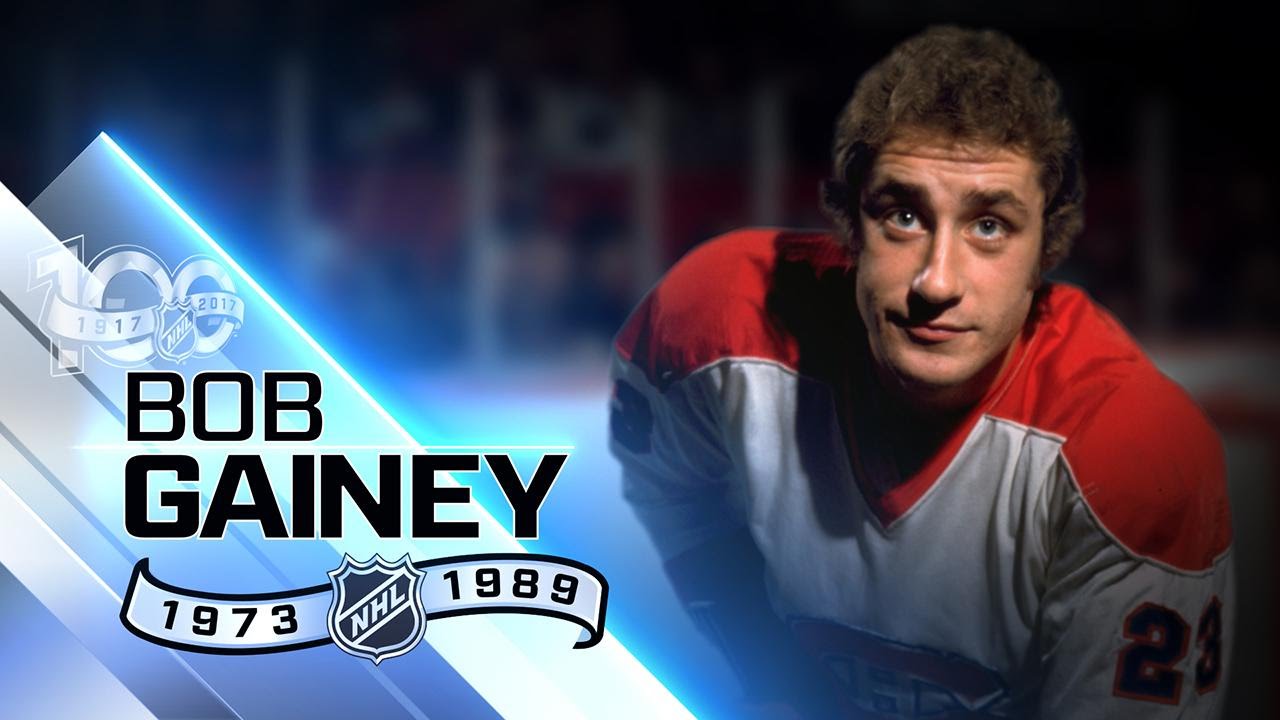
Bob Gainey epitomized the role of “defensive forward.” In his 16 seasons in the NHL, he used those skills to lead the Montreal Canadiens to five Stanley Cup championships while he took home the Frank J. Selke Trophy the first four times it was awarded. At the end of such a successful career, Gainey announced his retirement on July 17, 1989.
From the ages of 7 until 15, Gainey actually played as a defenseman. He then switched to forward as a left wing and soon thereafter played junior hockey with the Peterborough Petes under Roger Neilson’s direction. Gainey later said, “Playing for the Petes with a coach like Roger, who structured the Petes in team play, fit my style.” His style and size attracted the attention of the Montreal Canadiens.
After they selected him as their first-round pick (8th overall) in 1973, Gainey only ever played for one NHL team. They made the playoffs every single season of his career. Of the six finals they played in, they won five of them. Gainey earned the Conn Smythe Trophy as playoff MVP following the fourth consecutive championship in 1979, and his teammates lifted him on their shoulders in celebration. As of 1982, he took on the responsibility of captaining the team and led them to his final Stanley Cup in 1986. The rematch with the Calgary Flames in 1989 went the other way, and Gainey retired right after that one near-miss.
At Gainey’s retirement, he had played in 1,160 regular-season games (239G, 263A, 502P) and 182 postseason games (25G, 48A, 73P). “Most players at some point realize that they’re going to have to make a career change, whether it be in six months, a year or three years,” Gainey said in an interview. “I always had certain traits about recognizing the team composition and how things worked and keeping an eye open for what was going on. I knew in a number of different ways that my playing career was coming to an end. There was a point when Serge Savard, the GM, said that when I was finished playing, he’d be open to talking about some other kind of work in the Canadiens’ organization. That was a window of opportunity that was opened for me before I actually got to the point.”
Gainey still is best known for having received the award for the NHL’s best defensive forward in each of the first four years since the Selke’s introduction in 1978. Despite not winning it after that, he remained in the top 10 for the next four seasons. When Gainey prepared to present the award (to Patrice Bergeron who tied his record), he explained what it was like to receive it. “There was usually a year-end conference or banquet … and a very simple awards ceremony. I don’t think there were nominations or finalists. The luncheon was held at a downtown Montreal hotel, the Windsor or the Queen Elizabeth, and different awards would be given out. … The Selke was an award that began after I’d started my NHL career (in 1973-74). Mr. Selke (who died in 1985) always presented it to me.” He then described the traits being recognized with the award. “There have always been players in previous generations who represented that defensive or defensive-balance two-way player, who in the team structure were given that role. … Over time, like everything, there’s been an evolution. That player has become maybe a more complete player, a balanced player of offense and defense, if need be, to really be able to fulfil the role of strong defense in the parts of the game that require it completely.”
After the end of his playing career, Gainey first went to France to play and coach for the Epinal Squirrels, a Tier Two league. He said, “It wasn’t too demanding but it did put me in a position of responsibility.” Having gained experience in coaching, Gainey returned to the NHL to coach the Minnesota North Stars. “I left my playing career right at the time when things were really starting to change in the NHL. There were a lot of ownership changes and changes in locations of teams, plus expansion and the union had changed. We were going into a completely new era but no one really knew that in 1990.” He relocated to Dallas with the team and became general manager. Under his management, they won the 1999 Stanley Cup.
From 2003 to 2010, Gainey returned to the Canadiens, serving as Executive Vice President and General Manager. “For many of the past ten years, I saw myself as a player who was coaching or a player who was managing. I think the player part diminishes with time. It’s hard to keep that sensitivity towards all those things a player has to go through every day. Some of them remain and you can draw on those to come to conclusions in certain situations. All of us use the experiences we had in different situations and with different people and try to apply them to make us more successful than our competitors.” Gainey then came full circle when he became a volunteer senior advisor for the Peterborough Petes of the Ontario Hockey League.
Gainey was inducted into the Hockey Hall of Fame in 1992. “It was something that I didn’t really appreciate enough until I got there,” admitted Gainey. “Hockey is what I’ve done for my life’s work. I’d like to be able to leave a mark alongside people who have left their name and their results on the game. That’s what people who are in the Hockey Hall of Fame have done.” Finally, in 2008, nearly 20 years after he had retired, the Canadiens retired No. 23, the only number Gainey ever wore in the NHL.
When Claude “Pepe” Lemieux was born in Buckingham, Quebec on July 16, 1965, no one could have predicted just how successful and (to many) reviled he would become in the NHL. As his son Brendan said in 2014, “My dad was a second-round pick; had really good junior numbers but was pretty much a nobody from a small town, but the first in a town of 5,000 to make it out of there. He did it because of his work ethic.” That hard work led Lemieux to four Stanley Cup championships with three different teams.
Growing up in Mont-Laurier, Quebec, Lemieux was a huge fan of the Montreal Canadiens. It must have been a dream come true when, in 1983, they drafted him in the second round (26th overall). After spending most of 1983 to 1986 playing for the Verdun Juniors then the Sherbrooke Canadiens, Lemieux moved up to the NHL just in time to help Montreal win the 1986 Stanley Cup. He played ten regular-season games followed by all twenty in the postseason, during which time he placed second in scoring with 16 points (10G, 6A). On the down side, during those finals Lemieux bit the finger of Calgary Flames captain Jim Peplinski, who remarked, “I didn’t know they allowed cannibalism in the NHL.”
After missing most of the 1989-90 season with an abdominal injury, Montreal traded Lemieux to the New Jersey Devils (for Sylvain Turgeon). This would be his first of two stints with the Devils, and they won championships in both. Lemieux originally spent five seasons in New Jersey, culminating in the 1995 Stanley Cup, the team’s first. Of his 13 playoff goals, three were game-winners, earning him the Conn Smythe Trophy as playoff MVP. The Devils regretted sending Lemieux on his way immediately thereafter, so in November 1999 they brought him back. He turned out to still have some postseason magic because they won the Stanley Cup championship that season as well.
When the Devils sent Lemieux away, he ended up playing for the Colorado Avalanche throughout the late 1990s. In his first season there, Lemieux had a great regular-season scoring 71 points with 10 game-winning goals. He followed that up with 12 points during the playoffs to help the Avs win the 1996 Stanley Cup and in the process became only the tenth NHL player to win back-to-back championships with different teams. Along the way, however, Lemieux had his darkest moment. Playing in the conference finals against his nemesis from the 1995 Final, the Detroit Red Wings, he checked Kris Draper from behind, essentially breaking Draper’s face. As a result, Draper’s teammate Darren McCarty had a beef with Lemieux causing various dust-ups over the next two seasons. Consequently, Lemieux often has been blamed for the bitter rivalry between Colorado and Detroit. Still, during the 1996-97 postseason, he had a career-high of 23 points (13G, 10A) with four game-winners.
As Lemieux’s career wound down, he signed with the Phoenix Coyotes in 2000. Mid-way through his third season there, he was traded to the Dallas Stars. He managed six points in the postseason before their elimination. Not quite ready to hang up the skates, Lemieux spent part of the following season skating for EV Zug of the Swiss Nationalliga A.
Lemieux then, between 2005 and 2007, headed the ECHL Phoenix RoadRunners as president before participating in a few reality TV shows. Finally, he decided to make something of a comeback in 2008. As a friend of the San Jose Sharks GM Doug Wilson, Lemieux signed up with their organization. In mid-November, he signed with the China Sharks of the Asia League Ice Hockey and played two games in Shanghai to see how prepared he was to return to the game. Before the month ended, he finalized a tryout contract with the Worcester Sharks of the AHL. It only took 23 games before the San Jose Sharks came calling. “What I am most proud of was seeing him make his comeback in San Jose [in 2008-09],” his son Brendan reminisced. “I remember everyone in San Jose standing up and cheering for my dad, a 43-year-old playing on the fourth line. I think my mom cried.” Lemieux ended up playing 18 regular-season games and one playoff game in the NHL before officially retiring on July 8, 2009.
After 1215 NHL regular-season games, Lemieux had 786 points (379G, 407A) and 1777 penalty minutes. In his 234 playoff games (the fourth highest), he tallied 158 points (80G, 78A) and 529 penalty minutes (third highest). Those 80 goals still rank ninth all-time, and Lemieux’s 19 postseason game-winning goals ties him for third (with Joe Sakic, behind Wayne Gretzky and Brett Hull). The three times Lemieux scored double-digits during the postseason (1986, 1995, and 1997) were also the times he actually scored more in the postseason than he had during the regular season. All told, Lemieux played in 18 postseasons, and he is one of 11 to win the Stanley Cup with three or more teams.
Lemieux’s possible inclusion into the Hockey Hall of Fame has triggered quite the debate. Some feel that his role as an agitator and his hard-hitting style should not be rewarded. Others think that his many successes on the ice are worthy of recognition. For now, the attention has shifted to comparisons with his son Brendan. Who knows how public opinion of the Lemieux family may shift as time passes.
Born in Neudorf, Saskatchewan on July 15, 1932, forward Eddie Litzenberger would grow up to win four consecutive Stanley Cup championships followed immediately by two Calder Cup championships.
The tall “gentle giant” first drew attention playing for the Regina Pats of the Western Canada Junior Hockey League between 1949 and 1952. He served as captain and made the All-Star team for those final two seasons. In 1950-51, he had the second-highest score in the league with 44 goals.
Litzenberger debuted in the NHL with the Montreal Canadiens, who, on December 10, 1954, “donated” him to the struggling Chicago Black Hawks. Despite the mid-season trade, he tallied 51 points (23G, 28A) to earn the Calder Memorial Trophy as best rookie.
After a couple more seasons of leading by example and changing the defeatist attitude there, Chicago made Litzenberger their captain in 1957. After years at the bottom of the NHL, under his leadership, the Black Hawks began climbing. Finally, in 1961, for the first time since 1938, Chicago won the Stanley Cup, which Captain Litzenberger accepted on the team’s behalf.
Surprisingly, Chicago then offloaded its Cup-winning captain. That June, they traded Litzenberger to Detroit, their opponents in the Final. At the very end of the year, on December 29, the Toronto Maple Leafs claimed him on waivers. That turned out to be quite all right for Litzenberger, who promptly helped Toronto win three consecutive championships between 1962 and 1964. No one else had won four consecutive championships with two different teams.
Having seen little action in 1963-64, Litzenberger’s NHL career ended there. Instead, he kept playing hockey in Toronto’s affiliate in the American Hockey League, the Rochester Americans. In his two seasons with the Americans, they won the Calder Cup back to back. After the first, Jack Riley, president of the AHL, joked with Litzenberger, “Four Stanley Cups and a Calder Cup. Not bad.” Litzenberger replied, “You know what, Jack? It couldn’t happen to a nicer guy.” He is the only one to win six straight professional hockey championships, especially with three different teams.
Litzenberger was inducted into the Saskatchewan Sports Hall of Fame exactly one month before his 70th birthday.
The 1980s Edmonton Oilers must have had quite the bond as they won five championships in seven seasons. Others, especially Mike Keenan, seemed keen to recapture that magic. He had witnessed it first hand back in 1987, when coaching the Philadelphia Flyers through losing the finals. When Keenan coached the New York Rangers to the Stanley Cup in 1994, several former Oilers were there hoisting it high. After he ditched the Rangers in favor of the St. Louis Blues that summer, he began acquiring them again. To that end, on July 14, 1995, as the Blues GM, Keenan signed both Grant Fuhr and Geoff Courtnall.
Goalie Grant Fuhr had been with the Oilers since they drafted him 8th overall in 1981. After winning four championships with them, in September 1991, Edmonton traded Fuhr (with Glenn Anderson and Craig Berube) to Toronto. Fuhr struggled a bit as, in February 1993, Toronto traded him to Buffalo, who traded him to Los Angeles two years later. Meanwhile, Toronto passed Anderson on to the Rangers in March 1994. He signed with St. Louis in February 1995.
As for left winger Geoff Courtnall, he started his NHL career by signing with the Boston Bruins on July 6, 1983. Perhaps to their chagrin, they traded him to Edmonton in March 1988, only to have the Oilers beat them for the Stanley Cup a few months later. In the offseason, Edmonton traded Courtnall to Washington, who traded him to St. Louis two years later. In March 1991, the Blues traded him to Vancouver. Despite his brief time in St. Louis, Courtnall decided to return there in 1995.
Apparently, Keenan decided on Fuhr after a chance encounter with the most famous of the Oilers, Wayne Gretzky. Fuhr’s efforts during the 1994-95 lockout impressed Gretzky enough to sing his former-teammate’s praises. With the Ninety-Nine All-Stars he organized, Fuhr played eight exhibition games in five countries. The Blues’ two primary goalies, Curtis Joseph and Jon Casey, were both free agents. Keenan liked the idea of switching off Fuhr and Casey. “I think, in that situation, Grant would respond in a positive fashion. He still has athletic ability, in my mind.” He signed Fuhr to a multi-year contract.
Courtnall was one of the other three big stars (along with Dale Hawerchuk and Brian Noonan) signed at the same time. Keenan crowed, “I don’t think there is a better team in the league as far as left wing goes. You’re looking at a lot of depth.” After all, the Blues already had Esa Tikkanen, who had played for both the Oilers and the Rangers. Just a few months after the 1994 Final, Tikkanen had been traded by the Rangers to the Blues. However, in November 1995, the Blues traded Tikkanen on to New Jersey. In February 1996, Gretzky himself was traded to the Blues and reunited with his Oilers teammates. The following month, Hawerchuk was traded for Craig MacTavish, another Cup winner from the Oilers and Rangers.
The 1995-96 season started off rocky for Fuhr, who turned up to training camp so out of shape that Keenan suspended him. Fuhr more than made up for it by setting an NHL record of playing 76 consecutive games and a total of 79. In the process, he managed his personal best save percentage (.903). In the meantime, Courtnall came in fifth in scoring (with 40 points). As a team, the Blues placed fourth in the Central Division with 80 points (32-34-16). In the postseason, they beat Toronto (4-2) then lost to Detroit (4-3). Many felt that if Fuhr had not been injured during the first round, the team would have gone all the way that season.
Both Fuhr and Courtnall remained in St. Louis until 1999. That September, Fuhr was traded to Calgary. Two months later, Courtnall announced his retirement. Fuhr retired in September 2000 and (as the first black player) was inducted into the Hockey Hall of Fame in 2003.
Additional Sources:
Mike Commito, Hockey 365: Daily Stories from the Ice(Toronto: Dundurn, 2018), kindle edition.
Jeff Gordon, “Blues Make Talent Base Grow Fast,” St. Louis Post-Dispatch, 16 July 1995, pp. F1 and F12.
It had been a long 310 days, the longest lockout in professional sports. Finally, on July 13, 2005, NHL owners and the NHL Players’ Association (NHLPA) reached a tentative deal that would officially end the lockout on July 22.
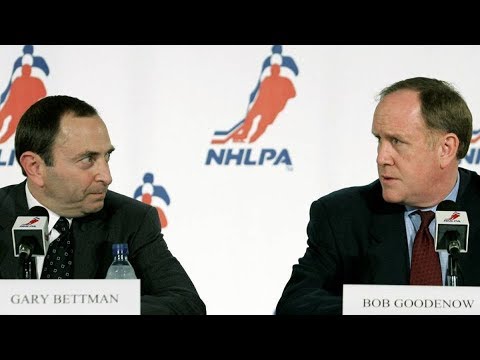
The 1995 collective bargaining agreement between the NHL and NHLPA expired on September 15. 2004, and the lockout began the next day. Perhaps oversimplifying the issues, essentially Commissioner Gary Bettman and the owners felt that fundamental changes (including halting “runaway salaries”) needed to be made to ensure the stability of the league’s future. The NHLPA, led by Bob Goodenow, felt that the players deserved their fair share of the huge profits made by many owners. The two sides delayed truly negotiating until it was too late to save the season (the 88th), which was canceled on February 16, 2005.
This marked the first time in North America that an entire professional sport season was the victim of a labor dispute and the second time (after the 1994-95 MLB strike) that the whole postseason was canceled. For the first time since the Spanish Flu halted the 1919 finals, the Stanley Cup was not awarded. When an agreement still had not been reached after the season would have ended, everyone wondered whether there would be a new season.
To ensure the next season began on schedule, the NHL and NHLPA ramped up their efforts to settle things. They met every week in May and June and then for ten consecutive days starting July 4. Working overnight on July 12, they finally agreed on a deal. After making the announcement, they had to wait nine days until the meeting in which NHL board of governors could (unanimously) ratify the new 600-page collective bargaining agreement. Meanwhile, the NHLPA had to brief the players, who then voted on the agreement with 87% in favor. Thus, the lockout officially ended on July 22.
At the end of it all, the NHL and its players would have a lot of work to do in making up for the lost season and the negative public opinion. As Wayne Gretzky (managing partner of the Phoenix Coyotes) criticized, “At the end of the day, everybody lost. We almost crippled our industry. It was very disappointing what happened. For everyone to say, ‘All right, let’s forgive and forget, let’s move forward.’ That’s all fine and good, but it’s a lot easier said than done. It’s going to take a long time, it’s going to take a lot of hard work. We disappointed a lot of people. . . . We’ve got a lot of work ahead of us. It’s not going to all change and be all nice overnight.” Basically, the economy of and supporting the NHL had fallen into a depression. The lockout cost 1,000 jobs and $1.3 billion in players’ salaries. The owners lost $2.1 billion in revenue. That did not even count all the losses in advertisers and sponsors.
The primary change was the introduction of a salary cap (of $39 million), but that cap would be adjusted based on revenues. The players would take a pay cut, but the minimum pay was increased. They would be eligible for free agency at a younger age. The agreement also instituted rule changes meant to speed up the game and elevate excitement. The highlights of these included resolving overtime stalemates with shootouts, removing the red line, and cracking down on obstruction. Goalies would face new restrictions on the size of pads and a smaller area in which to play behind the net. To implement the new agreement, everyone had to wait ten days before signing anyone. At the time, only 288 players were under contract, leaving 400 still to be signed. The also had the entry draft to be held on July 30. On a side note, Bettman announced that the NHL would continue to play in the Olympics but would not hold All-Star games during those years.
Although the collective bargaining agreement was adjusted in September 2010, it officially expired on September 12, 2012. Another lockout immediately began and did not end until January 2013. That CBA will expire in 2022, but they can opt out as of September 1, 2019.
Additional Sources:
Mike Commito, Hockey 365: Daily Stories from the Ice(Toronto: Dundurn, 2018), kindle edition.
Hockey Chronicle: Year-by-Year History of the National Hockey League(Lincolnwood, Ill.: Publications International, Ltd., 2006), 662-666.
“The Puck Drops,” Montreal Gazette, 14 July 2005, pp. A1-A3. “Lockout had no winner,”Montreal Gazette, 14 July 2005, pp. C1 and C3.
“There are no real winners in interminable dispute,”Montreal Gazette, 14 July 2005, p. C3.
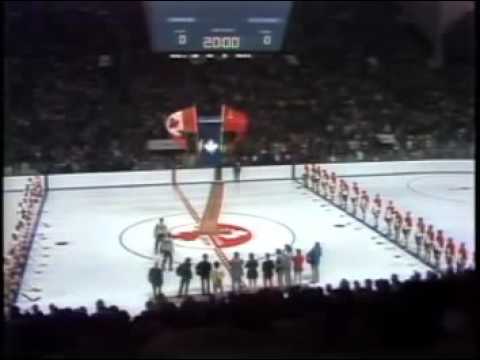
In 1972, two hockey superpowers had something to prove and in April developed the idea of playing each other that September to make their hockey prowess known across the globe. The Soviet Union had just won nine consecutive World championships and in the process, the last three Olympic gold medals. However, Canada (whose national identity is tied up in being the birthplace of hockey) was not allowed to send its professional players into international competitions like that. Everyone was about to find out how the world champions and NHL stars compared. In order to do so, on July 12, Canada chose its representatives.
Team Canada’s coach, Harry Sinden, introduced the “35-man super squad” at Sutton Place in Toronto. In selecting the team members, Sinden’s primary strategy was to find the right balance. “When we sat down to do this, we recognized that all the great teams had one thing in common – balance. That was our criterion. We passed up some publicity-prone players in favor of the men we needed to round it out.” He further explained, “Some of the players were selected specifically to fill out a line. . . . Some players may play all eight games, some only one. There’ll be different conditions for each game. We want the right measure of offence and defence, finesse and aggressiveness, youth and experience.”
His other tactic was to make sure the lines had at least some familiarity with each other. For that reason, he kept the New York Rangers’ GAG line (of Jean Ratelle, Rod Gilbert, and Vic Hadfield) completely intact. The Montreal Canadiens’ Mahovlich brothers (Pete and Frank) and Yvan Cournoyer would form another line. He planned to put Phil Esposito and Wayne Cashman of the Boston Bruins on a line with Richard Martin of the Buffalo Sabres. Similarly, he was thinking Detroit’s Red Berenson and Mickey Redmond could share a line with J.P. Parise of the Minnesota North Stars. The other potential line would consist of Buffalo’s Gilbert Perreault, Minnesota’s Bill Goldsworthy, and Paul Henderson of the Toronto Maple Leafs.
The defensemen would also pair with teammates. The intended pairing included: Brad Park and Rod Seiling of the Rangers, J.C. Tremblay and Jacques Laperriere of the Canadiens, Bill White and Pat Stapleton of the Chicago Blackhawks, and Bobby Orr (who ended up missing the series due to knee injuries) and Don Awrey of the Bruins.
Finally, Sinden already planned to have Montreal’s Ken Dryden man the net for the series opener. Chicago’s Tony Esposito would serve as backup. Although it seemed unlikely that he would qualify, Sinden also chose Boston’s Gerry Cheevers as the third goalie.
Overall, the roster featured three goalies, twelve defensemen, and twenty forwards. The teams with the most representation included the Canadiens (with seven players), the Bruins (with six), and the Rangers (with five).
Of course, the lines were subject to change in training camp (to be held at Toronto’s Maple Leaf Gardens), and they were only allowed to take 30 players when traveling. In addition, there was a major restriction to the eligibility of the men on the roster. In order to play in the 1972 Summit Series, each player had to sign an NHL contract for the 1972-73 season before training camp started on August 13. The NHL owners had only agreed to allow their players to participate under the condition that only NHLers could play, and President Clarence Campbell and Chicago’s owner Bill Wirtz remained firm on that point.
Some of those on Sinden’s roster had not yet signed with the NHL. As Park remarked, “It puts me under extra pressure. But I can quickly turn that around. Don’t you think the front office would feel some heat if I can’t play because they’re haggling over a few dollars?” As it turned out, four of the chosen 35 were barred because they instead signed with the new rival league, the WHA. By the time the list came out, Bobby Hull had already accepted a $1 million signing bonus with the Winnipeg Jets, and Cheevers was finalizing talks with Cleveland Crusaders. Tremblay and Derek Sanderson were the other two who chose the WHA over the NHL and Summit Series.
The eight-game series would begin at Montreal on September 2 then continue westward across Canada with games at Toronto, Winnipeg, and Vancouver. The Russian half of the series would begin in Moscow on September 22. Between, they scheduled exhibition games against Sweden and Czechoslovakia in Prague. Partly due to overconfidence approaching the series, Team Canada lost three of the first five games. Thanks to Henderson’s game-winners, they came back to win the final three games and the series.
Additional Sources:
Mike Commito, Hockey 365: Daily Stories from the Ice(Toronto: Dundurn, 2018), kindle edition.
Ted Blackman, “NHL brass blocks Bobby Hull’s shot at Russia,” Montreal Gazette, 13 July 1972, p. 1.
Ted Blackman, “Sinden: Dryden’s his man in opener,” Montreal Gazette, 13 July 1972, p. 25.





 Prev
Prev