Regardless of where they started or where they end up, some players just become so much the face of a franchise that separating the two feels nigh impossible. After going undrafted and then set loose from his first NHL team, on July 31, 2000, Martin St. Louis took the first step in becoming the face of the Tampa Bay Lightning franchise. He would remain with them for 13 seasons, racking up so many accolades that even after requesting a trade and retiring elsewhere, his No. 26 was the first ever retired by Tampa Bay.
The five-foot-eight winger took the collegiate route playing and captaining for the University of Vermont Catamounts. St. Louis was the ECAC player of the year in 1995, a three-time Hobey Baker finalist, and winner of the J. Edward Donnelly Award (as top senior athlete at Vermont) in 1997. He led the team to their first ECAC hockey championship. As of 2014, St. Louis still held Vermont’s record for points (267) and assists (176). The university inducted him in their Hall of Fame in 2007 and retired his No. 8 in 2016.
Despite his collegiate accomplishments, the NHL did not seem interested, leaving St. Louis undrafted. In 1997, he signed with the Cleveland Lumberjacks of the International Hockey League (IHL) for two years with an out clause in case the NHL changed its mind. After scoring 50 points in 56 games, the Calgary Flames made use of that clause and signed him on February 18, 1998. He finished that season helping their AHL affiliate, the Saint John Flames, to the Calder Cup finals. The next season, he managed 13 games with the big boys and then primarily played in Calgary during the 1999-2000 season. Although GM Al Coates wanted to keep him (before he was fired), his replacements left St. Louis available to the 2000 NHL Expansion Draft. As before, drafts do nothing for St. Louis, so Calgary instead made him an unrestricted free agent.
At that point, aged 25, St. Louis had a few possibilities, choosing Tampa Bay as the likeliest place to get ice time. He commented later, “Tampa was not a very good team then. It was at the bottom of the league. For me it was like, ‘If I can’t play there, where can I play?’” As for the Lightning, they made the offer because, as GM Rick Dudley said, “One of the things we’ve been attempting to do is build a fast team, and these are three of the faster players in the game.” He signed St. Louis to a two-year contract at $262,500. At the same time, upon the deadline for qualifying offers to restricted free agents, Dudley also signed Steven Martins and Brian Holzinger to one-year contracts.
St. Louis got off to a slow start with the Lightning, not scoring until six weeks into the 2000-01 season. His strong beginning to the next season was hampered by an awkward check that resulted in a broken leg. With the postseason of his third season, he scored three game-winners, including the one that gave the Lightning their first playoff series victory. Then came the big one, 2003-04, during which St. Louis led NHL scoring to earn the Art Ross Trophy, the Hart Trophy, and the Lester B. Pearson (Ted Lindsay) Award. After his game-winner forced a Game 7, the Lightning won its first Stanley Cup championship, against Calgary no less.
During the 2004-05 lockout, St. Louis played for HC Lausanne of Switzerland’s National League A. He then returned to the Lightning under a six-year contract extension. He soon reached a career high in points (102), proving they had made the right decision. They added another four-year extension in 2011. At the announcement, GM Steve Yzerman proclaimed, “Marty means so much to this franchise, both on and off the ice. His hard work and dedication are unsurpassed and we are thrilled that he will finish his career here in Tampa Bay.” St. Louis’s iron-man streak of 499 games ended that December due to a face injury. He won three Lady Byng Memorial Trophies (in 2010, 2011, and 2013) for his sportsmanship. Even with another lockout, St. Louis led the scoring in 2012-13 to become (at 37) the oldest to win the Art Ross Trophy. The Lightning then made him captain. St. Louis still holds the Tampa Bay record for points (953).
In 2014, St. Louis decided not to finish his career with the Lightning. After Yzerman snubbed him for Team Canada (though he did end up subbing for the Olympics), St. Louis requested a trade. He chose the New York Rangers, the team he had considered back in 2009, since his no-move clause gave him the power to choose. Having been traded on March 5 and had his mother die suddenly on May 8, St. Louis became a rallying point for the Rangers as they made it to the Stanley Cup Final (for the first time since 1994). In what would be his final NHL season, 2014-15, St. Louis became an alternate captain, but the Rangers still did not want to renew his contract in the end.
Without any other offers, St. Louis retired on July 2, 2015, after playing 1134 regular-season games (391G, 642A, 1033P). As soon as he was eligible, in 2018, St. Louis was inducted into the Hockey Hall of Fame.
Additional Sources:
Mike Commito, Hockey 365: Daily Stories from the Ice(Toronto: Dundurn, 2018), kindle edition.
Kevin Kelly, “Lightning, feeling need for speed, signs 3 free agents,” Tampa Bay Times, 1 Aug. 2000, p. 9C.
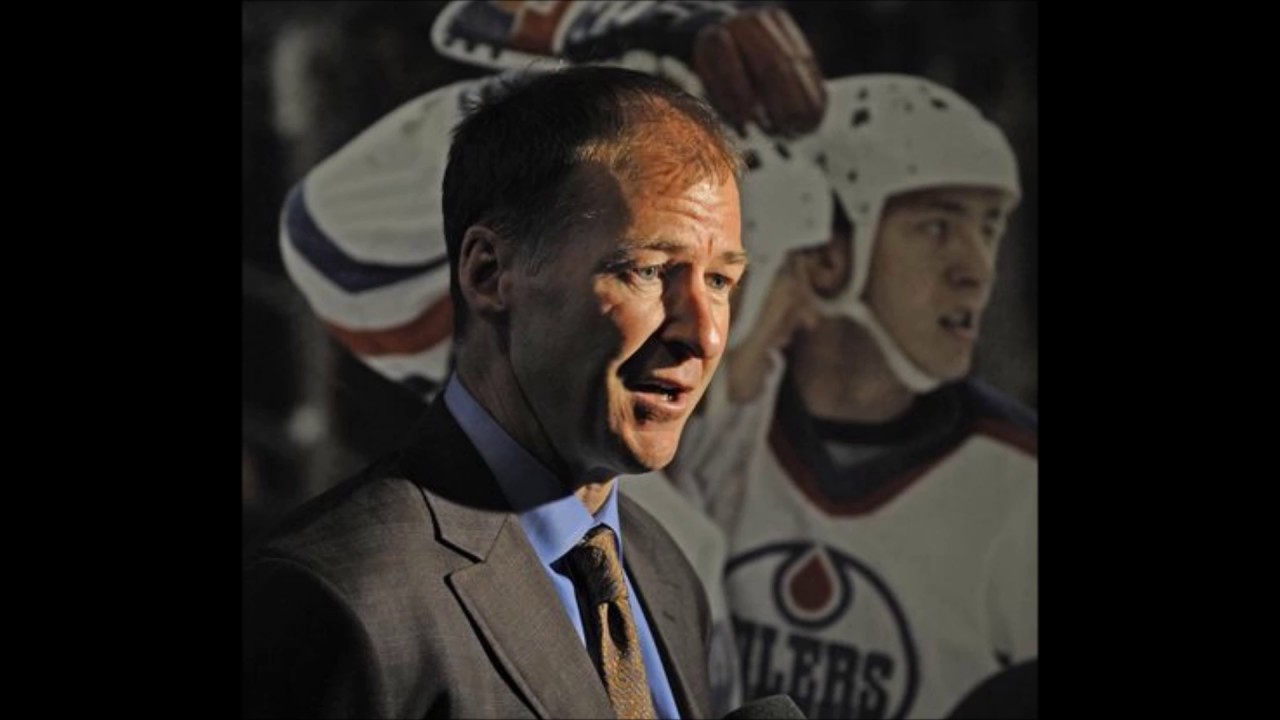
Six-time Stanley Cup winning defenseman Kevin Lowe retired in order to become an assistant coach with the Edmonton Oilers on July 30, 1998, just two days after Slava Fetisov similarly retired and went into coaching.
Lowe’s start in the NHL was quite portentous. He was the very first player the Edmonton Oilers drafted into the NHL in 1979, when he was selected 21st overall. That October 10th, he scored their very first NHL goal, with Wayne Gretzky’s very first NHL assist. Lowe helped the team win five Stanley Cup championships (1984, 1985, 1987, 1988, and 1989). After winning the King Clancy Memorial Trophy and the Budweiser/NHL Man of the Year Award in 1990, Lowe became the Oilers captain in 1991.
On December 11, 1992, the Oilers traded Lowe (as a restricted free agent) to the New York Rangers, where he would join six of his former teammates. Together, they won the 1994 Stanley Cup. Lowe played for the Rangers over four seasons. As a free agent, he re-signed with the Oilers on September 28, 1996. After a full season there, he developed an inner-ear virus affecting his balance and was only able to manage seven games throughout the 1997-98 season. He never played in the minors, and his team only missed playoffs once in his entire playing career.
Over his 19-season playing career, Lowe participated in 1,254 regular season games and 214 playoff games. In doing so, he holds the Oilers’ record for the most games played in an Oilers uniform. He was also (until 2010) the only one in Edmonton to wear No. 4.
When the Oilers offered 39-year-old Lowe an assistant coaching position in July 1998, he officially retired as a player. When he made the announcement, Lowe said, “I prefer to speak from the heart” instead of writing a speech, and he teared up when reminiscing. “I guess that’s the way I played my whole career – on instinct and heart. So I just listened to my heart and said, it’s time to move on.” Deciding to pursue coaching, he commented, “I think the challenge of winning, just helping players develop. That’s the challenge for me. I was very fortunate, coming up as a player, to have a lot of good coaches around me that I could feed off. I’d like to provide some of that.” In looking ahead, Lowe remained realistic, saying, “I don’t know, it’s new territory for me. If you’d have asked me in my first year when I got drafted here, what to expect coming in. I would have told you the same thing I’ll tell you now: I’m only going to give you as much as I have. And just go on heart and instinct.”
He joined Ted Green in assisting head coach Ron Low, his former teammate. Low told the press, “He brings an awful lot to the table. You don’t have his career by accident.” Also touching on his successful career, GM Glen Sather remarked, “He was the consummate team guy who helped keep everything together when things got a little bit scratchy. He leads with his heart, and he led a lot of those players. And I’m talking about Wayne, Mark, Jari, all of them. He was a guy who did a lot of great things for this hockey team.” Director of player personnel Kevin Prendergast completely agreed, commenting, “He’s been through all the battles. He’s been a player of the highest caliber, a captain here. He’s given everything he’s had to this organization.”
Lowe continued to give to the Oilers organization. After a year as assistant coach, on June 18, 1999, he became their seventh head coach. That season, they finished second in the Northwest Division (32-26-16-8). Almost exactly a year later, on June 9, 2000, Lowe was promoted to general manager, replacing Sather (the Oilers first GM). Under his guidance, Edmonton made it to the Stanley Cup Final in 2006. Two years later, in 2008, Lowe became the Oilers President of Hockey Operations. In 2015, he took the position Vice Chair and Alternate Governor of Oilers Entertainment Group.
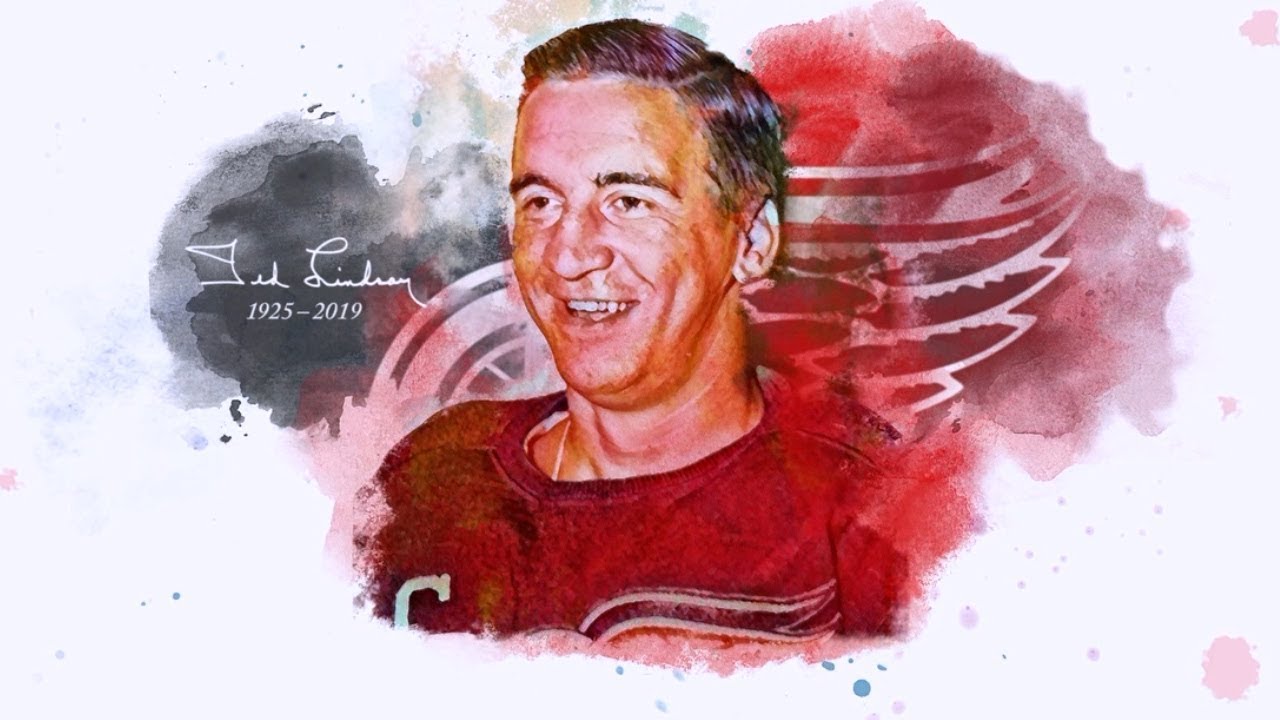
Ted Lindsay was born at Renfrew, Ontario on July 29, 1925, but he devoted his life to Detroit. During his 17-year NHL playing career, all but three (with the Chicago Blackhawks) were spent with the Detroit Red Wings.
One of the NHL’s earliest goalies, Bert Lindsay, raised a family of nine children in an Ontario mining town. Even 600 miles north, they could pick up Red Wings games on radio from Detroit. As the youngest, 9-year-old Ted Lindsay first borrowed skates that were too large. His love of the game shown through so much that his father sprung for a pair of Red Horner model skates. About 20 years later, Lindsay beat Horner’s record to become the NHL penalty king.
At the age of 18, in 1943-44, Lindsay played for the St. Michael’s Majors in the Ontario Hockey Association Junior A League (now the Ontario Hockey League). Although the team was Toronto-based, the Maple Leafs mixed up players during scouting. Lindsay would go on to feud with their owner, Conn Smythe, throughout his time in the NHL. That left the door open for Red Wings chief scout Carson Cooper, who paved the way for Lindsay to attend training camp and try out with the Red Wings.
The Red Wings’ coach and general manager, Jack Adams, was a former teammate of Lindsay’s father. He offered a contract agreeing to Lindsay’s stipulation that he play at least four-fifths of the season with the Red Wings (rather than in the minors) along with a $2,000 bonus. When 19-year-old Lindsay signed on October 18, 1944, he was the first son of an original NHLer to join the NHL himself.
Lindsay quickly rose to stardom with the Red Wings. His success and subsequent fame increased (between 1947 and 1952) when he became the left wing of the legendary “Production Line.” Team captain Sid Abel centered the line, and the famous Gordie Howe bookended it on the right. However, Abel later said of his linemates, “They are both unorthodox, crisscrossing on the ice so that no one really is a right wing, a center or left wing.” The three of them topped the NHL in scoring in 1949-50 with Lindsay earning the Art Ross Trophy. They then won their first Stanley Cup together, and a tradition was born when that Cup was presented. Lindsay hoisted it up and skated it around Olympia Stadium for the fans. He explained simply, “I saw all the people sitting there so I picked it up and took it to them.”
After Abel was traded in 1952, when they won their second Stanley Cup, Adams made Lindsay team captain. Under his leadership, the Red Wings then won back-to-back championships in 1954 and 1955. They had won four in just six seasons. However, Adams stripped Lindsay of the captaincy for the 1956-57 season.
This was punishment for the leadership role Lindsay took in attempting to organize a players’ association or union. At the time, owners grew richer while the players did not make enough to support themselves for the full calendar year much less after their playing days ended. Lindsay dared to file an anti-trust suit against the NHL due to the Norris syndicate operating all four U.S. arenas. In February 1958, they settled out-of-court agreeing to many player demands. Lindsay explained, “When I did it the NHL was a dictatorship. I just wanted to give us a voice. We had no voice. I’d do it again. I was not a crusader, I wasn’t trying to change hockey. It was just something we as players needed as a vehicle to be able to discuss things. The effort was not a failure, because we did make a few gains and we paved the way.” However, the NHL Players’ Association would not be formed until 1967. Due to his role, the Lester B. Pearson Award was renamed in his honor. Association members vote annually to bestow the Ted Lindsay Award to the NHL’s most outstanding player.
For Lindsay, the damage was already done. On July 23, 1957, less than a week before his 32nd birthday, Adams traded Lindsay (and goalie Glenn Hall) to the Chicago Blackhawks. He played solid hockey there for three seasons before retiring. The retirement only lasted four seasons.
In 1964-65, Lindsay returned to the NHL for a last hurrah. He often said he “still had Red Wings tattooed” on his head, heart, and rear and wanted to end his career in Detroit. Adams had been fired in 1961, and Lindsay’s old linemate, Sid Abel, led the Red Wings. Though surprising to many, Lindsay made the team after attending camp. Clarence Campbell, NHL president, could only apologize for his snide comment, “It’s the blackest day in hockey when a 39-year-old man thinks he can make a comeback in the world’s fastest sport.” Not only did Lindsay play the whole season, he played very well, scoring 14 goals and 14 assists and spending 173 minutes in the penalty box. He was quite touched by the warm reception Detroit fans gave him. “The years I was [in Detroit], I produced for the people. I didn’t cheat them. That’s all. It doesn’t mean anything to anybody else, but it means a lot to me.”
The nickname “Terrible Ted” was well-deserved for Lindsay’s tough on-ice persona. At 5-foot-8, 165 pounds, he did not seem intimidating. He would joke, “When I put my skates on I’m 6-foot-5.” He said he could never have been a goalie like his father because “I loved handling the puck. I loved hitting people. And I loved intimidating people, also.” Over the course of his playing career, Lindsay needed about 600 stitches and received 1,808 penalty minutes. “I hated everybody. I had no friends. I wasn’t there to make friends. I was there to win. … I had ability, I had talent and I didn’t have an ego that I thought I was great. I realized I had to earn it. That was my purpose — to be the best that there was at the left wing position.”
He certainly was fantastic at his job, scoring 279 goals, 472 assists, and 851 points in 1,068 regular-season games. When he first retired, he was third in points behind Howe and Maurice Richard. Once he retired again, he was inducted into the Hockey Hall of Fame in 1966. In 1991, Detroit retired his No. 7, and Lindsay said he wished that his parents could have been there and that “I could put on these skates and don that Red Wing uniform one more time.”
As the 1970s progressed, the Red Wings sunk as the Norris family approached bankruptcy. Meanwhile, Lindsay was an NBC color commentator with his own sports show airing before Hockey Night in Canada. He begged fans not to give up on the Red Wings. Finally, in 1977, he was hired as their general manager. When the Wings made playoffs for the first time in nine seasons, Lindsay was named executive of the year. However, that high did not last, and Lindsay was demoted to coach in 1980 then fired that November.
Lindsay filled his remaining decades with charity work. He is best known for the Ted Lindsay Foundation’s efforts to raise millions for autism research. “You see, the people in my sport are very gifted,” said Lindsay. “I was one of the gifted. I had a chance to make a living at the thing I love, and I have always appreciated that and I have always wanted to give something back.” Lindsay gave and gave until, at 93, his life gave out on March 4, 2019. The Red Wings honored him and his No. 7 three days later as they won a shootout.
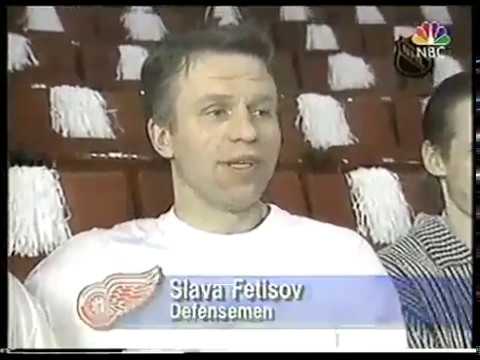
Having played professionally since the age of 16, Viacheslav “Slava” Fetisov had a full career in the Soviet Union before making it out and into the NHL. The defenseman then played nine seasons in the NHL, split between first the New Jersey Devils and then the Detroit Red Wings. When the latter wanted to limit his playing role, the former offered him the position of assistant coach. On July 28, 1998, at the age of 40, Fetisov retired from playing in the NHL and signed a coaching contract.
Even though Fetisov had tossed about the idea of retiring following the 1997 Stanley Cup championship, after the 1998 championship he still hoped to re-sign with the Red Wings for the 1998-99 season. He knew he would need to take on a reduced role, but Detroit wanted to limit him to a severely restricted role of 30 games or less. According to Fetisov, “I’m not the type of player who can play 30 games.” He also was unhappy with the $500,000 offered by GM Ken Holland. “I was waiting until the last moment for Kenny to make different offer, because the best four years of my hockey career were in Detroit.” To be fair to the Red Wings, they already had a full roster without him and would have had to juggle to keep him signed.
Meanwhile, Fetisov’s former team in New Jersey wanted him to assist their new head coach, Robbie Ftorek. “Of the coaches available, there were a couple names that came to mind, and Slava’s was at the top of the list,” said GM Lou Lamoriello, the very person who had arranged for Fetisov to play in the U.S. He explained, “In addition to being a world-class athlete, Slava Fetisov is a well-respected, first-class individual. With over 20 years spent as a player in both international and NHL competition, the experience he brings to the Devils will be beneficial to both our veteran and younger players.” He and Fetisov worked out a three-year deal averaging about $400,000 per season. “The Devils showed me a lot of respect and class in the past month, calling me and asking me what can they do to make me comfortable,” said Fetisov. Coach Ftorek was on board saying, “Slava and I will talk about everything. He’ll be involved from A to Z.”
Weighing his options, Fetisov decided to retire and take the coaching position. He told the media, “It was pretty tough couple of weeks for me to decide to stop playing. I never thought it would be so difficult to make the move not to play hockey again. … I was thinking a lot and talking to different people, and they told me I would be a good teacher. This is a great opportunity for me to go into coaching. I have a lot of experience in hockey, and I’m going to help this team.”
He became one of the first European assistant coaches in the NHL. During his three years with the Devils, they won the Stanley Cup in 2000 and lost the Final in 2001.
When his assistant coaching contract with the Devils ended, Fetisov became coach and GM of Team Russia for the 2002 Winter Olympics, where they won bronze. Around the same time, he became Russia’s Chairman of the State Committee for Physical Culture and Sport. In 2005, he became the first chairman of the World Anti-Doping Agency’s Athlete Committee. Four years later, he took over presidency of HC CSKA Moscow and even had to put his skates back on when he ran low on healthy defensemen.
Over the course of his playing career, Fetisov had had many accomplishments. Internationally, he won nine world championships and (as of 1998) held almost every record for a defenseman in international hockey. He earned one silver and then two gold medals in the Olympic Games held during the 1980s.
In the NHL, Fetisov was drafted twice before he was actually able to leave the USSR in 1989. The Devils traded Fetisov to the Wings on April 3, 1995. Though the former defeated the latter for the Stanley Cup that season, the Red Wings then won back-to-back championships in 1997 and 1998. After the first, he brought the Cup to Moscow for its first visit to Russia. Tragically, on June 13, 1997, Fetisov and his teammate Vladimir Konstantinov and team masseur Sergei Mnatsakanov were victims in a limousine accident. Instead of retiring, Fetisov dedicated the second Cup to Konstantinov, whose injuries ended his playing career.
As he approached the end of his playing career, Fetisov said, “I’m very fortunate to be here right now. I know what hockey has been like for me all my life and I don’t know what it’s going to be like without hockey. But I want to give everything I have to the game because it’s been good to me for such a long time.” He retired having played 546 NHL regular-season games (36G, 192A, 228P).
When he was inducted into the Hockey Hall of Fame in 2001, Fetisov remarked, “It’s a great honour. You play all your life to get the recognition and it feels great, especially being a Russian-born hockey player and spending most of the best years back in Europe. It’s a great honour to be in same category as other legends.”
The most famous name on ice is not held by a hockey player, figure skater, coach, or other executive but by an inventor. Frank Zamboni (January 16, 1901 – July 27, 1988) invented the ice-resurfacing machine that would bear his name in 33 countries (by the time of his death). At that point, the Zamboni company had sold 4,000 machines, but in 2012, the 10,000th was sold for use at Montreal’s Bell Centre.
Ice was in Zamboni’s blood. His father, Francesco Giuseppe, hailed from the Tyrol, in the Alps of northern Italy. Zamboni’s parents came separately to the U.S. in the mid-1880s and married soon thereafter. The third of four children, Zamboni was born at Eureka, Utah but moved about a year later to a farm in Lava Hot Springs, Idaho, where he learned mechanical skills.
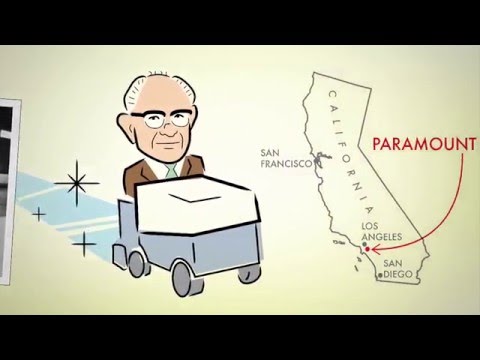
After his elder brother George set up an auto repair shop in a district of Los Angeles, in 1920 Zamboni and his younger brother Lawrence joined him. (Later, in 1948, Zamboni would help establish that Los Angeles area as the city of Paramount.) Working together, they saved enough for Zamboni to learn the electric business at Chicago’s Coyne Trade School. In 1922 back in California, Zamboni and Lawrence opened Service Electric Co. (later Zamboni Bros. Co.), an electrical service installing refrigeration and water pumping equipment for dairy farms. In the meantime, Zamboni also patented three electrical devices for New Way Electric Co.
In 1927, the brothers made block ice (for shipping vegetables by rail) with their ice-making plant, but with Willis Carrier’s patents coming in the 1930s, they closed their ice business in 1939. The following year, the Zamboni brothers (and their cousin Pete) kept their refrigeration equipment to build an ice rink – Iceland Skating Rink. Southern California had few rinks, and theirs was one of the largest in the country. The Zambonis soon added a dome roof to protect the ice from the sun, and then (in 1946) Frank patented a method that eradicated the rippling the pipe floors usually caused. The Zamboni family still operates the rink just blocks from their factory and test Zamboni machines there.
One major issue the Zamboni family had was keeping the ice surface smooth when it took five men 90 minutes to resurface by scraping, shoveling, spraying with water, and scraping again. Frank Zamboni began experimenting in 1942 and over the next eight years developed a machine that would do all that work at once. The original “unpainted, unwieldy contraption” combined the front ends of two old Dodge automobiles, a war-surplus Jeep engine, and a wooden bin. In mid-1949, he patented the “Model A Zamboni Ice Resurfacer,” which turned ice resurfacing into a one-man, 15-minute job.
He then began producing improved versions of these machines to sell by founding Frank J. Zamboni & Co. The first two (Model B) went to skating star Sonja Henie, another to the Pasadena Winter Garden, and a fourth to the Ice Capades (which the U.S. Hockey Hall of Fame has displayed). As the machine continued to improve, the Model E of 1954 became the first to be used by the NHL. The Boston Bruins were the first, and they later gave theirs to the Hockey Hall of Fame. Zamboni always told rink owners, “The principal product you have to sell is the ice itself.” He also continued to improve the machines, submitted his 15th and final patent at the age of 82 in 1983. His family still owns and operates the company he founded.
Mere months after receiving an Honorary Doctorate of Engineering from Clarkson University in Potsdam, New York and losing his wife (ten days before her 85th birthday), 87-year-old Zamboni died of cardiac arrest (and lung cancer) at Long Beach Memorial Hospital.
Zamboni has received much recognition for his contribution to skating. He
was inducted into the following: Ice Skating Institute of America Hall of Fame (1965),
United States Figure Skating Hall of Fame (2000), World Figure Skating Hall of
Fame (2006), United States Hockey Hall of Fame (2009), United States Speed
Skating Hall of Fame (2013). The NHL honored Zamboni in 2002 by naming him “Official
Ice Resurfacer of the NHL.”
Additional Sources:
Mike Commito, Hockey 365: Daily Stories from the Ice(Toronto: Dundurn, 2018), kindle edition.
“Ice Surface Maker Zamboni Dies,”Los Angeles Times, 28 July 1988, p. 1.
Burt A. Folkart, “Frank Zamboni: the Man Behind That Odd Machine,” Los Angeles Times, 29 July 1988, p. 20.
Dustin Penner went from signing his first NHL contract in May 2004 to the next season being canceled by a lockout to playing 19 games for the Mighty Ducks of Anaheim during the 2005-06 season to winning the Stanley Cup with the Anaheim Ducks in 2006-07. Then, on July 26, 2007, he got a massive raise by signing an offer sheet from the Edmonton Oilers as a restricted free agent.
At that point in time, offer sheets were rarely used. Basically, if an NHL team gave their restricted free agent a qualifying offer, another team could counter with an offer sheet. The original team would have seven days to match the offer or receive draft picks as compensation for the lost player. This had the potential to put a general manager in a tough position, so their peers usually avoided the bad blood in the hopes of it not being turned back on them.
However, in 2007, Edmonton Oilers GM Kevin Lowe used the tactic to bolster his offense. Upon failing to sign any unrestricted free agents, he tendered an offer sheet to forward Thomas Vanek. His Buffalo Sabres immediately matched the offer. Lowe had a wish list of players and thought about who he might be able to poach. Agent Ritch Winter said of Lowe’s next move, “This is a hard one for Kevin. I respect what Kevin is doing personally. He’s making an effort to do something that isn’t going to be popular within the hockey community, amongst his peers. He’s trying to do what’s best for his team. That’s admirable.”
Lowe was interested in 24-year-old power forward Penner because he played the left side, which would fill a gap for the Oilers. In his first full NHL season, Penner had just scored 29 goals and 16 assists on the way to the championship. He also happened to be the only restricted free agent for the vulnerable Ducks. So Lowe offered Penner, who had only made $450,000 over the past season, a five-year contract for $21.25 million. “From our perspective, it was a very necessary one if we were going to improve our hockey club,” explained Lowe. “Dustin was on a very short list of players we thought would compliment our hockey club. We see him as a guy who is capable of scoring 20-plus goals and he adds some size to our lineup.”
Brian Burke, GM of the Anaheim Ducks, did not take it well. “I think it’s a classless move timing-wise,” he remarked. After all, the offer sheet was signed on Burke’s day with the Stanley Cup, and the following day, he was inducted into the British Columbia Hockey Hall of Fame. That ate into the seven days the Ducks would have to match or receive compensation, per the terms of the new collective bargaining agreement. Burke also complained, “I was not notified of this until an agent faxed it into us. I thought Kevin would have called me and told me it was coming. I thought that was gutless. I have no problem with offer sheets. They’re part of the CBA. It’s a tool a team is certainly entitled to use. My issue here is this is the second time this year in my opinion Edmonton has offered a grossly inflated salary for a player.”
Originally, Burke had said he would match any offer for Penner, but the Ducks had offered him a much, much lower salary. Having won the championship, the Ducks were facing a salary cap crunch. They already had 19 players signed for a total of almost $41.5 million, quickly approaching the $50.3 million cap. Burke acknowledged, “From a tactical standpoint, with the steps we’ve taken, and with the unique circumstances we’re in . . . we’ve created this situation and put ourselves at risk. We’re acutely aware of that.” Thus, at the beginning of August, Burke reported, “I just decided that this offer doesn’t make sense. If I believe these salaries don’t make sense and I match, then I’m just as dumb as the team that extended the offer.” It was the first time in recent memory that the offer sheet was not matched. Instead, the Ducks would receive the Oilers’ first, second, and third-round draft picks to let Penner go.
The bitterness between the two general managers lingered a while. They had been considered buddies, but Burke called the offer sheet “an act of desperation by a GM fighting to keep his job.” He stated, “It’s not a priority for me to mend this fence.” Meanwhile, Lowe commented, “I’m not in the business of trying to make friends. Never have, never will be.” During a radio show on July 4, 2008, Lowe finally responded to Burke’s continued aggression by calling him “a media junkie.” According to one story, Lowe challenged Burke to a fight, and Burke planned to rent a barn to host it. However, Commissioner Gary Bettman stepped in threatening to suspend them both.
As it turned out, in November 2008, Burke left the Ducks to become president and general manager of the Toronto Maple Leafs. Meanwhile, Lowe remained GM and executive vice president for the Oilers until 2008, when he was promoted to President of Hockey Operations.
As for Penner, he had the best outlook going forward. He said at the time of the decision, “I don’t know what my potential is, but I think in the next five years I’ll find out. I know I didn’t peak this last year as a player in Anaheim.”; “Now that the decision’s been made, I’m excited to be an Oiler. Hopefully I can help the organization get back to the Stanley Cup final.” Unfortunately, the Oilers failed to even make playoffs during his years with them. They traded him to the Los Angeles Kings in February 2011, and he won the 2012 Stanley Cup with the Kings. In a final twist, on July 16, 2013, nearly six years after signing the offer sheet, Penner signed with the Ducks again. He played 49 games for them and (after the trade deadline) another 18 games with the Washington Capitals to end his NHL playing career.
Additional Sources:
Mike Commito, Hockey 365: Daily Stories from the Ice(Toronto: Dundurn, 2018), kindle edition.
Joanne Ireland, “Duck Hunter,” Edmonton Journal, 27 July 2007, pp. C1 and C3.
Eric Stephens, “Penner has $21-million offer from Edmonton,” Los Angeles Times, 27 July 2007, p. D7.
Eric Stephens, “Oilers’ offer to Penner upsets Burke,” Los Angeles Times, 28 July 2007, p. D3.
Joanne Ireland, “Burke blasts Lowe for move,” Edmonton Journal, 28 July 2007, pp. D1 and D8.
Jim Matheson, “Oilers’ pursuit of Penner a calculated gamble,” Edmonton Journal, 28 July 2007, p. D8.
Joanne Ireland, “Oilers Win Penner at High-stakes Table,” Edmonton Journal, 3 Aug. 2007, pp. A1 and A20.
Jim Matheson, “Burke had to let Penner fly,” Edmonton Journal, 3 Aug. 2007, pp. C1 and C8.
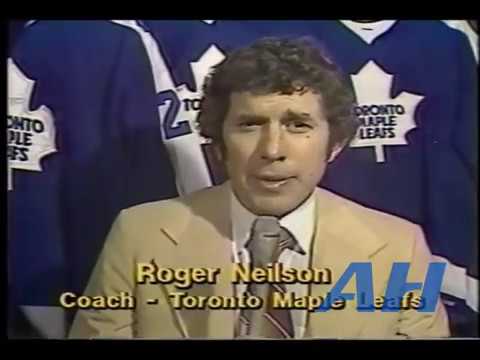
Everyone has to start somewhere. Roger Neilson started on July 25, 1977, when he received his first head coaching job in the NHL. In total, he coached eight NHL teams throughout his career before heading his 1,000th and final game in April 2002.
Neilson did not have to go far to find his first gig in Toronto, his birthplace. In his youth, he used to attend junior games at Maple Leaf Gardens and then hide there so he did not have to pay to watch NHL games. He coached various hockey (and baseball) teams while attending North Toronto Collegiate Institute and then McMaster University (for a degree in physical education). The legendary Scotty Bowman hired him in 1962 to scout the Toronto area part-time.
For about ten years after he was hired in 1966, Neilson coached the Peterborough Petes of the Ontario Hockey Association. They were the Montreal Canadiens’ junior farm team. He made sure the team helped the players with tuition if they wanted to further their education. He himself also taught physical education at a local high school. For the 1976-77 season, Neilson moved on to coach the Dallas Black Hawks in the Central Hockey League. They were affiliated with the Toronto Maple Leafs (and Chicago Blackhawks), who noticed Neilson’s innovations and exploitations of the rulebook.
In 1977, Toronto was looking to replace Red Kelly, their coach for the past four seasons and had played for them throughout the 1960s. Neilson was hired by owner Harold Ballard who would controversially fire, rehire, and fire him after two seasons. In the first season, he led the team to 41 wins and the second round of playoffs. One of his star players, Darryl Sittler, proclaimed, “He was the best coach I had in my professional career.” Their record in the second season, leading to his dismissal, was 34-33-13.
After Toronto, Neilson went on to coach the Buffalo Sabres (1980-81), Vancouver Canucks (1982-1984), Los Angeles Kings (1984), New York Rangers (1989-1993), Florida Panthers (1993-1995 as their first ever coach), Philadelphia Flyers (1990-2000), and two games with the Ottawa Senators (2002). He joked, “I’ve been fired pretty well every way there is.” Though he came close in 1982 with the Canucks and just missed with the Rangers (who won in 1994), Neilson never coached Stanley Cup champions. He was working as a videotape analyst for the Edmonton Oilers when they won in 1984. Overall, Neilson coached 1,000 regular-season games (460-378-159-3). He also served as assistant coach in Buffalo, Chicago, St. Louis, and Ottawa. He summed up his entire career saying, “From the time I was 17 until now, I was just trying to win games.”
Mainly, Neilson was known for his pushing of boundaries. As one of the first to use video to scout and analyze opponents, he was called “Captain Video.” He was also one of the first to emphasize stretching before playing and conditioning during the off-season. Further, his willingness to take advantage of loopholes in the rulebook caused many rules to be changed. For being a pioneer and coach, Neilson was inducted into the Hockey Hall of Fame in 2002 and was invested into the Order of Canada the following May (a month before dying of cancer).
Additional Sources:
Mike Commito, Hockey 365: Daily Stories from the Ice(Toronto: Dundurn, 2018), kindle edition.
“Maple Leafs Happy family,” Windsor Star, 26 July 1977, p. 27.
Usually, a player who has stability with a team plays for them continuously. Luc Robitaille played for the Los Angeles Kings through 14 of his 19 NHL seasons, but it took three stints with them – at the beginning, middle, and end. He signed with them for the third time on July 24, 2003. Robitaille said at the time, “The Kings is where it all started for me, and the fans of Los Angeles have always treated me and my family well. I look forward to playing for them once again.”
The Kings first obtained Robitaille as a ninth-round pick (171st overall) at the 1984 NHL Draft. Robitaille often acknowledged, “I owe my career to Alex Smart. He was the only scout that ever talked to me. I was on one (team’s scouting) list.” Despite comments about his poor skating, once he began skating for the Kings in 1986, Coach Pat Quinn immediately noticed, “The puck seemed to follow him around and he seemed to know what to do with it. Alex Smart was right. Luc Robitaille was someone special.” It became obvious to the rest of the NHL as Robitaille took home the Calder Trophy as the top rookie. He was definitely learning from teammate Marcel Dionne, who had housed the rookie for the entire season to keep him from living in a bad neighborhood.
Robitaille remained with the Kings for eight seasons, including the franchise’s first Stanley Cup run in 1992-93. Controversially, Los Angeles traded him to the Pittsburgh Penguins on July 29, 1994. At his sendoff, Robitaille remarked, “I just want to say that I feel bad about leaving L.A. I had great years here. I grew up here. I learned to speak English here. I learned a lot here and I’ve got some great memories.” Pittsburgh only kept him a year before sending him to the New York Rangers on August 31, 1995.
On August 28, 1997, Robitaille was traded back to Los Angeles. He never dropped below 36 goals in each of the four seasons he spent there. Then, on July 5, 2001, the free agent signed a two-year contract with the Detroit Red Wings. In the first season, he reached the highest heights by helping the team win the Stanley Cup. Even though he made about $4 million the second season, struggled with not receiving much ice time and put up his lowest number of points. Robitaille said afterwards, “Last year was certainly a hard year for me. I know this is a big year for me coming back.” Still, he was already the highest-scoring left wing with his 631 goals.
By May 2003, Robitaille made known that he would take a pay cut and play fewer (though more significant) minutes in order to return to Los Angeles. The following month, he met with GM Dave Taylor, President Tim Leiweke, and Coach Andy Murray (who had previously criticized his scoring droughts). Robitaille told the press, “We had a real good talk. I came out of there real positive. I want to go to a situation where I can play. I’m looking forward to helping a team a lot more than I did in Detroit because I know I can still contribute.”
After working out issues with personal and team incentives, late in July Robitaille signed a one-year contract for $1.1 million. He would be returning to his No. 20 Kings sweater. Murray seemed optimistic, “The best part of his game is what he does offensively. Luc’s a guy that when given the opportunity, he scores. He has an ability to finish.” He continued, “You can never have enough good players. Last year with all of our injuries we didn’t have enough players. Luc’s a real positive.” Taylor agreed, “We look for Luc to regain that scoring touch. He’s always had great success in Los Angeles. He has a lot of high-scoring forwards we can pair him with.” As for Robitaille, he had high hopes. “The way this team is set right now, I feel we could beat any team in the league. There’s so many Kings’ fans that have been around 30 years or so and they deserve to see a championship or a great team on ice. I think they’re going to get that this year.”
As it turned out, thanks to Robitaille leading the team in goals (22) and points (51), the Kings seemed like they would make playoffs. However, they ended the season in an 11-game slump. The season following the lockout would be his last and worst in points (24). However, that January, he did (with a hat trick) tie and surpass Dionne’s franchise record of 550 goals. In April 2006, Robitaille officially announced his retirement. He held the Kings’ record for goals (577) and was second to Dionne in points (1154). In the NHL, Robitaille is the all-time scoring leader for left wings with 668 goals and 1,394 points. He had scored nearly all of them with the Kings.
For his accomplishments, the Kings retired No. 20 in 2007, the same year they made Robitaille their president of business operations. As such, he oversaw the team as they won the Stanley Cup Final in 2012 and 2014. Robitaille was inducted into the Hockey Hall of Fame in 2009. Six years later, the Kings placed a bronze statue of him outside the Staples Center, and in 2017, they promoted Robitaille to president.
Additional Sources:
Mike Bresnahan, “Robitaille Reunites with Kings,”Los Angeles Times, 25 July 2003, pp. D1 and D12.
Mike Bresnahan, “Robitaille: ‘We Could Beat Any Team in the League,’” Los Angeles Times, 26 July 2003, p. D8.
Mike Bresnahan, “Following Career Low, He Has Sights Set High,” Los Angeles Times, 22 Aug. 2003, p. D2.
Helene Elliott, “On the NHL,” Los Angeles Times, 7 May 2003, p. D7.
Jerry Crowe, “Kings, Robitaille Talking,”Los Angeles Times, 12 June 2003, p. D9.
Over 120 years ago, on July 23, 1897, a boy was born at Russell, Manitoba who would rise through the ranks of the NHL only to walk away almost completely following a bitter disappointment. Mervyn “Red” Dutton faced extreme personal challenges during both world wars but still managed to become a Hall-of-Fame hockey player, coach, and even the NHL’s second president.
Lying about his age, 16-year-old Dutton left school to enlist. As he carried a stretcher to the front lines on April 27, 1917, shrapnel shredded into his leg and rear to the point of medics debating whether or not to amputate. Dutton protested, explaining, “I felt that a young soldier who had played hockey all his life would find things rather empty in Western Canada if the game were to be denied him when he was discharged from service.” Fortunately, he returned to Canada in two years later with scars but both legs. As a way to strengthen them, he juggled skating for seven local teams. He later wrote that he was “determined to be a hockey player again if I died in the attempt.”
Soon enough, the “rugged and physical” Dutton turned pro. For the 1920-21 season, he played defense for the Calgary Canadians of Alberta’s Big-4 League. On November 20, 1921, he signed with the Calgary Tigers of the Western Canada Hockey League (WCHL). He spent five seasons there, including 1923-24, when they won the championship (though they then lost the Stanley Cup Final). Dutton led the team in penalty minutes throughout and twice led the WCHL. Said league had so many financial issues, on September 11, 1926, the Tigers had to sell Dutton off to the Montreal Maroons.
Dutton signed his first NHL contract at $7,000 per season. He remained with the Maroons for four seasons, including another attempt at the Cup in 1928 and leading the league in penalty minutes in 1929. On May 14, 1930, the Maroons sold Dutton and three others to the New York Americans for a total of $35,000. Again, he led the NHL in penalties in 1932, and this style made him quite popular with the fans. Still, the Americans failed to make playoffs until Dutton’s final season as a player. During his NHL career, Dutton amassed 96 points (28G, 68A) during 449 games in ten seasons, landing himself in the top ten for penalty minutes for all but two of them.
That did not mark the end of Dutton’s work with the Americans, not by a long shot. In 1935-36, Dutton became the second player-coach in NHL history, finally leading the Americans to the postseason. Around that time, owner Bill Dwyer borrowed $20,000 from Dutton to keep the team from declaring bankruptcy. When Dwyer essentially abandoned the team, Dutton took over management and continued coaching the team without an owner. In addition to increasing their success, he made them the first team to fly to away games. Over his four years as coach, the Americans earned 161 points (66-97-29).
World War II caused many Canadian players to leave for service, which further hurt the struggling New York Americans. In an effort to gain more fans, in 1941, Dutton moved the team to Brooklyn (out from under the competition with the New York Rangers). Just two months later, the U.S. entered the war, and travel restrictions further hindered the Americans. At the end of the season, on May 15, 1942, NHL governors discussed the problems. President Frank Calder noted that the franchise’s debts had reached $185,000 while the team had not made as much as expected. Dutton’s efforts to buy or relocate the team failed. Despite Calder’s request to renew the lease, Madison Square Garden’s owners declined. The NHL was forced to suspend the franchise, causing Dutton to remark bitterly, “We didn’t quit, we were scuttled.”
Familial tragedy compounded Dutton’s loss. His elder son Joseph went missing in June 1942 during a bombing mission in Germany. His younger son Alex disappeared over enemy waters while laying mines in March 1943. Neither was recovered.
The month before Alex’s disappearance, President Calder died suddenly. In May 1943, NHL governors elected Dutton as his replacement, thanks to his popularity with the players. Although they again suspended the Americans for a season, Dutton agreed to take on the presidency with the promise that he receive a Brooklyn franchise after the war. He had grand ideas of expanding the NHL to 15 teams divided into three divisions. After two attempts to resign, in 1945 Dutton signed a five-year agreement to remain president.
Almost exactly one year after the war ended, on September 4, 1946, Dutton raised the issue of his Brooklyn franchise. Despite arranging the financing, he had not found a site for the new rink, and he had not done much towards purchasing the team. Thus, the NHL reneged on its promise. According to Dutton, “I looked around the room and nobody was looking at me. I got the message.” He told off his peers as he left the room. “Gentlemen, you can stick your franchise up your ass.” He primarily blamed the Rangers and purportedly cursed that they would never win a Stanley Cup in his lifetime, which they did not. That same day, Dutton resigned upon the promotion of his chosen successor, Clarence Campbell.
Dutton mostly left hockey behind for the next 34 years, refusing to attend another NHL game until October 9, 1980, when he dropped the ceremonial puck at the Flames’ first game in Calgary. At the time, he told the press, “People think that I still bear a grudge against NHL governors because they didn’t give me back my New York team. The truth is that they did me a big favor. They sent me back here to work … in a business which has brought joy and success.” That successful business, Standard Gravel and Surfacing Company, was a Calagary-based construction company that built (among other things) airports, highways, McMahon Football Stadium, the Chinook Centre mall, and Canada’s first drive-in movie theater. Meanwhile, despite his beef with the NHL, Dutton served as a Stanley Cup trustee from 1950 until his death on March 15, 1987.
Any lingering bitterness did not prevent Dutton from receiving many honors. After being inducted into the Hockey Hall of Fame as a player in 1958, Dutton served on the selection committee for 15 years. For his hockey work in the U.S., he received the Lester Patrick Trophy in 1993. The Sports Halls of Fame in Manitoba and Alberta inducted Dutton in 1998 and 2005, respectively. In Calgary, locals compete at Red Dutton Arena, and annually, Canada West University’s best defenseman receives the Mervyn (Red) Dutton Trophy.
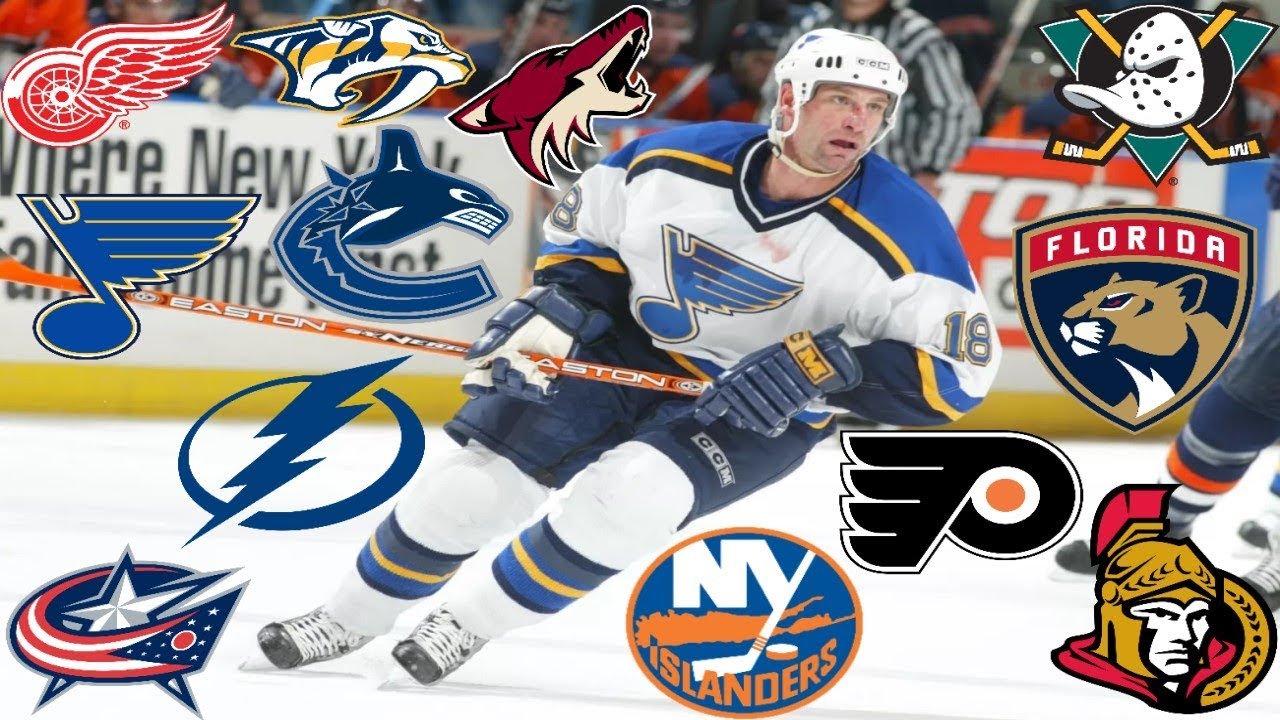
The ultimate journeyman, Mike Sillinger tied a record by being traded nine times throughout his NHL career. Ultimately, he skated for a record 12 teams during his 17 NHL seasons. The only time he was ever traded in the offseason, Sillinger actually switched teams twice in the same day, July 22, 2003.
Sillinger’s NHL career started with the Detroit Red Wings, who selected him 11th overall in the 1989 NHL Entry Draft. During his time in the AHL, he led the scoring as the Adirondack Red Wings won the Calder Cup championships. It was not until 1992-93 that he began playing for Detroit regularly. On April 4, 1995, they traded him to the Mighty Ducks of Anaheim, who at the next trade deadline (March 15, 1996) sent him on to the Vancouver Canucks. Sillinger was at least able to play a full season in Vancouver before, on February 5, 1998, they traded him to the Philadelphia Flyers. However, that December 12, Philadelphia shuffled him off to the Tampa Bay Lightning. As of March 14, 2000, Sillinger had to move further south to play for the Florida Panthers. Almost exactly one year later, he was traded to the Ottawa Senators for future considerations. In his briefest tenure, he only played 13 games for Ottawa.
Finally, Sillinger became a free agent and chose to sign a three-year contract with the Columbus Blue Jackets on July 7, 2001. This was to be only the third time he was able to complete a full season with one team, and he played more games (155) with the Blue Jackets than any other team. By this time, he had gained a reputation as a two-way center great at faceoffs and penalty kills. However, as Sillinger was about to enter the final year of his contract, Columbus found itself deep in the center but in need of a defenseman.
Then the Phoenix Coyotes came calling. Sillinger explained, “I’ve played 12 years in this league, it’s a lot to be proud of, and I’m still playing. It’s good to know that other team wants you. Mike Barnett (the Coyotes GM) called me and said they’ve been trying to get me for a half a year but Columbus wouldn’t give me up. It’s just a matter of a deal being put in place and nowadays it’s about fitting into teams’ budgets as well. That’s why there’s a lot of player movement.” Barnett said of Sillinger, “We felt we had the makings of a solid energy line capable of making both mayhem and offence … The absence of a similar player in the middle was a hole we needed to fill, and he’s a player who fits it.”
Meanwhile, the Coyotes had an expensive defenseman (and team captain) they could no longer afford in Teppo Numminen, a 15-year veteran of the club. He had a no-trade clause that he would only waive for the Dallas Stars (or Detroit), so Barnett reached out to make a deal. Numminen said, “We sat down with Mike and talked about the future and everything. I just felt it was time for a change. It was very classy for Mike to do what he did, and give us the chance to look around. I’m happy about the future and I’m fine with the past. The organization was great to me, and I have great relationships there.” As it turned out, Dallas needed to replace their captain, Derian Hatcher (who had signed with the Red Wings). The Coyotes asked the Stars to work out a deal with the Blue Jackets.
Thus, a three-team deal was conducted. Columbus traded Sillinger and a 2004 second-round draft pick (Johan Fransson) to Dallas in return for all-star defenseman Darryl Sydor. Dallas turned around and traded Sillinger and a conditional draft pick to Phoenix in return for Numminen. Barnett remarked, “I’m excited for Teppo because I know he is, and I’m excited we have a player like Sillinger coming back to us.” The man traded twice in one day commented, “Everywhere I’ve gone I seem to have done well and this is another opportunity. Now I have to look at it as an opportunity to get another contract.”
Despite their high interest in Sillinger, the Coyotes only kept him for 60 games. At the trade deadline (March 4, 2004), Sillinger had to move on to the St. Louis Blues. After the lockout, Sillinger had a great season, even after the Blues traded him to the Nashville Predators on January 30, 2006. He finished out the season, but then (on July 2) he signed with the New York Islanders. Sillinger finished his playing career there when hip injuries caused him to officially retire on August 26, 2009.
Throughout all the moving around, Sillinger still managed to play 1,049 NHL regular-season games (240G, 308A, 548P) and 43 playoff games (11G, 7A, 18P). His many trades and two signings meant that he played in every single NHL division. In describing what it was like moving so often, Sillinger said, “Any team I went to, I knew there were 22 guys there to welcome you with open arms and be part of the team.” He continued, “The biggest reason for my longevity was I never took a day for granted. I always thought it was an honor and a privilege to play in the National Hockey League. The reason being is I approached every day that it was going to be my last.”
From the time he retired until 2014, Sillinger was the Director of Player Development for the Edmonton Oilers. He then scouted and recruited for his former junior team, the Regina Pats.



 Prev
Prev