The new owners of the relocated Nordiques apparently were so excited, they could not keep anything out of the news. Newspapers had already reported the new name, and merchandise with the new colors and logo hit the stores before the announcement. No one was surprised on August 10, 1995, when the Comsat Entertainment Group announced that the team would be called the Colorado Avalanche.
The Nordiques, a team that had transitioned from the WHA to the NHL in 1979, led their division and nearly the NHL in the 1994-95 season. However, Quebec City was too small to financially support the team. That May Comsat Entertainment Group agreed to buy the team, and the sale and relocation to Denver were finalized July 1st. They kept GM Pierre Lacroix and coach Marc Crawford and almost none of the players changed.
That meant that the next item on the checklist was to choose an identity. For the interim, the team was referred to as the Denver Nordiques. Comsat began the process of naming them the Black Bears before changing course. It was almost extreme, the nickname for the relocated Nordiques, the Rocky Mountain Extreme. However, Adrian Dater leaked the name in The Denver Post, and Colorado hockey fans reacted negatively, extremely. After the franchise’s marketing VP, Shawn Hunter, rang Dater, the latter predicted what would happen next. “Burned by all that bad publicity the day before, the ‘Extreme’ would get cold feet and pull the whole concept, then deny it ever was a possibility.”
The new owners went back to the literal drawing board and announced their openness to public suggestions via a “Feedback Forum.” Alternatives for the nickname included many nature-themed options like Storm, Ice, Blizzard, Rapids, and Cougars. The other options seemed to harken back to the cowboy era with Wranglers, Outlaws, and Renegades. The geography part of the name also came up in discussions. They could highlight the city of Denver, the state of Colorado, or the region of the Rocky Mountains. Hunter reminded everyone that they had only had two months (since the sale and move) to brainstorm and decide. He said, “The name was something we always thought we’d wait with and do right.”
The right thing ended up being the Colorado Avalanche. The nickname Avalanche actually had already been attached to at least three other sports organizations in the state: a pro paint-ball team, a semi-pro football team, and a junior A-league hockey team.
Although the same designers made logos for seven of the options (and the Extreme), they only ended up needing the one for the Avalanche. The logo featured an A looking like a mountain, obviously representing the Rocky Mountains, which symbolizes the strength to succeed. Swooshing around the A is the avalanche of snow on a puck. This symbolized the “power and speed of skating, passing and shooting in the game.” For the colors, the team went with burgundy, silver, and a deep blue.
With all that sorted, the players wanted to, well, play. “As players we’re very excited,” Captain Joe Sakic began. “We’ll start with identity, and we’re just looking forward to starting to play hockey now.” He had already told GM Lacroix, who commented, “Time to go on the real side of the business. My captain calls me up this morning and says, ‘I’m in town. I hear we have a name. I’m ready to play.’ These are the things that show a lot of positive stuff for next year.”
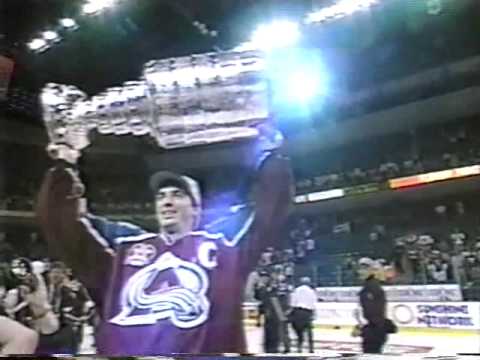
He wasn’t the only one with a prediction. Jack Todd of Montreal Gazette wrote for the edition going out the day after the announcement, “The Avalanche will be very rich and very good. It’s not inconceivable that they could win a Stanley Cup in their first year in Denver.” When you’re right, you’re right. The newly minted Colorado Avalanche did indeed win the Cup that first season in Denver.
Additional Sources:
Jack Todd, “Nordiques officially dead after being buried by Avalanche,” Montreal Gazette, 11 Aug. 1995, p. D1.
“As expected, Avalanche the name for Denver NHL squad,” Grand Junction Daily Sentinel, 11 Aug. 1995, p. 2B.
It was the trade heard around the hockey world, practically starting a revolution. On August 9, 1988, Wayne “The Great One” Gretzky was traded by the Edmonton Oilers to the Los Angeles Kings, trading dynasty for celebrity. The trade was compared to the one in 1920 that sent Babe Ruth from the Boston Red Sox to the New York Yankees. The Oilers got much needed cash, and the Kings got much needed star power. Canadians were shocked to outrage while Californians celebrated with ticket sales. And the hockey world would never be quite the same.
None of those involved in the trade actually expected it to happen. Edmonton had just won a fourth Stanley Cup championship in five years. Gretzky had just won his second Conn Smythe Trophy as playoff MVP, and he had eight consecutive Hart Trophy as league MVP. Bruce McNall, the new Kings owner, had pestered Oilers owner Peter Pocklington about trading Gretzky, only to be laughed off by both of them. McNall remarked to The Hockey News, “Wayne was the greatest player in the world and they’d just come off their fourth Cup, so it wasn’t anything that was in the realm of my thinking this was possible. My biggest concern was when it happened and we really got serious about it was Wayne himself: Did he really want to come? I didn’t want to trade for the greatest player in the world and have him not happy about coming to L.A.”
That summer of 1988, Pocklington realized that with Gretzky becoming an unrestricted free agent in 1989, he should shop around for the cash influx he desperately needed. Gretzky told The Hockey News, “I think my dad and some people in the hockey world knew there was a possibility of me being traded before I did. It came down to a real strong business decision by Peter and a sense that if I wasn’t going to sign an extension with the Oilers – I was an unrestricted free agent at the end of that year – he was going to move me.” At that point, Gretzky began working with McNall concerning the terms of the trade.
When it all shook out, Edmonton sent Gretzky, enforcer Marty McSorley, and center Mike Krushelnyski to Los Angeles in return for center Jimmy Carson, rookie left wing Martin Gelinas, three first-round draft picks (defenseman Corey Foster in 1989, forward Martin Rucinsky in 1991, and defenseman Nick Stajduhar in 1993), and $15 million.
The timing was bad for Carson, having just bought a house after McNall told him he would be staying and renegotiating his contract. When the trade was confirmed, said Carson, “I put the phone down and told my parents I’d just been involved in the biggest trade in the history of sports, and the phone rang as the doorbell was being rung. It was reporters, TV crews, TV trucks. It was crazy.” Even at the time the news broke, Carson joked, “I’ll always be the answer to the trivia question: ‘Who was traded for Wayne Gretzky?’” Meanwhile, Krushelnyski remarked, “I was actually shocked they would trade the icon Wayne Gretzky. I could understand trading role players, people like Marty and myself and Carson and everybody else in the package.” In the end, he said, “(The trade) went against the grain. The Stanley Cup was not the priority. Neither was the team, nor the people. Money was. Plain and simple.”
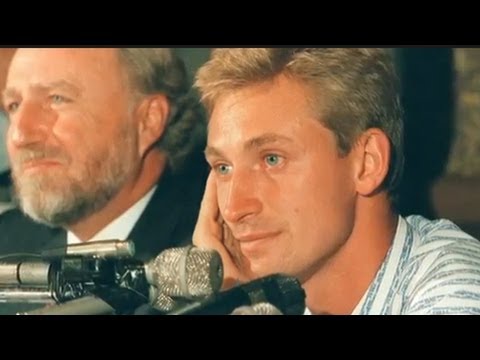
The backlash was swift and brutal. Gretzky described, “It was sort of like a hurricane: it comes through and you didn’t see it coming. All of a sudden it just blazed through and it was done. It was kind of weird that way.” It seemed like Edmonton fans looked for people to blame. Some even took it out on Gretzky’s wife, actress Janet Jones, he just had married on July 16. According to McNall, “She wasn’t the influence the Canadian press made her out to be, but she was there and she really wanted it to happen, so she and I were on the same page.” At the time of his emotional press conference, Gretzky told the press, “I decided that for the benefit of Wayne Gretzky and my new wife and our expected child in the new year that it would beneficial for everyone involved to let me play with the Los Angeles Kings.”
New Democratic Party leader Nelson Riis made news by referring to Gretzky as “a national symbol like the beaver” who Pocklington may as well have sent “to the moon as send him to L.A. Everybody knows that Los Angeles isn’t a hockey town – they wouldn’t know a puck from a beach ball.” Pocklington definitely received the brunt of the blame, despite efforts to emphasize Gretzky’s willingness to go.
Carson had to not only face those fans but also Gretzky’s former teammates on the Oilers. He put into words what it was like joining them after the trade. “I didn’t know what to expect when I got to Edmonton for the introductory press conference. … They were wonderful in the broader bubble of utter shock, disappointment and anger. … They’d been friends, they all grew up together with Wayne. … They did amazing things with a lot of superstars and one mega-star, and now he’s gone.”
Over the next two seasons, it was interesting how the trade played out. In 1989, Gretzky received his ninth Hart Trophy, and the Kings placed second in the Smythe Division. In a twist of fate, the Kings and Oilers faced each other in the first round of playoffs. When in Edmonton, fans booed Gretzky, who said, “It didn’t bother me. In a way it was nice. People can stop talking about the trade now.” The Kings forced a Game 7, which Gretzky’s two goals helped win 6-3. Los Angeles then lost to Calgary, who won the championship. In 1990, that all reversed. The Kings beat the Flames only to lose to the Oilers, who went on to win the Stanley Cup (with both Carson and Gelinas). That was the last time Edmonton won the finals. Whereas, Los Angeles made it to the finals for the first time in 1993 but did not win until 2012 and 2014.
Los Angeles became a hockey town after all, thanks to Gretzky. The man himself told The Hockey News, “There’s a lot of people that still think or talk about me coming to Los Angeles to help hockey grow in California and the United States, but that wasn’t the case at all. … I really never thought about growing the game or trying to make hockey bigger in L.A.” However, back in 1988, he told the press, “It’s very exciting. I’m sure it’s something that will not only be good for Wayne Gretzky and the L.A. Kings, but also for the game of hockey.” In looking back on the 25th anniversary, Carson thought McNall had that in mind the whole time. “I read an article the other day on the enrolment in hockey in California and it’s grown quite a bit since the trade was made. That’s got to be directly attributable to the trade. It elevated that team to a media powerhouse right away.” On the fan side, actor Alan Thicke commented, “But I’m here to tell you I knew the difference between pre-Gretzky and post-Gretzky in trying to get anybody out to a hockey game. You felt it everywhere in the community. … The fact we suddenly had a celebrity made all the difference in the world to the other celebrities.”
The raised interest went far beyond California as hockey drew more fans as Gretzky and the Kings played around the U.S. In addition to the 1980 Miracle on Ice, Gretzky’s trade is credited with inspiring young players across the country, which has allowed the NHL to expand. As his former Oilers teammate Craig Simpson said, “I don’t think anybody else would have been able to do what Wayne was able to do for hockey in the south. … He was the absolute perfect guy – a larger-than-life talent, but an everyday, down-to-earth person.”
Born ten years after the formation of the NHL, Bill Gadsby played 20 seasons during the Original Six era, retiring the year before the 1967 expansion. He was born at Calgary on August 8, 1927, but the defenseman never played for a Canadian NHL team. He did, however, live a long life of over 88 years before he passed away on March 10, 2016. Gadsby put it succinctly, “I think being a pro hockey player, especially in the NHL, is a great life.”
Growing up in Canada, naturally Gadsby skated as often as he could, including sneaking out at night. Eventually, his exasperated father asked if he planned to continue school or just become a professional hockey player. Judging by his success, Gadsby chose wisely when he chose the latter.
However, before he could do either, the tough defenseman twice almost came to the end of the line. At 12 in 1939, he and his mother barely survived a German U-boat torpedo attack that sunk the S.S. Athenia, killing over 100. Then, at 14, a “huge piece of concrete” nearly fell on him from four stories up.
Gadsby followed through with leaving school to pursue hockey, when at 17 he joined the Edmonton Canadians junior team. Two seasons into his time there, he was noticed by a scout for the Chicago Black Hawks. Signing with Chicago as a free agent, they paid him over $10,000 with a $3,000 signing bonus. According to Gadsby, “Before my father, Bill Sr., sent me off to play in the NHL, he offered me one piece of advice that I’ve always tried to follow: ‘Never bring the game home with you.’” Furthermore, his father asked him to keep his good reputation. “To me, what that meant was setting high standards for myself on and off the ice.”
Those high standards came at a cost. In his very first NHL game, he found himself needing 12 stitches. He ended up taking out an insurance policy that paid him $5 per stitch. It paid off mere days later when a puck split Gadsby’s lip. “The final tally was 30 stitches. It was the ugliest gash of my career. My diet consisted of tea and toast for about three weeks. I lost 11 pounds. But I had to laugh at the poor agent who sold me that stitch insurance. In less than two weeks I had paid for the policy. I had gotten back all my money, plus a $50 profit. I think they stopped offering that policy not long after that.” His wife Edna kept a log of stitches, and by the end of his career, he had an unofficial record of about 650 stitches.
In addition to stitches, Gadsby contracted polio during training camp in 1952. He still somehow made the All-Star team that season. To add to his troubles, Gadsby’s nose was broken 11 times. His motto was, “If I have a pulse, I believe I should play.” He further explained why he put himself out there for his teams, “As an athlete I felt as if I owed my coach, my teammates and the fans my best every night. As an athlete I felt I had to stand up for my teammates and myself. As an athlete I felt I couldn’t cheat the talent I had been blessed with.”
Early in his ninth season playing hard, on November 23, 1954, Chicago traded Gadsby to the New York Rangers. He blossomed offensively there. His 46 assists during the 1958-59 season set an NHL record for a defenseman.
At the end of the 1960-61 season, the Detroit Red Wings finally worked out a deal to obtain Gadsby on June 12. GM Jack Adams had wanted him since the season before, thinking he might be the right player to lead them to the Stanley Cup. For Gadsby, “Coming to Detroit, I thought it was going to be a chance to win it all. We had some tremendous teams.” However, he also admitted his original plan. “I was going to come here (to Detroit) for a year and then go back to Edmonton where I lived in the off-season. I was going to coach the farm team there. Instead, I got a new life and I lasted another five or six years with the Red Wings.”
Detroit made it to the Stanley Cup Final during three of his final four seasons there. Sadly, they lost the first two to Toronto and the last to Montreal. Reflecting back, Gadsby advised, “You can’t dwell on the disappointment. I had a wonderful career and got to play with some great players.” Still, after the 1966 disappointment, he retired. “I could have played a couple more years but the body was talking back to me. When the body starts talking back to you and you can hardly gets the legs out of bed next morning, it’s time to quit.”
Instead of leaving Detroit, Gadsby took over coaching the team through the next two seasons. Under his guidance, the team went 35-31-12 for 82 points. Gadsby then worked at a Detroit-based crane-rental company until his 1986 retirement. He kept ties with the Red Wings by raising money for Detroit children’s charities and by attending games at Joe Louis Arena.
Gadsby’s legacy was in going the distance. He was the first to skate over 300 games for each of three NHL teams, and he was the first defenseman to earn 500 points in the NHL. He played over 1,000 games (like teammate Gordie Howe), 1,248 to be exact. His 568 points (130G, 438A) was the highest for a defenseman of his era, and he also led in penalty minutes (1,539). “In reviewing my career, I’m proud that I left the NHL as the highest scoring defenseman in NHL history. I’m more proud of the fact that Gordie Howe and I were the first players to play 1,000 games. In the days of Original Six hockey, to play through injury, pain and discomfort was expected as much as it was admired. The tradition passed down from generation to generation.”
The Hockey Hall of Fame inducted Gadsby in 1970. In a 1988 list of 100 Greatest Hockey Players, Hockey News ranked him 99th. Gadsby put it perfectly when he commented, “It’s been a good life. I had to scratch and claw for everything I got but, you know, I’d do it all over again. In a minute.”
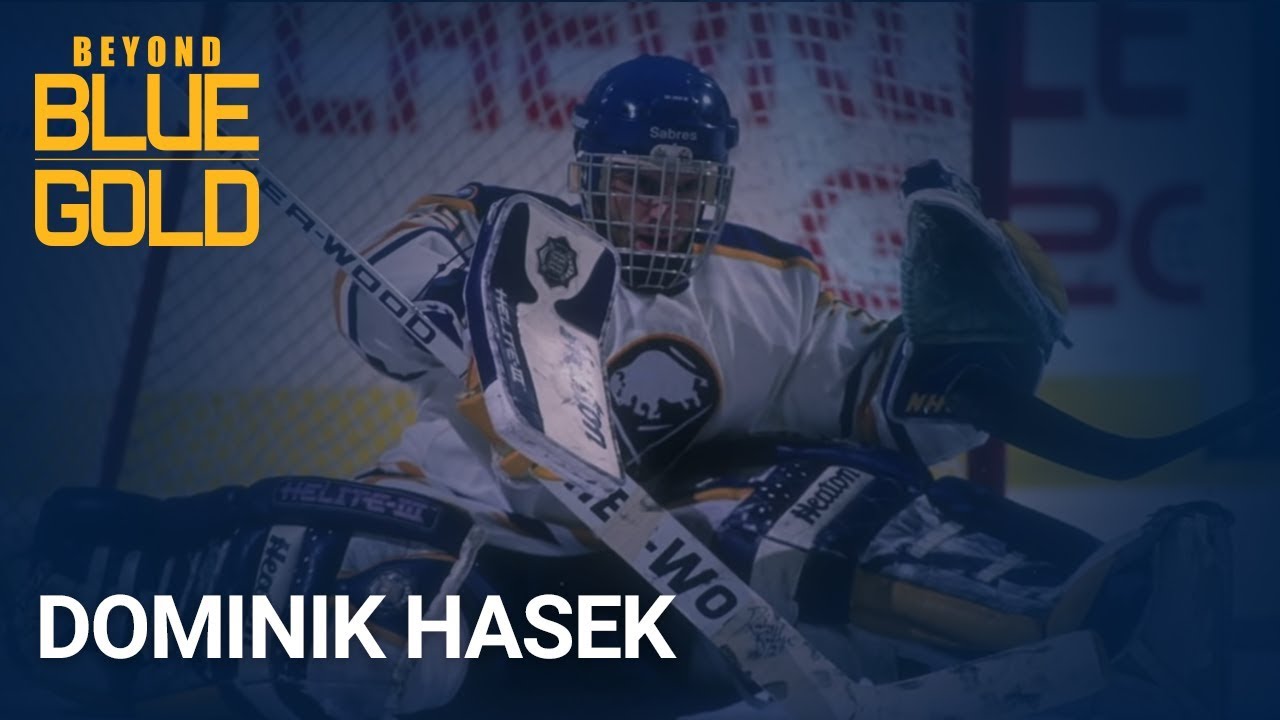
Hall-of-Fame goalie Dominik Hasek played for four teams during his NHL career. Nowhere did he play longer than the nine seasons with the Buffalo Sabres. The Chicago Blackhawks traded him to Buffalo on August 7, 1992, and he finished out the decade there.
Already a star in Czechoslovakia (now Czech Republic), in 1983, Chicago drafted Hasek in the 11th round (207th overall). After his debut in November 1990, he backstopped Chicago for 25 regular-season and six playoff games throughout his two seasons there. Hasek really stood out during game 4 of the 1992 Stanley Cup Final. Unfortunately for him, Ed Belfour’s place as top goalie stood firm, and Chicago had too much depth in goal.
The Buffalo Sabres had noticed Hasek’s talent and pressed Chicago for five months. According to GM Gerry Meehan, “We’ve liked Hasek for a long time. We’ve been trying to get the trade done since February or March.” As Chicago was involved in talks with other teams, Meehan admitted their pursual had “been an on-again, off-again kind of thing.”
Finally, the teams came to terms, essentially trading goalies. The Sabres would get Hasek and give Chicago Stephane Beauregard (and a fourth-round pick). Chicago basically just used Beauregard to retrieve forward Christian Ruuttu from the Winnipeg Jets.
For Hasek, the trade presented the opportunity to take the lead. Chicago GM Mike Keenan remarked, “He feels strongly about his chances to be a No. 1 goaltender. He has expressed openly about his desire to start on a consistent basis.” Keenan felt, “He’s capable of being No. 1. He can play 60 games or so.” The Sabres agreed, and Meehan promised, “Hasek will be given the opportunity to be the No. 1 goalie.” However, Buffalo ended up having too many goalies, giving Hasek some development time. Mitch Korn, the goaltending coach, said of Hasek at the beginning, “He was so smart, he knew exactly what was going to happen next, but he was too early. So he showed his hand like a bad poker player.” Thanks to Korn’s help, Hasek was ready to take the lead after Grant Fuhr’s knee injury in November 1993.
At the end of the 1993-94 season, Hasek and Fuhr shared the William M. Jennings Trophy for having the fewest goals scored against their team. That same season, Hasek earned his first of six Vezina Trophies, all received during his time in Buffalo. In 1997 and 1998, he was voted as both the league MVP to receive the Hart Trophy (as the only goalie to win more than once) and as the most outstanding NHL player receiving the Lester B. Pearson Award. The Sabres came within one controversial goal of winning the 1999 Stanley Cup Final. In his final year with Buffalo, Hasek again earned the Jennings Trophy. During six consecutive seasons in the 1990s, he also led the NHL in save percentage, almost always coming in at .930 or better.
A combination of Hasek wanted to backstop a Stanley-Cup contender and the Sabres needing to reduce salaries led to a 2001 trade with the Detroit Red Wings. Before leaving, Hasek set franchise goals for games played (491), wins (234), shutouts (55), and lowest goals against average (2.22). As Korn praised “The Dominator,” “But for me, nobody made more of a difference every night … This guy did it every night for a good long period of time. He was that dominant on a team that really needed him to be dominant.”
Hasek played four seasons for Detroit, with a year in Ottawa in the middle. He led the Red Wings to win championships in 2002 and 2008. In that final year, he again took home the Jennings Trophy. Then he retired from the NHL.
At the end of his career, Hasek’s honors just kept coming. He was enshrined in the Greater Buffalo Sports Hall of Fame in 2003. In 2014, he was inducted into the Hockey Hall of Fame and the Buffalo Sabres Hall of Fame. The following year, the Sabres finally retired his No. 39.
What a special circumstance when an NHL team’s first coach is someone new to NHL coaching. Newby coach Barry Trotz, hired on August 6, 1997, was able to build and guide the Nashville Predators from the season before they began playing through their 15th season. That gave him the record for the longest tenure as not only the first coach of a franchise but as the coach of one NHL team.
Trotz’s early career, like the one in Nashville, was thanks to David Poile. When Poile was GM for the Washington Capitals, Trotz began scouting for the team in his home province, Manitoba. After all, during the 1980s, he was coaching already at the University of Manitoba. Poile then, in 1992, hired Trotz to coach the Capital’s AHL affiliate, the Baltimore Skipjacks. The following year, he moved with the team to Portland, Maine, and he coached the Pirates to the Calder Cup finals in 1994 and 1996. They won the first and lost the second. Trotz had one more season in the AHL before Poile called upon him again.
In 1997, Poile became GM for Nashville’s new expansion franchise. As its president Jack Diller noted, “With an expansion team, you are building for tomorrow. The leagues does not structure it so you can put a Stanley Cup contender on the ice right away, but we believe we can build a successful organization over time.” He had to think that way because, contrary to advice, Poile chose a coach without any NHL experience.
To assist 34-year-old Trotz, they brought in 40-year-old Paul Gardner, who had been his assistant since 1992. Gardner had played (ten seasons) in the NHL as had his father and brother, and he tended to be the extrovert, allowing Trotz to focus on tactics and planning. Trotz told Nashville’s press, “It would have been a lot more difficult decision I think if Paul was not coming. I can be very intense, I’m a little more reserved than Paul, but I think it is a good mix for us.” Poile agreed, saying, “They have paid their dues. They have prepared for this day. It is the perfect time for them and for Nashville’s hockey team.”
Trotz and Gardner would focus on scouting for the expansion and entry drafts of June 1998. “This is a perfect fit for me,” explained Trotz. “I get to evaluate players, get to participate in learning contracts of the people who might be available for us to draft, I get to analyze the systems that work for coaches, I get to scout the teams we’ll be playing for a year and I don’t lose a game that season. How can you not like that?” He continued, “One of the reasons I wanted the job is that it gives us an opportunity to talk to every coach and every hockey person in a non-competitive atmosphere.”
Another thing Trotz found important during this preparatory year was educating the population in and around Nashville about hockey. “We want people to know the game and love the game. Educating people about hockey is a big part of my job and the whole organization’s job. . . . We want to build a foundation one brick at a time, and part of that is educating people in the community about the game. . . . I think this is going to be an unbelievable hockey town.”
Perhaps most importantly for those fans and the team, Trotz was the first to suggest the name Predators. Based on the stylized saber-toothed tiger logo, he found the Granby Predateurs of the Quebec Major Junior Hockey League. Fans voted in the suggestion. Trotz later commented, “You sort of need a name and a face, being your logo, your brand, and then people start to know you.”
Over the course of his 15 seasons leading the Predators, they made the playoffs seven times but never passed the semi-finals. Having brought the team to a certain level, missing the playoffs in 2013 and 2014 was enough for Poile to replace Trotz (with Peter Laviolette). Trotz had coached 1,196 games (557-479-60-100), giving him the record as the longest unbroken coaching streak. He had been honored by the Nashville Association of Talent Directors and was among the finalists for the Jack Adams Trophy twice.
Although Nashville had offered a front office position, Trotz preferred to keep coaching. About a month after he was let go, he was picked up as coach of his old umbrella organization, the Washington Capitals. He was joined by two of his Predators staff, assistant coach Lane Lambert and goaltending coach Mitch Korn. Trotz led the Capitals to the playoffs all three seasons, and along the way, he finally won the Jack Adams Trophy in 2016 and the Stanley Cup in 2018. It took a record 19 seasons for him to bring an NHL team all the way to the Cup. Directly following the championship, issues working out a new contract with the Capitals led Trotz to resign. He now coaches the New York Islanders.
Additional Sources:
Mike Commito, Hockey 365: Daily Stories from the Ice(Toronto: Dundurn, 2018), kindle edition.
Stephen Laroche, Changing the Game: A History of NHL Expansion(Toronto: ECW Press, 2014), 382-385.
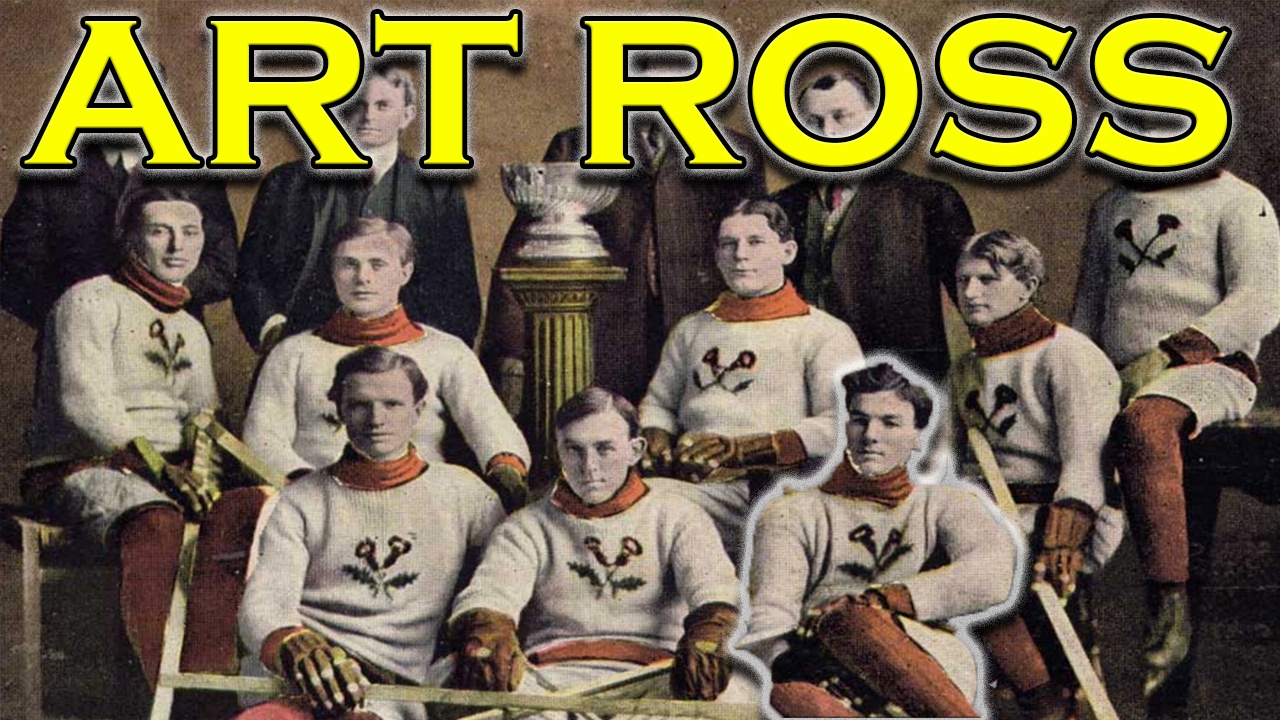
Art Ross lived for nearly 79 years and spent 49 of them working in professional hockey. During that time, he filled almost every position, from player to referee to coach to general manager to vice president. By and large, his playing career was centered around Montreal while his post-playing career focused on developing the Boston Bruins from their inception. Born January 13, 1886, Ross was the 12th of 13 children, who grew up first near Sudbury, Ontario and then in Westmount of Montreal, Quebec. He spent the final years of his life at a nursing home in Medford, Massachusetts, where he died on August 5, 1964.
After playing high school and junior hockey at Westmount (with Lester and Frank Patrick), Ross started his professional hockey career in 1905 with the Brandon Wheat Cities of the Manitoba Hockey League. However, the majority of his 13-year playing career was spent with the Montreal Wanderers. His first Stanley Cup came from defeating them in 1907, but the next season, he won the Cup with the Wanderers. With the Wanderers, Ross played his only three NHL games and retired after their rink burned down (leading to the team folding). Ross revolutionized the defense position by skating the puck up the ice (instead of just passing to a forward), thus becoming the top rushing defenseman of his era. For the Hockey Hall of Fame, in 1945 Ross was one of the very first group inducted. Thirty years later, he was also inducted into the Canadian Sports Hall of Fame.
The career behind the bench began while Ross still played, like with the Wanderers during their only NHL season. After his retirement, he refereed a bit and then coached the Hamilton Tigers for the 1922-23 season. There, he began implementing off-ice work to increase physical fitness.
Ross’s true calling came in 1924, when Charles Adams was granted an NHL franchise in Boston. Adams hired Ross to be the first coach and general manager, and Ross chose the nickname Bruins based on the yellow and brown uniform colors. For the next 30 years, Ross managed the Bruins, coaching them for 17 seasons. After a slow start, the Bruins began picking up steam after Boston Garden opened in November 1928 and went on to win their first Stanley Cup that spring. Under Ross’s coaching, the Bruins won another championship in 1939, and two years later, they won again while he managed the team. With Ross’s guidance, the Bruins topped the league standings ten times.
It took three tries before Ross could retire completely from coaching and focus on managing. In 1934, he hired former teammate Frank Patrick but had to replace him when his drinking became a problem. Then, in 1939, he hired Cooney Weiland, but Ross again stepped in to coach in 1941. Finally, Ross stepped back for the last time in 1945. The coaching saga continued until 1950, when he convinced Lynn Patrick to take the job.
Beyond the Bruins, Ross left quite the legacy in hockey innovations and was called the “man who never ran out of ideas.” In 1927, his B-shaped goal nets (that better caught the puck) was adopted by the NHL and used until 1984. He also designed the synthetic rubber, bevel-edged puck (which reduced bouncing). In 1931, Ross pulled goalie Tiny Thompson to add a sixth attacker, marking the first instance of this kind of substitution. With Frank Boucher, he added the red line to help speed up the game. Finally, in 1947, he and his two sons donated a trophy which ever since has been presented annually to the NHL’s top scorer as the Art Ross Trophy.
Ross finally retired completely in 1954. He had been laying the groundwork since at least Patrick’s hiring in 1950 since Patrick would succeed him as general manager. The team was sold in 1951, which led to Ross being bought out of his shares the following September. His five-year contract was scheduled to end May 1, 1953, and his wife Muriel died just ten days later. Trying to keep busy, Ross signed a one-year contract as GM and then was voted back in as vice president. At the Bruins’ annual break-up dinner, on April 1, 1954, Ross announced his retirement with the promise to serve as advisor for another half year. His formal retirement came on September 30. For his work with the U.S.-based Bruins, in 1984 he received the Lester Patrick Trophy for service to hockey in the United States.
By the time he left the Bruins, his vision was so poor, the glare from ice caused severe headaches. His health continued to decline so that he moved into the nursing home in 1962. Although he had had a feud with Conn Smythe pretty much since the Bruins’ beginnings, Smythe sent a simple but touching telegram upon Ross’s death. “Sorry to hear the old Bruin warrior has gone along. Give my deepest sympathy to his family.” Funerals were held in Boston and Montreal, where Ross was buried at Mount Royal Cemetery by Muriel.
Additional Sources:
Eric Zweig, Art Ross: The Hockey Legend Who Built the Bruins(Dundurn, 2015).
“I think there’s going to be a rebirth of hockey here in Southern California,” said Jeremy Roenick. “I’m really excited to be part of that.” The Philadelphia Flyers traded center Jeremy Roenick to the Los Angeles Kings because acquiring Peter Forsberg put them over the salary cap. At the same time, the Mighty Ducks of Anaheim lured defenseman Scott Niedermayer away from the New Jersey Devils by giving him the opportunity to skate with his brother Rob. After much wheeling and dealing on Wednesday, the chips had all fallen into place and the press was informed on Thursday, August 4, 2005. Southern California became the center of hockey news thanks to two popular east-coast players relocating to the west coast.
According to the Los Angeles Times, Anaheim got the better player in 32-year-old Neidermayer but Los Angeles got the better entertainer in 35-year-old Roenick. The former had received the Norris Trophy in 2004 and had won three Stanley Cup championships during his 12 seasons in New Jersey. The latter had played in nine All-Star games during his 16 NHL seasons and then made some choice comments during the lockout that left him saying, “My recognizability in the last three months has skyrocketed.” GM Dave Taylor put it bluntly, “Hockey is a foreign sport out here. We have to do whatever we can to sell it. We’ve been away too long, so players like Jeremy will help us bring it back.”
Roenick’s trade came about thanks to the salary cap. Over the course of four hours, GM Bob Clarke worked out a $5.7-million deal with Forsberg that put the Flyers over the $39-million cap. Clarke called Roenick five times during the proceedings to keep him informed. Roenick said, “I can’t say enough about Clarke. It was hard for him to do what he had to do, but he went far out of his way to try and make sure that I was well taken care of. That’s something you don’t get in professional sports when something like this happens, and for that I will be grateful forever.”
To make room for the Flyers, Roenick had waived his no-trade clause as long as he went to Los Angeles or Phoenix, because he had a home in Scottsdale, Arizona. Taylor called Clarke in the early hours of the morning on his way into the office. He said, “We talked with Philly about a minute after the Forsberg deal was done. The deal made a lot of sense for us. We were able to add a first-line forward and a player who brings characteristics of a power forward that fits well with the mix of players we already have.” The Kings got the final year of Roenick’s $4.94-million contract and a third-round draft pick cheap, just in return for “future considerations.”
The Kings’ interest in Roenick had a lot to do with their star, Luc Robitaille, who apparently told Roenick he was going to ask management to go after him. Robitaille explained, “We were a team that was trying to make the playoffs, now we’re a team that wants to win the playoffs, and that’s a big, big difference. That’s what Jeremy is about. This guy is a playoff performer. He’s a big-game performer. He’s a big mouth too. He’s got it all.” At the announcement, Roenick half-jokingly said, “The quest to get Luc 30 goals this year is going to weigh heavily on my mind because that’s what he told me I have to do if I came here.” Robitaille looked forward to skating with Roenick, saying, “This guy is Showtime, this guy is Magic Johnson. Man, this year is going to be so much fun. … L.A. needed to get a player like this, and in reality, the NHL needed L.A. to get a player like this.”
Philadelphia was sad to see Roenick go, and Los Angeles was glad to have him. Clarke commented, “J.R. was everything we thought he’d be. He never took a night off and he was exceptionally good with [the media]. Sometimes we wish he would have thought a little more before he said some things, but at no time did he ever not give everything to this team or this organization.” Then Taylor said, “He brings a lot of passion, whether he’s driving to the net or hitting someone into the boards or talking about the game. He speaks from the heart, and it’s very, very colorful.” On leaving, Roenick said, “My heart is really hurt. … It hurts to know that they are going to have a good team this year and I’m not going to be a part of it.” On arriving, he said, “I think L.A. is going to have a very good hockey team this year. It’s a place I wanted to play my whole career.”
For Niedermayer, the move was about making positive changes, not leaving negative circumstances. “It was tough. There was no reason to want to leave New Jersey. It was more that there were more reasons to go to Anaheim.” He continued, “In New Jersey, I was very comfortable. I knew exactly how everything worked and all I had to do was play hockey. This is going to be a new experience. I think an exciting part of life is doing new and different things.” Not to mention, his parents lived in British Columbia, his in-laws were in California, and, most importantly, his brother played in Anaheim.
Scott and Rob, only 16 months apart, had been teammates growing up only to have to oppose each other in the 2003 Stanley Cup Final. According to Scott, “Since I was 16 and he was 15, we’ve been apart playing hockey and now we have the opportunity to play on the same team. When we played in the world championship for Canada [in 2004], it was a lot of fun. It felt extra special.” Rob agreed, saying, “We thought it would be nice to experience that for a whole season. When he decided to come, I was probably one of the happiest guys around.” At first, it seemed they might only be together a season, until Rob’s contract was extended. When asked about that, Scott remarked, “It was Rob’s choice, not mine. Obviously there was one more year that we could have played together and that was enough for me. If it’s going to be more than that, even better.”
Ducks GM Brian Burke went on a whirlwind three-day tour to convince Niedermayer that, as he said, “I’m the only GM that can check off every item on [Scott’s] list.” He also remarked, “This was a no-brainer to go after [Scott]. This guy is a proven winner and he has the jewelry to prove it.” According to Epp, “I think he took it upon himself to do everything to make the deal happen. At a point Tuesday night, we were still thinking that there was a possibility that Scott was going to be back in New Jersey. When we got to Vancouver, everything really changed. [Scott and Rob] believed what he had to say. The more Brian got to know them as people, the more he wanted them.”
Thus, he signed Scott to a $27-million contract ($6.75 million per season), which was lower than the Devils’ offer. Burke had originally approached Rob (a restricted free agent acquired in 2003) with a qualifying offer of almost $1.6 million but then ended up giving him a four-year contract for $8 million ($2 million per season). Burke remarked, “I made these moves to help our club. Now, if we sell some tickets, well, great.” Soon after joining the team, Scott was made captain of the Ducks.
Due to their proximity, the Kings and the Ducks had a rivalry going. When Roenick was traded to Los Angeles, he trash-talked Anaheim, despite being scheduled to throw the first pitch at a baseball game there. “Does Anaheim even have a city? Are there big buildings there? . . . Here in L.A., we have lots of big buildings. We’re a city.” He continued, “I think I fit in very well in L.A. I’m an L.A. kind of guy.” After all, “It fits my personality. It fits my style of game … a great pick for me.” Finally, he focused on the hockey saying, “I can see them trying to do a lot of good things in Anaheim. I still think we’ll kick their ass.”
As it turned out, during the 2005-06 season, the Ducks finished third in the Pacific Division with 98 points (43-27-12) while the Kings trailed them with 89 points (42-35-5). The Ducks made it to the conference finals while the Kings missed the playoffs. On July 4, Roenick signed with the Phoenix Coyotes, where he had played before Philadelphia. He spent a year there followed by two with the San Jose Sharks before retiring on August 6, 2009. Meanwhile, the Niedermayer brothers played for the Ducks in 2007, as they became the first Californian team to win the Stanley Cup, with Scott receiving the Conn Smythe Trophy. Two years later, Rob signed with Scott’s former team in New Jersey while Scott remained with the Ducks until retiring on June 22, 2010. After these careers ended, the Kings finally won the Stanley Cup championships in 2012 and 2014.
Additional Sources:
“Two Real Ice Breakers,” Los Angeles Times, 5 Aug. 2005, pp. D1 and D6.
Helene Elliott, “Keeping Up With Burke Can’t Hurt Kings,” Los Angeles Times, 5 Aug. 2005, p. D6.
Steve King, “With Time Running Out, Clarke Scores,” Philadelphia Daily News, 5 Aug. 2005, p. 116.
Ed Barkowitz, “Roenick emotional over trade to Kings,” Philadelphia Daily News, 5 Aug. 2005, p. 117.
Tim Panaccio, “Bittersweet goodbye: Flyers send Roenick to L.A.,” Philadelphia Inquirer, 5 Aug. 2005, p. D7.
“Ducking Out,” Hackensack Record, 5 Aug. 2005, pp. S1-S2.
George “Gerry” Geran got around. He skated in the U.S., Canada, France, and at the Olympics held in Belgium. He played at the collegiate, amateur, international, and professional levels. All this was accomplished, not by a Canadian, but by a player born at Holyoke, Massachusetts on August 3, 1896.
Geran’s biggest claim to fame came from being the first U.S.-born skater to play in an NHL game. During the NHL’s inaugural season, the center signed with the Montreal Wanderers. He played that historic first game on December 19, 1917. Although he had come into the game “with the reputation being a second Hobey Baker,” the Montreal Gazette reported afterwards, “The Wanderers tried out a new man, Geran, who played a year ago with Boston, and from what he showed he is not fast enough for professional hockey.” Geran commented, “The first thing that stood out in the professional game was the resourcefulness of the players. Amateur players are inclined to be too mechanical, but a pro sizes up a situation at a glance and depends on his initiative to go through.” Unfortunately, the Wanderers only played three more games that season before their rink burned down on January 2, forcing them to fold. Geran did not score any points in those four opportunities. When he rejoined the NHL for the 1925-26 season, he played as the last active member of the Wanderers.
Having played with multiple Boston-based amateur teams, Geran later signed with the Boston Bruins on November 23, 1925. He had tried out with the team at a local camp to earn his contract. Three days later, he became the first American to play for a U.S.-based NHL team. When he scored twice on December 11th, he became the first U.S.-born player to score in the NHL. During his sole season with the Bruins, Geran scored five goals and one assist in 33 games.
Geran played the majority of his career as an amateur. While attending Dartmouth College, he played for them through two seasons between 1915 and 1917. Around the four games he played for the Wanderers, Geran played eleven for Boston Navy Yard. During the 1920-21 season, he played six games for the Boston Shoe Trades of the new United States Amateur Hockey Association (USAHA). After a couple seasons abroad, Geran returned to the USAHA to play three seasons for the Boston Athletic Association Unicorns. He was one of five Massachusetts men on the team. After a March 1923 series against St. Paul, the press noted, “Geran should be classed as the outstanding player of the series chiefly because it was through his sole effort that two games were won for the Boston team.” On November 4, 1926, the Unicorns traded Geran to the St. Paul Saints of the American Hockey Association (AHA). He played 12 games there before retiring in 1927.
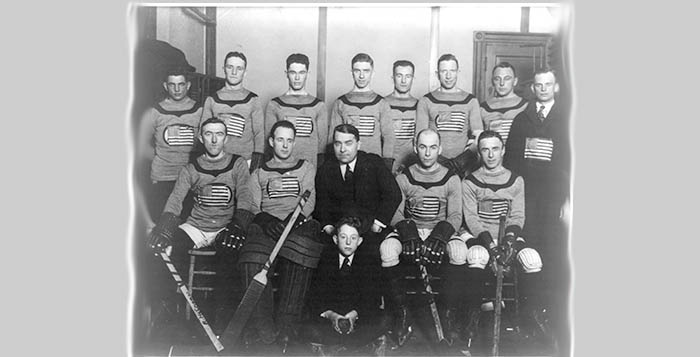
Thanks to his return to amateur status after 1917, Geran joined Team U.S.A. for the 1920 Summer Olympics at Antwerp. Naturally, this made him the first NHLer to play in the Olympics. They won the silver that summer. Afterwards, Geran continued to play in Europe, as the first NHLer to play in a European League. During the 1921-22 season, he played eight games for the France Club des Patineurs de Paris, called the Volants. In that time, he scored a whopping 88 goals. He returned to America with the nickname “Duke of Paris.”
After retiring in 1927, Geran did some scouting for the New York Rangers. There in New York in 1941, he formed the Association of Professional Hockey Players of America, and the top officers all hailed from the Rangers. This was one of the first attempts to form a players’ association that planned to raise money by staging annual all-star games. Geran’s letter to players explained that the association was “strictly for benevolent purposes, operated on a non-profit basis and at no time will it take part in club-player contract disputes or otherwise interfere with the management of league affairs.” Meanwhile, he wrote to Frank Calder hoping for NHL cooperation and received the response that Calder would take the suggestion to the Board of Governors. With World War II ramping up, the association received little support.
Geran led quite the life, on ice and off. He was “a slow skater but great stickhandler and playmaker.” According to Bruins owner Weston Adams, “He wore spats and a derby. Those were his trademarks.” He was also adventurous, even bullfighting in Spain. After 72 years of living life to the fullest, Geran died on Christmas in 1968.
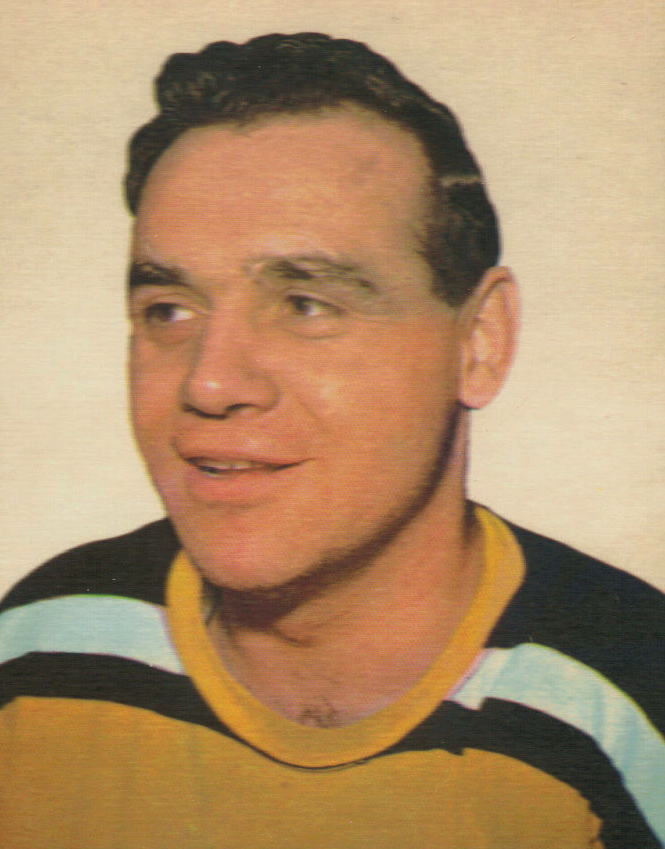
Leo Boivin was small for a defenseman but hit so hard he earned the nickname “Fireplug.” The stay-at-home defenseman stayed in the NHL for 19 seasons, coming close to the Stanley Cup three times (only to lose each to Montreal). Boivin’s first home was Prescott, Ontario, where he was born on August 2, 1932.
Growing up on the St. Lawrence River, Boivin skated from the age of 7 onward. He reminisced, “We had many a hockey game on the St. Lawrence River. We had some open-air rinks close by and anytime the river was frozen, we’d go there and skate too. I remember being [in] skates since I could walk.” As soon as he joined organized hockey, Boivin realized his preferred position. “I got into Bantam and Midget hockey and knew that I wanted to be a defenceman because defencemen got to stay on the ice longer.”
In 1948, Boivin began playing for the Inkerman Rockets and was recruited by the Boston Bruins to play for two seasons with the Port Arthur Bruins. In all three seasons, his juniors team made it to the Memorial Cup playoffs. “That was my game even in junior hockey,” said Boivin. “I just kept getting better and better at bodychecking.”
Despite Boivin’s two years preparing for the Bruins, in 1950 they traded his rights to the Toronto Maple Leafs. He explained, “Toronto made a deal that sent Vic Lynn and Bill Ezinicki to Boston and got Fernie Flaman, Phil Maloney and Kenny Smith. I was the amateur thrown in.” The Leafs needed to replace the lost Bill Barilko, so they gave the tough Boivin a couple tryout games while he played for the Pittsburgh Hornets of the AHL. Boivin played full time for the Leafs from 1952 until November 9, 1954, when he returned to the Bruins.
That November was the start of Boivin’s longest tenure in the NHL. He summarized, “I was sent to Boston and Joe Klukay was sent to Toronto. I stayed in Boston for pretty near twelve years.” At the start of his time there, according to Boivin, “We had some good teams. When I went there in ’54-55, we were struggling a little bit. New York was ahead of us in points but we came back and took fourth place. We ended up playing Montreal in the semi-finals. In the meantime, the following year, you couldn’t buy a ticket in Boston at all. We were sold out completely.” The height of his time in Boston came in 1957 and 1958, when the Bruins lost the Stanley Cup finals to Boivin’s childhood favorite, the Montreal Canadiens. “We had some great games with Montreal,” said Boivin. “We ended up playing Montreal twice for the Stanley Cup, once in 1957 and again in 1958.” From 1963 through his final four seasons there, Boivin captained the Bruins, who sank to the last place for three seasons.
With the Bruins struggling, Boivin was open to a trade that took place February 16, 1966. As Boivin told an interviewer, “Hap Emms asked me if I would go to Detroit. It was near the (trade) deadline. (Doug) Barkley lost his eye that year and Sid Abel wanted me to go there. I said, ‘Sure, I’ll go to Detroit.’ It was quite a feeling to go in there because they had guys like (Gordie) Howe and (Alex) Delvecchio that I had hit hard through the years. But they welcomed me with open arms. I really enjoyed playing there.” Boivin was one of the Red Wings who had not yet won the Stanley Cup, but again in 1966, he lost it to the Canadiens. That was the last hurrah for Boivin. “The next year, we couldn’t put it all together and we missed the playoffs.”
With the 1967 NHL Expansion Draft, Boivin found himself with the brand new Pittsburgh Penguins. “After sixteen years in the six-team league, expansion added on to my career,” said Boivin. “At that time, there were a lot of players playing in the American Hockey League that were great players who just didn’t get a chance.” Being new, the Penguins were not very successful during those inaugural two seasons.
In January 1969, the Penguins traded Boivin to another expansion team, the Minnesota North Stars. Boivin summarized his time there, “I went to Minnesota with Wren Blair and stayed there for a year and a half. I retired in 1970.” The retirement came about when the North Stars released him and the Buffalo Sabres tried to recruit him. Having played 1,150 regular-season games, Boivin retired with 72 goals, 250 assists, 322 points, and 1,192 penalty minutes.
Boivin’s career in hockey continued when he became a scout. He also coached for a few years. In 1975-76 and 1977-78, he filled in as coach for the St. Louis Blues, for whom he scouted for a decade. Then he coached for the Ottawa 67’s of the Ontario Hockey League, where he guided Denis Potvin. Boivin continued scouting for the Hartford Whalers until his second retirement in 1993. At that time, he returned to the St. Lawrence River area of his childhood.
In 1986, Boivin received his biggest honor, induction into the Hockey Hall of Fame. “I think the biggest thrill of my career was being inducted into the Hockey Hall of Fame. To be voted in among your peers, even today, is hard to explain. I had never been on a Stanley Cup (winning team), but to be in there with such great, great hockey players was just such a great honour. That, to me, was even better than winning the Stanley Cup!”
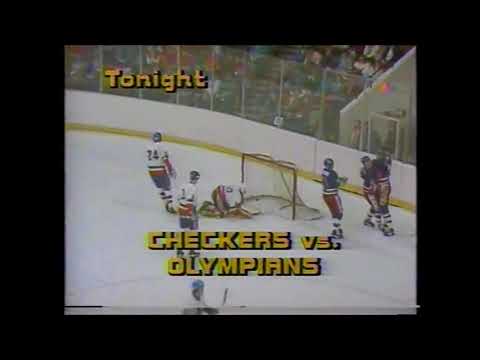
Most NHL fans know that the New York Islanders won four consecutive Stanley Cup championships between 1980 and 1983 (and lost the fifth in 1984). Few realize that during that dynasty, the Islanders had a farm team in Indianapolis, the Checkers of the Central Hockey League (CHL). On August 1, 1979, the Islanders announced their new CHL franchise, which they kept until the league folded in 1984.
Indianapolis had been the home of the WHA’s Racers, who played from 1974 through the first 25 games of the 1978-79 season. Their most famous player was Wayne Gretzky, when he was too young to join the NHL. The way in which the WHA team folded left Indy bitter and missing hockey.
Meanwhile, the Islanders decided to expand into a new area rather than keep using the Fort Worth Texans as their top farm team. The Colorado Rockies agreed to make Fort Worth the home of their first farm team, freeing the Islanders to look elsewhere. Islanders President and GM Bill Torrey explained, “The reason we moved here to a new market was because we’re a little further down the road than Colorado with our farm operation and more capable of placing a team here. … We had a good relationship with Fort Worth for six years, but with the growth of hockey nationally and its expansion we moved here because it is a major market with a major arena.”
They also chose Indianapolis because, Torrey said, “I think Indianapolis is a good hockey town.” He assured former Racers fans, “When hockey treats Indianapolis right, we feel Indianapolis will treat hockey right.” The Islanders wanted to help Indianapolis’ market rather than depend on that market to make money. “We’re not looking for anything from Indianapolis. It is up to us to put a good product on the ice and we will. You’ll see as good hockey as you’ve seen in the last five or six years.” Torrey certainly sounded positive about the future when he remarked, “I can’t think of a better place for our top farm team to operate. I know that our many fine players will bring the best of CHL action to Indianapolis.”
The NHL franchise felt that the CHL was the strongest of the other leagues. Torrey noted, “I think outside the NHL, the best hockey in the U.S. will be played this season in the CHL. I don’t like the tag minor league. This (the CHL) is a development league. Minor league is what you saw in ‘Slapshot.’ The players here will be only a step or two away from the major leagues. And they will all be under contract to the Islanders.” Torrey emphasized, “We believe in the farm system and of scouting and developing our own players.” The Islanders franchise felt that Indianapolis would give the players necessary experience. “We’re here because we feel it’s the best place to continue the process of developing players.”
Torrey made the franchise announcement at Market Square Arena, where the team originally had contracted to play. The pricing and other administrative details still needed to be worked out, but they wanted to give some priority to former Racers ticket holders.
The Checkers received James Devellano as GM. He had scouted for the Islanders since 1974. Their first coach would be Bert Marshall, who had played defense for the Islanders for seven seasons before serving as their assistant coach.
During their five seasons in the CHL and as a farm team for the Islanders, the Checkers won the Adams Cup (named for President Jack Adams) twice, in 1982 and 1983. The CHL folded directly following the 1984 championships. As a result, the Islanders sold the Checkers to the Pittsburgh Penguins’ owner, and the Checkers joined the International Hockey League (IHL).
In 1987, due to heavy financial losses, the franchise folded, leaving Indianapolis without a hockey team for a full season. The Indianapolis Ice of the IHL formed in 1988 and operated until 1999.




 Prev
Prev