The 2013 Stanley Cup Banner was hanging over them, but the red team playing in the United Center Thursday night did not look much like champions as they took on the St. Louis Blues.
While rookie Brandon Pirri opened the game on a good note for himself and the Blackhawks with his first NHL goal, the team let every move be answered by the Blues.
Three minutes after Pirri’s goal, David Backes tipped one in past goalie Corey Crawford on a Power Play after Jonathan Toews was called for slashing.
“Awful,” Blackhawks coach Joel Quenneville told media after the game, “didn’t like our game at all … first 12 minutes I liked.”
“Early, we had that and I don’t know. We stopped getting behind them, getting it at the net. We slowed ourselves right down. Didn’t like our pace, how we turned pucks over, didn’t get pucks to the net, didn’t generate any offense after the first.”
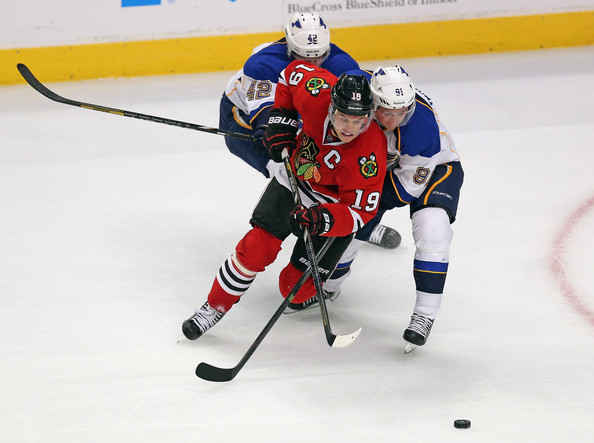
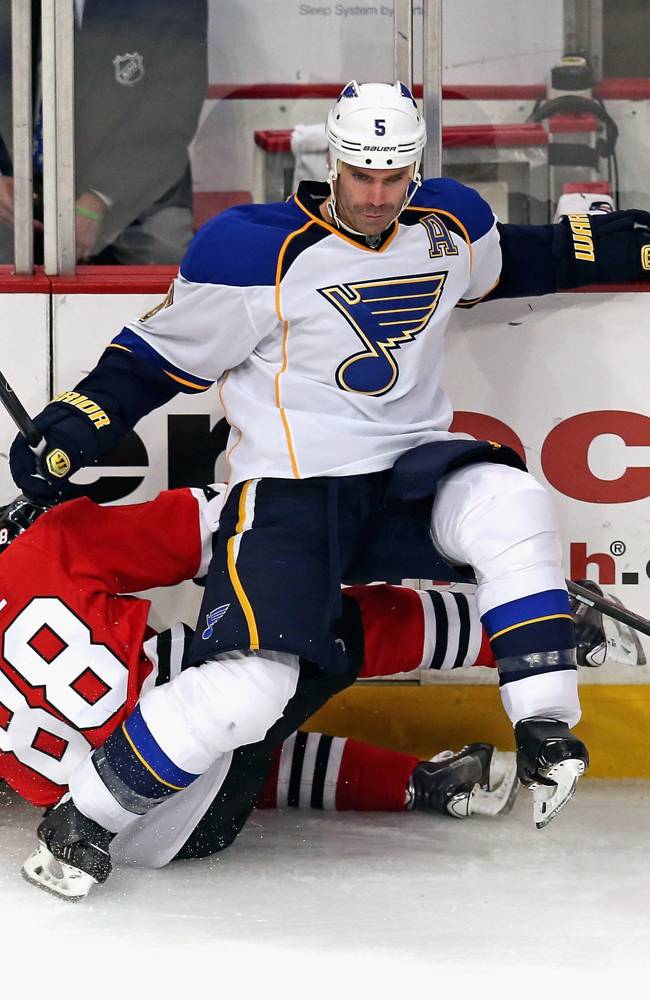
The Blues opened the second period, but lost some momentum when Barret Jackman earned a boarding penalty with a hard hit from behind on Patrick Kane at 7:18.
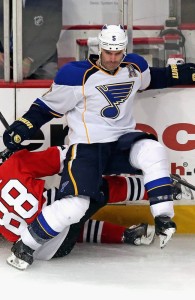
Though Kane knelt on the ice a while after the hit, he was back on the for the Power Play. The Hawks played with a vengeance, battling fruitlessly back and forth but not managing many shots to the net.
When Marian Hossa had a breakaway slapshot goal about 10 minutes later, it was quickly answered by St. Louis. Jay Bouwmeester’s shot was redirected by Alex Steen, hitting Blackhawk defenseman Duncan Keith’s stick, and sliding past Crawford to tie the game 2-2 about one minute later.
“That’s what they do: they put pucks on the net. They score ugly goals,” Quenneville said, “we’re not willing to do that.”
The Blackhawks looked ready to score again late in the third after the Blues’ Roman Polak hit Marcus Kruger from behind at 6:14, yielding a boarding penalty and a barrage of fists from Brandon Bollig. The two received fighting majors, with Bollig getting the extra misconduct and instigating. Jackman joined Polak in the box for roughing against Andrew Shaw.
Again, the Hawks couldn’t set up a play and Shaw got a roughing call just a minute later against T.J. Oshie.
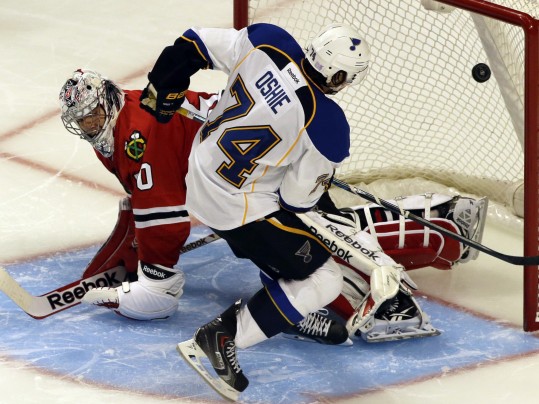
After a sloppy third period, a fruitless overtime led to a shootout, where Oshie tallied the game-winner with a forehand-backhand goal against Crawford.
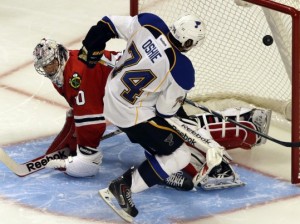
The Blackhawks had 28 shots on goal for the game, while the Blues had 26.
“We’re going to see a lot of them, and we’ll be fighting with them for spots in our division,” Chicago defenseman Brent Seabrook said, “we have to be better against these guys and come out Saturday night and have a better effort.”
The Blackhawks host Toronto at 6 p.m. CT Saturday, for the team’s Hockey Fights Cancer Night.
When Joshua Harris and David Blitzer purchased the New Jersey Devils in August, they gave us one instruction: “Make the Devils the best franchise in sports- on and off the ice”.
Our objective is, and will always be, to build a franchise that makes us all proud. The Devils’ decades of success on the ice comes from a dedication to key principles: integrity for hockey, a team-first commitment, class, and dignity. Our players never taunt or disgrace our opponents no matter the circumstance. We play hard every shift and we play for the front of the jersey. These core values have defined what it means to be part of the Devils Family. Unfortunately, the organization hasn’t always lived up to the high standards we have established on the ice. We are charged with changing that.
Universally loved traditions should never change. Over the last few years certain fans started chants that offended a large portion of our fan base and turned off others. Our strength is our unity. We want a game experience that represents what we are on the ice, makes all age groups proud of who we are, and represents our community.
You are the key to making that happen. We want to reset a tradition that represents who we are on the ice, what it means to be in the Devils Family.
We would like your input in selecting a new goal song. We will take your suggestions and introduce the most popular in each of the next three home games. These songs will be suggested by and voted on by you the fans. The winning song will be played on November 2 in our game against Philadelphia.
We are glad that you are passionate about your Devils traditions and hope that you are equally excited to be part of the new traditions we will be making in the decades to come. The home ice advantage is in all of our hands.
Sincerely,
Lou Lamoriello (GM), Scott O’Neil (CEO), and Hugh Weber (President)
Long letter short; the Devils new Overlords dislike how “classless” the whole chanting “HEY! YOU SUCK” to (a cover of) Gary Glitter’s Rock and Roll Part II that they used to play after the Devils would score at home.
Personally, I think it’s silly because this is sports. You are going to hear some bad words and outside of us playing the Rangers or Flyers, very few fans even really mean it, it’s just something fun to scream with people who understand you.
On the other hand, I do realize that I learned the phrase “fuck you motherfucker” when I was 5 by my grandmother who was watching an ice skating competition, so I know that what was okay for me as a young kid (who actually didn’t even get into sports until I was in my teens) might not be ok for everyone. If by “everyone” I mean mostly mean children in this case.
Plus, they’ll never really be able to stop the Devils fans from starting the ‘Rangers Suck’ (Flyers Swallow: Avery Watches) whistle. So, for those of you who enjoy a little vulgarity in your sports, there will always be that, even if the ending part is wayyyyyy more offensive then a random Wednesday Night “Hey, you suck (not-even-in-our-conference-St-Louis-Blues)!”
You have until Oct. 27th to tell the Devils what they should play every time the Devils score (if you say either the MUP MUP MUP song or Seven Nation Army, so help me Ghost of the Devils Defense, I will hunt you down)
But, don’t worry. Have you seen how the Devils are playing this season? It’s pretty unlikely that we won’t be hearing whatever new and terrible song they choose that often this season anyway…
Tim Thomas will always hold a special place in the hearts of Boston fans, but for the first time since helping lead the team to Stanley Cup victory in 2011, he wasn’t a teammate, but an opponent. In a much touted match up between the Boston Bruins and Florida Panthers, Thomas looked to lead his new team in victory, while Boston hoped to capitalize on their familiarity with an old friend.
Coming off a frustrating loss to Detroit at home on Monday, it was Boston who dominated the first period in Florida. Adam McQuaid was targeted as the healthy scratch for the black and gold defense, perhaps an odd choice at first, but the young defensive trio of Bartkowski, Hamilton and Krug proved to be a solid choice. In the first period alone, combined they skated to the dressing room with a goal and an assist. First period scoring, Paille with a wrister at 3:45 from Seidenberg and Bartkowski. At 11:16, Mattias made the strides of shame to the penalty box for a hooking call on Krejci. Ceasing the power play opportunity, Hamilton at 12:47, from Krejci and Chara. The Bruins left the score at 2-0 going into the second.
Lackluster performance in the first for Florida saw a similar start to the second period, however, they found their momentum swing at 12:32 from the ever talented, once Bruin, Versteeg who quickly wristed the puck past Rask with the assistance of Huberdeau and Gilbert. The lack of intensity was a key theme throughout the second, which gave way for limited overall action and one tripping penalty coming at 18:24 from Bruins Smith against Weaver. Despite peppering goals at 39-year-old Thomas, who faced a total of 26 in the opening periods, 40 by games end, the score remained 2-1 heading into the third.
Opportunities galore faced the Panthers in the opening minutes of the third, but Rask managed to keep the score 2-1 in Bostons’ favor. A one goal game meant the chance for Florida to turn the tables, with the possibility to tie in sight, the pressure was on and continued throughout the period. Boston, with a successful power play so far this season looked to make it 3-1 when they were awarded an extended power play from a high stick on Krejci, it was Panthers Kulikov that skated to the box at 6:24. Killing off the four minute penalty, the Panthers found their stride shortly after the halfway mark, trying to make moves against Rask but ultimately found themselves denied. The effort from the Panthers was evident as Winchester tipped the puck past Rask at the 14:00 mark, tying the game. But it was Boston who pulled out the win from an unassisted backhand at 19:01 from former Dallas Star, Reilly Smith. The goal put the Bruins past the Panthers with a final of 3-2.
“It got close at the end there, we didn’t want that to happen,” said Smith. “It’s a great feeling to be able to score, to help your team out and to get a win.”
Both teams will play their next game on Saturday, October, 19th. Boston will look to sweep their Florida road trip when they face the Tampa Bay Lightning for the second time this season; while the Minnesota Wild skate into Panther territory.
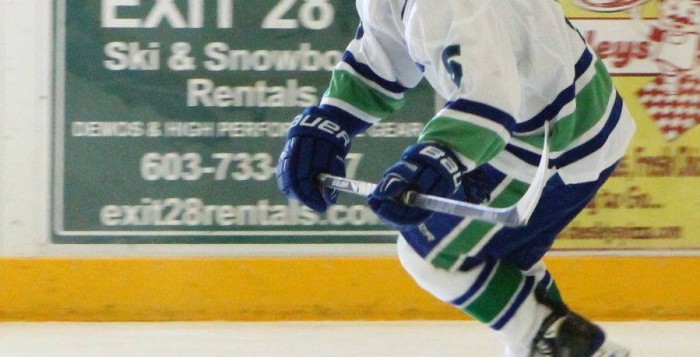
In-state rivals Maine Moose and Maine Wild will meet again in two home-and-home tilts, and the Cape Cod Islanders will host the Syracuse Stampede for the first time this season in this weekend’s
Northern States Junior Hockey League action.
But first, on Friday, the Maine Moose will travel to Salem, N.H. to face the Junior Mariners at Salem Icenter.
“We will be having a busy weekend with three games,” said Moose Interim Head Coach Bill Desmaris. “The Moose are heading into the weekend with top leading scorer Taylor Zion with 7 goals, and the most points by Captain Colt Steele with 3 goals and 13 assists. The Moose have to be ready for a very skilled Mariners team with lots of depth from the front end to the back end.”
The Mariners ran over the Moose in their last match up, 7-2, on Oct. 6.
Desmaris also warned his team that they will have a tough series against the Maine Wild on Saturday and Sunday.
“They are a hard-working team that can cause problems if you are not ready to play,” he said.
Maine Wild Head Coach Mike Tenney says his team is ready to do just that: play hard and notch their first win.
“They are a familiar opponent who we’ve played twice already, so the good news is we have tape and we will break that down and come up with a game plan based on what they do,” he said, “They beat us twice in their barn (on opening weekend) so we have to show up and focus.”
Tenney knows it will be a tough battle against the Moose on Saturday night in their barn, but hopes a hometown crowd on Sunday will give the Wild an edge.
“I think we are moving in the right direction,” said Tenney of his team, which is still without a win. “We got the lead (last weekend against Syracuse) so we know what it is like to play with the lead. Hopefully we can grab a lead and maybe finish it off. We are looking forward to the weekend, the guys are really starting to come together. I think we are ready to go, it’s a matter of getting the monkey off our backs.”
On Friday the Wilkes-Barre Miners will travel to Waterville Valley for a two-game series against the AHI Fighting Spirit, who are currently first place in the league.
“The Fighting Spirit is a fast team, just like us, so it will come down to who makes the least amount of mistakes,” said Miners Coach Martin Moucha. “We are expecting an even match throughout the weekend.”
The Syracuse Stampede will travel to Cape Cod this weekend for a two-game series against the Islanders. The Stampede is coming off a four-point weekend against the New England Stars and Maine Wild. Both games resulted in 4-2 wins.
“We have four huge points up for grabs this weekend in Cape Cod,” said Syracuse Stampede assistant coach James Muscatello. “We have worked a lot this week on execution of our systems, which we are looking to carry over to the games. We have all the pieces in place and now just need to execute, plain and simple.”
Muscatello said his team has prepared to play against a team firing on all cylinders.
“We have to match the intensity, being on the road,” he said.
Islanders Head Coach Dan Hodge knows his team needs to step up if they have a chance of registering wins against the Stampede. The Islanders fell 5-2 to the AHI Fighting Spirit and 3-1 to the Wilkes-Barre Miners at the NSHL showcase last weekend.
“We are expecting a tough weekend ahead with Syracuse coming here for two games,” Hodge said, “We have not played well the past two weeks and we need to find what made us successful in order to compete with those guys. I am anticipating that we will come ready to play and try to reverse our current trend.”
The New England Stars will host the Jersey Shore Wildcats this weekend, with contests on Saturday and Sunday at Skate 3. The Stars are coming off a disappointing weekend, with an 8-4 loss to the Moose in addition to their 4-2 loss against the Stampede.
Stars Head Coach Darryl Green is hoping his team can improve their consistency on the ice.
“We are expecting two hard-fought games this weekend,” said Green. “Much like last weekend, we have challenged ourselves to be consistent and pay very close attention to all the details that go with winning hockey games.”This weekend’s games:
Friday:
Maine Moose @ Jr Mariners, 8:30 p.m., Salem Icenter, Salem N.H.
Wilkes-Barre Miners @ AHI Fighting Spirit, 8 p.m. Waterville Valley Ice Arena, Waterville Valley N.H.
Saturday:
Jersey Shore Wildcats @ New England Stars, 3:30 p.m., Skate 3, Tyngsboro, Mass.
Maine Wild @ Maine Moose, 5 p.m., The Icevault, Hallowell, Maine
Syracuse Stampede @ Cape Cod Islanders, 5:20 p.m., Tony Kent Arena, South Dennis, Mass.
Wilkes-Barre Miners @ AHI Fighting Spirit, 12 p.m., Waterville Valley Ice Arena, Waterville Valley N.H.
Sunday:
Jersy Shore Wildcats @ New England Stars, 10:40 a.m., Skate 3, Tyngsboro Mass.
Syracuse Stampede @ Cape Cod Islanders, 11 a.m., Tony Kent Arena, South Dennis, Mass.
Maine Moose @ Maine Wild, 11 a.m., Biddeford Ice Arena, Biddeford Maine
Connect with Northern States Junior Hockey League and its teams on social media:
@NSJHL on Twitter, Facebook
@CapeCodIslander on Twitter, Facebook
@WBMiners on Twitter, Instagram, Facebook
@NEStarsHockey on Twitter, Instagram, Facebook
@SYR_Stampede on Twitter, Facebook
@MaineWildHockey on Twitter, Instagram, Facebook
[tubepress video=”zaalwyFdtBQ”]
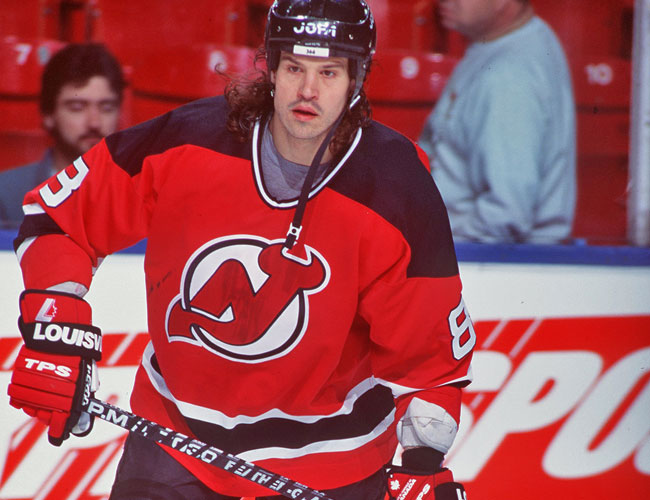
One of the most defining moments in the Stanley Cup final game of 1995 was a big tough guy sitting on the New Jersey Devils bench weeping. The tears just came pouring out of him uncontrollably as he wept.
He wasn’t crying because the Devils were losing. He was crying because he was thinking at that moment that the original New Jersey Devils, Ken Daneyko, Bruce Driver and John MacLean, were about to win their first Stanley Cup. This moment was the moment these original Devils had been waiting for and Mike Peluso was witnessing it firsthand.
To him, it was the most beautiful moment he had ever experienced. He wasn’t thinking about how his team was winning the Stanley Cup in that moment. He was thinking about the original Devils winning their very first Stanley Cup. He became so overcome with emotion, he couldn’t leave the bench.
Before that moment on that bench in 1995 when Peluso’s emotional outburst of tears made Devils history, he was just a kid growing up in Minnesota…never believing that he would one day be sitting on the bench crying his heart out watching the New Jersey Devils win their first Stanley Cup.
He didn’t grow up watching NHL moments on television. He wasn’t like most kids that grew up idolizing certain NHL stars. He grew up idolizing his older brother, Gino.
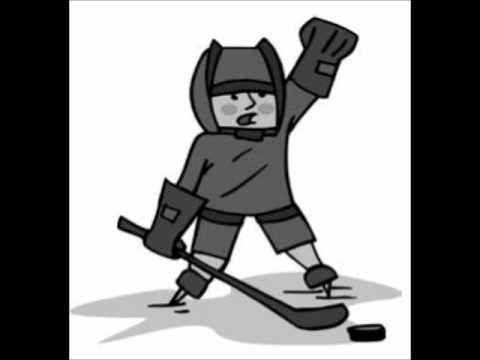
“He was not a good skater like Niedermayer, but he was gifted,” Peluso said of his older brother. “I looked up to him at the start. In Northern Minnesota, we only got three channels, so we didn’t get the game. Once in a while on Sundays, we got the Flyers game. Bob Kelly did the games. I don’t know if you remember Peter Puck. He’d come in with his cartoon.”
It was Peter Puck that he said was his favorite. That’s as close as it came to what made him fall in love with the game as far as stars were concerned. When it came down to an actual person, he responded, “Doug Wilson for me and my brother. I didn’t get a lot of channels.”
This was also the 1960’s and early 1970’s. Cable and satellite TV didn’t rule evenings at home. Out in northern Minnesota, life was really about the community.
“We didn’t have cable TV. I don’t want to sound like a hardship case. We only got three channels. Every once in a while we got Channel 8 out of Midgie, and that was Sesame Street. We did get on Sunday Bob Kelly. We got the Flyers game and Peter Puck and that’s when I watched some games on TV.
He watched his first hockey game in the late 70s. Possibly some time between 1976-78.
“Bob Kelly was actually announcing and then they’d have the Peter Puck guy come out on the ice.”
“We had college hockey and high school hockey. We followed that. There wasn’t really that much pro-hockey until the Stanley Cup. With 3 channels, hockey really wasn’t a big sport. We followed the North Stars. I’ve been a big North Stars fan my whole life. I’d go down once and a while. My Dad would take me to Met Center and watch the North Stars play. But it was mainly college hockey that I followed.
“Minnesota is kind of environmental. Everyone is kind of raised on skates, snow and ice so everybody plays hockey. We had a lot of outdoor rinks. All of the northern Minnesota’s little small towns had big ice rinks, so it’s kind of environmental where you grow up. People are born with skates on their [feet] so that’s how it all began there.”
“I started when I was about five,” he said of his early hockey beginnings. “I was a short, fat kid. I liked playing in my boots because I was always better in my boots, but then guys got a little quicker so I switched to skates.”
“We had youth programs…house league programs. I think it’s just Minnesota. You’re just born in the environment of hockey. It’s just part of your life.”
“We all played [hockey],” Peluso said of his family. “Dad was real supportive. We had mite hockey, pee wee hockey. The parents are just very influential. First of all, putting equipment on you and then hockey is somewhat like Canada in Northern Minnesota…the environment, the cold weather and the ice rinks…it’s just part of life. It’s part of what we are. Everybody plays.”
Peluso always looked up to his brother as a hockey player. His brother had a lot of talent. So why didn’t he end up playing in the NHL?
“My brother Gino, he was a really good hockey player. I think he just had a lot of scholarships, but he just maybe perhaps chose the wrong school. He went to the University of Minnesota and never really played. Then he just went four years and then he played a little bit, but not as much as they promised him. So he just really didn’t develop. The fact [is] he didn’t get the chance to play.”
Peluso ended up going to the University of Alaska.
“It was the only scholarship I ever had. In Northern Minnesota, if you didn’t get a hockey scholarship, you just went into the mining company and worked, because the mining company is booming.”
“I don’t want to sound like a hardship case here, and I’m not. My parents couldn’t afford college. But that was our goal…to get a scholarship. My brother got a scholarship in baseball. My brother Gino got a scholarship in hockey. I got a scholarship at the University of Alaska. But it was the only scholarship offer I had so I took it.”
Like many players, Peluso didn’t always start off on offense. He started his hockey career playing in a different position.
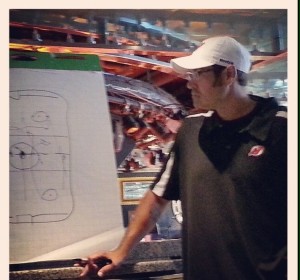
Photo: Michelle Kenneth
“In college, I was a defenseman. I had some really good offensive numbers in college. When the Blackhawks signed me, they started going around me, so they threw me on the left wing. It’s like right field in baseball. They put me on left wing because I didn’t have the footwork.”
After his time in college, he ended up going to play in Chicago for their minor league team.
“I just actually quit playing,” he said after he left college. “I just didn’t think I would ever make it. My Dad asked me if I would just tryout for a team. I tried out for the Blackhawks and had a good training camp. I was making $100 an exhibition game. I got into the lineup and had a good training camp. I ran their first run draft pick and then I got noticed.
“[Mike] Keenan called me into his office and he said, ‘Who are you and where did you come from?’
“And I said, ‘I played at the University of Alaska.’
“He says, ‘Do you know how close you are to making the Chicago Blackhawks?’
“I said, ‘No, I don’t.’
“He says, ‘Well, I’m going to give you a three-year contract in the minors and a one-way contract if [you] make it up.’
“I played every exhibition game. I think what set me aside was…I didn’t know if anybody fought. I thought everybody fought. Steve Thomas got cross-checked against St. Louis. I just reacted. I just said ‘Fuck it. We’re down 5-2.’
“It’s not who I am. I wasn’t trying to make the team, so I went over and fought him. And that’s when it kind of hit me that’s what I was supposed to do. Then the next night, I beat the shit out of Kelly Chase. I was fighting everybody. I didn’t even realize what I was doing. I was just reacting to who I am. Then the next thing…I got a contract.”
Peluso didn’t fight to win a contract. That wasn’t his motive.
“I never did anything to get a contract. I just did it out of instinct.”
“I started off on defense and then they started going around me…my footwork…so Keenan moved me to left wing. He wanted to find a place for me. It’s like right field in baseball!
“I remember when I was playing on defense, Keenan says, ‘Peluso, get up here.’ He put me on [Jeremy] Roenick and [Steve] Larmer’s line. We were in Buffalo. They dumped the puck in, I ran someone over and that’s how I became a left winger.
“I certainly wasn’t going to become a defenseman in the National Hockey League. I thought I had quick feet in college. But oh my god, guys started going around me. They wanted to find a place for me but it wasn’t defense.”
By moving him over to the left wing he said it was “less responsibility.”
“I could forecheck. I could hit. I don’t have to worry about playing defense in the National Hockey League. It’s very difficult. You can’t run out of position. You have to have good angles, good footwork. Playing defense in the National Hockey League I believe is harder than playing goalie.
“All I had to do was get the puck in. Because you make a mistake on defense…it’s trouble, because you are the last man back.”
Peluso’s first year as a left winger netted him over 320 minutes in the penalty box. The following year, it was 408 minutes.
“Well, I got my ass kicked a lot in the minors. I remember my first game was against Salt Lake City. It was Calgary’s farm team. Rick Hayward was supposed to be the big tough guy. He lined up on a draw with me and he says, ‘Hey, college boy.’ I say, ‘Oh, fuck.’
“I actually kicked the shit out of him. Now, I’m a marked man. Then I got my ass kicked after that.
“Butch Cassidy came up to me and said (as he brought my gloves and my stick to the penalty box), ‘You just kicked the shit out of the toughest guy in the league.’ He says, ‘Oh my god!’ I said, ‘I don’t think I can keep doing this.’
“That was my role and I had tough coaches. Sometimes I just wanted to quit hockey, but I stuck it out.”
After Chicago, he headed off to Ottawa during the expansion, where the fans fell in love with him.
“I went from fourth line to third line to second line. Even though we didn’t win a lot of games, I moved up. It’s gratifying to be able to have more of a role than just that role [of enforcer]. I think everybody wants to do that. I scored 15 [goals]. I just got more of a responsibility.
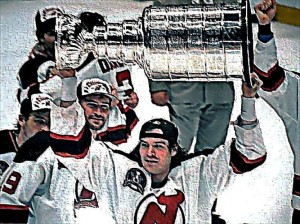
Photo: juniorhockey.com
“I think if expansion hadn’t come in, I would have been out of the league. But expansion came into the league and I was able to continue my career and take on more of a role. I think if Ottawa and Tampa hadn’t come in, I probably would have been done after five years. That’s just the way it worked. But expansion continued my career, so I owe a lot to Ottawa. Our +/- wasn’t very good. Someone said that our +/- was like the climates of the Northwest Territory in December.
“I want to be a plus player. I have always been a plus player, but after Ottawa, I never could work my way out of the hole. It took me ten years to get it to +19. I take it personal when I’m on the ice when there’s a goal scored. The people don’t look at the scores or how many goals they scored, they look at that +/-.”
Peluso was originally drafted by the New Jersey Devils in 1985. Even though they drafted him, they never gave him a contract. But after watching his success in both Chicago and Ottawa, they traded for him.
Peluso spent most of his career bringing his A-game against New Jersey because they didn’t sign him back in 1985. He fought the Devils. He did things to get under their skin. When they traded for him, he realized that he would be facing these guys in the locker room.
“I was really nervous,” he said of going to New Jersey. “I had pains in my stomach when they made the trade. I’ve had a lot of battles against them. I think Lou [Lamoriello] always wanted a guy who could fight but could also play. It was nerve wracking. I always dreaded going to training camp that year because I was just really nervous.
“Then Ken Daneyko and Randy McKay pulled me to the side and said ‘We’re glad to have you on board.’ I kind of loosened up. Then I got relaxed and I was on a line with Randy and Bobby Holik.”
Daneyko said that when the Devils used to go down into the Flyers territory for a game, you could hear a pin drop on the bus. Everyone was always scared of playing the Broad Street Bullies back then. For Peluso, playing for Ottawa was the same feeling.
“Not that it didn’t bother me. Now, I’m coming to a team who wins and is established with a great group of guys and Jacques Lemaire. I played my best years while I was with New Jersey.”
Lemaire has been one of the most amazing coaches in the history of hockey. He has Stanley Cup rings to prove it.
“Jacques never screamed or hollered so it was nice. I’d always had coaches that screamed and hollered ‘go out there, you know what your job is don’t you?’ I got the fucking tap on the shoulder from Keenan many nights. He kicked me in the back in Chicago and he says, ‘What have you done all night?’ I says, ‘Well, fuck, I haven’t been out on the ice. What am I supposed to do?’ So he says, ‘Get out there.'”
“I’ve always been accustomed to guys that were in your face. Jacques wasn’t. He actually made hockey fun, positive and beautiful. I’ve always had screamers. I’ve had guys that kicked me in the back. And I didn’t mind that. But to get Jacques…”
“Jacques called me when I got to New Jersey. ‘Didn’t you play center in Ottawa?” I said, “Oh, hell yeah!” I didn’t play center! You never tell a coach anything like I hadn’t played a position. I said, “Yeah, I played defense. I played center and I did a little goalie too!”
“As a player, three things that stand out in my career is playing in the Chicago Stadium. I mean, that rink was incredible. The Stanley Cup in New Jersey was #1. Playing in the Chicago Stadium and then being an Ottawa Senator, because if it wasn’t for the Ottawa Senators in their expansion year, my career probably would have been shortened. The Chicago Stadium is not even close to the Stanley Cup, but it was important.”
Summing up his time with the Devils, Peluso said that it was the best time of his career.
“The best group of guys I ever played with. I thought I had a great group of guys in Chicago. It didn’t compare to the ’95 Devils. A lot of fun. Some cocktails.”
“It’s nice to get paid good money for something you love…and that’s the ’95 team.”
Other great memories he shared all lie with his first goal. You never forget your first goal.
“I do remember my first goal in Detroit. I batted in a fucking rebound from Troy Murray. It was funny because Michel Goulet took me out for some beers, and he’s a 500-goal scorer and he says, ‘I really don’t remember all the ones that were in between, I only remember my first one and my 500th.’ He says, ‘You’re not going to get to 500, but let’s have a drink to the first one!'”
After his tenure with the Devils, Peluso headed out to St. Louis, where he said he enjoyed his time.
“Keenan had traded for me. The year was good. We had a really good team on paper, but we had this conflict between Brett Hull and Mike Keenan. Either Brett Hull was going to be traded or Mike Keenan was going to get fired. We had a really great team. They were going back and forth. We were good on paper, but the chemistry wasn’t there.”
“There was always this feud in the paper between Mike Keenan and Brett Hull. Something had to give.”
Keenan was the one to go.
As Peluso continued to go from one team to the next after his stint with New Jersey, he says he started to lose his edge, especially while he was in Calgary.
“Jersey is where it all started,” he said of his best years playing hockey.
Peluso was injured when he was hit from behind during a game in Carolina while he was with the Flames. When he returned to Calgary, he discovered some stiffness in his neck. They took an MRI of his neck and then told him his neck was really bad. The injury was very similar to Gary Roberts’ injury.
Peluso joked that you fuse the 50-goal scorer’s neck, not the fourth liner. You send the fourth liner to the glue factory (Ken Daneyko joked). That injury ended his playing career.
Later, he ended up working as a scout for the Edmonton Oilers, while returning to his home in Minnesota.


 Prev
Prev