Teams around the AHL are no strangers to supporting different charitable causes. Many, if not all, do a couple jersey auctions throughout the season to benefit various charities. They understand it’s important to give back. But teams are getting more and more involved. Sometimes the initiatives come from the players themselves.
Today, the Texas Stars, AHL affiliate of the Dallas Stars, announced a new program initiated by goaltender Cristopher Nilstorp. The program is called “Torp’s Tots” and the focus is to benefit children with serious illness. Nilstorp, a native of Malmo, Sweden, is in his second year with Texas and wanted to do something positive.
After the start of the season, he approached team officials with an idea. He wanted kids suffering from a serious illness to be able to come out and take in some hockey. So, he personally purchased four 24-game partial season tickets. For 24 of the remaining 33 games, Nilstorp will use the tickets to bring out kids and their families.
“First of all, it’s very painful for me to see any children dealing with a serious illness,” said Nilstorp in a Texas Stars press release. “I think if we can get some of these kids to our games and give them some good experiences, maybe put some smiles on their faces, it will mean a lot for me and my teammates. I had a friend whose little brother died at an early age. That has given me energy and I hope we can give these kids some energy to continue to fight for their health.”
Hopefully bringing these kids and their families out to a Texas Stars game will give them a break from the stress and let them just be kids. Sometimes something like this is all it takes to make a positive change. It’s great to see the team supporting a program such as this one.
There will be three main recipients for the tickets: children and their families who are associated with Muscular Dystrophy Association, Ronald McDonald House Charities of Austin & Central Texas and R.O.C.K., Ride On Center for Kids. The tickets could also go to local hospitals treating kids with other series illnesses. The first game will be tomorrow night, November 8th, as the Stars host the Milwaukee Admirals.
After 16 days on the road, the Ducks came home to 14,045 fans that welcomed them back from their eight-game road trip; rested and eager to take on the Coyotes, and former Duck Kyle Chipchura, on home ice. They entered the game as the league’s only remaining team undefeated at home.
“It ended up pretty good,” said head coach Bruce Boudreau, regarding the team’s road trip. “We were a little worried when you start the trip off 0-2 and you’ve got six more games. I think it says a lot about the character of the group. The Ottawa game was very tough, and we hung in and we just kept getting better and better after that. And then you start to believe you can win, and then they do.
It was also the return of favorite Teemu Selanne, the league’s oldest active player, who missed the previous 3 games due to a mouth injury. He skated back on the ice with four less teeth than he had prior to October 29th when he took a high stick to the kisser from Philadelphia defenseman Luke Schenn. He was expected to be out 2 weeks after having oral surgery that required 40 stitches, but returned much sooner than expected.
“I was lucky,” said Selanne on his recovery at Tuesday practice. “All of the four teeth I lost were fake ones. I already have all new ones. I was very lucky. My mouth guard really saved me in this case. I’m feeling good now. I’ve been skating a couple days, and today was the third day already. I’m anxious to get back.”
Rookie defenseman Hampus Lindholm scored his first NHL goal with a wrist shot that eluded Phoenix Goalie Mike Smith. Lindholm was the 6th pick of the 2012 draft, and pulled off his first with his Dad in the crowd. And as if your first NHL goal isn’t enough, he assisted on the game-winning goal late in the second.
“It’s nice to see anybody get their first goal, “said Coach Bruce Boudreau. “He was jumping up into the play which is what we’ve been trying to get the D to do, to get more offense from them. So, him doing that and getting that first goal is always pretty nice for a coach to see.”
Anaheim’s seven game streak of at least a point (6-0-1) is the longest current streak in the NHL and has landed them in the top spot in the Pacific Division, the Western Conference and the league with a 13-3-1 record. This win broke the Coyotes five-game winning streak and they are now 0-2 this season against the Ducks. They will face each other 3 more times this season.
The Ducks look ahead to their rematch against the Sabres tomorrow at 7:00 PM and hope to have another 7 game winning streak under their belts.
I have played wheelchair hockey for over 20 years, I also played on a team that was a step above a beer league team. I love playing wheelchair hockey and always have – I love the competitiveness of the sport. Within those 20 years I have played this sport – I have seen this sport change from a possible Paralympic Sport to a recreation sport. I have also seen equipment changes which made sense … now. I also seen players grow and excel in this sport, then go on to start an entirely new sport.
Let’s talk about the changing of the equipment for a while: helmets with full cages are now a must have to play. That change makes a lot of sense because of the hockey ball and some sticks get too high not intentionally. I fully agree with that equipment change for safety issues and such. Another change was the ball – it went from a tennis ball to an orange hockey ball. The orange hockey ball doesn’t hurt as much as the tennis ball used to. Changing of sticks I don’t agree with – because it doesn’t make sense what so ever. Because type of sticks is a player preference and a player shouldn’t be asked to change because of the organization or group. The last but not least equipment change we must discuss is for all goalies. Goalies need a little more gear than any other players – even in wheelchair hockey the goalies need the protection.
The goalies have to spend more money on gear and that’s one change I wish they would consider making a must. Because stopping tennis balls was difficult enough at least with gear it would have been a little easier. And now with the change to a hockey ball – the goalies do need equipment. Equipment that works for them and for them only – their equipment can be small so they can move. The goalies can have large equipment so they don’t have to move. Goalie equipment should be made a must have to any wheelchair goalie for their own protection. Any goalie who said they don’t need the proper safety gear is dead wrong and shouldn’t be playing. The goalies that play wheelchair hockey are very lucky the shots aren’t that fast – regardless of the rumors.
The last thing is the rules and regulations or should I say the lack of – the sport of wheelchair hockey is the only sport without a definite set of rules and regulations. The sport needs to change or somebody might get seriously hurt. This sport had rules and regulations back in the day – there wasn’t much at least there was something. Having a brand new set of rules and regulations this sport just might survive. I would love to see this sport grow again to Paralympic quality.
In part two of the Throwback Thursday series featuring Ken Daneyko, he shares his Growing Up Hockey story. This story defines why he is called Mr. Devil.
“I was born in Windsor, Ontario,” Daneyko said as he began his tale. “But I grew up in Edmonton, Alberta. [We] left when I was six and a half years old to Edmonton. In Windsor, my dad would freeze the backyard and we would start skating. My first experience as a four year old, I got on skates and went head first on the ice…stitches in my head, so I didn’t have a very promising career starting off as a player.
“I still have a little scar to this day right on my forehead. My mom was like, ‘Oh my God, I know everybody plays hockey in Canada, but if this is the way it’s going to be….’ She hated blood and panicked.
“My dad, born in Germany, never knew [anything] about hockey. My dad was a soccer guy. But when it came to Canada, he knew he had a lot to learn about hockey. He didn’t speak English until he came to Canada. But he made ice in the backyard, which would freeze over all the holes….we were very blue collar. He was just trying to make his way over in Canada coming over from Germany, so it was a lot to give us a little place to skate. I had an older brother who played hockey as well.
“My parents were just supportive. They never pushed. They just saw they had a kid that was a fanatic. I told them many times. I told my mother since I was seven years old every day, fifty times a day, I was going to play in the National Hockey League.
“As much as I was a blue collar type player and a hard worker in the trenches of the National Hockey League, I was pretty good growing up. I was pretty talented like a lot of kids in the NHL. I was offensive when I was young. I was ranked the best defenseman in Edmonton when I was 14 years old and in offense too.
“I look back. I reflect now. Sometimes I think, ‘Wow, I was a fanatic.’ I wanted to play so darn bad and nobody was going to tell me differently. I had a lot of self doubt. Believe me. There were kids better. There were 10 Ken Daneykos in every corner. That was true in Edmonton.
“My dad worked for the Canadian Airlines and worked for the airlines for 30 years. It became Air Canada and now it’s Canadian all in one. He came from Germany at a young age on his own to Canada. He started off in baggage for CP Air, up on to supervisor. That’s what he did his whole life right up until retirement. We got some good deals on flights on stand-by.
“But I’ll never forget, even though I was a Toronto Maple Leaf fan growing up, we were growing up in Windsor, my first six my years, my dad…the Canadiens would always come through Windsor to go to Detroit or coming back to go to Montreal…he’d get me John Ferguson’s stick…or Richard’s stuff…and I’m so mad I used them as road hockey sticks. I never thought I’d collect them back then. But it was pretty special. I’d wake up in the morning and I’d see a real game stick that John Ferguson [used]. It was pretty cool early on in my early years.
“I used them as road hockey and on the ice up until they widdled away to a little sliver and I regret that now because I have such a deep perspective of players before me. I’d love to have those sticks now. But yeah, that was my dad’s way of showing me that even though he didn’t know a whole lot about hockey that he knew how much I loved it. I was sitting in my room like I was a kid at Christmas every time.”
Going back to his years in minor hockey ranked as one of the top defensemen in Edmonton at 14, he was playing in the Bantam As.
“I still always underestimated myself,” he said of his younger years. “Everybody was telling me I was pretty good. I had the determination and drive. I had that fear of failing all of the time.
“I went right from Bantam and I thought I was going to stay in Edmonton and play midget hockey. You get put on a protected list of tier-1 for junior teams and there’s no draft or anything. The Ontario League might have done it. In the Western League, you were put on a protected list. The Great Falls Americans, who lasted all of half a season, had me on their protected list. I always wanted to be on the Portland Winterhawks, that was the big team and somehow they missed me.
“That put me back the same, maybe I’m not that good, because the Winterhawks always got the best Edmonton kids. Always did. Well, what about me? I was ranked. Somehow Great Falls got me. They thought I was ready to go play tier-2 junior. They asked me to skip midget.
“Whatever it took for me to advance, there was no thought process. You think it through. They think it’s going to help me. It’s the next best thing for me…I’m going to listen. But my mom didn’t want me going. She just wouldn’t even hear my grumblings. I told my dad, ‘There’s no way she’s going to let me go.’
“He took me to meet the coach, who drove to Edmonton to pick me up, Jerry Bolt. I’ll never forget it. My dad said, ‘Don’t say goodbye to your mom because I know she’s going to not let you go.’
“He said, ‘You go ahead. If this is what you want, son, for your life.’ My dad was very quiet, and a stern German man like the Eastern European guys. He said, ‘Son, if this is what you want to do with your life. If you think this is a stepping stone, even at 14, I’m going to trust your judgment.’ That’s the way they did it back then.
“I said, ‘Dad, this is what I want to do.’ He says, ‘Don’t worry, I’m going to take care of your mom.’
“That was a great learning year for me. I went to Yorktown. I was one of two 15 year olds in Saskatchewan hockey league playing 17, 18 and 19 year olds. It was scary at times. It was a tough, nasty league, but a great part of my development. I lived with a great family there. I played every game that year and survived it somehow. I know we had 77 players. Players went home all the time because it was nasty, too tough. Guys get homesick and say ‘forget it, I’m not going to play in this league.’
“I played only one year in tier-2. I went to Great Falls. I moved to Spokane. Played for Spokane Flyers. Played for the Western League, again another step getting closer. That’s all I cared about…those steps to get there.
“I played in Spokane as a 16 year old. First year in tier-1 in the Western Hockey League. As a 17 year old, which is my draft year, because I was going to turn 18 that summer, I played half a year up until Christmas and the Spokane Flyers folded.
“I ended up going to the Seattle Breakers. That was the second half of the year.”
“You get more notice on good teams like the Winterhawks. The Winterhawks were always getting scouted…I was always pissed thinking I’m not getting enough recognition.
“But I went to Seattle and we were kind of a lunch pail crew like our Devils. We made the playoffs. We weren’t supposed to.”
This was the time when then Devils scout Bert Marshall discovered Daneyko and followed his team around for the last month of the season and during the playoffs in his Winnebago. He was the man responsible for putting his career on the line and telling the Devils to pick Daneyko in the Draft.
The Devils didn’t want to draft Daneyko. He was essentially an unknown. He wasn’t ranked.
At the time, there were 21 teams in the league. The Devils had the 8th and 18th pick. Marshall had to convince them to pick Daneyko.
“I saw Glen Sather about five years after I retired,” Daneyko said. “I knew Glen through Mark Messier. Mark was instrumental in my career. Through Mark, since I was 13 or 14 years old, I used to go to hockey schools of his dads. Mark always took a liking to me. He loved my heart and my drive, so I learned so much from him about leadership, about what it was going to take to play in the National Hockey League.”
“At 22, Mark had such leadership he wasn’t afraid to tell Slats at 21st overall pick, because they had won the Cup, he says, ‘I’m telling you, if this Ken Daneyko is there at 21, you’ve got to take him.’
“Sather said, ‘Thank God, the New Jersey Devils took you 18th, because I would have never lived it down, because I wouldn’t have taken you at 21st, because Mark would have killed me.’”
Both Messier and Marshall knew that Daneyko had the staying power to play 15+ years in the NHL. They both saw the drive in him to be a NHL player. It was a gamble for the Devils to pick Daneyko, but it paid off in the end so well that Marshall still scouts today for the Carolina Hurricanes.
“He told the New Jersey Devils, ‘He’s going to play 15 years. I’m telling you.’ And they’re rolling their eyes.”
He told Daneyko, ‘You outdid them. You played 20 for them. You outdid what I said to them. But I’m still scouting. We’re very grateful to each other.’
Messier is 4 or 5 years older than Daneyko and played an instrumental part in his learning years. They became great friends.
“I loved that I was going to New Jersey, because I knew they weren’t that good. I thought that gave me a better opportunity.”
He had a great training camp that first year. He played in all the exhibition games. They kept him on the first 10 games, but he never saw his first NHL game. They sent him back down to the minors.
“I was crushed. A lot of 18 years old want to go back and don’t think they’re ready. I had the opposite mentality. I was ready now. They weren’t very good. I felt like I could play. I wanted to play as soon as I could.”
The next year, at 19, he made the team and played in his first game at Madison Square Garden. They lost, but he had an assist in his first game. His mom was there at that first game.
“My mom was always glass half empty. She says, ‘Kenny, why do you always think to put all your eggs in one basket? It’s so tough to make the National Hockey League.’ She wanted to believe in me. She came to my first game. She flew to New York. She hated big cities. She’s a little petite lady and wanted to get back to Edmonton and the little outskirts we lived in. She flew back from New York and said, ‘I don’t care if that kid plays one more game. He told me every goddamn day he’s going to play in the National Hockey League…’ She couldn’t believe it. She was beside herself. ‘He really did it.’ She was kind of shocked.
“That was kind of cool.”
Daneyko has told the tale many times of how his third grade teacher called his mother to ask her to talk to him about not disturbing his classmates while they were doing their work. He would finish his work early and then tell the rest of his class that he was going to play in the National Hockey League when he grew up. His mother told the teacher not to tell him he couldn’t play in the NHL, not to crush his dream.
“My mom went back after New York, went back to the school to the same third grade teacher and Ms. Aldman said, ‘I know what you’re going to say. I remember it like it was yesterday. I’ll never deter another kid. Your son played last night. We’re so proud of him.’ Because everyone in Edmonton knows your business, especially for hockey.
“My dad was just proud. Very old school. What I respect…he trusted my thought process. He trusted what I was doing. He would always just support it. ‘Son, if you believe this is what you want to do, go ahead.’ No parent would have let their kid…I’ve got a 14 year old boy, an 18 year old girl…I wouldn’t dare let them go at 15.”
“That’s what I appreciate now,” he said of his father trusting him. “The little grin on his face told it all [after the first NHL game].”
Last season, both of Daneyko’s children sang the National Anthem at a Devils game. His son wasn’t that interested in playing hockey growing up. He was more interested in acting and singing.
“He is total opposite of me. I adore him. That’s what I learned from my dad. Whatever he’s passionate about, I support it. I don’t know a lot about [acting/singing], just like my dad didn’t know a lot about hockey at the time, so he never interfered. I don’t interfere. It’s kind of relatable because I know how tough that industry is to make it. He’s in the right area, but people that know a lot more than me tell me he’s got a ton of talent. He acts, sings and does all that. He’s been doing it since three and loves it.
“I just support him and it’s so unique to me.”
He felt bad when his son would go to the games and people would ask if he played hockey like his dad. For the longest time he told his dad to tell people he played hockey. He played sporadically. It just wasn’t his passion.
“I would do that for him and I’d always take him to the side and say, ‘Shane, it doesn’t matter. I want to reiterate I could care less.’ Some parents aren’t like that. Or athlete parents, guys would put that pressure on them too. But I was like, ‘Shane, I love what you do. It’s so unique to me and you’ve got a talent. I can’t carry a tune in a bucket or have the guts to go on stage at 14.’
“When he was 12 years old, he’s 14 now, I’ll never forget, at the Rock, fans came around and asked that same question. He goes, ‘Nope. I’m an actor and a singer and that’s what I love. I love coming to the games, but it’s just not my thing.’
“He became a little man, because he felt comfortable and confident. I was proud of him to say what he wanted to do.”
Daneyko realized during this interview that the way he supported his son was exactly the way his father supported him when he was a kid.
“I didn’t even realize it until I said it out loud,” Daneyko said laughing. “But I learned from my dad, make sure you’re just supportive in whatever they want to do. My dad didn’t know what the hell I was doing.”
Even though Mr. Daneyko didn’t know anything about hockey, he was there to see his son play in every game. He supported him. He never booed him or criticized him. He loved going to the games and watching him play. He always said ‘Good game,’ no matter what the outcome.
“My dad was the perfect medicine for me,” he said of the support. “I was hard enough on myself.”
As far as Daneyko’s favorite moments of being a New Jersey Devil, he says the key moment for him was being drafted by them. The second key moment was his first game at Madison Square Garden, becoming a Devil and making the NHL.
“One of the greatest moments was going through some lean years in ’88 and making the playoffs, and making the run we did. That was special. It was like winning the Cup.”
“I can’t believe we celebrated as much as we did just making the playoffs,” he said. “We were a young group. We didn’t know any better. We didn’t know how to react.”
“When you’re in it, you don’t feel it as much as when you’re out of it,” he said of the playoffs and winning the Stanley Cup.
“I know the fans in New Jersey. I feel like I kind of was that perfect fit in New Jersey. My personality…I fit like a glove. Fans love me. They love me to death. I’m grateful for that. I think they relate to me. I’m one of them. I’m just a regular guy that worked his tail off and wanted to play in New Jersey and wanted to be part of something that when we started from crap, when we were the Mickey Mouses, or we were the little brothers of New York…the afterthought, I wanted to be part of something. I think the fans appreciate that.”
At the end of his career, he knew when it was his last game.
“I knew that was it. I couldn’t wipe the smile off my face for weeks. I went around the ice about three times, banging on the glass, saying to all the fans I knew that this was the last time they were going to see me on the ice in a Devils uniform as far as being a player…unless it was alumni.
“I absorbed it. I really got to absorb it. That was as special as anything. The fans knew when I was banging on the glass. Everybody that I knew, knew this was it. What a run! 20 years. Three Cups. Played with great guys, great teammates. That’s what was all coming back to me.”
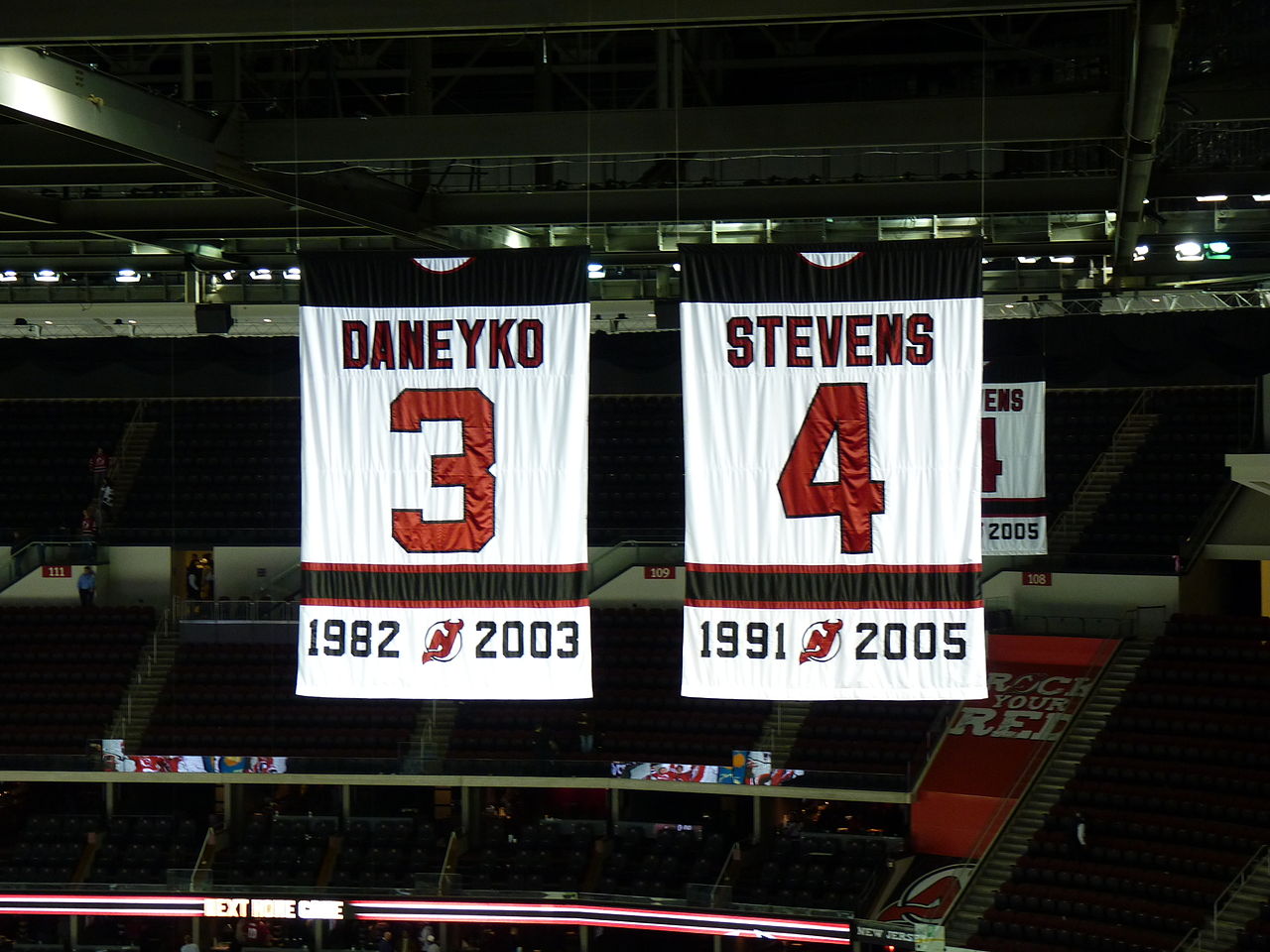
Three years later, the Devils retired his jersey.
“I was really humbled by that,” he said of those moments at the end of his career. “What it showed me was a blue collar guy…I’m not trying to sell myself short, I kind of served a pretty important role here, but I know I wasn’t Scott Niedermayer…I had a purpose and a role. You work hard.”
He said that this says something about the Devils organization for young players coming in. You don’t have to be a superstar to be honored. You just have to work hard and play your role. It is appreciated by the organization.
He says he still gets choked up when he thinks back to that night they honored him by retiring his jersey. 19,000 fans cheering for him…that was a special moment.
“I hung out with them all. I had a beer with them all, because that was me. That was my personality. I appreciated them.”
“I’m just a blue collar kid that didn’t know [where New Jersey was]…I wanted to play one game in the league and to play 20 years, 1283 games, and 175 more in the playoffs…it was…WOW. How the hell did I do that? Here in New Jersey.
“I wear the NJ proudly. You tell me anything negative about it and I’m gonna probably smack you.”
This describes perfectly why he became Mr. Devil.
“That just kind of happened.”
“How did I become Mr. Devil?” he asked himself. “I’m pretty proud of it.”
“I want the guys here to succeed,” he said of the Devils players. “They’re following in my footsteps.”
Daneyko is now a TV hockey analyst for the Devils, the NHL Network and MSG Networks. Being an analyst isn’t just about bringing his knowledge and experience of the game to the masses, it also allows him to learn more about the game…to be a constant student of the game. It’s something he enjoys doing.
Wrapping up their 2013 Stanley Cup Celebration Tour, members of the winning Chicago Blackhawks team traveled to Washington, D.C. Monday.
President Obama and staff honored the team with a partial tour of the White House and a presidential handshake (one that Patrick Kane was a little prematurely ready for.)
“Some of the guys were laughing at me because he was moving pretty quick down the line and I was next to Rocky Wirtz and he shook his hand pretty quick,” Kane said. “I put my hand out too quick while he was still talking to Rocky so my hand was out there waiting for him to shake my hand. It was a pretty funny moment.”
Then, the President shared some of his favorite moments of the run, from the streak, to the close calls, to the sentimental tales.
“Duncan Keith had an interesting first round. He scored a goal in game three. Then he flew home to Chicago to be with his wife for the birth of their son, Colton,” President Obama said. “Then he flew back to Minneapolis the same day, arrived two hours before the drop of the puck, helped lead the team to a win that put them up 3-1 in the series. And about six weeks later, Colton may have become the youngest person ever to be hoisted by the cup.
“That hadn’t happened before.”
Before making it to the White House, the team visited Walter Reed Hospital, spending time with wounded soldiers.
“Whether it’s here or back in Chicago, if we get to share the Stanley Cup with them for a little bit it always reminds you to keep your feet on the ground when people are asking you for your autograph and celebrating the championship you won, knowing that those people are really sacrificing for not only themselves and their families, but sacrificing their lives for the country,” Blackhawks captain Jonathan Toews said. “It puts everything into perspective. It’s a special thing for us to be able to do that.”
President Obama praised the team for their visit.
“This morning, the entire team paid a visit to our wounded warriors at Walter Reed, helping to raise the spirits of men and women who have sacrificed so much for this country,” he said. ” And when I had a chance to have some of our wounded warriors in the room with these guys beforehand, I said, ‘I love the Blackhawks, I love all my sports teams, but obviously our best team, our most important team are those folks who every day serve us in uniform and keep us free.’ So we really just are grateful to them.”
He mentioned Andrew Shaw auctioning his Game 6 stitches off for charity, raising $20,000 for the V Foundation to help cancer research. He commended Toews’ leadership on and off the ice. But he managed to make a few jokes, as well.
“These are not just good hockey players, they’re good guys and that helps explain why 2 million Chicago fans came out to Grant Park to celebrate bringing home the Cup,” President Obama said. “Speaking of Grant Park, we were originally going to let Corey Crawford say a few words today, but we thought we’d keep this family event family-friendly.”
(See Corey Crawford’s not-so-family-friendly victory rally speech here.)
As the players parted ways, several returning to their new teams.
This event is essentially the end of Stanley Cup celebratory ceremonies.
“We know this is a big part of our tradition and we look forward to that,” Toews said. “Everyone’s busy, especially guys who aren’t with us. But to be together as a team, for a second, and remember what we accomplished last year, and enjoy this day, it’s a lot of fun.”
“I guess you could say we’ve turned the page officially.”
And now they’re back in action, playing for another season.
After all, the President said he’d like to see them again. He also put a little pressure on the other Chicago sports teams, in case they happened to be listening.
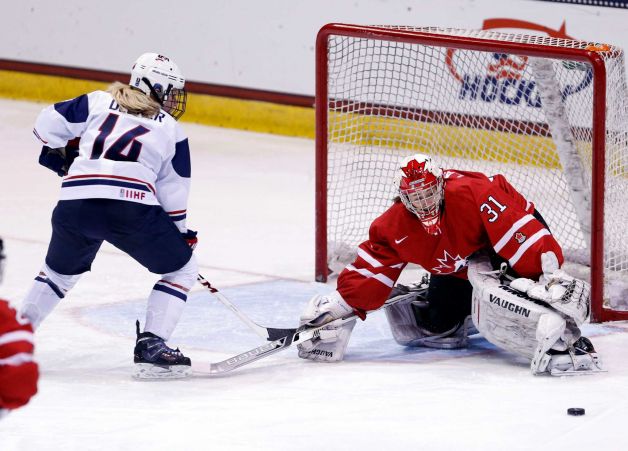
The U.S. Women’s National Team lost in heartbreaking fashion Wednesday night in Lake Placid. The United States and Canada were tied with only 3:30 left in the game when Natalie Spooner scored on a 5 on 3 power play. Canada would score an empty net goal to seal the deal in the last 12 seconds of the game.
“We give them more respect than we would like at times, and then it swirls into a game of hesitation for us and we have absolutely no reason to hesitate,” said head coach Katey Stone, “We’re a team that should go, and as soon as we all get on that same page, we’ll be in good shape.”
The tone after the game was disappointment about the loss along with a hope to bounce back in their next match against Finland.
“Our game is pressure and speed with the puck, and we weren’t able to do that consistently until the third period,” said Stone. “The last thing we want to do is come out dejected, because we played hard and we will find a way to build off this game.”
The United States is now 1-1-0-0 in the tournament, with a total of 3 points in the competition for a spot in the championship game. Canada commands 6 points with a 2-0-0-0 record but Team USA, thanks to their performance against Sweden, dominates the goal differential category. USA will face Finland, with whom they are tied in the standings at 3 points, on Friday at 7:00.
Canada has clinched their spot in Saturday’s championship game, as either the United States or Finland could only tie them with a regulation win. All eyes will be on the U.S.-Finland game to see who will join Canada in the race for the Four Nations Cup.
For more information on the Four Nations Cup, including schedules and tickets; please visit USA Hockey’s website here.
Also, be sure to follow the exciting action streaming live on usahockey.fasthockey.com and on twitter@USAHockey and @usahockeyscores with the hashtag #4NationsCup.
Track the U.S. Women’s National Team throughout its journey to Sochi by following @USAHockey on Twitter or by liking U.S. Women’s National Hockey Team on Facebook.
There are a lot of important roles on a hockey team. One such role that might get overlooked is the team’s captain. The captain is an important role, though, and one that helps create good chemistry on the team. He has to be someone that is a good role model and someone who can lead by example.
This season, veteran Aaron Johnson will be leading the way for Hartford Wolf Pack, the AHL affiliate for the New York Rangers. The 30 year old defenseman from Port Hawkesbury, NS signed a one year contract with the Rangers during the offseason. Being named captain in Hartford was not something he expected.
“I was really honored. It was kind of a surprise because I was new to the organization. It was a huge honor once the guys voted me in. I’m excited to get the chance to lead the way,” Johnson said. “This is the first team I’ve been captain for. I was assistant in Milwaukee and back in junior. So it means a lot.”
A big thing that Johnson brings to the table is experience. Since playing his first pro season in 2003-2004, he has played 265 regular season AHL games with 6 different teams and 291 regular season NHL games with 6 different teams. That wealth of knowledge gives him a unique perspective and the ability to help younger teammates.
“Obviously I know I’m an older guy and I’m an experienced guy. I thought there might be potential for me to be wearing an ‘A’ but they didn’t know me very well,” Johnson said. “Now that I’ve been here a little while, it meant a lot. You can kind of tell the guys look up to guys that have played in the NHL.”
Depending on the team, there might be a variety of qualities valued in a captain. The most important would be for him to be able to lead by example. He has to be able to show the other guys on the team what it takes to be successful.
“Work ethic is really important. I think I’ve always tried to be the hardest working guy out there,” Johnson said. “I try to lead by example in every situation. That’s something I take a lot of pride in.”
The AHL plays a 76 game season and that can be hard for rookies to adjust to. There are going to be good days and bad days. Johnson knows that keeping motivated can be difficult at times, especially for a younger guy. Throughout his time as a professional, he has seen a lot of ups and downs. He tries to bring that into the locker room.
“I have to try and bring that good work ethic day in and day out. It’s also important to try and stay positive. Those are two of the hardest things to do during a long season,” he said. “You have to work hard and stay positive even when you’re having a down day. I think those are two things I bring.”
Prior to the season starting, Johnson took part in camp with the Rangers, where he met a lot of the guys he’s playing with now. He must have made a good impression. Although he did not make it onto the Rangers roster, making a return to the NHL is not really something on his mind. The Rangers have gotten off to a rocky start, but that is not something that Johnson worries about.
“It really hasn’t been in my mind at all. I’m just looking forward to being (in Hartford) and playing a lot. I’m excited to help out the Wolf Pack right now,” Johnson said. “I know that there’s been some struggle (with the Rangers) but that kind of thing will take care of itself. We’ve got a lot of guys that can go up. It hasn’t really crossed my mind.”
Conversely, Hartford got off to a good start. After dropping their first game in a shootout, they went on to win their next five games. There has been a reasonable shuffle of players between the Rangers and Wolf Pack already, but it hasn’t seemed to slow them down much.
“We’re off to a good start. We’ve had some guys that have gone up and guys that have come back down. So, we have some talented players. I like the way it’s going so far,” Johnson said.
The biggest struggle for the Rangers has been at goaltender. Henrik Lundqvist who is usually stellar between the pipes has struggled a little bit and has already had an injury to deal with. On top of that, Martin Biron announced his retirement after starting the season. That has caused a shuffle of goalies through Hartford as well.
“It’s been tough. We’ve had 4 or 5 different guys coming in and out. To be honest, though, they’ve all done a great job and all played really well. It’s been easy to play in front of them,” Johnson said.
Hartford has had some fight filled games already this season and Johnson understands the importance of physicality. He has only dropped the gloves a couple times during his career, but he has been around long enough to see the value.
“I think that’s just part of the game of hockey. You have to be able to stand up for yourself and for your teammates in different situations. I think we have a lot of grit on our team with this,” Johnson said. “When a team has grit and talent, it can be a lethal mix. We hope it helps us.”
As a veteran player, Aaron Johnson does not have as difficult a time moving to new teams now as when he was younger. Each new team is a new opportunity to continue playing the game a player loves and he knows that well. It is a great perspective to have and likely helps make each new transition easier.
“Originally it was hard to switch to a new city with all new players just because you don’t know anyone. The more years you play, the more chance there is you know someone on your new team. It makes it a little easier to move to a new city,” he said. “At the end of the day everyone is there to play hockey and it’s such a small hockey world. It’s pretty easy to get to know the guys.”
Something similar can be said for your most memorable experiences. For young players, they always have similar favorite memories. As a player goes on in his career, the memories start to accumulate. Players get the chance to take part in playoff runs. Those can be invaluable and Johnson realizes that. Every player dreams of making a Stanley Cup run and ultimately winning the Cup. Johnson considers himself lucky to have witnessed some impressive playoff runs.
“At the start of your career your best memories are always your first game and your first goal. As you get older, it shifts to different memories. I was in the conference finals with Chicago a few years back and the Stanley Cup Final last year with Boston,” he said. “Those are moments that change a person’s career. You learn so much in May and June. I think those are moments that taught me the most.”
Even though being with the Bruins was not the most ideal situation, Johnson made the most of it. He was only able to get into 10 regular season games and did not make it into the playoffs at all. It seemed like with the injuries to defensemen that he might get to play during the playoffs. However, his last regular season game had been at the end of March and he had not been able to report to Providence without clearing waivers.
Even though he had to watch from the press box, Johnson will never forget the experience of Boston making it all the way to the Stanley Cup Finals. He got to see how the leaders for the Bruins handled themselves game in and game out all through the playoffs.
“The biggest takeaway was the way the guys were in the dressing room. Guys like Chara or Bergeron who have played in those situations really don’t overreact,” Johnson said. “They’re in the moment and don’t get over excited. I think that’s something I really learned.”
It might seem counterintuitive to keep from overreacting during the Stanley Cup Playoffs. After all, not every professional player gets to see the post season at all, much less gets the chance to see the Finals. Johnson knows that it’s important to have a certain level of excitement but you cannot very overexcited.
“It’s definitely hard to stay grounded and not get too caught up in the moment. It was new for me. I was in Chicago in the Conference Finals so I had kind of been in that situation but it was awhile ago,” Johnson said. “I think for a guy in that situation for his first or second time, it can be really exciting. The emotion can take over which is a good thing and a bad thing. You don’t want to get over excited but you want to play with that energy. You try to make it as positive as you can.”
This season, Johnson will look to impart some of the lessons that he’s learned on his teammates in Hartford. Although he says that getting a call-up is not a concern for him, it’ll be interesting to see if the veteran defenseman gets another shot at the NHL. He currently leads the team in points and assists. He is a hard worker, a good role model, and brings a lot to any team he plays for.
Goalies. Some people love them, others hate them, but it’s one player a team can’t live without. Goalies are different and while they have some equipment that mirrors their teammates, their gear has a flair all its own.
Pink Puck TV caught up with former Manchester Monarchs and current LA Kings goaltender Martin Jones to discuss what makes his gear unique. Jones has been a steady force in the crease for the AHL affiliate of the LA Kings and is off to his best (and the team’s best) start yet. Through his 11 starts so far this season, he has 8 wins and only 1 regulation loss.
The Bruins and the Stars have recent history, what may you ask? Boston traded away their “golden child”, Tyler Seguin for a more mature option in Loui Eriksson during free-agency in July. The much touted about blockbuster trade sent Seguin and Rich Peverely to Dallas, while Eriksson, Reilly Smith and Matt Fraser headed to Boston. The trade happened nearly 5 months ago, but still begs the question who made out better in the deal. With a long season still yet to be played, only time will tell. The two teams faced off for the first time since the trade Tuesday evening.
The game featured Seguin’s return to old stomping grounds, but it was also Eriksson’s first time facing off against the team that drafted him and gave him a home for his entire career prior to this season in Boston. Knowing the organization to an extent has its benefits, but each season differs and ultimately has little effect heading into a game.
“I don’t know that it really matter because you’re only talking about a small amount of guys that are on one side, one on the other. It’s more about the team concept and how you play with your team,” said Boston Head Coach Claude Julien prior to the game. “I think that’s more important than anything else. So there’s some knowledge there on both sides but we’ve made some changes with our system a little bit so it’s a little different and they’ve got a new coach so more than likely, I guess their game resembles a little bit more what we saw out of Buffalo last year with Lindy [Ruff] there.”
Dallas captain Jamie Benn opened the scoring just 3:38 into the first, ASST: Valeri Nichushkin (3), Jordie Benn (3). It was a short lived lead when Boston’s Torey Krug had a Tip-in – ASST: Reilly Smith (7), Carl Soderberg (4) at 4:16. A scoreless second period skated into the third where at 11:39, Milan Lucic (7) made it a 2-1 game with a wrist shot – ASST: Dougie Hamilton (2), David Krejci (12). But Dallas tied it up in the closing minutes of the third period, at 17:26 to be exact with an unassisted backhander from Vernon Fiddler (2), courtesy of a penalty shot.
The game went into a scoreless overtime and eventually a shootout, where it was won 3-2 by Dallas. While Patrice Bergeron managed to score in the 1st round, it just wasn’t enough. But it was former Bruins’ duo of Seguin and Peverley, perhaps trying to make a point to the city they once loved, that scored on Tuukka Rask.
“I don’t know, facing in practice it’s a different scenario,” said Bruins Rask regarding Seguin and Peverley. “You think know you know what they’re going to do and then they do something else. You knew they were going to score at some point though – that’s how it goes when you play against you’re old team, you find a way to score.”
Whether emotions played a part in the final score, it’s hard to say. But that doesn’t mean emotions didn’t play a roll to some degree.
“It did,” said Stars Peverley on his return to Boston. “I think I was more nervous for this game than I was for any of the Stanley Cup Finals. It was emotional for me, but it was fun to be here.”
Boston was once their home, but not a place that some members of the trade strive to get back to. With mixed emotions running high and noting that the game was special and marked on his calender, having the game in the books and notching the win is of greater importance.
“I have been asked that question a few times today,” said Stars Seguin on missing Boston. “If I got a contract or a trade to come back here or asked, I don’t think I would come back. I think in the end you want to play where you are wanted. I have great relationships with our coach and the GM here, and I know how much they want me. It feels good to play here. I guess that is all I want to say on that.”
The Bruins will welcome another familiar face to the Garden tomorrow night as Tim Thomas and his Panthers skate into town. While Dallas will face the Red Wings in Detroit.








 Prev
Prev