At only 32, David Poile felt he had paid his dues and was ready to take his career to the next level. On his fourth try in two years, he finally made the jump to NHL general manager. When he was hired on August 30, 1982, the Washington Capitals were also looking to break the mold by making the playoffs for the first time, in their ninth season.
Fresh out of Northeastern University in 1972, 22-year-old Poile landed the position of administrative assistant for the brand new expansion franchise, the Atlanta Flames. Five years later, he was promoted to assistant GM and moved with the franchise to Calgary in 1980. In his tenth year with the organization, one of Poile’s final tasks for the Flames was working to secure Denver as the location for their Central Hockey League affiliate (once the Colorado Rockies moved to New Jersey).
Although he was still under contract with the Flames, GM Cliff Fletcher gave him permission and recommendations to speak to other teams with GM openings. In late June 1982, the new owner of the Detroit Red Wings, Mike Ilitch, looked for a replacement for GM Jim Skinner. He brought Poile in for two days of interviews, but with five others being considered, Ilitch set a mid-July deadline for hiring someone. He explained, “I’m looking for a general manager but, in case I don’t get the one I want, I’m talking to a lot of coaches, too. If I don’t get exactly who I want, I might have to put a combination together.”
Poile’s chances looked good. He commented, “This is what I’ve been working for the last 10 years. Hockey is my life. I feel I’ve put in my time as an apprentice and, now, I’m ready to move up. I like the idea of going to Detroit. It’s an expansion team in a lot of ways. He (Ilitch) agrees with me that a lot of changes have to be made. And, the changes have to be the right changes, not just the ones that were made.”
However, on July 12, Ilitch hired Jim Devellano, assistant GM of the New York Islanders. As the press pointed out, Devellano would be dropping from the Stanley Cup winner to the second-worst team in the league. Devellano reassured them, “There will be some pain along the way, but I’m a very positive guy and think of myself as a winner.”
What disappointment Poile might have felt about missing out on the Red Wings did not last more than a month. By mid-August, the Washington Capitals acquired permission to speak with Poile about joining them as GM. They had joined the NHL in 1974 and wanted desperately to finally make the Stanley Cup playoffs. On top of that, the previous season had cost them $3 million. After some preliminary discussions with Poile, a final formality interview was scheduled for August 28.
By that point, owner Abe Pollin had fired interim GM Roger Crozier (who had replaced Max McNab), and the press had already been informed that the Caps considered Poile all but hired. The cautious Poile said that morning, “It isn’t done yet. But I’m hopeful it will be settled in an interview later today.” He continued, “Naturally, I’m looking for a multi-year deal, but I recognize this could be just one shot. I’ve been an assistant GM for 10 years and I feel I’ve been passed over by some clubs for people with less experience. I’m at the point where I have to take the chance when it comes along. If I find out I can’t handle it in two or three years, I won’t be too old to get into something else.”
On August 30, the Capitals held a press conference to officially make the announcement that Poile would be their GM. He told the audience, “I’m psyched up. The point about this job is that I’d never have taken it unless I thought the team could realistically make the playoffs this year. I want to make it work and I feel I can do the job.” Poile felt that job would be challenging, a “risky proposition.” According to the Calgary Herald, “Poile inherits a team that is solid up front, competent in goal and relatively weak on defence.” Poile explained, “It’s the Atlanta situation 10 years ago all over again. There are a lot of negatives. The owners want a competitive team right now that will make the playoffs and generate revenue.” To get the job done, he did not plan to ditch coach Bryan Murray. “Making a change right now could be the worst thing that ever happened to this franchise. This is an organization that has to be built up, not torn down.”
Meanwhile, back in Calgary, Fletcher gave Poile his full blessing. “David would do a hell of a job. I wouldn’t think of standing in his way. The Caps have their best chance of making the playoffs this year.” When asked about replacing him, Fletcher responded, “I know exactly what I’ll do. If it’s true David has been hired, we’ll have to make some moves later in the week. It is only two weeks until training camp, but I have no other comment right now.” As was predicted, on September 1, the Flames confirmed that former coach Al MacNeil would step into the role, which would be similar to a director of player development and scouting. Their director of public relations, Al Coates, would take over Poile’s administrative work.
As Washington’s GM, Poile wasted no time. As of September 9, he made a major trade with the Montreal Canadiens to acquire Hall-of-Fame and Norris-winning defenseman Rod Langway, who became known as the “Secretary of Defense.” Poile admitted, “It was the kind of deal I dreamed about making when I took the job here.” Under Poile’s management, the Caps made the playoffs every single postseason between 1983 and 1996. The following season, having missed a playoff berth for the first time since he was hired, Poile’s career in Washington was over. The team he had helped assemble went on to make the Stanley Cup Final for the first time in 1998. During Poile’s time in Washington, the Caps had a record of 561-414-123.
The timing of Poile’s firing could not have been better. He was immediately snapped up by the newest franchise, the Nashville Predators, and he has served them ever since.
Additional Sources:
Mike Commito, Hockey 365: Daily Stories from the Ice(Toronto: Dundurn, 2018), kindle edition.
“Poile named Caps’ GM,” Baltimore Sun, 31 Aug. 1982, p. B5.
“Flames eye Denver for farm team,” Calgary Herald,17 May 1982, p. C2.
Eric Duhatschek, “Wings keep Poile on hold,” Calgary Herald,2 July 1982, p. B11.
“Isles’ Devellano gets Wings’ job,” Calgary Herald,13 July 1982, p. C7.
Larry Wood, “Poile listening to Caps,” Calgary Herald,28 Aug. 1982, p. F1.
Eric Duhatschek, “A Capital game for persistent Poile,” Calgary Herald,30 Aug. 1982, p. F1.
Eric Duhatschek, “Reinhart will make a million,” Calgary Herald,2 Sept 1982, p. C1.
The first season of Behind the Glass was filmed last season and featured the New Jersey Devils. The show went over great with the fans, who got to see the behind the scenes of what goes into running an NHL training camp and preseason. It was a four-week series where the cameras followed around general manager Ray Shero and head coach John Hynes as they made final roster decisions, put the players through grueling workouts and tried to find a way to put together four solid lines and three defensive pairings. Behind the Glass gave fans access to the aspects of training camp that they would not have otherwise had like how hard choosing one player over another may be in the final roster decisions and the thought process behind it.
Behind the Glass: Philadelphia Flyers Training Camp will also be a four-part series that will give the fans some insight as to what exactly happens behind-the-scenes at training camp. The cameras will follow the team through training camp, preseason and the team’s opening game in Prague as part of the NHL’s Global Series. The series will shadow Flyers president of hockey operations and general manager Chuck Fletcher and head coach Alain Vigneault as they evaluate the players who will be in a battle for roster spots. The Flyers won’t have too many roster spots available, but there is an opening on the third line for a winger and that should be the most interesting battle during training camp and preseason.
The fans will also get a look into defenseman Shayne Gostisbehere, who will be looking to bouce back from an inconsistent and disappointing season last year. There will be some attention on the Flyers biggest offseason acquisition, Kevin Hayes, who looks to build off of his successful season last year. The series will also feature Carter Hart as he looks to solidify his position as the team’s number one goalie and will want to avoid the dreaded sophomore slump. The series will also feature Jakub Voracek as he returns to his home country of the Czech Republic in the NHL’s Global Series. The game will take place on Friday, October 4, 2019, against the Chicago Blackhawks.
The series should be an interesting one and it will give the fans a chance to become familiar with the prospects on the roster and see more of their favorite current players. There will be exclusive content and clips each episode that will be shared on the three partner’s social media platforms using #BehindTheGlass. The episodes will also re-air on Sportsnet and the NHL’s platform on YouTube, Facebook, and IGTV.
The first episode will premiere on Wednesday, September 25, at 8p.m. The second episode is set to be aired on Monday, September 30 at 8 p.m. The third episode will air on Monday, October 7 at 10 p.m. Fans should be aware of the start time for the third episode as it it starting two hours later. The fourth and final episode will be airing on Monday, October 14 at 8 p.m. All episodes will originally air on NHL Network.
It will be interesting to see exactly what goes on behind the scenes during training camp and the preseason, which is something that fans don’t often get to see.
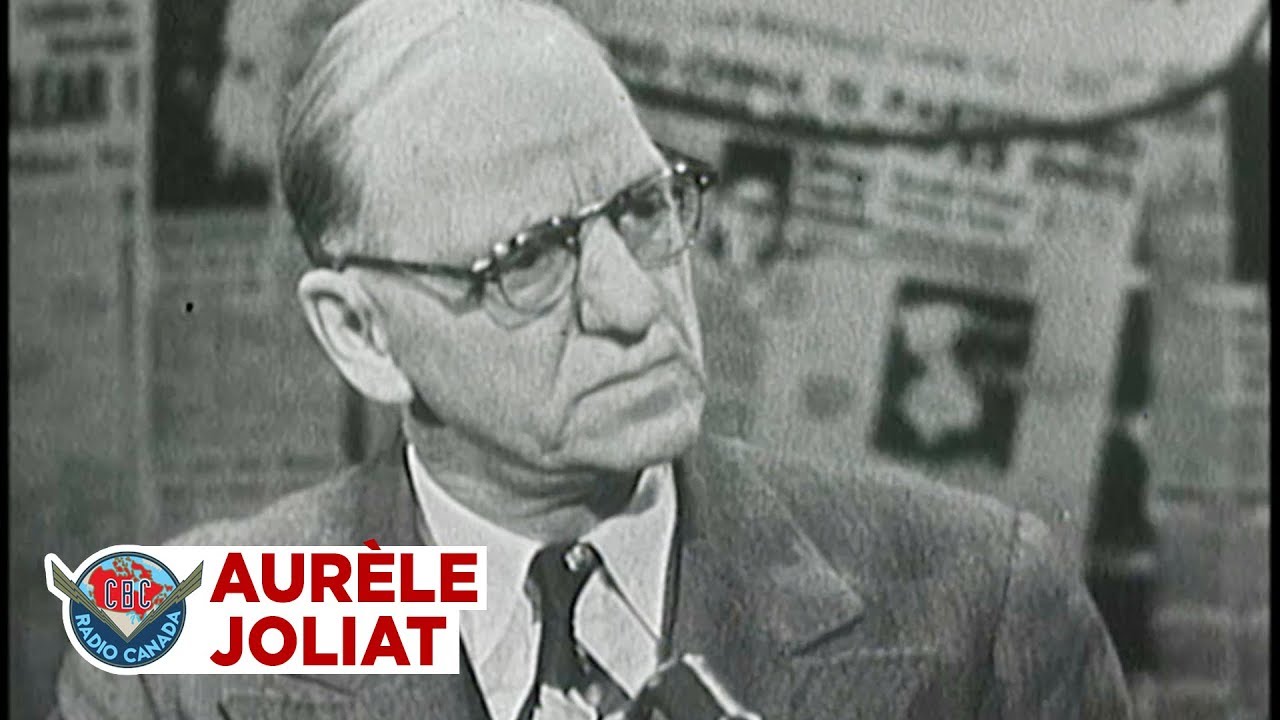
Aurèle Joliat, born in Ottawa, Ontario on August 29, 1901, grew up to just 5-foot-7 and about 136 pounds (making him one of the smallest skaters in the early NHL). However, the left wing never let his slight build stop him from facing challenges. When he fell off a roof and walked away as a teenager, he showed signs of how he would shake off bigger opponents once he played for the Montreal Canadiens. His refusal to back down despite his size earned him the nicknames “Mighty Atom” and “Little Giant.”
Between 1916 and 1920, Joliat played for the Ottawa New Edinburghs of the Ottawa City Hockey League. In his final year with the team, he lead the league in scoring. Moving on to the Iroquois Falls Papermakers in the Northern Ontario Senior Hockey Association, Joliat pulled off quite the con for the championship game. He accepted $500 to throw the game but instead scored six goals, snuck out, and ran away with the cash after the victory. As punishment for agreeing to the scam, he was suspended for the 1921-22 season. This carried over even when he tried to play for the Saskatoon Sheiks of the Western Canadian Hockey League.
Fortunately for Joliat, on September 18, 1922, the Sheiks traded him (and $3,500) to the Montreal Canadiens in return for the declining but still famous Newsy Lalonde. His 22 points in his first 24 games went a long way to soothing Habs fans unhappy about losing Lalonde.
The best was yet to come. Almost exactly a year after Joliat joined the Canadiens, center Howie Morenz signed with them. Paired together for the rest of their careers, the two became “one of the most potent scoring duos.” During a 1963 interview, Joliat said, “We must have been brothers. We both scored the same number of goals, 270 apiece, and Howie and I were partners for thirteen and a half years.” That first season together, they won the Stanley Cup (over the Calgary Tigers of the Western Canada Hockey League). At the end of the next, Joliat’s 30 goals and 42 points placed him second in the league. The duo won two more Stanley Cup championships together, in 1930 and 1931. Then in 1934, Joliat received the Hart Memorial Trophy as the NHL’s MVP. Unfortunately, within months, Morenz was traded.
For one final season, Joliat and Morenz were reunited in Montreal. Sadly, on January 28, 1937, Morenz’s devastating leg injury during a game led to his death on March 8. Joliat was never the same, and he only lasted one more season. According to the bitter Joliat, “Retired? Hell! The Canadiens fired me when the Montreal Maroons folded and some of their players moved over to the Canadiens!”
Still, Joliat ended his career with 270 goals, a record for the Canadiens at the time (until Maurice Richard) and still ninth for the franchise. His goals ranked him third (behind Nels Stewart and Morenz) in the NHL at his retirement. In addition, Joliat had 190 assists for 460 points and even 757 penalty minutes in 655 games.
Wearing a small black cap to hide his bald spot, Joliat had been a scoring sensation. He even potted the first documented empty-netter, on January 21, 1932. Joliat was so well known, in 1935 poet Wilson MacDonald wrote the silly poem “Monsieur Joliat” (in a mocking French accent). It began:
Boston she have good hockey team;
Dose Senators ess nice.
But Les Canadiens ees bes'
Dat ever skate de ice.

Morenz he go lak' one beeg storm;
Syl Mantha's strong and fat.
Dere all ver’ good, but none ees quite
So good as Joliat.
Among the other verses, the reader learns more about Joliat’s size, speed, and skills. One verse noted:
He's good on poke-heem-check, he is:
He's better on attack.
He run against beeg Conacher
And trow heem on hees back.
Then towards the end, MacDonald described watching a particular game.
Dat was a ver' exciting game:
De score eet was a tie;
An' den dat leetle Joliat
Get hanger een hees eye.

He tak' de poock at odder goal
An' skat heem down so fas'
De rest of players seem asleep
As he was going pas'.
After his playing days, Joliat saw firsthand the player who would surpass his goals record when he refereed Richard’s first game in 1942. Just five years later, in 1947, Joliat became the third Canadiens player inducted into the Hockey Hall of Fame. Still, it took until 1984 for the team to retire his No. 4, by then shared with superstar Jean Béliveau. Skating almost until the end of his life, Joliat died on June 2, 1986, just after the Canadiens won the Cup and a few months shy of his 85th birthday.
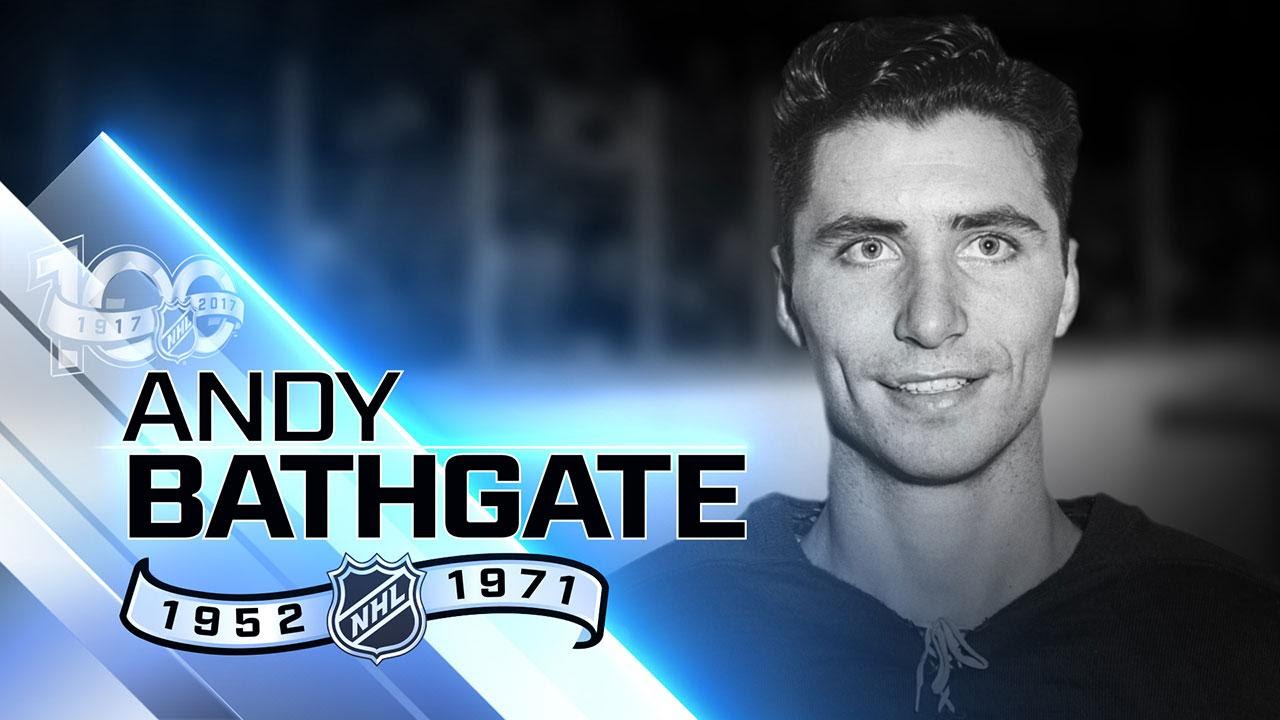
During the final decade of the Original Six era, wearing No. 9 meant more than just playing wing and really showed something about a players’ contributions to the team. The Boston Bruins had Johnny Bucyk, the Chicago Black Hawks had Bobby Hull, the Detroit Red Wings had Gordie Howe, the Montreal Canadiens had Maurice Richard, and the Toronto Maple Leafs had Dick Duff. For the New York Rangers, their No. 9 was Andy Bathgate, who was born at Winnipeg, Manitoba, August 28, 1932.
Perhaps it was simply meant to be as Bathgate began skating in organized hockey at age 9. He described his youth hockey experiences, “One winter, I played on eight different teams, and when I was 13, I coached the 12-year-olds.” Reaching the age of 17, Bathgate joined the Rangers’ junior affiliates, the Guelph Biltmores of the Ontario Hockey Association. He captained them to the 1952 Memorial Cup as he scored 216 points in 129 games.
That was enough for the Rangers to call Bathgate up early. He split time between the big leagues and minors until 1954. Despite an injury during juniors leading to a plate in his knee, Bathgate almost never missed a game. During his 12 seasons with the Rangers, he had perfect attendance during all but three of them. What’s more, he helped his team in every game he played, averaging over a point per game. Unsurprisingly, the Rangers made him their alternate captain in 1955 and captain in 1961, returning his team to the playoffs that year.
Unlike most of his rivals who wore No. 9, Bathgate has not been remembered to the same degree. Mostly, this had to do with the Rangers’ struggles throughout his time there. Bathgate usually gets remembered for three actions, which all occurred in 1959. In January, Bathgate became the first member of the Rangers to appear on the cover of Sports Illustrated, which called him hockey’s “most exciting player.” Another quote from the article noted, “Bathgate was making the best start of his short but dazzling career. He shot magnificently, skated with the puck so well that he stirred old-timers to memories of the great stick-handlers of bygone days and passed the puck with uncanny timing and aim.”
On November 1, his famously strong shot sent the puck right into Jacques Plante’s face, which required stitches and sparked Plante’s insistence on wearing a mask. The trend of goaltenders wearing masks stemmed from this shot.
About a month later, Bathgate authored the article “Atrocities on Ice” for True Magazine in which he condemned spearing because “unchecked brutality is going to kill somebody.” As he later explained, “I wrote this article and got fined for it. I got fined $1,000—and I was only making $18,000 at the time—so you take that, plus the $1,000 we had to pay into our pension, that’s a lot of money out of your pocket. They changed the rule at the end of the year but they still didn’t give me my $1,000 back. It burns my (butt) at times, but you have to stand up for it. Sometimes, you’ve got to speak up for the betterment of hockey because someone was going to get seriously hurt.”
As it turned out 1959 was also a good year for Bathgate as a player. During the 1958-59 season he became the first Ranger to score 40 goals and 88 points, which led him to beat out Howe for the Hart Trophy as League MVP. He had been a finalist for the award the previous two seasons. From 1955 until 1964, Bathgate always finished in the NHL’s top five scorers. He was more proud of how he ranked in the top four for assists throughout that entire time. He said, “I never thought I was a goal-scorer, but I thought I could make plays.” During the 1961-62 season, his 84 points tied Hull for the top scoring spot but missed the Art Ross Trophy because he told the NHL to take away credit for an assist that was not his and scored fewer goals than Hull. Bathgate followed that by setting a record in 1962-63 for scoring goals in ten consecutive games.
Despite Bathgate’s contributions, the Rangers usually did not even make the playoffs. Rumors swirled that he might be one of the changes management looked to make. Still, everyone including Bathgate was shocked on February 22, 1964. Before a game against Toronto, Bathgate had to abandon a steak to hear the news that he would be dressing for the opposing team. Television coverage included the announcement, “This is Win Elliot from Maple Leaf Gardens with the biggest news of the National Hockey League season: Andy Bathgate is now a member of the Toronto Maple Leafs.” Bathgate felt quite awkward about the trade. “I had been brought up as a Ranger, all the way from junior hockey . . . Even worse, I was an outsider who had taken the place of guys on the Leafs who were pretty close friends of those who were still on the club.”
Still, Bathgate ended up leading the Leafs back to the Stanley Cup Final, their third in a row. His goal in Game 6 led to an overtime win, forcing a Game 7, where he scored the Cup-winner (on a breakaway). Of his scoring success, Bathgate said, “I got on a line with Red Kelly and Frank Mahovlich, and Big Frank, I knew if I got him the puck, there was no one in the League who could stop him.” Again, Bathgate’s accomplishments did not save him. He suffered further knee injuries and had a rocky relationship with coach Punch Imlach, both of which led to a trade to Detroit on May 20, 1965.
For his two seasons in Detroit, Bathgate had to wear No. 21 (because of teammate Howe). Apparently, losing his number did not cause him to lose his scoring power. He set a record with five power play goals during the 1966 semifinals.
With the 1967 expansion, 34-year-old Bathgate (who had meant to retire) was drafted by the Pittsburgh Penguins. On October 11, he scored the franchise’s very first goal. He described, “It was a good, clean goal. It went far side low, but they didn’t have the equipment they use today!” A week later, he scored the franchise’s first hat trick. Unsurprisingly then, he finished the season as the top scorer playing for an expansion team. However, the Penguins did not want to keep Bathgate for another season. “They wanted me to retire during training camp the next year. I told them that I wouldn’t be retiring. I was going to play no matter what.”
Although they traded him to the Montreal Canadiens, the language barrier caused Bathgate to choose instead to play for the Vancouver Canucks of the Western Hockey League (WHL). During his two seasons there, the Canucks won the Lester Patrick Cup twice. His 108 points during the 1969-70 season led him to earn the George Leader Cup as the WHL’s top player.
At 38, Bathgate returned to the NHL for a final season with the Penguins. He ended his NHL career of 1,069 games with 973 points (349G, 624A). He spent a year in Switzerland playing for HC Ambri-Piotta. Then, during the 1974-75 season, Bathgate made a brief comeback. He played 11 games for the WHA Vancouver Blazers, who he had coached the season before.
The Rangers waited until February 22, 2009 (before a game against the Leafs) to retire Bathgate’s No. 9. They had retired the number almost a month earlier in honor of Adam Graves, who called Bathgate “the greatest Ranger to ever wear the No. 9.”
Bathgate had been inducted into the Hockey Hall of Fame in 1978, joining fellow-nines Richard and Howe. Bucyk, Hull, and Duff would follow so that every one of Bathgate’s contemporaries who wore the number became Hall-of-Famers.
A simple one-for-one trade took just three days to settle. It was only the second trade deal brokered by coach Alex Delvecchio, who had become GM for the Detroit Red Wings in May. On August 27, 1974, he sent the popular headband-wearing forward Henry Boucha to the Minnesota North Stars in return for veteran consistent-scoring forward Danny Grant. Delvecchio had said Boucha was untouchable even as Minnesota tried to retrieve their native son over the course of two years. When GM and coach Jack Gordon heard he was finally available, he jumped at the chance.
Detroit seemed to get the better end of the bargain. In Grant, they welcomed a 28-year-old, seven-year veteran. He had played enough games with the Montreal Canadiens to win the Stanley Cup in 1968. Acquired by the North Stars, he scored 34 goals during the 1968-69 season to earn himself the Calder Trophy as best rookie. During his six seasons in Minnesota, Grant scored 172 goals, averaging 29.4 goals per season. Even more consistent than his scoring was his attendance. By the time of the trade, he had not missed a game, tallying a 442-game streak, the second-best in active players.
At the time, Grant commented, “I’m sorry to be leaving my friends in Minnesota, but I’m happy to be going to a team I like. Actually, mid-way through last season I felt a trade would be good for me. I felt I was in a rut and needed a fresh start. Sometimes a change is as good as a rest, and I hope that’s the way it works out.” His old GM, Gordon, wished him well saying, “Danny will fit in with Detroit’s plans.” Obviously, Detroit’s GM agreed. “Really, we can use improvement at any position,” admitted Delvecchio. “But I think we’ve bettered our team with this deal. We’re a young team and we need somebody with experience to go along with the younger guys. Hopefully, Grant will be the answer.”
Grant’s first season in Detroit proved his worth. He scored a personal best (50G, 37A, 87P) working with Marcel Dionne. When Dionne was traded that summer, Grant took over as captain. Unfortunately, leg injuries kept him sidelined, and he never again played a full season. With his greatly-reduced role, he requested a trade. On January 9, 1978, he was sent to reunite with Dionne in Los Angeles. He finished his NHL career there with the 1978-79 season.
Meanwhile, Minnesota welcomed home 23-year-old Boucha (of Warroad, Minnesota). He had drawn fans’ attention by wearing a headband “emblematic of his part-Chippewa heritage” to hold back his long hair. He played for the U.S. during the 1972 Winter Olympics at Sapporo, Japan. Having been drafted 16th overall in 1971, he returned to Detroit. He set an NHL record scoring just six seconds after an opening faceoff. In his final season with Detroit, he scored 19 goals, with five of them being game-winners.
To most, it seemed that Boucha’ primary appeal to the North Stars was that he was local and could become a fan favorite there, giving the box office a boost. This was especially necessary in light of the rival WHA Minnesota Fighting Saints scooping up local stars. However, Gordon told the press, “I suppose that might help, but that’s not why we made the trade.” He explained, “Everyone seems to be saying we lost a scorer and gained a checker. But Henry has more ability than that. He scored 19 goals last season and missed many games due to injuries. He was used to kill penalties, too.” Gordon continued, “We hope to be more aggressive to cut down on our goals against. In addition, Henry can be moved around. He is a right-handed shot and can play right wing or center, but we’ll use him at left wing.”
Boucha was glad to be heading home, though he still felt shocked and rushed with the change. “I was supposed to go to Minnesota last spring, but that deal never materialized. Now, with the season almost here, I wasn’t anticipating a trade. I had mixed emotions, at first. I have a lot of friends here. And I have business interests, too, what with the hockey schools. But I’m happy to be going to the North Stars. It’s a good team and I hope I can help it.” The rush to get there in time for the first practice on September 16 would be worth it, he said, “Because I’m coming home.”
Sadly, Boucha did not have much of a chance to make an impact for the North Stars. On January 5, 1975, he and Boston Bruins wing Dave Forbes fought, sat seven-minute penalties, and Forbes came out of the box swinging his stick. Having fractured Boucha’s right eye socket, Forbes became the first pro athlete prosecuted in the U.S. for assault during a game. Though ruled a mistrial, he had already been suspended for ten games. For Boucha, the injury ended his career with the North Stars. He played for the WHA’s Fighting Saints for 36 games the following season. He then returned to the NHL playing 28 games with the Kansas City Scouts and relocating with them to Colorado, where he finished out his final nine NHL games in 1976.
Additional Sources:
Mike Commito, Hockey 365: Daily Stories from the Ice(Toronto: Dundurn, 2018), kindle version.
The Hockey Hall of Fame (HHOF) only seems like it has been around forever. Although established in 1943, the Hall still did not have a building by 1958. That year, Toronto was chosen as its home, and the Hockey Hall of Fame officially opened there, at the Canadian National Exhibition (CNE), on August 26, 1961.
Originally, the HHOF was intended to be housed at Kingston, Ontario – the birthplace of hockey, according to James T. Sutherland (an early proponent of creating a hall of fame). While trying to get a physical hall built, the HHOF occasionally inducted slates of members. Sutherland died in 1955, and Kingston still did not have a building to house the HHOF.
In 1958, Clarence Campbell, as president of the NHL, moved the location to Toronto. Three years earlier, Canada’s Sports Hall of Fame had opened there, on the grounds of Stanley Barracks (named for the Stanley Cup donor) and later the CNE. Then Conn Smythe (former head of the Toronto Maple Leafs) obtained funding to build on those same CNE grounds, sharing space with the other hall. With construction underway, the HHOF began inducting members annually.
Having finished construction on May 1, 1961, the HHOF held an official opening ceremony on August 26. The new building had cost somewhere around $480,000 or $500,000. In acknowledgement of their contributions in running and housing the HHOF, the ceremony included raising the flags of the six NHL teams. At the event, Smythe remarked, “Hockey is more than just a sport. It’s something fine and decent, a Canadian way of life.”
The opening was attended by most of the 43 living HHOF inductees. Reporting back, Ken McKenzie said, “There were 10 or 15 old-timers in the room. They started comparing ages. And there wasn’t one of them under 70. I don’t think sport in either Canada or the United States has ever brought more oldtime athletes together for a celebration unless it’s the baseball Hall of Fame show at Cooperstown.” Aurele Joliat (inducted in 1947) commented, “I never thought I’d see a day like this.”
Canadian Prime Minister John Diefenbaker had the honor of declaring the HHOF open. He took the opportunity to make a big announcement, which practically overshadowed the occasion. Canada’s federal government intended to implement the annual support of $5 million to aid and encourage amateur athletics, especially in international competition. A new National Advisory Council on Fitness, Recreation and Amateur Sport would develop a program of “federal grants and assistance in personnel and coach training, research, information, leadership training and coaching courses, assistance to participation in national sport in international competition and in other ways.” According to Diefenbaker, “There is no greater prestige for a country than success in international sport.” He promised, “The legislation will be the first major recognition of the importance of sports and athletics in the national life of the nation.”
With the new museum, the HHOF welcomed 11 new players: Syl Apps, Charlie Conacher, Hap Day, George Hainsworth, Joe Hall, Percy LeSueur, Frank Rankin, Maurice Richard, Milt Schmidt, Oliver Seibert, and Bruce Stuart. They also inducted three builders (George V. Brown, Paul Loicq, and Fred C. Waghorne) and three referees (Chaucer Elliott, Mickey Ion, and J. Cooper Smeaton).
Throughout the first year, the HHOF received at least 750,000 visitors. The CNE remained its home for about 32 years. During the mid-1980s, it began costing the NHL too much money to maintain, so President John Ziegler led a search for a new building. The committee assigned to the task decided to keep the HHOF in Toronto and found a historic bank building downtown that Ziegler said “would provide unparalleled ease of recognition and accessibility.” Its developer, Bell Canada Enterprise, restored the building at what became known as Brookfield Place. The HHOF moved into its current home there on June 18, 1993. In 2012, they extended their lease until 2032.
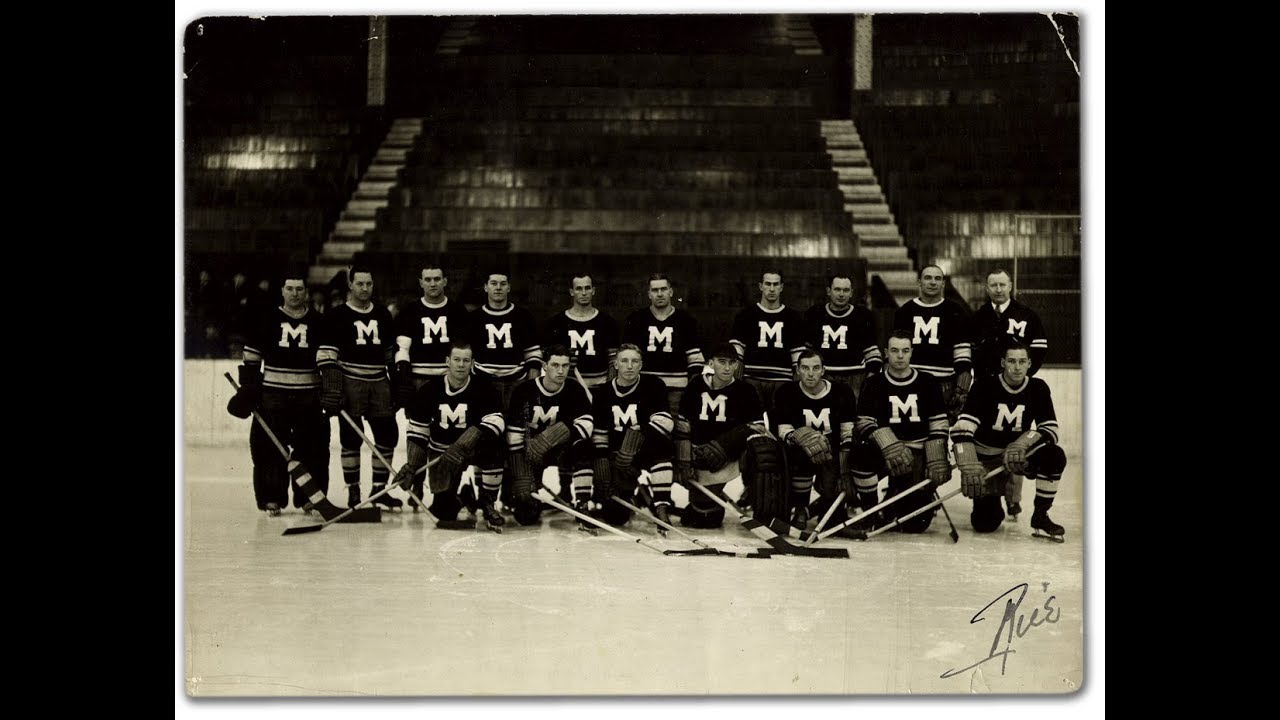
What was supposed to be a temporary solution turned into another step towards the NHL’s Original Six era. Struggling with finances, the Montreal Maroons requested and received a one-year suspension of operations as of August 25, 1938. As it turned out, they never returned, instead folding almost a decade later.
Montreal had hosted two NHL teams since 1924, with the enfranchisement of the Maroons (and the Boston Bruins). They were intended to represent the English-speaking population of Montreal since the Canadiens represented the French-Canadian population. However, the Great Depression proved that the Canadiens drew more spectators and that Montreal could not support two teams in the hard times. For their final three seasons, the Maroons had the worst attendance in the league, causing extreme financial difficulties.
The Maroons ended what would be their final season, 1937-38, on the lowest possible note. They lost their final game, 6-3 on March 17, against their Montreal rivals. Their record, 12-30-6, was their worst since their inaugural season. Unsurprisingly, they finished in the cellar of the standings.
Rumors of relocation lingered even after Maroons President Donat Raymond denied them back in September 1937. Reconstruction Investment Company said they were willing to bring the Maroons to St. Louis, Missouri, and the deal would have given them the option to buy the team in three years. However, they had not yet given any funding and did not specify how long they would willingly operate the team. The NHL doubted St. Louis’s viability since their Eagles had failed due to high travel costs to reach opponents’ rinks. When the NHL’s board of governors met at New York, Maroons GM Tommy Gorman applied for the Maroons’ transfer to St. Louis, but the board rejected the proposal.
In response to the rejected relocation proposition, Gorman requested a temporary suspension of operations to given them time to manage their finances. They were in “dire financial straights” receiving “poor support” for the past two seasons. The board had already turned down the Maroons’ request back at their annual meeting on June 22. With the upcoming season closer to starting, the NHL board “decided the suspension would be the best solution of the club’s financial difficulties for the present.” To the press, Gorman seemed “well pleased over the outcome.” The NHL would schedule seven teams for the upcoming season, and the top four would participate in playoffs.
A major concession from the NHL was that they allowed the Maroons to retain rights to all players (on active, reserve, and negotiation lists) and distribute them however they chose. Apparently, the Maroons intended to rent out players to the highest bidders, but although “besieged with offers,” they had “refused to entertain any.”
Primarily, Gorman indicated that they intended to give the Canadiens first dibs. This made sense because the players were already in Montreal and the Canadian Arena Company owned both teams (and had since 1935). Canadiens President Ernie Savard said, “We are not yet in a position to state what players we will take, but we will not miss the good ones. It looks like a banner hockey season for Montreal.”
Savard indicated the Canadiens would probably take five or six players. Of the original five names of interest, the Canadiens ended up with four of them and an additional two former Maroons. As of mid-September, the Canadiens paid the Maroons cash in return for center Bob Gracie, wings Herb Cain and Jimmy Ward, and defensemen Stew Evans, Cy Wentworth, and Des Smith. The Canadiens also obtained negotiation rights to defenseman Lester Brennan and goalies Claude Burke and Rick Ferley. Coach Cecil Hart had concerns with whittling down the team with this abundance of players. The amount exchanged for the players was not disclosed but reported as a “very substantial sum.” The Canadiens also ended up with Gorman himself. He served as their GM from 1940 to 1946.
The Chicago Blackhawks benefitted from the Maroons as well. They paid $30,000 in return for a complete line – right wing Baldy Northcott, center Russell Blinco, and left wing Earl Robinson. All of them had played their entire NHL careers with the Maroons. In November, Chicago also paid the Canadiens to trade Gracie.
Two other NHL teams took one player each. The Toronto Maple Leafs had sought forward Gus Marker as early as September but did not receive him until November 3. His price tag amounted to $4,000. Dave Trottier, also a forward, thought about retiring because he did not want to leave his Montreal business connections. However, he was traded to the Detroit Red Wings on December 13.
Five more players moved down a tier to the International-American Hockey League (IAHL), soon to become the AHL. By September, forwards Paul Runge and Jerry Shannan were being pursued by the IAHL, so that October, the Maroons sold them to Cleveland . Defensemen Maurice Groghan and Al Shields went to New England, playing for the Providence Reds and New Haven Eagles. Goalie Bill Beveridge played for three different IAHL teams that next season. He returned to the NHL with the New York Rangers for the 1942-43 season.
For centers Tom Cook and Carl Voss (who injured his knee at training camp), that was the end of the line for their playing careers.
It marked the end for the Maroons. In 1945, the Maroons franchise looked to sell to a Philadelphia group. The NHL was willing to allow this as long as they had enough money and got the team running by April 1947. Although the funding came through, Philadelphia did not have a suitable arena and a new one could not be funded by the deadline. Thus, the NHL officially ended the Maroons franchise.
Additional Sources:
Mike Commito, Hockey 365: Daily Stories from the Ice(Toronto: Dundurn, 2018), kindle edition.
“Composite Team to Represent Montreal in 1937-38 N.H.L. Schedule,” Montreal Gazette, 26 Aug. 1938, p. 14.
“Maroons Franchise,” New York Daily News, 26 Aug. 1938, p. 46.
“Seven Clubs in National Hockey,” Boston Globe, 26 Aug. 1938, p. 9.
“Maroons Quit Hockey League; 7 Teams Left,” Chicago Tribune, 26 Aug. 1938, p. 21.
“Maroon Six Quits League for a Year,” Detroit Free Press, 26 Aug. 1938, p. 13.
“Chicago and Canadiens Buy Nine Players as Maroon Team is Disbanded,” Montreal Gazette, 16 Sept. 1938, p. 14.
Stephen Laroche, Changing the Game: A History of NHL Expansion(Toronto: ECW Press, 2014), 18.
Brian McFarlane, Brian McFarlane’s History of Hockey(Champaign, Ill.: Sports Publishing Inc., c1997), 44.
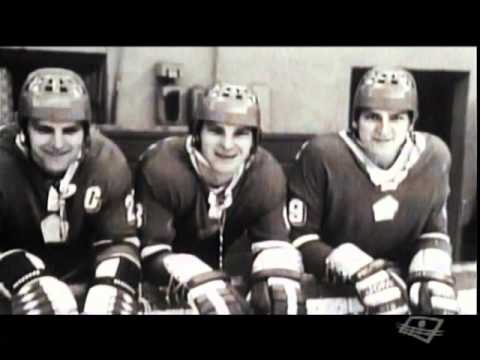
The plan played out like a spy movie – secret phone call, police escort racing through the streets, asylum at an embassy, and arrival on a new continent the next day. That was how the Stastny brothers defected from Czechoslovakia to Canada in 1980. The middle and younger brothers, Peter and Anton, initiated the defection from Innsbruck, Austria, which they left on August 24, and on August 25, they landed as new members of the Quebec Nordiques. After a miserable year facing repercussions back in Europe, the team finally managed to bring over the third member of the Stastny line, older brother Marian. The success of the Stastny brothers opened the door for further defections and for more European players to sign with the NHL.
Perfectly summarizing the mindset going into this, then president of the Nordiques Marcel Aubut said, “Believe it or not, there’s a mother in Czechoslovakia who’s got a son [Anton] who is the star on the left side , another son [Peter] who’s a star in the center , and another one [Marian] who is the star on the right wing. I said, ‘That’s it, we have to go and pick them up. How do we do this?’” After Gilles Lèger scouted them in 1976, he began a three-year effort to obtain the Stastny brothers for the WHA. When Lèger was hired as the Nordiques director of player development in 1979, Aubut entrusted him with “The European Project,” signing the Stastny line. They drafted the youngest, Anton, in the fourth round that year.
Until that point, the Stastny brothers had it too good to leave Czechoslovakia (now Slovakia). They did not appreciate the 1968 invasion by the Soviet Union, which prompted Peter to say, “They were so big and we were just a tiny speck. But in the hockey rink, it was different. We were on even terms.” After all, he noted, they were playing in “the golden age of hockey in Czechoslovakia,” winning the World Championship in 1972, 1976, and 1977 and silver at the 1976 Olympics. For their role in the mid-1970s national accomplishments, the Stastny brothers received honors and bonuses. However, under a coach Peter felt “wasn’t fulfilling his responsibilities towards the players,” the national team slid, missing the medal podium in 1980 at Lake Placid (where the Nordiques intended to meet with the Stastnys but failed to get around security). At the same time, HC Slovan Bratislava, the brothers’ team in the Czechoslovakian league, went through some trades that brought them low. Peter said, “I wanted to play good hockey . . . and there were some problems with the hockey club there.”
When HC Slovan Bratislava traveled to Innsbruck for a tournament, Peter and Anton made their move. On August 21, Peter used a pay phone at the post office to call the Nordiques’ switchboard. He told Lèger and Aubut that he and Anton wanted to sign with them if they were still interested. They were so interested, they flew over immediately. Aubut said, “For me, it was one more try.”
On Friday, August 22, the Nordiques management landed in Austria and checked in to the Europa Tyrol Hotel, a couple blocks from the Holiday Inn hosting the team. After their game against Finland, Peter and Anton met with them at the Europa for two and a half hours. The Stastny brothers knew their worth and negotiated six-year contracts at about $250,000 per year. Aubut wanted them to leave from there, but the brothers decided to stay for the final game.
Sunday’s game would be one last hurrah for the Stastny line because Marian would be left behind to return to his family back in Slovakia. As the Soviets crushed the Stastnys’ team 11-1, Peter’s heavily pregnant wife, Darina, moved all their bags into a red Mercedes driven by an anonymous man (often called 007 because his name has not been made public). When the game ended at 11 pm, the brothers had some drinks and dinner with teammates. At 12:15 am, the brothers bid each other farewell as Peter and Anton left Marian at the bus (scheduled to leave at 1), got into the Mercedes, and drove six hours to Vienna. Peter later admitted, “[Those were] the scariest moments of my life. It was like being part of a John le Carré novel.”
Meanwhile, Lèger and Aubut had arrived at Vienna and informed the Canadian Embassy of the impending arrival and need for asylum and documentation. The Stastny family arrived at 6 am and tried to rest in Aubut’s suite at the Intercontinental Hotel. Unfortunately, the Nordiques representatives were recognized by Czechoslovakian security personnel and had to hightail it to the embassy at 10 Dr. Karl Leuvering Strasse. There, a woman named Schallgruber took charge. When she noticed a car from the Czechoslovak Embassy outside, she asked whether Lèger had protection. She then arranged for the Austrian police to escort them back to the hotel. The Stastny defectors were alarmed to see Schallgruber and the police when they opened the door to the suite. The Czechoslovakians tried calling the brothers to threaten them into staying, but Schallgruber answered and hung up. Under police escort, the group raced back to the Canadian Embassy and then to the airport. The whole time Aubut worried, “We are going to lose everything without a perfect operation.”
After their harrowing escape, the Nordiques group landed in Montreal on Monday, August 25. As Aubut told the press, “We took certain risks, enormous risks . . . there are moments I won’t ever forget . . . I don’t think I’m ready to do it again.” To tie up loose ends, the Nordiques sent a proposal to the International Ice Hockey Federation (IIHF) to compensate the Czechoslovakian national team for the Stastny brothers. They then announced the Stastny contracts on August 26.
Meanwhile, Marian, had remained in Europe. His younger brothers made their escape thanks to loose security resulting from their team’s assumption that with Marian’s family back in Czechoslovakia, he would not leave and they would not abandon him. When his brothers told him their plan, Marian said, ” It was the worst moment I had to go through in my life so far, because I realized that it will be over for me and I cannot go with them, because I did not have my family with me.”
That left Marian to face the backlash caused by his brothers’ defection. Although he had been a team leader, HC Slovan Bratislava immediately suspended him, and he was basically blackballed from hockey in his homeland. Marian described the scene, “The chief of the team announced to me that I’m not anymore welcome in the dressing room. And he simply told me that, ‘Take your equipment and put into the dressing room and leave as soon as possible.’” Anton admitted, “We knew that life for Marian would change completely.” According to Peter, “I really felt responsible for all of the misery he had to go through because they punished him miserably. . . . They made him nobody, nothing. They isolated him.”
Aubut hoped they would find a way to bring over Marian too. After a year, they used falsified documents to get Marian, his wife, and their three kids out. Upon being reunited with his brothers, Marian said, “Well to be honest with you, I was very glad to see them, and to give them a hug, because they are and they were be forever my brothers.”
The brothers skated on a line together as they had in Czechoslovakia, and became one of the decade’s strongest lines. After struggling to transition to their new league, team, and country, the Stastny brothers found great success playing for the Quebec Nordiques. Peter even won the Calder Trophy as the top rookie.
As a result of their defection and NHL stardom, the Stastny brothers are credited with the near flood of European players that followed them into the NHL. Peter would even help some of them adjust as he spoke no less than six languages! He said, “I remembered what it was like. I was in their shoes.” In doing so, he learned that his former enemies, the Russians, “all have huge hearts, they are very good human beings. I don’t think it’s the people who are bad. Sometimes, the leaders, the system, they are what is bad.” With the system overhauled by the Velvet Divorce that separated Slovakia from the Czech Republic, Peter was able to represent his homeland once more and carried the Slovakian flag to open the 1994 Olympics.
By playing first for Czechoslovakia, then Canada, then the U.S., then Slovakia, the Stastny family became the first to represent so many countries in international hockey.
Additional Sources:
Wayne Parrish, “It’s Nordiques 2, Communists 0 as Czech brothers defect to NHL,” Montreal Gazette, 27 Aug. 1980, p. 1.
Wayne Parrish, “Nordiques to pay compensation,” Montreal Gazette, 27 Aug. 1980, p. 80.
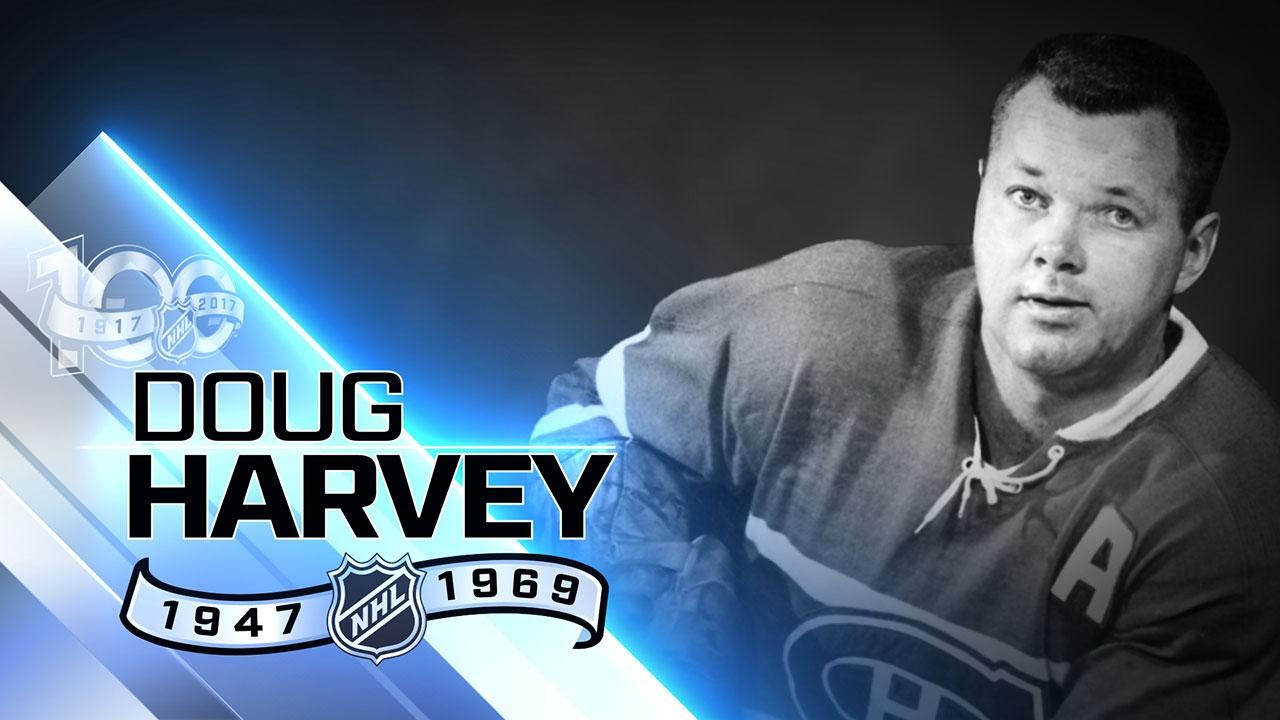
This is the story of a defenseman named Doug, who looked like a thug, liked to raise a jug, and on August 23, 1973, gave a shrug that seemed smug. Montreal native Doug Harvey was not shy about airing his beefs with the NHL and the Hockey Hall of Fame. Many felt he had been snubbed for induction in 1972, so when he was selected the following year, he skipped the ceremony.
Harvey’s history leading up to that point can be traced back to about 1942, when at 18, he began playing for the Montreal Junior Royals of the Quebec Junior Hockey League. In 1947, that led him to the Montreal Canadiens, with whom he won six Stanley Cup championships and the Norris Trophy six times. Despite his star power and skills, Harvey’s 14-season career with the Canadiens ended after he and Ted Lindsay tried to form a players’ association. On June 13, 1961, Harvey was traded to the New York Rangers, where he won his final Norris Trophy. Of the trade, Harvey commented, “It had to do with union activities. I was a first-team All-Star and won the Norris that year. You don’t give away a player like that.”
After two seasons with the Rangers and some time in the AHL, Harvey had a final hurrah playing a full season with the St. Louis Blues in 1968-69. The season ended with his final NHL team being swept in the Stanley Cup Final by his first NHL team.
In 1972, the Hockey Hall of Fame’s 12-member selection committee honored legends Gordie Howe, Jean Beliveau, and Bernie Geoffrion – all stars of Harvey’s era. When Harvey was not included with them, an uproar ensued. One of the selectors told the press, “There’s been a lot of misunderstanding about that. The fact is he wasn’t nominated a year ago because some people questioned whether or not three years had actually passed since he had retired from St. Louis. So he wasn’t voted down, he just wasn’t considered. But when you consider the fact we waived the three-year rule to put Gordie Howe and Jean Beliveau in immediately, maybe there should have been a case made for Harvey, too. I’m not sure I agree with last year’s decision.”
The Hall looked to rectify the situation in 1973 and unanimously voted Harvey in. In May, when Harvey was working as assistant coach and chief scout for the WHA’s Houston Aeros, he was told there was a 95% chance he would be inducted. His response was to tell the Montreal Gazette, “How many times do I have to tell you that I don’t give a damn whether they put me in there or not? You know, I’m not that type of guy who wants to be given special treatment. It doesn’t mean a bloody thing to me. I am what I am and that’s it. I enjoy the stuff of the trade, the guys, the talk, the laughs, and that’s it.” He later continued, “Mr. (Frank) Selke mentioned to me several times this year that he thought I might be in line this year, but I was wondering what they would do now that I’ve taken a job working with the other league.”
On June 13, Harvey received word that he had indeed been selected. He still looked down on the intended honor. “There was a fuss last year when I didn’t get in, and now I guess there will be a fuss this year, too. Frankly I’m not too interested. It just doesn’t mean that much to me anymore. I expect to be seeing Eddie Shore in a few days and I’ll ask him what he thinks I should do. And then there’s my two sons, too. If it really means a lot to them, well, then maybe I’ll consider accepting. But my first reaction is to tell them to forget about it.” Harvey stuck to his guns a month later when he joked, “I’m not sure when the induction ceremonies are, but whenever they are, I plan to be out fishing.”
The reason Harvey gave for boycotting had more to do with those who had and had not been selected before him. “I think there are a lot of citizens walking around the streets who are maybe a little more deserving than some of the citizens they have put in the place.” He followed that up by saying the Hall “overlooked a hell of a lot of fine hockey players because those players just didn’t know the right people.” Harvey claimed that the Hockey Hall of Fame was “nothing but politics, and that’s one game I’ve never played.” In choosing not to attend, he was in fact taking a political stance.
The induction ceremony was held at the Canadian National Exhibition Grounds in Toronto on August 23. Harvey was inducted in his absence. According to one recap of the event, “In announcing the award, no biography of Harvey was read and National Hockey League president Clarence Campbell made no comment on his failure to appear.” The curator for the Hockey Hall of Fame, Lefty Read, said that Harvey was probably the first to turn them down (though that did not stop them from enshrining him).
Those who did attend their induction that night were Rangers goalie Chuck Rayner, referee Frank Udvari, and former Canadiens owner Hartland Molson. Ottawa star Tommy Smith was inducted posthumously.
As if Harvey wasn’t enough trouble, before the ceremony, the NHL had a closed-door meeting to discuss a crisis. The rival league, the WHA, had started drafting and signing juniors before they reached NHL draft eligibility at age 20. The most famous of these were the Howe brothers, 18-year-old Mark and 19-year-old Marty, who signed with Harvey’s Houston Aeros.
The NHL had to decide whether to renew their agreement with the Canadian Amateur Hockey Association (CAHA) and keep the age set at 20 or to let it expire and lower the age to 18. Following the meeting, President Clarence Campbell gave a statement that stressed “The problem cannot continue on this basis. We have formed a [six-man] committee to formulate a plan that will, as rapidly as possible, provide solutions to the problem.” The committee might lower the age to 18. “Our great interest is to preserve the structure of amateur hockey and to sign players only of eligible age. But if the only alternative is a plan whereby our teams are given authority to negotiate with under-age juniors, then we will be prepared to follow that course.”
The statement emphasized that merging the NHL and WHA was completely off the table. “The NHL similarly emphasizes that it has no interest and does not intend to propose any system for a common draft with the WHA.” As the WHA tried to find its own footing among other changes, it chose to go along with the original CAHA agreement. Its president, Gary Davidson, explained, “From a short-range view, we could have kept right on doing what we were doing, but we’re in business to stay, so over the long run, it was just good business sense to make a deal.” The age for the NHL Entry Draft was lowered to 18 in 1980, just one season after the final four WHA teams were incorporated into the NHL.
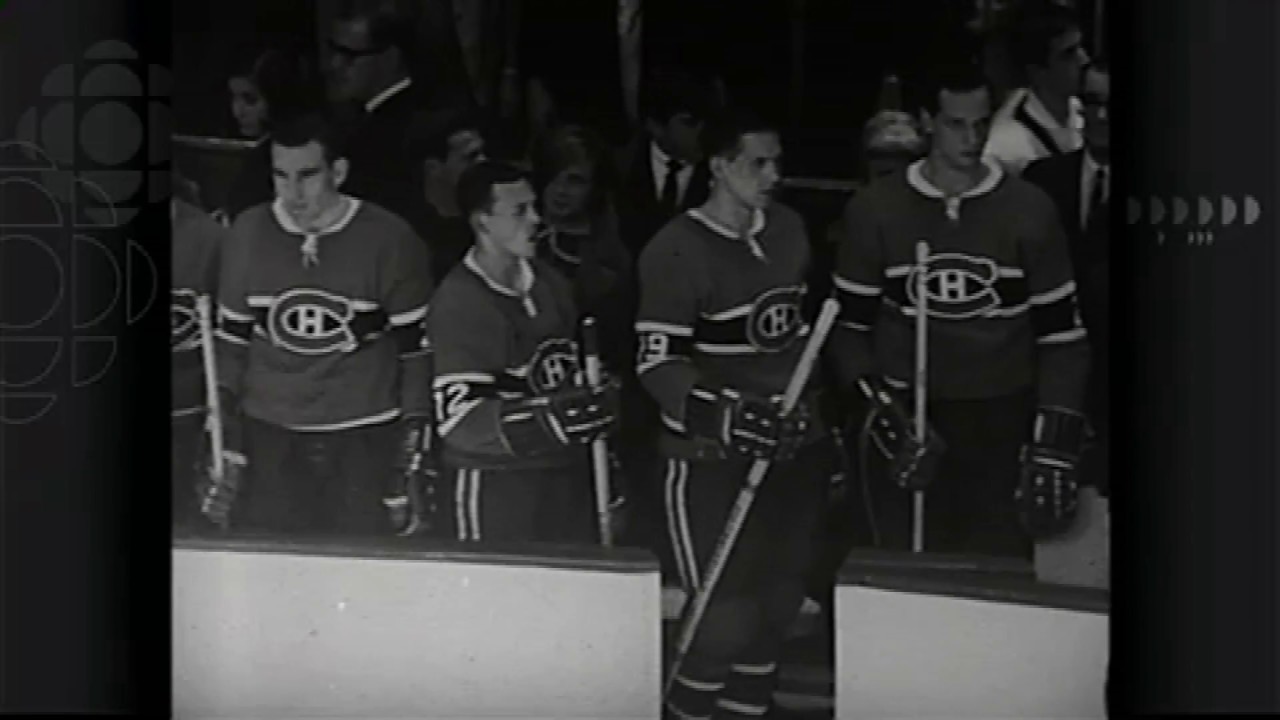
Does anyone ever get tired of winning the Stanley Cup? During his ten seasons with the Montreal Canadiens, defenseman Terry Harper won five championships. He then basically turned down another five when he chose to be traded to the Los Angeles Kings on August 22, 1972.
Harper, who always earned many more penalty minutes than points, began his NHL career with the Canadiens in 1962. In his first full season there, he came in third for the Calder Trophy, the closest he ever came to winning a player award. Despite often scoring a mere three goals per season, the “Harper hat trick,” he was the “guts of the Canadiens’ defence for a decade.” Harper reflected, “I played with and for the greatest men in hockey during my career here. When I first came up it was the best organization in the game.”
However, Harper’s happiness in Montreal was diminished when coach Scotty Bowman came on board in 1971. Even with their conflicts, when it came time to negotiate a contract, Harper admitted, “The Canadiens offered me a pretty good contract, by their standards.” It just failed to meet Harper’s standards. He wanted a three-year contract, which GM Sam Pollock vetoed. As Pollock saw things, “We had to take into consideration that next year (when Kansas City and Washington come into the league), we’ll only be able to protect 15 players . . . We also have a lot of promising young defencemen coming up.” Still, he complemented, “Terry had tremendous desire. He never backed down from anybody. The tighter the spot he was in, the better he was.”
Unsatisfied with the Canadiens’ offer, Harper did most of his own negotiating – with options to set up a trade to the Kings or to sign with the WHA’s Quebec Nordiques. He chose the trade that came with a three-year contract worth three times as much as the Canadiens’ price.
According to Harper, “It’s not only the money, there are many intangible benefits. I think I’m going to a first-rate organization. I’m convinced that Mr. Cooke, Larry Regan and Bob Pulford are people as good as their word . . . I know coach Bob Pulford and he’s an intelligent man.”
Of course he knew Pulford, with whom his fisticuffs in the penalty box led to the divided box used ever since. Pulford said simply, “He’ll strengthen our defense.” As for GM Larry Regan, he called Harper “one of the last hard-nosed players. When he puts somebody into the boards, it’s with the idea they won’t want that to happen to them again.”
Another reason Harper looked forward to joining the Kings was that he had some ideas about training and practice that they promised to adopt. “A lot more of the training should be done off with ice. I have a special conditioning program. There should also be assistant coaches and more study of films . . . I tried to get these ideas across to the Canadiens but they wouldn’t listen. They wanted to do it the old way. Scrimmages and three-on-ones.” According to Pollock, Harper actually was leaving a legacy back in Montreal. “Scotty has sent out a conditioning program to the players, and it’s based on Harper’s and Bob Williams’ (club trainer) theories.”
The reason Harper was so keen on the idea of a three-year contract was because at 32, he thought he had another five good playing years. “And if they keep expanding, I’m good for another 10.” He played for another nine seasons after leaving Montreal. In Los Angeles, he quickly became team captain and led the Kings to their best season yet (with 105 points) in 1974-75.
After three years in sunny California, Harper perhaps did the Kings the biggest favor yet. On June 23, 1975, they sent him to the Detroit Red Wings as part of the package in return for Marcel Dionne. In Detroit, Harper served as captain during the 1975-76 season and then stayed for another three years. He rounded out his career by signing with the St. Louis Blues in 1980 and the Colorado Rockies in 1981. In 19 years, he only managed 35 goals but a hefty 1,362 penalty minutes.
Meanwhile in Montreal, the Canadiens received four draft picks in return for Harper. In 1974, they chose Gary MacGregor in the second round. The following year, they picked Pierre Mondou in the first round and Paul Woods in the third round. Finally, in 1976, the Canadiens finished with Rod Schutt as the first-round pick. Of the four, only center Mondou helped the Canadiens. During his eight seasons with them, he scored 456 points in 548 games. Regardless of the success of the trade, the Canadiens won another five Stanley Cup championships before Harper’s career ended.
Additional Sources:
Tim Burke, “Harper traded to Kings – open the vault!” Montreal Gazette, 23 Aug. 1972, p. 38.
“Kings Acquire Terry Harper From Montreal,” Los Angeles Times, 23 Aug. 1972, section 3, p. 2.


 Prev
Prev