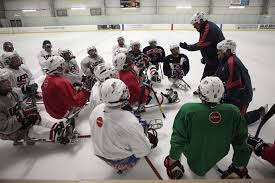
USA Hockey and the NHL are proud to present the fourth annual USA Hockey Sled Classic, hosted by the Pittsburgh Penguins. The event takes place this weekend at Robert Morris University Island Sports Center and Blade Runners Ice Complex in Pittsburgh, Pa. The three divisional championship games will take place on Sunday, November 24 at the CONSOL Energy Center.
Sled hockey (known as sledge hockey outside the United States) was created as a way to give disabled athletes a chance to play ice hockey.
Among the 200-plus competitors at the USA Hockey Sled Classic will be 15 members of the 2014 U.S. Paralympic Sled Hockey Team. They will be signing autographs for fans on Saturday, November 23 at RMU Island Sports Center from 5-7 p.m.
“The NHL and its member clubs have been tremendous supporters of the USA Hockey Sled Classic,” said Jeremy Kennedy, manager of membership and disabled hockey for USA Hockey. “With the 2014 Paralympic Games just a few months away the interest in sled hockey is significantly increasing. This year’s tournament in Pittsburgh includes the addition of two more teams and a third division.”
All of the competing teams are associated with NHL clubs – Boston Bruins, Buffalo Sabres, Carolina Hurricanes, Chicago Blackhawks, Colorado Avalanche, Columbus Blue Jackets, Dallas Stars, Florida Panthers, Los Angeles Kings, Nashville Predators, New York Rangers, Philadelphia Flyers, Pittsburgh Penguins and Washington Capitals. Sled hockey teams will represent their affiliated NHL club by wearing official NHL licensed jerseys with local club marks and logos.
If you live near one of the NHL teams affiliated with a sled hockey team, I encourage you to look them up! There are also many sled hockey teams in other locations. Sled hockey has the same fast paced, heart racing action we love in traditional hockey with the added benefit of bringing the game to athletes who would otherwise be unable to participate.
Oval or circle, it is the ice rink itself that helps to make this game what it is today.
I sometimes wondered where the size and shape of the ice rink came from? Did anyone really decided the size?
After getting into the NHL website and reading everything else but the history of the ice rink, I realized I needed to do more research on this matter. I went back into the different websites on hockey and after reading more about rulers and guidelines, I finally got somewhere!
First, hockey was played on curling rinks. There was no markings. I read this and tried hard to picture a hockey game being played on a curling rink. I just don’t see it! Do you?
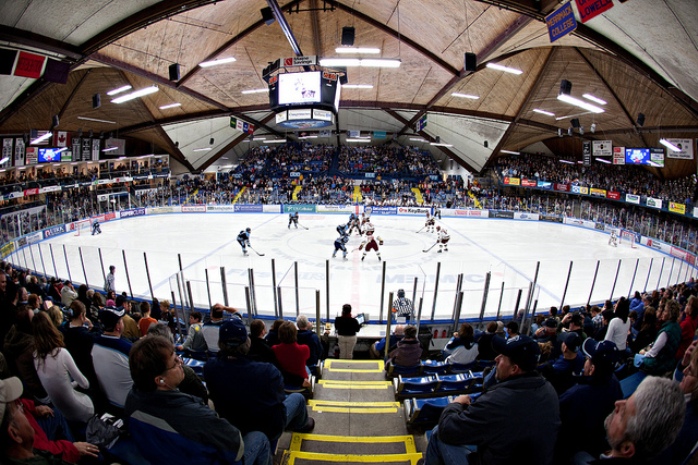
Today the game is played on a rectangle rink with rounded corners. All NHL hockey arenas are pretty much the same. All sizes came from the first indoor ice rink game, which was played in 1875. The arena “Victoria Skating Rink” in Montreal, Quebec, Canada was opened in 1862. The size of the hockey rink was 200 feet long, 85 feet wide with boards 40-48 inches high. We still see the game being played on the same size rinks as our great grand-fathers did, way back in 1875!
There are two different sizes of ice rinks in the world today. One is International and the other is what we in North America play on. The International sizes are a bit different from us. The overall size is 200 feet by 100 feet. It seems they have more play space than us! (I just sounded like a crying kid of 4, hockey makes me that way!) The International teams play under the rulers and guidelines of the International Ice Hockey Federation. (IIHF) We in North America play under the National Hockey League. (NHL)
The rink is cut into three zones. The defending zone, the attacking zone and the neutral zone. By the way, the word “rink” is Scottish for ‘course’ So next time you are watching a game on TV or sitting in an arena, look at the rink itself and notice that the size and shape has stayed the same for over 138 years! Wow! Most things today don’t last even last half that time!
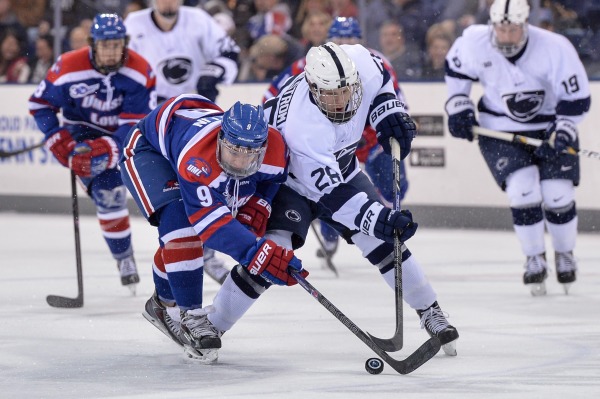
Penn State faced #13 ranked University of Massachusetts Lowell this weekend in State College, Pa. The first of their two meetings was Thursday night at 7 p.m.
With a goal scored by Adam Chapie at 1:51 of the first, UMass set the tone for the game early on. The remainder of the first period was scoreless.
In the second, Scott Wilson scored at 5:56 to give UMass Lowell a 2-0 lead. Exactly two minutes later, they scored again with a goal from Derek Arnold. Arnold scored the fourth goal of the game late in the third period to give the Riverhawks a 4-0 win at Pegula Ice Arena.
Some stats from the game: Penn State out-shot UMass 37-28. Penn State was 0 for 5 on the power play and UMass was 0 for 6 (the Nittany Lions have had some quality penalty kill practice since the start of the season). Penn State also won 54 percent of the faceoffs. Despite these good efforts, Penn State was no match for the speed of UMass.
The two teams met again on Friday night; each with a different goalie between the pipes. For UMass Lowell, Doug Carr got the start (3-2) and for PSU it was Eamon McAdam (0-3).
UMass Lowell took another early lead with a goal from Joe Gambardella at 4:26 of the first period.
In the second, Penn State scored a power play goal by Eric Scheid. Less than a minute later, Stephen Buco scored to give UMass Lowell the lead again. Adam Chapie scored his 6th of the year at 17:50 of the first to put UMass Lowell up 3-1.
The second period was scoreless, and Penn State made a final push in the third. David Goodwin scored a Penn State goal at 12:17. After a few great chances late in the period, PSU was not able to capitalize and fell to UMass Lowell 3-2.
Again, Penn State took too many penalties. On Friday night they gave the River Hawks five power plays. Fortunately for the Nittany Lions, UMass was only able to capitalize on one out of their 11 total power play opportunities on the weekend.
UMass Lowell advanced to 8-4-0 on the season while Penn State fell to 3-5-1.
Penn State will take on Union next on November 30 at Pegula.
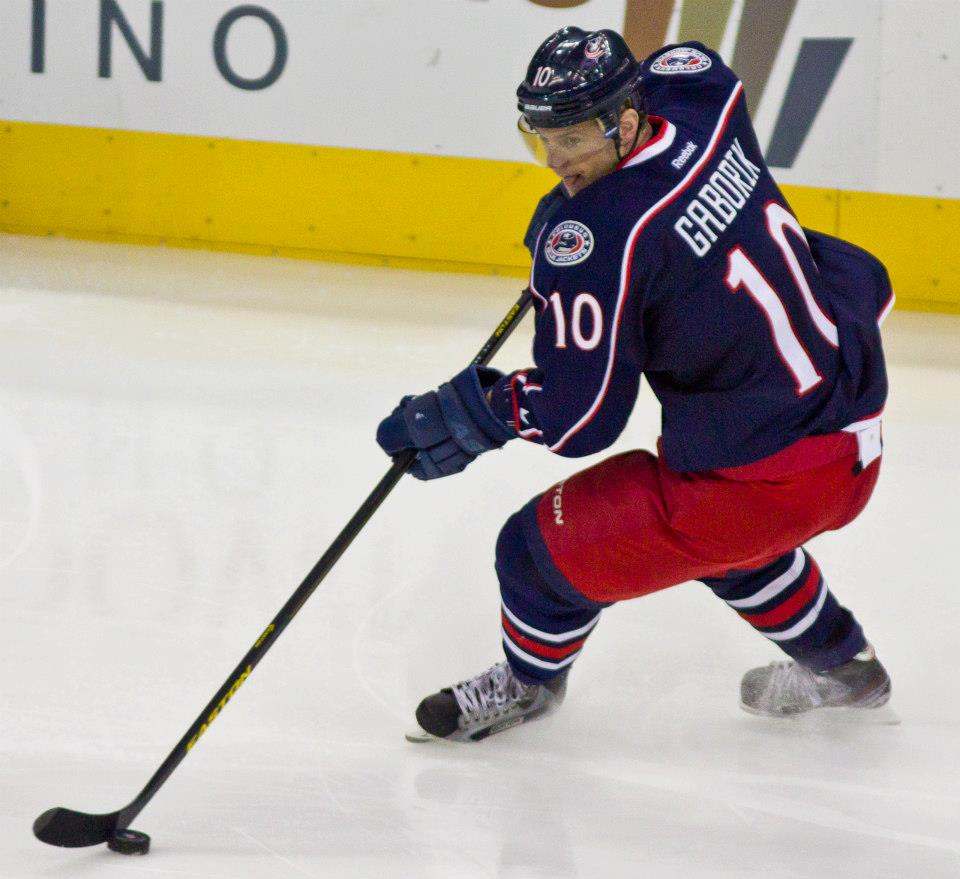
Well, in this week’s chapter of CBJ’s Dismal Luck, a novel by Jarmo Kekalainen and Todd Richards, Marian Gaborik has been placed on the Injured Reserve due to a knee sprain received during Thursday’s fall to Boston. Gaborik has been key in most if not all of the Blue Jackets’ successes this season, tallying five goals and six assists for 11 points in 17 games. He is tied with Brandon Dubinsky, Ryan Johansen, Artem Anisimov, and Cam Atkinson for most goals scored, and tied for third (Johansen and RJ Umberger) for assists.
Almost every line Gaborik has played on has met with a degree of success; it will be interesting to see how the Blue Jackets work around his absence in the coming weeks.
Columbus has also announced the reassignment of 24-year-old forward Sean Collins to the Springfield Falcons. Collins recorded a 0-1-1 in five appearances with Columbus this season.
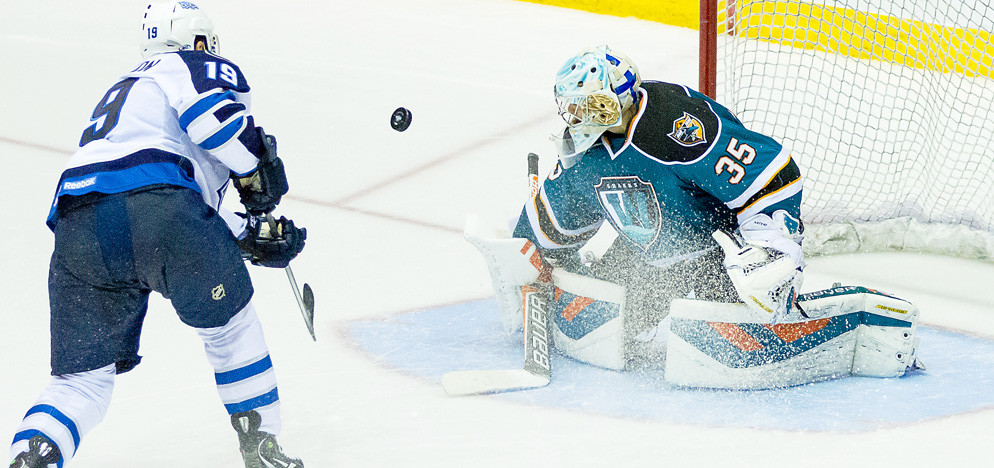
Although they are in the same division, the Worcester Sharks and the St. John’s IceCaps have a lot of space between them. The Sharks play the other teams in their division each 12 times throughout the season. But, the Sharks meeting the IceCaps 10 times this year is a record high. This past week, the Sharks headed to St. John’s for 3 games before heading back to Worcester.
The Sharks spent most of the day on Tuesday traveling, leaving early in the morning. On Wednesday morning they had their pre game skate and then it was time for game 1. Over the past two seasons, the Sharks have had incredible success visiting the IceCaps and have skated to a 5-1 record up there. Coming into the first game, the Sharks had not yet been to over time during the season. That was about to change.
Worcester jumped to an early lead with rookie Rylan Schwartz getting his first of the season unassisted on the penalty kill just over 2 minutes in. Daniil Tarasov added his team leading 7th goal during the second on the power play. Things were looking good for Worcester. But then, the third period came and the tides turned. Andrew Gordon beat Sharks rookie goaltender on the power play to cut the Sharks lead in half. Everything still was okay until the final two minutes of the game. Jerome Sampson added a short handed tally for the IceCaps to send the game to overtime.
It was the first time of the season that Worcester saw overtime and the first time the two teams had gone to overtime at Mile One Centre in St. John’s. It only took the IceCaps 26 seconds to complete the come-from-behind victory. Samson had his second of the night and fourth on the season to seal the win.
On Friday, the teams were right back at it. The Sharks went with Harri Sateri, who has been an excellent goalie but has been struggling so far this season. Wednesday’s game had been a little bit of a chippy one featuring a fight but a number of roughing penalties. This game, it was the fighting that opened things instead of scoring. Sharks defenseman Taylor Doherty and IceCaps tough guy Ryan Schnell. Later that same period, Curt Gogol of the Sharks fought Andrew Gordon, someone not usually known for fighting.
In the second frame, the Sharks opened the scoring as they had in Wednesday’s game. This time it was defenseman Matt Tennyson notching his first of the season. However, shortly after that Sharks captain Rob Davison got a major penalty for boarding and a game misconduct. During the following power play, St. John’s tied it up on a goal from their captain, Jason Jaffray. In the third period, the teams exchanged goals to keep the score tied. Freddie Hamilton had his third of the season for Worcester before Samson added his third goal of the mini-series.
Once again, the teams went to extra time. But this time, neither team was able to end it in overtime. St. John’s was not even able to register a shot on goal. The Sharks found themselves in the first shootout of the season. The IceCaps shot first and when the fifth round came, they were ahead 1-0. Worcester went with James Livingston who managed to score and keep the shootout going. St. John’s got another shootout goal from their sixth shooter, John Albert. But, the Sharks impressively answered with a goal from their sixth shooter, Sebastian Stalberg. It went all the way until the ninth round without St. John’s scoring again when Sena Acolatse put one past Eddie Pasquale to win it for the Sharks.
Another game on Saturday, the final one of the series, appeared to be another situation for extra time. In their third game in four days, the IceCaps and Sharks once again found themselves having to go past the three periods. Prior to the game, the Shark juggled their lineup again to make room for Matt Pelech to return. He had to sit out the previous two games serving a suspension but was able to return for the final game of the series between the two teams.
It was only 2:29 into the game when Pelech showed his grit. He got into a fight with enforcer Blair Riley at the same time Sharks agitator Curt Gogol fought Ben Chiarot. Worcester got the extra penalty and St. John’s went on the power play. About a minute into the man advantage, Samson struck first for the IceCaps. It was his 6th of the season, 4 of which have come during this series.
Despite a hard effort from the Sharks, the score stayed the same until the third period. Second year forward Travis Oleksuk had been struggling to find his step. But, he changed that when he scored his first of the season to tie the game. That was enough to send the game into extra time.
After the overtime period, where the Sharks dominated on chances, the scored was still tied at 1 and the teams were going to overtime for the second straight game. St. John’s went first again. Up first for the Sharks was James Livingston, who had come up big the night before but was unable to help tonight. However, Oleksuk was able to add a shootout goal as well. Brodie Reid scored fourth in the Worcester lineup and that was all they needed. The Shark were shootout victors again.
This was a really important trip for the struggling Sharks. They have done well since St. John’s came back to the AHL and the trip came at a great time for Worcester. Taking 5 points away from the weekend will hopefully see this team start to turn things around. The Sharks had not put together a two game winning streak since mid-March and had not taken 5 points in 3 games since the end of December in 2012. Another big takeaway from the trip will surely also be that starting goaltender Harri Sateri got two wins and made 51 saves on 54 shots. It’s a definite step in the right direction for the Finnish goaltender.
The Sharks made the long trek back early on Sunday and will be off until Friday. On Friday, they head up to Manchester for the second of this season’s 12 meetings and the first in Manchester. On Saturday, the Sharks host the Bridgeport Soundtigers before playing Manchester again, this time hosting them in Worcester.
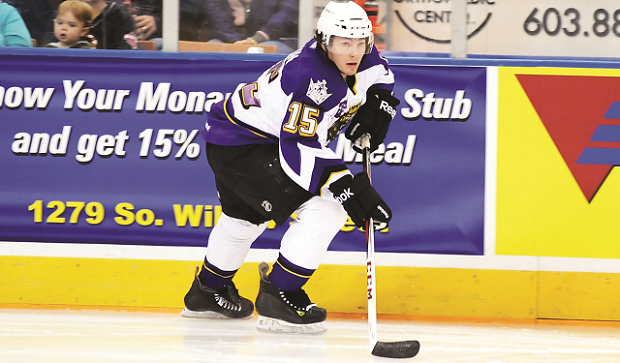
The Manchester Monarchs face off against the Norfolk Admirals four times this season. On Wednesday, they hosted the Admirals for a 10 am game for the 4th annual Education Day. On Saturday, Manchester closed out the set of home games against the Admirals.
Manchester had to skate just 16 skaters against the Admirals because those were the only skaters available to them. Following their game Wednesday morning, starting goaltender, Martin Jones, and forward Tanner Pearson. He started the season on the top line with Tyler Toffoli and Linden Vey. All are currently with the Kings. The Monarchs were able to skate 18 players on Friday, but they suffered another blow. Zach O’Brien, who Manchester recently signed to a PTO, was unavailable on Saturday due to back spasms. Ian O’Connor, also on a PTO, suffered a high ankle sprain.
“The guys were sucking wind. I was tapping them and telling them that they were up next and they were like are you kidding me?” Morris joked. “I give our guys credit. They played hard and executed well under the circumstances. We’re the walking wounded right now. I don’t know if I’ve ever seen a team decimated like this before.”
Come Saturday night, the Monarchs had their third game in three nights and were just trying to give it everything they had to hang in against a team that Monarchs head coach Mark Morris called a talented team.
“The guys gave it everything they had today, they had to. We had 9 forwards and 7 defensemen. With all the losses we’ve had this week and last week, you can’t say enough good things about the guys in the locker room. They laid it all on the line here and beat a lot of talented hockey players.”
Just 1:15 into the game, the Monarchs struck first. Admirals goaltender John Gibson went down to make the initial save. As he was down on the ice, Brandon Kozun picked the puck up and put it into the net easily. Despite being short players, the Monarchs were putting up a strong effort. Later on the power play, they continued their pressure. It looked as if they would have trouble converting. Then, Nick Deslauriers managed to put one past Gibson. Jordan Weal passed across the center to Deslauriers who dropped his knee at the face-off circle and fired it home.
Immediately following the second Manchester goal, the Admirals appeared to cut the lead in half. The referees ruled on the ice that there was no goal. Admirals captain Garnet Exelby argued the call and it went to review. But, the call stood and the teams ended up going to the first intermission with Manchester leading 2-0.
The first penalty of the second period came when Monarchs defenseman Andrew Bodnarchuk went off for interference. Almost immediately, Chris Wagner cut the Admirals lead in half. Despite a couple more penalties, neither team was able to convert again. Things got a little bit chippy between the two teams, but nothing seemed to completely boiled over.
When the teams came back out for the third, JF Berube was making some impressive saves. Prior to Jones being recalled, Berube had only started one game. He has now started the last three games in a row and has impressed. Rookie Colin Miller went off for hooking and Manchester went to the penalty kill. Kozun and Jordan Weal managed to get a breakaway despite being short handed. Weal passed across to Kozun, who was able to put it away and regain the two goal lead.
Shortly after that goal, the Monarchs had another player go to the box. They were facing 1:08 of a two man disadvantage. Somehow, they were able to help Berube stand tall and kill both penalties. Then, shortly after it went back to even strength hockey, the Admirals cut the lead to 3-2. Exelby passed to Maxime Sauve next to the net who passed across to Antoine Laganiere. Laganiere was able to put it past Berube.
The game ended up 3-2, despite a late effort from Brandon Kozun. He was going for the hat trick but was stopped by Gibson. The look on his face said it all, but he was just glad that the team got the win. With the team as decimated at they were, it was a great effort by them. The team will have the week off to regroup but will face another challenge next weekend. They have games Friday, Saturday, and Sunday and will undoubtedly hope to see the return of some injured players.
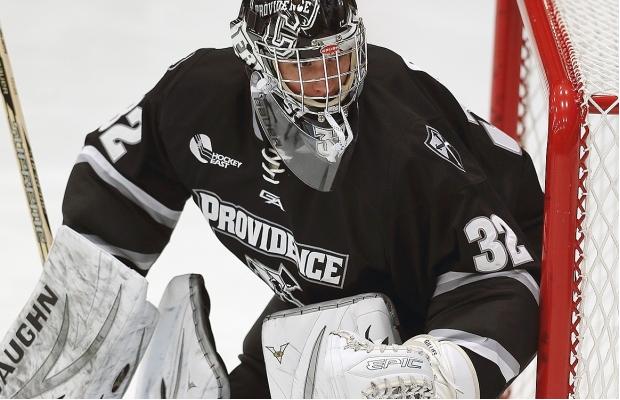
Providence College swept the University of Vermont on the road this past weekend for the first time in school history. Led by sophomore goaltender and Calgary Flames prospect Jon Gillies, the Friars took down the Catamounts by scores of 3-2 on Friday night and 3-0 on Saturday. Saturday marked Gillies’ eighth collegiate shutout, breaking the school record.
Yes, you read that properly. Gillies, a sophomore not even two months into his second season in uniform for the Friars, has already beaten the school’s all-time shutout record. To say that is insane would be like saying that Pavel Datsyuk is “okay” at stick handling.
Calgary fans are certainly in for a treat when he makes the jump to the NHL. The Flames are currently one spot out of dead last in the entire Western Conference, and have a current record of 6-11-3.
There’s something really magical about AHL intro ceremonies. From the actual fireworks to the pillars of fire rising from the structures that I imagine are meant to represent two wolves, there’s something at once solemn and hilarious about the way the ice lights up as the players skate out.
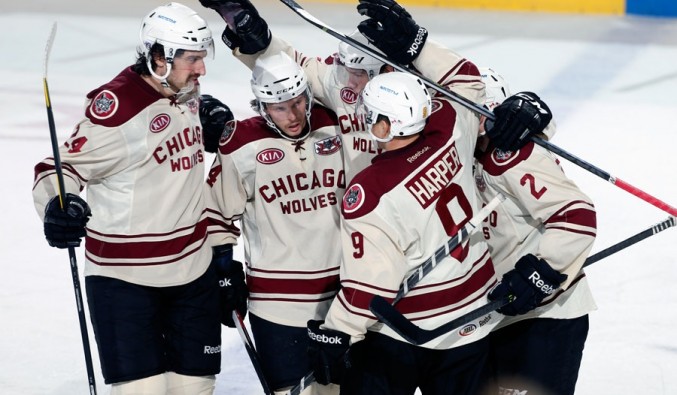
This was especially true last night as the Chicago Wolves took on the Grand Rapids Griffins, seeking to extend their win streak to five games. “Solemn and hilarious” is probably the best way to describe the feel of much of the game: we saw a focused passing game and a solid performance by goalie Matt Climie, coupled with an inordinate amount of broken sticks and more than a handful of whiffs and missed passes from both teams. When both teams played well, they played beautifully; when they didn’t, it felt like watching the initial montage in The Mighty Ducks. To be fair, miscommunication and failed passes happen in hockey. It’s a fast-paced game, and you can’t be everywhere at once. And I will say that the majority of the game was characterized by smart passes and clever hockey. Still: somebody needs to buy these guys some better equipment.
The Griffins’ Ryan Sproul nabbed the first goal a little less than halfway through the first period, but the Wolves didn’t relinquish control for long. Just a few minutes later, Nathan Longpre scored a gorgeous short-handed goal by wrapping his stick around the net to catch Griffins goaltender Tom McCollum out of his crease. After the game, Wolves head coach John Anderson called Longpre the team’s fastest skater, particularly in terms of getting to the puck. Longpre certainly showed it in the game, registering one goal and two assists by the time the third period came to a close. Of the goal, he said that the team had been told to “be aggressive on our PK,” which was apparently advice that he took to heart.
After the Wolves goal to tie the game at 1-1, the energy on the ice shifted. Play got faster, and a bit more brutal; several times over the course of the game fights wanted to break out and were broken up by the linesmen. Frankly, I’m glad the fights weren’t allowed to play out. The game didn’t need it–both teams were playing well, the energy was up, and nobody had delivered a particularly dirty hit that needed avenging. These were just examples of frustration at the close score devolving to the lowest common denominator, not the noble “on-ice policing,” that we all like to pretend fighting is.
Maybe the increase in the game’s speed can be blamed, but after the second goal, the Wolves seemed to struggle to make their passes connect. There were several widely missed passes and miscommunications on their part, while the Griffins seemed to hold it together. The period ended with the Wolves on a two man advantage.
The second period was only four minutes deep when Sergey Andronov scored his season’s first goal thanks to a series of beautiful passes from Cade Fairchild and Longpre. Shortly after, Dmitrij Jaskin padded the one-goal lead with a goal of his own thanks to a pass from Fairchild and Corey Locke.
Despite giving up a goal to Griffins center David McIntyre just a few short minutes later, and the equalizer less than a minute into the third period thanks to a smart backhand from right winger Tomas Jurco, Matt Climie played a strong game. His record going into the match was a rough 0-3-0, so this was an important battle for him. “It’s been kind of a tough start, for the team and me personally, so it’s nice to continue that momentum and continue the streak,” he said after the game. “Definitely the anxiety was there… it was tough to kind of get a feel for the game. But I felt that as the game kind of moved on, I felt more comfortable and felt my game was getting better.”
Arguably Climie proved himself best in that last period. After the equalizing goal from Jurco, the Wolves had a few panicked minutes, with messy shots and scattered passes. The passes seemed to fall through mostly when they were a surprise. That is, when a sudden opportunity presented itself, only half of the party seemed aware of it, and the other let the puck slide by. Maybe this comes down to on-ice communication or maybe just hockey sense.
A delightful short-handed goal from Taylor Chorney–tying the franchise record for shorties in a game–would ultimately be the game-winner. Of the record-tie, Coach Anderson joked, “Yeah, we’re taking penalties just so we can score goals, because our power play isn’t doing so good.” Personally, I thought that when the Wolves gave themselves time to think and make smart passes, their power play looked fine–but then again, I’m a Columbus fan, so maybe my idea of a good power play is kind of skewed.
As the clock wound down, more time than the Wolves would have liked was spent in their zone, and Climie showed that his three consecutive losses were not indicative of his talent or ability. He kept his composure as the puck stayed right in front of his crease, and despite the mess Climie kept the net clean to bring the Wolves to victory.
“It was jut one of those things, just kind of for the guys,” Climie said of those frantic last seconds. “I knew they’d battled hard for me all game and I just kind of had to do my job and keep the puck out and keep the wind streak alive.”
Well, he did.
The Wolves next match is against this Friday at 7 p.m. for an Amtrak Rivalry contest. They will once again face Grand Rapids at home on Saturday, November 23 at 7 p.m.
It’s that time again, Pink Puck-ers! Not only are we getting some terms defined by Manchester Monarch’s Nick Shore, but it’s my pleasure to bring you this week’s “Learning the game” topic. So far, we’ve learned about team positions, the rink, and now we’re learning about what makes the Pink Puck, the Pink Puck with everything P-U-C-K. Yes, that’s right, we’re learning about the Puck!
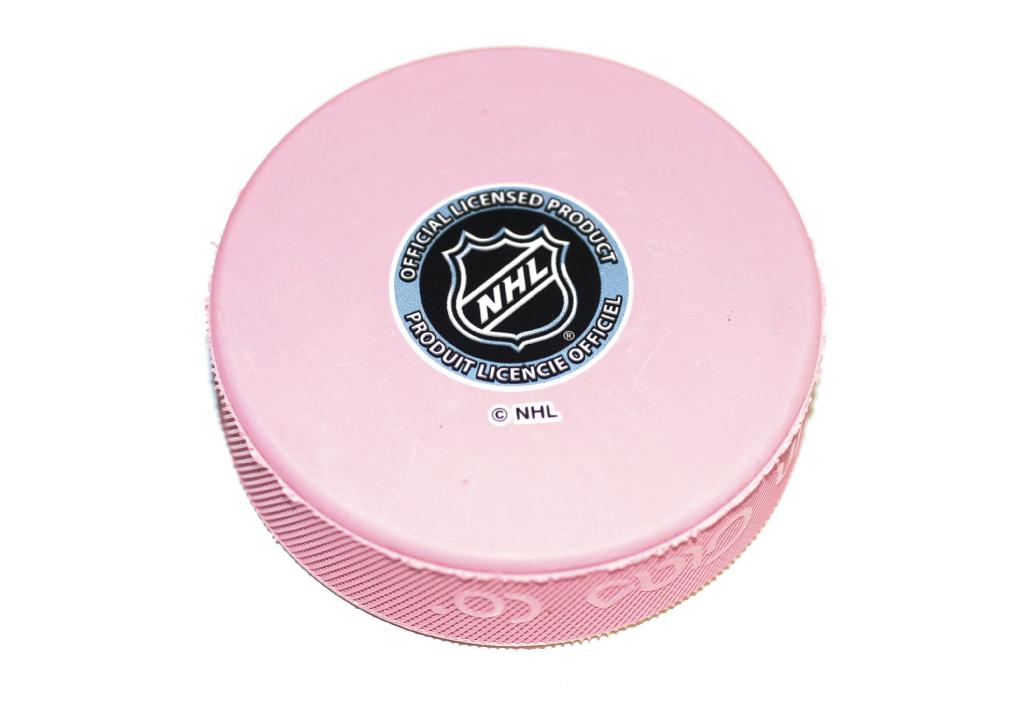
Erm, as much as I want it to be, maybe not THIS puck….
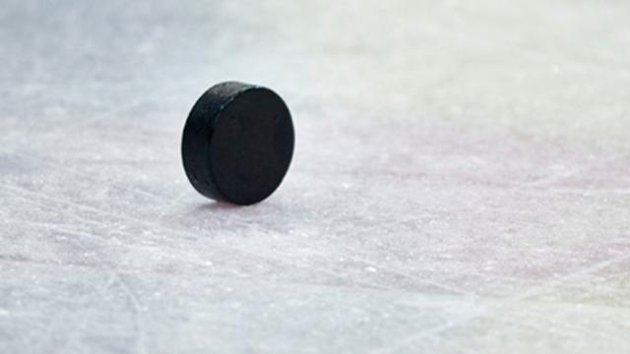
More like THIS puck…
Now, we have a TON of terms tonight, so bear with me my fellow hockey fans. We’re going to use our great A to Z Guide to Hockey Terms by Tim Moshansky once more and start with this week’s more important term:
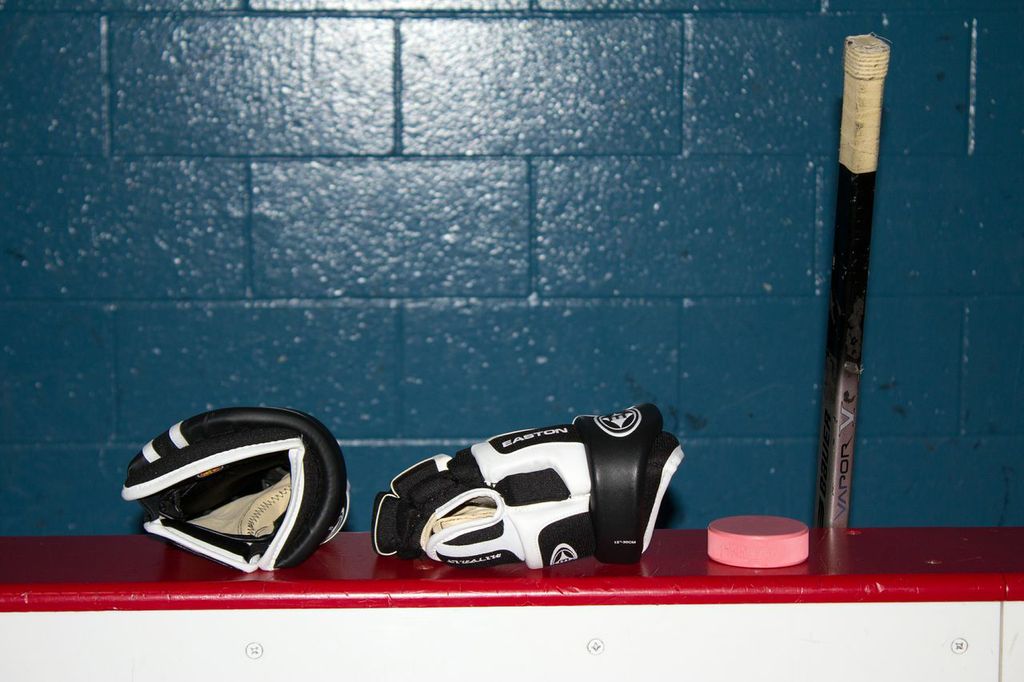
The Puck-Otherwise known as the biscuit or the rubber, this is a frozen, vulcanized rubber disk used to play hockey. NHL regulations say the puck should be one inch thick, three inches in diameter, and weighs between five and a half and six ounces. All pucks have to be approved before use. It’s up to the home team to provide the puck supply for each game and should be kept in a frozen state.
Bobble the puck– This is when a player moves the puck back and forth with the blade of the stick.
Bouncing puck– As many know, but some may not, pucks are typically frozen before game to keep them from bouncing. Since the puck is made from rubber, it’s prone to bouncing. Even if it’s frozen, the puck can bounce, which makes it hard to hit with a stick.
Clear the puck– Is when a player gets the puck out of the defensive zone when the other team is pressing.
Cough up the puck– Personally, I think this one sounds funnier than it is really. It’s when a player or goalie has the puck, loses control, and the puck is easily stolen from them.
Cycle the puck– This is when a team has the puck in the other team’s zone and passes from player to player looking for an open teammate for a clear shot at the net.
Dead puck– A dead puck happens when the whistle is blown and the puck is considered not playable or “dead”.
Deflection-Poor little pucky, this is when the puck is shot and it hits another player, stick, etc., and changes direction.
Falling on the puck– When a player falls on top of the puck deliberately, covering it with his body, a penalty is called. This is “Falling on the puck”.
Fan on the puck-I think this one is every players goof moment, but everyone has to experience it. Fan on the puck is when a player goes to shoot or pass the puck and manages to get their stick right over the top instead.
Feed the puck-This one is easy, it’s when a player passes the puck to another player as they skate ahead of you.
Freeze the puck– Who knew, but this one has two definitions. The first is when a player used their stick/skate to press the puck against the boards or another surface to stop it from moving. The second is something we’ve already mentioned, this is when they freeze the puck before games so that they move across the ice easier.
Handling puck with hands-This is a penalty which is called on any player who closes their hands on the puck or carries the puck with him or her as they skate.
Knuckle ball– A term borrowed from baseball, but means when the puck wobbles and then changes direction. This is very difficult for the goalie to stop.
Loose biscuit-A slang term for when the puck is on ice, but not controlled by a player.
Pick the pocket– You took my puck? You can’t take my puck! That’s right, this is when another player takes the puck away from an opposing player.
Pick up the garbage– This is when a player finds a loose puck in front of the net and then attempts to put the puck into the net.
Play the man– So, this isn’t when you go on a date with a guy and then never call him. Actually, ladies and gents, this is when a player who’s carrying the puck ignores the puck and makes contact with the player.
Play the puck– When you play the puck, you’re ignoring the opposing player with the puck and attempting to get it away from him.
Puck control– Keeping the puck away from other players and maintaining command of it at the same time.
Puck movement– This term describes how well a team passes the puck.
Puck on a string– A sign of a skilled player, puck on a string means that a player handles the puck so well that is looks as if the puck is attached to their stick on a string.
Puck protection– Just as it seems, this is when a player or team keeps the puck in their possession, essentially protecting it from the opposing team.
Puck support-This is when a player provides defensive or offensive support for another player on your team while they have the puck.
Puck possession-When the last team to touch the puck is said to have possession of the puck.
Ragging the puck– Essentially, this is when a player uses up time on the clock when the final moments of a period or game are near.
Rolling puck– Another term like it sounds, this is when a puck rolls like a wheel instead of being flat on the ice. Sometimes this is called a knuckle ball because rolling pucks are erratic.
Skipper– This is when a puck skips along the ice surface after a shot or pass.
Win the draw-When a team gains possession of the puck during a face-off.
Illegal puck– The NHL website describes this as, “If at any time while play is in progress, a puck other than the one legally in play shall appear on the playing surface, the play shall not be stopped but shall continue with the puck until the play then in progress is completed by change of possession”.
I can only say one thing that I learned about puck terms…WHOA, I did not realize there would be so many! It’s also really interesting how regulated the puck has to be, when we’re watching the game we often don’t take that into consideration. Now, let’s get to what you’re all TRULY waiting for–Manchester Monarch’s Nick Shore–defining for us today, icing, plus/minus tracking, and the penalty shot.
That was great, Nick Shore, we here at the Pink Puck would like to extend a HUGE thank you to you and the Manchester Monarch’s for helping us out with our Learning the game segment. It’s that time again, Pink Puck-ers, I bid you adieu. Thank you all for your continued support and I’ll be back next week with another video and more terms.
Note: Hey guys, since I’m just learning, if you think I’ve missed something give me a shout out! Or, if you want to know more term information and think I should write an article about it–let me know. I’ve provided a way to get in contact with me above and would love to hear from you. Thanks so much for your support.
References:
Moshansky, T. (2010). A to z guide to hockey terms (2nd ed.). Vancouver, BC: First Wave Publishing.

 Prev
Prev