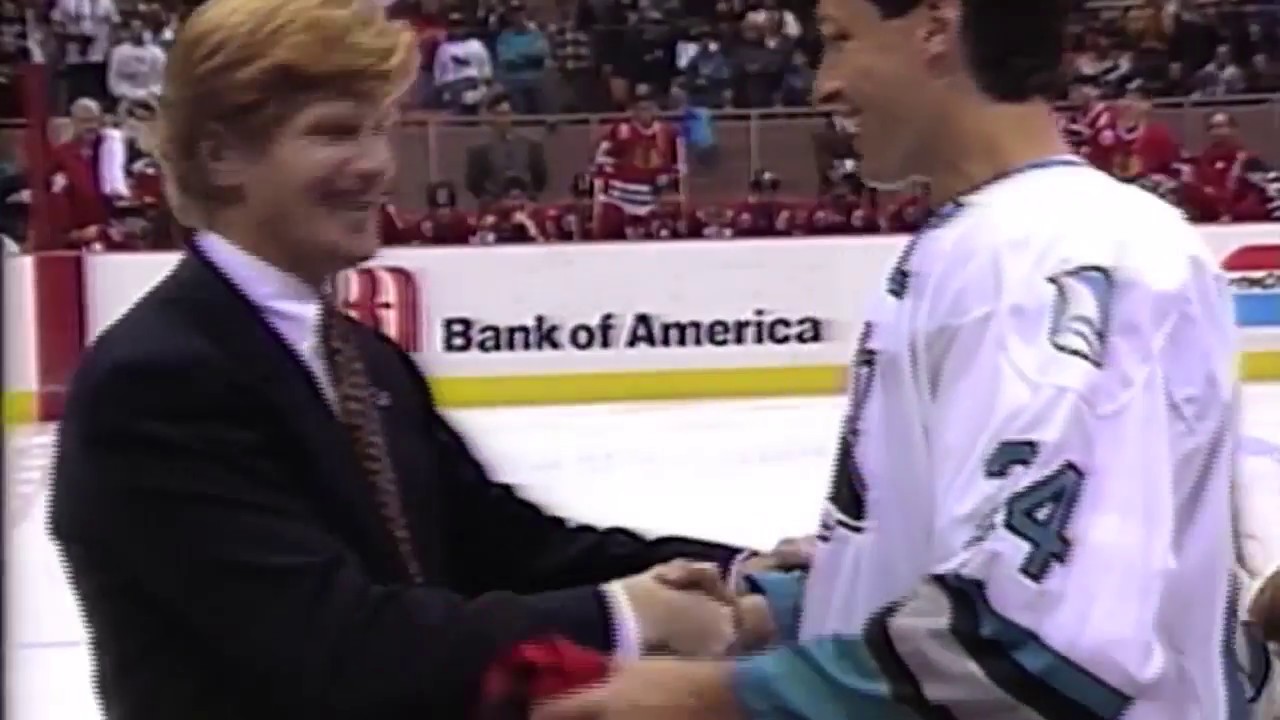
For the new San Jose Sharks, September 6, 1991 was certainly a day to remember. As they held their very first team practice, a trade went through that would bring them their first captain, defenseman Doug Wilson.
The Sharks franchise was born out of a compromise between the former owners of the California Golden Seals (who had left the area 15 years earlier), the Minnesota North Stars (where they held shares), and the former Hartford Whalers owner. The deal became official on May 5, 1990. About a year later, the new Sharks selected young prospects from the expansion draft followed by having a 2nd overall pick at the entry draft. Kerry “Topper” Toporowski was their fourth-round (67th overall) draft pick.
Making what turned out to be a very beneficial deal, the Sharks traded 20-year-old Toporowski (and a draft pick) to the Chicago Blackhawks for 34-year-old Wilson. Drafted 6th overall in 1977, Wilson had played his entire 14-year career in Chicago and remained one of the final six players not to wear a helmet. He received the Norris Trophy as best defenseman in 1982 and was a finalist for the award in 1990. Wilson still holds Chicago records among defensemen in goals (225), assists (554), and points (779).
Despite his long tenure, Wilson’s performance declined as tensions with the new GM and coach, Mike Keenan, rose. Wilson noted, “The relationship I had with Mike Keenan I don’t think was conducive for me being happy or playing good hockey.” The Chicago Tribune highlighted Keenan’s spitefulness by telling how Keenan moved Wilson from the first row to the second for the team photo the previous season. During playoffs, with a lacerated jaw, Wilson paid his own way to Minnesota for Game 6, but not only did Keenan refuse to put him on the ice, he told everyone Wilson said he wouldn’t play. Wilson felt wronged. “I told Mike how I felt about our relationship. I don’t think things should be handled that way.” Upon the trade, he joked, “The Sharks must want me because they’re paying for my plane fare.”
Keenan responded to Wilson’s comments all the way from Montreal, where he was busy coaching Team Canada. He gave his reasons for trading Denis Savard back in June 1990 and then Wilson. “They didn’t win. I feel I was loyal and patient with them. Our objective is to win, and it wasn’t happening with this organization when I arrived. All this Wilson talk is a smokescreen to hide the fact we would have had to make the move regardless. The issue of our relationship is a distraction from what had to be done. He didn’t win here and Denis didn’t win here and you have to accept the realities of the game.”
Although Wilson had another year of his no-trade contract, he chose to accept the trade. “It would have been wrong to try and stick it out here. I’ve played hockey 30 years and to not go to the rink and enjoy it, have fun with it, I could never imagine that. I wasn’t enjoying it. You can’t play to expectations if it’s not fun.” He continued, I planned to finish my career (in Chicago) but things change.” With the trade, he looked forward to joining the Sharks. “I’ve got to be the happiest hockey player in Chicago. … There’s enough talent and good people in the dressing room. But there’s also ways of dealing with people, different coaching styles. … This isn’t really a sad moment for me and my family.”
How did both teams feel about the deal? Keenan seemed resigned, saying, “Even if I could have shopped him to other teams, we wouldn’t have gotten any more at his age. I’m pleased with the deal.” Whereas the Sharks GM, Jack Ferreira, was enthused. “We’re talking about one of the top 10 defensemen in the league. We may have mortgaged a little of the future for now, but any time you can get a player of Doug Wilson’s quality you do it.” Coach George Kingston (a first-time head coach) chimed in, “He’s going to be the quarterback of our power play.”
In fact, all the Sharks were pumped to start their inaugural season. They held their initial preseason practice, in three 45-minute sessions, at Cow Palace. An audience of 300 fans came to cheer on their new team. Defenseman Rob Zettler loved the response, commenting, “We got applause for just skating onto the ice. If we get that for a practice, I can’t wait to see what happens in the games.” Kingston told the press, “Tonight was just a chance to get out on the ice for the first time. It’s exhilarating because for the first time we’re out doing all the things we’ve been preparing for. It’s an exciting time.”
So how did the trade turn out? Chicago did not get much from their side. Toporowski spent his entire career in the minors before retiring in 2004. At the time of the trade, he was already known for having 505 penalty minutes, and he kept earning penalties and a reputation as an enforcer. After bouncing around for years, he became a fan favorite with the Quad City Mallards for six seasons. Chicago had passed along the second-round draft pick that came with Toporowski. With it, the Winnipeg Jets selected Boris Mironov at the 1992 Entry Draft.
As for Wilson, he became San Jose’s first captain and their first player sent to the All-Star Game. At the time of the trade, Ferreira said, “When Doug came up he had older players help him out. Now he knows he’s in that role, and he kind of likes that idea.” The Sharks also made Wilson their first nominee for the King Clancy Memorial Trophy (for leadership and humanitarian contributions). While celebrating having played his 1,000th NHL game, he established the Doug Wilson Scholarship Foundation to fund Bay Area college students. During training camp in 1993, Wilson announced his retirement. Ten years later, in 2003, he was named San Jose’s GM. Since then, they have only missed playoffs once and made it to the finals in 2016. That was the year Wilson was inducted into the San Jose Sports Hall of Fame, having already become a member of the Chicagoland Sports Hall of Fame and the Ottawa Sports Hall of Fame.
Additional Sources:
Mike Commito, Hockey 365: Daily Stories from the Ice(Toronto: Dundurn, 2018), kindle edition.
Stephen Laroche, Changing the Game: A History of NHL Expansion(Toronto: ECW Press, 2014), 339-343.
Bob Verdi, “Picture Clearer, Wilson Smiling,” Chicago Tribune, 7 Sept. 1991, section 3, pp. 1 and 4.
Mike Kiley, “Wilson knows way to San Jose,” Chicago Tribune, 7 Sept. 1991, section 3, pp. 1-2.
Ross McKeon, “A touch of Shark fever in Cow Palace,” San Francisco Examiner, 7 Sept. 1991, pp. B1 and B9.
The Hockey Hall of Fame building would not open for another two years when the first member induction ceremony was held September 5, 1959. The HHOF was established in 1943 and began occasionally inducting members in 1945. It wasn’t until 1958 that President of the NHL Clarence Campbell chose to build the physical Hall in Toronto, specifically on the grounds of the Canadian National Exhibition (CNE).
The induction luncheon was held in the Queen Elizabeth Building of the CNE. Of the 59 members already inducted, 34 attended the luncheon and received the official HHOF crest. Only three other members (Senator Donat Raymond of Montreal, Frank Patrick of Vancouver, and Dan Bain of Winnipeg) still lived, but illness prevented them from attending.
The president of the CNE, Harry Price, announced the newest inductees. They had been chosen unanimously, each receiving all seven votes, at an earlier meeting of the organizing committee (which included Lester Patrick and Red Dutton). All three were selected for the Player Category.
Inductee Jack Adams had joined the NHL during its inaugural season, playing center for the Toronto Arenas, who won the first Stanley Cup for the NHL. They traded him in December 1919 to the Vancouver Millionaires of the PCHA. Almost exactly three years later, Vancouver traded Adams (in return for Corb Denneny) back to Toronto, whose NHL team had become the St. Pats. Adams spent his final playing year, 1926-27 with the Ottawa Senators and winning the Stanley Cup. Teammate King Clancy remarked much later, “Jack Adams was an inspiration to me as a player, a coach and a manager, even if he was tough on me as a referee.” As soon as he stopped played, Adams began coaching and managing the Detroit Red Wings. Under his leadership, they made the playoffs every year between 1939 and 1958 and won the championship seven times.
Left wing Cy Denneny began playing for the Ottawa Senators the season before they left the National Hockey Association as part of the newly-formed NHL. He had refused to report to Toronto’s training camp and was traded. Denneny remained with the Senators until his final NHL season, 1928-29, which he spent leading the Boston Bruins to their first Stanley Cup victory. As the NHL scoring champ of 1924, he was described as the man who “could have only five shots on goal and make two of them count.” He retired with the NHL record for most goals (247) and most points (336).
The third inductee was goalie Tiny Thompson, whose first year in the NHL happened to end when he, Denneny, and the Bruins won the Stanley Cup. During his decade with the Bruins, Thompson received the Vezina Trophy four times. In November 1938, he was traded to the Detroit Red Wings, where he finished out his playing career in 1940. He spent the following season as head coach for the Buffalo Bisons of the AHL.
Since 1959, the HHOF has held induction ceremonies annually. The Hall now has 280 players, 109 builders, and 16 officials.
The Dallas Stars had expectations of making it to the playoffs last season, and the team accomplished its goal. They lost in the second round to the eventual Stanley Cup Champion, St. Louis Blues, in seven games. The team had its success because of the goaltending duo of Ben Bishop and Anton Khudobin. The defense also helped out and the Stars allowed only 2.44 goals against per games played, the second fewest in the NHL.
The Stars had a solid team entering free agency, so not much had to be done. The team needed to add some depth scoring since most of the production came from Jamie Benn, Tyler Seguin and Alexander Radulov last year. A veteran depth defenseman needed to be added in the offseason. Dallas also needed to figure out which restricted free agents were worth keeping and which weren’t.
FREE AGENCY
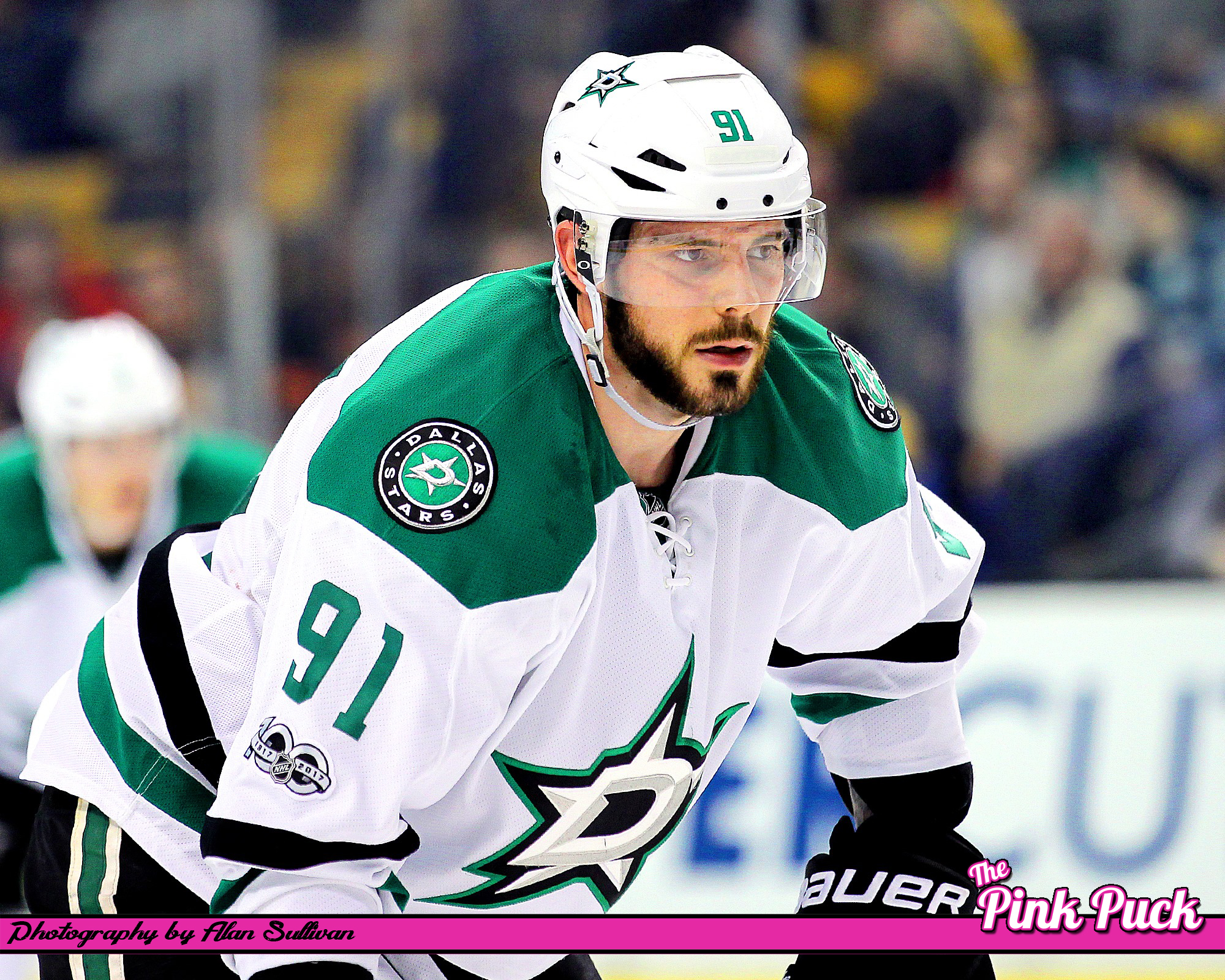
It didn’t take the Stars long to be a major player in free agency. The team signed right wing Joe Pavelski to a three-year deal, which should help to bring balance to the top two lines. The addition of Pavelski means that Benn, Seguin and Radulov can either play on the same line or different lines for match up purposes. The Stars have invited veteran forwards Scottie Upshall and Stefan Noesen to training camp. They have extended defenseman Esa Lindell to a new six-year deal. Mattias Janmark will be back on a one-year deal, while Jason Dickinson signed a new two-year contract.
The Stars also signed a few veteran players to low risk, high reward contracts. Corey Perry was bought out by the Anaheim Ducks and signed a one-year, $1.5 million contract with the Stars. Perry is looking to prove that he can still produce at a higher level after a rough season last year. Andrej Sekera’s contract was bought out by the Edmonton Oilers and he also signed a one-year, $1.5 million deal with the Stars. The two veteran players are looking to prove to not only themselves, but the League, that they can still play at a high level.
TRADES
There was only one trade for the Stars this offseason and it was a minor one. The Stars sent Tyler Pitlick to the Philadelphia Flyers in exchange for right wing Ryan Hartman. Hartman was a restricted free agent when acquired, but the Stars decided not to tender a qualifying offer to him, making him an unrestricted free agent. The trade made sense for the team because they could open up a roster spot for a younger player without having to use another buyout like they did with Valeri Nichushkin.
OVERALL GRADE: B+
The Stars added some scoring depth, improved a good defense, opened up a roster spot and made good use of the cap space that they had. Sure, there are some risks that may not pan out with Perry and Sekera, but they have younger players that can come up and produce, if need be. The one big contract that was given out in free agency was to Pavelski, who signed a three-year, $21 million contract. The Lindell extension was a good one because he is a key part of the defense and is young, mobile and can play solid defense alongside John Klingberg for a few more years.
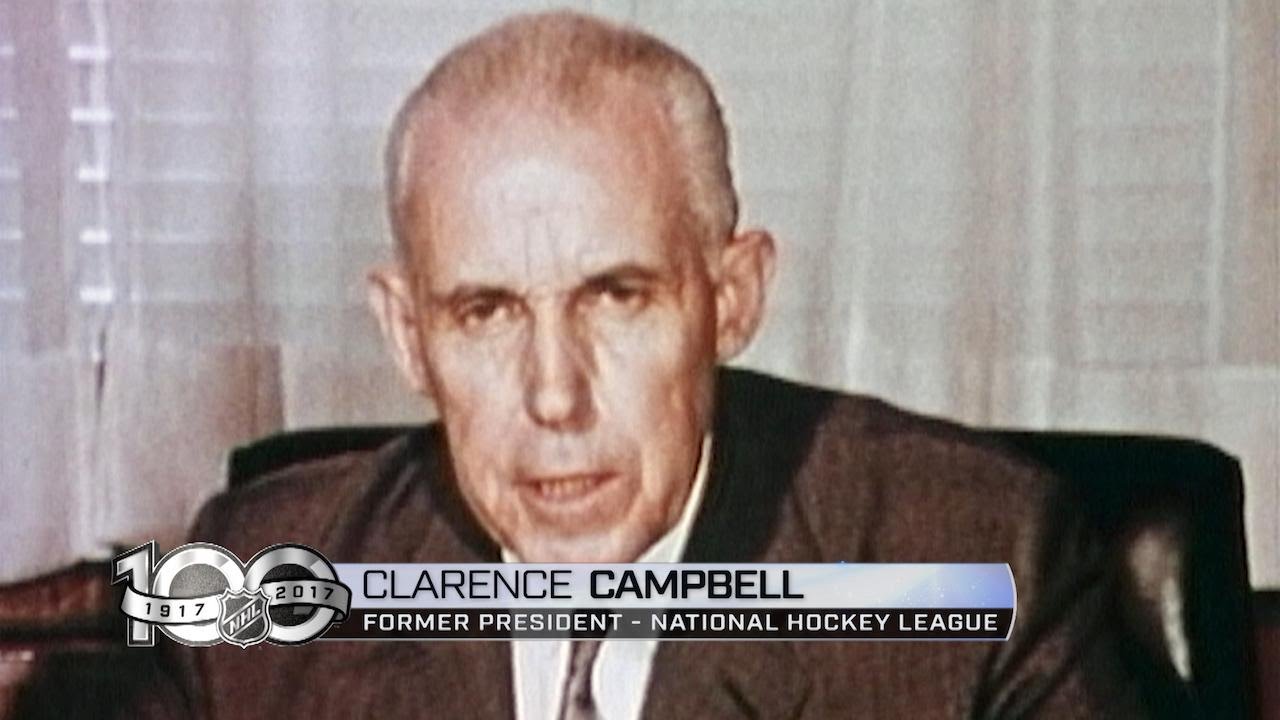
The succession was not supposed to happen so quickly, but World War II changed everything. When the President of the NHL resigned in a bit of snit, Clarence S. Campbell was announced as the new president on September 4, 1946.
Campbell’s primary profession had been that of a lawyer. However, he did work as an NHL referee between 1936 and 1940 (until Toronto’s Conn Smythe called for his removal). Although the NHL decided not to rehire Campbell as a referee, President Frank Calder invited him to work in his office and began grooming him in administration. The war paused Campbell’s career trajectory as he enlisted in the Canadian Army. He served for six years, during which time he received the Order of the British Empire, worked with the No. 1 Canadian War Graves Investigation Unit, and prosecuted at least one Nazi leader for war crimes. Upon returning from the war, Campbell became the assistant to Mervyn “Red” Dutton.
When Calder died suddenly, in May 1943, Dutton had been elected as the President of the NHL. It seemed that he really did not want the job since he tried to resign a few times. Despite signing a five-year contract in 1945, Dutton took advantage of Campbell’s return to step aside. He claimed, “I’m tired out. I haven’t had much home life and I’ve missed it. I want to drop anchor for a while.” The press cited “the increasing pressure of business interests,” like his construction company in Calgary.
In reality, Dutton’s departure had more to do with bitterness. Part of his agreement to preside over the NHL had concerned reviving the Americans franchise in Brooklyn once the war ended. They questioned whether that region could support yet another team, and Dutton had difficulties with financing and constructing an arena. He resigned when they denied his franchise request, but he recommended Campbell as his replacement.
At the semi-annual meeting at the Windsor Hotel in Montreal, the NHL approved Campbell as the new president. Despite whatever hard feelings he may have had, Dutton commented, “But I must say the governors gave me fine cooperation as head of the league. The press did, too, and I’m grateful for it. If they support Clarence Campbell the same way he’ll do a good job.”
In the official press statement, Campbell said: “Today’s developments were much more rapid than I had anticipated. It was my original understanding and my personal hope that Mervyn Dutton would have continued in the office of president for the ensuing year and at least for a few months. Like everyone else I appreciate how important it is for him to attend to his personal affairs at this time and I am very grateful to him for his expression of confidence that I should succeed him so rapidly and without any practical experience in administration of the National Hockey League. … In my new position I conceive it my duty to do everything possible to enhance its [hockey’s] prestige, not only in organized professional sport, but with the sporting public and the parents of the young hockey players, who will some day be the hockey greats.”
Campbell himself has been considered a hockey great. He served as president for 31 years, until his retirement on June 22, 1977. Over those three decades, he led the NHL in adding annual All-Star Games (beginning in 1947-48), increasing from 50 to 60 games (beginning in 1946-47) then 60 to 70 games each regular season (beginning in 1949-50), holding an annual amateur draft (beginning in 1963), and expanding to double the size (in 1967) and triple the size (by 1976).
Campbell was inducted into the Hockey Hall of Fame in 1966. With the first major expansion the following year, the NHL began awarding the Clarence S. Campbell Bowl to the winner of the Campbell Conference (which became the Western Conference as of 1993).
Additional Sources:
Mike Commito, Hockey 365: Daily Stories from the Ice(Toronto: Dundurn, 2018), kindle edition.
“Clarence Campbell Elected President of the N.H.L.” and ‘From War Trials to Presidency is Road of New League Head,” Montreal Gazette, 5 Sept. 1946, p. 12.
Dink Carroll, “Playing the Field: Red Heads for Home,” Montreal Gazette, 6 Sept. 1946, p. 16.
Signing restricted free agents was considered bad karma, as in negative consequences would follow. When the St. Louis Blues signed power forward Brendan Shanahan away from the New Jersey Devils, they offered compensation per the collective bargaining agreement. The Devils declined, and on September 3, 1991, the arbitration judge instead awarded them the Blues’ captain, defenseman Scott Stevens. Effectively, it turned into a Stevens-for-Shanahan trade.
The Devils had drafted Shanahan second overall in the 1987 Entry Draft, and after four seasons, he was finally starting to come into his own. Though they went through the effort of developing Shanahan, on July 24, the Blues swooped in and signed him to a two-year contract worth $1.6 million.
Per the CBA, the Blues ordinarily would have compensated the Devils with draft picks. However, the Blues had already pulled this kind of coup the previous year when they acquired Stevens from the Washington Capitals. At that time, they promised the Caps their next five first-round draft picks.
So instead, St. Louis offered New Jersey their backup goalie Curtis Joseph, winger Rod Brind’Amour, and two draft picks (in the third and fourth rounds). Blues GM Ron Caron felt they had made a fair offer. “We offered two good young players. I went at it defensively. If you put more than two players, they could say you’re unloading contracts. We didn’t want to do that. The picks: A lot of good players have been picked if you select the right way. These are important values.” Unaware of his fate, Stevens commented at the time, “I think St. Louis is being very fair about this. In fact, I think they’d be giving up too much.”
Devils GM Lou Lamoriello, who took a lot of flak for losing Shanahan, disagreed. “Rod Brind’Amour is a good hockey player who had a good year two years ago and had an off year last year, but he is a quality player. I personally felt Curtis Joseph really did not add to the package. I thought, if anything, he detracted from it.” Lamoriello concluded, “The draft picks are unknowns, and right now we’re dealing with a quality player in Shanahan, and we had to get a quality player in return. Draft picks are a way to build a team, not replace a player like Shanahan.”
The issue then went into arbitration, over which 72-year-old Judge Edward Houston of the Ontario Court of Justice presided and gave a 14-page ruling. According to Blues president Jack Quinn, “Ron Caron made the finest presentation I’ve ever heard.” Whereas Lamoriello and the Devils, he remarked, “made only one statement in regard to the players involved. They spent the rest of the time basically whining.” Quinn concluded, “We won the oral presentation hands down.”
However, Judge Houston ruled with Lamoriello, who had put the demand for Stevens in his sealed bid. Both sides felt that this was, at least, a short-term victory for the Devils. Lamoriello prudently said, “I don’t know if I’d call it a victory. The decision came our way, and it was what we wanted because of the circumstances. I don’t look at it as a victory. I think it was equalization.” However, New Jersey press did worry that this decision might scare general managers away from signing free agents.
The St. Louis Blues were shocked and appalled, seeing this as retribution. Quinn pondered, “It’s odd that the same decision affects the first two free agents to move in 70-some odd years. On the surface, at first glance, it appears to be somewhat punitive.” New to the Blues Shanahan was more blunt, “This was done to punish St. Louis in some way for what they’ve been doing.”
They could only look to the future. GM Caron commented, “We’re extremely pleased to get Rod Brind’Amour and Curtis Joseph back, and we’re extremely pleased with Brendan Shanahan. But don’t ask me what we’re going to do about our defense.” Quinn looked to the bright side. “We have an arsenal of good players. We’ve got good forwards. No one in the league is as good as us up front. We will survive.”
The person most affected by the decision was Captain Stevens. In shock, he commented, “I didn’t think my name would be involved. I was so thrilled we would be getting Shanahan. I never thought I’d be compensation. I was hoping to stay in St. Louis for my whole career.” He had signed a four-year $5 million contract with the Blues the previous summer. The Blues still had to give Washington four more first-round draft picks while the Devils had to pay the rest of Stevens’ salary. Caron snidely said, “For what they’ll have to pay Mr. Stevens, they could have had Mr. Shanahan.”
Stevens was not sure he would report to the Devils after he finished playing for the Canada Cup. Immediately after the ruling, he said, “I’m not sure I’ll go. I really haven’t had time to think about anything. I really don’t know what I’ll do. I’m shocked. … I understand that these people have decisions to make, but it’s tough to be treated like that, to be moved around without any say in the matter.” Lamoriello did not even want to consider the possibility. “I haven’t talked to him directly, but this is a quality kid.” Stevens decided not to report to camp at first, and it took three weeks before he relented.
In the end, the Devils had the more obvious success with Stevens, who became their captain from his second season there until his retirement with them in 2005. Under his leadership, they won three Stanley Cup championships.
For the Blues, Shanahan did hit personal highs in points, but they traded him in 1995. After a season with the Hartford Whalers, Shanahan really made his mark with the Detroit Red Wings. He was traded there on October 8, 1996 and proceeded to win three Stanley Cup championships before signing with the New York Rangers in 2006. Interestingly, Shanahan chose to sign with the Devils again on January 14, 2009, almost 18 years from when the Blues snared him.
Both Stevens and Shanahan were inducted into the Hockey Hall of Fame and ranked in the 100 Greatest NHL Players.
Additional Sources:
Mike Commito, Hockey 365: Daily Stories from the Ice(Toronto: Dundurn, 2018), kindle edition.
Dave Luecking, “Blues Lose Arbitration, Stevens,” St. Louis Post-Dispatch, 4 Sept. 1991, pp. 1A, 1D, 6D.
Jeff Gordon, “A Mellonhead Would Have Backed Blues,” St. Louis Post-Dispatch, 4 Sept. 1991, p. 1D.
Dave Luecking, “Stevens Hints He’ll Fight NHL Ruling,” St. Louis Post-Dispatch, 4 Sept. 1991, p. 6D.
John Dellapina, “Devils get their due,” Hackensack Record, 4 Sept. 1991, pp. D-1 and D-5.
The Colorado Avalanche managed to pull off the round one upset in the postseason but then lost in the second round to the San Jose Sharks. The Avalanche took care of business in the offseason and are a better team. There will be high expectations come the season, and they should be able to live up to them with the current roster.
The Avalanche needed a number two center and got one, which should take some pressure off the top line to produce as much as it had to last season. They needed some depth for the third and fourth lines, and that happened. They did lose one of their better defensemen in Tyson Barrie, but he would have cost a fortune to keep beyond this season. Also, the team has some young, talented defensemen who won’t have a problem eventually filling Barrie’s shoes.
FREE AGENCY
The two major moves in free agency added some depth and extended a young, talented defenseman. The Avalanche signed left-winger Joonas Donskoi to a four-year contract that has a $3.9 million cap hit. They also signed center Pierre-Edouard Bellemare to a two-year contract. The Avalanche are taking a chance on Valeri Nichushkin, who they signed after he was bought out by the Stars in the offseason.
A majority of free agency was spent re-signing key members of the team like defenseman Nikita Zadorov, forward J.T. Compher, and others to cap-friendly deals. The Avalanche also were busy upgrading the minor league system with some younger players and veterans. The biggest re-signing of the offseason has been defenseman Samuel Girard to a new seven-year deal which starts in the 2020-21 season.
TRADES
The team was busy in the trade market this offseason. They acquired left-winger André Burakovsky, who will be looking for a bounce-back season, from the Washington Capitals. The Avalanche acquired defenseman Kevin Connauton from the Arizona Coyotes but lost Carl Soderberg in the trade. Connauton will be the sixth or seventh defenseman on the roster this season.
The biggest offseason trade landed the Avalanche the second-line center that the team needed. They traded defenseman Tyson Barrie, forward Alexander Kerfoot and a draft pick to the Toronto Maple Leafs for center Nazem Kadri and defenseman Calle Rosen. Yes, the Avalanche traded away one of the better defensemen on the team but got back a solid second-line center, that can play a 200-foot game. Kadri is an effective player when he isn’t sitting in the press box because of a suspension.
OVERALL GRADE: B
The Avalanche made moves to improve the current roster and the minor league rosters. The team is taking some chances on players like Kadri, Burakovsky, and Nichushkin. Burakovsky and Nichushkin have the potential to be low risk, high reward players with a change of scenery. Kadri is going to have to learn to stay on the ice when it matters to be a more effective player.
I like what the team did in the offseason and they should be able to get to the Western Conference Finals with this roster. The biggest reason for giving them a B is that a key piece in Mikko Rantanen remains unsigned, as he is a restricted free agent. If the Avalanche can manage to get him signed, and in camp on time, then the final grade would be upgraded to an A-.
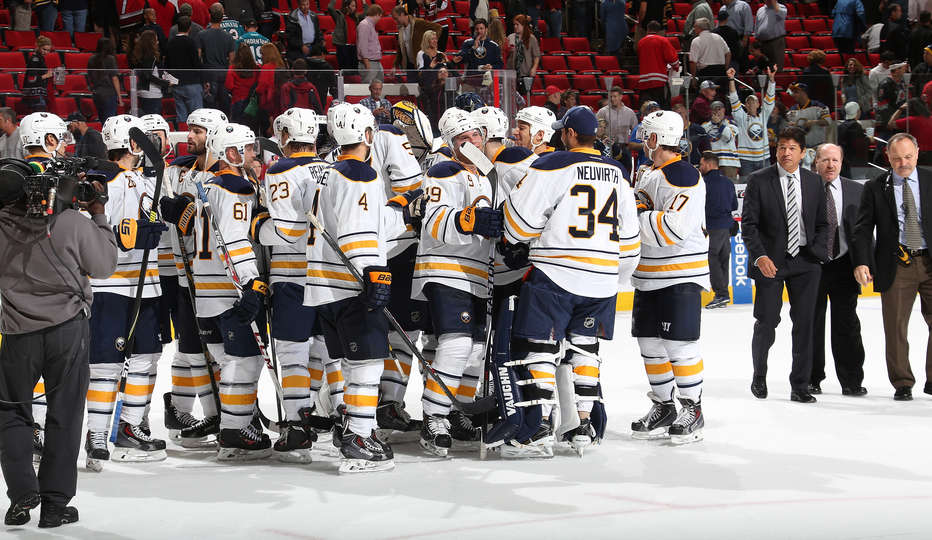
The Buffalo Sabres are coming off yet another disappointing season of not making the playoffs. The 2018-19 season started well for the team, but they just couldn’t sustain it for the entire year. Buffalo picked in the top seven of the draft instead of playing postseason hockey.
The Sabres started the offseason by firing head coach Phil Housley and hiring Ralph Kruger. The main goals of the offseason were to re-sign Jeff Skinner, improve the defense, and get some secondary scoring. It didn’t take a genius to figure out that the team was sticking with the goaltending tandem of Carter Hutton and Linus Ullmark. The Sabres managed to get most of these things done via free agency and trades but didn’t leave themselves any wiggle room as far as cap space.
FREE AGENCY
The first order of business was to get forward Jeff Skinner signed to a new deal, and the Sabres did just that with a new eight-year, $72M contract for the goal scorer. Skinner and Jack Eichel had good chemistry last season. The Sabres needed to add some scoring depth since the line of Sam Reinhart, Eichel and Skinner scored a majority of the points for the team last year. The defense needed to be tweaked and top four guys added to the roster.
The Sabres managed to sign left winger Marcus Johansson to a two-year, $9 million deal with a $4.5M cap hit in free agency to help with the top nine depth. The rest of the free agency period was used re-signing current players and improving the Rochester Americans, the American Hockey League Affiliate of the Sabres.
TRADES
The team made three big trades this offseason, and two of them were to improve the defense. The Sabres managed to acquire defenseman Colin Miller from the Vegas Golden Knights for two draft picks. The Golden Knights were experiencing some cap trouble and had to make someone expendable. The other trade for defensive improvement could be more of a benefit for the Sabres than the Miller trade. The team acquired defenseman Henri Jokiharju from the Chicago Blackhawks for forward Alex Nylander.
The other trade was to re-acquire forward Jimmy Vesey from the New York Rangers for a 2021 draft pick. The Rangers were looking to dump salary in an attempt to land free agent Artemi Panarin. Vesey’s speed and goal-scoring ability will help to establish a solid top nine for the Sabres. He will also help improve a struggling power play from last season.
OVERALL OFFSEASON GRADE: B
The team had an offseason plan and went out and executed it. They re-signed Skinner to a new contract. Yes, he may have been overpaid, but that’s the name of the game in free agency. The top nine depth was improved with the additions of Vesey and Johansson. The defense is much better with the acquisition of Miller and Jokiharju. The Sabres also made a point to re-sign some of its restricted free agents to one- or two-year deals. They also improved the Americans with some of the signings in free agency.
Canada felt that it was high time to compromise concerning international play. Back in 1970, Canadian Amateur Hockey Association (CAHA) began a boycott of all international competition through the International Ice Hockey Federation (IIHF). They found it unfair that they could not send professionals to represent the country when European teams were not upfront about the amateur or professional status of their players. Thus, Canada set up two Summit Series in which the NHL would play the Soviet Union in 1972 and the WHA would play them in 1974. These popularized the idea of a true best-on-best world championship in which players of any status could participate. Thus, the first Canada Cup tournament began on September 2, 1976.
Over the course of two years, a compromise was reached. Canada would compete internationally again, the World Championships would allow professionals, Soviet Union teams would play Super Series in North America, and the Canada Cup tournament would be held. The executive-director of the National Hockey League Players Association (NHLPA), Alan Eagleson not only organized those negotiations but also brought the association’s players and the NHL owners on board. The former were promised increased pensions, and the latter would receive half the proceeds from the tournament games.
The Canada Cup was scheduled for early September, before the NHL season started. The games would be played in Ottawa, Toronto, Montreal, Winnipeg, and Quebec City. In the U.S., Philadelphia also played host as a compromise to the Philadelphia Flyers, who put up a fuss about their players potentially being injured. The round-robin tournament would end with a best-of-three final.
Six teams competed in the 1976 Canada Cup – Canada, U.S., Czechoslovakia, Sweden, Finland, and the Soviet Union. All six flags were raised at the opening ceremony, and the Royal Canadian Mounted Police (RCMP) band played all six national anthems.
Naturally, Team Canada played in the opening game. The team was packed with NHL stars and the WHA’s Bobby Hull (who had been ineligible at the 1972 Summit Series). After the Summit Series had shown that Canada’s overconfidence was unfounded, they entered this tournament much more cautiously. In the opening game against Finland, held at Ottawa’s Civic Centre, they need not have worried.
Canada crushed Finland 11-2. Within the first 7:11 of the game, Richard Martin, Bobby Hull, and Phil Esposito all scored, and Hull followed up with a second at 12:20. Esposito remarked, “I’ve never in my life seen such pourin’ it on like that in my life. Clarke’s line set the pattern and we just followed.” As Coach Scotty Bowman explained, “We got those quick goals and that immediately took any pressure off. So the guys just naturally let up a bit. We needed all those goals. Under the tournament rules in case of a tie, it will be broken on goal average. This gives us a plus of nine right off the bat. We know what we have to do.” At the end of the second period, the Canadians already led 6-1. By the end, Martin had three goals and two assists, but he humbly commented, “I can’t say I played an exceptional game. I just happened to be in the right place at the right time.”
Hull kept things in perspective. “We can’t afford to go up against any of these teams and figure we’ll run them out of the rink. We have to work our butts off right from the start every time.” Of Team Finland, he commented, “I didn’t think they did too badly for a country that size. They don’t have that much to choose from. You ask me, sure they belong in the tournament. They’re a little country trying to improve their hockey.” Bobby Orr chimed in, “They’re pretty smart hockey players. They move the puck pretty well but by the same token our forwards really forechecked them.”
Team Finland knew they would be the underdogs, but they also admitted to being a bit out of their depth. A former NHL defenseman, Carl Brewer, served as their assistant coach. He originally joked, “We’re bringing over reindeer milk, our secret weapon. We couldn’t bring the reindeer themselves, because you know how Canadians are about customs.” More seriously, he explained, “Our guys were a little awed by the people they were playing against. They’re young and they’re inexperienced, and when we get behind against a team like that, we just haven’t got the depth of talent to come back.” Defenseman Heikki Riihiranata (member of the WHA Winnipeg Jets), added, “Our players aren’t use to this kind of play. Our goalie Antii Leppanen has never seen so many players in front of him. They don’t play like that in Europe. He complained that he couldn’t see the shots.” After the game, retired superstar Jean Beliveau presented an Eskimo stone carving to Matti Hagman as MVP of Team Finland.
Three issues cropped up during the game. One had to do with Canada’s captain, Bobby Clarke (of the Flyers), who collapsed at 4:03 into the third period. Grimacing from the pain, he said, “Nah, nobody hit me. I just tripped and fell and the thing (leg) got caught underneath me.” The doctor who looked him over thought he had stretched his achilles tendon but sent him to the hospital for x-rays. One of the men in the room as he was being checked said morosely, “If they lose Clarke for the tournament, Team Canada has lost its soul.” Linemate Bill Barber commented, “Jee’, I’d like to see Bobby come back. But these things happen and you just have to pick up the slack.” Defenseman Larry Robinson agreed, saying, “You’re always going to miss a player of Clarke’s caliber but the thing about this team is we’ve got guys like Sittler and Dionne (Marcel) who can go in and play just as well in that spot. That’s probably why the team was picked the way it was.” He ended up missing Canada’s second game, on September 5, against the U.S.
The other two problems concerned the arena. Of the about 9,500 in attendance, at least 150 (who had paid for better seats) had their view badly obscured by scaffolding erected for the RCMP band to play opening ceremony and period breaks. Then, during the final period, water came pouring down to center ice from the roof, leaving a puddle and softened ice. It was not raining, but the leak was caused by cleaners in the concourse overflowing a sink. The minor waterfall lasted for about five minutes.
Team Canada went on to defeat every other team besides Czechoslovakia, whom they then faced for the finals. In two hard-fought games, Canada came out of the tournament as the ultimate winners. Orr was named MVP, and Clarke was presented with the Canada Cup (by Prime Minister Pierre Trudeau). No less than 18 of the 25 members of Team Canada became Hall-of-Famers. The Canada Cup tournament was played four more times, until 1991.
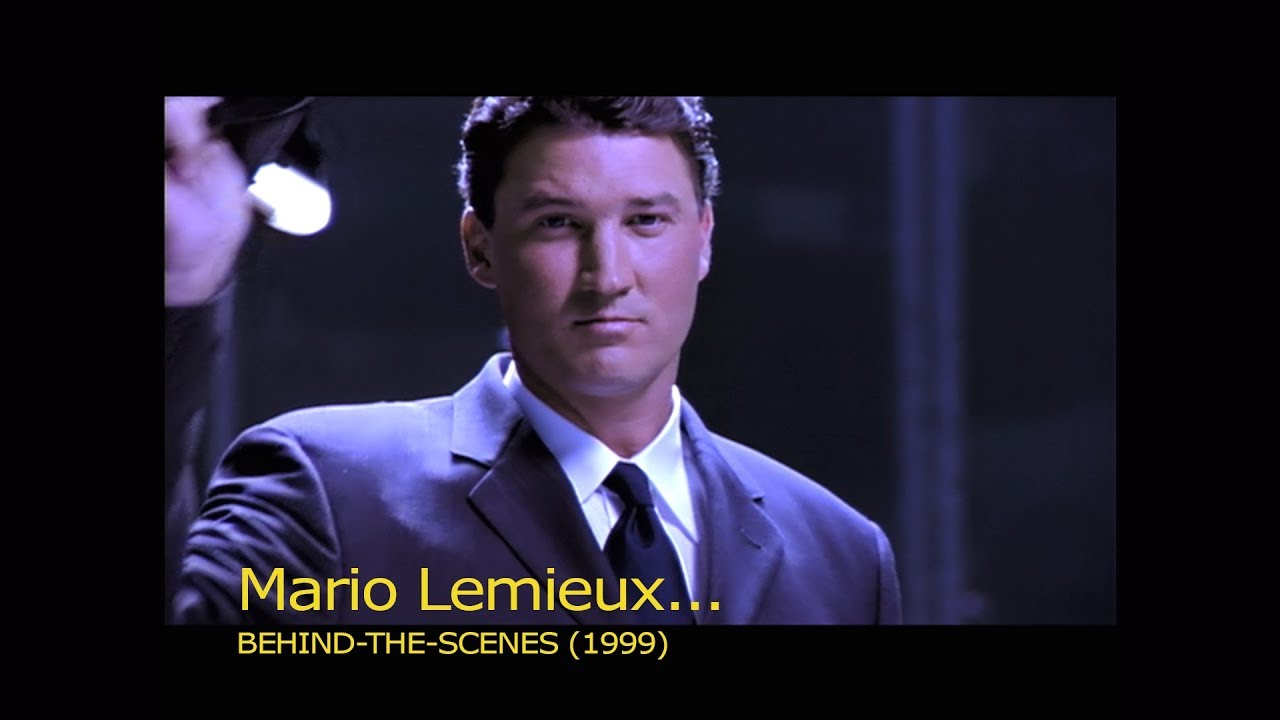
Some people only go up, never taking it easy. Mario Lemieux skated for 12 seasons with the Pittsburgh Penguins, retired in 1997, and was immediately inducted into the Hockey Hall of Fame. Other retirees might look for a nice hobby. Lemieux took the sour lemons of still being owed millions in deferred salary and turned that into the lemonade of saving the team from bankruptcy by becoming its owner. On September 1, 1999, the NHL Board of Governors approved Lemieux’s ownership application.
As Lemieux was heading into retirement, the Penguins were heading into financial disaster. They finally had to declare bankruptcy in November 1998. Everyone wondered whether they would relocate or even fold completely. They still owed their recently retired superstar over $32 million in deferred salary, which made him their largest creditor. Lemieux made an offer they could not refuse. He would turn $25 million into an equity stake to give him controlling interest in the franchise. As majority owner, he would insist on keeping the team in Pittsburgh.
Lemieux had not really considered owning a team when he retired as a player. “I think this was an unusual situation because of the team defaulting in my wages and the team going into bankruptcy. That gave me an opportunity to buy the Penguins. It’s pure circumstances. In a way, there’s a sad side of it, because I didn’t get paid for my services. But I certainly welcome the opportunity to come back to the game and be a big part of it.” As his reason for choosing to become an owner, Lemieux explained, “I think there’s a lot of upside to the game. I see the future as very bright for the NHL. At the same time, it was important to me to keep the Penguins in Pittsburgh. They’ve been a big part of my life for 15 years.”
In order to own the team and dig it out of bankruptcy, Lemieux (with his group of investors and attorneys) had to jump through a lot of hoops. First, back on June 24, they received preliminary approval from the U.S. Bankruptcy Court to go forward with the plan. The attorneys then had to work with the insurance companies, who were owed a total of $22 million.
On August 31, negotiations with the Civic Arena landlord, Spectacor Management Group (SMG), lasted from 7:30 am to 1 am. Lemieux’s attorney Doug Campbell commented, “This came down to the wire. It’s like, don’t try this trick at home.” With these last-minute talks, Lemieux agreed to pay SMG $1.5 million (at closing) so that SMG would not seek damages. In addition, SMG would have a seat on the nine-member board of directors but would not have a partnership interest in the Penguins. Around the same time, Lemieux and Fox Sports Pittsburgh worked out a deal for Penguins’ coverage.
The NHL Board of Governors met at St. Regis Hotel in Manhattan at 1 pm on Wednesday, September 1st. Before Lemieux could even say anything about his application for ownership, he knew things would go the way he hoped. “I walked in and they all stood up and applauded.” Commissioner Gary Bettman explained, “Mario as a player has generated a great deal of respect. And I think people were delighted that the effort has been made, as only Mario could have done, to save the Penguins in Pittsburgh.” Penguins GM Craig Patrick praised, “Mario’s got more character than anybody I’ve ever met. … He’s got so much drive and determination that it’s going to be a thrill to work for someone like him.” The NHL Board not only approved his application, they voted for it unanimously at 30-0.
By that point, Lemieux’s group of investors had added to his $25 million for a total of $52 million to put towards the purchase. They hoped to find more investors to raise another $10-$15 million more. Lemieux said, “We’ve been talking to a lot of people lately, and I think most of those people wanted us to close first and see the final documents. I think we have a good opportunity to go out and raise more money and make this a solid franchise.”
The final step to pulling the franchise out of bankruptcy was a hearing scheduled for September 3. U.S. Bankruptcy Judge Bernard Markovitz also had to approve the sale. The court liked Lemieux’s plan to ensure all creditors (including Societe Generale bank, Bank of America, co-owner Roger Marino, unsecured creditors, and the NHL) received payments. With the court’s approval, Lemieux officially owned the Pittsburgh Penguins, making him the first former player to become owner of a major professional sports team.
Naturally, Lemieux was glad it had all come together. “It’s a great feeling and a big relief. Bankruptcy is a very difficult process. I had no idea it was this difficult to put a deal together. There were a lot of different parties … SMG, Fox, all the banks, the senior lenders … there were a lot of moving targets. That’s what made this so difficult, especially down the stretch. That’s why I’m just glad we were able to put everything together. Even in the last couple days, there were things that needed to be resolved, and they were.” As for himself, he remarked, “I’m certainly excited to come back to the game after a couple years. It’s really a dream come true. After these last 10 months of working hard on this deal, trying to keep the Penguins in Pittsburgh, I’m very excited about the opportunity.”
With his new role, Lemieux would serve as president, chairman, and CEO. He planned to focus on the business side and let GM Craig Patrick handle the hockey side. “That’s where I’m going to spend most of my time and surround myself with some smart people, people who have been successful.” He felt that his perspective as a former player would benefit him both with the NHL Board of Governors and as team owner. “I think I have some pretty good ideas to make the game better for the players and the fans and for television. Hopefully, I’ll have some input in the future, but I’m still a rookie in this game.” He felt that more athletes may look to invest in teams, but he advised, “They’ve got to have their hearts set on it, which I did from the start. And that was natural for me because I spent my whole career in Pittsburgh.”
By and large, Lemieux’s plan worked. In the first season, the team actually managed to scrape their way into the black with a small profit. Within the first six years, the Penguins were able to repay all their debts.
Most would assume there is no place to go but downhill from there. Not for Lemieux. In 2000, he decided to return to the Penguins as a player, becoming the first player-owner in modern major professional sports. He even became captain again in 2001. Though plagued by injuries, Lemieux remained a player until retiring again on January 24, 2006. As a player and owner, he had to juggle some points of conflict. For example, he paid dues but was not a member of the NHL Players Association, and he had a VP vote in owners’ meetings. When a sale for the team fell through in 2006, Lemieux not only has remained owner but also ensured (thanks to an arena agreement) that the Penguins would stay in Pittsburgh for at least the next 30 years. Since then, Lemieux’s team has won him three Stanley Cup championships.
Additional Sources:
Mike Commito, Hockey 365: Daily Stories from the Ice(Toronto: Dundurn, 2018), kindle edition.
Dejan Kovacevic, “One More Step and It’s Mario’s,”Pittsburgh Post-Gazette, 2 Sept. 1999, pp. A-1 and A-3.
“Penguins Win Approval,” Pittsburgh Post-Gazette, 2 Sept. 1999, p. A-3.
On August 31, the Minnesota North Stars gave up a player and gained another in 1992 and had a former player retire in 1999. In the earlier part of the decade, Minnesota traded scorer Brian Bellows to the Montreal Canadiens in return for the more-consistent Russ Courtnall. At the end of the decade, Dino Ciccarelli (who had started off with Minnesota) wrapped up his 19-season NHL career.
The 1992 trade was essentially completed on Saturday, August 29 but announced (to the players and the press) that Monday, before the Canadiens’ golf tournament at Elm Ridge. The two players swapping teams had their perceived weaknesses highlighted by their former general managers and their skills praised by their new management.
Bellows
Bellows had been drafted 2nd overall in 1982 and began skating with the North Stars within three months. In his ten seasons, he had scored 30 or more goals in seven of them. He set a franchise record for goals (342) and came in ranked second in assists (380) and points (722). Going into the option year of his three-year contract, with a salary of $750,000, he was almost traded to the New Jersey Devils. Instead, the day before his 28th birthday, the North Stars sent him to Montreal.
Minnesota’s new GM, Bob Gainey, never seemed to get on with Bellows, and the two even shouted at each other during the season. Gainey went on a bit of a tear about his reasons for punting Bellows. “It was a question of us trying to find a player with something different, something we didn’t have in Brian, that would help us be a better team. We’re trying to create a different outlook for our team and move ahead in the Norris Division. Brian is a skilled player, an individual player, a good offensive player; no one can argue against his ability to score. But the record over the period Brian was here wasn’t very good, and he has to be held accountable. He was a first draft pick, he was perceived as the best player on the team, and the record doesn’t reflect well on him. … It’s time to take the risk and find another player who can help us improve our position.” Gainey continued, “There’s no doubt that he can put points up on the board, but he hasn’t been as consistent as you like him to be. There are times when he’s as good as any player on the ice and his playoff record indicates that he has picked some good times to play well. But our biggest problem here is that we don’t have a good record in the regular season.”
The news reached Bellows while he was playing in a golf tournament. He responded, “I had planned to talk to Bob Gainey next week about my future with the North Stars. I did get a call last week from (Montreal general manager) Serge Savard, asking me if I’d be interested in playing with the Canadiens. I told him I’d consider it if everything could be worked out from a contract standpoint. I had sent a wire to all the Canadian clubs telling them I would not play hockey in Canada, but the Canadiens are something special.” Bellows began making plans. “Though I preferred to stay in Minnesota, I still will make my offseason home there and continue to go to college at St. Thomas. I love the area. I’m not bitter. I had 10 good years in Minnesota, and now I’ve got a new challenge.”
The Canadiens seemed quite pleased to welcome Bellows. Savard merely commented, “We had hoped to improve our offence and the two players we got in the past few days (Bellows and Vincent Damphousse) are players we expect to produce in our system.” Coach Jacques Demers had a lot more excitement to share, exclaiming, “We were looking to add 80 goals to our offence in the off-season and we may have got 100.” He clearly thought they had the better end of the deal. “Bellows is a better hockey player than (Russ) Courtnall. He’s a physical player, not in the sense that Shayne (Corson) is a physical player, but he can take care of himself,” he explained. “Nothing against Russ Courtnall, but Brian has the reputation of coming to play every night, a guy who gives a maximum effort. This coach is a happy man.” Demers also made something of a promise as to encouraging Bellows. “I’ve heard that he needs a tap on the shoulder. But we’re going to make him feel important, just like he was when he was a top pick in the draft.”
The trade had an immediate effect. Bellows scored 88 points his first season with the Canadiens, and they went on to win the Stanley Cup.
Courtnall
Meanwhile, Montreal had traded Courtnall to Minnesota in return. He had been drafted 7th overall in 1983, being just nine months younger than Bellows. After four years with the Toronto Maple Leafs, they traded him to Montreal on November 7, 1988. That first season in Montreal, he was under the captainship of Gainey, who retired as a player at the end of the season. Courtnall was about halfway through his four-year contract of $830,000 per season.
Courtnall really did himself in with the Canadiens. In June, he went to the press demanding a trade to the Los Angeles Kings so that he could live in his new Hollywood home with his wife, actress Paris Vaughan. He even threatened to retire if the Canadiens did not make the trade, and he began working out with Kings players. Savard apparently told Courtnall’s agent that he “tried to trade [him] to Los Angeles, but there was no room there.” Savard felt that Courtnall cared more for his wife’s career than his own. “Looking at our club, if Russ had been 100 percent dedicated to hockey, we wouldn’t have had to make this deal.” He continued, “You can’t let a player dictate to you. We took the best deal we could get.” If not for this trade, Canadiens captain Guy Carbonneau intended to make Courtnall apologize to the team for what he had been saying. At learning of the trade, Courtnall said, “I’ve been dealt a hand, and now I’ve got to go out and play it and be as positive about it as I can.”
Having captained Courtnall, Gainey overlooked the player’s issues from Montreal. “His chief asset is his speed and his skating. I wasn’t concerned when the injuries weren’t related to his lower body; they can be washed away because this wasn’t his year. He doesn’t come with a clean slate. He had some other personal problems in Montreal and wanted to leave there. And there was some risk on our side as to whether he would accept (the deal) and look forward to coming to Minnesota. I spoke with him today. He told me he is excited about coming here and is ready to look for a place to live.” Most of all, Gainey praised, “Courtnall learned in Montreal what it means to play within a team and compete every night. He’s a consistent player, and he fits in well with the rule changes on coincidental penalties.”
Though he was “surprised, even shocked,” Courtnall commented, “Now I’m looking forward to Minnesota. It’s a whole new game in Minnesota. Bob (Gainey) told me you really have to concentrate to maintain a high level of hockey interest, and where the big change is for me is that I’ve played in the two major hockey cities in Canada, and now I’m finally playing for a team in the United States.”
As it turned out, Courtnall only played that initial season in Minnesota before the franchise moved south to become the Dallas Stars. During those two seasons with the franchise, he earned career highs in points (79 then 80). The Stars, in April 1995, traded Courtnall to the Vancouver Canucks, who traded him to the New York Rangers in March 1997. Finally, on November 7, 1997, Courtnall was able to sign with the Los Angeles Kings as he had wanted. He finished the last two seasons of his career there. Meanwhile, Gainey’s Dallas Stars won the Stanley Cup in 1999.
Ciccarelli
A couple of months after that 1999 Stanley Cup Final, Dino Ciccarelli announced his retirement. He had begun his NHL career with the Minnesota North Stars back in 1980-81, when the team went all the way to the Stanley Cup Final. With his 21 points in 19 games, Ciccarelli set a playoff rookie record that still stands. Minnesota traded him to the Washington Capitals in March 1989, and he played there for about 3.5 seasons. A couple months before the Bellows-Courtnall trade, in June 1992, Washington traded Ciccarelli to the Detroit Red Wings, where he spent four seasons. After being traded in August 1996, he spent parts of two seasons with the Tampa Bay Lightning and parts of the next two with the Florida Panthers. He scored his 600th goal on February 3, 1998, joining a club of only ten players to reach the milestone by 1999.
The Panthers bought out the final year of Ciccarelli’s contract after he had only been uninjured for 14 games that final season. All of the injuries stemmed from back issues, like a hairline fracture in his back. He told the Sarnia (Ontario) Observer, “I tried skating a bit last week and the same soreness and stiffness was there. There’s no use kidding myself anymore.” He commented to another newspaper, “I’d love to be able to play, but because of the injury, it’s not strong enough. It’s the same nagging thing that had me laid up in bed unable to move last season.” From his home in Yale, Michigan he reflected, “I’ve always heard people say you will know when it’s time to call it quits. I know for sure it’s time for me to go.” Ciccarelli made the official announcement through the NHL Players’ Association by stating, “It is with regret that I have to retire from the game I love. I have been fortunate to have a long career in the NHL and I will always appreciate the experience of playing in the NHL.”
As his final GM, Bryan Murray paid tribute to Ciccarelli. “He brought such emotion to the game, and fire. When I try to motivate a young player to be more competitive, I often have said, ‘Just look at Dino. Show up and play hard like him.’ Courageous players score goals, and he’s one of the most courageous players I’ve ever seen.” Ciccarelli remained more humble. “I had a knack for scoring goals and going to the net, but I wasn’t an overly skilled player. I didn’t have a great shot, and I wasn’t a great skater by any means. You know, I wasn’t even a great stick-handler. What it was, I think, was I used to try to just go out there, work hard, play for my teammates and play a feisty game.” Still, he retired eighth in career hat tricks (19), ninth in goals (608), and 28th in points (1200). Among the North Stars franchise, at the time, he still ranked fourth among all-time scorers (with 651 points).
Ciccarelli said his future might include color commentary or scouting but definitely becoming more involved with the Ontario League’s Sarnia Sting that he owned with his brothers, Rob and Larry. “I loved this game as a kid. I loved it as a pro. I’ll continue to love it when I’m retired.” After such a career, Ciccarelli was inducted into the Hockey Hall of Fame in 2010.
Additional Sources:
Mike Commito, Hockey 365: Daily Stories from the Ice (Toronto: Dundurn, 2018), kindle edition.
Rachel Blount, “Stars trade Bellows,” Minneapolis Star Tribune, 1 Sept. 1992, pp. 1C and 3C.
Sid Hartman, “Next big trade could come from Wolves,” Minneapolis Star Tribune, 1 Sept. 1992, p. 2C.
Pat Hickey, “Unhappy Courtnall off to Minnesota” and “Both coaches badmouth their players after deal,” Montreal Gazette, 1 Sept. 1992, p. E1.
Michael Russo, “Ciccarelli quits: 19 years, 608 goals” South Florida Sun Sentinel, 1 Sept. 1999, p. 5C.
“Bad back forces Ciccarelli to retire,” Detroit Free Press, 1 Sept. 1999, p. 2E.
“Ailing back sends Ciccarelli into retirement,” Baltimore Sun, 1 Sept. 1999, p. 2D.
“Ciccarelli retires after 19 years,” Minneapolis Star Tribune, 1 Sept. 1999, C2.





 Prev
Prev