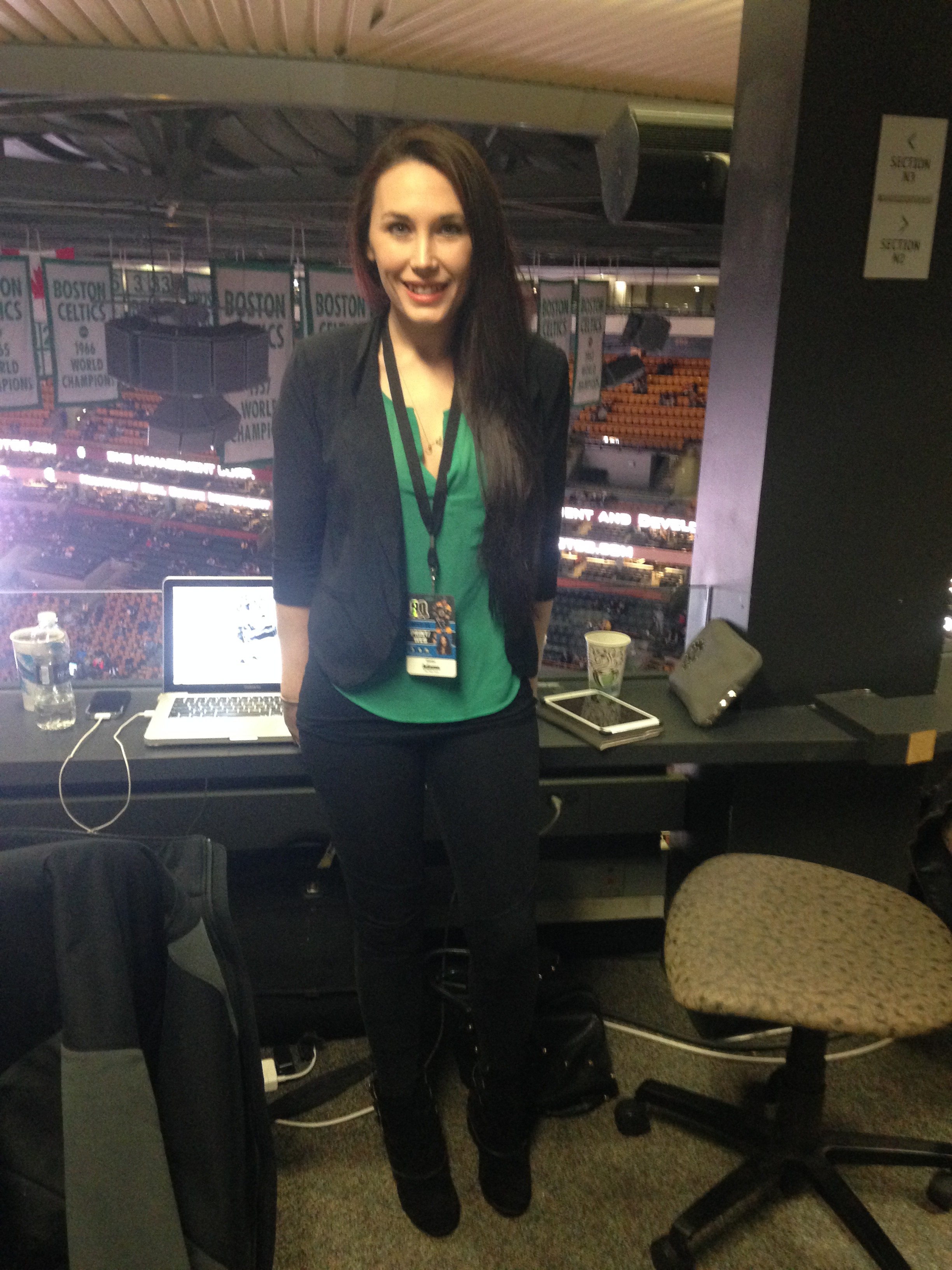
Matinee starts usually instill a feeling of more casual press level attire. But today’s contest against the Edmonton Oilers will be followed by Boston Bruins Casino Night to benefit the Bruins Foundation, that means an outfit that would be acceptable for not only the game, but the event following.
Which led me to an internal debate, skirt, dress or pants. Ultimately, I went with pants because I’m a tomboy at heart and the idea of having to wear a dress or skirt for multiple hours on end wasn’t a happy one.
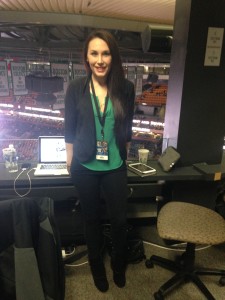 Breakdown:
Black skinny leg dress pants, Ann Taylor, $32
Black blazer, Macys, $21.99
Green blouse, Sears, clearance, $6
Black angle wedge boots, Aldo, clearance, $19.99
Media Tip: Perhaps you’re like me, and you enjoy tea as a coffee alternate on occasion… throw a few tea bags into your bag, so that way when they run out of them or press level you have a backup! This honestly happens more than one may think, just saying.
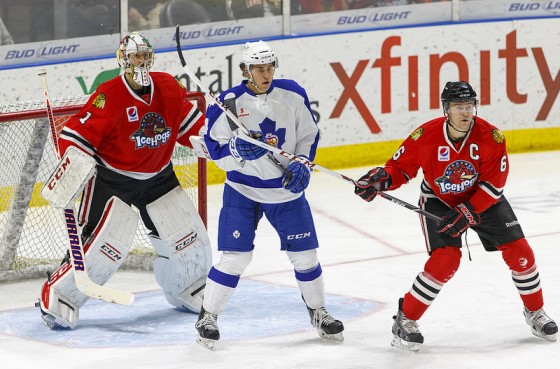
The Rockford IceHogs skated almost half the season without having named an official captain. Instead, they were using a few assistant captains that worked together. A couple weeks ago, that changed when they named Jared Nightingale.
“Obviously anytime that you’re recognized, whether it be by your peers or a group, especially as captain of a hockey team, it’s quite humbling,” he said on being named captain. “I didn’t expect that. I’m thrilled and really excited about the opportunity to help our team make the playoffs.”
Nightingale, a 31-year-old defenseman from Cheboygan, Michigan, is playing in Rockford for the first season. It was something that he had not expected. Although he’s held a leadership role in the past, it is the first time he has captained an AHL team. As someone just on an AHL contract, it came unexpected when there are other great leaders on two-way contracts throughout the roster. But, he knows what is important for the team in order to be successful.
“I think it might be kind of cliché but you want to be the same person you’ve been. So I guess away from the rink, it’s important to have a bond with your team. The teams that go the farthest are always the teams that want to fight to the last second,” Nightingale said. “They want to keep the season going as long as possible. I think that’s important but that’s not just the captain that does that. It’s got to be everyone pulling the same weight, even away from the rink.”
The bond that a hockey team has is something that many people undervalue. But if the players don’t care about each other off the ice, they won’t want to play for each other on it. Through his time with other teams, Nightingale has picked up a few things that he brought with him. After last season with the Syracuse Crunch, he started a bowling league in Rockford. He also continued his years of having a Christmas party, something he has always had but they did not seem to have already in Rockford. He hopes that will make the team more successful.
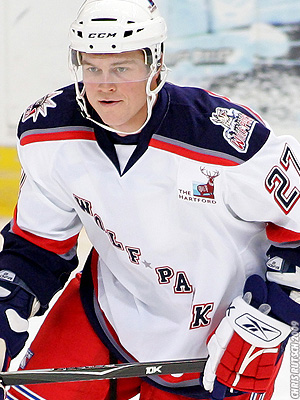
“In my last year in Hartford, we had a really close team. The guys all came together and we were actually really close to beating Norfolk who went on to win the Calder Cup. I think the closeness of a team is one of those things people don’t appreciate as much as really matters,” he said.
“We’ve been struggling a little bit of late but I’m a big believer that we can learn from that. We have a young group and good character guys. I definitely see a process going on that we can have a strong second half,” Nightingale said.
This is the 8th season for Nightingale playing professional hockey and he has spent that time between the ECHL and AHL so far. For the past few seasons, he has been in the AHL full time. During his time, he has learned a lot about what can make it a challenge playing in this league.
“I think the challenge in the AHL is you have a handful of guys that want to be up, in our case with the Blackhawks, which isn’t wrong at all. Then there’s another group of guys that are stressing out about getting sent to the ECHL,” he said. “As a guy that’s been around, a good leader can try to keep the team’s mind in Rockford and in the present. It doesn’t do any of us any good to dwell on the what-ifs. The off-ice stuff is so important because you build a bond and friendships.”
It all comes back to that off-ice dynamic of the team and he feels like as a captain, he can help that by leading by example. That is not the only role of a captain, though, and he has had the benefit of learning from some really great leaders over the past few years.
“I’ve had a lot of great leaders and I could go on and on. But there are a few that stick out to me. Last year’s captain (in Syracuse), Mike Angelidis, was one. He’s not known for putting up a lot of points but he’s a team-first guy and you wouldn’t appreciate him as much unless you had him on your team. I learned a lot just by watching how he dealt with the day-to-day stuff leaders go through,” said Nightingale. “Then probably the biggest influence I’ve had in pro hockey has to be Wade Redden. Obviously he had an unbelievable NHL career. Then he ended up getting sent down to Hartford by the Rangers for two years. I never heard him complain about it. He was still one of the first guys to the rink and one of the last to leave. As talented as he is, he was an even better person off the ice.”
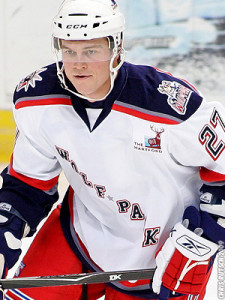 Getting to play with Wade Redden had a huge impact on Nightingale. The two spent the better part of two seasons in Hartford as a defensive pairing and Nightingale opted to wear 6 this season in tribute. One of the greatest lessons he learned was how important it is to work hard and make the most out of every situation. Complaining about things outside of your control will never help you in the long run.
“You can always find reasons to complain in your first or second year in hockey. There are times you think you should be up in the NHL,” he said. “When you face that early adversity, if you have the right mind set, it’ll only help you down the road. Hockey is a small world and you don’t want to burn bridges.”
Adversity is certainly something that Nightingale is all too familiar with. That is probably what makes him such a great leader because he can tell younger players about what he went through and how he overcame it. The first challenge for him was tearing his ACL. It came right at the beginning of his professional career and he did not let it stop him from chasing a dream.
“At the time, I was pretty upset but I had a good support group with my parents and my brothers. You always have to look at the glass as half full, though. I had an AHL deal that I lost. I was hungry to improve. I’ve been playing this game since I was 5 years old and I always had a dream to at the highest level,” he said.
“Why should I give up because of an injury? Every player goes through injuries and I really do believe that injuries and everything else you go through helps shape you as a person,” Nightingale offered. “It can also make you, if you allow it, a better hockey player. That’s exactly what happened with me. I learned to appreciate everything. I’m still a work in progress though. I’m not perfect.”
After losing that AHL deal, Nightingale did what he had to do to get another chance: he played in the ECHL. His brother, Adam, got him a shot playing with the Charlotte Checkers, who were still in the ECHL at the time, because he had played there the season before. Over the next couple seasons, he had to battle a lot to get to where he is now. But, his teammates undoubtedly benefit from that experience now.
Nightingale spent the majority of the 2007-2008 season in the ECHL recovering from his surgery with only two brief AHL call-ups. To start the next season, he found himself in training camp with Hartford, only to get cut. He got the call after about a quarter of the season and stayed up. The next season started the same way. He got cut out of camp again and earned his way back once again. Finally, for the 2010-2011 season, he earned a full-time spot in the AHL and has not looked back since.
“At the time, I was really bitter and I used that as motivation. It happens a lot, so I like to share it with the guys. A lot of guys give up during times when they could actually take a lot from it. Even today, I’m really thankful to be here in Rockford and be a captain and have the chance to work with younger guys. I’m also working on myself, you’re never done improving,” Nightingale said. “I still have a dream to play in the NHL. I know that it’s slim, but I believe things happen for a reason. I wouldn’t trade getting sent down to the ECHL or getting cut by teams in the past for anything. Those experiences are what shapes your character. Those are the things that develop your mental toughness, which I definitely think is a strength of mine.”
Making it into the AHL from the ECHL full time is not an easy task, which is something that Nightingale recognizes. During his time there, he landed on something that got him noticed: fighting. That has been something he has kept doing since.
“For me, I broke into the AHL because I was willing to fight or at least step up and defend my teammates. I didn’t win every fight but I don’t think that’s the most important thing. The coaching staff in Hartford appreciated my hard work and willingness to step up, Nightingale. “It’s kept me in the AHL and I’m really thankful. There are a lot of good players in the ECHL too but it’s so tough to crack the AHL when you’re not drafted, like I wasn’t, and stay in the AHL. I feel really fortunate that things have worked out.”
After his time in Hartford, he headed to Syracuse to play with the Crunch for the 2012-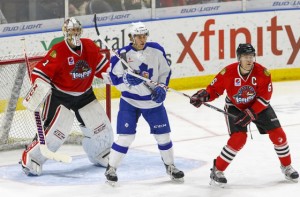 2013 season. Prior to that season, their NHL affiliation had changed. Syracuse now held the prospects from Tampa Bay, the same prospects who won the Calder Cup during the 2011-2012 season in Norfolk. The result was that the team had a lot of talent again and went all the way to the Finals where they lost to Grand Rapids.
“I didn’t dress at all in the playoffs and there were 20 games during the regular season, too, that I didn’t play because I was scratched. We had 8 defensemen on NHL contracts in Syracuse and I knew that we had a special team,” he said. “It would have done no good for me to show up to the rink and complain because I wasn’t playing. Five years from now, we might not remember who led our team in scoring, but they will remember what type of teammate or person you were.”
Despite not getting to play at all in the playoffs and having to sit during the regular season, Nightingale says that the learned a lot from being part of the team. Although another contract was not on the table in Syracuse for this season, there was an offer on the table.
“I didn’t get offered a contract there but actually, the Syracuse coaching staff wanted to see if I was interested in coaching. They wanted to see if I was ready to hang them up, which I wasn’t quite yet,” Nightingale said. “The contract came up in Rockford and I think it’ll be a unique story and hopefully I can get that NHL game I’ve always dreamt of.”
The opportunity in Rockford has been one that Nightingale has really enjoyed. Not only does he have the chance to play with some great veterans like Wade Brookbank, Brad Winchester, and Jason Labarbera, who recently joined the team, but he also is working with a great group of younger guys. His role as a captain and a leader is to help the team succeed.
“I think it’s really important for younger guys to have a leader. I think the most rookies I’ve ever had on a team is 6 and we have something like 12 this season. There are a good group of us too though. We have a great group of core guys that I think are good for the young guys we have,” he said. “You go through the growing pains and ups and downs. You cant really put a price on having a good core group. Our team has been taking steps in improving. I’m excited to see where we can go for the second half.”
With so many younger players, a player like Nightingale becomes even more important. He has really been through a lot and loves to share his story. Many younger players struggle with the idea of spending time in the ECHL. It was actually a great experience for him. It gave him the chance to work on some things that he has struggled with.
“The biggest thing for me was skating. It’s something that maybe didn’t come as easily for me but since college I’ve had a power skating coach. I think confidence is another big thing for me. You have to believe you have the tools to play in the AHL or NHL even,” Nightingale said. “Hockey is a game of confidence. When you feel confident, you go out there and you want the puck instead of just wanting to get rid of it. The biggest leap I made from the ECHL to the AHL was when I had someone believe in me. I had that in Hartford and I had a role there.”
The Rockford IceHogs will look to finish strong in the second half of their season as their new captain continues to provide strong leadership. One thing is certain, though. Jared Nightingale has a lot to offer the team both on and off the ice. He does not take any chance for granted and believes in working for everything that he gets.
Until he hangs up the skates, Nightingale will still be chasing the same dream that he has had since he was just 5 years old. He wants an NHL contract and to play in that one game. Although he recognizes that he’s older than most guys getting their first look, he has seen it happen. He is not ready to give up.
I sit here tonight, listening to the dismal San Jose Sharks game. It’s 2-0 Calgary and the San Jose Sharks haven’t scored a goal since their ECHL Minor League Affiliate San Francisco Bulls closed the barn doors on the season, 32 games away from a full second season, on Monday morning. Tonight, I should have been at a Bulls game watching a heated rivalry between San Francisco and the Stockton Thunder, but instead I found myself lost, mourning the death of grind-it-out-in-the-corners hockey in my backyard.
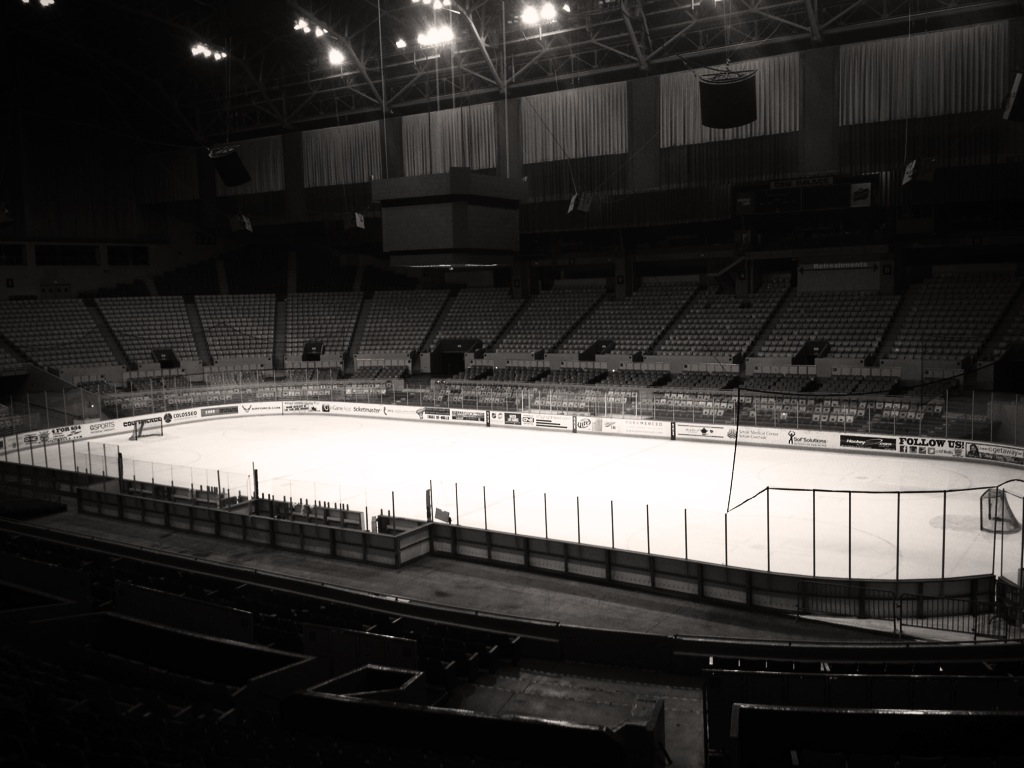
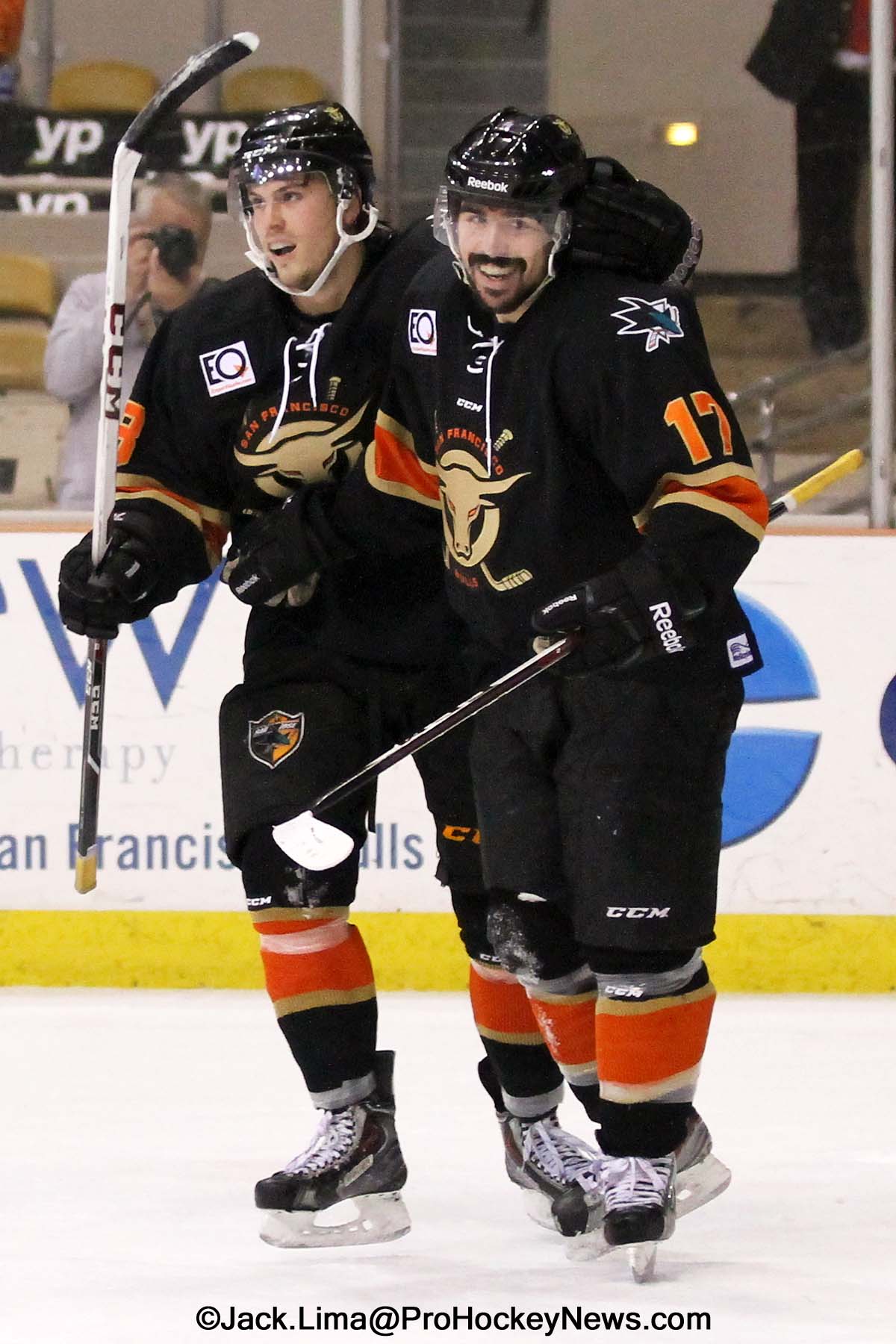
The San Francisco Bulls follow in the skate tracks of other teams who have tried to make a go of it at the venerable Cow Palace, where hockey teams go to die: The California Golden Seals, the San Francisco Shamrocks and the San Francisco Spiders, gone but not forgotten from the hockey fabric of the City by the Bay. People say this isn’t a hockey town, but I disagree. If that were true, it’d be easy to get ice time at the local rink. The Bay Area rivals the state of Minnesota for adult players, and the San Jose Sharks wouldn’t consistently sell out if this area didn’t love its hockey.
The Bulls benefited immensely in their inaugural season with the NHL lockout and the hockey starved made the trek to the Old Barn. Ryane Clowe shared the bench duties with Head Coach Pat Curcio and former Shark now Minnesota Wild forward Torrey Mitchell called the Cow Palace his home ice for a brief moment in time.
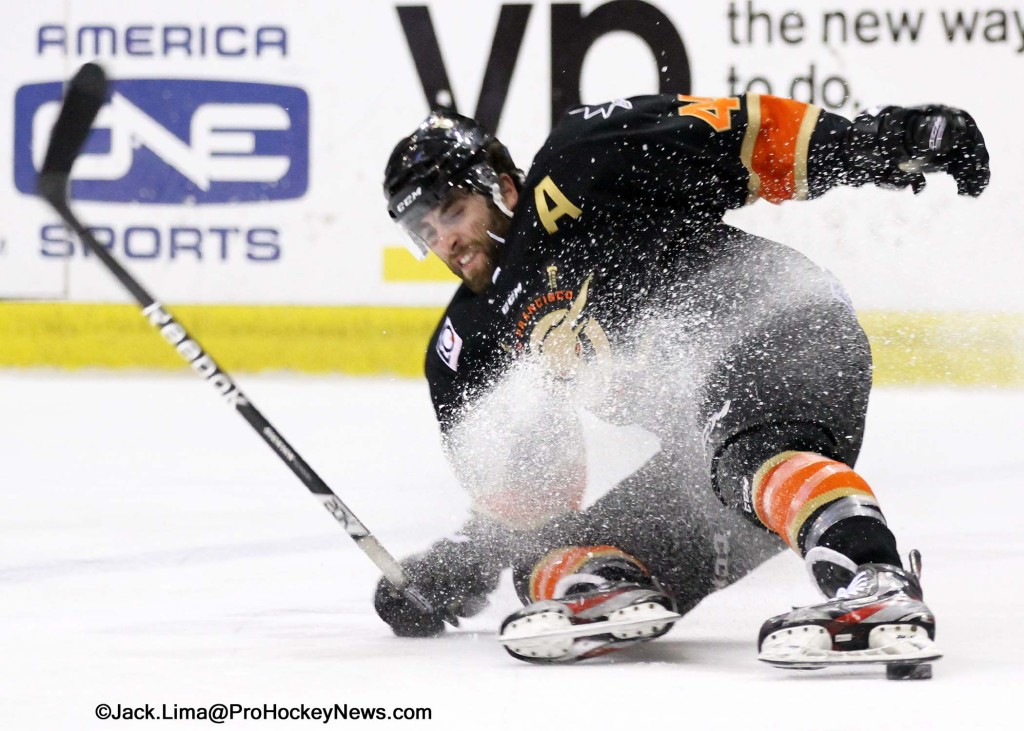
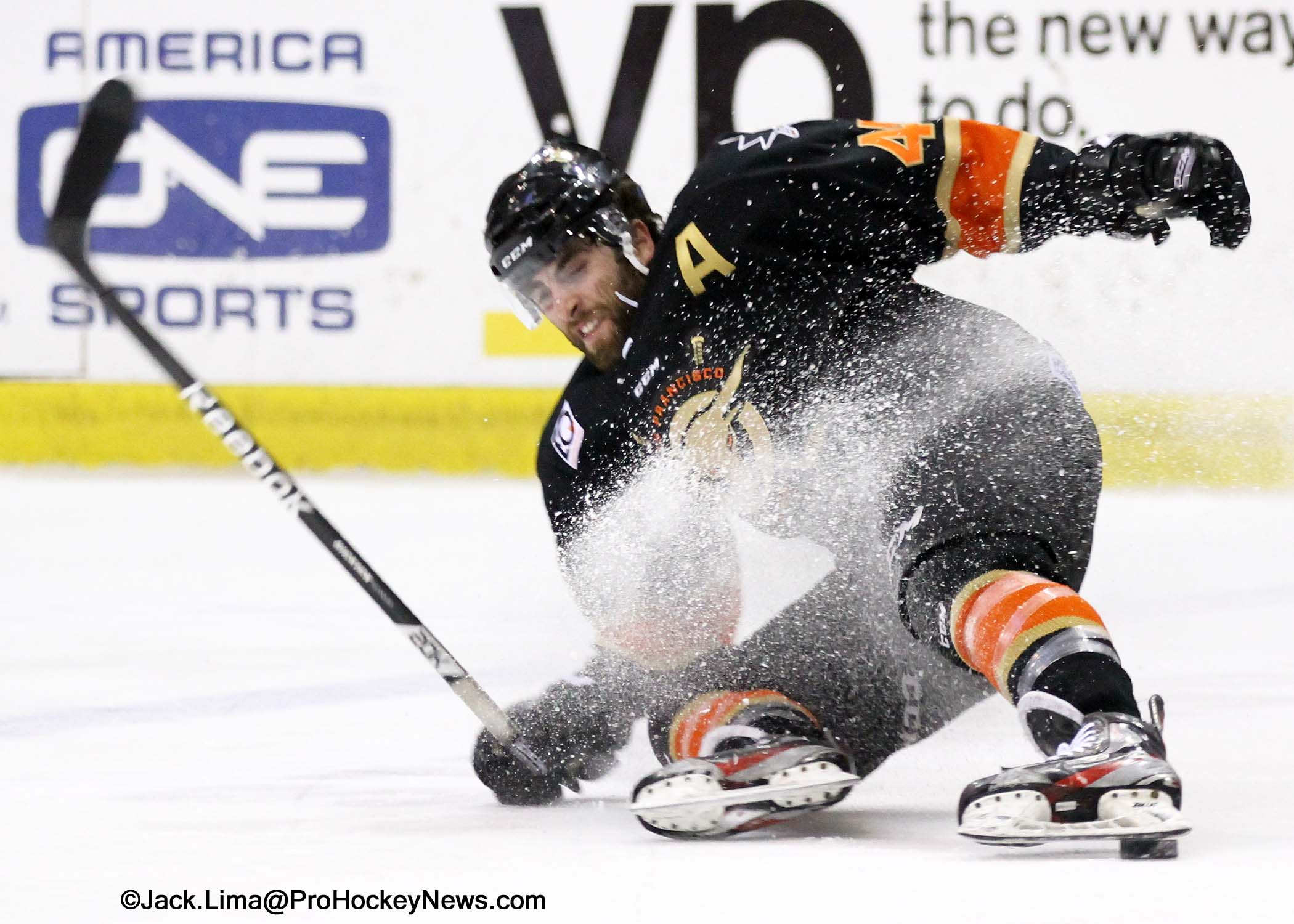
ECHL All-Star Dean Ouellet, now playing for the Fort Wayne Komets
One can’t just point the finger at attendance in their second season, which fell significantly, as the main contributor to their downfall. It was probably the most noticeable to the casual fan and was a drag for the players, who played their hearts out every game night for their dedicated fans. No, there were many complicated details and drama, that put together, caused the team to fold. There is no point in dwelling on it now, what is done, can not be undone. It seems the way of things here in the city, San Francisco. There is only room for the Major Leagues (read: rich), the minor leagues (read: everybody else) have been pushed to the fringes, pay or pack.
I have been a hockey fan since the Sharks took roots in San Jose, but I did not truly fall in love with the game until I watched minor league hockey. Every night in an ECHL game, a player has something to prove, they are playing for their career. Their fans are a dedicated lot, suffering through the highs of high scoring games and the lows of players traded faster than horses. A minor league team becomes a part of the community like a major league team just cannot be. The players are people, not just abstract athletes, who have lives beyond the game.
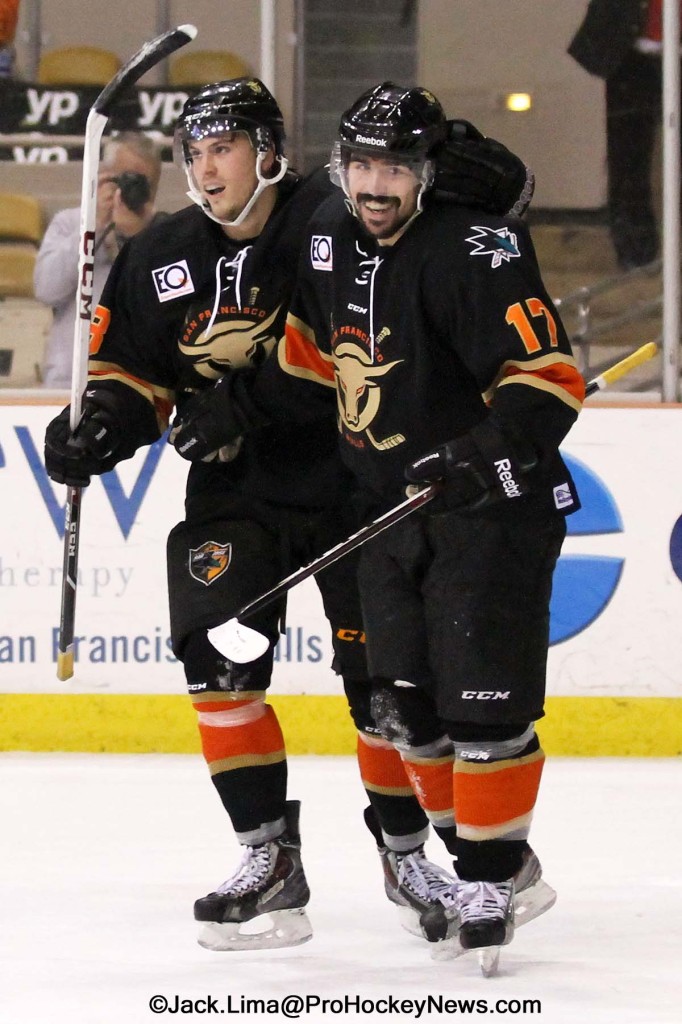
Dale Mitchell (R), now with the South Carolina Stingrays
celebrates the OT goal with Sebastian Stalberg,
now playing with the Ontario Reign
The team became a part of my family and indeed as a part of the Matadors Booster Club we tried to be that “home away from home” for the players. I cooked for them, I shopped for them and yes, I even cleaned for them. I got to know them, as people, their likes and dislikes. It broke my heart to see my family all of a sudden scattered like leaves to the wind, with what seemed like so little warning to the coming storm.
The signs were there, we just chose to ignore them to stave away the inevitable truth. They weren’t just a team, they were my friends. Friends talk candidly, boldly. When the paychecks didn’t come, it was a sign. When players left to go back to Europe, it was a sign. The eviction notices, they came too, but still we all held out hope that somehow, the dream that Pat Curcio had to bring back hockey to the Bay wouldn’t die.
Coach “Curdog”, your dream won’t die, hockey is here to stay. The Bulls gave the community so many gifts in their brief life and infused a new generation with a passion for the game.
They inspired me to go behind the game, to dig deeper, and share the game I love as a writer.
Thank you San Francisco Bulls. I still Bull-ieve.
Feel free to ask anyone, who has even casually known me, from when I was a toddler all the way up through my college years. They’ll confirm: I hate uniforms.
To be more specific: I can’t stand being told what to wear. Ever.
When I got my very first job working at a gym, where I was required to wear the company polo and a pair of yoga/track/workout-able pants, I yearned to wear a pencil skirt and heels.
When I got my first desk job, where I was relegated to dress pants and was forbidden to sport any kind of a sleeveless top, I dreamed of days my boss was away so I could rock a billow-y blouse and leggings.
This contrary attitude definitely has roots in my tween years, when I learned that the dance studio I grew up at required me to take at least one ballet class a week in order to be on the jazz competition team.
The thought made me cringe. Not just because I was a hip-hopper with terrible turnout. But because I had to suit up in one of the most recognizable uniforms in the history of mankind: a black leotard and pink tights, with my hair pulled tightly into a bun. An ensemble that all five-feet-four-inches of me could not pull off if I tried.
So when I finally made it to the sports-writing promise land in my mid-twenties, I was delighted to find that—unlike some professional sports’ leagues where reporters in denim cut-offs seems to be a problem—the NHL didn’t have a rigorous dress code that I had to follow.
In my mind I was doing cartwheels. I can literally wear whatever I want! As long as I don’t look like a hot mess, I can dress however my little heart desires!
… And what did I do with that newfound fashion freedom?
I created my own work uniform.
That’s right. This newly-credentialed sports’ geek found a way to implement a few style musts that I now use as a go-to guide for dressing to cover the San Jose Sharks home games.
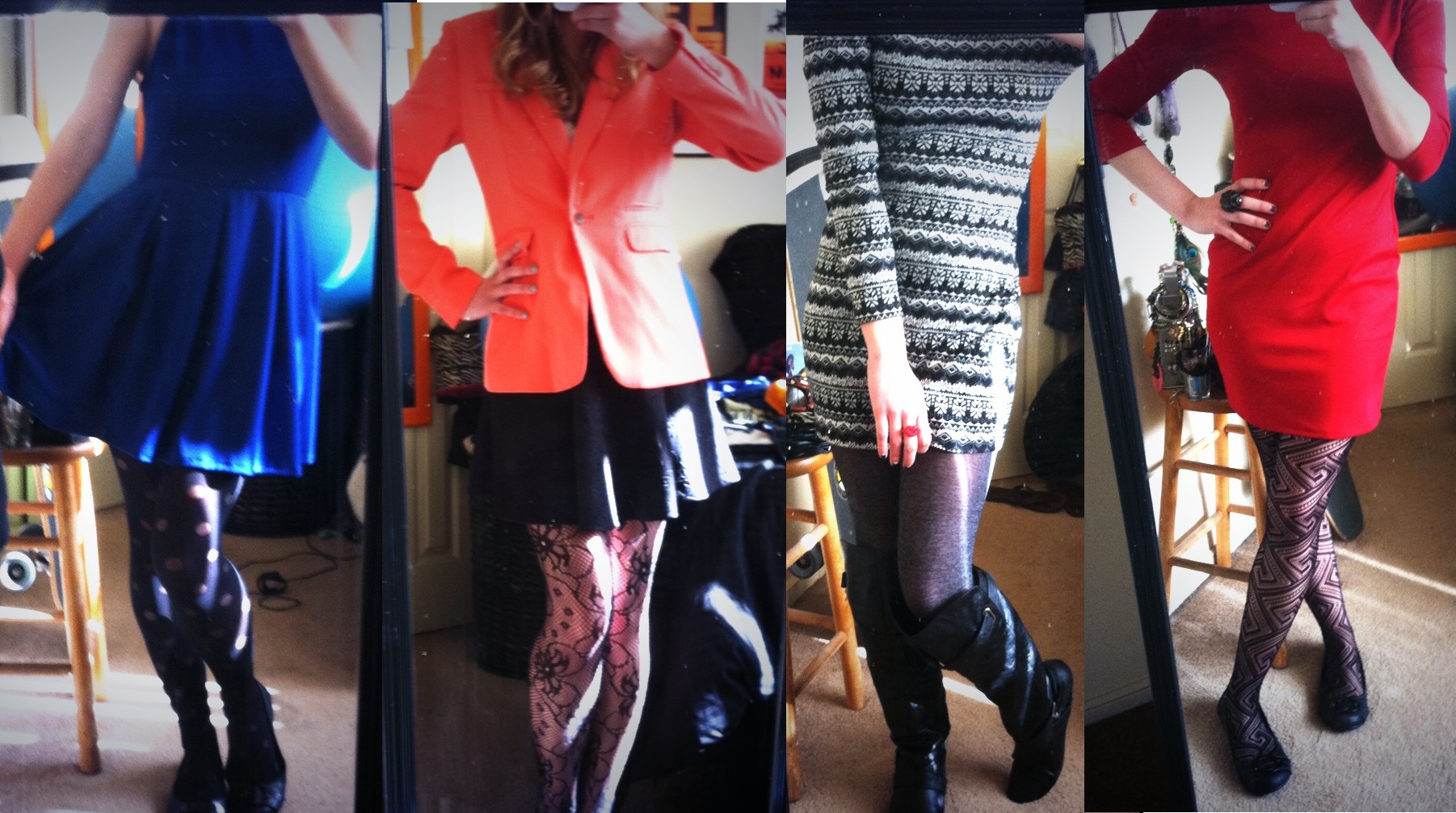
And—as if all those times at the ballet barre had never existed—my biggest work wardrobe staple became: a chic and affordable pair of tights.
Picking out my girly outfits the night before a game is as much a part of my routine as discussing the forecheck over coffee between first and second period. I feel better equipped to critique the contest on the rink far below the press box when sporting a smokey eye inspired by the print on my mod sweater dress. A pair of over-the-knee boots paired with my polka dot stockings almost guarantees that I’m rocking thick-knit legwarmers underneath, so I can keep warm no matter how icy it gets sitting behind my laptop at the Tank.
The cuter I feel in my workday duds, the more confident I am walking into that smelly dressing room post-game to shove my recorder in tired, sweaty, toothless hockey players’ faces.
And, although a colossal part of my career includes “playing with the boys,” there’s nothing that will make me blush and curtsey quicker than someone telling me that I “look great” at work.
So I invite all of you out there in Pink Puck Land to join me as I paperdoll myself through the rest of this hockey campaign and beyond. If you have outfit questions, or ensemble ideas that I haven’t thought of, then by all means send them my way. We can bond over a killer ballet flat as much as we can over a great backhanded shot or a game-changing save between the pipes, right?
Just, please, don’t suggest that I pull out an old ballet leotard. Certain things should just stay far away from press level fashion.
Some game nights you find yourself with plenty of time, others with little to none or like today — plenty of time wasted with my nose in my Learn French book. By the time I wrapped up French lessons, the time to head to the rink had fast approached. So, in the light of honesty, my press level ensemble weighed heavily on what articles were dry enough after my mid-afternoon load of laundry… aka, the same outfit I wore out with friends this past weekend. Little to no thought and sometimes, that’s just the kind of outfit you need for rivalry night.
*Note -In all the excitement of the Original Six match up, I forgot to have someone take my picture. So, I resorted to a terrible selfie in my mirror at home. The photo features a lovely cameo from my best friend Ryder the pup!
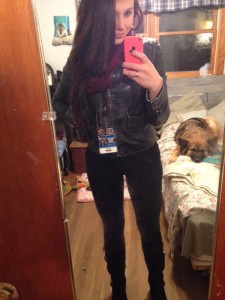 Breakdown:
Black leggings, Nordstrom Rack, $15
Black and white striped shirt, Target, $16.99
Black boots, Sears, clearance, $12.99
Black leather jacket, Germany, Price unknown
Maroon scarf, gift, Price unknown
Media Tip: Carry Advil in your media bag, because you never know when a headache may strike and the noise of the rink won’t help your cause.
Photo: Avalanche
The Colorado Avalanche have signed goaltender Semyon Varlamov to a new five-year contract extension that goes through the 2018-19 season, the team announced today. The 25 year old Russian native will be pulling $29.5 million, or $5.9 million per season.
“Undoubtedly, Semyon has been an impact player for us this season,” said Avalanche Executive Vice President of Hockey Operations Joe Sakic. “At only 25 years old, he is entering the prime years of his career and he wants to be part of this franchise moving forward. We are very excited to have come to terms with him and the fact that he has agreed to a five-year extension demonstrates his commitment to the Avalanche and what we’re trying to accomplish.”
Varlamov has been thriving under first-year coach and Hall of Fame goaltender Patrick Roy, posting a 26-9-5 record with a 2.43 goals-against average. He’s second in the league in saves (1,199) this season and his 26 wins already match a career high.
He will represent Russia at the Sochi Olympics next month.
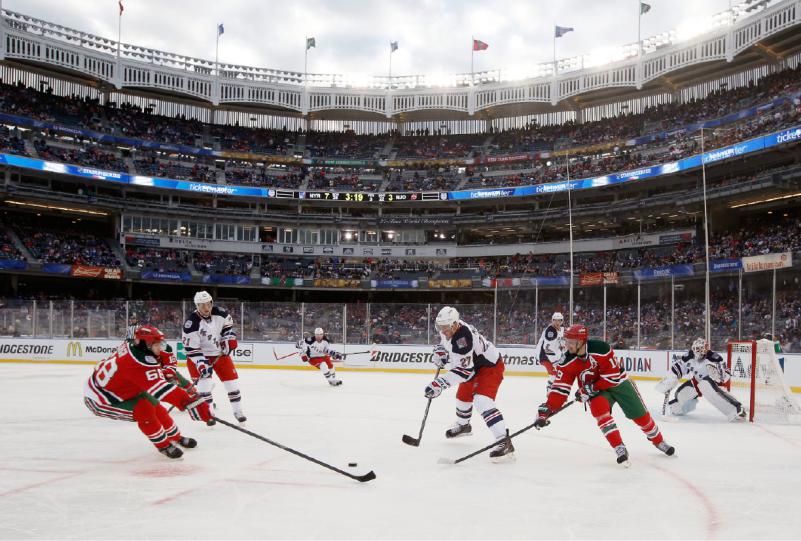
With outdoor games growing more and more popular, the NHL introduced the 2014 Coors Light ‘Stadium Series’. Rivals claim their bragging rights by bringing the game outdoors, exactly like both the Winter Classic and Heritage Classic outdoor games. The Rangers, Devils, and Islanders traveled to the Bronx to play at Yankee Stadium. The Anaheim Ducks and LA Kings played at Dodger Stadium, and the Pittsburgh Penguins and the Chicago Blackhawks will play at Solider Field on the first of March.
The Rangers beat their Hudson River Rivals in an amazing 7-3 victory. It was a slow start for the Rangers as they fell to 3-1 by the end of the first period. Eventually they found the net and kept the goals coming. One of those goals included a penalty shot: Ranger centerman Derek Stepan beat the Devils new addition at goaltender, Cory Schneider. In an opportunity to take the second place seed in the Metropolitan division, the Devils fell short. Still behind Pittsburgh by a heavy 15 points, the Rangers remain in the second place seed.
After an excitingly offensive game against the Devils, the Blueshirts were confident going into the next game verses their biggest rival, the New York Islanders. The “Battle of New York” rivalry between these two teams dates back to the early 1970’s. The self-assured Rangers came out on top again, beating the Islanders 2-1. However, the Islanders deserve some credit. Goaltender Evegeni Nabokov, now 38 years old, made 32 saves in the Islanders loss. It was the first game back for the veteran net minder since sustaining a lower-body injury earlier this month.
The much-needed four points the New York Rangers gained from the series keeps them safely in second place, and sixth in the Eastern Conference with 61 total points.
Finally, you’ve decided to get off the bleachers and hit the ice. Making the choice to cross the gap from fan to player can be a difficult one, we’ve outlined some tips in our article, Is it Possible to Become a Player this Late in the Game, but once the choice has been made you’ll never look back. Of course you probably thought making the decision to play was the hardest part, but then came the dreaded realization that you need equipment.
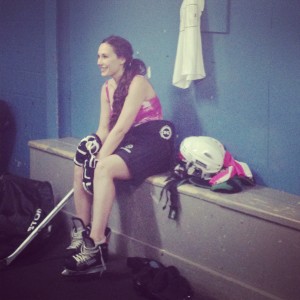 Duh, you need equipment to play. Any beginner in the game gets anxious when it comes to picking what suits you best, what you actually need and how to go about getting it. Some of us have infinite bank accounts, others have a tighter budget to work with, the good news is, the options for getting equipment are almost endless. Whether it’s top of the line, slightly used, or well loved, the breakdown is the same. If you’re female, you’re going to need the following:
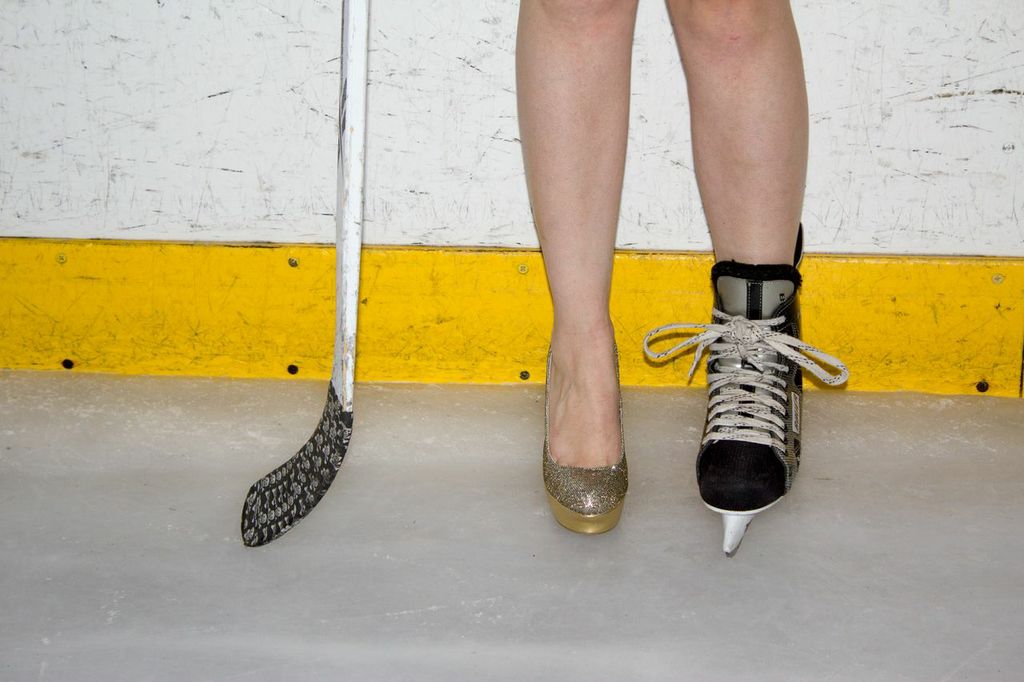
Stick, they say when wedding dress shopping the dress picks you, when you know, you know. The same theory can be applied to stick shopping. The debate over composite or wood has been ongoing, but truth be told a wood stick will certainly suffice (and save you some dough) if you’re just starting out. Don’t be afraid to pull out and test each and every stick in the aisle that catches your eye. Test it with a pair of gloves on, test it without, ask a store employee for a puck or ball to play with in the aisle. Your stick is one of your greatest tools, so make sure it’s going to suit you for the long run.
Skates, it’s a no-brainer that your skates are the most important piece of equipment, they make you a hockey player. Choose wisely, because even when you aren’t suiting up for a game, you might be using them at a public skate as well. You’ll use your skates more than any other piece of equipment you own! Focus on finding a skate with a good fit and a boot stiffness level you can live with. If heat molding is an option, take it. Heat molding shapes the boot to your foot. The skates are warmed in a special oven and then put on your feet for about 20 minutes, which molds the inner lining to the foot. It helps to ensure a “perfect” fit.The store will do an initial skate sharpening and some places may throw in a few extra if you ask.
Gloves, make sure they fit you, like a glove. Hockey gloves are certainly something you’ll get used to over time, initially they feel a little odd, that’s normal. Many women have smaller sized hands, junior sized gloves often do the trick.
Helmet, you aren’t going to be skating in the big show anytime soon and chances are you value your teeth -so, wear a cage. Many women’s leagues require it. Sure, it might look silly, but ensuring your face stays bruise and break free is well worth it.
Mouth Guard, you’re probably wondering why, if you’re already wearing a cage, do you need to wear a mouth guard as well. The helmet protects your head when it slams into the ice, the boards, another player… but the mouth guard will help prevent your teeth cracking together upon impact.
Shoulder Pads, make you feel like a linebacker in the NFL, it’s a fact. But they protect you on impact from tough hits, this is a necessary piece of equipment. Wearing a larger junior size has proven to be a better fit over the years. Women don’t often have broad shoulders and the junior sizing seems to mimic the female frame a bit better than the senior sizing.
Elbow Pads, it doesn’t matter if you’re new to hockey, or you’ve played the game your whole life… you will repeatedly, fall on your elbows. Just because you’ve got the extra padding, try to avoid getting two minutes in the sin bin for using them on your opponents. Elbowing, it’s a real issue.
Jill Strap, just like men wear jock straps to protect their private areas, women wear Jill straps or pelvic protectors to serve the same purpose.
Shin Pads, made to protect what else, your shins. Shin pads give you armor from over your knee all the way down to the top of your skate. They feel awkward until you get used to them and that might be quite a few games and practices in. Be warned.
Hockey Pants, padded pants that assist your body in the art of falling down. Seriously, it doesn’t matter how much junk you’ve got in the trunk — hockey pants will prove to be life savers. Not only are they required, but why would you want to skate without a built in airbag?
Hockey Socks, no, they aren’t socks with little team emblems on them, they’re big, thick, knitted socks that cover your shin pads. They often reflect the color of your team, but many players own them in varied colors and mix it up for practices and learn to play programs.
Jersey, the name on the front, is a hell of a lot more important than the one on the back. But as a player, you’ll have team jerseys and then blank colored versions as well. Over the lifetime of your hockey “career”, you’ll more likely than not own a rainbow of jerseys.
Hockey Bag, the black hole for your equipment. You’ll lose pieces of equipment on a nightly basis and have to rummage through the bag that’s most likely bigger than you are to find it. They come in over the shoulder versions or rolling versions. If you’re going to play the game without getting chirped, probably pick the aforementioned variety. Nothing is worse than a hockey player rolling their bag into the rink.
Equipment Tips:
Relish in the fact that as women, we often fit in junior sized equipment.
Purchasing equipment online is a fantastic money saving solution, in a game where fit is important, try to find the same make and model at a local store to try on before you buy, that way you’re certain of which size to order.
You’ll also need, stick tape, t-shirts, Under Armor/ sweat wicking clothing, regular socks and shower supplies.
Be prepared to own your rink stink, it’s an inevitable part of the game – although we outline a few suggestions to help in our article, Change Your Rink Stink Life Forever… you, your car, your loved ones and your equipment will thank us later.
Most importantly love the game, because it will absolutely love you back.
What Patrick Roy has done in Colorado as a first year coach is nothing short of remarkable. He has taken a team who could not keep the puck out of it’s own net, who finished the 2012-13 season with the League’s second-fewest points (39), and turned them into one of the best teams in the league! Should the success continue, it’s hard to imagine anyone but Roy winning the Jack Adams award, the annual coach’s award presented by the NHL Broadcasters’ Association to the coach who determinedly contributed the most to his team’s success.
Patrick Roy was hired this summer by new Executive Vice President of Hockey Operations, Joe Sakic, and has been the biggest reason for the Avalanche’s resurgence. “When I took this job, and I knew I had to find a coach, Patrick was always my top candidate,” Sakic said when he introduced Roy as the new coach May 28, 2013, “Patrick has a great hockey mind, he is a tremendous coach, and there is no one more passionate about this game. He’ll bring a winning attitude and help this young team grow, and I know he’ll get the best out of each player.”
What has made Roy such a good coach so fast? Above all, players say he coaches with a teaching style, “He explains things to you, how to make things he wants done actually work,” veteran defenseman Jan Hejda said, “and if you want to ask a question or even suggest something, he listens.”
When Roy told his new team that he wanted to be their “partner,” he seemed to take things to a new level. Instead of standing off to the sideboards checking his watch and having his assistants fish pucks out of the corner, at practice Roy is often right there in the middle of it, skating right along with the players and calling out instructions.
Roy’s famous temper was on national display opening night when he blew up at Anaheim coach, Bruce Boudreau, and nearly pushed the glass partition separating the benches down on his head. It had a great effect on the team. Here was a coach ready to fight for them after four years of Joe Sacco, whose hands-in-pockets, passive-aggressive demeanor wore the players very thin!
In addition to the culture change that has helped the Avalanche, Roy has real ideas about the game and he quickly implemented new team offensive and defensive systems. Early in the season, Avs center and Canadian Olympian, Matt Duchene, said players had no confidence in the previous coach’s system and that, “we knew it would fail. Now, there is nothing but dressing room confidence in management’s leadership and direction.”
“We were losing all the time. Things weren’t changing much. It was just bad in here. When you came to the rink, it was always just ‘Groundhog Day’ here. People were scared, people were stepping on eggshells,” center and U.S. Olympian, Paul Stastny, told The Denver Post, “but now, on the rink and off, we’re finally having some fun again. In the past, if you wanted something to change, you’d be told, ‘Look in the mirror first, you gotta play better.’ Well, yeah, I understand that, but in the past it was players on one side and management on the other side and there wasn’t much communication. We have more of a two-way street now.”
But, can the Colorado Avalanche really close the deal and make the playoffs? “It’s important for us to just focus on ourselves, to try and improve every day and work hard,” Roy said, “we don’t want to look too far ahead. It’s one game at a time for us.”
 Prev1...286287288...412Next
  Page 287 of 412

 Breakdown: