While the Women’s Ice Hockey Tournament has been in full swing since the end of last week, the Men’s Tournament officially begins today at 12:00 PM EST.
2014 Olympic Winter Games
Game Schedule for Men’s Ice Hockey Tournament
Feb. 12-23 • Sochi, Russia
Date
Match-Up
Time (Local/EST)
Preliminary Round
Wed., Feb. 12
Group C: CZE vs. SWE
21:00/12:00 PM
Group C: LAT vs. SUI
21:00/12:00 PM
Thurs., Feb. 13
Group B: FIN vs. AUT
12:00/3:00 AM
Group A: RUS vs. SLO
16:30/7:30 AM
Group A: SVK vs. USA
16:30/7:30 AM
Group B: CAN vs. NOR
21:00/12:00 PM
Fri., Feb. 14
Group C: CZE vs. LAT
12:00/3:00 AM
Group C: SWE vs. SUI
16:30/7:30 AM
Group B: CAN vs. AUT
21:00/12:00 PM
Group B: NOR vs. FIN
21:00/12:00 PM
Sat., Feb. 15
Group A: SVK vs. SLO
12:00/3:00 AM
Group A: USA vs. RUS
16:30/7:30 AM
Group C: SUI vs. CZE
21:00/12:00 PM
Group C: SWE vs. LAT
21:00/12:00 PM
Sun., Feb. 16
Group B: AUT vs. NOR
12:00/3:00 AM
Group A: RUS vs. SVK
16:30/7:30 AM
Group A: SLO vs. USA
16:30/7:30 AM
Group B: FIN vs. CAN
21:00/12:00 PM
Qualification Playoff
Tues., Feb. 18
E1: 5D vs. 12D
12:00/3:00 AM
E2: 6D vs. 11D
16:30/7:30 AM
E3: 7D vs. 10D
21:00/12:00 PM
E4: 8D vs. 9D
21:00/12:00 PM
Quarterfinals
Wed., Feb. 19
F1: 1D vs. Winner of E4
12:00/3:00 AM
F2: 2D vs. Winner of E3
16:30/7:30 AM
F3: 3D vs. Winner of E2
21:00/12:00 PM
F4: 4D vs. Winner of E1
21:00/12:00 PM
Semifinals
Fri., Feb. 21
Winner of F1 vs. Winner of F4
16:00/7:00 AM
Winner of F2 vs. Winner of F3
21:00/12:00 PM
Bronze Medal Game
Sat., Feb. 22
Semifinal game losers
19:00/10:00 AM
Gold Medal Game
Sun., Feb. 23
Semifinal game winners
16:00/7:00 AM
The Men’s Ice Hockey Tournament features 12 teams, divided into 3 groups of 4. The men’s teams play will start as the women’s did: 3 round robin games against the other teams in their pool. After these preliminary rounds, each team will be assigned a seed from 1D-12D. This ranking will be based on each team’s position in their group, number of points earned, goal differential, goals scored, and their 2013 IIHF World Ranking.
Seeds 1D-4D earn a bye into the Quarterfinals while the remaining 8 teams must compete in a single elimination Qualification Playoff where they will earn an “E” ranking of E1-E4. (Losers exit the tournament with a rank of 9-12, based on their position at the end of pool play)
5D vs. 12D (Winner will become E1)
6D vs. 11D (Winner will become E2)
7D vs. 10D (Winner will become E3)
8D vs. 9D (Winner will become E4)
The 4 “E” teams will then join the 4 “D” teams in the Quarterfinals, in which the winners advance to the Semifinals and earn an “F” ranking. (Losers exit the tournament with a rank of 5-8, based on their position at the end of pool play)
1D vs. E4 (Winner will become F1)
2D vs. E3 (Winner will become F2)
3D vs. E2 (Winner will become F3)
4D vs. E1 (Winner will become F4)
The “F” teams face off in the Semifinals, with the winner of each game advancing to the Gold Medal game, and the losers to the Bronze Medal game.
F1 – F4 (Winner plays for gold, loser for bronze)
F2 – F3 (Winner plays for gold, loser for bronze)
–
The Women’s Tournament works a little differently. There are 2 groups instead of 3, featuring only 8 teams in total. Even the pools the ladies were placed in were decided quite differently from the men. Because there is very little parity in women’s hockey, the top 4 teams are all in the same heat; whereas the talent is more spread out across the men’s groups. This was done deliberately to keep the elite teams from beating up the little guys, making all the games a little more competitive.
2014 Olympic Winter Games
Game Schedule for Women’s Ice Hockey Tournament
Feb. 8-20 • Sochi, Russia
Date
Match-Up
Time (Local/EST)
Preliminary Round
Sat., Feb. 8
Group A USA 3 : 1 FIN
Completed
Group A CAN 5 : 0 SUI
Completed
Sun., Feb. 9
Group B SWE 1 : 0 JPN
Completed
Group B RUS 4 : 1 GER
Completed
Mon., Feb. 10
Group A USA 9 : 0 SUI
Completed
Group A FIN 0 : 3 CAN
Completed
Tues., Feb. 11
Group B GER 0 : 4 SWE
Completed
Group B RUS 2 : 1 JPN
Completed
Wed., Feb. 12
Group A SUI 3 : 4 FIN
Completed
Group A CAN vs. USA
16:30/7:30 AM
Thurs., Feb. 13
Group B JPN vs. GER
12:00/3:00 AM
Group B SWE vs. RUS
21:00/12:00 PM
Quarterfinals
Sat., Feb. 15
3A vs. 2B
12:00/3:00 AM
4A vs. 1B
16:30/7:30 AM
Classification Playoff
Sun., Feb. 16
L(3A vs. 2B) vs. 3B
12:00/3:00 AM
L(4A vs. 1B) vs. 4B
21:00/12:00 PM
Semifinals
Mon., Feb. 17
1A vs. W(4A vs. 1B)
16:30/7:30 AM
2A vs. W(3A vs. 2B)
21:00/12:00 PM
Classification Playoff
Tues., Feb. 18
7th Place Game
12:00/3:00 AM
5th Place Game
16:30/7:30 AM
Finals
Thurs., Feb. 20
Bronze Medal Game
16:00/7:00 AM
Gold Medal Game
21:00/12:00 PM
A lot more is already determined at the end of the Preliminary Round than in the men’s tournament. The top teams from Group A (1A and 2A) receive a bye all the way into the Semifinals. The bottom teams from Group A (3A and 4A) and the top teams from Group B (1B and 2B) advance to the Quarterfinals. (The bottom teams from Group B go to a Final Classification Playoff game to determine their rank)
Quarterfinals match-ups as follows:
3A vs. 2B (Winner of this game plays 2A in Semis, loser plays 3B in Classification Playoff)
4A vs. 1B (Winner of this game plays 1A in Semis, loser plays 4B in Classification Playoff)
There are 2 Classification Playoff rounds. The losers of the first round play to determine 7th and 8th place in the second round, while the winners play for 5th and 6th place.
Semifinals match-ups as follows:
1A vs. W(4A vs. 1B)
2A vs. W(3A vs. 2B)
Once again the winners here will play for gold, while the losers battle for bronze.
At last, the greatest hockey tournament in the world is here. This year, with incredible talent spread across most of the rosters, it appears the tournament is up for grabs. Although Sweden is without two of their top scorers in Henrik Sedin and Johan Franzen, defense is what is going to separate the top teams from the rest, and Sweden has a stellar core that can defend and score in front of their world-class goaltender. I like the Russian firepower to excite the home crowd early on but I expect the defensive woes of Alex Ovechkin and the his host countrymates to eventually come back to bite them. Verdict: Sweden brings home the gold, U.S. upsets Canada to make gold medal game, Russia fails to win a medal, and Czech Republic uses it’s experience for a chance to play Canada for a medal.
Preliminary Round-Robin (group records in parentheses)
Group A:
Russia – (3-0-0)
Slovakia – (1-2-0)
Slovenia – (0-3-0)
United States – (2-0-1)
Group B:
Austria – (0-3-0)
Canada – (3-0-0)
Finland – (2-1-0)
Norway – (1-2-0)
Group C:
Czech Republic – (2-1-0)
Latvia – (0-0-3)
Sweden – (3-0-0)
Switzerland – (1-2-0)
Reseeded Knock-out Rounds (Predicted game scores in parentheses, winners in CAPS)
(Group D):
1) Canada
2) Sweden
3) Russia
4) United States
5) FINLAND vs. 12) Slovenia (4-0)
6) CZECH REPUBLIC vs. 11) Latvia (5-0)
7) SLOVAKIA vs. 10) Austria (4-1)
8) NORWAY vs. 9) Switzerland (2-1)
Group E:
1) CANADA vs. Norway (7-0)
2) SWEDEN vs. Slovakia (4-1)
3) Russia vs. CZECH REPUBLIC (5-4)
4) UNITED STATES vs. Finland (2-0)
Group F:
1) Canada vs. UNITED STATES (3-2)
2) SWEDEN vs. Czech Republic (3-1)
Group G:
Gold a medal game: United States vs. SWEDEN (3-1)
Bronze medal game: CANADA vs. Czech Republic (5-2)
Gold: Sweden
Silver: United States
Bronze: Canada
4th: Czech Republic
(The American team celebrates the historic, first women’s Olympic gold in Nagano in 1998. Source: .www.iihf.com)
What is the pinnacle of an NHL athlete’s career?
This isn’t a trick question. Your brain probably just said, “Winning the Stanley Cup,” and your brain is right. Awards are nice feathers in a player’s cap, maybe nice incentive for a higher salary. But little boys on skates don’t grow up dreaming about winning an ESPY or even an Art Ross. Little boys grow up dreaming about Lord Stanley, hoisted high over their heads, to the roar of a home crowd. They dream about their names, etched and permanent in tiny script along its rings, a stamp that says I was here and I did this. They dream about bringing that beautiful, carved promise back to their hometowns and letting their neighbors put babies in its mouth as summer peaks and cools and then fades again into the new season, into the first breath of their skates back on ice.
Here’s another question: What do little girls on skates dream of?
—
The first Olympic tournament to include women’s hockey took place in 1998 in Nagano, Japan. The International Olympic Committee (IOC) had voted to approve the inclusion of women’s hockey as early as 1992, but it was nearly left out of the 1998 games as the Nagano Winter Olympic Organizing Committee felt, not unreasonably, that the costs of hosting the event was an unfair additional burden (given that women’s hockey had not been in the program when they made their bid and were granted the honor of hosting). Eventually they agreed, but with the stipulation that only six teams would be allowed to compete, no additional facilities would be built, and the Canadian Amateur Hockey Association would help build and train the Japanese team.
The six teams to show up that year were the United States, Canada, Finland, Sweden, China, and Japan. Canada was the heavy favorite to win, having taken home literally every international championship up to that point. The IIHF World Women’s Hockey Championship held its first tournament in 1990 and Canada won every single one of its gold medals until 2005, with a quick break in 1995 and 1996 when the World Women’s Hockey Championship became the Pacific Rim Championship. (They won those, too.)
Mostly the United States rode into and out of World Championships on silver; they came close to gold, in 1997, losing 4-3 in overtime. Finland stayed comfortable in third place for the first ten years of the Championship (Russia would oust them in 2001). And though Sweden most frequented the fourth place spot, China had bested them twice, in 1994 and 1997.
Everyone knew what the Games’ outcomes would be. Canada would win, because women’s hockey–what there was of it–and there wasn’t much–belonged to Canada. The United States would place second, as they always did. Third place was a bit of a toss up, maybe. Finland? Sweden? Probably not China. Almost definitely not Japan.
The thing is … everyone was wrong.
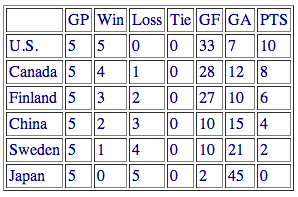
Round Robin Points Tally
Olympic Women’s Hockey, 1998
(source: whockey.com/int/olympics/1998)
They were wrong in the Round Robin Canada/U.S. match-up, when the American team somehow managed to claw their way back from a 4-1 deficit to a 7-4 win. They were wrong in the final, when the United States held a 3-1 lead through the final buzzer. They were wrong when 20 non-professional women became just the third American hockey team of any gender to take that gold medal home.
(Well, they were right about one thing. Third place was definitely not Japan.)
—
If you are eighteen, and you are a girl, and your feet fit better in bulky black skates than they ever did in elegant white ones, here are your options:
College hockey.
Well, that’s unfair. The Canadian Women’s Hockey League (CWHL) exists, and has six teams who battle every year for a spot in the Clarkson Cup Championship. The Western Women’s Hockey League (WWHL) also exists, except that is supposed to have merged with the CWHL in 2011.
Let me be clear: the CWHL is an excellent league, filled with excellent players, both past and present. Julie Chu is the obvious example, but there are also hockey greats, both past and present, like Manon Rhéume, Caroline Oullette, Ding Xiaolin, and Lori Dupuis. The talent is there, all there, so obviously, frustratingly there.
The money is not.
In 2013, the entire league was operating under a budget of $1 million. To give you a frame of reference, the NHL’s minimum salary is $525,000. That is to say, a rookie who has never played a single NHL game will make 52.5% of the CWHL’s entire budget. None of the players are paid; the coaches are, but their salaries are “roughly equivalent to what [someone] could make flipping burgers at McDonald’s,” according to a Boston Globe article about the Boston Blades which ran on March 21, 2013. The league spreads its money equally across the teams, most of it going toward travel and equipment.
Trina Crosby, mother to Pittsburgh Penguins captain Sidney, made headlines earlier this year when she joined the board of the CWHL for the 2013-2014 season. When asked what had prompted her to become involved, she told a story about her 17-year-old daughter Taylor, a goaltender at Shattuck-St. Mary’s. (Hockey Canada seems to think that she’s pretty all right, if their invitation to a prospect camp in Calgary is any indication.)
As Mrs. Crosby told The Star:
“She started talking about how much she loved playing hockey … She said it’s scary to think she’d have to give it up and it wouldn’t be part of her life. I said, ‘What do you mean?’ and she said she’d go to college and university and then what? What after that?”
What after that, indeed.
The overall style of women’s hockey is not the same as men’s hockey; its strengths and strategies have evolved into something unique. Men’s hockey is fast, but women’s hockey is fluid. Men’s hockey is brash, and women’s hockey is a little bit sneaky. That’s not to say that women couldn’t play the hard-hitting hockey of the NHL–one look at the Lamoureux sisters in action proves that. Nor is it to say that the NHL is all fist and no finesse. But watch an NHL game immediately after a CWHL game and the differences are apparent.
“If there’s a better hockey player in the country [than Amanda Kessel], I’d like to know who it is,” said Minnesota coach Brad Frost to United States College Hockey Online in January of 2013, as quoted in the Toronto Star. The Hockey News ranked her as the 8th best hockey player of 2013–the only woman on the list but certainly not the only one who deserved to be there. If performances by players like Amanda Kessel, Hayley Wickenheiser, Noora Räty, and so many others are any indication, women’s hockey is a bastion of smart, strong, dedicated skaters with hockey sense that is, frankly, out of this world.
You have to be dedicated to play women’s hockey. There aren’t any incentives to do it, beyond a desperate love of the game.
—
When the triumphant USA Women’s Hockey Team returned home from Japan in 1998, USA Today ran a piece on their welcome home. It included a charming and poignant reference to the fact that only 15 of the 20 players were featured on the Wheaties cereal box (one-and-a-half million boxes of cereal!), because five of them were college students whose involvement with NCAA sports precluded them from appearing in promotions. The hockey team was chosen over other female heroes because, according to the article, they had given “the most memorable performance of the Winter Games.”
It also included this:
PIONEERS LOOK AHEAD: One will finally go on her honeymoon. Another may travel with her best friend and Olympic rival. The rest will return to the educations or careers they postponed. Whatever they do, now that gold medals hang around their necks, things will never be the same for the U.S. women’s hockey team – or for any other girl or woman who loves the game.
It’s a paragraph that hurts in how much it still rings true. The gold medal still means everything to women’s hockey; it still has to. In a league where tickets are often on sale for as little as $10 (free, if you’re under the age of 6), it is the closest that many will ever get to a roaring crowd. Competing and finding success at the Olympic level is an enormous accomplishment, requiring hours and hours of practice, travel, sweat, and sacrifice. For the men, a spot on the roster means a trip to the Olympics while the NHL waits; for women, it means tours and tournaments and time spent with players who are as much your teammates as whatever team you play for back home.
This is true of any Olympic sport, not just women’s hockey; but it means something different to a sport where, from the moment you step down from that raised podium, you’re left as part of a league-wide question mark.
In 1998, coming off the win from the Olympics, plans were made for a Women’s Professional Hockey League. Members of the gold medal winning women’s hockey team, such as Katie King, were said to be involved with the project.
Ed Saunders, president of the organization, wrote:
We are not trying to be a WNHL. The model we have used falls more along the lines of men’s major junior hockey in Canada. Unfortunately, no such program exists for the world’s finest women’s hockey players. As a result, many have indicated that after the Olympics, they will retire. They will leave the game that has been so important in their lives thus far. Ask yourself, what message does that send to the thousands of young women and girls out there that may choose to participate in women’s ice hockey? If you’re not one of the fortunate 20 to make the national squad in your country, where do you go to compete after college? Where do you train for the 2002 games? I know several world class players who are unexpectedly facing those questions on a daily basis right now.
But money proved an issue–just as money is always proving an issue in women’s sports–and the league never quite materialized. Players on the men’s teams will fly home and get back to their seasons and their salaries and their Stanley Cup runs. And all the verve and spark and talent, all that blade-sharp hockey sense and devastatingly quick hands of the Olympic women’s hockey teams, will be left asking, “And then what?”
What after that, Mom?
A gold medal is women’s hockey’s own version of I was here and I did this. There won’t be a Cup day, but there will probably be a parade. There will be the moment when the whole world understands that figure skates gave them blisters that didn’t hurt right, not the way that hockey blisters did.
There are two things a person learns if they play hockey. First, when you fall down, you must get right back up. Second, hockey is a game of mistakes. And both of these facts were put to the test Monday night as the Boston College Eagles and the Northeastern University Huskies met at TD Garden to battle it out in the 62nd Beanpot Tournament Championship Game.
Perhaps most watching the game expected the Eagles to score first and carry the game away. However, while they did score first, 8:40 into the game on a shot from Kevin Hayes, assisted by his line mates Bill Arnold and Johnny Gaudreau, the Huskies did not give up. In fact, the north and south game was one of the most exciting games that many had seen. And when the Huskies tied it in the second, it was clear that the excitement would continue into the third.
While goals were scored, there is probably more to be said about the goals that weren’t scored. For the Huskies, redshirt junior Clay Witt stood on his head and even took a little batting practice—knocking one puck out of the air with his stick. And perhaps his teammates are beginning to expect such extreme saves from him. Though not well-known outside of Northeastern circles, he should be. Before the Beanpot, Witt was named the Hockey East Co-Defensive Player of the Week, marking his sixth honor of this season (he was named the “Stop It” Goaltender of the Month on February 3, and earned the Hockey East Defensive Player of the Week for the fourth time of the season on January 27). And while Witt was impressive, head coach Jim Madigan said how proud he was of all of the players during the postgame interviews.
At the other end, for the Eagles, was freshman phenom, Thatcher Demko, whose save percentage was an impressive .966. Throughout the two-game tournament, Demko allowed only two goals—one in the semi-final game against Boston University last Monday, and then one during the championship game, scored by Northeastern freshman, and USHL Dubuque Fighting Saints alumnus, John Stevens, assisted by sophomore Kevin Roy. Demko kept Northeastern off the score sheet for the first 38:36 of the championship game.
Both goalies may have felt like they were in a football match, as they each got their share of tackles—both getting up slowly after at least one hit a piece, though no penalties were called on either team. In fact, there were only two penalties in the entire game—though fans on both sides felt the referees missed a few. Both penalties were called on the Eagles, who killed both off.
The game-winning goal was scored by Eagles senior, and team captain, Patrick Brown from the seat of his breezers as he was “mauled” (as he described it postgame), assisted by Isaac MacLeod and Austin Cangelosi.
With one minute remaining in the game, Huskies coach Madigan, pulled Witt. Unfortunately, a bad play by the Huskies allowed Eagles junior “Johnny Hockey” Gaudreau, also a Dubuque Fighting Saints alum, an opportunity to get the puck on his stick which meant that, even from the middle of the ice, his shot was right on net, for an empty net goal.
Just 50 seconds left in the game, Brown added one more for the Eagles, getting it past Witt, who was accidentally leveled by one of his own teammates. His frustrations got the better of him as he grabbed the puck from the net and threw it with some anger.
This marked the fifth consecutive Beanpot championship for the Boston Eagles—and perhaps their team is getting used to winning. Their seniors have never known losing this tournament. For the senior Huskies, they have unfortunately never known winning this tournament, though they have managed to get into the championship game three of the last four years.
Consolation Game
As the Boston University Terriers and the Harvard University Crimson took to the ice, it was soon apparent that Harvard was at least determined to get as many shots on goal as possible during the consolation game. And though the Terriers scored first, on just their third shot on goal, they would not score again until the third period, with just 12:40 left in the third period. Unfortunately for the Terriers the Crimson would put up three points of their own in between those two goals and then just 37 seconds after the Terriers scored their second, the Crimson would score their fourth, showing they were not intimidated by Boston University.
Watching the two teams as the game progressed showed that Harvard considered this to be just as important a game as any other they would play. They also seemed a little more on top of their passing game and being in the right place at the right time. The Terriers on the other hand were struggling to make a solid tape-to-tape pass through most of the game and again made some bad choices—including icing the puck while they were on the power play.
For the Terriers, perhaps the silver lining in the 6-2 loss was that senior Anthony Moccia, a local player from Medford, Massachusetts, had a chance to play in the last 2:14 of the game—and to be scored on by Harvard as well.
For the fourth year in a row, Harvard took the third place spot in the Beanpot. And it is the third time in four years that Boston University has been the fourth place team. Most interesting perhaps is that this is only the fifth time in the last 31 years that the Terriers have played in the consolation game (1994, 2008, 2011 and 2013 the others).
Though the Beanpot Tournament is a distinctly Boston event, it is nonetheless an epic tournament to those who play in it every February from Boston College, Boston University, Harvard University and Northeastern University. For these four schools this is their own silver chalice, and the joys of victory and the agonies of defeat resonate with each player. For those who will return to one of these four schools next season, the first two Mondays of February will once again be circled on the calendar, as the other three schools do their best to end the current winning streak of the Boston College Eagles.
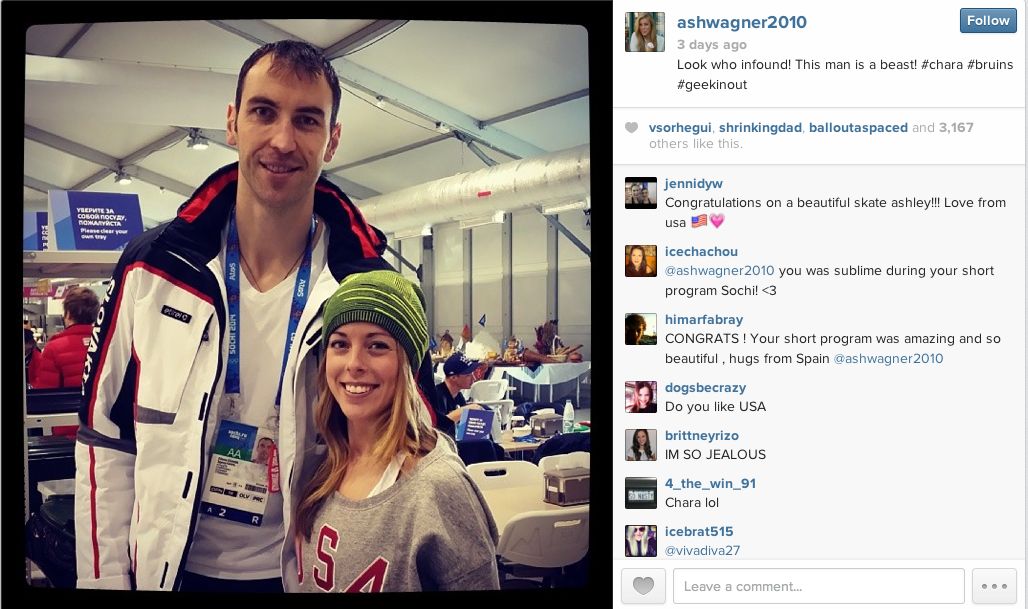
While Bruins fans have always loved their 6’9” captain, it appears that athletes and attendees at the 2014 Winter Olympics in Sochi, Russia have discovered the big man as well. As a result, Zdeno Chara’s a big hit in Sochi.
He is quickly becoming the most photographed man in Sochi. The hashtag #PicswithZdeno is catching momentum, as more and more people share their photos (though some of them have not been taken at Sochi).
Bruins fans on Twitter are enjoying the attention that Chara is receiving.
Lol as a bruins fan I'm loving the #picswithzdeno 🙂 I guess we can share him with y'all….for now
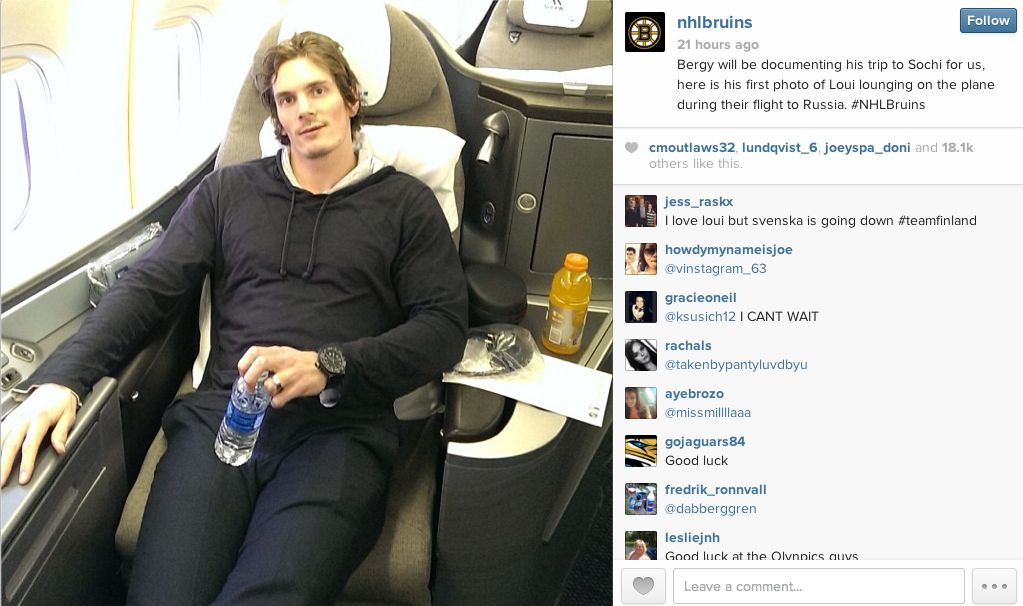
Perhaps his Bruins’ teammates who have now arrived in Sochi will also get in on the action. After all, Patrice Bergeron is documenting their experiences for the Boston Bruins.
One has to wonder if Bergeron, Loui Eriksson, David Krejci and Tuukka Rask know what a big hit their captain has become?
It all began with Canadian pairs skater Kirsten Moore-Towers picture, which may have captured the tallest and the shortest athletes in Sochi, as she is just 4’11”.
For those who are suffering Bruins withdrawal, keep checking in on Twitter to see who has been photographed with Chara lately. Perhaps for Team USA, getting a picture with Chara could be a good omen (it has already worked for Canada’s Kirsten Moore-Towers and USA’s figure skater Ashley Wagner). And apparently for Wagner it was a very big deal–she appears to have heard of the Bruins.
But perhaps the best tweet about Chara’s photo appeal is this one.
Chara isn't actually going to play in these Olympics. He's just going to pose for pictures with every Olympian #PicswithZdeno
The Olympics are upon us. We hear all kinds of facts and figures coming from Sochi. I will not bombard you with any thing to do with the games. My thoughts are homeward-bound.
The players who did not make the teams for the Olympics are here, no , ok, I mean they are closer to us than the Olympic players. Most have gone the way of the birds. Down to the sunny and warm south of any country!
They have 10 days to rest, eat and visit family and friends. The players have a season with hectic schedules. All players are ‘on the road’ most of the time, playing games in a strange un-friendly city. Jet lag, time changes and missing family can make one homesick and tired.
This can be called a nice mini holiday where the players can spend quality time with family and they can re-charge their batteries. The regular season starts again on February 25th, 2014
I expect great playing when they start up again. I want to see more energy on the ice and less fighting. I would like to see some of the losing teams rise up, from the dirt and win a few games! I want to see action with no injuries to anyone.
I am hoping that I am not asking for a lot? Maybe I am. But I hope not!
Team USA won their game against Switzerland in the span of 55 seconds.
It took the ladies of the USA’s women’s hockey team roughly ten minutes to fully show up to their battle against Switzerland. They were a little slow, just a little jetlagged on their plays and passes. For a team that is notoriously patient with the puck, passing around until a shot opens up and a pair of hot hands can find the back of the net, the opening minutes of the match were out of character. Switzerland came out on the ice and played with heart; the USA came out on the ice and . . . well, just played.
But nine minutes and 20 seconds into the first, Team USA found their feet.
Monique Lamoureux netted the game’s first goal with assists from her sister Jocelyne Lamoureux and Meghan Duggan, and just 47 seconds later, Brianna Decker followed suit, thanks to some excellent stickwork by Amanda Kessel and Hilary Knight. Then, 8 seconds after that, Kessel took one for herself off an assist from Kendell Coyne.
It’s terrible to say that the game was over with plenty of time still left in the first, but it was. It rapidly became clear that the three goals had woken Team USA up, and the rest of the game was a relentless effort on the part of team Switzerland to just keep the puck out of their own zone. Swiss goalie Florence Schelling faced 53 shots on goal and saved 44 of them; USA goalie Molly Schaus faced merely 10. Switzerland’s chose to leave Schelling in the net despite mounting goals, and she played with composure through the last buzzer. It’s hard to blame a goaltender when you’re watching Team USA’s offense play at their best–Kessel, Knight, Coyne, Decker, the Lamoureux sisters . . . you need an extraordinary defense to be able to compete against those types of players.
Though Kessel is America’s sweetheart and, apart from perhaps Julie Chu, almost certainly the best-known player on the squad, the win this morning was absolutely a team effort. We saw in particular an excellent game from Kendall Coyne, whose speed took Lara Stalder by surprise during a collision, after which Stalder had to be helped from the ice. (No call was made on the play.) It’s hard to cherrypick players to praise; frankly, the hockey sense and technical skill that the team displayed made the game fun to watch even as the score ticked up and the pressure ticked down. They showed extraordinary speed, control, and just great hockey sense. Decker’s goal included a breathtaking one-two-three passing play that would have made the most ardent American patriot wince in sympathy for Team Switzerland.
One excellent moment showed the Lamoureux sisters on the bench drawing up plays on the board, their coach nowhere nearby. (“We’ve got it, coach, you just put your feet up. Maybe have some Gatorade.” — the Lamoureux sisters, probably.)
The other six goals went, in order, to Knight, a second for Kessel, a second for Monique Lamoureux, two in a row for Coyne (she managed a hat trick, but one of the goals was discounted), and the final goal of the game went to Alex Carpenter.
The U.S. Olympic Women’s Ice Hockey Team is off until Wednesday, February 12, when they will face Canada at 7:30 a.m. E.T.
The Northeastern Men’s Hockey Team’s twitter account (@GoNUmhockey) has already promised a live blog beginning at noon, Monday.
And though she has her own important hockey match, Northeastern alumnus and Team USA Women’s Hockey Team member, Kendall Coyne has already sent her good luck wishes to the men’s team for the Beanpot.
And for those who are wondering how the Huskies find themselves again in the Beanpot finals for the third time in four years, Northeastern has released Part 1 of “Huskies Unleashed – The Road to the Men’s Beanpot” via YouTube.
However, just what are the Huskies’ chances? The team sports an impressive number of freshmen including three players from the 2013 Clark Cup-winning Dubuque Fighting Saints: Matt Benning, Michael Szmatula, and John Stevens. They understand what is needed to push to the finish, and in this case the finish would be the opportunity to hoist the Beanpot—something Northeastern hasn’t been able to do since 1988.
Mike Szmatula (Credit: Northeastern University)
The 5’9” Szmatula, according to Harvard’s head coach Ted Donato is “dangerous.” Donato went on to say that Benning is “an excellent quarterback on the power play at the blue line.” Benning is also a Boston Bruins prospect, taken in the sixth round (175 overall) during the 2012 NHL Draft.
Szmatula,who is currently ranked second in the nation in freshman scoring (11-20-31), attributes his success to the team and to the coaching staff. He pointed out that the upperclassmen made it easy for he and his fellow freshmen to get right into the flow of how the team plays.
Backing up the Huskies in front of the net is Clay Witt, who has been impressive most of the year. As head coach Jim Madigan said after the semi-final blow out over Harvard last Monday, “Of course, Clay was tremendous in net. And when you have the confidence that we’re playing with, it’s because of our goaltending.”
If they play hard, and with the focus and force they have been bringing throughout much of the season, they stand a very good chance of succeeding in taking a win.
Of course, the opposition has just as much intensity, and has won the last four consecutive Beanpot finals and are hoping for a fifth. The Boston College Eagles, coached by the most winning NCAA hockey coach, Jerry York, have been giving many teams fits over the last few years, and not only during the first two Mondays in February. They have also taken a couple of national titles—three Frozen Four titles in the last five years, for instance.
Gaudreau, Arnold and Hayes
The current roster boasts such talent as Johnny Gaudreau—known to many by his nickname, “Johnny Hockey,” whose line mates include Bill Arnold and Kevin Hayes. They have combined for the nation’s top line in points (55-89-144). And they go first, second and third for the Eagles in points on the current roster; a dangerous trio to be sure.
Not only is BC No. 1 in the Pairwise rankings, take a look at how Gaudreau-Hayes-Arnold rank in scoring nationally… pic.twitter.com/Nqn224zTNj
To keep up on what is happening as the clock draws closer to the fateful moment for the Championship game at TD Garden on Monday at 7:30pm, from the view of the Eagles, fans will want to follow the Eagles men’s hockey team twitter account (@BCHockeyNews).
This team is certainly motivated to get Coach York another win, and in the Battle of Comm Ave, against the Boston University Terriers, a fifth straight Beanpot win would certainly give them bragging rights, especially depending on what happens between the Terriers and the Harvard Crimson during the consolation game, which takes place at 4:30pm.
“It is (nice to bounce back) especially headed into a break. The last thought in your head is the last game you played. So it’s nice to have that go through your head as you’re having your down time. Then you have a good feeling when you step back onto the ice,” Head Coach Mark Morris about the win.
In their last game before a couple much needed days off, the Manchester Monarchs hosted the Albany Devils for the only time in Manchester this season. They were coming off a difficult 3-2 loss to the Providence Bruins the night before in a game they battled hard.
It was only 68 seconds into the game when Manchester got onto the board for the first time in what would end up being the game winning goal. Sean Backman sniped the puck from the right face-off circle to beat Devils net minder, Scott Wedgewood. Backman’s seventh tally of the season came from Derek Forbort.
“It was a clearing attempt by Albany and Forbort kept the puck in. I actually gloved it down and took it around the top there and got it on net. I just managed to find the back of the net there,” Backman said of his goal.
Manchester continued to control the game through the rest of the period, ending up with 15 shots while only allowing the Devils to take 4. The newly reunited line of Tyler Toffoli, Linden Vey, and Tanner Pearson generated some quality chance with Pearson ringing pucks off one of the posts and the crossbar just in the first period.
The teams came out for the second period and the shots seemed to even out a little bit more with Albany generating a few more chances. It was Andy Andreoff’s turn to get on the score sheet when he put the Monarchs up 2-0 just over four minutes into the second. He made a nice move around Wedgewood and managed to put the puck home. It was his first goal since January 18th and his eighth on the year.
“It’s definitely a relief. When you’re having a tough time scoring, it can weigh on you. But it’s good to get it out of the way and get back like that,” Andreoff said.
Aside from just contributing a goal, Andreoff saw a lot of penalty kill time with Nick Shore. The pair did well when it came time to rely on them. Coach Morris sees Andreoff as someone he can depend on in all types of situations as a really coachable player. Andreoff commented that no matter what line he’s on or what situation he’s in, he’s always ready to play where he’s needed.
The second period scoring did not end there, though. With 1:40 left in the second period, it was Jordan Weal’s turn to add a tally. Jeff Schultz made an excellent pass across the slot that Weal one-timed past Wedgewood. It was not a fast moving puck, but it was still a good goal. It was definitely a pay off for the hard work Weal had been doing on his line with Backman and Brian O’Neill. The three were all working hard together and seemed to be using their speed to their advantage.
“The line that we have with Jordan (Weal) and Brian (O’Neill) has been pretty good the last couple weeks. It’s been great,” Backman said on playing with Weal and O’Neill. “Brian and I try to pound the puck and get it into Jordan’s hands as much as possible. He’s a really skilled player and he makes things happen with the puck.”
When the teams came out for the final period, Albany seemed to have lost what little steam they had left. They managed to put up an impressive 12 shots in the second after only 4 in the first. But they could not seem to get shots off in the final period. Towards the second half of the period, both teams looked like they had taken their foot off the gas a little bit.
With the 3 shots in the third, Martin Jones made 19 saves in the shutout. The Monarchs did a good job of controlling the puck in their defensive zone to help him. Despite the low shot total, Jones did have to come up with some impressive saves to preserve his shutout.
The Monarchs continue to struggle on the power play and have netted only 3 goals on their last 25 attempts. That includes a little over a minute of 5-on-3 play today where they were kept off the board. The newest first power play unit seems dangerous on paper with Tyler Toffoli, Nick Shore, and Tanner Pearson as the forwards, Nick Deslauriers dropping back to defense and Linden Vey acting as the quarterback at the point. However, they still seem to struggle with getting their passing and timing just right.
The AHL takes a couple days off with the All-Star Classic coming in the middle of this week. Schedules resume on Friday when the Monarchs host the Worcester Sharks.
Last night, for the second time this week, the Stars faced off against the Coyotes. The stakes going into this game were high, for both teams.
The Coyotes managed to slip into a Wild Card spot, thanks to their win against the Blackhawks on Friday. They had the momentum of wanting to keep that spot working for them—but the physical demands of playing back-to-back games working against them. The Stars were coming off a small break, not having played since their loss to the San Jose Sharks on Wednesday.
The Stars got on the board fast in the first period thanks to Ray Whitney, who sunk a feed from Jordie Benn to net his seventh goal of the season.
Whitney’s goal lit a fire underneath the Coyotes, who played quickly and aggressively after the Stars took the first lead. At times, they made the Stars look slow, and the Stars are not a slow team.
Both teams were fairly even when it came to shots on goal, but Phoenix’s backcheck was working overtime, and had impressive coverage on the Stars. With 33.2 seconds left in the second period, Seguin snapped the puck to Benn off the dot and Benn passed neatly to Daley, who slapped it in for a goal.
The goal was eventually credited to Nichushkin, not Daley—but I’ll disagree with the NHL, here. Nichushkin did poke the puck back into the goal, but only after the puck rebounded off the back of the netting. It would appear to have been a goal before Nichushkin touched the puck. Either way, the Stars led 2-0 at the end of the second.
The third period saw an optimal scoring chance for Dallas, who had a 5-on-3 advantage after Shane Doan was called for interference against Erik Cole and Mike Riberiro was called for unsportsmanlike conduct.
Dallas failed to take advantage of the opportunity and their power play unit seemed underwhelming the entire game. Failing to score on a 5-on-3 is like someone offering you free cake that is also free of calories and saying “No thanks.”
The small upshot to this is that Dallas’ PK did perform well throughout the game. Eakin, Dillon, Benn and Roussel are really clicking together on the penalty kill, and hopefully that’s a trend that continues.
With only 16 seconds left in the game, Phoenix managed to get on the board thanks to a snap shot from Radim Vrbata. But they failed to get the extra goal needed to force overtime, and Dallas won 2-1.
With that win, Dallas slips into the Wild Card spot vacated by the Coyotes and sits pretty as the number 8 seed in the West.
The trick will be to see if they can keep it. The Canucks are currently in the slide to end all slides. I don’t really see them being a renewed source of competition for the Wild Card spot. The LA Kings are in a similar situation, and could potentially slip out of the assured playoff spot and into the Wild Card race. That could make them a challenger, but it could also free up an assured playoff spot Minnesota could slip into—and I would rather see the Stars have to fight the failing Kings then the determined Wild.
Coming back from the Olympic break, the Stars will benefit from having one of their star forwards (Tyler Seguin) well rested. Exhaustion is a concern for Stars Olympians Jamie Benn, Valeri Nichushkin, and Kari Lehtohnen, but Benn and Nichushkin aren’t likely to get the amount of ice time they’re used to seeing with the Stars, and Team Finland is blessed with an abundance of talented goalies. Tuukka Rask is likely to start, and then Antti Niemi, so it’s impossible to say what kind of ice time Lehtohnen will get, if any.
The Stars have real potential to break out after the Olympic break, as they try to hold on to their hard won Wild Card spot. It should be fun to watch.

 (source: whockey.com/int/olympics/1998)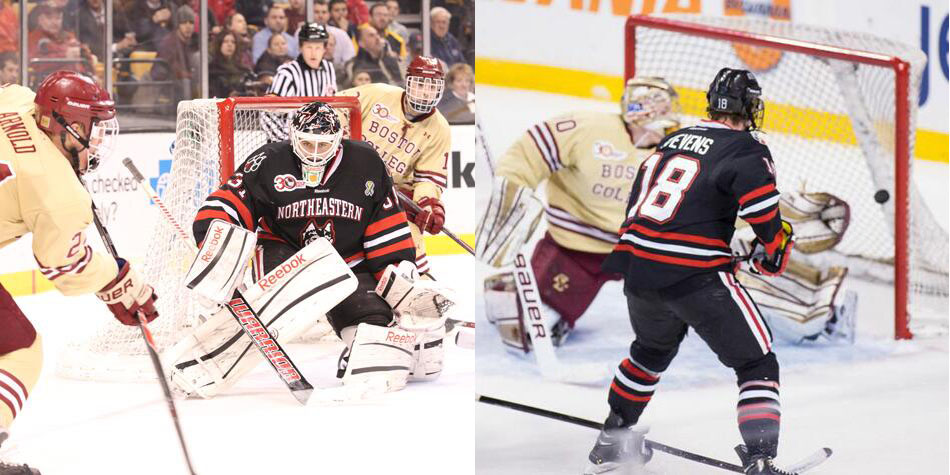

 Prev
Prev