(photo: www.usahockey.com)
Team Canada bested the Americans in a 3-2 decision yesterday in Sochi. It was the most anticipated match of the Women’s Ice Hockey Preliminary Round, featuring the two teams ostensibly destined to meet again in the ultimate game for gold. Both teams already earned a bye straight into the Semifinals with a win each over Finland and Switzerland, so this game couldn’t possibly mean all that much – Right? Try telling them.
Team USA and Canada have a fierce rivalry that is deeply rooted in their history of play against one another. They love nothing more than to beat each other, and when these two get a chance to play, they leave everything on the ice. This was the first time in Olympic history that the United States and Canada faced off in the Preliminary round, due to the new format to keep the games more competitive.
“I’ve been pretty open about the fact that it’s great for our game and the fans to have a match up like this in the preliminary round,” said head coach Katey Stone. “I think it’s a good test. For the players it certainly helps them get their feet wet when it comes to intensity and the environment.”
The opening period was a scoreless one as both teams played pretty evenly. The United States took two penalties, while the Canadians had one. Team USA had the slight edge in shots, getting 11 on Canada goalie Charline Labonté, while allowing 8 on Jessie Vetter.
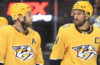
The second period was where the US Women seemed to shine. A power play goal 17:34 into the frame opened the scoring and gave the United States the lead. Alex Carpenter was able to set up a shot from the point for Anne Schleper, which was directed into the net by Hilary Knight. Shots in this period were 13-11 in favor of the United States.
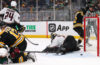
The third period was where Team USA would come undone. They got into some penalty trouble early on, and this time Canada would not let them get away with it as Meghan Agosta tied the game at 2:21. Just over a minute and a half later, the United States would let in a disheartening, slightly controversial goal that trickled through a sprawled out Jessie Vetter just as the whistle blew. The goal was reviewed to determine whether or not it crossed the line before the sound of the whistle, and it stood as the tie-breaker for Team Canada.
A Canada breakaway late in the period led to another goal by Agosta, extending the lead to 3-1. The Americans were never truly out of it, though, as Stone decided to pull Vetter down by 2 goals with over two minutes left in the third. Anne Schleper was able to cut the deficit in half at 18:55. Canada gave the United States a chance to even things up as they took a penalty for too many (wo)men on the ice with 31 seconds remaining, but it was not meant to be as the final score remained 3-2. The victory for Team Canada marks the first win against the United States under the direction of Kevin Dineen, who joined the bench for Canada late last year.
The final frame proved to be the difference maker in this game in more ways than one. Canada, echoing their performance against Finland, scored all three of their tallies in the third. The United States by contrast lost the shot count by a decisive 12-3 margin. If destiny is to come to fruition and these two teams meet in the finals, Team USA must work on shutting Canada down in the third period, where they are their most dangerous.
Both teams are off until Monday, February 17 when they will each play their Semifinal Playoff game.
(photo: POOL/REUTERS)
Two goals from Erik Karlsson catapulted Sweden to a 4-2 win today over the Czech Republic in the first men’s hockey game of the 2014 Winter Olympics.
Karlsson drew first blood in the contest, proving why so many think Sweden is a gold medal contender: a team with strong scoring up front as well as from the blue line, and notable goaltender Henrik Lundqvist between the pipes.

The Czechs made a surprising decision not to start their strongest goaltender in the contest, Ondrej Pavelec, opting for Jakob Kovar instead. As a result the match became less about Sweden proving they have the talent to win and more about the Czech Republic’s decision that may have cost them the game.
Patrick Berglund would find the back of the net three minutes after Karlsson, lifting Sweden to a 2-0 lead after one period of play. In the second, Sweden’s captain Henrik Zetterberg put a puck with eyes for the back of the net past Kovar. Alexander Salak replaced Kovar for the Czech Republic, their coaching staff making the clear decision not to play Pavelec, who reportedly did not even dress.
Karlsson would net his second goal of the game, capitalizing with nine seconds left on a power play, firing a rocket from the blue line resulting in a 4-0 lead for Sweden.
The Czechs came back later in the second period, though, when Marek Zidlicky collected a drop pass and fired the puck over Lundqvist’s shoulder to make the score 4-1. Czech legend Jaromir Jagr notched a goal of his own when he took a shot from down low which crept across the goal line on Lundqvist’s stick side.
The Czechs could not muster another goal in the third period, however, and the final score would be 4-2.
Sweden will next face Switzerland on Friday and Latvia on Saturday in round robin play.
The author of this article is, as many of you are, an advocate for USA Hockey:
I’m not going to lie, this game was tough to watch.
Even though this was just a preliminary game, it had a lot of hype surrounding it given the intense rivalry between the two teams. Coming into Wednesday’s game, Canada had yet to put in a full 60 minute effort while the US had played two outstanding games against Finland and Switzerland. So it would be fitting that Canada walks away with the win, the three points and the bragging rights (for now at least) despite getting outplayed in the first 40 minutes and really only putting in their best effort in the last 20 minutes of the game.
The American ladies controlled the play for the first five minutes and had the ice fairly well tilted towards the Canadian goalie. Just 30 seconds in, Kelli Stack got a breakaway and nearly beat Charline Labonte but ripped the puck off the crossbar instead. It was a moment that had American fans everywhere going, “If only…” While Team USA did cede two individual breakaways in the first few minutes, most of the pressure was on Canada’s defense to prevent dangerous women such as Amanda Kessel, Kendall Coyne or either of the Lamoureux twins from getting too close to the net with the puck. One dangerous turnover in the defensive zone nearly saw Canada down 1-0 midway through the first period, if not for the solid positioning of their goaltender. Another one of those “Aw man, so close” moments.
Both teams had their fair share of turnovers in the first, neither was particularly sharp at moments, but in spite of that and the (lack of) score, Team USA was the better and far more dangerous team through 20 minutes.
Things got… interesting, shall we say, in the second period. The first few minutes started off very even, in a track meet between the two teams. But as time passed on, the Canadians got away with countless penalties, one that the referee herself was a part of but chose to ignore when she was into by an American player who had been pushed by a Canadian player. Later on the period, I counted three separate penalties where the Canadians got away with a hold and two body checks then one American player got away with a body check.
Look, I’m all for body checking in women’s hockey. I think it’s kind of dumb that it’s not legal and I don’t understand the rationalization that body checking is illegal in women’s hockey. It’s not like they don’t do it anyway and it’s not as if these women can’t handle the physical or mental strain of hitting.
Anyway, the officiating basically took over the game from here on out as Canada got away with an extended too many men penalty because there’s only one referee and she was a little busy watching the play unfold, despite the fact that Canada had SEVEN players on the ice for about 30 full seconds. Canada continued to get away with obvious body checks, a delay of game penalty (curiously called a hand pass instead) and surrendered Grade A scoring chances to their superior opponents (when you’re getting outplayed the way Canada was, that means your opponent is superior).
While on a penalty kill, Team USA had a great shorthanded chance with Hilary Knight springing Kelli Stack for a great opportunity, who was stoned by a smart Labonte.
Team USA’s dangerous power-play paid off at the end of the second period when Hilary Knight tipped in a goal from defenseman Anne Schleper. The referee finally called Canada for a body checking penalty and that goal gave Team USA a lot of life.
The third period opened with Brianna Decker taking a penalty less than a minute into the period, though some might argue that the woman Decker tripped went down a little easily (and it stings worse for Team USA fans who rightly felt that Canada had gotten away with several other penalties earlier in the game). Team Canada scored on their power-play and then were gifted (for some strange reason, not that they actually earned it) a goal from the referee.
Jessie Vetter, Team USA’s goalie, bobbled a save and the puck slid underneath her and into the net. However, and this is crucial, the whistle had very clearly blown before the puck had crossed the line entirely. So, more bad luck for Team USA as a supposedly impartial referee had not only done a very poor job officiating up to this point, gave Team Canada the lead. I saw it in real time and I saw it again on the replay. The whistle blows as the puck gets to the line but the puck has to cross the line entirely to be counted as a goal. That’s not a goal. Even in international hockey, the rule is still the same that the entire puck must cross the line before it is counted as a goal.
Basically, Team USA got shafted on two extremely poor calls and it’s such a joke that Team Canada walked away with the undeserved, unearned 3 points in this game. That goal was a back breaker and a game changer for Team USA. If the referee does her job properly, makes the right call, Team USA goes into overtime with Canada who may have walked away with the extra point still, or Team USA may have gotten a lucky bounce go their way and they ended up with the three points. Yes, I am going to blame officiating as the reason for Team USA losing this game. The referee has a responsibility to call the game fairly. When you call one team for penalties far more than another team who is doing the exact same thing and getting away with it, that’s not being a responsible official and is giving one team an unfair advantage. Now you may call me biased, and you’d be right. But it was pretty plain as day that Canada was getting away with tons of body checks, shoving their opponent down and had already gotten away with SEVEN players on the ice for much longer than the allotted eight second line change time. Oh, and those two extra players were involved in the play, creating an unfair advantage against Team USA.
I saw a lot of people saying that Team USA came out flat to start the third period, but I disagree. I thought they had just as much jump in their step as they had in the first period and I thought Canada got a fortuitous call their way and then another fortuitous call as the American women had started to retake control of the game. That’s an incredibly deflating goal and gave Team Canada momentum in the period, while also being a dagger in the side of the US women. As I said, that call was a joke and basically handed Canada the win in that game.
Here’s another point to the officiating: with just over eight minutes played in the third, the referee missed another too men penalty on Canada, who had six players on the ice, all of whom were participating in the play. It was a potential power-play opportunity for Team USA, and again, they were on the receiving end of a bad (non) call. Throughout the entire game, the television announcers on NBC Sports Network noted how few calls were actually going Team USA’s way. They were shocked several times at the calls that should have been.
In the end, Team USA’s comeback fell short as they managed to put a dent into Canada’s lead with only one goal. But, this game was not lost by USA’s poor play, though they had their moments. This game was ultimately lost due to extremely poor officiating, one that came a day after a very controversial non-goal gave Russia the win over Japan.
Team USA will not play again until February 17th in the semifinals with both opponent and time TBD.
I can only hope that karma is on Team USA’s side in the gold medal game and everything goes their way, including getting a well deserved gold medal. They’re pretty clearly the best team in the tournament and everything right just went Canada’s way on Wednesday. While deserve ain’t got nothin’ to do with it, only a gold medal will make up for such brutal luck.


(Photo: Nathan Denette, AP)
By Andrew Imber
The first game of the 2014 Winter Olympics for the United States Hockey Team is going to be monstrously huge. Some could argue that it is actually their most important game of the round robin section. It isn’t just about getting off to a good start, but mainly about who their opponent is and how the group works.
It is hard to believe, but the United States is actually the third highest ranked team in their group of four (based on when seedings constructed the groups). That means, by the book, the United States is actually supposed to lose to Slovakia, their first opponent of the round robin. Now, it would be very surprising to see the US come in as anything but favorites in this game, but that doesn’t mean they should be expected to win. Slovakia is one of those under the radar type teams that could surprise a lot of opponents, and they will certainly be looking to make a statement against the Americans.
Slovakia’s notable NHL’ers – Zdeno Chara, Marian Gaborik*, Jaroslav Halak, Marian Hossa, Tomas Kopecky, Lubomir Visnovsky*. *Injured
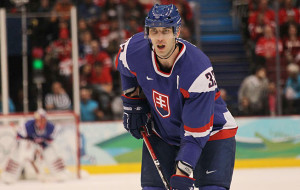
Zdeno Chara will be a big obstacle for the Americans (Damian Strohmeyer/SI)
The Good: In my opinion, in a tournament like this, you ideally want your first opponent to be a mixture of NHL and KHL players. It will, naturally, take time for these players to gel, and they should find chemistry difficult during the first game. Taking that into consideration, the US is lucky to draw Slovakia first, as opposed to huge underdog Slovenia (who will be almost exclusively used to the large ice surface). Slovakia has 11 European players (mostly KHL) and 14 from the NHL/AHL, meaning they have a big split of styles to deal with. Nobody could blame them if they struggle to adjust in their first game, and the United States, though completely unfamiliar with the big ice (except in brief prior tournaments), will at least all play the same style game. Slovakia’s goalies are solid, but projected starter Jaroslav Halak has been up and down and has had trouble holding off Brian Elliott at times in St. Louis this year. Injuries to Gaborik and Visnovsky take away from some of the higher end NHL talent.
The Bad: In all honesty, I would have rather drawn the Russians first. Get your toughest game done with first, another team dealing with a big mix of KHL and NHL talent, and major pressure of being at home right away. This is also a very dangerous game, as it is the second toughest team in the group. If the United States drops this one, they put themselves in very precarious waters. The game against the Russians becomes a near must win, or a date with a heavily favored team could result in the Quarters (not to mention a tough play in game). Slovakia is a tough team with super stars like Chara and Hossa, and they won’t be a push over. They put a huge scare into Canada during the Semis in 2010.
The Bottom Line: It is kind of nerve-wracking to say this, but I feel like this is a huge litmus test for the United States right off the bat. Win this opener, and your tournament becomes a totally different ball game. Lose this and you’re playing from a large hole, and medal chances go way down. The US can win and should be favored, but it will be interesting to see how Slovakia gels, and if their European league players give them any sort of edge. The United States can’t afford to come into this tournament with anything less than 100% intensity from the get go because a loss in the opener sets the stage for a potential early exit. You don’t want your first toss up elimination game (on paper) to be until the Semis. Only winning your group will ensure that, and it is tough to envision the United States winning the group if they head into the showdown with Russia at 0-1.
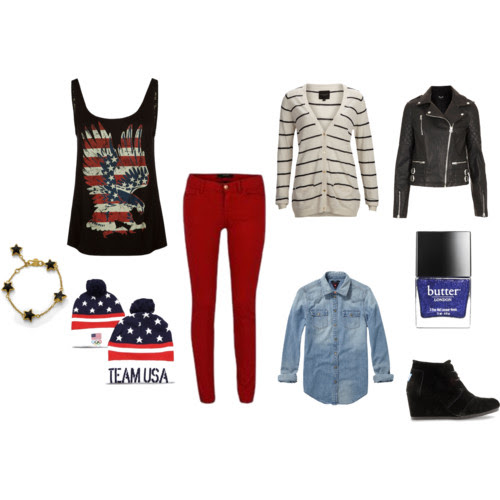
With the Olympics in full swing, chances are most of you aren’t taking in the games in Sochi itself, but representing your country at home, in bars or at Olympic parties with friends. While yoga pants and a sweatshirt scream the ideal clothing choice when catching a Team USA hockey game at 5 am, perhaps by the time the re-broadcast skates around you’ll want a different look.
We went with an American theme, with an emphasis on layers. Tank top, lightweight denim shirt, cardigan and cuff the sleeves, top with a leather jacket for colder climates. Comfort is key, so wedge sneakers or boots will compliment the outfit nicely. The red pants can easily be subbed for jeans, bright blue, or a more subdued maroon red — it’s all about the Team USA colors.
Instead of picking a t-shirt that showcases USA in bold lettering, we went a different route with the still all-American symbol, the bald eagle. A star bracelet and a Team USA hat complete the look. We recommend picking a nail polish in a bright red or blue hue, but a silver would work nicely as well. Root for the home team in a patriotic way!
By Jake Shoemaker
With the men’s Olympic hockey tournament officially here, we, as fans, must take the time to savor the quality of Olympic hockey as it stands because this could be the final year that NHL players are allowed to participate.
During the NHL’s most recent work stoppage, Olympic participation was a hot-button issue amongst owners and players. The owners, who invest incredible amounts of money into both their NHL franchises and the players who play for them, want their players to have no part in the Olympics for a variety of reasons. They fear risk of injuries to their investments (the players) and they detest the loss of revenue during the two week Olympic break. But, although these arguments are valid, the owners are failing to recognize one thing: fans love Olympic hockey and the NHL must respect its fans.
After the NHL cancelled the 2004-2005 season, public interest in professional hockey decreased dramatically. No doubt, one of the major contributors to this decrease in “popularity” was the split between the NHL and ESPN. When the league returned from a year of invisibility, the world’s most powerful sports network no longer had any vested interest in promoting the NHL. As a result, the NHL had to slowly work it’s way back into favor with its viewers.
Over the past decade, the NHL has steadily gained popularity in large part due to its phenomenal partnership with NBC, a network that has been committed to developing its presence in the sports world. And guess what? NBC owns the rights to all Olympic coverage.
So, here you have the Olympic hockey tournament. A chance for the NHL and NBC to subtly “advertise” their product to the world. A chance for the NHL to remind the casual hockey fan how exciting the sport is. A chance for NBC to remind the sports fan who blindly watches ESPN for their sports coverage that there is another network out there – one with a different product. A better product.
NHL fans don’t lose interest over the Olympic break. They root for their country and they track the successes of their home-team stars. People who love hockey will continue to love hockey.
The Olympic break is a pause in NHL consumption but not hockey consumption. And the hockey consumption occurs on the same television network as the NHL. In the end, the more people the NHL can get watching high quality hockey, the more people the NHL will draw to its product when play resumes.
The NHL and NBC need the best players in the world to participate in the Olympics. And that is what the fans want.
(Photo: www.TheAHL.com)
St. John’s IceCaps captain Jason Jaffray, who is also acting as captain for the All-Stars, scored in the final event to send the Skills Competition into a shootout. Jaffray then scored again in the sudden death shootout to secure an exciting win for the AHL.
There are 7 events total in the Skills Competition which the skaters alternate competing in. Of those events, three go towards determining which goalie wins the goalie competition by having the best save percentage. But before any of that could get under way, the teams were introduced. Not surprisingly, there was a huge roar when they got to the end of the AHL All-Star roster, introducing Brenden Kichton and Jason Jaffray to their hometown crowd. There was also a huge roar and a standing ovation part of the way through the AHL roster when they got to Luke Adam, a Rochester American that was born and raised in St. John’s.
First up in the skills competition was the Sher-wood Puck Control Relay. This had four heats, with a goal going to the winner of each heat. The first two heats pitted teams of three from each side against each other in a relay. The second two were individual races. Each skater had to go from one goal line to the other, retrieve a puck, then weave back around cones without losing control. The teams split the event. Jason Jaffray competed in the first, earning a loud applause as he edged out his competition. But the real story was Oliver Kylington, competing in, and winning, the second individual heat for Farjestad at only 16 years old. He was the youngest competitor.
The second event was the CCM Fastest Skater. This event featured the teams alternating back and forth for a total of four skaters per side. They had to skate a full lap around the ice, staying inside the cones. There were two goals up for grabs: one of the overall fastest time and one for the side with the fastest average. The AHL’s Mike Hoffman (of the Binghamton Senators) was the fastest skater and the only one under 14 seconds at 13.990 as he slid on his stomach across the finish line. The AHL also earned fastest team average.
With the third event, fans finally got to see goalies for the first time. The RBC Rapid Fire. This event saw each of the four goalies face two shooters from the opposite team. Each shooter had 5 pucks to shoot alternatively under a certain amount of time without using slap shots. All the goalies stopped 6 of the 10 shots, except for Farjestad’s Frederik Petterson-Wentzel, who stopped 7 shots and earned Farjestad the goal for most team saves.
The fourth event let the goalies have a break again as skaters faced off in the CCM Hardest Shot competition. The goalies probably would not want to be in front of most of these shots anyway. Each side got four skaters, alternating back and forth and each of them got 3 chances to register their hardest shot. Last year’s winner, Brayden McNabb of the Rochester Americans, appeared to defend his title. Although he beat his own time from last with a shot registering 102.6 MPH this year, he was not able to defend his title. Farjestad’s Magnus Nygren shattered the AHL record with his hardest shot coming in at 104.6 MPH. He earned his team the goal for hardest individual shot and helped his team earn the goal for fastest team average. This put Farjestad up 5-4 against the AHL at the halfway mark.
Next up for the fifth event was the Pepsi Accuracy Shooting. For this event, each team sent out four skaters to test their accuracy. Disks were placed in the four corners of the goal and skaters got 8 attempts to hit all the targets. Pucks were fed to the shooters alternatively by teammates. For the AHL it was Texas Stars teammates Travis Morin and Colton Sceviour. For Farjestad it was former Hobey Baker winner Jack Connolly and Rickard Wallin. Three players tied for 4 targets on 6 attempts, but Farjestad had the edge on more targets hit and kept their lead.
The sixth and seventh events brought the goalies back into the picture for the second and third events contributing to their overall scores. The sixth event was the Assante Wealth Management Pass and Score. Each goalie faced one heat of three skaters from the other team. Those heats had 40 second to make three attempts on the goalie with the rules that each attempt must include at least two passes, they must reset at the blue line before each attempt, and they were not allowed to take slap shots.
The goalies all came out exactly even on this event with each allowing two goals and making one save. The highlight, though, was the combination of the AHL’s Chad Billins, Brett Connolly, and Brenden Kichton. For their final attempt, they fell into I formation with the first two drop passing to the players behind them and the final member of the team taking the shot past Farjestad goalie Pekka Tuokkola.
The final event was AHL Live Breakaway Relay in which every skater participated. Skating in groups of 5, each heat would face off against an opposing goalie. As in the sixth event, every goal counted towards the final score. Through the first three heats, Farjestad still led by 2 with a score of 16-14. In the first half of the final round, AHL goaltender Dustin Tokarski allowed only one goal from the five skaters. But that meant that the AHL skaters needed three goals from their final round to tie it.
It came down to Jason Jaffray as the final skater to tie it up and he managed to, amid a roar from hometown fans. That meant the teams were tied at 17 and it went to a sudden death shootout where teams selected which goaltenders would defend and which of their shooters they were relying on. In the third round of the shootout, it came right back to Jaffray and he did not disappoint. He beat Wentzel to give the AHL All-Stars the win in one of the most exciting ends to a skills competition imaginable.
For event by event results, see here.
The Winter Games unite hockey fans from around the world, lovers of the game flood their TV’s, rooting their team towards medal placement. There is always plenty of excitement in the matches played throughout the games, with the NHL season on hold and players representing their respective countries, the games ice the way for any fan to expand their cheering demographic. It’s possible for a die-hard Boston Bruins fan to find their voice when Canada, Sweden, Slovakia and Finland compete. Loving the Pittsburgh Penguins gives you the chance to support Canada, Finland, Russia and USA. The list goes on an on with the amount of NHL talent in full force in Sochi.
While the games allow for friendly competition between friends, the Olympics are a chance for some people to go even further. Gambling in sports goes glove and glove with the excitement of the game, and following NHL betting odds is the real deal during the NHL season. Betting on the games certainly adds another level of excitement. Even if your team isn’t winning, you can win in another way, making your NHL season that much more fulfilling. Of course if your team is playing well, it gives you something else to boast about if you show confidence in them by putting ‘something’ on the line.
Whether a friendly bet between friends or placed in an online forum, upping the ante, so to speak, gives an added excitement to the outcome of a game. Perhaps actually placing a monetary bet isn’t you style, but placing a bet among friends to do something embarrassing is always a fun option. Players do it all the time and take to social media to share the stakes…
Friendly competition, it’s a good thing, especially if you’re certain that your team will be going for gold or hoisting Lord Stanley at seasons end.
(AP Photo/Julie Jacobson)
After much hemming and hawing, Dan Bylsma finally selected a goalie to start against Slovakia tomorrow.
Jonathan Quick was the third string goalie in 2010 and did not see any ice time as Ryan Miller played pretty much every game. After practice, Quick told reporters how he found out he was going to be the starter.
“It was pretty casual,” Quick said. “We were on the ice stretching and he just came over and said it. We have three great goalies on this team and everyone wants to start. I’m just fortunate for the opportunity and want to make the best of it.”
After the announcement, Twitter exploded as only the way social media can do with a seemingly vast array of people complaining about the decision to play Quick over Miller. If you wish to entertain yourself, The Royal Half retweeted a bunch of the people who freaked out and took to the Internet to voice their concerns.
On paper, Miller is clearly the better goalie with a .923 sv% and 2.74 goals against average while Quick has a .909 sv% and 2.22 GAA. Miller is also playing for last place Buffalo, while the Kings are still in the top 10 in the NHL. However, since returning from a groin injury that kept him out for 7 weeks, Quick has been excellent in net for the Kings, despite their inability to put the puck in the net.
While Bylsma did indicate that it was Quick’s recent pedigree (carrying his team into the playoffs and then backstopping them all the way to a Stanley Cup with a record breaking 3 shutouts and less than 2.00 GAA in 2012 and nearly carrying them to the Stanley Cup Final a year later), he also “stressed Wednesday his decision is only for the game against Slovakia. He has not made a commitment to stick with Quick and does not know at this point if Miller will see time in the preliminary round” according to Shawn Roarke, senior managing editor of NHL.com.
In the meantime, Miller will back up Quick and just be ready to play whenever he gets the call.
(photo credit: Alaskaaces.com)
The Alaska Aces, proud affiliate of the Calgary Flames of the National Hockey League, announced in conjunction with the ECHL that Aces center and captain Nick Mazzolini has been named Sher-Wood Hockey ECHL Player of the Week for Feb. 3-9.
Mazzolini, 28, scored four goals, assisted on four others and was a +6 last week as the Aces swept three games against Stockton, including a pair during ECHL Hockey Heritage Weekend.
He scored the game-winning goal and added two assists in a 4-2 win on Friday against the Stockton Thunder before a national television audience for the Hockey Heritage Weekend, recorded a power-play goal in a 5-2 victory on Saturday and notched four points (2g-2a) in a 4-3 win on Sunday, including his 100th career goal in an Aces sweater.
The Anchorage native is tied for the Aces lead with 17 goals and ranks second on the Aces with 43 points, which is seventh in the league. He ranks fifth in the ECHL in plus-minus at +22.
Mazzolini has tallied 234 points (101g-133a) in 244 career regular season games with Alaska and has added 13 points (6g-7a) in 22 career games during the Kelly Cup Playoffs.
Last season, he was named to the All-ECHL Second Team after finishing tied for second in the league with 36 goals.
 Prev1...281282283...412Next
  Page 282 of 412