Today’s game was a case of two teams moving in opposite directions—Canada performing worse than expected, Finland performing better—and meeting somewhere in the middle. The result was an even match up and a tight game.
Canada got on the board first with a power play goal from Drew Doughty.
It became obvious as the game went on that Finland had a distinct advantage on the larger ice, with many players familiar with it. When Canada entered Finland’s defensive zone, Finland forced Canada’s offense against the boards. In the NHL you could maybe get a decent shot off from a foot away from the boards—but not here. Any time Canada’s offense tried to move the puck into prime scoring position, towards the middle of the ice, Finland’s defensemen would pick off the puck and bolt.
With two minutes left in the second Finland’s Tuomo Ruutu (whose birthday is today) positioned himself in front of the net and redirected a slap shot from the blue line to tie up the game. Happy Birthday to you, Happy Birthday to you, and so on.
The game remained mildly heart attack inducing and tied through to the end of the third, forcing over time.
Jamie Benn a great breakaway, that didn’t end so great—face meet board—after the same thing happened to him that seemed to be happening to all the Canadian players all game, and one of the Finnish players just plain out-maneuvered him.
In the end, it was Doughty again who came through—taking a quick shot off a pass from Carter to win the game for Canada, 2-1.
When all was said and done, Canada had outshot Finland 27-15, but only narrowly claimed victory.
Looking at those numbers, and Canada’s lower-than-projected standings going into the Quarter Final, and it’s easy to say Canada has a scoring problem. What’s a bit harder is figuring out exactly why Canada has a scoring problem.
NBC saw fit to blame Crosby. Referencing the pitiful amount of points Crosby’s put up so far in the tournament, and the revolving wingers he’s had, they decided the fault was with him.
I think Crosby’s lack of production is symptomatic of a larger problem that exists within Canada’s Management. It’s not just Crosby’s lines that have seen significant shuffling—Canada’s put up a different combination of players every game so far. With the amount of talk going into the Olympics,about how teammates were chosen for the Olympic teams often to help boost chemistry on-ice considering the quick pace of the tournament—it’s hard to see how constantly line shuffling helps any.
It was a bit boggling to find Kunitz on another line today. Another strange misstep was scratching PK Subban—who has been a consistent player these games. Meanwhile, Duncan Keith had two bad turnovers that I could see.
Babcock and the rest of Canada’s management have to sit down and have a serious conversation about line mates and ice time. Keeping players together and keeping them on the ice for longer periods of time could go a long way towards fixing Canada’s “scoring problem.”
So would possibly telling Sidney Crosby he can take shots on goal. Something Babcock seemed to be leaning away from, if his amount of posturing with Carter being a shooting guy there to shoot is any indication. Crosby is great on the assist, but if he’s floundering with new line mates, you have to let him just be Sidney Crosby.
Both teams will play Wednesday, with their opponents to be decided in Tuesday’s Qualification round.
The Stockton Thunder have spent most of the month of February on the road, last night’s contest with the Utah Grizzlies only their second home game. Their season long 7 game road trip turned into a five game series against the red-hot Alaska Aces after the San Francisco Bulls folded in late January. Two extra games with the Aces were added to the schedule after meeting both the Bakersfield Condors and the Ontario Reign, all teams who have dominated moving into the second half of the season. The Thunder won two out of the seven games on the road and their five game series with Alaska was physically and emotionally taxing. They were only able to muster one win up in the Great White North, with more penalties being handed out than points. They won big 4-3 in the last game with the Aces, racking up 3 power play goals coming from forwards Joey Martin, Greg Miller and Mitch Bruijsten. Thunder netminder Brian Foster had a game commanding performance and the team contained Alaska’s top scoring line of Peter Sivak, Nick Mazzolini and Brendan Connelly, who put up an impressive 29 points over 5 games, holding them to one goal.
Utah has also been on the road, with a nine game road trip, but unlike the Thunder, the Grizzlies would come out with a 6-2-0-1 record. Grizzlies goaltending duo Aaron Dell and Igor Bobkov have been a big factor in the team’s success. Both goalies have earned ECHL Goaltender awards, with Dell earning the CCM ECHL Goaltender of the Week for the last week of January and Bobkov garnering the same award the following week. Dell also earned the Warrior Hockey ECHL Goaltender of the Month award for the month of January for his impressive overall performance. Needless to say, the team has been on a hot streak and the Stockton Thunder knew that goals would be hard to come by.
Thunder forward Greg Miller said, “They are a hot team right now and he (Dell) is a great goalie so I think just traffic in front, trying to take his eyes away is huge, with any goalie, not letting him see the play.”
Parker Milner with the Glove Save
Indeed, goals would be hard to come by for both teams, although the scoring chances were there on both sides. Both goalies, Thunder minder Milner and Grizzlies tender Dell put on a goalie clinic on their respective sides of the ice, but it would be Parker Milner that shut the door on Utah’s offense, blanking the Grizzlies 1-0.
“Milner had to make some big saves, especially at the end,” said Thunder Head Coach Rich Kromm. “That glove save he made in traffic was huge. It’s good to see him get a shutout, it’s well-deserved. Both our goaltenders have been playing very well, and its nice to see him get rewarded tonight.”
The first period of play between the Thunder and the Grizzlies went scoreless, but Stockton dominated the play, Utah only holding it in the offensive zone long enough for 4 shots on goal. The defensive Thunder core held the Grizzlies at bay, breaking up any zone entries at the blue line and feeding their Stockton forwards pucks.
“We stayed with our game and we limited their scoring chances,” said Kromm. “It was a real positive defensive effort all around tonight. The best part of it for me tonight was we were really competing hard defensively, we really shut them down and didn’t give them alot of chances.”
After a quiet first period from the Utah Grizzlies, they stepped it up a notch in the first half of the second, peppering Thunder netminder Milner with shots. He took it in stride, expecting the onslaught.
“It’s tough sometimes when you have that quiet first,” said Milner. “It’s easier to get 10 or 15 shots in the first and get in the game. But it’s important to stick with it because you know they are going to come out hard.”
Stockton Thunder Team Leading scorer Greg Miller
Utah spent most of the rest of the second period on the penalty kill, but held the league-leading Thunder power play scoreless, a testament to the Grizzlies strength on the kill. Greg Miller broke the scoring drought late in the second, netting a team high 17th goal of the season. The play began with defenseman Ryan Constant rifling a shot from the left circle, which Joey Martin collected. He fired it off the post and Miller drove it home.
“Boutin made a great play, he kind of pinched in to keep the cycle alive for us, and I just backed him up,” Miller said of the goal. “I moved it over to Constant and then he looked like he was going to fake it but shot it to the net and Martin got a piece of it. It kind of hit the post and I went to the net hard and good things happen.”
The third period began with a parade of penalties for the Grizzlies. The penalty killing unit kept the Thunder off the scoreboard and netminder Aaron Dell made some spectacular saves as Stockton forwards James Henry and Joey Martin buzzed the net, with near misses that could have added to the shot total.
“I think we did really well tonight at not letting the frustration get to us which can be very difficult sometimes, said Miller. “You gotta continue to battle and work hard . You can’t let that drag you down because mentally that can be detrimental to your game. Blocking that out is something you have to work on as a forward. You have to work hard every shift.”
Utah poured on the pressure in the final minutes of play, as desperation for a goal set in. Milner was forced to make several key saves but it would be Ryan Constant who captured the save of the game with just 16 seconds left. With Milner tied up on the side of the net, the puck popped out and Constant cleared the puck to safety.
“He made a big play there,” said Kromm. “Everybody has to collapse to the house and help out in those kind of situations.”
Milner was upset at the last ditch scramble by Utah at the end because he had tied up the puck with his glove only to have it dug out by Utah’s forward.
“On the initial shot I had the puck under my glove clearly and the guy came and jammed it out,” said Milner. “I thought the guys did a great job bearing down on them in the ensuing face-off and Constant got a great clear and it ended up being perfect because it took all the time off. It’s great to play behind a team when we play that defensive, it’s easier for me.”
One last offensive draw for Utah, but Thunder’s Martin would win and Constant sent it down the ice, nearly netting an empty net goal, and running the clock to zero. The two teams collided in a post game scrum, as the frustration boiled over.
The Stockton Thunder and Utah Grizzlies played in front of over 8000 fans for Star Wars night. It was a nice homecoming for the team that had struggled on the road and the win on home ice puts fuel in the tank before they head out to face the Colorado Eagles for a three game series in Loveland, CO next weekend. The Thunder have lost top Dman Mike Dalhuisen who was dealt to the San Antonio Rampage by the Bridgeport Sound Tigers in advance of Saturday night’s game. In exchange, the team picks up forward Adam Brace, who previously played with the Cincinnati Cyclones and the Rampage.
Brace made his debut on Saturday night against the Grizzlies and Coach Kromm had positives to say of his game. “He competes hard for the puck. I can tell he’s smart and he’s going to be able to create a lot of scoring opportunities. He’s got a nice touch around the net and I can see he’s got potential to be a real dangerous player for us.”
The Stockton Thunder will face the Colorado Eagles Feb 21-22-23 for a three-in-three weekend series before coming back home to take on the Ontario Reign on March 2nd.
Utah returns home to meet the Idaho Steelheads for a four game series, three on home ice and one away beginning Monday February 17th.
Vinny Prospal retired late last month. He had played 16 seasons in the NHL, jumping Jagr-like from team to team, first with the Philadelphia Flyers and eventually the Columbus Blue Jackets. He was born in 1975–a good year for hockey, and for the Flyers in particular, who made it all the way to the Stanley Cup Finals. They were turned away by the Montreal Canadiens, but Reggie Leach won playoff MVP. The Habs’ Guy Lafleur was the season’s top scorer but the Flyers’ Bobby Clarke won season MVP. Mel Bridgman made his NHL debut after being selected first overall, and fourteen seasons later he retired. In 1992, he was was named the first General Manager of the Ottawa Senators, for whom Prospal played from 1998-2001.
By the time he announced his retirement, Vinny Prospal had skated on a lot of different ice and called a lot of different rinks “home.” He had been to Turin and taken home a bronze medal. He had played 1,108 games in the league, all told. He is 38.
Noora Räty is 24. She played 139 games for the Minnesota Gophers and won 122 of them, including a perfect season in 2012-13, where she recorded 17 shutouts and a .95 save percentage. In a 38-game season, Räty let in a mere 36 goals, giving her a 0.96% GAA. She made the Finnish National team at age 15 and helped them win bronze at 21, making 16 saves for a win over Sweden. She won the IIHF World Women’s Championships Best Goalie in 2007 and 2008 and MVP in 2008 (Hayley Wickenheiser, former captain of Team Canada and flag-bearer at Sochi’s Opening Ceremonies, won the year before).
She has 41 career shutouts in the NCAA–a Division I record. Earlier this year, The Hockey News ranked her as one of their People of Power (at #63). They wrote, “Räty ha[s] the ability to be the tournament [in Sochi]’s most influential player. She [is] the person capable of derailing a juggernaut almost singlehandedly.”
It’s not speculation. Räty shut out Team USA–who has never left the World Championships without a gold or silver medal–in the 2008 World Championships with 30 saves. Räty’s shutout came the same year that the American team beat the Canadians for just the second time in 11 matches; in other words, an already-juggernaut team at their absolute strongest.
Noora Räty is among the best goalies in the world, male and female. She is 24.
She is retiring.
—
This is Noora Räty:
What’s remarkable about this save isn’t that Räty didn’t fall for the deke; it’s that she did. You can see her glove hand going up, reaching for a puck that isn’t coming. It’s like she’s isolated her different muscles, like each of them can react independently to one another. Räty’s glove hand is falling for the deke while her leg knows better. She makes two saves at the same time.
A goalie like that would go first round in the NHL draft, if she were lucky enough to have been born with a Y chromosome. A goalie ready for the international stage at 15, who can be fooled and unfooled at the same time, a goalie who can carry her team in her glove, would barely languish at all in the AHL. A goalie like that would be hailed as the next Ken Dryden, the next Patrick Roy, the next Martin Brodeur.
Brodeur, by the way, is 41. He has played 21 seasons with the New Jersey Devils. Roy retired after 18 years in the NHL, first with the Canadiens and then the Avalanche (for whom he is now coach and Vice President of Hockey Operations). Dryden played just seven seasons with the Habs, retiring at 31. The decision to retire was his own; he was ready for different things. His life as a hockey player had run its course.
…As much as I would love to just play the game I love and that has given me so much, I have to choose a work career (unless I can make a living from playing). Why? Because who would then pay my rent, car loan and insurance, and other bills? I’m 24-years-old, out of college, single, and the money doesn’t grow in [sic] trees so yes you are right, the answer is no one. I’m done living from hand to mouth and now it’s time to start building wealth and think[ing] about my future. And I’m not the only player having this problem… the majority of female players have the same problem.
Noora Räty is not retiring because she is finished with hockey; she is retiring because there is nowhere for her to go. I wrote earlier this week in “Women’s Olympic Hockey: Why Gold Matters” about how limited a woman’s hockey options are, the farther along she gets in her career. Despite being one of the fastest growing women’s sports in the world, when it comes to making a living, even the most extraordinary players are brought up short.
The Canadian Women’s Hockey League (CWHL), full of talent and empty of funds, cannot pay its players. Russia has an 11-team professional woman’s league, but the league suffers from the same curse that plagues the CWHL–the same plague that follows women’s hockey (and women’s sports) everywhere: underfunding, underexposure, and a near-total lack of engagement outside of Olympic years.
Throw a stone in most places and you’ll hit five separate hockey programs for little boys; throw a boulder and you’ll still miss the single female hockey program as it rounds a corner. A 2009 study of coverage by gender in ESPN The Magazine published in the International Journal of Sport Managementfound that:
for 1,425 feature articles which pertained to men’s sports, only 50 pertained to women (and only 48 pertained to both)–which means that men received 96.6% percent of the coverage, and women a mere 3.3%
of the articles devoted to women, 90.0% of them were relegated to the back half of the magazine; only 58.8% of articles about men received the same treatment
94.7% of “special photographs” (i.e. covers and “Zoom” section photographs) were exclusively dedicated to male sports, and only 5.3% to women’s sports.
“But wait!” you say. It’s not ESPN The Magazine‘s fault that not as many people watch women’s hockey. It’s not the media’s fault that audiences will watch 4,000 replays of TJ Oshie vs. Russia in the shootout but aren’t sure how to spell “Wickenheiser.” Can we really blame ESPN The Magazine for catering to its readership?
The problem is that readership is as much dependent on content as it is determined by content. Maybe most women don’t spend a lot of time reading ESPN The Magazine, butwhy should they? People like them aren’t in it. A woman sports fan has to read 1,375 articles to find a story about someone whose gender identity matches hers. Writing for dudes about dudes creates a feedback loop that doesn’t allow for growth in either direction. As the same study points out, “the media are seen as influencing people’s leisure choices because of their ability to cultivate images and perceptions of what’s popular and attractive … for those sports that are under-represented, awareness and efforts to build fan bases are often much more difficult.”
Getting fans there is half the battle. Once they’re in the building, they’ll bring their wallets, they’ll buy beer and t-shirts and season tickets. They’ll grow loyalties and cultivate favorites; they’ll spend hours on the pond with their daughters talking about the game they saw when they were younger– “Oh man, honey, you should have seen it–Wick with the puck and Räty in goal, I swear the whole stadium stopped breathing…”
In other words: if you build it, they will come.
—
There’s a caveat in this story, which is that Noora Räty is not actually retiring from hockey.
She is retiring from women’s hockey.
I will hang up my skates for good if I can’t play professional hockey IN A COMPETITIVE LEAGUE next season. I said competitive league because I could always go play in the Russian women’s league … [however, after] playing a few games there myself in January, I don’t think this league will challenge me enough[…] But I play hockey because I love to get challenged as it drives me to get better as an athlete and goalie. Thus, I would love to take on the challenge and try playing with men since I can’t play college hockey anymore and there’s no professional league [that pays its players] in North America. But I guess time will show if some men’s pro team is willing to give me a chance.
Räty wouldn’t be the first female player to play on a team with the boys; Manon Rhéaume was the first women to play in an NHL game (for the Tampa Bay Lightning in 1992) and Hayley Wickenheiser played on both Finnish and Swedish men’s teams (she also turned down an offer from Phil Esposito to play for the Cincinnati Cyclones in the ECHL). Hilary Knight, in an interview after the USA/Canada game on Wednesday, talked about going to Sweden to play in the men’s league over there. When asked whether she wanted to play with the boys, Knight grinned big and said, “Oh, yeah.”
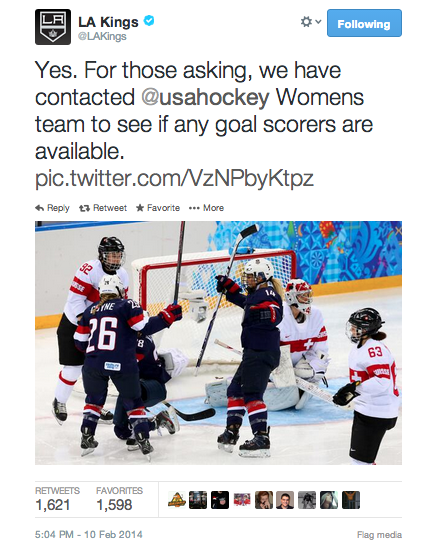
The problem with this joke by the LA Kings’ twitter is not that it is at the USA Women’s Olympic Hockey Team’s expense; it isn’t. It’s at the LA Kings’ expense. The problem with this joke isn’t that women couldn’t hack it in the NHL; in my opinion, many of them could, if they wanted to. The problem with this joke isn’t even that it isn’t funny, because at least 1,598 people found it so.
The problem with this joke is that not a single player on the USA Women’s Olympic Hockey Team has a chance to make even the NHL’s minimum salary of $525,000 playing their sport and doing it better than many of their male counterparts.
The problem with this joke is that Noora Räty has to retire so that she can pay her car loans.
Gender integration isn’t something that has ever made it too high up on the NHL’s To Do List. They are more worried about whether players should be allowed to tuck their shirts in, and trying to figure out what arbitrary line in the sand would mark the difference between Just Part of the Game Violence and We Are About To Get Super Duper Sued Violence. Technically, there is nothing stopping women from playing in the NHL, except that they are rarely given the chance.
Women’s hockey has peculiar pressure points. Checking isn’t allowed, technically, but it still happens; the match-up between the USA and Canada on the 12th proved that. Still, there are no Broad Street Bullies, no Big Bad Bruins. There is no such thing as an enforcer, or at least, not in the way that the NHL understands the term. You can’t make a living off your fists in women’s hockey because you can’t use your fists. Even players whose main job is to play the enforcer-type role has to be able to contribute at the technical level. (Also, of course, you can’t make a living in women’s hockey at all.)
The game has evolved to put high focus on stick-work and skill. Essentially every player on the team has to be able to perform the kind of puck-handling madness that players like Patrick Kane and Sidney Crosby do in the NHL. That’s not because women can’t fight, or learn the right way to absorb a hit; it’s because that element was taken out of their league’s game, and they had to compensate.
(Well. For the most part.
They’re only human, after all.)
Of course, gender integration of the NHL is not the answer to the problems of the CWHL–or women’s hockey in general. As Brenda Andress, Executive Director for the CWHL, told the Toronto Star, “We’re not the NHL and we’re never going to be, nor should we be, we have a very different game.” Räty herself doesn’t even call for it; instead, she writes that she believes the best hope for the future of women’s hockey is to build up the North American women’s leagues to a competitive level. Women’s hockey–women’s sports–already have the players. They have the heart and the hands and the heads.
Someone just has to build the stadiums up around them.
As the final spot for Team USA came down to a few names, debate amongst the United States management team was extremely heated. While a few participants indicated that perhaps a guy like Brandon Saad was more versatile and brought more to the table than the others, USA GM David Poile spoke up about T.J. Oshie.
“Oshie’s got that shootout move” Poile said.
Yeah, Oshie has a shootout move, or two, or four. The St. Louis Blues forward’s performance against Team Russia yesterday vaulted him into United States hockey lore and put The Stars and Stripes in the driver’s seat to win Group A in Sochi. Assuming all of the favorites win today, the US will probably be looking at a Quarters matchup with Switzerland (not the greatest scenario for us), and, if favorites continue to win, a date with Sweden in the Semis. However, there is still a lot left to be decided on the ice.
For now, the United States must put an emotional win behind them, and not get caught up looking past Slovenia. If there was any chance of that happening, hopefully that was put to rest with Slovenia’s shocking upset of floundering Slovakia yesterday. There is no doubt that today’s game will not be a cakewalk, and the US will need to show up to win the game and the group.
Anze Kopitar presents a challenge for Team USA (Julio Cortez, AP)
Slovenia’s Notable NHL’er – Anze Kopitar
The Good: Well, the list of NHL players is short. One. That means that the overwhelming majority of Slovenia’s roster comes from a league that doesn’t have the same pedigree as the NHL. The fact that Slovenia beat Slovakia means they know they’ll have a winnable game in the play-in round. With that in mind, and knowing they have a very difficult opponent, they may choose to get some rest for the big guns, in order to be ready for the elimination game in a couple of days. Ultimately, there’s no denying there’s a reason the team is a 1,000-1 shot for the Gold.
The Bad: If the team had to have one player from the NHL, Kopitar is obviously one of the better players in the game. The win over Slovakia means that, technically, Slovenia has a path to win the group, and may allow themselves to dream big. Plus, there’s no short changing what momentum can do for a team. They have nothing to lose, and that’s another sign of a dangerous opponent. While keeping the game close with Russia in the opener seemed more like a fluke at the time, they may be proving otherwise with strong results so far. Do not underestimate.
The Bottom Line: Oshie’s heroics mean that the United States controls its destiny with regard to winning the group. Beat a team that was looked at as perhaps the biggest underdog coming into the tournament, and you wrap up your bye and top three seed. Barring an overtime result from the Finland/Canada game, you also put yourself on the opposite side of the bracket from those two teams and Russia. While a potential date with Sweden would lurk in the Semis, injuries have made the Gold Medal contenders look slightly vulnerable.
Coming off of their two wins on Thursday, Team Russia having beat Slovenia 5-2 and Team USA having routed Slovakia 7-1 (the most goals scored by a USA team since the 2002 Olympics), both teams came into their game against each other with confidence. However, an Olympic game between Team USA and Team Russia is much more than just a simple hockey game. And while there is no longer a Soviet Union, with their Red Machine that took so many gold medals and beat all-star NHL teams, to say that this morning’s game between the two countries was just another game would be a serious understatement.
Though both teams are dramatically different—the rosters being filled with NHL players as opposed to college kids and Russian Army men—it is impossible to keep from comparing this game to that Miracle on Ice game played in Lake Placid in 1980 between the two countries. For Team USA that improbable team of college kids who managed to defeat a team almost ensured of a gold medal basically helped put hockey on the map for the United States. It is from that miraculous game that some of those now playing for the Red, White and Blue, got their first itch to put on a pair of skates and pick up a hockey stick. For Team Russia, playing in their home country, in front of a president who is a huge hockey fan, and who had a hand in selecting the head coach of the team—Zinetula Bilyaletdinov, who played for the USSR against Team USA in the surprising 1980 loss—it is no doubt that the pressure is high.
For many hockey fans across the world it sounded more like an NHL game being called with all the names being familiar, though on unfamiliar lines, and even the announcers recognizable. But this was anything but an ordinary game and there was much more than two points on the line for both teams.
Despite President Vladimir Putin’s comments that this would be a good test to show the rest of the world that the Kontinental’naya Hokkeynaya Liga (KHL) was a strong team on par with the NHL, there are only nine players on Team Russia who come from the KHL. The remaining 16 players are all active players on NHL teams.
From the players point of view, their familiarity with each other either as teammates on NHL teams or as opponents during the NHL season, they perhaps have an advantage on each other as opposed to some of the other teams that are not as NHL-heavy. The emotions were seen quickly, with “introductions” being made, much as fans see throughout the hockey season. However, that opportunity to represent your country in competition brings an entirely different emotion to the surface. Each shift means a little more. Each win is felt with a little more elation, while each loss hurts all the worse. And perhaps for those of Team USA, the support of the fans being primarily for Russia—complete with some of the loudest fans in a hockey arena—was perhaps a little noticeable. Cheers for Russia alternated with “Get the puck” (шайбу – prounounced “shaybu” in Russian) whenever Team USA had the puck.
Of the four goals scored during regulation, three of them would be scored on power plays, showing how important that man advantage could be. Team USA would be called for six penalties in regulation, while Team Russia would take five. Russia would go 1-6 on the power play whereas the USA would go 2-5.
There are some who will point to the disallowed Russian goal at the end of the third as a potential “questionable” tactic by Team USA’s goalie Jonathan Quick of the Los Angeles Kings—the goal was disallowed because the net became dislodged well before the play) as the real win of the game. However, the confidence of the goalies for both teams (Russia chose to start Sergei Bobrovski of the Columbus Blues Jackets) was evident throughout the game and carried over into the shootout.
And while much of the United States is currently calling shootout winner T.J. Oshie (St. Louis Blues) a hero, he has shown once again why hockey players are so well loved when he responded that the real heroes wear camo, referring to those in the military.
Team USA will play Team Slovenia on Sunday, February 16 and Team Russia is set to meet Slovakia in a match on also on Sunday. Though it would be easy to to say both teams will win, neither team should underestimate their underdog.
What today’s Men’s Olympic Hockey game that pitted Slovakia against Slovenia taught the world was that the underdog should never be counted out.
Coming into the game Slovakia was no doubt considered to be the lock for the game given that of the 25-man team they came in with 18 current NHL players from some of the best NHL teams in the standings going into the Olympic break. For Slovenia, this is the country’s inaugural Olympics in this sport and the team claims only one current NHL player.
Slovakia has a Who’s Who in Hockey roster with the likes of Marian Hossa (Chicago Blackhawks), Zdeno Chara (Boston Bruins) , Michal Handzus (Chicago Blackhawks) to name just a few—all Stanley Cup winners for the teams mentioned. And while Slovenia’s lone NHLer is also a Stanley Cup winner—Anze Kopitar (Los Angeles Kings), it did seem like Slovakia, despite their loss to the Americans on Thursday, would be the likely winner.
One thing about an underdog though is that it has nothing to lose by going all out, and that is exactly what happened during the Slovakia-Slovenia game. Despite a few short periods here and there for the Slovakians, the Slovenian team dominated the play. It was clear they were the hungrier team. And, as often has been seen throughout the other events at this Olympics, the fans in the stands have leant their support to the underdogs.
During the first period, Slovakia lost a valuable player in Tomas Kopecky (Florida Panthers) when he took an elbow to the head by Sabahudin Kovacevic while being sandwiched between Kovacevic and another of the Slovenian players. Kopecky lost his helmet and went down. He got up—as play continued—and began to try to make his way to his bench. He tumbled down, clearly suffering from the hit, and then once again pulled himself up and stumbled ultimately to the bench, again as play continued. Kopecky would not return to the game and it would later be mentioned that Kovacevic would be having a hearing about the hit.
As the teams began the third period, with Slovenia having to kill the remaining 45 seconds of a penalty, the score remained 0-0 and the shots on goal were tied at 19, though Slovenia was clearly the stronger team. Slovakian’s goalie Jaroslav Halak (St. Louis Blues) seemed to have real problems tracking the puck after rebounds. He was seen constantly looking around in search of the puck—never a good sign.
After killing the penalty, Slovenia was then on the power play just 1:36 into the third. And as the PP began to count down, forward Rok Ticar would score, with assists from Ziga Jeglic and Robert Robert Sabolic, putting the Slovenians on the scoreboard first.
Slovenia continued to bring the play to the Slovakian team, who seemed on their heels most of the game, and at 8:59 of the third, Slovenian’s captain Tomaz Razingar, assisted by Jan Urbas and Marcel Rodman, put another behind Slovakia’s Halak. And then just like that, just 23 seconds later, the Slovenians put another puck in the net, when Kopitar scored, assisted by Jan Mursak.
It looked like Slovenia’s goalie, Robert Kristan would have a shutout, when with just 17.8 seconds remaining in the game Tomas Jurco got a puck into the net, assisted by Tomas Zaborsky and captain Chara. This was the Slovakian captain’s first point in the Olympic games.
It seems somehow poetic that not only did the underdog win, but Slovenia, a country who used to be part of Yugoslavia (a country who last qualified for the Olympics for hockey in 1984) would win a game in their first appearance in the Olympics for hockey and that the game winning goal was made by their own captain, Razingar.
Slovenia will play against Team USA on Sunday, February 16 and Slovakia (who is winless so far in the preliminaries) will see Team Russia, also on Sunday.
With Henrik Zetterberg’s Olympic dream over due to a long-standing back injury, his team banned together and beat Latvia today, 5-3.
Sweden found the back of the net first in the contest, on the power play, when Patrik Berglund put a puck behind Latvia goaltender Kristers Gudlevskis, assisted by Erik Karlsson and Alex Steen. Although Latvia could only muster five shots on goal in the first period but would answer one minute and twelve seconds before the first period ended with a goal from Lauris Darzins.
The second period became a battle of second teams as both Latvia and Sweden capitalized on their respective man advantages. Latvia took a 2-1 lead minutes into the second period when Janis Sprukts beat Swedish goaltender Henrik Lundqvist while Niklas Kronwall in the box for tripping. Sprukts’ stick tipped a shot from the point, which went high behind Lundqvist’s shoulder.
Sweden, though, would capitalize on three power play opportunities in the second period to make the score 4-2 after two. Erik Karlsson, Daniel Alfredsson and Jimmie Ericsson each put a puck behind Gudlevskis. Latvia out-shot Sweden 9-5 in the second period.
Latvia would make it a one-goal hockey game a minute and a half into the third period when Zemgus Girgensons put a puck behind Lundqvist on the man advantage. Sweden would extend their lead, though, with an even-strength goal (only the second in the game) from Alexander Edler to make the score 5-3.
Though Sweden squeaked out the win, the numbers drop Lundqvist’s save percentage in the Olympics so far down to .935%. Latvia has remained winless in round robin play. Sweden will move on to the qualification round, which will begin Tuesday.
There’s no love lost between these two hockey teams. They faced off against one another in the bronze medal match in Vancouver, where a lengthy battle on ice ended in a win for Finland and a grudge for Sweden. In today’s game, that lingering animosity was tangible from the very first whistle, and players came off both benches playing hard and fast.
Checking isn’t allowed in women’s hockey. But body contact is allowed, as long as contact is made while both players are in pursuit of the puck. So you don’t have the swooping forecheck you do in men’s hockey, so much as the smashing together of two bodies trying to occupy the same amount of space on the ice at the same time. It’s ugly.
All this physical play meant a fair share of penalties for both teams. Finland scored late in the second, but Sweden tied up the game not long after with a power play goal shot by Anna Borqvist.
Sweden claimed the lead in the third, and then it was Finland’s turn to tie it up. Emma Nuutinen made the goal for Finland off a pass from from Karoliina Rantamaki.
Finland soon had another costly penalty called against them, and Sweden regained the lead with a power of a shot off the blue line from defenseman Emma Eliasson.
Looking to tie things up again, Finland pulled arguably their most accomplished player on the team (Goalie Noora Raty), and naturally Sweden’s Emma Nordin scored an empty netter.
The final score was 4-2, Sweden.
During the game, announcers from NBC said on more than one occasion that Noora Raty is “the best goaltender in the world.” They didn’t hedge that with best “female” goaltender. They just said best.
And today the world learned that the best goaltender in the world would be retiring after the Sochi games. Not because of injury or waning interest in the game—that’s a privilege that extends only to male hockey players, where you have guys like Teemu Selanne and Jaromir Jagr playing into their early forties.
(Photo: www.unionleader.com – Linden Vey, Tyler Toffoli, Tanner Pearson reunited as a line)
The rivalry between the Manchester Monarchs and the Worcester Sharks has always been a strong one. This season, despite Manchester hovering at the top of the conference, they have had a little bit of a hard time facing the Sharks. In the last meeting, they lost in a shootout in Worcester.
The two teams came into the game both having one their previous contest and both benefitting from the Olympic break in the NHL. The break has seen the reunion of Tyler Toffoli, Linden Vey, and Tanner Pearson on the same line and last night the chemistry was apparent.
“(Toffoli) showed a scoring touch, and obviously the familiarity with his linemates from previous stints had a lot to do with it,” said Monarchs Head Coach Mark Morris. “He’s a guy that has a gift to score and we saw a taste of that here today. Obviously, that line put up a lot of points and they did exactly what we’d hoped they would do.”
Manchester set the pace early, completely controlling the action in their offensive zone. Despite a couple good chances, Sharks goaltender Troy Grosenick was doing an excellent job of keeping his team in it early. Just over seven minutes into the game, Manchester went on their first power play. Coming back into the zone, after a clear by the Sharks, Jordan Weal out skated the Sharks defensemen and passed it to Zach O’Brien. O’Brien fed it right back to Weal in a great move so he could put the Monarchs on the board at 8:25.
It was an important goal for the Monarchs who have been struggling on the power play. It was not until after that goal that the Sharks even got their first shot of the game on Martin Jones. Although Manchester had to spend some time on the penalty kill, they completely dominated the first period. They put 18 shots on Grosenick in the first period alone and limited their opponents to only 6.
At the start of the second period, the Monarchs were still on the penalty kill and would have to face being down two men when Vincent LoVerde went off early for tripping. It was 23 seconds of 5-on-3 hockey. It seemed like the Monarchs might get out unscathed, but just after the first penalty expired, the Sharks scored on the 5-on-4. There was a lot of traffic in front of Jones, who did not seem to be able to see them puck as Sharks forward Freddie Hamilton put it past him.
Grosenick was still playing strong between the pipes for Worcester, but it was not enough to stop the first goal of the night from Tyler Toffoli. Linden Vey passed to Andrew Bodnarchuk who fed it to Toffoli in a pass across the crease. Grosenick was not able to change sides quick enough to stop Toffoli from the easy score just past the halfway mark of the second. But that would not be all as the Monarchs had one more goal in them from the second period.
The Monarchs found themselves on a 5-on-3 for almost two full minutes as Sharks defenseman Nick Petrecki went off for holding. He was following 14 seconds later by fellow defenseman Taylor Doherty who had to serve a double minor for high sticking. The Sharks frantically tried to clear the puck but were not able to. Tanner Pearson managed to get the goal from Nick Deslauriers and Nick Shore.
“I think it’s big. That wins hockey games, especially down the road when it comes to playoff time,” Pearson said on scoring power play goals. “It’s crucial. When you’re struggling, the power play can generate a lot for you.”
Through two periods, the Sharks had only managed to take 11 shots while Manchester had taken 28. When the third period started, the Sharks seemed to pick up their pace a little bit, registering 15 shots in the final period but it was much to little and much too late. Jones faced a lot of traffic in front of his net but did not let another one past him.
Toffoli, on the other hand, showed just how talented he is with the puck. He added his second and third goals of the game in the second half of the final period. With the smaller crowd, only a few people tossed their hats. What was more impressive was that it was the second hat trick of the season for the second year pro who has only played 16 games. He adds that to the two hat tricks from last season for a Manchester record for most hat tricks by a player. He has accomplished this feat in just 75 games.
Although Linden Vey did not join his linemates in adding a goal, he assisted on all three of Toffoli’s goals as well as lending an assist on Weal’s goal. It seemed like the best game he had played in awhile as the Monarchs first line has regained their chemistry. He earned second star of the game while Toffoli claimed first star honors.
Despite allowing 5 goals, Troy Grosenick was named third star of the game for making 38 saves on 43 shots, some of them coming in impressive fashion. Last night, the Sharks skated 7 defensemen and only 11 forwards. Two of those players included forward Freddie Hamilton and defenseman Matt Tennyson, who got into a car accident earlier in the day yesterday but were apparently fine.
Manchester plays on the road tonight against Hartford, while the Sharks had to hop on a bus to Binghamton immediately following the game to face them tonight. The Monarchs will be back at home tomorrow afternoon as they host the IceCaps. It is the final meeting of 10 between the two teams this season and Manchester has only gone 3-6-0-0 against their division rivals.
Both Team Norway and Team Finland entered today’s game limping. Team Finland won their first match up of the games, true enough, but they came into the Olympics minus two of their most talented players (Minnesota’s Mikko Koivu and Tampa Bay’s Valtteri Filppula). Yesterday, Team Norway managed to keep Canada on the ropes for longer than anyone anticipated, but lost control of the game in the second period, and badly wanted to regain some of their lost momentum.
Team Finland Captain Teemu Selanne, who sat out most of the game against Austria due to a neck injury, came back strong and scored the first goal for Finland.
Seven minutes into the first, the puck popped up into the air and every player on the ice for Norway lost sight of it. When the puck fell back to the ice, it was picked up by Olli Jokinen, who had ample time to set up a perfect shot on goal, and put Finland up 2-0.
Goalie Lars Haugen was a veritable wall in the game against Canada, but floundered in the first period against Finland. A shot courtesy of Finland’s Jori Lehtera, flew right past Haugen’s ear and into the net, and there was no question we’d be seeing a different goalie between with pipes at the beginning of the second.
Except the fault for the growing goal differential didn’t lie with Norway’s goalie. Lars Volden came into goal for Norway in the second, and Finland racked up another two goals, making the score 5-0.
The real problem was Norway’s timid offense. Norway played aggressively against Canada, but for some reason they held back against Finland. There was no forecheck to be found, and Norway was consistently being out-puck handled by Finland.
Finland was able to take their time when they had possession of the puck, skate around, survey the ice and wait until an optimal play landed in their lap. Norway never should have let Finland have all that time—and it became clear Norway lacked the confidence to try and take the puck from Finland.
Norway started the third with a one man advantaged that increased to a two-man advantage after a high sticking call against Ruutu. Olimb passed neatly to Skroder, who took the shot, and finally put Norway on the board. That Norway’s only two goals in the past two games came during one-man advantages says something damning about their offensive play, though.
With two minutes left in the game, Norway made a bad line change, and couldn’t take advantage of a run at Finland’s goal by Zuccarello. Finland took possession back from Zuccarello and Maata backhanded the puck past Volden to bring the game to an end. Final score: 6-1, Finland.
Moving forward, Norway has some serious confidence they need to regain. Hopefully that can come to them when they go against the equally faltering Team Austria.
The big question for Finland ahead of their game against Canada on Sunday will be who to start in goal. Rask has the obvious seniority, and a history in the Olympics with Canada, but Antti Niemi hasn’t had any play yet these games and will be well rested and prepared. Lehtohnen won’t start, but he played well today, using every bit of his 6’4 frame to block Norway out.
Whoever Finland chooses, they go into the game against Canada real contenders. Finland has had its fair share of foibles ahead of the Olympics, but they’ve really rallied in these games. Their blue line is a potential point of weakness, but Olli Maata has performed admirably in the past two games. And their offense has proven they’re certainly capable of getting goals. Canada fumbled during their game against Norway, and they’ve improved in their play today, but Canada and Finland could prove more evenly matched in their play that anyone would have thought.




 Prev
Prev