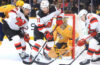
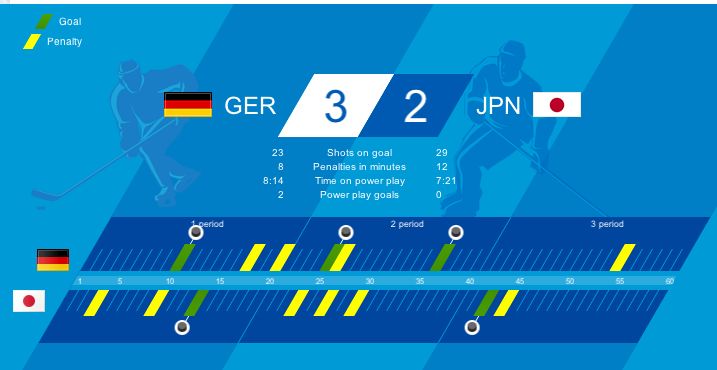
Watching this morning’s Classification game at the 2014 Winter Olympics in Sochi between the German and Japanese Women’s Hockey teams was a lesson in passion and determination. This was not a game for a medal. This was not a game for the chance to stand on a podium. And because these are women athletes, this wasn’t even a game for million dollar contracts or recognition by a professional team. This was for the love of the game and for the right to claim the win.
The second thing that becomes clear is that without the ability to body check—which is allowed only in the men’s games—the stick and puck handling skills are all the more important. Without such skills, it becomes impossible to get the puck out of a team’s defensive zone and be able to make offensive plays.
The larger ice surface combined with the lack of allowed body contact offers a view of the sport of hockey that is sometimes overshadowed when the men are banging each other in the corners and in front of the crease. The use of the sticks and the importance of smart tape-to-tape passes become all the more important.
Viona Harrer (Photo: 2014Sochi.com)
The game was a lot of back and forth with each team claiming the momentum from time to time, especially in the first period. While Japan was outshooting Germany on net, Germany had goalie Viona Harrer between the pipes. Going into the game her save percentage was above .930 and she had one shutout.
For Japan, their goalie, Nana Fujimoto came into the game under the .900 save percentage. Unfortunately for her, the penalties that her team would take proved costly, as Germany got their first two goals via the power play. However, it was the third goal by Germany at the end of the second, where she again struggled with her glove save and she would be pulled and backup goalie Akane Konishi would go in to finish the game.
The shots on goal for the first two periods favored the Japanese, which is where the strong save percentage of Harrer helped her team remain in the game. Harrer did struggle with a few rebounds, and it was one of those rebounds that allowed the Japanese to tie the game in the first period. However, the Germans were then able to keep the Japanese off the scoreboard until early in the third.
Because body checking is not allowed in women’s ice hockey, it was quite a bit of a surprise to watch Japan’s Tomoe Yamane, who was called for checking, in a move that in the National Hockey League is called “boarding” as she came up behind Germany’s Andrea Lanzl, whose body was bent, head slightly down, facing the boards, and checked her into the boards.
It is such dangerous hits that the NHL is trying to get removed form the professional game, and in a game where body checking isn’t allowed at any time, it was surprising to see Yamane get only a two minute penalty for such a hit. Fortunately Lanzl did get up, though it looked like she was slightly shaken up by the hit and the awkward way her head and neck contacted the boards.
For much of this game, the Japanese players had the better players and had more of the momentum. However, as has been proven many times, the team with the great goalie can often steal a game. And in some ways that is what happened to Japan as they were ultimately defeated by just one goal in their game against Germany.
Admiration for the perseverance of these women was evident of those who were present during the game. But when you consider that many of these women have full time jobs to allow them to continue their hockey dreams, that really speak to their love of the sport.
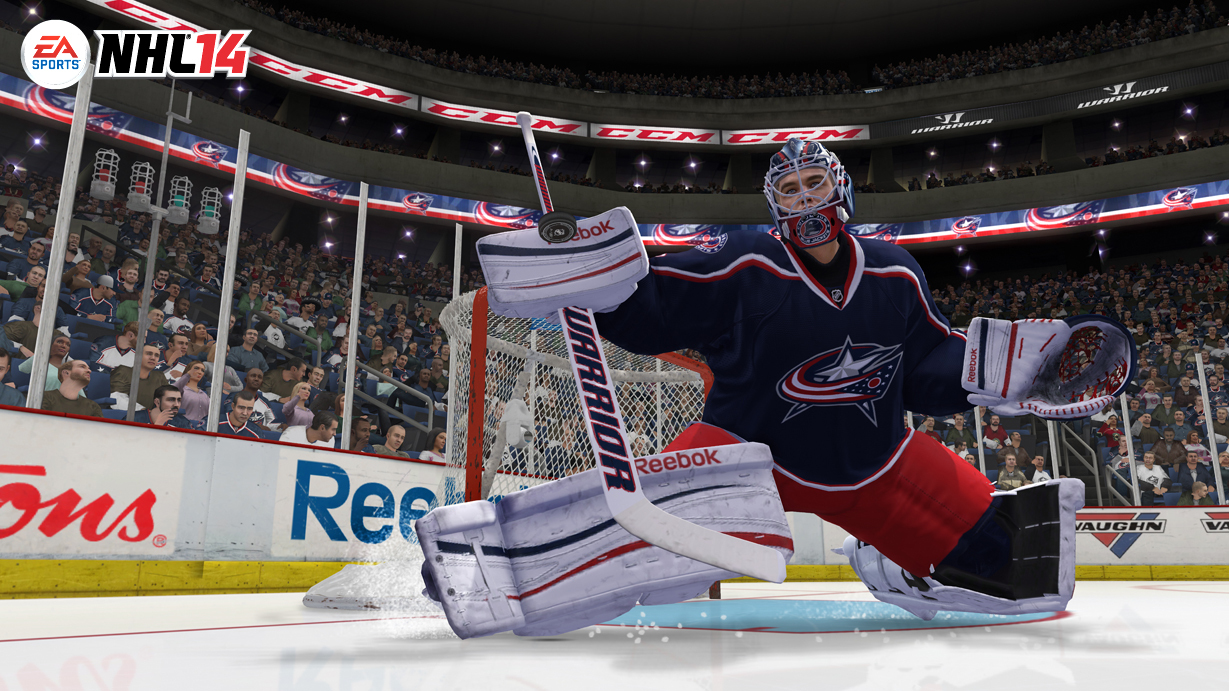
The Olympic break is here. Rosters are updated. And the hottest buzz in NHL 14 is to represent your nation in online play- giving yourself a chance to be a hero; a chance to have your own “Oshie moment.” With storylines abundant as the elimination round arrives- like the US’s domination, or Canada’s less than stellar play- the international online gaming has only gained steam. While the Canada-USA matchups reign supreme, Russia and Sweden are two other hot choices as NHL online play picks up.
EA sports released a fascinating Infographic breaking down each Olympic team in a variety of categories.
Jonathan Toews and Sidney Crosby lead all Sochi representatives with 4.3 and 3.5 million in-game goals respectively.
Pavel Datsyuk is third with three million, followed by Chicago Blackhawk’s teammates Marian Hossa and Patrick Kane who are tied at 2.7 million in-game goals apiece.
The winningest Sochi goaltender is Roberto Luongo with 4.1 million victories. Carey Price is second on the list with 1.5 million, followed by Jimmy Howard and Tuukka Rask.
In terms of the salary cap it’s Canada, as expected, leading the way by more than $30 million with a $150.9 cap hit. The US is second with a $119.8 million cap hit.
Team Finland boasts the most players who have won Olympic medals with 14.
Take a look here to see who rounds out the leading NHL 14 Sochi representatives:
The top two seeds as we head to elimination play, Sweden and the US, have been the most impressive teams thus far in Sochi. That being said, the tournament is wide open, as Canada could certainly fix their Chemistry “issues”, and Russia’s elite goal-scoring talent is always a threat; even Switzerland with their high-speed tempo and superb goaltending by Jonas Hiller could make some noise. And then, there are the Finns.
The tournament has been a hockey fan’s dream thus far and will only get better. Be sure to make your own Olympic history with NHL 14’s online play- this could be your last chance, with NHL players, that is.
Goaltender Semyon Varlamov has gained traction this season, protecting the crease for the Colorado Avalanche. With the NHL on break, Varlamov has been representing his home country of Russia in the Sochi Olympics.
Meanwhile, Canadian actor Greyston Holt has been prowling the streets as a wolf in Syfy’s show “Bitten”. While the two aren’t dead ringers for each other, they do bear a similar brooding resemblance.
A quick search on YouTube does not reveal much about Finnish sensation Noora Räty. The videos are mainly interviews, both in English and in her native tongue and only one video of a spectacular save. Pick just about any NHL goalie and you will easily find highlights, even Chad Johnson who serves as a backup in Boston, has more highlights than Räty.
So who exactly is Noora Räty (pronounced like “Nor-uh Rah-too”) and why should you care? Well let’s start with who she is: she’s a 24-year-old Finnish netminder who played for the University of Minnesota and during her senior year in 2012-2013, she started all 38 games and did not lose a single one (including overtime and shootouts), backstopped her Golden Gophers to their second national championship in a row and set a record as the best NCAA goalie in the entire country by posting a 1.00 winning record, a .956 save percentage and had a ridiculous goals against average of .96. She made 776 saves, posted 17 shutouts (an NCAA single season record), and broke an NCAA record for career wins with 114 and career shutouts with 43. The most amazing part of this is that she had accomplished all this by the time she was 23 years old.
Add to that, she is a three-time Olympian, has participated in four World Championships, has been a member of the Finnish national team since she was 15, and helped Finland earn their second-straight bronze medal at the 2009 IIHF World Championships when she stopped 78 shots. And this isn’t even close to the full list of her professional and collegiate accomplishments.
A product of Finland’s goaltending program, it’s clear she is a special talent who is more than capable of going toe-to-toe with the best in the world; I dare say she could probably even give her countryman Tuukka Rask a run for his money.
So now that you’ve “met” her so to speak, why should you care? You should care because she’s an extraordinarily successful, incredibly gifted young athlete who is retiring from professional hockey. At 24 years old. As fellow The Pink Puck writer Mollyhall noted, it’s not that her career is over or that she’s through with hockey, it’s just that she has nowhere else to go. If she’d been born a male, she’d be lauded and praised for her amazing achievements and be on a one-way ticket to the NHL. As it stands, she is female and has seen her career peak simply because there’s nothing better out there for her.
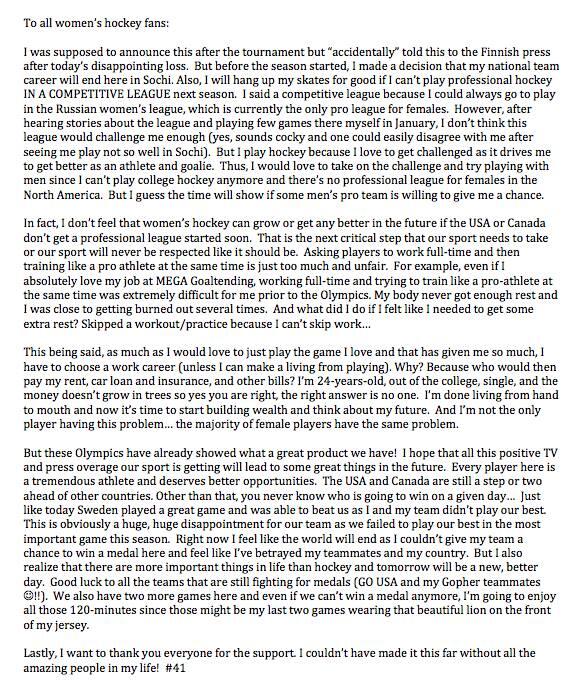
Following Saturday’s upset loss to Sweden, Räty revealed her impending retirement to the Finnish media and later clarified her position on Twitter. Below is the full announcement she made, expressing her desire to play with men to better challenge herself as an athlete and a goaltender.
Photo credit Noora Räty
I am not now, never have been, nor will I ever be a professional athlete but I can sort of sympathize where she’s coming from. Being female in a male dominated world isn’t easy, period. Being the best among your peers and not being able to grow because of your gender has to be extremely difficult.
One thing that sticks out to me is her desire to see Canada and the US establish a professional women’s league. Because of their prowess in ice hockey, the IIHF changed the formatting for women’s Olympics, putting what they considered to be the four best teams into one group to make it a little bit more “fair” for other teams to at least get a shot at winning.
Finding the disparity between North America and the world in women’s hockey is easy: We have the NCAA.
Hughes makes a good point that the NCAA has helped to spur these two countries’ complete dominance in women’s hockey. With the amount of resources and training facilities available, it’s no wonder that North American athletes are so much better and stronger than their competition.
Räty, a former NCAA athlete herself, said she doesn’t “feel that women’s hockey can grow or get any better in the future if the USA or Canada don’t get a professional league started soon.” Perhaps unbeknownst to her, a women’s professional league already exists: the CWHL – Canadian Women’s Hockey League. There are only five teams and the league is not heavily promoted, so it does not get a lot of exposure.
Creating a new professional league or even expanding the CWHL could really help to grow the sport. Back when the NHL was first established, there were only six teams and it was dominated by all Canadian men. Now, 90 years later, the NHL features men from all over the world and sees young boys leave their home countries to come to North America (OK fine, Canada) for a chance to compete in the NHL. Programs like USA Hockey’s National Team Development program, started in 1996, would not exist without the patience and desire to grow ice hockey internationally.
The biggest issues surrounding the current CWHL are 1) lack of promotion; without that, it’s going to be hard to get exposure and 2) lack of elite players who have played at a higher level beyond the NCAA. However, without being attached to a larger name like the NHL, it’ll be hard for CWHL to gain a lot of momentum in terms of marketing and promotion.
As James Neveau, a reporter from NBC Chicago, pointed out, “If any women’s league is going to work, then they would likely need the backing of the biggest hockey league on the planet to do it. After all, multiple women’s soccer leagues were started following the wild success of Team USA at the 1999 Women’s World Cup […], but since they weren’t partnered up with a major media outlet or sports league, the efforts to gain traction have been largely futile.”
It would likely be an unpopular decision with the masses, but if NHL Commissioner Gary Bettman were to agree to back a CWHL type league, it would be the biggest thing to ever happen in the world of hockey; even more so than naming a franchise after a children’s movie or putting a hockey team in Sunrise, Florida. It would likely be the most controversial decision ever made and would be picked apart endlessly by critics. But it could also be one of the best decisions ever made. That is, IF Commissioner Bettman agrees. IF.
Keeping on this “If” train, should the CWHL expand, the best place to start would be in the Midwest – where the Chicago Blackhawks look to be perennial contenders for hockey’s holy grail and household names like Zach Parise (who happens to be captaining the US men’s team at the Olympics this year) and Ryan Suter (also an alternate captain with the men’s team) act as stabilizing bookends for a hard working Minnesota Wild team.
“With the popularity of teams like the Chicago Blackhawks and Minnesota Wild in their respective markets, piggy-backing on their success by starting new women’s hockey franchises in those cities would be a great place for the CWHL to start. Minnesota especially is a hockey-mad state, with several top tier collegiate programs on both the men’s and women’s sides of things serving as testament to their voracious appetite for hockey,” writes Neveau.
The self-proclaimed hockey state was the first state in the nation to sanction girls’ ice hockey as a high school varsity sport. Being one of the first to add a women’s pro team in the US would further add to their reputation of being puck lovers.
One of the biggest complaints and criticisms of women’s ice hockey is that it’s boring because the women aren’t as good as the men in the NHL. For those who think that, I’m not sure they’ve ever watched a game. At 5’5, Noora Räty would be considered “too small” to play goal in the NHL. In spite of her petite stature, she is still one of the best, most dominant goaltenders in the world.
Amanda Kessel has an incredible release that is comparable in quality to her brother Phil’s, as evidenced by this video below.
Kessel easily dodges her defender and puts it top shelf just under the crossbar. It’s a move that’s on par with some of the best NHLers, who are arguably the best hockey players in the world.
Kendall Coyne can be compared to Patrick Kane with her blinding speed, excellent offensive awareness and an ability to put the puck in the net; she’s fast and has great escapability qualities in her game that makes her one of the best female hockey players in the world.
These women are fast and strong; they are intense, tough and gritty and they have insanely high hockey IQs. Many of them would be able to hold their own against their male counterparts in the NHL and they are every bit as competitive as the men to whom they are compared. Having a professional women’s league that’s competitive and well promoted would create tons of growth within the sport. As an added bonus, it would also make more games that much more enjoyable to watch, especially for the casual viewer.
Noora Räty is not just another frustrated athlete upset that her team lost and will not medal. She is a highly accomplished goaltender who finds herself at a crossroads between a career and pursuing her life’s passion. For now, she must accept adulthood responsibilities and give up professional hockey unless she is fortunate enough that a men’s team will allow her to play with them. It’s not that it’s based on talent or skill level; she’s already proven beyond a shadow of a doubt that she’s more than capable of being the best in the world. It’s that she has no future career path that will challenge her to grow as an individual and as an athlete. Until such time that there is a professional women’s league that can be competitive like the NHL, this is the reality that she and other women are faced with.
So what do you think? Do you agree with Noora Räty that the US and Canada should have a professional women’s league? Do you think we’re ready for an expanded women’s league? Do you think the NHL should support an expansion league? Sound off in the polls below.
Just when you think you’re getting a grip on things at the Men’s Olympic Hockey Tournament, a few more curveballs get tossed into the mix.
The United States took care of their business on Sunday with a solid victory over Slovenia. That’s pretty much where the predictably stopped, though. Slovakia shockingly forced a shootout against the host Russians, and Canada needed overtime against Finland. This brought on one of the few roads not expected heading into play on Sunday and it is a mixed bag for the USA.
Canada needing overtime to beat Finland granted the number one seed to Sweden. The Swedes were the only team to win all three of their games in regulation time during round robin play. However, a combination of injuries, close games, and non-power opponents makes them anything but the obvious favorites as we reach the elimination stage.
While it looked like Team USA was locked into the three seed, that overtime result pushed them up to the number two spot. Because of this, the United States will play the winner of the Slovakia/Czech Republic game, instead of the winner of the Switzerland/Latvia game. Despite the fire power of the Czechs, this has to be looked at as a positive for The Stars and Stripes, as Switzerland gave up a total of one goal during round robin play (Jonas Hiller has still not allowed a goal in his tournament).
However, moving up into the two spot comes with a consequence. If Canada or Finland had won in regulation time, the United States would have been the three seed, and sent to the bottom of the bracket with banged up Sweden as their biggest threat. Looking at it, the USA would have needed to beat (most likely) Switzerland, Sweden and whoever survived the war of attrition amongst Canada, Finland and Russia in the upper half of the bracket. Instead of this, a possible rematch with Canada now looms in the Semis. If the US could exact revenge, they would still have to beat one of Sweden, Russia or Finland to win it all. Ultimately, although they may have earned a slightly easier Quarters battle, they now have a much more difficult road to Gold.
As they say, you have to beat the best to be the best. Barring any crazy upsets along the way, the United States will have to do just that if they want to be the ones celebrating on Sunday.
Since the beginning of the tournament, the Women’s Ice Hockey discipline at the Sochi games has been predictable. After the United States’ assertive 6-1 victory over Team Sweden yesterday, the final match-up we all saw coming was made official. Canada and Team USA will rematch for gold.
Other keyboards will continue to tell the tale of the disparity in women’s hockey. This particular game only confirmed what many have been shouting. The shot count of the opening period was a staggering 29-1 in favor of the Americans, and only got slightly less lopsided in subsequent stanzas. Team USA completely dominated the entire game, scoring 3 goals in the first, two of which came in a span of 66 seconds. Alex Carpenter opened the scoring at 6:10 from a feed off Kelli Stack on the power play. Then Kacey Bellamy capitalized on some pressure in Sweden’s zone at 7:16 to extend the lead to 2-0. Hilary Knight would draw Team Sweden’s third penalty of the game, and though the Americans would not score on the man advantage, Amanda Kessel netted USA’s third goal a mere 2 seconds after Sweden killed the penalty.
The second period did not look much better for Sweden. Monique Lamoureux lit up the lamp for Team USA’s fourth goal, on the power play, at 5:41. A goal by Megan Bozek would give the US women a commanding 5-0 lead at 12:17, and lead to Sweden’s Valentina Wallner to be replaced by Kim Martin Hasson at 12:31. Martin Hasson was part of the 2006 Sweden team that upset Team USA that year, the first time the Americans were ever defeated at the international stage by a team not named Canada.
Had the game not gotten so out of hand by this point, the last period would have been an interesting one. Sweden finally got on the board over halfway through the third. Jessie Vetter worked harder than she had yet in the game to deny a wraparound stuff attempt by Erica Uden-Johansson, only to be scored on moments later from a shot by Emma Eliasson that got deflected in by Anna Borgqvist at 13:04. A minute and a half later, Jocelyne Lamoureux was taken down in front of the net as she came in on a breakaway and the Americans were awarded a penalty shot. Unlike the NHL, IIHF allows a team to select any player to take the penalty shot, as opposed to the athlete who drew the penalty. Head coach Katey Stone went with Jocelyne Lamoureux anyway, and though she made a brilliant spin-o-rama move, she was not able to fool Martin Hasson. An unfortunate own-goal by Team Sweden would seal their fates at 16:58, as Brianna Decker fired a shot off the crossbar that would bounce off a Swedish defender’s skate and into the net to clinch the Americans’ 6-1 victory. Team USA would triumph in the shot count by an overwhelming 70-9.
The U.S. Olympic Women’s Ice Hockey Team have a few days off before they face Team Canada in the gold-medal game on Thursday at 12:00 PM EST. It is the team they expected and hoped to face all along, and there is no doubt they will want vengeance for both their 2010 gold-medal match, and the preliminary game they lost to the Canadians just 5 days ago.
Everyone expected that Team Canada of the Olympic Women’s Hockey would win in their game today against Switzerland. And it looked, just past the halfway point in the first period, as though Canada would obliterate Switzerland. Once again the Olympics would show that in addition to skill, emotion and determination can at least make a win more difficult.
Switzerland would be called for two penalties back to back. They managed to kill off the first (and the few seconds of five on three after the second was called) and then just eight seconds after gaining back one of their players, Spooner would strike again, this time assisted by Catherine Ward in addition to Wickenheiser, which made up for a disallowed one just seconds before as a result of Spponer being in the crease (something that is a penalty in international play).
Before Switzerland’s goalie Florence Schelling could get her head back into the game from Canada’s power play goal, in just 23 seconds, Canada found the back of the net yet again. This time it would be Melodie Daoust assisted by Jennifer Wakefield.
Switzerland’s head coach, Rene Kammerer, called a time out to get his team refocused. For this women’s team, the fact that they were even in the medal round was a major accomplishment.
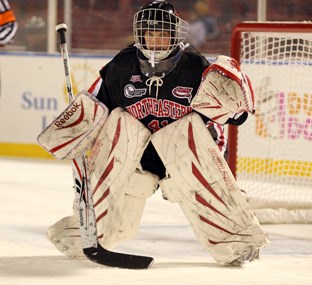
Photo: Northeastern University Athletics
After the time out, Switzerland began to push back and Schelling–a Northeastern University alumni–shut the door for the remainder of the game, though Canada would have a few good bids for additional goals, including one in the third period that went in, but was disallowed because Schelling was pushed into the net by Meghan Agosta. Commentators and the Canadian team tended to disagree with the decision.
For the play-by-play and color commentator the fact that there was only a single referee on the ice for the women’s games was brought up a few times. And the disallowed goal was one of those instances. United States referee Erin Blair was back at the red line when the shot was made on the goal and followed into the net by Schelling and Agosta. The replays showed the puck in the back of the net, but it was difficult to determine just when it got across the line—before or after Schelling traveled into the net.
What had begun as a likely Canadian blow out, became an interesting north and south game as the Swiss kept coming back for more. And while Team USA sat waiting to hear who they would play in the Gold Medal round—and wishing it would be Team Canada—there were some in the stands and perhaps many watching (who were not in Switzerland) that perhaps hoped the Swiss could rebound.
Such was not the case, but the Swiss will go into the bronze medal game and their confidence is high at this point. The achievements of holding the Canadians to just three goals can’t help but boost that confidence. It is unknown if Schelling will be in net for the Swiss for the bronze medal, but if she is, it is likely that Team Sweden will encounter the same brick wall that stymied the Canadians as the game continued.
And for Team USA and Team Canada the grudge match will continue. When interviewing USA’s captain Meghan Duggan, after their win over Sweden earlier today, the question was brought up as to just how much animosity there was between the two teams. Duggan is from Danvers, Massachusetts and is a Boston Bruins fan, and the interviewer suggested that it could be as much “dislike” as that between the Bruins and the Montreal Canadiens. Duggan grinned. Likewise when interviewed during the first intermission of the Canada-Swiss game, Spooner also was looking forward to a rematch against Team USA.
In the end, the Swiss would fall to the Canadians, but in a respectable 3-1 score and are taking a determination to the bronze medal game for the win. And both Teams Canada and USA get the chance to again meet across the faceoff dot in Sochi, but unlike earlier in the round-robin, this game will bring with it all the emotions—some would call it hate—for each other and all the desire to be the team on the top podium.
After Saturday’s incredibly thrilling, emotionally heavy, tightly played game against Russia, it seems natural to expect that the US might not have quite the same jump in their step. All doubts of that were removed when Phil Kessel scored the first goal just over a minute into the game, beating Slovenian backup goaltender Luka Gracnar. A couple minutes later, Kessel batted the puck in mid-air to double the lead. It was a great display of some excellent hand-eye coordination that started with a perfect Joe Pavelski pass.
Down but not out, Slovenia rebounded and started to take control of the first period, though they weren’t able to get on the board. The second period started off favorably for Slovenia, generating quality chances and spending extended amounts of time in the defensive zone, to no avail.
However, midway through the period, the US seemed to wake up and Kessel completed his natural hat trick by converting a rebound into an empty net. The Americans put together a second great shift in a row with Blake Wheeler taking the puck around the net and slipping a perfect cross-ice pass to Ryan McDonagh, who wristed it home.
In spite of the score, Slovenia kept pressing to break the shutout. They continued to play with confidence and assurance that a single goal was within reach. They nearly broke through on the power-play, but Ryan Miller made a great save with the butt end of his stick to keep the score 4-0.
Anze Kopitar did not return in the third period due to an illness, according to his father and the Slovenian head coach, Matjaz Kopitar.
Matjaz Kopitar on Anze: “he just didn’t feel good. Something with the stomach. He was without the power. Hopefully he’s going to be better.’
In spite of missing their best player, the Slovenian team pushed forward and did their best to hold the Americans to a 4 goal lead. Luka Gracnar stopped several quality chances from the US, but was unable to completely hold off David Backes as the puck bounced off his skate and into the net. They ruined Ryan Miller’s shutout with just 17.9 seconds left in the game thanks to some very sloppy play by Miller and his teammates. However, given that Slovenia had had their shutout ruined with just 17 seconds to go in the previous game against the Slovaks, it was a bit of poetic justice for the hardworking team from a small nation of roughly only two million people.
Next up for Slovenia: They’ll face Austria on Tuesday the 18th in a qualifying round to get into the quarterfinals.
Next up for the US: They get a short break until Wednesday when they face the winner of the Czech/Slovakia game in the quarterfinals.
The Manchester Monarchs came back from their All-Star break and immediately got back into the swing of things with a three-in-three weekend. According to forward Tanner Pearson, as nice as it is to have the time off, it can also be difficult. They did not get back to practicing until Friday morning and had to immediately get to work.
They had a convincing win over the Worcester Sharks on Friday night before battling the snow to get down to Hartford on Saturday night. It was a real test for Martin Jones, who made 34 saves on 36 shots. They headed back to host the St. John’s Ice Caps on Sunday. The Ice Caps had Saturday off.
So far this season, the Ice Caps have proved a difficult opponent for the Monarchs to solve and this game started off seeming like it was going to go the same way. The teams were skating quickly and it was making it hard for either team to get a good shot off. A little more than halfway through the first, Manchester’s Tyler Toffoli, who has been on fire since returning from LA, took a hard hit and left the ice to go down the tunnel. Andrew Campbell also took a puck to the face, but both returned before the end of the period.
The teams skated out for the second without either team having made it onto the scoreboard. The Monarchs started the second with almost two full minutes of a power play, but were unable to capitalize. It would be the Monarchs that did ultimately strike first, despite the ice seeming to be tilted in the Ice Caps favor. New addition Steve Quailer, that came to the Monarchs as the result of a trade between the Kings and Canadiens. Quailer stopped just short of Ice Caps goalie Michael Hutchinson and fired it home.
However, St. John’s did not wait long to tie it up. Eric O’Dell sent the puck back to Carl Klingberg who fired from near the blue line. Martin Jones was doing his best to keep his team in the game, but he was unable to stop that shot. Following that, he continued to make a number of impressive saves. Despite his continued strong play, the Ice Caps took the lead at 14:16. Kael Mouillierat dug the puck out of the corner and fed it to Adam Lowry for the easy goal right in front of Jones.
It looked like St. John’s might take the 2-1 lead into the second intermission. If that had been the case, it would be lucky for the Monarchs. The Ice Caps got 22 shots on the board during the second period and the whistles were not going the Monarchs way. But with just 3 seconds left in the second, Nick Deslauriers evened up the game. Derek Forbort shot the puck from the blue line and Deslauriers was planted in front of the net, unable to give up which ended up paying off.
That was a huge goal for Manchester going into the second intermission and it came when they needed it. The Ice Caps took the lead again early in the third period. In a weird move, the puck might have deflected and bounced right over the shoulder of Jones. John Albert got credit for the goal.
Despite being behind again, Manchester continued to work hard. They got continued support from Jones and from their penalty kill unit. That was when they managed to convert in a big way again. Coming out of the penalty box, Toffoli raced after the puck and managed to beat Hutchinson to it behind his own net. He centered it in front of the net and it looked like it might clear the zone when Deslauriers came racing in off the bench for his shift. With Hutchinson still caught behind the net, Deslauriers fired it into an unprotected net and his second of the game.
The score would stay the same through the end of regulation forcing overtime. During the five minute overtime, Manchester only made use of a select few forwards and shifted Deslauriers in on defense. Despite their best efforts, the game would go to a shootout for a decision.
They only needed four skaters to get a final score. Jerome Samson, Mouillierat, O’Dell, and captain Jason Jaffray shot for the Ice Caps and all four were turned away by Jones. For Manchester, Nick Shore and Jordan Weal beat Hutchinson with him turning away Tanner Pearson and Tyler Toffoli.
With that win, the Monarchs took all 6 points available on the weekend. Martin Jones was the clear star of the game, making 40 saves and stopping all shootout attempts. It is unlikely that he will spend much more time in Manchester. When the Olympic Break comes to an end, he will probably head back to LA to be Jonathan Quick’s back up. And he will probably be joined by Tyler Toffoli.
Manchester is off until Friday, when they kick off another three-in-three weekend, this time with all the games being at home. They host Springfield Friday night, Portland on Saturday night, and have a rematch against the Worcester Sharks on Sunday afternoon.
A look at the number of scratches for the Providence Bruins which included players like Ryan Spooner, Nick Johnson, Matt Fraser and Andrew Cherniwchan and it was clear that the P-Bruins were hurting on the bench as their injured players were hurting in the stands.
“We’ve lost some key guys here every game we’ve played in the last five or six,” said head coach Bruce Cassidy after the game. “But it’s the American Hockey League and it’s next man up and someone has to come through.”
Newly acquired defenseman, Joe Lavin, made his debut in Providence, having been acquired from the Springfield Falcons for future considerations on February 7, 2014 for future considerations. Coach Cassidy was pleased with what he saw both in his skating and in his ability to take hits to make plays.
Parlett’s Play
Though not making his debut, The Pink Puck was curious how Cassidy felt Blake Parlett was fitting in on the bench after a few games; having been acquired from the Springfield Falcons in exchange for forward Carter Camper during that same trade on February 7.
“Parlett’s playing well. He does everything well,” said Cassidy. “I don’t think he’s one of those guys that has an identity, that he’s terrific at being a power play guy or an offensive guy, but he plays a good, solid, all-around game and we need that.”
Robins Rocks, Roles and Socks
At the beginning of the game the Bruins appeared to be the ones with the momentum, which showed in the shots on goal. which could have been helped by perennial favorite, Bobby Robins dropping the gloves just 6:42 into the first against Shawn O’Donnell. Robins explained what went on there after the game.
“I think I had a big hit on a guy and he came and did his job and defended his teammate and I obliged him.” Robins told The Pink Puck with a grin. “It looked like our team got a little momentum from it. We got a little life.”
“It provided momentum for me personally, and got me into the game,” Robins continued. “It was just one of those things that happened quick and it was a reactionary fight and those are the best kind.”
With the Bruins suffering from so many injuries right now, players like Robins need to help the newcomers and stand tall when they are on the ice. Robins does not take his role on the team lightly.
“I just want to be a solid hockey player. All I’m worried about is playing a good offensive game, defensive game,” he said. “When I’m out there being an asset and not a liability and just making good outlet passes, getting the puck out, and getting the puck to the net and when I’m keeping the game simple like that and finishing my checks and playing hard, that’s when I’m most effective.”
Getting On the Board
The recently combined line of Alexander Khokhlachev, Justin Florek and Seth Griffith likewise wanted to be effective and despite a few issues, did manage to put the Bruins on the scoreboard first. Griiffith would go on to have a multi-point night, assisting Mike Moore in tying the game late in the third along with Craig Cunningham. Griffith would also get one behind Hartford Wolf Pack’s goalie, Dov Grumet-Morris during the shootout that would result from Moore’s tying goal.
However, it appeared that Griffith seemed to be passing a bit more than was necessary, missing some possible scoring opportunities. When asked about this by the Pink Puck, Griffith was honest about some of his choices on the ice today.
“I guess me and [Khokhlachev], we tried a little too many passes sometimes,” he said. “Maybe we should shoot when we get the chance more often. We gotta start to keep it a little more simple and I think we’ll have a lot more chances.”
However, the line combination seems to have been working since put together on Friday night as Coach Cassidy juggled some of his lines. There is some chemistry between the three players.
It wasn’t so much the fact that the Wolf Pack goalie Grumet-Morris stood tall in his crease and denied the Bruins goals on 42 of their 44 shots on goal during regulation. Instead for Cassidy, it was the number of missed opportunities that he noticed tonight, which he attributed to the lack of goal-scoring players on his roster at the present.
“I think of the shots we missed the net,” he told The Pink Puck. “I liked what we generated offensively, [Grumet-Morris] just did a good job in [the net]. And when you have a lineup that’s not full of goal scorers then they may need four or five chances before they bury one.”
Cassidy was happy that the team was able to keep the Hartford Wolf Pack to only two goals during regulation, though he was not happy with the unforced errors that resulted in the first goal.
“I think we made a bad play. And I’m being generous with my choice of words,” he told media. “It was an egregious play and it ended up in the back of the net where it should have ended up when you make decisions like that.”
His goal with the young players is to help them eliminate those unforced errors. He pointed out that the Bruins gave the Wolf Pack some easy chances and that he is trying to get those out of the Bruins game.
“Trying to get that out of our game and not be that team that does that,” he said. “Because that’s a losing formula and we’re trying to make that winning formula, no gifts.”
He recognizes that the players will make mistakes, but he wants those mistakes to be the result of being out-muscled by an opponent who is better or stronger.
Shootout Success
However, the Bruins battled as they so often do, and goalie Malcolm Subban refused to let any of the Wolf Pack players score on the shootout, which only had to go to four rounds as Anthony Camara in the second round and Griffith in the fourth round found the back of the net.
In talking with Griffith after the game, The Pink Puck couldn’t help asking him if he had as many options in his repertoire as Team USA’s T.J. Oshie came out with during the Russia and USA game on Saturday morning.
“I sometimes go forehand, but backhand’s the main one I use,” he said. “But watching that shootout of Russia versus the U.S. was a lot of fun and you could see that T.J. Oshie’s really good at the shootout so it was fun watching him.”
With today’s win, the Providence Bruins extend their winning streak to four games. Next weekend they will be on the road. They will return to the Dunkin’ Donuts Center on Friday, February 28, 2014.






 Prev
Prev