Photo: AP Photo/Julio Cortez, Pool
By Jen D’Amico
Irrespective of the fact that a ‘W’ means a ticket to the Gold Medal Game, whenever these two teams match up, bragging rights and respect are also up for grabs. These are some of the best players in the world playing against each other; a total of 24 of them from both sides returning from the 2010 Vancouver Games. Throw in a rivalry nearly 100 years old, and we have a semifinal game that promises not to disappoint. Both teams have gone unbeaten through 4 games in Sochi.
Canada has focused on deploying its defensive talent this tournament, scoring only 3 goals in 4 games. Some may argue that they haven’t met “Canadian Par” in the Games thus far, but it is a strategy that has gotten them to the semifinal match, so who are we to judge. USA on the other hand has scored 19 goals and focused on their speed to drive the net.
Both Red and White came out in the first fired up, putting Team Canada goalie Price and Team USA goalie Quick to work right away. The first 5 minutes of play were physical and strong from both sides, but then it seemed to get choppy and also included a 9 minute lull where there were no shots on goal for USA, including 2 minutes of power play time. The first ended with 16 SOG’s for Canada and 11 for Team USA.
Canada scores the first goal with a deflection goal from Jamie Benn (who was the only one to make the team that wasn’t invited to the Canadian summer camp) early in the second. Followed up by a slashing call on Canadian Ryan Getzlaf puts USA on the power play, but they failed to drive the net enough to produce a point. Team USA continued to struggle in their zone half way through the second, and Quick came out of the crease with a huge save with 5:55 left in the period. Surprisingly, we didn’t see any real roughness amongst the teams until a scuffle in the Canadian zone ends up with a third USA power play opportunity with 4 minutes left on the clock. Canada continues to excel with their defensive game, shutting down any small attempt USA makes at a shot on goal. The second ends with a 1-0 lead by Team Canada, who also led the period 28-22 in shots.
USA coach Dan Bylsma made changes to 2 of the 4 lines for the third, hoping to create more of a synergy amongst the offensive players and get a score on the board. Canada came out just as dialed in as the previous 2 periods, keeping the pressure on and getting their second power play opportunity of the game. Even with a 1 man advantage after pulling Quick with 2 minutes on the board, USA comes up short and loses to Canada 1-0.
From my perspective, Canada’s defense combined with Quick’s valiant effort to keep USA in the game sums up this matchup. It was not as physical as I expected, Team USA looked scared to take chances as they were intimidated by Canada’s swarming defense, and spent most of the game skating and shooting the puck from the outside. Definitely not a game deserving USA a chance at a Gold Medal.
Sweden and Canada will get a day of rest until they duke it out for Gold Sunday at 7:00 EST, while USA and Finland will face tomorrow at 10:00 EST for the Bronze.
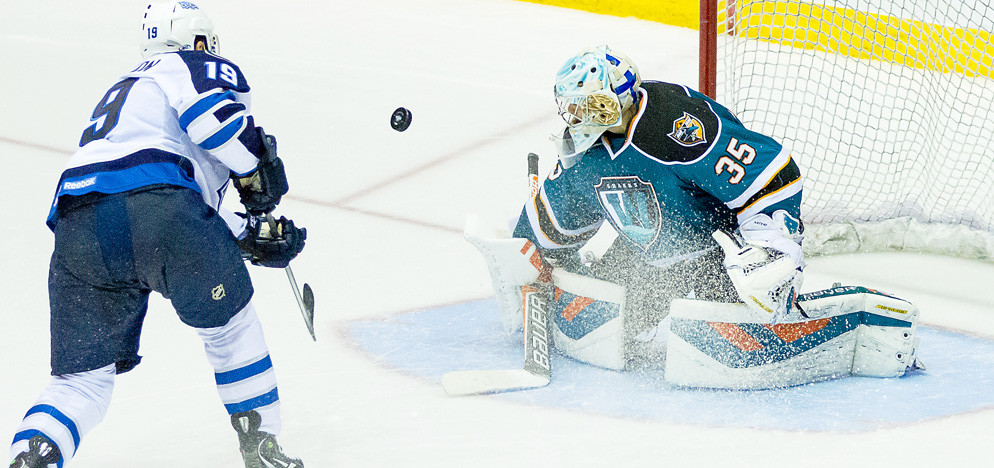
Photo: IceCaps
The St. John’s IceCaps wrap up their road trip this weekend be revisiting Portland on Sunday. The two teams combined for 12 goals during their last meeting on Tuesday with St. John’s earning the win. Before they wrap up the trip, though, they stop in Worcester for two games: tonight and tomorrow night.
Being still two months away from the end of the season, it might not make sense why this series is important to both teams, but it is. Both teams have reason to really want to take these four points and gain important standing.
For starters, the teams are rivals as a result of being in the same division. Although they are not all that close in the standings, two games could definitely make a difference when the end of the season comes around. Against another team in your division, four points that you get and keep an opponent from getting are huge. At the end of the season, there are usually only a couple points that separate you from being clearly in the playoffs as opposed to clearly out of the playoffs.
These teams have also traditionally had better success on the road than they have had at home. This season, the Sharks have taken 7 of a possible 10 points while playing in St. John’s. The bigger surprise is that Worcester has also won both games against St. John’s while playing in Worcester this season. Prior to this season, the Sharks were winless in Worcester when facing the IceCaps.
For these two games, the Sharks will look to keep their streak of beating St. John’s at home alive during a time that they seem to desperately need it. If you look at the numbers, the Sharks do not seem to be doing all that poorly. They are just above .500. But in a period where you get a point for forcing overtime, even if you lose, being .500 doesn’t mean the same thing that it used to.
The Sharks are also coming off a weekend where they were outscored 17-2 over three games. If they could manage to put forth a good showing this weekend, it might shift their momentum in the direction that they need it to and prevent a full-on downward spiral.
This weekend is important for the IceCaps too, though. They started off their trip with a loss to Providence followed by a shootout loss to Manchester in a game where they seemed to be out skating their opponent. Being better rested, they seemed primed to continue their success against the Monarchs.
Over this 6-game road trip for St. John’s, they have also only played opponents in their own division, making the games seem to count for more. As it stands right now, the IceCaps are in a three-way tie for sixth place in the conference. There are only four points separating fourth place from ninth, so things are far from decided.
The playoff picture starts to approach a more realistic sense at this point of the season and the IceCaps want to see themselves return to the post season as they did in 2011-2012, their first season in the league. On the other side of the picture, the Sharks are looking to avoid missing the playoffs for the fourth straight season. Both teams are certainly approaching this mini-series and being a serious test for them in the back-half of the season.
(photo: Lee Calkins )
I play a pretty simple game. I’ve been well coached throughout my career so I understand the game, the systems, and that makes the game easier for me. I want to help the young guys realize that you can be as skilled as you want but if you don’t play within a system you’re not going to be successful.

photo: Lee Calkins
Derek Couture receiving his 500th game award
from the Ontario Reign Organization
Derek Couture has earned every inch of ice that his aggressive power forward role for the Ontario Reign demands. Having just surpassed his 500th professional game, he didn’t find it to be that big of a deal, making the 500 mark, and Couture is certain there are lots of players that make it that far. At the same time, he realizes that to have made it this far, it has taken commitment, sacrifice, and dedication.
“I’m just proud that I’ve made it,” Couture said. “I haven’t had the easiest career in hockey. It’s been disappointments, there’s been adversity. There were times early on in my career when I was like, ‘what am I doing? I should figure it out, get a job.’ For me I’m just proud that I was able to work through that, just continue to play and continue to live the dream.”
A captain who has weathered the highs and lows of a professional hockey career, grinding it out in the minor leagues, gives young guys coming in to the league a perspective on the game and the work ethic that is required to truly make it. Couture has lived it and his career has been a learning by doing experience right from the get-go.
Derek Couture grew up near Calgary, Alberta and began skating as soon as he could walk. He had an older brother that was 2 years older than he was who started playing hockey. His parents didn’t want to wait and started Couture at the same time, around the age of 4. Surprisingly, he didn’t watch a lot of hockey growing up. He grew a love of the game, from playing the game for hours on end with his friends.
“If we weren’t playing ice hockey, we were playing street hockey for six hours a day. I never started watching hockey until my friends started playing in the NHL, and the only time I was watching the game was to watch them play.”
His parents, particularly his dad, gave him the drive to play and to work hard, especially when it came to pushing his career professionally. He had many coaches growing up, but Couture said that because of where he grew up, making it to the next level was never really talked about as a possibility. He believes that the way he was raised gave him the work ethic to play hockey.
“My dad never told me like some dads, if you want to play at the next level what you have to do is this or that. He more encouraged me to just have good morals, work hard at it and be a man. Even if I had a job being a welder, he would have told me that. He supported me no matter what.”
His parents learned along with Couture about how the junior hockey system worked in Canada. They had no experience with how it all worked and it was overwhelming at the time to be forced into making some pretty life-shaping decisions at such an early age.
“The WHL teams are calling you before the draft, I didn’t even know what it meant at the time. They would call me and say ‘what are you going to do? Are you going to play in the Western Hockey League or are you going to go to college?‘ And at 14, I was like I don’t know?”
He remembers a call from one team where they asked him if he had made a decision. They asked him what his marks were in school at the time and Couture wasn’t necessarily the best student at 14. When he told them his grades, they convinced him that the WHL was where he’d need to be as his marks wouldn’t be good enough for college hockey.
He played for the WHL Saskatoon Blades for four years from 2000-2003 and then went to the Seattle Thunderbirds for one season before turning pro with the AHL Omaha AK-Sar-Ben Knights. The WHL overall was a good experience for Couture and while playing you still get a quality education. He learned a lot about how to handle himself as a professional athlete. The WHL rolls four lines, players are healthy scratched and you have to earn your spot to play. He thinks that what he learned in juniors helped him immensely in his first professional year.
“I went through that hardship, getting healthy scratched or not getting playing opportunities when I was young which gave me tougher skin when I turned pro. I learned how to battle through the adversity and keep playing.”
Now that Couture is captain for the Ontario Reign, he takes a lot of pride in helping out the younger guys navigate their first year. He wants to make it easier for them, easier than he had it. It’s one of the main reasons he likes coming back to the team. He knows how difficult it is to be in the ECHL, especially for guys who have been sent down from the AHL level. It’s an adjustment and Couture wants to support them as they strive for the next level. He’s found that the best way he can be there for the guys coming in is to show them how important it is to be a professional off the ice. The coaches take care of the on-ice skills and he realizes that a lot of the young guys have way more skill than he has, so Couture doesn’t feel it’s his place to critique their game, but he can help them get to the rink on time and show up looking like a pro.
“That stuff counts. If you handle yourself professionally off the ice, coaches and general managers and everyone at the next level will respect you that much more. I tell them too if you are going to go out and have a good time, you better be the best players out on the ice the next day at practice. It’s those little things I can do to help them get to the next level.”

photo: Lee Calkins
Work ethic is a big part of the game for Couture, both on and off the ice. He says that players have to realize that it’s more than just the game, it’s a business and that you are getting paid to be the best you can be, regardless of whether you are on the ice or out with the fans. Presenting yourself in a professional manner has helped him get to where he is. He tells young guys that this is just one more thing that can help separate them from the pack, because there are so many players out there that have the same skill set and drive.
Skill and work ethic aren’t the only pieces that new players have to have. They also have to understand how to play within a system. Couture plays a pretty simple game and he hopes that young guys see that how he plays is how their coach wants them to play. He plays hard within the system and that is why he is successful.
“You can be as skilled as you want, but if you don’t play within a system you’re not going to be successful. At the next level, the American League, they are so systematically sound that if you don’t know how to play within that you are going to get sent back down to the ECHL.”
Couture understands how important it is to play within a system. It’s one of the reasons that the Los Angeles Kings Organization has been so successful at all levels. Their coaching staff is dedicated to developing young players. Couture feels Reign Coach Christie and Coach Hardy have been instrumental in his success on the ice. With new players in and out all the time at the ECHL level, having a good system is key to a complete team and Couture believes that the way they coach has set both him and the team up for success.
Couture enjoys playing for the Ontario Reign and he realizes how lucky he is to play for a team in Southern California. When he isn’t on the ice, he loves to get outdoors, play golf and spend time with his friends at the nearby beach or even Disneyland. There aren’t many teams that have those amenities close by almost year round, especially in the ECHL.
“I love it but I appreciate it. I’m living in California, sitting by the pool and playing hockey, going to the beaches and I deserve this, I’ve made my sacrifices, because I’ve played in places where you just don’t want to be.”
Now that Couture has surpassed 500 games, does he think he’ll go another 500?
“I’m just going to ride this thing out until somebody with credibility comes up to me and tells me ‘Listen you don’t have it any more, you’ve gotta stop.’ Who knows when that will be.”
By Andrew Imber
If the United States Men’s Hockey Team needed a reminder of the painful loss they endured in 2010, they got one on the eve of their rematch with the team that handed it to them.
You’d have to imagine a good amount of the team saw the women’s squad give up a late 2-0 lead, eventually losing on a 5-on-3 disadvantage in overtime after one of the most ticky tack calls you’ll ever see in the sport. The US Women had the gold medal all but wrapped up, and in the blink of an eye, it was gone.
Sound familiar?
Here we are, four years later. I still think about the Men’s 2010 Gold Medal Game on a consistent basis. I still think about that Zach Parise tying goal, which sadly holds up as the most exciting moment of my sports life which features no championships for any of my favorite teams. And I still think about the tournament where we were the best team overall, never lost in regulation, but still had to settle for second place.
It is time to draw a line in the sand. No more heart breaking losses to our neighbors from the North. Canadians tell us that it is simply their game, and every time one of these types of results happen, it backs them up. Of course, hockey was born in Canada, but that doesn’t mean the gap isn’t closing in a hurry.
When Team USA beat Team Canada in the round robin stage in Vancouver, it sent a strong message that this generation of American born players had arrived. And, considering that only a couple of players on the current roster were even born during The Miracle on Ice, it is time for this group to write their own tale.
Honestly, all I’ve seen for the last four years is that golden goal, and I’m sick of it. When I can, I still look away from the television.
Maybe I’m partially looking for justification. Growing up in South Florida, I was one of the very few who claimed hockey as his or her favorite sport. It put me in the minority, but it also put me into a fraternity with all other USA Hockey supporters and participants. Any boy or girl wearing a shirt of their favorite NHL team or player instantly became a friend. Every rink that I went to had a sense of camaraderie, even between opponents. Hockey is a beautiful game, and those that fully understand it are unified.
Hockey has given me so much in my life. I make part of my living because of the sport. I have a wonderful girlfriend, because of the game, who loves it as much as I do. Someday, I plan to make a lifetime legacy on hockey. And when I see certain fans calling for hockey to be removed from the South, and returned “home”, I stand up and fight. Because, without expansion to non-traditional areas, I can’t even fathom how different my life would be.
Indirectly, I owe a lot of my happiness to these American hockey players. Their growth has encouraged the sport to market all over our great nation, and it continues to grow because of that.
So, I patiently wait for the big statement. I wait for the moment where the United States shows the world that hockey belongs in all parts of the country. And I wait to hear my friends say, “you know what, you were right about hockey,” as the team pours into a discombobulated group picture with the right color medal hanging around their necks.
We came as close as you can without succeeding in Vancouver. Let Sochi and the Bolshoy Ice Dome forever be associated with our Red, White, and Blue.
In an interview with Pierre McGuire before today’s gold medal game against Canada, Team USA captain Meghan Duggan said, “It’s just giving everything for sixty minutes.”
Everything: speed, skill, hockey sense, and no small degree of brute force.
Absolutely nobody was surprised that the Olympic Women’s Gold Medal game started out with a bang. Just two minutes into gameplay, Canadian defenseman Tara Watchorn spent her first (but not last) two minutes in the penalty box for body checking. A mere four minutes later, her teammate Meaghan Mikkelson did time for roughing, followed by two minutes for cross checking for USA’s Hilary Knight.
In other words, “playing nice” was not on today’s agenda.
Not that it ever really is, with these two teams. Words like “revenge,” “hatred,” and “rivalry,” get thrown a lot between the U.S. and Canada’s women’s teams — arguably more so than they do between the men’s, perhaps because this game is ‘The Game’, for women’s hockey, and these teams are ‘The Teams’.
Every Olympic series is the Stadium Series, is the miracle on ice.
Canadian goalie Shannon Szabados was tested early and often in the first period, but kept the period scoreless with a composure that was hard-earned through this Olympic series. Szabados has been the backbone of Team Canada’s formidable defense in every game that she has played in, and while Team USA’s Jessie Vetter made some truly spectacular saves and absolutely played an enormous part in the overall control the USA showed throughout the matchup, Szabados’ performance is what kept Canada in the race when they needed to be kept.
The game is never over until it’s over, and a medal isn’t yours, until it’s around your neck.
The second period belonged to a few of Vetter’s more miraculous saves and of course to Duggan and Jocelyne Lamoureux, whose tight stick work gave Team USA the first goal of the game. Lamoureux dropped the puck near the face-off and Duggan snapped it high and hard over Szabados’ left shoulder.
It was just one goal, and there was plenty of hockey left to play, but these are always low-scoring match-ups, and in the wake of the goal it was clear that Team USA planned to use it.
This iteration of the USA Olympic women’s hockey team has been one of the most highly-touted, certainly one of the most visible. They’re young, they’re funny. They’re underdogs, kind of, insofar as you can possibly be an underdog when you’ve medalled in all but one of your Olympic endeavors.
“We put our armor on before the game. We were ready,” Gigi Marvin said in an interview during intermission.
They certainly looked like it through the first half of third period, when they came out strong and kept the puck in Canada’s zone. They scored early in the last twenty minutes, a sharp power play goal from Alex Carpenter off assists from Knight and Kelli Stack.
They could feel it, probably, that medal around their necks. Five minutes left. Four-thirty. Four. Three.
But then —
Brianne Jenner ripped Team USA’s lead in half with just over three minutes left to go in the period, thanks to a series of tough play from Mikkelson and Jocelyne Larocque, and with less than a minute left in the game, Marie-Philip Poulin scored the equalizer.
We’re back in Vancouver, 2010.
Three minutes ago, it had felt a little bit like fate. In four Olympic tournaments, Canada has won three gold medals. The United States has won one. This is likely Julie Chu’s last Olympics; her team’s motto may have been, “Team first,” but it’s hard not to understand why the motto came with a tagline: Do it for Julie. It was that kind of home-grown heart that carried the U.S. team through the first two and a half periods.
The problem with heart is that it can only carry you so far.
The OT that followed the last heartbreaking minutes of the third period is hard to describe. What had started out as a tough, physical game rapidly spiraled into a desperate physical game, for both teams. It would be impossible to number the near-misses and almost-had-its. By the end of the game, it was hard to even keep track of the penalties–we’d seen five-on-four, then five-on-three, then four-on-three, and finally got all the way down to a three-on-three that made it a little hard, as a spectator, to breathe.
It’s the kind of game you want to see in a tournament like this, a game where both teams show their best and their worst, where any player at any point could have the game on her stick. Games like this are why people love hockey.
It sucks to lose games like this.
Ultimately, it was Poulin who scored the golden goal, Poulin who jammed it where she needed it to go. It’s hard to be surprised, since Poulin is Poulin and every time she does something amazing it’s just the most recent time that she’s done something amazing. This game was no exception–Team Canada fought hard for sixty minutes and then fought hard in OT. They earned the win. Team USA didn’t earn a loss, but that’s what they got. That’s hockey. Somebody has to take home silver.
Duggan promised us to leave everything out on the ice, and she did. They all did.
Gold or silver, they lived up to their promise.
Photo: AFP/JONATHAN NACKSTRAND
Slovenia was supposed to be the butt end of jokes in Olympic hockey. They were supposed to compete with Latvia for last place. Instead, they finished in seventh place in a pool of 12 teams. They managed to win one of their round robin games and shutout Austria to get into the quarterfinals.
The Slovenians were making life tough for the Swedes through the first 40 minutes and Robert Kristan did everything he could to give his team a chance to at least tie the game. The lone goal in the first period came on the powerplay as Alex Steen converted on a powerplay. Slovenia was doing a pretty good job in the first, but hurt themselves by taking too many penalties, which led to Steen’s goal.
The second period was all about Robert Kristan while Henrik Lundqvist did his best not to fall asleep. No truth to the rumor that the Swedes pulled Lundqvist and replaced him with a shooter tutor. Slovenia was outshot nearly 2-1 in the second, ending the period with only five shots on goal, none of which were credited to Kopitar.
Things started to unravel quickly in the third period for the Slovenians. They were still desperately clinging to a one goal deficit when a Daniel Sedin goal opened the floodgates for Sweden. Loui Eriksson fed Sedin from behind the net who standing all alone in front and easily buried it. Sweden tried hard to allow Slovenia back in the game by taking a couple penalties and even allowing a shorthanded opportunity, but no dice for Slovenia. Eriksson and Carl Hagelin both scored in the latter half of the period to secure Sweden’s victory and a place in the semifinals.
So the team that had become a dark horse for a possible medal came up short as they were unable to top Sweden’s high powered offense. But for a country with a population of approximately two million people, less than 900 hockey players and only seven ice rinks, it was a proud moment in spite of the outcome. A team that was expected to finish dead last fought and clawed their way into the quarterfinals while facing some extremely difficult competition. They were able to hang on with the U.S. and Russians, handily beat Austria and topped Slovakia all of whom featured more NHL players than Slovenia, who only had Anze Kopitar and Jan Mursak as the guys with NHL experience.
It was a great first Olympics for this hockey team that went farther than anyone could’ve predicted and (presumably) no one involved regrets a thing.
It was Shea Weber’s third period goal that boosted Canada over Latvia and into the semi-finals.
The game was a showcase for Latvian goalie, Kristers Gudlevskis, a Tampa Bay Lightning prospect, who nearly knocked his general manager’s team out of the Olympics. This was a surprise after starter, Edgars Masalskis, made thirty-two saves which knocked Switzerland out of the Olympics a day earlier. In his game, Gudlevskis, turned away fifty-five Canadian shots, and remained alert throughout the many times the puck found its way into the Latvian zone.
Latvia had a long road to the Olympics, and should be proud of where they finished. They won their Olympic qualifications only because they had an overtime loss and gained the extra point they needed to advance.
Scoring was opened by Patrick Sharp at 13:37 in the first, it was the sixth goal by a Canadian forward in four games. Half of those being scored by Jeff Carter, who scored those goal in just under twelve minutes in the game against Austria. Latvia answered back shortly after with Lauris Darzins’ breakaway goal.
From that point onward the Canadian assault on the Latvian net began, but Gudlevskis would not be beaten. At the other end of the ice, Canadian goalie Carey Price, spent a lot of time watching the young net minder do his thing. Price made a mere fifteen saves in the game, in which he was having a hard time staying focused on.
“He did very well tonight. He held their team in there,” Price said of the young goalie. “That was one of the best performances I’ve ever seen.”
The game remained scoreless throughout the second, and into the third. It left fans wondering if the game was going to head into overtime, but Shea Weber scored on Canada’s fifty-fourth shot of game. It broke Canada’s 1-1 tie and brought them into the semi-finals in which they will play USA.
Though the victory may have been a relief for Canada, it came with some downfalls. Canadian centre, John Tavares, left the game in the second period with an injury after he took a hard hit from Latvian defenseman Arturs Kulda and struggled to get back to the bench before eventually leaving for the dressing room. It was announced after the game that Tavares, the New York Islanders captain and NHL’s third-leading scorer with 66 points in 59 games, will miss the remainder of the tournament.
GAME SUMMARY
SCORING
LAT 1 0 0 – 1
CAN 1 0 1 – 2
First Period
1. CAN, Sharp (Nash) 13:37
2. LAT, Darzins (Kulda, Sprukts) 15:41
Penalties – Sharp CAN (tripping) 6:18, Keith CAN (broken stick) 16:02
Second Period
Penalties – Girgensons LAT (slashing) 5:37, St. Louis CAN (slashing) 10:21, Ozolinsh LAT (high sticking) 19:33
Third Period
3. CAN, Weber – PPG (Doughty, Toews) 13:06
Penalties – Pujacs LAT (slashing) 11:09
SHOTS ON GOAL
LAT 6 5 5 – 16
CAN 16 19 22 – 57
Goaltenders (saves-shots against) – LAT: Gudlevskis (L, 55-57); CAN: Price (W, 15-16)
Power plays (goals-chances) – LAT: 0-3; CAN: 1-3
(Photo by: Matt Slocum/AP)
In what started as a fast and physical game, Team USA dominated the Czech Republic in a victory that will take them one step closer to the Olympic medal podium.
Five different players scored in the 5-2 win.
James van Riemsdyk struck first, assisted by Patrick Kane and Ryan Kesler, just 1:21 into the game. But, Milan Michalek (assisted by Ales Hemsky, Marek Zidlicky) bit back three minutes later when his shot appeared to fumble around, off Ryan McDonagh’s clear attempt and Ryan Suter’s skate, past goaltender Jonathan Quick.
The Czech Republic gained momentum with the tied game, with Cam Fowler saving a Hemsky shot that Quick didn’t control and David Backes battling Jaromir Jagr for the puck in the neutral zone.
USA (and Pittsburgh Penguins) Coach Dan Bylsma is just 6-15 in his last 21 NHL games versus former Penguin Jagr, an interesting statistic that fortunately for USA hockey was proved moot as the team’s energy picked back up in the last several minutes of the first.
At 5:22, Dustin Brown scored with a one-timer set up from Backes and Suter. The U.S. widened their lead with just 1.8 seconds left, when Backes (assisted by McDonagh, Suter) was able to angle a shot past Ondrej Pavalec.

“They’re hard-working, ugly, blue collar type goals and that’s what we needed,” Backes (who also saves puppies) said during intermission.
About halfway through the second, Captain Zach Parise scored on another difficult angle, rebounding off a shot by Joseph Pavelski and taking USA ahead by three.

A bad penalty by Brooks Orpik (interference, late in the period) was matched by Jakub Voracek, making for almost two minutes of 4-on-4 hockey.
While shots on goal only favored the U.S. team by two (9-7) in the first, they were 18-13 at the end of the second period.
Just two minutes into the third, Phil Kessel took the lead to 5-1 on a pass from Kesler (also assisted by Kevin Shattenkirk). Later in period, Hemsky skated right through the middle of the ice with seven minutes left in the game and shot a wrister past Quick. That wouldn’t be enough to turn the tides for the Czech team, though, as the U.S. protected their lead through the finish.
With that victory, Team USA takes on Canada in the semifinals at 12:00 P.M. ET Friday.
I think we all maybe saw this coming—even if we didn’t want to admit it. Russia hasn’t been playing well during this tournament, plagued with scoring problems and a lackluster defense. Finland, meanwhile, has rallied in the face of mounting injuries and become a serious contender.
The game started well for Russia after Ilya Kovalchuk scored during a power play. But if that goal hoped to wake up the Russian team, all it proved to do was really light a fire underneath Team Finland.
Russia got out-maneuvered left and right, up and down, and all over the ice. Finland picked apart Russia’s already struggling defense and left nothing but hockey pads and bones by the time they were done. Granlund in particular showcased some expert puck handling and quick movement—he made Russian Defenseman Slava Voynov look like a boulder on skates, slow and clumsy.
Finland’s backcheck was on point throughout the game. Watching the figures in blue dart collectively down the ice to flood their own defensive zone and pick off the puck from the Russian offense was like staring at a swooping flock of birds in the sky. They moved very well, and all together, and it was a kind of cohesiveness in their play the Russian’s could only pray for.
Finland won 3-1 and Olympic hockey is over and done for Russia.
A lot kicking and screaming and finger pointing is bound to follow, and indeed, it’s already started. And while many of the names we recognize from the NHL maybe didn’t play their absolute best during this tournament, any blame for Russia’s less-than-stellar showing in Sochi lies squarely with the management and the coaching staff of Team Russia.
Starting Varlamov was a mistake. We can’t really blame Varlamov for his performance—I think it’s pretty clear the D-men for Russia weren’t helping him, but the coaches made a crucial error opting to go with Varlamov over Bobrovsky.
A more thorough discussion of Team Russia’s problems will follow as part of a larger article. For now I’ll just say—Ovechkin has nothing to apologize for.
Team Finland goes on to face Team Sweden in the Semifinal on Friday in what promises to be a game between teams that, um, well—may make history. They’re not fond of one another let’s leave it at that. And me thinks Team Sweden’s Coach may have some apologizing to do. What do you think?
(Photo: USAHockey.com)
During the Olympics, there is a lot of emphasis on the athletes and the devotion and commitment they need to compete in their chosen sport. And all of that is true—the money, equipment, family support, and exercise and involvement of the athlete are all necessary to make it to the Olympics. Now, consider doing that while missing one or both of your legs and going out and playing hockey. Such is the Paralympic Sled Hockey Team and for Team USA they are at Sochi to defend their 2010 Paralympic Gold from Vancouver.
The Paralympic Winter Games will take place from March 7-16 in Sochi, Russia. And for those interested, all of the U.S. games will be streamed live at TeamUSA.org. NBC and NBC Sports Network will also have Paralympics coverage.
The U.S. Paralympic Sled Hockey Team is currently training in North Carolina through February 22, with final preparations taking place in Colorado Springs—where Team USA will hold practices on February 26 and 27 before they embark for Sochi on February 28.
Seven of the seventeen players on the 2014 U.S. Paralympic Sled Hockey Team are returning from the 2010 U.S. squad. They are determined to defend and try to reclaim the gold.
The game schedule for the U.S. Paralympic Sled Hockey Team is as follows (times are Sochi/EST), with all games taking place at Shayba Arena:
- Sat., March 8 (4:30pm/7:30am) – against Italy
- Sun., March 9 (5:30pm/8:30am) – against South Korea
- Tues., March 11 (5:30pm/8:30am) – against Russia
- Wed., March 12 (5:00pm/8:00am) – 5th-8th Placement
- Wed., March 12 (9:00pm/noon) – 5th-8th Placement
- Thurs., March 13 (2:00pm/5:00am) – Semifinal
- Thurs., March 13 (9:00pm/noon) – Semifinal
- Fri., March 14 (2:00pm/5:00am) – 7th Place Game
- Fri., March 14 (9:00pm/noon) – 5th Place Game
- Sat., March 15 (2:00pm/5:00am) – Bronze Medal Game
- Sat., March 15 (9:00pm/noon) – Gold Medal Game
Ice Warriors: USA Sled Hockey

However, before the competitions begin, The 2014 U.S. Paralympic Sled Hockey Team will be featured in a one-hour documentary entitled “Ice Warriors: USA Sled Hockey.” This documentary is scheduled to debut on Monday, February 24 on PBS and follows Team USA across North America as it prepares to defend its 2010 Paralympic gold medal at the 2014 Paralympic Winter Games in Sochi.
The show will also be available online in its entirety beginning February 25
For more information on the U.S. Paralympic Sled Hockey Team, you can visit their web site.
 Prev1...277278279...412Next
  Page 278 of 412