Most modern spectators would not enjoy hockey nearly as much without the forward pass, and a team’s passing game often is what gives it the edge over opponents. Though difficult to imagine now, ice hockey originally did not allow forward passing. It was not until September 28, 1929 that the NHL allowed forward passing in all zones.
Quite the innovators, brothers Lester and Frank Patrick introduced both the blue lines and forward passing between them to their Pacific Coast Hockey Association (PCHA) in 1913. Eastern teams found this, as the Toronto Daily Star put it, “an absurd rule … as the teams will discover as the season progresses.” During interleague games between the PCHA and the NHL (or its predecessor), they would alternate rules every other game of the series. For the 1918-19 season, the NHL also began allowing forward passing between teammates both situated in the neutral zone between the blue lines.
In an effort to speed up the game offensively, at the NHL meeting in Chicago on September 24, 1927, the NHL began allowing forward passing within the defensive zone by changing the offside rule. The new rule stated “a defending player shall not be considered offside in his area if he receives the puck in that area [between his own goal and the blue line].” They hoped to “materially cut down whistle-blowing for trivial off-sides which in themselves were of no advantage to the side offending in this respect.”
After a season of particularly low scoring, the NHL made another revision at the 1929 meeting, held at the Hotel Plaza in New York City. By popular demand, the board of governors implemented numerous changes meant to speed up the game by allowing more opportunities for scoring and less for whistle-blowing. Apparently, “some of the old-timers clung tenaciously to hockey as it has been played, but after much discussion it was conceded that the experiment might be worth while.”
The most impactful change involved the forward pass. Henceforth, the new rule stated, “The ice shall be divided into three sections known as the defending zone, the neutral zone, and the attacking zone. It is permitted to pass the puck forward by one player to another of the same side in each of these three zones, but it shall not be permitted to pass the puck by a player from one zone to a player of the same side in any other zone unless the player taking the pass crosses the zone line behind the puck.”
Immediately, they got their wish and saw scoring boosted dramatically, too dramatically. Scoring reached the double digits, and by December, teams were averaging 3.5 goals per game, over twice the previous average. The governors had left a loophole in that players could wait in the offensive zone for teammates to pass the puck. To combat that, on December 16, the modern offside rule was implemented. The scoring average per game dropped to 2.75, which was still higher than before but more manageable.
The 1927 and 1929 NHL meetings also introduced other rules meant to balance the game by restricting defensive measures. They strengthened the anti-defense rule in 1927 by prohibiting three defensive players from remaining behind their blue line when the play was happening in the opposite goal zone. In 1929, they permitted three players (including the goalie) from remaining in the defensive zone but implemented a minor penalty to be called on the fourth man to enter it while the puck was outside of that zone. The intention was to “prevent the defense from concentrating its forces around the goal.”
Another set of rules pertained to the goalie. In 1927, the NHL ruled that he could not hold the puck for longer than three seconds (or travelling with it more than four feet out from the net). Two years later, they ruled that if a goaltender was penalized for holding the puck, it will be placed 10 feet in front of the net, where two opposing players would face off. It was like a penalty shot but with the goalie assisted in defense by a teammate. The goalie was also henceforth prohibited from throwing the puck up the ice. As of 1927, anyone but the goalies who picked up the puck would receive a minor penalty.
The 1927 meeting introduced the interference rule in which any player not in possession of the puck would be penalized for cross-checking/holding/impeding-the-progress of any player also not in possession. At the 1929 meeting, the NHL put the kibosh on “jockeying” the puck behind the net. The new rule made it “mandatory for the player having the puck to carry out immediately.”
Additional Sources:
Mike Commito, Hockey 365: Daily Stories from the Ice (Toronto: Dundurn, 2018), kindle edition
Marshall D. Wright, The National Hockey League, 1917-1967: A Year-by-Year Statistical History (McFarland, 2014), 85-86.
This time, what happened in Vegas did not stay in Vegas. About quarter of a century before Las Vegas received its own NHL team, it hosted an NHL game. On September 27, 1991, the Los Angeles Kings and New York Rangers met up there for an exhibition match. The trick of it was that, in the middle of the desert, the game was held outside. It was the first outdoor game between two NHL teams.
The crazy idea of setting up an outdoor ice surface in Vegas belonged to the higher-ups of Caesars World Sports. Caesars Palace hotel and casino had been holding large sporting events in their parking lot for years, and shortly after holding an ice-skating show there (in 108-degree heat) in 1988, they decided to import ice hockey. Their president, Rich Rose, commented, “When I went to them with the idea, the only thing they said was, ‘Can it be done?’” Telling them he could make it happen, he proceeded. “I went to the NHL, and once they got over the shock and asked me if I really wanted to do this, they gave their approval.” Rose contacted Kings owner Bruce McNall, who gave his blessing.
So how did they make and keep the ice with temperatures over 80 degrees? They hit the jackpot with Bob May of Ice Systems of America. He had already installed 151 permanent rinks and 14 temporary, including at least one outdoors. May acknowledged, “This was a big challenge.” Still, he took a chance and hedged his bets, installing a rink about 8 feet smaller than normal NHL surfaces at a cost of $135,000.
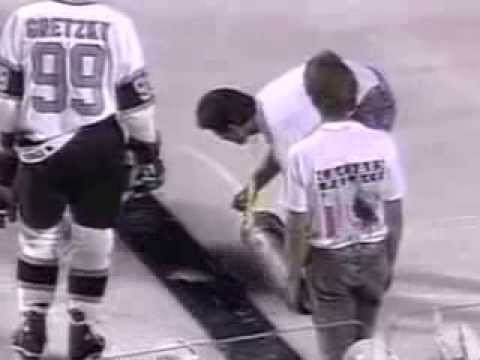
Rink construction began the week before. First, they laid an “inch-thick Styrofoam insulation atop the concrete of the back lot,” then plastic sheets, and then 300 tons of sand. They cooled 25,000 gallons of water from 88 degrees to 16 in just 2.5 hours by using three times the usual amount of refrigerating equipment, including 22 miles of coiled tubing. Instead of paint, they used fabric to make up the lines showing through the ice. All week they tested for any issues and covered the rink with a protective tent. Upon removing the tent, they used a reflective blanket to protect the ice from the sun.
Unfortunately, the day of the game was almost disastrous. The intermittent rain throughout the morning had already taken its toll on the ice. Then they let the tarp fall to the ice as they were bringing it down around noon. The tarp was about 110 degrees and began melting the ice under it. It took another 90 minutes to remove the tarp from the soupy rink. Fortunately, they had made the ice two inches thick, twice the normal level, so they were able to crank up the refrigeration units. The Zamboni driver, wearing the garb of a Roman soldier, saved the game, which started just 15 minutes late. Despite temperatures in the high 80s, the ice held without any serious issues.
For a sellout crowd of 13,007, the Kings defeated the Rangers 5-2. The Rangers rolled the dice scoring twice in the first period. Throughout the rest of the game, it seemed the Kings held all the cards. After three in a row during the second period, Jari Kurri and Wayne Gretzky cashed in the chips with a goal apiece. It was the debut of Los Angeles’ new Wayne Gretzky-Jari Kurri-Tomas Sandstrom line. Gretzky said later, “We were a little bit in awe and I’m sure [the Rangers] were too. We kept looking at each other and couldn’t believe we were playing hockey in 80-degree weather. But it was real nice.”
The Kings and Rangers intended to meet up again the upcoming Sunday (September 29) for another outdoor exhibition game in Charlotte, North Carolina. The ice there had the opposite problem in that they let it get too cold. When a youth hockey league used the ice that morning, they noticed that it was chipping far too easily. Despite two attempts by the NHL teams to warm up that evening, the chipped sections grew too numerous. Steve Camp, the director there, announced, “We have been advised that the ice does not meet NHL standards. We’re all disappointed.” With the game canceled due to the unsafe ice surface, they sent home about 10,000 fans little more than an hour before the scheduled start time promising refunds would become available midweek. Fan Mark Lange lamented, “They can reimburse my ticket money and they can reimburse my parking, but they can’t reimburse someone’s feelings.” That was the second NHL exhibition in three days canceled due to poor ice conditions.
Additional Sources:
Mike Commito, Hockey 365: Daily Stories from the Ice (Toronto: Dundurn, 2018), kindle edition.
Steve Springer, “Sheet of Ice in the Desert? It’s No Mirage,” Los Angeles Times, 27 Sept. 1991, p. C18.
Steve Springer, “Kings Are Headliners for a Night,” Los Angeles Times, 28 Sept. 1991, pp. C1 and C8.
“Unsafe Ice Forces Cancellation of Kings’ Game,” and “Notes on a Scorecard,” Los Angeles Times, 30 Sept. 1991, p. C3.
On September 26, in back-to-back years, the NHL seemed to be saying, “We want more!” In 1925, the league expanded by accepting two applications for new franchises. In 1926, the NHL first split into eastern and western divisions and further expanded their reach by signing agreements with the American Hockey Association (AHA) with its three minor-league loops. As a side note, even the neutral zone on the ice expanded by moving the blue lines.
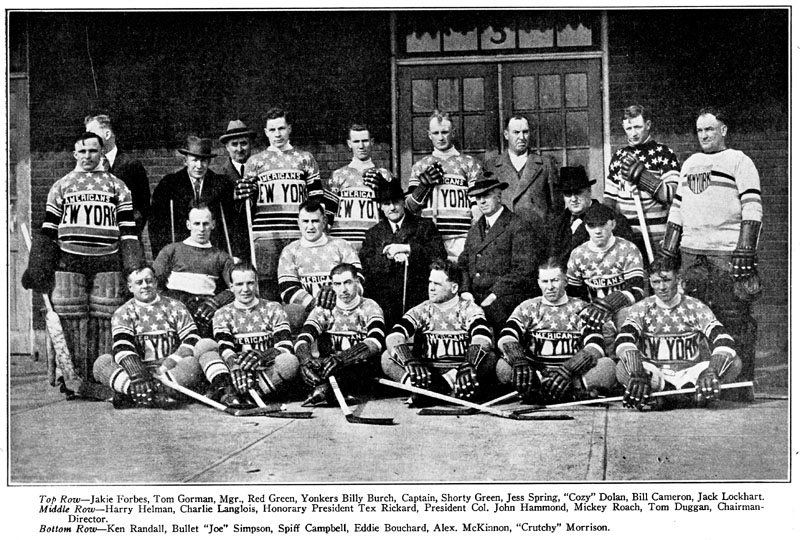
The NHL held a special meeting at the Biltmore Hotel in Manhattan on September 26, 1925. The big news was that they accepted applications for new franchises in New York City and Pittsburgh. For the former, the Americans were scheduled to begin playing that season, while for the latter, the soon-to-be-named Pirates still needed official ratification at the next meeting (despite being voted in at six-to-one). It was anticipated that eight teams would play in the upcoming season.
Both franchises had rosters already in mind. Pittsburgh’s request for a franchise was a means of professionalizing its popular amateur club. That being the case, they intended to keep players from the Yellow Jackets to form the “nucleus” of the NHL team. Of them, Lionel Conacher was selected as captain.
New York announced that owner Tex Rickard and manager Tommy Gorman bought the entire club in Hamilton, Ontario and all its players. The Hamilton Tigers had been suspended after a strike the season before, but upon ratifying the sale, the NHL indicated that “all the players are to be reinstated” to play for the Americans. Of them, Bill Burke (the “Babe Ruth of Canadian hockey last year) was purchased for $40,000 to serve as team captain. According to their president, John S. Hammond, “When we entered the National Hockey League we appealed to other clubs to help us in the player situation. We were offered a few dilapidated old players and several young men of no account. We have battled all summer to get a team. We finally secured one and intend to hold it.”
Interestingly, the NHL was keeping the Hamilton franchise “in trust” with the intention that they would buy back the club (but not the players) from New York. Rumors flew that the franchise would be moved to another U.S. city like Chicago, Cleveland, or Philadelphia. As it turned out, only seven teams participated in the NHL during the 1925-26 season.
Three more franchises were added to the NHL for the 1926-27 season – the New York Rangers, Chicago, and Detroit. The irony is that the very thing that threatened to break the NHL in 1925 ended up being a popular option in 1926. With the addition of New York and Pittsburgh, a proposal that the NHL divide into two sections led New York to threaten that all U.S. teams would withdraw to form their own separate league, leaving the NHL to Canada. At the September 26 meeting held at the Windsor Hotel in 1926, the ten NHL teams were divided (for the first time ever) into two even sections. The eastern division (soon known as the Canadian Division) included the Ottawa Senators, Montreal Canadiens, Montreal Maroons, Toronto Maple Leafs, and New York Americans. The western division (American Division) consisted of the Boston Bruins, Pittsburgh Pirates, New York Rangers, Chicago Black Hawks, and Detroit Cougars. The three leading teams played off to determine champions for each section who then played each other for the Stanley Cup.
The other big news stories pertaining to the 1926 meeting had to do with the NHL’s interactions with other leagues. With the collapse of the Western Hockey League (WHL) that May, Lester and Frank Patrick spent that spring and summer trying to “liquidate their assets” with NHL teams raiding the WHL players. Primarily, others took issue with the way the Bruins bought seven western players and thus the purchase was not recognized by the board of governors.
In addition to trying to work out the proper channels for signing these WHL players, the NHL made agreements about obtaining players from the American Hockey Association (formerly the Central Hockey League). The newly revamped three minor-league branches of the AHA aimed to be more professional in their organization by having “all leagues working in harmony.” These included the Prairie League, the Canadian Professional League (formerly the Senior Ontario Hockey Association), and the Canadian-American League (which later morphed into the AHL). The agreement was that the NHL could not draft players but had the right to purchase them via club owners or the players themselves. These rights were not territorial, as in certain NHL teams having rights to certain clubs.
All of these topics completely overshadowed the rink alteration approved at that same meeting. At the beginning of September, the rules committee made the recommendation that “blue lines be marked 60 feet in front of the goals instead of being measured from the centre ice as in the past. This will make the defence areas uniform in all rinks on the circuit and will enlarge the centre or no-offside areas in the larger arenas of the circuit, though those rinks with smaller ice surfaces will not be materially changed by the new markings.” The intention here was also to reduce offside calls, and to that end, they also clarified the offside rule.
Additional Sources:
“Team Bought by Tex for City,” New York Daily News, 27 Sept. 1925, p. 53.
“New York and Pittsburg Enter Hockey League,” Brooklyn Daily Eagle, 27 Sept. 1925, p. 2D.
“Duquesne Garden Gets Franchise in ‘Pro’ Hockey League,” Pittsburgh Daily Post, 27 Sept. 1925, section 3, p. 8.
“Pittsburgh in Pro Hockey League,” Pittsburgh Post-Gazette, 27 Sept. 1925, section 3, p.7.
“Equal Number of Clubs in Canada and U.S. Likely,” “Players Lined Up For New N.H.L. Teams,” and “Admit New York and Pittsburgh to National Hockey League,” Ottawa Citizen, 28 Sept. 1926, pp. 1, 10-11.
“Minor Changes in Pro Hockey Rules,” Montreal Gazette, 6 Sept. 1926, p. 14.
“Ten N.H.L. Teams in Two Sections for Winter Play,” Montreal Gazette, 27 Sept. 1926, p. 18.
The Buffalo Sabres are coming off of yet another disappointing season where they missed the postseason. They fired head coach Phil Housley in the offseason and hired Ralph Krueger as the new bench boss. The talent to make a postseason push is on the roster, but they just haven’t managed to put everything together the last few seasons. The Sabres have lacked depth at the forward position, but with the addition of some veteran free agents and prospects, the scoring should be a problem.
Jack Eichel staying healthy and producing is going to be a big part of how the team does this season. The goaltending is probably the shakiest part of the team, but the battle between Carter Hutton and Linus Ullmark will be one to watch. There will be a prospect or two that makes the roster and players who have bounce-back seasons. Here are my five bold predictions for the Sabres 2019-20 season.
1) Jack Eichel Hits 100 Points
Yes, this has been a bold prediction the past season or two for me, but this year will be different. Eichel will remain healthy, on the ice, and will produce with this wingers. His left winger may vary during the season, but Sam Reinhart should be a staple on the right side, unless he’s out injured or gets in a rut. Eichel will get ample power play and even strength time this season so getting 100 points should be attainable for him.
Eichel can either snipe the puck or set up one of his teammates for a goal, which will help him get to 100 points this season. If he can get open on the power play, his rocket of a shot should help him get some goals. He has the patience to let the play develop in front of him before making a decision with the puck and that should also help him rack up some points. In all, if Eichel can manage to stay healthy and put everything together he should be one of the top scorers in the NHL.
2) Linus Ullmark Takes Over the Crease
The goaltending battle between Linus Ullmark and Carter Hutton will likely be one of the better storylines to follow this season. The goalies weren’t exactly good last season, but they also faced a lot of untested shots coming from opposing players who just happened to be wide open. Hutton is a career backup goaltender, but he had a few good seasons for the St. Louis Blues and he was awarded a contract to be the Sabres’ starting goalie. His numbers in his first season with the Sabres were anything but spectacular as he posted a 18-25-5 record to go with a 3.00 goals against average and .908 save percentage in 50 games played.
Ullmark didn’t show much last season when he was given the opportunity. He was 15-14-5 with a 3.11 goals against average and .905 save percentage in 37 games. There isn’t anything particular that brought on this prediction, but Ullmark is entering his fifth professional season in North America and the team in front of him should be better defensively. Ullmark will be given the chance at some point to take the number one job, and he will do it.
3) Dylan Cozens On Opening Night Roster
There has been a bit of a competition going on during training camp and preseason to play on the top line with Eichel and Reinhart. The two candidates are Dylan Cozens and Victor Olofsson. The coaching staff has liked what it has seen from Olofsson, but Cozens is also making his case. Olofsson is a natural left wing, while Cozens is a natural center, but he can play the wing. The two kids are still on the roster after the latest round of cuts.
Cozens was the eighth pick overall in the 2019 NHL Entry Draft. He signed his entry level deal, but then injured his thumb during practice. The injury was healed in time for the start of training camp with the big club and he has impressed. Cozens is on the roster to start the season because of the speed and versatility that he can bring to the lineup. The 18-year-old also plays a solid two-way game and can win some face-offs.
4) Rasmus Ristolainen Remains On Roster
In the offseason, there were rumors galore about the Sabres possibly trading defenseman Rasmus Ristolainen. The trade never happened so now it’s time for Ristolainen to prove that he belongs on this team, and can be an effective all around defenseman. The 24-year-old is entering his sixth NHL season, and needs to show that he can be that shutdown, number one defenseman that the Sabres desperately need. Even with the addition of Colin Miller this summer, Ristolainen will still be relied on daily to eat up some major minutes on the blue line.
Ristolainen can skate well and he needs to get a little more active in the offensive zone to get a shot through to the net. The biggest key to Ristolainen’s game is to play simple, don’t try to do too much. In seasons past, he has had that pressure on him to be the number one guy, but this season he will have Miller, Montour and McCabe to help take that pressure off of him. Ristolainen doesn’t need to go out of his way to make the big hit, just play the puck and avoid being taken out of the play. With some of the pressure taken off of him, Ristolainen will be able to finally play his game and help the Sabres be competitive to the end.
5) Kyle Okposo Scores 30 Goals
Yes, this is really going out on a limb, but if Kyle Okposo can remain healthy then there is a good chance he can reach the 30 goal plateau. He will likely see second or third line minutes at even strength, but he should also see some power play time. Okposo isn’t afraid to shoot the puck and that will help his chances to get to 30 goals this season. The forward isn’t afraid to go to the dirty areas to score goals and that improves his chances of scoring.
The biggest issue for Okposo will be staying healthy and not going into any major slump. He has underperformed in his time with the Sabres, mainly due to injuries. His potential linemates could be Marcus Johansson and Jeff Skinner. If this line sticks then Okposo would really have a decent shot at 30 goals even if Skinner is the shooter on this line. The opposition will be focusing on Skinner and that will leave Okposo and Johansson open to get some quality chances.
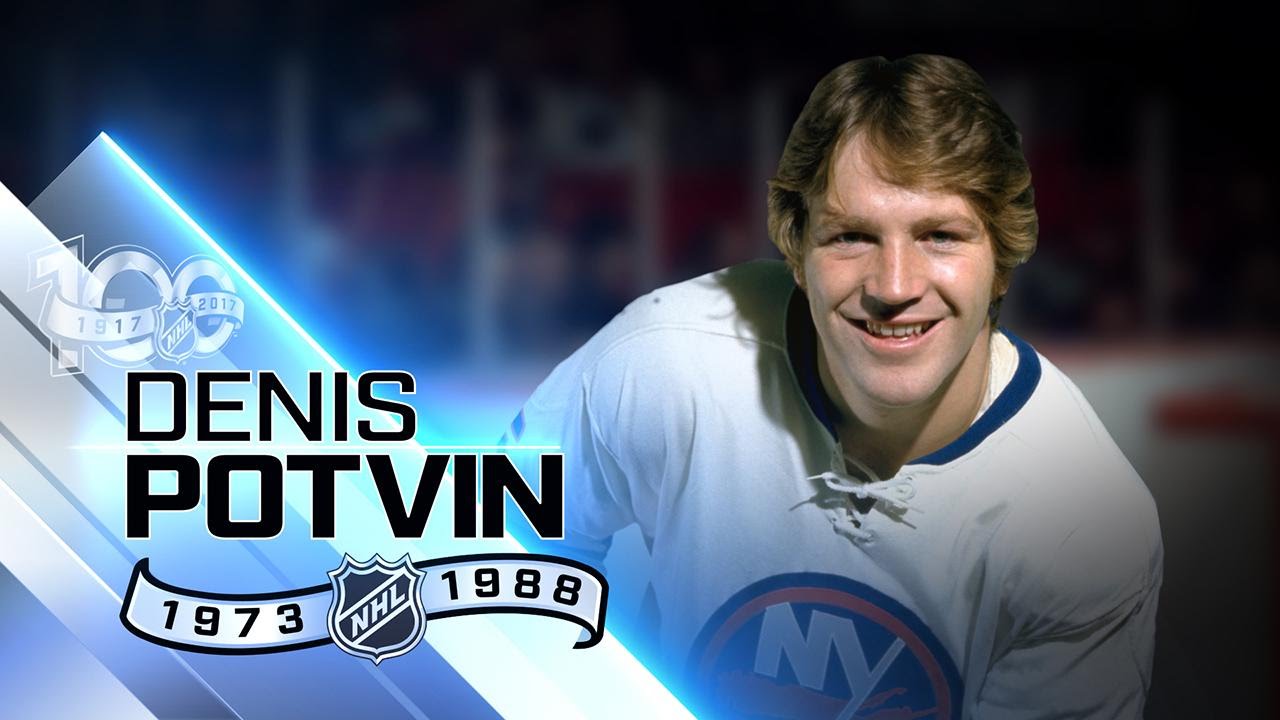
Some people just know when it’s time to go. On September 25, 1987, 33-year-old Denis Potvin resigned as captain of the New York Islanders and announced that his 15th season would be his last skating in the NHL.
Potvin spent his entire career with the Islanders. Having been selected first overall at the 1973 NHL Entry Draft, Potvin immediately made his talent known by winning the Calder Trophy in 1974. He considered it a personal “hat trick” that he received that recognition for setting rookie records in goals and points. As the best defenseman, Potvin earned the Norris Trophy in 1976, 1978, and 1979.
Going into the 1979-80 season, the Islanders named Potvin as captain. He commented, “I wanted to be the captain, (and) I wanted the dressing room to respect that fact. My leadership qualities had nothing to do with what I said. It was important to me to go out night after night and show that intensity.” That season marked the first in the Islanders’ string of four consecutive Stanley Cup championships. After the fourth, the euphoric captain exclaimed, “I am not going to be humble about it. I think it’s the best team in the history of the game.” Indeed, the Islanders made the playoffs in all but the first season with Potvin playing defense.
Much of the success of the Islanders during that era has been credited to Potvin. As his fellow-defenseman, Ken Morrow, praised, “He wasn’t just all offense. He wasn’t just all defense. He could change the course of a game in many different ways, whether it was a thundering body check or a pass behind the net to Butch Goring on the penalty kill, or as one of the best power-play point men in history.” By the time he announced his retirement, Potvin had surpassed Bobby Orr to become the highest-scoring defenseman (291G, 710A, 1001P). He still ranks seventh. He’d also tied for most Stanley Cup games played (180) while scoring 55 goals and 104 assists in the postseasons.
With all these accomplishments, Potvin’s announcement of retirement was expected. The press reported the news before the actual press conference was held at Nassau Coliseum about a month shy of his 34th birthday. At the time, Potvin told them, “I had a strange feeling from within that I had done everything I could do here. I didn’t want to play one season too many.” Looking back later, he had no regrets. “I was blessed with the talent to play in the league for fifteen years and had the opportunity to say, ‘I’ve had enough,’ The Islanders had offered me a new deal to continue to play but I just didn’t want to at that point. I felt it was time for me to move on. I had prepared for my after-hockey life and having worked in the summers prior to 1988, was prepared for the new lifestyle and I was ready to leave.”
Potvin played the 1987-88 season until his final game (a 4-2 loss in the Patrick Division Semifinals) on April 12. After 1,060 games with the Islanders, he had scored 310 goals, 742 assists and 1,052 points. On top of that, he had 164 playoff points. He reflected, “1987-88, my last season, had to be one of the most enjoyable seasons I had had since the early years. I knew I was going to hang them up and I had made the announcement that it was going to be my last year and all of that made it great. Memories of that last year are terrific.” Others thought he could have continued playing for a while, but he explained, “Well, maybe so, but in my own mind I didn’t like the way I was progressing and it was time to move on. I never regretted it for a moment.”
It didn’t take long for the honors to heap upon him in retirement. Potvin’s junior team, the Ottawa 67s, retired his number at the Ottawa Civic Center. On March 31, 1988, the Islanders retired his No. 5. He commented, “To have my number retired, and to be the first one ever to be retired in Long Island, was a tearful kind of joy.” In 1991, Potvin (along with his teammate Mike Bossy) was inducted into the Hockey Hall of Fame. According to Potvin, “When I went in 1991, there were fewer than two hundred people who were in the Hall of Fame and I started to realize the magnitude of being chosen.”
After retiring, Potvin began a television broadcasting career. He did color commenting for the Florida Panthers from 1993-2009 and 2014-2019. In between, he served the Ottawa Senators as an analyst. Potvin retired from his second career on July 29, 2019.
Monday night, the Boston Bruins returned to TD Garden for the first time since the devastating Game 7 loss in the Stanley Cup Final against the St. Louis Blues. It was a preseason game, as they played host to the Philadelphia Flyers. The two teams met first last Thursday in Philly where the Bruins walked away with a 3-1 victory—in large part due to Jaroslav Halak’s “Spidey sense” saves that had Flyers’ rookie Morgan Frost clutching his helmeted head in disbelief. Frost wasn’t part of the roster on Monday for the Flyers. The Bruins had added a few more of their veterans including Tuukka Rask, David Krejci, Brad Marchand and David Pastrnak.
Like many preseason games there were still some players to be evaluated. Likewise the preseason games are designed to also get familiar with the changes to the rules.
No one expects major injuries to come from these games, but both of the games against the Flyers have cost the Bruins players. Last Thursday’s game Anton Blidh had just seven shifts, for a total of 4:40 time on ice before he had to leave the game. On Monday, it was Krejci who got injured after just two shifts and 1:55 ice time. It was announced during the game Monday that Krejci had sustained a lower body injury and would not be returning to the game.
After the game, the Bruins head coach, Bruce Cassidy, addressed the Krejci injury.
“I don’t think he’s serious. Took a hit early on, tried to keep playing but he just felt it was better to not push through, it wasn’t worth it. Obviously we’ll know more tomorrow, but I don’t think it’s serious,” he said.
However Krejci was noticeably absent at practice Tuesday morning.
“He’ll be re-evaluated tomorrow [Wednesday]. Right now, we don’t think it’s anything serious but we’re going to take our time with it and make sure he’s ready to go next week,” Coach Cassidy shared after Tuesday’s practice.
It is unlikely that Krejci will play in either of the remaining preseason games.
Meanwhile the injury to Blidh has resulted in surgery. The Bruins announced on Tuesday that Blidh had undergone the surgery on Monday to repair a ligament in his right shoulder. He is expected to be out a minimum of four months.
Coach Cassidy had already announced that Halak would start in net on Wednesday when the Bruins host the New Jersey Devils. And Rask will start on Saturday against Chicago.
The Bruins organization also announced on Tuesday that they had assigned Dan Vladar to Providence. He played the final period and the OT of Monday’s game, and gave up two goals on the 16 shots he faced. In addition to Rask and Halak, the Bruins still have Maxime Lagacé and Kyle Keyser on the training roster, so it is possible that each of them will see a little more playing time in these last two preseason games.
Perhaps the most awaited news has been when Patrice Bergeron might play. He has been participating in camp the last few days without a red non-contact jersey. And he told media after Tuesday’s practice that he expects to be in the lineup on Saturday.
“I’m slowly feeling better on the ice and more comfortable. I’d like to be in Saturday for sure if things go according to plan. There’s not much more to say than I’m feeling good, things are advancing and looking good,” Bergeron said.
Boston will participate in skates Wednesday morning at Warrior Ice Arena and then will take on the Devils at TD Garden at 7:00pm. Wednesday’s game will be televised on NESNPlus.
It seemed that many of the most memorable meetings of the NHL Board of Governors had the Boston Bruins to thank for noteworthy events. At the meeting held in New York on September 24, 1937, Art Ross suggested a new addition to the rulebook that became the icing rule.
Icing was to be called when a player shot the puck from his defensive zone past the opposite goal line. Today, as Rule 81 in the NHL Official Rules, “should any player of a team, equal or superior in numerical strength (power-play) to the opposing team, shoot, bat or deflect the puck from his own half of the ice [over the center red line] beyond the goal line of the opposing team, play shall be stopped.” Thus, icing does not count when the defenders are short-handed.
In 1937, the Boston Globe reported: “Under the new rule a whistle will stop play on such occasions and the puck will be faced at the point from which it was shot up the ice. The rule will not apply, of course, when the defensive team is short-handed and under no circumstances will the puck be faced nearer than 15 feet from the goal.” The day following the rule change, the term “icing” had not been announced, but by September 28, the Baltimore Sun described it thus: “If two teams are of the same strength and one team undertakes to ‘ice’ the puck, the referee will call a face-off at the point from which the disk was ‘iced.’ The term ‘icing’ is applied to the practice of shooting the puck the length of the rink to waste time.”
That Boston raised the issue was no surprise. They had held a grudge against “kitty-bar-the-door hockey, or at least that defensive gesture whereby a hard-pressed team relieves the pressure by icing the puck the length of the rink” since at least December 8, 1931. That night, they lost their first home game of the season 3-2 in part because the New York Americans kept shooting the puck from end-to-end to stall and take breaks while maintaining their lead. As the Boston Globe reported, “In that feverish third period, when the New Yorkers were sorely pressed, McVeigh, Himes and Dutton did some very fancy stalling. … And of all the players who shoot the puck the length of the rink to relieve pressure, nobody does it more scientifically than Dutton.” The Americans even took advantage of the crowd’s protest against their style and the referee calls. They insisted the ice be cleared of the thrown papers, which caused bottles to be thrown. The game was delayed ten minutes for their removal.
When the two teams met for a rematch in New York on January 3, the Bruins retaliated. Apparently, their owner, Charles F. Adams threatened them with fines if they did not play defensively. Thus, the Globe summarized that the Bruins “somewhat peeved at what they termed the drab defensive play of the Amerks … set out to give the New Yorkers a taste of their own medicine and in the first period they ‘golfed’ the puck down the ice no less than 40 times while making no pretense of a serious attack.” Calling this “probably the poorest excuse for a National Hockey League game ever seen anywhere,” the New York Daily News counted that by the end, the Bruins had “shot the disk without excuse the length of the rink – or, at least, from outside the blue line – no fewer than 89 times.” By their count, the Bruins had “golfed” the puck 42 times in the first period, 14 in the second, 16 in the third, and even 17 times in overtime. The only result was that the teams had the first scoreless draw of the 1931-32 season.
According to some sources, New York Rangers President John S. Hammond said the Bruins should be fined, but NHL President Frank Calder noted that nothing in the rulebook prevented this tactic. It took almost six years to change that.
At the same 1937 meeting, several other rule changes were announced by the NHL Board of Governors. They included:
In cases when a puck is shot over the boards, a faceoff will be held at the point where the player shot not where the puck went out of bounds.
Goalies would no longer be penalized for freezing the puck against the boards.
If a player other than the goalie deliberately falls on the puck within 10 feet of his goal, the opposing team will receive a penalty shot but the offender will not receive a two-minute penalty.
Any player who has accidentally dropped or broken his stick can kick the puck without penalty.
Fouls committed when play has ceased would draw the same penalties as when play was in progress.
All rinks were to be equipped with electrical timing devices (like those used in Toronto and New York).
Additional Sources:
Mike Commito, Hockey 365: Daily Stories from the Ice (Toronto: Dundurn, 2018), kindle edition.
A puck will be dropped on the new NHL season in just a week. There are still major headlines heading into the season like the Winnipeg Jets, who are awaiting a decision from Dustin Byfuglien on whether he will retire or keep playing. The Jets also do not have two key players under contract for the season yet in Patrik Laine and Kyle Connor, as they are both restricted free agents. However, the preseason is coming to a close and teams are starting to finalize their rosters for the upcoming season.
The NHL regular season is a long one, as it spans over seven months. A lot of things can and will happen, but for now here are three far-fetched predictions for the 2019-20 NHL regular season.
1) Philadelphia Flyers are in the Eastern Conference Finals
I am starting off my predictions with a bang, and most people will likely disagree with this one. The team improved on the back end immensely and brought in some veterans, who can help the younger players develop. The Flyers will also have a balanced blue line with three right-handed shooters and three left-handed shooters, who could be paired together. They brought in Kevin Hayes, who plays a 200-foot game and this will balance out the lines. Hayes will also bring a stability at the second line center that the Flyers haven’t had in a few seasons.
In the offseason, the Flyers brought in Alain Vigneault to be the bench boss. Vigneault has a good track record of getting teams deep into the playoffs in his first few seasons with the team. In each of his first seasons with the three previous teams he has coached, Vigneault has taken the team to the second round or deeper in the postseason. The Flyers will have a balanced lineup, an improved defense and a young goalie who will just keep getting better as the season goes on.
2) Patrik Laine Sits Out the Season
The Winnipeg Jets and restricted free agent Laine have yet to reach a contract agreement for the season. Laine has already made plans to start training with a team overseas and that can never be a good sign in a contract situation. The forward is a key piece of the team even though he went into a really bad scoring slump last season, but was much better in the playoffs. Laine’s worst season came last year when he scored 30 goals, had 20 assists and totaled 50 points in 82 games played. In 237 NHL games, he has 110 goals, 74 assists and 184 points.
The Jets and Laine seem like they are currently at a stalemate, and that will continue so Laine won’t be playing in a Jets uniform or any other NHL uniform this season. The two sides will likely try to get a deal done, but my gut is telling me that one doesn’t happen before the deadline, and he is forced to sit out the rest of the season.
3) No 50-Goal Scorer in NHL
Yes, there is a ton of talent around the NHL and that will be the biggest reason why there will be no 50-goal scorer this season. During the 2018-19 season, there were only two players who scored 50 or more goals: Alexander Ovechkin (51) of the Washington Capitals and Leon Draisaitl (50) of the Edmonton Oilers. There were 11 NHL players who scored between 40-47 goals. The rosters are much more balanced and in order to be successful in the NHL, a team needs to have a balanced attack from all four lines.
Sure, teams rely more on certain players than others in the lineup, but the opposition does its homework. In today’s NHL, it’s usually one team’s best offensive line against the opposition’s best defensive line so they can try to shut down the other team. The days of relying on just one or two players in a lineup are over, so that is why I think there won’t be any 50 goal scorers this season in the NHL. Plus, these predictions are supposed to be far-fetched, so I figured that I would go all out with this one.
The NHL preseason is finishing up and the start of the regular season will be here before you know it. The offseason has come and gone. There are some teams who made great moves this offseason, while some teams barely improved the current roster. Some teams were looking to improve in certain areas and did just that, while other teams struggled to fill needs. A majority of teams got better, but some did not do much to improve their needs, whether it was because players went elsewhere or the franchise just decided to give some of their kids a shot a making the roster and impact on the ice.
The following teams did not have a great offseason, even with getting some bigger name players and making improvements. Here are five teams that were among the NHL offseason losers:
1) Detroit Red Wings- Atlantic Division
The Detroit Red Wings is one of the teams that look like they will rely on the young kids. Sure there will be some veteran players in the lineup, but the kids will bring some skill and speed. In the offseason, they lost a ton of veteran leadership when Niklas Kronwall decided to retire. The Red Wings signed Calvin Pickard to a two-year contract and he figures to be the back up goalie. They also signed forward Valtteri Filppula and defenseman Patrik Nemeth in free agency to two-year contracts.
The team re-signed center Dominic Turgeon, defenseman Joe Hicketts and defenseman Dylan McIlrath to new two-year contracts. They also signed youngsters Joey Veleno and Filip Larsson to entry level contracts. The only trade this offseason was when the Red Wings acquired left wing Adam Erne from the Tampa Bay Lightning for a 2020 fourth round draft pick. The team didn’t get much better but did add some veteran leadership.
2) Columbus Blue Jackets- Metropolitan Division
The Columbus Blue Jackets will still have a decent team this season after a very disappointing offseason. The Blue Jackets lost free agents Sergei Bobrovsky, Matt Duchene and Artemi Panarin in the offseason. The biggest free agent acquisition was right wing Gustav Nyquist, who signed a four-year deal with the team. Nyquist should replace some of the offense lost with the departures of Panarin and Duchene. They also gave left wing Marko Dano a one-year contract.
A majority of the offseason was spent re-signing the team’s restricted free agents. Defenseman Zach Werenski signed a new three-year deal as did defenseman Scott Harrington. Adam Clendening and Ryan Murray will be on the Blue Jackets’ blue line for at least the next two seasons. The Blue Jackets have players who can produce, but can they produce enough to get the team back into the postseason? The Metropolitan Division is going to have the most parity this season, and most of the teams have made improvements, but the Blue Jackets lost a ton in free agency.
3) Winnipeg Jets- Central Division
The Winnipeg Jets are an intriguing team heading into the regular season. The team is waiting on a decision from defenseman Dustin Byfuglien on whether he is going to continue to play the game or retire. The team has yet to sign two key restricted free agents in Patrik Laine and Kyle Connor. The Jets traded one of its best defenseman in Jacob Trouba to the New York Rangers for defenseman Neal Poink and a 2019 first round pick. The team has $23 million in cap space, but can’t use any of it because they need to re-sign the restricted free agents.
The Jets did manage to extend defenseman Josh Morrissey for the next eight years. The team also extended center Andrew Copp for the next two years. The biggest free agent signings were Mark Letestu, Anthony Bitetto and Nathan Beaulieu, who all signed one year deals. The Central Division will likely be one of the hardest to get through and the Jets did not help themselves this offseason to keep up with the division.
4) Anaheim Ducks- Pacific Division
The Anaheim Ducks did not land a decent free agent in the offseason. The team focused on grabbing some depth players and signing them to one-year deals. The Ducks are another one of those teams that look like they are going to let the young kids compete to make the roster, and hope that they make an impact. The Ducks biggest offseason moves were buying out veteran Corey Perry, signing goalie Anthony Stolarz to a two-year deal, signing defenseman Michael Del Zotto for the season, and bringing in right wing Andreas Martinsen for one year.
The Ducks struggled to score goals last season and that should continue this year since the team really didn’t do anything to upgrade the offense. The young kids should help with offensive production, but you never know what to expect out of the youngsters. The Ducks also acquired right wing Nicolas Deslauriers from the Montreal Canadiens in exchange for a 2020 fourth round draft pick.
5) Los Angeles Kings- Pacific Division
The Kings will have a good mix of veterans and younger kids on the roster to start the season. The veteran players will need to lead the way and have bounce-back seasons, while the kids just need to go out and play their game. The Kings bought out defenseman Dion Phaneuf in the offseason, which was the team’s one major splash. The team focused on re-signing its own players rather than improving from the outside since it will be going through a rebuild while trying to win some games.
The biggest offseason additions were center Mario Kempe, defenseman Joakim Ryan and right wing Martin Frk. Jonathan Quick is gong to need to have a great season if the Kings even hope to entertain thoughts of a playoff spot rather than a lottery spot. The team didn’t get much better in the offseason, and they didn’t bring in any key depth players, which could cost them during the season.
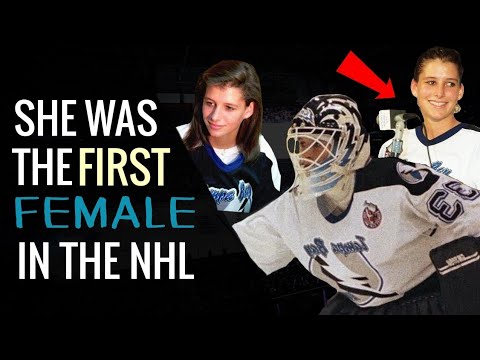
The NHL had existed for 76 years by the time the first female was invited to attend a team’s training camp. Goalie Manon Rheaume did well enough that she then played in an exhibition game on September 23, 1992, as the first woman to play for one of the four major professional sports in North America. These firsts were among quite a few in her resume as Rheaume made history throughout her hockey career.
Rheaume’s historic career launched when, in 1984, the 11-year-old became the first female to participate in the Quebec International Pee-Wee Hockey Tournament. As part of the events, she had the chance to practice with the Quebec Nordiques and her role-model, Patrick Roy. She wore No. 33 in his honor throughout her professional career. At the time, newspapers already commented that she could play for the NHL someday. This was after she had spent her childhood learning from her father how to toughen up and wearing her helmet into the rinks so that her gender was not obvious.
The next few years were difficult as she was blocked from playing at the highest (and eventually even the second) tier of Quebec peewee and bantam leagues. When she took a year off from hockey to attend school, she ended up playing in a women’s league and attracted the attention of the Trois-Rivieres Draveurs of the Quebec Major Junior Hockey League. As the third-string goalie, she made her only appearance with them in November 1991, when she backstopped the team for 17 minutes. She had blood dripping down her face after a puck broke her helmet, but she did not stop. Rheaume was the first woman to play in a junior major hockey game.
A tape of that performance was sent to Phil Esposito, then the GM of the new Tampa Bay Lightning. Rheaume described the result saying, “One of the scouts from Tampa Bay he asked Phil what he thought about that goaltender, and he didn’t know at first that it was a girl. So he said, ‘Yeah, you know the goaltender is ok, a little bit small, but doing the same job as any other goaltender that age.’ And the scout said after that, ‘It’s a girl.’ And that’s when Phil said, ‘Oh my god.’ He got kind of a flash. This is neat.”
In 1992, Esposito invited Rheaume to become the first woman to participate in an NHL training camp. While he did intend to raise publicity for his franchise, he also wanted her to do well. “Her attitude was so good with that camp. She didn’t show a lot of emotion. That’s something I noticed about her. The guys never pulled any punches, and they were told, ‘You shoot the puck wherever you want as hard as you want.’ And in fact, I’ll bet you they tried to shoot it even harder to try to hit her more. You know, it’s just like any other rookie, and you take advantage of her. The fact that she was a woman too, it made it doubly so. … I knew the coach wasn’t gonna talk to her. That’s for sure. … I did it because I thought that she had a chance. And I’ve always thought that if there was any way a woman could make professional hockey, it would have to be in goal.”
Wearing the pads from the peewee tournament that her father had reinforced, Rheaume’s first practice was actually tending goal during the second period of a scrimmage. She had a shutout, blocking all 14 shots that came at her. That led Esposito to tell the press that she would play in one of the exhibition games instead of being cut from the team as she had formerly expected.
On September 23, a crowd of 8,223 came to the Florida State Fairground Expo Hall to see the first female start in an NHL game. As the 20-year-old said at the time, “I don’t think about being the first. I think about coming here to go as high as I can. I come here to try to stop 100 mile-per-hour pucks. I have a lot of pressure on me, so I don’t think about anything except stopping pucks.” Later, Rheaume reflected, “I was thinking about my game, and everything was fine. I was calm. I was not nervous at all. And I was preparing myself.” She felt the pressure once she left the bus and was nervous until she saw flowers sent by a Montreal radio station wishing her well and providing support. Rheaume returned to the moment, “I was back to myself playing a hockey game. And I didn’t really realize but I was in the Tampa Bay jersey, and it was an NHL jersey.”
Esposito, having taken a chance on her, was also nervous. “That night when she got into the game with St. Louis, my biggest fear would be that they would have six shots on net and score five or six goals. And that the guys wouldn’t give her the support. … Cause a lot of the players didn’t like that she was there. The coaching staff thought it was a joke.” However, things really came together after her first save. According to Esposito, “There wasn’t a woman in that building that night that wasn’t cheering her brains off. And I was cheering for her too.”
During her 20-minute session, Rheaume made seven saves and allowed two goals (a bad one by Jeff Brown and a good one by Brendan Shanahan). She left the net with the teams tied at 2-2. The Lightning then sent in their top goalie, Wendell Young, who let in two goals in nine minutes. The crowd called for Rheaume’s return. Young allowed another two goals for a 6-4 loss.
As for Rheaume’s performance, it impressed both Phil and his former-goaltender brother, Tony Esposito. Tony commented, “She’s surprised me like she’s surprised everyone. She has natural concentration. And a couple of times when she let in a bad goal, which all goalies do, she didn’t panic. She stayed poised and focused.” Phil continued, “If I’m rating her, I have to give her a 7 ½. The first goal was a bad goal; she should have stopped it. The second one, Tony said nobody could have blocked it, not even him. And she did have three unbelievable stops on the power play.” Later Esposito admitted, “I breathed a sigh of relief, not only for her but for ourselves and our team and the situation and for myself I guess. It could have backfired. It could have blown up in my face. There’s no doubt about it.”
Rheaume herself was proud of her accomplishment. “That was the greatest feeling because I knew how important it was for me to play well. It was not enough for me to have done good during training camp. It was not enough for the media.” No one could say she didn’t deserve to be there. She had done over 100 interviews in the 11 days she was with the Lightning and had proved herself to the naysayers.
Phil Esposito summed up his resulting opinion, “I think some day she can play in the NHL. She’s earned a chance to try. We really want her in our organization.” Thus, he sent her to their farm team, the Atlanta Knights of the International Hockey League (IHL). When she signed the three-year contract with them, Rheaume was the first female to sign a professional contract. She debuted on December 13 (against the Salt Lake Golden Eagles) as the first woman to play a professional regular-season game.
Unfortunately, Rheaume’s season with the Knights involved many promotions and very little playing. She requested a trade down a level so she could play more frequently and cut back on promotions. Up through 1997, she played 24 games with the Knoxville Cherokees, Nashville Knights, the Las Vegas Aces, the Tallahassee Tiger Sharks, Las Vegas Thunder, and the Reno Renegades.
Meanwhile, Rheaume also made a name for herself internationally. She backstopped Team Canada to gold medals in the 1992 and 1994 IIHF Women’s World Championships, making the All-Star team for both. After being cut from the Canadian team in 1997 for inconsistent playing, she came back stronger than ever to earn her spot in 1998, when women’s hockey first appeared in the Olympics. With Rheaume in net, Team Canada earned the silver medal in the finale at the 1998 Winter Olympics in Nagano.
Additional Sources:
Mike Commito, Hockey 365: Daily Stories from the Ice (Toronto: Dundurn, 2018), kindle edition.




 Prev
Prev