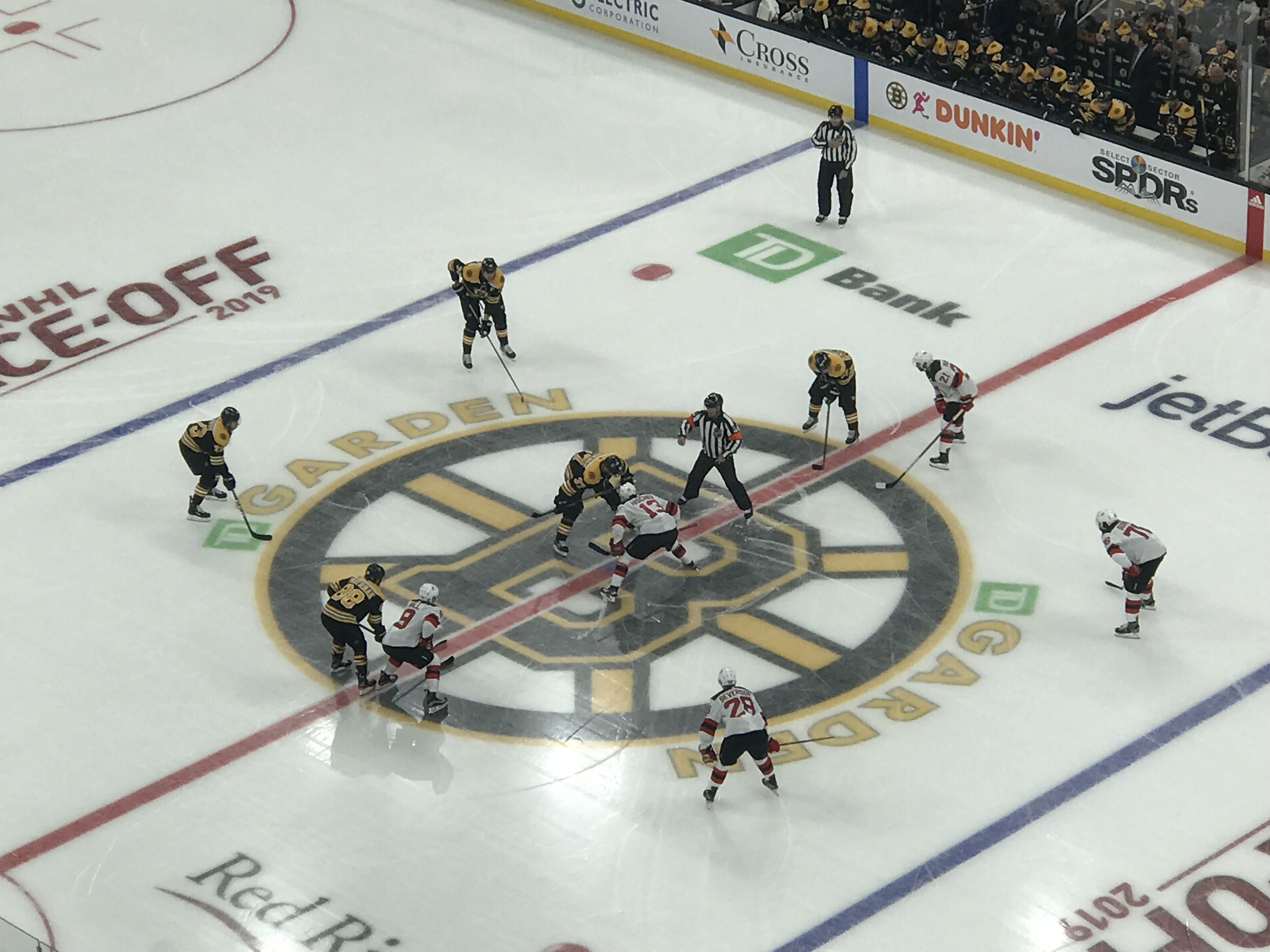
The Boston Bruins came into Saturday night’s home opener having garnered six of a possible eight points in their season-starting four-game road trip against Western Conference teams. Chemistry looked like it was improving with each game, but would they be able to focus from the first puck drop after the added hype of the home opener introductions?
The answer was yes.
In fact, some of their strongest shifts were in the first period against the New Jersey Devils. In hockey terms, the Bruins started the game on time. And by the first intermission they had two even strength goals to show for it. The first was from the Bruins’ top line—well, two-thirds of it—as Brad Marchand notched his fourth goal of the young season on a pass from David Pastrnak. Joakim Nordstrom gave Boston a little wiggle room when, eight minutes later, he got his first of the season assisted by Chris Wagner and Sean Kuraly.
The second period saw the Devils trying to tilt the ice in their favor. With the help of a couple of power plays, New Jersey was putting a few more shots on Tuukka Rask. Rask stayed strong in net, denying all attempts from the Devils, continuing his confident play both in net and puck management to his teammates.
“I thought their start was excellent. I thought we finished really well. In between, we had some moments where we could have been better. We’re still working on our game, like every other team, and I thought that’s where Tuukka [Rask] really stepped up and that’s when he should get the credit. In a game like this, I thought that’s when he earned his paycheck tonight. We broke down a lot there; trying to break pucks out and had some loose play. And he was really good,” said Bruins head coach, Bruce Cassidy.
The Bruins found themselves on the penalty kill twice during the middle frame, but both Patrice Bergeron and Marchand continued to stand tall. The fans especially liked it when Marchand looked almost as though he was toying with the Devils.
“I think what [Bergeron’s and Marchand’s play] does more is deflates the other. If that’s our power play, and I see a team doing that, frustration sets in from the coaching staff; the players on the ice are frustrated and so I think it more demoralizes the opposition than it does to lift us up,” said Coach Cassidy.
As the middle frame was down to less than a minute remaining and having withstood the Devils power play, Bergeron got his first goal of the season just 15 seconds into a Bruins power play giving the Bruins a three-goal lead and sending the Devils to the second intermission with that knowledge.
While it wasn’t a perfect game for the Bruins, they got did get secondary scoring and strong goaltending when it was needed. Undoubtedly they will concentrate on those areas of their game that allowed the Devils to think they could get back into the game. However, the game definitely hinted to what the Bruins are expecting of themselves throughout this season. They will make no excuses for their short off-season and continue to make the critical plays and stops, holding each player accountable.
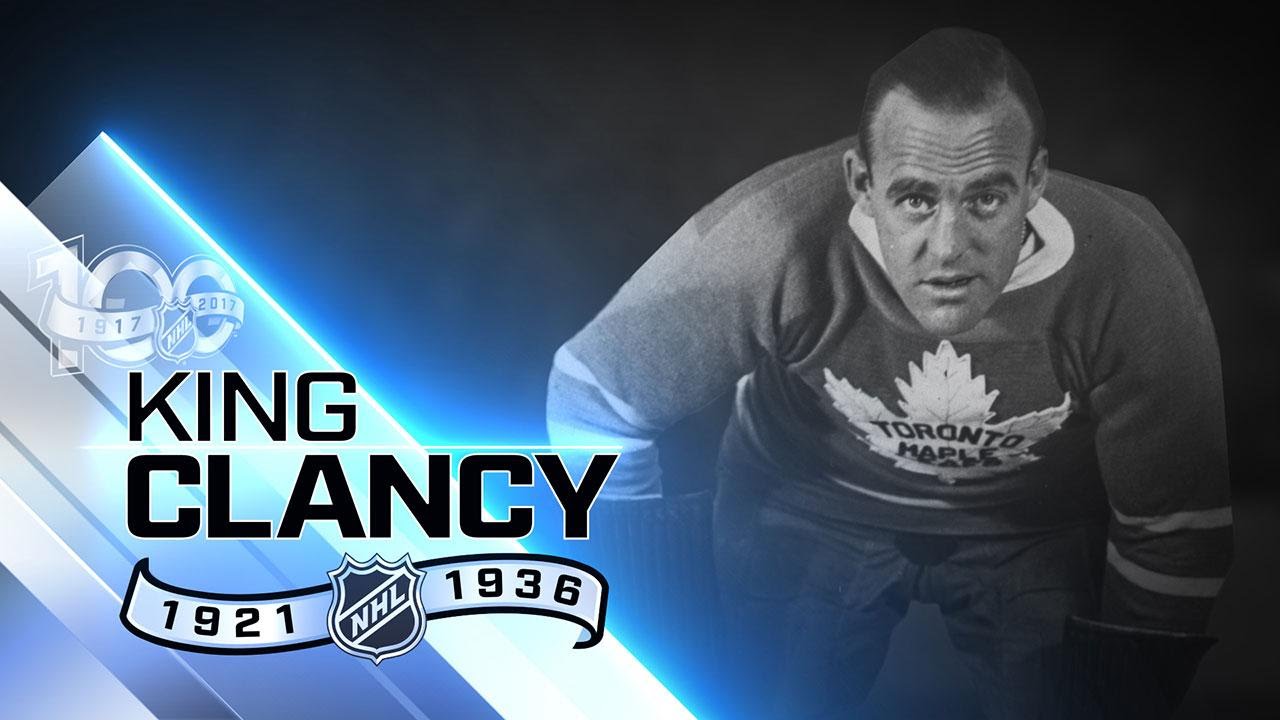
Frank “King” Clancy was born in Ottawa, Ontario and that was also where his professional hockey career was born when he joined the Ottawa Senators for the 1921-22 season. The diminutive defenseman, who stood just 5’ 7”, didn’t let his size prevent him from doing whatever was necessary.
Prolific hockey author Brian McFarlane wrote of him that “Clancy started a thousand fights and never won one.” Toronto journalist Trent Frayne once wrote that he had a face “like a Dublin back alley.”
“Today King Clancy and Harold Starr—a pair of fighting-est Irishmen who ever laced on a skate—are the mutual admirers they were in other years when they played together on their home-town Ottawa team in the National League.” Saskatoon’s Star-Phoenix reported on a game between Clany’s Toronto Maple Leafs and Starr’s Montreal Maroons. “When the general war broke a few seconds before the game’s end, the inevitable happened. Starr went for Clancy and Clancy raced for Starr. Arms wildly churned the air but little damage was done.”
However, lest you dismiss Clancy as some early NHL goon, he was in fact a fast-skating, goal-scoring defenseman. During the 1929-30 season—his last with the Ottawa Senators—Clancy had a career high 17 goals and 23 assists for 40 points in 44 games. And he had helped the Senators win the Stanley Cup in 1923 and 1927.
After having played 10 seasons with the Senators he found himself part of what was an astounding trade by Toronto Maple Leafs’ manager Conn Smythe to acquire Clancy from the Senators on October 11, 1930.
“Directors of the Toronto club today approved of the deal made
by Manager Conny Smythe whereby Eric Pettinger, a forward, and Art Smith, husky
defence player, together with $35,000 in cash, will go to Ottawa in return for
the services of the mighty ‘King,’” wrote The Ottawa Citizen. “This
completes one of the biggest player deals ever consummated by the astute
manager of the Leafs and constitutes a record price ever to be paid for a
player in the National Hockey League.”
The $35,000 would be the equivalent of roughly $538,118 today. When one considers that this deal was transpiring less than a year after the U.S. Stock Market crash sent financial ripples around the globe ushering in The Great Depression, the monetary amount is staggering.
“And, when apprised that the vote held by the Toronto club
in order to obtain expressions of opinion on the transaction was a big one and
unanimous in favor of the deal, the modest King said he would do his best to
please them.”
When the Leafs acquired Clancy, they got a player who could be used in many different situations, including serving as a center. During a game against the Maroons in Montreal on December 23, 1930, that resulted in a 4-4 tie, Clancy pulled double duty.
“King Clancy, as dashing and effective as ever, alternated between his usual defensive work and centre for the second-string forward line. The King’s speed made of the combination of himself, [Harvey “Busher”] Jackson and the youthful [Roger] Jenkins, who showed up well, a dangerous trio. Clancy always a great play-maker, fed his wings perfectly while acting as pivot, and wrecked many a Maroon foray with a potent poke-check in the middle zone. He was the guiding hand and the moving spirit behind the Leafs last night,” wrote Marc T. McNeil of The Gazette.
Six games into the 1936-37 season Clancy would announce his
retirement, however not before aiding the Leafs to a Stanley Cup during his
second season in Toronto.
It’s safe to say though, that King Clancy was certainly worth the king’s ransom that was paid by the Leafs to acquire him.
Additional Sources:
Marc T. McNeil, “Leafs and Maroons Proved Fans with Thrilling Display,” The Gazette (Montreal, Quebec), Wednesday, December 24, 1930, p. 14.
“Toronto Hockey Club Directors Support Manager Conny Smythe,” The Ottawa Citizen (Ottawa, Ontario), Saturday, October 11, 1930, p. 13.
“Story Book Ending to Clash Between Irish Hockey Stars,” The Saskatoon Star-Phoenix (Saskatoon, Saskatchewan), Monday, February 15, 1932, p. 8.
In today’s NHL, it is nothing to see players from former
Iron Curtain countries such as Russia and what was once Czeckoslovakia—now the Czech
Republic and Slovakia—playing against each other, but such was not always the
case. In fact, 40 years ago, it was considered wasting a draft pick if a team
announced they were selecting a Russian.
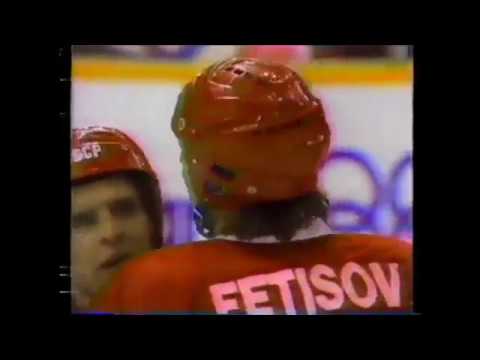
Viacheslav “Slava”
Fetisov, who was drafted first in 1978 by the Montreal Canadians and then again
by the New Jersey Devils in 1983, when he was re-entered in the draft, would
not actually make it to North America until 1989. In fact, another Russian
player would get to sign an NHL contract before Fetisov—Sergei Priakin.
Priakin signed with the Calgary Flames the end of March 1989,
just days before the playoffs were to begin.
“The deal is costing the Flames $500,000 in total for two
years, $120,000 per season allegedly going to the player and the rest to the
currency-starved Russians. And you can be sure Priakin won’t be seeing anywhere
near those numbers, When the deal to bring Viacheslav Fetisov to New Jersey was
being discussed, the player was to be allowed to keep just $1,200 per month,”
columnist Tony Gallagher of The Province wrote of the signing.
“Three months later [March, 1989], after what seemed like an
eternity of waiting, history was finally made and the Soviet Union allowed one
of its citizens to legally play for a National Hockey League club. But that
citizen wasn’t Slava Fetisov, nor was it any of his Green Five comrades,
Fetisov had always hoped to be the first, but the devolution of his
relationship with Tikhonov eventually compelled the Soviet program to select
forward Sergei Priakin to be that player. While Priakin was reporting to the
Calgary Flames, Fetisov was rumored to be toiling at a government desk job
after leaving the Red Army team,” described Taj Pinchevsky in Breakaway,
From Behind the Iron Curtain to the NHL—The Untold Story of Hockey’s Great
Escapes.
In addition to Fetisov, the Green Five of the CSKA Moscow
team included Alexei Kasatonov on defense and forwards Vladimir Krutov, Igor Larionov,
and Sergei Makarov. Like Fetisov, Makarov had been drafted in 1983, but by the
Flames who now had the first Russian player.
“Makarov received the long-awaited news Thursday [May 25]: That he and teammates Viacheslav Fetisov and Igor Larionov were finally discharged from the Soviet army, the last remaining hurdle in their efforts to play in the National Hockey League,” reported Calgary Herald’s Eric Duatschek.
Of course, management within the Flames and the Devils, along with the NHL Players’ Association executive director Alan Eagleson still had their doubts that Makarov and Fetisov would actually get to play in the NHL.
Eventually Fetisov and Makarov were able to sign with their respective teams in time for the 1989-90 season. When the Calgary Flames visited the New Jersey Devils on October 10, 1989, history was made. For the first time in the NHL players from the Soviet Union faced each other. The Flames had Priakin and Makarov while the Devils had Fetisov and Sergei Starikov—who had played for CSKA Moskva and the Soviet national team.
The Flames took the game 4-2 with Priakin notching the game-winning goal and Makarov getting an assist on the Flames’ fourth goal.
“We played together 16 or 17 years,” said Fetisov of
Makarov. “The first time you play against him, it’s unusual. I looked to pass
to Serge once. Then I remembered.”
Eventually Fetisov would get traded to the Red Wings where he would be reunited with Larionov and put together with Sergei Fedorov, Slava Kozlov and Vladimir Konstatinov—who would go down in history as The Russian Five.
Additional Sources:
Tony Gallagher, “CCCP spells dissent,” The Province (Vancouver, British Columbia), Friday, March 31, 1989, p. 59.
Eric Duhatschek, “Decision on Makarov comes down to dollars,” Calgary Herald, Friday, May 26, 1989, p. C-15.
Eric Duhatschek, “Pride stung, Priakin makes Devils pay,” Calgary Herald, Wednesday, October 11, 1989, p. C-1-2.
Taj Pinchevsky, Breakaway, From Behind the Iron Curtain to the NHL—The Untold Story of Hockey’s Great Escapes (Mississauga, Ontario: John Wiley & Sons Canada, Ltd., 2012), kindle edition.
The Buffalo Sabres have been scoring goals in the early season, and are 2-0-1 with five points in three games. In those three games, the Sabres have scored 13 goals, and seven of them came in one game against the New Jersey Devils. The Sabres are getting contributions from up and down the lineup in the early going. They are playing with speed and pace to their game, and the goaltending has been decent, when needed.
The Montreal Canadiens are 1-0-1 in its first two games this season. They have scored some goals, but the difference is that they are also allowing goals against. The goaltending will have to be better for the Canadiens throughout the year, and Carey Price should get his game together. The Canadiens did beat the Maple Leafs in its second game of the season by a score of 6-5 so they do have some momentum to build off of for the next few games.
Here are three keys for the game against the Canadiens on Oct. 9, 2019:
1) Get First Goal- Canadiens
The Montreal Canadiens are a better team when they play with the lead versus playing from behind. The Canadiens are off to a 1-0-1 start with the one win coming when the team scored the first goal. If the Canadiens can get on the scoreboard first, then they have a good chance of taking the home crowd out of the game early. By scoring the first goal, the Habs should be able to establish some momentum to carry throughout the game.
The Canadiens are 1-0-0 when scoring the first goal of the game while being 0-0-1 when the opposition scores the first goal of the game. The Sabres are 2-0-0 when scoring the first goal of the game, so the Canadiens want to get that first goal to try to slow the Sabres down. The Canadiens only have one first period goal and that won’t get the job done against the Sabres. The team needs to come out fast and set the pace early to get that all-important first goal.
2) Depth Scoring- Sabres
The Canadiens have only played two games, but they have gotten production from the entire lineup. The Sabres can’t rely on the top line again this season because while they got off to a good start last season, they faltered with no depth scoring. The top line is putting up some decent numbers to start the season, but the difference this season is that the other three lines are also contributing when on the ice. If the top line is shut down during a game, then the depth scorers will need to step up since the Canadiens have four lines that can produce.
There will be some depth scorers on the blue line this season for the Sabres. Some of the defensemen can skate and they can all move the puck pretty well. When Rasmus Dahlin is on the ice, the Canadiens need to know where he is at all times. Dahlin can act as a fourth forward when he is on the ice and will get his scoring chances in the offensive zone. Rasmus Ristolainen is another player who can put up some points from the backend for this Sabres team.
3.) Jesperi Kotkaniemi vs. Victor Oloffson
Jesperi Kotkaniemi came on to the NHL scene last season and put up 11 goals, 23 assists, and 34 points in 79 games. This season in two games, he has one goal and no assists, but this kid can play. Kotkaniemi displayed some of his great vision last season, and that is something the Sabres will need to be aware of in his game. He is also reliable in the defensive end, but watch out for his playmaking ability in this game. The center is on a line with Jonathan Drouin and the two of them bring speed and creativity, which could be a major headache for the Sabres and the other teams in the NHL this season.
Victor Olofsson came into camp and made so much of an impression on management and the coaches that he won a roster spot. Olofsson has been playing with Jack Eichel and Sam Reinhart to start the season, and the chemistry has been instant. Olofsson has a decent shot and he isn’t afraid to use it, which makes him a good fit on the top line. He may not be the biggest or fastest guy on the ice, but he can produce some points. The winger can find the open ice so the Canadiens will need to keep an eye on him.
Having the man-advantage during the power play certainly increases the chances of a team scoring, but it is seldom a guarantee. Apparently, no one thought to tell that to the Vancouver Canucks and the Minnesota North Stars. On October 7, 1983, the Canucks played host to the North Stars at the Pacific Coliseum. Those in attendance not only got a game full of goals, but they also saw a lot of special team play, The Canucks came out victorious over the North Stars in the 10-9 game.
“Not since March 16, 1944, when the Detroit Red Wings edged
the Boston Bruins in Boston Garden, have 19 goals been scored in an NHL game,” printed
the St. Louis Post-Dispatch.
For Canucks goaltender, John Garrett, it certainly wasn’t
the kind of game he was hoping for.
“Let’s face it, it was a tough night for the goaltenders. It’s
sort of like the good news, bad news joke. The good news is we won; the bad
news is that my goals-against-average is nine,” said Garrett.
Of the nine goals scored on Garrett, four were deflected in while two others were a form of friendly fire, having gone in off Vancouver’s defensemen.
Ten of the 19 goals were scored while one of the teams was on the power play. Vancouver set a team record, notching six power play goals. The North Stars weren’t far behind with four. Seven goals were scored in the opening frame, with five of those on the power play.
Four minutes into the game Minnesota’s Craig Hartsburg was whistled for a hooking call, and it seemed that the referee never took the whistle out of his mouth after that:
15:21: MNS Daniel Mandich—cross checking (PP GOAL-VAN)
16:21: MNS Jordy Douglas—holding (PP GOAL-VAN)
19:38: VAN Jere Gillis—tripping (PP GOAL-MNS in 3rd)
3rd Period:
08:37: MNS Gordon Roberts—hooking (PP GOAL-VAN)
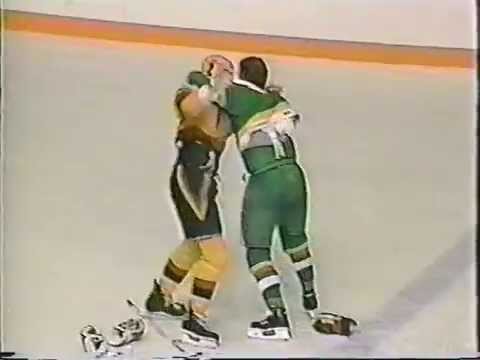
14:49: MNS Steven Payne—fighting
14:49: VAN Darcy Rota—fighting
15:04: MNS Donald Beaupre—delaying game – illegal play by goalie
Between the discipline issues and defensive gaffes, neither
coach was overjoyed with the way their respective team played.
With all the stoppages in play and special teams, it is actually surprising that the players managed to find any rhythm in which to score the other nine goals. And one would think given the high number of goals that the shots on goal must have been unusually high. Such was not the case. The North Stars put 31 shots on Garrett, while Vancouver managed 36 on Beaupre.
Perhaps in addition to getting the win, Garrett could also find the fact that he managed not to take penalties a good thing. In addition to losing, Beaupre had been whistled for two of the North Stars penalties. Fortunately, neither resulted in a power play goal, which is saying something in this game.
Additional Sources:
“Defense? What’s That? Vancouver Wins, 10-9,” St. Louis Post-Dispatch, Saturday, October 8, 1983, p. 7A.
“Vancouver, Minnesota Total 19 Goals,” The Sheboygan Press, Saturday, October 8, 1983, p. 15.
The Dallas Stars are looking to bounce back from a rough opening week. In the first game of the season, the injuries piled up. Then it was time to face the defending Stanley Cup Champions, St. Louis Blues, and they lost that game too. The Stars have fallen behind in the standings early and it could come back to haunt them playing in a tough Central Division. The offense has been missing in the first two games, and the big guns need to find a way to get it going.
This week doesn’t get any easier for the Stars, as they take on the Detroit Red Wings on Sunday at 7 p.m. On Tuesday night, it’s a trip to the nation’s capital to take on the Washington Capitals. The Calgary Flames will visit the Dallas Stars on Thursday night, and then the Capitals visit Dallas to end the Stars’ week. This week doesn’t seem any easier, but if the offense can find a way to get going then they will be able to steal some games.
1) Sunday, Oct. 6, 2019 – Stars @ Red Wings – 7 p.m. ET
The Stars are looking for its first win of the season, while the Red Wings are looking to gain some momentum from its season opening win. The Stars need to find a way to get Jamie Benn, Tyler Seguin and Alexander Radulov going. One way to do that would be to put the trio back on the same line for the game, but that takes some offense away from the other three lines. In order to win the game, the Stars need to stop the top six of the Red Wings because they do a majority of the scoring. Another way the Stars could win this game is to get the power play going, which might also get the big trio going.
The Red Wings aren’t projected to be very good this season, but they bring the element of speed to their game. If the team plays with speed and keeps its feet moving then there is a good chance that it will be able to take away two points. The Red Wings need to get some depth scoring because the top six can’t do it all and will be a focus for the Stars. The Red Wings want to take care of the puck and avoid turnovers. They should also be aware of where the Stars defenseman are on the ice since they can contribute on the offensive side of the puck.
The Stars need to find a way to stop the balanced attack of the Capitals especially since Evgeny Kuznetsov will be back in the lineup, after serving his three-game suspension. The Stars should avoid the penalty box since there is a talented power play personnel group on the Capitals team. Ben Bishop or Anton Khudobin will be required to have a decent game assuming that the Stars want to come home with two points and a win. The depth scoring is going to be key in this game especially if the top six still haven’t gotten it going come Tuesday night.
This will be foward Evgeny Kuznetsov’s first game of the season, and that will give the Capitals a big boost. The team shouldn’t expect the win just because the Stars have struggled to start the season. The neutral zone game of the Caps is going to need to be solid and they should also avoid turnovers. The Stars can be forced into turning over the puck so a solid forecheck is recommended for the Capitals throughout the game. The biggest key to this game for the Capitals is to play a full 60 minutes and compete for the full game.
The Stars finally return home after a three-game road trip that started last Saturday, Oct. 5, 2019. The team should make an attempt to stop the top line of the Calgary Flames since most of the production comes from that line. The puck should find a way to the net especially if there is some traffic in front of the goalie. The Stars shouldn’t overpass, but take the shot when it is there, just to get some players on the stat sheet. It would be a huge boost for this team if Seguin, Benn and Radulov can get involved offensively and put some points on the board.
The Flames need to score first to take the home crowd out of the game. A big reason for the Flames taking home two points will be the depth scoring. The Stars will shut down the top line so the depth scorers should take it upon themselves to get pucks to the net, and find a way to contribute to the offense. The Stars defensemen can and will contribute on the offensive side of the puck because they can skate and move the puck so the Flames need to be aware of where they are on the ice at all times.
The Stars take on the Capitals for the second time in three days, but this time they have the home ice advantage. The team is going to want to set the tone early with either a physical play or a goal. The depth production will be needed in this game because the top six has a chance to get kept off the board. The Stars will find it necessary to get to some dirty but good goals with guys in front of the net for deflections or rebound chances. The key to this game is the Stars playing smart, disciplined hockey for 60 minutes.
The Capitals would benefit from getting the first goal of the game since the Stars haven’t looked good playing from behind in the early season. The team should also take care of the puck, even with the Stars struggling offensively because one mistake could get Dallas going. One of the bigger problems for the Capitals early in the season is playing a full 60 minutes, which is something they should try to do against this Stars team. If the Capitals can get that first goal then just keep attacking and putting pucks on net for chances.
Shooting Stars Weekly Prediction
The Stars finish the week with a 2-1-1 record picking up five of a possible eight points. The big boys finally get involved in the offense and lead the team to a few wins this week. Miro Heiskanen continues his amazing plays and picks up some points during the four games this week. The two wins come against the Red Wings and Flames (in overtime). The regulation loss comes against the Capitals while on the road. The overtime loss comes when facing the Capitals at home on Saturday.
The Tampa Bay Lightning had a home-and-home series with the Florida Panthers to kick the season off last week. The Lightning won the home game by a score of 5-2, but managed to drop its first road game of the season 4-3. Mike Hoffman had a hat trick for the Panthers in the second game of the home-and-home series. The Lightning ended the first week of the season with a 1-1-0 record, and the schedule doesn’t get any easier this week.
On Sunday, the Bolts travel to North Carolina to take on the Carolina Hurricanes for a 5 p.m. puck drop. The team gets some rest and won’t play its next game until Thursday night when it travels to Toronto to take on the Toronto Maple Leafs. The Lightning end the week in Ottawa on Saturday night to take on the Ottawa Senators.
1) Sunday, Oct. 6, 2019 – Lightning at Hurricanes – 5 p.m. ET
The Bolts will take on the Hurricanes on Sunday in an early evening tilt. If the Lightning want to win this game then they will need to control the play in the offensive zone. The team should establish a forecheck early and often to deter the Hurricanes from using its speed. The more time the Bolts spend on offense, then the less time that they will have to spend defending. The Bolts should try to set the tone early in the game by getting a goal and taking the home crowd out of the game. Once they score, the Lightning need to make sure that they keep attacking because the home team doesn’t quit.
If the Hurricanes want a shot at coming out of this game with the two points then they will need to use the speed on this roster to their advantage. The Hurricanes players will want to keep moving their feet and skate so they can force the Lightning into take some penalties. These teams both played on Saturday night so the Hurricanes will want to set the pace in the first 10 minutes of the first period. The other key factors for the Hurricanes to win this game will be to avoid the penalty box and get solid goaltending.
2) Thursday, Oct. 10, 2019 – Lightning at Maple Leafs- 7 p.m. ET
The Bolts play its third divisional game in the team’s four start of the season when they take on the Toronto Maple Leafs. This game should be a high scoring affair since both teams have a ton of offensive talent on the roster. The Lightning want to play a solid all around defensive game since the Maple Leafs have four lines that can produce. If there’s a chance to get a puck on net, then the Lightning need to take it especially if there is traffic in front. The Bolts should be aware of what they are doing with the puck and play a smart game because the Maple Leafs will take advantage of mistakes.
The Maple Leafs will want to establish its speed early and often in this game. If there is a chance to skate the puck into the Lightning zone with speed then they need to take it. It’s no doubt that this team can score goals, but they will want to avoid bad turnovers and not get into a shootout with the Lightning. It would help for the Leafs to get the first goal of the game and keep attacking from there. If the Maple Leafs can win the even strength battle then there is a really good chance they come away with the two points.
In yet another divisional battle, the Lightning will take on the young Ottawa Senators. The biggest thing that this team needs to avoid is playing down to the level of the Senators. The Bolts want to avoid a slow start and get pucks on net early and often. They can’t get frustrated if the pucks don’t go in early because they will eventually go in against the Senators. The Lightning should come out with energy to start the game so they can establish the forecheck early.
The Senators are expected to be one of the worst teams in the NHL, but the team is still going to try to steal wins against higher ranking opponents. The Senators will establish a physical game from the jump to try to force some Lightning turnovers. The goaltending is going to be the biggest factor in this game for the Senators because if it’s bad then the team has no chance to win the game. The Senators may not be able to keep up with the Lightning at even strength so they should try to use their speed to draw penalties and score some power play goals. The biggest reason the Senators might have a chance at winning this game is avoiding the penalty box while playing smart hockey.
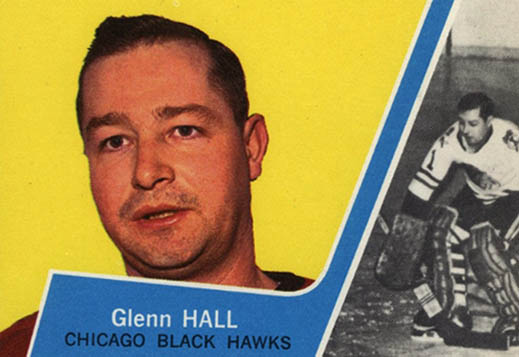
Glenn Hall was born in Humboldt, Saskatchewan, October 3, 1931. After signing with the Detroit Red Wings in 1949, he spent the next four years playing in the juniors with the Windsor Spitfires for two years and then in the minors for the next two.
Though he was called up by the Red Wings during the 1952
playoffs, he didn’t actually get into any of the games. That didn’t stop
Detroit from putting his name on the Stanley Cup that year. He had yet to
actually play in his first NHL game which wouldn’t happen until the next
season. He played just six games at the NHL level during the 1952-53 season.
It took him three more years before he finally earned his spot with the Red Wings as their starting goaltender to begin the 1955-56 season, after the Wings general manager, Jack Adams traded Terry Sawchuk during the offseason.
“As a dealer in hockey flesh Jack Adams of the Detroit Red Wings makes the fabulous Trader Horn look like a piker. Last Saturday [May 28, 1955] he consummated an unexpected four-for-four deal with the Chicago Black Hawks. Yesterday’s [June 3, 1955] deal with the Boston Bruins, in which Goalie Terry Sawchuk, three-time winner of the Vezina Trophy, was the key figure, was not unexpected but there can be no denying that its magnitude was startling,” reported Doug Vaughn in The Windsor Star.
“I’ve waited a long time to get this far,” Hall said a few days before the Red Wings season opener. “I know playing in the NHL will be tougher. Every player up here can really fire that puck at you. They’re more accurate too.”
Two nights later on October 6, 1955, Hall would suit up for the first time as the starting goaltender, as the Red Wings opened their season against the Chicago Blackhawks. It didn’t go quite as Hall would have liked.
“Leave it to Dick Irvin to spoil a good thing. He walks into
Chicago, takes hold of the dying Black Hawks and fires them up to such a point
that they wreck in 60 minutes a record Detroit held for 16 years. Hawks opened
their National Hockey League season Thursday night with a surprising 3-2
victory over the new-look Red Wings. It was the first time since 1938 the Wings
were beaten in a home opener,” printed The Calgary Herald the next day.
While it may not have been the most auspicious of beginnings in net for Hall, it turned out to be the first of 502 consecutive starts for the netminder. It was not until November 7, 1962, now playing with Chicago to whom he was traded before the 1957-58 season began, that he had to be relieved by Denis DeJordy midway through the first period against the Boston Bruins; the result of his back tightening up. And then three days later DeJordy played the entire game against the Montreal Canadiens.
“There comes a time when the most durable of iron men must take a rest,” reported The Daily Chronicle in DeKalb, Illinois on November 8th. “It came Wednesday night for Glenn Hall, the Chicago Black Hawks’ goalie who had logged more than 33,000 consecutive minutes while playing 551 <sic> National Hockey League games.”
Hall had injured his back during practice the day before the game and was suffering from a pinched nerve that prevented him from making a stop on the Bruins’ first shot of the game.
“It was a shot I could have saved, but the pain in my back
made me afraid to bend down as far as I should have. I decided that it was time
to get out of the game,” Hall described.
Hall’s record is something that will stand forever, in large
part because of the use of backup goalies and limiting the number of games
starting goaltenders usually play in today’s NHL.
While his streak may have ended, he would continue to play
in the NHL for another eight seasons, the last four with the St. Louis Blues,
before retiring in 1971.
Additional Resources:
Doug Vaughan, “On the Rebound,” The Windsor Star (Windsor, Ontario), Saturday, June 4, 1955, p. 26.
“Wings Sold Solid on Goalie Glenn Hall,” The Lethbridge Herald (Lethbridge, Alberta), Tuesday, October 4, 1955, p.7.
“Hawks Away on Right Foot,” The Calgary Herald (Calgary, Alberta), Friday, October 7, 1955, p. 46.
“Glenn Hall’s String Ends at 551 Games,” The Daily Chronicle (DeKalb, Illinois), Thursday, November 8, 1962, p. 16.
After the only full season canceled due to a lockout, the NHL was back in business for 2005-06. Over the summer, one major rule change eliminated tie-games through the use of a shootout if teams failed to score in overtime. The season opened on October 5, 2005, and that very first night, the Ottawa Senators and Toronto Maple Leafs had the experience of holding the first NHL shootout to decide a game.
As the NHL ratified its new collective bargaining agreement in July 2005, they created a new competition committee made up of four players, four general managers, and one owner, all supervised by the NHL’s executive vice-president and director of hockey operations. The committee implemented a string of new rules meant to reduce defensive measures, creating more scoring opportunities. “I think offence sells more than defence,” commented Lightning MVP Martin St. Louis. “If we’re not trying different things, something’s wrong. We have to try different things and I think we’re moving in the right direction.”
Catering to fans, the committee got rid of ties by adding shootouts. Speaking as a member of the competition committee, Brendan Shanahan (of the Detroit Red Wings) explained, “Nobody said, ‘Give us a shootout,’ but everybody said, ‘No more ties.’ And, in the end, that’s the only way you can guarantee that there will be no more ties.” Panthers goalie Jamie McLennan put it simply, “What we’re trying to create is entertainment. Somebody goes home a winner, somebody goes home a loser. That’s what sports are all about.” Shanahan added, “We have to re-educate ourselves on how to play the game of hockey.”
The new rules stated that “Following a scoreless five-minute overtime, three players from each team participate in a shootout.” The coaches would submit their names to the referee, and each would take three shots. The team with the most goals would receive an extra goal on the scoreboard to give them the win. If after the six shots, the tie remained, the shootout would turn into sudden death with additional shooters added as needed. The winner of the shootout would receive two points for the standings, and the loser would earn one point. The shootout format was only meant for the regular season.
When he learned of the shootout addition, Toronto tough guy Tie Domi remarked, “I definitely think that, for the fans, the shootout is going to be a key thing. Not that I’ll be one of the guys taking them, but it’s gonna be exciting to watch.” Funny he should say so. As the shootout was being tested out in all NHL exhibition games that autumn, Toronto Coach Pat Quinn went through seven players failing to score on Buffalo Sabres goalie Ryan Miller. He then chose Domi, who succeeded in sending the puck through Miller’s legs to get the victory.
Quinn explained that their strategy going forward would be to analyze the goaltenders and choose those who could score on them the best. In choosing the shooters, he said, “We probably have six guys who are good in that situation. You might have a hunch (about one of those players during a game) or you might have a guy that’s hot that night and looks sharp. He would draw that assignment.” He also noted, “There’s some guys that don’t want that scrutiny. They want to be able to be away from the limelight. It’s a pressure spot.” At any rate, the shootout was bound to have an effect on the standings.
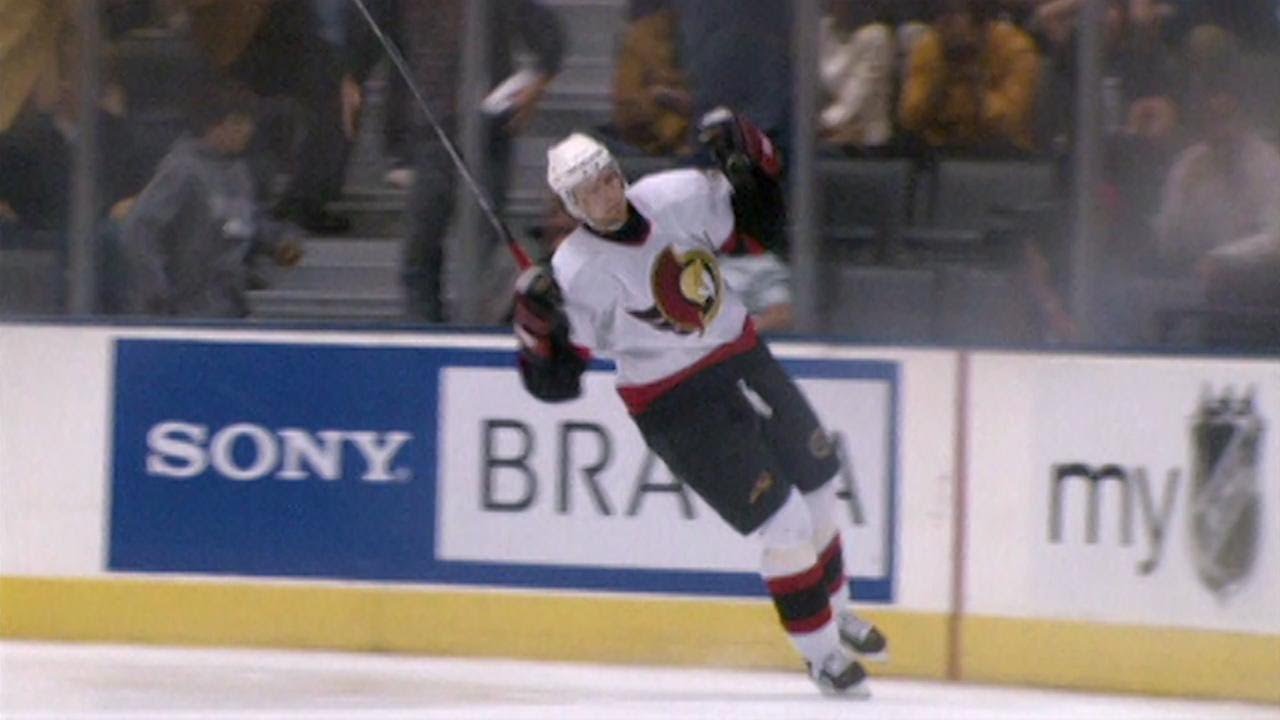
The Maple Leafs hosted the very first regular-season NHL shootout at the Air Canada Centre before a crowd of 19,452. Despite the intention of the other newly-introduced rules, the game was primarily a defensive match between two 40-year-old goalies, Ed Belfour of the Leafs and Dominik Hasek making his Senators debut. The former made 21 saves and the latter 23.
Otherwise, the game was most memorable for both team captains. In the first period, after Toronto’s Bryan McCabe scored the first goal (on a power play), his captain Mats Sundin was injured. Skating past Ottawa’s goal about seven minutes into the game, an “errant puck struck him in the left eye, prompting blood to gush.” He was taken to hospital, but no eye damage was detected. Winger Jeff O’Neill remarked, “It was tough when you lose the best guy on the team. I thought we rebounded together and had the game in our hands.”
In the second period, Ottawa only managed one shot on goal while Toronto had nine that failed to produce. Stepping it up in the third period, Senators Captain Daniel Alfredsson saved his team twice, facing a lot of booing in the process. He tied up the game at 14:12 on a pass from Jason Spezza. However, with only a minute and a half remaining, popular homegrown Leaf Eric Lindros scored one for the cheering crowd. Only 29 seconds later, Alfredsson evened the score again (assisted by Spezza and Dany Heatley).
When neither team scored in overtime, the game was decided by shootout. Alfredsson kicked things off scoring “low to the catching mitt side with a wrist shot.” Alfredsson said afterwards, “I haven’t scored in the pre-season and I didn’t score in the intra-squad game. But things were going my way (last night). I didn’t worry about it. I just went in and shot.” The Leafs’ first shooter, Jason Allison had the “puck poke-checked off his stick.” Martin Havlat’s “wrist shot glanced off Belfour’s stick,” and then Lindros sent a “high shot that missed the net.” It came down to Dany Heatley, who had a groin injury. Coach Bryan Murray said, “He told me he could score, and when a player does that, you go with it.” Sure enough, Heatley “planted the puck the same place Alfredsson had aimed.” That ended the shootout in Ottawa’s favor, which ended the game 3-2.
The players and coaches weighed-in on the shootout. As the victorious goalie, Hasek remarked, “I’m not crazy about shootouts, but it’s always fun when you win. We came back twice and won in a shootout. It’s a good feeling.” On the losing side, defenseman McCabe said, “It’s not for me to judge, it’s obviously disappointing to lose that way. Especially when you lose the lead with a minute left.” His coach admitted, “I’m one of the ones who don’t like the game being settled this way.” Whereas Coach Murray said, “I’m not happy at all with the way we played. And I hope we don’t play that way again. But we found a way to win a hockey game.” For scoring-machine Captain Alfredsson, “It was pretty ugly out there. We took a lot of penalties and didn’t play the way we want to play. But it was a great way to win.”
“NHL brand goes back on shelves with new look, including new rules, new pads, and the dreaded shootout,” Toronto National Post, 22 July 2005, pp. S2-S3.
“The NHL’s Day of Reckoning,” Toronto National Post, 23 July 2005, pp. S1-S5.
“A Look at the Rule Changes for 2005-06” and “Experts opine on NHL rule changes,” Ottawa Citizen, 23 July 2005, p. C3.
“Rule Changes,” Montreal Gazette, 5 Oct. 2005, p. F6.
Michael Traikos, “Leafs Can’t Win for Mats,” Toronto National Post, 6 Oct. 2005, pp. S1-S2.
“Senators Draw First Blood,” Ottawa Citizen, 6 Oct. 2005, pp. B1-B2.
“Senators win first shootout,” Montreal Gazette, 6 Oct. 2005, p. C2.
In three years on October 4, four NHL players scored three goals each. In 1991, Jari Kurri’s first game with the Los Angeles Kings brought his 21st hat trick. Meanwhile, that night another California team, the San Jose Sharks debuted. In 1999, on their eighth anniversary, Sharks Owen Nolan and Jeff Friesen celebrated with a hat trick apiece. Two years later, in 2001, San Jose hosted the Detroit Red Wings, whose Brendan Shanahan became the second NHL player to score opening-night hat tricks twice in his career.
1991
In 1991, 14,558 fans at Winnipeg Arena watched the season opener in which the Californian visitors beat the Jets 6-3. The Kings’ first goal was followed by two for the Jets. Then the new Wayne Gretzky-Jari Kurri-Tomas Sandstrom line kicked into gear. The line had just successful debuted at the outdoor exhibition game played at Las Vegas on September 27. This was the first regular-season game reuniting former Edmonton Oilers linemates Gretzky and Kurri. They only needed 10 seconds over halfway through the first period to prove themselves again.
As the Los Angeles Times described the back-to-back plays: “Sandstrom received the puck at mid-ice, flipped it to Kurri skating by, and watched as the former Oiler drilled the puck through the legs of Winnipeg goalie Stephane Beauregard from the left circle. Ten seconds later, Gretzky threw the puck into the corner. Sandstrom gained control and flipped it in front of the crease. Kurri, the late man in, skated past Beauregard, frozen and helpless, and backhanded in his second goal.” To earn his hat trick, Kurri waited until the final minute of the game before “firing into an empty net off Gretzky’s pass after Beauregard had been pulled.”
Naturally, Kurri and his new linemates looked forward to a season playing together. Sandstrom said, “Playing with Wayne, there’s going to be some room out there. When you play with partners like that, if you don’t have fun, it’s time to retire.” The man himself commented, “It’s going to be fun.”
Meanwhile, at Pacific Coliseum in Vancouver, the Canucks hosted the debut of the newest expansion team, the San Jose Sharks. The new kids on the block trailed 3-0 a few minutes into the third period. Then, in less than ten minutes, they rallied to tie the score. Craig Coxe scored their first goal as a franchise followed by Pat MacLeod making two thirds of a hat trick. Unfortunately for the Sharks, the Canucks squeaked in a game-winner with less than 20 seconds to spare.
1999
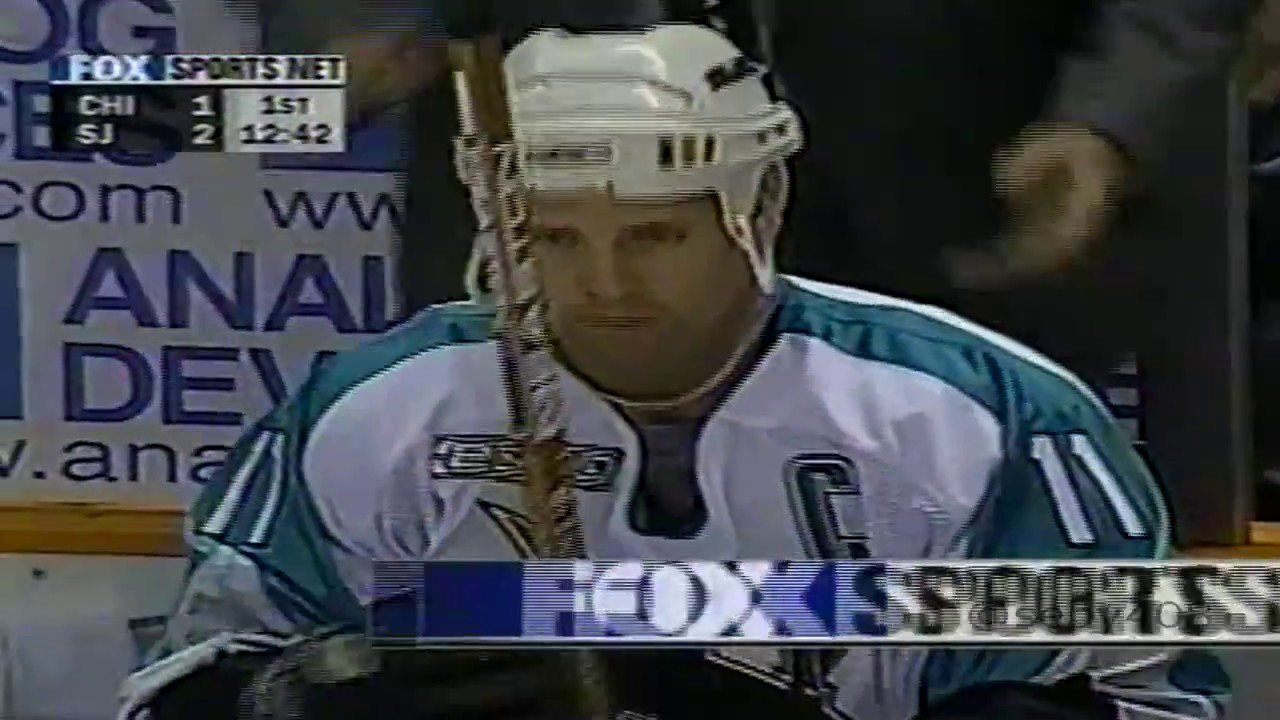
The eight-seasons-old Sharks hosted the Chicago Blackhawks and decimated them 7-1 thanks to one line. After Chicago scored its only goal, Captain Owen Nolan, left wing Jeff Friesen, and veteran center Vincent Damphousse really came out to play. Nolan notched his tenth hat trick while assisting on all three goals of Friesen’s second hat trick. His six points set a franchise record. Damphousse tied a team record by earning four assists (on all three of Nolan’s and one of Friesen’s goals). All this scoring gave the Sharks their first ever “double hat trick.”
Much of their success could be laid at the feet of the “undisciplined Chicago squad.” Their penalties gave the Sharks a 5-on-3 advantage, which Nolan used to score his first two goals within 66 seconds midway through the first period. According to the San Francisco Examiner, “From the left side of the slot, Nolan teed up a Gary Suter feed” to score once and then to score again “he simply redirected Damphousse’s perfect cross-ice feed to the left doorstep.” Friesen closed out the period when he “capped a 2-on-1 break with Nolan by tapping home the right wing’s feed just 45 seconds before the first break.”
In the second period, Nolan finished his hat trick when the puck “deflected off Chicago starting goalie Jocelyn Thibault, then off the glove of Blackhawk defenseman Bryan McCabe and into the net.” Nolan joked, “I had empty nets last year and nothing went in. Now I’m getting ricochets going in.”
Friesen closed out his hat trick during the final four minutes of the game. He had “two third-period power-play goals that came 2:43 apart.” Friesen commented, “It’s nice to get off to a fast start, but we have to re-focus right away … It’s just two games and there’s a long way to go.” Between these goals, all 12 players on the ice (and another off the bench) participated in a brawl instigated by Chicago’s Mark Janssens charging Sharks goalie Steve Shields. This resulted in a total of 84 penalty minutes.
Still, the award for worst game went to Chicago defenseman Bryan McCabe, who “played a part in 3 San Jose goals.” At the end of the first period, “McCabe coughed up the puck just inside his own blue line and eventually Friesen had an easy score in front after Nolan’s rebound hit McCabe’s skate.” It was his glove that deflected in Nolan’s third goal. Friesen’s “third [goal] banked in off his body,” prompting Hawks Coach Lorne Molleken to tease, “He got a hat trick.” McCabe admitted, “It wasn’t the best start with a new team, but I’ve got to put it behind me. It was a rough night. It was just a matter of trying to do too much and being a little overly excited.”
2001
In 2001, the visiting Detroit Red Wings ruined the Sharks’ home opener. After drawing first blood, the Sharks let the Wings update the scoreboard three times before getting back on the board themselves. At 14:49 of the first period, Brendan Shanahan tied the game at 1-1 when Detroit was short-handed. He was assisted by teammate Sergei Federov, who also helped Shanahan score just 49 seconds into the second period. According to the Detroit Free Press, “Federov avoided defenseman Scott Hannan with some sweet stickhandling and made a short pass. From there, Shanahan picked the far corner of the net.” Almost five minutes later, Brett Hull brought the score up to 3-1.
The Sharks regained their pride when Todd Harvey’s slap shot past Dominik Hasek tied the game with just 4:31 remaining. This forced the game into overtime, which only lasted 1:55. Just 34 seconds into overtime, Federov was sent to the penalty box for cross-checking. Despite being short-handed, “Shanahan’s forechecking forced San Jose goalie Evgeni Nabokov to play the puck awkwardly off the board. Shanahan corralled the loose puck and beat Nabokov for his second short-handed goal of the night.” Shanahan became only the second NHLer to twice score a hat trick on opening night.
Additional Sources:
Stephen Laroche, Changing the Game: A History of NHL Expansion (Toronto: ECW Press, 2014), 339-342.
Steve Springer, “Kurri Heats Up the Kings, Burns Jets,” Los Angeles Times, 5 Oct. 1991, p. C12.
“Chula Vista’s Coxe Gets Sharks’ 1st Goal,” Los Angeles Times, 5 Oct. 1991, p. C12.
Ross McKeon, “Sharks now just lining up to score,” San Francisco Examiner, 5 Oct. 1999, p.p D1-D2.
“Nolan, Friesen Lead Sharks, 7-1,” Los Angeles Times, 5 Oct. 1999, p. D12.
Tim Sassone, “Hawks’ season gets off to disappointing start,” Chicago Daily Herald, 5 Oct. 1999, section 2, p. 1.
Tim Sassone, “A nightmarish debut for defenseman McCabe” and “Brawl with Sharks leaves Blackhawks in defensive mood,” Chicago Daily Herald, 6 Oct. 1999, section 2, p. 3.
“Shanahan’s big night ruins Sharks’ opener,” San Francisco Examiner, 5 Oct. 2001, p. B1.
Nicholas J. Cotsonika, “Hats off to Shanahan! His OT goal wins for Wings,” Detroit Free Press, 5 Oct. 2001, pp. 1D and 4D.




 Prev
Prev